SUBHEAD: Debt, deflation, the rentier economy and the coming financial cold war.
By Justin Ritchie on 26 February 2016 at Naked Capitalism -
(
http://www.nakedcapitalism.com/2016/03/michael-hudson-on-debt-deflation-the-rentier-economy-and-the-coming-financial-cold-war.html)
 Image above: Cartoon illustration used in article on "American Capitalism". From (http://www.zerohedge.com/news/2015-09-27/american-capitalism).
Michael Hudson has sent us the transcript of his newly-released interview with Justin Ritchie on
February 26 with XE Podcast; You can also listen to the podcast here (
https://soundcloud.com/extraenvironmentalist/episode-912-michael-hudson-on-killing-the-host?in=extraenvironmentalist/sets/episode-91-age-of-stagnation).
Justin Ritchie: In your book, you draw this metaphor of parasites and global finance? Could you explain what you mean by this?
Michael Hudson: The financial sector today is decoupled from industrialization. Its main interface with industry is to provide credit to corporate raiders. Their objective is asset stripping, They use earnings to repay financial backers (usually junk-bond holders), not to increase production. The effect is to suck income from the company and from the economy to pay financial elites.
These elites play the role today that landlords played under feudalism. They levy interest and financial fees that are like a tax, to support what the classical economists called “unproductive activity.” That is what I mean by “parasitic.”
If loans are not used to finance production and increase the economic surplus, then interest has to be paid out of other income. It is what economists call a zero-sum activity. Such interest is a “transfer payment,” because it that does not play a directly productive function. Credit may be a precondition for production to take place, but it is not a factor of production as such.
The situation is most notorious in the international sphere, especially in loans to governments that already are running trade and balance-of-payments deficits. Power tends to pass into the hands of lenders, so they lose control – and become less democratic.
To return to my use of the word parasite, any exploitation or “free lunch” implies a host. In this respect finance is a form of war, domestically as well as internationally.
At least in nature, “smart” parasites may perform helpful functions, such as helping their host find food. But as the host weakens, the parasite lays eggs, which hatch and devour thehost, killing it. That is what predatory finance is doing to today’s economies. It’s stripping assets, not permitting growth or even letting the economy replenish itself.
The most important aspect of parasitism that I emphasize is the need of parasites to control the host’s brain. In nature, a parasite first dulls the host’s awareness that it is being attacked. Then, the free luncher produces enzymes that control the host’s brain and make it think that it should protect the parasite – that the outsider is part of its own body, even like a baby to be specially protected.
The financial sector does something similar by pretending to be part of the industrial production-and-consumption economy. The National Income and Product Accounts treat the interest, profits and other revenue that Wall Street extracts – along with that of the rentier sectors it backs (real estate landlordship, natural resource extraction and monopolies) – as if these activities add to Gross Domestic Product. The reality is that they are a subtrahend, a transfer payment from the “real” economy to the Finance, Insurance and Real Estate Sector. I therefore focus on this FIRE sector as the main form of economic overhead that financialized economies have to carry.
What this means in the most general economic terms is that finance and property ownership claims are not “factors of production.” They are external to the production process. But they extract income from the “real” economy.
They also extract property ownership. In the sphere of public infrastructure – roads, bridges and so forth – finance is moving into the foreclosure phase. Creditors are trying to privatize what remains in the public domains of debtor economies. Buyers of these assets – usually on credit – build interest and high monopoly rents into the prices they charge.
JR: What is your vision for the next few decades of the global economy?
MH: The financial overhead has grown so large that paying interest, amortization and fees shrinks the economy. So we are in for years of debt deflation. That means that people have to pay so much debt service for mortgages, credit cards, student loans, bank loans and other obligations that they have less to spend on goods and services. So markets shrink. New investment and employment fall off, and the economy is falls into a downward spiral.
My book therefore devotes a chapter to describing how debt deflation works. The result is a slow crash. The economy just gets poorer and poorer. More debtors default, and their property is transferred to creditors. This happens not only with homeowners who fall into arrears, but also corporations and even governments. Ireland and Greece are examples of the kind of future in store for us.
Financialized economies tend to polarize between creditors and debtors. This is the dynamic that Thomas Piketty leaves out of his book, but his statistics show that all growth in income and nearly all growth in wealth or net worth has accrued to the One Percent, almost nothing for the 99 Percent.
Basically, you can think of the economy as the One Percent getting the 99 Percent increasingly into debt, and siphoning off as interest payments and other financial charges whatever labor or business earns. The more a family earns, for instance, the more it can borrow to buy a nicer home in a better neighborhood – on mortgage. The rising price of housing ends up being paid to the bank – and over the course of a 30-year mortgage, the banker receives more in interest than the seller gets.
Economic polarization is also occurring between creditor and debtor nations. This is splitting the eurozone between Germany, France and the Netherlands in the creditor camp, against Greece, Spain, Portugal, Ireland and Italy (the PIIGS) falling deeper into debt, unemployment and austerity – followed by emigration and capital flight.
This domestic and international polarization will continue until there is a political fight to resist the creditors. Debtors will seek to cancel their debts. Creditors will try to collect, and the more they succeed, the more they will impoverish the economy.
Background?
JR: Let’s talk about your history, why did you become an economist?
MH: I started out wanting to be a musician – a composer and conductor. I wasn’t very good at either, but I was a very good interpreter, thanks to working with Oswald Jonas in Chicago studying the musical theories of Heinrich Schenker. I got my sense of aesthetics from music theory, and also the idea of modulation from one key to another. It is dissonance that drives music forward, to resolve in a higher key or overtone.
When I was introduced to economics by the father of a schoolmate, I found it as aesthetic as music, in the sense of a self-transforming dynamic through history by challenge and response or resolution. I went to work for banks on Wall Street, and was fortunate enough to learn about how central mortgage lending and real estate were for the economy. Then, I became Chase Manhattan’s balance-of-payments economist in 1964, and got entranced with tracing how the surplus was buried in the statistics – who got it, and what they used it for. Mainly the banks got it, and used it to make new loans.
I viewed the economy as modulating from one phase to the next. A good interpretation would explain history. But the way the economy worked was nothing like what I was taught in school getting my PhD in economics at New York University. So I must say, I enjoyed contrasting reality with what I now call Junk Economics.
In mainstream textbooks there is no exploitation. Even fraudulent banks, landlords and monopolists are reported as “earning” whatever they take – as if they are contributing to GDP. So I found the economics discipline ripe for a revolution.
JR: What is the difference between how economics is taught vs. what you learned in your job?
MH: For starters, when I studied economics in the 1960s there was still an emphasis on the history of economic thought, and also on economic history. That’s gone now.
One can easily see why. Adam Smith, John Stuart Mill and other classical economists sought to free their societies from the legacy of feudalism: landlordism and predatory finance, as well as from the monopolies that bondholders had demanded that governments create as a means of paying their war debts.
Back in the 1960s, just like today, university courses did not give any training in actual statistics. My work on Wall Street involved National Income and Product Accounts and the balance-of-payments statistics published by the Commerce Department every three months, as well as IMF and Federal Reserve statistics. Academic courses didn’t even make reference to accounting – so there was no conceptualization of “money,” for instance, in terms of the liabilities side of the balance sheet.
New York University’s money and banking course was a travesty. It was about helicopters dropping money down – to be spent on goods and services, increasing prices. There was no understanding that the Federal Reserve’s helicopter only flies over Wall Street, or that banks create money on its own computers. It was not even recognized that banks lend to customers mainly to buy real estate, or speculate in stocks and bonds, or raid companies.
Economics is taught like English literature. Teachers explain the principle of “suspension of disbelief.” Readers of novels are supposed to accept the author’s characters and setting. In economics, students are told to accept just-pretend parallel universe assumptions, and then treat economic theory as a purely logical exercise, without any reference to the world.
The switch from fiction to reality occurs by taking the policy conclusions of these unrealistic assumptions as if they do apply to the real world: austerity, trickle-down economics shifting taxes off the wealthy, and treating government spending as “deadweight” even when it is on infrastructure.
The most fictitious assumption is that Wall Street and the FIRE sector add to output, rather than extracting revenue from the rest of the economy.
JR: What did you learn in your work on the US oil industry?
MH: For starters, I learned how the oil industry became tax-exempt. Not only by the notorious depletion allowance, but by offshoring profits in “flags of convenience” countries, in Liberia and Panama. These are not real countries. They do not have their own currency, but use U.S. dollars. And they don’t have an income tax.
The international oil companies sold crude oil at low prices from the Near East or Venezuela to Panamanian or Liberian companies – telling the producing countries that oil was not that profitable. These shipping affiliates owned tankers, and charged very high prices to refineries and distributors in Europe or the Americas. The prices were so high that these refineries and other “downstream” operations marketing gas to consumers did not show a profit either. So they didn’t have to pay European or U.S. taxes. Panama and Liberia had no income tax. So the global revenue of the oil companies was tax-free.
I also learned the difference between a branch and an affiliate. Oil wells and oil fields are treated as “branches,” meaning that their statistics are consolidated with the head office in the United States. This enabled the companies to take a depletion allowance for emptying out oil fields abroad as well as in the United States.
My statistics showed that the average dollar invested by the U.S. oil industry was returned to the United States via balance-of-payments flows in just 18 months. (This was not a profit rate, but a balance-of-payments flow.) That finding helped the oil industry get exempted from President Lyndon Johnson’s “voluntary” balance-of-payments controls imposed in 1965 when the Vietnam War accounted for the entire U.S. payments deficit. Gold was flowering out to France, Germany and other countries running payments surpluses.
The balance-of-payments accounting format I designed for this study led me to go to work for an accounting firm, Arthur Andersen, to look at the overall U.S. balance of payments. I found that the entire deficit was military spending abroad, not foreign aid or trade.
Junk Economics?
JR: Why do you think there is a disconnect between academic economic theory and the way that international trade and finance really works?
MH: The aim of academic trade theory is to tell students, “Look at the model, not at how nations actually develop.” So of all the branches of economic theory, trade theory is the most wrongheaded.
For lead nations, the objective of free trade theory is to persuade other countries not to protect their own markets. That means not developing in the way that Britain did under its mercantilist policies thatmade it the first home of the Industrial Revolution. It means not protecting domestic industry, as the United States and Germany did in order to catch up with British industry in the 19th century and overtake it in the early 20th century.
Trade theorists start with a conclusion: either free trade or (in times past) protectionism. Free trade theory as expounded by Paul Samuelson and others starts by telling students to assume a parallel universe – one that doesn’t really exist. The conclusion they start with is that free trade makes everyone’s income distribution between capital and labor similar. And because the world has a common price for raw materials and dollar credit, as well as for machinery, the similar proportions turn out to mean equality. All the subsequent assumptions are designed to lead to this unrealistic conclusion.
But if you start with the real world instead of academic assumptions, you see that the world economy is polarizing. Academic trade theory can’t explain this. In fact, it denies that today’s reality can be happening at all!
A major reason why the world is polarizing is because of financial dynamics between creditor and debtor economies. But trade theory starts by assuming a world of barter. Finally, when the transition from trade theory to international finance is made, the assumption is that countries running trade deficits can “stabilize” by imposing austerity, by lowering wages, wiping out pension funds and joining the class war against labor.
All these assumptions were repudiated already in the 18th century, when Britain sought to build up its empire by pursuing mercantilist policies. The protectionist American School of Economics in the 19th century put forth the Economy of High Wages doctrine to counter free-trade theory. None of this historical background appears in today’s mainstream textbooks. (I provide a historical survey in Trade, Development and Foreign Debt, new ed., 2002. That book summarizes my course in international trade and finance that I taught at the New School from 1969 to 1972.
In the 1920s, free-trade theory was used to insist that Germany could pay reparations far beyond its ability to earn foreign exchange. Keynes, Harold Moulton and other economists controverted that theory. In fact, already in 1844, John Stuart Mill described how paying foreign debts lowered the exchange rate. When that happens, what is lowered is basically wages. So what passes for today’s mainstream trade theory is basically an argument for reducing wages and fighting a class war against labor.
You can see this quite clearly in the eurozone, above all in the austerity imposed on Greece. The austerity programs that the IMF imposed on Third World debtors from the 1960s onward. It looks like a dress rehearsal to provide a cover story for the same kind of “equilibrium economics” we may see in the United States.
JR: Can the US pay its debts permanently? Does the amount of federal debt, $18 or $19 trillion even matter? Should we pay down the national debt?
MH: It is mainly anti-labor austerity advocates who urge balancing the budget, and even to run surpluses to pay down the national debt. The effect must be austerity.
A false parallel is drawn with private saving. Of course individuals should get out of debt by saving what they can. But governments are different. Governments create money and spend it into the economy by running budget deficits. The paper currency in your pocket is technically a government debt. It appears on the liabilities side of the public balance sheet.
When President Clinton ran a budget surplus in the late 1990s, that sucked revenue out of the U.S. economy. When governments do not run deficits, the economy is obliged to rely on banks – which charge interest for providing credit. Governments can create money on their own computers just as well. They can do this without having to pay bondholders or banks.
That is the essence of Modern Monetary Theory (MMT). It is elaborated mainly at the University of Missouri at Kansas City (UMKC), especially by Randy Wray – who has just published a number of books on money – and Stephanie Kelton, whom Bernie Sanders appointed as head of the Senate Democratic Budget Committee.
If the government were to pay off its debts permanently, there would be no money – except for what banks create. That has never been the case in history, going all the way back to ancient Mesopotamia. All money is a government debt, accepted in payment of taxes
This government money creation does not mean that governments can pay foreign debts. The danger comes when debts are owed in a foreign currency. Governments areunable to tax foreigners. Paying foreign debts puts downward pressure on exchange rates. This leads to crises, which often end by relinquishing political control to the IMF and foreign banks. They demand “conditionalities” in the form of anti-labor legislation and privatization.
In cases where national economies cannot pay foreign debts out of current balance-of-payments revenue, debts should be written down, not paid off. If they are not written down, you have the kind of austerity that is tearing Greece apart today.
JR: You say that mainstream economic theory and academic study is pro-creditor? Why is this the case?
MH: Thorstein Veblen pointed out that vested interests are the main endowers and backers of the higher learning in America. Hardly by surprise, they promote a bankers’-eye view of the world. Imperialists promote a similar self-serving worldview.
Economic theory, like history, is written by the winners. In today’s world that means the financial sector. They depict banks as playing a productive role, as if loans are made to help borrowers earn the money to pay interest and still keep something for themselves. The pretense is that banks finance industrial capital formation, not asset stripping.
What else would you expect banks to promote? The classical distinction between productive and unproductive (that is, extractive) loans is not taught. The result has been to turn mainstream economics as a public-relations advertisement for the status quo, which meanwhile becomes more and more inequitable and polarizes the economy.
JR: What can be learned by studying the history of economic thought? What did Adam Smith and the people in his era and those which followed him understand that would be useful to us now?
MH: If you read Adam Smith and subsequent classical economists, you see that their main concern was to distinguish between productive and unproductive economic activity. They wanted to isolate unproductive rentier income, and unproductive spending and credit.
To do this, they developed the labor theory of value to distinguish value from price – with “economic rent” being the excess of price over socially necessary costs of production. They wanted to free industrial capitalism from the legacy of feudalism: tax-like ground rent paid to a hereditary landed aristocracy. They also opposed the monopolies that bondholders had insisted that governments create to sell off to pay the public debt. That was why the East India Company and the South Sea Company were created with their special privileges.
Smith and his followers are applauded as the founding fathers of “free market” economics. But they defined free markets in a diametrically opposite way from today’s self-proclaimed neoliberals. Smith and other classical economists urged markets free from economic rent.
These classical reformers realized that progressive taxation to stop favoring rentiers required a government strong enough to take on society’s most powerful and entrenched vested interests. The 19th-century drive for Parliamentary reform in Britain aimed at enabling the House of Commons to override the House of Lords and tax the landlords. (This rule finally passed in 1910 after a constitutional crisis.) Now there has been a fight by creditors to nullify democratic politics, most notoriously in Greece.
Today’s neoliberals define free markets as those free for rent-seekers and predatory bankers from government regulation and taxes.
No wonder the history of economic thought has been stripped away from the curriculum. Reading the great classical economists would show how the Enlightenment’s reform program has been inverted. The world is now racing down a road to the Counter-Enlightenment, a neo-rentier economy that is bringing economic growth to a halt.
JR: Why does economic thought minimize the role of debt? I.e. I read Paul Krugman and he says the total amount of debt isn’t a problem, for example you can’t find the internet bust in GDP or the 1987 crash
MH: When economists speak of money, they neglect that all money and credit is debt. That is the essence of bookkeeping and accounting. There are always two sides to the balance sheet. And one party’s money or savings is another party’s debt.
Mainstream economic models describe a world that operates on barter, not on credit. The basic characteristic of credit and debt is that it bears interest. Any rate of interest can be thought of as a doubling time.
Already in Babylonia c. 1900 BC, scribes were taught to calculate compound interest, and how long it took a sum to double (5 years) quadruple (10 years) or multiply 64 times (30 years).
Martin Luther called usury Cacus, the monster that absorbs everything. And in Volume III of Capital and also his Theories of Surplus Value, Marx collected the classical writings about how debts mount up at interest by purely mathematical laws, without regard for the economy’s ability to pay.
The problem with debt is not only interest. Shylock’s loan against a pound of flesh was a zero-interest loan. When crops fail, farmers cannot even pay the principal. They then may lose their land, which is their livelihood. Forfeiture is a key part of the credit/debt dynamic. But the motto of mainstream neoliberal economics is, “If the eye offends thee, pluck it out.” Discussing the unpayability of debt is offensive to creditors.
Anyone who sets out to calculate the ability pay quickly recognizes that the overall volume of debts cannot be paid. Keynes that made point in the 1920s regarding Germany’s inability to pay reparations.
Needless to say, banks and bondholders do not want to promote any arguments explaining the limits to how much can be paid without pushing economies into depression. That is what my Killing the Host is about. It is the direction in which the eurozone is now going, and the United States also is suffering debt deflation.
Turning to the second part of your question, Krugman and others say that debt doesn’t matter because “we owe it to ourselves.” But the “we” who owe it are the 99 Percent; the people who are “ourselves” are the One Percent. So the 99 Percent Owe the One Percent. And they owe more and more,thanks to the “magic of compound interest.”
Krugman has a blind spot when it comes to understanding money. In his famous debate with Steve Keen, he denied that banks create money or credit. He insists that commercial banks only lend out deposits. But Keen and the Modern Monetary Theory (MMT) school show that loans create deposits, not the other way around. When a banker writes a loan on his computer keyboard, he creates a deposit as the counterpart.
Endogenous money is easily created electronically. That privilege enables banks to charge interest. Governments could just as easily create money on their own computers. Neoliberal privatizers want to block governments from doing this, so that economies will have to rely on commercial banks for the money and credit they need to grow.
The mathematics of compound interest means that economies can only pay their debts by creating a financial bubble – more and more credit to bid up asset prices for real estate, stocks and bonds, enabling banks to make larger loans. Today’s economies are obliged to develop into Ponzi schemes to keep going – until they collapse in a crash.
The models of the macroeconomy to forecast the future and to develop policy at institutions like the IMF, often consider finance and banking as just another sector of industry, like construction or manufacturing. How do these institutions consider their model of the financial sector?
The IMF acts as the collection agent for global bondholders. Its projections begin by assuming that all debts can be paid, if economies will cut wages and wiping out pension funds so as to pay banks and bondholders.
As long as creditors remain in control, they are quite willing to sacrifice the 99 Percent to pay the One Percent. When IMF “stabilization” programs end up destabilizing their hapless victims, mainstream media blame the collapse on the debtor country for not shedding enough blood to impose even more austerity.
Economists often define their discipline as “the allocation of scarce resources among competing ends.” But when resources or money really become scarce, economists call it a crisis and say that it’s a question for politicians, not their own department. Economic models are only marginal – meaning, small changes, not structural.
The only trend that does grow inexorably is that of debt. The more it grows, the more it slows the “real” economy of production and consumption. So something must give: either the economy, or creditor claims. And that does indeed change the structure of the economy. It is a political as well as an economic change.
Regarding the second part of your question – how creditor institutions model the financial sector – when they look at prices they only consider wages and consumer prices, not asset prices. Yet most bank credit is tied to asset prices, because loans are made to buy homes or commercial real estate, stocks or bonds, not bread and butter.
Not looking at what is obviously important requires a great effort of tunnel vision. But as Upton Sinclair noted, there are some jobs – like being a central banker, or a New York Times editorial writer – that require the applicant not to understand the topic they are assigned to study. Hence, you have Paul Krugman on money and banking, the IMF on economic stabilization, and Rubinomics politicians on bailing out the banks instead of saving the economy.
If I can add a technical answer: The IMF does not recognize that the “budget problem” – squeezing domestic currency out of the economy by taxing wages and industry – is quite different from the “transfer problem” of converting this money into foreign exchange. That distinction was the essence of the German reparations debate in the 1920s. It is a focus of my history of theories of Trade, Development and Foreign Debt.
Drawing this distinction shows why austerity programs do not help countries pay their foreign debt, but tears them apart and induces emigration and capital flight.
JR: Does the Financial Sector Add to GDP?
MH: The financial sector is a rentier sector – external to the “real” economy of production and consumption, and therefore a form of overhead. As overhead, it should be a subtrahend from GDP.
JR: In the way that oil industry funded junk science on global warming denial, Wall Street funds and endows junk economics and equilibrium thinking?
MH: Falling on your face is a state of equilibrium. So is death – and each moment of dying. Equilibrium is simply a cross section in time. Water levels 20 or 30 feet higher would be another form of equilibrium. But to the oil industry, “equilibrium” means their earnings continuing to grow at the present rate, year after year. This involves selling more and more oil, even if this raises sea levels and floods continents. That is simply ignored as not relevant to earnings. By the time that flooding occurs, today’s executives will have taken their bonuses and capital gains and retired.
That kind of short-termism is the essence of junk economics. It is tunnel-visioned.
What also makes economics junky is assuming that any “disturbance” sets in motion countervailing forces that return the economy to its “original” state – as if this were stable, not moving down the road to debt peonage and similar economic polarization.
The reality is what systems analysts call positive feedback: When an economy gets out of balance, especially as a result of financial predators, the feedback and self-reinforcing tendencies push it further and further out of balance.
My trade theory book traced the history of economists who recognize this. Once a class or economy falls into debt, the debt overhead tends to grow steadily until it stifles market demand and subjects the economy to debt deflation. Income is sucked upward to the creditors, who then foreclose on the assets of debtors. This shrinks tax revenue, forcing public budgets into deficit. And when governments are indebted, they becomemore subject to pressure to privatization of public enterprise. Assets are turned over to monopolists, who further shrink the economy by predatory rent seeking.
An economy going bankrupt such as Greece and having to sell off its land, gas rights, ports and public utilities is “in equilibrium” at any given moment that its working-age population is emigrating, people are losing their pensions and suffering.
When economists treat depressions merely as self-curing “business downturns,” they are really saying that no government action is required from “outside” “the market” to rectify matters and put the economy back on track to prosperity. So equilibrium thinking is basically anti-government libertarian theory.
But when banks are subjected to “equilibrium” by writing down debts in keeping with the ability of borrowers to pay, Wall Street’s pet politicians and economic journalists call this a crisis and insist that the banks and bondholders must be saved or there will be a crisis. This is not a solution. It makes the problem worse and worse.
There is an alternative, of course. That is to understand the dynamics at work transforming economic and social structures. That’s what classical economics was about.
The post-classical revolution was marginalist. That means that economists only look at small changes, not structural changes. That is another way of saying that reforms are not necessary – because reforms change structures, not merely redistribute a little bit of income as a bandage.
What used to be “political economy” gave way to just plain “economics” by World War I. As it became increasingly abstract and mathematical, students who studied the subject because they wanted to make the world better were driven out, into other disciplines. That was my experience teaching at the New School already nearly half a century ago. The discipline has become much more tunnel-visioned since then.
Present State of Financial World?
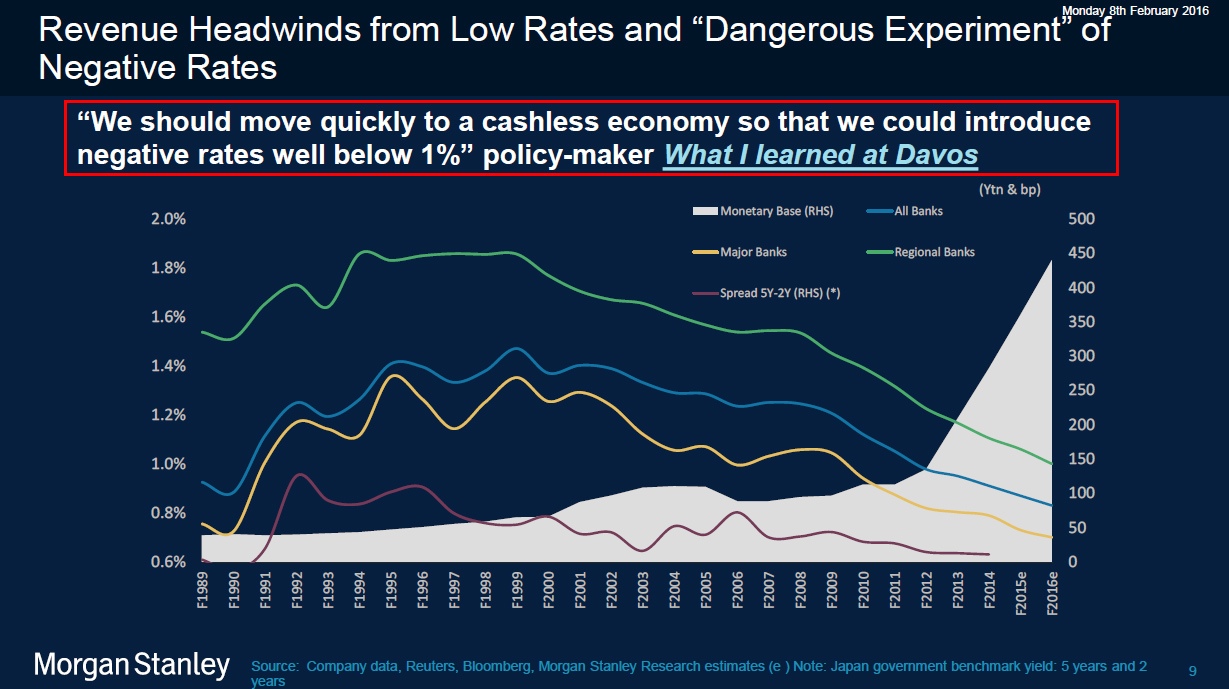
JR: We see around the world something like 25% of all national debt is now has a yield priced in negative interest rates? What does this mean? Do you see this continuing?
MH: On the one hand, negative interest rates reflect a flight to security by investors. They worry that the debts can’t be paid and that there are going to be defaults.
They also see that the United States and Europe are in a state of debt deflation, where people and businesses have to pay banks instead of spending their income on goods and services. So markets shrink, sales and profits fall, and the stock market turns down.
This decline was offset by the Federal Reserve and the European Central Bank trying to re-inflate the Bubble Economy by Quantitative Easing – providing reserves to the banks in exchange for their portfolio of mortgages and other loans. Otherwise, the banks would have had to sell these loans in “the market” at falling prices.
In the name of saving “the market,” the Fed and ECB therefore overruled the market. Today, over 80 percent of U.S. home mortgages are guaranteed by the Federal Housing Authority. Banks won’t make loans without the government picking up the risk of non-payment. So bankers just pretend to be free market. That’s for their victims.
The “flight to security” is a move out of the stock and bond markets into government debt. Stocks and bonds may go down in price, some companies may go bankrupt, but national governments can always print the money to pay their bondholders. Investors are mainly concerned about keeping whatthey have – security of principal. They are willing to be paid less income in exchange for preserving what they have taken.
Here’s the corner that the economy has backed itself into. The solution to most problems creates new problems – blowback or backlash, which often turn out to be even bigger problems. Negative interest rates mean that pension funds cannot invest in securities that yield enough for them to pay what they have promised their contributors. Insurance companies can’t earn the money to pay their policyholders. So something has to give.
There will be breaks in the chain of payments. But the way Wall Street administrators at the Treasury and Fed plan the crisis is for small savers to lose out to the large institutional investors. So the bottom line that I see is a slow crash.
JR: Could there be a more symbiotic relationship with global financial institutions? For money to have value, doesn’t it need a functioning economy, rather than an entirely financialized one?
MH: Money is debt. It is a claim on some debtor. Government money is a claim by its holder on the government, settled by the government accepting it as payment for tax debts.
Being a claim on a debtor, money does not necessarily need a functioning economy. It can be part of a foreclosure process, transferring property to creditors. A financialized economy tends to strip the economy of money, by sucking up to the creditor One Percent on top. That is what happened in Rome, and the result was the Dark Age.
JR: In 2007/2008 we had a subprime crash and since 2014 we’ve had a commodities crash where oil prices are low, is this because of what’s going on in emerging market economies? Are emerging market economies and China the next subprime?
The current U.S. and Eurozone depression isn’t because of China. It’s because of domestic debt deflation. Commodity prices and consumer spending are falling, mainly because consumers have to pay most of their wages to the FIRE sector for rent or mortgage payments, student loans, bank and credit card debt, plus over 15 percent FICA wage withholding for Social Security and Medicare (actually, to enable the government to cut taxes on the higher income brackets), as well income and sales taxes. After all this is paid, consumers don’t have that much left to spend on commodities. So of course commodity prices are crashing.
Oil is a special case. Saudi Arabia is trying to drive U.S. fracking rivals out of business, while also hurting Russia. This lowers gas prices for U.S. and Eurozone consumers, but not by enough to spur economic recovery.
JR: You’ve written that we’re entering a financial cold war – the IMF and the US have been very strict on debt repayment for loans from debtor nations, but in Ukraine they’ve made an exception regarding Russia, could you discuss your recent writing on that?
MH: U.S. diplomats radically changed IMF lending rules as part of their economic sanctions imposed on Russia as result of the coup d’état by the Right Sector, Svoboda and their neo-Nazi allies in Kiev. The ease with which the U.S. changed these rules to support the military coup shows how the IMF is simply a tool of President Obama’s New Cold War policy.
The aim was to enable the IMF to keep lending to the military junta even though Ukraine is in default of its $3 billion debt to Russia, even though it refuses to negotiate payment, and even though IMF money has been used to fund kleptocrats such as Kolomoisky to field his own army against Russian speakers in Donbas. Ukraine has no foreseeable means of paying off the IMF and other creditors, given its destruction of its export industry in the East. My articles on this are on my website, michael-hudson.com.
JR: Today’s economy has some truly amazing technology from companies like Apple, but Apple is also example of financial engineering, you outline this in your book, what financial innovations have been associated with the story of Apple’s stock?
MH: The main financial innovation by Apple has been to set up a branch office in Ireland and pretend that the money it makes in the Untied States and elsewhere is made in Ireland – which has only a 15 percent income-tax rate.
The problem is that if Apple remits this income back to the United States, it will have to pay U.S. income tax. It wants to avoid this – unless Wall Street can convince politicians to declare a “tax holiday” would let tax avoiders bring all their foreign money back to the United States “tax free.” That would be a tax amnesty only for the very wealthy, not for the 99 Percent.
This tax angle explains why Apple, almost the wealthiest company in the world, has been urged by activist shareholders to borrow. Why should the richest company have to go into debt?
The answer is that Apple can borrow from U.S. banks at a low interest rate to pay dividends on its stock, instead of paying these dividends by bringing its income back home and paying the taxes that are due.
It would seem to be an anomaly to borrow from banks and pay dividends. But that is the “cannibalism” stage of modern finance capitalism, U.S.-style. For the stock market as a whole, some 92 percent of earnings recently were used to pay dividends or for stock buybacks.
JR: What is the eventual outcome of all theses corporate buybacks to pump up share prices?
MH: The problem with a company using its revenue simply to buy its own shares to support their price (and hence, enable CEOs to increase their salaries and bonuses, and make more capital gains on their stock options) is that the price fillip is temporary. Last year saw the largest volume of U.S. stock buybacks on record. But since January 1, the market has fallen by about 20 percent. The debts that companies took on to buy stocks remain in place; and the earnings that companies used to buy these stocks are now gone.
Corporations did not use their income to invest in long-term expansion. The financial time frame always has been short-term. Projects with long-term paybacks are cut back, because CEOs and financial managers simply want to take their money and run. That is the financial mentality.
JR: What is the outcome of all theses corporate buybacks to pump up share prices?
MH: When the dust settles, companies financialized in this way are left as debt-leveraged shells. CEOs then go to their labor unions and threaten to declare bankruptcy if the unions don’t scale back their pension demands. So there is a deliberate tactic to force companies into debt for short-term earnings and stock-price gains in the short term, and a more intensive class war against present and past employees and pensioners as a longer-term policy.
JR: Why do business schools endorse of financialization? Reversing short-termism?
MH: The financial sector is the major endower of business schools. They have become training grounds for Chief Financial Officers. At Harvard, Prof. Jensen reasoned that managers should aim at serving stockholders, not the company as such. The result was an “incentive” system tying management bonuses to the stock price. So naturally, CFOs used corporate earnings for stock buybacks and dividend payouts that provided a short-term jump in the stock price.
The ideological foundation of today’s business schools is that economic control should be shifted out of government hands into those of financial managers – that is, Wall Street. That is their idea of free enterprise. Its inevitable tendency is to end in more centralized planning by Wall Street than in Washington.
The aim of this financial planning is quite different from that of governments. As I wrote in Killing the Host: “The euro and the ECB were designed in a way that blocks government money creation for any purpose other than to support the banks and bondholders. … The financial sector takes over the role of economic planner, putting its technicians in charge of monetary and fiscal policy without democratic voice or referendums over debt and tax policies.”
Financial planning always has been short-term. That is why planning should not be consigned to banks and bondholders. Their mentality is extractive, and that ends up hit-and-run. What passes for mainstream financial analysis is simply to add up how much is owed and demand payment, not help the economy grow. To financial managers, economic prosperity and unemployment is an “externality” – that is, not part of the equation that they are concerned with.
Future?
JR: The story of Greece in recent years is relevant to our discussion because the political party Syriza took over with ideas that were traditionally representing the left? Does the body of traditional left ideas have the ability to solve some of the challenges regarding financial warfare?
MH: The left and former Social Democratic or Labour parties have dome to focus on political and cultural issues, not the economic policy that led to their original creation. What is lacking is a focus on rent theory and financial analysis. Part of the explanation probably is covert U.S. funding and sponsorship of Blair-type neoliberals.
The eurozone threatened Greece with domestic destabilization if it did not surrender to the Troika’s demands. Syriza’s leaders worried that the ensuing turmoil would bring a right-wing neo-Nazi group such as Golden Dawn into power, or a military dictatorship as a client oligarchy for U.S. and German neoliberals.
So the political choice today is much like the 1930s, when the global economy also broke down. The choice is between nationalism and populism on the right, or socialism reviving what used to be left-wing politics.
JR: Could there be a debt write down? Isn’t someone’s debts another person’s savings, i.e. pension funds, 401k, retirement funds?
MH: The problem is indeed that one party’s debt finds its counterpart in some other party’s savings. Not paying debts therefore involves annulling some other party’s financial claims on the debtor. What happens to the savings on the other side of the savings/debt balance sheet?
The political question is, who will lose first?
The answer is, the least politically protected. The end game is “Big fish eat little fish.” Pension funds are in the front line of sacrifice, while government bondholders are the most secure. Greek pensions already have been written down, and the savings of U.S. pension funds, Social Security and other social programs are the first to be annulled.
The only way to achieve a fair debt cancellation is to write down the debts of the wealthiest, not the most needy. That is the opposite of how matters are being resolved today. That is why southern Europe is being radicalized over the debt issue.
JR: Will financialized economies implode? Leaving the non-financialized ones?
MH: The One Percent who hold most of the economy’s savings are quite willing to plunge society into depression to collect on their savings claims. Their greed is why we are in an economic war much like Rome’s Conflict of the Orders that shaped the Republic, and its century of civil war between creditors and debtors, 133-29 BC.
Argentina has been imploding, just as Third World debtors were obliged to do when they accepted IMF austerity programs and “conditionalities” for loans to keep their currencies from depreciating. To avoid being forced to adopt such self-defeating and anti-democratic policies, it looks like countries will have to move out of the U.S. and Eurozone orbit into that of the BRICS. That is why today’s financial crisis is leading to a New Cold War. It is as much financial as it is military.
JR: How would you advise a politician to restore prosperity in the future?
MH: The problem is who to give advice to. Most politicians today – at least in the United States – are proxies for their campaign contributors. President Obama is basically a lobbyist for his Wall Street in the Democratic Party’s Robert Rubin gang. That kind of demagogue wouldn’t pay any attention to policies that I or other economists would make. Their job is not to make the economy better, but to defend their campaign contributors among the One Percent at the economy’s expense.
But when I go to China or Russia, here’s what I advise (without much success so far, I admit):
First, tax land rent and other economic rent. Make it the tax base. Otherwise, this rental value will end up being pledged to banks as interest on credit borrowed to buy rent-yielding assets.
Second, make banks into public utilities. Credit creation is like land or air: a monopoly created by society. As organs of public policy they would not play the derivatives casino, or make corporate takeover loans to raiders, or falsify mortgage documents.
Third, do not privatize basic utilities. Public ownership enables basic services to be provided at cost, on a subsidized basis, or freely. That will make the economy more competitive. The cost of upgrading public infrastructure can be defrayed by basing the tax system on economic rent, not wages.
JR: Does it have to be this way?
MH: The Eurozone die is cast. Countries must withdraw from the euro so that governments can create their own money once again, and resist creditor demands to carve up and privatize their public domain.
For the United States, I don’t see a concerted alternative to neoliberalism squeezing more and more interest and rent out of the economy, making the present slump even deeper in debt.
JR: How won’t debts be paid?
MH: There are two ways not to pay debts: either by annulling or repudiating them, or by foreclosure when creditors take or demand property in lieu of monetary payment.
The first way not to pay is to default or proclaim a Clean Slate. The most successful example in modern times is the German Economic Miracle – the Allied Monetary Reform of 1948. That cancelled Germany’s internal debts except for wages owed by employers, and minimum working balances.
The United States Government has fought against creation of an international court to adjudicate the ability of national economies to pay debts. If such a court is not created, the global economy will fracture. That is occurring in what looks like a New Cold War pitting the United States and its NATO satellites against the BRICS (China, Russia, South Africa, Brazil and India) along with Iran and other debtors.
The US preferred policy is for countries to sell off whatever is in their public domain when they lack the money to pay their debts. This is the “foreclosure” stage.
Short of these two ways of not paying debts, economies are submitting to debt deflation. That strips income from producers and consumers, businesses and governments to pay creditors. As the debtor economy weakens, the debt arrears mount up – often at rising interest rates to reflect the risk of non-payment as creditors realize that there is no “business as usual’ way in which the debts can be paid.
Debtor countries may postpone the inevitable by borrowing from the IMF or U.S. Treasury to buy out bondholders. This saves the latter from taking a loss – leaving the debtor country with debts that are even harder to annul, because they are to foreign governments and international institutions. That is why it is a very bad policy for countries to move from owing money to private bondholders to owing the IMF or European Central Bank, whose demands are unforgiving.
In the long term, debts won’t be paid in the way that Rome’s debts were not paid. The money economy itself was stripped, and the empire fell into a prolonged Dark Age. That is the fate that will befall the West if it continues to support the “rights” of creditors over the right of nations and economies to survive.
JR: Thanks again for speaking with us.
.