Hawaii - Start of American Empire

SOURCE: Ken Taylor (taylork021@hawaii.rr.com)
SUBHEAD: Lost Kingdom - Hawaii's last queen, the Sugar Kings, and America's first imperial adventure.

 By Staff on 26 February 2012 for NPR -  
(http://www.npr.org/2012/02/26/147304072/how-sugar-brought-down-hawaiis-nationhood)  
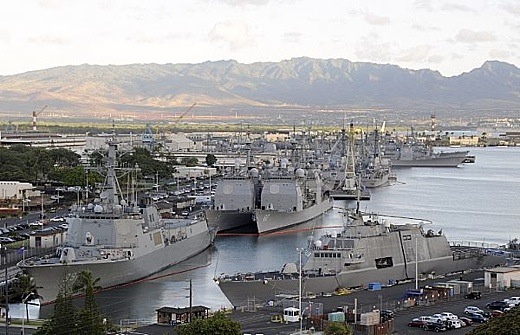
Image above: The Gathering of warships from 14 nations are in port at Joint Base Pearl Harbor-Hickam for the 2010 RIMPAC exercise. From (http://newwars.wordpress.com/2010/07/02/sea-links-138).

[IB editor note: This summer (2012) is scheduled as another Rim of the Pacific joint navel exercise year. Hawaii and a million square miles of ocean will be threatened by munitions, pollution, sonar noise and many over inconveniences that will degrade our culture and environment.]

If you've seen a Hawaiian tourism commercial, a beach movie, or even a cartoon with Daffy Duck in a lei and a grass skirt, you've heard the poignant strains of "Aloha Oe." But the tune has a history stretching far beyond cartoons and commercials:

It was composed in 1878 by the woman who would become the last queen of Hawaii, Lili'uokalani. Hawaii is the only state to have once been an independent monarchy. And when Lili'u, as she called herself, was born in 1838, it was at its height. "She was born at a time when all things seemed possible to the kingdom of Hawaii," author Julia Flynn Siler tells weekends on All Things Considered host Guy Raz.

Siler has written a new book about Lili'u and her times, Lost Kingdom: Hawaii's Last Queen, the Sugar Kings, and America's First Imperial Adventure. She says the seeds of Hawaii's downfall had already been planted when Lili'u was born — by the missionaries who came early in the 19th century to bring reading, writing and Christianity to the islands. "The old saying in Hawaii about the Christian missionaries who arrived was, they came to do good and they did very well," Siler says.

By the end of the 19th century, "the sons and grandsons of the missionaries controlled the vast majority of arable land, as well as the banks, the steamship lines and most other businesses," she says. Those missionary descendents had snapped up vast tracts of land from the cash-poor, land-rich Hawaiian aristocracy; the Hawaii of Lili'u's childhood, a land of small-scale taro farms and fish ponds, had been plowed under and converted into sugar plantations.

When Lili'u came to the throne in 1891, she found herself in an impossible position. The islands and the mainland were suffering a terrible economic depression. Her brother and predecessor, David Kalākaua, had plunged the monarchy deeply in debt to the sugar planters. He had also been stripped of many of his powers by the white merchant class.

"He was essentially a figurehead," Siler says, "and Lili'u, upon taking the throne, and at the request of her people, tried to regain some of those powers by introducing a new constitution." It did not end well. The merchants and sugar planters banded together and overthrew Lili'u in 1893. And though she campaigned tirelessly for restoration, she was unsuccessful. Hawaii became a U.S. territory in 1898.

Siler says the annexation of Hawaii marked a turning point for the United States. "This was the first time in America's history that we reached beyond our mainland shores and took a nation that had been independent, sovereign, recognized by the other great powers," Siler says. "And we grabbed it for America."

[NPR note - Excerpted from Lost Kingdom: Hawaii's Last Queen, the Sugar Kings, and America's First Imperial Adventure by Julia Flynn Siler. By permission of Atlantic Monthly Press, an imprint of Grove/Atlantic, Inc. Copyright 2011 Julia Flynn Siler.]

Preface
She walked down the palace steps toward a horse-drawn carriage.


Four footmen in white knee breeches carried the train of her lavender silk gown. She was fifty-four years old and strands of silver ran through her black hair. Despite her many sorrows, Hawai'i's queen walked with dignity. On that January day in 1893, she was determined to right a wrong.

Lili'uokalani, the reigning monarch of the Hawaiian kingdom, belonged to an ancient line of chiefs. Long before her birth, perhaps around the time Constantine ruled the Roman empire, her ancestors had paddled double-hulled canoes from Polynesian settlements thousands of miles across the heaving swells of the Pacific. Using the stars to navigate, they settled on a remote chain of volcanic islands they called Hawai'i.

For more than fifteen hundred years they lived there unbeknownst to Westerners, passing along their understanding of the world through chants, hula, a form of storytelling. But on January 18, 1778, when the queen's great-great-grandfather was a high chief, two sloops from the British navy appeared on the horizon. Commanded by the explorer James Cook, the ships' sailors shattered the splendid isolation of the Hawaiians, bringing deadly diseases, liquor, and firearms.

A few decades later Christian missionaries arrived, bringing the word of a new god and the printing presses to spread it. Wood frame houses arose alongside grass huts: the once languid capital Honolulu became a riotous port town, filled with whalers, roustabouts, and sailors of every nationality. By the time Lili'uokalani reached adolescence Hawai'i had adopted a declaration of rights, a constitution, a national legislature, and a public education system and had accepted the Western concept of private property.

The world rushed into Honolulu through its harbor. Newcomers founded the kingdom's banks, its steamship lines, and many of its newspapers. Some former missionaries and their descendants became businessmen and soon began demanding greater say in the kingdom's government. Foreigners brought the wider world to Hawai'i. But they also threatened to subsume the traditional livelihood, language, and culture of native Hawaiians.

Lili'uokalani herself spanned the worlds of both ancient Hawai'i and the West. Born in a grass house, she lived as queen in an ornate palace illuminated by electric lights, installed four years before the White House's in Washington, D.C. Educated by missionaries alongside other high chiefs' children, she spoke and wrote fluent English and Hawaiian, along with a smattering of French, German, and Latin. She also had traveled across the United States and halfway around the globe to England.

She ruled over a kingdom that was independent but tiny. Just eight inhabited islands surrounded by thousands of miles of Pacific Ocean, Hawai'i was one of the most remote places on earth. When Cook arrived the native Hawaiians numbered 300,000 to 400,000. In the 1890 census, the kingdom's entire population was 89,990, less than a third of San Francisco's, which at nearly 300,000 people was the largest city on America's west coast. As the mighty nations of the day, which were surging west in search of new markets, Lili'uokalani's island kingdom was isolated and virtually defenseless. It became a stopover where traders provisioned their ships on their way between North America and Asia.

As she left the palace to step into her carriage, Lili'uokalani cast off the subservience that she had learned as a sweet-faced girl from her missionary teachers. On that day, Saturday, January 14, 1893, Hawai'i's queen planned to substitute a new constitution for the one forced upon her brother several years earlier, which had turned Hawai'i's monarch into a mere figurehead. Now she aimed to reclaim power for the throne and her people.

Beneath cloudless skies she left the palace. Cannons boomed as the royal carriage rolled toward the legislature. She expected the day to be one of the most triumphant in her two-year-reign, if all went as planned.

But that very morning the USS Boston, a warship based in the islands with special orders to protect U.S. interests, steamed into Honolulu harbor. Aboard was the United States envoy to the islands, a tireless advocate of American expansionism. Unbeknownst to Hawai'i's queen, a small group of conspirators, backed by the envoy, was plotting to wrest her away from the throne.

With its fragrant ginger blossoms and mist-swathed mountains, the independent nation of Hawai'i was the reluctant bride in a contest among three suitors –America, Great Britain, and France. During the nineteenth century each at times had sought to expand its influence in the Pacific by controlling the islands, a key stopover in the trade route between North America and Asia.

By 1893 a mounting threat to Hawai'i's independence had also come from within: powerful white sugar planters and merchants sought relief from an economic depression by pushing to annex the islands to the United States, the primary market for Hawaiian sugar. Already, they'd almost completely transformed Hawai'i's economy. For decades, vast sugar plantations had been subsuming the patchwork of taro fields and fish ponds that had long sustained native Hawaiians. This chain of verdant volcanic islands had been harnessed into a sugar-producing powerhouse, in which a small group of white planters controlled four-fifths of the islands' arable land.

A German-American named Claus Spreckels was the most aggressive of those sugar barons. Unlike the missionary descendants turned businessmen, Spreckels was loyal to profits above God or country. He dominated Hawai'i's sugar industry and became the kingdom's chief moneylender, entangling Lili'uokalani's predecessor, her brother, King Kalākaua, in many of his schemes.

Spreckels, who was known as the Sugar King, was just one of a long line of entrepreneurs and adventurers who sought their fortunes in Hawai'i. He favored the islands' continued independence to protect its planter-friendly labor laws. On the mainland he was not involved when a zealous group of white lawyers and businessmen took the next step. They formed a secret Annexation Club a year earlier, which hoped to push Hawai'i into America's arms. These machinations set the stage for a brutal clash between a relentlessly expanding capitalist empire and a vulnerable Polynesian island kingdom.

Packed into a one-story armory in downtown Honolulu two days after the queen's attempt to introduce a new constitution, a crowd of roughly a thousand white men were electrified by Lorrin Thurston, a passionate, dark-eyed lawyer whose parents had arrived with the first company of missionaries to the islands. As a founder of the Annexation Club, he spoke in a booming voice that reached the back of the hall, asking, "Has the tropic sun cooled and thinned our blood, or have we flowing in our veins the warm, rich blood which makes men love liberty and die for it?"

Thurston sought out the American minister, who had already sent a message to the commanding officer of the USS Boston. A few hours later at 5 p.m. on January 16 the warship's commander ordered the landing of 162 American sailors and marines onto the nearly deserted streets of Honolulu.

The queen was then at the palace, just a few blocks from the Honolulu harbor. Hearing the beat of the American military drums, she stepped onto the veranda and watched from above as the troops marched from the harbor. As they kicked up dust in the unpaved streets, she could see they were heavily weighed down with double belts of cartridges.

The sun sank and the skies over Honolulu darkened. The blue- jacketed sailors approached the palace. Beneath the town's newly installed electric streetlamps, Lili'uokalani could see them pushing a revolving cannon and a fearsome Gatling gun, equipped with 14,000 rounds of ammunition that could rip through a large crowd. Following their movements in the streets she was frightened. Why had the troops landed when everything seemed at peace?

The air was heavy with the scent of gardenias. Mosquitoes were drawn to the sweat of the blue-jacketed sailors. As the troops marched past the palace grounds, accompanied by drum rolls, they hoisted their rifles to their shoulders and seemed to point them in the queen's direction.

Were their weapons drawn and ready to fire, as Lili'uokalani later recalled? Or were they merely signaling their respect for Hawai'i's queen by marching past and beating the drums in a royal salute, as one of their commanding officers later insisted?

Whatever their intention, this brash display of military power ignited a crisis that would alter the course of American history.

The landing of U.S. Marines in 1893 came after decades of tension between Hawaiians and the West. The events leading up to it are passionately debated even today among legal scholars, Hawaiian rights activists, and historians. It is the crux of the story of how Hawai'i became part of the United States and it is at the heart of the racial conflict that still tears at the state that bore America's forty-fourth president.

Until recently, American history textbooks have largely overlooked how a small group of businessmen, many of whom were descendants of early Christian missionaries to the islands, managed to overthrow a sovereign kingdom. Most tourist guidebooks simply note the historical curiosity that Hawai'i was once an independent nation, boasting the only former royal palace on American soil.

Yet a glance at the state's newspapers today makes clear that many of the families and firms behind Queen Lili'uokalani's overthrow more than a century ago still wield power in Hawai'i. Vast fortunes accrued to some of them in the years after the overthrow. What happened to the Kingdom of Hawai'i was one of the most audacious land grabs of the Gilded Age, in which 1.8 million acres of land now worth billions of dollars was seized from native Hawaiians and claimed by American businessmen.

It was also the first major gust in a brewing storm of American imperialism, occurring just before U.S. troops took control of Cuba during the Spanish-American War, conquered the Philippines, and turned Guam and Puerto Rico into U.S. territorial possessions. As Americans gained a new belief in their manifest destiny around the globe, Hawaiians lost their country, the first sovereign nation to become a casualty of America's imperial outreach.

The queen stood watching the troops, facing an impossible dilemma.

Should she remain "civil," risking her overthrow and the surrender of native Hawaiian culture and sovereignty? Or should she order the troops under her command—outnumbering the Boston's force by nearly four to one – to fight back?

To do so risked inciting the slaughter of a race of people that was already disappearing, decimated over the years by smallpox, syphilis, and measles. Epidemics had carried away tens of thousands of native Hawaiians, who had little resistance to the deadly viruses that swept regularly through the islands. If her people fought off the Americans, would the British, French, or possibly even the Japanese swoop in to replace them?

What should she do?.
Korean Island of Peace

SOURCE: Koohan Paik (kosherkimchee@yahoo.com)
SUBHEAD: Jeju island was known as the Island of Peace until the US Navy wanted a deep water port there.  

By Bruce Gagnon on 26 February 2012 for Space4Peace - 
(http://space4peace.blogspot.com/2012/02/busted-in-jeju.html)

 
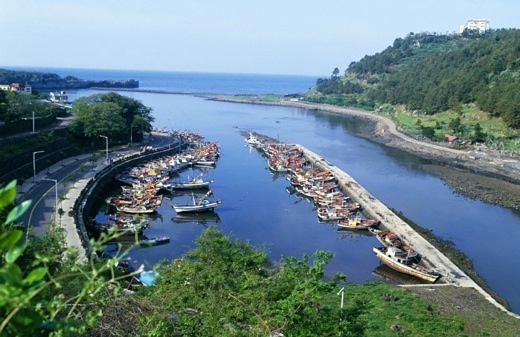
Image above: Historicsmall boat fishing porton Jeju island. From (http://www.igoo.com/forums/gallery/showimage.php?i=302&c=&langid=2).
 
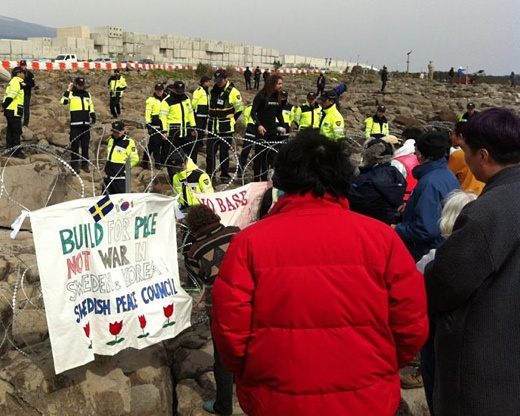
Ten international activists and six Korean activists were arrested today after crawling under the razor wire at the Navy base on Jeju Island. Seven Global Network members were among those arrested including Bruce Gagnon, Mary Beth Sullivan, Dave Webb, Natasha Mayers, Agneta Norberg, Gun-Brit Makitalo, and Dennis Apel.

More than 70 activists used kayaks to get onto the rocky coast where they held a Catholic mass, sang songs, ate food, made speeches, and then moved under the the wire fence to enter the base destruction area.

Five of those arrested were moved to Dongbu police station in Jeju City. Today's candlelight vigil was held in front of Seogwipo police station where the other 11 were being held. The police arrested 20 more people during the vigil at the police station claiming it was an illegal protest. After some hassles by the authorities many of the activists were released from jail by about 11:00 pm.

 
Image above: Protesters face Korean mainland police at site of future US naval base under construction on Jeju island. From original article.

Jeju & Anti-Base Movement  

By bpeacoc1 on 6 September 2012 for Ohnuna  
(http://ohnuna.wordpress.com/2011/09/06/jeju-island-of-peace-and-the-anti-base-movements/)

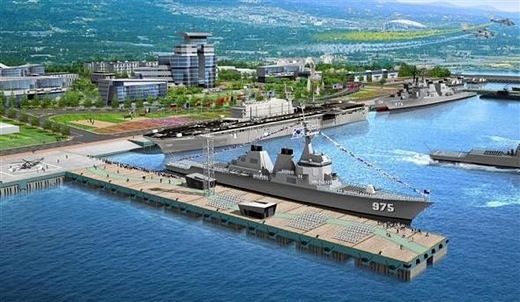
  Image above: Rendering of part of U.S. navel base under construction on Jeju island. From (http://bemil.chosun.com/nbrd/gallery/view.html?b_bbs_id=10044&num=146457).
 
Jeju island is known as The Island of Peace. Jeju’s location off the Southern tip of Korea. Jeju hosts three UNESCO World Heritage Sites. The island is known for its beauty and also for the residents resistance in the past, notably the Jeju Uprising. Jeju is currently now a Special Self-Governing Province and is the only special autonomous province in South Korea.

Now the island’s peace is seemly threatened by installation of a naval base, or is it? In 2002 the South Korean Navy “first proposed Hwasoon village in western Jeju, followed by Wimi village in 2005. [....] Local antie-base resistance developed in both villages.” So in 2007 Gangjeong was finally chosen. Since the proposal anti-base movements have moved into Gangjeong increasing global awareness of local resistance.

Anti-base movements are steeped in historical, political, environmental, security, and social issues; just to name a few. The anti-base movement in South Korea has typically be against American bases (USFK: United States Forces Korea). But the Jeju case is different simply because it will be a Korean Naval Base.

As always different forces convening in Gangjeong, pro and con, will impose different issues. At this time it would be interesting to look at the issues a situation like this exposes.

This is exactly what Japan Focus, a peer-reviewed online journal, has done. For information on the situation in Jeju and anti-base movements in Korea and Japan.
See also:

Back to the Future: Korean Anti-Base Resistance from Jeju Island to Pyeongtaek

Anti-Base Movements in South Korea: Comparative Perspective on the Asia-Pacific

National and International Protests Challenge Naval Base Construction on Jeju Island

Overcoming American Military Base Pollution in Asia: Japan, Okinawa, Philippines

Understanding Security Relations on the Korean Peninsula

Monsanto Pesticide in trouble

SUBHEAD: Scientists find even extremely diluted exposure to Roundup causes damage to DNA. By Sara Novak on 25 Febuary 2012 for TreeHugger - (http://www.treehugger.com/health/study-even-extremely-diluted-roundup-does-damage-to-dna.html) Image above: Man in mask applying pesticide to small vineyard. From (http://woodswine7.blogspot.com/2011/08/micro-vineyard-seminar-cce-8-11-2011.html).

Farmers use five times more weed killers on their crops then they did in 1997, and with 94 percent of soybeans and 72 percent of corn being grown this way, herbicide use has exploded, according to a story in The New York Times. Glyphosate is the largest selling herbicide and it's a main ingredient in Roundup, one of the most popular and widely used herbicides in the U.S.

But recent findings are showing once again, that Monsanto's Roundup can cause major health problems. A new study shows that even when it's diluted to .02 percent of what is sprayed on crops it can cause DNA damage.

The study found that inhaling glyphosate causes acute membrane damage, impairment of mitochondrial functions, and damage to DNA. According to Natural News, polyoxyethyleneamine, an ingredient that facilitates glyphosate's absorption into cells, has been found to significantly increase Roundup's toxicity in humans. The main goal of the study was to see the damage that glyphosate did through inhalation.

Glyphosate Already In Trouble

Monsanto collected $2 billion in sales from Roundup and other glyphosate-based herbicides last year so it's expected that they would stand by their product. But this isn't the first time it's come under fire. The EPA is currently evaluating glyphosate to see whether its use should be eliminated or controlled. The only problem is that their deadline isn't until 2015.

"Glyphosate's days are numbered," said Paul Achitoff, a lawyer for Earthjustice, an environmental law firm that is suing the U.S. Department of Agriculture in part over concerns about heavy glyphosate use.

And it's not just the damage that Roundup Ready crops do through inhalation. The GMO crops themselves, which have been created to be resistant to Roundup, have been shown to cause organ damage as well. One study showed that when GMO corn was fed to rats it did damage to the liver and kidneys, the body's detoxifying organs, as well as the heart, adrenal glands, and spleen.

.

Wyoming Doomsday Bill

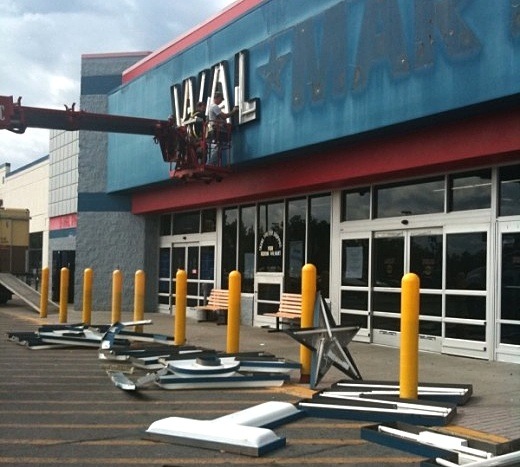
SUBHEAD: State gets ready for contingencies in a economic and political breakdown of national systems. By Jeremy Pelzer on 24 February 2012 for Trib.com - (http://trib.com/news/state-and-regional/govt-and-politics/wyoming-house-advances-doomsday-bill/article_af6e1b2b-0ca4-553f-85e9-92c0f58c00bd.html) Image above: Wal*Mart sign being removed from building. From (http://mithan415.hubpages.com/hub/America-Collapse-Warning-Sign-Wal-Mart-has-Seventh-Straight-Quarter-of-Declining-Sales). Wyoming state representatives on Friday advanced legislation to launch a study into what the state should do in the event of a complete economic or political collapse in the United States.

House Bill 85 passed on first reading by a voice vote. It would create a state-run government continuity task force, which would study and prepare Wyoming for potential catastrophes, from disruptions in food and energy supplies to a complete meltdown of the federal government.

The task force would look at the feasibility of Wyoming issuing its own alternative currency, if needed. And House members approved an amendment Friday by state Rep. Kermit Brown, R-Laramie, to have the task force also examine conditions under which Wyoming would need to implement its own military draft, raise a standing army, and acquire strike aircraft and an aircraft carrier.

The bill’s sponsor, state Rep. David Miller, R-Riverton, has said he doesn’t anticipate any major crises hitting America anytime soon. But with the national debt exceeding $15 trillion and protest movements growing around the country, Miller said Wyoming — which has a comparatively good economy and sound state finances — needs to make sure it’s protected should any unexpected emergency hit the U.S.

Several House members spoke in favor of the legislation, saying there was no harm in preparing for the worst.

“I don’t think there’s anyone in this room today what would come up here and say that this country is in good shape, that the world is stable and in good shape — because that is clearly not the case,” state Rep. Lorraine Quarberg, R-Thermopolis, said. “To put your head in the sand and think that nothing bad’s going to happen, and that we have no obligation to the citizens of the state of Wyoming to at least have the discussion, is not healthy.”

Wyoming’s Department of Homeland Security already has a statewide crisis management plan, but it doesn’t cover what the state should do in the event of an extreme nationwide political or economic collapse. In recent years, lawmakers in at least six states have introduced legislation to create a state currency, all unsuccessfully.

The task force would include state lawmakers, the director of the Wyoming Department of Homeland Security, the Wyoming attorney general and the Wyoming National Guard’s adjutant general, among others.

The bill must pass two more House votes before it would head to the Senate for consideration. The original bill appropriated $32,000 for the task force, though the Joint Appropriations Committee slashed that number in half earlier this week.

University of Wyoming political science professor Jim King said the potential for a complete unraveling of the U.S. government and economy is “astronomically remote” in the foreseeable future.

But King noted that the federal government set up a Continuity of Government Commission in 2002, of which former U.S. Sen. Al Simpson, R-Wyo., was co-chairman. However, King said he didn’t know of any states that had established a similar board.

.

Future of Debt Slavery - Part 1

SUBHEAD: The entrenched U.S. system forces people into longer hours for less wages over time.  

By Ashvin Pandurangi on 22 February 2012 for Automatic Earth - 
(http://theautomaticearth.org/Finance/our-depraved-future-of-debt-slavery-part-i.html)


Image above: Convention of former slaves in Washington DC in 1916. (L. to R.) Annie Parram, age 104; Anna Angales, age 105; Elizabeth Berkeley, 125; Sadie Thompson, 110. From original article by national Photo Co.
 
It is almost surprising that the concept of slavery is very foreign to those living in the developed world, especially the U.S., since it was extensively practiced as recently as 70 years ago. What’s more disturbing about this ignorance is the fact that the system of post-Civil War slavery in the U.S. was not so different than the systems of slavery many Americans and Europeans will be experiencing in upcoming years. Indeed, I’m sure many people will probably take offense to such a comparison even being made, as they feel it demeans the atrocious acts committed in the past.

I would argue, however, that we demean history by failing to understand it and learn from it. Many people refer to debt slavery when referencing current policies of the West, especially in Greece right now where the concept has become very real, but they perhaps still under-estimate how bad it can get. These systems of slavery are primarily borne out of deeply-rooted economic structures which foster high levels of dependency, greed and malice by those with unchecked levels of political power. In the late 19th and early 20th centuries, these powerful groups consisted of wealthy Southern agricultural and industrial elites.

In his book “Slavery By Another Name” [documentary here], Douglas A. Blackmon documents how very few of the 4 million slaves that existed at the end of the Civil War were actually allowed to realize their freedom until decades later. As the white middle class of the South grew from 1870-1950 (with the exception of some years encompassing the Great Depression), due in no small part to the success of Southern industry, the blacks were kept in their chains through various mechanisms, such as convict leasing and debt peonage, over and above the outright discrimination and violence that they also suffered.

The Southern convict leasing systems were a means of extending slavery for African Americans well past the Civil War, Emancipation Proclamation and the 13th and 14th amendments. Southern laws were crafted to guarantee that the now “free” African Americans would be incarcerated at much higher rates than whites. Blacks were picked up, hauled off and locked up for ridiculous crimes such as “vagrancy” (being homless or unemployed), loitering in public, speaking loudly in the company of white women or selling farm products after dark, to name only a few.

Once these people were matriculated into the prison system, they had effectively become slave laborers again. The state allowed convicts to be leased out to private corporations for little more than a pittance - convict laborers were rented out at monthly rates that represented a 50-80% discount over the wages paid to free laborers. They were forced to work in some of the most dangerous environments at the time, laying railroad and mining coal, and a significant percentage developed severe illness/injuries and died in the course of such work.

It is estimated that at least 9000 convict workers were murdered or died of “natural causes” over a few decades under this system alone. As one historian described it, the system was “brutal in a social sense, but fiendishly rational in an economical sense”. That is really the crux of the matter – the Southern plantation economy, as well as newly developing transport industries, was very dependent on extremely low-cost labor, in both an economic and psychological sense. Convict leasing proved to be even more profitable than slavery in many cases, since there was really no need to keep the workers healthy and alive for very long.

Many African Americans were also placed into peonage or “debt servitude”, despite the fact that the federal government made it illegal after the accession of New Mexico into the U.S and the Civil War. These blacks were typically accused of falsely owing money or trivial sums, given sham trials and quickly sold off by the courts into a privatized system of debt slavery. The peonage contracts contained horrifying terms, allowing the employer to trade, confine, whip and beat workers as long as the debt was deemed unpaid, which could practically last forever.

It was established that some of the wealthiest Alabama farmers had their own “justices of the peace” who would fraudulently try and convict blacks on charges of unpaid debts. The federal government launched an investigation into these practices, and an Alabama court convicted a few of the farmers of public bribes and illegal debt peonage. However, they were given minimum sentences and then pardoned by President Theodore Roosevelt shortly after. Despite the investigation and state court ruling, this practiced continued in many Southern states for years after.

Another less explicit form of forced labor was sharecropping, in which the poor black farmers theoretically received a percentage of the profits from sale of a certain crop grown by them. However, these workers were forced to take out relatively large loans just to meet daily expenses and these loans sometimes carried interest rates upwards of 50% or 60%. At the end of day, many of these sharecroppers were treated just like slaves and received very little compensation for their work, besides the basic necessities of life.

It is probably quite obvious to most readers how all of these mechanisms of forced labor and debt slavery are still being practiced today and are only getting worse. The prison-industrial complex in the U.S. has become more extensive than ever, as the list of petty crimes for which people are incarcerated has grown longer (but still does not include corporate/banking fraud or political corruption at the highest levels). There are, of course, many serious offenders in the system, but the point is that it is becoming ever-easier for our modern “slavemasters” to blur the line.

Foremost among the petty punishment is for drug use and addiction, which, as Dr. Gabor Mate has insightfully explained (h/t El Gallinazo), are conditions that primarily develop from environmental influences at an early age (as opposed to genetics). The socioeconomic structures and growing wealth inequality embedded in our society, especially at this time of economic depression, places enormous amounts of stress on its poorest members and can literally re-wire their brains in ways that eventually lead them down a path of self-defeating drug addiction and associated behaviors.

U.S. Department of Justice – Prisoners in 2010

In 2009, the most recent data available, 53% of state prison inmates were serving time for violent offenses, 19% for property, 18% for drug, and 9% for public order or other offenses.

About half (51%) of federal inmates in 2010 were serving time for drug offenses, 35% for public-order offenses (largely weapons and immigration), and less than 10% each for violent and property offenses.

Instead of working to change our fundamental economic structures and mitigate the stress triggers, our society has sought to “punish” and “rehabilitate” these people by placing them in environments of unprecedented fear and stress, such as prison. Given the amount of money and resources poured into the “war on drugs” in the U.S. over decades, there is never any shortage of people that can be easily sucked into this prison complex and then become a part of an enslaved labor force. Maintaining prisons and their populations has become very costly to taxpayers, but that’s the whole point.

The growing and increasingly outsourced U.S. prison workforce is frankly a wet dream for private corporations, just like the convict leasing system was for Southern corporate elites. They have already been stripped of almost all their freedoms through the system of incarceration, and can be forced to work for a very low wages in poor working conditions, under very strict levels of order and discipline. This pool of enslaved labor exploded since the early 1970s, as shown above, and therefore has already been thoroughly exploited by private corporations for many years.

On top of that, the entire business of building and running both state and federal prisons has been in the process of being outsourced to private corporations as governments come under fiscal pressure. These private interests now have even more incentive to help state and federal governments maintain the currently elevated number of prisoners. In recent years, the annual percentage increase in prisoners has dropped off, but that’s a “problem” which can be easily solved by the powers that be. In addition to inevitable increases in crime rates associated with economic depression, the list of jailable offenses can simply be expanded along with their associated sentences, like they were for blacks after "Reconstruction".

Right now, we have millions of people up to their eyeballs in housing and consumer debts, paying upwards of 20% interest on their credit cards and “payday loans”. It is an entrenched system that forces people to work longer hours for fewer benefits and wages over time. But, even as such, the titans of industry and owners of concentrated financial wealth are finding it difficult to squeeze enough blood from the stones. So what’s to stop the corporate elites and their political/judicial flacks from manufacturing debts out of thin air and exacting excessive wealth/punishment from those with debts owed?

In the follow up to this piece, we will look at the other ways in which the era of global indebtedness today has come to resemble that of the post-Civil War enslavement of African-Americans, except at a much larger scale. Is it really so unimaginable that an average lower or middle class American family, of all different races (although the racially-divided inequality of the past is still with us in many real ways), could find themselves in literal contracts of debt peonage, despite the technical “illegality” of such contracts at this time? What is the likelihood that laws will be re-written and/or ignored and how easy is it for the line between financial harassment/abuse and physical enslavement to simply disappear?

See also:
Ea O Ka Aina: Our Future of Debt Slavery - Part 2 2/27/12
Ea O Ka Aina: Our Future of Debt Slavery - Part 3 2/28/12 .

Notes from the field

SUBHEAD: This land of milk and honey is tangible and real, but it comes with strings attached.

 By Mark on 20 February 2012 for Club Orlov -  
(http://cluborlov.blogspot.com/2012/02/notes-from-field.html)
\
 
Image above: "The Last View of Home" by Richard Redgrave, 1858. From (http://en.wikipedia.org/wiki/File:Richard_Redgrave_-_The_Emigrants%27_Last_Sight_of_Home.jpg).

You hear a lot of talk about relocalization and deindustrialization. The pastoral life, the good old days. How romantic! Reality pays you a visit when your pick-axe hits a rock, a chunk hits your face, and you taste your own blood. Unaware of it at the time, I was a child of privilege, one of five born to a Chairman of Earth and Space Sciences at a State University in New York.

We were all expected to be high achievers. I fulfilled the expectation and put in 32 years as an engineer helping the über-wealthy zip around the skies in personal rocket ships from one golf game to another while chalking it off as business expenses, when all I ever really wanted to do was sit out in the woods and cook some food on a stick over a fire.

 In 1994 I acquired a 160 acre tract of land in southeast Kansas, for a price only slightly above chicken feed, as a weekender place to go sit by that fire and decompress from the rat-race. 18 years ago the future didn't look quite so ominous. Reel forward to the present and this full-time back-to-the-land experiment is starting to look like a pretty good idea. Some stark realities become self evident however when you are actually 'living the life'. Talking about it is easy. Doing it is something altogether different. Here is where I wish to convey a few 'notes from the field':
  1. You realize after a while it is mostly hard, dirty, repetitive and boring. Mud, blood, shit, sweat, discomfort, disappointment, death. There are rewards, but you have to have a passion for it to endure. People who have grown up ranching already know these things of course, but they don't have to adapt. They know the life.
  2. If you create an artificial abundance of anything, Mother Nature will do her best to return things to the status quo. Plant a large garden and you will have more venison than you can eat. Goats are not native to this region, coyotes are. Eagles, hawks, owls, raccoons, possums, foxes and bobcats are also native here. Chickens are not. They will all eat your chickens, given a chance.
  3. If you want to eat meat, you have to kill something. It's brutal and unpleasant. Blood is blood, you best get used to it. Warm guts smell bad. They smell different, depending on what you just killed, but they all smell bad. The first time you shove an arm elbow deep in warm guts and blood to tear loose some connective tissue, you are hard pressed to not lose your lunch. It begins to get a bit easier when you have a chilled carcass with the hide peeled off, and the pieces you hack off start to look like something you would buy in a grocery store, but the lifeless eyes continue to stare.
  4. Intellectual deprivation. This was unexpected. It doesn't become apparent right away because you're so damned glad to be away from the crush of humanity and the demolition derby approach to getting around. Land is inexpensive in certain regions for a reason. Living elsewhere is much easier (so far). In this case, the regional economy has been in decline for 70 years. The population has declined nearly 80% from its peak, and the brain drain is close to 100%. Most anybody with ambition left long ago, and most youth leave, never to return. It is not hard now to understand why, historically, tribes of 1 to 5 haven't fared well. You need some minimum critical mass of human interaction to be able to survive psychologically, and some degree of specialization and division of labor just to cover all the bases. For those of you considering it, the 'survivalist bunker' approach to dealing with the future would be ill advised. Social interaction is not just something nice, it is an imperative.
Not to be too glum, on the upside there is sunshine, fresh air, fresh meat, eggs, milk, cheese, honey, fruits, nuts, vegetables, abundant wildlife and beautiful scenery. You don't need to 'go to the gym' to stay in shape either. To peer into the future and see nothing beyond an endless re-run of this hard living is enough to put fear and dread in most hearts.

I find it increasingly difficult to believe that dispossessed cubicle dwellers will be able to adapt physically or mentally. In this setting it is not hard to envision the emergence of a tradition where you take each seventh day off from the grunt work and get together with your friends and neighbors just to celebrate the fact you are still breathing.

No deities or voodoo required. Then just for fun, throw a big feast every solstice and equinox and invite everybody. Wait... haven't we been there before? People tend to think of a 'land of milk and honey' as something idyllic and easy. This land of milk and honey is accessible, tangible and real, but it comes with strings attached.

.

Greek Slavery & The General Strike

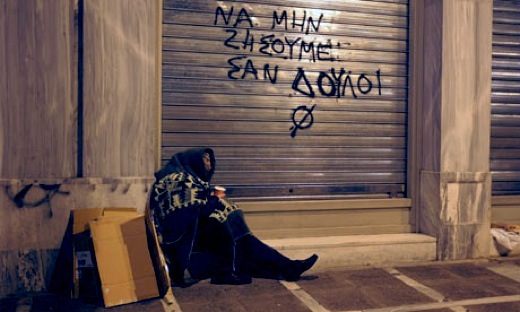
SUBHEAD: The German finance minister said “The promises from Greece aren’t enough for us any more”. By Nicholas Mirzoeff on 12 February 2012 for nicholasmirzoeff.com - (http://www.nicholasmirzoeff.com/O2012/2012/02/12/greece-slavery-and-the-general-strike/) Image above: on 2/12/12 a homeless Greek woman in front of sign that reads,"We should not live as slaves". From original article. oday the Greek parliament met to approve the deliberately humiliating terms of the German-backed bond rescue plan (aka the bailout). In the streets, it is more precisely defined as slavery. The response is, as it has long been, to organize the general strike. For globalized neo-liberalism this is the moment to bring an “end” to 2011, a year after their man in Egypt, Mubarak, had to step down.

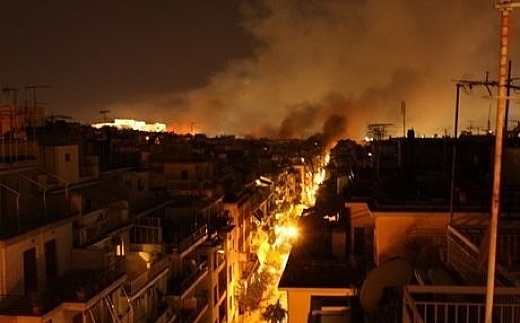
Estimates suggest 50,000 people in the street in Athens, perhaps as many as 100,000 with thousands more elsewhere, and many buildings occupied. The inevitable riot police and tear gas have been deployed. Exarchia, the radical district resounded to explosions. As fires burned, allegations circulated that the police had started them or ignored them. (Watch on Livestream here.)

The scenes were extraordinary–Starbucks on fire, smoke bombs, riot police–with the word “chaos” on every Greek website.

The troika-installed Prime Minister Papademos–whose name seems to evoke a patriarchal “father of the people”–pushed the market line about debt refusal:

It would create conditions of uncontrolled economic chaos and social explosion. The country would be drawn into a vortex of recession, instability, unemployment and protracted misery.

Such remarks fly in the face of existing reality, in which those are already the prevailing conditions. Official unemployment exceeds 20%. Reports have suggested people returning to family farms in the countryside and islands from the cities in order to survive. The Church feeds 250,000 people a day in a country of 11 million people. Homelessness has increased by 25% (although the absolute numbers are low by U. S. standards. The official EU statistics agency Eurostat reports that one-third of the country is living in poverty. And yet Papademos called for more “sacrifice.”

Nonetheless, even this is not enough for the one percent: “The promises from Greece aren’t enough for us any more,” the German finance minister, Wolfgang Schauble, said in an interview published in the Welt am Sonntag newspaper. When the vote is passed, the minimum wage will be cut by over 20%, pensions will be reduced and the already ruined state will cut back still further. The graffiti in the streets calls this slavery.

Image above: The scenes were extraordinary - Starbucks on fire, smoke bombs, riot police. From original article.

“We should not live as slaves,” it reads [Na men zesoume san douloi]. Evocatively, the word “doulos” is used for “slave,” the same term used by Aristotle in his Politics to approve the institution of slavery. His meditation on slavery is in fact one of governance, which manifests itself as the necessity of dominance.

I’m going to quote at some length because it is the inability to “reason” according the “logic” of the markets that is being used to justify Greek slavery today. It’s also important to read this to realize how thoroughgoing and long-lasting the Western commitment to slavery has been.It is also a passage that contains within it so many of today’s critical concerns from the human/nonhuman, to the “soul at work” (Bifo), governmentality, Rancière’s division of the sensible, and the persistence of slavery. Let us note this is not a coincidence:

for that some should govern, and others be governed, is not only necessary but useful, and from the hour of their birth some are marked out for those purposes, and others for the other, and there are many species of both sorts….Those men therefore who are as much inferior to others as the body is to the soul, are to be thus disposed of, as the proper use of them is their bodies, in which their excellence consists; … they are slaves by nature, and it is advantageous to them to be always under government. He then is by nature formed a slave who is qualified to become the chattel of another person, and on that account is so, and who has just reason enough to know that there is such a faculty, without being indued with the use of it; for other animals have no perception of reason, but are entirely guided by appetite, and indeed they vary very little in their use from each other; for the advantage which we receive, both from slaves and tame animals, arises from their bodily strength administering to our necessities; for it is the intention of nature to make the bodies of slaves and freemen different from each other {1254b-1255a}

The present rhetoric of the “lazy” Greeks, shiftlessly avoiding tax payments and demanding state support defines people driven entirely by appetite. They must therefore become the chattel of the troika, despite the likelihood that the cuts will still worsen the economy and necessitate yet more support for the external bond markets. What matters is that the Greeks be made an example: “Can’t pay! Won’t pay!” is reworked into “Can’t pay? Become a slave.”

In Black Reconstruction, W. E. B. Du Bois insisted that the enslaved had ended chattel slavery themselves by mass migration from South to North at the beginning of the Civil War, long before the Emancipation Proclamation:

This was not merely the desire to stop work. It was a strike on a wide basis against the conditions of work. It was a general strike that involved directly in the end perhaps half a million people.

The result of the strike was an abolition democracy, whose participatory process centered on education and the capacity to be self-sustaining. The measures have passed. The occupations have been ended. It’s up to us to keep this present, to remain in the moment, to be present.

.

Indentured service to the rich

SUBHEAD: Through Costco, slaves put squid on U.S. dining tables from South Pacific’s cruelest catch.

By E. Benjamin Skinner on 23 February for Bloomberg News -
(http://www.bloomberg.com/news/2012-02-23/slaves-put-squid-on-u-s-dining-tables-from-south-pacific-catch.html)


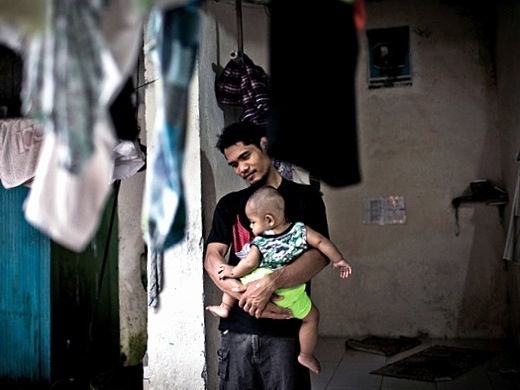
Image above: Escaped former indentured worker Yusril, with his son in Indonesia. From original article.

On March 25, 2011, Yusril became a slave. That afternoon he went to the East Jakarta offices of Indah Megah Sari (IMS), an agency that hires crews to work on foreign fishing vessels. He was offered a job on the Melilla 203, a South Korea-flagged ship that trawls in the waters off New Zealand. “Hurry up,” said the agent, holding a pen over a thick stack of contracts in a windowless conference room with water-stained walls. Waving at a pile of green Indonesian passports of other prospective fishermen, he added: “You really can’t waste time reading this. There are a lot of others waiting, and the plane leaves tomorrow.”

Yusril is 28, with brooding looks and a swagger that belies his slight frame. (Yusril asked that his real name not be used out of concern for his safety.) He was desperate for the promised monthly salary of $260, plus bonuses, for unloading fish. His wife was eight months pregnant, and he had put his name on a waiting list for the job nine months earlier. After taking a daylong bus ride to Jakarta, he had given the agent a $225 fee he borrowed from his brother-in-law, Bloomberg Businessweek reports in its Feb. 27 edition. The agent rushed him through signing the contracts, at least one of which was in English, which Yusril does not read.

The terms of the first contract, the “real” one, would later haunt him. In it, IMS spelled out terms with no rights. In addition to the agent’s commission, Yusril would surrender 30 percent of his salary, which IMS would hold unless the work was completed. He would be paid nothing for the first three months, and if the job were not finished to the fishing company’s satisfaction, Yusril would be sent home and charged more than $1,000 for the airfare. The meaning of “satisfactory” was left vague. The contract said only that Yusril would have to work whatever hours the boat operators demanded.

Locked In
The last line of the contract, in bold, warned that Yusril’s family would owe nearly $3,500 if he were to run away from the ship. The amount was greater than his net worth, and he had earlier submitted title to his land as collateral for that bond. Additionally, he had provided IMS with the names and addresses of his family members. He was locked in.

What followed, according to Yusril and several shipmates who corroborated his story, was an eight-month ordeal aboard the Melilla 203, during which Indonesian fishermen were subjected to physical and sexual abuse by the ship’s operators. Their overlords told them not to complain or fight back, or they would be sent home, where the agents would take their due. Yusril and 23 others walked off in protest when the trawler docked in Lyttelton, New Zealand. The men have seen little if any of what they say they are owed. Such coerced labor is modern-day slavery, as the United Nations defines the crime. (The South Korean owners of the Melilla ships did not respond to requests for comment.)

Debt Bondage The experiences of the fishermen on the Melilla 203 were not unique. In a six-month investigation, Bloomberg Businessweek found cases of debt bondage on the Melilla 203 and at least nine other ships that have operated in New Zealand’s waters. As recently as November 2011, fish from the Melilla 203 and other suspect vessels were bought and processed by United Fisheries, New Zealand’s eighth-largest seafood company, which sold the same kinds of fish in that period to distributors operating in the U.S. (The U.S. imports 86 percent of its seafood.) The distributors in turn sold the fish to major U.S. companies. Those companies -- which include some of the country’s biggest retailers and restaurants -- sold the seafood to American consumers.

Yusril’s story and that of nearly two dozen other survivors of abuse reveal how the $85 billion global fishing industry profits from the labor of people forced to work for little or no pay, often under the threat of violence. Although many U.S. seafood companies and retailers claim not to do business with suppliers who exploit their workers, the truth is far murkier.

Musty Quarters
Hours after Yusril arrived in Dunedin, New Zealand, the Melilla 203 officers put him to work unloading squid on the 193- foot, 26-year-old trawler. The ship was in bad shape, and the quarters were musty, as the vessel had no functioning dryer for crew linens or work clothes. Yet the conditions seemed comparatively decent to Yusril.

Two years earlier he had worked on the Dong Won 519, operating under the auspices of Sanford Ltd., a 130-year-old, $383 million New Zealand company. On that boat, Yusril says the officers hit him in the face with fish and the boatswain repeatedly kicked him in the back for using gloves when he was sewing the trawl nets in cold weather.

Most unnervingly, the second officer would crawl into the bunk of Yusril’s friend at night and attempt to rape him. When asked for comment, Chief Executive Officer Eric Barratt said Sanford’s observers, which the company placed on all their foreign-chartered vessels (FCVs), reported that the ships “don’t have any issues with labor abuse.”

Conditions Worsen
When the Melilla 203 set sail for the deep waters of the Southern Ocean, conditions worsened, according to the accounts of Yusril and a dozen other crew members. The ship trawled for up to two months at a time, between 12 and 200 miles offshore. The boatswain would grab crew members’ genitals as they worked or slept. When the captain of the ship drank, he molested some of the crew, kicking those who resisted. As nets hauled in the catch -- squid, ling, hoki, hake, grouper, southern blue whiting, jack mackerel, and barracuda -- the officers shouted orders from the bridge. They often compelled the Indonesians to work without proper safety equipment for up to 30 hours, swearing at them if they so much as asked for coffee or a bathroom break. Even when fishermen were not hauling catches, 16-hour workdays were standard.

Fatigue
The resulting fatigue meant accidents, which could bring dismemberment in the cramped below-deck factory where the fish were headed and gutted by hand, then passed along conveyor belts to be frozen. Over the past decade at least two crew members of the Melilla ships have died, according to local newspaper accounts and reports by Maritime New Zealand, a government regulatory body. Dozens of Melilla crew members suffered injuries, some crippling.

When Ruslan, 36, a friend of Yusril’s on the 203, snapped two bones in his left hand in a winch, it took three weeks before he was allowed to go to a hospital. The morning after his discharge he was ordered back to work but could not carry out his duties. The company removed him before any follow-up medical appointments. “I was a slave, but then I became useless to the Koreans, so they sent me home with nothing,” he says.

Today, back in his home village in Central Java, Ruslan has a deformed hand. While IMS, the recruiting agency, finally paid him $335 for three months of work, it has blacklisted him, according to Ruslan, because he spoke to investigators, and it has refused to help with medical bills.

Ecological Infractions
During the last decade, New Zealand authorities repeatedly fined or seized the Melilla ships for ecological infractions, such as a 2005 oil discharge in Lyttelton (LPC) Harbor, which the country monitored by satellite and occasional inspections by Ministry of Fisheries observers. Crimes against humanity were secondary. Scott Gallacher, a spokesman for New Zealand’s Ministry of Agriculture and Forestry (which merged with the Ministry of Fisheries in July), explained that “observers are not formally tasked” with assisting abused crew, though they may report abuses to the Department of Labour. Yet Yusril said that when he once whispered a plea for help, an observer expressed sympathy but said it was “not my job.”

New Zealand authorities had plenty of prior evidence of deplorable working conditions on foreign vessels like the Melilla. On Aug. 18, 2010, in calm seas, a Korean-flagged trawler called the Oyang 70 sank, killing six. Survivors told the crew of the rescuing vessel their stories of being trafficked. A report by Christina Stringer and Glenn Simmons, two researchers at the University of Auckland Business School, and Daren Coulston, a mariner, uncovered numerous cases of abuse and coercion among the 2,000 fishermen on New Zealand’s 27 FCVs.

New Zealand Inquiry
The report prompted the government to launch a joint inquiry. The researchers gathered testimony from New Zealand observers who saw abuses being committed even after they had boarded ships. “Korean officers are vicious bastards,” one observer said, as quoted in the report. The source said a factory manager “rapped” a 12-kilogram (26 pounds) stainless steel pan over a crew member’s head, splitting the top of it, with blood “pissing out everywhere.” The observer said he gave the Indonesian fisherman 26 stitches.

After eight months on the Melilla 203, Yusril and 23 other crew members protested their treatment and pay to the captain. The move came after a Department of Labour investigator visited the ship in November 2011, when it was docked in Lyttelton. The official gave Yusril a fact sheet stipulating that crew members were entitled to minimum standards of treatment under New Zealand law, including pay of at least $12 per hour. When deductions, agency fees, and a manipulated exchange rate were subtracted, the fishermen were averaging around $1 per hour.

Retribution Threats
The captain dismissed the document and threatened to send them home to face retribution from the recruiting agency. Believing that the New Zealand government would protect them from such a fate, Yusril and all but four of the Indonesian crew walked off the boat and sought refuge in Lyttelton Union Parish Church. Aided by two local pro bono lawyers, they decried months of flagrant human rights abuses and demanded their unpaid wages under New Zealand’s Admiralty Act.

Ten miles from Lyttelton, in neighboring Christchurch, stands the headquarters of United Fisheries, the company that exclusively purchased the fish that Yusril and his mates caught. The building features gleaming Doric columns topped with friezes of chariot races. It was designed to resemble the temples to Aphrodite in Cyprus, the homeland of United founder Kypros Kotzikas.

‘High Standard’
The patriarch started in New Zealand with a small fish-and- chip restaurant. Some 40 years later, his son, Andre, 41, runs a company that had some $66 million in revenue last year. Although three Melilla crew members, citing abuse, had run away nine days before I spoke with Kotzikas, he told me he had heard of no complaints from crew on board the ships, and he had personally boarded the vessels to ensure that the conditions “are of very high standard.”

“I don’t think that claims of slavery or mistreatment can be attached to foreign charter vessels that are operating here in New Zealand,” he said. “Not for responsible operators.”

In an e-mail, Peter Elms, a fraud and compliance manager with Immigration New Zealand, cited a police assessment that found that complaints from crews amounted to nothing more than disputes over work conditions, alleged minor assaults, intimidation, workplace bullying and non-payment of wages. Elms said his department had two auditors who visited each vessel every two or three years, and they had found nothing rising to the level of human trafficking, a crime punishable in New Zealand by up to 20 years in prison.

‘Beautiful Stuff’
Kotzikas said that while New Zealand’s labor laws are “a thousand pages of, you know, beautiful stuff,” he believed they did not necessarily apply beyond New Zealand’s 12-mile territorial radius.
Half of United Fisheries’ annual revenue is generated outside New Zealand, spread across five continents. In the U.S., which imports an estimated $14.7 billion worth of fish annually, regulators are beginning to pay attention to the conditions under which that food is caught.

The California Transparency in Supply Chains Act, as of Jan. 1, requires all retailers with more than $100 million in global sales to publicly disclose their efforts to monitor and combat slavery in their supply chains. The law covers some 3,200 corporations that do business in the state, including several that trade in seafood.

Kotzikas said his company sold ling, a species of fish caught by the Melilla crews, to Costco Wholesale Corp, America’s largest wholesaler and the world’s seventh-largest retailer.

Costco
As is true with many seafood exports from New Zealand, the exact quantity of United’s sales to Costco was untraceable through public shipping records. Costco did not respond to requests for comment about the sales and the abuse allegations.

In New Zealand, there is no independent auditing of catch method once a fish has been landed and processed. Ling caught by longlines is considered to be of higher quality and more environmentally sustainable than ling hauled by trawlers. As a result, longline-caught fish can fetch double the price, providing incentive for fraud and mislabeling.

As recently as 2008 the Melilla ships were fined more than $300,000 for “trucking,” which means misreporting catches from one fishing area to another. New Zealand officials have not, however, accused them or any other vessel of trying to mislabel trawler-caught fish as longline-caught.

‘Well Away’
Dean Stavreff, managing director of Quality Ocean --- the Christchurch-based company that exported the fish and whose largest shareholder is Kotzikas -- said Costco purchases ling processed through the facility at United Fisheries headquarters.

While he didn’t oversee that process, Stavreff insisted that all of the ling that Quality Ocean sold Costco had been caught on “longline” vessels operated by Talley’s Group Ltd and Okains Bay, two companies that “stay well away from the alleged slave labor that is associated with the Melilla ships.”

Costco advertises that it offers only chilled, longline- caught ling to U.S. consumers. The retailer, which annually audits United’s processing facility but not its vessels, had issued the company a six-page Supplier Code of Conduct, which laid out minimum labor conditions and specifically prohibited slave labor, human trafficking and physical abuse of employees.

Other large U.S. retailers also do business with United Fisheries. (Thirteen employees at nine seafood companies contacted for this article agreed to speak only on background.) PF Chang’s China Bistro Inc, a Scottsdale, Arizona-based chain with more than 200 restaurants worldwide and more than $1.2 billion in annual revenue, purchased squid exclusively through Turner, a California-based importer.

Squid
According to Import Genius and Urner Barry shipping records, Turner bought at least 568,554 pounds of squid from United since Nov. 2010. Squid was one of the most common seafood species caught by fishermen held on the Melilla boats, according to Yusril and other crew members. Turner did not respond to requests for comment. A representative for PF Chang’s declined to comment on record.

Honolulu-based importer P&E Foods Inc has also bought at least 48,940 pounds of squid from United since November 2010. According to P&E’s president, Stephen Lee, his company sells squid to Sam’s Club, the 47 million-member wholesaler.

Lee said he was unaware of allegations of abuse on ships chartered by United, a company with which Lee has done business for “20, 30 years.” He added that he did not know whether any of P&E’s buyers required him or his suppliers to sign a code of conduct for labor practices. Carrie Foster, senior manager for corporate communications at Sam’s Club, said her company does require such signed agreements from their suppliers.

Risking Punishment
Another New Zealand company with ties to U.S. retailers is Sanford, the country’s second-largest seafood enterprise. On Nov. 3, I interviewed crew members of the Dong Won and Pacinui vessels, charters catching fish for Sanford, near the docks at Lyttelton. These men risked punishment by speaking out: Less than a week earlier three Pacinui crew members who had complained were sent back to Indonesia to face the recruiters.

A Dong Won deckhand said he felt like a slave as he simulated a Korean officer kicking him on the ground. Their contracts, issued by IMS and two other Indonesian agents, were nearly identical to those signed by the Melilla crew. They reported the same pay rates, false contracts, doctored time sheets and similar hours, daily abuse, intimidation, and threats to their families if they walked away.

Audits
After several desertions over the past decade, New Zealand labor audits of the Dong Won ships turned up some of the same complaints. In 2010, Sanford assured the government that it would improve oversight of foreign-chartered vessels and address allegations of abuse or wage exploitation. Barratt, Sanford’s CEO, said observers of his company’s foreign vessels did not find instances of abuse and that three deported Pacinui crew had returned voluntarily.

According to Barratt, his company exports to the U.S. through at least 16 seafood distributors, the majority through Mazzetta Co LLC, a $425 million corporation based in suburban Chicago that is the largest American importer of New Zealand fish. Mazzetta sells the same species caught on the Dong Won and Pacinui ships to outlets across the country. On Feb. 21, after the publication of an online version of this article, CEO Tom Mazzetta sent Barratt a letter demanding an investigation of labor practices on Sanford’s foreign-chartered vessels.

Sanford also sells to the $10 billion supermarket chain Whole Foods Market Inc, Barratt said. Whole Foods spokeswoman Ashley Hawkins said that “for proprietary reasons we cannot reveal who we source from for our exclusive brand products.”

‘In Compliance’
Asked about allegations that FCVs in New Zealand employ slave labor, Hawkins said Whole Foods is “in compliance with the California Transparency in Supply Chains Act. According to the U.S. Department of Labor, New Zealand is not considered high-risk.”

Other buyers of Sanford’s fish include Nova Scotia-based High Liner Foods Inc, which sells products containing the same seafood as that caught by the indentured fishermen on the Dong Won and Pacinui ships. High Liner’s customers include U.S. retailers such as Safeway Inc, America’s second-largest grocery store chain, and Wal-Mart Stores Inc, the world’s largest retailer. When alerted by Bloomberg Businessweek, spokespeople for both retailers pledged swift investigations.

“As with all of our suppliers, we have a process under way to obtain documentation” that High Liner complies with human trafficking laws and reviews its supply chain to ensure compliance, said Brian Dowling, Safeway’s vice president of public affairs, on Feb. 17.

‘Following Up’
“We have not yet received certification from High Liner,” Dowling said. “However, we are following up with them immediately and asking that they provide us with certification.”

High Liner CEO Henry Demone said he “abhorred” slavery and labor abuse and that his company “tries very hard to do the right thing.” He said in the case of the FCVs used by Sanford, “we bought from a company whose labor practices in the plant were fine. We audited that. We didn’t audit the fishing vessels. But we relied upon a well-known New Zealand-based company and their assurance of 100 percent observer coverage.”

It is unclear exactly how much seafood caught by indentured fishermen ends up on the plates of American consumers. Public shipping records -- which do not report seafood imported on planes, and only detail some seafood imported to the U.S. by boat -- are sparse, and seafood distributors rarely disclose their specific suppliers. Alastair Macfarlane, a representative of New Zealand’s Seafood Industry Council, declined to comment on which American companies might be buying fish from troubled vessels such as the Melilla 203.

Tainted Fish However, an analysis of several sources of data --including New Zealand fishery species quota and FCV catch totals made available by the Ministry of Agriculture and Forestry --suggests roughly 40 percent of squid exported from New Zealand is caught on one of the vessels using coerced labor. Perhaps 15 percent of all New Zealand hoki exports may be slave-caught, and 8 percent of the country’s southern blue whiting catch may be tainted.

Despite the prevalence of foreign-chartered vessels, which in 2010 earned $274.6 million in export revenue and hauled in 62.3 percent of New Zealand’s deepwater catch, some companies have determined they are not worth the risk.

“The reputational damage is immeasurable,” says Andrew Talley, director of Talley’s Group, New Zealand’s third-largest fishing company, which submits to third-party audits on its labor standards, a condition of its contract to supply McDonald’s Corp with hoki for its Filet-O-Fish sandwiches.

‘Hard-Earned’ Reputation
“New Zealand seafood enjoys a hard-earned and world- leading reputation as a responsible fisheries manager, with a product range and quality to match,” says Talley. “There is nothing responsible at all about using apparently exploitative and abusive FCVs.”

The main thoroughfare that bisects Yusril’s Central Java village feeds into a chain of divided tollways that run all the way to Jakarta. Travelers along the road quickly leave the briny air of the fishing kampungs and pass through green rice paddies dotted with water buffalo and trees bearing swollen, spiky jackfruit. Sixty years ago, Yusril’s grandfather worked that land. Today, thousands journey along the highway to seek new lives.

When I found him last December, Yusril was back in his in- laws’ modest home, tucked well off a side road. He was out of work and brainstorming ways to scratch out a living by returning to his father’s trade, farming. IMS, the recruiting agency in Jakarta, had blacklisted him and was refusing to return his birth certificate, his basic safety training credentials, and his family papers. It was also withholding pay, totaling around $1,100. In total, Yusril had been paid an average of 50¢ an hour on the Melilla 203. (An IMS attorney did not respond to repeated e-mails requesting comment. When I showed up at the agency’s offices in Jakarta, a security guard escorted me out.)

Two of the 24 men who walked off the Melilla 203 returned to work on the ship rather than face deportation. The ship’s representatives flew the remaining 22 resisters back to Indonesia. When they returned to Central Java, the resisters say they were coerced by IMS into signing documents waiving their claims to redress for human rights violations in exchange for their originally stipulated payments of $500 to $1,000. Yusril was one of two who held out. On Jan. 21, when I last spoke to him, I asked why he had refused to sign the document.

“Dignity,” said Yusril, pointing to his heart.

Slaves, Squids, Costco in Hawaii

SUBHEAD: Some fish and squid sold in Hawaii are alleged product of slave labor.

By Larry Geller on 1 March 2012 for Disappeared News - 
(http://www.disappearednews.com/2012/03/some-squid-and-fish-sold-in-hawaii-are.html)
 
Some fish you may buy at Costco or Sams Club or eat at P.F. Chang may have been caught with slave labor, according to an article in Business Week. The article detailed how Indonesian workers were recruited, cheated, and enslaved on fishing vessels operating off the coast of New Zealand. Some were maimed or died on board the slave ships.

The catch, the product of human slavery and death, has found its way to Honolulu, according to the story. Specifically, the author traces fish sold by Christchurch-based United Fisheries, which charters ships allegedly manned by slaves, to outlets in Hawaii:
Honolulu-based importer P&E Foods has also bought at least 48,940 lb. of squid from United since November 2010. According to P&E’s president, Stephen Lee, his company sells squid to Sam’s Club, the 47 million-member wholesaler. Lee said he was unaware of allegations of abuse on ships chartered by United, a company with which Lee has done business for “20, 30 years.” He added that he did not know whether any of P&E’s buyers required him or his suppliers to sign a code of conduct for labor practices. Carrie Foster, senior manager for corporate communications at Sam’s Club, said her company does require such signed agreements from their suppliers.
[Business Week, The Fishing Industry's Cruelest Catch: In the waters off New Zealand, scores of indentured workers are trawling for seafood—and you may be buying it, 2/23/2012]
Also:
P.F. Chang’s China Bistro (PFCB), a Scottsdale (Ariz.)-based chain with more than 200 restaurants worldwide and more than $1.2 billion in annual revenue, purchased squid exclusively through Turner, a California-based importer. According to Import Genius and Urner Barry shipping records, Turner bought at least 568,554 lb. of squid from United since November 2010. Squid was one of the most common seafood species caught by fishermen held on the Melilla boats, according to Yusril and other crew members. Turner did not respond to requests for comment. A representative for P.F. Chang’s declined to comment on record.
Even Costco, a generally respected company, was implicated:
In our interview, Kotzikas said his company sold ling, a species of fish caught by the Melilla crews, to Costco Wholesale (COST), America’s largest wholesaler and the world’s seventh-largest retailer. As is true with many seafood exports from New Zealand, the exact quantity of United’s sales to Costco was untraceable through public shipping records. Costco representatives did not respond to requests for comment about the sales and the abuse allegations.
Until Costco responds, the best thing to do may be to ask about the fish before purchasing. If it’s from New Zealand, not only should it not be purchased, but you could post comments here about what you learn.
.

Cutting off Iran's central bank

SUBHEAD: As an act of war, there's no point reducing Iranian oil exports 20% if oil prices rise 30%. By Indira Lakshmanan on 24 February 2012 for Bloomberg News - (http://www.bloomberg.com/news/2012-02-24/swift-may-expel-iran-s-central-bank-hindering-oil-payments.html) Image above: Iran's nuclear research facility in Busher on the Perisn Gulf. From (www.alphabetics.info/international/2010/06/04/irans-nuclear-program-growing-suspicions/).

[IB Editor's note: It seems that the US is getting ready to justify conflicts with Syria and its ally Iran at the same time it's losing Afghanistan and Iraq. This while Obama states that the US is pivoting its military attention the the Pacific (read China). Who is kidding who? We're broke. More sanctions that strangle Iran will be an act of war that America (and Europe) can ill afford. It will be China that, in the end, will dictate where Iranian oil will go.]

The financial messaging service for most international money transfers has told U.S. officials it is prepared to cut off Iran’s central bank, according to people involved in the talks, an action that would be a blow to Iran’s already battered economy.

The Society for Worldwide Interbank Financial Telecommunication, known as Swift, dispatched its top lawyer to Washington for discussions this week in response to proposed U.S. legislation targeting Swift and its board, whose chairman is Yawar Shah of Citigroup Inc. and deputy chairman is Stephan Zimmermann of UBS AG.

Swift’s general counsel Blanche Petre said the Belgium- based service is prepared to expel Iranian institutions sanctioned by the European Union as well as Iran’s central bank, according to aides to U.S. lawmakers who met with Petre and spoke on condition of anonymity because of the sensitivity of the issue.

A spokeswoman for Swift, JoAnn Healy, declined to comment on private meetings involving its officials.

Acting against the Iranian institutions would be “a very serious step, disruptive to the users, but also to the financial community as a whole,” Healy said today in an e-mailed response to questions. “It is a complex situation that needs to take into consideration the implications to the functioning of the global payments system, as well as to the continued flow of humanitarian payments to the Iranian people.”

Going Further

The Obama administration, which has imposed more sanctions on Iran than any nation or past U.S. administration, has expressed wariness about the unintended consequences of expelling all Iranian entities from Swift, according to the aides to lawmakers. Treasury Department and White House officials declined to comment on discussions with Swift and EU authorities.

By including Iran’s central bank, Swift’s proposal goes further than lawmakers or the administration sought, and might roil oil markets on concern that buyers will be unable to pay the second-largest producer in the Organization of Petroleum Exporting Countries for its 2.2 million barrels a day of oil exports.

“This is the financial equivalent of warfare,” Avi Jorisch, a former U.S. Treasury official, said in an interview. “The administration is very concerned about anything that would spike oil markets. Cutting off Iran’s central bank from Swift would do just that, but at same time, it would deal a knockout blow to Iran’s ability to use the international financial system.”

‘Need to Choose’

“We need to choose at this point if we want Iran to get a nuclear bomb or take the chance that oil markets will spike,” he said.

Oil climbed for a seventh day, the longest sustained price increase since January 2010, as escalating tension with Iran threatens supplies and on signs of a global economic recovery. Crude oil for April delivery rose 1.8 percent to $109.77 a barrel, the highest settlement on the New York Mercantile Exchange since May 3.

Following a Nov. 8 report by United Nations inspectors that raised questions about Iran’s nuclear program, the U.S. and EU have imposed an increasingly stringent array of economic penalties on Iran to try to force its leaders to make concessions on their nuclear development. The UN’s International Atomic Energy Agency in Vienna said in an 11-page restricted report obtained today by Bloomberg News that Iran tripled its production of enriched uranium since November and rejected concerns about its possible pursuit of nuclear weapons.

First Expulsion

Iran says its nuclear program is for civilian energy and medical research. Western intelligence agencies say they have evidence suggesting Iran is seeking the capability to make a nuclear bomb.

In its 39 years, Swift has never expelled any institution from the cooperative of 10,000 member banks and organizations in 210 countries. Swift transmits an average of 17 million financial messages a day, facilitating trillions of dollars in cross-border payments, officials said. According to its annual report, 19 Iranian member banks and 25 financial institutions sent and received 2 million messages through Swift in 2010.

Swift authorities said Feb. 17 they were prepared to comply with any new EU regulations instructing them to expel sanctioned Iranian entities. EU officials say regulations for financial messaging services should be ready within weeks. If Swift expels all EU-sanctioned Iranian institutions, the pending U.S. legislation may be amended or shelved, congressional aides said.

Swift Bylaws

Swift doesn’t actually need to wait for the EU to issue new rules. Its own bylaws give it the authority to expel any user who is “subject to sanctions,” or any member whose use may adversely affect Swift’s “reliability” or “reputation.” The European Central Bank’s guidelines for Target2, the system that settles transactions in euros through the Swift gateway, bar access to those engaged in “money laundering and the financing of terrorism, proliferation-sensitive nuclear activities and the development of nuclear weapons delivery systems.”

Swift officials confirmed its bylaws include multiple provisions permitting expulsion.

“Swift is engaging with U.S. and EU authorities, as well as the G-10 central banks, which oversee Swift, to find the right multilateral legal framework,” Healy said.

Mark Dubowitz, executive director of the Foundation for the Defense of Democracies in Washington, said he believes Swift is seeking “political cover to do something unprecedented” that might set an unwanted example for governments to press for the expulsion of other members.

‘Political Football’

“They want to be able to say, ‘We are governed by European law and only if the Europeans tell us we have to remove these institutions do we comply,’” Dubowitz, who has advised lawmakers and the administration on the implications of a Swift ban on Iran, said in an interview. “Otherwise, they risk becoming a political football if China asks them to expel Taiwanese banks, for example.”

The EU and the U.S. have sanctioned more than 20 Iranian banks or financial institutions for involvement in illicit activities. The EU also froze the EU assets of the Iranian central bank to prevent financing of nuclear activities, while ensuring that legitimate trade can continue under strict conditions, Maja Kocijancic, an EU foreign-policy spokeswoman, said today from Brussels.

Oil Payments

Trevor Houser, an energy analyst and partner at Rhodium Group, a New York-based economic research firm, said in an interview that “expelling Iran’s central bank from Swift would complicate Iran’s ability to receive payment for the crude oil it exports and could accelerate a reduction in Iranian supply more quickly than Western officials would like to see in the interest of keeping oil markets in balance.”

“U.S. and EU officials have a tough needle to thread: They’re trying to reduce Iranian revenue while preventing a spike in global oil prices,” said Houser, a visiting fellow at the Peterson Institute for International Economics in Washington. “Blunt instruments like removing Iran’s central bank from Swift risk making that process even harder to manage than it already is.”

Bank-to-Bank Payments

Houser said Iran would still be able to set up bank accounts at the same financial institutions as oil buyers, allowing them to process payments intra-bank, without the need for a messaging system. Iran might also send messages through Telex or e-mail, or accept payment for oil through other means.

Dubowitz said he is concerned that expelling Iran’s central bank from Swift might complicate legal trade in food, medicine and oil. He recommended EU regulators and Swift work closely with the U.S. to minimize the risk of an oil price spike.

“If the central bank can be expelled from Swift while allowing permitted oil trades to occur through other legal mechanisms, I would fully support its expulsion,” he said.

“There is little point in driving 20 percent reductions in Iranian oil exports if global oil prices then increase by 30 percent,” he said. “That will only enrich Iran’s Supreme Leader Ali Khamenei while plunging the rest of us into an oil- led recession.”

.

Remotely Piloted Corporate War

SUBHEAD: How privatized corporate war became the American Way of Life.

By Tom Englehardt on 23 February 2012 for Tom Dispatch -   
(http://www.tomdispatch.com/post/175507/tomgram%3A_engelhardt%2C_the_arrival_of_the_warrior_corporation)

 
Image above: 30,000 drones are planned for US surveillance in next ten years.From (http://www.irishtimez.com/2012/02/bill-clears-path-for-30000-surveillance-drones-over-us-in-next-ten-years/).
 
In the American mind, if Apple made weapons, they would undoubtedly be drones, those remotely piloted planes getting such great press here. They have generally been greeted as if they were the sleekest of iPhones armed with missiles.

When the first American drone assassins burst onto the global stage early in the last decade, they caught most of us by surprise, especially because they seemed to come out of nowhere or from some wild sci-fi novel. Ever since, they've been touted in the media as the shiniest presents under the American Christmas tree of war, the perfect weapons to solve our problems when it comes to evildoers lurking in the global badlands.

And can you blame Americans for their love affair with the drone? Who wouldn’t be wowed by the most technologically advanced, futuristic, no-pain-all-gain weapon around?

Here’s the thing, though: put drones in a more familiar context, skip the awestruck commentary, and they should have been eerily familiar. If, for instance, they were car factories, they would seem so much less exotic to us.

Think about it: What does a drone do? Like a modern car factory, it replaces a pilot, a skilled job that takes significant training, with robotics and a degraded version of the same job outsourced elsewhere. In this case, the “offshore” location that job headed for wasn’t China or Mexico, but a military base in the U.S., where a guy with a joystick, trained in a hurry and sitting at a computer monitor, is “piloting” that plane.

And given our experience with the hemorrhaging of good jobs from the U.S., who will be surprised to discover that, in 2011, the U.S. Air Force was already training more drone “pilots” than actual fighter and bomber pilots combined?


That’s one way drones are something other than the futuristic sci-fi wonders we imagine them to be. But there’s another way that drones have been heading for the American “homeland” for four decades, and it has next to nothing to do with technology, advanced or otherwise.

In a sense, drone war might be thought of as the most natural form of war for the All Volunteer Military. To understand why that’s so, we need to head back to a crucial decision implemented just as the Vietnam war was ending.

Disarming the Amateurs, Demobilizing the Citizenry
It’s true that, in the wake of grinding wars that have also been debacles -- the Afghan version of which has entered its 11th year -- the U.S. military is in ratty shape. Its equipment needs refurbishing and its troops are worn down.

The stress of endlessly repeated tours of duty in war zones, brain injuries and other wounds caused by the roadside bombs that have often replaced a visible enemy on the “battlefield,” suicide rates that can’t be staunched, rising sexual violence within the military, increasing crime rates around military bases, and all the other strains and pains of unending war have taken their toll.

Still, ours remains an intact, unrebellious, professional military. If you really want to see a force on its last legs, you need to leave the post-9/11 years behind and go back to the Vietnam era. In 1971, in Armed Forces Journal, Colonel Robert D. Heinl, Jr., author of a definitive history of the Marine Corps, wrote of “widespread conditions among American forces in Vietnam that have only been exceeded in this century by the French Army’s Nivelle mutinies of 1917 and the collapse of the Tsarist armies [of Russia] in 1916 and 1917.”

The U.S. military in Vietnam and at bases in the U.S. and around world was essentially at the edge of rebellion. Disaffection with an increasingly unpopular war on the Asian mainland, rejected by ever more Americans and emphatically protested at home, had infected the military, which was, after all, made up significantly of draftees.

Desertion rates were rising, as was drug use. In the field, “search and evade” (a mocking, descriptive accurate replacement for “search and destroy”) operations were becoming commonplace. “Fraggings” -- attacks on unpopular officers or NCOs -- had doubled. ("Word of the deaths of officers will bring cheers at troop movies or in bivouacs of certain units.")

And according to Col. Heinl, there were then as many as 144 antiwar “underground newspapers” published by or aimed at soldiers. At the moment when he wrote, in fact, the antiwar movement in the U.S. was being spearheaded by a rising tide of disaffected Vietnam veterans speaking out against their war and the way they had fought it.

In this fashion, an American citizen’s army, a draft military, had reached its limits and was voting with its feet against an imperial war. This was democracy in action transferred to the battlefield and the military base. And it was deeply disturbing to the U.S. high command, which had, by then, lost faith in the future possibilities of a draft army. In fact, faced with ever more ill-disciplined troops, the military’s top commanders had clearly concluded: never again!

So on the very day the Paris Peace Accords were signed in January 1973, officially signaling the end of U.S. involvement in Vietnam (though not quite its actual end), President Richard Nixon also signed a decree ending the draft. It was an admission of the obvious: war, American-style, as it had been practiced since World War II, had lost its hold on young minds.

There was no question that U.S. military and civilian leaders intended, at that moment, to sever war and war-making from an aroused citizenry. In that sense, they glimpsed something of the future they meant to shape, but even they couldn’t have guessed just where American war would be heading.

Army Chief of Staff General Creighton Abrams, for instance, actually thought he was curbing the future rashness of civilian leaders by -- as Andrew Bacevich explained in his book The New American Militarism -- “making the active army operationally dependent on the reserves.” In this way, no future president could commit the country to a significant war “without first taking the politically sensitive and economically costly step of calling up America’s ‘weekend warriors.’”

Abrams was wrong, of course, though he ensured that, decades hence, the reserves, too, would suffer the pain of disastrous wars once again fought on the Eurasian mainland. Still, whatever the generals and the civilian leaders didn’t know about the effects of their acts then, the founding of the All-Volunteer Force (AVF) may have been the single most important decision made by Washington in the post-Vietnam era of the foreshortened American Century.

Today, few enough even remember that moment and far fewer have considered its import. Yet, historically speaking, that 1973 severing of war from the populace might be said to have ended an almost two-century-old democratic experiment in fusing the mobilized citizen and the mobilized state in wartime.

 It had begun with the levée en masse during the French Revolution, which sent roused citizens to the front to save the republic and spread their democratic fervor abroad. Behind them stood a mobilized population ready to sacrifice anything for the republic (and all too soon, of course, the empire).

It turned out, however, that the drafted citizen had his limits and so, almost 200 years later, another aroused citizenry and its soldiers, home front and war front, were to be pacified, to be put out to pasture, while the empire’s wars were to be left to the professionals.

An era was ending, even if no one noticed. (As a result, if you’re in the mood to indulge in irony, citizen’s war would be left to the guerrillas of the world, which in our era has largely meant to fundamentalist religious sects.)
Just calling in the professionals and ushering out the amateurs wasn’t enough, though, to make the decision truly momentous.

Another choice had to be married to it. The debacle that was Vietnam -- or what, as the 1970s progressed, began to be called “the Vietnam Syndrome” (as if the American people had been struck by some crippling psychic disease) -- could have sent Washington, and so the nation, off on another course entirely.

The U.S. could have retreated, however partially, from the world to lick its wounds. Instead, the country’s global stance as the “leader of the free world” and its role as self-appointed global policeman were never questioned, nor was the global military basing policy that underlay it. In the midst of the Cold War, from Indonesia to Latin America, Japan to the Middle East, no diminution of U.S. imperial dreams was ever seriously considered.

The decision not to downsize its global military presence in the wake of Vietnam fused with the decision to create a military that would free Washington from worry about what the troops might think.

Soon enough, as Bacevich wrote, the new AVF would be made up of “highly trained, handsomely paid professionals who (assuming that the generals concur with the wishes of the political leadership) will go anywhere without question to do the bidding of the commander-in-chief.” It would, in fact, open the way for a new kind of militarism at home and abroad.

The Arrival of the Warrior Corporation
In the wake of Vietnam, the wars ceased and, for a few years, war even fled American popular culture. When it returned, the dogfights would be in outer space. (Think Star Wars.) In the meantime, a kind of stunned silence, a feeling of defeat, descended on the American polity -- but not for long. In the 1980s, the years of Ronald Reagan’s presidency, American-style war was carefully rebuilt, this time to new specifications.

Reagan himself declared Vietnam “a noble cause,” and a newly professionalized military, purged of malcontents and rebels, once again began invading small countries (Grenada, Panama). At the same time, the Pentagon was investing thought and planning into how to put the media (blamed for defeat in Vietnam) in its rightful place and so give the public the war news it deserved.

In the process, reporters were first restrained from, then “pooled” in, and finally “embedded” in the war effort, while retired generals were sent into TV newsrooms like so many play-by-play analysts on Monday Night Football to narrate our wars as they were happening.

Meanwhile, the public was simply sidelined.
Year by year, war became an ever more American activity and yet grew ever more remote from most Americans. The democratic citizen with a free mind and the ability to rebel had been sent home, and then demobilized on that home front as well.

As a result, despite the endless post-9/11 gab about honoring and supporting the troops, a mobilized “home front” sacrificing for those fighting in their name would become a relic of history in a country whose leaders had begun boasting of having the greatest military the world had ever seen.

It wasn’t, however, that no one was mobilizing. In the space vacated by the citizen, mobilization continued, just in a different fashion. Ever more mobilized, for instance, would be the powers of big science and the academy in the service of the Pentagon, the weapons makers, and the corporation.

Meanwhile, over the years, that “professional” army, that “all volunteer” force, began to change as well. From the 1990s on, in a way that would have been inconceivable for a draft army, it began to be privatized -- fused, that is, into the corporate way of war and profit.

War would now be fought not for or by the citizen, but quite literally for and by Lockheed Martin, Halliburton, KBR, DynCorp, Triple Canopy, and Blackwater (later Xe, even later Academi). Meanwhile, that citizen was to shudder at the thought of our terrorist enemies and then go on with normal life as if nothing whatsoever were happening. (“Get down to Disney World in Florida.

Take your families and enjoy life the way we want it to be enjoyed,” was George W. Bush’s suggested response to the 9/11 attacks two weeks after they happened, with the “war on terror” already going on the books.)

Despite a paucity of real enemies of any substance, taxpayer dollars would pour into the coffers of the Pentagon and the military-industrial complex, as well as a new mini-homeland-security-industrial complex and a burgeoning intelligence-industrial complex, at levels unknown in the Cold War years. Lobbyists would be everywhere and the times would be the best, even when, in the war zones, things were going badly indeed.

Meanwhile, in those war zones, the Big Corporation would take over the humblest of soldierly roles -- the peeling of potatoes, the cooking of meals, the building of bases and outposts, the delivery of mail -- and it would take up the gun (and the bomb) as well.

 Soon enough, even the dying would be outsourced to corporate hirees. Occupied Iraq and Afghanistan would be flooded with tens of thousands of private contractors and hired guns, while military men trained in elite special operations units would find their big paydays by joining mercenary corporations doing similar work, often in the same war zones.

It was a remarkable racket. War and profit had long been connected in complicated ways, but seldom quite so straightforwardly. Now, win or lose on the battlefield, there would always be winners among the growing class of warrior corporations.

The All-Volunteer Force, pliant as a military should be, and backed by Madison Avenue to the tune of hundreds of millions of dollars to insure that its ranks were full, would become ever more detached from most of American society. It would, in fact, become ever more foreign (as in “foreign legion”) and ever more mercenary (think Hessians).

The intelligence services of the national security state would similarly outsource significant parts of their work to the private sector. According to Dana Priest and William Arkin of the Washington Post, by 2010, about 265,000 of the 854,000 people with top security clearances were private contractors and “close to 30% of the workforce in the intelligence agencies [was] contractors.”

No one seemed to notice, but a 1% version of American war was coming to fruition, unchecked by a draft Army, a skeptical Congress, or a democratic citizenry. In fact, Americans, generally preoccupied with lives in which our wars played next to no part, paid little attention.

Remotely Piloted War
Although early drone technology was already being used over North Vietnam, it’s in another sense entirely that drones have been heading into America’s future since 1973. There was an eerie logic to it: first came professional war, then privatized war, then mercenary and outsourced war -- all of which made war ever more remote from most Americans. Finally, both literally and figuratively, came remote war itself.

It couldn’t be more appropriate that the Air Force prefers you not call their latest wonder weapons “unmanned aerial vehicles,” or UAVs, anymore. They would like you to use the label "remotely piloted aircraft" (RPA) instead. And ever more remotely piloted that vehicle is to be, until -- claim believers and enthusiasts -- it will pilot itself, land itself, maneuver itself, and while in the air even choose its own targets.

In this sense, think of us as moving from the citizen’s army to a roboticized, and finally robot, military -- to a military that is a foreign legion in the most basic sense. In other words, we are moving toward an ever greater outsourcing of war to things that cannot protest, cannot vote with their feet (or wings), and for whom there is no “home front” or even a home at all. In a sense, we are, as we have been since 1973, heading for a form of war without anyone, citizen or otherwise, in the picture -- except those on the ground, enemy and civilian alike, who will die as usual.

Of course, it may never happen this way, in part because drones are anything but perfect or wonder weapons, and in part because corporate war fought by a thoroughly professional military turns out to be staggeringly expensive to the demobilized citizen, profligate in its waste, and -- by the evidence of recent history -- remarkably unsuccessful. It also couldn’t be more remote from the idea of a democracy or a republic.

In a sense, the modern imperial age began hundreds of years ago with corporate war, when Dutch, British and other East India companies set sail, armed to the teeth, to subdue the world at a profit. Perhaps corporate war will also prove the end point for that age, the perfect formula for the last global empire on its way down.
.