Suspended Agitation

SUBHEAD: Considering the mess we're in President Obama should call it quits and sign on with the home team - Goldman Sachs. By James Kunstler on 27 June 2011 for Kunstler.com - (http://kunstler.com/blog/2011/06/suspended-agitation.html) Image above: Illustration with Obama "Ding God's Work". From (http://heseemsrealnice.blogspot.com/2009/11/goldman-sachs-doing-gods-work.html).
Woe is unto the world. It doesn't know whether to shit or go blind. The rule of law has been replaced by Murphy's Law. The story in Greece gets more and more curious. One of the latest proposals is to ask holders of Greek bonds to go along with a voluntary rollover, meaning we will pay you on Tuesday for a hamburger today, even though we already owe you for ten years of weekly hamburgers.
Odd how the financial innovation never ceases. This last great new idea: that bonds never really have to pay off, will do wonders for the bond market everywhere. People will clamor for bonds that come with no clear terms and probably no redemptions. Now, the buzz around the cosmic meme-sphere is saying fuggedabowt Greece, we're gonna do the same thing with Portugal and its sillyass bonds. Enter China.
Europe is about to enjoy the greatest monetary Chinese fire drill ever staged. Wen Jiabao will wave a magic wand and the Euro will fly above mundane reality on dragon wings allowing everybody in Greece, Portugal, Spain, Ireland, and Italy to hold a senior management job at the motor vehicle bureau with retirement at 53. Then, with 80 percent of their former pay, they can open cafes where people still working at the motor vehicle bureau can spend the better part of each afternoon sipping Ouzo and arguing politics, finance, sports... or just enjoying the antics of the boorish German tourists.
Meanwhile, Goldman Sachs's man in Europe, Mario Draghi, will take a seat in Jean Trichet's big chair at the European Central Bank around November of this year. It was Goldman Sachs, apparently, that erected a giant credit default swap house of cards for Europe to live in happily-ever-after - except in the event of a default accident, in which case Goldman Sachs would receive all the money ever printed on God's green Earth, plus commissions, premiums, penalty payouts, interest, and bonuses... and homeless Europe would then be welcome to take a flying fuck at a rolling donut - or make that a strawberry Bismarck! Personally, I don't see how the various players can delay some sort of crisis until November. The European currency experiment is a bust and too many big banks are just plain insolvent. Can Wen Jiabao launch another flying dragon that seeds the European skies with counterparty payoffs that will rain down from Dublin to Athens and keep everybody happy?
Don't get the idea that the USA can just occupy a grandstand seat and stuff its fat face with Cheez Doodles while the current act plays out in the center ring of the world financial circus. Plenty of intermingled American interests depend on how things work out over there, not the least of which is the fact that the International Monetary Fund is actually a proxy American bail-out operation. It worked just fine in the old days when its exertions focused on little urchin nations like Swaziland, but wait until the Tea Party hears that America runs twelve thousand cafes for European motor vehicle bureaucrats to while away the afternoons drinking Ouzo in. (At least maybe we can get them to drink Old Mr. Boston anisette liqueur instead.)
It does prompt one to think we might try something like that here. Would it not improve the national character generally if our citizens spent more time arguing politics in cafes than lying on the couch watching a TV figment named "Snooki" throw standing crotch-locks on every unemployed forklift driver in the mythical kingdom of New Jersey?
If I were Barack Obama, I'd think twice about presiding over this irresolvable muddle of engineered swindles, sinking prospects, booby-trapped budgets, and played-out lies for another term. Let Hillary step in and try to keep this leaky Flying Dutchman out of the drink. She's looking more and more like Winston Churchill physically every day now, anyway. Maybe she is acquiring something like his stolid habits of mind, too. If I were President Obama, I'd just call it quits and sign on with the home team: Goldman Sachs. He can have Mario Draghi's old job - chief of the international division. They'll love him in all those peculiar little countries where people wear hats that look like rat-traps and flavor their beer with the cocoons of nectar-sipping moths. They'll enjoy it when he forecloses on them, and maybe even ask for more. "Here, take our grandchildren's baby teeth, too!" I wish him and his beautiful family well in their new life as distinguished private citizens-of-the-world. I just hope Michele Bachman and her probable running mate, Jesus, don't steal the next election. They'll rip out the Obamas' vegetable garden and put a Nascar track there so that all of Ms. Bachman's 27 children can have jobs selling miniature bibles in the parking lot. ("Prayed over by qualified preachers twenty-four hours a day!")
By the by, many observers were amused by last week's cute trick of releasing sixty million barrels of oil from the world's strategic reserves at the rate of two million-a-day in an effort to pretend that the world doesn't have a basic oil production problem. It is, of course, at the bottom of the world's financial disarray, because if you can't increase energy inputs that feed an industrial economy you don't get growth and then the whole idea of compound interest falls apart because it is predicated on a perpetual increase in wealth. Hence, debt collapses in on itself. The world is caught up in an epochal contraction now, and it manifests in situations like the Greek emergency. But soon it will be a universal emergency.
The lesson, if I may be tendentious for moment, is that the human race is welcome at any time to begin living differently, at a smaller scale, much more locally, with fewer automatic machines doing all the work for us, and more time spent on useful and necessary activities than on television fantasies. Got a problem with oil? Don't imagine that you're going to run WalMart - or, for that matter, Goldman Sachs - on wheat-straw distillates. Something is in the air this week and it is making a lot of people very nervous. If you loaded up the old investment portfolio with shale gas stocks, I feel especially sorry for you.
.

FFP Hydroelectric Land Rush

SOURCE: Ken Taylor (taylork021@hawaii.rr.com)
SUBHEAD: Free Flow Power is speculating and making claims through FERC to potential hydro sites in many places.  

By Alex Silbajoris on 5 October 2009 Scioto River Friends - 
  (http://sciotoriverfriends.org/news/hydroelectric.html)

 
Image above: The 1849 Gold Rush wasted the streams and rivers of California. From (http://www.postalmuseum.si.edu/artofthestamp/subpage%20table%20images/artwork/history/Gold%20Rush/BIGgoldrush.htm).

As "green energy" becomes more attractive, hydroelectric power is drawing more interest. By generating electricity and selling it to the grid, there is profit to be made from flowing water. Companies are prospecting claims on existing and potential dam sites, and one such example is Columbus' Griggs Dam on the Scioto River.

Hydroelectric projects operate under license from the Department of Energy's Federal Energy Regulatory Commission (FERC). FERC uses a licensing process to regulate the hydroelectric industry. FERC applies terms and conditions in these licenses to control the design and operation of hydroelectric projects. Applications must meet criteria covering dam safety, environmental impacts, and other concerns. Licenses run 30 - 50 years, and they convey eminent domain to the license holder.

According to the FERC website, "A preliminary permit, issued for up to three years, does not authorize construction; rather, it maintains priority of application for license (i.e., guaranteed first-to-file status) while the permittee studies the site and prepares to apply for a license." In other words, this preliminary permit lets a company place a claim on a potential hydroelectric site, similar to a prospector staking a claim on a parcel of land. This is happening now, at Griggs, in a process largely hidden from the public view.

On March 25, 2009, the Julian Griggs Dam Water Power Project, LLC (JGDWPP) filed a Notice of Preliminary Permit Application to study the feasibility of a hydroelectric project at Griggs. FERC published acceptance of this application on August 6, 2009.

FERC requires public disclosure of applications. According FERC's records, JGDWPP published their public notice re the application in the Northland News, one of the local neighborhood publications of Suburban News. However it seems no notice was published in the SN sister publications for Upper Arlington, Hilliard, Dublin, or Northwest Columbus. The Ohio Revised Code requires that public notices be published in a newspaper of general circulation. But JGDWPP published not in the city-wide Dispatch, but in a neighborhood newspaper whose circulation area does not cover Griggs.

The application lists the major components of the project: "The proposed Julian Griggs Project would consist of: (1) The existing 67.5-foot-high, 983-foot-long concrete dam; (2) the existing 385-acre reservoir with a 4,322 acre-foot storage capacity; (3) a new 70-foot-long intake structure; (4) two new 70-foot-long, 120-inch- diameter penstocks; (5) a new powerhouse containing two proposed generating units with a total installed capacity of 4.0 megawatts; (6) a new 100-foot-long tailrace; (7) a new switchyard containing a single three-phase step-up transformer; and (8) a new 1,100-foot-long, 34.5- kilovolt overhead transmission line."

 All this would go somewhere in the existing park. In exchange for the public's loss of the land, an estimated annual output of 12,000 megawatt-hours would be sold to the grid by a private, for-profit company. Who would make this profit? The permit applicant is the Julian Griggs Dam Water Power Project, LLC, which was formed on March 16, 2009, but who is behind that entity? The Applicant Contact is Mr. Alan Skelly of Cincinnati. In a Google search for that name, the first result listed indicates he is the CEO of Ohio Power and Light, of Cincinnati.

The Ohio Power and Light website shows little more than a transmission line, an electric meter, a flowing stream, and a woman carrying a child on a beach. A hydropower page on the site also says little. According to the documents associated with the FERC permit application, another agent and firm appear to be leading the effort. A Mr. Ramya Swaminathan is listed as the Managing Member of JGDWPP, LLC, but also, is shown as Vice-President, Project Development, for the firm Free Flow Power Corporation, located in Gloucester, Massachusetts.

The Chairman of Free Flow Power Development LLC is Brig. Gen. (Ret.) Robert Crear, , who headed the Army Corps of Engineers' Mississippi Valley Division. Additionally, Mr. J. Mark Robinson serves as an Advisory Board member. According to an August 2009 press release, "Mr. Robinson retired in June as the Director of the Office of Energy Projects at the Federal Energy Regulatory Commission (FERC), where he was responsible for FERC's regulatory approval of new energy infrastructure development projects, including hydropower projects."

The Free Flow Power website indicates two subdivisions, of which Free Flow Power Development, LLC, is responsible for developing hydroelectric projects, primarily on rivers. Their page lists these criteria for site selection: economies of scale, proximity to large consumers of energy, low environmental sensitivity, minimum flow, minimum depth, and absence of significant recreational use. While many who know the Scioto at Griggs might well agree that it often fits the criterion of "minimum flow," the environmental sensitivity and recreational use in the area would seem to rule it out.

Yet the permit was sought. Griggs Dam is owned by the City of Columbus, and operated by the Department of Public Utilities, Division of Water and Power. An inquiry sent to Maintenance Manager Larry Krall brought this response: "Reply from my administration 'City is aware of this application and of other applications for this site and another City owned dam, and it is our understanding that there are several, mostly newly formed, companies mining state dam inventories and filing permit applications for any dam they think might be capable of supporting a hydroelectric facility.

Although these companies can file for permits without the owner's knowledge or consent no facilities can be built without the owner's consent, and at this time the City has no plans to develop or allow the development of hydroelectric plants at any more of its dams.' Thank you for your interest."

 It is unclear whether the public-comment period for the FERC permit ends on October 7 or 17. While the City stands against this project "at this time" the secretive pursuit of this permit makes it unlikely that many other objections have been raised. And, the City might be persuaded to approve, if there is a sufficient monetary incentive.

 Development is a compromise between competing interests, and FERC weighs public concerns and comments in its permitting and licensing terms and conditions. Across the table are the formidable resources of a major hydroelectric energy player. It's a contest between green recreation vs. green profits, and the integrity of our parkland is at risk.

 .

Polynesians again reach Hawaii

SUBHEAD: Navigators from Polynesia land seven canoes with crew from 14 islands at Kualoa, Oahu.  

By Gorden Y. K. Pang on 26 June 2011 for the Star Advertiser - (http://www.staradvertiser.com/news/20110626_Navigators_from_Polynesia_land_their_canoes_at_Kualoa.html)


Image above: Pererika Makiha aboard the Te Matau a Maui was among the crew members waiting to be shuttled off their voyaging canoe to Kualoa Regional Park. From original article.
 
The sun broke briefly through the overcast sky over Kualoa Regional Park Saturday morning as the crew members from seven canoes that had journeyed across the Pacific made their way to shore.

The voyagers, who numbered well more than 100 people, came from 14 island nations in the South Pacific, including Tahiti, Samoa, Fiji, the Cook Islands, Aotearoa (New Zealand), Tonga and New Guinea.

It was a chicken-skin moment for many of the 1,000-plus people who gathered to greet them and understood the symbolism of the arrival. Hokule‘a, the first double-hulled voyaging canoe to make its way across the Pacific through traditional celestial navigation in 600 years, set off for its mission to Tahiti from Kualoa in 1975.

Thirty-five years later, navigators from the nations touched by Hokule‘a had come here, also relying on the stars to find land.

Frank Kawe, who captained the Aotearoa vessel Te Matau A Maui, said, "It's important to complete this aspect of the journey — to bring the newer people who've begun voyaging and sailing from our part of the Pacific up to meet the family that's been here and has been doing this work for 35 years," Kawe said. "These are some of the lifelong friends we've made over the years that have hosted us, that have fed us, that have trained us."

Kailua resident John Myrdal, who paddles recreationally in Lanikai, sat on the beach alone and watched in awe at the seven canoes, constructed in Aotearoa specifically for this journey, sat moored side by side in the bay with the flags of different nations flapping in the wind.

"Any time people from different backgrounds and cultures can get together — it's a good thing to reconcile the differences we may have had in the past in this world. You can't help but be impressed by the camaraderie and people acting as one human race."

Nani Kauka of Kailua canceled all the other activities she had planned for the day so she could attend the "once-in-a-lifetime" event.

Polynesians are "getting back to realizing that we are probably one of the greatest voyaging cultures in the world," Kauka said. "What Hokule‘a did was instill in the rest of the Polynesians a desire to reclaim their cultures."

The mission of the voyage, dubbed "Te Mana o te Moana" or "The Spirit of the Sea," is to promote global awareness of increasing threats to the environment and the world's oceans, the Pacific in particular. It is sponsored by Okeanos — Foundation for the Sea, a nonprofit founded by German native Dieter Paulmann.

The voyage began in Aotearoa in April and arrived in Hilo a week ago. While on Oahu during the next 10 days, representatives from the project will take part in Kava Bowl Ocean Summit 2011 at the Imin International Conference Center. After a stop on Kauai, the contingent will head to California.

Billy Richards, one of Hokule‘a's original crew members, said the voyage has not only brought the peoples of the different island nations closer, but also has helped provide what essentially are classrooms for a new generation of Pacific navigators.

The voyage's message of environmental awareness was also repeated throughout Saturday's celebration.

"The Earth's in trouble," said Hokule‘a master navigator Nainoa Thompson, chief executive of the Polynesian Voyaging Society. "And the one piece that needs to be saved first — because otherwise nothing else will make it — is the oceans. And I would argue that the largest, the most magnificent and the most powerful ocean of them all is the Pacific. And if we lose the Pacific, ecologically, it's over.".

KIUC secret plans continue

SUBHEAD: Now we know the sign that KIUC is lying. It's when their lips are moving.

 By Andy Parx on 23 June 2011 for Parx News Daily - (http://parxnewsdaily.blogspot.com/2011/06/ask-alice.html)

 
Image above: KIUC CEO David Bissel is smiling with crossed fingers. Mashup by Juan Wilson.

It didn't take long for our phone to start ringing yesterday and, as is usual when we describe someone- in this case people with Kaua`i Island Utilities Co-op (KIUC) - grasping at straws, trying to overcome past stupid foibles by spewing additional half-truths and outright lies, as things get clearer and clearer they also get curiouser and curiouser. KIUC's latest "claim,"- as we called it yesterday even though we know how charged that word is as opposed to simply "said" that essentially KIUC has only thus far received "preliminary permits" through the Federal Energy Regulatory Commission (FERC) process and that the state doesn't oppose that, has a few people confused.

Because for it to mean anything at all it would mean that those urging a "no" vote on the ballot question co-op members are currently being asked to decide, have won and KIUC is stopping the FERC "process" with these "preliminary permits." The question that we came away from those calls with is "so what." Because unless KIUC has decided to reverse course and end their involvement with Free Flow Partners (FFP) and abandon the actual development of the hydroelectric projects, it's an absolutely meaningless red herring.

Because, although we can't be sure what in the heck KIUC has agreed to in their super-secret Memorandum of Agreement (MOA) with FFP because they won't let anyone see it. It's quite obvious that the "FERC process" they speak of includes the actual development of the projects and the granting of full FERC "licenses" to do so.

That bit of obfuscation and some other things were made a bit clearer with the on-line availability of Joan Conrow's Honolulu Weekly article on the subject. But one thing, if we're reading it right, just adds another layer to the original sins of KIUC in secretly signing up with FFP. Joan writes that:
The utility actually followed the lead of Free Flow Power (FFP), a Massachusetts-based consortium of consultants and investors that filed the permit applications that created a community uproar. The utility became embroiled when it bought Free Flow’s permits and hired the firm (emphasis added) to guide it through a hydro development process administered by the Federal Energy Regulatory Commission (FERC) in Washington, DC... To stake its own claim, KIUC purchased the shell companies that FFP formed to file six applications on waterways (emphasis added) from Hanalei to Kekaha. FERC has already approved three, giving KIUC preliminary permits that carry the exclusive right to study hydroelectric development for three years.
Now those following the the issue down the rabbit hole will remember the original claim by KIUC CEO David Bissell and their attorney David Proudfoot was that the reason they went to FFP and engaged in the FREC process was so that they could make sure that someone else didn't apply for a permit, which grants the exclusive rights to a three-year period to consider development. But if we're reading Conrow's contention right it sounds like that "someone else" might just have been... drum roll... FFP.

That would certainly explain why, as opponents have said, KIUC chose a company with no hydroelectric track record that sounds more like a venture capital firm- with shady connections- than an energy developer. While as KIUC has indicated there may have been others who they were afraid of it makes you wonder who is extorting whom. As we said in our "editorial" Monday- and as Conrow makes abundantly clear- "nothing but a pack of cards" KIUC has created a situation where anyone who didn't, as they say, think that "a sign that they're lying is that their lips are moving" before this episode, is certainly convinced of it now. Yet unbelievably, Bissell is quoted as bizarrely having said:
“I encourage everyone to have trust in KIUC, have trust in your elected board, have trust in me and, most importantly, have trust in yourself. The only way these projects will go forward is through overwhelming community support.”
All we can say to that is "eat me."

See also:
 Ea O Ka Aina: Community Meeting on KIUC 6/24/11

 .

New Garden of Eden Myth

SUBHEAD: Somehow we'll be able to escape catastrophic climate change by migrating north.  

By John Laumer on 25 June 2011 for TreeHugger -
(http://www.treehugger.com/files/2011/06/new-garden-eden-myth-well-escape-catastrophic-climate-change-by-moving-north.php)


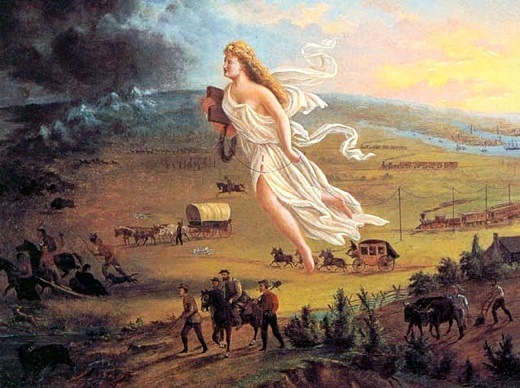
Image above: "American Progress", 1872 painting by John Gast became symbol of the myth of "Manifest Destiny". From (http://www.destinyschildren.org/en/timeline/the-us-mexican-war/manifest-destiny).

People who've never been to a wilderness area treasure the idea that they one day could. (This explains broad public support for Federal and State wilderness protections.) City dwellers think if they can learn how grow a tomato in a bucket they could live off the land - if needed. A person 'texting' while driving believes he'll never get in an accident, 'unlike those other dummies.' Here's the climate adaptation corollary : 'If it gets really bad, we'll move to upstate New York or to Saskatchewan or something and farmers farther north will grow more food for the nation.' Wrong.

Aside from the fact that the fantasy neighbors may not welcome a stream of climate refugees - absence of an NRA sticker on the front door does not, by the way, mean soup's on, come on in - such thinking is dangerously delusional.

The best land for raising cash crops in North America is already in production and that land could be vulnerable to flooding or drought. Looking out your airplane window and seeing all that seemingly vacant land between the coasts bears no evidence whatsoever on agricultural potential. There are no extra millions of green acres (that there might be, is the New Garden of Eden Myth).

In the US South, extended, severe drought has taken the upper hand over many farms. For details on what this may mean, see: Will Climate Again Drive US Internal Migrations? I also strongly recommend West Palm Beach Florida Has Just A Few Week's Worth of Water Left...Gulp

It's true there are good soils in the Great White North. But, the total combined acreage of such soils is small and the suitability for corn and soy is very limited. Take, for example, the New York State Soil, which is called Honeye Soil. There are only about 500,000 acres of it in the entire state - the best they have.
Honeoye soils are used for corn, soybeans, wheat, oats, vegetables, alfalfa, grass pasture and hay, and grape and apple orchards. Woodlots contain sugar maple, white ash, red and white oak, hickory, and associated species. These productive soils occur on about 500,000 acres in New York
Michigan's Kalkaska soil is mainly good for stumps, taters, and strawberries. That's why they make cars!
Kalkaska soils formed in sandy deposits left by the glaciers that once covered Michigan. These soils are used primarily for hardwood timber, namely sugar maple and yellow birch. Some areas are used for the production of Christmas trees or for specialty crops, such as potatoes and strawberries
The State of Washington has more than 1,000,000 acres of 'Tokul soils.' These State Soils are on the western side of the Cascade Mountains along the Puget Trough, from south of Seattle north to the Canadian border.

Keep in mind, the growing season along much of the northern border of the US, regardless of how good the State Soil happens to be, is relatively short compared to the former mesic prairie acres of Southern Minnesota, Iowa and Illinois, for example. These are the acreages that beat all others in productivity. If they are lost to climate change, we are in deep crap.

Also good to remember: the farmers in Saskatchewan are up on the hockey stick and know how to use it.

Bottom Line Don't assume that Southern farms lost to extreme drought will be replaced in the northerly states with similar cropping systems and that the replacement acres will reach comparable levels of productivity in time to save our obese asterisks.

Northern soils and cropping practices are very different than in the South; and, while the climate is in long-term transition there is no assurance that first and last frost dates in the north will be predictable and steady. No climate model has enough resolution to put a risk number on this issue. So ask yourself, do you feel lucky?

The best thing you can do for the climate is work hard to get out the vote for the next election. Sign up now..

Collapse and Continuity

SUBHEAD: Prunings of the Tree of Life, were essential to us: each cleared the field for new diversifications.

 By Robin Datta on 23 June 2011 for Nature Bats Last -  
(http://guymcpherson.com/2011/06/collapse-and-continuity)

 
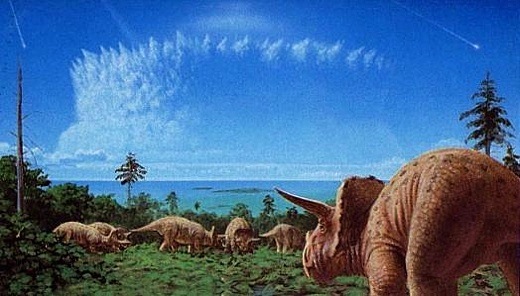
\Image above: Onset of mass extinction event that destroyed the dinosaurs. From (http://network.earthday.net/profiles/blogs/what-is-mass-extinction-are-we).
 
This is an attempt to address collapse in its greater temporal context.

Collapse is a regression that is perceived by the observer as a change of a large magnitude over a short period of time. This regression is in a direction towards the status quo ante. However, there can be many irreversible changes during the time interval measured from the status quo ante: in such cases collapse cannot produce an exact reversal to that prior state. Such regression is caused by the progressive and cumulative failures of essential components of a system, through their destruction, lack of maintenance, and/or lack of sustenance.

Collapse can occur in static systems as in the controlled demolition of a building, when the supporting structural elements are removed. In a dynamic system, such as a star, collapse occurs when the supporting forces, energy — generated through nuclear fusion — radiating outwards declines as the nuclear fuel is depleted: gravity is then unopposed.

A human society collapses when there is a progressive shortfall in meeting its needs. The most critical of these, as recognized by Abraham Maslow’s Hierarchy of Needs are the physiologic needs. Respiration is of such immediacy that it is usually considered a given. The other physiologic needs are hydration, nutrition, and homeothermy (the maintenance of body temperature, through clothing and shelter). While community and its corollaries including security are essential in a larger frame of reference, they presume the adequate sustenance of the physiologic needs.

Meeting the needs requires the provision of items of daily use including potable water, food, clothing, shelter, etc. All of these are ultimately derived from Nature: sunlight, arable land, flora and fauna, wind, water resources, energy sources, etc. and these constitute the primary economy.

Conversion of items from the primary economy into usable items in the secondary economy is by the direction of streams of energy with appropriate skills (= services). Some items in the secondary economy represent very large amounts of embedded energy, as in buildings, bridges and other infrastructure.

To facilitate the exchange and transfer items of the primary and secondary economies, symbolic representations of value are used. These can be cowrie shells, wampum, disks of base or precious metals (coins), printed paper issued by an authority wielding force (government issued paper money) or even magnetized particles or a hard drive. The symbols can be represented by other symbols, such as collateralized debt obligations, certificates of deposit, and other derivatives, and even derivatives of derivatives.

A dollar or a dime is the promise of the state (not the cashier at Wal-Mart) to make good the value it represents in items of the primary or secondary economies when the cash is tendered. This promise is redeemed by making the symbols “legal tender”: coercion, through the threat of force, to accept it as the medium of exchange.

The tertiary economy can be expanded by producing more symbols and derivatives, all of them promising to make good at some future date, their purported value, in items of the primary and secondary economy. Larger numbers and longer times to redemption make for “fiat growth” in the tertiary economy even when the primary and secondary economies may be contracting.

The critical factor in the industrial society that distinguishes it from prior societies is the ability to entrain massive amounts of energy. Harnessing sunlight by cultivation of plants and animals gave agricultural and pastoral societies an advantage over the prior hunter-gatherer paradigm. This exosomatic (originating outside the body) energy was far greater than the hunter-gatherers could command. It was increased further by many orders of magnitude when fossil fuels were harnessed. The endosomatic energy (originating inside the body) could be used to control exosomatic energy streams very many orders of magnitude greater.

Both agricultural and industrial exploitation of energy had limitations: arable lands and fossil fuels. But while arable lands may decline, appropriate practices can minimize this or even prevent it altogether. And depleted lands can be restored by careful management within decades — a human lifetime. Fossil fuels, on the other hand, take hundreds of millions of years to generate, and no such options are available to replenish them as their extraction proceeds apace.

Increased energy availability translates into increased availability of food: increased substrate in biological systems fosters growth and replication, In human terms this translates into increased populations. Populations increase pari passu with energy availability. Current human populations are sustained with significant undernutrition and starvation by the fossil fuel extravaganza. Depleting fossil fuels will result in depleting populations if energy availability declines with the fossil fuels: and as yet no alternate energy sources fill the bill, either in scalability or in energy return on energy invested.

Sustainability implies the continued fulfillment of the needs that maintain a system. In agriculture this can be approached by recycling the plant and animal (including human) waste/products back to the soil via composting. Fossil fuels however, cannot be recycled. Matter can and should be recycled.

Energy is a one-way street. The Three Laws of Thermodynamics (pertaining to energy) can be roughly summed up as:
1. Nothing is lost. 2. Everything turns to trash. 3. You cannot stop it or clean it up.


The Second Law reflects the direction of energy flows, from concentrated (low entropy) to dilute (high entropy). This implies the heat death of the universe, when the energy is evenly distributed throughout and puts a limit to sustainability. Sustainability comes with its time scale: when the scale is not mentioned, it is understood that it is so large that in is being excluded from consideration.

Marion King Hubbert’s time scale for petroleum depletion was derided and ignored until the reality loomed large. Then of course, every possible ploy was used to rebut and/or deny that prognostication, with little effect or mitigating the reality. Rather, they stalled any useful measures towards mitigation while the windows of opportunity were still open. With declining energy availability, any substantial adaptive changes to infrastructure are moot. The option to minimize trauma in this regression has been discarded.

Yet this tsunami is a wave, albeit of different magnitude and consequence. It is the first one in recorded history to affect humanity, but not the first bottleneck: it is estimated that at one time there were as few as six hundred breeding pairs of humans. There is less genetic diversity in all the nearly seven billion humans today than in a band of chimpanzees in the 3% of the DNA in which we differ from them. Our closest relative, the Neanderthals (now extinct for 32,000 years) had survived for 400,000 years — twice as long as we have.

Now, however, a substantial part of the carbon sequestered in fossil fuels through a combination of biologic and geologic processes over hundreds of millions of years is being released in hundreds of years by another of nature’s creations, another oscillation (or perhaps wild gyration) in the larger scheme of things as billions of individual human stories unfold in the denouement. The associated environmental impacts including pollution have engineered the sixth great extinction.

Extinctions, however, have been followed by luxuriant radiations, a diversification of the survivors, often from a very narrow origin. The derived branches carry traits marking their ancestral kinships. Prominent examples include the three pairs of legs in insects, the seven cervical (neck) vertebrae in mammals, and the bony configuration common to both the lobe-finned (sarcopterygian) fish and the four-limbed vertebrates (Tetrapoda — although some, including snakes and whales/dolphins have lost their limbs).

Yet the range of diversity in insects and mammals calls no attention to the limitations imposed by the three pairs of legs or the seven cervical vertebrae: the loss of biodiversity through repeated prunings is masked by the regrowth. Similar diversification could be hoped for after this sixth (and greatest) extinction.

These prunings of the Tree of Life, however, were essential to us: each of them cleared the field for new radiations and diversifications that were cumulative from pruning to pruning and made Homo sapiens possible. The pruning of dinosaurs made room for mammals — and for primates (monkeys, apes and humans). We owe our existence to (among other things) the prior great extinctions.

The time scale to any future radiation and diversification might be estimated by looking backwards at the last great extinction, the one that retired the dinosaurs, 65 million years ago. Taken in the perspective of our genus — Homo — 2,000,000 years old, our species — sapiens – 200,000 years old, agriculture 12,500 years, written language 3,000 years, the recovery from the present extinction is far outside any human cultural context. Indeed, it could well be up for debate whether or not Homo sapiens would be extant on that time scale as the species we know today — even under the best of circumstances.

The replenishment of fossil fuels would involve a time scale of several hundreds of millions of years, combined with some very fortuitous circumstances, both geologic and biologic acting in concert. Barring some near-miraculous technology, another industrial age for Homo sapiens is not in the cards. Should another intelligent species appear in that time period, the biological drives may leave it susceptible to overshoot and dieback if presented the opportunity for unconstrained growth. Overcoming these drives may require a preponderance of wisdom to guide decisions and actions.

It has been suggested well before the fossil fuel depletion era that the absence of evidence for intelligent life elsewhere in the universe may reflect similar drives leading any and all intelligent beings to overshoot and dieback – and possibly extinction.

But even on a smaller scale, the transition through the current collapse and its bottleneck may bode better for those endowed with a measure of wisdom.

• Robin Datta was born in Quetta, Pakistan in 1949. His father was one of three Hindu officers in the Pakistan Army, and a veteran of the Burma campaign of WW2 (Regimental Medical Officer). Robin attended nine different schools as his father was posted to different places. His mother was also an officer in the Nurse Corps of the British Indian Army in WW2. Mother’s native language Telegu, fatrer’s Bengali; common language English (British Raj for two centuries). Spoke English as first language, but had to unlearn it rapidly in NY. Also speaks Urdu, the lingus franca in those parts, natively.
 
Datta graduated with a medical degree from Bangladesh in 1972, and learned Bengali in the process. He learned history from the locals in order to graduate, and moved to New York in 1973. He served in the Army two years (one in Korea, and half a year in Desert Storm). Served three years in the Navy. Flight Surgeon in both branches of service.


Datta completed Family Practice Residency in Louisville, Kentucky, and passed board exams both in Family Practice and Emergency Medicine. He worked in Emergency Medicine 1983 to 2009 in Kentucky and California (San Jose, Hollister, Fresno). He is single (never married) and retired with no dependents.


Datta is not sure what to do next. Whatever it is, it must include the imminent collapse. He is open to any possibilities and suggestions.


.

Santa Isn't Bringing Gigawatts

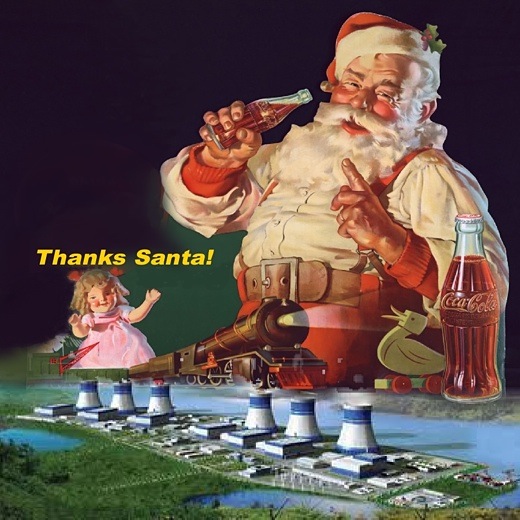
SUBHEAD: What energy resources will allow us to keep the electricity grid and cars running? - There aren’t any! By John Michael Greer on 22 June 2011 for ArchDruid Report - (http://thearchdruidreport.blogspot.com/2011/06/santa-isnt-bringing-gigawatts.html) Image above: Mashup of Coke and Areva ads by Juan Wilson. From (http://www.experiencingla.com/2010/12/happy-st-nicholas-day.html). Through the clouds of wishful thinking that too often make up what we are pleased to call a collective conversation on the subject of energy, a ray of common sense occasionally shines through. This week’s ray came by way of a study on the Earth’s thermodynamic balance, soon to be released in no less a scientific publication than the Proceedings of the Royal Society. The study found among other things that there’s a fairly modest upper limit to the amount of energy that wind farms can extract from the atmosphere without changing the climate. So far, at least, the peak oil blogosphere hasn’t responded to this study at all. That’s not surprising, since the idea that renewable energy resources might also be subject to environmental limits is about as welcome in most alternative circles these days as a slug in a garden salad. These days, for many people who consider themselves environmentally conscious, a vision of giant wind turbines in serried ranks as far as the eye can see fills a pivotal emotional need; it allows them to pretend, at least to themselves, that it’s possible to support today’s extravagant lifestyles on renewable energy – to have our planet, one might say, and eat it too. In the real world, things don’t work that way, but we’ve had a long vacation from having to deal with the real world. Three hundred years of ever-increasing production of fossil fuels have misled most of the population of the industrial world into thinking that it’s natural and normal to have as much cheap energy as you want and are willing to pay for. As petroleum production wobbles along a bumpy plateau and approaches the point of irreversible decline, and other fossil fuels move implacably toward their own peaks and declines, one of the prime necessities of sanity and survival involves unlearning the mental habits of the age of abundance, and coming to terms with the fact that all human activities are subject to ecological limits. It’s as though we’re a bunch of children with very, very short memories, who wake up one morning to find that it’s Christmas Day and there are heaps of presents around the tree. Giddy with excitement, we open one package after another, revel in our shiny new toys, then delight in the holiday atmosphere of the rest of the day. As night falls, we doze off, thinking happily about how there will be another round of presents and another big meal the next day. Then the next day comes, and it’s not Christmas any more; search as we will, the area around the tree stubbornly refuses to yield any more presents, and if we strain our memories as far as they will reach, we might just remember that the other 364 days of the year follow different rules. Especially in America, but not only in America, a great many people are basically sitting around on the day after Christmas, waiting for Santa Claus to show up with gigawatts of bright shiny new energy in his sack. The people who insist that we can keep our current lifestyles powered with giant wind farms or solar satellites or Bussard fusion reactors or free energy devices – that latter is what they’re calling perpetual motion machines these days, at least the last time I checked – are right in there with the folks who chant "Drill, baby, drill" in the fond belief that poking a hole somewhere in a continent that’s been more thoroughly prospected for oil than any other part of the Earth will somehow oblige the planet to fill ‘er up. I have too much respect for magic to dignify this sort of logic with the label of magical thinking; an initiate whose grasp of occult philosophy was that inept would be chucked out of any self-respecting magical lodge on the spot. The realization that has to come is the realization that most current chatter about energy is trying desperately to avoid: that Santa isn’t bringing gigawatts or, if you prefer, that no law of nature guarantees us a steady supply of enough energy to maintain the fabulously extravagant habits of the recent past. Once people begin to grasp that the only meaningful answer to the question "What energy resources will allow us to keep the electricity grid running and cars on the road?" is "There aren’t any," it’s possible to ask a different question – "What energy resources will allow us to provide for the actual necessities and reasonable wants of human beings?" – and get a more useful answer. That’s more or less the discussion I’ve been trying to further with the posts on energy here in recent months, in the course of surveying those ways of working with energy with which I have some personal experience—conservation first and foremost, but also homescale solar and wind power. There are also plenty of other other options that I haven’t worked with personally, and they also deserve to be brought into the discussion. "Micro-hydro" and "mini-hydro," for example, are potentially options of great importance in the broad picture of a post-abundance energy future, but they’re not options I’ve explored personally. The "hydro" in each of these phrases, of course, is short for "hydroelectric;" micro-hydro is homescale hydroelectric power, usually produced by diverting a small amount of a stream or river on one’s property through a small turbine and using the latter to spin a generator. Back in the day there was a certain amount of work done with simple undershot waterwheels made from scrap metal, hooked up to truck alternators of the sort discussed in an earlier post on wind; I have no personal experience with how well these worked, but the concept may well be worth revisiting. Mini-hydro is the next step up, hydroelectric power on the scale of a neighborhood or a rural town. Unlike what I suppose would have to be called mega-hydro, this doesn’t require damming up whole river basins, devastating fish runs, and the like; a small portion of a river’s flow or a small and steep stream provide the water, and the result under most circumstances is a supply of sustainably generated electricity that doesn’t suffer from the intermittency of sun and wind. Of course it depends on having the right kind of water resource close by your community, and that’s a good deal more common in some areas than others; it also requires a good deal more investment up front; but if you can get past those two obstacles, it’s hard to think of a better option. Small amounts of electricity can be generated in a variety of other ways. Still, one of the great lessons that has to be grasped is that the thermodynamic costs of turning some other form of energy into electricity, and then turning the electricity back into some other form of energy such as rotary motion or heat, can be ignored only if you’ve got a half billion years or so of stored sunlight to burn. There are situations where those losses are worth accepting, but not that many of them, and if you can leave the energy in its original form and not take it through the detour into electricity, you’re usually better off. Methane is an example. Methane production from manure on a small scale is a going concern in quite a few corners of the Third World; you need more raw material than a single human family will produce to get a worthwhile amount of gas, but small farms with livestock yield enough manure to keep a small kitchen stove fueled on this very renewable form of natural gas. (The residue still makes excellent raw material for compost, since only the carbon and hydrogen are involved in methane production; the nitrogen, phosphorus, potassium, and other plant nutrients come through the process untouched.) Since cooking fuel is higher on the list of basic human necessities than most things you can do with modest amounts of electricity, this is probably the best use for the technology. Flatulence jokes aside, I don’t have any personal experience with small-scale methane production. Wood heat, on the other hand, is a technology I’ve worked with, and it’s probably going to be a major factor in the energy mix in North America in the future. It’s a simple, robust technology that works very well on the home scale – in fact, it’s not too easy to use it on any larger scale – and many wood stoves come with what’s called a waterback, which uses heat from the stove to heat domestic hot water. Combine solar water heaters with a cooking stove equipped with a waterback, and you’ve basically got your hot water needs covered year round. The problem here is that wood heat is a major cause of deforestation worldwide; whether or not too much windpower can mess with the climate, as the study referenced earlier in this post suggests, it’s a hard fact that too much harvesting of wood has devastated ecosystems over much of the world and caused a range of nasty blowbacks affecting human as well as biotic communities. There’s at least one way around that problem, though it needs to be implemented soon and on a large scale A very old technique called coppicing allows for intensive production of firewood off a fairly small acreage. The trick to coppicing is that quite a few tree species, when cut down, produce several new shoots from the stump; these grow much more rapidly than the original tree, since they have their root system already well in place. When the shoots get to convenient firewood size, the coppicer cuts them again, and yet another set of shoots come up to repeat the process. I’ve dabbled in coppicing – the vine maple of the Pacific Northwest, which grows like a weed and produces decent firewood, made that easy enough, and other regions have their own equivalents. As other fuels run short, the owner of a few acres who uses it for coppicing and sells dry wood nicely sized for wood stoves may have a steady income, or at least a perennial source of barter, on his or her hands. Biofuels such as ethanol and vegetable oils are another source of heat energy that will probably see a great deal of use in the future, though here again the limits on production are not always recognized. In a world with seven billion mouths to feed and an agricultural system at least as dependent on fossil fuels as any other part of industrial civilization, diverting any substantial portion of farmland from growing food to producing biofuels risks a substantial political backlash. I wonder how many of the proponents of biofuels production have thought through the consequences of a future in which the hazards of driving might just include being stopped by makeshift barricades and torn to pieces by an impoverished mob that is all too aware that every drop of ethanol or biodiesel in the tank represents food taken from the mouths of their children. Biofuels are likely to play some role in the early stages of the end of the age of abundance, then, but thereafter, at least until the world’s human population and post-petroleum agriculture have settled down into some sort of equilibrium, it’s unlikely that this role will be very extensive. Later on, it’s anyone’s guess, and the answer will be up to the people of the twenty-fourth century and onward, not us. Methane, wood, and sunlight, then, will probably account for the great majority of heat energy in common use in the centuries immediately ahead of us. What about mechanical energy? The breakthrough that launched the industrial revolution was the discovery that heat from burning coal could be turned into mechanical energy by way of a steam engine, and much of what sets our civilization apart from other civilizations in history is precisely the ability to put almost unimaginable amounts of mechanical energy to work. If a car with a 100-horsepower engine literally had to be pulled by a hundred horses, for example, and each of those horses required the care and feeding that horses do, the number of such cars on the roads would be a very small fraction of the present total. There are good reasons, some historical and some pragmatic, to think that the major source of mechanical energy in the post-abundance future will be what it was in the pre-abundance past, that is, human and animal muscle, amplified by a variety of clever tools. If anything, some of the more ingenious inventions of the last few centuries make muscle power even more useful now, and in the centuries ahead of us, than it was before the first steam engine hissed and groaned its way into a new age of the world. The extraordinary efficiency with which a bicycle converts muscular effort into movement is a case in point. The relatively simple metallurgy and engineering needed to build a bicycle is very likely to survive into the far future, or to be reinvented after some more or less brief interval, and the sheer value of a technology that can move people and supplies a hundred miles a day on decent roads will hardly be lost on our descendants. It’s far from unlikely, for example, that wars will be won in the post-petroleum era by those nations that have the common sense to equip their infantry with bicycle transport. More generally, the invention of really effective gears may turn out to be one of the nineteenth century’s great contributions to the future. The Roman world had some very complex machines using cogs and gears, but the designs used at that time did a poor job of transmitting power; gearing systems originally evolved in the late Middle Ages for clockwork underwent dramatic changes once steam power created the need to transfer mechanical motion as efficiently as possible from place to place and from one direction to another. Once invented, effective gears found their way back down the technological pyramid to the realm of hand tools; anyone who has ever compared beating egg whites with a spoon to doing so with a hand-cranked beater will have a very clear idea of the difference in effort that such simple mechanical devices make possible. That difference may not seem like much in comparison to the gargantuan achievements of current fossil fuel-powered technology, or the even more grandiose fantasies served up by a good many of those who insist that the end of the age of petroleum must, by some kind of technological equivalent of manifest destiny, usher in the beginning of the age of some even more titanic energy resource. Still, if these claims amount to sitting around the chimney on December 26 waiting for Santa’s boots to appear – and I think a very good case can be made for the comparison – it’s past time to shelve the fantasies of limitless energy and the hubris that goes with them, and start paying attention to the tools, technologies, and modest but real energy sources that can actually have a positive impact on human existence in an age when only natural phenomena have gigawatts at their disposal any more. .

NY okays LGBT Marriage

SUBHEAD: New York State legislature votes to legalize same-sex marriage.  

By AP Staff on 24 June 2011 in NPR.org - 
  (http://www.npr.org/2011/06/24/137409547/n-y-legislature-votes-to-legalize-same-sex-marriage?sc=17&f=1001)

Image above: On February 27, 2004, New Paltz Mayor Jason West married 25 same-sex couples before a cheering crowd in front of the New Paltz Village Hall. From (http://clubs.calvin.edu/chimes/article.php?id=6819).

 New York lawmakers narrowly voted to legalize same-sex marriage Friday, handing activists a breakthrough victory in the state where the gay rights movement was born. New York will become the sixth state where gay couples can wed and the biggest by far. "We are leaders and we join other proud states that recognize our families and the battle will now go on in other states," said Sen. Thomas Duane, a Democrat.

Gay rights advocates are hoping the vote will galvanize the movement around the country and help it regain momentum after an almost identical bill was defeated here in 2009 and similar measures failed in 2010 in New Jersey and this year in Maryland and Rhode Island. Though New York is a relative latecomer in allowing gay marriage, it is considered an important prize for advocates, given the state's size and New York City's international stature and its role as the birthplace of the gay rights movement, which is considered to have started with the Stonewall riots in Greenwich Village in 1969.

The New York bill cleared the Republican-controlled state Senate on a 33-29 vote. The Democrat-led Assembly, which passed a different version last week, is expected to pass the new version with stronger religious exemptions and Democratic Gov. Andrew Cuomo, who campaigned on the issue last year, has promised to sign it. Same-sex couples can begin marrying 30 days after that. The passage of New York's legislation was made possible by two Republican senators who had been undecided. Sen. Stephen Saland voted against a similar bill in 2009, helping kill the measure and dealing a blow to the national gay rights movement. "While I understand that my vote will disappoint many, I also know my vote is a vote of conscience," Saland said in a statement to The Associated Press before the vote. "I am doing the right thing in voting to support marriage equality."

Gay couples in gallery wept during Saland's speech. Sen. Mark Grisanti, a GOP freshman from Buffalo, also said he would vote for the bill. Grisanti said he could not deny anyone what he called basic rights. The effects of the law could be felt well beyond New York: Unlike Massachusetts, which pioneered gay marriage in 2004, New York has no residency requirement for obtaining a marriage license, meaning the state could become a magnet for gay couples across the country who want to have a wedding in Central Park, the Hamptons, the romantic Hudson Valley or that honeymoon hot spot of yore, Niagara Falls.

 New York, the nation's third most populous state, will join Connecticut, Iowa, Massachusetts, New Hampshire, Vermont and Washington, D.C., in allowing same-sex couples to wed. For five months in 2008, gay marriage was legal in California, the biggest state in population, and 18,000 same-sex couples rushed to tie the knot there before voters overturned the state Supreme Court ruling that allowed the practice.

The constitutionality of California's ban is now before a federal appeals court. While court challenges in New York are all but certain, the state — unlike California — makes it difficult for the voters to repeal laws at the ballot box. Changing the law would require a constitutional convention, a long, drawn-out process. The sticking point over the past few days: Republican demands for stronger legal protections for religious groups that fear they will be hit with discrimination lawsuits if they refuse to allow their facilities to be used for gay weddings. The climactic vote came after more than a week of stop-and-start negotiations, rumors, closed-door meetings and frustration on the part of advocates.

Online discussions took on a nasty turn with insults and vulgarities peppering the screens of opponents and supporters alike and security was beefed up in the capitol to give senators easier passage to and from their conference room. The night before, President Barack Obama encouraged lawmakers to support gay rights during a fundraiser with New York City's gay community. The vote also is sure to charge up annual gay pride events this weekend, culminating with parades Sunday in New York City, San Francisco and other cities.

Despite New York City's liberal Democratic politics and large and vocal gay community, previous efforts to legalize same-sex marriage failed over the past several years, in part because the rest of the state is more conservative than the city. The bill's success this time reflected the powerful support of Cuomo and perhaps a change in public attitudes.

Opinion polls for the first time are showing majority support for same-sex marriage, and Congress recently repealed the "don't ask, don't tell" policy that barred gays from serving openly in the military. In the week leading up to the vote in New York, some Republicans who opposed the bill in 2009 came forward to say they were supporting it for reasons of conscience and a duty to ensure civil rights. Pressure to vote for gay marriage also came from celebrities, athletes and New York City Mayor Michael Bloomberg, the Republican-turned-independent who has long used his own fortune to help bankroll GOP campaigns and who personally lobbied some undecided lawmakers.

Lady Gaga has been urging her 11 million Twitter followers to call New York senators in support of the bill. While the support of the Assembly was never in doubt, it took days of furious deal-making to secure two Republican votes needed for passage in the closely divided Senate. Representatives of the Roman Catholic Church, Orthodox rabbis and other conservative religious leaders fought the measure, and their GOP allies pressed hard for stronger legal protections for religious organizations.

Each side of the debate was funded by more than $1 million from national and state advocates who waged media blitzes and promised campaign cash for lawmakers who sided with them. But GOP senators said it was Cuomo's passionate appeals in the governor's mansion on Monday night and in closed-door, individual meetings that were perhaps most persuasive. The bill makes New York only the third state, after Vermont and New Hampshire, to legalize marriage through a legislative act and without being forced to do so by a court. [Copyright 2011 The Associated Press]

 .

Community Meeting on KIUC

SUBHEAD: It became clear that KIUC board members do not and never had any intention of seeking mutual agreement with the Kauai Community. By Elaine Dunbar on 24 June 2011 in Island Breath - (http://islandbreath.blogspot.com/2011/06/community-meeting-on-kiuc.html) Image above: Ols West salesman sells Snake Oil to the general public. From (http://planetpov.com/2011/04/22/the-republican-snake-oil-salesmen). Last night Adam Asquith and others offered some sincere alternatives in the spirit of coming together and mediating; for instance, take FERC out of the deal, extend the voting deadline, recall the ballot. It became clear that KIUC board members do not and never had any intention of seeking mutual agreement by their firm reluctance to even consider anything except stay the course. The cheerful and agreeable willingness to continue community engagement has a leash on it; they will attend meetings until the cows come home, but their position is set in stone. A PR charade. Bisselʻs original statement that if the community does not want this, we wonʻt go forward was just hot air. Ben Sullivan, last night, added unnecessarily, to the contentiousness by his comment of the meeting being ʻpolarizedʻ; this was countered eloquently by a local lady who said she came to the meeting to try to understand what was going on and didnʻt appreciate being accused of being ʻpolarizedʻ......as she had not even gained knowledge at that point to have an opinion. She came there to learn. I came to the point of directing questions only to Carol Bain for direct, unmuddied answers. Ben Sullivan does not seem to grasp the details nor the whole picture or maybe he is just intent to stay KIUCʻs course; I canʻt and wonʻt tolerate spin, especially ill informed spin. Carol provided a direct answer, without delay, on the procedure to protect and process the ballots. She stated the ballots are received and handled by a 3rd party to their POBox and not opened until the day the votes will be counted and that the counting will be overseen by people chosen to monitor. Ben had informed me that it would take several days to provide this information. Thanks to Carol, I was satisfied with her efficient response. Stewart Burley who described himself as a risk management person, when asked why he didnʻt foresee risk potential before the MOA was signed without communicating with the public first, was rather vague in his answer and quickly digressed to submarines. There were some things they refused to respond to such as the amount of Membersʻ money spent so far, in ad campaigns to influence the Members to vote ʻYesʻ. Or the fact that canceling the contract with FFP would amount to millions as opposed to the $350,000 figure being tossed around. KIUC has created the polarization because, simply, they did not respect the local community enough to engage with them BEFORE the action was taken. Myself, I can only assume this occurred because they either have some other agenda or they think we donʻt know any better and are incapable of making informed decisions. I would hope that now they know we are. To date, there still has been no commitment from the KIUC board to honor a legally mandated responsibility to address Native Hawaiian concerns. This is something that should have been done at the onset, before the secret Memorandum of Agreement. They skate the issue every time someone brings it up and say they will get to it. I would think this is part of the due diligence that needed to be done before the MOA. And, as well, the Lawful Hawaiian Government filed a Notice of Objection, Cease and Desist with FERC, KIUC and FFP. Many would like to hear that addressed by KIUC in their ability to move forward and how they intend to respond. In Joan Conrowʻs excellent piece in the Honolulu Weekly Kauaiʻs Hydro Battle , one part by Isaac Moriwake, Earthjustice attorney, jumped out as particularly alarming: "Hawaii has very strong and nationally recognized protections regarding stream flows and Native Hawaiian rights. That stands to be completely wiped out by what KIUC is doing, and it seems theyʻre doing it for that purpose," And with that said, KIUCʻs MOA has become a more dangerous matter now. See also: Ea O Ka Ania: KIUC's Smoke Filled Room 6/18/11 Ea O Ka Aina: Kauai's Hydro Battle 6/24/11 .

Lepeuli Access gets hearing

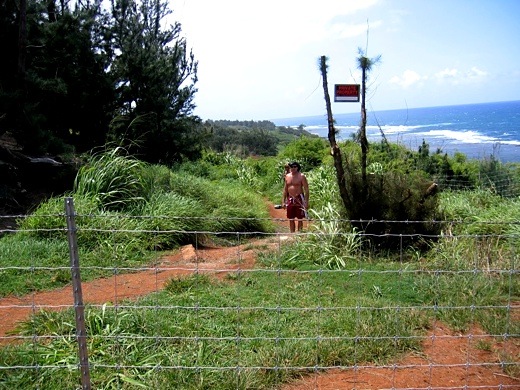
SUBHEAD: After petioning the Planning Commission in April the Lepeuli (Larsons) Beach access will get hearing. By Richard Spacer on 23 June 2011 for Island Breath - (http://islandbreath.blogspot.com/2011/06/lepeuli-access-gets-hearing.html) Image above: Hiker finds Alaloa Trail blocked illegally by cattle fence. From (http://kauainaturists.blogspot.com/2011/05/fencing-blocking-lateral-trail-at_2856.html). My petition has the goal of revoking the Special Management Area Permit (SMA Permit) of Paradise Ranch, owned by Bruce Laymon, to do work at Lepeuli. Specifically, I am asking the Planning Commission to issue Order To Show Cause to Paradise Ranch because I allege Paradise Ranch has consturcted illegal fencing across the gradual, lateral trail to Lepeuli (Larsen's) Beach in direct violation of Condition 6 of the SMA permit, issued by then Planning Director Ian Costa. Additionally, the fencing is illegal as it is located within 300 feet of the shoreline. The State Land Use Commission states the mauka boundary of the state Conservation District is 300 feet mauka of the shoreline in this part of Kauai. The map of Paradise Ranch private surveyor Hiranaka is inaccurate and incorrectly depicts the fencing as outside the Conservation District, when in fact, it is inside the Conservation District. As Bruce Laymon no longer has a state Conservation District Use Permit to do work within 300 feet of the shoreline, that part of the fencing blocking off the gradual, lateral trail is illegal. The state Department of Land and Natural Resources could fine Bruce Laymon $15,000. per day for each day of this illegal work. Paradise Ranch, through their attorney Lorna Nishimitsu, lied in order to obtain this SMA permit. I intend to prove this before of the Planning Commission. It is alleged in the application paperwork for the SMA permit that there are no endangered or protected species like albatross, monk seals, or green sea turtles in the subject property, Lepeuli. It is alleged there is no archaeology, yet Dr. David Burney of the National Tropical Botanical Institute surveyed and studied a feature at the north end of the beach which includes paving stones, possibly the foundation of a structure. Dr. Burney estimated the date of the sturcture, based upon radiocarbon dating, to be from 1650-1700 AD. This is pre-European contact, an "ancient" feature. Because of the existence of this archaeology, the federal funding from the National Resource Conservation Service, part of the US Department of Agriculture, was cut off. The amount originally funded was $73,500. This is our tax dollars that was intended to keep us out of the gradual, lateral trail. Paradise Ranch had originally intended to install fence 110 feet behind the beach, running parallel to the beach, all the way across Lepeuli from the boundary at Kaakaaniu to Waipake, but Paradise Ranch surrendered their state permit to do this in January, as a direct result of pressure from activists like myself, Malama Moloaa, Sierra Club, Surfrider, etc. The Vice President of Waioli Corporation, Charles "Bill" Spitz, told activists in January we had cost them over $40,000. in legal fees. Additionally, Bruce Laymon has told beach goers, who have a right to be on this PUBLIC beach, various things such as a comment made to a gay couple personally known to me, "This is MY beach, get the f***k out of here", and to Colorado visitor Dennis Bosio "Next week we are going to have 50 Hawaiians down here and RUN you haoles out of here." And to me "Next week we are going to have 100 Hawaiians down here. We are going to take back our beach...Richard Spacer!!!!!!!" On January 19, while installing two fence post/boundary markers, a young lady trying to go to the beach via the gradual, lateral trail was stopped by Bruce Laymon and his crew, and told she would be tresspassing and she had to use the steep trail the county obtained in August 2010 from Waioli Corporation. She asked Bruce Laymon WHY he was installing fencing. He replied "To keep the nudes, gays and hippy campers away from the beach." This bigoted and hateful attitude is why the group Kauai Naturists was formed, of which I am the president. Blocking off the gradual, lateral trail will not prevent any of the people mentioned from reaching the beach. It WILL prevent the senior citizens, those with mobility issues, parents with very young children, etc. from reaching the beach. I urge all who support the cause of public access to beaches that is safe and easy for all to attend the Planning Commission hearing Tuesday, June 28 at 9 AM in room 2A-2B of the Moikeha Building in the Kauai County complex at 4444 Rice Street, Lihue. Mahalo. Following is top part of the meeting agenda. KAUA'I PLANNING COMMISSION REGULAR MEETING Tuesday, June 28, 2011 [9;00 A.M.J Lihue Civic Center, Moikeha Building Meeting Room 2A-2B 4444 Rice Street, Lihue, Kauai, Hawaii AGENDA Call to Order Approval of the Agenda Receipt of Items for the Record A. GENERAL BUSINESS MATTERS (For Action) Item 1. Letter of Transmittal, Status Report and Time Extension request by Katie Davis of EnviroServices and Training Center LLC for the Department of Transportation, Airport Division, as required by Condition No. 8 of Special Management Area Use Permit Item 2. Director's Report and Recommendations concerning Petitioner Richard Spacer's April 18, 2011 Request for the Commission to Issue an Order to Show Cause pursuant to Chapter 12 of its Rules of Practice and Procedures (June 20, 2011) re Special Management Area Minor Permit SMA (M)-2009-6, Tax Map Key (4) 5-1-003: 003. .

Kauai's Hydro Battle

SOURCE: Ken Taylor (taylork021@hawaii.rr.com)
 SUBHEAD: This is a decision that will be made in this community, by this community.  

By Joan Conrow on 22 June 2011 for Honolulu Weekly - 
  (http://honoluluweekly.com/cover/2011/06/kauais-hydro-battle)

 
Image above: TVA Fort Peck Dam on cover of the first pictorial Life Magazine on 11/23/1936 From (http://www.milkintheclock.com/2008/11/first-issue-of-life-is-published/).

 Hawaii has very strong and nationally recognized protections regarding stream flows and Native Hawaiian rights. That stands to be completely wiped out by what KIUC is doing, and it seems they’re doing it for that purpose. Isaac Moriwake COVER Farmer Jerry Ornellas bristled when he read in the local newspaper that Kauai Island Utility Cooperative (KIUC) was looking to develop a hydroelectric project on the Wailua reservoir. It was the first he’d heard of it, and that rankled, considering he was president of a water users cooperative whose system includes the reservoir.

“They know who we are,” Ornellas said. “You’d think they would have given us the courtesy of a call. But they never said a word.” The Robinson family was equally vexed to discover they had not been consulted on plans to study hydro on land in western Kauai they have owned for more than a century. Conservationists, meanwhile, were outraged to learn that a twice-bitterly-beaten-down plan to dam the Wailua River apparently had been resurrected.

Thus began KIUC’s clumsy foray into hydroelectric development under a federal process that allows investors to stake a claim, gold rush-style, on rivers and irrigation ditches. The utility actually followed the lead of Free Flow Power (FFP), a Massachusetts-based consortium of consultants and investors that filed the permit applications that created a community uproar.

The utility became embroiled when it bought Free Flow’s permits and hired the firm to guide it through a hydro development process administered by the Federal Energy Regulatory Commission (FERC) in Washington, DC. It’s a process that has been attempted in Hawaii, but never completed, and Sen. Daniel Akaka has unsuccessfully sought legislation to prevent its use in the Islands. The core concern is whether the FERC process will respect the state’s progressive water code, particularly its instream flow standards, which determine the quantity, flow and depth of water required to protect the various uses of a specific stream.

Others wonder if federal bureaucrats–given their unfamiliarity with Hawaii’s unique cultural, environmental and historical characteristics–can be reasonably expected to set the right standards. Whether or not Hawaii residents can effectively participate in a proceeding based in Washington, DC has yet to be determined. For all those reasons, KIUC’s decision to take the FERC route has raised suspicion and resistance. But the secrecy surrounding the initial applications, and uncertainty about exactly what might be developed, has also fed the opposition.

KIUC claims it is too early to discuss project plans, and regardless of what Free Flow wrote on the applications, it is not going to build any dams. “These permits just give us the right to do feasibility studies,” says David Bissell, chief executive officer of KIUC, a member-owned utility cooperative. “We are just at the very preliminary stages of trying to see what’s possible.”  

Hindu Monks Oppose

Not everyone is convinced. “All we have to go on is what’s in their applications,” said Rev. Easan Katir, a monk at Kauai’s Hindu monastery. The monks, who normally eschew political activism, are vigorously opposing the utility’s proposed hydro projects on the Wailua River, which runs through the monastery’s grounds and feeds the East Kauai Water Users Cooperative they helped to form. FERC opponents are leery of both Free Flow and the process that brought it into a relationship with KIUC. “Free Flow Power has never done hydro development,” said Adam Asquith, a taro farmer and Universiy of Hawaii Sea Grant extenson agent on Kauai.

 Keeping the Flow

Bissell maintains that the non-profit utility cooperative will benefit from having FFP manage the process, which he says offers insurance that KIUC will not be edged out by a private developer who would charge more for any electricity generated. He also says that without FERC, hydro has no future at KIUC. “I would not recommend we go forward investing possibly millions of dollars without the FERC process because a for-profit developer could jump in front of us,” Bissell said. To stake its own claim, KIUC purchased the shell companies that FFP formed to file six applications on waterways from Hanalei to Kekaha.

FERC has already approved three, giving KIUC preliminary permits that carry the exclusive right to study hydroelectric development for three years. Bissell said no specific price was placed on the applications, which were purchased as part of a larger consulting contract. The utility has refused to disclose the full value of the contract, which includes an incentive for delivering completed projects, but KIUC attorney David Proudfoot said FFP will be paid “several million dollars if none go past the first stage.”

In response, Asquith led a petition drive that is forcing KIUC to put its FFP contract to a vote of its members, with ballots being mailed out this week. Although FERC opponents have little money for advertising, the monastery funded a full-page informational ad in the Kauai newspaper, and citizens have used social media and the Island’s community radio station and public access television station to take their message to co-op members.

 Navigating the Waters

Meanwhile, the East Kauai Water Users Cooperative, County of Kauai, Department of Hawaiian Home Lands (DHHL) and State Agricultural Development Corporation filed formal petitions to intervene in the FERC permits, and the state attorney general’s office apparently plans to take similar action.

 “Why go to Washington, DC, to decide how Hawaii streams are managed?” said William Tam, deputy director of the Hawaii Commission on Water Resources and Management. “It is hard to understand some facts when you’re 5,000 miles away. Written statements do not always tell the whole story.” Tam has taken no stand on the current KIUC permits. The matter may come before the Water Commission, and he has not thoroughly reviewed the applications. But he is familiar with FERC from his earlier tenure in the State attorney general’s office.

Between 1989 and 1991, the State opposed FERC jurisdiction over three proposed hydroelectric projects for the upper and lower Wailua River and the Hanalei River. The State objected on the grounds that the projects were not located on “navigable waters,” as provided under the Federal Power Act, and that FERC would assert its authority over in-stream flow standards.

The State Water Code vests that authority to the State Water Commission, which is charged with managing Hawaii’s stream water–a public trust resource–for cultural, ecological and economic purposes. While a California court recognized FERC’s authority to set instream flow standards and another court upheld the State of Washington’s right to set Clean Water Act standards, those questions remain untested in Hawaii, because no FERC hydro project has ever been built in the Islands. However, the issue of FERC jurisdiction has been addressed, at least in part.

On June 2, 1989, FERC ruled that it had no jurisdiction over a proposed “lower Wailua” project–a diversion dam about 1,000 feet upstream from Wailua Falls with a powerhouse about .9 miles upstream of the Fern Grotto–because “the Wailua River has not been shown to be a navigable water at the site of Island Power Co.’s proposed project.” On July 18, 1991, FERC issued an order stating that federal licensing was not required for Island Power’s proposed “upper Wailua” project–again because the site was not on “navigable waters.”  

License to Flow

In 1990, however, FERC ruled that it had the authority to issue “voluntary licenses” for a proposed project on the Hanalei River because it constitutes “Commerce Clause waters.” These are defined as “any waterway within the United States…where…water will ultimately end up in public waters such as a river or stream, tributary to a river or stream, lake, reservoir, bay, gulf, sea or ocean either within or adjacent to the United States,” which is true of virtually all streams in Hawaii. Developers ultimately dropped all three projects, leaving unanswered the question of whether federal or state interests prevail. In light of these decade-old orders, Tam said, it is not correct for KIUC to claim that the FERC process is required for the Wailua River. Nor is it accurate to claim that FERC is the only way to secure priority for a project. “The applicant will have to obtain an option or a lease from the landowner at some point,” he said. “Do it up front. No one else will be able to use the property.” Asquith said the KIUC Board could “level the playing field” simply by passing a resolution refusing to buy electricity from any project developed under a FERC permit. KIUC officials say it is too early in the process to sign a lease or obtain an option, because they are uncertain which locations may bear fruit.

Besides, they say, FERC offers the benefit of a clear roadmap for developing hydro, which is lacking at the state level. “It’s a well-defined, transparent process that requires intensive involvement by all stakeholders,” Bissell said. “It gives stakeholders a seat at the table on these important resources people feel very passionate about. It’s really not a way to circumvent the state process.”

KIUC board members also have vowed to secure all the state permits needed for a hydro project. While the FERC process is relatively common in the western United States, Tam does not believe it is appropriate for Hawaii. First, the methodology for determining stream flows on the Mainland is “very different” than what is used in Hawaii, he said. There is also the distance factor. “There just is not a similar ability to participate.

You have to go to Washington to participate in hearings about what is happening in Hawaii streams. We think those kinds of decisions should be made here.” Isaac Moriwake, an Earthjustice attorney who has litigated water use issues on Maui, agrees. “Hawaii has very strong and nationally recognized protections regarding stream flows and Native Hawaiian rights. That stands to be completely wiped out by what KIUC is doing, and it seems they’re doing it for that purpose,” he said.  

A Matter of Trust

The (DHHL) raised similar concerns in its intervention request. “Hawaii law grants DHHL priority over other users of the State of Hawaii’s water resources, including water in the East Kauai Irrigation System, which encompasses the Wailua Reservoir. In addition, a preliminary permit would afford [KIUC] certain priorities that may interfere with DHHL’s current and future development of the area’s hydrologic resources.” Asquith was also disturbed by that prospect. “Water in Hawaii is a highly provincial resource, hydrologically, socially, culturally–even the rain has a different name in each valley,” he said. “It is impossible to convey the depth of the value of water to someone who hasn’t taken time to understand it. The FERC bomb was just this horrific breach of protocol that was shocking to me.”

 The insensitivity displayed by KIUC and FFP, both of which failed to consult key players before filing permit applications, and the prospect of working through a federal process that he termed “more procedural than substantive” motivated Asquith to mount the petition drive. In addition to forcing a vote on the FFP contract–ballots must be cast by July 8–the petition drive also required KIUC to host a general membership meeting, which was held June 4.

More than 100 people attended. Most expressed concerns, grievances and reservations in testimony that spanned the better part of a day. “I support hydro, but in good conscience, how can I vote yes when I don’t know what it’s going to entail, is all I’m saying,” testified Mark Sueyasu, who identified himself as a west Kauai hunter. Puanani Rogers said the utility should have met with Native Hawaiians before moving forward, prompting Bissell to reply that such consultation “is very high on our priorities.”

 “You’ve run off down this road in secret…without having the community on board, and I think that’s the core of your problem,” said Les Brosnan, who noted that in its earlier forays into alternative energy, KIUC “chose weak partners that are still flailing around and have failed to deliver.” Some, however, urged KIUC to move ahead. Among them was Councilwoman JoAnn Yukimura, who said she believes that ending the Free Flow contract “will stop our in-house efforts to develop hydro.”

 That spurred others to address Bissell’s desire to “get the discussion out of the FERC process and into hydro,” which apparently prompted the utility to distribute hand-held paper fans that read “hydros” on one side and “yes!” on the other. “KIUC has successfully blurred the reason for this meeting,” said Elaine Dunbar, who helped collect petition signatures. “It’s not about hydro. It’s about secrecy and an improper process.” Criticism about the process spilled over into KIUC’s approach to the upcoming vote, including its preparation of a “voter guide” that focused on hydro, with no reference to the petitioners’ concerns about FERC. Petitioners said it seemed unreasonable that KIUC had written the pro and con arguments. KIUC attorney Proudfoot disagreed.

“The Board voted for [the Free Flow contract]. They are entitled to support it. They are not required to help others who don’t support it with the member’s money. That’s why it’s clearly labeled ‘KIUC voters guide.’” Despite edging petitioners out of that particular process, and acknowledging past failures with consultations, KIUC officials said they are fully committed to carefully considering public concerns as they explore hydroelectric development. “This is a decision that will be made in this community, by this community,” said KIUC director, Jan TenBruggencate. Bissell offered his own exhortations at the meeting.
“I encourage everyone to have trust in KIUC, have trust in your elected board, have trust in me and, most importantly, have trust in yourself. The only way these projects will go forward is through overwhelming community support.”
Therein seems to lay the crux of the conflict. “If KIUC cannot conduct a single meeting in a manner which addresses the acknowledged intent of the petition and the clear interest of the people attending, how can they possibly conduct complicated community interactions on hydro?” Asquith questioned, in a widely circulated email. “If they cannot refrain from shameful ballot propaganda that completely distorts the intent of the petition and vote, how can they possibly deliver a balanced presentation on hydro?” Or as Kapaa resident Glenn Mickens noted during a break in the meeting:
“There’s only one reason we’re here. It’s a matter of trust. From the get-go, there’s this underlying mistrust for KIUC.
And overcoming that mistrust ultimately may prove more difficult for the utility than successfully developing hydroelectric under any process.  

Plenty water but no kokua

With one of the world’s wettest places at its summit, Waialeale receives 424 inches of rain each year. Many of Kauai’s numerous streams derive from the lush hilltop, feeding sugar and pineapple plantations and generating the hydroelectric power that ran the plantations’ mills and camps. McBryde Sugar Co. built a plant on the north shore’s Wainiha River in 1905 that continues to generate about 3.6 megawatts of power for Kauai Island Utility Cooperative, while also serving the needs of Kauai Coffee. Seven smaller systems–five of them privately owned–produce another 5 megawatts for the utility. Together, they account for about 15 percent of the island’s total power generation. While several hydro projects were proposed for the Wailua and Hanalei rivers in recent decades, they were all stalled by environmental concerns, community opposition and funding problems.

.

Moloaa Bay Ranch For Sale

SUBHEAD: Moloaa Bay Ranch Is For Sale!! Let the buyer be aware of the Alaloa Trail.  

By Hope Kallai on 23 June 2011 for Free Larson's Beach -   
(http://freelarsensbeach.com/2011/06/23/moloaa-bay-ranch-is-for-sale-let-the-buyer-be-aware-of-the-alaloa/)


Image above: Walking the Alaloa Trail as it passes through Molakai Ranch 9/8/2005. Photograph by Juan Wilson.


Remember – The Coastal Alaloa segment managed by Na Ala Hele Trail and Access System runs through Moloaa Bay Ranch.
 
Here's the offering: Moloa`a Bay Ranch For Sale! Coldwell Banker Bali Hai Realty
Price $20,000,000 Prop Tax.$21,267 MLS#245878 Moloaa Bay Ranch – 170 Pristine Acres now offered in its entirety or as 20 separate parcels.

Enjoy the ever changing ocean vistas from a wealth of choice locations for home sites, or meander down to the laid back sun warmed white sand beach of Moloaa Bay.

A picture perfect 3,000 s.f. Plantation home and 2,400 s.f. shop/garage enhance easy island living. Significant upgrades include a gated entry, paved and graded roads, and electricity.

The water system serviced by a well with 67,500 gallon storage capacity is fully computerized for both the potable and irrigation system.

A scenic drive on the roads that traverse the property enjoys views of a myriad of wildlife, ponds, and a coconut grove.

Take the time to appreciate the sight and sounds of one of the most beautiful and unique places on earth.
.