SUBHEAD: Non-monetary household and local community economies with as little as 10% of the population could stop growth.
By David Holmgren on 3 February 2014 in Resilience.org -
(http://www.resilience.org/stories/2014-02-03/crash-on-demand-pathways)

Image above: Illustration of moving along path to sustainable prosperity. From (http://www.worldwatch.org/stateoftheworld2012).
This is Part 3 of David Holmgren's new essay Crash on Demand: Welcome to the Brown Tech Future, which updates his Future Scenarios work. Read Part 1, and Part 2.
Nested Scenarios
Perhaps the greatest ah-ha moment from participants in Future Scenarios seminars has come with my explanation of the following slide.
Each scenario has a characteristic scale energy density and organisational power. It is natural for national governments and corporations to respond to energy descent with massive infrastructure and energy projects and policies, that fit the Brown Tech scenario. Similarly it is natural for families to think about food supply and personal security, reflecting the Lifeboat scenario.
Between these two extremes many mainstream environmental strategies that suggest a Green Tech future are most effectively being applied by medium sized business and city or state governments, while many classic permaculture strategies that are emblematic of the Earth Steward scenario can be best applied by small business and local communities.
To some extent all scenarios are emerging simultaneously and may persist to some degree into the future, one nested one within another.
Crashing the operating system of the global economy
The evidence that the global financial system is a not-so-slow moving train crash is getting stronger. That investors and the billion or so middle class people who have any savings and discretionary expenditure are losing faith, might be an understatement. It may be that paralysis and inertia is all that is holding the system together.
A collapse in credit could make it very difficult to raise the finance necessary for the ongoing extraction of tar sands, shale gas and other mad resource extraction projects that are accelerating the production of GGE. A deflationary spiral that follows from a credit crisis and collapsing asset (housing, etc.) values could change behaviour to the extent that people stop spending on anything but essentials because of job insecurity and the fact that everything will be cheaper next month.
I believe the chances of global economic collapse (in the next five years) being severe enough to achieve this have to be rated at least 50%. Further I believe many climate activists and policy professionals are shifting to at least privately hoping this might be the case because the chances of a planned powerdown seems to be fading.
If we accept a global financial crash could make it very difficult, if not impossible, to restart the global economy with anything other than drastically reduced emissions, then an argument can be mounted for putting effort into precipitating that crash, the crash of the financial system.
Any such plan would of course invite being blamed for causing it when it happens. No one wants to be strung up along with the bankers for causing a global version of Greece, Egypt or many other countries, let alone the horrors of Syria. On the other hand, we have no precedent to indicate how bad conditions might be in currently affluent countries.
The picture I am building is that it is almost inevitable that those who warn of the crisis will get the blame for causing it.
So if we are going to be blamed anyway, we could be proactive about it and at least get the advantage for humanity of crisis now, rather than later.
For the people of Syria caught in the grip of climate, energy and geopolitical struggle, all this hardly matters because it couldn’t get worse for them. In fact conditions in such stricken places could actually improve if global superpower competition is disabled by the collapse of the global finance.
Even the average citizen in Greece or Egypt might be hoping to see the remaining affluent countries get a ‘taste of their own medicine’. The complexity of global human overshoot, so long predicted, and now unfolding, is far too multifaceted to be captured by any simple story about good, innocence, evil and blame.
Before considering whether this is a good idea or not, I want to consider whether concerted action by limited numbers of activists could bring it about?
Given the current fragilities of global finance, I believe a radical change in the behaviour of a relatively small proportion of the global middle class could precipitate such a crash.
For example a 50% reduction of consumption and 50% conversion of assets into building household and local community resilience by say 10% of the population in affluent countries would show up as 5% reduction in demand in a system built on perpetual growth and a 5% reduction in savings capital available for banks to lend. Small fluctuations in the supply-demand balance can have a massive effect on prices.
Further, when the system has been growing due to rising debt, arguably for decades, then the vulnerability to drops in demand can be massive. For example, small drops in demand for new houses and the high fuel costs of commuting for those servicing mortgages, triggered the collapse of the housing bubble in the USA and other countries.
It seems obvious to me that it is easier to convince a minority that they will be better off by disengaging from the system than any efforts to build mass movements demanding impossible outcomes or convincing elites to turn off the system that is currently keeping them in power.
I accept that many people find the idea of assisting economic collapse abhorrent, even if that collapse is becoming more and more likely as a collective outcome of human actions. Daryl Taylor uses the caring metaphor “hospicing and euthanasing” the old/dying system along with “doula-ing and midwifing the new/emerging system.
Whatever the metaphors, climate activists who believe we are on the verge of runaway catastrophic climate change that will be far worse than simply stalling the economy, do have options other than shouting louder for mitigation or shifting to adaptation and defence. Rather than simply planning for bad and rocky energy descent delivered initially by economic depression, they could choose to focus their energy on actively trying to destroy faith in the financial system.
Mainstream environmental tactical shift
This may seem like a mad idea from a fringe radical, but I think there is evidence that the most mainstream elite of the climate policy community may effectively be pursuing a strategy that is very similar.
Environmental activists have for some years now been targeting investors in coal, tar sands, shale oil and gas and other disastrous energy developments with some signs of success, or at least more than has been achieved by lobbing politicians.
The fact that many of these investments are based on bubble economics should be evident to investors anyway, but with so much money sloshing around the global financial system in search of investments which are safe and promise a reasonable return, behaviour of investors becomes more erratic and irrational.
A report from Carbon Tracker and the Grantham Research Institute, Unburnable carbon 2013: Wasted Capital and Stranded Assets,suggests that 60-80% of the oil, gas and coal reserve on the books of the global energy companies could be stranded assets.
Four trillion dollars in share values and 1.27 trillion in debt could be worthless if governments take seriously their commitments to avoid dangerous climate change. This is a recent prominent example of climate policy work attempting to undermine financial investment in the fossil fuel industries. It seems to me what they are saying was intended to be a warning to investors, to pull their money out because it is too big a financial risk.
The strategy behind such a report might be to encourage an investment flow out of fossil and into renewable energy projects. However, if investors did this very fast, it could destabilise global commodity and financial markets so much that it precipitates the collapse of global finance, and I suggest, also brings down greenhouse gas emissions.
Investment and Divestment
Similarly, the efforts by permaculture, transition and related activism to build local resilience, may result in convincing people that they should get out of debt, downsize, and radically reduce consumption and put their savings into concrete assets that build local capacity, as rapidly as possible.
Nicole Foss’s message is specifically targeted to this end and I have seen it lead to people making radical changes to their financial affairs, which all the evidence of climate catastrophe never did. As Foss explains, when most of the so-called wealth evaporates, the public is left holding the empty bag of worthless assets, a process that is well underway in Europe and the USA.
Her message is targeted to help the very people who are most motivated and able to make a positive contribution in the energy descent future. If these people can survive and thrive through the very short-term bottleneck of deflationary economic collapse, then they may be able to exercise a very positive influence on the systems that emerge following the collapse. This strategy is a very altruistic one, one I have supported publicly.[1]
There have always been strong ethical, strategic and practical grounds for permaculture and transition activism to focus on the simultaneous withdrawal of assets from destructive centralised systems and the reinvesting of them in household and community economy development. In Australia, the shift in the early 1980s of ethical investment from avoiding tobacco and arms manufacturers, to taking more proactive investment choices was influenced by permaculture activism.
As climate activists use the power of divestment as one of the few prospects for leveraging rapid change away from coal and other fossil fuel industries, it might be useful to show how this might fit into a more holistic framework for investment and divestment informed by permaculture principles.
Firstly, divestment must always be balanced by a conscious plan of re-investment that doesn’t simple recreate the problems in a new form.
As with the Jevons paradox, there are many examples of rebound effects. For example savings on power bills with solar power leading to more frequent overseas holidays by airplane.
Secondly, investment is not just of money, but our time, skills and assets. Often it is these non-monetary assets that can be most effectively put to good work, while our finances are tied up in systems that are causing the very problems we wish to avoid.
Thirdly the investment mentality assumes a return, but in a deflationary world, capital asset protection is more important than any expectation of a return. The accepted wisdom of not putting all eggs in one basket, becomes more important in an uncertain future.
Apart from any framework to characterise what we should invest in (e.g. renewable rather than fossil energy), the most powerful shift occurs when we extract resources from the top of the global financial food chain and reinvest at the most local level.
In Energy Descent Action Planning[2] we wrote;

Image above: The Formal and Informal economic sectors at Peak Energy (overshoot). From original article.
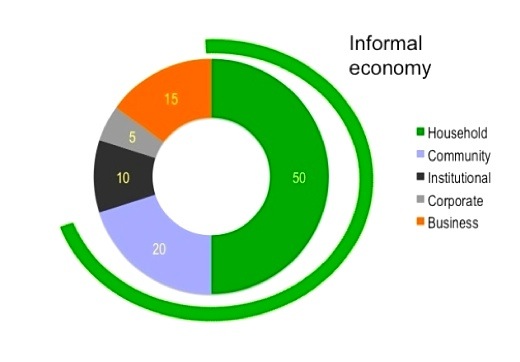
Image above: The Formal and Informal economic sectors at after Peak Energy (energy descent). From original article.
Affluent nations have a long history of extracting wealth out of the informal household and community economies to bolster growth in the formal economies, but we have little experience in proactively reversing the process.
Recognising the differences between at least three domains of financial control can help evaluation investment and divestment strategies and options.
Corporations are cost minimising, profit maximising organisations, designed like machines to suit the scale and density of fossil fuel. In the energy descent future corporations will be less adapted but in the Brown Tech scenario where power shifts from the global to the national level, corporations will remain the primary tools by which strong national governments will implement radical, and where necessary, unpopular policies.
Corporations only respond to legal constraint and mass-market forces. Where we invest in larger scale organisation for complex functions, cooperatives are inherently more subject to ethical and democratic influence than corporations.
Natural persons, and businesses fully controlled by natural persons, are, unlike corporations, potentially subject to ethical influence and action other than short-term cost minimisation and profit maximisation. This potential will be critical to breaking the trance created by the current mal-adapted convergent systems.
Even more importantly, individual entrepreneurs perusing divergent and even idiosyncratic risk taking are essential to deal with a world of rapid change and uncertainty.
When we hold money as cash we risk theft and lose value due to inflation, but in an energy descent world of deflation, cash is king and avoids the risk that the largest financial institutions will fail or be subject to arbitrary laws that confiscate savings[3]. Withdrawing money from banks and holding relatively large amounts of cash, is one of the easiest actions ordinary citizens can take to increase their own resilience and divest their support for corrupt and dysfunctional systems. When we hold and spend cash in the grey economy we stimulate the most resilient part of the monetary economy that will best survive and even thrive in a deflationary economy.
The cash economy cuts out corporations and government tax, which of course reduces money available for public services, that we might otherwise think are progressive. But if we accept the thesis that the system cannot be reformed sufficiently to avoid climate catastrophe, then withdrawing support may be a necessary evil.
A surprising and increasing number of citizens already have such a negative view of big government, business and banks, that willingness to use the cash economy is hardly a radical perspective even if it is very rare for it to be publicly advocated by “serious commentators”.
Alternative currencies and non-monetary economies
When we convert money out of fiat currencies [4] and into local and alternative currencies (and to a limited extent, precious metals) we further spread risks, encourage local economy and reduce reinforcement of centralised dysfunction.
While precious metals and local currencies have a long history of growth in times of mainstream economic contraction, virtual currencies such as Bitcoin represent global wildcards that expand the threats to fiat currencies.
Whether virtual currencies create a brave new world of peer-to-peer[5] inflation proof money independent of governments and banks remains unclear, but they do diversify the transaction options and reduce risks from financial instability for proactive citizens taking control of their finances.
The direct exchange of goods and services in barter is often seen as clumsy and inefficient, but it can build far stronger relationships than any monetary exchange. When it works well, barter creates a sense of serendipity, and builds confidence that we have something of value and that we can find what we need.
The gift economy is even more potent despite the superficial impression that gifting brings no rewards. In all traditional societies gifting increased the social status and often the real power and security of the giver. In addition, it functioned to redistribute wealth and provide a social safety net.
Even in affluent modern societies these functions can be recognised and in a contracting economy, gifting of surplus food, seed and garden tools (for example) to hard up people could help kick start community economies at the same time that it builds trust, support networks and social insurance in insecure times.
Labour and skill vs fossil fuel and technology
Another lens for framing expenditure is to preference employing labour and skill over fossil fuel and technology. In affluent economies with high wages, we have a long history of believing it is always cheaper to preference fossil fuels and technology over labour and skills but in the energy descent future this will not be the case.
By shifting our behavior now, we stimulate needed economic transition and deprive the largest corporations of the growth they must have to survive.
When we buy direct from farmers, a higher proportion of the money goes to the farmer and his/her labourers and less to transport, packaging and retailing corporations that maximise the consumption of resources and minimise the employment of people. When we pay a self-taught computer wiz to fix our machine rather than buying a new one, we encourage the growth of skills essential to the energy descent future and deprive computer corporations of sales they need to perpetually grow.
When we pay a contractor to dismantle a building rather than demolish with a excavator, we support the employment of more labour in dismantling and reuse, create less land fill, use less fossil fuel and demand less investment in expensive machinery manufactured by global corporations.
This very brief exploration suggests investment and general spending can work as a systemic boycott of centralized dysfunctional systems that are driving climate change and at the same time stimulate the emergence of the very systems that are adaptive to energy descent while minimizing GGE.
Brown Tech possibilities
Permaculture, Transition and voluntary simplicity have always involved personal and community empowerment, ethical concern for others and rebuilding nature. These motivations remain valid but if we are moving into a Brown Tech future, then the urgency for more radical action to build parallel systems and disconnect from the increasingly centralised destructive mainstream is a logical and ethical necessity whether or not it contributes to a financial collapse.
In Future Scenarios I characterized the politics of the Brown Tech world as ‘fascist states’ where the divide between the haves and the have nots increase, and where the tension for activists between working within the system and supporting the marginalized, and those pursuing autonomy, will become much more extreme.
In workshops on the scenarios and in public talks, I illustrated this conflict with the example of a possible choice between an ID card giving us rationed access to government backed supermarket monopolies or taking our chances in the feral food economy of home grown and fringe farmers markets.
At present we have the luxury of playing with the latter while the former is still freely accessible. The shifts towards authoritarianism and a surveillance state since ‘9/11’, and the recent intensification of the cyber wars between the state and transparency activists, suggests we may have a small window of opportunity, to build these alternative systems before a combination of state and corporate power (fascism) becomes more draconian in protecting their business model in a world of economic contraction.[6]
Most of the shrinking numbers of middle class citizens in overdeveloped countries will probably continue to throw their lot in with the declining comfort and remaining privileges the system provides. The fact that the majority of the Japanese people were against nuclear power but nevertheless voted in a government committed to restarting the nuclear program, is a good example of the pattern.
The attitude of the majority of Australians (some of the richest people in the world) to refugees who arrive by boat is another example. Perhaps the most relevant of all is the apparent acquiescence of the majority to the rapidly expanding surveillance state, highlighted by the Edward Snowden revelations.
On another front, if the pattern of worsening bushfires in south-eastern Australia continues, it seems inevitable that the response of governments will be resettlement of people from fire prone communities into ‘safe’ towns and cities. Those who refuse to move will probably have to cope without mains power (closure of the single line earth return systems) as well as no fire-fighting services, and so on.
The response of governments to severe bushfires and other recent natural disasters, as experienced and documented by permaculture and community activist Daryl Taylor, suggest the stress to survivors of the ‘top down’ government-sponsored recovery processes can be worse than the natural disaster itself, for a significant percentage of survivors of any disaster who become empowered by the experience.[7]
Empowered survivors of disasters and crises have the potential to catalyze community rebirth rather than accept the stifling palliative care delivered by the system. Consequently they are treated as a threat to the bureaucratic and corporate order.
While embracing self-organisation, Taylor emphasises the need for disaster-vulnerable communities to enact defensible community regeneration decision-making structures, at the sub-local government authority level, as a key disaster-crisis preparedness strategy.
For him, household and neighborhood self-reliance, mutual self-help, and sharing economy strategies are critical for community renewal, as are new participatory democracy and subsidiarity governance[8] practices.
Meg Wheatley and Deborah Frieze are documenting how communities are leading this ‘Walk Out, Walk On’ shift – from tier-upon-tier ‘parent-child’ globalizing dynamics, to peer-to-peer ‘agentic adults’ trans-localization collaborations.[9]
These expressions of the Brown Tech world will be interpreted by many as problems that need to be corrected by sensible reforms based on the evidence, while others will see them as dysfunctional outcomes of corrupt power elites of failing empire, that need to be swept away by radical mass movements.
There may be some truth in both positions, but these symptoms also reflect the residual structures of majority politics and multi-generational mass affluence in an era of stagnation and contraction.
As the crises worsen, the public will, and already is, demanding that governments fix the problems.
As elites lose their religious faith in the markets’ ability to solve all problems, it is inevitable that governments will struggle to relearn their functions through erratic and arbitrary exercise of paternalistic power. Much of this will be well intentioned and even reduce suffering in the short term.
Actors at the Fringe
While the majority may gain some real or imagined comfort from many of these actions of governments, those of us at the fringes, trying to create more resilient household and community economies, will experience them as a greater threat than the contracting economic conditions and worsening natural disasters.
Without apportioning blame, I believe it is essential that those of us who cannot live in the stifling constrictions of a failing system, must work hard while we can, to build the parallel systems that might provide some alternative to the strictures of the Brown Tech world.
If the logic of the Future Scenarios stepwise descent is true, the Brown Tech world could be one that persists for many decades, before degenerating to the Lifeboat Scenario, which spreads from the wild hinterlands to flood the remaining urban centers of the command economy.
If there are few of us following the path of frugal autonomy, then we must expect to live as a marginalised minority, but hopefully with our freedom intact as we prepare to enable our descendents, biological and otherwise, to both survive and preserve something of long term cultural value during the long descent.
If we succeed in rapidly building effective alternatives at exactly the same time that the strictures of the stressed mainstream become apparent to more people, then we could see so many people join the informal household and community economies, that the loss of worker/consumers in centrally controlled systems leads to a more rapid collapse.
The resultant massive reduction in GGE might still save the world from the worst of climate chaos. The precipitous nature of the collapse would be a massive psycho-social shock, but ameliorating factors might allow a rebuilding, based on more humane and ecological principles than are unlikely to be dominant in either the Brown Tech or Lifeboat worlds.
A relatively benign climate change would provide a basis for a recovery of ‘garden agriculture’ and wild foraging, while salvage of the leftovers from industrial assets and infrastructure would provide material needs through creative reusing and recycling; i.e. the essence of the Earth Steward Scenario in which a frugal communitarian culture based on ecological principles would be the mainstream rather than the fringe.
While the Earth Steward Scenario has many positive aspects, it is only likely to emerge through a path of great loss and suffering. Whether that suffering will be any greater than what the world is enduring already, from the dying stages of Pax Global Capitalism cannot be known.
And if the elites of the resurgent resource nationalism and command economies of the Brown Tech world do protect people from the worse impacts of that transition they will do it by accelerating the resource depletion at the cost of climate chaos, causing more pain and suffering in the longer term.[10]
Not Financial Terrorists
These bleak prospects need to be balanced by the incredibly positive results that come from permaculture, Transition Towns, and related activism.
As I explained in the contribution to a debate in Australia’s Arena magazine in 2013, these expressions of positive environmentalism, autonomy and community building have the advantage of being primarily driven by enlightened self interest to build personal, family and community resilience, rather than a desire to save the world or atone for our own, or our forebear’s, sins.
A permaculture way of life empowers us to take responsibility for our own welfare, provides endless opportunities for creativity and innovation, and connects us to nature and community in ways that makes sense of the world around us.
We generally don’t articulate permaculture as a political strategy or movement but reflecting the principle of multiple functions, permaculture strategies have powerful political impacts that have several advantages over conventional political action that focuses on getting those in power to pull the right levers.
In my comments to Arena[11] I supported permaculture activism as having political efficacy in the following way.
Because permaculture is a highly integrated multifaceted example of positive environmentalism it also has the effect of a systemic boycott of centralized fossil fuel powered economics dominated by corporations. When seriously applied at the household and community level it undermines centralised debt-based economies, including the tax base of governments.
Application of permaculture and associated voluntary simplicity principles over decades by committed households can lead to reductions in consumption and greenhouse gas emissions of greater than 50% with up to 80% possible.[12]
The nested future scenarios concept highlights the importance of household and local community strategies whether or not larger scale systems collapse. Those (permaculture) strategies are effective at the local and household scale, while the ones promoted to us by the upper levels of power (eg upgrading the light bulbs) are weak and tend to further undermine our resilience and autonomy.(eg centralised disaster management systems)
This understanding can save us spending too much emotional energy focused on which scenario will win out in the end.
It also reminds us that the emerging Brown Tech world arises out of the level of available energy more than evil intent by global and national elites. If larger scale systems do fail due to greater self-reliance and resilience at the local and household level then that exposes the degree of overreach and instability in those larger systems, not the impact of radical relocalizers trying to destroy the system.
Conclusion
Mass movements to get governments to institute change have been losing efficacy for decades, while a mass movement calling for less seems like a hopeless case. Similarly boycotts of particular governments, companies and products simply change the consumption problems into new forms.
I believe that actively building parallel and largely non-monetary household and local community economies with as little as 10% of the population has the potential to function as a deep systemic boycott of the centralised systems as a whole, that could lead to more than 5% contraction in the centralised economies. Whether this became the straw that broke the back of the global financial system or a tipping point, no one could ever say, even after the event.
Discussing such possibilities may be counterproductive and may brand us as crazy people, a doomsday cult or even terrorists.
Maybe it is better to keep focusing on the positive aspects of these bottom up changes that are acceptable to the average citizen; better physical and mental health, more fun and empowered children who can survive and thrive in a world of dramatic transformation, while minimizing our contribution to harm to nature and others.
On the other hand, bringing these issues out in the open might inspire desperate climate and political activists to put their substantial energy into permaculture, Transition Towns, voluntary frugality, and other aspects of positive environmentalism. It just might stop the monster of global growth after all other options have been exhausted. Rather than spurning financial system terrorists, we would welcome the impacted and vulnerable to the growing ranks of terra-ists[13] with their hands in the soil.
[1] Talking up the risks of the centralised food system has always been the flip side of my promotion of household and local food production to kickstart community resilience. For example see footage included in Anima Mundi, a film by Peter Downey (http://holmgren.com.au/product/anima-mundi-dvd/)
[2] Energy Descent Action Planning Discussion Paper; report by David Holmgren and Ian Lillington to the Environmental Sustainability Advisory Committee of Hepburn Shire Council September 2011.
[3] Such as already happened in the Cypriot banking crisis
[4] Government backed national currencies that are not underpinned by precious metals or other material resources of real value. Fiat currencies depend on faith that the government can guarantee their value.
[5] Peer to peer networks that contrast to heirachical server-client networks (in IT) have become models for a wide range of initiatives identified through the P2P Foundation, including alternative currencies. See http://p2pfoundation.net/Category:Money
[6] Italian Fascist dictator Benito Mussolini is said to have said “Fascism should more appropriately be called Corporatism because it is a merger of state and corporate power.”
[7] See How the Kinglake Ranges Community is building resilience in the aftermath of disaster (pdf) by Darryl Taylor and Lucy Filor. http://www.ourcommunity.com.au/files/cic/DarylTaylor.pdf
[8] See: Participatory Budgeting http://www.participatorybudgeting.org/
Gaian Democracies http://www.gaiandemocracy.net/ and
Liquid Democracy http://p2pfoundation.net/Liquid_Democracy as starting points
[9] See: Walk Out, Walk On website http://www.walkoutwalkon.net/ and book for case studies
[10] For a very realistic portrayal of the Brown Tech world and a utopian Earth Steward community see Brian Love’s new novel Entheogensis http://holmgren.com.au/product/entheogenesis/
[11] See Household economy counts for the full text.
http://holmgren.com.au/household-economy-counts-full-text/
[12] At Melliodora we are managing to operate an extended household economy and globally connected small business at less than 25% of the Australian average GGE (purely as a byproduct of applying permaculture principles and without accounting for any carbon sequestration from decades of tree planting and land management).
[13] A term suggested by deep ecologist John Seed after hearing me float these ideas in a public forum in 2013.
Acknowledgements
Thanks to Rick Tanaka, Maureen Corbett and Daryl Taylor for comments and corrections.
By David Holmgren on 3 February 2014 in Resilience.org -
(http://www.resilience.org/stories/2014-02-03/crash-on-demand-pathways)
Image above: Illustration of moving along path to sustainable prosperity. From (http://www.worldwatch.org/stateoftheworld2012).
This is Part 3 of David Holmgren's new essay Crash on Demand: Welcome to the Brown Tech Future, which updates his Future Scenarios work. Read Part 1, and Part 2.
Nested Scenarios
Perhaps the greatest ah-ha moment from participants in Future Scenarios seminars has come with my explanation of the following slide.
Each scenario has a characteristic scale energy density and organisational power. It is natural for national governments and corporations to respond to energy descent with massive infrastructure and energy projects and policies, that fit the Brown Tech scenario. Similarly it is natural for families to think about food supply and personal security, reflecting the Lifeboat scenario.
Between these two extremes many mainstream environmental strategies that suggest a Green Tech future are most effectively being applied by medium sized business and city or state governments, while many classic permaculture strategies that are emblematic of the Earth Steward scenario can be best applied by small business and local communities.
To some extent all scenarios are emerging simultaneously and may persist to some degree into the future, one nested one within another.
Crashing the operating system of the global economy
The evidence that the global financial system is a not-so-slow moving train crash is getting stronger. That investors and the billion or so middle class people who have any savings and discretionary expenditure are losing faith, might be an understatement. It may be that paralysis and inertia is all that is holding the system together.
A collapse in credit could make it very difficult to raise the finance necessary for the ongoing extraction of tar sands, shale gas and other mad resource extraction projects that are accelerating the production of GGE. A deflationary spiral that follows from a credit crisis and collapsing asset (housing, etc.) values could change behaviour to the extent that people stop spending on anything but essentials because of job insecurity and the fact that everything will be cheaper next month.
I believe the chances of global economic collapse (in the next five years) being severe enough to achieve this have to be rated at least 50%. Further I believe many climate activists and policy professionals are shifting to at least privately hoping this might be the case because the chances of a planned powerdown seems to be fading.
If we accept a global financial crash could make it very difficult, if not impossible, to restart the global economy with anything other than drastically reduced emissions, then an argument can be mounted for putting effort into precipitating that crash, the crash of the financial system.
Any such plan would of course invite being blamed for causing it when it happens. No one wants to be strung up along with the bankers for causing a global version of Greece, Egypt or many other countries, let alone the horrors of Syria. On the other hand, we have no precedent to indicate how bad conditions might be in currently affluent countries.
The picture I am building is that it is almost inevitable that those who warn of the crisis will get the blame for causing it.
So if we are going to be blamed anyway, we could be proactive about it and at least get the advantage for humanity of crisis now, rather than later.
For the people of Syria caught in the grip of climate, energy and geopolitical struggle, all this hardly matters because it couldn’t get worse for them. In fact conditions in such stricken places could actually improve if global superpower competition is disabled by the collapse of the global finance.
Even the average citizen in Greece or Egypt might be hoping to see the remaining affluent countries get a ‘taste of their own medicine’. The complexity of global human overshoot, so long predicted, and now unfolding, is far too multifaceted to be captured by any simple story about good, innocence, evil and blame.
Before considering whether this is a good idea or not, I want to consider whether concerted action by limited numbers of activists could bring it about?
Given the current fragilities of global finance, I believe a radical change in the behaviour of a relatively small proportion of the global middle class could precipitate such a crash.
For example a 50% reduction of consumption and 50% conversion of assets into building household and local community resilience by say 10% of the population in affluent countries would show up as 5% reduction in demand in a system built on perpetual growth and a 5% reduction in savings capital available for banks to lend. Small fluctuations in the supply-demand balance can have a massive effect on prices.
Further, when the system has been growing due to rising debt, arguably for decades, then the vulnerability to drops in demand can be massive. For example, small drops in demand for new houses and the high fuel costs of commuting for those servicing mortgages, triggered the collapse of the housing bubble in the USA and other countries.
It seems obvious to me that it is easier to convince a minority that they will be better off by disengaging from the system than any efforts to build mass movements demanding impossible outcomes or convincing elites to turn off the system that is currently keeping them in power.
I accept that many people find the idea of assisting economic collapse abhorrent, even if that collapse is becoming more and more likely as a collective outcome of human actions. Daryl Taylor uses the caring metaphor “hospicing and euthanasing” the old/dying system along with “doula-ing and midwifing the new/emerging system.
Whatever the metaphors, climate activists who believe we are on the verge of runaway catastrophic climate change that will be far worse than simply stalling the economy, do have options other than shouting louder for mitigation or shifting to adaptation and defence. Rather than simply planning for bad and rocky energy descent delivered initially by economic depression, they could choose to focus their energy on actively trying to destroy faith in the financial system.
Mainstream environmental tactical shift
This may seem like a mad idea from a fringe radical, but I think there is evidence that the most mainstream elite of the climate policy community may effectively be pursuing a strategy that is very similar.
Environmental activists have for some years now been targeting investors in coal, tar sands, shale oil and gas and other disastrous energy developments with some signs of success, or at least more than has been achieved by lobbing politicians.
The fact that many of these investments are based on bubble economics should be evident to investors anyway, but with so much money sloshing around the global financial system in search of investments which are safe and promise a reasonable return, behaviour of investors becomes more erratic and irrational.
A report from Carbon Tracker and the Grantham Research Institute, Unburnable carbon 2013: Wasted Capital and Stranded Assets,suggests that 60-80% of the oil, gas and coal reserve on the books of the global energy companies could be stranded assets.
Four trillion dollars in share values and 1.27 trillion in debt could be worthless if governments take seriously their commitments to avoid dangerous climate change. This is a recent prominent example of climate policy work attempting to undermine financial investment in the fossil fuel industries. It seems to me what they are saying was intended to be a warning to investors, to pull their money out because it is too big a financial risk.
The strategy behind such a report might be to encourage an investment flow out of fossil and into renewable energy projects. However, if investors did this very fast, it could destabilise global commodity and financial markets so much that it precipitates the collapse of global finance, and I suggest, also brings down greenhouse gas emissions.
Investment and Divestment
Similarly, the efforts by permaculture, transition and related activism to build local resilience, may result in convincing people that they should get out of debt, downsize, and radically reduce consumption and put their savings into concrete assets that build local capacity, as rapidly as possible.
Nicole Foss’s message is specifically targeted to this end and I have seen it lead to people making radical changes to their financial affairs, which all the evidence of climate catastrophe never did. As Foss explains, when most of the so-called wealth evaporates, the public is left holding the empty bag of worthless assets, a process that is well underway in Europe and the USA.
Her message is targeted to help the very people who are most motivated and able to make a positive contribution in the energy descent future. If these people can survive and thrive through the very short-term bottleneck of deflationary economic collapse, then they may be able to exercise a very positive influence on the systems that emerge following the collapse. This strategy is a very altruistic one, one I have supported publicly.[1]
There have always been strong ethical, strategic and practical grounds for permaculture and transition activism to focus on the simultaneous withdrawal of assets from destructive centralised systems and the reinvesting of them in household and community economy development. In Australia, the shift in the early 1980s of ethical investment from avoiding tobacco and arms manufacturers, to taking more proactive investment choices was influenced by permaculture activism.
As climate activists use the power of divestment as one of the few prospects for leveraging rapid change away from coal and other fossil fuel industries, it might be useful to show how this might fit into a more holistic framework for investment and divestment informed by permaculture principles.
Firstly, divestment must always be balanced by a conscious plan of re-investment that doesn’t simple recreate the problems in a new form.
As with the Jevons paradox, there are many examples of rebound effects. For example savings on power bills with solar power leading to more frequent overseas holidays by airplane.
Secondly, investment is not just of money, but our time, skills and assets. Often it is these non-monetary assets that can be most effectively put to good work, while our finances are tied up in systems that are causing the very problems we wish to avoid.
Thirdly the investment mentality assumes a return, but in a deflationary world, capital asset protection is more important than any expectation of a return. The accepted wisdom of not putting all eggs in one basket, becomes more important in an uncertain future.
Apart from any framework to characterise what we should invest in (e.g. renewable rather than fossil energy), the most powerful shift occurs when we extract resources from the top of the global financial food chain and reinvest at the most local level.
In Energy Descent Action Planning[2] we wrote;
In pre-industrial society the non-monetary economies of the household and community, based on love, reciprocity, gift and barter, were the bulk of the economy and energy descent will see a rapid expansion of these economies from the current very low base.
Rural communities that have retained more of these non-monetary economies and have better access to non-monetary resources from nature (water, firewood, food, etc) are in a better position to benefit from energy descent than urbanised communities.And we used the following diagrams to visualise the shift in economies;
Image above: The Formal and Informal economic sectors at Peak Energy (overshoot). From original article.
Image above: The Formal and Informal economic sectors at after Peak Energy (energy descent). From original article.
Recognising the differences between at least three domains of financial control can help evaluation investment and divestment strategies and options.
- Corporate and government finance and transactions through the banking system,
- NGO, business and individual finance and transactions through the banking system
- Cash transactions that are restricted to individuals and small businesses
Corporations are cost minimising, profit maximising organisations, designed like machines to suit the scale and density of fossil fuel. In the energy descent future corporations will be less adapted but in the Brown Tech scenario where power shifts from the global to the national level, corporations will remain the primary tools by which strong national governments will implement radical, and where necessary, unpopular policies.
Corporations only respond to legal constraint and mass-market forces. Where we invest in larger scale organisation for complex functions, cooperatives are inherently more subject to ethical and democratic influence than corporations.
Natural persons, and businesses fully controlled by natural persons, are, unlike corporations, potentially subject to ethical influence and action other than short-term cost minimisation and profit maximisation. This potential will be critical to breaking the trance created by the current mal-adapted convergent systems.
Even more importantly, individual entrepreneurs perusing divergent and even idiosyncratic risk taking are essential to deal with a world of rapid change and uncertainty.
When we hold money as cash we risk theft and lose value due to inflation, but in an energy descent world of deflation, cash is king and avoids the risk that the largest financial institutions will fail or be subject to arbitrary laws that confiscate savings[3]. Withdrawing money from banks and holding relatively large amounts of cash, is one of the easiest actions ordinary citizens can take to increase their own resilience and divest their support for corrupt and dysfunctional systems. When we hold and spend cash in the grey economy we stimulate the most resilient part of the monetary economy that will best survive and even thrive in a deflationary economy.
The cash economy cuts out corporations and government tax, which of course reduces money available for public services, that we might otherwise think are progressive. But if we accept the thesis that the system cannot be reformed sufficiently to avoid climate catastrophe, then withdrawing support may be a necessary evil.
A surprising and increasing number of citizens already have such a negative view of big government, business and banks, that willingness to use the cash economy is hardly a radical perspective even if it is very rare for it to be publicly advocated by “serious commentators”.
Alternative currencies and non-monetary economies
When we convert money out of fiat currencies [4] and into local and alternative currencies (and to a limited extent, precious metals) we further spread risks, encourage local economy and reduce reinforcement of centralised dysfunction.
While precious metals and local currencies have a long history of growth in times of mainstream economic contraction, virtual currencies such as Bitcoin represent global wildcards that expand the threats to fiat currencies.
Whether virtual currencies create a brave new world of peer-to-peer[5] inflation proof money independent of governments and banks remains unclear, but they do diversify the transaction options and reduce risks from financial instability for proactive citizens taking control of their finances.
The direct exchange of goods and services in barter is often seen as clumsy and inefficient, but it can build far stronger relationships than any monetary exchange. When it works well, barter creates a sense of serendipity, and builds confidence that we have something of value and that we can find what we need.
The gift economy is even more potent despite the superficial impression that gifting brings no rewards. In all traditional societies gifting increased the social status and often the real power and security of the giver. In addition, it functioned to redistribute wealth and provide a social safety net.
Even in affluent modern societies these functions can be recognised and in a contracting economy, gifting of surplus food, seed and garden tools (for example) to hard up people could help kick start community economies at the same time that it builds trust, support networks and social insurance in insecure times.
Labour and skill vs fossil fuel and technology
Another lens for framing expenditure is to preference employing labour and skill over fossil fuel and technology. In affluent economies with high wages, we have a long history of believing it is always cheaper to preference fossil fuels and technology over labour and skills but in the energy descent future this will not be the case.
By shifting our behavior now, we stimulate needed economic transition and deprive the largest corporations of the growth they must have to survive.
When we buy direct from farmers, a higher proportion of the money goes to the farmer and his/her labourers and less to transport, packaging and retailing corporations that maximise the consumption of resources and minimise the employment of people. When we pay a self-taught computer wiz to fix our machine rather than buying a new one, we encourage the growth of skills essential to the energy descent future and deprive computer corporations of sales they need to perpetually grow.
When we pay a contractor to dismantle a building rather than demolish with a excavator, we support the employment of more labour in dismantling and reuse, create less land fill, use less fossil fuel and demand less investment in expensive machinery manufactured by global corporations.
This very brief exploration suggests investment and general spending can work as a systemic boycott of centralized dysfunctional systems that are driving climate change and at the same time stimulate the emergence of the very systems that are adaptive to energy descent while minimizing GGE.
Brown Tech possibilities
Permaculture, Transition and voluntary simplicity have always involved personal and community empowerment, ethical concern for others and rebuilding nature. These motivations remain valid but if we are moving into a Brown Tech future, then the urgency for more radical action to build parallel systems and disconnect from the increasingly centralised destructive mainstream is a logical and ethical necessity whether or not it contributes to a financial collapse.
In Future Scenarios I characterized the politics of the Brown Tech world as ‘fascist states’ where the divide between the haves and the have nots increase, and where the tension for activists between working within the system and supporting the marginalized, and those pursuing autonomy, will become much more extreme.
In workshops on the scenarios and in public talks, I illustrated this conflict with the example of a possible choice between an ID card giving us rationed access to government backed supermarket monopolies or taking our chances in the feral food economy of home grown and fringe farmers markets.
At present we have the luxury of playing with the latter while the former is still freely accessible. The shifts towards authoritarianism and a surveillance state since ‘9/11’, and the recent intensification of the cyber wars between the state and transparency activists, suggests we may have a small window of opportunity, to build these alternative systems before a combination of state and corporate power (fascism) becomes more draconian in protecting their business model in a world of economic contraction.[6]
Most of the shrinking numbers of middle class citizens in overdeveloped countries will probably continue to throw their lot in with the declining comfort and remaining privileges the system provides. The fact that the majority of the Japanese people were against nuclear power but nevertheless voted in a government committed to restarting the nuclear program, is a good example of the pattern.
The attitude of the majority of Australians (some of the richest people in the world) to refugees who arrive by boat is another example. Perhaps the most relevant of all is the apparent acquiescence of the majority to the rapidly expanding surveillance state, highlighted by the Edward Snowden revelations.
On another front, if the pattern of worsening bushfires in south-eastern Australia continues, it seems inevitable that the response of governments will be resettlement of people from fire prone communities into ‘safe’ towns and cities. Those who refuse to move will probably have to cope without mains power (closure of the single line earth return systems) as well as no fire-fighting services, and so on.
The response of governments to severe bushfires and other recent natural disasters, as experienced and documented by permaculture and community activist Daryl Taylor, suggest the stress to survivors of the ‘top down’ government-sponsored recovery processes can be worse than the natural disaster itself, for a significant percentage of survivors of any disaster who become empowered by the experience.[7]
Empowered survivors of disasters and crises have the potential to catalyze community rebirth rather than accept the stifling palliative care delivered by the system. Consequently they are treated as a threat to the bureaucratic and corporate order.
While embracing self-organisation, Taylor emphasises the need for disaster-vulnerable communities to enact defensible community regeneration decision-making structures, at the sub-local government authority level, as a key disaster-crisis preparedness strategy.
For him, household and neighborhood self-reliance, mutual self-help, and sharing economy strategies are critical for community renewal, as are new participatory democracy and subsidiarity governance[8] practices.
Meg Wheatley and Deborah Frieze are documenting how communities are leading this ‘Walk Out, Walk On’ shift – from tier-upon-tier ‘parent-child’ globalizing dynamics, to peer-to-peer ‘agentic adults’ trans-localization collaborations.[9]
These expressions of the Brown Tech world will be interpreted by many as problems that need to be corrected by sensible reforms based on the evidence, while others will see them as dysfunctional outcomes of corrupt power elites of failing empire, that need to be swept away by radical mass movements.
There may be some truth in both positions, but these symptoms also reflect the residual structures of majority politics and multi-generational mass affluence in an era of stagnation and contraction.
As the crises worsen, the public will, and already is, demanding that governments fix the problems.
As elites lose their religious faith in the markets’ ability to solve all problems, it is inevitable that governments will struggle to relearn their functions through erratic and arbitrary exercise of paternalistic power. Much of this will be well intentioned and even reduce suffering in the short term.
Actors at the Fringe
While the majority may gain some real or imagined comfort from many of these actions of governments, those of us at the fringes, trying to create more resilient household and community economies, will experience them as a greater threat than the contracting economic conditions and worsening natural disasters.
Without apportioning blame, I believe it is essential that those of us who cannot live in the stifling constrictions of a failing system, must work hard while we can, to build the parallel systems that might provide some alternative to the strictures of the Brown Tech world.
If the logic of the Future Scenarios stepwise descent is true, the Brown Tech world could be one that persists for many decades, before degenerating to the Lifeboat Scenario, which spreads from the wild hinterlands to flood the remaining urban centers of the command economy.
If there are few of us following the path of frugal autonomy, then we must expect to live as a marginalised minority, but hopefully with our freedom intact as we prepare to enable our descendents, biological and otherwise, to both survive and preserve something of long term cultural value during the long descent.
If we succeed in rapidly building effective alternatives at exactly the same time that the strictures of the stressed mainstream become apparent to more people, then we could see so many people join the informal household and community economies, that the loss of worker/consumers in centrally controlled systems leads to a more rapid collapse.
The resultant massive reduction in GGE might still save the world from the worst of climate chaos. The precipitous nature of the collapse would be a massive psycho-social shock, but ameliorating factors might allow a rebuilding, based on more humane and ecological principles than are unlikely to be dominant in either the Brown Tech or Lifeboat worlds.
A relatively benign climate change would provide a basis for a recovery of ‘garden agriculture’ and wild foraging, while salvage of the leftovers from industrial assets and infrastructure would provide material needs through creative reusing and recycling; i.e. the essence of the Earth Steward Scenario in which a frugal communitarian culture based on ecological principles would be the mainstream rather than the fringe.
While the Earth Steward Scenario has many positive aspects, it is only likely to emerge through a path of great loss and suffering. Whether that suffering will be any greater than what the world is enduring already, from the dying stages of Pax Global Capitalism cannot be known.
And if the elites of the resurgent resource nationalism and command economies of the Brown Tech world do protect people from the worse impacts of that transition they will do it by accelerating the resource depletion at the cost of climate chaos, causing more pain and suffering in the longer term.[10]
Not Financial Terrorists
These bleak prospects need to be balanced by the incredibly positive results that come from permaculture, Transition Towns, and related activism.
As I explained in the contribution to a debate in Australia’s Arena magazine in 2013, these expressions of positive environmentalism, autonomy and community building have the advantage of being primarily driven by enlightened self interest to build personal, family and community resilience, rather than a desire to save the world or atone for our own, or our forebear’s, sins.
A permaculture way of life empowers us to take responsibility for our own welfare, provides endless opportunities for creativity and innovation, and connects us to nature and community in ways that makes sense of the world around us.
We generally don’t articulate permaculture as a political strategy or movement but reflecting the principle of multiple functions, permaculture strategies have powerful political impacts that have several advantages over conventional political action that focuses on getting those in power to pull the right levers.
In my comments to Arena[11] I supported permaculture activism as having political efficacy in the following way.
“I am more than ready to acknowledge that ‘our’ collective efforts at positive environmentalism during and since the 1970s have so far failed to catalyse the necessary changes in society, but Andy Scerri’s assertion that composting your private garden counts for nothing, reflects an ignorance of several structural and systemic factors driving and constraining social change.
Firstly if the changes or innovations required, do not confer some advantage to the innovators and early adopters then there is little incentive for others to follow their lead.
Secondly, unless the necessary changes or innovations can be independently adopted by individuals, households and local communities, without the resources, support and approval from central authority, then it can always be blocked by established interests that stand to lose by its widespread adoption.
Thirdly, it is extremely difficult, if not impossible, for higher order organisations and governments to mandate a reality that doesn’t already exist as working models.
Progressive and integrated adoption and refinement of the myriad of strategies and techniques associated with permaculture, enacted at the household and local level, addresses all three systemic issues.Permaculture, Transition Towns and related positive environmental activism, have spread through personal, small scale entrepreneurial and community actions so readily because they bypass these three systemic blocks to a creatively designed energy descent pathway. This spread has happened with only marginal and indirect support from governments, corporations and even NGOs.
Because permaculture is a highly integrated multifaceted example of positive environmentalism it also has the effect of a systemic boycott of centralized fossil fuel powered economics dominated by corporations. When seriously applied at the household and community level it undermines centralised debt-based economies, including the tax base of governments.
Application of permaculture and associated voluntary simplicity principles over decades by committed households can lead to reductions in consumption and greenhouse gas emissions of greater than 50% with up to 80% possible.[12]
The nested future scenarios concept highlights the importance of household and local community strategies whether or not larger scale systems collapse. Those (permaculture) strategies are effective at the local and household scale, while the ones promoted to us by the upper levels of power (eg upgrading the light bulbs) are weak and tend to further undermine our resilience and autonomy.(eg centralised disaster management systems)
This understanding can save us spending too much emotional energy focused on which scenario will win out in the end.
It also reminds us that the emerging Brown Tech world arises out of the level of available energy more than evil intent by global and national elites. If larger scale systems do fail due to greater self-reliance and resilience at the local and household level then that exposes the degree of overreach and instability in those larger systems, not the impact of radical relocalizers trying to destroy the system.
Conclusion
Mass movements to get governments to institute change have been losing efficacy for decades, while a mass movement calling for less seems like a hopeless case. Similarly boycotts of particular governments, companies and products simply change the consumption problems into new forms.
I believe that actively building parallel and largely non-monetary household and local community economies with as little as 10% of the population has the potential to function as a deep systemic boycott of the centralised systems as a whole, that could lead to more than 5% contraction in the centralised economies. Whether this became the straw that broke the back of the global financial system or a tipping point, no one could ever say, even after the event.
Discussing such possibilities may be counterproductive and may brand us as crazy people, a doomsday cult or even terrorists.
Maybe it is better to keep focusing on the positive aspects of these bottom up changes that are acceptable to the average citizen; better physical and mental health, more fun and empowered children who can survive and thrive in a world of dramatic transformation, while minimizing our contribution to harm to nature and others.
On the other hand, bringing these issues out in the open might inspire desperate climate and political activists to put their substantial energy into permaculture, Transition Towns, voluntary frugality, and other aspects of positive environmentalism. It just might stop the monster of global growth after all other options have been exhausted. Rather than spurning financial system terrorists, we would welcome the impacted and vulnerable to the growing ranks of terra-ists[13] with their hands in the soil.
[1] Talking up the risks of the centralised food system has always been the flip side of my promotion of household and local food production to kickstart community resilience. For example see footage included in Anima Mundi, a film by Peter Downey (http://holmgren.com.au/product/anima-mundi-dvd/)
[2] Energy Descent Action Planning Discussion Paper; report by David Holmgren and Ian Lillington to the Environmental Sustainability Advisory Committee of Hepburn Shire Council September 2011.
[3] Such as already happened in the Cypriot banking crisis
[4] Government backed national currencies that are not underpinned by precious metals or other material resources of real value. Fiat currencies depend on faith that the government can guarantee their value.
[5] Peer to peer networks that contrast to heirachical server-client networks (in IT) have become models for a wide range of initiatives identified through the P2P Foundation, including alternative currencies. See http://p2pfoundation.net/Category:Money
[6] Italian Fascist dictator Benito Mussolini is said to have said “Fascism should more appropriately be called Corporatism because it is a merger of state and corporate power.”
[7] See How the Kinglake Ranges Community is building resilience in the aftermath of disaster (pdf) by Darryl Taylor and Lucy Filor. http://www.ourcommunity.com.au/files/cic/DarylTaylor.pdf
[8] See: Participatory Budgeting http://www.participatorybudgeting.org/
Gaian Democracies http://www.gaiandemocracy.net/ and
Liquid Democracy http://p2pfoundation.net/Liquid_Democracy as starting points
[9] See: Walk Out, Walk On website http://www.walkoutwalkon.net/ and book for case studies
[10] For a very realistic portrayal of the Brown Tech world and a utopian Earth Steward community see Brian Love’s new novel Entheogensis http://holmgren.com.au/product/entheogenesis/
[11] See Household economy counts for the full text.
http://holmgren.com.au/household-economy-counts-full-text/
[12] At Melliodora we are managing to operate an extended household economy and globally connected small business at less than 25% of the Australian average GGE (purely as a byproduct of applying permaculture principles and without accounting for any carbon sequestration from decades of tree planting and land management).
[13] A term suggested by deep ecologist John Seed after hearing me float these ideas in a public forum in 2013.
Acknowledgements
Thanks to Rick Tanaka, Maureen Corbett and Daryl Taylor for comments and corrections.
Editorial Notes: Editorial Notes: Part 2 of the essay looks at Energy Descent Scenarios.
© 2014 Holmgren Permaculture Design for Sustainable Living. All Rights Reserved. Reposted on Resilience.org with permission.
Read discussion of this essay here:
David MacLeod, Jason Heppenstall, Rob Hopkins, Joanne Poyorouw, Albert Bates, Dmitry Orlov, and John Michael Greer.
See also:
Ea O Ka Aina: Crash on Demand 12/30/13
Ea O Ka Aina: Stabbing the Beast 1/1/14
Ea O Ka Aina: Response to Holmgren's scenarios 1/10/14
Ea O Ka Aina: Energy Descent Scenarios 1/24/14
.© 2014 Holmgren Permaculture Design for Sustainable Living. All Rights Reserved. Reposted on Resilience.org with permission.
Read discussion of this essay here:
David MacLeod, Jason Heppenstall, Rob Hopkins, Joanne Poyorouw, Albert Bates, Dmitry Orlov, and John Michael Greer.
See also:
Ea O Ka Aina: Crash on Demand 12/30/13
Ea O Ka Aina: Stabbing the Beast 1/1/14
Ea O Ka Aina: Response to Holmgren's scenarios 1/10/14
Ea O Ka Aina: Energy Descent Scenarios 1/24/14