More Meltdown Mania

SUBHEAD: The operators are left with nonsense cures while the radiation loads from all four reactors increases exponentially.  

By Steve Ludlum on 5 April 2011 in Economic Undertow - 
(http://economic-undertow.blogspot.com/2011/04/more-meltdown-mania.html) 

 
Image above: Heroic workers at Fukushima Dai Nuclear Plant. Note protective footwear inlcudes plastic bags over shoes taped to ankles and calves. From (http://www.news.com.au/world/japan-admits-inadequate-nuke-safeguards-after-quake-disaster-and-fukushima-fallout/story-e6frfkyi-1226030693886).

 It's interesting to watch how pop culture deals with problems like the Fukushima Fiasco: It can't and it doesn't. The establishment soothes while coming up with idiotic 'solutions' such as putting shredded newspapers into a 'crack' in concrete leaking 7 tons of intensely radioactive water per hour onto the highly manicured 'grounds' of the reactor complex and thence into the Pacific.

You know ... 'That' Pacific Ocean, where all those buff dudes go to surf ... "

No more surfing for you!" No walking on the beach either, unless you want to get what is becoming known in Japan as a 'Ground Tan'.

Energy Meanwhile the Fossil Fuel Fiasco takes place under everyone's noses:

PRODUCT PRICE CHANGE %UP
BRENT CRUDE 120.23 1.530 1.29%
GAS OIL FUT 1,006.0 9.000 0.90%
HEATING OIL 315.31 1.860 0.59%
NATURAL GAS 4.32 -0.045 -1.03%
GASOLINE ) 314.58 -0.550 -0.17%
WTI CRUDE 108.07 0.130 0.12%
Yowzah! $120 per barrel is a bludgeon to the head of the waste-based economy. How are the precious SUV's and giant pickup trucks going to cope? Here's what's happening with three- month average US gas prices from estimable Gasbuddy:
How about that for a bull market? Gas prices are not the determinant whether our sorry excuse for an economy takes a dump or not but they are a good 'pain indicator'. They measure the level of wishful thinking about how our machines interfere with reality ... Reality sez there are limits, Fantasy sez some wads of newspaper and 'polymers' will make them go away. If not, skip the pesky reactors and welcome 'profits'! Here is the party line from Bloomberg:
S&P 500 earnings are poised to surpass the 2007 peak of $90 a share in the third quarter after surging from $7 in March 2009, the quickest recovery since at least 1900, according to data from S&P and Yale University’s Robert Shiller compiled by Bloomberg. The gap between projected 12-month profits and average earnings over the last 10 years is set to widen the most since 1951, the data show.
PNC Wealth Management, Federated Investors Inc. and ING Investment Management, which together oversee about $1 trillion, say consumer spending will sustain the recovery after government stimulus helped lift profits from the lowest level since the Great Depression. While earnings will slow in the second half, stock purchases by investors who missed the S&P 500’s advance will fuel gains, according to Leuthold Group LLC.
Somehow, all those hapless unemployed on food stamps are going to spend money they don't have in stores that are now boarded up ... If they spend all their cash on gas what is left to push up 'profits'? The best answer is pesky customers and 'salez' are unnecessary. What is required is corporate 'self dealing' and finance 'investments' in other companies just like themselves.

It's hard to think of a US company that is makes something useful other than GE, which brings 'Good Things' like ground tans to light. Those pimping vapor profits have an agenda: anyone willing to take some time and think for themselves can come to the conclusion: what used to be progress is now naked self interest. There are the privileged and there are the damned. At some point you start asking yourself whose side are you going to be on when the shooting starts?

Reactor Number 2 did not provide a visible explosion to analyze. It's primary and secondary pumps failed after the flood and like the others was dependent upon fire engines for cooling injections of seawater.

The reactor 3 blast on Monday the 14th rendered 4 of the 5 fire trucks servicing unit 2 DOA: the survivor ran out of fuel and was then unable to overcome reactor pressures due to a stuck valve. Operators said fuel rods were out of water for an extended period. The consequent blast took place within the suppression pool in the early morning of the 15th.


Image above: Identical Browns Ferry Reactor Number 1 under construction. Click to enlarge. From (http://en.wikipedia.org/wiki/Browns_Ferry_Nuclear_Power_Plant).

 Figure 1
This is the pressure vessel before it is surrounded or clad with reinforced concrete. The central 'flask' or lightbulb- shaped fixture is the inner mold for a ten- foot thick concrete shell that is an integral part of the overall containment structure. Below the lightbulb is the torus- shaped suppression pool which is also within the containment. While everything you can see here is very robust and oversized, this is not nearly so as much as the pressure vessel and containment of a pressurized water reactor (PWR) which operates at pressures approximately 2,000 psi.

The PWR has the familiar dome structure(s) which rise above the rest of the facility. The operating pressure for this kind of reactor when making steam and electricity is approximately 1000 psi. Ordinarily, water and steam are circulated around the core with the reactor 'throttled' or 'accelerated' by inserting or withdrawing control rods along with increasing/decreasing the flow of feedwater.

Excess steam is vented into the suppression pool where it is condensed. The power cycle has steam flowing from the fuel elements through the power turbine to a condenser which is the heat exchanger for the reactor. Condensate is pumped back into the core. Work is a flow of heat from the fuel toward the ocean by way of the turbine and condenser.

Important feedwater pumps along with control rod drive mechanisms are located within the pressure vessel under the core. This core is the metal can that contains the fuel- and control rods. It sits high inside the pressure vessel dry well which is within the throat of the pressure vessel. The core is where the boiling takes place. Vents equalize the pressure so that it is the same within the core as well as within the rest of pressure vessel.

The obvious weak point of the design is where the pressure balance tubes (parts 'e' in Figure 1) connect to the suppression pool. There are eight of these radiating like spokes from the central flask of the pressure vessel. Where the tubes join the suppression pool are elaborate welded and mechanical joints that cannot accept stresses that more regular shapes such as the sphere and torus can.

Other weak areas are where tubular sections of the suppression pool are welded together, where pipes and valves are attached to the suppression pool and where conduits and ducts such as control rod hydraulic lines penetrate the pressure vessel. Most of the non- welded pipe joints are conventional flange fittings with gaskets. The amount of pipe and fittings within the containment is significant. It is likely that much of the piping in all the Fukushima reactors was severely damaged by the earthquake, before cooling problems emerged.

 It is likely that all three reactor explosions originated in the suppression pools and specifically in areas of the pools that were unable to contain an instant increase in steam pressure. Steam pressure would flash when fuel melted and flowed through core fittings and pipes into the bottom of the pressure vessel and from there into the suppression pools.

 Since all the reactors are of more or less identical design, shared identical vulnerabilities and were subject to the same cooling abuses it is likely that all met the same explosive fate in the same place, within the suppression pool area. Severe fuel meltdowns caused powerful steam explosions that damaged the suppression pools and compromised the containments. The simple explanation for the flows of radioactive water and isotopes in the plant area seen today is the multiple explosive failures of reactor containments.

When the fuel rods are exposed above cooling water, the zircalloy cladding oxidizes producing hydrogen and zirconium oxide. There is no free oxygen in the pressure vessels under working conditions as these are charged with nitrogen. When the pressure vessels in the other reactors were vented, the nitrogen and hydrogen flowed into the service areas above the containment buildings.

The nitrogen was of little significance in the service areas' vast spaces. The vented hydrogen mixed with oxygen in the air within the service areas: steam explosions, when they occurred, triggered nearly simultaneous hydrogen blasts in the service areas. In the suppression pool area of unit 2, there was little free oxygen to mix with hydrogen being produced by the zircalloy oxidation. Hydrogen was due to be vented into the service area as was the case with the other reactors but this venting could not take place due to the stuck valve.

As was the case with the other reactors, when the fuel rods within the core were exposed for long enough period, the cladding failed and fuel pellets aggregated within the core. At that point, the cooling water had been pushed by steam pressure into the suppression pool. Enough fuel melted together then flowed from the waterless core into the suppression pool where the melt caused the steam explosion.

This wasn't a total meltdown and the result was not a massive explosion as was the case in unit 3 but it was sufficient to blow a hole in the suppression pool area of the pressure vessel with steam under extraordinary force blasting away internal parts of the containment. Here is reactor 2 with its ominous trail of steam emitting from its bowels:
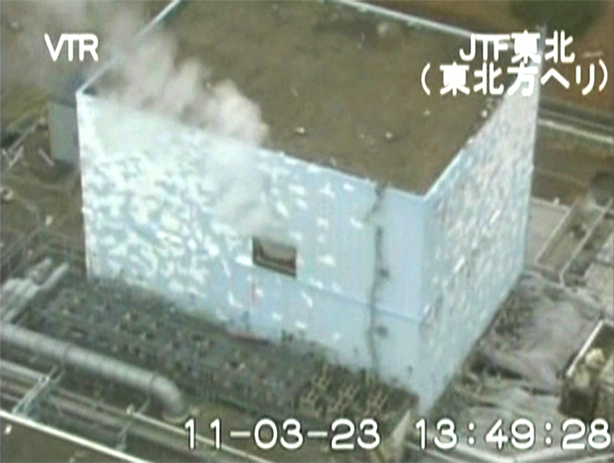

 After the explosion, all but 50 of the workers at the four-reactor site were removed due to increases in radiation. Further examination showed high levels of radiation in water in buildings connected to Reactor #2 along with many short-lived isotopes indicating ongoing criticality taking place within the destroyed core.

As has been noticed by others, that means the plants' operators have been attempting to stanch the flow of radioactive water out of these reactors has been pathetic. Water flows create a dilemma: water flow is needed to cool what remains of the cores while water acts as a moderator for reactor fuel, triggering chain reactions.

Heat is removed from the cores to the ocean but moderating water causes the ruined cores to emit more heat in a vicious cycle. Newly released TEPCO data provides evidence of periodic chain reaction at Fukushima Unit 1 from Fairewinds Associates.  
Video above: Arnie Gundersen, Chief Nuclear Engineer at Fairewinds Associates . From (http://vimeo.com/21881702).

 The operators are left with nonsense cures while the radiation loads from all four reactors increases exponentially. With all four reactors fatally compromised, the outcome is a reactor complex that is steadily becoming too 'hot' for anyone to approach even with protective gear. Once that point is reached the remaining core structures will fail and even more radiation and radioactive particles will be emitted. The Japanese have to get serious and marshal vast forces to battle these reactors. Every Japanese citizen will need to do his duty, to take lead brick in hand and gain not a Warholian fifteen minutes of fame but a three minute tour of hell. Japan also needs to make a plan to decommission all of its reactors. They are all ticking time bombs, Japan is broke and the 'financial' outcome is more and more meltdowns. The 'mass attack' is rejected is that it is too 'old school'. It defies modernity and the fantasy of mechanical advantage, advertising- directed self- actualization and increasing luxury. Modernity's leverage is to waste fuel and have the illusion of doing something useful by the process. It's that or nothing with the Japanese tempting an avoidable fate. Then again, there is no such thing as leadership, only soothing. .
What Is Adapting in Place?

SUBHEAD: Creating a vision of a life worth having that takes limits into account is a project that is quite literally life or death.  

By Sharon Astyk 5 April 2011 in Casaubon's Book - 
(http://scienceblogs.com/casaubonsbook/2011/04/what_is_adapting_in_place.php)

 
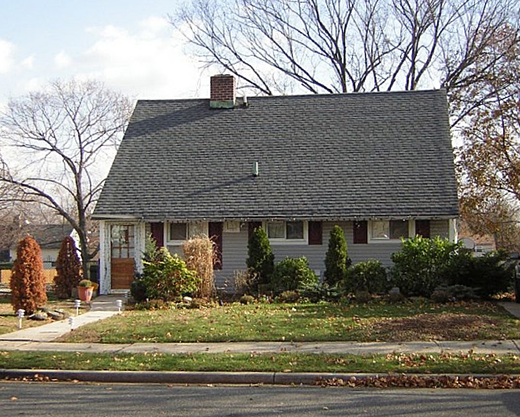
Image above: A home in Levittown, Long Island, NY built circa 1950, leading the suburban explosion. From (http://www.flickr.com/photos/roarlaura/69728784).

So what is Adapting In Place anyway? I'm writing a book about it (coming out next fall), I talk about it a lot, but what exactly am I getting at? It is partly about preparedness, both individual and community, partly about changing expectations, partly about achieving a kind of balance. It seems pedestrian in a way - lots of questions about how to do the laundry and keep food cool and work with your neighbors - ordinary things. Trivial seeming things. Or perhaps not. In a way this may be the biggest question of all - how do we go on where we are with what we have in this new world?

Moreover, how do we create a model of a life worth aspiring to that isn't destructive, that honestly takes a look at where we're going? This is not trivial, and it isn't purely personal - in fact, you could argue that this is the world's single most central question, because for the last 70 years, the US and other Global North nations have exported a vision of a life that has penetrated across the globe.

With policy and with military might and with money and with Hollywood and with everything we have, we have modeled consumption, we have modeled cheap energy, and we have set up almost 7 billion people to want something that 7 billion people cannot have.

We can't have it because the earth can't sustain it - it lacks the resources. It lacks the capacity to absorb the pollution and outputs. And the longer we keep up the lie that some people don't mind that you have 5, 10, 20, 1000 times more than they do, the harder the adaptive process will be, and the more fighting and the more dying it will cause.

Most of us will die or kill for a dream we hold strongly enough. Re-creating the dream, creating a vision of a life worth having that takes limits into account is a project that is quite literally life or death. It starts with staying. The world cannot handle more people who pick up and leave for new territory after they've raped the place they live in.

And while we know that there will be many relocations and radical changes, most people are going to make the best of the infrastructure we've created over the last years, simply because we have no choice. I personally think that there is insufficient time to remake our world dramatically. Now there are people who would argue with me about this - and they may even have a case.

But I think there are compelling reasons to believe that we may not have enough time to take a world created for cheap energy and transform it into one that can handle expensive energy and replace much of that with renewable power. The idea that we will be able to make a massive societal retrofit occur rapidly depends in large part on, I think, the idea that the current economic crisis is just an unpleasant coincidence that happens to be occurring just as peak oil and climate change are really hitting us.

This, I think is a radical error in reasoning - in fact, as nearly every serious analyst who really grasps peak oil gets, the economic limitations are part and parcel of our present crisis. That is, our ability to do new things is going to be more and more constrained over time. Which means that most of us aren't going to be living in new urbanist walkable communities or in perfect ecovillages driving electric cars - we're going to be living where we are.

Some projects will be done - but the idea that we're going to do a full-scale overhaul of our society seems deeply wrong - we did a radical build out to get ourselves here, and we used up the easy, cheap segment of our resources. Which means that most of us are going to be limited to what we can accomplish ourselves, using our personal resources, what resources are available through family, friends, community and governments of various levels.

Much of our way of life may have been, as Kunstler refers to suburbia, "the greatest-misallocation of resources in history", but is how we allocated the resources - we've done this build out, and we're going to be living with the results. While the current situation has created mobility for some people - those who have already lost jobs and homes, those who know they are in a situation that can't possibly improve - on the other hand, for many people, the current situation works to keep them in place.

Nothing is selling in their area - so they can't sell their house and move to another. Or they are afraid to change jobs, because the loss of seniority would lead to making them easy targets for layoffs in this economy. It may not be possible any longer to get back what they owe on their house - but it may still make sense to keep paying the mortgage, because they expect extended family to move in, or because they can grow food on the land.

They may be tied down by elderly or disabled family members who can't be easily moved, by a shared custody agreement, or by need to access to certain kinds of medical care. Family - biological or chosen - may tie them to an area, as may familiarity with the climate and region. We may decide that strong community ties make an imperfect area (and all areas are imperfect) enough to keep us there.

Or we may lack the resources to move. Staying in place isn't always the best of a bad lot of options - sometimes it is simply the best option. There's been a tendency to rhetorically abandon areas we don't know what to do with - inner cities, exurbs, suburbia - all of these are dismissed sometimes, as though this will magically vacate them.

The fact is that 300 million people in the US or 60 million in Britain cannot simply all go out to the countryside to their own bunkers, unless we wish to create a new suburbia, with barbed-wire, each ticky-tacky bunker lined up in the countryside next to its neighbors . Nor can we move everyone into cities - there aren't jobs enough, nor room enough to grow food. Food alone will mean that the countryside and suburbs (near the city markets, often built on good farmland) will have to be populated - and the cities were usually cities for reasons long before oil - those reasons won't go away.

More and more, I am advising people to stay put, or at most move to a place fairly near and like the one they live in now. I don't think there's enough time to adapt to new climates and environmental conditions, to retrofit new homes and build communities - now that doesn't mean some people won't have to move. But if you can stay put, I think there are some real advantages for most people - it takes time to build community, to build soil, to learn the bus lines, to get into the carpools, to find the cheap produce, to learn about pests and diseases and how to keep cool or warm.

We need a model of a new life now - not ten years from now when we've found the perfect place. The nuts and bolts of adapting in place are ordinary, so ordinary they seem small.

Should I insulate? How do I collect rainwater? How little electricity can I do with? What do I do if the power goes out entirely? What is the right thing to eat for dinner? How shall I preserve it for later? What do we teach the kids? What do we tell Grandma about what we're doing?

 I don't live in the perfect place, and these ordinary trivial seeming things are the bread and butter of my life too. They become almost invisible, and we learn to miss their enormous impact - the aggregate of 300 million Americans or 1 billion developed world dwellers eating and pooping and keeping warm and cool and getting around.

 I don't live the perfect life in the perfect place, but I remake it in the image of my dream a little more each year. I once read that people who build their dream houses spend 2 years building them - and then live in them for an average of 7 years. Because dreams change.

Because sometimes what we dream about is the thing we can't have, not the thing we do. And yet most of us in the developed world have more possessions, more comforts than the kings of old, than the richest people of our great-great grandparent's time.

We have more ease than the slave owners of the past, with fossil-fueled slaves to do our bidding. If we can't come to embrace what we do have, and a fair share, who can? If we can't do with less, will you ask someone who lives a harder life with less to do it? If we who made the dream and sold it to the rest of the world can't change our dream when it doesn't fit us anymore, what hope is there?

 .

KIUC, Stop FERCing Kauai Update

SOURCE: Ken Taylor (taylorj021@hawaii.rr.com)
SUBHEAD: As member you can stop Federal FERC process from using eminent domain on Kauai water rights.  

[Author's note: This article has been updated 4/13/11 with places to sign petition and contact names.]  

By Juan Wilson on 6 April 2011 for Island Breath - (http://islandbreath.blogspot.com/2011/04/stop-kiuc-fercing-kauai.html)

 
Image above: The Norris Dam on the Clinch River in Tennessee being built by the federal government for the TVA in 1933. From (http://www.tva.gov/75th/timeline.htm).  

WHAT:
250 names and addresses with KIUC account numbers on a petition.  

WHO:
Current KIUC members only for this petition. Anyone can collect signatures.  

ACTION:
Download petition. Sign it with your name and account number. Ask others to sign.  

WHEN:
(updated deadline) Deadline Noon, Monday, April 29th 2011 for submission.  

RESULT:
Compel KIUC to re-call the request for FERC application. SUBMISSION: Contact Coordinator or Adam Asquith for submitting hard copy. See below.  

Download Background Sheet (with this Background Information) (http://www.islandbreath.org/2011Year/04/110405fercinfo.pdf) Download No FERC Petition Sheet (to sigh and distribute) (http://www.islandbreath.org/2011Year/04/110405fercpetition.pdf)  
Coordinator: Adam Asquith 4654 Hauaala Road Kapaa HI 96746 (808) 635-8290 adam_asquith@yahoo.com  

ADDITIONAL WAY TO SIGN UP:
Signature sheets at the below locations so you can sign up at the location or you can drop off a sheet you have filled out. The signature sheets will be picked up Saturday April 16
Hanapepe Cafe
Hanapepe

Happy Mango
Waimea

Living Foods,
Kukuilua Shopping Village, Poipu V

im 'N Viger Health Food,
Lihue

Children of the Land, Kapaa
(next door to Papayas)

Kilauea Bakery & Pau Hana Pizza,
Kilauea  

Island Wide - 
Diana Labedz
dianalabedz@aol.com
PO Box 808 Waimea HI 96796 
 (808) 337-9977  

Westside -
Linda Harmon
PO Box 257 Hanapepe HI 96716
(808) 335-2737
lindaharmon@hawaiiantel.net

 Eastside - Ken Taylor
1720a Makaleha Place Kapaa HI 96746
(808) 823-8527
taylork021@hawaii.rr.com

Tip to those collecting signatures. If signer does not have account number with them get phone number. You can call them for account number and fill it in later.  

BACKGROUND:
 The KIUC Board of Directors has voted to initiate the Federal FERC process to develop hydroelectric systems on several Kauai streams As a KIUC coop member, you have asked for, and will soon be paying for, a mainland company to seize the water rights and develop these projects. You have asked the Federal Government to preside over this action and make decisions.

If a FERC license is granted it conveys the right of Federal eminent domain. The licensee has the full power of the
Federal government to seize land necessary to development the hydro project and transmit the power. Within the FERC process, there is NO law that protects the rights of living or future Hawaiian people.

 The KIUC Board voted to initiate this process without explaining to you how invasive and controlling it is. You asked for the FERC process, only You can stop it. Tell the KIUC Board to Stop FERC and give up the water claims. We have 20 days after the posting of the Draft minutes of the March 29 meeting to: 
• Petition the Board to have the action submitted to all Members for approval.

• Request that a Special Meeting be held to discuss this action. 
This is a very formal request, and all signatures must have the KIUC ACCOUNT number to show that they are a Member. This is going to take some work. We need 250 signatures with Account Numbers. From a comment on article below:
Aloha, Kauai Island Utility Cooperative (KIUC) signed a deal with a Massachusetts company to explore hydroelectric possibilities. There are two major times to intervene and/or make comments. They are steps 2 and 3. We are now only at step 1. (1) They need a Federal Energy Regulatory Commission (FERC) permit to explore possibilities. The public could make comments, but it does not mean much (2) If they move forward they must file for another FERC application to actually build a hydroelectric facility, non-profit organizations can and should intervene. If FERC approves it, then ... (3) KIUC needs to file the proposed power purchase contract with the Hawaii Public Utilities Commission (PUC). The public can and should intervene in that case also. WHAT WE SHOULD FOCUS ON NOW IS PUBLIC VALUES & PERCEPTIONS Henry
See:
Ea O Ka Aina: KIUC Sells Off Water Rights 4/3/11 .

Radiant City

SUBHEAD: Watch film "Radiant City" - how urban sprawl is eating the planet.  

By Lloyd Alter on 4 April 2011 in Treehugger -  
(http://www.treehugger.com/files/2011/04/watch-radiant-city-sprawl.php)

 
Image above: Still frame from film "Radiant City". See video below.

Four years ago I reviewed Radiant City, a sort of cross between documentary and drama by Gary Burns and journalist Jim Brown. Spacing describes how "together they demonstrate how urban sprawl is eating the planet. They look at the brutalizing aesthetic of strip malls and listen to fears about the soul-eating suburbs. Making heavy use of cultural references, they riff off sitcoms and reality TV and drop names from Jane Jacobs to The Sopranos while all the while using a wide range of cinematic devices to examine what happens when cities get sick and mutate."

Now it is free and online.

At the time I found it to be a strange mix, combining Jim Kunstler, Ken Greenberg, Andreas Duany and Mark Kingwell with - the Moss family, trying to survive in suburban Calgary. The poor family has a hard time keeping up with Kunstler, gleefully chewing up the scenery.

Definitely worth a watch, courtesy of Canada's National Film Board.

Video above: Trailer for "Radiant City". From (http://www.nfb.ca/film/radiant_city/).

 .

Failing Future Infrastructure

SUBHEAD: Will we be able to maintain & replace our energy & transportation infrastructure in a post-peak oil world?  

By Jeffrey Brown on 4 April 2011 in ASPO - 
  (http://www.aspousa.org/index.php/2011/04/will-we-be-able-to-maintain-replace-our-energy-transportation-infrastructure-in-a-post-peak-oil-world)

 
Image above: Bridge over the Mississippi River catastrophically collapses on I-35 at rush hour in Minneapolis in 2007. From (http://www.uaprogressiveaction.com/node/340).

Developed countries worldwide are facing enormous financial costs associated with maintaining and ultimately replacing their aging energy and transportation infrastructure of pipelines, refineries, power plants, electric transmission lines, roads, bridges, tunnels, dams, etc. Given the reality of an energy-constrained global economy, especially in the context of a long-term decline in global net oil exports, it seems inevitable that, at best, our current energy and transportation infrastructure will only be partially replaced in future years.

Given a long-term expectation of partial infrastructure replacement, it seems likely that inevitable natural disasters - like earthquakes/tsunamis such as recently hit Japan, and hurricanes like Katrina and Rita that hit the US Gulf Coast in 2005 - will only aggravate the infrastructure problem. It seems likely that many areas heavily damaged by natural disasters will not be rebuilt, or will only be partially rebuilt. Government officials in Japan are considering exactly this scenario regarding many coastal fishing villages that were damaged by the recent earthquake and tsunami. In the US, civil engineers have been warning about failing infrastructure for years.

In 2009, they gave US infrastructure a “D” ranking, just barely above failing. Executive Director Patrick Natale of the American Society of Civil Engineers told CNN in 2009: “The bottom line is that a failing infrastructure cannot support a thriving economy.”

Unfortunately, when we consider the probability of an ongoing and accelerating rate of decline in global net oil exports, we have to consider the predicament of failing infrastructure combined with a declining economy. Of course, the conventional wisdom is that we can have a virtually infinite rate of increase in our consumption of a finite fossil-fuel resource base.

Most governmental planners in the US are still making plans to cope with a vast increase in US automobile traffic in future decades. The irony of this point of view is that there is already evidence that we can’t fully maintain, let alone consider replacing, the current road system.

Already, many county governments in the US are being forced to stop paving county roads and turn them back to gravel roads. In Texas, in order to help balance the state budget, legislators are debating a proposal to completely eliminate state funding for county road maintenance.

However, when we look at the global economy from the point of view of a long-term decline in global net oil exports, it seems very likely that, to paraphrase a famous quote, what can’t be funded and maintained won’t be funded and maintained; and that the funding and maintenance problem will probably continue to become most apparent in the short term in American suburbia and exurbia (which is very remote housing developments at great distances from job centers).

Jim Kunstler famously called American suburbia the “Greatest misallocation of resources in the history of the world.” In a number of books and lectures, Jim has described how the US had a pretty good and highly energy-efficient urban system, up until immediately after the Second World War, when the long national nightmare of out-of-control suburban development really began.

I would agree that the Late Forties was the inflection point, for a number of reasons.

First, the Late Forties was really the starting point for the post-war boom in the US. Second, in 1948 the US slipped into net oil-importer status, after serving as a primary source of oil for the Allies in the
Second World War only a few years earlier.

Third, 1948 marked the high water point for many urban electrified-rail mass-transit systems.

For example, in the Dallas/Fort Worth area in the Forties there were up to 250 miles of electrified streetcar lines in 1948, connected by a regional electric interurban rail system, all of which began to be abandoned that very year.

So, how should we address the problem of failing infrastructure in an energy-constrained future?
I have previously argued that we need to look at a triage plan. The simplest triage approach, given a mass casualty event, is to divide survivors into three groups:
(1) Those who are likely to survive, regardless of the care that they receive;
(2) those who are likely to die, regardless of the care that they receive; and
(3) those for whom immediate care might make a difference in outcome.
With that as background, here is what I argued for in a 2006 essay entitled, “Net Oil Exports Revisited“:
 
A Proposed Triage Plan
I believe that vast expanses of American Suburbia are going to become virtually abandoned in the years ahead. Alan Drake has noted that a good deal of suburbia was so poorly constructed that a lot of it is biodegradable. Alan has outlined how we can go back to what we used to have: electric trolley cars connected to electric light rail lines.

CBS Sunday Morning, on 8/20/06, had a segment on “tiny houses.” They profiled a home designer and builder who specialized in building very small functional homes of about 100 square feet. You can find more information on his website.

What this builder has realized, and what millions of Americans are just beginning to also realize, is that anything over 100 square feet or so per person is not a necessity; it is optional consumption, a want, instead of a need.The US is not Switzerland, but Alan Drake has described how Swiss per capita oil consumption in the Second World War was about 0.15% (later estimate of 0.25%) of current US per capita oil consumption. They did it primarily by electrifying their transportation system.

I propose a sort of triage operation: “tiny” homes and multifamily housing along electric mass transit lines. In my opinion, it is the only way that we can preserve some semblance of a civilized society. The suburbs are, by and large, a lost cause.

If we apply “Triage Rules” to infrastructure, we need to focus dwindling resources on areas that can be rehabilitated.

Of course, at least for the time being, the probability of a serious discussion, let alone implementation, of an infrastructure triage plan is somewhere between negligible and none.

On an individual basis, I would suggest that one consider living in an area that was doing well with the infrastructure and energy consumption levels that we had in the Late Forties. Unfortunately, when one considers population growth, total US oil consumption, even at Late Forties per capita levels, would still be quite high. US per capita oil consumption in 1949 was 14.2 BO (barrels of oil) per person per year. In 1978, US consumption had increased to 30.8 BO, before beginning to decline. In 2005, the US consumed 25.6 BO, falling to 22.8 BO in 2009 (EIA & Census Bureau).

In terms of total volume consumed, in 1949 the US consumed 5.8 mbpd (million barrels per day), increasing to 20.8 mbpd in 2005, falling to 19.3 mbpd in 2009.

However, the US population has increased from 149 million people in 1949 to 309 million people in 2010. So, even if, or more likely when, US per capita consumption falls back to 1949 levels, the US would still be the world’s largest oil consuming country, consuming about 12 mbpd.

Interestingly enough, note that France’s per capita annual oil consumption in 2005 (12 BO, Nationmaster) was well below the US per capita annual oil consumption in 1949 (14.2 BO).

Therefore, as low as our per capita oil consumption was in 1949, it seems likely that a 1949 per capita consumption level will only be a milepost along our path to a much lower level of per capita oil consumption.

Obviously, given this outlook, trying to maintain a long commute in a gas guzzling SUV to a large suburban mortgage would not be advisable.

In early 2007, I outlined my advice for a post-Peak Oil environment in my “ELP Plan” essay. ELP stands for Economize, Localize, Produce. An excerpt from that essay follows:
In this article I will further expound on my reasoning behind the ELP plan, otherwise known as “Cut thy spending and get thee to the non-discretionary side of the economy.”
I have been advising for anyone who would listen to voluntarily cut back on their consumption, based on the premise that we were probably headed, in a post-Peak Oil environment, for a prolonged period of deflation in the auto/housing/finance sectors and inflation in food and energy prices.
To put our current rate of worldwide crude oil consumption in perspective, during George W. Bush’s first term, the world used about 10% of all crude oil that has been consumed to date, and based on our mathematical models, the world will use about 10% of our remaining conventional crude oil reserves during George W. Bush’s second term. . .
Recently people who have followed some version of the ELP plan, either because of my recommendations, or based on their own evaluation of the present environment, have had considerable reasons to be glad that they voluntarily downsized. So far, I have not heard any regrets from anyone who downsized.

Or, turn it around. Does anyone now wish that they had bought a large SUV and large suburban McMansion–all with 100% financing–on January 1, 2006?

In the ELP Plan essay, I recommended that readers:
(1) Try to live on half or less of current income;

(2) move to smaller, energy efficient housing, close to where one works, ideally along a mass transit line and

(3) become, work for, and/or invest in providers of essential goods and services. Perhaps something like the ELP Plan is the most sensible approach that one can take, as we begin the second decade of what is going to be a most “interesting” century.
[IB Editor's note: I agree that most people will live in “tiny homes and multifamily housing along electric mass transit lines" as the only way that to preserve some semblance of a civilized society. However, I would add that at one extreme of the mass transit line there will be open country (abandoned suburbs) and at the other a real city (with all buildings requiring elevators pretty much abandoned). In a century or two a new form of "natural" disaster will be the occasional toppling of a Sears or CitiBank tower.]

 
.

Learning from Fukushima

SUBHEAD: We should all look at the increasingly sceptical view towards nuclear power in Japan as the disaster unfolds.

By Nirmal Ghosh on 5 April 2011 for The Straights Times - 
(http://blogs.straitstimes.com/2011/4/4/learning-from-fukushima-2011)

 
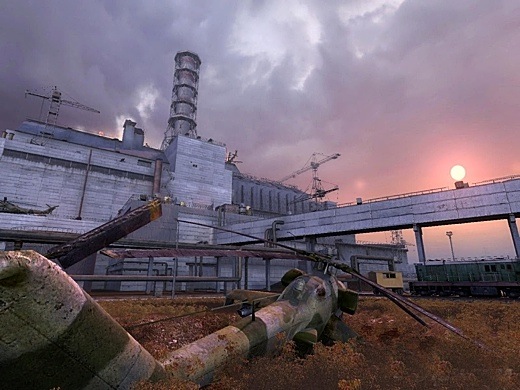
Image above: Still frame of destroyed nuclear plant in game "Stalker - Shadow of Chernobyl". About as slose as you can get to the real plant is in a computer simulation like this one that details the entire site including the abandoned city of Pripyat. Fro (http://thehiat.blogspot.com/2010/11/abandonment-in-games-stalker-1.html).

James Lovelock was never far from my mind in Japan last week. The originator of the Gaia hypothesis which maintains that the Earth is a living self-regulating organism a few years ago came to the conclusion that human beings are incapable of or do not want to adapt to mitigate global warming. Therefore, given that we want business as usual, we need energy – and more of it given the growing needs of countries like India and China.

Since we want to continue enjoying life as we know it, we have to build more nuclear plants regardless – because we are all going to fry anyway when the Earth inevitably heats up several degrees. I am putting this in simplistic and even facetious terms, but you get the drift. I highly recommend James Lovelock’s book "The Vanishing Face of Gaia".

It is visionary, realistic - and sobering. At a cafe in Tokyo, as young men and women chatted and laughed around us (belying an undercurrent of concern as the population gets a crash course on the arcane details of radioactivity), I met with Yu Tanaka, one of Japan’s lonely breed of anti-nuclear activists. He spoke of the entrenched nuclear power industry in Japan – a cozy club of big corporations (power utilities and construction), bureaucracy, politicians and the media. Later, I met with Mr Tetsuo Saito, a physicist and PhD holder from Princeton University who has been minister of environment and now sits in the opposition. Even he agreed there was no longer a consensus in Japan about the safety of nuclear power plants.

 Nuclear power debate
 Use Google News and key in "Nuclear, Japan, Fukushima" and you will come up with a mass of articles discussing nuclear power. UN talks on climate change are under way right now in Bangkok, and Fukushima has put a cat among the proverbial pigeons. The nuclear renaissance – over 300 plants are planned around the world – is partly driven by the need to reduce carbon dioxide (CO2) emissions from coal-burning power plants.

But the critics say if you go back to look at Chernobyl in 1986, and then fast forward to Fukushima 2011 which is still unfolding (there seems to be something inherently wrong about a system that keeps going even if you flip the OFF switch?) it warrants a pause for serious thought. The big question is what we use from our menu of options – from the benign (solar, wind, waves) to the dangerous (coal, nuclear). Somewhere in the middle is hydro power. And at the root of it is our hunger for energy. It is this – the key input that maintains our life as we know it – combined with the big business interests, that leaves us with only dangerous solutions.

Somewhat like how the entrenched interests of the US auto industry delayed the development of fuel-efficient or electric cars, if the resources that go into nuclear power (or indeed the importing of oil) were to be diverted to renewable energy, remarkable achievements are possible. This is especially so in Japan with its long coastline. Will the still-leaking radioactive water from Fukushima force this kind of revolution? The debate rages. See this article for an critique of George Monbiot’s views: http://links.org.au/node/2246

Hugh Gusterson in an article last week for the Bulletin of the Atomic Scientists, wrote "Countries with other energy options, strong democratic structures, and powerful environmental movements will probably de-emphasise, and maybe eventually renounce, nuclear energy. "Switzerland has already suspended plans to build new reactors, and Germany's Angela Merkel, responding to large antinuclear protests, announced plans to close seven reactors pending further evaluation of their safety and to reconsider plans to extend the lives of Germany's oldest reactors.

"In the meantime, countries with weak environmental movements and weak regulatory norms seem to be proceeding as if nothing has happened." As the Fukushima nuclear disaster unfolded, Turkey announced plans to go ahead with two reactors, and we can surely expect China, Russia, and India to do the same.

 It seems supremely ironic to me that Japan – the only country ever to be struck by nuclear bombs, twice – should be facing a nuclear disaster which is the result of its own marriage with nuclear energy. I mentioned this to a friend on Saturday as we left an evacuation centre housing people from the 20 km exclusion zone around the Fukushima Daiichi nuclear power plant. "Yes" she said. "We are idiots if we still do not learn."

 .

Japan's Peak Oil Dry Run

SUBHEAD: Life for survivors after the Japanese earthquake and tsunami gives a clue to what a peak oil world would look like.  

By Brendan Barretton 4 April 2011 in OurWorld 2.0 -  
http://ourworld.unu.edu/en/transition-japan-peak-oil-dry-run/)

 
Image above: A line for scarce fuel in post earthquake/tsunami/meltdown Japan. From original article.
 
For large parts of eastern Japan that were not directly hit by the tsunami on 11 March 2011, including the nation's capital, the current state of affairs feels very much like a dry-run for peak oil. This is not to belittle the tragic loss of life and the dire situation facing many survivors left without homes and livelihoods. Rather, the aim here is to reflect upon the post-disaster events and compare them with those normally associated with the worst-case scenarios for peak oil.

The earthquake and tsunami affected six of the 28 oil refineries in Japan and immediately petrol rationing was introduced with a maximum of 20 litres per car (in some instances as low as 5 litres). On 14 March, the government allowed the oil industry to release 3 days' worth of oil from stockpiles and on 22 March an additional 22 days' worth of oil was released.

The Tokyo Electric Power Company (TEPCO), which serves a population of 44.5 million, lost one quarter of its supply capacity as a result of the quake, through the closedown of its two Fukushima nuclear power plants (Dai-ichi and Dai-ni), as well as eight fossil fuel based thermal power stations. Subsequently, from 14 March 2011 onwards, TEPCO was forced to implement a series of scheduled outages across the Kanto region (the prefectures of Gunma, Tochigi, Ibaraki, Saitama, Tokyo, Chiba, and Kanagawa).

While the thermal power stations may restart operations soon, the overall shortfall will become even more difficult to manage over the summer period when air conditioning is utilized. The reality is that these power cuts could continue for years, especially since the one of the two Fukushima nuclear plants has effectively become a pile of radioactive scrap.

Related to this, when the Tokyo Metropolitican Government began to announce levels of radioactive contamination of drinking water above permissible levels, this was immediately followed by the rapid sell-out of bottled water, even after the levels dropped again. When bottled water is on sale in local convenience stores after some restocking took place, each customer is only allowed to purchase one 2 litre bottle.

Immediately after the quake, supermarkets outside the disaster area in Tokyo and other major cities began to sell out of foodstuffs, including various instant meals. The electrical appliance stores sold out of batteries, flashlights and portable radios.

As we all know, the twin natural and human tragedies are having impacts beyond the Tohoku region where Fukushima lies, and the Greater Tokyo area. It has been difficult for Japan's notoriously efficient industries to maintain production, given that they rely on just-in-time systems and which have supply plants (for needed parts) that are located in the zone impacted by these combined disasters.

One example is in car production, where major firms have had to suspend work at their factories when key parts are no longer available from the affected region. The fragility of this system of industrial production is glaringly obvious and it is something that peak oil commentators have warned of multiple times.

These food and bottled water shortages, power cuts, fuel-rationing and breakdowns in just-in-time manufacturing have been anticipated by those who take peak oil seriously. It is almost as if eastern Japan is experiencing a peak oil rehearsal, although other regions of Japan are virtually unaffected. If proponents of peak oil are correct, then the rest of the world may experience something similar within the next 5 to 10 years, and hence it is important that we learn valuable lessons from Japan's response to the current circumstances.

What makes the current situation different from peak oil?
Under a peak oil scenario, the entire world (not just one country) would be affected by a continuous decline in global oil production. The rate of that decline is the key factor. If the rate is very gradual (a few percent points each year), then economies and their food and energy production and distribution systems in particular will have more time to adapt.

In such circumstances, we could envisage a significant decline in the flow of goods and people across the globe — a slowing or a potentially grinding halt. For a country like Japan that relies heavily on the import of food, having only 40% self-sufficiency, the real peak oil scenario would have dire impacts.

Under the present situation, Japan can still rely on imports to alleviate food supply problems. This is fortunate as over 600 farms, 125 harbours and 2,333 fishing vessels were destroyed by the tsunami, not to mention the thousands of people who made their livelihoods from agriculture and fishing who are either deceased or displaced. Furthermore, the 20-30 km zone around the Fukushima Dai-ichi plant may not be used for food production for some time to come and the good reputations of those areas for providing clean produce may take even longer to be restored.

In a global peak oil scenario, it is highly likely that food prices would increase significantly. To some extent this is happening. For instance, in February 2011 it was reported that food prices reached a record high due to poor harvests, rising oil prices (at US$105 per barrel) and increasing demand for foodstuffs due to rising population and incomes. The conflict in Libya was predicted to further exacerbate the food and oil prices. In fact, conflict and civil unrest in oil producing countries is another facet of various peak oil scenarios as nations scramble for the remaining resources. It is something that Richard Heinberg describes as the "last one standing" scenario in which powerful countries will use their assets to promote their own survival at the expense of everyone else.

So in the current predicament facing Japan, the situation is ameliorated by the ability of different nations to offer support and continue trading (for instance, Evian is selling a lot of bottled water to Japan at the moment). This certainly would be more difficult under some of the extreme peak oil scenarios, where rapid oil decline is involved.

Lessons from Japan
While the consequences of the current disaster for Japan have been tragic in terms of the loss of life and while it is clear that the emotional, psychological and economic impacts are enormous, there are real signs of hope.

The first important lesson to recognize is the way that Japan's leaders acted rapidly and responsibly. We have already indicated that fuel rationing was in place from 12 March 2011. The reality is that Japan is one of the most disaster-prepared nations in the world and regularly undertakes wide-scale drills. This practice proved to be of vital importance in helping people, communities and institutions cope with the major challenges that they have had to face.

Government officials quickly recognized that people were hoarding food supplies and began to publicly request that they only buy what they need. This was followed up by a series of public service announcements by the Japan Ad Council under theme of "What I can do now."

The Minister in charge of consumer affairs, Renho Murata, frequently called on people not to panic buy and hoard food. She argued that this kind of activity was undermining the ability to provide relief supplies to the quake hit areas. At the same time, the general public and the private sector in the Kanto region were encouraged to comply with the scheduled power outages and to significantly reduce their energy consumption. Everybody responded positively – keen to play their part in solving this problem.

Prime Minister Naoto Kan in particular made an appeal to the people of Japan on 13 March 2011 when he said, "We Japanese have overcome many very trying situations in the past to create our modern society of peace and prosperity. I firmly believe that through our citizens working together to respond to this great earthquake and tsunami, we will certainly be able to overcome this crisis."

This message has been echoed across the media and the Japanese public has responded by showing calmness, patience, respect for each other and mutual support. If anything, they have exemplified Richard Heinberg's power down scenario — the path of cooperation, conservation and sharing. Whether they can hold true to this path over a prolonged period of time remains to be seen.

In the global Transition Movement, they often refer to the "head, heart and hand" approach to coping with peak oil and climate change, as discussed in Rob Hopkin's Transition Handbook. Put simply, the head signifies the exploration needed about how we can re-orient our lives to become more local and small scale as our awareness increases of the energy crisis we are heading into.

The heart symbolizes how we can generate positive visions of the future and how they can be harnessed to overcome the feelings of powerlessness in the face of these immense challenges. The hands are a representation about understanding how the transition model can be employed in practice for specific communities.

For many communities in eastern Japan, the current circumstances represent the first time they have had to consider questions about food and energy security. The vast majority appear, quite naturally, to share the overwhelming desire to get back to normal, back to the way things were before. But there are also signs of the head, heart and hand approach as many Japanese commentators are asking questions about how will develop in the future.

If Japan is to build back better, then it should perhaps do so by building more resilient, more locally oriented communities in the areas affected by the quake and tsunami, and beyond. In fact, this is a chance to reconsider completely the development path for Japan towards one that is less vulnerable, less reliant upon fossil fuels, and ideally a low carbon society.

To borrow the words of Prime Minister Kan once again when he called upon his compatriots:
"Through this resolve, let us all now — each and every individual — firmly reinforce our bonds with our families, friends, and communities, overcoming this crisis to once more build an even better Japan."

Blowing Green Smoke

SUBHEAD: The reason for this obvious idiocy is that it's all about the cars. That's all we care about in the USA, the cars. We can't get over the cars. Yet.  

By Jame Kunstler on 4 April 2011 for Kunstler.com -
(http://kunstler.com/blog/2011/04/blowing-green-smoke.html)

 
Image above: SUV burns in suburban driveway. From (http://www.lehighvalleylive.com/phillipsburg/index.ssf/2010/04/car_catches_fire_in_phillipsbu.html).
"We also have Secretary Steven Chu, my Energy Secretary. Where is Steven? There he is over there. - President Obama at Georgetown U last week
Blame Steven Chu, then, because when it comes to America's energy predicament, the president has been woefully misinformed. Mr. Obama pawned off a roster of notions and proposals already product-tested in the public meme-o-sphere. Almost everyone of these ideas is inconsistent with reality, based on faulty premises, or represents some kind of magical thinking. What they have in common is that they're ideas the public wants to hear, whether they are truthful or not, because we don't want to change the way we live.

The central idea in Mr. Obama's speech is that we will reduce our oil imports by one-third in a decade. This is a gross distortion of reality. The truth is that our oil imports will be reduced automatically, whether we like it or not. The process is already underway. The nations that export oil to us are using much more of their own oil even while their supplies have passed peak production and entered depletion.

Countries like Saudi Arabia, Venezuela, and Mexico have some of the highest population growth-rates in the world. They sell gasoline to their own people for less than a dollar a gallon. At the same time China and India are driving more cars and importing a lot more of the world's declining supply. (China has perhaps the equivalent of a four-year supply of its own oil in the ground, and India has next-to-zero oil of its own).
One meme circulating around the Web these days is that the USA has the equivalent of "three Saudi Arabias" in the shale oil fields of North Dakota, Colorado, Wyoming, and Montana. That is not true. A lot of this magical thinking focuses on the Bakken fields of Dakota. We're currently producing less than 400,000 barrels a day out of Bakken and the projected maximum ten years from now is around 800,000.

We use 20 million barrels a day in the US running suburbia, Wal Mart, and the US military. By the way, Bakken shale oil requires extensive rock fracturing operations - "fracking" - which means a lot of horizontal drilling, which means a lot of steel pipe. It is not just a matter of sticking a steel straw in the ground like we did in Texas in 1932.
Note: much of the shale "oil" in other western states is not actually oil. It is kerogen, an organic precursor to oil, in effect organic polymers that have not been subjected to enough heat and pressure to turn into oil. If you want to turn it into oil, you have to cook it - which takes energy! That's after the mining operation to scoop it out of the ground. That takes energy too. Or, you can send machinery into the ground and cook it in place. That takes energy, too. We are not going to get oil out of there anytime soon - and perhaps never.
The "drill drill drill" gang is under the impression that North America has vast unexplored regions where oil is just begging to be discovered. This is not true. The New York Times reported after Obama's speech - in a disgracefully dumb story by Clifford Krauss - that the eastern Gulf of Mexico and Atlantic Coast contain 3.8 billion barrels of oil. Really? Hello!

The US uses over 7 billion barrels of oil every year. Does the Arctic National Wildlife refuge contain between 4 and 11 billion barrels (US gov estimate)? Great, that averages out to about a year or so of US supply. And I'm not even against drilling there, only against the idea that it represents a meaningful "solution" to our problem.
Meanwhile, the old standby Alaskan oil fields at Prudhoe Bay are depleting so remorselessly that there may not be enough flow in a year or so to move the oil through the famous pipeline.
How about Canada's tar sands? Well, first of all, they belong to Canada, not us, unless we want to change that - and that could be politically messy. The tar sands will never produce more than 3 million barrels a day. The operations are already too huge, costly, and damaging to the northern watershed. Canada is our number one source of imported oil, but China would also like to buy Canadian oil. Are we planning to invoke the Monroe Doctrine to prevent Canada from selling its oil to parties outside the Western Hemisphere? That could be messy, too.
Mr. Obama returned to the popular theme of bio-fuels. Our initial venture into this area was the ethanol fiasco which, predictably, took more energy to make than it produced, and had disastrous effects (still does) on corn commodity prices - in effect stealing from the food supply in order to drive to the Wal Mart. The next venture will apparently be in algae. We'll discover (once again) that what works as a science project doesn't scale to run millions of cars.
Mr. Obama told the nation that we have a 100 year supply of natural gas. (The moronic Larry Kudlow of CNBC told his audience it was 300 years). Neither of them knows what he is talking about (and evidently Energy Secretary Chu doesn't either). So far, proven reserves of shale gas amount to about a 4 to 6 year US supply at current rates, and total natural gas reserves - including conventional gas, the kind that doesn't require fracking - amounts to about a 12 year supply. The idea that we are going to ramp up an entire natural gas fueling system for America's tractor-trailer trucks is an absurdity.
Ditto the notion that we are going to electrify the US auto fleet.
Here's something to chew on: we run about 250 million cars in the USA. Let's say we ramped up an electric vehicle fleet of 10 million cars - which, by the way, is a purely hypothetical and wildly optimistic number. Do you think it might be a political problem if 10 million lucky Americans get to drive electric cars while everybody else either pays through the nose for gasoline, or can't even afford to own a car anymore?
There are a few things you can state categorically about the US energy predicament and the national conversation we're having about it - including the leaders of that conversation in government, business, and the media. One is that we are blowing a lot of green smoke up our collective ass. None of these schemes is going to work as advertised. The disappointment over them will be massive and probably lead to awful political consequences.
Another is that we are ignoring the most obvious intelligent responses to this predicament, namely, shifting our focus to walkable communities and public transit, especially rebuilding the American passenger railroad system - without which, I assure you, we will be most regrettably screwed ten years from now. Mr. Obama had one throwaway line in his speech about public transit and nothing whatever about walkable neighborhoods.
The reason for this obvious idiocy is that it's all about the cars. That's all we care about in the USA, the cars. We can't get over the cars. We can't talk about anything except how we'll find magical new ways to run all the cars. This is a very tragic sort of stupidity and if we don't change our thinking about it, from the highest level on down, history is going to treat us very cruelly.
A special shout-out here to The New York Times, whose abysmal reporting on these issues, once again, is due to their reliance on a single source: the IHS-CERA group, Cambridge Energy Research Associates, the paid public relations auxiliary of the oil industry, led by that mendacious sack of shit Daniel Yergin, whore-in-chief.

 .

Itsy Bitsy Spiderwort

SUBHEAD: Permaculturists are the emergency planetary technicians, and bioremediation is our bailiwick.  

By Albert Bates on 3 April 2011 in The Great Change - 
(http://peaksurfer.blogspot.com/2011/04/itsy-bitsy-spiderwort.html)

 
Image above: Zig zag spiderwort buds. From (http://rampant-mac.com/dp_08/Zig-Zag-Spiderwort_1440.jpg).
 
Since the reactor meltdown in Japan we have been in communication with the Permaculture Institute there, offering advice, equipment and public health-related resources. They were quick to inform us that the shelves in stores were becoming barren of canned goods and water, that fresh produce and tap water was no longer reliable, and that people were afraid to garden because the possibility of soil contamination. While there is no quick and easy solution to these problems, there are things that dedicated permaculturists can do. We are the emergency planetary technicians, and bioremediation is our bailiwick. Firstly, lets have a look at the problem.

Like most developed countries, Japan has gone from a nation of people who walked and used animals for transport, to one that depends on cars, trucks, trains, and high tech. Using first coal and oil, and then nuclear power, they have been able to hire versatile energy slaves for every purpose, and have become utterly dependent on many technological prosthetics. With high speed rail and fast highways carrying food from country to city, Japan has urbanized its population to more than 15,000 people per square mile in its cities.

So, when a collapse of the nuclear house of cards finally came — and it is inevitable everywhere they have been built, it is just a matter of time — it affected a great many people. Lets briefly recap where the Japanese ‘accident’ stands at this writing. The 9.0 Tōhoku earthquake of Friday, March 11, 2011, has been long expected. Japan is located near the boundary of three plates (the Boso Triple Junction) that have been relatively quiet since a 8.3 magnitude quake in 1923 that killed 142,000 people.

While Japan has engineered its buildings to withstand such events and prevent great loss of life, the 2011 quake produced maximum ground accelerations that exceeded the design specifications for 4 of the 6 reactors at the Fukushima Daiichi plant (as well as for all of the nuclear plants in the United States). Although Fukushima was protected by a seawall that was designed to withstand a tsunami of 5.7 metres (19 ft), the wave that struck the plant, which is on the coast, was estimated to be more than twice that height at 14 metres (46 ft). At least three nuclear reactors suffered explosions due to hydrogen gas that built up within their containment buildings after cooling system failure.

 Reactor #1
At the Fukushima complex, roughly 70 percent of the core of reactor No.1 suffered severe damage, but is now being hosed down, so that the oxidizing fuel in the core is no longer melting. Still, a witches’ brew of long-lived radionuclides are being carried away in steam and ocean runoff. The melted rods have been encrusted with salt from seawater, which will make them a continuing health hazard until they have cooled and are encased in concrete.  

Reactor #2
Tokyo Electric Power Co (TEPCO) said it has found a crack in the pit at its No.2 reactor, generating readings of 1,000 millisieverts of radiation per hour in the air inside the pit. For those old enough to remember the rads and rem nomenclature, that would be 10 rem per hour. Actually, they probably meant to say 10 grays per hour, but they got it wrong.

The nuclear industry switched from rads and rem a decade or more ago to grays and sieverts because that made the worst cases seem much more minor. A sievert is 100 rem so a rem is 10 mSv. A millisievert is 100 millirem (0.1 rem). Rem (for “radiation equivalent for man”) is a health physics term that attempts to calculate what portion of a rad (rate of disintegration in dry air) is biologically absorbed. Grays are the new rads, sieverts the new rem.

Decimals have been shifted to confuse us. While no amount of radiation is safe — the tiniest fraction has the potential to either kill you or leave you undisturbed, much like taking a stroll through a mine field — the industry allows its workers to receive an annual dose of 17 rem, or 170 mSv, in the US (and 20 mSv in Japan).

The limit for workers during Fukushima emergency has now been elevated to 250 mSv/year. Therefore the observed dose in Reactor No. 2 exceeds the annual allowable dose in about fifteen minutes. To work inside that space, TEPCO would need to replace every employee every fifteen minutes, and the retiring employees would need to go somewhere far enough away to be uncontaminated for a year before they could return to work. Workers at Reactor #2 are attempting to plug the crack with concrete, presumably working in 15 minute shifts.  

Reactor #3
Over at Reactor #3, which violently exploded on YouTube on March 14— some days before TEPCO and the Japanese government admitted it had a serious problem there — a long vertical crack is running down the side of the reactor vessel itself. Since the surrounding containment building has been blown away, it is easy to view the reactor from Google Earth. According to TEPCO, the crack runs down below the water level in the reactor and has been leaking fluids and gases since the explosion. “It’s up and down and it’s large,” TEPCO said. “The problem with cracks is they do not get smaller.” Number 3 is where they were using MOX fuel, or a mixture of plutonium and uranium. When you blend in plutonium in that volume, the public health threat is cubed.

 Reactor #4
Reactor #4 was out for service and the core was being stored in a swimming pool when the earthquake and tsunami took out offsite power. The heat from the fresh fuel quickly evaporated the coolant and once exposed to air the zirconium cladding oxidized (burned away) allowing the uranium and transuranic elements in the fuel pellets to collect at the bottom of the pool and melt together like radioactive lava. The hot mass has now cracked the concrete bottom of the pool but water is being poured in at a faster rate than it is going out, so for now the fuel is being cooled. Nonetheless, because of the random configuration, the potential for recriticality of the pile cannot be excluded, and in such an event a rekindled chain reaction could produce considerably more heat than fire hoses can cope with, meaning the core would once more uncover and burn. As of last Friday, the fuel in the #4 pool was once more uncovered and burning. Observed “blue flashes” above the plant at night suggest that a rekindled chain reaction is indeed taking place.  

Off Site
 High levels of radiation have been measured 40 km from the complex, well outside the evacuation zone. Low airborne levels, and contamination of fresh food and tap water have been measured in Tokyo, 140 km to the South. Some operating problems have also been reported at other nuclear reactor complexes in Japan that are attempting to go to cold shutdown status but have not succeeded. With that situation in mind, we were asked by people in Japan what they should do with respect to food. Our reply has been three-fold. Firstly, people should eat only foods packaged prior to the March 11 earthquake, or imported from well outside the zone of potential contamination.

While we initially thought it a wives’ tale, we discovered some scientific support for miso soup and presumably other fermented foods as well (natto, ontjom, tempeh, kim chi, sauerkraut, etc.). According to a group of Japanese researchers at the Department of Environment and Mutation, Research Institute for Radiation Biology and Medicine, Hiroshima University, miso (a fermentation product from soybeans) has a radioprotective effect on mice. Miso at three different fermentation stages (early-, medium- and long-term fermented miso) was mixed into biscuits at 10% and administered from 1 week before irradiation. Animal survival in the long-term fermented miso group was significantly prolonged as compared with the short-term and medium-term fermented miso.

Delay in mortality was evident in all three miso groups, with significantly increased survival. At high doses (10 and 12 Gy X-irradiation at 4 Gy/min), the treatment with long-term fermented miso significantly increased survival. Thus, eating foods with prolonged fermentation appears to be very important for protection against radiation effects. See: Ohara M, et al, (2001) Radioprotective effects of miso (fermented soy bean paste) against radiation in B6C3F1 mice: increased small intestinal crypt survival, crypt lengths and prolongation of average time to death, Hiroshima Journal of Medical Sciences 50:4;83-86. Secondly, food producers who are threatened with contamination should either evacuate the area, or if the contamination is slight or indirect, they should move growing operations indoors, erecting glass houses and polytunnels as needed. We recommended to the Permaculture Institute of Japan that they build a bioshelter and monitor anything going into the enclosed growing area as it came in — soil, water, seed, tools, people, etc. — to maintain radioactive sterility. Of course, there is no way of knowing if a single hot particle of plutonium carries in on someone’s clothes, but you do what you can. We are supplying Geiger counters from SE International here on The Farm. Thirdly, obtain KU-9 Tradescantia cuttings from Dr. Sadeo Ichikawa at the University of Saitama, Uruwa, and clonally propagate those.

Distribute them widely. For those unfamiliar with Tradescantia, our illustrated 1978 book, Honicker v. Hendrie: A Lawsuit to End Atomic Power, describes them in detail. Professor Ichikawa, while doing genetic research at Brookhaven National Laboratory in Upton, NY in the early 1970s, studied the effects of gamma radiation on reproductive integrity of stamen hairs in polyploid Tradescantia. After studying effects on chromosomes of various Tradescantia species (commonly known as spiderwort), Ichikawa was able to select and clonally propagate a number of cultivars in a species he named Tradescantia nonukes. Tradescantia nonukes has two genes for color in the cells of the stamen hairs and petals. The dominant gene codes cells to display blue.

The recessive gene codes cells to display pink. Spiderwort produces its flowers daily, so a change from blue to pink, or blue with purple splotches, would instantly signal the presence of an environmental mutagen. Well, “instantly” may be a stretch. Since mutagens can reach the sites of cell division by air, water and soil mineral uptake, the display may lag the exposure by some days.


Nonetheless, this is a very low cost and accurate biological Geiger counter. How accurate? By taking daily cell counts for color change along the single-cell strands of stamen hairs under a low-power optical microscope, Ichikawa and his SUNY-Brookhaven students were able to chart subtle changes in background radiation from day to day. In field trials outside a nuclear plant in Japan, Ichikawa accurately correlated known emissions data to responses by his plants. The clones are highly sensitive, and moreover, they are not measuring ionizing radiation by static charge in dry air the way a Geiger tube does, using a mathematical model to extrapolate biological dose from studies of mice and dogs to humans. The plants are measuring biological uptake in the first instance and therefore monitoring all possible exposure pathways.
See C. H. Nauman, A. G. Underbrink and A. H. Sparrow (1975) Influence of Radiation Dose Rate on Somatic Mutation Induction in Tradescantia Stamen Hairs. Radiation Research 62:1; 79-96; Ichikawa, S. (1981), In Situ Monitoring with Tradescantia around Nuclear Power Plants, Environmental Health Perspectives 57:145-164, The National Institute of Environmental Health Sciences (NIEHS); and Ichikawa, S., et. al., (1995), Flower production, stamen-hair growth, and spontaneous and induced somatic mutation frequencies in Tradescantia cuttings and shoots with roots cultivated with nutrient solutions, Japanese Journal of Genetics 70:5;585-600.

To those in Japan, and others, we urge that it is important to obtain genuine Tradescantia nonukes and not some common garden variety that does not have genetically dipolar coloration. The KU-9 clone is a perennial that can overwinter from Texas and Florida into Southern Canada, going back to its roots while dormant and re-emerging again in the Spring after last frost. In a greenhouse it can bloom all year. Every temperate climate permaculturist should have a supply.

We met Dr. Ichikawa in Louisville, Kentucky in 1976 and returned to Tennessee with samples of clonal Tradescantia nonukes that we have propagated since that time. Because of genetic variation, it should never be grown from seed, and any Spiderwort you get from a seed packet will not be a reliable radiation detector. To clone Tradescantia is very easy. Select a long strand with at least three nodes between root and flower. Cut the strand near the root zone and then trim it back so that there are two extant nodes on the cut stem. Remove flowers and trim the leaves to one-half or one-third size (this reduces stress, since the plant cannot supply leaves and flowers until it has re-established roots).

The cutting can remain dry for a few days, but the root end should be wrapped in moistened bathroom tissue to keep it from drying out. As soon as feasible, place the root end into a small vase or water glass. This will allow it to retain moisture and begin to grow new root hairs. Within a few days of cutting, or even immediately, the clone can be placed into moistened soil. It should establish there within a few weeks and in a month or so be making new flowers. The original stem will likely die back before flowering, but then re-emerge from its roots with fresh growth. Reconditioning damaged soil is the next challenge, and we will discuss that here next post.

 And by the way, smoking 1.5 packs/day gives you a radiation dose of 13-60 mSv/year. Tobacco is grown using superphosphate fertilizers that contain thorium, which decays to radium and its radioactive daughters (lead, bismuth and polonium). These particles are deposited on the sticky hairs of the tobacco leaf and then burned into the smoke you inhale, lodging in your lungs for decades, or being carried by your bloodstream to various long-term residences in your body. Just because you don’t work in a nuclear plant or live in Japan doesn’t mean you are free of risk from inhaled radioactive particles. Try blowing smoke on a spiderwort plant and watch what happens.
MISO SOUP (serves 2)
Ingredients: 3 ounces dried soba noodles 2-4 tablespoons white miso paste 2-3 ounces firm tofu, chopped into 1/3-inch cubes Handful of spinach, washed and trimmed 2 green onion, tops removed, thinly sliced 3 small shiitake caps, preferably hanadonko grade (white with black cracks) Small handful cilantro, optional Pinch of red pepper flakes
Cook soba noodles in salted water according to package directions. Drain and run cold water over the noodles to stop them from cooking. Set aside.
Stem, clean and slice the shiitake caps. If dried, rehydrate for some hours. In an iron skillet brown them lightly in olive oil and shoyu. This brings out the mushroom flavor. Set aside.
In a medium saucepan bring 4 cups water to boil. Reduce heat to gentle simmer and remove from heat. Pour a bit of the hot water into a small bowl and whisk in the miso paste…this allows the paste to thin out and prevents clumping. Stir the paste back into the pot. Add the tofu and shiitake, remove from the heat and let sit for a minute. Split the noodles between 2-3 bowls and pour the miso broth, shiitake and tofu over them. Add some spinach, green onion, cilantro, and (if desired) red pepper flakes to each bowl and serve.
.

Our Economic Black Hole

SUBHEAD: The black hole power grows silently and invisibly with every further addition to its hidden mass.  

By Richard Heinberg on 2 April 2011 in Post Carbon Institute -
(http://www.postcarbon.org/blog-post/295033-our-economic-black-hole)

 
Image above: Scene from 'The Battle of the Black Hole" episode of Stargate (2006). From (http://stargate.wikia.com/wiki/Battle_of_the_Black_Hole).
 
In recent months economist and former Labor Secretary Robert Reich has been saying that the American economy is “in the gravitational pull of the Great Recession”. It’s an interesting metaphor. The U.S. economy is assumed to be a satellite of some heavy object, and just needs a little more push (in the form of Federal stimulus) in order to achieve escape velocity and go on its merry way.

Perhaps the metaphor makes more sense if it’s reframed slightly. Maybe it is more accurate to think of the economy itself as the black hole. At its heart is a great sucking void created in 2008 by the destruction of trillions of dollars’ worth of capital. The economy used to be a star, spewing out light and heat (profits and consumer goods), but it imploded on itself. Now its gaping maw will inevitably draw all surrounding matter into itself.

You can’t see the black hole, of course; it’s invisible. It is composed largely of unrepayable debt in the form of mortgages, and of toxic assets (mortgage-backed securities and related derivatives) on the books of major financial institutions, all of which are carefully hidden from view not just by the institutions themselves but by the Treasury and the Fed. Added to those there is also a growing super-gravitational field of resource depletion—which is again invisible to nearly everyone, though it does create noticeable secondary effects in the form of rising energy and food prices.

The Treasury and Fed are perhaps best thought of as a pair of powerful Battlestars orbiting just outside the singularity, zapping propulsive jolts of energy (in the forms of stimulus packages, bailouts, and quantitative easing programs) at hapless spaceships (banks and businesses) in the vicinity in order to keep them from falling into default, bankruptcy, and foreclosure. Unfortunately, the Battlestars—with their limited and depleting energy sources—are ultimately no match for the black hole, whose power grows silently and invisibly with every further addition to its hidden mass. The Battlestars will themselves eventually be assimilated.

What are we puny, rank-and-file space voyagers to do? Sadly, we must resign ourselves to being absorbed by the black hole at some point. There’s at least the theoretical possibility, though, that at the heart of the singularity there exists a wormhole—a magical pathway to some other reality. In that alternate universe the economic rules are entirely different: money is not based on interest-bearing debt, and the economy is assumed to be a subset of the ecosystem, rather than the other way around. Unfortunately, it is impossible to get to this through-the-looking-glass world without passing through the singularity.

However, what we do now may have some bearing on our prospects: a few physicists reportedly believe that there are many alternate realities, and by visualizing and acting according to the rules of the reality we prefer, we might be attracted toward it rather than some other.

At least that’s the way it works in science fiction.


.

Financial Advice

SUBHEAD: How do I invest my money for it to survive financial, political and commercial collapse?  
By Dmitry Orlov on 1 April 2011 in ClubOrlov -  
(http://cluborlov.blogspot.com/2011/04/financial-totalitarianism.html)

 
Image above: Detail of "St. Francis in Ecstasy" by Giovanni Bellini. From (http://www.medievalists.net/2010/02/11/between-form-and-representation-the-frick-st-francis).
 
A particularly annoying question I am often asked and have come to hate is:
“How do I invest my money for it to survive financial, political and commercial collapse?”
The short answer is:
“Nohow. Money will not survive collapse; not yours, not anyone else's.
But that answer is not acceptable, because accepting it would require a profound loss of faith—faith in money, a profound Götterdämmerung for a civilization based on the worship of money. People want continue to believe all sorts of things: that they can own land (i.e., shares in the Earth), or that they can do good through philanthrophic spending and charity, or that the world with which they have grown up and have lived their lives can collapse all around them, but that if they are informed and prepared, they can survive with all of their middle-class trappings intact. I am told that there is good money to be made in telling them such things.
Those who care to look can easily turn up plenty of evidence that the value of every type of financial asset, not just fiat currency or debt instruments, is unsupported. Its value derives from the goods and services provided by a functioning global industrial economy, which is quickly running out of every type of resource it requires; not just high-EROEI fossil fuels, but also metals, rare earth elements, phosphate, irrigation water and arable land.

As industrial activity dwindles, worker productivity will decline precipitously. Many people point to precious metals as the ultimate storehouse of value, but without industrial equipment a man can only put out about 100 Watts of energy—a light bulb's worth—and won't dance any faster no matter how many gold or silver coins you throw at him.
This eventual outcome is the result of long-term physical trends: physical processes that move at predetermined rates and in only one direction. It is not possible to un-burn oil or coal or to un-mine gold or silver. But the short-term political and financial trends point in an altogether different direction: that of the global industrial economy turning boutique.

You see, one shoe has already dropped: the level of industrial activity that can be sustained today is already insufficient to provide anywhere near full employment and a reasonable quality of life for vast numbers of people; the solution is to disenfranchise them, to confiscate their savings, to cancel their retirements, to concentrate all of the remaining wealth in as few hands as possible, and to create a boutique economic and financial environment in which the lucky and unscrupulous few can continue to live comfortably, and... wait for the other shoe to drop, I suppose. That will happen once the industrial economy becomes sufficiently disrupted by social and political upheaval that even its boutique version finally crashes.
A feeble (feeble-minded?) counter-reaction to these trends can be discerned: many people want to somehow find an escape from this system while still clinging to their money. This may seem like a contradiction in terms—“fleeing the money system while clinging to the money itself”—but this point seems lost on many people.

 Most of this counter-reaction is focused on the stampede to precious metals (gold and silver). This train of thought starts out as a smart market play: precious metals have been and continue to be a spectacular investment, and a good way to avoid being robbed blind by the out-of-control printing presses at the US Treasury. But eventually it goes off into ontological self-delusion—that gold and silver are “real” money, as opposed to paper fiat currency, which is “fake” money. Ladies and gentlemen, it doesn't matter whether or not it's shiny; it's all as real or as fake as you are.

Some people go straight over the edge and decide to take the law into their own hands and, waving about a dog-eared copy of the US Constitution, set off to coin their own “coin of the realm,” not realizing that the realm isn't theirs. If the realm is financially stable, it will simply change the rules to make such a gambit unprofitable. If the realm is financially distressed and teetering on the verge of collapse, it will panic, shout “Terrorism!” at the slightest provocation, and the result is long-term political imprisonment for the ontologically deluded:
March 21, 2011 WASHINGTON (Reuters) – A North Carolina man was convicted for creating and distributing a counterfeit currency that was very similar to the real dollar, a U.S. Attorney said. Bernard von NotHaus, 67, minted Liberty Dollar coins in the value of $7 million dollars. The conviction concludes an investigation that was started in 2005. “Attempts to undermine the legitimate currency of this country are simply a unique form of domestic terrorism,” Anne Tompkins, U.S. Attorney for the Western District of North Carolina, said in a statement on Friday. “While these forms of anti-government activities do not involve violence, they are every bit as insidious and represent a clear and present danger to the economic stability of this country,” she said.
This Reuters story has since been taken down, after being ignored by media in the US (but not in Russia). Von NotHaus is looking at 20 years in jail. This is a lot, you might think, for stamping some politically edgy shiny trinkets, but then Stalin gave out similarly long sentences to millions of people for doing absolutely nothing, so let us count our blessings.

Let's get one thing straight, though: in the United States, by law, anyone who, “except as authorized by law, makes or utters or passes, or attempts to utter or pass, any coins of gold or silver or other metal, or alloys of metals, intended for use as current money, whether in the resemblance of coins of the United States or of foreign countries, or of original design . . .” faces a fine or imprisonment. It is the same in every other country: the term “coin of the realm” implies that it is the realm that controls creation of all coinage and its circulation. You can wave your US Constitution around, or you can swat flies with it, or you can use it as kindling: the result will be exactly the same.


You cannot create your own money system, and you cannot change the way the money system works; either you are in the money system, or you are out. Most of us lack the ability to sever all ties with the financial realm, but, as with so many things, having the right attitude is very helpful. To that end, let me drop a Bible-bomb on you. (I do this as someone quite free of any religious sentiment; I just find the Bible to be an interesting and useful work of world literature, filled with highly quotable, pithy remarks.)

Here's a particularly nice quote from the Beatitudes: “Blessed are the poor in spirit.” Never has a truer phrase been written. Many of the more recent self-styled or so-called “Christians” have attempted to distort it to mean that it doesn't imply depriving yourself of any worldly goods, and that “poor in spirit” is a special, strictly spiritual sort of poverty. That is, of course, nonsense. You do not have to dig deep for the real meaning: “Poor” just means “poor,” and “in spirit” means “on purpose, not as a result of, say, injustice, misfortune, or being lazy, stupid or a gambler.” Oh, and “blessed” means “not damned.”

Accordingly, Christian monks take the vow of non-acquisitiveness, which is a virtue, with the corresponding vices of stinginess (“what is mine is mine”) and greed (“what is yours is mine”). It is rather difficult to embrace such basic tenets while remaining within a culture that has elevated avariciousness and rapaciousness to the status of virtues. But here is a key insight: being poor on purpose is much easier than being poor as a result of suddenly having less than you are accustomed to having. Voluntary poverty is a hell of a lot easier than involuntary poverty.
And so, the answer to the perennially annoying question:
“How do I invest my money for it to survive financial, political and commercial collapse?”
Answer:
"There is no answer to your question. Try asking a different question, to which there might be an answer.”