SUBHEAD: After logging they grinned and drove away. Another job well done but without ceremony.
By Brian Miller on 19 October 2015 for Winged Elm Farm -
(http://www.wingedelmfarm.com/blog/2015/10/18/meaningful-work/)
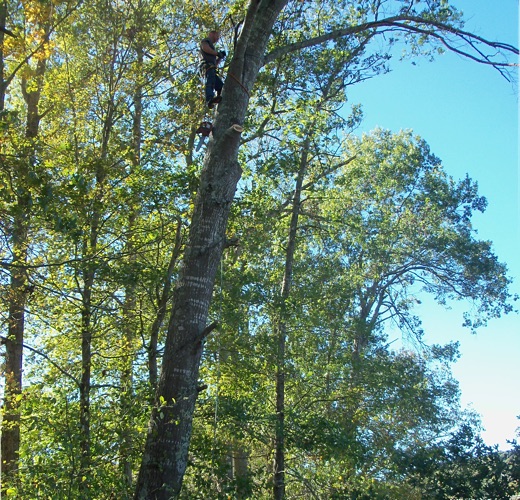
Image above: Man high in tree set to cut down large branches. From original article.
Bush-hogging the hill pasture in preparation for winter, I came across a large buck with an impressive antler spread. He leapt in front of the tractor, then bounded over a fence into a neighbor’s field, which, unbeknownst to him, was a no-kill farm, a safe zone where he could, if he only stayed put, live out his entire life without danger.
I then watched him run across the field and jump another fence, and he was gone. Another circuit around the hill and I saw a couple of trucks pull up at the farm. I headed down and greeted the men arriving to cut down four massive trees alongside our drive.
The trees, one white and three red oaks, needed to be felled expertly to avoid nearby power lines and a neighbor’s house. The men had to climb 60 feet and, from an eagle’s perch, drop the limbs.
Once the upper limbs were cut, they laid the trunks across the drive and cut them into 10-foot-long sawlogs. Ultimately, the largest logs will be milled into lumber, the crowns mulched, the limbs cut into firewood, the stumps drilled and plugged with oyster mushroom spawn. Logging 007
Dancing high above the ground with running chainsaws is dangerous work, but it was done with real purpose, joy, and competence, something that seems at odds with the lethargy of many young men I encounter. It’s a lethargy that seems endemic: man-boys extending their adolescence well into adulthood, living at home, gliding into their thirties without experiencing responsibility.
Not so long ago 80 percent of American high schools offered vocational training. But in just a 20-year span those totals were reversed, including at our own rural school. Now boys (and girls, too) enter biological adulthood without getting any practical schooling in crafts that formerly allowed them to earn a living and, more importantly, self-respect.
The fallout from this lack of preparation for honorable and satisfying work: Young men like my neighbor who drive 40 miles to Knoxville to work in a call center, selling jewelry to elderly women.
For reasons not fully understood, we continue to entertain the idea that all youth are destined for college. Without any statistical evidence, I’d still hazard a guess that the average electrician, plumber, or surveyor out-earns a significant portion of college grads.
My gut feeling that self-worth comes from tangible outcomes, whether raising livestock, felling trees, or wiring a barn, is backed up by personal experience — my own father’s landscape, for example, where a lifetime as a construction engineer allows him daily to see the evidence of an industrious life.
Matthew Crawford echoes the same sentiment in his insightful book Shop Class as Soulcraft:
Should the young men fed into our current system, one that devalues particular competence and focused physical activity, descend into a lifetime of malaise and meaningless boasting, it will not come as a surprise. Nor will there be any surprise should those rural young men who find employment in crafts, trades, or farming have a stronger sense of purpose and self-worth.
As the day ended, the cutting crew got in their pickups. They grinned, waved, and drove away. Another job well done but without ceremony.
.
By Brian Miller on 19 October 2015 for Winged Elm Farm -
(http://www.wingedelmfarm.com/blog/2015/10/18/meaningful-work/)
Image above: Man high in tree set to cut down large branches. From original article.
Bush-hogging the hill pasture in preparation for winter, I came across a large buck with an impressive antler spread. He leapt in front of the tractor, then bounded over a fence into a neighbor’s field, which, unbeknownst to him, was a no-kill farm, a safe zone where he could, if he only stayed put, live out his entire life without danger.
I then watched him run across the field and jump another fence, and he was gone. Another circuit around the hill and I saw a couple of trucks pull up at the farm. I headed down and greeted the men arriving to cut down four massive trees alongside our drive.
The trees, one white and three red oaks, needed to be felled expertly to avoid nearby power lines and a neighbor’s house. The men had to climb 60 feet and, from an eagle’s perch, drop the limbs.
Once the upper limbs were cut, they laid the trunks across the drive and cut them into 10-foot-long sawlogs. Ultimately, the largest logs will be milled into lumber, the crowns mulched, the limbs cut into firewood, the stumps drilled and plugged with oyster mushroom spawn. Logging 007
Dancing high above the ground with running chainsaws is dangerous work, but it was done with real purpose, joy, and competence, something that seems at odds with the lethargy of many young men I encounter. It’s a lethargy that seems endemic: man-boys extending their adolescence well into adulthood, living at home, gliding into their thirties without experiencing responsibility.
Not so long ago 80 percent of American high schools offered vocational training. But in just a 20-year span those totals were reversed, including at our own rural school. Now boys (and girls, too) enter biological adulthood without getting any practical schooling in crafts that formerly allowed them to earn a living and, more importantly, self-respect.
The fallout from this lack of preparation for honorable and satisfying work: Young men like my neighbor who drive 40 miles to Knoxville to work in a call center, selling jewelry to elderly women.
For reasons not fully understood, we continue to entertain the idea that all youth are destined for college. Without any statistical evidence, I’d still hazard a guess that the average electrician, plumber, or surveyor out-earns a significant portion of college grads.
My gut feeling that self-worth comes from tangible outcomes, whether raising livestock, felling trees, or wiring a barn, is backed up by personal experience — my own father’s landscape, for example, where a lifetime as a construction engineer allows him daily to see the evidence of an industrious life.
Matthew Crawford echoes the same sentiment in his insightful book Shop Class as Soulcraft:
“The satisfaction of manifesting oneself concretely in the world through manual competence has been known to make a man quiet and easy. He can simply point: the building stands, the car now runs, the lights are on. Boasting is what a boy does, because he has no real effect on the world.”
Should the young men fed into our current system, one that devalues particular competence and focused physical activity, descend into a lifetime of malaise and meaningless boasting, it will not come as a surprise. Nor will there be any surprise should those rural young men who find employment in crafts, trades, or farming have a stronger sense of purpose and self-worth.
As the day ended, the cutting crew got in their pickups. They grinned, waved, and drove away. Another job well done but without ceremony.
.