Showing posts with label Design. Show all posts

Resilient Suburbia

SUBHEAD: Suburbia could be more self-sufficient, healthy, productive, and life-affirming than we know today.

By Morgan Maiolei on 21 July 2016 for Strong Towns -
(http://www.strongtowns.org/journal/2016/7/20/resilient-suburbia)


Image above: Huntington Woods, Michigan, ranked in top 20 suburbs in America by Business Insider. From (http://www.businessinsider.com/best-suburbs-in-america-2014-9?op=1).

This week, Strong Towns' members and readers respond to the questions: Is it possible and/or worthwhile to retrofit suburbia/big box stores, or would we be better off abandoning underused suburban spaces? How might we go about retrofitting big box stores for future use?

Here is Morgan Maiolie's answer.
“It’s worth questioning whether it makes sense to expend our limited time, attention, and funds to retrofit what is certainly an expansive misallocation of resources.”
Talented designers and planners have shown us that it’s possible to retrofit suburbia. Although the scale at which we’ll be able to do this has yet to be seen, that it can be accomplished is clear. A more interesting question, and the one I want to tackle, is “How should we retrofit suburbia?” but, first, I’ll briefly address why we should bother in the first place.

It’s worth questioning whether it makes sense to expend our limited time, attention, and funds to retrofit what is certainly an expansive misallocation of resources. The suburbia we’ve built is costly to maintain in both infrastructure and energy.

It is an uncomfortable environment, poor in walkability and civic life, that sentences its denizens to ever-increasing hours of car commutes.

It generates a sedentary lifestyle and cuts rapaciously into valuable habitat, creating health impacts that transcend human communities to adversely affect other species (and which then, because we are part of an interconnected ecosystem, reverberate back to damage our own).

Suburbia’s cost, discomfort, and adverse health impacts make the case only that we should stop building in this way for the future, however. Whether we should leave the suburban investment we’ve already made is a different question altogether and my answer is a staunch, No.

Although it’s tempting to picture packing up and leaving suburbia to peacefully degrade, we shouldn’t. More, we wouldn’t like what would happen if we did.

Our economic markets are directly tied to suburbia’s success and to abandon it would be to collapse the financial system as we know it.

A great many members of our society have invested in this form of development, and, if it becomes untenable and its homes worthless, it would be impossible to finance the development of more sustainable urban forms; not to mention the hardship we’d bring upon a large segment of our society.

Jeff Vail calls this suburbia’s  Catch-22: it isn’t possible to finance suburban alternatives because the credit markets that would do so are tied to suburbia’s longevity and value.

That we have no financial choice other than to ride out our investment in suburbia isn’t the only reason to keep it, however. Suburbia’s weaknesses are great, but surmountable, and its sprawling form might offer unique advantages.


Image above: Maple Heights is thought to be in the top ten worst suburbs of Cleveland, Ohio. From (https://www.roadsnacks.net/these-are-the-10-worst-cleveland-suburbs/).

Suburbia's Weaknesses
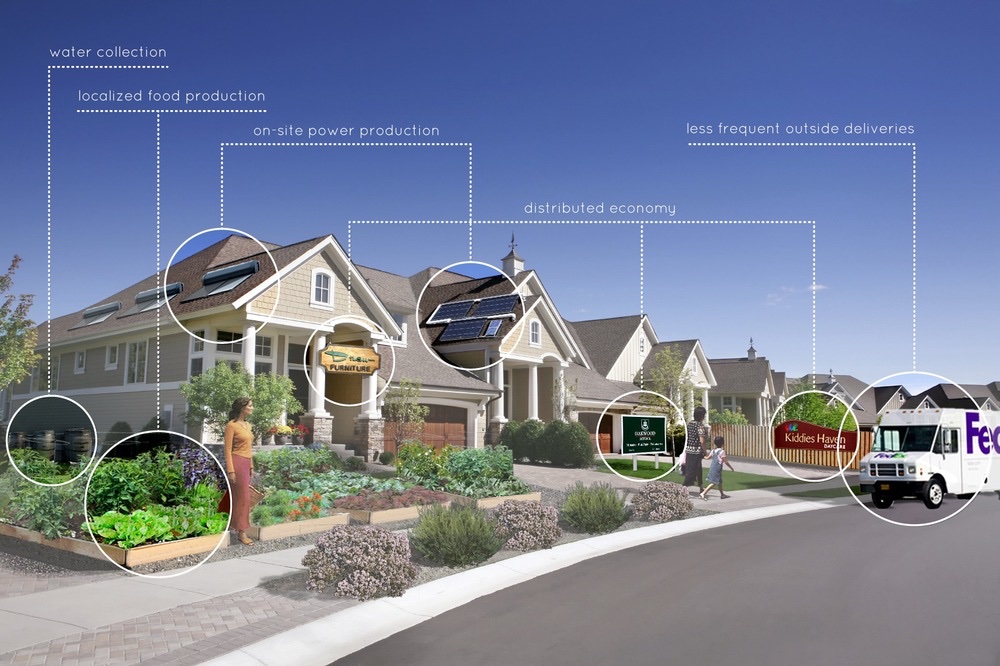
To begin, suburbia’s most glaring weakness as a car-dependent system may not be as intractable as we think. In his four-part series for The Oil Drum, Jeff Vail makes the convincing case that a willingness to accept slight inconvenience in the form of ridesharing, mass transit, biking and less frequent deliveries would make a significant enough reduction in the cost and greenhouse gas emissions of suburban transportation to overcome the benefits of leaving our suburban infrastructure behind.

A larger hurdle than transportation is the inherent energy inefficiency of suburbia’s loosely-spread form and large, detached buildings. Compared to denser, insolation-constrained urban development, however, suburbia stands to see much more dramatic gains from solar power innovation.

If advances in sustainable technology continue, suburbia could offset its inefficiency to our centralized systems by producing a greater amount of its own power.

Even if sustainable technology advances slow, the technologies we already have in solar hot water, passive heating and cooling, increasing insulation and demand-controlled ventilation are promising means for suburbia to reduce consumption and provide localized power to a majority of suburban homes and businesses.

Suburbia is also better-positioned than urbia to produce food locally, reducing its dependence on frequent, centralized food shipments. A carefully-tended 1/4th-acre suburban lot can realistically meet 25% of the caloric needs of a family of four.

Brad Lancaster, a master gardener working in the unforgiving climate of Tucson, Arizona, has seen much greater yields, turning a 1/6th-acre lot into a forest of food production using only rainwater and graywater.

Lancaster’s garden provides nearly half the food for his four-person family and, while this is not to say food production at that scale is easy, it implies that the rest of the country’s suburbs in more forgiving climates have significant growing potential.

http://www.islandbreath.org/2016Year/07/160725suburbiabig.jpg
Image above: Features of a revitalized American suburb featuring water collection, power generation, food growing, small manufacturing and a distributed economy. Illustration by Morgan Maiolei. From original article. Click to enlarge

Suburbia's Advantages

Moving beyond its weaknesses, suburbia’s decentralized form offers a unique advantage in economic innovation. Urban societies are coordinated, centralized systems that are structurally more dependent on top-down control, which tends to create barriers to innovation.

By contrast, suburbia is a decentralized rhizome of almost uniformly distributed dwelling and ownership. Such distributed systems have historically excelled at innovation.

In his book, Throwing Rocks and the Google Bus, Douglas Rushkoff relates that the decentralized mediaeval bazaar was such a powerful force of middle class growth and innovation that feudal lords created hierarchical corporations to quell it.

Distributed, non-hierarchical economic systems are powerful because they are chaotic but smart; what they lose in regularity, they gain in unimpeded, open-source production.

Combine this with modern technology's ability to connect us to new ideas and expand our capacity for fabrication through 3D printing and open-source plans (see: 100,000 Garages), and a future begins to take shape that elevates suburbia above an urban center’s bedroom community to a unique economic engine in its own right.


Suburbia already has many of the characteristics to support a distributed society of makers. Its form is one of ample space; lawns for gardening, garages for building, and enough residential square footage to spare for commercial enterprise and denser living.

I am writing from New Orleans, where many historic homes too expensive for single family occupancy have been converted to businesses and multifamily dwellings. It’s not a stretch to picture the same transition in suburban McMansions if the right market signals are in place.

Suburbia also offers large, flexible big boxes in spades. Where big box stores are currently utilized by a car culture of large-scale, one-stop consumerism, their innate flexibility gives them the ability to transition to hubs of local production and civic space.

In this context, big boxes could constitute the physical framework for community cooperatives to compliment individual, distributed business.

Big box stores can easily, and in many cases have already, been reimagined as libraries, schools, shared workshops, fabrication facilities, and year-round farmer’s markets. The U.S. has seen over a dozen big box Walmarts transition to churches.

When we picture a retrofit of suburban development, we often picture its conversion to a New Urbanist paradise; former suburban sprawl densified into an 1800s-esk town center surrounded by close-knit neighborhoods that follow the same economic model as the urban behemoth they were built to serve.

But to take suburbia back in time is a failure of imagination. We would do better to address suburbia’s weaknesses in transportation, energy efficiency, and health without throwing away the economic opportunities its form provides.

If we capitalize on suburbia’s strengths and think creatively about its evolution, we could position it as a form of development much more self-sufficient, healthy, productive, and life-affirming than the suburbia we know today.

Note: This article is informed to a large extent by Jeff Vail’s prescient and insightful presentation, Rescuing Suburbia, delivered at the 2010 ASPO-USA conference in Washington, D.C. You can watch Vail’s presentation at PeakOil.org and read his summary and slides at Resilience.org.
.
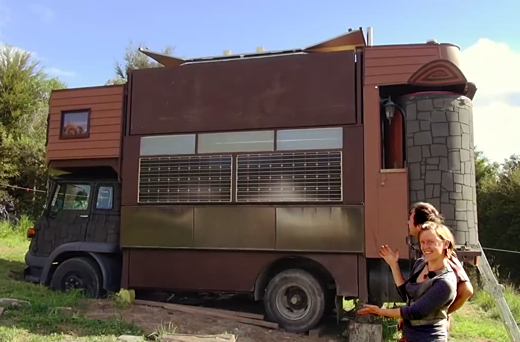
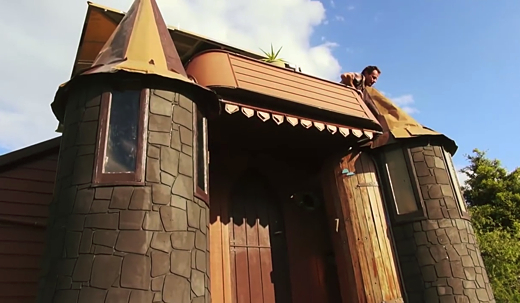
The Transforming Castle Truck

SUBHEAD: New Zealanders Jola and Justin have created a three level road worthy house truck with its own turrets!

By Andrew Martin 15 May 2015 for Onenes Publishing -
(http://onenesspublishing.com/2015/05/seeing-is-believing-the-transforming-castle-house-truck/)


Image above: Exterior of road legal truck before its transformation into a castle home. Still shot from video below.

With the average size of houses having increased over recent decades, there is a growing movement for people seeking alternatives to large, expensive, energy intensive housing. Australia currently holds the record for the country with the largest homes.

The average size of a new Australian house increased from 162.2 square metres (1742 sq feet) in 1984 to 227.6 square metres (2444 sq feet) in 2003. The average new Australian home is now 10% bigger than even its U.S. equivalent [1].

Australian is closely followed by the U.S., Canada and New Zealand all having homes either over 200 metres squared or just under 200 metres squared (2200 feet squared). In contrast other countries have significantly smaller houses such as Germany (109 m2), Japan (95 m2), Sweden (83 m2), UK (76 m2), China (60 m2) and Hong Kong (45 m2).


Image above: Exterior of castle during transformation from truck. Still shot from video below.

While the trend over the last decade has been for larger homes, the tiny house movement is becoming popular among those wishing to be more sustainable and wanting to live simpler less consumerist lifestyles. The small house movement is about reducing the overall size of dwellings to less than 1,000 square feet or approximately 93 square metres.

Following the Global Financial Crisis and Hurricane Katrina both of which helped spark interest in the small home movement, there is a small but growing younger demographic moving toward living with less. While still a relatively small sector, the tiny house market is set to see more interest over the coming decades. As housing affordability deteriorates along with economic conditions people will seek alternative ways of living [2].

One such couple who have embraced the tiny house movement with their passion and skills are Jola and Justin from New Zealand. They have combined functional and practical with quirky and fun. They have created a three level road worthy house truck with its own turrets! The 40 square meter ‘Castle’ truck is an engineering masterpiece.


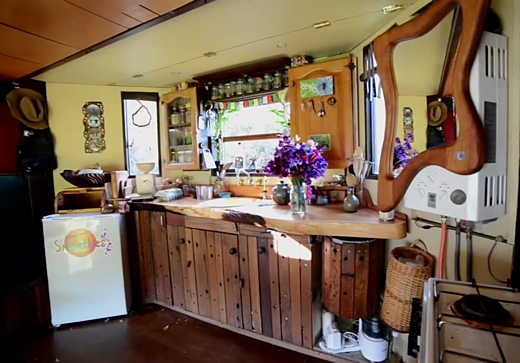
Image above: Interior of kitchen area of castle truck. Still shot from video below.

The Castle truck includes biofold doors, a loft, a rooftop bathtub, a large food dehydrator, a full working kitchen complete with oven cook top and refrigerator. The bathroom facilities include a shower (within one of the turrets) and composting toilet (in the other turret) and a washing machine. Solar panels pull out to provide power for the family and recycled materials have been used throughout the vehicle [3].

Don’t take my word for it see for yourself what the team over at Living Big in a Tiny House have done to showcase this quirky, fun and functional engineering masterpiece.


Video above: Unbelievable house truck transforms into fantasy castle. From (https://youtu.be/CnHGKUh-5O4).

Article compiled by Andrew Martin editor of onenesspublishing and author of One ~ A Survival Guide for the Future… and the JUST RELEASED Rethink…Your World, Your Future.


.

Beauty in a Landscape

SUBHEAD:  The post-modern American hedgerow, a landscape form that offers benefits to humans and nature.

By Adrian Ayres Fisher on 18 November 2014 for Ecological Gardening -
(http://www.ecologicalgardening.net/2014/11/where-do-we-find-beauty-in-landscape.html)


Image above: Separating agland from the road are hedgerows of eucalyptus creating the Tree Tunnel on the way to Poipu, Kauai, Hawaii. Photo by Brian Harig. From (http://fineartamerica.com/featured/eucalyptus-tree-tunnel-kauai-hawaii-brian-harig.html).

Part one of a series on the post-modern American hedgerow, a landscape form that offers benefits to humans and nature.

Before we get to hedgerows’ multifaceted functionality and usefulness, and why and how we should plant them, let’s start with beauty, a quality not often associated with the mundane, anthropocentric landscapes, whether urban, suburban or rural, of many parts of the Midwest—or elsewhere in the US, for that matter. Beauty—deep, profound, emerging through complexity, impossible to quantify—matters immensely.

As Aldo Leopold and a host of others, most recently Courtney White in Land, Soil, Hope, have pointed out, though there is struggle, suffering and disease, predation and often early death among the wild denizens, enmeshed in the food web as they are, nevertheless, an ecologically sound landscape—wherever it is, however lush, arid or in between—is beautiful in a way a degraded one can never be.

Beauty’s necessity is a fact of life for indigenous peoples and for us moderns who have lived close to the land in regenerative fashion, who’ve been worked on by it until we have become re-enchanted, until we’ve have become naturalized citizens of our home ecosystems. Artists, writers, poets, composers and musicians have always known and celebrated this fact, as have certain religious writers, philosophers and scientists.

I believe even the most urbanized, nature-phobic among us recognize and understand this necessity, though they may be unaware of it, or may have suppressed this knowledge to the detriment of their own psychic health and much else.

Because of the extreme degradation of so many human-occupied landscapes, some people might only associate beauty with a manicured corporate campus, or Disney-fied theme park, with the neat and tidy in general.

 Some of these landscapes might be pretty, but they have none of the deep mystery and complexity—and delight—that beauty entails. Others might only associate wild nature’s beauty—and ecosystem health—with nature reserves, national parks, and places of spectacular scenery well away from cities.

This camp includes people, even respected conservationists and scientists, who hold the ethos that true ecosystem health and beauty depend on a lack of humans in the landscape, where nature can do its thing free of our interference.

This attitude is important and necessary: it is why we need and have our great national parks and nature reserves and must continue to set aside land where other species can live and humans can visit without the threat of shopping malls apartment complexes, industrial farming and, worse, extractive industries, ruining the land.

However, and this is where hedgerows and other forms of greenways such as wildlife corridors come in, human-occupied landscapes can also be ecologically sound, full of a beauty not imposed according to strictly human rules and principles.

While an overly controlled landscape or one managed only for short-term gain, function or appearances never can be beautiful, a working landscape will be beautiful if it is managed with close attention to natural processes and room for the messy complexity of wild nature.

Unless there is room for wild nature, there will be no beauty or health—and there will be no life, in the sense of all the processes and cycles of living and dying that form that landscape.

There will only be that tendency toward cessation, toward depletion, degradation and impoverishment—toward death in its guise of “nevermore,” that is, of finality, of entropy, of extinction, of the dissolution of complexity that is the ruin of any piece of land.

As far as I know, the first peoples understood that humans can be part of an eco-system without destroying it, and that human influence is not necessarily negative.  I’m pretty sure that those original settlers of my part of the world never thought about the question of belonging or not in the terms set forth here.

Often the question was, and is, one of how humans can fit in properly, can earn the right to partake of the gifts our ecosystem offers, and of what we will give back. This is obvious if you read any of the old creation myths and stories about life on our continent, sometimes called Turtle Island. Humans belong here.

The wilderness that Europeans “settled” was actually land that had been lived in and managed by its peoples since the Laurentide ice sheet retreated 10,000 years ago.

We humans, if we live and work, think, plan and do as citizens of the biotic community, can actually be of benefit to an ecosystem, but only if we make an effort to follow the rules, sometimes called the “original operating instructions.”

This ancient, vital knowledge is only now being redeployed. Combining it with modern ecological science forms a powerful hybrid that can lead to truly regenerative land management practices.


Image above: Endless GMO soy and corn fields in Kansas stretch to the horizon. Photo by Galen Maly. From (http://www.imbikingacrossthecountry.com/?p=692).

Some caveats
Now it’s true that some farmers, the ones who grow commodity crops like soybeans and corn on vast fields, don’t like hedgerows. Nor do many developers, park districts, or conventional landscaping firms.

Hedgerows are inappropriate in large prairie areas, whether remnant or restored, where grassland birds require vast, treeless areas on the order of 10,000 acres or so to feel comfortable enough to nest and start families. They are shaggy, messy, unkempt looking. They require effort to put in, nurturance while young, and regular maintenance thereafter. We have fences.

I would never promote use of hedgerows in areas of the country where they’d be inappropriate, such as the desert southwest, or arid grasslands (except possibly where trees and shrubs might occur naturally, such as riparian areas) or large public lands managed for restoration. They have their own beauty and ecosystem complexity.

My aim during this series of posts will be to talk about how, in temperate areas of our country that are already built on or farmed, that can’t be restored or set aside, hedgerows can be used to help heal the land. They can be an important component of green infrastructure, complementing bioswales and raingardens.

Further, as our climate changes, hedgerows and greenways could be crucial not only for their carbon-storage properties, but also for their ability to serve as corridors linking larger, wilder areas so that animals and even plants can migrate to more favorable habitats.

Some of the plant migration could even be human-assisted, though that is controversial. In all, they are a prime example of reconciliation ecology, the practice of designing human-centered landscapes to accommodate the needs of other species.

Unless you’ve visited places with thriving hedgerows and have seen how they can positively impact a landscape, you may not understand why they are so vitally important.

This is partly a case of shifting baselines. You can’t appreciate or miss a type of landscape that nurtures all the creatures that live in an area unless you experience it, and beyond that, have the cultural understanding to value it.

In England, enough hedgerows have continued to exist and enough people and organizations have kept the cultural and historical knowledge alive to enable hedgerows as a concept to remain viable, and as a landscape feature to be to be saved and resuscitated.

Here in the US, both the concept and the reality are having to be reinvented. A friend of mine, who has been studying hedgerows and advocating their use for twenty years, calls these new efforts “post-modern hedgerows.”

Gardeners, conservationists, permaculturalists and organic farmers are already practicing hedgerow making, particularly in California.

By so doing they are reinvigorating ancient art and utilizing modern science that could, if practiced widely enough, help knit back together many of our fractured landscapes, providing habitat for pollinators, other beneficial insects, birds, and other animals while simultaneously providing food, materials, and shelter—in the form of privacy and microclimate enhancement—for humans.

Properly planned and maintained, they can increase bio-diversity, store carbon, help manage rainwater, and add beauty and livability for all.

When a farmer plants and manages a wide, ecologically diverse hedgerow, or enriches an old fencerow, or a government agency does the same along a road, they might say they are creating a pollinator reserve, wildlife corridor, game bird habitat, micro-climate enhancer, even a carbon sequestration system.

The same goes for those of us who have smaller pieces of land to work with in suburbs or city, whose small yards can link together in beneficial ways. But what we all really are doing is co-creating beauty.


.

WarkaWater in Ethiopia

SUBHEAD: This elegant invention draws water from air without muscular or electrical effort.

By Laura Secorun Palet on 26 May 2014 for NPR News -
(http://www.npr.org/2014/05/26/316124174/a-simple-elegant-invention-that-draws-water-from-air)


Image above: Three bamboo framed WarkaWater atmospheric condensers stand in Ethiopian village providing drinking water. From original article.

When Italian designer Arturo Vittori and Swiss architect Andreas Vogler first visited Ethiopia in 2012, they were shocked to see women and children forced to walk miles for water.

Only 34 percent of Ethiopians have access to a reliable water supply. Some travel up to six hours a day to fetch some or, worse, resorts to using stagnant ponds contaminated by human waste, resulting in the spread of disease.

Worldwide, a whopping 768 million people — two and a half times the U.S. population — don't have access to safe drinking water. So just imagine if we could just pull water out of thin air?

That's what Vittori and Vogler asked once they saw the magnitude of problem and vowed to take action. Their firm, Architecture and Vision, has since come up with WarkaWater, a majestic palm-like structure that may look like something you'd see in a modern art museum but it's been designed to harvest water from the air.

WarkaWater, which is named after an Ethiopian fig tree, is composed of a 30-foot bamboo frame containing a fog-harvesting nylon net that can be easily lowered for repairs and to allow communities to measure the water level.

Collecting water through condensation is hardly a new technique, but the creators of WarkaWater say their tree-inspired design is more effective, maximizing surface and optimizing every angle to produce up to 26 gallons of drinkable water a day — enough for a family of seven.

Many Failed Attempts By Aid Groups

Western organizations have been working to provide clean water access in Africa for decades, so WarkaWater joins a very long list of earlier attempts. So far, high-tech solutions, like the once-promising Playpump (a hybrid merry-go-round water pump), have failed, mostly due to high costs and maintenance issues.

This is where WarkaWater could stand apart — as a lower-tech solution that is easy to repair and far more affordable than digging wells in the rocky Ethiopian plateau.

Each water tower costs $550 — a Playpump is $14,000 — and its creators say the price will drop significantly if they start mass-producing it. The structure takes three days and six people to install and doesn't call for any special machinery or scaffolding.

"Once locals have the necessary know-how, they will be able to teach other villages and communities to build the WarkaWater towers," says Vittori, who is already working on WarkaWater 2.0, an upgraded version that may include solar panels and LED bulbs to provide light after dark.

The firm is in the process of raising funds to begin installing towers in Ethiopia next year. And WarkaWater could also prove useful in other areas, like deserts, which have the critical feature for collecting condensation: a dramatic change in temperature between nightfall and daybreak.

This elegant invention may not solve all of the world's water woes, but it could improve accessibility one drop at a time.

.

We need to talk about TED

SUBHEAD: Science and technology run on the model of American Idol – as embodied by TED Talks – is a recipe for civilization disaster.
.
By Benjamin Bratton on 30 December 2013 for the Guardian -
(http://www.theguardian.com/commentisfree/2013/dec/30/we-need-to-talk-about-ted)


Image above: Technology huckster Bill (GMO) Gates gives TED Talk. From (http://www.ted.com/promos/TEDTalksEducation).

In our culture, talking about the future is sometimes a polite way of saying things about the present that would otherwise be rude or risky.

But have you ever wondered why so little of the future promised in TED talks actually happens? So much potential and enthusiasm, and so little actual change. Are the ideas wrong? Or is the idea about what ideas can do all by themselves wrong?

I write about entanglements of technology and culture, how technologies enable the making of certain worlds, and at the same time how culture structures how those technologies will evolve, this way or that. It's where philosophy and design intersect.

So the conceptualization of possibilities is something that I take very seriously. That's why I, and many people, think it's way past time to take a step back and ask some serious questions about the intellectual viability of things like TED.

So my TED talk is not about my work or my new book – the usual spiel – but about TED itself, what it is and why it doesn't work.

The first reason is over-simplification.

To be clear, I think that having smart people who do very smart things explain what they doing in a way that everyone can understand is a good thing. But TED goes way beyond that.

Let me tell you a story. I was at a presentation that a friend, an astrophysicist, gave to a potential donor. I thought the presentation was lucid and compelling (and I'm a professor of visual arts here at UC San Diego so at the end of the day, I know really nothing about astrophysics). After the talk the sponsor said to him, "you know what, I'm gonna pass because I just don't feel inspired ...you should be more like Malcolm Gladwell."

At this point I kind of lost it. Can you imagine?

Think about it: an actual scientist who produces actual knowledge should be more like a journalist who recycles fake insights! This is beyond popularisation. This is taking something with value and substance and coring it out so that it can be swallowed without chewing. This is not the solution to our most frightening problems – rather this is one of our most frightening problems.

So I ask the question: does TED epitomize a situation where if a scientist's work (or an artist's or philosopher's or activist's or whoever) is told that their work is not worthy of support, because the public doesn't feel good listening to them?

I submit that astrophysics run on the model of American Idol is a recipe for civilizational disaster.

So what is TED exactly?

Perhaps it's the proposition that if we talk about world-changing ideas enough, then the world will change. But this is not true, and that's the second problem.

TED of course stands for Technology, Entertainment, Design, and I'll talk a bit about all three. I Think TED actually stands for: middlebrow megachurch infotainment.

The key rhetorical device for TED talks is a combination of epiphany and personal testimony (an "epiphimony" if you like ) through which the speaker shares a personal journey of insight and realisation, its triumphs and tribulations.

What is it that the TED audience hopes to get from this? A vicarious insight, a fleeting moment of wonder, an inkling that maybe it's all going to work out after all? A spiritual buzz?

I'm sorry but this fails to meet the challenges that we are supposedly here to confront. These are complicated and difficult and are not given to tidy just-so solutions. They don't care about anyone's experience of optimism. Given the stakes, making our best and brightest waste their time – and the audience's time – dancing like infomercial hosts is too high a price. It is cynical.

Also, it just doesn't work.

Recently there was a bit of a dust up when TEDGobal sent out a note toTEDx organisers asking them not to not book speakers whose work spans the paranormal, the conspiratorial, new age "quantum neuroenergy", etc: what is called woo. Instead of these placebos, TEDx should instead curate talks that are imaginative but grounded in reality. In fairness, they took some heat, so their gesture should be acknowledged. A lot of people take TED very seriously, and might lend credence to specious ideas if stamped with TED credentials. "No" to placebo science and medicine.

But ... the corollaries of placebo science and placebo medicine areplacebo politics and placebo innovation. On this point, TED has a long way to go.

Perhaps the pinnacle of placebo politics and innovation was featured at TEDx San Diego in 2011. You're familiar I assume with Kony2012, the social media campaign to stop war crimes in central Africa? So what happened here? Evangelical surfer bro goes to help kids in Africa. He makes a campy video explaining genocide to the cast of Glee. The world finds his public epiphany to be shallow to the point of self-delusion. The complex geopolitics of central Africa are left undisturbed. Kony's still there. The end.

You see, when inspiration becomes manipulation, inspiration becomes obfuscation. If you are not cynical you should be sceptical. You should be as sceptical of placebo politics as you are placebo medicine.
T and Technology

T – E – D. I'll go through them each quickly.

So first T, as in technology ...

We hear that not only is change accelerating but that the pace of change is accelerating as well. While this is true of computational carrying-capacity at a planetary level, at the same time – and in fact the two are connected – we are also in a moment of cultural de-acceleration.

We invest our energy in futuristic information technologies, including our cars, but drive them home to kitsch architecture copied from the 18th century. The future on offer is one in which everything changes, so long as everything stays the same. We'll have Google Glass, but still also business casual.

This timidity is our path to the future? No, this is incredibly conservative, and there is no reason to think that more gigaflops will inoculate us.

Because, if a problem is in fact endemic to a system, then the exponential effects of Moore's law also serve to amplify what's broken. It is more computation along the wrong curve, and I don't it is necessarily a triumph of reason.

Part of my work explores deep technocultural shifts, from post-humanism to the post-anthropocene, but TED's version has too much faith in technology, and not nearly enough commitment to technology. It is placebo technoradicalism, toying with risk so as to reaffirm the comfortable.

So our machines get smarter and we get stupider. But it doesn't have to be like that. Both can be much more intelligent. Another futurism is possible.

E and as in economics

A better 'E' in TED would stand for economics, and the need for, yes imagining and designing, different systems of valuation, exchange, accounting of transaction externalities, financing of coordinated planning, etc. Because states plus markets, states versus markets, these are insufficient models, and our conversation is stuck in Cold War gear.

Worse is when economics is debated like metaphysics, as if the reality of a system is merely a bad example of the ideal.

Communism in theory is an egalitarian utopia.

Actually existing communism meant ecological devastation, government spying, crappy cars and gulags.

Capitalism in theory is rocket ships, nanomedicine, and Bono saving Africa.

Actually existing capitalism means Walmart jobs, McMansions, people living in the sewers under Las Vegas, Ryan Seacrest … plus – ecological devastation, government spying, crappy public transportation and for-profit prisons.

Our options for change range from basically what we have plus a little more Hayek, to what we have plus a little more Keynes. Why?

The most recent centuries have seen extraordinary accomplishments in improving quality of life. The paradox is that the system we have now –whatever you want to call it – is in the short term what makes the amazing new technologies possible, but in the long run it is also what suppresses their full flowering. Another economic architecture is prerequisite.

D and as in design

Instead of our designers prototyping the same "change agent for good" projects over and over again, and then wondering why they don't get implemented at scale, perhaps we should resolve that design is not some magic answer. Design matters a lot, but for very different reasons. It's easy to get enthusiastic about design because, like talking about the future, it is more polite than referring to white elephants in the room.

Such as…

Phones, drones and genomes, that's what we do here in San Diego and La Jolla. In addition to the other insanely great things these technologies do, they are the basis of NSA spying, flying robots killing people, and the wholesale privatisation of biological life itself. That's also what we do.

The potential for these technologies are both wonderful and horrifying at the same time, and to make them serve good futures, design as "innovation" just isn't a strong enough idea by itself. We need to talk more about design as "immunisation," actively preventing certain potential "innovations" that we do not want from happening.
And so…

As for one simple take away ... I don't have one simple take away, one magic idea. That's kind of the point. I will say that if and when the key problems facing our species were to be solved, then perhaps many of us in this room would be out of work (and perhaps in jail).

But it's not as though there is a shortage of topics for serious discussion. We need a deeper conversation about the difference between digital cosmopolitanism and cloud feudalism (and toward that, a queer history of computer science and Alan Turing's birthday as holiday!)

I would like new maps of the world, ones not based on settler colonialism, legacy genomes and bronze age myths, but instead on something more … scalable.

TED today is not that.

Problems are not "puzzles" to be solved. That metaphor assumes that all the necessary pieces are already on the table, they just need to be rearranged and reprogrammed. It's not true.

"Innovation" defined as moving the pieces around and adding more processing power is not some Big Idea that will disrupt a broken status quo: that precisely is the broken status quo.

One TED speaker said recently, "If you remove this boundary ... the only boundary left is our imagination". Wrong.

If we really want transformation, we have to slog through the hard stuff (history, economics, philosophy, art, ambiguities, contradictions). Bracketing it off to the side to focus just on technology, or just on innovation, actually prevents transformation.

Instead of dumbing-down the future, we need to raise the level of general understanding to the level of complexity of the systems in which we are embedded and which are embedded in us. This is not about "personal stories of inspiration", it's about the difficult and uncertain work of demystification and reconceptualisation: the hard stuff that really changes how we think. More Copernicus, less Tony Robbins.

At a societal level, the bottom line is if we invest in things that make us feel good but which don't work, and don't invest in things that don't make us feel good but which may solve problems, then our fate is that it will just get harder to feel good about not solving problems.

In this case the placebo is worse than ineffective, it's harmful. It's divertsyour interest, enthusiasm and outrage until it's absorbed into this black hole of affectation.

Keep calm and carry on "innovating" ... is that the real message of TED? To me that's not inspirational, it's cynical.

In the US the rightwing has certain media channels that allow it to bracket reality ... other constituencies have TED.

.

What Permaculture Isn't and Is

SUBHEAD: It is a means to design a world in which human needs are met while enhancing the health of this miraculous planet.

By Toby Hemenway on 10 June 2013 for Pattern Literacy -
(http://www.patternliteracy.com/668-what-permaculture-isnt-and-is)


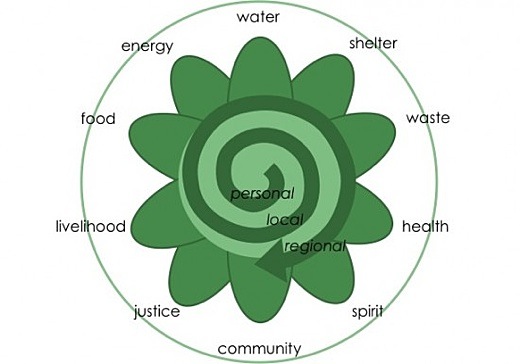
Image above: The Permaculture Flower, modified from Holmgren. From (http://www.patternliteracy.com/668-what-permaculture-isnt-and-is).


Permaculture is notoriously hard to define. A recent survey shows that people simultaneously believe it is a design approach, a philosophy, a movement, and a set of practices. This broad and contradiction-laden brush doesn’t just make permaculture hard to describe. It can be off-putting, too.

Let’s say you first encounter permaculture as a potent method of food production and are just starting to grasp that it is more than that, when someone tells you that it also includes goddess spirituality, and anti-GMO activism, and barefoot living.

What would you make of that?

And how many people think they’ve finally got the politics of permaculturists all figured out, and assume that we would logically also be vegetarians, only to find militant meat-eaters in the ranks?

What kind of philosophy could possibly umbrella all those divergent views?

Or is it a philosophy at all?

I’m going to argue here that the most accurate and least muddled way to think of permaculture is as a design approach, and that we are often misdirected by the fact that it fits into a larger philosophy and movement which it supports. But it is not that philosophy or movement. It is a design approach for realizing a new paradigm. And we’ll find that this way of defining it is also a balm to those in other ecological design fields and technologies who get annoyed, understandably, when permaculturists tell them, “Oh, yes, your work is part of permaculture, too.”

Humans are a problem-solving species. We uncover challenges—How do we get food? How do we make shelter? How do we stay healthy?—and then we develop tools to solve those problems. Permaculture is one of those tools. For the last 10,000 years, agriculture and the civilization it built have been the way humans attacked the problems of meeting basic needs.

Because we live on a planet that for millennia was large compared to the human population and its needs and impact, our species could focus on expanding and improving agriculture’s immense power to convert wild ecosystems into food and habitat for people, and we could ignore ecosystem health. But our industrial civilization of seven billion is chewing up ecosystems relentlessly.

We are learning that without healthy ecosystems, humans—and everything else—suffer. So we cannot focus solely on the problem, “How do we meet human needs?” but must now add the words, “while preserving ecosystem health.” Rafter Ferguson has offered that question as a definition of permaculture. He’s onto something, though I think that “meeting human needs while preserving and increasing ecosystem health” is the goal of permaculture, and not its definition.

But it gives some clues toward defining it, and helps untangle the knots wrapped around “What is permaculture?” It names and clarifies the problem that permaculture is trying to solve.

Thomas Kuhn, in his masterwork, The Structure of Scientific Revolutions, uses the word “paradigm” to mean the viewpoint that defines the problems to be solved in a particular field. Kuhn explains that the proper framing of a paradigm reduces the number of blind alleys that researchers go down by re-stating a problem in clearer terms. New paradigms usually require—and spur the development of—new tools to solve the now-reframed problem.

“Paradigm” has been trivialized through overuse and I’m sure that Kuhn is spinning in his grave. But I don’t think it’s abusing the term to view the change in humanity’s principal goal from “meeting human needs” to “meeting human needs while preserving ecosystem health” as a paradigm shift. It changes the tools that we use, and the mindset required to develop and use new, appropriate tools. It restores a relationship between people and nature that agriculture, by treating nature like a mere resource to be subjugated and consumed, had severed.

Suddenly, agriculture and industrial society look like scourges and technologies of destruction, rather than the saviors of humanity that we’ve regarded them. That’s quite a shift.

Permaculture and other ecological approaches are attempts to articulate this new paradigm, by framing the problem and offering tools and strategies to pursue its solution. When the larger problem is framed so that it reveals the interdependent relationship between human needs and ecosystem health, we can more clearly see the steps to the solution.

Now we can ask, what are human needs, and how can each of them be met while retaining, restoring, and improving ecosystem health? We know how to articulate human needs, and we have metrics to gauge ecosystem health. Our problem now is to reach this twinned goal, and permaculture offers us hope.

So, why, then, is permaculture so confusing to define? I think it is because in the early days of any new paradigm, the boundary between the new paradigm and the tools—mental and physical—needed to articulate and solve it is blurry. We’re confusing the mindset required to do permaculture effectively with the work of doing it. Let me give a historical example to show what I mean.

In the 18th Century, combustion was explained by something called phlogiston. Matter was thought to be composed of elements plus principles, and phlogiston was the principle of combustibility. When an element burned, it released phlogiston, and burning stopped when all was released. The residue contained the principle of calx, the true elemental substance. The theory was backed by the fact that many things, such as wood and other fuels, lose weight when they burn.

In the 1770s, cracks began to appear in phlogiston theory. Antoine Lavoisier, using careful experiments and new, accurate balances, found that many substances gained—not lost—weight when they burned. In 1771, Carl Scheele, and later Joseph Priestley and others, produced samples of a gas (the yet-unnamed oxygen) that made flames burn more brightly and longer. They called this “dephlogistonated air,” since, to fit into the theory, it had to be able to accept more phlogiston from burning substances than air could. This sort of stop-gap, convoluted reasoning is one of the first signs that a theory is failing.

By 1777, Lavoisier was sure this gas was a pure element that combined with others to support burning, and began to reject phlogiston theory. Priestley and others objected; the were simply not able to recognize oxygen for what it was. They knew that elements contained principles, like phlogiston and calx, and these principles combined with elements, were hidden or revealed through processes such as burning, and were emitted, unchanged.

The idea that a substance could chemically bond with another and be transformed did not fit their paradigm of matter. It was, literally, inconceivable. But phlogiston theory was doomed by the piling up of inconvenient facts, and by 1800, what is now called the chemical revolution had swept it away.

The rejection of phlogiston and the acceptance of the chemical revolution was logically simple—the oxygen theory of combustion snuffed out the contradictions of phlogiston—but it was cognitively difficult because of the mental barrier created by phlogiston thinking. It took a revolution in thought to see oxygen.

Many of the pioneers of this revolution called themselves natural philosophers, and they led an enormous shift in worldview that required and prompted a new way of thinking about nearly every natural phenomena and event. From the 1500s to the early 1800s, the new astronomers, chemists, and physicists were seen as radicals and a threat to the social order. They often were: Thomas Jefferson, Benjamin Franklin, and other revolutionaries were promoters of this new scientific approach based on measurement and experiment.

The philosophy that guided their work was, at that time, hard to distinguish from their work itself. Nowadays we view chemistry and the other sciences bred during this tumultuous era as settled disciplines that are neatly split from politics and philosophy, but in those days, to practice chemistry or astronomy was part of a radically new worldview, and the boundaries between the scientists’ radical philosophy, the problems that it set for them to work on, and their experimental approach to those problems were not distinct.

Permaculture, like phlogiston-cramped chemistry, can’t be understood well under the old paradigm, and I think this is why it is often regarded as a movement and philosophy as well as a problem-solving approach. To grasp permaculture fully, we need to have made the shift to the new paradigm.

New tools and new paradigms mutually reinforce and strengthen one another, and permaculture is one of many examples of this. Lavoisier’s improved balances exposed inconsistencies that toppled phlogiston theory from its perch, and demanded a new way of thinking about gases and matter. In a similar vein, permaculture’s design methods such as zones, sectors, and needs-and-yields, by emphasizing relationships and consequences, reveal the weaknesses of thinking in terms of isolated events and static objects.

The flaws in old-paradigm concepts like infinite growth, waste, and “externalities” become glaringly obvious under a whole-systems view. The tools encourage the new thinking, and the new paradigm helps create the appropriate tools.

Many people come to permaculture knowing that there is something wrong with the old worldview, but they don’t yet have a new paradigm to replace it. They are attracted to permaculture as better gardening or as a means of social change, and gradually adopt the new worldview as they see it overcoming the flaws and damage of the old.

Others come to permaculture after shifting to this holistic paradigm because permaculture supports it and offers an approach to working within it. In both cases, it takes time to fully grasp the depth of permaculture in part because nearly all of us were raised in the old paradigm. After twenty years of practicing permaculture design, I still have trouble defining it.

Permaculture, then, is not a philosophy or worldview, and it is not a single tool, either. But to use permaculture well requires adopting a new worldview and new tools. Like the early chemists who called themselves philosophers, right now the boundary between the tools, the approach to using them, and the worldview that makes their effective use possible are blurry.

In some ways permaculture is in a class similar to the problem-solving approach called the scientific method, the experimentalist view developed by Lavoisier, Boyle, and their peers. It is not the paradigm, it is not the tools. It is the approach for using the tools—a way of working that is guided by the paradigm. So of course this is confusing.

People have been arguing over what “the scientific method” is for centuries: is it deductive or inductive, does the hypothesis or the data come first? Most scientists can’t tell you. They learn the scientific method by using it, and it’s devilishly hard to explain what it is. Sound familiar?

With all this in mind, I think the definition of permaculture that must rise to the top is that it is a design approach to arrive at solutions, just as the scientific method is an experimental approach. In more concrete terms, permaculture tells how to choose from a dauntingly large toolkit—all the human technologies and strategies for living—to solve the new problem of sustainability. It is an instruction manual for solving the challenges laid out by the new paradigm of meeting human needs while enhancing ecosystem health.

The relationship explicitly spelled out in that view, which connects humans to the larger, dynamic environment, forces us to think in relational terms, which is a key element of permaculture.

The two sides of the relationship are explicitly named in two permaculture ethics: care for the Earth, and care for people. And knowing we need both sides of that relationship is immensely helpful in identifying the problems we need to solve.

First, what are human needs?

The version of the permaculture flower that I work with names some important ones: food, shelter, water, waste recycling, energy, community, health, spiritual fulfillment, justice, and livelihood. The task set out by permaculture, in the new paradigm, is to meet those needs while preserving ecosystem health, and we have metrics for assessing the latter.

The way those needs are met will vary by place and culture, but the metrics of ecosystem health can be applied fairly universally. This clarifies the task set by permaculture, and I think it also distinguishes permaculture from the philosophy—the paradigm—required to use it effectively and helps us understand why permaculture is often called a movement.

Permaculturists make common cause with all the other millions of people who are shifting to the new paradigm, and it is that shift—not the design approach of permaculture that supports it—that is worthy of being called a movement. Permaculture is one approach used by this movement to solve the problems identified by the new paradigm. To do this, it operates on the level of strategies rather than techniques, but that is a subject for another essay.

Because we are, in a way, still in the phlogiston era of our ecological awareness, we don’t know how to categorize permaculture, and we can confuse it with the paradigm that it helps us explore.

Permaculture is not the movement of sustainability and it is not the philosophy behind it; it is the problem-solving approach the movement and the philosophy can use to meet their goals and design a world in which human needs are met while enhancing the health of this miraculous planet that supports us.

.

Programmable Permaculture

SUBHEAD: How can a gardener create different sorts of microclimates of soil, air, and water?

By Barath Raghaven on 28 February 2013 for Contraposition -
(http://contraposition.org/blog/2013/02/28/programmable-permaculture/)


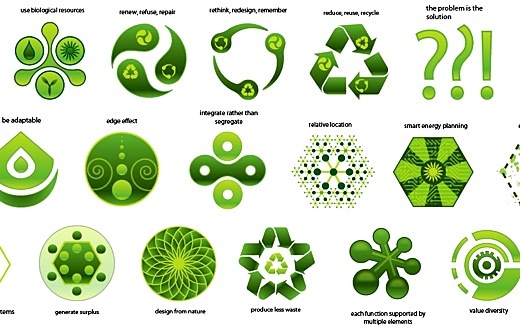
Image above: Computer designed icons for permaculture metatools. From (http://podcollective.com/fora/viewtopic.php?p=9900).

There’s a cultural phenomenon, one that has been growing for the past decade, of hobbyist hackers exemplified by Make Magazine and TechShop. These hackers want to have the experience of building something in the physical world while still applying the tools and techniques of computing. With the rise of open hardware platforms like Arduino—even whole systems like the Raspberry Pi for $25—it’s surprisingly affordable for people to program their own electronics.

The key to design when working on such projects is to decompose a problem into its constituent actions, to figure out what can be done by the programmable hardware vs. what must be done using other (e.g., more conventionally mechanical) components, and then to assemble the pieces into a working whole. While I can’t say I have any deep experience working on such projects, for some time I’ve been wondering whether the same ideas can be applied in a direction of more interest and perhaps of more importance.

How can we solve a problem (in a garden, say), with permaculture tools, by decomposing the problem and coming up with a set of interlocking pieces that solves it? Framing the problem in this way is very much applying an engineering mindset, something that might irk those who insist on thinking holistically about any and all ecological settings. 
And I can relate to that sentiment, because too much has been done in engineering and science more broadly to stop holistic thinking and to employ scientific reductionism in its place.

But for the moment I want to consider something small scale: employing the vocabulary and tools of permaculture to specific tasks in a garden. Here are the stated principles of permaculture:
  1. Observe and interact: By taking time to engage with nature we can design solutions that suit our particular situation.
  2. Catch and store energy: By developing systems that collect resources at peak abundance, we can use them in times of need.
  3. Obtain a yield: Ensure that you are getting truly useful rewards as part of the work that you are doing.
  4. Apply self-regulation and accept feedback: We need to discourage inappropriate activity to ensure that systems can continue to function well.
  5. Use and value renewable resources and services: Make the best use of nature’s abundance to reduce our consumptive behavior and dependence on non-renewable resources.
  6. Produce no waste: By valuing and making use of all the resources that are available to us, nothing goes to waste.
  7. Design from patterns to details: By stepping back, we can observe patterns in nature and society. These can form the backbone of our designs, with the details filled in as we go.
  8. Integrate rather than segregate: By putting the right things in the right place, relationships develop between those things and they work together to support each other.
  9. Use small and slow solutions: Small and slow systems are easier to maintain than big ones, making better use of local resources and producing more sustainable outcomes.
  10. Use and value diversity: Diversity reduces vulnerability to a variety of threats and takes advantage of the unique nature of the environment in which it resides.
  11. Use edges and value the marginal: The interface between things is where the most interesting events take place. These are often the most valuable, diverse and productive elements in the system.
  12. Creatively use and respond to change: We can have a positive impact on inevitable change by carefully observing, and then intervening at the right time.
I don’t know about you, but while I agree with this list, it’s all a little vague. And so what I’d like to look at is specific techniques that have broadly become part of the permaculture bag of tricks that somewhat adhere to this thinking.

To make the goal concrete, let’s focus on one question: how can a gardener create different sorts of microclimates of soil, air, and water for the diversity of plants one might want to include in a garden? While I could have considered other goals like water purification, fertilization, composting, water transport, etc. 
I’ve found myself trying to figure out microclimates a lot lately so it seems like a good place to start. It seems to me that many challenges I’ve run into while gardening have to do with the environment not being right for what I’m trying to grow, something that’s inevitable given that most of the food-bearing crops we eat today are not native to the places we live.

I’m often reminded of Sepp Holzer’s citrus gardens in the Alps as a sign that it’s possible to do amazing things with microclimates, but very few people have Holzer’s level of skill and experience. This is where programmable permaculture comes in. To make the analogy concrete, here the hardware is permaculture, which is capable of being used to do perform certain actions towards a goal, and the software is the creative combination of instructions for the hardware to achieve that goal. 
The certain actions the hardware can execute is its instruction set, and usually hardware is relatively minimalist (and the challenge is to make it complete at the same time), so it’s the combination of steps that makes it powerful. In addition to the microclimate aspect we want to adjust (soil, air, water, etc.) there’s the question of scale—how big is the microclimate? Are the techniques that help when building an herb spiral the same as when building an impoundment lake? That is, is there a subroutine in common between the two?

Let’s say we’re trying to grow avocados in a flat garden in a suboptimal climate. Avocados (the tasty cultivars, anyway) require well-drained fertile soil, nearly zero days of frost in the winter and relatively warm summer days, no shallow-root competition, and lots of direct sun. While we’re probably not going to be growing avocados in Portland, Maine (anytime soon, that is), we might be able to grow them in Portland, Oregon with the right microclimate. So let’s decompose it:

Soil: 
the soil in the Willamette Valley is plenty fertile, though throughout the winter it’s probably too wet for an Avocado tree. Here we might apply the principle of self-regulation, and dig a shallow French drain near the tree, and direct the water from it to a pond. Since the garden is flat in this example, the tree would have to be on a raised bed.

Frost: 
Portland has over 30 days of frost a year and even a few days with highs below freezing annually. (To give you a sense of the challenge that presents, consider that the California Master Gardener Handbook lists Santa Cruz County as the furthest North one can reliably grow avocados, and Santa Cruz gets something like 3 days of mild frost per year.) 
Here we clearly want to catch and store energy. The key is that the average (over a 24 hour period) is typically above freezing, and so buffers are key. We want to store a lot of heat and release it slowly, and conveniently water has the highest specific heat capacity of any common substance. 
That suggests that digging a pond near the tree—perhaps the same pond that was used for drainage—would help store heat during the day and re-radiate it at night. Add warm wastewater from a house to the pond and we apply the principle “produce no waste” while giving the tree-pond system a margin of safety for those days that don’t go above freezing. Stones placed in and around the tree and pond can add to the pond’s heat buffering.

Sun: 
The Pacific Northwest isn’t known for its sunshine. It’s likely that the directly incident rays in Portland would be insufficient for a tropical / sub-tropical tree like an avocado. Conveniently, water reflects light, and by placing the pond at the correct angle for the winter sun, we can provide a bit of extra sunshine to the tree via pond reflection. But what if the sky is just gray and the sun’s rays diffuse? While there isn’t much we can do, we can build a small parabolic reflector that redirects the sun’s rays at the tree from another spot in the garden. (One technique I’ve heard of is to pick up a discarded satellite dish and cover it in something reflective like aluminum foil.)

The other microclimate needs—such as warm summer days—are probably already met here.

While this application of principles was fun, it wasn’t as, well, programmable as I would have liked. Ideally it’d be possible to take a setting, describe the constraints / objectives within some dimensions, and then directly apply techniques that are derived from the principles to achieve the goal. In another post I’ll try to develop what we might consider an instruction set for permaculture and also, separately, what might differentiate permaculture from geoengineering.

See also:
Ea O Ka Aina: Permaculture - Growing Zones 3/22/10

.

Trike Home & Turf

SUBHEAD: If you want to know why the Chinese experiment in industrial consumerism is bound to fail, take a look at this project.

By Kimberly Mok on 4 January 2013 for TreeHugger -
(http://www.treehugger.com/green-architecture/tricycle-house-peoples-architecture-office.html)


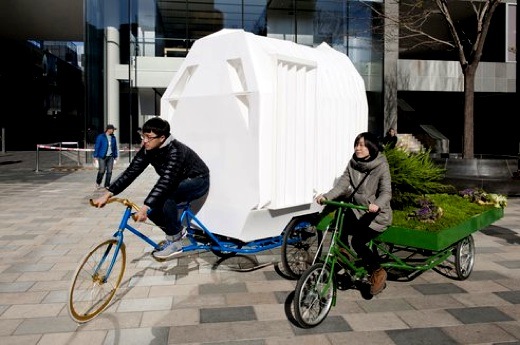
Image above: It's likely the security folks guarding this corporate office plaza will be moving these folks along by sunset.  From original article.

Private land ownership is something that most of us might take for granted, but it's not the case in communist China, where all land is either state-owned or run by collective economic organizations (CEOs).


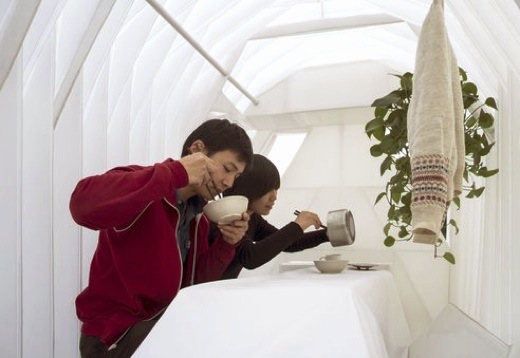
Image above: Note how this "generous" storage system has to be folded-down or placed somewhere else when functions like eating or sleeping are involved. From original article.


But with China's rapidly developing economy, skyrocketing real estate prices, unscrupulous "land grabs" and recent legislation towards a civil code protecting private ownership, the issue of owning land is in a tumultuous transition, prompting designers like People’s Architecture Office (PAO) and the People’s Industrial Design Office (PIDO) to explore different possibilities.


Image above: They don't really show where the cooking and cleaning is done in this kitchen/dining mode - could it be out on the curb? From original article.

Their joint effort is the Tricycle House and Tricycle Garden, a paired mobile home and garden plot mounted on modified three-wheelers. Made with CNC-scored, translucent polypropylene plastic, the house is an accordion-shaped, expandable temporary shelter. Say the designers:
Through this design, single family homes can be affordable and sustainable, parking lots are not wasted at night, and traffic jams are acceptable. The Tricycle House is man-powered allowing off-the-grid living.

Image above: Does the dirty bath water get drained though the floor and onto the plaza stonework, or what... where's the toilet? From original article.

Created as part of Beijing's Get It Louder 2012 exhibition, Tricycle House was shown alongside other temporary urban shelters, like this one made out of spray foam insulation. Of course, this house's hidden amenities gives it a more comfortable edge, allowing it to be a multipurpose living space in small quarters:
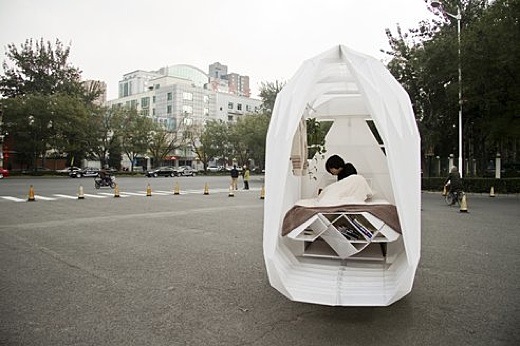
Facilities in the [Tricycle] house include a sink and stove, a bathtub, a water tank, and furniture that can transform from a bed to a dining table and bench to a bench and counter top. The sink, stove, and bathtub can collapse into the front wall of the house.

Image above: Ah sweet dreams sleeping on your dining room table over your folded storage unit. From original article.

The mobile garden is a clever addition, showing that living small and on the move doesn't mean a landless existence. More images over at ArchDaily, People’s Architecture Office and the People’s Industrial Design Office.


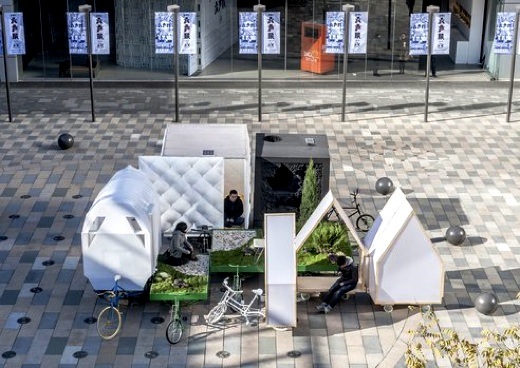
Image above: An romantic encampment on the plaza before sunset, as other like minded bike oriented vagabonds gather after work to get through the night. From original article.

[IB Editor's note: How long will the houseplant or the uncovered raised gardens boxes live? Any longer than it takes to get rid of the dirty bathwater? 

This effort by could be a joke or possibly a promo stunt by the cargo bike industry. It could be attempt by the People’s Architecture Office and the  People’s Industrial Design Office  to misdirect the West into a race to the bottom of industrial design concepts of housing and transportation.

The tin-roofed shacks in America's urban Hoovervilles of the 1930's were better urban housing solutions than these cargo bikes. Today's makeshift slums around (or in) the junkyards major third-world cities are the natural home for these polypropylene hovels.]
.

Metrodome collapse symptomatic

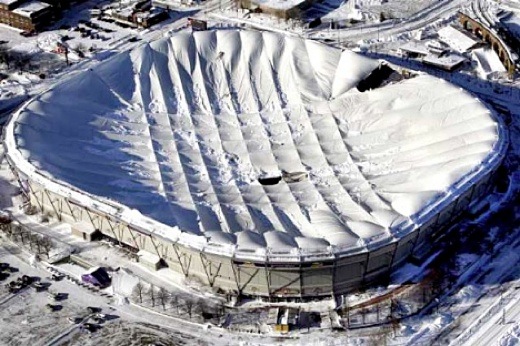
SUBHEAD: In the old days, they built places that could last a century. Fenway Park. Wrigley Field. Boston Garden. By Lloyd Alter on 14 December 2010 for TreeHugger - (http://www.treehugger.com/files/2010/12/metrodome-roof-failure-symptom-of-larger-failure.php) Image above: The collapsed roof of the Twin City Metrodome. From original article.

People build air supported domes like the Hubert Humphrey Metrodome for two reasons: They are quick and they are cheap. The whole stadium was an exercise in cheapness, being described in Wikipedia by one official as a place to "get fans in, let 'em see a game, and let 'em go home."

I didn't think it was news when it collapsed the other day; it is the fourth time, and it happens to all of these bunion pad stadia. But this one has got a lot of attention, and has even been the subject of a musical remix by Vanilla Brice. Perhaps it deserves a closer look.

The 28 year old Metrodome roof is made from fiberglass fabric 1/16th of an inch thick coated with teflon for protection from ultraviolet light. There is an inner acoustic absorption layer hanging from it; warm air is circulated between the two layers to melt snow on the roof. The 580,000 pounds of roof are held up by the air pressure supplied by 20 90 horsepower fans. It is designed for snow loads.

But while air supported roofs are cheap and fast to build, they are expensive to operate and maintain, and they don't last very long. When Birdair Structures, (these were invented by Walter Bird in 1946) the builder of the dome, inspected it last spring they noted:

The membrane was weathering as anticipated and had exceeded its service life of 20 years; it recommended planning for replacement of the roof fabric, and noted that planning and implementation would take an additional five years and cost $12-$15 million.

According to the Buffalo News, (home of Birdair)

A snowstorm battered the Midwest over the weekend, dumping 17 inches of snow on the Twin Cities. Stadium officials tried in vain to keep snow from accumulating on the roof. An interior heating system tried to melt the pileup. Workers went on the roof with hoses to blast hot water but had to stop due to dangerous winds. Three holes could be seen in the roof after the collapse.

The possibility of this happening was clearly not a surprise, nor was the result catastrophic; the roof slowly deflated and came to rest on its cables. But it is a great demonstration that fast and cheap is no substitute for good or green.

Air supported roofs suck a lot of energy to keep up, to heat, and they don't last. They are hangovers from an era when people built charmless complexes (some roofed, some not) fast and cheap; As Chris Erskine wrote in the Los Angeles Times:

30 years seems about right for modern arenas. In the old days, they built places that could last a century. Fenway. Wrigley. Boston Garden. Madison Square Garden. They were built by two guys with a hammer and a bucket for cement. There's one in Rome that's pretty old too.

Today, stadiums are built like double-wide trailers, virtually disposable. The Metrodome's crummy next-of-kin included the Seattle Kingdome, Veterans Stadium in Philly, the Pontiac Silverdome.

I have quoted Steve Mouzon many times: sustainable buildings

The Metrodome was not lovable; it was brutal and ugly and cheap. It was not durable; one sixteenth of an inch of fiberglass is not going to last. It was not particularly flexible, incapable of adapting to the seasons and it certainly wasn't frugal, needing continuous supply of electricity just to stay up.

They will stick on a few patches, reinflate it and be playing inside again soon. But it will remain an object lesson in how not to build. Video above: Mashup of Twin City Metrodome roof collapse. From (http://www.youtube.com/watch?v=oyEOWgGihU4). .

Concepts and Themes in Design

SUBHEAD: Chapter 2. Design sustainable human systems that harmonize with the natural world.

By Jesse Lemieux on 22 September 2010 in Permaculture Research Institute - (http://permaculture.org.au/2010/09/22/introducing-the-permaculture-designers-manual-chapter-2-concepts-and-themes-in-design)

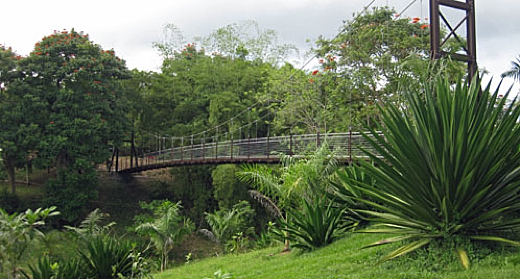
Image above: The Caugus Botanical & Cultural Garden on an abandoned sugar plantation in Puerto Rico. From (http://www.visit-the-coqui.com/2010/01/caguas-botanical-garden-where-history-and-nature-blend).

This is the second in a series of fourteen introductory articles about permaculture — one for each chapter of Bill Mollison’s “Permaculture: A Designers’ Manual.” The series was originally initiated back in March of 2010. I only managed to finish and post the first before the Canadian PDC teaching season swept me away.

With the fall slow down I am at the computer again and will get through as many of the remaining chapters as I can between now and November 21st when I start teaching a two week Permaculture Design Certificate (PDC) at Zaytuna Farm this coming November. Through this series I will connect theory with practice, and share practical examples of permaculture in action.

As we understand from Chapter 1, permaculture is an ethical system of design that produces a stable and secure place for humans and all other living things. This second installment is about what inspires us and how the functions of natural systems inform the design process.

What are the principles of natural systems? What are our design directives for sustainable systems? What is a working definition of SUSTAINABLE?

Sustainable:
Is Any system which produces and stores enough energy and resources to provide for its ongoing maintenance and reproduction.

Sustainability is about energy and how it is captured, stored, and cycled within a system. Energy is in constant flow and flux moving from one place to another. Energy is always on the move. Energy is all things, continually changing from one form into another: heat, light, water, people, soil, trees, animals, wind, electricity, fuel, sound, cash…et cetera.Industrial system
In the development of sustainable systems, we almost always need to make a significant investment of energy upfront. Particularly when working in degraded places such as our cities, agricultural lands and clear-cut forests. Permaculture is the design and implementation of systems that produce more resources and energy over their lifetime than was originally expended in their implementation.

This diagram illustrates the basic pattern of the industrial system. It is in constant need of resources and energy input, necessitated by the constant flow of energy and resources out. The waste stream, the net loss, is the most critical component of this system. Without this constant loss there would be no need for a continued consumption and nobody would be making any money.

In the words of Albert Einstein, “we cannot solve problems by using the same kind of thinking we used when we created them.” While there are many great and beneficial things that have come out of the industrial pattern, it is not and never will be a pattern for sustainable society. The concept of the consumer is not part of a sustainable future. We need a different model.

There are no evil doers in this system, it’s just the way it has been designed. By our participation we continue to support this self destructive pattern. The challenge we face is the wholesale re-design of systems with out the necessity of wholesale revolution. We have experimented with bloody revolution in the past and it is not a viable option for the present.

How do we make the shift with elegance and grace?

Ecosystems
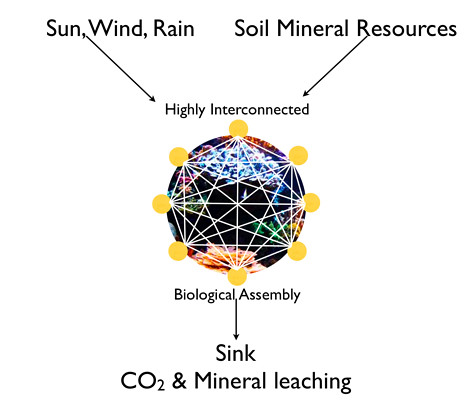
The EcosystemThis diagram outlining the basic pattern of an ecosystem. Ecosystems use the basic energy inputs of the sun, climate and soil. So long as the sun shines this system will continue to function.

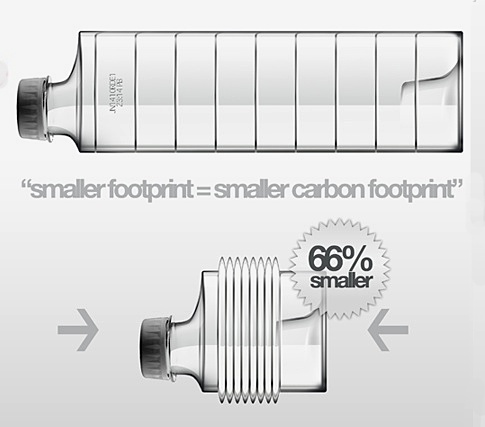
The connections between the elements of the system are both direct and indirect exchange of service. There is no free lunch–everything returns. Everything gardens, all species, ourselves included, have an impact. All species play a role in the evolution of the system. We all have a function.

Permaculture focuses on function. It is not diversity alone that generates stability and resilience. There must be functional diversity, a diversity of connections. In truth, the long term survival of a species has nothing to do with competition and brutality. Long term survival is for species that place themselves in most service to the whole. As a species of choice and innovation, we have the unique opportunity to design ourselves into a position of service to all of the natural world. In return we can expect clean air, clean food, clean water, clean communities and long term survival. We may restate the problem as follows:

How do we best become of service to each other and all other things in the biosphere?

Permaculture draws on the themes and principles of ecosystems to assemble endlessly productive and absolutely abundant human habitat. Following the ecosystem model, we have all the information required to design and implement sustainable human habitat.

Permaculture Best Practices:
Design patterns to details.

All we need is to understand the basic patterns of natural systems.
Principles of Natural systems:
• everything is connected to everything else
• every function is supported by many elements
• every element serves many functions
Simple yet profound. Are these principles useful? No. Principles are not very useful. Principles are little more than passive observation. Being people of action, we need directives. We must translate principles into directives.
Permaculture directives for real world design:

• The needs of one element must be met by the yields of another.

• Every critical function must be supported by multiple elements.
• Every element must serve multiple needs.

Our definition of sustainable made use of the term ‘resources.’ Design requires a sound understanding of what a ‘resource’ is and how it functions.
Resources fall into 5 broad categories:

  1. Those which increase with modest use (pastures, wood coppice systems) 
  2. Those unaffected by use (the wind, a view, water used to turn a water wheel) 
  3. Those that degrade if not used (an annual vegetable crop, information) 
  4. Those that are reduced by use (fossil fuels, deep aquifers) 
  5. Those that degrade other resources if used (nuclear power, herbicide, insecticides, artificial fertilizers, weapons)
Design Directives for ethical and sustainable real world design:
• The majority of resources used must come from categories 1, 2 and 3.
• Use category 4 resources modestly to develop resources in categories 1, 2 and 3.
• Avoid category 5 resources at all costs.
Our design implementation options are limited by our current resource set. We cannot spend money we don’t have and we cannot eat food we have not grown. When making decisions about how to invest our resources we must have a very clear path forward. Below is a set of directives that have never let me down. Of course in the world of debt based currency and centralized global distribution networks, we can spend money we do not have and eat food we have not grown. That is why permaculture starts with the ethic. A conscious choice to divest ourselves from a destructive system, while simultaneously investing in the design of productive systems.

Directives for order of Investment :
• First, invest in elements that produce energy and resources
• Second, invest in elements that save on energy and resources
• Third, invest in elements that consume energy and resources
 Water is the foundational energy system for all life on the planet. Knowing that fact, as permaculture designers we can follow a very simple set of design priorities.

Directive of Real World Design Priority:
• water
• access
• structures
At the very least follow this progression and you will not go wrong. It does not matter what scale, location, or climate. Always think “water, access, structures”. Water and where it is coming from and where it is going are the most important energy consideration of any design. As much as 40% of all the energy consumed by cities is used to move around water.

To sum it all up, permaculture is really about our first step. If our first move is towards the benefit of living systems, which we are all a part of, all subsequent steps will follow along the same path. With clients it is often the case that they need help knowing where to start. “Here’s our 10 acres… what do we do with it?”

My duty as a permaculture designer is to give the project sustainable direction–a starting point for sustainable and emergent design as the user’s needs, experience and skill set change and develop through time. What it boils down to is energy and how it flows through the design. By examining and understanding the basic patterns of how energy and resources move through an ecosystem we gain the insight and knowledge needed to design sustainable human systems that harmonize with the natural world.

Be sure to check back for the Chapter 3 ‘Methods of Design.’

See also:

Square Coke Bottle

SUBHEAD: We are no fans of corn-syrup based soft drinks, but industrial design can matter.

By Pete Scholtus on 29 April 2010 in Tree Hugger -  
(http://www.treehugger.com/files/2010/04/andrew-kim-s-square-coke-bottle-design.php)


Image above: Packaging for proposed design for square soft drink container. From (http://designfabulous.blogspot.com/2010/03/eco-coke-bottle-design.html).
 
Maybe not as radical as square watermelons, but still quite progressive is Andrew Kim's square Coke bottle design. It definitely raised the question whether or not all bottles and containers should be square from an environmental point of view. Of course aesthetics, identity and function are also important, but it's surprising how much we could lower the environmental impact of distributing goods by stopping to transport air!


Andrew Kim proposed a bottle that is still 100% recyclable, and:

• with a 25% slimmer cap (saving lots of material)
• 27% more efficient (more bottles fit into a smaller space saving on packaging and transportation)
• collapsible design (for more efficient transportation after its use)
• 100% plant based (made from sugar cane byproducts)
• stackable design (even more efficient transport)

 
Image above: Square bottle is designed to be crushed before recycling. (http://designfabulous.blogspot.com/2010/03/eco-coke-bottle-design.html).
 
By making the bottle square, one can fit more Coke into a container, and less air! Kim calculated that a shipping container fits 3949 additional bottles if they are square, which is cost-saving too.

Of course this is only a concept design at this stage (pretty impressive for a midterm project by an 18-year-old) and one has to look into costs, functionality and other issues with this new design, but we believe it is a good reminder to question the shape of things and to work on minimizing the environmental footprint of transportation in general.

 .