Showing posts with label Foraging. Show all posts

Whodunit? The foragers

SUBHEAD: Archeologists have been far too eager to brand ancient cultures as farmers on flimsy evidence. 

By Vera Bradova on 11 February 2015 for Leaving Babylon -
(https://leavingbabylon.wordpress.com/2015/02/11/whodunit-the-foragers/)


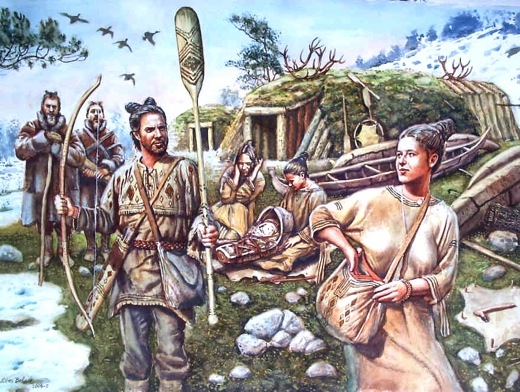
Image above: Hunter-gaterers, or foragers, in what appears to temperate north America. From original article.

Dogs diverged genetically from wolves more than 100,000 years ago, during the previous warm interglacial. Did humans have anything to do with it? The oldest known dog skeletons are from 36 and 33,000 years ago, found in Belgium and Siberia. A child was exploring the Chauvet cave, using a torch to look at the artwork while a dog followed… 26,000 years ago, well before the Ice Age Maximum.

When the cold began to let up, some 17,000 years ago, the people of the Pyrenees living at the Isteritz cave took such good care of a reindeer with a broken leg, it survived for two years (viz Paul Bahn: Pre-neolithic control of animals, 1984, and his response to ongoing controversy). By 15,000 years ago, pictures of horses with rope halters appear in the Magdalenian cave art of SW France.

Foragers created the first magnificent art. They built the first temples and the first high-density towns with thousands of inhabitants. They invented ovens and kilns, cookworthy pottery, wine and beer. They clearly domesticated the dog and probably tamed reindeer and horses.

So perhaps it’s not such a stretch to believe that they also domesticated the pigs, sheep and goats and a whole slew of plants, from grains to squash, gourds, and legumes, to delicacies like chocolate, vanilla, and chili peppers. Even more amazingly, it was rock-shelter dwelling, semi-nomadic foragers who spent hundreds of years patiently experimenting with the unpromising teosinte to bring about maize. Then they spent thousands of years more improving the new tiny-cobbed plant before settling down to grow it as a staple.

If a group of foragers plants a plot of squash near their favorite cave, then comes back in late summer to harvest their bounty, can they legitimately be called farmers? If another group of foragers raises some pigs while living off wild foods (and eating no cereals), can they be called farmers?

If Egyptian foragers throw a bunch of traded domesticated wheat down into the rich alluvial mud on the banks of the Nile, perhaps to brew some beer, but otherwise live the hunting-fishing-gathering lifestyle, how are they any different from the Californian native foragers or the Aborigines who spread some favorite seeds and flooded them by diverting a creek’s spring runoff?

Perhaps we need a new term, one that would reflect the foragers’ sophisticated plant manipulation skills that nevertheless did not, by themselves, lead to the predominantly farming life.

Archeologists have been, in my opinion, far too eager to brand cultures as farmers on flimsy evidence. It appears that farming is much younger than previously claimed. The first farming village was found in Egypt, dated to only 7,000 years ago.

As Melinda A. Zeder, an archeobiologist, states:
This broad middle ground between wild and domestic, foraging and farming, hunting and herding makes it hard to draw clean lines of demarcation between any of these states.

Perhaps this is the greatest change in our understanding of agricultural origins since 1995.
The finer-resolution picture we are now able to draw of this process in the Near East (and, as seen in the other contributions to this volume, in other world areas) not only makes it impossible to identify any threshold moments when wild became domestic or hunting and gathering became agriculture but also shows that drawing such distinctions actually impedes rather than improves our understanding of this process.

Instead of continuing to try to pigeonhole these concepts into tidy definitional categories, a more productive approach would be to embrace the ambiguity of this middle ground and continue to develop tools that allow us to watch unfolding developments within this neither-nor territory.

.

No Gaurantees

SUBHEAD: Being a forager or horticulturalist is not a promise we humans won't drive our environment into extinction - but it better than what we're doing.

By Vera Bravado on 22 February 2013 for Leaving Babylon -
(http://leavingbabylon.wordpress.com/2013/02/22/no-guarantees/)


Image above: Koru rocks in Maori landscape in the Hamilton Gardens, Hamilton, New Zealand.From (http://www.flickriver.com/photos/jayveeare/5332053003/).

Our human forebears everywhere did not just passively gather food and basketry materials but actively tended the plant and animal populations on which they relied. There was no clear-cut distinctions between hunter-gatherers and the more “advanced” agricultural peoples of the ancient world. Moreover, California Indians had likely completed the initial steps in the long process of domesticating wild species…
– Kat Anderson, Tending the Wild
In Agriculture: villain or boon companion, I argued that we sapiens have been cultivators since time immemorial, that a combination of foraging and cultivation is a sensible, durable way of life that has served us well, and that the “origin of agriculture” really is the intensification of cultivation that becomes visible in the archeological record.

I have since been stymied in my quest for clearer understanding by the ongoing insistence of some folks to paint agricultural cultivation into a corner as a disastrous turn for humans and the root of our present troubles. They point to foraging and horticulture as modes of food production that avoid the damage agriculture has brought about. I wanted to test this claim.

It became quickly apparent to me that one does not need agriculture to intensify and produce an increasing surplus. For example, the rich salmon-and-candlefish-based economy of the Kwakiutl provided plenty of surplus to support elites and even to motivate slavery. Foragers are said to live in harmony with their environment, to keep their populations low and their hierarchies flat (if any). Unfortunately, it ain’t necessarily so.

There are compelling data showing that the Australian aborigines wreaked continent-wide devastation with their use of fire on a highly vulnerable landscape, degrading the vegetation, causing massive runoff and loss of soil during monsoons, and eventually precipitating a change in climate for the worse.

While in North America the native tribes may have had but little to do with megafauna extinction, not so in Australia. The human-precipitated change of vegetation deprived the largest and most specialized browsers of adequate food, and they began to disappear not long after the arrival of humans, some 45,000 years ago, along with their marsupial predators. That should hardly be surprising, as the same story repeated many millennia later with the colonization of Far Oceania.

For example, in New Zealand. the South Island Maori, former horticulturists who returned to foraging as more suited to that environment, slaughtered the moas and other vulnerable creatures in an orgy of gluttony, only to turn on each other when protein ran low. The populations of both aborigines and Maori fluctuated according to food availability. Some of the tribes lived in hierarchical societies.

It has also been claimed that horticulturists for the most part remain egalitarian and lack despots, armies, and centralized control hierarchies, and have built-in constraints against large populations and the hoarding of surplus. Nothing could be further from the truth. There have been, indeed, some horticulturists who remained egalitarian, chose to limit their population when it was getting out of hand, and whose gardens and edible forests leave the soil and ecosystem in a good shape. The small island of Tikopia comes to mind.

But they seem no more common than those horticulturists (such as Easter Islanders and many others) who pillaged their new island home, wiping out much of the native flora and fauna, permanently degrading the living environment. The horticulturists who settled Far Oceania were generally rigidly ranked peoples whose chiefs extracted a goodly portion of the harvest, waged wars on neighbors, built fancy tombs and megaliths, and occasionally came close to a state formation. The puzzle of intensification cannot be sidestepped by a reference to a golden age of horticulture.

Still, it bears stressing that many — perhaps most? — ancient forager/cultivator societies coexisted very well with their landbase.

For example, the Moriori, cousins of the Maori, also switched to settled foraging on Chatham Islands, and were such careful stewards of their environment that seal colonies flourished within a stone’s throw from their villages. They lived notably egalitarian lives and carefully controlled their population. Until they were wiped out by the Maori, they were an impressive example of cool temperate region people living in close symbiosis with their ecosystem.

The illuminating and well-researched book Tending the Wild documents various Indian tribes who were also, by and large, careful stewards of their coastal California homelands. “They were able to harvest the foods and basketry and construction materials they needed each year while conserving — and sometimes increasing — the plant populations from which these came. The rich knowledge of how nature works and how to judiciously harvest and steward its plants and animals without destroying them was hard-earned; it was the product of keen observation, patience, experimentation, and long-term relationships with plants and animals.”

Living among a similarly abundant natural environment as the Kwakiutl further north, they did not succumb to ongoing intensification, and continued to share any accumulated seasonal surpluses. Why did Kwakiutl intensify, while their close neighbors to the south, the Coastal Yurok, did not?

I conclude that neither the foraging nor horticultural modes of food production are by themselves a guarantee against ongoing intensification and the eventual damage it brings.

There is a streak of persistent idealization of the forager and simple horticulturist among primitivists and other uncivilization-minded people. Slavery might be reframed as “captivity,” environmental damage rationalized, potlatches celebrated as evidence for gift-economies rather than economic warfare, and discussion shut off. Surely it’s not necessary to ostracize people who point out the facts on the ground, and a need for a rethink?

After all, egalitarian forager/cultivators do show us that this particular mode of existence — so successful and durable during most of our species’ history — functioned mostly within the ‘Law of limits’ that allows ecosystems to thrive.


.

Farming is a terrible idea

SUBHEAD: Evidence supports that first farmers were shorter, weaker and died younger than their wild-foraging forebears.  

By Michael Hanlon on 28 July 2011 for Daily Mail - 
  (http://hanlonblog.dailymail.co.uk/2011/07/farming-a-terrible-idea.html)

 
Image above: Illustration of hunter-gatherers in temperate climate springtime. From (http://www.dangerouscreation.com/2009/04/is-this-our-future).
 
Progress, we tend to assume is, well, a Good Thing. Things that are new, and better, come to dominate and sweep aside old technologies. When they invented the car, the horse was rendered instantly obsolete. Ditto the firearm and the longbow, the steamship and the clipper, the turbojet and the prop. It’s called the ‘better mousetrap’ theory of history – that change is driven by the invention of superior technologies.

Except it really isn’t that simple. Sometimes a new invention, even if obviously ‘better’ than what came before takes a surprising amount of time to become established.

The first automobiles were clumsy, unreliable and expensive brutes that were worse in nearly all respects than the horses they were supposed to replace. The first muskets were less accurate and took longer to reload than the long- and crossbows which had reached their design zenith in medieval Europe. The last of the clippers were far faster than the first steam packets designed to replace them.

A fascinating essay in this week’s New Scientist points out that perhaps the second-greatest human invention of all (after language), that of farming, was not immediately successful at all. In fact the big switch from a hunter-gatherer lifestyle to settled farming communities 11,000 years ago in the Neolithic had more to do with the creation of new social and economic structures than increasing food supply.

It has long been realised that the advent of farming was not necessarily good for humans. Skeletal evidence tends to support the idea that the first farmers were shorter, weaker and died younger than their wild-foraging forebears.

Indeed, people have been shrinking for millennia since paleolithic times and only very recently have those in the rich world begun once again to approach the statures of our prehistoric ancestors. In his 2010 book ‘Pandora’s Seed’, geneticist Spencer Wells argues that farming made humans sedentary, unhealthy, prey to fanatical beliefs and triggered mental illness.

It is certainly true that large settled communities – possible only with specialisation of labour and organised food production – are more prone to diseases. Of course Stone-Age people got sick, but they tended not to get the plagues and epidemics that are associated with more recent history. A lot of this is speculation, but in his New Scientist essay, Samuel Bowles, describes his quantitative analysis of the relative effectiveness of foraging versus farming - in terms of which provides the most calories for the least effort.

Using a whole host of data, collected by anthropologists studying hunter-gatherer tribes and analysing the effort needed to wield replicas of ancient farming implements, he has come to the conclusion that, like the first cars, the first farmers were no better than what came before in terms of feeding the masses. Indeed, they were probably worse.

So why did we do it? Farming, Bowles points out, ushered in a new era of property rights, created huge inequalities, paved the way for a wealth-based economy, divided the sexes and led to the creation of militaries needed to defend all this. Along with farming then, we got war and crime, madness and disease, cruelty, dictatorship and religions that were all about telling us what to do rather than emphasising our links with the Earth. The writer Jared Diamond has called agriculture ‘the biggest mistake humans have ever made’ and it is tempting to see the story of the Garden of Eden and the Fall as an allegory for the descent of Man into settled barbarism.

It is a persuasive thesis. For most of our hundred-thousand-year history human beings have not lived as we live today. Perhaps a great deal of our problems, from the modern plagues of depression and anxiety, obesity and environmental issues, can be ascribed to the Neolithic Revolution. In the end, though, there was no stopping the farmers. Along with the bad stuff we also got art, medicine, science and literature – all more or less impossible in a nomadic, Stone Age society.

Cars eventually got better than horses, guns won out over longbows and steamships overtook the graceful clippers. But the success of the new is rarely as obvious, at the time, as it seems with historical hindsight. A thought that must have occurred to those first labourers, breaking their backs on someone else’s field, wondering why on earth they were doing this rather than picking fruit off a tree like their grandparents had done.

See also:
Island Breath: Is sustainable agriculture an oxymoron? 8/31/06
 Island Breath: The Garden of Eden 4/19/07

 .

Wild Thanksgiving Food

SUBHEAD: Thoughts on surviving Thanksgiving week in Portland, Oregon, on wild foods.  

By Rebecca Lerner on 28 November 2009 in Culture Change -  
(http://www.culturechange.org/cms/index.php?option=com_content&task=view&id=561&Itemid=1)

   
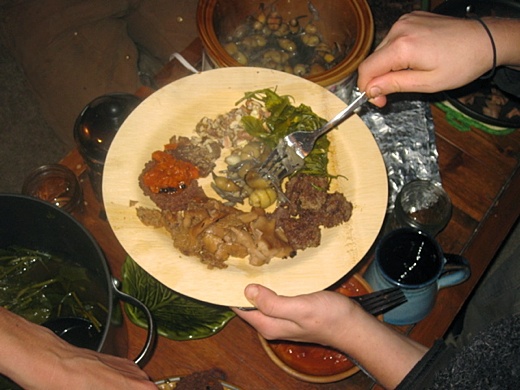
Image above: Loading wild foods onto Thanksgiving plate in 2009

Together, my forager friends and I spent five hours preparing our wild Thanksgiving feast. We sipped lemonbalm tea as we worked, crafting a colorful spread of nourishing foods that were totally local, money-free, and produced 100% compostable waste. Most impressively, our dinner actually tasted good! I never would have guessed it, but boiled rose hips are even better than cranberry sauce.

The red-orange dish is a similar texture and flavor, yet naturally sweeter. To make it yourself, wash the rose hips, then remove the seedy core and little hairs surrounding it. Put the sliced berries in a pot, add water, boil and simmer until the mixture is soft and thick, and voila! I cracked black walnuts with a rock as chestnut-breaded venison sizzled in the pan, filling the room with a delectable scent.

It tempted even me, a pesco-vegetarian who has rarely liked the flavor of mammal meat. Since it was roadkill, I couldn't have moral objections to eating it, so I chose to taste it. Honestly, it was delicious. I never imagined that roadkill would be so tender. I ultimately spit it out because I didn't want to risk sickening myself with meat after avoiding it for so long.

My friends who ate it, though, considered it the highlight of the meal. We also ate baked cattail roots; steamed wapato bulbs; oven-baked biscuits made of chestnut, acorn and dock seed flour with elderberries; roasted chestnuts; raw black walnuts; baked breaded mushrooms and boiled mustard greens. To drink, we had apple cider, lemonbalm tea, and Juniper beer. Surrounded by forager friends whose heart-filled enthusiasm kept me going through all seven days, I couldn't pick a more fitting finale for a week of wild food. When I started on Friday, I was determined and optimistic, but I wasn't sure what I was in for. As it turned out, the lessons I learned in May adequately prepared me to make it through.

 I didn't waste any calories wandering around looking for food because I had scouted my neighborhood in advance. I wasn't beholden to the bare trees because I stocked my pantry in advance, gathering stinging nettle over the summer and chestnuts and black walnuts in September and October. And I had the support of a tribe of forager friends who share the belief that survival is a cooperative endeavor. Together we gathered and processed more edibles more efficiently than I could have on my own.

They also generously offered gifts of plant foods they had stumbled upon, like sumac and feral prunes. I could have continued another week, if I had wanted to to continue eating foods that were less palatable than I'd like. In yesterday's blog I wondered whether ancient indigenous people had different expectations for flavor and texture than we do now. They may have, however, there is also some evidence to suggest that they sometimes cultivated wild plants for flavor. It's hard to know, but speculating is interesting.

 I wanted to keep the project local enough to stay relevant to the realistic constraints of a survival situation, but if I had expanded the range of the project to include the coast, I could have included sea salt, seaweed, and an abundance of fish and shellfish. Some friends did offer to give me fish they had caught in local rivers, but these were farm-raised fish that had been stocked in the waterways, and that didn't exactly seem "wild."

It can be difficult to define wild food. I tried to stick as much as possible to the indigenous diet here, but I also wanted to highlight non-native weeds and other plants that we don't tend to think of as food, like rose hips. My aim was to reveal hidden abundance and show that the Earth feeds us naturally. We don't have to dominate the land to get what we need. To paraphrase my friend Ariel Marguiles,

"The sun warms the Earth and never once does it say, 'But what did you ever do for me?' " The Earth gives us living gifts of food and medicine and asks nothing in return. Agriculture brought overpopulation. Overpopulation threw the natural system out of balance, creating scarcity. And now, instead of cooperation, the world economy is based on competition, greed and domination. Politicians propose wiping out the last remaining wilderness to build roads and drill for oil, because they don't recognize nature's inherent value to provide for us.

 They have forgotten that the Earth is a natural welfare system with free food, free housing and universal health care. Even environmentalists, much of the time, build their campaigns on sentimentality and aesthetics. Mankind has lost its way. Fortunately, the world is filled with the vestiges of a more harmonious past. Wild plants are a link to what once was and what could be. To forage is a beautiful thing, for it is a proclamation that you remember where you came from, that you acknowledge another way.


Image above: Author Becky "Wild Girl" Lerner gives thanks to nature with friends.

Together, my forager friends and I spent five hours preparing our wild Thanksgiving feast. We sipped lemonbalm tea as we worked, crafting a colorful spread of nourishing foods that were totally local, money-free, and produced 100% compostable waste.

Most impressively, our dinner actually tasted good! I never would have guessed it, but boiled rose hips are even better than cranberry sauce. The red-orange dish is a similar texture and flavor, yet naturally sweeter. To make it yourself, wash the rose hips, then remove the seedy core and little hairs surrounding it.

Put the sliced berries in a pot, add water, boil and simmer until the mixture is soft and thick, and voila! I cracked black walnuts with a rock as chestnut-breaded venison sizzled in the pan, filling the room with a delectable scent. It tempted even me, a pesco-vegetarian who has rarely liked the flavor of mammal meat. Since it was roadkill, I couldn't have moral objections to eating it, so I chose to taste it. Honestly, it was delicious. I never imagined that roadkill would be so tender. I ultimately spit it out because I didn't want to risk sickening myself with meat after avoiding it for so long.

My friends who ate it, though, considered it the highlight of the meal. We also ate baked cattail roots; steamed wapato bulbs; oven-baked biscuits made of chestnut, acorn and dock seed flour with elderberries; roasted chestnuts; raw black walnuts; baked breaded mushrooms and boiled mustard greens. To drink, we had apple cider, lemonbalm tea, and Juniper beer. Surrounded by forager friends whose heart-filled enthusiasm kept me going through all seven days, I couldn't pick a more fitting finale for a week of wild food.

When I started on Friday, I was determined and optimistic, but I wasn't sure what I was in for. As it turned out, the lessons I learned in May adequately prepared me to make it through. I didn't waste any calories wandering around looking for food because I had scouted my neighborhood in advance. I wasn't beholden to the bare trees because I stocked my pantry in advance, gathering stinging nettle over the summer and chestnuts and black walnuts in September and October. And I had the support of a tribe of forager friends who share the belief that survival is a cooperative endeavor. Together we gathered and processed more edibles more efficiently than I could have on my own. They also generously offered gifts of plant foods they had stumbled upon, like sumac and feral prunes.

I could have continued another week, if I had wanted to to continue eating foods that were less palatable than I'd like. In yesterday's blog I wondered whether ancient indigenous people had different expectations for flavor and texture than we do now. They may have, however, there is also some evidence to suggest that they sometimes cultivated wild plants for flavor. It's hard to know, but speculating is interesting. I wanted to keep the project local enough to stay relevant to the realistic constraints of a survival situation, but if I had expanded the range of the project to include the coast, I could have included sea salt, seaweed, and an abundance of fish and shellfish. Some friends did offer to give me fish they had caught in local rivers, but these were farm-raised fish that had been stocked in the waterways, and that didn't exactly seem "wild." It can be difficult to define wild food. I tried to stick as much as possible to the indigenous diet here, but I also wanted to highlight non-native weeds and other plants that we don't tend to think of as food, like rose hips.

My aim was to reveal hidden abundance and show that the Earth feeds us naturally. We don't have to dominate the land to get what we need. To paraphrase my friend Ariel Marguiles, "The sun warms the Earth and never once does it say, 'But what did you ever do for me?' " The Earth gives us living gifts of food and medicine and asks nothing in return.

 Agriculture brought overpopulation.

Overpopulation threw the natural system out of balance, creating scarcity. And now, instead of cooperation, the world economy is based on competition, greed and domination. Politicians propose wiping out the last remaining wilderness to build roads and drill for oil, because they don't recognize nature's inherent value to provide for us. They have forgotten that the Earth is a natural welfare system with free food, free housing and universal health care. Even environmentalists, much of the time, build their campaigns on sentimentality and aesthetics. Mankind has lost its way. Fortunately, the world is filled with the vestiges of a more harmonious past.

Wild plants are a link to what once was and what could be. To forage is a beautiful thing, for it is a proclamation that you remember where you came from, that you acknowledge another way. Contact: Rebecca Lerner Urban Forager & Blogger RebeccaELerner [at] gmail.com www.FirstWays.com

See also:
Culture Change: Surviving a week in Portland on wild food 11/19/09 http://www.culturechange.org/cms/index.php?option=com_content&task=view&id=549&Itemid=1
Island Breath: Eden was a garden not a farm 4/19/07
Island Breath: Nuts & Bolts of preparing for a crash 11/26/07
The Gobbler: Native American Strawberry Festival 3/21/94
The Gobbler: A recipe for wild cowslips 3/21/94
The Gobbler: Wild Mayapple Jam 9/21/93
The Gobbler: A taste of spring - Wild Leeks 3/21/93