SUBHEAD: The end of our empire is near and it won't be pretty.
By Tom Englehart on 9 January 2020 for TruthDig -
(https://www.truthdig.com/articles/the-end-of-american-empire-wont-be-pretty/)
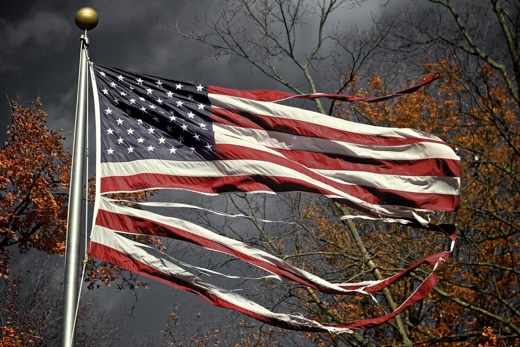
Image above: A tattered American flag flies in shreds. From original article.
Yes, our infrastructure stinks, our schools are failing, this country’s a nightmare of inequality, and there’s a self-promoting madman in the White House, so isn’t it time to take pride in the rare institutional victories America has had in this century?
Arguably, none has been more striking than the triumphal success of the American war system.
Oh, you’re going to bring that up immediately? Okay, you’re right. It’s true enough that the U.S. military can’t win a war anymore. In this century, it’s never come out on top anywhere, not once, not definitively.
And yes, just to get a step ahead of you, everywhere it’s set foot across the Greater Middle East and Africa, it seems to have killed startling numbers of people and uprooted so many more, sending lots of them into exile and so unsettling other parts of the world as well. In the process, it’s also had remarkable success spreading failed states and terror groups far and wide.
Al-Qaeda, whose 19 suicidal hijackers so devastatingly struck this country on September 11, 2001, was just a modest outfit then (even if its leader dreamt of drawing the U.S. into conflicts across the Islamic world that would promote his group big time). Nineteen years later, its branches have spread from Yemen to West Africa, while the original al-Qaeda still exists.
And don’t forget its horrific progeny, the Islamic State, or ISIS (originally al-Qaeda in Iraq). Though the U.S. military has declared it defeated in its “caliphate” (it isn’t, not truly), its branches have multiplied from the Philippines deep into Africa.
And the Afghan War, that original American invasion of this century, remains hell on Earth more than 18 years later. In December, the Washington Post broke a story about interviews on that conflict conducted by the Special Inspector General for Afghanistan Reconstruction with 400 key insiders, military and civilian, revealing that it was a war of (well-grasped) error.
As that paper’s reporter, Craig Whitlock, put it: “Senior U.S. officials failed to tell the truth about the war in Afghanistan throughout the 18-year campaign, making rosy pronouncements they knew to be false and hiding unmistakable evidence the war had become unwinnable.”
Many of those generals and other officials who had claimed, year after year, that there was “progress” in Afghanistan, that the U.S. had turned yet another “corner,” admitted to the Inspector General’s interviewers that they had been lying to the rest of us. In truth, so long after the invasion of 2001, this wasn’t exactly news (not if you had been paying attention anyway).
And it couldn’t have been more historically familiar. After all, U.S. military commanders and other key officials had, in a similar fashion, regularly hailed “progress” in the Vietnam War years, too.
As U.S. war commander General William Westmoreland put it in an address to the National Press Club in 1967, “We have reached an important point where the end begins to come into view,” a sentiment later boiled down by American officialdom to seeing “the light at the end of the tunnel.”
In fact, half a century later, these, too, have proved to be tunnel years for the U.S. military in its global war on terror, which might more accurately be called a global war of error.
Take Iraq, the country that, in the spring of 2003, President George W. Bush and crew so triumphantly invaded, claiming a connection between its autocratic ruler, Saddam Hussein, and al-Qaeda, while citing the dangers of the weapons of mass destruction he supposedly possessed.
Both claims were, of course, fantasies propagated by officials dreaming of using that invasion to establish a Pax Americana in the oil-rich Middle East forever and a day. (“Mission accomplished!”)
So many years later, Americans are still dying there; American air and drone strikes are still ongoing; and American troops are still being sent in, as Iraqis continue to die in significant numbers in a country turned into a stew of displacement, poverty, protest, and chaos.
Meanwhile, ISIS (formed in an American prison camp in Iraq) threatens to resurge amid the never-ending mess that invasion created — and war with Iran seems to be the order of the day.
And just to continue down a list that’s little short of endless, don’t forget Somalia. The U.S. military has been fighting there, on and off, with strikingly negative consequences since the infamous Blackhawk Down disaster of 1993.
Last year, American air strikes rose again to record levels there, while — no surprise — the terror outfit Washington has been fighting in that country since 2006, al-Shabaab, an al-Qaeda offshoot, seems only to be gaining strength.
Hey, even the Russians got a (grim) win in Syria; the U.S., nowhere. Not in Libya, a failed state filled with warring militias and bad guys of every sort in the wake of a U.S.-led overthrow of the local autocrat.
Not in Niger, where four American soldiers died at the hands of an ISIS terror group that still thrives; not in Yemen, yet another failed state where a Washington-backed Saudi war follows perfectly in the U.S. military’s footsteps in the region. So, yes, you’re right to challenge me with all of that.
How to Run a War of Error
Nonetheless, I stand by my initial statement. In these years, the American war system has proven to be a remarkable institutional success story. Think of it this way: in the military of the twenty-first century, failure is the new success. In order to grasp this, you have to stop looking at Afghanistan, Iraq, Libya, Somalia, and the rest of those embattled lands and start looking instead at Washington, D.C. While you’re at it, you need to stop thinking that the gauge of success in war is victory. That’s so mid-twentieth century of you! In fact, almost the opposite may be true when it comes to the American way of war today.
After more than 18 years of what, once upon a time, would have been considered failure, tell me this:
Is the Pentagon receiving more money or less? In fact, it’s now being fed record amounts of tax dollars (as is the whole national security state).
Admittedly, Congress can’t find money for the building or rebuilding of American infrastructure — China now has up to 30,000 kilometers of high-speed rail and the U.S. not one — and is riven by party animosities on issue after issue, but funding the Pentagon? No problem. When it comes to that, there’s hardly a question, hardly a dispute at all. Agreement is nearly unanimous.
Failure, in other words, is the new success and that applies as well to the “industrial” part of the military-industrial complex. That reality was caught in a Washington Post headline the day after a CIA drone assassinated General Qassem Suleimani: “Defense stocks spike after airstrike against Iranian commander.” Indeed, the good times clearly lay ahead. In the age of Trump, when the last secretary of defense was a former Boeing executive and the present one a former lobbyist for arms-maker Raytheon, it’s been weapons galore all the way to the bank.
Who cares if those weapons really work as advertised or if the wars in which they’re used are winnable, as long as they’re bought at staggering prices (and other countries buy them as well)?
If you don’t believe me, just check out Lockheed Martin’s F-35 jet fighter, the most expensive weapons system ever (that doesn’t really work). Hey, in 2019, that company got a $2.43 billion contract just for spare parts for the plane!
And this version of a success story applies not just to funding and weaponry but to the military’s leadership as well. Keep in mind that, after almost two decades without a victory in sight, if you check any poll, you’ll find that the U.S. military remains the most admired institution around (or the one Americans have most “confidence” in). And under the circumstances, tell me that isn’t an accomplishment of the first order.
For just about every key figure in the U.S. military, you can now safely say that failure continues to be the order of the day.
Consider it the twenty-first-century version of a military insurance policy: keep on keeping on without ever thinking outside the box and you’ll be pushed up the chain of command to ever more impressive positions (and, sooner or later, through Washington’s infamous “revolving door” onto the corporate boards of weapons makers and other defense firms). You’ll be hailed as a great and thoughtful commander, a genuine historian of war, and a strategist beyond compare. You’ll be admired by one and all.
Americans of another age would have found this strange indeed, but not today. Take, for instance, former Secretary of Defense and Marine General James “Mad Dog” Mattis who led troops into Afghanistan in 2001 and again in the invasion of Iraq in 2003.
In 2004, as commander of the 1st Marine Division, he was asked about a report that his troops had taken out a wedding party in western Iraq, including the wedding singer and his musicians, killing 43 people, 14 of them children. He responded: “How many people go to the middle of the desert… to hold a wedding 80 miles from the nearest civilization?”
And then, of course, he only rose further, ending up as the head of U.S. Central Command, or CENTCOM, which oversees America’s wars in the Greater Middle East (and you know how that went), until he retired in 2013 and joined the corporate board of General Dynamics, the nation’s fifth largest defense contractor.
Then, in 2016, a certain Donald J. Trump took a liking to the very idea of a general nicknamed “mad dog” and appointed him to run the Department of Defense (which should probably be renamed the Department of Offense).
There, with full honors, the former four-star general oversaw the very same wars until, in December 2018, deeply admired by Washington journalists among others, he resigned in protest over a presidential decision to withdraw American troops from Syria (and rejoined the board of General Dynamics).
In terms of the system he was in, that may have been his only genuine “error,” his only true “defeat.”
Fortunately for the Pentagon, another commander who had risen through the same dead-end wars, four-star Army General Mark Milley, having been appointed head of the Joint Chiefs of Staff, knew just what to whisper in the president’s ear — the magic word “oil,” or rather some version of protect (i.e. take) Syrian oil fields — to get him to send American troops back into that country to continue the local version of our never-ending wars.
By now, Milley’s rise to glory will seem familiar to you. In announcing his appointment as Army chief of staff in 2015, for instance, Secretary of Defense Ashton Carter called him “a warrior and a statesman.” He added, “He not only has plenty of operational and joint experience in Afghanistan, in Iraq, and on the Joint Staff, but he also has the intellect and vision to lead change throughout the Army.” Exactly!
Milley had, in fact, fought in both the Afghan and Iraq wars, serving three tours of duty in Afghanistan alone. In other words, the more you don’t win — the more you are, in a sense, in error — the more likely you are to advance.
Or as retired General Gordon Sullivan, president of the Association of the United States Army and a former chief of staff himself, put it then, Milley’s command experience in war and peace gave him “firsthand knowledge of what the Army can do and of the impact of resource constraints on its capabilities.”
In other words, he was a man ready to command who knew just how to handle this country’s losing wars and keep them (so to speak) on track. Once upon a time, such a crew of commanders would have been considered a military of losers, but no longer. They are now the eternal winners in America’s war of error.
In September 2013, Milley, then an Army three-star general, typically offered this ludicrously rosy assessment of Afghanistan’s American-trained and American-supplied security forces: “This army and this police force have been very, very effective in combat against the insurgents every single day.”
As Tony Karon wrote recently, “Either Milley was dissembling or he was deluded and therefore grotesquely incompetent.” One thing we know, though: when it comes to public military assessments of the Afghan War (and the global war on terror more generally), he was typical. For such commanders, it was invariably “progress” all the way.
Just in case you don’t quite see the pattern yet, after the Washington Post‘s Afghanistan Papers came out last December, offering clear evidence that, whatever they said in public, America’s commanders saw little in the way of “progress” in the Afghan War, Milley promptly stepped up to the plate. He labeled that report’s conclusions “mischaracterizations.”
He insisted instead that the endlessly optimistic public comments of generals like him had been “honest assessments… never intended to deceive either the Congress or the American people.”
Oh, and here’s a final footnote (as reported in the New York Times last year) on how Milley (and top commanders like him) operated — and not just in Afghanistan either:
By Tom Englehart on 9 January 2020 for TruthDig -
(https://www.truthdig.com/articles/the-end-of-american-empire-wont-be-pretty/)
Image above: A tattered American flag flies in shreds. From original article.
Yes, our infrastructure stinks, our schools are failing, this country’s a nightmare of inequality, and there’s a self-promoting madman in the White House, so isn’t it time to take pride in the rare institutional victories America has had in this century?
Arguably, none has been more striking than the triumphal success of the American war system.
Oh, you’re going to bring that up immediately? Okay, you’re right. It’s true enough that the U.S. military can’t win a war anymore. In this century, it’s never come out on top anywhere, not once, not definitively.
And yes, just to get a step ahead of you, everywhere it’s set foot across the Greater Middle East and Africa, it seems to have killed startling numbers of people and uprooted so many more, sending lots of them into exile and so unsettling other parts of the world as well. In the process, it’s also had remarkable success spreading failed states and terror groups far and wide.
Al-Qaeda, whose 19 suicidal hijackers so devastatingly struck this country on September 11, 2001, was just a modest outfit then (even if its leader dreamt of drawing the U.S. into conflicts across the Islamic world that would promote his group big time). Nineteen years later, its branches have spread from Yemen to West Africa, while the original al-Qaeda still exists.
And don’t forget its horrific progeny, the Islamic State, or ISIS (originally al-Qaeda in Iraq). Though the U.S. military has declared it defeated in its “caliphate” (it isn’t, not truly), its branches have multiplied from the Philippines deep into Africa.
And the Afghan War, that original American invasion of this century, remains hell on Earth more than 18 years later. In December, the Washington Post broke a story about interviews on that conflict conducted by the Special Inspector General for Afghanistan Reconstruction with 400 key insiders, military and civilian, revealing that it was a war of (well-grasped) error.
As that paper’s reporter, Craig Whitlock, put it: “Senior U.S. officials failed to tell the truth about the war in Afghanistan throughout the 18-year campaign, making rosy pronouncements they knew to be false and hiding unmistakable evidence the war had become unwinnable.”
Many of those generals and other officials who had claimed, year after year, that there was “progress” in Afghanistan, that the U.S. had turned yet another “corner,” admitted to the Inspector General’s interviewers that they had been lying to the rest of us. In truth, so long after the invasion of 2001, this wasn’t exactly news (not if you had been paying attention anyway).
And it couldn’t have been more historically familiar. After all, U.S. military commanders and other key officials had, in a similar fashion, regularly hailed “progress” in the Vietnam War years, too.
As U.S. war commander General William Westmoreland put it in an address to the National Press Club in 1967, “We have reached an important point where the end begins to come into view,” a sentiment later boiled down by American officialdom to seeing “the light at the end of the tunnel.”
In fact, half a century later, these, too, have proved to be tunnel years for the U.S. military in its global war on terror, which might more accurately be called a global war of error.
Take Iraq, the country that, in the spring of 2003, President George W. Bush and crew so triumphantly invaded, claiming a connection between its autocratic ruler, Saddam Hussein, and al-Qaeda, while citing the dangers of the weapons of mass destruction he supposedly possessed.
Both claims were, of course, fantasies propagated by officials dreaming of using that invasion to establish a Pax Americana in the oil-rich Middle East forever and a day. (“Mission accomplished!”)
So many years later, Americans are still dying there; American air and drone strikes are still ongoing; and American troops are still being sent in, as Iraqis continue to die in significant numbers in a country turned into a stew of displacement, poverty, protest, and chaos.
Meanwhile, ISIS (formed in an American prison camp in Iraq) threatens to resurge amid the never-ending mess that invasion created — and war with Iran seems to be the order of the day.
And just to continue down a list that’s little short of endless, don’t forget Somalia. The U.S. military has been fighting there, on and off, with strikingly negative consequences since the infamous Blackhawk Down disaster of 1993.
Last year, American air strikes rose again to record levels there, while — no surprise — the terror outfit Washington has been fighting in that country since 2006, al-Shabaab, an al-Qaeda offshoot, seems only to be gaining strength.
Hey, even the Russians got a (grim) win in Syria; the U.S., nowhere. Not in Libya, a failed state filled with warring militias and bad guys of every sort in the wake of a U.S.-led overthrow of the local autocrat.
Not in Niger, where four American soldiers died at the hands of an ISIS terror group that still thrives; not in Yemen, yet another failed state where a Washington-backed Saudi war follows perfectly in the U.S. military’s footsteps in the region. So, yes, you’re right to challenge me with all of that.
How to Run a War of Error
Nonetheless, I stand by my initial statement. In these years, the American war system has proven to be a remarkable institutional success story. Think of it this way: in the military of the twenty-first century, failure is the new success. In order to grasp this, you have to stop looking at Afghanistan, Iraq, Libya, Somalia, and the rest of those embattled lands and start looking instead at Washington, D.C. While you’re at it, you need to stop thinking that the gauge of success in war is victory. That’s so mid-twentieth century of you! In fact, almost the opposite may be true when it comes to the American way of war today.
After more than 18 years of what, once upon a time, would have been considered failure, tell me this:
Is the Pentagon receiving more money or less? In fact, it’s now being fed record amounts of tax dollars (as is the whole national security state).
Admittedly, Congress can’t find money for the building or rebuilding of American infrastructure — China now has up to 30,000 kilometers of high-speed rail and the U.S. not one — and is riven by party animosities on issue after issue, but funding the Pentagon? No problem. When it comes to that, there’s hardly a question, hardly a dispute at all. Agreement is nearly unanimous.
Failure, in other words, is the new success and that applies as well to the “industrial” part of the military-industrial complex. That reality was caught in a Washington Post headline the day after a CIA drone assassinated General Qassem Suleimani: “Defense stocks spike after airstrike against Iranian commander.” Indeed, the good times clearly lay ahead. In the age of Trump, when the last secretary of defense was a former Boeing executive and the present one a former lobbyist for arms-maker Raytheon, it’s been weapons galore all the way to the bank.
Who cares if those weapons really work as advertised or if the wars in which they’re used are winnable, as long as they’re bought at staggering prices (and other countries buy them as well)?
If you don’t believe me, just check out Lockheed Martin’s F-35 jet fighter, the most expensive weapons system ever (that doesn’t really work). Hey, in 2019, that company got a $2.43 billion contract just for spare parts for the plane!
And this version of a success story applies not just to funding and weaponry but to the military’s leadership as well. Keep in mind that, after almost two decades without a victory in sight, if you check any poll, you’ll find that the U.S. military remains the most admired institution around (or the one Americans have most “confidence” in). And under the circumstances, tell me that isn’t an accomplishment of the first order.
For just about every key figure in the U.S. military, you can now safely say that failure continues to be the order of the day.
Consider it the twenty-first-century version of a military insurance policy: keep on keeping on without ever thinking outside the box and you’ll be pushed up the chain of command to ever more impressive positions (and, sooner or later, through Washington’s infamous “revolving door” onto the corporate boards of weapons makers and other defense firms). You’ll be hailed as a great and thoughtful commander, a genuine historian of war, and a strategist beyond compare. You’ll be admired by one and all.
Americans of another age would have found this strange indeed, but not today. Take, for instance, former Secretary of Defense and Marine General James “Mad Dog” Mattis who led troops into Afghanistan in 2001 and again in the invasion of Iraq in 2003.
In 2004, as commander of the 1st Marine Division, he was asked about a report that his troops had taken out a wedding party in western Iraq, including the wedding singer and his musicians, killing 43 people, 14 of them children. He responded: “How many people go to the middle of the desert… to hold a wedding 80 miles from the nearest civilization?”
And then, of course, he only rose further, ending up as the head of U.S. Central Command, or CENTCOM, which oversees America’s wars in the Greater Middle East (and you know how that went), until he retired in 2013 and joined the corporate board of General Dynamics, the nation’s fifth largest defense contractor.
Then, in 2016, a certain Donald J. Trump took a liking to the very idea of a general nicknamed “mad dog” and appointed him to run the Department of Defense (which should probably be renamed the Department of Offense).
There, with full honors, the former four-star general oversaw the very same wars until, in December 2018, deeply admired by Washington journalists among others, he resigned in protest over a presidential decision to withdraw American troops from Syria (and rejoined the board of General Dynamics).
In terms of the system he was in, that may have been his only genuine “error,” his only true “defeat.”
Fortunately for the Pentagon, another commander who had risen through the same dead-end wars, four-star Army General Mark Milley, having been appointed head of the Joint Chiefs of Staff, knew just what to whisper in the president’s ear — the magic word “oil,” or rather some version of protect (i.e. take) Syrian oil fields — to get him to send American troops back into that country to continue the local version of our never-ending wars.
By now, Milley’s rise to glory will seem familiar to you. In announcing his appointment as Army chief of staff in 2015, for instance, Secretary of Defense Ashton Carter called him “a warrior and a statesman.” He added, “He not only has plenty of operational and joint experience in Afghanistan, in Iraq, and on the Joint Staff, but he also has the intellect and vision to lead change throughout the Army.” Exactly!
Milley had, in fact, fought in both the Afghan and Iraq wars, serving three tours of duty in Afghanistan alone. In other words, the more you don’t win — the more you are, in a sense, in error — the more likely you are to advance.
Or as retired General Gordon Sullivan, president of the Association of the United States Army and a former chief of staff himself, put it then, Milley’s command experience in war and peace gave him “firsthand knowledge of what the Army can do and of the impact of resource constraints on its capabilities.”
In other words, he was a man ready to command who knew just how to handle this country’s losing wars and keep them (so to speak) on track. Once upon a time, such a crew of commanders would have been considered a military of losers, but no longer. They are now the eternal winners in America’s war of error.
In September 2013, Milley, then an Army three-star general, typically offered this ludicrously rosy assessment of Afghanistan’s American-trained and American-supplied security forces: “This army and this police force have been very, very effective in combat against the insurgents every single day.”
As Tony Karon wrote recently, “Either Milley was dissembling or he was deluded and therefore grotesquely incompetent.” One thing we know, though: when it comes to public military assessments of the Afghan War (and the global war on terror more generally), he was typical. For such commanders, it was invariably “progress” all the way.
Just in case you don’t quite see the pattern yet, after the Washington Post‘s Afghanistan Papers came out last December, offering clear evidence that, whatever they said in public, America’s commanders saw little in the way of “progress” in the Afghan War, Milley promptly stepped up to the plate. He labeled that report’s conclusions “mischaracterizations.”
He insisted instead that the endlessly optimistic public comments of generals like him had been “honest assessments… never intended to deceive either the Congress or the American people.”
Oh, and here’s a final footnote (as reported in the New York Times last year) on how Milley (and top commanders like him) operated — and not just in Afghanistan either:
“As Army chief of staff, General Milley has come under criticism from some in the Special Operations community for his involvement in the investigation into the 2017 ambush in Niger that left four American soldiers dead. He persuaded Patrick M. Shanahan, who was acting defense secretary, to curtail a broader review, and also protected the career of an officer who some blamed for the ambush. General Milley’s backers said he prevented the officer from leading another combat unit.”Whatever you do, in other words, don’t give up the ghost (of error). Think of this as the formula for “success” in that most admired of institutions, the U.S. military.
After all, Milley and Mattis are just typical of the commanders who rose (and are still rising) to ever more prestigious positions on the basis of losing (or at least not winning) an endless series of conflicts. Those failed wars were their tickets to success. Go figure.
Where Defeat Culture Leads
In other words, the men who fought the twenty-first-century equivalents of Vietnam — though against right-wing Islamists, not left-wing nationalists and communists — the men who never for a second figured out how to win “hearts and minds” any better than General William Westmorland had half a century earlier, are now triumphantly running the show in Washington.
Add in the corporate types who endlessly arm them for battle and lobby for more of the same while raking in the dough and you have a system that no one involved would want to change. It’s a formula for success that works like a dream (even if someday that dream is sure to end up looking like a nightmare).
Once upon a time, in the early 1990s, I wrote a book called The End of Victory Culture. In it, I traced how a deeply embedded American culture of triumph evaporated in the Vietnam War years, “its graveyard for all to see,” as “the answers of 1945 dissolved so quickly into the questions of 1965.”
Once upon a time, in the early 1990s, I wrote a book called The End of Victory Culture. In it, I traced how a deeply embedded American culture of triumph evaporated in the Vietnam War years, “its graveyard for all to see,” as “the answers of 1945 dissolved so quickly into the questions of 1965.”
Speaking of the impact of that war on American culture, I added: “There was no narrative form that could long have contained the story of a slow-motion defeat inflicted by a nonwhite people in a frontier war in which the statistics of American victory seemed everywhere evident.”
Little did I know then how deeply a version of what might be called “defeat culture” would embed itself in American life. After all, Donald Trump couldn’t have been elected to “make America great again” without it. From the evidence of these years, nowhere was that culture more deeply absorbed (however unconsciously) than in the military itself, which has, in our time, managed to turn it into a version of the ultimate success story.
Afghanistan has, of course, long been known as “the graveyard of empires.” The Soviet Union fought Islamic militants (backed by the Saudis and the United States) for nine years there before, in 1989, the Red Army limped home in defeat to watch a drained empire implode two years later.
Little did I know then how deeply a version of what might be called “defeat culture” would embed itself in American life. After all, Donald Trump couldn’t have been elected to “make America great again” without it. From the evidence of these years, nowhere was that culture more deeply absorbed (however unconsciously) than in the military itself, which has, in our time, managed to turn it into a version of the ultimate success story.
Afghanistan has, of course, long been known as “the graveyard of empires.” The Soviet Union fought Islamic militants (backed by the Saudis and the United States) for nine years there before, in 1989, the Red Army limped home in defeat to watch a drained empire implode two years later.
That left the U.S. as the “sole superpower” on Planet Earth and its military as the uncontested greatest one of all.
And it took that military just a decade to head for that same graveyard. In this century, Americans have lost trillions of dollars in the never-ending wars Washington has conducted across the Greater Middle East and parts of Africa, wars that represent an eternal reign (rain?) of error. I’ve long suspected that the Soviet Union wasn’t the only superpower with problems in 1991.
And it took that military just a decade to head for that same graveyard. In this century, Americans have lost trillions of dollars in the never-ending wars Washington has conducted across the Greater Middle East and parts of Africa, wars that represent an eternal reign (rain?) of error. I’ve long suspected that the Soviet Union wasn’t the only superpower with problems in 1991.
Though it was anything but obvious at the time, I’ve since written:
“It will undoubtedly be clear enough… that the U.S., seemingly at the height of any power’s power in 1991 when the Soviet Union disappeared, began heading for the exits soon thereafter, still enwreathed in self-congratulation and triumphalism.”The question is: When will the far more powerful of the two superpowers of the Cold War era finally leave that graveyard of empires (now spread across a significant swath of the planet)?
Still commanded by the losers of those very wars, will it, like the Red Army, limp home one day to watch its country implode? Will it leave a world of war, of the dead, of countless refugees and rubblized cities, and finally return to see its own society disintegrate in some fashion?
Who knows? But keep your eyes peeled in 2020 and beyond. Someday, the U.S. military’s war of error will come to an end and one thing seems certain: it won’t be pretty.
.Who knows? But keep your eyes peeled in 2020 and beyond. Someday, the U.S. military’s war of error will come to an end and one thing seems certain: it won’t be pretty.