Showing posts with label Zoning. Show all posts

Kauai General Plan open house

SUBHEAD: Waimea hosted a westside community meeting on proposed County General Plan update.

By Juan Wilson on 8 December 2016 for Island Breath -
(http://islandbreath.blogspot.com/2016/12/kauai-general-plan-open-house.html)


Image above: Kauai Planning Department Deputy Director Kaaina Hull explaining the General Plan Update as shown on the presentation boards for Waimea and Hanapepe. Photo by Juan Wilson.

On December 5th, 2016 I attended the Kauai Planning Department Open House on the Kauai General Plan Update proposal at the Waimea Theater.

About 25 people attended the meeting. When I arrived, just before 5:30pm, Leanora Kaiaokamalie (Lea) was setting up presentation boards in the lobby of the Waimea Theater and other staff were setting up tripods with boards of the General Plan proposal in front of the stage.

I asked Lea about setting up boards that I had done concerning the general plan including material I presented to HENA (Hanapepe Eleele Neighborhood Association). These consisted of material I have shared with HENA and material on my website.

She said I would have to wait until her boss arrived. The boss being Kaaina Hull, the Deputy Director of the Kauai Planning Department.

Ken Taylor arrived about that time with his own presentation boards. Ken showed me his boards showing his estimate of property tax increases that the plan's execution would require.

Kaaina Hull was late arriving so Ken and I set up our presentation material at the back of the theater. We engaged with some of the public that were interested and I handed out some presentation material.

Once Kaaina got to the theater the the open house activity got under way. In front of the Hanapepe-Eleele tripod board I engaged Lea in a conversation of the “neighborhood “rings” that seem a core concept across all of Kauai's community population clusters.

Walking Distance and Density
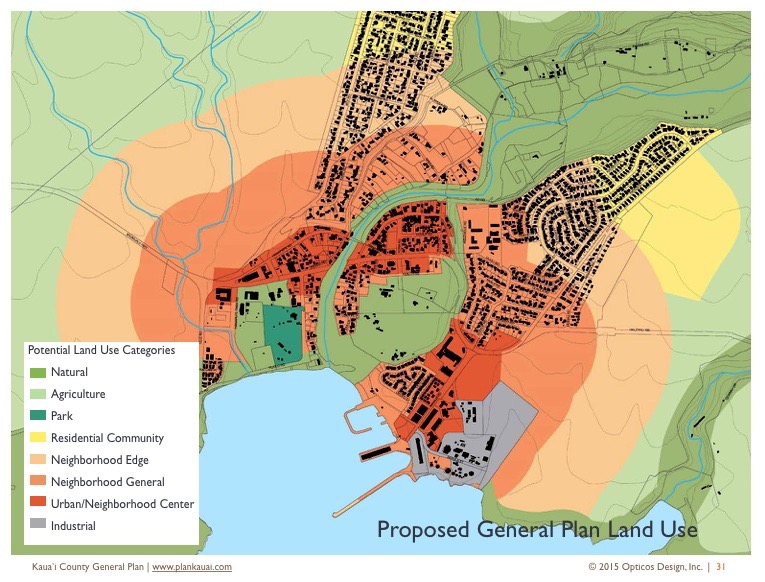
The proposed General Plan describes these "rings" as defined as neighborhoods characterized by walking distance to the community centers.

First I asked her if the names and colors of the nested rings might also relate to greater density at the core and lesser density at the perimeter. A gradient from red (Neighborhood Center), to red-orange (neighborhood General) to orange (Neighborhood Edge) to yellow (Residential Community). Lea  said that was “correct”.

I then asked her if the Planning Department had numbers with the ranges of density to these areas. I asked because I did not see that information in the Kauai General Plan Update Proposal or on the Kauai Plan website. Lea said there were such numbers, but they were not in the public presentation material.

When asked what the density numbers were she said one would have to go online and find them. She said they were buried in “Resources” on the website, but could not give link information or further detail.

One piece of information I have been trying to discover is the growth in population on Kauai that a build-out of proposed General Plan implies. For Hanapepe-Eleele area I have used the upcoming Lima Ola "affordable housing" project developed by the Kauai Housing Division on 75 acres of Alexander & Baldwin property adjacent to Eleele and south of the Kaumaalii Highway.

The Lima Ola project has proposed 550 units in single family, and multi-unit multi-story housing. The Lima Ola project takes up the bulk of the  "Residential Community" in the west Eleele area. The 550 units on 75 acres means 7.33 units per acre.

Using the average number of residence per unit on Kauai of 2.99 this means a population increase of 1,645 people. Projecting that level of development  across the greater Hanapepe-Eleele area could increase the population from 5,028 residents (in the 2010 US Census) to 13,545 new residents, or an increase of 269% people.

Later, after people had a chance to see the material and talk to Planning staff Lea handed the meeting over to Kaaina. He did an overview of the Planning Department effort and the prominent elements of the plan.

Population needs and Hazard planning
He took questions as he spoke, and I asked him why they were showing concentric rings crossing from Hanapepe Heights to Eleele that crossed the breadth of the Hanapepe Valley. I pointed out there was no ring because the landscape could not be traversed between the Heights and Eleele. One had to descend to the hazard area flood plain negating the “ring” function”.

I mentioned that in fact many assets of the community in the river valley would likely have to be abandoned as the hazard area now included our only area firehouse, neighborhood center, and library.

With the possible projected population increase and response to global warming, sea rise and tsunami/hurricane threats to low lying areas, it is likely that some of these community services would have to be expanded and placed at higher elevations.

This would include an additional elementary school in Hanapepe Heights, a neighborhood center in both Hanapepe Heights and Eleele, and a fire house in both neighborhoods.  The fire house would be needed in both locations because the flooding hazard zone has been increased to cross the Kaumaalii Highway and disaster relief and fire fighting might be unable to cross the valley floor.


Rationale for Population Planning
Kaaina made the case that there were compelling reasons the Planning Department had to plan for more housing on Kauai. One reason was the need for "affordable" housing so that the younger generation, our children, could stay on the island.

But also, the Planning Department also anticipated large increase in population on Kauai over the next few generation that necessitated the great expansion proposed in the General Plan update. Their study had shown a Kauai population increasing greatly going out to 2035.

Kaaina said that the bulk of that population increase would not be from the American mainland arrivals or foreign immigrants moving to Kauai. He said The bulk was from “Natural” population growth.

He explained that this was because local people’s births exceeded deaths by between 1% to 2% a year. He stated that it was “unconstitutional” to limit reproductive rights of Americans. Thus the extrapolation of that birth "excess" through 2035 necessitated the current update plan.

The Planning Department has put no other reason to accommodate a doubling of the population of Kauai that I am aware of.

I counter that the the plan will damage the island in many ways. The ecosystem will be threatened in ways not seen before (even discounting global warming, rising seas and less regular rain.) The cost of mitigating the negative effects of greatly increasing Kauai’s population  is not affordable.
  • It means more schools need to be built.
  • It means existing highways widened and new highways created. 
  • It means new recreational, sports, and community services with have to be provided.
  • It means greater impact on our delicate natural resources too. 
There are things that cannot be mitigated with "planning". You cannot manufacture additional sandy beaches. As it is, our sandy beaches are threatened by coral die-off, global warming, and sea rise, Just imagine Salt Pond Beach Park with triple the parking needs and Sunday crowds in 2035.

Natural Growth can be Adjusted
I said to Kaaina that the argument that "natural" growth demands we suburbanize Kauai like has happened on Oahu and Maui is false.

My point is, wouldn’t it be much cheaper and more desirable to mitigate the impact of 1-2% “natural” population growth through education, incentives, and other benign motivators. Statistically parents who restrict their offspring to two or less are better educated and do better financially. A birthrate a wee bit higher than two per family can support a steady total population as there is some unfortunate child mortality.

Does the Planning Department mean to say that we have so little self control that we must destroy the island’s nature, charm, culture to accommodate unborn hoards. 

Incentives and education are much less expensive than paving over the landscape building new highways, schools and other infrastructure. The island could even remain rural and be where you wanted to live… meaning living within Kauai’s natural beauty … not just seeing it afar from end of your suburban cul-de-sac amid the sprawl.

Again the Deadline to respond to the General Plan update is December 16th 2016. Island Breath recommends that the Kauai General Plan Update not be adopted as planned. It should be rejected.  A New approach is needed to marginally reduce "natural" population growth and avoid thus avoid unaffordable infrastucture costs as well as environmental and resource degradation.

The plan as written will make Kauai less resilient, and more dependent on off island resources for food and energy. "KEEP KAUAI RURAL!"

Comments to the draft can be emailed to plankauai@kauai.gov

or snail-mailed to:
Kauai County Planning Department,
Attention: Long Range Division
4444 Rice Street, Suite A473, Līhue, HI 96766.

See also:
Ea O Ka Aina: Reject the Kauai General Plan Update 11/30/16
Ea O Ka Aina: Kauai County "Keep it Rural" 11/17/16
Kauai County General Plan 2000-2020 undated
Ea O Ka Aina: Kauai General Plan Update 9/3/16
Ea O Ka Aina: Kauai Plan Disappoints 12/9/15
Ea O Ka Aina: Tax Donkey Purgatory - Lima Ola 7/18/14
Ea O Ka Aina: Lihue Loss of Vision 9/5/14
Ea O Ka Aina: Kilauea Development on Agland 4/9/11
Ea O Ka Aina: If a tyrant developed Kauai 3/24/11
Ea O Ka Aina: Potash King's Palace 6/24/10
Ea O Ka Aina: Kauai Farm Worker Housing 7/14/09
Ea O Ka Aina: Let Moloaa farmers farm 4/2/09
Ea O Ka Aina: Kauai General Plan 4/2/09
Ea O Ka Aina: Peak Oil Planning 1/29/09
Island Breath: Kauai Sustainable Land Use Plan 11/1/07
Island Breath: LEGS Sustainability Conference 10/13/07
.

Reject the Kauai General Plan update

SUBHEAD: Comment period by the public has been extended to 12/16/16. Stop the suburban oblivion now!  

By Juan Wilson on 30 November 2016 for Island Breath -
(http://islandbreath.blogspot.com/2016/11/reject-kauai-general-plan-update.html)


Image above: Detail of the cover of the proposed Kauai General Plan update produced by the Kauai Planning Department and its consultants. From (http://plankauai.com/wp-content/uploads/Nov-2016-Kauai-General-Plan-Discussion-Draft-Online-Version.pdf).

ATTENTION: LAST OPEN HOUSE ON GENERAL PLAN
Last County sponsored public meetings on General Plan update issue are:

Two additional Open Houses Announced! If you missed the first round of open houses, please join us at the following Open Houses to learn about the General Plan Discussion Draft, and share your input:

Waimea Theatre, Monday, December 5, 2016, 6:00pm- 8:00pm
Princeville Library, Tuesday, December 6, 2016, 10:00am- Noon

These events will be open house style, with comments accepted in written form. There will not be a formal presentation. For an ASL interpreter, materials in an alternate format or auxiliary aid support, call at 241-4050 at least five business days before the event.

KAUAI GENERAL PLAN COMMENT DEADLINE UPDATE
Comments on the update of the Kauai General Plan will be taken up to 16 December 2016. This is an extension of the previous date of 12/2/16.

HOW TO COMMENT ON GENERAL PLAN UPDATE
Comments to the draft can be emailed to plankauai@kauai.gov

or snail-mailed to:
Kauai County Planning Department,
Attention: Long Range Division
4444 Rice Street, Suite A473, Līhue, HI 96766.

See more at (http://plankauai.com/)

The PDF file of the proposed update ti the Kauai General Plan can be found at (http://plankauai.com/wp-content/uploads/Nov-2016-Kauai-General-Plan-Discussion-Draft-Online-Version.pdf)

ISLAND BREATH TAKE ON COUNTY GENERAL PLAN UPDATE
As a Kauai resident and architect/planner I've been concerned with the island’s General Plan update process and resulting report. Like many such documents, it turns out to  mostly "eyewash", "boiler plate", "window dressing", and "feel good fluffery" that merely disguise its real purpose... to promote real estate development… specifically, in this case, to get the approval from the public of a plan to convert Agricultural designated land into suburban sprawl with the effect of doubling the population of Kauai in a generation.

The Big Ag companies that used to operate coconut groves, pineapple and sugarcane plantations are at a loss. Companies like Grove Farms and Alexander & Baldwin see no way forward except to convert their property from a State Land Use designation of Agriculture to the State Land Use designation of Urban. I've seen the A&B annual reports identifying all their land from Poipu to Port Allen (some 3,000 plus acres) in their mind being Urban.

But not Urban in the sense of old Koloa, Hanapepe or Waimea Town - really it's (sub)Urban in the sense of Milliani and the suburban sprawl on central Oahu that occurred after the failure of much of the pineapple industry over the last 30 years.   

One thing has been clear since the previous Kauai General Plan was put in play in 2000 (and not followed by the County). The people of Kauai want the island to remain rural in character. But that dream is slipping away with every new big box store and fast food franchise.

I have been working with the Hanapepe-Eleele Neighborhood Association (HENA) on reviewing the currently proposed Kauai General Plan Update. We have been meeting and reviewing and marking up the proposal with comments and suggested changes.

 We have been parsing through the document PDF file (http://plankauai.com/wp-content/uploads/Nov-2016-Kauai-General-Plan-Discussion-Draft-Online-Version.pdf)

The soul of this document is on the first page of the Introduction in bold large colored typeface.

Growth is Happening Whether We Like It or Not

In other words "You don't have a choice about this."  Bullshit!

HENA worked on the Introduction and Goals section and then has concentrated on the Hanapepe-Eleele Section of the document.

My suggestions began with.

INTRODUCTION
Remove headline
“Growth is Happening Whether We Like it or Not”

Replace with
“Growth will happen to the extent the people of Kauai want it."

GOAL: A SUSTAINABLE ISLAND
Remove content
"Sustainability means growing responsibly to meet the needs of current and future generations without depleting important resources."

Replace with
"Sustainability requires a goal of greater self reliance and self sufficiency. Training and supporting careers working in local communities using renewable resources and alternative energy. Providing food, services, and locally made products is a key factor in achieving sustainability."

HANAPEPE-ELEELE
The General Plan proposal for each community around the island provided maps and text explaining unique aspects of growth change in that local. The section on Hanpepe-Eleele spoke of the charm of Old Hanapepe Town with its galleries, and artisan crafts as well as its historical character. It spoke little about Eleele and none about Hanapepe Heights.

These distinct and different places that are separated by the dramatic rift of Hanapepe River Valley running through the center of it all. Even Hanapepe Town is split by the river into a distinct East and West side.

With this in mind, the planners and consultants for the General Plan use a crude set of concentric rings around Hanapepe-Eleele as areas of new development (and this is the case with all the other community area plans in the proposal). The differences in the use and purpose of these development rings are never fully detailed. In a way they appear to be a gradient of lessening density around an urban core.

Under "Permitting Actions and Code Changes the General Plan says 
  1. Promote and support appropriately scaled infill development in all towns, with the exception of areas affected by existing and future hazards.
  2. Allow for a variety of accessory dwellings such as ‘ohana units and “granny flats” within the Neighborhood Center, Neighborhood General and Neighborhood Edge designations.
  3. Allow additional rental units in all Residential Communities.
http://www.islandbreath.org/2016Year/09/160904hanapepebig.jpg
Image above: Page 37 from Kauai Plan Closing Workshop on Hanapepe-Eleele showing the expansion of the Urban Neighborhood center, Neighborhood General, Neighborhood Edge and Residential Community "doubling" in area. Note the proposed Lina Ola project is the yellow area in the upper right down through the light orange down to Route 540 about 2/3 down this image. From (http://plankauai.com/wp-content/uploads/2015_1104_HanapepeEleeleClosing-1.pdf).

To get a more specific idea of what impact these areas to be developed would have I used two current projects as metrics for determination. One project is Eleele Iluna and the other is Lima Ola. Both are adjecent to one another and adjacent to existing housing in Eleele.

The Eleele Iluna project for 107 single family homes is under construction. It is being built by Habitat for Humanity as Phase Two after 18 homes were built with sweat equity immediately next door.

The other project, Lima Ola, is for 550 mixed single and multi-family units immediately adjacent to Eleele Iluna that would occupy most of the "Residential Community" designation on the east of Hanapepe Valley. Shown in yellow in plan below.

http://www.islandbreath.org/2016Year/11/161130eleelebig.jpg
Image above: Detail of map by IslandBreath.org of Hanapepe-Eleele area used to analyze future density and population of the area. Click to see full enlarged map and explanation.

I recreated the Proposed General Plan Use map from (http://plankauai.com/wp-content/uploads/2015_1104_HanapepeEleeleClosing-1.pdf) and added the existing TMKs (red lines) and building footprints (black) from the Kauai Planning Department. I also created the building footprints and TMKs from the information available about Eleele Iluna and Lima Ola.

With this inormation and the 2010 US Census I made a calculation. US Census counts Hanapepe-Eleele area having 5,028 residents, an average density of 2,465 per square mile or 3.85 per acre. The Proposed Kauai General Plan Update shows four concentric rings of development identified 
Urban Neighborhood Center, Neighborhood General, Neighborhood Edge and Residential Community.

Implications for Hanapepe-Eleele of adopting the Kauai General Plan Update
These new neighborhood areas measure about 616 acres (or 96% of a sq mile). At 2010 census density this would translate to 2,372 new residents totaling a 7,400 head count, an increase of 47%. A difficult adjustment.

Implications for Hanapepe-Eleele  of approving Lima Ola Affordable Housing Project
Lima Ola Affordable Housing is owned  by the County of Kauai and  planned  by the Kauai Division of Housing. Lima Ola Project Area  is 75 acres with 550 units that equal 7.33 units per acre.

Kauai average is 3 people per unit or 1,650 new residents. At that density the new General Plan residential areas would increase Hanapepe-Eleele area population by:

 7.33 units per acre x 616 acres = 4,515 units x 3 people per unit = 13,545 new residents, or an increase of 269% people.

This would have disastrous impacts on Hanapepe-Eleele area traffic, state education and county recreational facilities. This added population would likely require two new elementary schools, one middle school, and one high school.

Implications for Hanapepe-Eleele of Expanded Hazard Area and Sea Rise
As the only fire station, library and community center in the Hanapepe-Eleele area are all in lowland of Hanapepe Valley and in the the newly expanded river flood/hurricane surge/tsunami inundation area, then Hanapepe-Eleele will likely also need 2 new fire stations, 2 new community centers and a relocated library at higher ground.

Also with greatly increased population and increased isolation when hazard strikes a 24/7 medical center with an emergency/trauma capability would be advised.

Implications for Additional Traffic Through Hanapepe-Eleele
Traffic is already a problem at rush hour between Eleele and Kalaheo. This arises between Wahiawa Valley and the 540 Bypass to the Kauai Coffee Plantation. Bumper to bumper is common on the Kaumualii Highway to the light in Kalaheo. Two additional lights are planned on the highway in Eleele for the Lima Ola project.

But even now it is becoming difficult to exit Hanapepe Town at either end of Hanapepe Road or Kona Road at the library and fire station. Those three locations will likely require three more stop lights in town.

It is unfortunate that the State of Hawaii is going to spend a fortune in the next few years rebuilding the Kaumualii Highway bridge over Hanapepe River. Not only creating horrible traffic jams through town for years, it will likely have to be widened to four lanes when two additional lanes are required on highway across the island before this General Plan runs its nightmarish course to suburban oblivion.

Implications for Kauai of adopting the updated General Plan for 2020-2025
Expect the population of Kauai to more than double in the next generation. Expect traffic, crowded beaches, and a reduction int the quality of life.

But worse is the reduction in our ability to cope with economic collapse driven by dwindling worldwide resources and environmental damage due to global warming and population growth.

Sustainability on Kauai, as well as the rest of planet Earth, will be dependent on constraining growth of all kinds. Forget virtual reality, time travel, and alternate universes. If we can't live on Earth we certainly won't live on Mars or anywhere else. There is no option for us to survive while ruining the Earth.

Suggested Action on proposed General Plan Update
Reject the new proposed update to the Kauai General Plan. Ask our Planning Department to go back to the drawing board for a plan to “Keep Kauai Rural”.  The current General Plan still stands until 2020. We have time to look into the likely near future of localization and a need to be more self reliant and resilient.

Again Deadline is December 16th 2016:
Comments to the draft can be emailed to plankauai@kauai.gov

or snail-mailed to:
Kauai County Planning Department,
Attention: Long Range Division
4444 Rice Street, Suite A473, Līhue, HI 96766.

See also:
Ea O Ka Aina: Kauai County "Keep it Rural" 11/17/16
Kauai County General Plan 2000-2020 undated
Ea O Ka Aina: Kauai General Plan Update 9/3/16
Ea O Ka Aina: Kauai Plan Disappoints 12/9/15
Ea O Ka Aina: Tax Donkey Purgatory - Lima Ola 7/18/14
Ea O Ka Aina: Lihue Loss of Vision 9/5/14
Ea O Ka Aina: Kilauea Development on Agland 4/9/11
Ea O Ka Aina: If a tyrant developed Kauai 3/24/11
Ea O Ka Aina: Potash King's Palace 6/24/10
Ea O Ka Aina: Kauai Farm Worker Housing 7/14/09
Ea O Ka Aina: Let Moloaa farmers farm 4/2/09
Ea O Ka Aina: Kauai General Plan 4/2/09
Ea O Ka Aina: Peak Oil Planning 1/29/09
Island Breath: Kauai Sustainable Land Use Plan 11/1/07
Island Breath: LEGS Sustainability Conference 10/13/07

.

Kapaa Heights Development

SUBHEAD: Pot Luck to discuss Land-Use Zoning change being requested by the Kapaa Heights Developers.

By Jonathan Jay on 14 January 2015 for Island Breath -
(http://islandbreath.blogspot.com/2015/01/kapaa-heights.html)

http://www.islandbreath.org/2015Year/01/150113highlandsbig.jpg
Image above: Illustration by Juan Wilson of suburban fill-in of Kapaa Highlands around Kapaa Middle School. Sprawl texture from a development in New Mexico. Click to embiggen. From (http://luc.hawaii.gov/wp-content/uploads/2014/12/A11-791_HoKua_Place_EISPN_ExhibitsB.pdf).

WHAT:
Pot Luck and Kuka Kuka to discuss Land-Use Zoning change being requested by the Kapaa Heights Developers.

WHEN:
Wednesday, 14 January 2015 from 5:00-7:00pm

WHERE:
Main Pavilion at Lydgate Beach Park south of the Wailua River, Kauai.

Would you like to know more about the newly proposed Kapa`a Heights Development?

This Wednesday evening January 14 from 5-7pm at the main pavilion at Lydgate Beach Park, all concerned Kaua`i residents are invited to attend a pot luck and kuka kuka (open discussion) about the Land-Use Zoning change being requested by the Kapaa Heights Developers.  You are invited!

Presently the 97 acre project area (the former canelands on the bluff west of the Bypass Road past the Fellowship Christian Church, south of the Kapa`a traffic circle, and south of Olohena Road behind and surrounding the Kapa`a Middle School extending down to the bridge by the solar farm) is zoned "Agricultural."

The developers are requesting the land use be changed to "Urban" so they can construct a high density neighborhood of approximately 800 homes for 2,000 people and cars, as well as a new 1.4 acre commercial district and network of interior neighborhood streets to connect Olohena and the Kapa`a Bypass road.

If completed, this project would be like adding a second Wailua Houselots to the East side.  Read the proposal here:

(http://luc.hawaii.gov/pending-petitions-2/boundary-amendments/a11-791-kapaa-highlands-phase-ii-hg-kauai-joint-venture-llc/petitioners-environmental-impact-statement-preparation-notice-eispn/)

[IB Publisher's note: The quality of some of these PDF documents (particularly those produced by MS Word) is so poor as to be unintelligible and therefore created in error or part of some deliberate obfuscation.]
  • How do you think this project could impact you? 
  • What are your concerns?
  • What kinds of improvements and mitigation efforts would you like to see completed by the developers BEFORE they get a land use zoning change?  
The public comment period for this project ENDS Thursday, January 22 2015, so if you would like to learn more before you email your comments to 1. Land Use Commission: email address luc@dbedt.hawaii.gov this is your opportunity.

Please join us Wednesday evening January 14 from 5-7pm at the Lydgate Beach Park Pavilion to discuss and share information about this project proposal.  Please bring drinks and pupus (yummy snacks) to share with your neighbors.  It will be fun, and we'll get stuff done!

If you know anyone who might be interested, please help get out the word by forwarding them this email.  All are welcome!


.

Frack Fight 2012

SUBHEAD: A secret war by activists in upstate New York with the fate of the Earth in the balance.

By Ellen Cantarow on 18 November 2012 for Tom Dispatch -
(http://www.tomdispatch.com/post/175618/tomgram%3A_ellen_cantarow%2C_%22little_revolution%2C%22_big_fracking_consequences/)


Image above: Blowing off excess gas in a fracked well in rural Pennsylvania where drilling is controversial. From (http://articles.philly.com/2012-08-27/news/33403570_1_susquehanna-county-town-cabot-oil-baby-drill).

There’s a war going on that you know nothing about between a coalition of great powers and a small insurgent movement. It’s a secret war being waged in the shadows while you go about your everyday life.

In the end, this conflict may matter more than those in Iraq and Afghanistan ever did. And yet it’s taking place far from newspaper front pages and with hardly a notice on the nightly news. Nor is it being fought in Yemen or Pakistan or Somalia, but in small hamlets in upstate New York. There, a loose network of activists is waging a guerrilla campaign not with improvised explosive devices or rocket-propelled grenades, but with zoning ordinances and petitions.

The weaponry may be humdrum, but the stakes couldn’t be higher. Ultimately, the fate of the planet may hang in the balance.

All summer long, the climate-change nightmares came on fast and furious. Once-fertile swathes of American heartland baked into an aridity reminiscent of sub-Saharan Africa. Hundreds of thousands of fish dead in overheated streams. Six million acres in the West consumed by wildfires. In September, a report commissioned by 20 governments predicted that as many as 100 million people across the world could die by 2030 if fossil-fuel consumption isn’t reduced. And all of this was before superstorm Sandy wreaked havoc on the New York metropolitan area and the Jersey shore.

Washington’s leadership, when it comes to climate change, is already mired in failure. President Obama permitted oil giant BP to resume drilling in the Gulf of Mexico, while Shell was allowed to begin drilling tests in the Chukchi Sea off Alaska. At the moment, the best hope for placing restraints on climate change lies with grassroots movements.

In January, I chronicled upstate New York’s homegrown resistance to high-volume horizontal hydraulic fracturing, an extreme-energy technology that extracts methane (“natural gas”) from the Earth’s deepest regions. Since then, local opposition has continued to face off against the energy industry and state government in a way that may set the tone for the rest of the country in the decades ahead. In small hamlets and tiny towns you’ve never heard of, grassroots activists are making a stand in what could be the beginning of a final showdown for Earth’s future.

Frack Fight 2012

New York isn’t just another state. Its largest city is the world’s financial capital. Six of its former governors have gone on to the presidency and Governor Andrew Cuomo seems to have his sights set on a run for the White House, possibly in 2016. It also has a history of movements, from abolition and women’s suffrage in the nineteenth century to Occupy in the twenty-first. Its environmental campaigns have included the watershed Storm King Mountain case, in which activists defeated Con Edison’s plan to carve a giant facility into the face of that Hudson River landmark. The decision established the right of anyone to litigate on behalf of the environment.

Today, that activist legacy is evident in a grassroots insurgency in upstate New York, a struggle by ordinary Americans to protect what remains of their democracy and the Earth’s fragile environment from giant corporations intent on wrecking both. On one side stands New York’s anti-fracking community; on the other, the natural gas industry, the state’s Department of Environmental Conservation, and New York’s industry-allied Joint Landowners Coalition.

As for Governor Cuomo, he has managed to anger both sides. He seemed to bow to industry this past June by hinting that he would end a 2010 moratorium on fracking introduced by his predecessor David Paterson and open the state to the process; then, in October, he appeared to retreat after furious protests staged in Washington D.C., as well as Albany, Binghamton, and other upstate towns.
“I have never seen [an environmental movement] spread with such wildfire as this,” says Robert Boyle, a legendary environmental activist and journalist who was central in the Storm King case and founded Riverkeeper, the prototype for all later river-guardian organizations. “It took me 13 or 14 years to get the first Riverkeeper going. Fracking isn’t like that. It’s like lighting a train of powder.”

Developed in 2008 and vastly more expansive in its infrastructure than the purely vertical form of fracking invented by Halliburton Corporation in the 1940s, high-volume horizontal hydraulic fracturing is a land-devouring, water-squandering technology with a greenhouse gas footprint greater than that of coal. The process begins by propelling one to nine million gallons of sand-and-chemical-laced water at hyperbaric bomb-like pressures a mile or more beneath Earth's surface. Most of that fluid stays underground. Of the remainder, next to nothing is ever again available for irrigation or drinking. A recent report by the independent, nonpartisan U.S. Government Accountability Office concluded that fracking poses serious risks to health and the environment.

New York State’s grassroots resistance to fracking began about four years ago around kitchen tables and in living rooms as neighbors started talking about this frightening technology. Shallow drilling for easily obtainable gas had been done for decades in the state, but this gargantuan industrial effort represented something else again.

Anthony Ingraffea of Cornell University’s Department of Engineering, co-author of a study that established the global warming footprint of the industry, calls this new form of fracking an unparalleled danger to the environment and human health. “There’s much more land clearing, much more devastation of forests and fields. . . thousands of miles of pipelines. . . many compressor stations [that] require burning enormous quantities of diesel. . . [emitting] hydrocarbons into the atmosphere.” He adds that it’s a case of “the health of many versus the wealth of a few.”

Against that wealth stands a movement of the 99% -- farmers, physicists, journalists, teachers, librarians, innkeepers, brewery owners, and engineers. “In Middlefield we’re nothing special,” says Kelly Branigan, a realtor who last year founded a group called Middlefield Neighbors. “We’re just regular people who got together and learned, and reached in our pockets to go to work on this. It’s inspiring, it’s awesome, and it’s America -- its own little revolution.”

Last year, Middlefield became one of New York’s first towns to use the humblest of tools, zoning ordinances, to beat back fracking. Previously, that had seemed like an impossible task for ordinary people. In 1981, the state had exempted gas corporations from New York’s constitutionally guaranteed home rule under which town ordinances trump state law. In 2011, however, Ithaca-based lawyers Helen and David Slottje overturned that gas-cozy law by establishing that, while the state regulates industry, towns can use their zoning powers to keep it out. Since then, a cascade of bans and moratoria -- more than 140 in all -- have protected towns all over New York from high-volume frack drilling.


Image above: Cabot Oil & Gas consumptive water use while fracking in 2008 in New York state before drilling moratorium. From (http://www.riverkeeper.org/campaigns/safeguard/gas-drilling/).

This Is What Democracy Looks Like

Caroline, a small hamlet in Tompkins County (population 3,282), is the second town in the state to get 100% of its electricity through wind power and one of the most recent to pass a fracking ban. Its residents typify the grassroots resistance of upstate New York.

“I’m very skeptical that multinational corporations have the best interests of communities at heart,” Don Barber, Caroline’s Supervisor, told me recently. “The federal government sold [Americans] out when they exempted fracking from the Clean Water and Air Acts,” he added. “Federal and state governments are not advocating for the civil society. There’s only one level left. That’s the local government, and it puts a tremendous load on our shoulders.”

Caroline’s Deputy Supervisor, Dominic Frongillo, sees local resistance in global terms. “We’re unexpectedly finding ourselves in the ground zero for climate change,” he says. “It used to be somewhere else, mountaintop removal in West Virginia, deep-sea drilling in the Gulf of Mexico, tar sands in Alberta, Canada. But now...it’s right here under our feet in upstate New York. The line is drawn here. We can’t keep escaping the fossil fuel industry. You can’t move other places, you just have to dig in where you are.”

Two years of pre-ban work in Caroline included an election that replaced pro-drilling members of the town board with fracking opponents, public education forums, and a six-month petition drive. “We knocked on every single door two or three times,” recalls Bill Podulka, a retired physicist who co-founded the town’s resistance organization, ROUSE (Residents Opposed to Unsafe Shale Gas Extraction). “Many people were opposed to gas-drilling but were afraid to speak out, not realizing that the folks concerned were a silent majority.” In the end, 71% of those approached signed the petition, which requested a ban.

On September 11th, a final debate between drilling opponents and proponents took place, after which Barber called for the vote. A ban was overwhelmingly endorsed. “For the first time,” he told the crowd gathered in Caroline’s white clapboard town hall, “I will be voting to change the balance of rights between individuals and civil society. This is because of the impacts of fracking on health and the environment. And the majority of our citizens have voted to pass the ban.” The board then ruled 4 to 1 in favor.

Stealth Invasion

About a year and a half ago, as Caroline and other towns were moving to protect their land from the industry, XTO, a subsidiary of Exxon-Mobil Corporation, began preparing for a possible fracking future in the state. It eyed tree-shaded, Oquaga Creek, a trout-laden Delaware tributary in upper New York State’s Sanford County, leased the land, and applied to the Delaware River Basin Commission (DRBC) for a water-withdrawal permit. XTO required, it said, a quarter of a million gallons of water from the creek every day for its hydraulic fracturing operations.

Delaware Riverkeeper, an environmental organization, found out about the XTO application and spread the word. Within days, the DRBC received 7,900 letters of outrage. On June 1, 2011, hundreds of citizens, organized by grassroots anti-frackers, packed a hearing in Deposit, a village in Sanford Township that lies at the confluence of the creek and the western branch of the Delaware River. Only two people spoke at the meeting in favor of XTO. One was the Supervisor (mayor) of Sanford, Dewey Decker. He applauded the XTO application and denounced protestors as “outsiders.” He is among a group of landowners who have leased land to XTO for hundreds of millions of dollars. (Decker refused to be interviewed for this article.) The rest of the crowd spoke up for the creek, its fish, and its wildlife. The Delaware River Basin Commission indefinitely tabled the XTO application.

While a grassroots victory, the episode also served as a warning about how determined the industry is to move forward with fracking plans despite the state-enforced moratorium still in place. As a result, Caroline and other towns are continuing to develop local anti-fracking measures, since they know that the 2010 ban on the process will end whenever Governor Cuomo okays rules currently being written by the Department of Environmental Conservation (DEC).

When it comes to those rules and fracking more generally, the DEC has a conflict of interest. While it is supposed to protect the environment, it is also tasked with regulating the very industries that exploit it through the agency’s Mineral Resources Division. Last year, the DEC received over 80,000 written comments on the latest draft of its guidelines for the industry, the 1,500-page “SGEIS” (which stands for “Supplemental Generic Environmental Impact Statement"). Drilling opponents outnumbered proponents 10 to 1. The deluge was a record in the agency’s history.

Activists weren’t the only ones with a keen interest in the SGEIS, however. Documents obtained through New York’s Freedom of Information Law indicate that, in mid-August 2011, six weeks before the DEC made its statement public, the agency shared detailed summaries of it with gas corporation representatives, giving the industry a chance to influence the final document before it went public.

Two days before the SGEIS was opened to public scrutiny, an attorney for the Oklahoma-based Chesapeake Energy Corporation and other companies asked regulators to “reduce or eliminate” a requirement for the sophisticated testing of fracking fluids. Such fluids are laden with toxins, including carcinogens, which storms could wash away from drilling sites -- an especially grim prospect given the catastrophic flooding experienced in the state over the last three years.

At the same time, two upstate New York journalists revealed that Bradley Field, the head of the DEC’s Mineral Resources Division, had signed a petition that denied the existence of climate change. Formerly of Getty Oil and Marathon Oil, Field also serves as the state’s representative to the Interstate Oil and Gas Compact Commission and the Ground Water Protection Council, both industry fronts which maintain that fracking is benign. As this was coming to light, state officials anonymously leaked word of a plan to open five counties on New York’s border with Pennsylvania to fracking as long as communities there supported the technology.

This is What Autocracy Looks Like

In May 2012, Dewey Decker and his board passed a resolution pledging that the town of Sanford would take no action against fracking, while awaiting the decision of the DEC. There was no prior notice. Citizens were left to read about it in their local papers. “You wake up the next morning and say, ‘What happened?’” commented Doug Vitarious, a retired Sanford elementary school teacher.

In June, a headline in the Deposit Courier, a Sanford paper, read “Local Officials in Eligible Communities Approve Pro-Drilling Resolutions.” Accompanying the piece was a map of towns that had passed such resolutions. The subscript under the map read: “Joint Landowners Coalition of N.Y.” The JLCNY is the state’s grassroots gas industry ally, whose stated mission is to “foster... the common interest... as it pertains to natural gas development.” Decker represents the organization in Sanford.

During the summer, Vitarious and other citizens asked their town board where the resolution had originated, but were met with silence. They requested that the board rescind the resolution and conduct a referendum. Decker refused.

By the end of August, 43 towns in the region had passed resolutions modeled on one appearing at the JLCNY website. It stipulates that at the local level “no moratorium on hydraulic fracturing will be put in place before the state of New York has made it’s [sic] decision.” Under New York’s Freedom of Information Law, Catskill Citizens for Safe Energy and the Natural Resources Defense Council obtained records from Sanford and two other towns about how they achieved their objectives. The records, says Bruce Ferguson of Catskill Citizens for Safe Energy, “detail contacts between gas industry operatives and officials.”

Two months before superstorm Sandy swamped parts of the state, Sue Rapp, a psychotherapist from the town of Vestal, told me that flooding worries her as much as anything else about fracking. Upper New York State suffered flooding in 2010 and 2011. And then came Sandy. Floods turn millions of gallons of fracking waste-water for which there is no safe storage into streams of poisons that wash into waterways.

Unlike Sanford’s board, Vestal’s has not formally blocked debate. It has heard arguments for a moratorium by Rapp and an organization she co-founded, Vestal Residents for Safe Energy (VERSE), as well as pleas for a moratorium by physicians and academics. Its reaction, however, has simply been to sit on its hands, waiting for the DEC and Cuomo to make a final decision. This amounts to adopting the JLCNY position in all but formal vote. “What is happening?” asked Rapp rhetorically at a demonstration in Binghamton this past September. “They are trying to shut us down. But we do vote and we will vote. We do not constitute [what pro-drillers call] the tyranny of the majority, but simply the majority. That is called democracy.”

Demonstrations against Cuomo’s frack plan, which drew thousands to Washington D.C., Albany, and elsewhere in New York, included pledges to commit sustained acts of civil disobedience should the governor carry out plans to open the Pennsylvania border area of the state to fracking. At the end of September, the New York Times announced that Cuomo had retreated from his June stance. The report credited the state’s grassroots movement for his change of mind. Legendary for his toughness and political smarts, the governor will confront a political challenge in the coming months. Either he will please gas-industry supporters or his Democratic base. Whichever way he goes, it could affect his chances for the White House.

The stakes, however, are far larger than Cuomo’s presidential aspirations. Opening any part of the state to fracking will certainly damage the local environment. More importantly, a grassroots win in New York State could open the door to a nationwide anti-fracking surge. A loss might, in the long run, result in a cascade of environmental degradation beyond the planet’s ability to cope. As unlikely as it sounds, the fate of the Earth may rest with the residents of Middlefield, Caroline, Vestal, and scores of tiny villages and small towns you’ve never heard of.

“All eyes are on New York,” says Chris Burger, a former Broome County legislator and one of a small group who persuaded New York’s last governor, David Paterson, to pass the state’s moratorium on fracking. “This is the biggest environmental issue New York has ever faced [and not just] New York, the nation, and the world. If it’s going to be stopped, it will be stopped here.”


• Ellen Cantarow first wrote from Israel and the West Bank in 1979. A TomDispatch regular, her writing has been published in The Village Voice, Grand Street, Mother Jones, Alternet, Counterpunch, and ZNet, and anthologized by the South End Press. She is also lead author and general editor of an oral-history trilogy, Moving the Mountain: Women Working for Social Change, published in 1981 by The Feminist Press/McGraw-Hill, widely anthologized, and still in print.

.

Insane Prosecution

SUBHEAD: Councilmember Tim Bynum has finally filed a malicious prosecution suit against  Prosecuting Attorney Shaylene Iseri-Carvalho.

By Andy Parx on 23 September 2012 for Parx Daily News - (http://parxnewsdaily.blogspot.com/2012/09/separating-white-from-rice.html)


Image above: "Insane Prosecutor" photo by Jonathan Jay.

It can't be a surprise to anyone who has followed our coverage of"Rice-Cooker-Gate"- going back to November of 2010 - that Councilmember Tim Bynum has finally filed a malicious prosecution suit against Kaua`i Prosecuting Attorney Shaylene Iseri-Carvalho.

The content of the suit- the "Facts" section of which are presented below, interspersed with background material and comments- won't shock our readers very much either. But for anyone who hasn't been able or attempted to put our real-time exposure of Iseri's blatant abuses of power into an even more horrific narrative, Bynum's attorneys- including local lawyer Dan Hempey and former State Attorney General Marjorie Bronster- have served up for Iseri what many hope will be some measure of the proverbial "dish best served cold".

The barely-scratching-the-surface coverage in the local and Honolulu papers failed to go into any depth, as could be expected. And that left former Kaua`i Council Chair Kaipo Asing- the mastermind behind the political hatchet job against Bynum- pretty much unidentified.

While his role is central to the plot and he is identified in the narrative of the suit as a driving force behind the farce, he isn't named as a defendant, so his role has yet to be widely exposed.

For the underpinnings of the whole story you can use the search box at the top of this page to go back and read how much of the basis for the suit began with Bynum's challenges of the paternalistic power exercised by the once beloved and eventually corrupt and reviled "Uncle Chair," as Bynum and others had taken to calling Asing.

In brief, toward the end of his career, Asing, the one time "voice of the people," began to abuse his evolving power until the wheels of Kaua`i government meshed solely at his whim.

Bynum, along with now-retired Councilperson Lani Kawahara, dared to challenge Asing's power grab simply by asking for things like adherence to the state's sunshine and open records laws, general transparency and public access to documents. They even had to do battle to place items on the agenda, something that Asing had come to deny councilmembers on matters which Asing didn't want publicly addressed.

When she was a councilmember, Iseri, along with fellow Councilperson Mel Rapozo, had become the chief minions of the Minotaur, owing much of their political careers to Asing's benevolence.

Nothing was too much for Asing to ask.

Going deeper though, much of this whole debacle has roots- as does everything seemingly on Kaua`i- in the infamous "Lap Dancer" episode, as described in the book KPD Blue by Tony Sommer which is serialized at this site (see left rail). That led to the infamous Executive Session (ES) 177 where Rapozo, a former Kaua`i Police Department (KPD) officer who was present in the room at police headquarters that night she was fondled by officers, went into a rant about the incident and other potentially explosive internal KPD matters.

Despite orders from the Office of Information Practices (OIP) that the potentially explosive minutes be released publicly, Asing successfully went all the way to the Hawai`i Supreme Court (HSC) to protect Rapozo from exposure, leaving Rapozo- and his ally Iseri of course- forever politically indebted to Asing.

In addition to everything else, Iseri had her own personal feud going with Bynum, much of it seemingly a part of Iseri's well known "anti-haole (Caucasian)" attitude- a mindset finally manifesting itself in the recent settlement of an EEOC racial harassment case.

Another factor in Iseri's enmity for Bynum was her opposition to Bynum's measure which ended Transient Vacation Rentals (TVRs) on Agriculturally zoned land but allowed existing ones to be grandfathered in. It was a major issue on Kaua`i and passage of the resulting ordinance left Iseri, Rapozo and Asing seething and licking their wounds.

So Iseri needed very little prodding to join Rapozo in doing the dirty work for "team Asing" during the well-documented good governance "Battle Royale" between Bynum and Asing.

That set up the "set up," so to speak, and Iseri set on a path to "get" Bynum after she successfully ran for Prosecuting Attorney in 2008.

The "Facts" section of the lawsuit lays out a chilling tale of how Planning Department Supervising Inspector Sheila Miyake trumped up charges against Bynum at the behest of Iseri and ultimately Asing, both of whom are identified by Miyake as apparent co-initiators of the scheme to issue the notice of a building violation.

Missing is the back story of Asing's years-long quest to silence Bynum who had been a thorn in Asing's side on the council as we briefly touched on above. Those seeking to read the whole sordid tale can make good use of the search box at the top of this page, inserting names and terms we've used here in order to follow the blow-by-blow accounts we've presented over the past almost three years.

The detailed "facts," as presented in suit itself (in italics), are a worth a look too. So, interspersed with a little background, here they are.
Beginning in 2008, BYNUM, following legal guidance offered by the Kaua'i County Attorney's Office, voted for certain amendments to Kaua'i zoning laws with which Defendants MIYAKE and ISERI-CARVALHO disagreed.
BYNUM's right to vote as he did was protected by the First Amendment to the United States Constitution and his votes related to matters of public concern.
Defendant ISERI-CARVALHO left employment with the Kaua'i County Council after she began her term as Kaua'i County Prosecuting Attorney in 2008.
Defendant ISERI-CARVALHO has a history of animosity toward Plaintiff. She harbors personal animosity toward the Plaintiff. She vehemently disagreed with Plaintiffs vote for certain amendments to Kaua'i zoning laws beginning in 2008.
Defendant MIYAKE has a history of animosity toward Plaintiff. She harbors personal animosity toward the Plaintiff.
The "amendment" was a successful effort by Bynum to "grandfather" existing Transient Vacation Rentals (TVRs) on agriculturally zoned land but ban new ones.

From there Bynum's suit sets up some of the events that led Iseri to go after Bynum:
2010 was an election year for the Kaua'i County Council. After the election, it was known that Deputy County Attorney Michael Dahilig would replace the sitting Director of the Kaua'i Planning Department, Ian Costa as of December 1,2010.
Prior to the 2010 election, Attorneys Michael Dahilig and Ian Jung were employed as deputy county attorneys for the Defendant COUNTY OF KAUAI. These two attorneys were tasked with, among other things, advising the various employees of the PLANNING DEPARTMENT, including but not limited to Defendant MIYAKE, as to the proper interpretation and enforcement of the COUNTY OF KAUAI'S Comprehensive Zoning Ordinance ("CZO") as well as regarding the ability and/or constraints on Planning Officials to enter private property for the purpose of conducting inspections related to zoning compliance.
At all times pertinent to this matter, and to this day, Plaintiff was the owner of a single family home in Kapaa, Hawai'i.
Pursuant to the Kaua'i CZO, it is illegal to convert a single-family dwelling unit into a multi-family dwelling unit without an appropriate permit.
In 2005, BYNUM built an addition onto his home to accommodate the four (4) generations of family members living there at the time. The drawings for the addition went through informal and formal review by the Planning Department. Prior to permitting, a representative of the Planning Department informed BYNUM that the addition, as designed, was legal as long as no stove was installed. The plans for the addition were approved by the Planning Department, after being circulated to and approved by various departments including the Planning Department and a valid building permit was issued. The County sent inspectors during construction, and conducted a final inspection, after construction, after which the Plaintiff was issued a certificate of occupancy.
A laundry room separated the original home from the permitted addition. The door between the original home and the addition had a lock at the time the addition was approved and permitted. The permitted addition also contained a counter top/bar and a sink, as well as several electrical receptacles.
In March and April 2010, plaintiff BYNUM allowed his daughter's friend, Victory Yokotake, to occupy a room in and reside in the BYNUM family home.
While residing at the BYNUM home, Ms. Yokotake had access to the family kitchen.
In early 2010 a female came to the BYNUM residence and allegedly assaulted Victory Yokotake. A police officer came to the house to investigate. The police officer generated a report that incorrectly characterized the addition to the BYNUM home as a separate apartment.
At the time it was generated, this police report regarding the assault of Ms. Yokotake was a protected and confidential document, only to be lawfully viewed by members of the police department and the Office of the Prosecuting Attorney.
But even though there was nothing illegal in what Bynum was doing, Iseri was determined to bend the facts and the law- to the point of breaking- in order to put an end to Bynum's political career and, she hoped, to convict him of a supposed crime... one that didn't exist.
In early 2010 an unknown person who had lawful access to the police report informed Defendants MIYAKE and ISERI-CARVALHO that s/he believed that BYNUM was "renting out a portion of his residence" illegally.
Defendants MIYAKE and ISERI-CARVALHO each knew or should have known at the time of the report that there was nothing illegal about plaintiff renting out a portion of his home to his daughter's friend.
Upon receiving the allegation that BYNUM was renting out a portion of his residence, Defendant MIYAKE wrote down the reporting person's name as "Kalani Martin" although, upon information and belief, she knew that not to be true. MIYAKE also claimed on the report form that she generated that the reporting person "wants to remain anonymous." Upon information and belief, "Kalani Martin" never made the subject report to MIYAKE, but his name was used falsely by MIYAKE as cover for the true reporting person. MIYAKE knew the true identity of the reporting person. Nonetheless, she treated the report as an anonymous complaint.
Defendant MIYAKE has stated that she acted on the subject report because, inter alia, the Kaua'i County Council Chair, "Kaipo Asing, was asking."
Government Inspectors at the Defendant PLANNING DEPARTMENT are not legally authorized, absent a warrant or an exception to the warrant requirement, to enter onto private property to investigate an anonymous complaint that someone is renting out a portion of his or her home, especially where renting out a portion of one's home is not illegal.
Next is the smoking gun which we reported on years ago- an email from Iseri showing her to be the one who contemplated and initiated action in the matter before it was ever on Miyake's radar screen- or for that matter anyone in the planning department.
Iseri has repeatedly denied she was in anyway involved in the matter until the planning department came to her with the supposed "violation" which the email disproves.
On or about April 7, 2010, before the Planning Department had instigated any investigation of the "anonymous" complaint, defendant Prosecuting Attorney ISERI-CARVALHO emailed then-Director Ian Costa of the PLANNING DEPARTMENT, stating: "Aloha Ian, We received information to corroborate an anonymous complaint dated March 26,2010 that was sent to the Planning Department and our office, that Councilmember Tim BYNUM was renting out his house, or a portion thereof. Can you let me know if renting out a portion of his residence is illegal given his land status, and what ordinance/statute would he be violating by doing so? Please advise. Much Mahalo, Shay."
Mr. Costa responded to Ms. ISERI-CARVALHO's email, advising her in relevant part: "The CZO really doesn't prohibit renting portions of structures. Even the issue of "lock-outs" is not addressed. The CZO does not dictate where locks are permitted and not permitted (thank goodness!). The issue would be whether the area, in question creates a "multi-family" dwelling. What was permitted is a "single-family" dwelling based on "one kitchen". If a second kitchen (area used for the preparation of food) is present, then a violation would exist for an illegal "multi-family" dwelling unit. I understand Sheila has been assisting and monitoring. Let me know if we can be of farther assistance."
Next is a description of Miyake's tangled web of illegal activity- activity which, she had been repeatedly informed, was anything but lawful.
Despite the Planning Director's correct interpretation of the CZO, i.e. that the allegedly anonymous compliant did not allege any illegal activity, Defendant MIYAKE nonetheless instructed her subordinate, Planning Inspector Patrick Henriques, to enter the BYNUM property and search for potential zoning violations. MIYAKE made no attempt to obtain a search warrant, or even consult with anyone about the necessity of a warrant before entering private property for the purpose of conducting a search for zoning violations.
Prior to searching Plaintiffs property without a warrant, MIYAKE made no attempt to contact BYNUM or anyone else in his household to schedule an inspection or offer him a chance to consent to or refuse the search.
In early April 2010 Defendant MIYAKE and Inspector Henriques entered BYNUM's private property without a warrant, without notice and without permission, went through a gate, walked up a wheelchair ramp in the rear of BYNUM's home, looked in his windows and took photographs of the inside of his home.
While conducting the warrantless search of BYNUM's home, Defendant MIYAKE allegedly observed a portable rice cooker and a refrigerator in the addition/family room in the family home.
Defendant MIYAKE specifically timed her entry on to Plaintiffs private property to a time and date when she knew Plaintiff would not be home - MIYAKE knew BYNUM would be attending a Kaua'i County Council Meeting at the time.
But later when it was apparent Miyake was in a deep hole she did what most criminals tend to do... keep digging... and digging... and digging...
During a subsequent investigation into the allegations of zoning violations of BYNUM's property by the State Attorney General, Defendant MIYAKE claimed to a Special Deputy Attorney General, Richard Minatoya, that the previous Kaua'i County Attorney, Matthew Pyun had trained her that she could lawfully search a private home without the need for a search warrant and without notice or consent of the property owner, as long as the private home was associated with a use permit.
Upon information and belief, County Attorney Pyun never actually taught MIYAKE that she could conduct a warrantless search of a private residence, without notice to the property owner based solely on the existence of a use permit on the property.
After MIYAKE searched Plaintiffs house and allegedly observed the rice cooker, she consulted with deputy County Attorneys Jung and Dahilig about what she had seen. Each of those deputy County Attorneys advised MIYAKE that she had trespassed onto the BYNUM property, thereby engaging in an illegal warrantless search. One or both of the two deputy County Attorneys also advised MIYAKE that the presence of a rice cooker and a refrigerator in the lawfully permitted family room did not constitute a second "kitchen" within the meaning of the CZO.
Despite having been clearly informed by COUNTY lawyers that BYNUM had not committed a crime by allowing a tenant who allegedly put a rice cooker and a refrigerator in BYNUM's lawfully permitted addition, and despite having been informed by County lawyers that she had illegally trespassed onto the BYNUM property and engaged in an illegal warrantless search, Defendant MIYAKE nonetheless caused an Zoning Notice Violation to be issued to Plaintiff by the COUNTY OF KAUAI.

Now as anyone who has even deal with the planning department on this knows, what constitutes a kitchen often depends on what the planner had for breakfast as much as anything else and Miyake took full advantage of that. But one thing was always clear- to be a separate apartment there has to be a stove installed. The suit goes on to tell the sordid tale.

At all times relevant to this Complaint, the KAUAI PLANNING DEPARTMENT maintained an official policy or custom of inadequate training and supervision of its planning inspectors, with respect to what constitutes a "kitchen," the legal standards and requirements for searching private property, and Kaua'i planning inspectors have no uniform or written standards other than the CZO to as to what is or is not a kitchen.
Defendant MIYAKE has stated that "each inspector has his own kingdom" with respect to such determinations. There are no written guidelines for inspectors to follow when interpreting the Kaua'i CZO with respect to the definition of "kitchen" and such determinations are made ad hoc, arbitrarily and, in this case, capriciously and maliciously.
52. On or about April 15, 2010, MIYAKE directed Inspector Henriques to prepare a Zoning Violation Notice ("ZVN") to be issued against BYNUM, using a standard PLANNING DEPARTMENT template.
So, determined to pound the square peg into the round hole, Miyake kept digging, bringing Chair Asing's henchman, County clerk Peter Nakamura, up-to-date.
On or about April 15, 2010, MIYAKE emailed the County Clerk, Peter Nakamura, with the subject line that read "4 your eyes only" and attached a copy of the April 15, 2010 ZVN. BYNUM was not informed of the ZVN for nearly one month later on May 12, 2010.
Defendant MIYAKE sent the email copy of the ZVN to the County Clerk, with the intent that it would later be made public and used against BYNUM in the coming 2010 election.
The Planning Department's April 15, 2010 ZVN form, alleged that a zoning violation had been found to "exist" on the Plaintiffs property. Such language, alleging the actual existence of a violation of the CZO, is necessary for such a Zoning Violation Notice to have legal effect — as due process requires the existence of an actual violation before civil or criminal prosecution for a violation of the CZO.
However, in BYNUM's case, the PLANNING DEPARTMENT caused the standard ZVN form originally issued in April 2010 to be altered on or about November 10, 2010 to change the sentence "we have found that a zoning 13 violation exists" to "we have found that a zoning violation may exist." (emphasis added).
At the time of the November 10, 2010 ZVN, there was no probable cause to believe that an actual zoning violation existed on BYNUM's property.=
Upon information and belief, the Zoning Notice Violation prepared against BYNUM was the only such notice ever issued by the County of Kaua'i that had alleged a violation based on what "may" exist - instead of what actually did exist.
On or about November 10, 2010, then-Planning Director Ian Costa sent BYNUM a letter stating, "This notice shall supersede our letter dated April 15, 2010," and stating that "we believe ... violations of Chapter 8, Kaua'i County Code may exist."
The November 10, 2010 ZVN did not allege probable cause to believe that either a civil or a criminal zoning violation had occurred.
Defendant MIYAKE then sent the uniquely modified November 10, 2010 Zoning Violation Notice, which claimed only that the Planning Department "believed" that a violation "may" exist to the Office of the Prosecuting Attorney.
Prior to the uniquely altered ZVN, the PLANNING DEPARTMENT routinely cc'd ZVN's to the Office of the Prosecuting Attorney. However, until the BYNUM ZVN, the Office of the Prosecuting Attorney has never filed criminal 14 charges until and unless the Planning Department had made a specific request for such criminal charges to be filed.
So Miyake had created quite the legal mess for those around her. And Iseri's First Deputy PA Jake Delaplane was taking no chances on letting himself or his boss be the fall guy, even though Iseri was key in pushing Miyake into the hole in the first place.
In November 2010, Jacob Delaplane, Esq. worked under the supervision and direction of defendant ISERI-CARVALHO at the Kaua'i Office of the Prosecuting Attorney, as a deputy prosecuting attorney. 64. In November 2010, Defendant MIYAKE met with deputy prosecuting Attorney Delaplane to discuss the BYNUM zoning matter, in depth.
Delaplane was an attorney licensed to practice law in Hawai'i at the time he met with MIYAKE.
Delaplane secretly recorded the approximately two-hour long conversation with Defendant MIYAKE.
During the November 2010 meeting with deputy prosecuting attorney Delaplane, MIYAKE informed Delaplane that deputy county attorneys Jung and Dahilig had previously advised MIYAKE that she had illegally trespassed on the BYNUM property, and engaged in an illegal search when she entered Plaintiffs property without a warrant in April 2010 and allegedly saw the portable ricecooker inside the BYNUM family home.
A portable rice-cooker is not an "installed appliance" within the meaning of the Kaua'i CZO.
Miyake, unaware she was being set up by being taped of course, spoke freely with Delaplane who wasn't about to do jail time for anyone- Miyake, or even apparently Iseri, if it came to that.
During the November 2010 meeting with Delaplane, MIYAKE informed Delaplane that deputy county attorneys Jung and Dahilig had previously advised her that the evidence that she had allegedly observed during her warrantless search (a refrigerator and a rice-cooker in the family room addition) did not constitute a second kitchen with "installed appliances" as contemplated by the Kaua'i CZO.
During the surreptitiously recorded meeting between MIYAKE and Delaplane, MIYAKE told Deputy Prosecuting Attorney Delaplane: "It is all political but I will never say on stand that it is political. It will be my demise." The prosecution of BYNUM was indeed for political reasons. MIYAKE also opined on the secretly-recorded tape that "the good guys lost" in the 2010 election. Knowing that a new Planning Director was taking over the Planning Department as a result of the 2010 election, MIYAKE and DOE defendants then arbitrarily and capriciously issued the second ZVN against Plaintiff so that she could "cc" it to the Prosecuting Attorney just before the new Planning Director (i.e., Dahilig - the former County Attorney who had concluded that MIYAKE had trespassed, engaged in an illegal search, and who had questioned whether Plaintiffs home had a second kitchen within the meaning of the Kaua'i CZO) took office.
Finally Miyake fingered "the Godfather" naming the then Council Chair as the one at whose behest she was acting when she issued the violation notice- an action on Asing's part that, if true, would be a violation of the County Code of Ethics and punishable by fines and even jail time described in the county charter.
Mr. Kaipo Asing was the Chair or the County Council at the time the revised ZVN was issued to BYNUM.
After MIYAKE told Delaplane about the advice she had received from deputy county attorneys JUNG and DAHILIG, (regarding trespass, illegal search and the definition of kitchen) and in response to further taped questioning by Delaplane, MIYAKE stated that she and PLANNING director Ian Costa issued the ZCN in November 2010: "Because Kaipo wanted it. Kaipo was asking. And I gotta answer to the Council Chair."
In fact, Defendant MIYAKE had no obligation as a Planning Inspector to "answer" to the Council Chair as to who was charged with zoning violations by the Planning Department. To the extent that MIYAKE based her decision-making as a Planning Inspector on the malicious political wishes of the Kaua'i County Council Chair at the time, her decision to issue the ZVN was arbitrary, capricious and malicious.
The November 2010 ZVN was not a valid ZVN based on admissible evidence of an actual zoning violation, but rather was a uniquely altered document that had no legal effect, did not state probable cause, and simply alleged a "belief' that a violation "may" have existed.
The November 2010 ZVN was issued against legal advice of at least one deputy County Attorney and was instead issued for political reasons at the urging of then Kaua'i County Council chair - as established by MIYAKE's taped admissions to Delaplane.
Meanwhile, back at the OPA ranch Iseri was drunk with, among other things, power. And, she was just getting started. Her dominoes were set up, and it was finally time to knock them over.
76. Despite having learned that the two deputy county attorneys who were tasked with advising the PLANNING DEPARTMENT had already advised that there was no probable cause to believe that BYNUM had violated any zoning ordinance, and despite knowing that the alleged rice cooker and refrigerator were only discovered as a result of an illegal warrantless search, and although the November 10, 2010 ZVN did not allege probable cause to believe that either a civil or a criminal zoning violation had occurred - Defendant ISERI-CARVALHO waited approximately one year (until the next election-year cycle) and then filed four criminal zoning charges against BYNUM in the District Court for the 5th Judicial Circuit.
Two of the four alleged criminal acts were based on the alleged presence of a rice-cooker and a refrigerator approximately one year and a half years earlier, and the other two charges were based on the alleged presence of a lock on the door between the addition and the original house - even though Planning Director Costa had already informed Defendant ISERI-CARVALHO that there was no law governing which doors inside a private home could or could not have locks, and even though the subject lock was the same lock that existed at the time the addition was permitted and the certificate of occupancy issued, years earlier.
Oblivious to everything but getting Bynum, Iseri had set the seeds of her own demise because there was "no there there." No matter how hard they squint, when rational people look at a rice cooker none of them are going to see an installed stove.
There was no probable cause for Kaua'i Prosecuting Attorney ISERI-CARVALHO to charge BYNUM with any crimes based on the alleged presence of a rice cooker and refrigerator in his lawfully permitted addition.
ISERI-CARVALHO would not have charged BYNUM with a crime had the Planning Department and MIYAKE not sent an unsolicited copy of the November 2010 ZVN to the Office of the Prosecuting Attorney.
Prior to charging BYNUM with four zoning crimes, ISERI-CARVALHO, or Delaplane, acting under her authority, had an investigator interview Victory YOKOTAKE about the BYNUM home. Although YOKOTAKE told the investigator that BYNUM was unaware of the rice-cooker in the addition and that she was welcome to use the BYNUM kitchen (such that she did not need a second kitchen) neither Delaplane nor ISERI-CARVALHO provided that investigator's report to BYNUM or his attorney while ISERI-CARVALHO was prosecuting him, despite written requests for exculpatory information and the constitutional requirement that such material must be provided to a criminal defendant.
During ISERI-CARVALHO' s investigation into whether BYNUM had committed misdemeanors in connection with the rice-cooker and door lock, deputy prosecuting attorney Jake Delaplane ordered Lucas Burns, another deputy prosecuting attorney, to interview Victory Yokotake, the pretext of the interview being that the interview was to assist with the prosecution of the earlier alleged assault against her, but with the real purpose of bolstering ISERI-CARVALHO'S case against BYNUM. The deputy prosecuting attorney was instructed to surreptitiously tape record the interview.
In April 2012, Lucas Burns testified about the unusually aggressive investigation technique involving misleading and surreptitiously recording a victim of an assault with the real intent of extracting from the assault victim, evidence against BYNUM's alleged zoning violations - having no real intent to bolster the assault case in any way.
Iseri had created quite the mess with "Rice Cooker Gate" stories circulating in "the blogs," as this and Joan Conrow's "KauaiEclectic" site are often cumulatively referred to in government circles.

But Iseri had other things to hide and when the budget for the 2012-2013 fiscal year came around things blew up publicly despite her attempts to keep aspects of her department's budget under wraps... not to mention her almost wacky attempts to keep Bynum from questioning her during the yearly departmental budget review hearings.
From January 2012 until approximately May 2012, while the criminal zoning charges were pending against Plaintiff BYNUM, the Kaua'i County Council was simultaneously considering various matters related to the operations and budget of the Office of the Prosecuting Attorney.
BYNUM had previously been a critic of many of Prosecuting Attorney ISERI-CARVALHO's decisions and he had planned to question ISERI-CARVALHO about her operations and budget as was relevant to the matters pending on the Kaua'i Council's agenda during these council meetings in early 2012.
Plaintiff BYNUM had constitutional rights under the First Amendment to the U.S. Constitution and the Hawai'i State Constitution to speak about and debate, as an elected member of the Kaua'i County Council, the operations and budget of the Office of the Prosecuting Attorney at official Kaua'iCounty Council meetings.
However, on January 19, 2012, while the false criminal charges were pending against BYNUM, prosecuting attorney ISERI-CARVALHO wrote a letter to the entire Kaua'i County Council, on Office of the Prosecuting Attorney letterhead, demanding that BYNUM be recused from County Council meetings involving legislative oversight of the prosecutor's office, while the BYNUM's criminal case was pending.
ISERI-CARVALHO initially stamped this January 19, 2012 letter as "confidential" but later released it to the public and to the mass media and press, with some names redacted.
The January 19, 2012 letter to the Council contained various erroneous statements of law to support ISERI-CARVALHO's demand that BYNUM should be recused from legislative matters concerning the OPA.
Iseri had reached the point where she had lost all contact with reality, living in her own self-constructed World of Shay- aka the Office of the Prosecuting Attorney. The letter read like the rantings of a lunatic. The only problem is that the lunatic in this case had- and still has, until at least December 1- the discretionary power to imprison people.
The January 19, 2012 letter also contained numerous statements that are disparaging of Mr. BYNUM's integrity including that "[Councilman BYNUM] has a clear financial interest in the operations of the OPA, as he would directly benefit if the OPA's operations were negatively impacted by any action of the Council. By virtue of being a criminal defendant, he has a vested interest in ensuring that the OPA not operate at peak efficiency" and "BYNUM's paranoid belief that the actions taken by our office were calculated personal attacks against him is without any merit and is completely baseless." ISERI-CARVALHO intentionally withheld from the public or the Council that the Director of the Planning Department had already "cleared" BYNUM of any violation or that BYNUM was innocent unless proven guilty.

90. When ISERI-CARVALHO demanded BYNUM's recusal on the basis that ISERI-CARVALHO had charged BYNUM in a criminal case that was premised on an illegal warrantless search, without probable cause, and on an interpretation of the CZO that was contrary to that stated by then Planning Director Costa and contrary to the advice of deputy county attorneys Jung and Dahilig, she was acting under the color of state law.
BYNUM had a clearly established constitutional and statutory right to fulfill his responsibilities as an elected councilman and to fully participate in 2012 Council hearings related to the operations and budget of the Office of the Prosecuting Attorney.
ISERI-CARVALHO wrote the January 19, 2012 with the intent of denying BYNUM his rights guaranteed statutes and under the U.S. Constitution and the Hawai'i State Constitution.
ISERI-CARVALHO wrote the January 19,2012 under the color of her authority under state law as an elected public prosecutor.

94. ISERI-CARVALHO wrote the January 19, 2012 with the intent of silencing BYNUM in his capacity as an elected official with respect to the operations and budget of the Office of the Prosecuting Attorney.
ISERI-CARVALHO's conduct, in writing and publishing the January 19, 2012 letter and her making her comments derogatory comments about BYNUM on the Council floor would have chilled or silenced a person of ordinary firmness from future First Amendment activities.
Fearful of the Prosecutor's unprincipled ire, and not wanting to risk violating the law related to recusal as it was presented to the Kaua'i County Council by the Prosecuting Attorney, BYMJM ceded to ISERI-CARVALHO's demand for his recusal from the January, 2012 County Council Meeting. Thereafter BYNUM solicited an opinion from the County of Kaua'i Board of Ethics, which later concluded, contrary to the legal assertions made by ISERICARVALHO to the Kaua'i County Council, that BYNUM did not have a conflict of interest such that he should not be recused from fulfilling his duties as an elected councilman with respect to questioning ISERI-CARVALHO, as would any other elected member of the Kaua'i County Council, with respect to the OPA operations and budget.
But it wasn't like Iseri didn't have a couple of loyal supporters on the council: members Mel Rapozo and Kipukai Kuali`i did their best to throw up smoke screens and throw down oil slicks to obscure, slow down and, they hoped, eliminate challenges to Iseri.
On March 14, 2012 and again on March 21, 2012 there was a Special Council meeting item involving the Prosecuting Attorney's request for Council permission to hire a Law Office Assistant. At the opening of the latter meeting ISERI-CARVALHO notified the Council, through counsel, that she would be asking questions of BYNUM before she would agree to testify before the Council. The proposed questions to councilman BYNUM included whether he would "waive [his] rights" and if [he was] aware that "statements that you make can be used against you in the criminal proceeding."
This March 14, 2012 questioning of BYNUM on behalf of ISERI-CARVALHO would have chilled or silenced a person of ordinary firmness from future First Amendment activities.
During these 2012 County Council meetings ISERI-CARVALHO repeatedly referred to the charges that her Office had filed against BYNUM as the primary basis for removing him from any legislative oversight of the Office of the Prosecuting Attorney. In none of these references did ISERI-CARVALHO reference any presumption of innocence or acknowledge the fact of Plaintiff s innocence as established by the legal opinions of deputy County Attorney's Jung and Dahilig.
In addition to the pressures Iseri was maliciously causing in Bynum's public life her actions made a mess of his personal financial affairs when he put his home up for sale.

While all of these matters were happening, BYNUM had listed his home for sale. In the spring of 2012, he entered into a contract for the sale of his home. The sale went into escrow. The buyers, however, became concerned that the house may not have been properly permitted after reading about the prosecution of BYNUM in the local newspaper. In response, the buyers went to the PLANNING DEPARTMENT and inquired whether there were problems with the permitting of the BYNUM property. The representative of the PLANNING DEPARTMENT wrongly and maliciously informed the buyers that the alleged zoning violations would run with the land and transfer to any new owners. The PLANNING DEPARTMENT employee then falsely informed the buyers that they would not be permitted to rent out any rooms in the residence if they bought the home. In response to these, and other false representations from the PLANNING DEPARTMENT, the buyers cancelled (sic) escrow. The house remains unsold. The loss of the sale of the home caused BYNUM to suffer significant financial damages to be proven at trial
Finally Bynum had his day in court so a judge could ostensibly say to Iseri "what are you, nuckin futz?"

So Oye, Oye. All rise for the courtroom scene- Take One:
On April 5, 2012 a hearing was held in the Fifth Circuit Court, State of Hawai'i, after which the Honorable Kathleen N.A. Watanabe ordered that the Office of the Prosecuting Attorney was disqualified from further involvement in the criminal zoning case against BYNUM.
Thereafter, the State of Hawai'i Office of the Attorney General appointed a Special Deputy Attorney General to take over the case from the disqualified Office of the Prosecuting Attorney. The Special Deputy re-investigated the facts and circumstances related to the alleged zoning crimes and very rapidly concluded that there was no provable case against BYNUM.
The Circuit Court, with the agreement and written consent of the Special Deputy Attorney General, dismissed the entire criminal case against BYNUM with prejudice.
Thereafter, First Deputy Prosecuting Attorney Delaplane, working under the authority of ISERI-CARVALHO told the local newspaper reporter that the dismissal did not equate to innocence.
Iseri is opposed by Deputy County Attorney Justin Kollar in the November 6 election.


Video above: State Court Judge Watanabe rules on 4/5/12 against OPA involvement with Tim Bynam prosecution and denying Iseri-Carvalho any participation in case. From Andy Parx.  (http://www.youtube.com/watch?v=z9c1g1iSZYc&feature=youtu.be)

Even if you heard the story of how Fifth Circuit Court Judge Kathleen Watenabe unceremoniously removed Prosecutor Shaylene Iseri-Carvalho and her office from pursuing the prosecution of Tim Bynum in the "Rice Cooker Gate" case, it can't hold a candle to actually seeing her chide Deputy PA Jake Delaplane. Here the priceless clip of her doing just that.
.