Elysium ad Nauseum

SUBHEAD: Elysium is everything that sucks about Hollywood feature films these days; violent, stupid, cynical, and unoriginal.

By Colin Berry on 6 August 2013 for Boing Boing -
(http://boingboing.net/2013/08/06/elysium-everything-that-sucks.html)


Image above: The Las Vegas Review Journal critic wrote "Elysium good summer sci-fi despite heavy political overtones". From (http://www.reviewjournal.com/columns-blogs/entertainment/movies/elysium-good-summer-sci-fi-despite-heavy-political-overtones).

[Author's note: what you’re about to read contains spoilers, but only if you haven’t seen a blockbuster since Nixon was president.]

[IB Publisher's note: Elyseium: The place at the ends of the earth to which certain favored heroes were conveyed by the gods after death.]

The fact that movie ticket sales have remained essentially stagnant for the past 10 years isn’t news to anyone. But if you’re interested to know why, look no further than the new sci-fi thriller Elysium, opening this week. Written and directed by Neill Blomkamp, the South African-Canadian director whose last film, District 9, came out in 2009, Elysium is much bigger and much more expensive — just under $100 million — and could serve as a poster child for everything that’s wrong with modern movies.

Set in 2154, Elysium tells the story of Max (Matt Damon), a lovable ex-con scraping out life on a ruined planet Earth, where crime, disease, and poverty are the norm for its (mostly) brown citizens. Nineteen miles above Earth, however, hangs Elysium, the ultimate gated community: a jewel-like space station inhabited only by super-rich, (mostly) white folks.

Though a series of unfortunate events, Max gets deathly sick and needs to get up to Elysium, where health problems are healed instantaneously with what looks like a magic tanning bed. (Each Elysian home has one.) To achieve this, he makes a Faustian deal to kidnap John Carlyle (William Fichtner), a rich tycoon, and steal his brain data, the ramifications of which could change civilization. Meanwhile, Max is also being hunted by Kruger (Sharlto Copley), a loathsome government sleeper agent and pawn of Elysium’s wicked overlord, Secretary Delacourt (Jodie Foster) who, besides French, speaks in halting English villain-ese. With me so far?

Woven into this adventure is Max’s friendship (and possible romance) with Frey (Alice Braga), whom he promised, years ago — and it’s in flashback, so you know it’s gonna happen — he’d bring to Elysium.

If all this sounds interesting, it’s not. From the first minute to the last, Blomkamp’s film is entirely predictable, lining up cinematic tropes — The childhood love interest! The charged object! The super-evil villains! The doomed best friend! — like dominoes to topple one by one.

The writing is dreadful. Characters are either completely good or completely evil; nuance in Blomkamp’s world is as rare as an ex-con on Elysium. The dialogue is pure torture: the scenes with Foster, one of her generation’s finest actors, are in particular the stuff of comic-book cliché. Got a favorite phrase from any major thriller or action flick? It’s in there. Hoping a likable character might do something mean, or one of the villains might reveal a little humanity? Think again, fellow movie-goer!

The responsibility for this lies directly with Blomkamp, who wrote the film and should know better. District 9, as I recall, had one or two pieces of moving dialogue, a storyline I couldn’t always predict, and an emotional spectrum beyond merely black or white.

What District 9 and Elysium do share, however, is carnage, and although I’m not in the film’s target demographic, I will say this (because someone has to, repeatedly): movie violence is a spreading disease on culture. Elysium, for all its purported good intentions — Blomkamp claims that (besides blowing things up) he’s interested in “serious topics” like universal health care and wealth discrepancy — the film is so thickly mired in gunfire, torture, and bloodshed that social issues are forgotten, scattered like spent shells on a dusty dystopian floor.

These kinds of films aren’t entertaining anymore; they’re offensive. Yet they sit side-by-side among countless clones, bullets in the chamber, cogs in wheels in the monstrous Movie Marketing machine — operating within the supercolossal Entertainment Industry — which only cares about money and formula and self-protection. No wonder the industry is dying. For our parts, as moviegoers, we are partly culpable for legitimizing these projects, in which innovation, risk, and surprise are next to nil, by continuing to buy their tickets.

Elysium-wise, is any of it worth watching? Some. The CGI for the space station itself, inspired by the Stanford Torus, is pretty cool. Wagner Moura, as the steampunk entrepreneur Spider, does a good job balancing manic and plain old crazy. But that’s really it — the film squarely fails the Bechdel test, and Copley’s Kruger is a disaster of agitated overacting.

I caught Elysium at a press screening in Los Angeles, where writers and critics like me filed in, picked up our free popcorn and parking passes, and sat down to watch. During the film, two young men in the audience chuckled a couple of times, after particularly explosive barrages of gun violence, but other than that, nobody seemed to react. As the credits began to roll, everybody got up and left. No applause, no discussion — nothing. We’d seen this movie a million times before.

The next day, on the top floor of a posh Beverly Hills hotel, we were allowed a rapid-fire roundtable interview with the director himself. Blomkamp seemed like a nice guy: amiable enough, responding to our questions with candor and what appeared to be not a lot of ego. But when I asked him why, for a hundred million bucks, he had chosen to take so few chances, he seemed caught a little off guard.

“My whole goal was big-scale cinema and archetypal storytelling,” he explained. “It will probably be the most expensive film I’ll ever make, but I think it’ll be something I’ll eternally be proud of. My next film will be far lower budget than this; the one after that may end my career. But to have a bunch of low-budget, super edgy films and not have something cinematic? I wouldn’t be happy not to have that in my body of work. Elysium really is the film I wanted to make.”

Elysium billboards and bus benches featuring Matt Damon’s shaved head are up all over L.A. right now, and all over the world. They’ll be up for a couple of weeks, before midnight crews pull them down and replace them with the next project, the next blockbuster, the next 90-minute exercise in toppled tropes. It’s what movies pass for now. While independent films struggle to get produced — brief meteors in the night sky — the movie industry hangs above us, Elysium-like, a bloated superstructure reserved only for the richest and lorded over by villains. Only rarely does a young director make it up there, slipping past the sentries and successfully landing his (or, even more rarely, her) scrappy ship on its surface without getting deported or shot down.

Maybe Blomkamp will be happy up there. Maybe he’ll make a difference in Hollywood. Maybe his next project will push against the formula, against the community he’s recently been welcomed into. We’ll see.

The MPAA estimates roughly 600 movies will be released in 2013. At last week’s screening, while I sat eating GMO popcorn and sipping high-fructose lemonade, watching a $100 million, cliché-riddled exercise that glorified guns and explosive violence, I thought to myself: We are doomed.

• Colin Berry is an author, editor, content consultant, speaker, and award-winning design journalist.

.

Not Written in the Stars

SUBHEAD: It might still be possible to maintain scientific research as a living tradition in the centuries immediately ahead of us.

By John Michael Greer on 8 August 2013 for the Archdruid Report -
(http://thearchdruidreport.blogspot.com/2013/08/not-written-in-stars.html)


Image above: Astrological signs arranged around the wheel of the stars in the heavens. From (http://www.thelivingmoon.com/44cosmic_wisdom/02files/Astrology_Articles_by_Radu.html).

When Friedrich Nietzsche proclaimed the death of God—in less metaphorical terms, the collapse of the Christian faith that had provided the foundations for European social life since the Dark Ages—he saw that event as a turning point in human history, a shattering and liberating transformation that would open the road to the Overman. That hope turned out to be misplaced, and it’s worth keeping in mind that any equally grandiose claims that might be made about the consequences of the death of progress will likely face disappointment along the same lines.

Even so, the collapse of the civil religion of progress marks a significant shift, as important in our time as was the event that Nietzsche announced turned out to be in his. Like its forerunner, the death of progress promises to kick the props out from under a great deal of today’s conventional wisdom, and pose serious challenges to some of the industrial world’s most central institutions.

The case I have particularly in mind here is modern science, and in particular the impressively large institutional forms that have been built up around the scientific project over the last century or so. Those forms were achievable only because a widely shared faith in progress made resources and funding available for them, and their continued existence depends just as directly on the survival of that same faith.

A specific example may be helpful here, so let’s consider the future of astronomical observatories. An observatory big and high-tech enough to contribute significantly to the advance of astronomy can be a very expensive proposition—the Palomar observatory outside San Diego, for example, costs over US$10,000 a night to operate—and the ebbing tide of prosperity in the industrial world is starting to make those costs hard to cover.

Here in the US, the National Science Foundation has proposed to delete the funding for six government-funded observatories, while many observatories owned by universities are facing funding cuts or closure as a result of similar pressures.

Observatories are particularly vulnerable in this context because they don’t make a profit for anybody. At a time when computer science and molecular biology departments at many universities increasingly operate as commercial enterprises, churning out patentable products to line the pockets of professors and university administrators alike, astronomers have got to be feeling like the red-headed stepchildren of academe; no matter how excited they and their colleagues may be about discovering a new type of quasar or what have you, the discovery’s not going to make them or their university any money, and the university administration is just as aware of this difference as the astronomers are.

These days, the sciences are being sorted out into two camps, those that produce technologies useful to government and business and those that don’t; I’m sure my readers need no help figuring out which of those camps is getting the lion’s share of research dollars these days, and which is being left to twist in the wind.

At this point I’d like to take the discussion in a deliberately improbable, even whimsical direction. It so happens that astronomers do have another potential source of income available to them—a funding source that could probably support many if not most of the existing observatories in the style to which they’ve become accustomed, and would be completely independent of government grants and the whims of university administrations alike.

It would require a certain number of grad students to get some additional training, but it could be done with equipment that can be found in any observatory. What’s more, it was the funding source for several of history’s most important astronomical projects.

It’s as simple as it is elegant, really. All that would be required is that observatory staff would have to learn how to cast and interpret horoscopes.

Yes, I’m well aware that that’s not going to happen, and in a moment we’ll talk about the reasons why, but let’s set that aside for now and consider the thing in the abstract. Despite the fulminations and wishful thinking of the rationalists among us, astrology’s not going to go away any time soon. It’s been a living tradition for well over two millennia in close to its current form, and is as lively now as it’s ever been.

The rationalist crusade against it has been a resounding flop, having failed to make the least dent in its popularity; today astrology supports its own economic sector of publishers, computer firms, annual conferences, correspondence schools, and many other businesses, not to mention thousands of professional astrologers who make a living casting birth charts, annual progressions, horary charts, and other astrological readings for a large and enthusiastic clientele.

Not only could astronomers tap into this market, it actually takes a continuing effort on their part to avoid doing so. I’ve been told by astronomer friends that observatories in the US routinely field calls from people who are a little confused about the difference between astronomy and astrology, and want someone to cast their horoscopes. Put a new message on the answering machine, teach the receptionist how to take down birth data, and that’s fixed.

The biggest and most prestigious observatories would have the most to gain—what Hollywood hunk or celebutante, for example, could resist the temptation to drop five figures on a genuine horoscope from the Palomar Observatory, complete with a glossy star field photo of the second or so of arc that was rising on the ecliptic when he or she was born?

Nor would this be anything new in the history of astronomy. Johannes Kepler paid the bills while he was working out the laws of planetary motion by casting horoscopes; Claudius Ptolemy did the same thing more than a millennium earlier while he was writing the Almagest.

Granted, neither man was in it just for the money; Ptolemy also wrote the most influential treatise on astrology ever penned, the Tetrabiblos, while Kepler was a brilliant innovator in astrology. The Keplerian aspects are very nearly as important in the history of modern astrology as the laws of planetary motion are in that of astronomy.

For that matter, the roots of modern astronomy reach deep into the traditions of the astronomer-priests of Sumeria and Babylonia, who made the first known systematic records of planetary movements and, not coincidentally, cast the first known horoscopes.

Much more could be said along these lines, but it’s probably better to stop here, so that my rationalist readers don’t fling themselves at their computer screens in a purely reflexive attempt to leap through cyberspace and wring my neck. Of course the modest proposal I’ve just offered has about as much chance of being taken seriously as Jonathan Swift’s famous suggestion that the Irish ought to support themselves by selling their infants for meat, and it was made in much the same spirit.

We can take it as given that in today’s America, astronomers will embrace astrology on the same day that Sam Harris and Richard Dawkins fall on their knees together and accept Jesus as their lord and savior. Nor, for that matter, am I interested in rehashing the weary debates over the validity of astrology. The issue I want to raise here is why the suggestion that astronomers might consider taking up astrology summons up so violent and visceral a reaction on the part of so many people these days.

It’s important to get past the standard rhetoric that surrounds the subject—the insistence on the part of rationalists that astrology is unacceptable because it’s irrational, medieval, and just plain wrong.

Sports fandom is well up there on the scale of irrationality, and yet it’s perfectly acceptable for astronomers to be rabid fans of the local baseball team; reenactment groups like the Society for Creative Anachronism are about as medieval as you can get, and yet an astronomer who belongs to such a group faces no criticism; as for just plain wrong, your average economist has astrologers beat three falls out of three

You’ll never catch an astrologer claiming that the sun will rise in the west tomorrow morning and then never set again, while it’s par for the course for economists to insist that the speculative bubble du jour will never pop, that the laws of economics can trump the laws of physics and geology, and so on. Yet you’ll never hear scientists denouncing economics as the crackpot pseudoscience that it arguably is.

What puts astrology outside the pale for today’s astronomers and the rest of the scientific community, rather, is that the collective imagination of the modern world assigns it to the dismal past from which the surrogate messiah of progress is forever saving us.

Like the Christianity from which it drew a great many of its central metaphors, the civil religion of progress has a very wide streak of moral dualism; there’s the side of the angels in white—or, rather, the researchers in white lab coats—and then there’s the side of the devils in some infernal equivalent of Madras plaid, and in contemporary culture, there’s no question about the side of the border on which astrology belongs. It’s part of the kingdom of anti-progress, the exact equivalent of the Christian notion of the kingdom of Antichrist.

The white-hot passion with which so many scientists condemn astrology and other systems of rejected knowledge thus has its roots in the identity that scientists are taught to assume by their education and their professional culture.

From the time of Francis Bacon right down to the present, scientists have been encouraged to think of themselves as laborers in the great cause of progress, leading humanity forward out of the superstitious past toward a brighter and better future of ever-increasing reason, knowledge and power. From the 19th century onward, in turn, this is the image of themselves that scientists have by and large tried to project into the wider society, with varying degrees of success.

That kind of acting out of an ideal can be a dangerous thing to do, and civil religions rarely have much sense of the risks involved. Theist faiths with at least a few centuries of experience under their belts tend to be a good deal more cautious; Buddhist monks who visualize themselves as bodhisattvas and Christians practicing the imitatio Christi have traditional protections to keep the identification of the self with an ideal figure from spinning out of control into psychological imbalance.

Those of my readers who, as I did, had the chance to spend some time around old-fashioned Communists will have seen some of what happens when those protections are neglected; the leader of the proletariat who goes to great lengths to avoid noticing that the proletariat is not following him, and melts down completely when this latter detail becomes too evident to ignore, was once a tolerably common type.

That type became much more common in the second half of the 20th century, when it started to take effort not to notice the fact that the American proletariat wasn’t going to follow a Marxist lead. In the same way, I don’t think it’s accidental that the current rationalist crusade against religion, astrology, and everything else it likes to label irrational, medieval, wrong, etc., shifted into overdrive in the final decades of the 20th century, right about the time that it first became really difficult to justify the blanket claim that progress was always as inevitable as it was beneficent.

Like their theist cousins, civil religions fairly often respond to challenges to their core beliefs by moving toward the extremes and looking for somebody to blame, and the cultural politics that assigned the label of “anti-progress” to certain traditional practices such as astrology gave the civil religion of progress an assortment of easy targets once the onward march of progress began to lose its appeal.

The difficulty with such exercises in scapegoat-hunting is that they do nothing to solve the problem that drives them, and may actually get in the way of addressing serious challenges. The status of science in contemporary American society is a case in point. Not long ago, when a qualified scientist got up in front of the public and spoke about some matter of scientific fact, most Americans took him at his word. Nowadays?

One of the core reasons for the failure of climate activism in the US is that a great many Americans know that an expert opinion from a distinguished researcher can be bought for the price of a research grant, and have seen scare tactics used to push political agendas so many times that another round of dire warnings from experts doesn’t impress them any more.

When climate activists chose to rely on the prestige of science to back up a standard-issue scare campaign, in other words, they were making a serious strategic mistake, on which their opponents were not slow to capitalize.

To some extent the collapse in the prestige of science has unfolded from the way that scientific opinion has whirled around like a weathervane on certain very public issues in recent decades. Plenty of people alive today still recall when continental drift was crackpot pseudoscience, polyunsaturated fats were good for you, and ionizing radiation was measured in “sunshine units.”

It’s important to the workings of science that scientists should be permitted to change their minds on the arrival of new evidence, but that necessary openness clashes with the efforts of the scientific community to claim a privileged place in the wider conversations of our time—for example, by insisting that claims by scientific authorities should not be challenged from outside the discipline no matter how many times these same authorities have changed their minds.

Add to that clash the increasingly visible corruption of science by financial interests—the articles in medical journals that are bought and paid for by pharmaceutical firms eager to promote their products, the studies whose conclusions reliably parrot the propaganda of their funding sources, and so on—and you’ve got the makings of a really serious public relations disaster.

That disaster is not going to be prevented, or even delayed, by denouncing astrologers and their ilk. Mind you, it may succeed in making astrology more popular than it otherwise would be, for the same reason that the Republican Party’s bizarre habit of defining anything it doesn’t like as Communism may yet convince a good many Americans to give Marx a second chance.

Given the very real pressures being brought to bear on scientists and scientific institutions in the current environment of economic contraction and violent political partisanship, it’s unlikely that anything more constructive will be on anyone’s agenda until well after the damage is done—and it’s the bad luck of astronomy, along with a great many other sciences not currently participating in the worst of the abuses, that it’s likely to be tarred with the same brush as those who richly deserve it.

Factor in the twilight of the civil religion of progress, though, and the ethical and political crisis of contemporary science becomes something considerably larger. In a world of the sort we’re most likely to encounter in the decades ahead, in which sustained economic growth is a subject for history books, a growing fraction of Americans live in gritty suburban slums with only the most intermittent access to electricity and running water, internet service costs more than the median monthly income, and let’s not even talk about how many people can afford basic modern medical care, faith in the inevitability and beneficence of progress will make roughly as much sense to most Americans as faith in the worker’s paradise of true Communism did to most citizens of the Soviet Union in 1980 or so.

In such a future, government funding for scientific research will be at the mercy of the first demagogue who realizes that gutting the National Science Foundation, and every other scientific program that doesn’t further the immediate needs of the Pentagon, is a ticket to a landslide victory in the next election.

So long as scientists keep on thinking of themselves as heroic workers in the grand cause of progress, furthermore, any attempt on their part to counter such efforts will labor under brutal limits. The vision of futurity central to their identity is already becoming the subject of bitter jokes of the “I believe I was promised a jetpack” variety.

As the shift in the collective imagination implied by those jokes continues to spread, like the old-fashioned Communists mentioned earlier in this essay, scientists won’t be able to respond to their critics without jettisoning their traditional rhetoric, and they won’t be able to jettison the rhetoric without abandoning the heart of their public identity. That’s a trap from which very few organizations and social movements ever manage to escape.

Thus it’s uncomfortably easy to imagine a meeting of the American Association for the Advancement of Science in 2070 or so, say, that resembles nothing so much as the national convention of one of the old-line American Communist parties eighty or ninety years earlier—a small group of old men going through the motions of an earlier time, repeating decades-old slogans, voting on resolutions that matter to no one else on the planet, and grimly trying to pretend that history hasn’t left them sitting in the dust.

In such a future, those astronomical observatories that haven’t been stripped of metal by looters and left to the wind and rain might find a second life as homes for the very rich—it’s just as easy to imagine the attendees at the convention I’ve just described muttering bitterly about the Chinese trillionaire who’s just had the former Palomar Observatory remodeled into a mansion, and boasting to reporters from 2070’s mass media about the spectacular view from his new home.

The point that needs to be grasped here is that the institutional structure of science in America and other industrial nations—the archipelago of university departments, institutes, and specialized facilities for research that provide the economic and practical framework for science as it’s practiced today—faces massive challenges as we move forward into the deindustrial world.

On the one hand, the raw fiscal burden of supporting that structure in an age of economic contraction and environmental payback will become increasingly difficult for any nation to meet, and especially challenging for the United States, as it descends from its age of imperial extravagance into a far more tightly constrained future.

On the other, the emotional commitment of scientists to the civil religion of progress, and to an understanding of the purpose and goals of science that only makes sense in the context of that religion, places harsh burdens on any attempt to preserve that structure once popular faith in progress dissolves.

It might still be possible to maintain scientific research as a living tradition in the centuries immediately ahead of us. In future posts, I plan on talking about ways in which that might be done, and the reasons why I think a project of that sort is worth pursuing. Still, it’s crucial to realize that nothing guarantees the success of such a project; to borrow a phrase from the astrologers, the survival of science as a living practice is not written in the stars.

.

Maized and Cornfused

SUBHEAD: Yukimura ducked responsibility leaving Kagawa, Repozo and Nakamura to try and kill the bill.

By Andy Parx on 6 August 2013 for Parx News Daily -
(http://parxnewsdaily.blogspot.com/2013/08/cornfused.html)


Image above: Entering the GMO Corn Maze of local legislation. From (https://www.jsausa.com/news/index.php?id=322).

So what the heck happened at the end (see the 9:58:00 mark) of today's Kaua`i County Council Committee meeting on Bill 2491 related to pesticides and GMOs?

Well for those who didn't get what they saw it was a semi blood bath. JoAnn Yukimura left early so Mel Rapozo and Ross Kagawa were able to get the bill deferred for a full month in order to try to kill it. Nadine Nakamura was no help either.

Essentially Ross and Mel...
[Yes  Mel is definitely not a friend of the bill or its purpose, although he may protest he hasn't made up his mind.] 
...are both are hoping the State Attorney General will come up with some BS reason why the law is preempted by either the state or feds, either stated or implied even though it's obviously not.  Mel knows damn well that it's not, but he will play politics to the end. Even the Pioneer attorneys couldn't cite any example while the Earth Justice lawyer cited case after case showing no preemption (meaning the county is able to enact the law regulating pesticides and GMOs).

Ross and Mel (and maybe Nadine) are trying to kill the bill through infinite deferral. Gary Hooser (here's his far more staid "first draft of history") tried to fend them off but didn't have even a second vote or anyone to make a motion for a two week deferral because JoAnn left early and Tim Bynum and Jay Furfaro are not on the committee.

Nadine is scared for her political life and you couldn't pry her lips apart with a crow up until she went with the four week deferral vote (i.e. she voted to defer for four weeks).

While a committee cannot kill a bill outright, they can defer it forever. Gary, as chair, said (to paraphrase) "Okay then I want everyone to come with all your amendments and be ready to vote on Sept 9." Good luck.

It's really up to Nadine at this point, so  it's time to lobby the you-know-what out of her.

This means we will not be able to keep getting and giving factual testimony and keep the ball rolling as it was this afternoon when the real science became apparent during the science and medical questioning of Dr Evslin and Dr Valenzuela of the University of Hawaii as well as Kyle Smith (the attorney for the Waimea lawsuit) who is an expert on these restricted use pesticides) and others.

And because they lost the legal round in the morning so badly they are hoping they can get through to the State Attorney General to provide a trump card, He will no doubt try his damnedest to make sure that Hawaii Governor Abercrombie doesn't blow his contributions from Monsanto et. al. in '14.

And who knows what the county attorney will do. Any honest appraisal will find no preemption either stated or implied either state or federal law. And will find the US Supreme Court on our side (something even Pioneer's lawyers couldn't counter).

But if they can't get to the county attorney, Mel will try to say it's too expensive for Kauai to pay to defend ourselves against Big Biotech. In other words we can't pass laws when deep pockets threaten to sue us back to the stone age over them. That something he has said the opposite about when it comes to money to keep defending his pal disgraced former kauai County Prosecutor Shaylene Iseri Carvalho... as did Ross, even more vehemently...

So we have to wait until September 9 and keep the momentum going while they spend another bazillion dollars on cable ads calling themselves poor seed farmers and continuing to extort and provide lying talking points to their poor employees who are caught in the middle.

Well, at least I hope they get hefty raises after testifying....

Don't forget, the only ones who are saying "the community is being torn apart" are those opposed to the bill. And the only ones against the bill are employees or their relatives or paid the shills like that UC Riverside guy today who managed to slither out of a question about funding, about which he said (under his breath) he "only" got a few private research projects a year (presumably industry funded) although his department doesn't take biotech money.

The rest of us are unified like never before by the lies and threats from the chemical companies.

See also:
Ea O Ka Aina: Deferral for Bill 2491 8/6/13
Ea O Ka Aina: On Kauai we are all victims 8/3/13
Ea O Ka Aina: Reports on Hearing for Bill 2491 8/1/13
Ea O Ka Aina: Security Strateguy at Bill 2491 Hearing 8/1/13
Ea O Ka Aina: Bill 2491 Hearing in new venue 7/27/13
Ea O Ka Aina: Kauai's Right to know 7/25/13
Ea O Ka Aina: Regulations of GMOs & Pesticides 6/27/13


.

SB 2491 Deferral

SOURCE: Jonathan Jay (jonathan@dakauai.com)
SUBHEAD: A short history of the deferral of Bill 2491 relating to pesticides and Genetically Modified Organisms.

By Gary Hooser on 6 August 2013 for GaryHoosersBlog -
(http://garyhooser.wordpress.com/2013/08/06/a-short-history-of-yesterday-bill-2491-relating-to-pesticides-and-genetically-modified-organisms/)


Image above: 2011 cartoon of GMO corporation attitude towards "pests" by Union of Concerned Scientists. (http://www.gmeducation.org/government-and-corporations/p192665-business%20first,%20health%20risks%20a%20long%20way%20behind%20in%20eu%20gm%20assessments.html).

 SB2491 has been deferred until September 9th when a meeting of the Economic Development Committee of the Kauai County Council will hold its second hearing. This is confirmed and will not change. The exact time and location will be announced within 6 days of the actual hearing date but the hearing will be held.

After a full day of what I believe was useful and very enlightening testimony by numerous very qualified individuals, I requested that the committee schedule its next meeting on or about August 19th to continue the process of gathering information, evaluating the Bill and perhaps work on any amendments that might be necessary.

Co-introducer Council member Tim Bynum spoke in support of my request but is not a member of the committee and thus could not vote at this meeting. Vice-Chair of the Committee JoAnn Yukimura and the other non-committee member Council Chair Furfaro were both unable to remain until the end of the meeting due to other pressing matters and did not participate in the final discussion.

In response to my request, Council member Kagawa supported by Council member Nakamura expressed their strong reservations about the legal viability of Bill 2491 and suggested the process be put on hold for at least 60 days pending a final legal opinion from the County Attorney and an opinion from the State Attorney General.

I argued against the suggestion put forth by my two Council colleagues and suggested that we keep working on the measure with an intention of improving and strengthening both its legal and its substantive merits.

In my opinion, successful requests for extended deferrals awaiting legal opinions or perhaps pending some amorphus study or round table discussion will in effect “kill the Bill by deferral”.

Council member Rapozo also expressed his reservations about the possibility of legal challenge and suggested that we compromise with a 30 day deferral. I agreed to this suggestion but indicated my support was conditioned upon the members returning on September 9 prepared to vote up or down.

While my request is not binding on the members, Council member Kagawa indicated after the meeting that he would commit to voting on September 9. A committee vote on September 9 regardless of outcome will ensure that Bill 2491 moves to the full council where every member may participate and vote on the final version of the measure.

The fundamental legal issues have not changed since the Bill was originally introduced. Numerous lawyers from local, statewide and national law firms have reviewed Bill 2491 and found it to be legally sound. The agrochemical company attorneys whose job is to protect the interests of their employers and who are backed by unlimited resources are threatening to sue the County should we pass the Bill.

Bill 2491 contains basic and modest provisions designed to increase environmental and health protections while having minimal negative impacts on industry. We are now being threatened by these companies who continue to oppose every single provision.

That these companies would threaten to take the County to court to fight for their right to spray toxic chemicals next to schools and hospitals is an indication of their corporate values and represents the mindset underlying every decision they make. Why do they do it? Because they can.

I learned about bullies in high school. You first try to reason with them; perhaps gain their friendship and respect. Then you try your best to ignore them and stay out of their way. But when they push you, you push them back. Pretty soon they stop pushing.

The fundamental premise of Bill 2491 has not changed: The people of Kauai are concerned about the excessive application of highly toxic restricted use pesticides and the related agricultural practices conducted by the agrochemical companies. There is tangible and scientific evidence that supports these concerns. It is the duty and obligation of the Kauai County Council to take proactive meaningful action.

I will continue to request that my colleagues allow the process to continue to a final vote of the full council.

As a result of the ongoing review and public discussion amendments will likely be introduced to narrow the focus in some areas, to clarify definitions and to resolve various issues and concerns that have been brought forth.

This is a customary and natural part of the process. Killing a Bill based on legal technicalities prior to making a good faith effort to resolve those concerns, is essentially a statement of nonsupport for the underlying substance and intent. I understand this and acknowledge the rights of individuals not to share my particular point of view, but I am asking that this conversation be allowed to occur and the public process be allowed to proceed.

This is an important issue. At the end of the day each council member should be allowed to cast a public vote, yes or no on the passage of Bill 2491.
.

The Age of Endings

SUBHEAD: Our myths of progress are killing us. Perhaps only poetry can save us now.

By Paul Kingsnorth on 7 August 2013 for Open Democracy -
(http://www.opendemocracy.net/transformation/paul-kingsnorth/age-of-endings)


Image above: A photo once taken on the Great Barrier Reef on planet Earth. From (http://www.oceanwideimages.com/categories.asp?cID=233).

Where can we find a new set of stories to inspire the work of the future? Only through the creative imagination of writers, artists, storytellers and musicians. Perhaps only poetry can save us now.

If I were a scientist, I might say we were living in an age of entropy. But I’m not a scientist, and I tend to think that using language of science to discuss issues outside of its domain is part of our current complex of cultural problems. So perhaps, instead, we could call this an age of endings.

Wherever you choose to look, old certainties and old realities appear to be dissolving. The Earth as we know it: its great forests, reefs, teeming cod banks and ancient glaciers. The tigers, the whales, the butterflies and the mountain gorillas. Whole species, at a higher rate of extinction than for millions of years. This planet’s 10,000 year old climatic era. Endings.

Human endings too: the great paintbox of human languages, with most scheduled to die out by century’s end, and ways of living and being that developed over centuries in response to local circumstances. Family life. Traditions. Local economic networks. Cultural certainties. Nations themselves. Known ways of living. Endings.

In some ways, this is not new. At any period of time we could have looked around us and seen empires collapsing and ways of living passing into history. But this is not the same. Never before have we – humans – altered the planet’s climate or pushed so many species into extinction that we may have already triggered a sixth mass extinction event. We have never seen such social and ecological loss on such a wide scale, across the entire globe before, and so fast.

All of these changes are caused by one phenomenon: a burgeoning human economy that serves a global consumer society in which desire poses as need and all needs are there to be met. Blame who you like for this situation: blame the sixties, blame the eighties, blame science, blame the Enlightenment, blame Thatcher or Marx or capitalism or feminism. Blame climate deniers or oil companies or people who take cheap flights or loggers or the owners of battery chicken farms. Blame population growth or greed or politics or technology. Blame yourself, or everyone else – it doesn’t really matter. The age of endings, the age of acceleration, is at hand, and each of us is strung out in its web.

What does it mean to live through times like these, and what should be done to make sense of them? If your children will be poorer than you were, their world scarred and deprived of much of its beauty and magic, what questions should we be asking about what human progress has come to mean?

Questions, I think, are the key. We need to be interrogating our stories deeply: the myths that underpin who we are and how we see the world. In the loosest sense of the word, we live in a materialist society. We pay attention to the material, the measurable, above all else, and we have a tendency to dismiss or ignore aspects of life which are equally real but not as easily reduced to a column on a spreadsheet.


Image above: A typical dying coral reef in Hawaii facing unknown infection in 2012. From (http://news.discovery.com/earth/oceans/hawaiian-corals-dying-from-mysterious-infection-121204.htm).

This means that when we ask ourselves how this global suite of potential disasters has arisen, we tend to look at the outer rather than the inner manifestations. We tell ourselves that the problem is technological: that we are producing too many greenhouse gases because we are burning fossil fuels, and therefore we need to stop burning them. Or we tell ourselves that the problem is political: democracy cannot respond adequately to the needs of ecology, so we need a new political system. Or perhaps the problem is structural: governments cannot reach agreement on necessary measures to tackle global problems, and corporations are too powerful and should be purged from the political system.

All of these things may well be true, but I would suggest that our culture has an inner problem as well as an outer one: our stories are malfunctioning. All cultures, all civilisations, are built on stories. The things they believe about themselves and their place in the world, and how that world works, are integral to how people behave, how institutions operate and how humans in that society relate to the nonhuman world. If you want to understand any culture, look at its myths.

What are our myths, here in the “Enlightened West?” Probably the most potent is the story of progress: that we used to be savages and now are civilised; used to be superstitious and now are rational; used to be primitive and now are advanced; used to be stupid and now are clever, and will continue to move in this direction bar the odd blip as we colonise the stars. This is the Genesis tale of modernity. Progress has become our civil religion: widespread, largely unquestioned, seeping into every intellectual crack. God is dead, and now the real paradise awaits. Except as before, it always remains just out of reach.

The myth of progress is encircled by a set of what we might call sub-myths: the ability to access truth through objective science; a faith in advanced technology; the assumption of reason’s superiority over intuition; and a belief in the supremacy of the human species over the rest of life (or, as we tend to call it, ‘our environment’: note the possessive ‘our’).

These are our stories. Now they are killing us – and not just us. The age of endings is a product of misplaced beliefs, of myths gone bad. Now our task is to think about different stories: to create new ones or disinter some old ones and begin telling them again.

Four years ago, I founded a network of writers and artists called the Dark Mountain Project with the explicit purpose of beginning this work. Since then, we’ve produced a number of books and held a series of public events aimed at interrogating our cultural stories and beginning to approach the creation of new ones. One of the first questions we have asked is: what might be some of the foundational stories of a new narrative?

My first response is that the myth of progress needs to be comprehensively debunked through some serious study of history and prehistory. I would say that science and economics need to be put in their place: an important place, but one which sees them as servants of our society rather than as its narrative masters. I would say that reason should be balanced with intuition; mythos with logos. Perhaps most importantly I would say that without what has been called an ecocentric perspective – a worldview which sees humans as one form of life among many, rather than as the pinnacle of evolution and the master of all – nothing very much will change.

If this is true, I would suggest that the work of change is too important to be left to scientists, political activists, politicians and economists. Their roles are important, to be sure, but the narratives that underpin their work are unlikely to be questioned from within. Rewriting stories is the task of the creative imagination, which means it is the task of writers, artists, storytellers, musicians and all who would regard themselves as workers of and with the imagination. Perhaps only poetry can save us now.

.

G20 Agenda Item #1 - Fix Fukushima

SUBHEAD: Given the threat to life in the largest body of liquid water in the known universe.

By Juan Wilson on 7 August 2013 for Island Breath -
(http://islandbreath.blogspot.com/2013/08/g20-agenda-item-1-fix-fukushina.html)


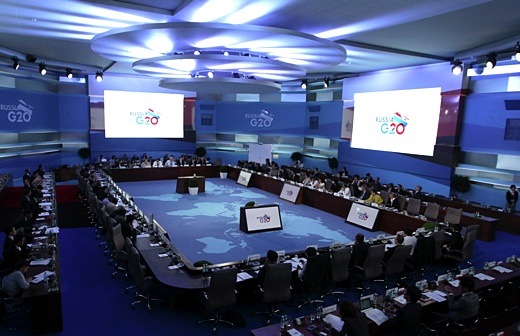
Image above: Earth to spaceship G-20 "Wake up you fools!". From (http://www.g20.org/photo/20130605/781388962.html).

The G20 Summit, to be held in St. Petersburg on September 5-6, 2013, will be the main G20 event of 2013. The meetings will be between the political and financial leaders of the G20 nations that include Argentina, Australia, Brazil,  Canada, China, France, Germany, India, Indonesia, Italy,  Japan, Mexico, Russia, Saudi Arabia, South Africa, South Korea, Turkey, United Kingdom, United States and the European Union.

Looking over this list of nations one can see it includes the vast majority of the people of the world, as well the bulk of money, resources, energy, industrialization, technology and military hardware on this planet. According to Wikipedia:
 "Collectively, the G-20 economies account for approximately 80 percent of the gross world product (GWP), 80 percent of world trade, and two-thirds of the world population"
It is understood that the purpose of the G20 is world finance, but it has evolved into the most significant meeting of world leaders that regularly occurs. Obviously, they can talk about anything they think is important. So what is their publicly announced agenda for their upcoming meeting:
  1. Framework for strong, sustainable and balanced growth;
  2. Jobs and employment;
  3. International financial architecture reform;
  4. Strengthening financial regulation;
  5. Energy sustainability;
  6. Development for all;
  7. Enhancing multilateral trade;
  8. Fighting corruption.

We can only pray that this is a fake agenda, or even a joke, and that the real agenda will include some of the real problems facing life on this planet.

The Worst Nuclear Disaster in History
Chernobyl was bad, but it was one nuclear reactor and was dealt with quickly. Given the threat to life in the largest body of liquid water in the known universe, the number one item on my agenda would be a commitment by the G20 to fix Fukushima - whatever the cost.

That means immediately coordinating a worldwide effort to mitigate the ongoing disaster that has been created by TEPCO and the government of Japan by building six nuclear reactors on one site at the shore of the Pacific Ocean in a highly dangerous earthquake zone.

This effort may cost a few trillions of dollars. But that's nothing compared to what the central banks of the G20 have stolen from the world's people to keep afloat after their international Ponzi scheme collapsed in 2008. Think on the scale of building the pyramids Egypt, The Great Wall of China, or the US NASA Moon program - whatever it costs. It's not like the Pacific Ocean isn't stressed already. The ocean is dying.
  • The reefs are dying -  from acidification (from CO2 absorbion), global warming (CO2 and methane releases). 
  • The fish are dying - from over fishing (over 90% of megafauna are gone). 
  • The plastic gyres are killing - birds, sea creatures and interfering with the organic chemistry of the ocean. 
Now, to add insult to injury, Japanese nuclear plant is spewing 400 tons of highly radioactive water into the Pacific Ocean everyday. And that's the situation "under control".  As far back as August 2011 small amounts of cesium-137 and cesium-134 were detected in 15 tuna caught near San Diego. 

Moreover, since 2011 University California Berkeley School of Nuclear Engineers (UCBSNE) have been reporting on their website findings of cesium 134, 137, strontium-90 and more in topsoil, rain and groundwater, milk, and produce. Cal State Long Beach researchers have found iodine-131 in kelp beds along the California coast, as well.

Worst and Getting Worster
But these are only the current problems at Fukushima. Others abound.  Just remember that there are three reactors that have melted down and likely experienced the China Syndrome - that is. they have burned their way through the bottom of the reactor core, through the vessel around it, then the containment building and finally through its foundation they rest on.

Each reactor melted core is about a 150 tons of uranium, plutonium and zirconium in hot blob of what's called "corium".  No one knows, or has stated, what the location or condition of that corium is. Re-criticallity (chain reactions) and other bad things can happen.

The nuclear fuel rods in Reactor #4 sit in the structurally damaged concrete pool of water 80 feet above the ground. Those rods have more fissile material in them than reactor below could possibly hold. Since 2012 the wall of the pool has been bulging and the reactor building seems to be sinking into the earth.

If ground water entering the site were not able to escape into the ocean, or be diverted, it could liquify the earth under the foundation of the reactor and topple the fuel rods to the ground. Such an event could make the Fukushima Daiichi site uninhabitable.

A Plea to the G20
Convince the Japanese representatives to admit that the crisis at the Fukushima Daiichi site is out of their control and that it must be handled by the world at large. Have all G20 members commit what ever resources are necessary to mitigate the pressing dangers and long range dangers presented by this disaster. Get on this pronto.

It is not acceptable to twiddle your fingers and call for industrial growth and more jobs. Industry and manpower need to be put in service to saving the world from Fukushima.

And while w'ere at it!
Beyond item #1 on my agenda for the G20 would be:

#2) A carefully accelerated schedule for safely closing down all nuclear facilities in the world. This effort should include the decommissioning of all nuclear weapons and their components.
#3) The re-localization of food production with as little need  as possible for mechanization, petroleum products and chemicals.
#4) A rejection of centralized power grids and the adoption of small-scale off-grid alternative power sources with greatly reduced overall consumption.
#5) The abandonment of international corporations and capitalism as the means of operating the economies of the world to achieve jobs and growth (a.k.a. slavery and death).
 There's plenty more but we should start with a doable list. Let's get on this people.


 .

    Time Lag of Irreversible Change

    SUBHEAD: If we understand the brutality on life our lifestyle entails, we must fundamentally reject our own standards of living.

    By Joshua Headley on 7 August 2013 for Nature bats Last -
    (http://guymcpherson.com/2013/08/the-time-lag-of-irreversible-change/)


    Image above: Concept illustration for "Terminator 3: the Rise of The Machines" - where you can't tell the humans from the robots who want to destroy them. From (http://www.postercollective.com/2012/04/21/poster-of-the-day-2/).

    If you’ve been a sentient being for the last few months, you’ve probably been watching some of the most curious weather events happening throughout the world.

    Of particular concern for many scientists has been the Arctic sea ice’s melt, which dropped to its lowest level on record last summer. In the first few months of this year, large cracks were witnessed in the sea ice, indicating a great possibility that it has entered a death spiral and will disappear completely in the summer months within the next two years.

    The rapid melt (and eventual disappearance) of the ice is having drastic affects on the jet stream in the northern hemisphere, creating powerful storms and extreme weather events, largely outside the comprehension of many scientists.

    Jeff Masters, meteorology director at the private service Weather Underground states:
    “I’ve been doing meteorology for 30 years and the jet stream the last three years has done stuff I’ve never seen. … The fact that the jet stream is unusual could be an indicator of something. I’m not saying we know what it is.”
    For example, in May there were wildfires caused by excessive heat in California while at the same time there was more than a foot of snow in Minnesota. Spring in Colorado started with early wildfires and was subsequently followed by massive flooding. Massive floods have been devastating much of the northern hemisphere this spring, including Canada, the United States, Europe, India, and Russia.

    Last month, Alaska saw its hottest days on record where the town of McGrath, Alaska hit 94 F degrees while just a few weeks earlier the local temperature was 15 F degrees. There have also been extreme heat waves throughout the southwest United States, some temperatures above 130 F degrees, also resulting in wildfires that spread to more than 6,000 acres in two days and killed 19 firefighters in Arizona.

    Today, the concentration of carbon dioxide in the atmosphere is at 400 ppm – a level not seen on this planet since the Pliocene epoch, nearly 3 to 5 million years ago when the average global temperature of the planet was 2-3 C degrees warmer than today. The International Energy Agency has recently warned that the planet is on track for 3.6 to 5.3 C degrees warming.

    This is catastrophic – most scientists have recognized any significant rise above 1 C will usher in irreversible changes that will threaten nearly all biological life on this planet.

    Carbon dioxide has an approximate thirty-year time lag between its release into the atmosphere and its corresponding affect on average global temperature. Even if we stop all emissions today – keeping it at 400 ppm – we still have nearly thirty years of warming and climatic changes to undergo.

    And right now, nothing that we are currently observing matches up with any of the models that we have – a stark acknowledgment that this historical moment we find ourselves in exists largely beyond our ability to comprehend it let alone predict its movement.

    We are in uncharted territory – we are facing challenges never before experienced in the history of the human species. This presents a grave problem: if the best science we have today cannot accurately offer any model predictions for the path that we are currently on, how can we effectively plan for the future?

    The honest truth: we can’t. We cannot effectively plan for a future that is beyond all known human experience.

    The best that we can do now is stop exacerbating the problem – stop contributing to the rapidly accelerating decline and destruction of the Earth’s biosphere and ecosystems.

    Quite literally: we have to completely dismantle the industrial economy, we have to do it soon, and really, we should have done it yesterday.

    But even still, grinding industrial civilization to a complete halt today is only guaranteed to mitigate the pace at which we’re running – it is not yet clear that it will ultimately alter our direction. We have, at minimum, thirty more years of incomprehensible climate disruptions and changes to undergo no matter what happens today or tomorrow. Our only chance to still have a thriving and living planet following the coming decades is by making a complete, radical and rapid shift from the industrial economy.

    The logic of industrial civilization and capitalism is immediacy – grow as quickly as possible, generate maximum profits in the shortest time, and deal with consequences and crises later (if at all). Long-term planning and strategizing is antithetical to, and bears no consequence on, the drive for capital accumulation, expansion, and domination.

    This process, within the last 30-40 years alone, has resulted in such an expansive project of urbanization around the world that capitalism has triumphed over (read: conquered, murdered, and erased) all other ways of existing on this planet, human and non-human. We now live in a truly global industrial civilization – a monoculture of unprecedented scope; a totality of being and of tyranny.

    To oppose this project of endless growth and centralization of control, we need to enter into the logic of a truly oppositional culture – a fundamental and radical break from of our entire material reality. This entails a complete negation of our current standard of living and entire way of being in the world. Anything short of this negation will only exacerbate the problem.

    Acknowledging this does not mean that the task at hand is easy or that a majority of people will accept it as truth. In fact, even amidst collapse, most people will not resist the status quo and are likely to fight to the death to protect it.

    As Derrick Jensen has stated:
    “If your experience is that your water comes from the tap and that your food comes from the grocery store then you are going to defend to the death the system that brings those to you because your life depends on that; if your experience is that your water comes from a river and that your food comes from a land base then you will defend those to the death because your life depends on them. So part of the problem is that we have become so dependent upon this system that is killing and exploiting us, it has become almost impossible for us to imagine living outside of it and it’s very difficult physically for us to live outside of it.”
    But this also does not mean that the task at hand is any less true. It does mean, however, that if we wish to build our struggle for a truly just and sustainable future we must first do away with our delusions, re-focus our strategies to the most effective, and be radically uncompromising in our vision.

    On June 25th, Barack Obama — a president whom, despite his rhetoric of care, spent all of the last five years of his presidency completely ignoring climate change — finally addressed the nation in a speech that was supposed to signal a “serious plan forward.”

    Many “environmental” groups along with the mainstream media heralded the speech as being progressive and a great commitment to the crisis at hand. In reality, much of the speech was full of nothing more than the doublespeak typical of his presidential legacy.

    In a move that many considered to be a “big victory,” the president merely stated that he will ask the State Department not to approve the final construction of the Keystone XL pipeline unless it can first determine that it “will not lead to a net increase in greenhouse gas emissions.”

    This is certainly a sly trick designed to pacify a building resistance, an attempt to re-frame the debate and make it appear as if our best interests are dutifully being considered. However, to even pretend that it is at all possible that this pipeline would not lead to a net increase in greenhouse gas emissions is delusional.

    While the fight against the KXL has been a fight against a pipeline, it is predominantly being waged as a fight against tar sands oil production entirely. It is incredibly easy to argue that one specific pipeline will not result in significant GHG emissions if we isolate it from the very process that demands its existence in the first place.

    It is the extraction process itself that is the net greenhouse gas emitter destroying the planet – not merely the nodes at which its product is transported and consumed. Although this infrastructure should be equally opposed and dismantled, stopping one pipeline being built will only mean that others will replace it or other means will be developed to export its goods.

    We should settle for nothing less than a complete end to all extraction processes. It is not even close to a victory until that happens.

    Despite his attempt to appease environmentalists with this speech, there were some activist groups that were rightfully confused and enraged with his hypocritical stance. In a speech meant to signal commitment to slow climate change, President Obama continued to praise and support the fossil fuel industry and hydraulic fracturing for natural gas.

    Chris Williams, author of Ecology and Socialism, examines the rhetoric and reality of this latest speech, providing a great reminder of whose interests this president actually serves – those of the ruling class. He also outlines some new ideas for Obama’s consideration:
    • If you’re serious about stopping global warming, you need to veto KXL.

    • If you’re serious about moving away from dirty energy, then there needs to be a strict timeline established for the complete phasing-out of all coal and nuclear plants by 2030 and their replacement, not with natural gas or nuclear, but with wind and solar power.

    • If you’re really serious about carbon pollution, you can’t with any honesty discuss solutions without making massive cuts in military spending. The Department of Defense is responsible for 80 percent of the U.S. government’s energy consumption, and the U.S. military is by far the biggest polluter on the planet. Radical reductions in spending on the Pentagon are essential for human survival.

    • You made no mention of the need for enormous investment in and expansion of public transit. If you’re serious about addressing climate change and making our cities more livable and the air more breathable, you will take the money you just saved by cutting military expenditures and apply it to the construction of new rail, light rail, tram and bus service, between and within cities, obviating the need for cars.”
    These ideas are some of the more prevalent solutions that are often tossed around in environmental and social justice circles. While the intention may be sincere, simply advocating for a shift from “dirty energy” (coal, oil, nuclear) to “clean energy” (solar, wind, tidal, geothermal, etc.) does a great disservice for generating informed decision-making at such a critical historical moment.

    While these energies have many flaws, one of the greatest problems with their proponents is that they do not fundamentally put into question our standard of living or way of being in the world.

    An often-cited study by these proponents is the work of Mark Z. Jacobson who, mere weeks after Hurricane Sandy devastated the Northeast U.S., presented the economic argument for investing in renewable energies. His plan calls for a complete shift off fossil fuels and towards a rapid investment in wind and solar power for the entire state of New York by the year 2030.

    Not only was this study completed on the premise that our culture does not dramatically change its standard of living, the study fails to even acknowledge the resources required to build these new energy infrastructures.

    These energy sources are not free from fossil fuels and are dependent on rare earth metals and minerals; this sort of rapid technological and social shift will require massive extractive processes – a price we simply cannot afford if we wish to stop the destruction of this planet.

    If we wish to create a “sustainable” future that is also just, a question that should be immediately asked is: Where are these resources coming from? From whose land will we steal from in order to build this renewable-energy utopia? Despite the fact that New York State ranks in or near the top third of U.S. mineral production, none of the crucial metals and minerals currently used for the development of solar panels and wind turbines can be found here – we will have to steal these resources from some other land base.

    Even more problematic, Jacobson’s study does not entirely take into consideration (to the extent that it is possible) the severe climatic disruptions we are unavoidably set to experience in the coming decades. The disappearance of the Arctic sea ice in the next few years will result in rising sea levels that could displace more than 400 million people globally. Is it worth the investment for an entirely new energy infrastructure that may ultimately be irrelevant by the time it can be actualized?

    To continue to advocate for these “solutions,” is to continue living in the delusion that we can have our current standard of living and have a planet too. As Robert Jensen articulates in his article, Get Apocalyptic: Why Radical is the New Normal:
    “Toughest to dislodge may be the central illusion of the industrial world’s extractive economy: that we can maintain indefinitely a large-scale human presence on the earth at something like current First-World levels of consumption. 
    The task for those with critical sensibilities is not just to resist oppressive social norms and illegitimate authority, but to speak a simple truth that almost no one wants to acknowledge: The high-energy/high-technology life of affluent societies is a dead end. 
    We can’t predict with precision how resource competition and ecological degradation will play out in the coming decades, but it is ecocidal to treat the planet as nothing more than a mine from which we extract and a landfill into which we dump.

    We cannot know for sure what time the party will end, but the party’s over.”
    Our primary goal and vision for the world is a living planet. Nothing else matters. The biggest challenge to that goal is the industrial economy and it’s a moving target. If we have any chance at stopping it we cannot have a strategy that is focused solely on the injustices of today. Our actions and strategies should be based on where we’re heading – and where we’re heading is nothing short of near-term extinction.

    This is not hyperbole or metaphor. 200 species went extinct today and another 200 species will go extinct tomorrow. 400,000 people die every year from climate-related deaths. A war has been declared against the living the world and we ought to start articulating which side we’re on, and we ought to seriously start fighting back.

    I’m reminded of a recent quote from MEND (Movement for the Emancipation of the Niger Delta), a militant group successful at halting more than 28% of Nigeria’s oil output between 2006 and 2009, which articulates the situation succinctly:
    “From today, every tanker vehicle we find distributing petroleum products including propane gas has become a legitimate target in our war against injustice, corruption, despotism and oppression.”
    This is the kind of vigor we need to be generating in our own movement. Never before have the lines between those who seek to destroy this planet and those who seek a radically different future, been so clearly drawn and defined. Yet, there is a degree of hesitancy within the majority of activist circles in the West that is painstakingly paralyzing our movements from reaching its goals.

    If we stand in solidarity with all the human and non-human lives that have been lost, or are routinely brutalized to this way of life, we must fundamentally reject our own standards of living and ideals about how to enter into relationship with each other and with the land. Knowing that we have now entered a historical moment of incomprehensible climatic disruptions and changes for the foreseeable future, we’d be better to do away with our delusions sooner rather than later.
    • Joshua Headley is a writer and activist living in New York City. He contributes to Deep Green Resistance News Service and can be reached at joshuaduane@riseup.net.

    .

    Hanabusa and Schatz Pipedream

    SOURCE: Taylor Ken (taylork021@hawaii.rr.com)
    SUBHEAD: : It's to have President Obama create the Akaka Tribe without Congressional approval?

    By Andrew Walden on 29 July 2013 for Hawaii Free Press -
    (http://www.hawaiifreepress.com/ArticlesMain/tabid/56/ID/10244/Hanabusa-Obama-Considers-Creating-Akaka-Tribe-Without-Congressional-Approval.aspx)


    Image above: Brian Schatz and Coleen Hanabusa playing Indians.Mashup by Juan Wilson. Click to enlarge.

    At first glance, the Akaka Tribe has never seemed deader. Seven months into the 113th Congress, no bill advancing the Akaka Gang’s scheme to invent a fake Indian Tribe and use it to seize control of the Native Hawaiian patrimony has been introduced into either house. Few Native Hawaiians are signing up for Kana’ioluwalu, the latest incarnation of the Akaka Tribal roll, a disinterest for which the Office of Hawaiian Affairs blames, “the lack of imminent threats to Native Hawaiian programs, such as lawsuits, which creates a lesser sense of urgency.”

    But behind the scenes there is a frenzy of activity. Scrambling for the votes and contributions of well-heeled Office of Hawaiian Affairs (OHA) cronies, Senate Democratic Primary opponents Rep. Colleen Hanabusa and Sen. Brian Schatz are peddling the idea that President Obama will create the Akaka Tribe without Congressional approval.

    (Parallel to this is a push by Robin Danner and the Coalition for Native Hawaiian Advancement for US Department of Interior oversight of the State Department of Hawaiian Home Lands—a separate effort which also encompasses a longshot attempt to create a fake Indian tribe in Hawaii, but that is a subject for another article.)

    Coming out of a July 23 meeting between Obama and 22 members of the Congressional Asian Pacific American Caucus (CAPAC), Hanabusa stated:
    “As a Keiki O Ka Aina, President Obama understands the importance of Native Hawaiian recognition and what it means to our host culture. We know he will seriously consider our request to use his executive branch authority to achieve this elusive goal. Federal recognition of the Native Hawaiians right to self-governance is long overdue.”
    But Schatz spoke of less specific ‘federal action’ rather than ‘executive branch action’ saying:
    “During the meeting, President Obama showed his clear commitment to prioritizing key issues that are important to Hawai‘i and the Asian American and Pacific Islander community, including … federal action to ensure that Native Hawaiians have a government to government relationship….”
    At issue is 25 CFR Part 83, the US Department of the Interior (DoI) “Procedures For Establishing That An American Indian Group Exists As An Indian Tribe.”

    Since 1978 this administrative procedure has existed alongside Congress’ right to recognize Indian tribes, but the Akaka Tribe is excluded because application is limited to geographic locations where real Indian tribes might actually exist*, specifically the “Continental United States, mean(ing) the contiguous 48 states and Alaska.”

    The DoI Office of Federal Acknowledgement is currently considering revisions to the Part 83 regulations with public comments open until August 16.

    At a March 19 hearing of the House Subcommittee on Indian and Alaskan Native Affairs, Department of the Interior Assistant Secretary for Indian Affairs Kevin K. Washburn responded to questions from Hanabusa and Samoa Rep Eni Faleomavaega: "Our regs now leave out Native Hawaiians. We are not able to consider Native Hawaiians under our current regs.” According to Washburn’s written testimony, in which he did not mention Hawaii, the Part 83 process focuses on rectifying administrative errors. Said Washburn:
    “The Part 83 Process is used by the Department to acknowledge Indian tribes that are not currently acknowledged as Indian tribes by the Department. The Department may also reaffirm a nation-to-nation relationship with tribes by rectifying previous administrative errors by the Bureau to omit a tribe from the original Federal Register list of entities recognized and eligible to receive services from the Bureau of Indian Affairs or by resolving litigation with tribes that were erroneously terminated.”
    After Washburn’s April 24 testimony before the Senate Indian Affairs Committee, in which he mentioned neither Part 83 nor Hawaii, Schatz released a statement emphasizing his desire to pass the Akaka Bill, making no mention of “executive branch authority”, and thanking Washburn for his support.

    Washburn then authored the ‘Preliminary Discussion Draft’ of potential revisions to Part 83 which retains the limitation to “the contiguous 48 states and Alaska.”

    It is likely that any effort to administratively invent the Akaka Tribe via a procedure intended to rectify clerical errors would provoke a backlash from Congress and from the real Indian tribes. The final version of the Akaka Bill introduced by Sen Dan Akaka in September, 2012, broke a decades-long deal with the real Indian tribes by grabbing for Indian program money and setting itself up to buy mainland properties, take them into trust, and establish Indian casinos.

    LINK:
    ‘Preliminary Discussion Draft’

    2012:
    Akaka Tribe: We Can Kick Out Anybody Anytime for Any Reason

    *The Hawaiian ethnicity was never tribal in nature. Hawaiian national identity emerged only with the creation of the Hawaiian Kingdom under Kamehameha I. The Hawaiian Kingdom was a national state originally organized along feudal lines. ‘Hawaiians’ were never a tribe. The Marquesan tribal groups which originally inhabited what we now call the Hawaiian Islands were subjugated, hundreds of years before the first Europeans arrived, by Tahitian invaders who set themselves up as feudal lords (alii) with a separate bloodline ruling over a subject peasantry (makaaina).


    CAPAC Members Meet with President Obama

    News Release from CAPAC Jul 23, 2013
    Washington, DC – Today, 22 Members of the Congressional Asian Pacific American Caucus (CAPAC) met with President Barack Obama at the White House. The meeting covered immigration reform, increasing diversity among presidential appointments, improving language access in enrollment for the Affordable Care Act, and pressing issues impacting Native Hawaiians and the Pacific Island territories. Members of the Congressional Asian Pacific American Caucus (CAPAC) released the following statements following the meeting….

    Senator Mazie K. Hirono (HI): “I was pleased to have this opportunity to speak with President Obama about critical issues that are facing Hawaii, our country and Asian American and Pacific Islander (AAPI) community. During our group’s discussion, I asked the President to support Native Hawaiians, who are often overlooked when we talk about the AAPI community. The President committed to continue working closely with me and the rest of our Hawaii delegation on issues important to Native Hawaiians. He also committed to continue pushing for immigration reform – a mobilizing issue for the AAPI community.”

    Senator Brian Schatz (HI):
    “During the meeting, President Obama showed his clear commitment to prioritizing key issues 
    that are important to Hawai‘i and the Asian American and Pacific Islander community, including passing comprehensive immigration reform in the House, federal action to ensure that Native Hawaiians have a government to government relationship, and diversity in the President’s cabinet. Today’s meeting marked an important step in a partnership between the President and Congress when advancing measures that will benefit Hawai‘i. I will continue to work with my CAPAC colleagues and the delegation to ensure that the people of Hawai‘i are heard in Washington, D.C.”

    Congresswoman Tulsi Gabbard (HI-02): “In our meeting with President Obama today, I appreciated the opportunity to highlight the concerns of Native Hawaiians, and critical issues facing our diverse communities in Hawai‘i. The President has been a strong ally of Asian American and Pacific Islanders across the country, and I’m encouraged by the dialogue we had today about the need for passing immigration legislation that includes family reunification measures. I look forward to continuing to work with the President and my CAPAC colleagues on issues like comprehensive immigration reform, Native Hawaiian recognition, and the reauthorization of the Native Hawaiian Education Act.”

    Congresswoman Colleen Hanabusa (HI-01): “As a Keiki O Ka Aina, President Obama understands the importance of Native Hawaiian recognition and what it means to our host culture. We know he will seriously consider our request to use his executive branch authority to achieve this elusive goal. Federal recognition of the Native Hawaiians right to self-governance is long overdue. The Congress of the United States has created and continues to fund programs that assist Native Hawaiians with housing, healthcare, and education yet a government to government relationship does not exist. I am working with my colleagues to carry on the work of the many legislators, activists and concerned citizens who have fought long and hard to solidify the trust relationship with Native Hawaiians. I would like to say mahalo to the President for taking the time to meet with us today.”

    See also:
    The Rest of the Statements

    News Release: CAPAC Chair Statement on Meeting with President Obama


    .

    Selling your soul

    SUBHEAD: Drought-stricken New Mexico farmers drain their aquifer to sell water to oil companies for fracking.

    By Joe Romm on 5 August 2013 for Climate Progress -
    (http://thinkprogress.org/climate/2013/08/05/2395051/drought-new-mexico-farmers-drain-aquifer-fracking/)


    Image above: When it does rain it can be scary in Eddy County, New Mexico. Photo by Roger Hill. 4/28/09. From (http://www.senmwx.com/2012/05/supercell-thunderstorms-in-southeastern.html).

    The bad news is that the terrible drought in New Mexico has led some farmers to sell their water to the oil and gas industry. The worse news is that many of them are actually pumping the water out of the aquifer to do so.

    The worst news of all is that once the frackers get through tainting it with their witches’ brew of chemicals, that water often becomes unrecoverable — and then we have the possibility the used fracking water will end up contaminating even more of the groundwater.

    The Albuquerque Journal reports:
    With a scant agriculture water supply due to the prolonged drought, some farmers in Eddy County with supplemental wells are keeping bill collectors at bay by selling their water to the booming oil and gas industry.

    The industry needs the water for hydraulic fracturing, known as fracking, the drilling technique that has been used for decades to blast huge volumes of water, fine sands and chemicals into the ground to crack open valuable shale formations.
    You may wonder why farmers would sell water to frackers when some 95% of the state has been under severe drought conditions for the entire year. The short answer is it pays the bills. Here’s the longer answer:
    In recent months, more legal notices have been appearing in the Current-Argus informing the public that a water-right holder with a supplemental well has submitted an application to the state engineer’s office seeking to change the purpose of use from agriculture to commercial, or transferring the right from one location to another.

    “A lot of folks are doing that,” said New Mexico Interstate Stream Commissioner Jim Wilcox, an Otis resident and president of the Otis Mutual Domestic Water Association. “I can’t blame them. The Carlsbad Irrigation District doesn’t have the water the farmers need, and our farmers have to have some income coming in.”

    Wilcox said farmers in the Carlsbad Irrigation District can’t sell their primary water source they receive via the irrigation system because the CID is a government project. However, if they have a supplemental well, they can apply for a change of use permit that gives them the right to sell their well water for commercial use.

    Yes, the New Mexico Interstate Stream Commissioner can’t blame farmers for an ultimately self-destructive practice that can’t possibly be sustained. Perhaps he should read Thomas Jefferson’s “brilliant statement of intergenerational equity principles.”

    Wilcox fully understands what it means to pump an unreplenishing aquifer during a drought:
    “Farmers right now are having to pump their supplemental wells, and we understand that. It’s their livelihood,” he said. “But the supplemental wells are drawing from the same water table we provide potable water to our customers (from).”

    “The oil and gas industry is requiring a lot of water and our concern is the effect it’s having on our aquifer,” he added. “We are concerned about losing water that can’t be recovered. Hopefully, we will get through this drought and everyone will be intact.”

    While this drought will likely end at some point, climate change means droughts in the southwest are going to get longer, drier, and hotter. If we don’t reverse emissions trends very soon, the entire region is headed towards permanent Dust Bowl conditions.

    The oil and gas industry apparently doesn’t care whether it helps destroy the entire water supply of New Mexico — as long as the groundwater supply lasts until they finish fracking the state. You’d think state officials would see the value for farmers and residents in sustainable water consumption given where the climate is headed.

    Tragically, fracked water can be worse than unrecoverable. It can poison groundwater when reinjection wells fail, which they are prone to do as Propublica explained in their exposé in Scientific American, “Are Fracking Wastewater Wells Poisoning the Ground beneath Our Feet?” As that article pointed out:
    “In 10 to 100 years we are going to find out that most of our groundwater is polluted,” said Mario Salazar, an engineer who worked for 25 years as a technical expert with the EPA’s underground injection program in Washington. “A lot of people are going to get sick, and a lot of people may die.”
    The Albuquerque Journal quotes one local man, Jim Davis:
    “In some areas, we are over-appropriating. We are in a drought and the water table has dropped drastically and there is no recharge,” he said. “There are some people who have legal water rights and they are over-pumping. The public doesn’t know about it. As private individuals, we have to raise Cain about it.

    … “Black River is at its lowest level ever. It’s lower than it was in the 1950s when we had a long drought. I make my living from selling water, but at the same time, I think it is important to protect our precious water supply.”
    Davis has been “selling water commercially from his wells in Black River for about seven years”! But now things have gone too far even for him.

    After Cain murdered Abel, God asked him where his brother was. Cain famously replied, “Am I my brother’s keeper?” As Answers.com puts it, “Cain’s words have come to symbolize people’s unwillingness to accept responsibility for the welfare of their fellows — their ‘brothers’ in the extended sense of the term. The tradition of Judaism and Christianity is that people do have this responsibility.” Seriously.

    [IB Puublisher's note: I own 10 acres in Eddy County, New Mexico. My grandparents bought two lots there back in 1956. They had spent some time their 35 years earlier before retiring to western New York. I think they half expected to build a cabin out west. Once there was speculation that the area would be developed into suburbs. That didn't happen. Mostly, the area around the property is in the clutches of oil companies with wells, brine pits... and now access to water for fracking somewhere. I've never visited the property and have been paying property taxes on the land for the last 20 years. About five years ago tried to contact a real estate agent about selling it. I couldn't even get a call back. After reviewing the local scene I found I'd have a hard time getting a thousand-dollars an acre for the land. That is until... an oil company contacted me and offered me $1,200 an acre to lease the oil and mineral rights for 5 years. What could go wrong? I took the deal. I now realize they may have been more interested in the water than the oil. Mea culpa.]
    .