Fukushima Leak goes Unplugged

SUBHEAD: So on Sunday they went farther up the system and injected sawdust, three garbage bags of shredded newspaper and a polymer.  

By Hiroko Tabuchi & Ken Belson on 3 April 2011 for New York Times - 
(http://www.nytimes.com/2011/04/04/world/asia/04japan.html?_r=1)

 
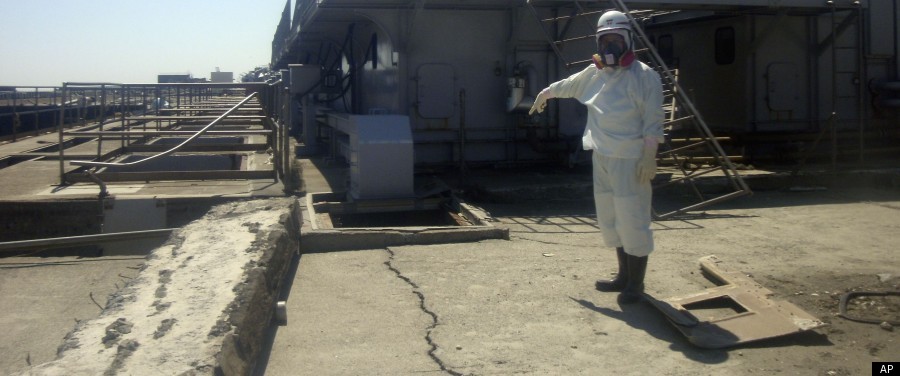
Image above: Tepco worker at Reactor #2 points to pit and crack where 7 tons an hour of highly radioactive water are leaking into pacific Ocean. From (http://i.huffpost.com/gen/262928/thumbs/r-JAPAN-NUCLEAR-CRISIS-huge.jpg).

Workers’ desperate struggle to plug a gush of highly contaminated water from the Fukushima Daiichi nuclear power station, using sawdust, shredded newspaper and an absorbent powder, appeared to be failing early Monday as the radiation threat from the crippled plant continued to spread.

Water with high amounts of radioactive iodine has been spewing directly into the Pacific Ocean from a large crack discovered Saturday in a six-foot-deep pit at the coastal plant north of Tokyo. The pit is next to the seawater intake pipes at the No. 2 reactor.

After an unsuccessful attempt to flood the pit with concrete to stop the leak, workers on Sunday turned to trying to plug the apparent source of the water — an underground shaft thought to lead to the damaged reactor building — with more than 120 pounds of sawdust, three garbage bags full of shredded newspaper and about nine pounds of a polymeric powder that officials said absorbed 50 times its volume of water.

[IB Editor's note: We've read in another article that the "polymeric powder" i question is a sister ingredient to the one used in baby diapers to absorb bodily fluids. You know, the blue glowing goop they stain the hygiene products with on TV. Yay! Pampers saves the Pacific!]
 
Although the stopgap measure did not appear to be succeeding, workers would keep trying to stem the leak, said Hidehiko Nishiyama, deputy director general of the Nuclear and Industrial Safety Agency.

Early Monday, workers injected a dye into a separate tunnel where contaminated water had been discovered, to determine whether that was the source of the water in the pit, said Tokyo Electric Power Company, the plant’s operator. Workers are also expected to continue efforts Monday to stop the leakage from the pit into the ocean.

Experts estimate that about seven tons an hour of radioactive water is escaping the pit. Safety officials have said that the water, which appears to be coming from the damaged No. 2 reactor, contains one million becquerels per liter of iodine 131, or about 10,000 times the levels normally found in water at a nuclear plant.

“There is still a steady stream of water from the pit,” Mr. Nishiyama said, but workers would continue to “observe and evaluate” the situation overnight.

The leak underscores the dangerous side effects of the strategy to cool the plant’s reactors and spent fuel storage pools by pumping them with hundreds of tons of water. While much of that water evaporates, a significant portion also turns into dangerous runoff that has been discovered in various parts of the plant, endangering workers at the plant and hindering repair efforts. On March 24, three workers were injured when they stepped into a pool of radioactive water in one of the plant’s turbine buildings.

In recent days, workers have tried to clear the contaminated pools, but have struggled to find places to store the water. Meanwhile, higher-than-normal levels of radiation have been detected in waters near the plant, raising fears of damage to sea life.

Tokyo Electric has said it has little choice but to pump more water into the reactors at the moment, since the normal cooling systems at the plant are inoperable and more radioactive material would be released if the reactors were allowed to melt down fully or if the rods caught fire.

Still, some experts expressed bewilderment at what they called an 11th-hour bid to plug the leak.
“I’ve never heard of anything like it at a nuclear power plant,” said Itsuro Kimura, emeritus professor at Kyoto University and director of the Japan-based Institute of Nuclear Technology.

What is really needed, he said, is for the cooling systems to come back online at the plant’s six reactors. Those cooling systems work by circulating water around the nuclear fuel, producing little runoff.
“That is the best way to stop the leakage of radioactive water,” Mr. Kimura said. “But for now, they have to stop the water leaking the best they can.”

Tokyo Electric has come under growing scrutiny for its handling of the nuclear crisis set off by the March 11 earthquake and tsunami that hit Japan. In recent days, reports surfaced that the company would be taken over by the government. Tokyo Electric reported that a protesters’ sound truck, presumably sent to heckle the company, was blocked from entering the Fukushima Daiichi plant on Thursday.

There are also frequent protests at the company’s headquarters in the Uchisaiwai-cho neighborhood of central Tokyo. On Sunday, several hundred antinuclear protesters assembled in front of Tokyo Electric’s offices, then marched to Kasumigaseki to protest in front of the offices of Japan’s nuclear regulators.

The protesters shouted such slogans as, “Tokyo Electric, get out of nuclear energy” and “Compensate the victims.” Others called for the company and government to apologize. Some carried placards that read, “Even if we don’t have nuclear power, we’ll still have electricity.”

“The Japanese people don’t protest usually, but this time, we have to show that we can call for change,” said Masanobu Takeshi, 40, with his wife and son.

Makoto Yanagida, 70, who has been protesting since March 12, said that on the first day, only about 10 people showed up. Sunday’s protest, the 10th, drew more than 300 people, he said. Mr. Yanagida said that he would continue protesting until nuclear plants were shut down.

Nuclear officials warned, however, that it could take months to bring the Fukushima Daiichi plant under control.

“It would take a few months until we finally get things under control and have a better idea about the future,” said Mr. Nishiyama of the nuclear safety agency. “We’ll face a crucial turning point within the next few months, but that is not the end.”

Earlier Sunday, Tokyo Electric said that two workers at the Fukushima Daiichi plant who were missing since the day of the earthquake and tsunami had been confirmed dead — the first of the company’s employees to be listed among the dead since the crisis began. Five employees of subsidiary companies also died at other Tokyo Electric facilities.

Tokyo Electric said the two workers at Fukushima Daiichi were found in the basement of the turbine building connected to the No. 4 reactor. The company found the bodies on Wednesday but did not release the details until the families had been notified.

The company said that the workers, Kazuhiro Kokubo, 24, and Yoshiki Terashima, 21, died on March 11, around 4 p.m., after the tsunami hit the plant.

“It pains me that these two young workers were trying to protect the power plant,” Tokyo Electric’s chairman, Tsunehisa Katsumata, said in a statement.

Of the other five deaths connected to the earthquake and tsunami, one man died when he was struck by a crane that had toppled at the Fukushima Daini nuclear power plant. Four other workers died at Tokyo Electric’s Hitachinaka coal-fired power plant when they fell from the chimneys they were working on.

Engineers pin hopes on Polymer  

By Ryan Nakashima & Mari Yamaguchi on 3 April 2011 for the AP -  
(http://hosted.ap.org/dynamic/stories/A/AS_JAPAN_EARTHQUAKE)

 
Image above: Pit where leak occurs partially filled with concrete that failed to block radioactive water escaping to ocean. From (http://www.allvoices.com/contributed-news/8666676-catastrophe-in-japan-21-workers-suffer-genetic-damage-from-radiation).
 
Engineers at Fukushima Dai Ichi Nuclear Plant pinned their hopes on chemicals, sawdust and shredded newspaper to stop highly radioactive water pouring into the ocean from Japan's tsunami-ravaged reactors Sunday as officials said it will take several months to bring the crisis under control, the first time they have provided a timetable.

Concrete already failed to stop the tainted water spewing from a crack in a maintenance pit, and the new mixture did not appear to be working either, but engineers said they were not abandoning it.
The Fukushima Da-ichi plant has been leaking radioactivity since the March 11 tsunami carved a path of destruction along Japan's northeastern coast, killing as many as 25,000 people and knocking out key cooling systems that kept it from overheating. People living within 12 miles (20 kilometers) of the plant have been forced to abandon their homes.

The government said Sunday it will be several months before the radiation stops and permanent cooling systems are restored. Even after that happens, there will be years of work ahead to clean up the area around the complex and figure out what to do with it.

"It would take a few months until we finally get things under control and have a better idea about the future," said Nuclear and Industrial Safety Agency spokesman Hidehiko Nishiyama. "We'll face a crucial turning point within the next few months, but that is not the end."

His agency said the timetable is based on the first step, pumping radioactive water into tanks, being completed quickly and the second, restoring cooling systems, being done within a matter of weeks or months.

Every day brings some new problem at the plant, where workers have often been forced to retreat from repair efforts because of high radiation levels. On Sunday, plant operator Tokyo Electric Power Co. announced it had found the bodies of two workers missing since the tsunami.

Radiation, debris and explosions kept workers from finding them until Wednesday, and then the announcement was delayed several days out of respect for their families.

TEPCO officials said they believed the workers ran down to a basement to check equipment after the magnitude-9.0 earthquake that preceded the tsunami. They were there when the massive wave swept over the plant.

"It pains us to have lost these two young workers who were trying to protect the power plant amid the earthquake and tsunami," TEPCO Chairman Tsunehisa Katsumata said in a statement.

On Saturday, workers discovered an 8-inch (20-centimeter) crack in a maintenance pit at the plant and said they believe water from it may be the source of some of the high levels of radioactive iodine that have been found in the ocean for more than a week.

This is the first time they have found radioactive water leaking directly into the sea. A picture released by TEPCO shows water shooting some distance away from a wall and splashing into the ocean, though the amount is not clear. No other cracks have been found.

The radioactive water dissipates quickly in the ocean but could be dangerous to workers at the plant.
Engineers tried to seal the crack with concrete Saturday, but that effort failed.

So on Sunday they went farther up the system and injected sawdust, three garbage bags of shredded newspaper and a polymer - similar to one used to absorb liquid in diapers - that can expand to 50 times its normal size when combined with water.

The polymer mix in the passageway leading to the pit had not stopped the leak by Sunday night, but it also had not leaked out of the crack along with the water, so engineers were stirring it in an attempt to get it to expand. They expected to know by Monday morning if it would work.

Meanwhile, tens of thousands of people are still living in shelters, 200,000 households do not have water, and 170,000 do not have electricity.

Running water was just restored in the port city of Kesennuma on Saturday, and residents lined up Sunday to see a dentist who had flown in from the country's far north to offer his services. Many were elderly and complaining of problems with their dentures.

Overhead and throughout the coastal region, helicopters and planes roared by as U.S. and Japanese forces finished their all-out search for bodies.

The effort, which ended Sunday, is probably the final hope for retrieving the dead, though limited operations may continue. It has turned up nearly 50 bodies in the past two days.

In all, more than 12,000 deaths have been confirmed, and another 15,500 people are missing.


.

KIUC sells off Water Rights

SUBHEAD: In summary KIUC has asked a mainland company to seize the water rights and develop several hydroelectric projects on Kauai.  

By Ken Taylor on 1 April 2011 in Island Breath -
(http://islandbreath.blogspot.com/2011/04/kiuc-sells-off-water-rights.html)

  
Image above: Privitation of water rights cartoon by M. Wuerker.

 In an act of either ignorance or audacious contempt for water, culture, and recent State court decisions, the KIUC Board of Directors voted on Tuesday, March 29, to engage the mainland company, Free Flow Power, to secure water rights to develop several hydroelectric projects on Kauai. In fact, these water claims had already been submitted by the Free Flow Power, but the Board decision will make every electrical user on Kauai party to this action.

Note that three Board members, Carol Bain, Ben Sullivan, and Jan Tenbruggencate voted against this action.

This Board action initiates a proscriptive Federal process for developing these water projects. The FERC process, like all Federal processes, is procedural, not substantive. This means that all they must do is check all the boxes on their list. Meetings will be conducted by the mainland company, Free Flow Power, or their subcontractor.

You will be given your three minutes at the microphone. Your name and input will be dutifully recorded and filed. The substance of your testimony is not relevant. When all required public meetings are concluded and all "stakeholders" consulted, the project can go forward. According to KIUC, the FERC process was chosen because it is an "independent and powerful arbiter." This means that FERC, not the Coop members or our community, will make the decision.

If a FERC license is granted. It conveys the right of Federal eminent domain. The licensee has the full power of the Federal government to seize land necessary to development the hydro project and transmit the power.

Do not think that this Federal process will protect any Hawaiian rights. Section 106 of the National Historic Preservation Act (NHPA) requires federal agencies to take into account the effects that their federally funded activities and programs have on "significant historic properties. Thus, the FERC process under Section 106 will only "consider" the things that kupuna made. It will NOT consider, or protect, the rights of living or future Hawaiians.

Likewise, NAGPRA, the Native American Graves Protection and Repatriation Act, will provide some protection to iwi kupuna under the FERC process, but provides NO specific legal consideration to living or future Hawaiians. In summary, as KIUC coop members, you have asked, and will soon be paying for, a mainland company to seize the water rights and develop several hydroelectric projects on Kauai.

Furthermore, you have asked the Federal government to preside over this action and seize any lands that you need to accomplish your goal. As KIUC Coop members we should recognize that these predatory claims are inexcusably insensitive to the past injustices of water use in Hawaii. We should know that these claims are an egregious breach of the protocol for how we think of, and access, water in Hawaii.

We should know that this action will put the Coop in an unnecessary aggressive and possessive position that will lead to conflict and litigation. We urge all Coop members to contact KIUC staff and Board members and instruct them to cancel any ties with Free Flow Power, and tell them that you reject the FERC process. Tell them that you have respect and responsibility for our water resources and you do not need a Federal arbiter to determine our use.


KIUC 4463 Pahe'e Street, Suite 1 Lihu'e, HI 96766-2000 info@kiuc.coop Att: KIUC Board of Directors I am a KIUC Cooperative member.
I am instructing the KIUC Board of Directors to repeal the decision on Tuesday, March 29, to engage the mainland company, Free Flow Power, to secure water rights to develop several hydroelectric projects on Kauai on my behalf.
I do not want to be party to a FERC hydroelectric development process. I will not participate in such a process. I have respect and responsibility for our island’s water resources and I do not need a Federal arbiter to determine our use. Please respond to this request in writing. Thank you (your name)

[IB Editor's Note: For those who are not members, but customers of KIUC, we suggest you write a letter/email the board of director's with your concern. You cannot direct the board as members might, but your water rights will be affected by KIUC actions. As non-members you have an option that members don't: You can buy electricity from other power providers. It's something that gives you a bit of leverage.]
 
See also:
Ea O Ka Aina: KIUC 25 Years After the Crash 3/17/11
Ea O Ka Aina: Kauai Hydro Projects Power Up 1/18/11
Ea O Ka Aina: KIUC Wailua Dam Plans 1/17/11
Ea O Ka Aina: Westside Solar Farm 2011 1/3/10
Ea O Ka Aina: KIUC $75 million GenX Plant 8/1/09


.

GMO Cows Produce Human Milk

SUBHEAD: Scientists have created cattle genetically modified with human genes that produce "human" milk.  

By Richard Gray on 2 April 2011 for the The Telegraph -  
(http://www.telegraph.co.uk/earth/agriculture/geneticmodification/8423536/Genetically-modified-cows-produce-human-milk.html)


Image above: Clarabelle Cow with park visitor at Mickey's Toontown at Disneyland. From (http://www.flickr.com/photos/23879054@N00/264566822).

 Scientists have created genetically modified cattle that produce "human" milk in a bid to make cows' milk more nutritious. They have successfully introduced human genes into 300 dairy cows to produce milk with the same properties as human breast milk.

Human milk contains high quantities of key nutrients that can help to boost the immune system of babies and reduce the risk of infections.
The scientists behind the research believe milk from herds of genetically modified cows could provide an alternative to human breast milk and formula milk for babies, which is often criticised as being an inferior substitute.
They hope genetically modified dairy products from herds of similar cows could be sold in supermarkets. The research has the backing of a major biotechnology company.
The work is likely to inflame opposition to GM foods. Critics of the technology and animal welfare groups reacted angrily to the research, questioning the safety of milk from genetically modified animals and its effect on the cattle's health.

But Professor Ning Li, the scientist who led the research and director of the State Key Laboratories for AgroBiotechnology at the China Agricultural University insisted that the GM milk would be as safe to drink as milk from ordinary dairy cows. He said:
"The milk tastes stronger than normal milk. We aim to commercialize some research in this area in coming three years. For the “human-like milk”, 10 years or maybe more time will be required to finally pour this enhanced milk into the consumer’s cup.”
China is now leading the way in research on genetically modified food and the rules on the technology are more relaxed than those in place in Europe.

The researchers used cloning technology to introduce human genes into the DNA of Holstein dairy cows before the genetically modified embryos were implanted into surrogate cows.

Writing in the scientific peer-reviewed journal Public Library of Science One, the researchers said they were able to create cows that produced milk containing a human protein called lysozyme,
Lysozyme is an antimicrobial protein naturally found in large quantities in human breast milk. It helps to protect infants from bacterial infections during their early days of life.

They created cows that produce another protein from human milk called lactoferrin, which helps to boost the numbers of immune cells in babies. A third human milk protein called alpha-lactalbumin was also produced by the cows.

The scientists also revealed at an exhibition at the China Agricultural University that they have boosted milk fat content by around 20 per cent and have also changed the levels of milk solids, making it closer to the composition of human milk as well as having the same immune-boosting properties.

Professor Li and his colleagues, who have been working with the Beijing GenProtein Biotechnology Company, said their work has shown it was possible to "humanise" cows milk.

In all, the scientists said they have produced a herd of around 300 cows that are able to produce human-like milk.

The transgenic animals are physically identical to ordinary cows.

Writing in the journal, Professor Li said: "Our study describes transgenic cattle whose milk offers the similar nutritional benefits as human milk.

"The modified bovine milk is a possible substitute for human milk. It fulfilled the conception of humanising the bovine milk."

Speaking to The Sunday Telegraph, he added the “human-like milk” would provide “much higher nutritional content”. He said they had managed to produce three generations of GM cows but for commercial production there would need to be large numbers of cows produced. He added:
“Human milk contains the ‘just right’ proportions of protein, carbohydrates, fats, minerals, and vitamins for an infant’s optimal growth and development.
As our daily food, the cow’s milk provided us the basic source of nutrition. But the digestion and absorption problems made it not the perfect food for human being."
The researchers also insist having antimicrobial proteins in the cows milk can also be good for the animals by helping to reduce infections of their udders.

Genetically modified food has become a highly controversial subject and currently they can only be sold in the UK and Europe if they have passed extensive safety testing.

The consumer response to GM food has also been highly negative, resulting in many supermarkets seeking to source products that are GM free.

Campaigners claim GM technology poses a threat to the environment as genes from modified plants can get into wild plant populations and weeds, while they also believe there are doubts about the safety of such foods.

Scientists insist genetically modified foods are unlikely to pose a threat to food safety and in the United States consumers have been eating genetically modified foods for more decades.

However, during two experiments by the Chinese researchers, which resulted in 42 transgenic calves being born, just 26 of the animals survived after ten died shortly after birth, most with gastrointestinal disease, and a further six died within six months of birth.

Researchers accept that the cloning technology used in genetic modification can affect the development and survival of cloned animals, although the reason why is not well understood.
A spokesman for the Royal Society for the Protection of Animals said the organisation was "extremely concerned" about how the GM cows had been produced. She said:
"Offspring of cloned animals often suffer health and welfare problems, so this would be a grave concern.
"Why do we need this milk – what is it giving us that we haven't already got."
Helen Wallace, director of biotechnology monitoring group GeneWatch UK, said: "We have major concerns about this research to genetically modify cows with human genes.
"There are major welfare issues with genetically modified animals as you get high numbers of still births.
There is a question about whether milk from these cows is going to be safe from humans and it is really hard to tell that unless you do large clinical trials like you would a drug, so there will be uncertainty about whether it could be harmful to some people.
Ethically there are issues about mass producing animals in this way."
Professor Keith Campbell, a biologist at the University of Nottingham works with transgenic animals, said:
"Genetically modified animals and plants are not going to be harmful unless you deliberately put in a gene that is going to be poisonous. Why would anyone do that in a food?
Genetically modified food, if done correctly, can provide huge benefit for consumers in terms of producing better products."


.

Corn Bubble Trouble

SUBHEAD: With the real estate scams a bit boxed in, Wall Street will be speculating on grains big time.  

By John Laumer on 2 April 2011 for TreeHugger -  
(http://www.treehugger.com/files/2011/04/corn-bubble-could-bring-troubles.php)

 
Image above: Jiffy Pop popcorn ad. This attempt to control exploding popcorn never worked very well. From (http://www.thedigitalreel.com/print/JiffyPop.jpg).
 
Corn is such a cultural cornerstone in America. Lend an ear to John Fahey playing "Give Me Corn Bread When I'm Hungry."

Remember Thoreau buying sacks of cracked corn for his Walden Pond stay? Tortillas and Katchina Dolls, and marbled beef, and corn root borers and Monsanto working together for the good of...
We may soon have to think about a corn price 'bubble' and what that means for American culture, during the rise, and after it "pops."


Farmers will do well this year if they are outside the areas of extended drought or floods. For the rest of us, especially the unemployed and underemployed, there may be increased difficulty.

Bloomberg reports (http://www.bloomberg.com/news/2011-03-31/corn-soybeans-surge-as-supplies-ebb-heightening-food-inflation-concerns.html) that:
Corn rose the most allowed by the Chicago Board of Trade as concerns mounted that food costs will climb after the latest U.S. government forecasts on supplies and acreage.
Reuters via Planet Ark reports (http://planetark.org/enviro-news/item/61649) that:
A government survey found corn plantings would be the second-largest since World War Two and soybeans the third highest ever. But traders focused on a companion report that showed unexpectedly small stockpiles, sending corn prices up by 5 percent. Wheat and soybeans surged more than 3 percent.
"We are not going to run out of (corn and soybeans) but we are in a very tight situation," said Joe Glauber, Agriculture Department chief economist, in an Insider interview.
Tractor makers are going do well for the first time in years. Farmland prices are crazy high. From the Illinois State Journal Register (http://www.sj-r.com/top-stories/x1777814067/Farmland-prices-continue-to-head-upwards):
Some of the highest prices were in the Springfield region, where sales of $6,500 to $9,000 an acre were reported for prime land.
Less prime farm land is going to be converted to housing developments while those land prices hold.
With corn reserves down and prices up, it is hard to imagine giving very much grain to nations experiencing famine.

American farmers will be pushing marginal land to the brink, trying to wring every dollar they can out of it while demand is up. There will be increased erosion on steep slopes and on plowed over grassed waterways. Water quality will suffer.

Irrigation water will be in high demand: farmers will be competing with cities for that water.
With the real estate scams a bit boxed in, Wall Street will be speculating on grains big time. How well do you think that will fly?


The corn bubble drives other trends that we all need to be thinking about. Chasing after top corn dollars, farmers will be tempted to get loans on new equipment and acreage (from smaller farms or badly managed ones) and seed and fuel and so on.

Bankers, seeing the large price that corn can bring (feeling the bubble along with all the others) will grant those loans, backed by Wall Street speculators who's firms are also buying futures contracts on grain based on "the bubble."

When the bubble bursts or if the farmer is hit by extreme weather (climate change I'm saying, yes), taxpayers are left to cover the loan defaults up and down the supply chain and the farmer is screwed.


.

Stick a fork in it - It's done!

SUBHEAD: “I don’t know if we can ever enter the No. 3 reactor building again,” Hikaru Kuroda, the company’s chief of nuclear facility management.

By Tsuyoshi Inajima, Yu-huay Sun & Wes Goodman on 2 April 2011 for Bloomberg - 
(http://www.bloomberg.com/news/2011-04-01/japan-s-government-says-stake-in-tepco-not-ruled-out-amid-radiation-leaks.html)


Image above: Aerial photo of wrecked Fukushima Reactor #3. From (http://pinktentacle.com/2011/04/high-resolution-photos-of-fukushima-daiichi/).


Tokyo Electric Power Company will try injecting a special polymer into a leaking pit at its stricken nuclear plant after a concrete plug failed to stop radioactive water from draining into the nearby sea.

Tokyo Electric will inject the polymer through a pipe connected to the pit, and is working to devise alternatives if that effort also should fail, the company said at a press conference that ended early today in Tokyo. The pit, used as storage for power cables near reactor No. 2, is cracked and leaking radioactive water.

Tokyo Electric, also known as Tepco, is preparing to infuse nitrogen into reactors to reduce the threat of a hydrogen explosion, and is connecting power cables to some cooling pumps as it tries to contain the spread of radiation and avert a meltdown 23 days after a crippling earthquake and tsunami.

A company executive said today he isn’t optimistic about the prospect of containing damage at the Fukushima Dai-Ichi nuclear power plant’s No. 3 reactor.

“I don’t know if we can ever enter the No. 3 reactor building again,” Hikaru Kuroda, the company’s chief of nuclear facility management, said at a press conference.

Workers must continue to cool the radioactive fuel rods with water to avert more damage, said John Price, a nuclear consultant and professor at Australia’s Monash University. “If it’s leaking or being exhausted as steam, then they have to keep putting it in.”

Radioactive Seawater
Radiation in contaminated seawater near the Fukushima Dai- Ichi plant was measured at more than 1,000 millisieverts an hour, Tepco said yesterday in a statement. Exposure to that level for an hour would trigger nausea, and four hours might lead to death within two months, according to the U.S. Environmental Protection Agency.

Japan’s Nuclear and Industrial Safety Agency yesterday ordered Tepco to increase its monitoring of seawater near the No. 2 reactor after the leaks led to a rise in radiation, agency Deputy Director Hidehiko Nishiyama said. Above-normal levels of radioactive iodine were detected in seawater 40 kilometers (25 miles) south of the plant, the agency said.

About 10 centimeters (4 inches) to 20 centimeters of radioactive water was found in the leaking pit, which is 1.2 meters by 1.9 meters across and 2 meters deep, and had a crack about 20 centimeters wide, Takashi Kurita, a company spokesman, told reporters at a briefing at Tepco’s Tokyo headquarters.

Plugging the Leak
Tokyo Electric tried to plug the crack by filling the pit with concrete yesterday, Junichi Matsumoto, another company official, said at a later press conference. Water in the pit was found to have 10,000 times the normal level of toxic iodine 131, he said.

The pit is at a different site from the trenches where the company found contaminated water earlier, Susumu Tsuzuki, a Tepco nuclear facility maintenance official, told reporters.

General Electric Co. (GE) Chief Executive Officer Jeff Immelt will meet officials from Tepco as the utility struggles to stabilize its damaged reactors, designed by the U.S. company.

Immelt is traveling to Japan “to meet with employees, partners and customers including Tepco,” as the utility is known, Deirdre Latour, a GE spokeswoman, said in an e-mail. Reactors at the crippled plant are based on a four-decade-old design from Fairfield, Connecticut-based GE.

Offering Help
“If they’re meeting now, it’s probably to discuss how to cool the reactors quickly, or how to scrap them, as Tepco doesn’t have the technology to do this,” said Jeffrey Bor, head of the economics department at the Chinese Culture University in Taipei and a former vice president of the International Association for Energy Economics. Taiwan operates six nuclear power reactors.
Tepco is still considering when and where it will inject nitrogen into the plant, said Kensuke Takeuchi, another spokesman.

The threat of a hydrogen explosion emerged when the gas was released from overheating reactors after the March 11 tsunami knocked out their cooling systems.

A 9-magnitude temblor and subsequent tsunami severed power and damaged reactors at the Fukushima complex about 220 kilometers (136 miles) north of Tokyo. Workers have been spraying water on the reactors to cool radioactive fuel rods in the worst nuclear accident since Chernobyl in 1986.

Radiation Slows Work
U.S. Energy Secretary Steven Chu estimated as much as 70 percent of the core in one of the six reactors may have been damaged. High radiation levels have impeded progress at the plant, Chu said April 1 during a breakfast sponsored by the Christian Science Monitor in Washington.

“Injecting nitrogen is done to cool reactors quickly,” said Chinese Culture University’s Bor. “Nitrogen should be considered an emergency measure and can’t be used for prolonged periods because you don’t have such large quantities of it.”

Tepco said it is connecting power cables to cooling systems on three of four damaged reactors. The utility will have to check pipes and equipment connected to the residual heat removers and those that circulate water through the reactors before the pumps can be turned on, Kobayashi said. Connecting power may not work because of potential damage caused by blasts that ripped through the plant in the days after the quake.

U.S. Military Barge
A second U.S. military barge has arrived at the port near the Fukushima power plant, while the first has started to pour fresh water into a tank at the complex to be used for cooling the reactors, Tepco said in a statement.

Katsumata, 71, took charge at Tepco last week when President Masataka Shimizu, 66, was hospitalized March 30 because of high blood pressure. Shimizu won’t be gone from his post “for long,” Katsumata said.

Japanese Prime Minister Naoto Kan yesterday made his second visit to the areas hit by the quake and tsunami, according to televised footage by national broadcaster NHK. Kan flew on a helicopter to Iwate prefecture in the northeast to meet with evacuees and then went to neighboring Fukushima prefecture to talk with Self-Defense Forces members and other workers at the Dai-Ichi nuclear plant.

The Japanese government may buy a stake in Tepco as the company tries to recover from the disaster and control the radiation leaks.


.

A Slower Ferry is Better

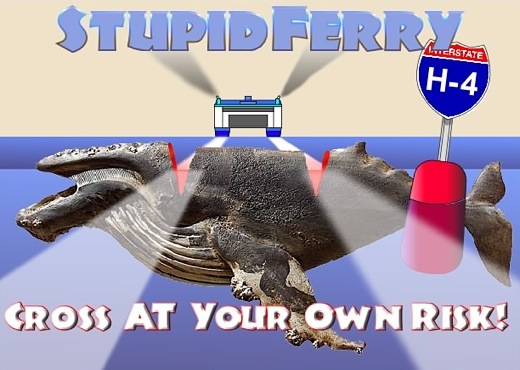
SOURCE: Dick Mayer (dickmayer@earthlink.net) SUBHEAD: The Hawaii state legislature has a Superferry bill that is flawed and misguided. By David Jung on 1 April 2011 in the Maui News - (http://www.mauinews.com/page/content.detail/id/547875/Viewpoint--Ferry-system-bill-lacks-key-information--is-misguided.html) Image above: Variation of an anti-SuperFerry poster titled "Whale Rider" created in 2007 by Juan Wilson. As general manager of Sea Link Of Hawaii, Hawaii's oldest ferry system, I feel obligated to share my 25 years of experience. Sea Link has operated since 1986 between Maui and Molokai at then-Gov. John Waihee's request to ease Molokai's unemployment problem. New ferry legislation (HB1239) has passed the state House and is poised to pass in the Senate. I am amazed and disturbed that fundamental economic and environmental questions have not been asked. While I do support a statewide ferry system, I fear this bill is misguided. What will the cost of operating a vessel and the ridership be? The legislation specifies that the service must have a 30-plus knot Superferry-type vessel; fuel consumption will be 1,500 to 2,000 gallons per hour (or 4,500 to 6,000 gallons per way from Oahu to Maui). Diesel is currently near $4 per gallon. This type of vessel is fuel inefficient and cannot compete with the 450 to 500 gallons used by a DC-9 on a 25-minute Oahu-to-Maui trip. A more conventional Alaskan or English Channel ferry will burn a fraction of that fuel. While the Superferry is a technological wonder, it is too expensive to maintain and operate on our interisland routes, even if the vessel itself were given free to the state. It will require huge subsidies, especially if the ridership is around the 150-passenger average that the Superferry was experiencing when it shut down. I have yet to see an operating budget based on 150 passengers per trip. How can we commit to a system with no idea what it will cost? The suggestion that the Superferry will be self-supporting is misleading. On the environmental side, we have seen the humpback whale population in Hawaii continue to increase. From 600 whales in the late '60s to 20,000 whales this year, it is a wonderful success story, but it has caused increases in whale/vessel collisions. While concerned about the whales, I am very concerned with the ferry and its passengers. Available research indicates high vessel speeds increase the likelihood of collisions. A 30-plus-knot ferry colliding with a 45-ton whale will likely injure passengers and cause structural damage to a lightweight, aluminum-hulled high-speed ferry, not to mention maiming or killing the whale. If a ferry is to operate during whale season, it will need to run at less than 20 knots. Sea Link's 17-knot ferry has had to slow down to avoid whales in the Kalohi Channel while the Superferry raced past at high speed. Propeller/rudder guards and the vessel-hull design should be such that effects of collisions are minimized. The Superferry twin torpedo hull is more likely to impale a humpback than a conventional hull that would ride over and drive down the animal with much less impact. The vessel needs to be specially designed for our special conditions. A large 20-knot state of the art conventional ferry should meet Hawaii's economic and environmental needs. They are currently operating successfully throughout northern Europe and Alaska. The concept of an upgraded statewide ferry system is a worthy goal. We do, however, have two successful PUC-regulated ferry companies between Maui, Molokai and Lanai. Both companies are self-supporting and pay PUC and employee taxes. Sea Link even has been subsidizing Molokai workers for over 20 years with a $25 round-trip fare at no cost to the state. Why the Legislature wants to include these routes with a state-run ferry and force out these two companies is beyond comprehension. House Bill 1239 is flawed. It will only lessen the chances of a successful operation being introduced. I implore our citizens and our legislators to take the time to carefully consider the issues. • David Jung is general manager of Sea Link of Hawaii. See also: Island Breath: Boycott the Superferry! 8/17/07 (with several links to prior articles) .

This Time it's Different

SUBHEAD: It's time to shop ’til we drop, time for the vaunted consumer to kick the engine of economic progress into overdrive. By Guy McPherson on 1 April 2011 for Nature Bats Last - (http://guymcpherson.com/2011/04/this-time-is-different/)

Image above: The house used in "Leave it to Beaver". From (http://gocalifornia.about.com/od/toppicturegallery/ig/Television-and-Movie-Houses/Leave-it-to-Beaver-House.htm).

Okay, I’m convinced. I’ve been wrong this entire time, but I’m willing to admit the error of my ways. It’s time to move on.

The industrial age will last forever, with no negative consequences for the living planet, including an infinite number of human occupants. If we find a use for those species that have inadvertently gone extinct, then we will develop technology to replace the species or bring them back from extinction. Or both.

When atmospheric carbon dioxide becomes problematic for humans, then appropriate technology will be developed. We will either extract carbon dioxide from the atmosphere or develop a way to cool Earth. Or both.

The news coming out of left-wing environmental organizations is ridiculous, and I’ll tolerate no more of it on this website. We solved the ozone problem at the South Pole and, when and if it becomes necessary, we’ll solve it at the North Pole. And enough about saving the whales: When was the last time you needed a whale, anyway?

When needed, we will find or create a comprehensive substitute for crude oil. Or both. Prices of our God-given resources will provide plenty of warning with respect to requisite changes in human behavior or technological developments. The free market has never failed, and it will never fail.

With respect to the number of humans on Earth, we have plenty of room and plenty of food. We could fit all the people on this planet into Texas — which is not a bad idea — and have plenty of space left over. We have food-distribution problems, but I’m confident the coming One World Government will be able to handle that problem

I used to refer to the U.S. as “Google Nation.” Like Google, it seemed had nearly unlimited information, but no wisdom. But now I know why we’re called the wise apes (sapiens = wise). We have all the knowledge and wisdom we’ll ever need to get us out of any predicament. There is no challenge we cannot conquer.

Now that the recession has ended and economic growth is fully under way, I’d like to take my proper place in the industrial economy. I will consider a position in government because government agencies exist to serve citizens. The Ministry of Truth would be a good fit for my skills. However, I would prefer a position in the private sector even more than I would value a position in government because real change occurs in the private sector. Sustainable growth of the industrial economy depends on research and development from corporations. In addition, the private sector must lead the way in economic growth and in setting the bar for ethical, humane behavior toward humans and other animals.

Anybody who is not earning a decent wage in this economy clearly is not trying hard enough. I have no pity for those losers, and I am certain they will not impede my quest for a high-paying job.

With every paycheck and bonus, I will invest heavily in the U.S. stock markets, using the tried-and-true strategy of “buy and hold.” I look forward to assisting in my own way to the ongoing progressive efforts of companies that contribute to our happiness and well-being, including such leading lights as Monsanto, BP, and DuPont.

My share of the rural property is for sale, effectively immediately. Please post a comment here if you’re interested, or send me a message. In the meantime, I hope to invest in a suburban house like the one shown above. In a few years, I’ll flip the house for a larger, shinier model.

Enough reading this drivel, everybody: It’s time to go back to work. It’s time to move some pixels around on our much-deserved imperial monitors, time to shop ’til we drop, time for the vaunted consumer to kick the engine of economic progress into overdrive. Otherwise, we’ll never get off this disgusting, depauperate planet. Our journey to other solar systems, other galaxies, and other universes is limited only by our imagination. Let’s aim for the stars!


Next-day updates (no foolin’):

Ellie — one of the goats we helped bring into the world last February — had kids of her own yesterday (two does and a buck). Tentative names, subject to suggestions from readers here: Joker, Fool, and Prank.

This 14-year-old clip from Good Will Hunting seems timely:

Video above: Mat Damon in NSA interview scene from "Good Will Hunting". From (http://www.youtube.com/watch?v=l8rQNdBmPek). .

Ready for the Sarcophagus

SUBHEAD: The developed industrial nations providing help to bury Fukushima Dai Ichi Nuclear Plant. By Staff on 31 April 2011 for MSNBC News - (http://www.msnbc.msn.com/id/42359020/ns/world_news-asiapacific) Image above: A truck carrying a cement pump that can extend nearly 200 feet is loaded onto an Antonov 124 plane in Stuttgart, Germany headed for Japan. From original article. Some of the world's largest cement pumps were en route to Japan's stricken nuclear plant on Thursday, initially to help douse areas with water but eventually for cement work — including the possibility of entombing the site as was done in Chernobyl.

Operated via remote control, one of the truck-mounted pumps was already at the Fukushima Dai-ichi site and being used to spray water. Four more will be flown in from Germany and the United States, according to the German-manufacturer Putzmeister. The biggest of the five has an arm that extends well over 200 feet.

"Initially, they will probably pump water," Putzmeister stated. "Later they will be used for any necessary concreting work."

A construction company in Augusta, Ga., was among those redirecting the pumps to Japan. Its owner said he believes building a concrete sarcophagus will follow.

"Our understanding is they are preparing to go to next phase and it will require a lot of concrete," Jerry Ashmore told the Augusta Chronicle.

He did not expect the pump to return. "It will be too hot to come back," Ashmore said.

A cargo plane is expected to fly the truck and pump from Atlanta next week at a cost of $1.4 million.

Putzmeister concrete pumps were among those used to seal in the Chernobyl reactor after it exploded in Ukraine in 1986, and sightings of the first truck at the Dai-ichi complex last week led to media speculation that Japan was planning to do the same in Fukushima.

Meanwhile, the Mainichi newspaper reported Friday that Japan's government plans to take control of Tokyo Electric Power Co., the operator of the stricken nuclear plant, by injecting public funds.

But the government is unlikely to take more than a 50 percent stake in the company, an unnamed government official was quoted by the daily as saying.

"If the stake goes over 50 percent, it will be nationalized. But that's not what we are considering," the official was quoted as saying.

Japanese trade minister Banri Kaieda said the government has yet to debate the possibility of nationalizing or taking control of TEPCO, Kyodo news agency reported.

The government may set up a team to discuss TEPCO-related compensation issues, Kyodo quoted Kaieda, whose ministry oversees nuclear safety, as saying the firm faces a huge potential compensation bill.

TEPCO could face compensation claims topping $130 billion if Japan's worst nuclear crisis dragged on, Bank of America-Merrill Lynch estimated this week, further fueling expectations Japan's government will step in to save Asia's largest utility.

Earlier Thursday, TEPCO said that short-lived radioactive contaminants 10,000 times above health standards were found in groundwater below the power plant.

Contaminated water has been pooling at the complex since it was damaged by the devastating earthquake and tsunami. Some was already known to have leaked into the sea and soil, and now groundwater is part of that mix.

The high levels of iodine-131 were measured in groundwater 45 feet beneath the reactor at Unit 1, Tokyo Electric Power spokesman Naoyuki Matsumo told reporters.

Matsumo emphasized that the local drinking water supply was not affected, which is the main way people might be harmed by iodine-131, which decays quickly, with half disappearing in eight days.

Contamination from the plant has also been seeping into the sea, though so far poses no threat to human health. Levels of radioactive iodine rose again Thursday in seawater some 360 yards from the shore to 4,385 times the legal limit.

Japan's Nuclear and Industrial Safety Agency said Thursday that consistently high levels found in seawater outside the plant may mean radiation is leaking out continuously.

"That is a possibility," Agency Deputy Director-General Hidehiko Nishiyama told a news conference when asked if there was continuous contamination of the sea.

He added that regulators and engineers did not know where the leaks may be.

On Wednesday, nuclear safety officials said seawater 300 yards outside the plant contained 3,355 times the legal limit of radioactivity.

Japanese officials are increasingly seeking outside help, including experts in eliminating contaminated water from French nuclear giant Areva. Experts and a robot from the U.S. have also arrived in Japan.

"The amount of water is enormous, and we need any wisdom available," nuclear safety agency spokesman Hidehiko Nishiyama said.

Areva CEO Anne Lauvergeon said she appreciated the enormity of the problem. Areva, a large supplier of nuclear fuel, sent staff with expertise in boiling water reactors and disposing of contaminated water and fuel rods.

"There is no precedent (for this kind of problem), and it's very complex," she said at a news conference in Tokyo.

Story: View images of quake, tsunami by date, location

The U.S. has also sent a remote-controlled robot, and officials from TEPCO said they expect to use it within a few days for evaluating areas with high radiation.

In other developments:

  • Efforts to recover the bodies of tsunami and quake victims from the evacuation zone have been slowed by debris, but also by fears of radiation. Police dressed in full radiation suits retrieved 19 corpses from the rubble Wednesday, a police official said. Each officer wears a radiation detector and must leave the area whenever an alarm goes off — a frequent occurrence that has often dragged the operation to a halt, the official said. "We want to recover bodies quickly, but also must ensure the safety of police officers against nuclear radiation," he said. Local media have estimated hundreds of bodies remain.
  • Hundreds of evacuees from the area around the stricken nuclear plant are being turned away by hospitals and shelters because of fear they may be carrying radiation, a British newspaper reported. The Daily Telegraph said some officials were demanding that evacuees provide certificates proving they have not been exposed to contamination.
  • French President Nicolas Sarkozy arrived in Japan Thursday, the first leader to visit since the devastating earthquake and tsunami sparked the worst nuclear crisis since Chernobyl in 1986.
  • Japan's health ministry ordered more tests after a cow slaughtered for beef was found to have radioactive contamination slightly higher than the legal limit. Officials stressed that the meat was not ever put on the market. Contamination has already been found in vegetables and raw milk near the plant, which has been leaking radiation since the March 11 earthquake and tsunami. The cesium was found in a cow slaughtered March 15 more than 40 miles from the plant. The cow had a total cesium level of 510 becquerels per kilogram. The limit is 500. A person could eat beef with that level of contamination for decades without getting sick.

As officials seek to bring an end to the nuclear crisis, hundreds of thousands in the northeast are still trying to put their lives back together following the earthquake and tsunami, which killed more than 11,000 people and left over 16,000 missing.

The government said damage is expected to cost $310 billion, making it the most costly natural disaster on record.

In the small coastal city of Miyako, many people still have no idea what happened to their relatives. Residents watched intently Thursday as a firefighter in a boat and two tractors cleared the bay of rubble, part of cleanup efforts under way along hundreds of miles of Japan's northeastern seaboard.

Giant tractors and dump trucks cleared roads and sorted debris into giant piles. Huge barges with onboard cranes docked offshore and scooped up wreckage in the shallow bays.

"I lost three grandchildren," says Isamu Aneishi, 69, who sat on a log for hours and watched the men search the bay.

A vacant lot outside Miyako has been turned into a car graveyard, with hundreds of wrecked vehicles from across the region deposited in neat rows. Some looked ready to be driven away, while others were little more than mangled heaps of metal.

Many were marked with red spray paint, indicating bodies had been found inside, and some still had keys in the ignition. Residents walked up and down the rows looking for their cars.

"This is my third time coming here," said Yasuhiro Ichihashi, 42, who watched his car get swept out of the parking lot at his factory from high ground. "They keep adding more cars every day, so I come back to check."

Strandbeests on the Shore

SOURCE: CW Uhlinger (bill@nshaonline.org) SUBHEAD: Amazing work, but is this our legacy? Recycled plastic that stalks the shorebreak like living plastic? By Staff on 20 December 2010 for the BBC - (http://www.bbc.co.uk/programmes/b00vt1xp) Image above: Theo Jansen and one of his strandbeests. Stillframe from video below.

Wallace and Gromit explore the wonders of the natural world and look at inventions inspired by Mother Nature. We visit some incredible flying penguins and other elegant manta-ray-inspired robots at Festo in Germany and visit Malawi, where scientists are studying the intricate structures of termite mounds to create self-cooling houses of the future.

In Holland we meet the brilliant sculptor Theo Jansen as he shows us his latest amazing contraption, the Animaris Siamesis - a huge insect-like structure that moves independently and gracefully with the wind.

Kinetic sculptor and artist Theo Jansen builds 'strandbeests' from yellow plastic tubing that is readily available in his native Holland.

The graceful creatures evolve over time as Theo adapts their designs to harness the wind more efficiently. They are powered only by the wind and even store some of the wind's energy in plastic bottle 'stomachs' to be used when there is no wind.

Video above: "Theo Jansen's Strandbeests". From (http://www.youtube.com/watch?v=HSKyHmjyrkA). .

After the Great Quake

SUBHEAD: Living precariously on the surface of a volatile planet is the norm. By Verlyn Klinkenborg on 28 March 2011 in Yale Environment 360 - (http://e360.yale.edu/feature/after_the_great_quake_living_with_earths_uncertainty/2387) Image above: A survivor is given a helping hand getting of a boat on arrivel to Banda Aceh after Indonesian earthquake and tsunami in 2004. From (http://bop.nppa.org/2006/still_photography/winners/DSR/66024/129875.html). In my layman’s cosmology, the anthropic principle says this: our existence implies that the universe must take the shape it does or we wouldn’t be here to perceive it. A universe with even minutely different physical laws wouldn’t include us (which isn’t to say that such universes don’t exist). An anthropic principle of sorts is also at work in geologic time — the 4.5 billion or so years this planet has existed. For the vast majority of Earth’s history, conditions were unsuitable for the evolution of mammals. (Nor were humans even remotely certain to evolve from those earliest mammals.) We’ve come to exist in the window of time in which we could have come to exist. Or rather, we’ve survived in the window of time in which we can survive. We call a portion of that window “historic time” — not the entire history of our species, but the history that’s part of our cultural record in one form or another, reaching back only several thousand years. Historic time overlaps with geologic time the way a whale louse overlaps with the blue whale it infests, though the scale of that comparison is too small by several orders of magnitude. And yet it’s all too easy to believe, with the self-importance of a whale louse, that we exist apart from or outside of geologic time. That’s what our experience tells us. The last 10,000 years or so have been relatively uneventful, geologically speaking. Given the overall length of geologic time, it’s likely that any span of 10,000 years or so would be relatively uneventful. But the Tohoku earthquake (3/11/11) and tsunami remind us there’s no guarantee that historic time must be geologically uneventful. They remind us — forcibly, tragically — that, despite vast differences in extent, historic time and geologic time always converge in the present. We’ve been reminded before. But one of the interesting things about humans, psychologically, is how rapidly history loses its tangibility. The eruption of Krakatoa in August 1883 occurred two months before my maternal grandfather was born, putting it within a degree or two of personal connection. And yet, as an event, it’s no more palpable to me or anyone living than the major Sumatra earthquake that preceded Krakatoa by 50 years — or the eruption of the Yellowstone supervolcano 640,000 years ago. Seismologists were surprised by the magnitude of the Tohoku earthquake, which exceeded their predictions for earthquakes along that fault line. But then seismologists have only had 130 years of earthquakes — at the outside — in which to calibrate their instruments. Realistically, they’ve had much less time than that. Which is to say that an understanding of what’s seismically likely, based on our experience, may come to differ sharply from an understanding of what’s seismically possible. Perhaps you’ve seen a computer animation showing the breaking apart of Pangaea, the super-continent that existed some 250 million years ago. In animation, the continents “drift” — that is the word, after all — into their present position as though they were running on greased ball bearings. The animation captures the average motion of the continents, a few centimeters a year. An average is an abstraction. Video above: History and future of Earth's land masses. From (http://www.youtube.com/watch?v=uGcDed4xVD4) But the tectonic plates that continents rest on neither glide nor drift, nor is their movement abstract. They lurch, heave, resist, yield, bend, fracture, ripping great seams in the planet’s crust, forcing each other down into the mantle below the crust — a process that sounds much more benign when it’s called subduction. None of this happens averagely. It happens momentarily, event by event over eons, generating volcanism and seismic activity on a scale we know almost nothing about, living, as we do, in conditions that allow our existence. The trouble is that we look back at the breaking up of Pangaea and the movement of the continents and think, well, that’s how we got here, as if we’d arrived somewhere special and the process had somehow paused for us. Two hundred and fifty million years from now, another animation might lead its viewers (whoever they may be) to look back at where the continents are now and think the same thing, as though in 2011 we were — as we are — merely a moment in the ongoing migration of the tectonic plates. Geologically speaking, we manage to be nowhere special (that’s also our location in the universe) and, at the same time, in a period special enough to allow our existence (ditto). Historically speaking we’re someplace unique — here and now — a uniqueness we share with every other moment that has been or will be the present. Some of those moments were placid. Some were and will be violent beyond our imagining, off the scale even by the standards of Tohoku. The uneasiness I think we all feel since the Tohoku earthquake is a compound of many things, including the forcible realization that we’re living in geologic time, where catastrophic events capable of dwarfing our outposts of civilization do occur. The next massive eruption of Yellowstone isn’t likely, but it certainly isn’t impossible. It’s one of those things you worry about knowing you shouldn’t worry about it. But I recognize the uneasiness from somewhere else. As we watch the specter of climate change unfold — trying to grasp the shifting, accelerating likelihoods — we’re looking at potential change of a kind normally associated with geologic time. It’s as though we’re running our own high-speed animation of atmospheric and climatic models over epochs — so much so that scientists seeking meaningful comparisons in temperature and atmospheric carbon concentrations look tens of millions of years before the Holocene, which includes all of historic time. Except that the atmospheric and climatic changes we’re looking at aren’t models. They’re real. The Tohoku earthquake and tsunami were genuinely humbling, a reminder that we ride skimming on the surface of a volatile planet. But what’s the word for the emotion caused by knowing we’re contributing to the planet’s volatility? We run the risk of raising global average temperature at a rate faster than any time in the past 50 million years (5 degrees C by 2100). As ice masses melt and sea levels rise, the load on the Earth’s crust will change, with the likelihood of what is gingerly called “geospheric response” — i.e., more earthquakes and volcanoes. This is a subject only beginning to be understood by geologists. A terrible uncertainty follows a major earthquake, an uncertainty we’ve always lived with. It dies down after a time, like the memory in Japan of the 1923 Great Kanto earthquake or the memory in this country of the San Francisco earthquake of 1906. But there’s a more terrible uncertainty in how we live and where we’re headed — the uneasy feeling that we’re entering geologic time in a way we’ve never known before. .

Too Much Energy

SUBHEAD: It may simply be that evolution didn’t prepare our species for the impact of our brief and self-limiting encounter with the Earth’s carbon reserves.  

By John Michael Greer on 31 March 2011 for Archdruid Report - (http://thearchdruidreport.blogspot.com/2011/03/too-much-energy.html)

  
Image above: Slamm town Emerson NJ Amtrak station is still in operation. From (http://activerain.com/blogsview/747618/small-town-america-spotlight-emerson-new-jersey).

One of the bits of mental flotsam that very often drifts to the surface in discussions of peak oil is the assumption, as common among diehard peakniks as it is among the most delusionally cornucopian of their opponents, that the “lottle” principle applies to energy: that is, if a little is good, a lot’ll always be better.

Widespread though this belief may be, I’ve come to doubt it, and those doubts crystallized as I rode the train from my home in western Maryland to Minneapolis and back during the interval between this Archdruid Report and the last.

Yes, I took the train. To most North Americans – people on other continents tend to be more realistic on the subject – that’s a shocking thought, though these days the surprise often gives way to nostalgic wistfulness.

The United States once had the world’s biggest and best rail system, and Canada’s wasn’t far behind.

Quite a few people alive today still remember the days when fast, efficient rail service connected all but the smallest towns here in America. These days, you have to choose your location carefully to benefit from the scraps that still remain; one of the reasons my spouse and I selected the old red brick mill town where we now live was that, unlike dozens of equally pleasant towns nearby, it has daily train service on a major route connecting the east coast and the Midwest.

The reach of rail service even across North American distances in the first half of the twentieth century was made possible by the simple fact that on land, at least, rail transit is more energy-efficient than any other mode of transportation.

Diesel-electric locomotives, the standard type in service nowadays, use essentially the same technology as a modern hybrid car, and since they don’t have to make sudden starts and stops, whip around sharp turns, or climb steep grades, the energy content of their diesel fuel goes a very long ways; as a rule of thumb, a locomotive can pull a ton of goods or passengers for not much less than a thousand miles on one gallon of diesel.

That means, among other things, that it took less petroleum to get me from Cumberland, Maryland to Minneapolis than it takes a yuppie driving alone in a big SUV to go shopping at the local mall. Still, the energy efficiency of train travel is only part of the picture. Another is the simple fact that train travel, even in these days of reduced budgets and limited routes, is among the few really civilized modes of travel left.

Take a car and you can count on doing battle with traffic hour after hour on one freeway after another; take a plane and, after you trudge through the lines and get ogled or groped by government functionaries who apparently believe that the Fourth Amendment can be suspended by executive order, you get to experience the joys of being stuffed into a winged sardine tin, breathing your fellow passengers’ stale exhalations, and staring at blank cloudscape, for however many hours it takes to get where you’re going.

On a train, by contrast, there’s plenty of room and fresh air; you can sit back, put your feet up, watch the scenery roll by, and enjoy the experience. If the child two rows ahead gets fussy, you’re not stuck listening; there’s always the lounge car, where you can duck downstairs, pick up a beer at the cafe, and sit at one of the tables and read while four old guys at another table play pinochle.

The food in the diner car’s on a par with most roadside restaurants and better than most of what you’ll find at an airport, and if you spring for a cabin in one of the sleeper cars – on long runs, I highly recommend this – the meals are included. If all this suggests that I’m an unabashed partisan of train travel, well, that’s a fair assessment.

There are good reasons for that just now, starting with the very high energy efficiency of rail travel, and the advantages of a mature technology that could be redeployed in a hurry without the bottlenecks and dead ends that are an inevitable part of bringing any new technology on line.

Most of the world’s other industrial societies, and quite a few of the nonindustrialized nations, won’t even have to go through the redeployment process; they had the common sense to keep their rail networks intact when the United States was busy selling most of its own for scrap, and thus may end up with a critical economic advantage in the difficult years immediately ahead of us. Here in America, by contrast, whenever passenger rail travel is discussed, two objections come up as reliably as a greasy airport breakfast on a rough flight.

The first, mostly heard from the current crop of pseudoconservatives, is the insistence that passenger trains are creatures of government subsidies and should be abolished as a money-saving measure.

This argument would have a bit more force if the modes of transport such people prefer didn’t get far more in the way of government largesse than the railroads do. Air travel is economically viable in the United States, for example, only because every level of government from the federal government right down to individual counties and cities carries much of the financial burden of the airports, air traffic control, and other services that make it possible, and subsidize aircraft manufacturers into the bargain.

As for automobiles, drivers pay only a tiny fraction of the cost of building and maintaining the network of streets, roads, and highways; they aren’t billed for the government money that goes to keep auto manufacturers afloat, and they don’t get charged for the immense direct and indirect government subsidies that prop up the oil industry.

These subsidies include, of course, the costs of repeated military interventions in the Middle East; it will not have escaped the attention of my readers, I trust, that nations selected for liberation from tyranny by the United States and its allies are inevitably those who happen to sit atop large amounts of fossil fuels.

If car owners had to pay all these costs themselves, you’d see very few cars on the roads, just as air travel would still be a prerogative of the “jet set” if corporate lobbying hadn’t pushed so many of the costs onto the government.

Myself, I’d be happy to see all government subsidies for transportation abolished, and just as happy if they were set at a fixed sum per passenger mile and shared out on that basis among all transport modes; either way, trains would win hands down.

The second objection is not limited to any one end of the political scene; it’s found straight across the spectrum, and though it seems really rather frivolous at first glance, it leads into territory not often explored in the last century or so.

This is the claim that train travel is too slow. It’s true, to be sure, that it took longer for me to get to Minneapolis from Cumberland by train than it would have taken by air. Counting a layover in Chicago long enough to meet a local friend for lunch, I was traveling some twenty-seven hours each way.

It’s hard to judge exact times by air, since the Cumberland airport hasn’t had commercial service for nearly a decade, but before then, a puddle-jumper to Pittsburgh or Cleveland and a direct flight from there to Minneapolis, counting the likely layover, might have taken eight hours each way; add in two hours to get through security and the rest of it, and it’s still a good deal faster than climbing aboard the westbound train at 7 o’clock one evening and rolling into Minneapolis around ten o’clock the next night. Granted, then, it takes more time. The upside, as mentioned earlier, is that the time you spend is less of a waste, since twenty-seven hours of train travel is on average less exhausting, more productive, and a good deal more enjoyable than ten hours of air travel. I

t’s an interesting situation. In theory, it would be possible to make air travel as pleasant as train travel, and once upon a time the attempt was even made – I recall airline ads from my youth that boasted about the amount of legroom passengers were allotted and the quality of the meals they were served, rather than talking solely about destinations, as they generally do today, and trying to make potential passengers forget about the unpleasant process of getting there and back.

In practice, a flying experience more or less as comfortable as an ordinary coach ticket on a train will cost you close to an order of magnitude more. It’s entirely possible that this is in large part an effect of industrial civilization’s overshoot of its energy resource base.

In the realm of energy economics, after all, the primary differences between rail travel and air travel are first, that the latter uses a great deal more concentrated energy than the former – the equivalent in jet fuel of the fraction of a gallon of diesel that brought me to Minneapolis, after all, might not even have gotten me off the ground if I’d taken a plane – and second, that the latter technology is a great deal more complex than the former and thus demands much more in the way of energy and resource inputs.

As resource limits clamp down, the more energy- and resource-intensive a technology is, the more likely it is to show the economic strain first; in the case of air travel, that strain shows up in the form of crowded seats, dwindling amenities, and repeated fiscal crises for air carriers. If the same logic works on a broader scale, and it’s hard to think of a good reason why it wouldn’t, it may be possible to anticipate which industries will be hardest hit by the opening rounds of energy supply contraction by paying attention right now to which industries are slashing the quality of their products and services fastest.

In an age when media spin and doctored statistics make it hard to see through the fog, this may be an early warning system worth cultivating. Still, there’s another issue at work here, one that I’m still only beginning to explore.

Most things in life have an optimum which is found considerably below the maximum. At some point in adolescence, for example, most of us find out that there’s such a thing as drinking too much beer.

Most of us have eaten too much food at one time or another, and information overload – the point at which taking in more information becomes an obstacle to understanding instead of a help – is a familiar state to many of us. Sort through the other activities of life, and pretty consistently there’s a point at which adding more takes away from the experience rather than adding to it.

Today’s economic orthodoxy, to be sure, denies this common human experience, and treats every increment as a benefit. That’s one of the reasons that Americans have created the first civilization in human history where storage units to stash all the things people buy and never get around to enjoying is a significant industry.

Heretical as though it may be, though, I’d like to suggest the possibility that there is such a thing as too much energy per capita, and that America may well have been in that territory for a good many decades now.

I’ve mentioned before, and it’s worth repeating, that the average European uses around a third as much energy per capita as the average American, and has a better standard living by most of the usual measures. Until recently – more specifically, until I mulled over the subject while looking out the window of the lounge car while the woods and plains of Wisconsin rolled by – I’d assumed that this was simply a function of waste and mismanagement on our part, and a more efficient use of limited resources on theirs.

Still, I find myself wondering if there’s a more direct connection between these two factors. Is it possible that Europeans have, by and large, a better standard of living because they use less energy, not in spite of that fact? Ask the question and it’s not hard to find obvious examples.

Consider the way that so many Americans buy gasoline-powered riding lawnmowers, and suffer the health impacts of a flaccid middle age – with attendant costs to the economic system – that could have been avoided by the moderate exercise gotten by using a push mower. Consider how much of the industrial world’s intractable unemployment has been driven by the replacement of skilled human labor with machines made possible by the availability of cheap abundant energy.

For that matter, consider the way that the availability of energy correlates with the civilian death toll in wars. Before the age of fossil fuels, the annihilation of the entire population of a city happened relatively rarely, and took an extraordinary amount of hard labor on the part of the attackers. By the twentieth century it was relatively easy, and therefore routine. Yet my sense – and it’s no more than an inchoate sense as yet, needing further exploration and definition – is that these examples don’t touch the core of the issues involved.

Those of my readers who have put into practice some of the ideas discussed here in the green wizardry posts of the last eight months or so, or who didn’t need those reminders to try out some of the practices in question, have already come closer to that core. I have yet to meet anyone outside of an advertisement who was exhilarated by the act of cranking up the thermostat when it gets cold, say, or getting groceries from a store. I have known quite a few people who were exhilarated, and more, when a passive solar panel or a garden bed that was the work of their own hands warmed a house or contributed to a meal.

It may simply be that evolution didn’t prepare our species for the impact of our brief and self-limiting encounter with the Earth’s carbon reserves. Doubtless, as industrial civilization gradually comes apart and the flow of energy to individuals and communities falters, most of us will find ourselves at least as far below the optimum level of energy per capita as today’s SUV drivers are above it, and a good many will find themselves facing, abruptly or slowly, that zero-energy-per-capita state we normally call death.

Still, for those who are willing to consider the possibility, there’s a chance that learning to use a lot less energy on a daily basis may have compensations at least as great as those involved in taking a few more hours to ride the train.

 .

Fukushima reactors reach criticality

SUBHEAD: Fukushima workers threatened by heat bursts from chain reactions as sea radiation rises.  
By Jonathan Tirone, Sachiko Sakamaki & Yuriy Humber on 31 March 2011 -
(http://www.bloomberg.com/news/2011-03-30/record-high-levels-of-radiation-found-in-sea-near-crippled-nuclear-reactor.html)


Image above: Possible photo of blue flash during "criticality" event at Fukushima Dia Ichi Nuclear Plant. From (http://enenews.com/ethereal-blue-flash-may-occur-during-localized-criticality-bloomberg).

 Japan’s damaged nuclear plant may be in danger of emitting sudden bursts of heat and radiation, undermining efforts to cool the reactors and contain fallout. The potential for limited, uncontrolled chain reactions, voiced yesterday by the International Atomic Energy Agency, is among the phenomena that might occur, Chief Cabinet Secretary Yukio Edano told reporters in Tokyo today.

The IAEA "emphasized that the nuclear reactors won’t explode," he said. Three workers at a separate Japanese plant received high doses of radiation in 1999 from a similar nuclear reaction, known as ‘criticality.’ Two of them died within seven months.

Tokyo Electric Power Co., the Fukushima Dai-Ichi plant’s operator, and Japan’s nuclear watchdog, dismissed the threat of renewed nuclear reactions, three weeks after an earthquake and tsunami triggered an automatic shutdown. Tokyo Electric has been spraying water on the reactors since the March 11 disaster in an effort to cool nuclear fuel rods.

 "The reactors are stopped, so it’s hard to imagine re-criticality," occurring, Tsuyoshi Makigami, a spokesman for the utility, told a news conference today. A partial meltdown of fuel in the No. 1 reactor building may be causing isolated reactions, Denis Flory, nuclear safety director for the IAEA, said at a press conference in Vienna. This might increase the danger to workers at the site.  

‘Ethereal Blue Flash’
 Nuclear experts call such reactions "localized criticality." They consist of a burst of heat, radiation and sometimes an "ethereal blue flash," according to the U.S. Energy Department’s Los Alamos National Laboratory website.

Twenty-one workers worldwide have been killed by “criticality accidents” since 1945, the site said. The IAEA acknowledged "they don’t have clear signs that show such a phenomenon is happening," Edano said. Radioactive chlorine found March 25 in the No. 1 turbine building suggests chain reactions continued after the reactor shut down, physicist Ferenc Dalnoki-Veress of the James Martin Center for Nonproliferation Studies in Monterey, California, wrote in a March 28 paper.

Radioactive chlorine has a half-life of 37 minutes, according to the report. Japan’s Nuclear and Industrial Safety Agency said there’s no possibility of uncontrolled chain reactions. Boron, an element that absorbs neutrons and hinders nuclear fission, has been mixed with cooling water to prevent this, Hidehiko Nishiyama, a spokesman for the agency, told reporters today.  

Ocean Contamination
Contamination of seawater found near the plant has increased. Radioactive iodine rose to 4,385 times the regulated safety limit yesterday from 2,572 times on Tuesday, Nishiyama said. No fishing is occurring nearby and the sea is dispersing the iodine so there is no threat, he said. There was 180 becquerel per cubic centimeter of radioactive iodine-131 found in the ocean 330 meters (1,082 feet) south of the plant.

Drinking one liter of fresh water with that level would be equivalent to getting double the annual dose of radiation a person typically receives. Workers have averted the threat of a total meltdown by injecting water into the damaged reactors. The complex’s six units have been reconnected with the power grid and two are using temporary motor-driven pumps.

Work to repair the plant’s monitoring and cooling systems has been hampered by discoveries of hazardous radioactive water. Dismantling the plant and decontaminating the site may take 30 years and cost Tokyo Electric more than 1 trillion yen ($12 billion), engineers and analysts said. The government hasn’t ruled out pouring concrete over the whole facility as one way to shut it down, Edano said.  

Dumping Concrete
Dumping concrete on the plant would serve a second purpose: it would trap contaminated water, said Tony Roulstone, an atomic engineer who directs the University of Cambridge’s masters program in nuclear energy. “They need to immobilize this water and they need something to soak it up,” he said. “You don’t want to create another hazard, but you need to get it away from the reactors.”

The process will take longer than the 12 years needed to decommission the Three Mile Island reactor in Pennsylvania following a partial meltdown in 1979, said Hironobu Unesaki, a nuclear engineering professor at Kyoto University. Tokyo Electric’s shareholders may be wiped out by clean-up costs and liabilities stemming from the nuclear accident, the worst since Chernobyl.

The company faces claims of as much as 11 trillion yen if the crisis lasts two years and potential takeover by the government, according to a March 29 Bank of America Merrill Lynch report. Radiation “far below” levels that pose a risk to humans was found in milk from California and Washington, the first signs Japan’s nuclear accident is affecting U.S. food, state and Obama administration officials said.

The U.S. is stepping up monitoring of radiation in milk, rain and drinking water, the Environmental Protection Agency and Food and Drug Administration said yesterday in a statement. The number of dead and missing from the earthquake and tsunami had reached 27,690 as of 10 a.m. today, Japan’s National Police Agency said.

 .