 Image above: Since 1998 Canadian farmer Percy Schmeiser has fought a David-and-Goliath battle against Monsanto after the biotech giant accused him of planting its Roundup ready canola seeds without its permission. Schmeiser, seen here with files from the legal action, argued the seeds he'd saved from the previous year's crop had been contaminated with the bioengineered product. "Organic farmers can't even grow canola anymore," he said. "It's all contaminated." A judge ruled in Monsanto's favor. From (http://science.nationalgeographic.com/science/enlarge/canadian-farmer.html).
By Lindsay Layton on 23 march 2011 for the Washington Post -
(http://www.washingtonpost.com/politics/genetically-modified-crops-get-boost-over-organics-with-recent-usda-rulings/2011/03/10/ABAAWNLB_story.html)
At the supermarket, most shoppers are oblivious to a battle raging within U.S. agriculture and the Obama administration’s role in it. Two thriving but opposing sectors — organics and genetically engineered crops — have been warring on the farm, in the courts and in Washington.
Organic growers say that, without safeguards, their foods will be contaminated by genetically modified crops growing nearby. The genetic engineering industry argues that its way of farming is safe and should not be restricted in order to protect organic competitors.
Into that conflict comes Agriculture Secretary Tom Vilsack, who for two years has been promising something revolutionary: finding a way for organic farms to coexist alongside the modified plants.
But in recent weeks, the administration has announced a trio of decisions that have clouded the future of organics and boosted the position of genetically engineered (GE) crops. Vilsack approved genetically modified alfalfa and a modified corn to be made into ethanol, and he gave limited approval to GE sugar beets.
The announcements were applauded by GE industry executives, who describe their genetically modified organisms as the farming of the future. But organics supporters were furious, saying their hopes that the Obama administration would protect their interests were dashed.
“It was boom, boom boom,” said Walter Robb, co-chief executive of Whole Foods Markets, a major player in organics. “These were deeply disappointing. They were such one-sided decisions.”
To a growing cadre of consumers who pay attention to how their food is produced, the agriculture wars are nothing short of operatic, pitting technology against tradition in a struggle underscored by politics and profits.
“Each side is so passionate,” Vilsack said in a recent interview. “And each side is convinced that it’s right.”
The two sides are not clashing over the ethics or safety of genetic engineering, in which plants are modified in the laboratory with genes from another organism to make them more pest-resistant or to produce other traits. Instead, the argument is over the potential for contamination: pollen and seeds from GE crops can drift across fields to nearby organic plants. That has triggered fears that organic crops could be overtaken by modified crops. Contamination can cost organic growers — some overseas markets, for example, have rejected organic products when tests showed they carried even trace amounts of GE material.
Organics supporters also say that, as the number of genetically engineered crops grows, so does the risk. And some conventional farmers who don’t use GE seeds are also concerned about their crops. USDA has approved 81 GE crops — it has never denied a proposal — and 22 applications are pending.
“It’s really about the right to farm and the right to choose,” Robb said. “You shouldn’t farm in a way that affects the way others farm.”
But the GE industry counters that farmers should be free to grow the crops because they do not harm other plants. GE boosters say it is the best way to feed a growing global population because farmers can raise more food and use fewer pesticides and less fertilizer.
“Biotechnology can help crops thrive in drought-prone areas, improve the nutrition content of foods, grow alternative energy sources and improve the lives of farmers and rural communities around the globe,” Jim Greenwood, head of Biotechnology Industry Organization, said this year.
Some recent studies, however, suggest that the proliferation of GE crops and the pesticide used on them has led to the development of “super weeds” resistant to that pesticide.
Since GE crops debuted in 1992, they have been embraced by many U.S. farmers. The vast majority of soy, corn, cotton and canola seed is genetically engineered. Although GE sugar beets were temporarily taken out of production by a court ruling, they had captured 95 percent of the market.
Foods made from GE crops are not labeled, but the typical American consumes them regularly because most processed products contain ingredients made from modified soy, corn, canola and sugar beets.
Organic agriculture, meanwhile, has also been expanding. Although organics represent just 3.7 percent of the food sold in this country, sales of food and personal care products reached $26.6 billion in 2009, according to the Organic Trade Association.
To meet the legal definition of organic, crops must be raised without chemical pesticides and fertilizers, irradiation or genetic modification.
Vilsack has said organics can help struggling small farms stay afloat. But he has also long supported genetic engineering — the industry named him “Governor of the Year” when he was Iowa’s chief executive. “I see both sides,” he said.
Vilsack arrived at the USDA to find the regulations on genetically modified foods outdated and the issue tangled in litigation.
In December, he called an unusual summit between the sides. He said the USDA had finished a court-ordered study of the environmental impact of GE alfalfa and faced a choice: granting unconditional approval to the crop, or approving it with restrictions, such as buffer zones between farms. The GE companies and farming groups argued against limitations, saying that the USDA was overstepping its authority.
Vilsack’s effort was slammed by Republican lawmakers and conservative publications. On Jan. 19, congressional Republicans told Vilsack that the idea of restricting GE alfalfa was “troubling.” And on Jan. 20, Vilsack heard more of the same from the House agriculture committee.
During the three weeks that followed, Vilsack announced approval of GE alfalfa, sugar beets and corn.
Organics supporters were shocked. They had fully expected Vilsack to require some limitations on GE alfalfa.
“Vilsack was very serious about the [coexistence] option, and people involved thought it was a done deal,” said Andrew Kimbrell of the Center for Food Safety. “Then Vilsack is called to the White House for questioning.”
Vilsack confirmed that he attended White House meetings. But, he said, ultimately regulations prevented him from restricting GE crops. Under the 24-year-old rules, the USDA can set limits only if the GE plant harms other plants. The agency has little authority to consider, for example, whether a GE crop poses economic harm to an organic crop.
If Vilsack had been hoping to restrict GE crops, the timing could not have been worse. Republicans had just won control of the House, and several farm-state members were adamantly opposed to any restrictions on GE crops. Obama was trying to bolster his credentials as being business-friendly and promising to reduce unnecessary regulation. The administration already had been pushing trade partners for greater acceptance of GE seeds.
The GE industry is declaring victory for the time being, but the wars have not dissipated.
Monsanto has sued the government for not fully deregulating GE sugar beets. The Center for Food Safety is again suing the USDA to stop the planting of GE alfalfa and sugar beets.
Critics of genetic engineering refer to a 2000 incident in which a GE corn meant for animal feed infiltrated tortillas, corn chips and other foods. More than 300 foods were recalled, and farmers were awarded a $110 million settlement for lost income.
Syngenta, maker of the GE corn to be used for ethanol, has said it will reduce risk of contamination by requiring farmers to grow the crop near ethanol plants and sell only to those plants, among other measures.
Sharon Bomer, an executive vice president at Biotechnology Industry Organization, said “there is deep appreciation” in the GE industry for the need to minimize the spread of the crops. She said organic farmers must protect their crops. “The burden is on them,” she said.
But GE critics are not satisfied. “To say ‘just trust me’ is rather absurd when we’re talking about profit-related companies,” said George Siemon, chief executive of Organic Valley, a major organic farmers’ cooperative.
Vilsack said “co-existence” is not dead, and he intends to push on.
“I had no expectation that the dialogue was going to end in some grand understanding or a kumbaya moment,” he said. “This is going to require a lot of work by reasonable, smart people to get this done. It’s in the interest of the country for these folks to stop fighting and get together and figure out how to live in the same neighborhood.”
See also:
Island Breath: What makes Percy Schmeiser so persistent? 6/23/04
Island Breath: Percy Schmeiser beats Monsanto 7/3/08
Ea O Ka Aina: Supreme Court rules for Monsanto against Schmeiser 6/22/10
.
Momentum swings towards GMOs

SUBHEAD: Genetically modified crops get boost over organic crops with recent USDA rulings.
Image above: Since 1998 Canadian farmer Percy Schmeiser has fought a David-and-Goliath battle against Monsanto after the biotech giant accused him of planting its Roundup ready canola seeds without its permission. Schmeiser, seen here with files from the legal action, argued the seeds he'd saved from the previous year's crop had been contaminated with the bioengineered product. "Organic farmers can't even grow canola anymore," he said. "It's all contaminated." A judge ruled in Monsanto's favor. From (http://science.nationalgeographic.com/science/enlarge/canadian-farmer.html).
By Lindsay Layton on 23 march 2011 for the Washington Post -
(http://www.washingtonpost.com/politics/genetically-modified-crops-get-boost-over-organics-with-recent-usda-rulings/2011/03/10/ABAAWNLB_story.html)
At the supermarket, most shoppers are oblivious to a battle raging within U.S. agriculture and the Obama administration’s role in it. Two thriving but opposing sectors — organics and genetically engineered crops — have been warring on the farm, in the courts and in Washington.
Organic growers say that, without safeguards, their foods will be contaminated by genetically modified crops growing nearby. The genetic engineering industry argues that its way of farming is safe and should not be restricted in order to protect organic competitors.
Into that conflict comes Agriculture Secretary Tom Vilsack, who for two years has been promising something revolutionary: finding a way for organic farms to coexist alongside the modified plants.
But in recent weeks, the administration has announced a trio of decisions that have clouded the future of organics and boosted the position of genetically engineered (GE) crops. Vilsack approved genetically modified alfalfa and a modified corn to be made into ethanol, and he gave limited approval to GE sugar beets.
The announcements were applauded by GE industry executives, who describe their genetically modified organisms as the farming of the future. But organics supporters were furious, saying their hopes that the Obama administration would protect their interests were dashed.
“It was boom, boom boom,” said Walter Robb, co-chief executive of Whole Foods Markets, a major player in organics. “These were deeply disappointing. They were such one-sided decisions.”
To a growing cadre of consumers who pay attention to how their food is produced, the agriculture wars are nothing short of operatic, pitting technology against tradition in a struggle underscored by politics and profits.
“Each side is so passionate,” Vilsack said in a recent interview. “And each side is convinced that it’s right.”
The two sides are not clashing over the ethics or safety of genetic engineering, in which plants are modified in the laboratory with genes from another organism to make them more pest-resistant or to produce other traits. Instead, the argument is over the potential for contamination: pollen and seeds from GE crops can drift across fields to nearby organic plants. That has triggered fears that organic crops could be overtaken by modified crops. Contamination can cost organic growers — some overseas markets, for example, have rejected organic products when tests showed they carried even trace amounts of GE material.
Organics supporters also say that, as the number of genetically engineered crops grows, so does the risk. And some conventional farmers who don’t use GE seeds are also concerned about their crops. USDA has approved 81 GE crops — it has never denied a proposal — and 22 applications are pending.
“It’s really about the right to farm and the right to choose,” Robb said. “You shouldn’t farm in a way that affects the way others farm.”
But the GE industry counters that farmers should be free to grow the crops because they do not harm other plants. GE boosters say it is the best way to feed a growing global population because farmers can raise more food and use fewer pesticides and less fertilizer.
“Biotechnology can help crops thrive in drought-prone areas, improve the nutrition content of foods, grow alternative energy sources and improve the lives of farmers and rural communities around the globe,” Jim Greenwood, head of Biotechnology Industry Organization, said this year.
Some recent studies, however, suggest that the proliferation of GE crops and the pesticide used on them has led to the development of “super weeds” resistant to that pesticide.
Since GE crops debuted in 1992, they have been embraced by many U.S. farmers. The vast majority of soy, corn, cotton and canola seed is genetically engineered. Although GE sugar beets were temporarily taken out of production by a court ruling, they had captured 95 percent of the market.
Foods made from GE crops are not labeled, but the typical American consumes them regularly because most processed products contain ingredients made from modified soy, corn, canola and sugar beets.
Organic agriculture, meanwhile, has also been expanding. Although organics represent just 3.7 percent of the food sold in this country, sales of food and personal care products reached $26.6 billion in 2009, according to the Organic Trade Association.
To meet the legal definition of organic, crops must be raised without chemical pesticides and fertilizers, irradiation or genetic modification.
Vilsack has said organics can help struggling small farms stay afloat. But he has also long supported genetic engineering — the industry named him “Governor of the Year” when he was Iowa’s chief executive. “I see both sides,” he said.
Vilsack arrived at the USDA to find the regulations on genetically modified foods outdated and the issue tangled in litigation.
In December, he called an unusual summit between the sides. He said the USDA had finished a court-ordered study of the environmental impact of GE alfalfa and faced a choice: granting unconditional approval to the crop, or approving it with restrictions, such as buffer zones between farms. The GE companies and farming groups argued against limitations, saying that the USDA was overstepping its authority.
Vilsack’s effort was slammed by Republican lawmakers and conservative publications. On Jan. 19, congressional Republicans told Vilsack that the idea of restricting GE alfalfa was “troubling.” And on Jan. 20, Vilsack heard more of the same from the House agriculture committee.
During the three weeks that followed, Vilsack announced approval of GE alfalfa, sugar beets and corn.
Organics supporters were shocked. They had fully expected Vilsack to require some limitations on GE alfalfa.
“Vilsack was very serious about the [coexistence] option, and people involved thought it was a done deal,” said Andrew Kimbrell of the Center for Food Safety. “Then Vilsack is called to the White House for questioning.”
Vilsack confirmed that he attended White House meetings. But, he said, ultimately regulations prevented him from restricting GE crops. Under the 24-year-old rules, the USDA can set limits only if the GE plant harms other plants. The agency has little authority to consider, for example, whether a GE crop poses economic harm to an organic crop.
If Vilsack had been hoping to restrict GE crops, the timing could not have been worse. Republicans had just won control of the House, and several farm-state members were adamantly opposed to any restrictions on GE crops. Obama was trying to bolster his credentials as being business-friendly and promising to reduce unnecessary regulation. The administration already had been pushing trade partners for greater acceptance of GE seeds.
The GE industry is declaring victory for the time being, but the wars have not dissipated.
Monsanto has sued the government for not fully deregulating GE sugar beets. The Center for Food Safety is again suing the USDA to stop the planting of GE alfalfa and sugar beets.
Critics of genetic engineering refer to a 2000 incident in which a GE corn meant for animal feed infiltrated tortillas, corn chips and other foods. More than 300 foods were recalled, and farmers were awarded a $110 million settlement for lost income.
Syngenta, maker of the GE corn to be used for ethanol, has said it will reduce risk of contamination by requiring farmers to grow the crop near ethanol plants and sell only to those plants, among other measures.
Sharon Bomer, an executive vice president at Biotechnology Industry Organization, said “there is deep appreciation” in the GE industry for the need to minimize the spread of the crops. She said organic farmers must protect their crops. “The burden is on them,” she said.
But GE critics are not satisfied. “To say ‘just trust me’ is rather absurd when we’re talking about profit-related companies,” said George Siemon, chief executive of Organic Valley, a major organic farmers’ cooperative.
Vilsack said “co-existence” is not dead, and he intends to push on.
“I had no expectation that the dialogue was going to end in some grand understanding or a kumbaya moment,” he said. “This is going to require a lot of work by reasonable, smart people to get this done. It’s in the interest of the country for these folks to stop fighting and get together and figure out how to live in the same neighborhood.”
See also:
Island Breath: What makes Percy Schmeiser so persistent? 6/23/04
Island Breath: Percy Schmeiser beats Monsanto 7/3/08
Ea O Ka Aina: Supreme Court rules for Monsanto against Schmeiser 6/22/10
.
Germany Backs Out of Nukes
SUBHEAD: If we had the winds of Texas or the sun of California, the task here would be even easier.
By Juergen Baetz on 23 March 2011 for MSNBC -
(http://www.msnbc.msn.com/id/42239367/ns/business-world_business/#)
 Image above: A German nuclear power plant. From original article.
Germany is determined to show the world how abandoning nuclear energy can be done.
Image above: A German nuclear power plant. From original article.
Germany is determined to show the world how abandoning nuclear energy can be done. The world's fourth-largest economy stands alone among leading industrialized nations in its decision to stop using nuclear energy because of its inherent risks. It is betting billions on expanding the use of renewable energy to meet power demands instead.
The transition was supposed to happen slowly over the next 25 years, but is now being accelerated in the wake of Japan's Fukushima Dai-ichi nuclear plant disaster, which Chancellor Angela Merkel has called a "catastrophe of apocalyptic dimensions."
Berlin's decision to take seven of its 17 reactors offline for three months for new safety checks has provided a glimpse into how Germany might wean itself from getting nearly a quarter of its power from atomic energy to none.
And experts say Germany's phase-out provides a good map that countries such as the United States, which use a similar amount of nuclear power, could follow. The German model would not work, however, in countries like France, which relies on nuclear energy for more than 70 percent of its power and has no intention of shifting.
"If we had the winds of Texas or the sun of California, the task here would be even easier," said Felix Matthes of Germany's renowned Institute for Applied Ecology. "Given the great potential in the U.S., it would be feasible there in the long run too, even though it would necessitate huge infrastructure investments."
Nuclear power has been very unpopular in Germany ever since radioactivity from the 1986 Chernobyl disaster drifted across the country. A center-left government a decade ago penned a plan to abandon the technology for good by 2021, but Merkel's government last year amended it to extend the plants' lifetime by an average of 12 years. That plan was put on hold after the March 11 earthquake and tsunami compromised nuclear power plants in Japan, and is being re-evaluated as the safety of all of Germany's nuclear reactors is being rechecked.
Germany currently gets 23 percent of its energy from nuclear power — about as much as the U.S. Its ambitious plan to shut down its reactors will require at least €150 billion ($210 billion) investment in alternative energy sources, which experts say will likely lead to higher electricity prices.
Germany now gets 17 percent of its electricity from renewable energies, 13 percent from natural gas and more than 40 percent from coal. The Environment Ministry says in 10 years renewable energy will contribute 40 percent of the country's overall electricity production.
The government has been vague on a total price tag for the transition, but it said last year about €20 billion ($28 billion) a year will be needed, acknowledging that €75 billion ($107 billion) alone will be required through 2030 to install offshore wind farms.
The president of Germany's Renewable Energy Association, Dietmar Schuetz, said the government should create a more favorable regulatory environment to help in bringing forward some €150 billion investment in alternative energy sources this decade by businesses and homeowners.
Last year, German investment in renewable energy topped €26 billion ($37 billion) and secured 370,000 jobs, the government said.
After taking seven reactors off the grid last week, officials hinted the oldest of them may remain switched off for good, but assured consumers there are no worries about electricity shortages as the country is a net exporter.
"We can guarantee that the lights won't go off in Germany," Environment Ministry spokeswoman Christiane Schwarte said.
Most of the country's leaders now seem determined to swiftly abolish nuclear power, possibly by 2020, and several conservative politicians, including the chancellor, have made a complete U-turn on the issue.
Vice Chancellor Guido Westerwelle said Wednesday "we must learn from Japan" and check the safety of the country's reactors but also make sure viable alternatives are in place.
"It would be the wrong consequence if we turn off the safest atomic reactors in the world, and then buy electricity from less-safe reactors in foreign countries," he told the Passauer Neue Presse newspaper.
But Schuetz insists that "we can replace nuclear energy even before 2020 with renewable energies, producing affordable and ecologically sound electricity."
But someone will have to foot the bill.
"Consumers must be prepared for significantly higher electricity prices in the future," said Wolfgang Franz, head of the government's independent economic advisory body. Merkel last week also warned that tougher safety rules for the remaining nuclear power plants "would certainly mean that electricity gets more expensive."
The German utilities' BDEW lobby group said long-term price effects could not be determined until the government spells out its nuclear reduction plans. Matthes' institute says phasing out nuclear power by 2020 is feasible by better capacity management and investment that would only lead to a price increase of 0.5 cents per kilowatt-hour.
In Germany, the producers of renewable energy — be it solar panels on a homeowner's rooftop or a farm of wind mills — are paid above-market prices to make sure their investment breaks even, financed by a 3.5 cents per kilowatt-hour tax paid by all electricity customers.
For a typical German family of four who pay about €1,000 ($1,420) a year to use about 4,500 kilowatt-hours, the tax amounts to €157 ($223).
The tax produced €8.2 billion ($11.7 billion) in Germany in 2010 and it is expected to top €13.5 billion ($19.2 billion) this year. The program — which has been copied by other countries and several U.S. states such as California — is the backbone of the country's transition toward renewable energies.
"Our ideas work. Exiting the nuclear age would also be possible in a country like the U.S.," Schuetz said.
Another factor likely to drive up electricity prices is that relying on renewable energies requires a huge investment in the electricity grid to cope with more decentralized and less reliable sources of power. Economy Minister Rainer Bruederle just announced legislation to speed up grid construction but gave no cost estimate.
And even if non-nuclear power is more expensive, Germans seeing images daily of Japan's crippled Fukushima nuclear complex seem willing to pay the higher price.
Ralph Kampwirth, spokesman for Lichtblick AG, Germany's biggest utility offering electricity exclusively from renewable sources, said since the Fukushima disaster it has been getting nearly three times more new clients than normal, up from 300 to more than 800 per day, despite prices slightly above average.
Sticking with nuclear power would also have its costs and require public funds.
The only two new nuclear reactors currently under construction in Europe, in France and in Finland, both have been plagued by long delays and seen costs virtually doubling, to around €4 billion ($5.7 billion) and €5.3 billion ($7.5 billion) respectively.
The disposal of spent nuclear fuel is also a costly problem, but it has no set price tag in Germany because the government has failed to find a sustainable solution.
Story: U.S. storage sites overfilled with spent nuclear fuelMany decades-old reactors are highly profitable as their initial cost has been written off, but they now face higher costs as regulators push for safety upgrades in the wake of the Fukushima disaster. One of the most pressing — and costly — requirements is likely to be a mandatory upgrade to reinforce all nuclear power plants' outer shell to withstand a crash of a commercial airliner.
Utility EnBW pulled the plug for good on one reactor temporarily shut down by the government because the new requirements made operating it "no longer economically viable."
But even if Germany abandons nuclear energy, some of Europe's 143 nuclear reactors will still sit right on its borders.
Since France and other nations are firmly committed to nuclear power, shutting down all reactors across Europe won't happen, but Merkel is now pushing for common safety standards. The topic will be discussed at the European Union summit in Brussels on Thursday and Friday.
Merkel said the 27-nation bloc, which has standardized "the size of apples or the shape of bananas," needs joint standards for nuclear power plants.
"Everybody in Europe would be equally affected by an accident at a nuclear power plant in Europe," Merkel said.
.
China on Nukes - Build Baby Build!
SUBHEAD: Fukushima has put nuclear power on the radar for a populace that was previously focused on enjoying its benefits.
By Kari Huus on 24 March 2011 for MSNBC -
(http://www.msnbc.msn.com/id/42219006/ns/world_news-asiapacific/#)
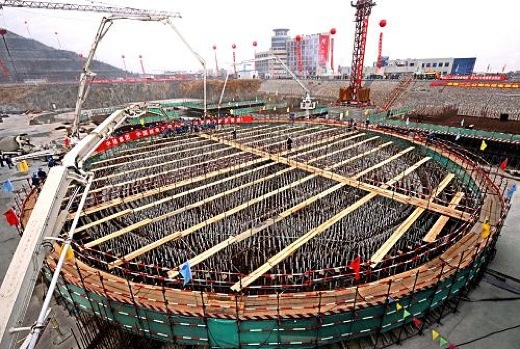 Image above: Qinshan nuclear power plant starts expansion near Hangzhou Bay, Zhejiang Province in 2008. Two reactors operational by 2014. From (http://www.china.org.cn/china/national/2008-12/27/content_17017915.htm).
Watching Japan’s nuclear drama unfold across the East China Sea, China is glued to the edge of its front-row seat.
There is a good reason for the rapt attention: In addition to fears that radiation from Japan could somehow reach its shores, China has more ongoing and planned nuclear construction than any other country — about half of the world’s total.
While it has joined governments in Europe and the United States in announcing a safety review of its nuclear power sector, the pressure to complete its nuclear projects – both those under way and on the drawing board — is intense.
And its record in keeping corruption and mismanagement at bay in construction projects is checkered, to say the least.
“One wonders how long a pause Chinese officials and businesses will feel they can actually take in examining the nuclear power issue,” says Nicholas Eberstadt, Henry Wendt Scholar in Political Economy at the American Enterprise Institute. “China’s demand for energy — if policy planners are correct about economic projections — is like a freight train that is accelerating, and the demand is only growing.”
China’s power consumption grew 14 percent in 2010, according to the official Xinhua News Agency. At the same time, China’s leadership is aggressively trying to wean the country off coal, a huge source of air pollution and associated health issues in China.
In the last decade, Beijing has made nuclear power a central component in its energy strategy. China has 13 operating nuclear reactors producing nearly 2 percent of its total power output, but there are another 27 reactors under construction, 50 more planned and more than 100 proposed. With new reactors coming every year, China is aiming for a tenfold increase in its nuclear generating capacity by 2020, with rapid growth projected to continue until 2050.
Reason for pause As the struggle to contain radiation was beginning at damaged nuclear reactors in Fukushima, in neighboring Japan, Beijing called for a comprehensive safety check and revision of safety standards for all nuclear plants in China.
"Safety is our top priority in developing nuclear power plants," the State Council, the power core of China’s central government, announced on March 16.
Coming from the State Council the edict carries weight.
“The Fukushima tragedy really gave the Chinese a serious wake-up call on the importance of nuclear safety,” said Zhou Yun, a Chinese nuclear security expert from China doing post-doctoral research at Harvard University’s Belfer Center.
But the accident in Japan does not mean China will move away from nuclear power, analysts agree. And it seems unlikely to significantly slow nuclear plant building.
Regulatory body needs bodies, teeth Under the State Council's order, power plants and other nuclear facilities that are operational or under construction will be inspected, said Zhou. But the new standards will be imposed only on plants that have either not yet been approved or have not advanced beyond site preparation.
Significantly, the nuclear oversight body also is limited both in technical capacity and clout in the Chinese government hierarchy, she said.
The National Nuclear Safety Administration is a division of the Ministry of Environmental Protection in China, several steps removed from the State Council. On the other hand, the state-owned nuclear power companies — China Guangdong Nuclear Power Group and China National Nuclear Corp. — report directly to the council.
“In a country like China — or more generally in Asia — you have to show respect to people with higher titles,” said Zhou. “That’s why people argue that the NNSA should have a higher level, directly under the State Council, not just a group or division or subdivision under Environmental Protection.”
The elevation of the nuclear safety agency, “making it an independent regulatory body with authority,” was one of several recommendations made in a January 2011 report by the State Council Research Office to keep pace with safety issues in the nuclear industry.
The research office also warned that safety could be compromised by a growing shortage of technical expertise — particularly among regulators because their salaries are not keeping pace with those of workers in the plants.
The challenge to technical inspectors is complicated by the variety of power plant designs China has in operation—with technology imported from France, Canada and Russia and the United States, as well as a domestic nuclear reactor design based largely on the French technology.
The only exception has been in Hong Kong, which operates with greater freedoms than China’s mainland, under a democratically elected local government.
When the Daya Bay Nuclear Power Station was built about 30 miles from Hong Kong, and opened in 1994, it did so over vocal opposition in Hong Kong, where more than 1 million people signed a petition to halt the project.
Two minor radiation leaks in the plant within the past year — which management said were contained within the plant — have revived unease and debate among Hong Kong legislators, but there has been no such open discussion in mainland China.
“For the most part, people did not pay much attention before the Fukushima nuclear incident,” said Zhou, the Harvard researcher.
But that is rapidly changing, she said. Chinese cyberspace is filled with discussion about Japan and nuclear safety. Anxiety about a possible impact from the leaked radiation prompted many Chinese to hoard salt and wear paper masks in misguided attempts to protect themselves.
Even so, China’s citizenry is more informed than in the past — in part because of government reforms and more recently because of an explosion in access to information technology.
They are increasingly aware of corner cutting in construction that has had deadly effects — such as in Sichuan, where dozens of schools collapsed in the 2008 earthquake there due to shoddy materials and construction, killing thousands of children.
And in a major corruption crackdown in the railway ministry that is still unfolding, it emerged that one of the guilty parties had allowed use of a cheap chemical hardening agents for its high-speed rail system, calling into question their safety for trains moving up to 250 mph. The Chinese rail network has been accused of pushing the trains beyond the recommended speeds.
Corruption and greed also were cited as key reasons behind the melamine-tainted baby formula scandal that hit Chinese consumers in 2008.
The potential for catastrophic consequences offers some hope that the Chinese government will see its nuclear power industry as an area where it has too much at stake to allow scandal, said Eberstadt, of the American Enterprise Institute.
“There is huge capital investment,” in nuclear power, he said. “The central government is inescapably responsible for their performance in a way that they arguably are not for dispersed and decentralized problems with the food chain supply.”
Nonetheless, Fukushima has put nuclear power on the radar for a populace that was previously focused on enjoying its benefits.
“Internet users spent a lot of time blogging and in group forums discussing the Fukushima incident and its consequences,” said Zhou.
“People suddenly realize that China is building a lot of nuclear power plants. They check the map and find 27 or 28 under construction,” she said. “So they start questioning the government: Do we really have a nuclear safety culture?”
.
If a tyrant developed Kauai
SUBHEAD: This is the first time a developer would be granted a "Special Use Permit" to develop commercially on designated agricultural land.
On 23 March 2011 by way of Keep Kauai Country -
(http://campaign.r20.constantcontact.com/render?llr=nphezafab&v=0018iMS5L3VR6N0_ig1Neau394Rw3j6Kjnm1mMEQdoLDnCG03R_eOXSZeJEZjUG9K5_O7D49MxwZ8k3LJ8nmhj_gOKSFMH-Dv1eeP1CZqtGEcfNQxcB1NVdsxxMqIvYF2HI)

Image above: Still frame from video below.
The County of Kauai is on the brink of setting a dangerous precedent that would give developers a loophole enabling them to build commercial developments on agricultural land.
On 23 March 2011 by way of Keep Kauai Country -
(http://campaign.r20.constantcontact.com/render?llr=nphezafab&v=0018iMS5L3VR6N0_ig1Neau394Rw3j6Kjnm1mMEQdoLDnCG03R_eOXSZeJEZjUG9K5_O7D49MxwZ8k3LJ8nmhj_gOKSFMH-Dv1eeP1CZqtGEcfNQxcB1NVdsxxMqIvYF2HI)
Image above: Still frame from video below.
The County of Kauai is on the brink of setting a dangerous precedent that would give developers a loophole enabling them to build commercial developments on agricultural land.
So far, the controversy about whether to build the Kilauea Pavilion has focused on the surface-issue of whether or not the community wants or needs an entertainment complex, which includes an outdoor amphitheater, in Kilauea. A story has been spun to make it sound like the controversy is about "elitists" of Kalihiwai Ridge who don't want the noise -- versus the local people who "need" the services of such an amusement center.
Though the surface issue is noise from the amphitheater, the deeper issue that has not been discussed is the dangerous precedent that would be set by the Kilauea Pavilion development. This would be the first case on the island that a developer would be granted a "Special Use" permit to build a commercial facility on State-zoned agricultural land. Don't we want to preserve our precious agricultural lands? Once this precedent is set, it could have grave impact on Ag land across the entire island.

A little background info...
Last year, just before the Planning Commission was expected to approve the Kilauea Pavilion project, Kalihiwai Ridge neighborhood association president Jim Gair filed an intervention to conduct a contested-case hearing. This put a hold on related Planning Department proceedings until the completion of the hearing. The hearing required Bill Porter, the Pavilion developer, to prove to the commissioners that he should be allowed a "Special Use" permit to build commercially on State-zoned agricultural land.
Last year, just before the Planning Commission was expected to approve the Kilauea Pavilion project, Kalihiwai Ridge neighborhood association president Jim Gair filed an intervention to conduct a contested-case hearing. This put a hold on related Planning Department proceedings until the completion of the hearing. The hearing required Bill Porter, the Pavilion developer, to prove to the commissioners that he should be allowed a "Special Use" permit to build commercially on State-zoned agricultural land.
Porter responded by launching a successful campaign to oust Gair and his board. The new board immediately withdrew Gair's intervention so that the contested-case hearing was never completed. Today it appears to be smooth sailing for Porter. With Gair's intervention out of the way, the burden of proof is no longer on Porter to prove why he should be able to commercially develop land zoned by the State for agriculture.
Yet to be scheduled sometime this April, the Planning Commission will conduct its final public hearing on the Pavilion.
None of Bill Porter's past donations should influence the people of Kaua'i to allow this destructive precedent to be set. It goes beyond whether or not he is a nice man. This is the future of the entire island we're talking about.

If you want to stop this dangerous precedent from being set, please write the Planning Department today. Let them know you are opposed to any "Special Use" permit being granted that would allow commercial development on State-zoned agricultural lands. Your letter should be mailed to:
Ka'aina Hull County of Kauai Planning Dept. 4444 Rice Street Lihue, HI 96766
Please reference the following information in your letter:
Project name: Kilauea Pavilion (part of overall Anaina Hou project)
Class IV Zoning Permit Z-IV-2010-15, Use Permit U-2010-14 and Special Permit SP-2010-3 Video above: No longer available on YouTube. Was titled "Hitler Develops Kauai's North Shore". From (http://www.youtube.com/watch?v=jgvn3gmthwo)
Nothing Is Happening
SUBHEAD: Instead of Hello Kitty they have to think Chernobyl, and then marshal tens of thousands of 'volunteers'.
By Steve Ludlum on 23 March 2011 in Economic Undertow -
(http://economic-undertow.blogspot.com/2011/03/nothing-is-happening.html)

Image above: Hello Kitty fabricated with a Hello Kitty Biker tattoo patterned fabric. From (http://www.kittyhell.com/2009/11/06/hello-kitty-tattoo-plush).
The slow-motion train wreck at the Fukushima Daiichi nuclear reactors continues. Despite the happy talk from Japanese authorities, the situation appears to be deteriorating.
Nothing works because the problems are out of reach of small solutions. The piecemeal approach insures that any grasp is going to fall far short of the efforts needed to force a positive outcome. One would think Botswana is battling a nuclear nightmare. Japan needs more than a handful of fire trucks and the 'Faceless Fifty'. It needs everything and everyone the nation can spare, thousands of trucks, men, lead, sand, boron, concrete, digging machines, pumps ... whatever is available and more!
Japan also needs a reality check and someone in charge. The reactor problems aren't going to go away by themselves, they are going to keep getting worse. Instead of a full-court press, there is a contest between TEPCO and the establishment on one side - versus the public on the other - over the perception of the establishment! This does not matter.
Like America, the Japanese establishment has had decades problem with facing its energy deficit. Policy has made selling magical thinking and the application of 'stimulus' by money authorities a substitute for accepting changed conditions on the ground. The medium is no longer the message. The reactor 'fix' is the same as more credit bubbles by Bernanke.
The fifty-plus reactors in Japan are a hedge against declining fossil fuel availability accompanying rising costs. Faced with a literal blowup of the hedge, the choice made by the establishment is to reanimate it, as if the 'hedge concept' still has validity. TEPCO and the rest attempt to inflate another 'reactor bubble' by pretending the multi-reactor meltdown in Fukushima isn't as bad as it obviously is. This defective logic is fatal under current circumstances. The real contest is between Japan as a functioning entity on one hand and its crumbling nuclear infrastructure on the other.
The cost of managing the emergency appears to be outside the reach of the Japanese social economy, that is, the cost-benefit mechanism that directs a nation toward collective action. Demanding collective action would illuminate the establishment's intellectual and moral bankruptcy. Events have escaped its ability to manage the same way the Chernobyl disaster unmasked the lazily accepted authority of the USSR.
This presents a dilemma for the establishment, it must either sacrifice itself and its precious toys or the entire scheme is undone by the laws of physics. The establishment chooses to finesse the issue and send forth an endless stream of karaoke klowns to provide distractions until the reactors somehow cure themselves. The problem isn't the handful of reactors, it is all of the reactors and the system that supports them! How will the collective deal with these other reactors?
The actions of the past two decades in Japan has been to 'wither'. The Japanese have been living in a nuclear-powered dream world. Denial isn't going to work any more! If not this emergency, what? The sacrifice demanded now is to do what is necessary at any cost to rein in the out-of-control cores, and then come to terms with the 'discovered' costs of the others. Japan needs leadership and there is none.
If it costs twenty or twenty-thousand lives to neutralize these cores, this price must be paid, regardless of the effects of that payment on the industry! There is no choice as the 20 or 40, or however many more, are already in the balance as the outcome of circumstance. HELLO! The folly of the post-pop 'now' or whatever anyone wants to call it is the insistent rejection of any sense that circumstance matters.
The so-called 'safety' of these particular nuclear plants or nuclear plants in general no longer applies. For Japan the issue is to win or die, to win ugly is acceptable but pretending not to understand how to win is fatal to Japan.
If Japan rouses itself to defeat the reactors rampaging across the countryside the nuclear industry is finished because the delivered cost of its product(s) will be recalculated to reflect their true worth. Modernity is challenged: costs will render it unprofitable or the out-of-control reactors will destroy 'Modern Japan' the same way atomic bombs annihilated Hirohito's militarism.
The establishment cannot bear, the pundits err: the issue is not absolute safety costs as in lives-per-plant but rather, the perceived nature of the costs. This is the relative marginal costs of cheap base load electricity versus the anxiety cost that 'cheap' nuclear inflicts the same customers.
No power company can meter anxiety. If the cost of cheap watts is balloon-headed kids there will be no electricity at all. The tsunami was and is a massive tragedy but ten in a row would not destroy Japan. The 'Fukushima Reactor Keystone Kops Nuclear Repair Department' is a rocket sled aimed at a wall.
The public relations department would rather focus on running an extension cord and turning on some lights rather than mobilizing a nationwide blitz to put the reactors out of their misery. Maybe the extension cord will work and maybe not. Mobilize the nation and people start asking questions - who pays for the next series of reactors when these melt down?
Certainly not a bankrupt Japan, done in by its mis-investment in nuclear power. Can you see the contradictions, now? Melt they will, every single one. Reactors require constant, expensive tending for long periods even after shutdown. The fuel components need the same expensive tending for centuries and more. Without a vital, industrial economy there are insufficient returns to service the massive energy debts these reactors represent. The sunk costs of 'Reactors Inc.' do not allow returns. The reactors have become millstones around Japan's neck. Time is running out for the Keystone Kops to get a grip.
They need a plan and fast. Instead of Hello Kitty they have to think Chernobyl, and then marshal the tens of thousands of 'volunteers' to mine under the reactors to keep cores from melting into the water table, to carry lead shielding to the uppermost levels of the containment pools or to heave radioactive concrete chunks out of the way so that spent fuel ponds and pressure vessels can be stuffed with sand and boron. The four reactors are severely damaged with extremely high levels of radiation adjacent to them.
On several occasions workers have been withdrawn from the plant because of the level of radiation exposure. Without a more-or-less instant fix the increasing radiation will prohibit anyone from working at the entire site. The reactors will then melt down. Greater ineptitude is hard to imagine:
.
By Steve Ludlum on 23 March 2011 in Economic Undertow -
(http://economic-undertow.blogspot.com/2011/03/nothing-is-happening.html)
Image above: Hello Kitty fabricated with a Hello Kitty Biker tattoo patterned fabric. From (http://www.kittyhell.com/2009/11/06/hello-kitty-tattoo-plush).
The slow-motion train wreck at the Fukushima Daiichi nuclear reactors continues. Despite the happy talk from Japanese authorities, the situation appears to be deteriorating.
- People are warned not to eat vegetables or drink milk sourced from Fukushima Prefecture area due to the presence of radioactive cesium and iodine found on samples.
- Water supply in Tokyo tests positive for radiation, leading to warnings to keep tap water away from infants. According to the same report, temperatures within reactors one and three exceeded design limits: that is beyond 305° C. Radiation levels adjacent the reactors are at life threatening levels: 500 millisieverts per hour. Ten hours at that level and half of you are dead from acute radiation poisoning.
- Twenty five embassies have relocated out of Tokyo or are in process. Numerous companies have escaped or are escaping out of Tokyo as well. US military dependents are also leaving along with nationals of other countries including France and China.
- The big picture is the glaring absence of an overall plan to either shut the reactors or to entomb them. Instead of a plan there are bromides. These don't build confidence. The soothing reassurances from the Japanese establishment suggests that circumstances are driving events while the operators are spectators.
Nothing works because the problems are out of reach of small solutions. The piecemeal approach insures that any grasp is going to fall far short of the efforts needed to force a positive outcome. One would think Botswana is battling a nuclear nightmare. Japan needs more than a handful of fire trucks and the 'Faceless Fifty'. It needs everything and everyone the nation can spare, thousands of trucks, men, lead, sand, boron, concrete, digging machines, pumps ... whatever is available and more!
Japan also needs a reality check and someone in charge. The reactor problems aren't going to go away by themselves, they are going to keep getting worse. Instead of a full-court press, there is a contest between TEPCO and the establishment on one side - versus the public on the other - over the perception of the establishment! This does not matter.
Like America, the Japanese establishment has had decades problem with facing its energy deficit. Policy has made selling magical thinking and the application of 'stimulus' by money authorities a substitute for accepting changed conditions on the ground. The medium is no longer the message. The reactor 'fix' is the same as more credit bubbles by Bernanke.
The fifty-plus reactors in Japan are a hedge against declining fossil fuel availability accompanying rising costs. Faced with a literal blowup of the hedge, the choice made by the establishment is to reanimate it, as if the 'hedge concept' still has validity. TEPCO and the rest attempt to inflate another 'reactor bubble' by pretending the multi-reactor meltdown in Fukushima isn't as bad as it obviously is. This defective logic is fatal under current circumstances. The real contest is between Japan as a functioning entity on one hand and its crumbling nuclear infrastructure on the other.
The cost of managing the emergency appears to be outside the reach of the Japanese social economy, that is, the cost-benefit mechanism that directs a nation toward collective action. Demanding collective action would illuminate the establishment's intellectual and moral bankruptcy. Events have escaped its ability to manage the same way the Chernobyl disaster unmasked the lazily accepted authority of the USSR.
This presents a dilemma for the establishment, it must either sacrifice itself and its precious toys or the entire scheme is undone by the laws of physics. The establishment chooses to finesse the issue and send forth an endless stream of karaoke klowns to provide distractions until the reactors somehow cure themselves. The problem isn't the handful of reactors, it is all of the reactors and the system that supports them! How will the collective deal with these other reactors?
The actions of the past two decades in Japan has been to 'wither'. The Japanese have been living in a nuclear-powered dream world. Denial isn't going to work any more! If not this emergency, what? The sacrifice demanded now is to do what is necessary at any cost to rein in the out-of-control cores, and then come to terms with the 'discovered' costs of the others. Japan needs leadership and there is none.
If it costs twenty or twenty-thousand lives to neutralize these cores, this price must be paid, regardless of the effects of that payment on the industry! There is no choice as the 20 or 40, or however many more, are already in the balance as the outcome of circumstance. HELLO! The folly of the post-pop 'now' or whatever anyone wants to call it is the insistent rejection of any sense that circumstance matters.
The so-called 'safety' of these particular nuclear plants or nuclear plants in general no longer applies. For Japan the issue is to win or die, to win ugly is acceptable but pretending not to understand how to win is fatal to Japan.
If Japan rouses itself to defeat the reactors rampaging across the countryside the nuclear industry is finished because the delivered cost of its product(s) will be recalculated to reflect their true worth. Modernity is challenged: costs will render it unprofitable or the out-of-control reactors will destroy 'Modern Japan' the same way atomic bombs annihilated Hirohito's militarism.
The establishment cannot bear, the pundits err: the issue is not absolute safety costs as in lives-per-plant but rather, the perceived nature of the costs. This is the relative marginal costs of cheap base load electricity versus the anxiety cost that 'cheap' nuclear inflicts the same customers.
No power company can meter anxiety. If the cost of cheap watts is balloon-headed kids there will be no electricity at all. The tsunami was and is a massive tragedy but ten in a row would not destroy Japan. The 'Fukushima Reactor Keystone Kops Nuclear Repair Department' is a rocket sled aimed at a wall.
The public relations department would rather focus on running an extension cord and turning on some lights rather than mobilizing a nationwide blitz to put the reactors out of their misery. Maybe the extension cord will work and maybe not. Mobilize the nation and people start asking questions - who pays for the next series of reactors when these melt down?
Certainly not a bankrupt Japan, done in by its mis-investment in nuclear power. Can you see the contradictions, now? Melt they will, every single one. Reactors require constant, expensive tending for long periods even after shutdown. The fuel components need the same expensive tending for centuries and more. Without a vital, industrial economy there are insufficient returns to service the massive energy debts these reactors represent. The sunk costs of 'Reactors Inc.' do not allow returns. The reactors have become millstones around Japan's neck. Time is running out for the Keystone Kops to get a grip.
They need a plan and fast. Instead of Hello Kitty they have to think Chernobyl, and then marshal the tens of thousands of 'volunteers' to mine under the reactors to keep cores from melting into the water table, to carry lead shielding to the uppermost levels of the containment pools or to heave radioactive concrete chunks out of the way so that spent fuel ponds and pressure vessels can be stuffed with sand and boron. The four reactors are severely damaged with extremely high levels of radiation adjacent to them.
On several occasions workers have been withdrawn from the plant because of the level of radiation exposure. Without a more-or-less instant fix the increasing radiation will prohibit anyone from working at the entire site. The reactors will then melt down. Greater ineptitude is hard to imagine:
- Authorities have not said -- and may not know -- which particular reactor is leaking the greatest amount of radiation.
- Authorities have not said -- and may not know -- the level of damage to the reactor cores of the three reactors containing operating fuel.
- Authorities have not indicated -- and may not know -- the amount of damage done to spent fuel pools in the four reactors and whether fuel rods have melted down or whether fuel components have escaped from any of the pools. They do not know or have not said whether the fuel in the pools is covered with water or debris, whether they are leaking and which the fuel in the pools is 'hot' radioactively and which is not.
- Nobody knows whether the spraying efforts have cooled the reactors or reduced radiation. Right now all four reactors are emitting steam. Offline reactor number 5 has experiencing a cooling pump failure.
- Nobody can explain the series of fires that have taken place at reactor number three. This is today's fire courtesy of NHK World in English:
Edwin Lyman, senior scientist at the U.S.-based Union of Concerned Scientists Global Security Program said the levels were worrying: "The fact that radiation releases are approaching the level they did in Chernobyl is a cause for concern, a sign of the severity of the accident that's already taken place," said Lyman, especially given the way Chernobyl exploded. One has to remember that there's still no evidence that the containment structures of the damaged (Fukushima) reactors 1, 2, and 3 have been significantly breached, which is a difference from Chernobyl where the confinement structure was destroyed in the very early stages of the accident." In Vienna, the Austrian institute's Dr Gerhard Wotawa said it was difficult to make day-by-day comparisons with Chernobyl, but he added: "For cesium and iodine ... the source terms (amounts released from the two accidents) are not so different." He said iodine -- linked to cancer if found in high doses -- and cesium were both "volatile substances" which escape relatively easily when there are nuclear accidents. Only minor traces of radiation have been detected in countries outside Japan, but the U.N. nuclear watchdog this week said "high levels of contamination" have been measured around the Fukushima plant, about 250 km north of Tokyo. Japanese authorities advised parents on Wednesday not to let infants drink tap water in the capital because of raised radiation levels, and the United States became the first nation to block some food imports from Japan.Right now it appears the primary institutional impulse is to cover up and hope the problems go away.
.
Earth's Scarcest Resource Is Time
SUBHEAD: In the event of a crisis, the US food supply would run out in three days.
By Lester Brown on 23 March 2011 in The Nation -
(http://www.thenation.com/video/159399/lester-brown-planets-scarcest-resource-time)
 Image above: Lester Brown in China. From (http://whoami-whoareyou.blogspot.com/2011/01/for-perspective.html).
In this eleventh video in the series “Peak Oil and a Changing Climate” from The Nation and On The Earth Productions, analyst, author and founder of the Earth Policy Institute Lester Brown discusses how unprepared the world really is for the growing effects of climate change. "Economists doing supply and demand projections are largely unaware" of the scale of the resource crises facing the world, Brown says, and "food is going to be the weak link for our civilization as it was for so many earlier civilizations."
Can the United States feed China?
Image above: Lester Brown in China. From (http://whoami-whoareyou.blogspot.com/2011/01/for-perspective.html).
In this eleventh video in the series “Peak Oil and a Changing Climate” from The Nation and On The Earth Productions, analyst, author and founder of the Earth Policy Institute Lester Brown discusses how unprepared the world really is for the growing effects of climate change. "Economists doing supply and demand projections are largely unaware" of the scale of the resource crises facing the world, Brown says, and "food is going to be the weak link for our civilization as it was for so many earlier civilizations." Most importantly, Brown emphasizes, is that we find a way to stabilize the Earth's population, climate and aquifers, which help provide water to many people in the world. "Many resources are becoming scarce but none more scarce than time," Brown says, and confronting peak oil and climate change demands immediate action. Already, eighteen countries are overpumping their aquifers, and few realize that in the event of a crisis, the US food supply would run out in three days.
"We need a mobilization at wartime speed on a wartime scale. Just fine-tuning this situation is not going to do it," Brown says.
Video above: Lester Brown speaks of food as weak link in survivability. From (http://www.youtube.com/watch?v=DXVgTD2F6ZQ).
Can the United States feed China?
By Lester Brown on 13 March 2011 in The Washington Post (http://www.washingtonpost.com/wp-dyn/content/article/2011/03/11/AR2011031106993.html)
China is at war. It is not invading armies but expanding deserts that threaten its territory. As old deserts grow, as new ones form and as more and more irrigation wells go dry, Beijing is losing a long battle to feed its growing population on its own.
In the years to come, China will almost certainly have to turn to the outside world for grain to avoid politically destabilizing price spikes. Enter the United States - by far the world's largest grain exporter. The United States exports about 90 million tons of grain annually, though China requires 80 million tons of grain each year to meet just one-fifth of its needs.
Just as China is America's banker, America could become China's farmer. Such a scenario - to be dependent on imported grain, much of it from the United States - is China's worst nightmare and one that could create nightmares for U.S. consumers, as well.
The evidence of China's plight is clear. Since 1950, some 24,000 villages in the northwestern part of the country have been totally or partially abandoned as sand dunes encroach on cropland. And with millions of Chinese farmers drilling wells to expand their harvests, water tables are falling under much of the North China Plain, which produces half of the nation's wheat and a third of its corn.
Chinese agriculture is also losing irrigation water to cities and factories. Cropland is being sacrificed for residential and industrial construction, including highways and parking lots that accommodate China's voracious demand for automobiles. In 2009, automobile sales in China totaled just under 14 million, surpassing those in the United States for the first time. For every 1 million cars added to this fleet, at least 50,000 acres are paved over.
And China's food supply is already tightening. In November, its food price index was up 12 percent from 2009. The price of vegetables alone was up 62 percent.
In these conditions, how do you feed more than 1 billion people? This question vexes China's leaders, many of whom are survivors of the Great Famine, in which 30 million people starved to death between 1959 and 1961. Last year, in an effort to halt rising food prices, the government auctioned corn, wheat, rice and soybeans from state reserves. And in recent years, China has bought or leased land in other countries from Sudan to Indonesia to produce food and biofuels, but there is little to show in production from these lands so far.
If China, which imported about 2 million tons of U.S. corn and wheat combined in 2010, charges into the U.S. grain market, American consumers will find themselves competing with nearly 1.4 billion foreign consumers for the U.S. grain harvest. This would raise the prices not only of products made directly from grain, such as bread, pasta and breakfast cereals, but also of meat, milk and eggs, which take large quantities of grain to produce. Corn futures have already hit $7 a bushel, up from $2 a bushel five years ago. In that same period, soybean futures climbed from $6 a bushel to $14 a bushel, and cattle and hog futures hit all-time highs.
China has been here before - with soybeans. In 1995, around the time the Communist Party prioritized grain production, China produced and consumed 14 million tons of soybeans. By 2010, China was still producing 14 million tons of soy annually, but consuming 69 million tons. For the nation that domesticated the soybean, the change was dramatic, and it resulted in the restructuring of agriculture in the Western Hemisphere. To meet overseas demand, the United States now has more land in soybeans than wheat. Brazil has more land in soybeans than in all grains combined. And Argentina is fast becoming a soybean monoculture. Today, nearly 60 percent of world soybean exports - almost all from these three countries - go to China.
Of course, when selling food to China, the United States is dealing with both an economic competitor and a creditor holding $900 billion worth of U.S. Treasury securities. If China pushes U.S. food prices higher, tensions between the two countries may escalate. An even greater stress may develop between Washington and U.S. consumers, as Americans - who think cheap food is a birthright - are likely to press for restrictions on exports to China. There is precedent for this: In the 1970s, the United States banned exports of soybeans to countries such as Japan to quash domestic food price inflation.
Though withholding food from an emerging superpower could lower domestic food prices, it would be bad diplomacy. Even during the Cold War, the United States exported 10 million tons of wheat - nearly a quarter of the U.S. harvest - to the Soviet Union in 1972 after a crop failure there. Well-fed enemies are more predictable.
Would this work today? The Obama administration - or any future administration - faces a choice. If we limit grain sales to China, might the Chinese limit their monthly purchases at Treasury securities auctions? What would happen to farmers who can't sell to the world's largest food market? We can't know how this tension will play out politically, but we do know that our huge deficits of the past 30 years restrict our bargaining power.
The United States has been the world's breadbasket for more than half a century. Our country has never known food shortages or spiraling food prices. But, like it or not, we will probably have to share our harvest with the Chinese, no matter how much that raises our prices.
Our world is about to change. In the supermarket checkout line, in restaurants and at Federal Reserve meetings, it's hard to imagine that it will be for the better.
.
Nothing Left to Steal
SUBHEAD: Shortly thereafter everyone realizes that the chips they are holding are not all that valuable any more.
By Dmitry Orlov on 18 March 2011 in ClubOrlov -
(http://cluborlov.blogspot.com/2011/03/nothing-left-to-steal.html)
 Image above: Ceramic poker chips for sale at 67¢ a piece. From (http://www.pokerchiplounge.com/poker-chips/ceramic-poker-chips.html).
Michael Betancourt is an intellectual: he uses words like semiosis and actually knows exactly what they mean. Speaking on The Keiser Report he made some interesting points about the pile of digital ephemera that the global financial system, and much of the economy with it, has devolved into. From 20:52 on (video here (http://www.youtube.com/watch?v=iRTfex2VQ7g), Michael has this to say on the current action in the financial markets around the world:
Image above: Ceramic poker chips for sale at 67¢ a piece. From (http://www.pokerchiplounge.com/poker-chips/ceramic-poker-chips.html).
Michael Betancourt is an intellectual: he uses words like semiosis and actually knows exactly what they mean. Speaking on The Keiser Report he made some interesting points about the pile of digital ephemera that the global financial system, and much of the economy with it, has devolved into. From 20:52 on (video here (http://www.youtube.com/watch?v=iRTfex2VQ7g), Michael has this to say on the current action in the financial markets around the world:
I wouldn't necessarily say "steal" ... I just don't feel that "stealing" is necessarily the right verb for this. It's something else. Stealing [implies] that there is some kind of physical commodity that's being stolen... that the currency is being debased implies that if we didn't do this the currency would be solvent, and the whole problem here is that the currency itself is disconnected from any kind of physical value. It exists as a debt against future production rather than a store of value. And all of this comes down to the immaterial basis that we are now living in. So, yes, in a sense you could say that they are stealing, [but] in another sense you could say that they are not stealing because there is nothing to be stolen... The reality is that this is an unsustainable system, and that the inevitability of its collapse has been there almost from the beginning, because the entire system is based on a currency that is not based on anything—it exists only in relation to other currencies...On the protesters in Wisconsin and elsewhere:
What makes this even more perverse is that what they are fighting for is the continuation of their entrapment... The powers that are currently acting and that are causing these riots, protests, rebellions... are fighting for their own survival, and the shift that's happening is perverse because we are driving towards a collapse, and it is almost inevitable that we are going to have this collapse again at some point. To a certain extent I think it may have already started with the credit freeze in 2009. The attempt to print our way out of it isn't going to result in hyperinflation necessarily (although there are people who are saying that it will) so much as it will result in a complete revaluation of the system, in which we arrive at some other, new equilibrium. Part of the problem with getting there is that there are forces fighting over who has the largest number of these essentially immaterial objects, this immaterial currency. What will happen is that at some point they will have most of it (and we are moving towards that already, if you look at any of the various numbers on who has the wealth and who doesn't). What will happen when it gets concentrated enough is that the entire system will freeze up like it did in 2009. This is because the equilibrium and the maintenance and the survival of this system depends upon the circulation of these immaterial commodities. As soon as they start getting hoarded, or as soon as people who have them start cashing out and into some sort of physical commodity, both of these can trigger an imminent collapse, not necessarily in the sense of a bank run or a panic, but in the sense that the system can no longer feasibly maintain its own equilibrium... it drives towards ever greater disequilibrium, because that's the ground state for this sort of a situation, where you have vast immaterial production versus limited physical production.I would tend to agree. The value of financial assets rests on the promise of future industrial production, which will fail to materialize due to shortages of multiple key resources. In the updated edition of Reinventing Collapse (which is scheduled to go to press next week), I try to get at much the same thing as Michael, trying hard to avoid big words like “disequilibrium”:
The extent to which we value money depends on our degree of confidence in the economy. At first, as the economy starts to collapse, we start to hoard money, to make sure that we don’t run out. Then, as the economy continues to wither away, supply disruptions and price spikes cause some of us to suddenly realize that we might not be able to gain access to the things we need for much longer, never mind the cost, and that running out of money is not fatal whereas running out of food, fuel and other supplies certainly can be. And then we start cashing in our paper assets in exchange for physical commodities we think might be more useful. Shortly thereafter everyone realizes that the chips they are holding are not all that valuable any more. It is this realization, more than anything else, that renders the chips instantly worthless. [RC 2.0 p. 54-55]In recent months I have had many occasions to walk through Boston's financial district and look at all the suit-and-tie-wearing lab rats whose job is to push buttons to try to stimulate the pleasure center of some wealthy person's brain. The vast majority of what they trade is derived from debt secured by future production that will not exist. At what point will their patron's pleasure cross the pain threshold? Will we see the über-wealthy immolating themselves on pyres of their now worthless money, just to escape the anguish of being disencumbered of their phantom possessions? I hope for everyone to survive with their precarious sanity intact, but I can't help but look forward to a Bonfire of the Vanities to put this lengthy episode of breathless financial self-digiting behind us. .
Economy - Energy - War
SUBHEAD: The world is stable in the sense of hanging by your fingernails is stable.
By Illargi on 21 March 2011 for The Automatic Earth -
(http://theautomaticearth.blogspot.com/2011/03/march-21-2011-stable-in-sense-of.html)
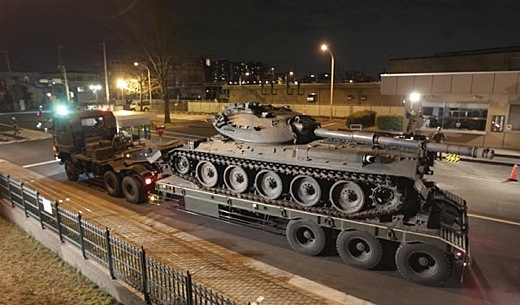
Image above: A military tank that will be used to clear rubble from the Fukushima nuclear complex leaves Camp Asaka on a trailer. From LA Times article below.
Eminent US physicist Michio Kaku says that the Japanese government may call the situation at Fukushima stable, but that it would be "stable in the sense of hanging by your fingernails" (which I in turn would suggest is a perfectly apt description of our entire global economy and various societies).
Kaku indicates that the only "solution" he sees for Fukushima is for the Japanese army to start dropping massive amounts of sand, boric acid and concrete on the Fukushima 1 reactors. Two of which are presently producing clouds of smoke, the origin of which is unknown to either TEPCO or Tokyo. In other words, "stable" is hardly the first term that comes to mind. And Japan may well be heeding Kaku's words; just not admitting to it yet.
Video above: TV interview with Michio Kaku on Fukushima disaster. From (http://www.youtube.com/watch?v=obK4zISRgyo). Thomas H. Maugh II writes for the Los Angeles Times: (http://www.latimes.com/news/nationworld/world/la-sci-japan-reactor-damage-20110321,0,7504433.story):
Smoke seen at Fukushima reactors - The company has also brought in a large construction device normally used to pump a cement mixture. Officials initially said they were going to use it to pump the cement mixture and water into the spent fuel pool of reactor No. 4, which is thought to have boiled dry, allowing damage to have been done to the fuel rods there. Officials later said, however, that they intended to use the device only to pump water into the pool.What Kaku proposes is known as the "sarcophagus" approach. In which the entire construction is basically buried, so no radioactivity can spread from the above ground facilities.
This may sound good, but it's also an admission that meltdown cannot be halted, and will continue beneath the concrete "structure". In the meantime, radioactivity has already spread into the local food supply. Milk and spinach are being taken off the market, and persistent reports claim water dumped and sprayed on the reactors is flowing out to sea. Nick Allen writes for the Telegraph (http://www.telegraph.co.uk/news/worldnews/asia/japan/8395985/Japan-nuclear-crisis-Fears-mount-over-radioactive-waste-in-food.html):
Radioactivity creates expansive regions that are off-limits to people. Like a sarcophagus that fits over a failed and out of control nuclear plant, seemingly solving problems, but in reality only pushing immediate issues forward into the future, where our very own children will be confronted with the dire consequences of our dramatic failures, we also distinguish a pattern of the sarcophagus of war being laid over economic crises.
I see many comparisons of the 2011 western attacks on Libya with the 2003 invasion of Iraq, but when I saw the first footage a few days ago, I was thinking that we need to wonder where and how 2011 differs from, say, 1938. War has throughout history been used by "leaders" as a means to cover up their economic failures. The Great Depression never truly ended before World War II broke out for real in 1939. Then:
They look far too trigger happy, far too eager to send young people into war, from which some, if not many, will return maimed and/or dead. And we do have an ongoing financial crisis, no matter what anyone pretends. Look at unemployment numbers, home sales, home prices in America.
At the height of the 1930s crisis, unemployment in the US was something in the order of 25%. In real numbers, we're not that far below that now. And all it takes to get there is a few more bad data. Or a drought, as happened in those days 70 years ago. And then of course there's this:
Most of Libya's oil, some 80%, is in the east near Benghazi. It's some of the lightest, sweetest, easiest to extract crude oil left on the planet. Its marginal extraction could be as low as $1 per barrel. Libya also has about 41 billion barrels in oil reserves, the US has 21 billion barrels. Libya has an estimated 1,500 billion M^3 of natural gas as well according to the National Oil Company.
This war, like any other, is first and foremost one of resources. Getting rid of Gaddafi is a mere bonus, but the main idea for now might well be to split the country in two. "We" are only interested in the eastern part. And the financial markets? Yeah, they’re moving up, aren't they? War is a profitable business still. We are always led into these adventures with the notion that it’ll be over in no time at all (think Iraq).
But then it never works out that way. And here I am wondering if the purpose of it is really to make it as short as possible. You don’t beat Gaddaffi on his home turf in two seconds flat. He may not have the most advanced equipment, but he knows the turf. Same as it ever was: Iraq, Afghanistan, the US hasn't won a war since World War II.
You get the idea that being in wars in more important than winning them. It could certainly be more profitable. A lot of the US soldiers fighting in Iraq were young kids who signed up just to pay for a college education. And we really need to wonder how far away we are from a draft, with a new battlefield that could easily expand greatly.
The Arab League may have supported the attack on Libya at first, but there are already cracks showing in their united resolve.
The Clintons and Camerons of this world may say it's all legal, but when they say "we need to help the people of Lybia", where do the people of Yemen and Bahrain come in exactly? Russian PM Putin has likened the attack to the Crusades.
Iran is waiting in the wings. China is an interested bystander. And all of them have their eyes on the same prize: oil. One of Adolf Hitler's main objectives from the very beginning was construction and control of the Baku pipeline. He didn’t get it, he had to make do with Fisher-Tropsch oil from coal, a very costly and elaborate process. It may well have cost him WWII victory.
These are the kinds of things I think about these days, the 1930s depression, how Hitler came to power, how it all led to mass warfare. I then look at developments in the world today and they fill me with dread. Especially when I think back to 1938. It's about seeing war against the backdrop of an unsolvable financial crisis. Which is then in turn seemingly solved by going to war.
.
By Illargi on 21 March 2011 for The Automatic Earth -
(http://theautomaticearth.blogspot.com/2011/03/march-21-2011-stable-in-sense-of.html)
Image above: A military tank that will be used to clear rubble from the Fukushima nuclear complex leaves Camp Asaka on a trailer. From LA Times article below.
Eminent US physicist Michio Kaku says that the Japanese government may call the situation at Fukushima stable, but that it would be "stable in the sense of hanging by your fingernails" (which I in turn would suggest is a perfectly apt description of our entire global economy and various societies).
Kaku indicates that the only "solution" he sees for Fukushima is for the Japanese army to start dropping massive amounts of sand, boric acid and concrete on the Fukushima 1 reactors. Two of which are presently producing clouds of smoke, the origin of which is unknown to either TEPCO or Tokyo. In other words, "stable" is hardly the first term that comes to mind. And Japan may well be heeding Kaku's words; just not admitting to it yet.
Video above: TV interview with Michio Kaku on Fukushima disaster. From (http://www.youtube.com/watch?v=obK4zISRgyo). Thomas H. Maugh II writes for the Los Angeles Times: (http://www.latimes.com/news/nationworld/world/la-sci-japan-reactor-damage-20110321,0,7504433.story):
Smoke seen at Fukushima reactors - The company has also brought in a large construction device normally used to pump a cement mixture. Officials initially said they were going to use it to pump the cement mixture and water into the spent fuel pool of reactor No. 4, which is thought to have boiled dry, allowing damage to have been done to the fuel rods there. Officials later said, however, that they intended to use the device only to pump water into the pool.What Kaku proposes is known as the "sarcophagus" approach. In which the entire construction is basically buried, so no radioactivity can spread from the above ground facilities.
This may sound good, but it's also an admission that meltdown cannot be halted, and will continue beneath the concrete "structure". In the meantime, radioactivity has already spread into the local food supply. Milk and spinach are being taken off the market, and persistent reports claim water dumped and sprayed on the reactors is flowing out to sea. Nick Allen writes for the Telegraph (http://www.telegraph.co.uk/news/worldnews/asia/japan/8395985/Japan-nuclear-crisis-Fears-mount-over-radioactive-waste-in-food.html):
Japan nuclear crisis: Fears mount over radioactive waste in food - Fears are mounting among Japanese health authorities that food and milk from areas surrounding the Fukushima nuclear plant could be contaminated with radioactive waste. Yukio Edano, Japan's Chief Cabinet Secretary, said shipments of spinach from four provinces surrounding the plant had been halted. Milk shipments from Fukushima province have also been banned. Mr Edano, the increasingly haggard face of the Japanese government's response to the crisis, sought to quell fears by saying radiation levels in food were not harmful to human health, and that he was prepared to eat contaminated produce himself. He said: "Even if you eat and drink them several times it will not be a health hazard. So I would like you to act calmly without reacting." Asked if he would be happy to give spinach and milk to his family, he said: "Of course." His comments were reminiscent of when John Gummer, the then Agriculture Minister, was pictured with his four-year-old daughter and half-eaten hamburgers, in an attempt to calm the British public during the "mad cow disease" outbreak in 1990. [..] Andre-Claude Lacoste, head of France's Nuclear Safety Authority, said local contamination would be a problem "for decades and decades." He added: "Ground deposits of radioactive particles are significant. Given the weather, it is likely that contaminations have occurred up to 100km (60 miles) or so." The World Bank said Japan may need five years to rebuild after the catastrophic March 11 earthquake and tsunami, which caused up to £144 billion in damage and left nearly 22,000 people dead or missing.The sarcophagus "tactic" was also applied in Chernobyl. While it did halt immediate radiation levels, it seems that radioactive water is now making its way, slowly but surely, towards the groundwater of Kiev, the Ukranian capital located some 80 km (50 miles) away. This is what almost certainly awaits the Fukushima region, and who knows which other adjacent regions. It will be interesting to see how large the exclusion zone (at Chernobyl it's called the "Zone of Alienation") will be.
Radioactivity creates expansive regions that are off-limits to people. Like a sarcophagus that fits over a failed and out of control nuclear plant, seemingly solving problems, but in reality only pushing immediate issues forward into the future, where our very own children will be confronted with the dire consequences of our dramatic failures, we also distinguish a pattern of the sarcophagus of war being laid over economic crises.
I see many comparisons of the 2011 western attacks on Libya with the 2003 invasion of Iraq, but when I saw the first footage a few days ago, I was thinking that we need to wonder where and how 2011 differs from, say, 1938. War has throughout history been used by "leaders" as a means to cover up their economic failures. The Great Depression never truly ended before World War II broke out for real in 1939. Then:
- Top 1929
- Decline until 1932/33
- Reflation 1933 - 1937
- Decline 1937-1942
- And war in 1939, the US entered in 1941
- Top 1999/2000 (peak in real terms)
- Decline until 2002/03
- Reflation 2003 - 2007 (peak in nominal terms)
- Decline 2007 - 2009
- Lesser reflation 2009 - 2011
- Decline 2011 - ? (probably several years)
They look far too trigger happy, far too eager to send young people into war, from which some, if not many, will return maimed and/or dead. And we do have an ongoing financial crisis, no matter what anyone pretends. Look at unemployment numbers, home sales, home prices in America.
At the height of the 1930s crisis, unemployment in the US was something in the order of 25%. In real numbers, we're not that far below that now. And all it takes to get there is a few more bad data. Or a drought, as happened in those days 70 years ago. And then of course there's this:
Most of Libya's oil, some 80%, is in the east near Benghazi. It's some of the lightest, sweetest, easiest to extract crude oil left on the planet. Its marginal extraction could be as low as $1 per barrel. Libya also has about 41 billion barrels in oil reserves, the US has 21 billion barrels. Libya has an estimated 1,500 billion M^3 of natural gas as well according to the National Oil Company.
This war, like any other, is first and foremost one of resources. Getting rid of Gaddafi is a mere bonus, but the main idea for now might well be to split the country in two. "We" are only interested in the eastern part. And the financial markets? Yeah, they’re moving up, aren't they? War is a profitable business still. We are always led into these adventures with the notion that it’ll be over in no time at all (think Iraq).
But then it never works out that way. And here I am wondering if the purpose of it is really to make it as short as possible. You don’t beat Gaddaffi on his home turf in two seconds flat. He may not have the most advanced equipment, but he knows the turf. Same as it ever was: Iraq, Afghanistan, the US hasn't won a war since World War II.
You get the idea that being in wars in more important than winning them. It could certainly be more profitable. A lot of the US soldiers fighting in Iraq were young kids who signed up just to pay for a college education. And we really need to wonder how far away we are from a draft, with a new battlefield that could easily expand greatly.
The Arab League may have supported the attack on Libya at first, but there are already cracks showing in their united resolve.
The Clintons and Camerons of this world may say it's all legal, but when they say "we need to help the people of Lybia", where do the people of Yemen and Bahrain come in exactly? Russian PM Putin has likened the attack to the Crusades.
Iran is waiting in the wings. China is an interested bystander. And all of them have their eyes on the same prize: oil. One of Adolf Hitler's main objectives from the very beginning was construction and control of the Baku pipeline. He didn’t get it, he had to make do with Fisher-Tropsch oil from coal, a very costly and elaborate process. It may well have cost him WWII victory.
These are the kinds of things I think about these days, the 1930s depression, how Hitler came to power, how it all led to mass warfare. I then look at developments in the world today and they fill me with dread. Especially when I think back to 1938. It's about seeing war against the backdrop of an unsolvable financial crisis. Which is then in turn seemingly solved by going to war.
.
Chamber of Commerce horrors
SUBHEAD: The gang that couldn't lobby straight or get anything right.
By Bill McKibbon on 20 March 2011 for Huffington Post -
(http://www.huffingtonpost.com/bill-mckibben/the-gang-that-couldnt-lob_b_839047.html)
 Image above: Logo of the US Chamber of Commerce with "Wrong Way" sign. By Juan Wilson.
What if I told you I'd found a political group that for a 100 years had managed to be absolutely right on every crucial political issue? A political lodestone, reliably pointing toward true policy north at every moment.
Sorry. But I have something almost as good: a group that manages to always get it wrong. The ultimate pie-in-the-face brigade, the gang that couldn't lobby straight. From the outside, you'd think the U.S. Chamber of Commerce must know what it's doing. It's got a huge building right next to the White House. It spends more money on political campaigning than the Republican and Democratic National Committees combined. It spends more money on lobbying that the next five biggest lobbyists combined. And yet it has an unbroken record of error stretching back almost to its founding. Take the New Deal, which historians have long since credited as saving capitalism in the U.S. FDR was dealing with a nation ruined by Wall Street excess -- a quarter of the country unemployed, Americans starving and hopeless. He gave his first fireside chat of 1935 on April 28, and outlined a legislative program that included Social Security. The next morning, a prominent official of the Chamber of Commerce accused Roosevelt of attempting to 'Sovietize' America; the chamber adopted a resolution "opposing the president's entire legislative package."
Fast forward to the next great challenge for America. FDR, having brought America through the Depression, was trying to deal with Hitler's rise. In the winter of 1941, with the British hard-pressed to hold off the Germans, FDR proposed what came to be called the Lend-Lease program, a way of supplying the allies with materiel they desperately needed.
Only 22% of Americans opposed the Lend Lease program -- they could see who Hitler was - -but that sorry number included the Chamber of Commerce. The lead story in the New York Times for February 6, 1941 began with the ringing statement from the Chamber's president James S . Kemper that "American business men oppose American involvement in any foreign war."
It's not just that this was unpatriotic; it was also plain stupid, since our eventual involvement in that "foreign war" triggered the greatest boom in America's economic history. But it's precisely the kind of blinkered short-sightedness that has led the U.S. Chamber of Commerce astray over and over and over again. They spent the 1950s helping Joe McCarthy root out communists in the trade unions; in the 1960s they urged the Senate to "reject as unnecessary" the idea of Medicare; in the 1980s they campaigned against a "terrible 20" burdensome rules on business, including new licensing requirements for nuclear plants and "various mine safety rules."
As Brad Johnson, at the Center for American Progress, has detailed recently, the U.S. Chamber has opposed virtually every attempt to rein in pollution, from stronger smog standards to a ban on the dumping of hazardous waste. (They're hard at work as well trying to relax restrictions on US corporations bribing foreign governments, not to mention opposing the Lily Leadbetter Fair Pay Act.) If there's a modern equivalent of World War II, of course, it's the fight against global warming. Again a majority of Americans want firm action, because they understand the planet has never faced a bigger challenge -- but that action's been completely blocked in Washington, and the U.S. Chamber is a major reason why. They've lobbied against every effort to cut carbon, going so far as to insist that the EPA should stay out of the fight because, if the planet warmed, "populations can acclimatize via a range of range of behavioral, physiological, and technological adaptations." That is to say, don't ask a handful of coal companies to adapt their business plans, ask all species everywhere to adapt their physiologies. Grow gills, I guess.
There's a reason the U.S. Chamber always gets it wrong: they stand with whoever gives them the most cash (in 2009, 16 companies provided 55% of their budget). That means that they're always on the side of short-term interest; they're clinically, and irremediably, short-sighted. They recently published a list of the states they thought were "best for business," and the results were almost comical -- all their top prospects (Mississippi!) ranked at the very bottom of everything from education to life expectancy.
But that doesn't mean that business is a force for evil. Though the U.S. Chamber claims to represent all of American business, their constituency is really that handful of huge dinosaur companies that would rather lobby than adapt. Around America, the local chambers of commerce are filled with millions of small businesses that in fact do what capitalists are supposed to do: adapt to new conditions, thrive on change, show the nimbleness and dexterity that distinguish them from lumbering monopolies. As Chris Mead, in an excellent history of the local chambers, makes clear, there are a thousand instances where clear-sighted businesspeople understood the future. Who lured the first movie producers to southern California? The LA Chamber, which sent out a promotional brochure in 1907. Why was the Lindbergh's plane called "The Spirit of St. Louis"? Because the St. Louis Chamber of Commerce raised the money -- that was a pretty good call.
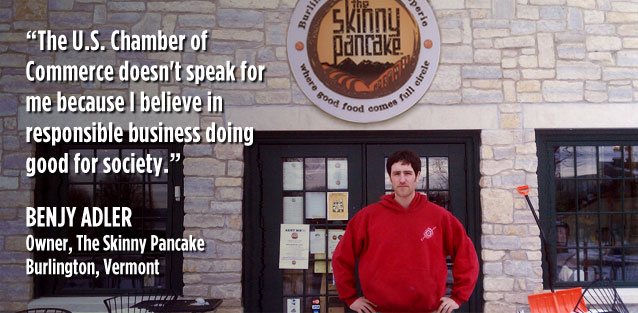
That's why thousands and thousands of American businesses concerned about our energy future have already joined a new campaign, declaring that "The US Chamber Doesn't Speak for Me." They want to draw a line between themselves and the hard-right ideological ineptitude that is the U.S. Chamber. Some of those businesses are tiny -- insurance brokers in southern California, coffee roasters in Georgia, veterinarians in Oklahoma -- and some are enormous. Apple Computer, for instance, which has... a pretty good record of seeing into the future.
There's only one reason anyone pays attention to the U.S. Chamber, and that's their gusher of cash. But the Chamber turns 100 next year, and it's just possible that a century of dumb decisions will outweigh even that pile of money. If you're trying to figure out the future, study the U.S. Chamber -- and go as fast as you can in the opposite direction.
.The Ends of the Earth
SUBHEAD: How far will we go to secure energy? Clearly, to the ends of the Earth. And perhaps even to the end of the (living) world.
By Guy McPherson on 22 March 2011 for Nature Bats Last -
(http://guymcpherson.com/2011/03/the-ends-of-the-earth)
 Image above: "The End of the World" computer wallpaper. From (http://www.fantasy-backgrounds.com/planets/end-of-the-world).
Judging from their actions, most people I know are more to committed maintaining their imperial lifestyles than in maintaining the lives of their children. Take a look around and tell me that isn’t how we managed to find ourselves in this dire array of interconnected predicaments. Empathy is so rare we treat it as a treasure. Which it is.
We’re willing to risk extinction by nuclear meltdown to keep the lights on. And not merely the extinction of other species, which we’ve been risking for generations. This time, we’re willing to take Homo sapiens into the abyss in exchange for hot pizza and cold beer. Meanwhile, governments of the world continue to cover up disasters as they occur. And we, the people, are willing to let them because we can’t handle the truth.
As if ongoing events in Japan aren’t enough to convince you that nuclear power plants aren’t a good idea — and apparently those events have failed to convince Barack Obama, who refuses to step down from his pro-nuclear stance — what about drilling for oil at depths we know are profoundly unsafe? That pesky Gulf of Mexico has sprung another leak, this time near yet another deepwater oil rig. Of course, this event isn’t deemed newsworthy, even as cleanup efforts have been under way for days. Increasingly desperate for crude oil, the International Energy Agency is begging Norway to ratchet up production. Sorry, no dice from post-peak countries.
And then there’s Libya, which currently supplies oil to industrialized countries at almost exactly the same rate as the so-called “spare” capacity. Take out Libyan oil, and the trip to $150 oil comes next week instead of later this year. Fortunately for lovers of American-style capitalism, BP has started drilling even as the bombs are flying. The ever-declining supply of Alaskan oil constrains options of the U.S. and its military allies to the approaches I’ve come to know and hate: abundant military action after generating an enemy Americans can hate (aka foreign policy) and printing money (aka domestic policy). Britain’s former Member of Parliament George Galloway understands our actions in Libya are all about the oil, and he’s even willing to talk about it (U.S. Congressional Representative Ed Markey agrees, as shown here).
Video above: Ex-MP George Galloway speaks about United Kingdom hypocracy on Libya. From (http://www.youtube.com/watch?v=Zk2u-pvOpcc).
Libya isn’t the only ongoing crisis in the Middle East and northern Africa. The whole region is aflame, and we canadd Yemen to the list of crises threatening the Saudi Arabian underbelly (thus, the world’s supply of crude oil).
Among the prices we pay, apparently all too willingly: Ice is melting from Greenland and Antarctica at a rate surprisingly rapid, even to the global-change scientists studying the issue. This is merely one more notch in the miles-long belt of industry, yet another minor insult on an overheating planet. Tack on the couple hundred species we drive to extinction each day, along with utter destruction of every other aspect of Earth’s environment, and you start to get the idea our efforts aren’t entirely positive.
Adverse impacts of industrialization are not restricted to the environmental realm. They extend to the sociopolitical arena, too. Feudalism has arrived to the United States, along with fascism (wrapped in a flag and carrying a cross, as predicted by Sinclair Lewis). Here at home, the cost of living continues to increase while Republicans try to make it illegal for poor people to carry money. Continuing the long-term theme of U.S. foreign policy, we’ll gladly kill anybody and everybody who interferes with our access to crude oil. Then our beloved military will continue to disgrace us byposing with the tortured bodies of civilians they killed. If you try to interfere with foreign policy, you get an all-expense-paid trip to Gitmo Bay, where you get to reside for the rest of your days, courtesy of our very own torturer in chief.
Fortunately, western civilization and its latest, worst, manifestation — the industrial economy — is near its end. We can add four more people to a large and growing group that foresees the end of empire within months: Gordon T. Long predicts end of fiat currency by the end of 2012 (also see Long’s essay about shadow banking here), Clyde Prestowitz anticipates an “economic earthquake or tsunami that will reset globalization,” Jim Willie has jumped on the hyperinflation bandwagon, and John Lohman indicates the Keynesian endgame has nearly run its course.
Seems I’m not the only optimistic in these parts.
The industrial economy was imploding before an earthquake and tsunami hit Japan. The world oil peak passed us by in 2005, as did the world peak in grain production (not coincidentally). But Japan is yet another straw on the back of the severely stressed camel known as the world’s industrial economy. Events in Japan are shaking the U.S. Treasury bond market and otherwise hastening the demise of the world’s industrial economy.
Not one single member of the corporate-owned mainstream media is willing to connect these seemingly disparate events. But, as should be obvious to anybody paying the slightest attention, each event is a stitch in a worldwide quilt. Each event indicates systemic collapse of the world’s industrial economy. If you’re waiting for the mainstream media to tell you when to launch your lifeboat, you’ll wait until it’s too late.
When is the correct time to flee an empire in decline? If you’re unconcerned about the morality of how you live and also about resistance against the dominant paradigm, then you probably have a few more months to suck at the teat of empire. If you’re concerned only about extending your own life, then you probably need not quit sucking until this summer, especially if your doomstead is field-tested and ready to go. If you’re concerned about whether and how you live, the time to leave is now. Or, judging from my own example and the difficulty of making preparations for a new world, a few years ago.
Radioactive seawater enters ocean
SUBHEAD: Radioactive runoff from damaged nuclear fuel rods leaking back into sea from reactor buildings.
By Tsuyoshi Inajima and Yuji Okada on 22 March 2011 in Bloomberg -
(http://www.bloomberg.com/news/2011-03-22/nuclear-plant-s-fuel-rods-damaged-leaking-into-sea-tokyo-electric-says.html)
[Editor's Note: It has become obvious that sea water pumped over damaged radioactive fuel rods are is making its way back to the ocean contaminated. From the wire: "Firefighters from Tokyo and Osaka have begun spraying water into the No.3 reactor at the quake and tsunami-damaged Fukushima Daiichi nuclear power plant. The Tokyo fire department has already sprayed water into the reactor's pool for cooling spent nuclear fuel rods for more than 20 hours. The department began its 4th water-spraying operation with the Osaka fire department on Tuesday at 3:10 PM local time. Seawater is being pumped up through a manually laid hose and sent to a water truck for about an hour of continual spraying. The firefighters have sprayed into the pool about 3,600 tons of seawater, or about 3 times the pool's capacity." From (http://www.ordons.com/asia/far-east/23767-firefighters-resume-spraying-water-to-no3-reactor.html).]

Image above: Firehouses, spraying thousands of gallons of ocean water, are trained on nuclear fuel rod cooling pool at Fukushima Diaichi Reactor #3. From (http://climatecrocks.com/2011/03/19/thom-hartman-what-we-know-now).
Radiation leaked into the sea from Japan’s crippled nuclear plant, raising concern that seafood may become tainted, while the site’s operator moved closer to restoring power to critical cooling pumps. Five kinds of radioactive materials released by damaged fuel rods were detected in the sea, Tokyo Electric Power Co. said on its website. Levels of one, Iodine-131, which increases the risk of thyroid cancer, were 127 times higher than normal in a sample taken yesterday, it said.
Screening food for radiation is being stepped up as Japan seeks to calm a population that eats more fish than any country other than China. Tokyo Electric said it expects to restore power to the buildings housing the plant’s first four reactors later today, a step toward getting cooling systems working again. Reactors No. 5 and 6 have electricity supply.
“Food-borne radiation will last longer than airborne radiation,” Gregory Hartl, a spokesman for the World Health Organization in Geneva, said in an interview. “Even smaller amounts of radiation in food could potentially be more dangerous because you ingest it.” The decay of radioactive fuel rods, composed of uranium and plutonium, at the Fukushima Dai-Ichi plant was suspected by company officials five days after the March 11 earthquake and tsunami, Tokyo Electric Power said.
Readings in seawater for cesium-134 were 25 times normal and those for cesium-137 were 17 times higher, it said. Cobalt has also been detected. Seafood Nation Japan, an island nation that prizes raw fish, consumes about 9 million metric tons of seafood a year, according to the website of the Sea Around Us Project, a collaboration between the University of British Columbia and the Pew Environment Group. China ranked first with consumption of 13.6 million metric tons and the U.S. was third at 4.7 million tons.
“They’ve been pumping a lot sea water into these reactors so it’s not surprising that radioactive isotopes have been found in the water,” said Don Higson, a Sydney-based fellow at the Australian Radiation Protection Society. “The only risk might be if people eat seafood with these materials inside it and this will be something the authorities will be paying careful attention to.”
Japan has been battling for 12 days to prevent a meltdown at the nuclear plant. Electricity from the power grid and back- up power systems to the reactor were cut off and damaged in the quake and tsunami, leading to explosions at the steel-and- concrete structures around the reactors and overheating fuel rods.
Power Restoration
Tokyo Electric expects to restore power to parts of the building housing the most damaged reactors, 1 through 4, by the end of today, Teruaki Kobayashi said at a news conference in the capital city. Reactors 5 and 6 were shut down before the earthquake and suffered little damage. Power was restored to those units this week. Workers finished spraying water on the spent fuel pool of the No. 3 reactor at 3:59 p.m. local time today, the nuclear safety agency said.
Spraying at the No. 4 reactor began at 5:17 p.m., a Tokyo Electric spokesman said. Seventy percent of the fuel rods at the No. 1 reactor may be damaged, and 33 percent at the No. 2 unit, the utility said on March 16. There are six reactors in total. “While we haven’t reached the point where we can say we’ve gotten out of this crisis situation, it can be said that we can see the light at the end of the tunnel,” Japanese Prime Minister Naoto Kan said at a meeting of his crisis response team in Tokyo yesterday.
Death Toll
Japanese stocks jumped, with the Nikkei 225 Stock Average advancing 7.2 percent -- the biggest two-day advance since April 2009, on signs of progress at the plant. Japan’s 10-year bonds fell for a second day. Markets were closed yesterday in Japan for a holiday. The death toll from the nation’s worst postwar disaster rose to 9,079 as of 3 p.m. local time, with 12,782 people missing, according to the National Police Agency in Tokyo.
The earthquake and ensuing tsunami devastated the country’s northern coastline and forced hundreds of thousands to evacuate. Rain and forecasts for snow in the hardest-hit areas threaten to hamper relief efforts as evacuees scatter among more than 2,000 shelters throughout the country. In Iwate, where the official death toll is nearing 3,000, officials are struggling to coordinate supplies among the evacuation centers, said Kenta Nakata, a spokesman at the prefecture’s disaster headquarters. Landlines remain down and there is limited mobile phone reception, he said.
Food Scare
The Japanese government is risking a food scare by failing to clarify where produce is contaminated and stopping some shipments, said Toshihiko Baba, a spokesman for the Central Union of Agricultural Co-operatives in Japan, which represents more than 4.8 million farmers. Japan’s nuclear safety agency said the nation will limit distribution of spinach and milk after samples from the area near the plant 135 miles (220 kilometers) north of Tokyo were found to have higher-than-normal radiation levels.
Farmers in Fukushima prefecture are destroying milk after the government restricted shipments. Japan’s limits are based on assumptions about how much contaminated food a person may eat, Edwin Lyman, a specialist on nuclear materials for the Union of Concerned Scientists in Washington, said in a press call.
Dilemma for Consumers
“It will be a dilemma for a lot of consumers in Japan,” Lyman said. “People are going to have to understand the basis for those limits.” Winds near the Dai-Ichi plant are forecast to blow from the southeast to northwest this afternoon at up to 4 meters a second (9 miles per hour), Japan’s Meteorological Agency said. Japan has distributed 230,000 units of potassium iodide to evacuation centers around the nuclear plants. Iodide pills can help prevent the accumulation of radioactive iodine in the thyroid.
The U.S. is making pills available to government employees and their families in Tokyo, Nagoya, Yokohama and 15 other prefectures, the embassy in Tokyo said in an e-mailed statement. People should only take the pills after being told to by the U.S. government, it said. The U.K. is distributing two doses to each of its citizens in Japan, with priority given to children and pregnant women. .
By Tsuyoshi Inajima and Yuji Okada on 22 March 2011 in Bloomberg -
(http://www.bloomberg.com/news/2011-03-22/nuclear-plant-s-fuel-rods-damaged-leaking-into-sea-tokyo-electric-says.html)
[Editor's Note: It has become obvious that sea water pumped over damaged radioactive fuel rods are is making its way back to the ocean contaminated. From the wire: "Firefighters from Tokyo and Osaka have begun spraying water into the No.3 reactor at the quake and tsunami-damaged Fukushima Daiichi nuclear power plant. The Tokyo fire department has already sprayed water into the reactor's pool for cooling spent nuclear fuel rods for more than 20 hours. The department began its 4th water-spraying operation with the Osaka fire department on Tuesday at 3:10 PM local time. Seawater is being pumped up through a manually laid hose and sent to a water truck for about an hour of continual spraying. The firefighters have sprayed into the pool about 3,600 tons of seawater, or about 3 times the pool's capacity." From (http://www.ordons.com/asia/far-east/23767-firefighters-resume-spraying-water-to-no3-reactor.html).]
Image above: Firehouses, spraying thousands of gallons of ocean water, are trained on nuclear fuel rod cooling pool at Fukushima Diaichi Reactor #3. From (http://climatecrocks.com/2011/03/19/thom-hartman-what-we-know-now).
Radiation leaked into the sea from Japan’s crippled nuclear plant, raising concern that seafood may become tainted, while the site’s operator moved closer to restoring power to critical cooling pumps. Five kinds of radioactive materials released by damaged fuel rods were detected in the sea, Tokyo Electric Power Co. said on its website. Levels of one, Iodine-131, which increases the risk of thyroid cancer, were 127 times higher than normal in a sample taken yesterday, it said.
Screening food for radiation is being stepped up as Japan seeks to calm a population that eats more fish than any country other than China. Tokyo Electric said it expects to restore power to the buildings housing the plant’s first four reactors later today, a step toward getting cooling systems working again. Reactors No. 5 and 6 have electricity supply.
“Food-borne radiation will last longer than airborne radiation,” Gregory Hartl, a spokesman for the World Health Organization in Geneva, said in an interview. “Even smaller amounts of radiation in food could potentially be more dangerous because you ingest it.” The decay of radioactive fuel rods, composed of uranium and plutonium, at the Fukushima Dai-Ichi plant was suspected by company officials five days after the March 11 earthquake and tsunami, Tokyo Electric Power said.
Readings in seawater for cesium-134 were 25 times normal and those for cesium-137 were 17 times higher, it said. Cobalt has also been detected. Seafood Nation Japan, an island nation that prizes raw fish, consumes about 9 million metric tons of seafood a year, according to the website of the Sea Around Us Project, a collaboration between the University of British Columbia and the Pew Environment Group. China ranked first with consumption of 13.6 million metric tons and the U.S. was third at 4.7 million tons.
“They’ve been pumping a lot sea water into these reactors so it’s not surprising that radioactive isotopes have been found in the water,” said Don Higson, a Sydney-based fellow at the Australian Radiation Protection Society. “The only risk might be if people eat seafood with these materials inside it and this will be something the authorities will be paying careful attention to.”
Japan has been battling for 12 days to prevent a meltdown at the nuclear plant. Electricity from the power grid and back- up power systems to the reactor were cut off and damaged in the quake and tsunami, leading to explosions at the steel-and- concrete structures around the reactors and overheating fuel rods.
Power Restoration
Tokyo Electric expects to restore power to parts of the building housing the most damaged reactors, 1 through 4, by the end of today, Teruaki Kobayashi said at a news conference in the capital city. Reactors 5 and 6 were shut down before the earthquake and suffered little damage. Power was restored to those units this week. Workers finished spraying water on the spent fuel pool of the No. 3 reactor at 3:59 p.m. local time today, the nuclear safety agency said.
Spraying at the No. 4 reactor began at 5:17 p.m., a Tokyo Electric spokesman said. Seventy percent of the fuel rods at the No. 1 reactor may be damaged, and 33 percent at the No. 2 unit, the utility said on March 16. There are six reactors in total. “While we haven’t reached the point where we can say we’ve gotten out of this crisis situation, it can be said that we can see the light at the end of the tunnel,” Japanese Prime Minister Naoto Kan said at a meeting of his crisis response team in Tokyo yesterday.
Death Toll
Japanese stocks jumped, with the Nikkei 225 Stock Average advancing 7.2 percent -- the biggest two-day advance since April 2009, on signs of progress at the plant. Japan’s 10-year bonds fell for a second day. Markets were closed yesterday in Japan for a holiday. The death toll from the nation’s worst postwar disaster rose to 9,079 as of 3 p.m. local time, with 12,782 people missing, according to the National Police Agency in Tokyo.
The earthquake and ensuing tsunami devastated the country’s northern coastline and forced hundreds of thousands to evacuate. Rain and forecasts for snow in the hardest-hit areas threaten to hamper relief efforts as evacuees scatter among more than 2,000 shelters throughout the country. In Iwate, where the official death toll is nearing 3,000, officials are struggling to coordinate supplies among the evacuation centers, said Kenta Nakata, a spokesman at the prefecture’s disaster headquarters. Landlines remain down and there is limited mobile phone reception, he said.
Food Scare
The Japanese government is risking a food scare by failing to clarify where produce is contaminated and stopping some shipments, said Toshihiko Baba, a spokesman for the Central Union of Agricultural Co-operatives in Japan, which represents more than 4.8 million farmers. Japan’s nuclear safety agency said the nation will limit distribution of spinach and milk after samples from the area near the plant 135 miles (220 kilometers) north of Tokyo were found to have higher-than-normal radiation levels.
Farmers in Fukushima prefecture are destroying milk after the government restricted shipments. Japan’s limits are based on assumptions about how much contaminated food a person may eat, Edwin Lyman, a specialist on nuclear materials for the Union of Concerned Scientists in Washington, said in a press call.
Dilemma for Consumers
“It will be a dilemma for a lot of consumers in Japan,” Lyman said. “People are going to have to understand the basis for those limits.” Winds near the Dai-Ichi plant are forecast to blow from the southeast to northwest this afternoon at up to 4 meters a second (9 miles per hour), Japan’s Meteorological Agency said. Japan has distributed 230,000 units of potassium iodide to evacuation centers around the nuclear plants. Iodide pills can help prevent the accumulation of radioactive iodine in the thyroid.
The U.S. is making pills available to government employees and their families in Tokyo, Nagoya, Yokohama and 15 other prefectures, the embassy in Tokyo said in an e-mailed statement. People should only take the pills after being told to by the U.S. government, it said. The U.K. is distributing two doses to each of its citizens in Japan, with priority given to children and pregnant women. .
Subscribe to:
Posts
(
Atom
)