Showing posts with label Taro. Show all posts

Amazing Taro Feast

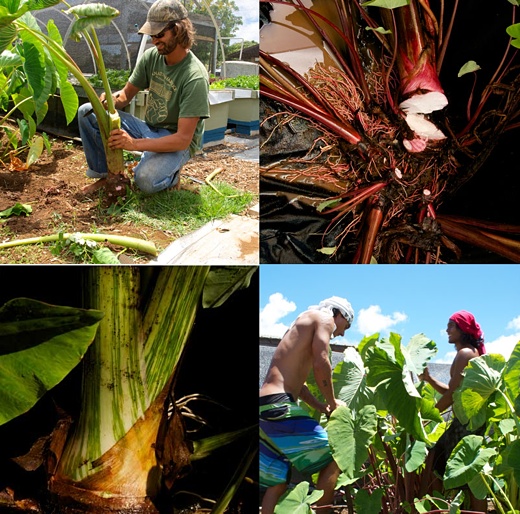
SUBHEAD: Join in a taro festival on Thursday, 23rd of August at 7:30pm at Children of the Land. By Jill Richardson on 22 August 2012 in Island Breath - (http://islandbreath.blogspot.com/2012/08/amazing-taro-feast.html) Image above: A medley of taro harvesting images. FromRegenerations Botanical Garden. WHAT: Adopt a Taro Variety Celebration & Feast WHEN: Thursday, 23rd of August 2012 from 7:30pm to 10:30pm WHERE: Children of the Land Center Kauai Village Shopping Center 4-831 Kuhio Hwy #332, Kapaa Next to Papaya's Natural Foods CONTACT: Jill Richardson Regenerations Botanical Garden Phone: 808-652-4118 Email: jr@ribg.org www.ribg.org
A unique and special opportunity to taste 40 organically grown varieties of taro and receive planting material of this sacred Hawaiian food. Featuring a screening of the film “Mālama Hāloa – Protecting the Taro” starring Uncle Jerry Konanui- who will be at this event to talk-story and share his love and knowledge of kalo (taro) with us! After 8 months of growth at the Kaua`i Community College farm, 43 varieties of taro were harvested over last weekend. The huli (cuttings used for propagating taro) are being distributed to planters all over Kaua`i. Many of these are rare traditional Hawaiian varieties that are prized for their beauty and superior eating quality. Now you can sample dozens of varieties and network with other taro lovers at this unprecedented dining event. Willing gardeners and farmers will adopt and take home prized taro varieties to grow out and share. This event is presented by Regenerations Botanical Garden, Children of the Land, and Makaweli Poi Mill. .

Makaweli Poi Reprieve

SUBHEAD: The Office of Hawaiian Affairs revisits decision to close Makaweli Poi Mill in Waimea. By Dennis Fujimoto on 15 may 2012 for the Garden Island - (http://thegardenisland.com/news/local/oha-revisits-makaweli-poi-mill-transition/article_fe5bca84-9f3d-11e1-9625-0019bb2963f4.html) Image above: Anna Henriques, Jade McCoy and Raynella Kanahele of Ishihara Market in Waimea show off the large size Makaweli poi. From from original article. The Office of Hawaiian Affairs announced Tuesday that its non-profit subsidiary, Hi‘ipoi LLC, will transition ownership and management of Makaweli Poi Mill to a Kaua‘i community organization.

“We want to ensure that people in the Kaua‘i kalo community would become the new owners and managers of Makaweli Poi Mill,” OHA Chief Operating Officer Kamana‘opono Crabbe said in a news release.

Hi‘ipoi’s plan allows decisions affecting Kaua‘i’s taro farmers and poi supply to be made by those closest to the situation, the release states.

“We know that local decision-making is important for our Hawaiian community,” Crabbe said. “Our transition plan is intended to make that happen.”

Crabbe said OHA is optimistic about its ongoing discussions with community members who are serious about becoming the new owners and managers of Makaweli Poi Mill.

“All of us in the discussion are aiming for a smooth transition that maintains taro production,” he said.

To maximize the success of the transition plan, OHA will be meeting with Kaua‘i taro community stakeholders, Wednesday to discuss an appropriate timeline and other aspects of the transition.

“We understand our original timeline may have been too ambitious and are open to considering a longer timeframe to implement the transition,” Crabbe said. “We are committed to working with the Kaua‘i community so that kalo can remain a vital part of its everyday life.”

Hi‘ipoi Chief Operating Officer Mona Bernadino said Tuesday in a phone conversation that there never was an intent to close the Makaweli Poi Mill following a visit to the facility and the town.

“Once an appropriate group is identified, things can happen quickly and there should be no disruption of poi,” Bernadino said. “If there is a disruption, it should be just briefly.”

OHA is a unique, independent state agency established through the Hawai‘i State Constitution and statutes to advocate for the betterment of conditions of all Native Hawaiians, with a Board of Trustees elected by the voters of Hawai‘i. OHA is guided by a vision and mission to ensure the perpetuation of the culture, to protect the entitlements of Native Hawaiians.

See also: Ea O Ka Aina: Na pulapula o Haloa 5/12/12

.

Na pulapula o Haloa

SUBHEAD: There are plans to close the Makaweli Poi Mill. Maybe it’s time to go back to our roots.

By Dominick Acain on 12 May 2012 for Island Breath -
  (http://islandbreath.blogspot.com/2012/05/na-pula-pula-o-haloa.html)

 
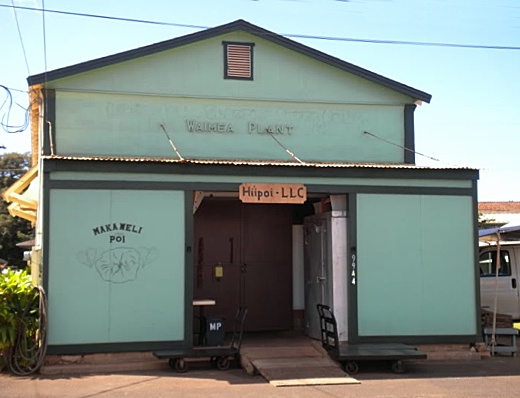
Image above: Front of the Makaweli Poi Mill in Waimea, Kauai. From (http://anyportinastorm.proboards.com/index.cgi?board=oceania&action=print&thread=4880).
 
This is from their (Makaweli Poi) Facebook site:

MAKAWELI POI MILL IS BEING CLOSED against the wishes of the farmers, employees and community. Mill owner, Hi'ipoi LLC has suddenly and unreasonably given the poi mill 2 weeks notice, with highly questionable plans for the mill's future and no community input. Last day of operations might be May 24th. For more information or to voice concerns come to: OHA Community Meeting Wednesday May 16th, 6:00pm King Kaumualii Elementary cafeteria, Hanamaulu. Any interested in helping to SAVE Makaweli Poi Mill should contact: makaweli.poi@gmail.com Please let folks know.

This is my submission to them:
Aloha, My name is Dominic Acain and I am a Kanaka Maoli with roots to Makaweli Valley since time immemorial. My ohana still live on kuleana lands in Makaweli Valley and have been eating the kalo grown there also since time immemorial. According to one ancient legend;
“the Sky Father, Wakea, and the Earth Mother, Papa, had a stillborn son named Haloa-naka. After Haloa-naka was buried, the kalo plant grew from his grave. Haloa is another name for kalo or taro, and it means everlasting breath. Later, humans were created from the same union, and were sustained by the food provided by their older brother, Haloa.”
Even today, like in ancient times, we live on kalo grown in the same earth as our ancestors. We are as Kanaka Maoli, Nā pulapula a Hāloa (The descendants of Haloa). The hills of Makaweli house the iwi of my ancestors who all grew up surviving on the kalo grown in the valley. The art of planting and gathering of kalo has sustained our culture for many generations and it was the responsibility of all to be educated in the process for the survival of our people. Correct me if I’m wrong, but OHA’s purchase of the Makaweli Poi was approved by the Board of Trustees in December of 2007.

According to the February 2008 issue of Ka Wai Ola, under the title “OHA plans for Makaweli poi production, kalo education” the article states that OHA’s intention of the purchase of Makaweli Poi was “to serve West Kaua'i as both an economic stimulus and an outdoor classroom.”

At the time of purchase, the article further stated that business was good from its acquisition by John A’ana in 1993 until the sale was made to OHA. At the time of acquisition by OHA, Makaweli Poi boasted a 12.5 percent profit on sale for a “part-time” operation. John was quoted in the article that he, and I quote, “needed to free up more of my time, but I was cautious about selling to the right party, because I wanted to make sure operations would continue."

It also mentions John as saying that he “considered other offers for Makaweli Poi and his 12-acre wetland kalo farm near the Waimea River” and that “what cinched the deal with OHA was the way the agency folded in cultural and educational programs.” I can’t speak for my cousin John, but as ohana I can tell you that this alone was proof that Makaweli Poi was more than a business venture for him. It was a way to perpetuate the practice that had sustained the Hawaiian culture for generations. I believe that he had sold the business to OHA not only because of their objectives but because of OHA’s mission which is:
“To mālama (protect) Hawai'i's people and environmental resources and OHA's assets, toward ensuring the perpetuation of the culture, the enhancement of lifestyle and the protection of entitlements of Native Hawaiians, while enabling the building of a strong and healthy Hawaiian people and nation, recognized nationally and internationally.”
When OHA purchased Makaweli Poi, it had become:
“the latest nonprofit subsidiary of OHA's limited liability company known as Hi'ilei Aloha, which OHA formed in 2007 as the parent company of Waimea Valley.”
Its goals were to:
  • To preserve and promote the cultural and historical tradition of taro farming and poi production in a sustainable and economically viable manner and to serve as an educational resource for youth.
  • To restore the Makaweli valley as a major taro producing area.
  • Increase the cultural awareness and participation, of young Hawaiians, in taro farming and poi production through the implementation of education programs.
  • Increase taro production in the Makaweli valley and other areas in Waimea by establishing a taro farmers co-operative.
  • Increase poi production and sales by expanding markets for Makaweli poi on Kaua‘i, O‘ahu, Moloka‘i, Maui, Big Island and the mainland.
Outputs/Outcomes over the next five years include:
  • Double taro production in the West Kaua‘i area.
  • At least 25% of the taro farms operated by new and/or young farmers.
  • Incomes significantly increase for at least 10 West Kaua‘i taro farmers.
  • Employment for at least 10 individuals involved in poi production.
These were all reasonable and highly achievable goals. Goals that could most definitely have been achieved under the right management. But that is the key. The right management. When John started operations it was done after hurricane Iniki had devastated the island and along with it taro production. Poi from the old Waimea Poi Mill came to a halt. Centuries of the old mill providing our main staple that kept our people nourished came to a halt.

Under John’s ownership and management, the Makaweli Poi Mill brought light and reconnected us to our past. He proved that he was “the right management.” He was the right management because not only did he live the culture but because all of the people who worked under him lived the culture.

They all had a vested interest in making this work. It wasn’t only about the money. If anyone here has ever worked the lo’i you will know that the labor is not worth the pay. You will not get rich or fat retirement checks from working in the lo’i. What it's all about is the preservation of the culture and historical tradition of taro farming. In fact it's the EXACT same goal that OHA had for the acquisition of Makaweli Poi except for one thing. John, his workers and taro farmers work back breaking jobs to get minimal pay, hardly any money, while OHA officials get to make decisions and earn their pay in the comforts of their air conditioned offices.

When OHA purchased Makaweli Poi, along with it came a responsibility. Not only to John and what he had achieved, but to all descendants of Wakea and Papa. OHA took on the responsibility to make sure that its goals were achieved. Like John, the successful management of the program would take someone who had a vested interest in the land and its people. Including generations not yet born.
Most of the people who farm the land and processed the kalo did not put their college education to work to achieve success. They poured in blood, sweat and tears into preserving our lifestyle. That came first. To make it work again, it would have to take people with a vested interest not only in the “program” but in the land and people who have been here for generations. Whether it is run by a council or a program manager, they would all have to have a vested interest to preserve and promote the cultural and historical tradition that the cultivation, process and education of everything regarding kalo is concerned.

The people on this island know who is who and who are capable of making this work. We have always been a close knit community who pull together through times of the most adversities. For the sake of preserving our culture and traditions, most of us think it unwise to thrust our entire culture into the hands of those who haven’t sacrificed what we have for us her. ON the soil of our ancestors. Many of us never went away. Some of us still live on the same land as our ancestors before the landing of europeans.
Your hiring process falls outside the realm of our west Kauai way of making things work and of persevering during trying times. Maybe it’s time to give our people, locally, here on Kaua’i the opportunity to show what we can do. To do something that we have been doing for generations anyway.

Not by objectives and goals made by people outside of the trenches, but by those within. We have lived the life without straying too far for many generations. We have a time honored tradition of continuing the traditions of our ancestors. We have a vested interest in our culture, our people and our future here on Kauai.

Maybe it’s time to think outside of the box and go back to the roots. Na pula pula o Haloa. We will never stop the preservation and promotion of our culture. We will never stop educating our youth and people in the historical traditions our ancestors. And we urge you to look through our eyes, and listen to our mana’o and to never stop fulfilling your obligation to our people. Nā pulapula a Hāloa (The descendants of Haloa).


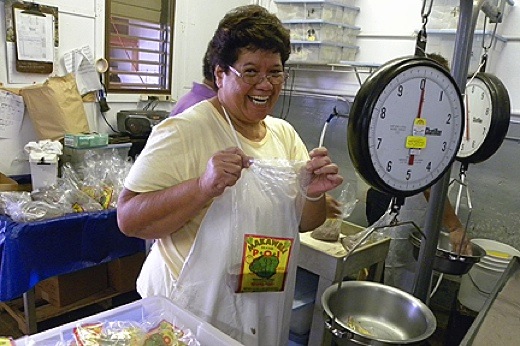
Image above: Makaweli Poi Mill worker Annie Lacro with a 1-pound bag of poi from the Kaua‘i mill where she has worked since 1997. From (http://www.oha.org/kwo/loa/2010/11/story03.php).

.

Free Showing "Release our Water"

SUBHEAD: Free showing of "Release Our Water", 3pm Dec 11, 2011 Kapaa Neighborhood Center Auditorium. By Ray Catania on 2 December 2011 in Island Breath - (http://islandbreath.blogspot.com/2011/12/release-our-water-free-movie-showing.html) Image above: Photograph of Keanae Stream on Maui. From (http://mauitropicalphotos.com/keanae%20stream.html). WHAT: Movie "Release our Water" to be shown free. WHERE: Kapaa Neighborhood Center Auditorium, 4491 Kou Street. Kapaa, HI, on Kauai. WHEN: Sunday, December 11, at 3:00 pm CONTACT: Sponsored by Jimbo Alalem and Ray Cataniaat 635-0835 or 634-2737 for more information. Or email may11nineteen71@gmail.com This documentary film follows film Kanaka Maoli farmers and fishermen from the Hana area on Maui, in their fight with the powerful sugar corporations with large land holdings who have diverted Waiokamilo Stream water for their plantations and then for their high income developments. The Hawaiians having been working to get the water flow back into the stream so that it can benefit the taro farmers and shoreline fishermen, whose ancestors have lived in Hana and Keanae for over a thousand years. Discussion to follow with free light refreshment. More about the film, from Native Books Hawaii (http://www.nativebookshawaii.com/shop/index.php?main_page=product_info&products_id=3510&zenid=vaggqgvj35023r64cjeakoo2f6):
In 1985 Uncle Harry Mitchell and other kūpuna from the Ko’olau of East Maui (Hāna and Ke’anae) began the fight for water when they contested the dewatering of Waiokamilo Stream by powerful corporations on Maui. 23 years later Uncle Harry and many others have passed and the dewatering continues leaving the next generation of Hawaiian taro farmers with the question "Do We Have Rights Or Don't We?" This issue and other issues affecting East Maui are looked at through the eyes of a few Hawaiians whose ancestors have inhabited the region for over a thousand years. This video features Hāna recording artist Boom Helekahi performing his song entitled "Hāna Maui.

A&B endangers Wainiha Taro

SUBHEAD: Taro grower claims A&B hydro-power shutdown impacted taro in Wainiha Valley.  

By Vanessa Van Voorhis on 14 September 2011 for the Garden Island - (
http://thegardenisland.com/news/local/article_b3b2a676-deb6-11e0-b0d9-001cc4c002e0.html)

 
Image above: Aerial view of Hinalele Falls in Wainiha Valley on Kauai, Hawaii. From (http://www.hawaiimagazine.com/blogs/hawaii_today/2010/2/23/untouched_Hawaii_natural_wonders_preserved_forever).

A Wainiha Valley taro grower says she was alarmed when her taro patches suddenly and unexpectedly dried out last month.

“It’s been three days now that no water is in the ‘auwai (irrigation ditch), almost no water in the stream here in Wainiha Valley,” Caren Diamond wrote in a July 28 email to the Department of Health seeking information. “I’m just below the hydro power plant. O‘opu impacted, along with the other creatures … Our taro patches are dry and cracking.”

Alexander & Baldwin, owner of Wainiha Hydro Power Plant, shut down the facility to perform annual maintenance for eight days between late July and early August.

A&B spokeswoman Linda Howe said the facility “gets shut down annually for maintenance for at least a week, sometimes longer.”

“This is a very long standing practice, done since around 1920,” she said. “The hydro can also be tripped offline by the utility, which would stop the flow of water as well.”

Taro ‘hasn’t recovered’

“When it first happened, I didn’t call anybody or do anything,” Diamond said last Wednesday. “I thought it would be coming on in a day or two, as it normally did — but then it didn’t. I wondered if something was wrong … There’s one little stream that comes off of the Wainiha and normally it has good flow.”

So she started asking “old-timers” who live in the valley what was happening. “They said (A&B) normally shuts it off for maintenance but not normally for so long … On the third day is when creatures stared dying.”

She began finding dead o‘opu, a native fish, in the stream along with other animals.

Diamond said there are “certainly” some impacts with hydropower, but issues like timing could be mitigated.

“There’s the heat, the dry summer heat, of July and August,” she said. “That was the exact wrong time to take the water out.”

Diamond questioned why such maintenance couldn’t be performed during wetter or cooler months of the year.

“Eight days with no water, my taro patches grew weeds,” said Diamond, an avid gardener and 32-year resident of Ha‘ena and Wainiha. “My taro patches were very beautiful before then. It hasn’t recovered from this. It will take a lot of manpower to get them back to where they were … This has made a whole lot of work for us.”

A&B’s response
The 3.5-megawatt Wainiha Hydro Power Plant on the North Shore was built in 1906 by McBryde Sugar Company, a subsidiary of A&B, to generate electrical power to drive irrigation pumps in Hanapepe. A 33-mile-long transmission line carries the power from the north to the south of the island.

Today, the power is sold to Kaua‘i Island Utility Cooperative.

According to a 1988 A&B newsletter, the water for the Wainiha plant comes from the Wainiha River and several feeder streams.

Howe said A&B intentionally schedules maintenance and upgrades of the Wainiha hydro during the driest time of the year for two reasons:

“First, out of concern for the safety of the people who do the work, as the entire system is involved — from the diversion dam, forebay, tunnels and ditches, pipelines to the powerhouse itself with its flywheels, turbines, various electrical equipment and tailrace ditch,” she said in an email.

“And secondly, to cause the least disruption in the supply of power to the Kaua‘i community. When rainfall is high, power production is high, thus the loss of clean renewable power to the public would be greater and result in a greater amount of fossil fuel being burned to compensate,” she said. “Thus, there is probably a lesser environmental impact undertaking the maintenance work in the drier times.”

Howe said A&B internal resources claim Diamond does not live along the river or its stream system.

“That property is located alongside our tailrace, which is a manmade ditch that returns water, after it has run through our hydro plant, back to the stream,” she said. “That property does not border the Wainiha Stream. The tailrace is not ‘natural’ and isn’t intended to be a source of water for anyone.”

To Howe’s assertion, Diamond replied: “The only time I ever heard that was from them after I complained.”

Diamond said the irrigation for her taro is natural and part of the traditional ‘auwai system the Hawaiians created centuries ago to specifically feed taro systems.

“The original taro lo‘i are on our property,” she said. “I looked up the Land Commission Award for here and the taro patches are named and numbered. The power plant came after the taro patches.”

Diamond said the water goes from mauka to makai and traverses many people’s taro lo‘i.

DLNR: More info needed
Gary Ueunten, an environmental health specialist for the Clean Water Branch on Kaua‘i, inspected Wainiha on July 29th. He confirmed that “the Wainiha hydroelectric plant was undergoing maintenance and the flow of water through the plant was stopped.”

Ueunten did not provide additional comments or information on his findings. He referred The Garden Island to Robert Chong, a planner for the Department of Land and Natural Resources’ Commission on Water Resource Management on O‘ahu.

Chong said in order to speak specifically on the matter, he would need to see the property’s TMK map showing the parcel along with the Land Commission Award — “the actual LCA translated into English.”

Generally speaking, people who live alongside a stream have certain riparian rights, Chong said, certain kuleana or appurtenant water rights under the Great Mahele, Hawaii’s land redistribution act during the 1830s and ’40s. It predates the Water Code, he said, and was grandfathered into it.

“There was a land commission that awarded land to the Native Hawaiians and, with this award, they may have kuleana water rights. For a person to claim they have kuleana water rights today, they need to show that that parcel of land has received that from the land commission.”

With hydro, he said, there’s a man-made diversion, an intake and an outtake. Whether it is located on public or private land is an important consideration.

Chong added that the Water Commission is currently in the process of setting a procedure to determine kuleana or appurtenant water rights on Maui.

In service management areas, people who divert water from ditches would be required to have a permit to use the water, he said. If the diversion is located on private property, typically permission must be obtained from the property owner to use the water in the ditch.

Sustainability
Don Heacock, a Kaua‘i state biologist who has spoken out about environmental impact and sustainability issues related to the Wainiha Hydro Power Plant, said the o‘opu nakea are the most culturally important native fish species. They spawn and migrate down river between August and November, he added.

“What triggers these spawning migrations is flood waters,” Heacock said. “There appears to be spawning that takes place on a small level when it doesn’t flood.”

He speculated that when the Wainiha Hydro Power Plant was built more than 100 years ago, its designers didn’t think about what would happen if the turbines were turned off.

“If we were designing one today, we would design it to bypass the turbine to keep water in the river,” he said. “(Wainiha) could be modified.”

The tailrace of the Wainiha plant — where high-pressure water is released from the turbine and into a ditch system — is a quarter to a third of a mile long, he said.

Heacock said he believes the best way A&B can mitigate the power plant’s impact to the o‘opu nakea and other species is to look for partnerships in habitat enhancement and watershed restoration programs through the state, Fish and Wildlife and EPA.

“We need to find creative ways landowners can make projects more sustainable,” he said.

.
Making Taro Hashbrowns

SUBHEAD: Chinese variety dryland taro makes a great substitute for a McDonald's hashbrown.


By Juan Wilson on 19 December 2009 for Island Breath - 
   (http://islandbreath.blogspot.com/2009/12/taro-hashbrowns.html)

[Authors update 9/26/12: For a while we have been freezing taro corms after trimming and cleaning them (seee second photo below). The frozen corms change their texture after thawing. I believe the freeze/thaw cycle helps break down the calcium oxalate. When shredding and frying the thawed taro I've found it cooks faste, is stickier and seems to have less irritation for those sensitive to calcium oxalate.]

   
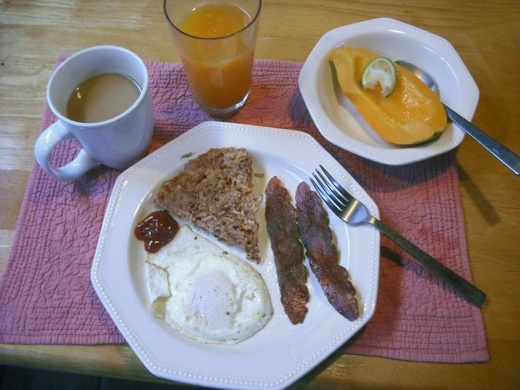
Image above: Mostly loco-vore breakfast. Eggs, papaya/lime, orange juice, and taro hashbrown from yard. Coffee from nearby Kauai Coffee. Catsup and turkey bacon from God-knows-where via Eleele Big Save Supermarket. All photos by Juan Wilson.

We've been growing dryland taro for five years in our backyard. See Island Breath: Backyard Taro Farmer. My favorite use of them is as a hashbrown for breakfast. Before you try any taro recipe you should realize that in its raw form taro is toxic, due to the presence of calcium oxalate, although the toxin is destroyed by cooking.

The calcium oxalate can be removed a long boil or, according to Wikipedia, by steeping taro roots in cold water overnight. It is also good to determine how sensitive you are to the calcium oxalate. I have a pretty high tolerance to it, whereas my wife is quite sensitive. She generally has no problem eating the taro prepared as hashbrowns. For my hashbrowns I neither boil or steep the roots (corms). Note, as far as I know this is only possible with the varieties of dryland taro that are low in calcium oxalate, to begin with. These varieties are white inside, rather than lined with a purple pinkish color.


Image above: Trimmed and cleaned dryland taro corms. Note how free of pink spots they are.

One medium size corn will provide 2-3 hashbrown servings. Peel the dark brown skin off the taro corm. The peeled skin should include the purple and pink layer below. From what I understand this is where there is the greatest concentration of calcium oxalate. Note the peeled corm has a soapy, slippery texture, so be careful of your knuckles on the grater... or leave a little skin on the corm to form a good grip.


Image above: A halfway shredded taro corm almost ready for seasoning.

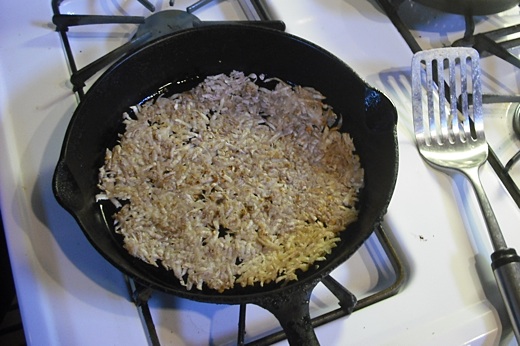
 Once shredded I add a pinch of Hanapepe sea salt, some black pepper and a generous amount of powdered garlic. Adding some minced fresh garlic as a nicety too. The shredded taro sticks quite well to itself. Just put the shreds in the preheated high temperature safflower oil. Spread and flatten the taro out to fill the bottom of a 10" cast iron skillet. The trick to taking care of the calcium oxalate is to press the taro very thin (1/8"). This process will make a the taro into something like a pan fried chipate. It will cling together, so that you can flip it like a pan-sized pancake. Cook the big hashbrown thoroughly on both sides.


 Image above: Shredded taro flattened and fried in oil on both sides until browned.

 This can takes about ten to fifteen minutes. The hashbrown is ready when it is slightly browned on both sides and crispy. I fold it in half and continue heating it for a few minutes. When the eggs and turkey bacon are done I cut the big semicircular hashbrown into some pie shaped wedges for serving. A little catsup on the side works well with a dash of hot sauce. Happy Breakfast! If you grow your own taro...

 
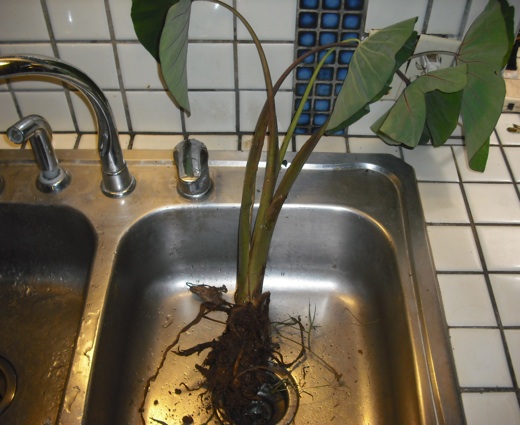
 Image above: a fresh picked dryland taro plant from backyard ready to be washed and trimmed.

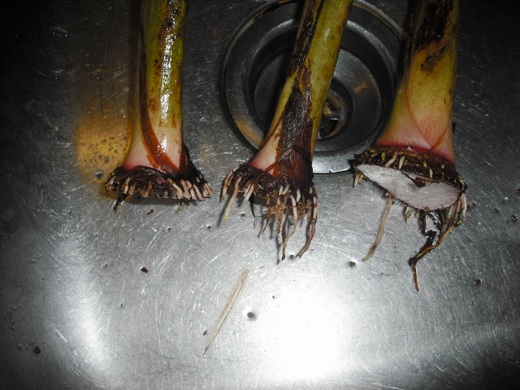
You want to harvest only the few plants you will need for no longer than a week or so. Care must be taken to cut the corm (root) off the plant without damaging the seam between the out-of-ground portion and the rooting portion. This is so the upper part of the plant can be replanted to regrow another corm. All but the most inner (newest) leaf stem should be clipped off the plant for replanting (so as not to waste plant energy).


Image above: Trimmed upper part of taro plants ready for re-planting in ground.

Taro plants do not have to be replanted immediately. Even a week after harvest plants can be viable. I recommend wrapping them in a moist towel and keeping them in a shaded place if you are going to wait to replant them.

See also:
Island Breath: Ulu - The Breadfruit Tree 12/31/06
Ea O Ka Aina: Get out your Ulu 7/19/09
Ea O Ka Aina: Peak Macadamia Nut 9/22/09
Ea O Ka Aina: Green Turtle Mango 10/13/09
Ea O Ka Aina: Green Papaya Sauerkraut 10/14/09
Ea O Ka Aina: Breadfruit Experiments 11/15/09