Showing posts with label Students. Show all posts

Student debt problem is "yuuuge"!

SUBHEAD: Long-term implications of loaning a trillion dollars to young people who have no assets.

By Shaun Bradley on 1 February 2017 for Anti Media -
(http://theantimedia.org/student-loans-problem-much-bigger/)
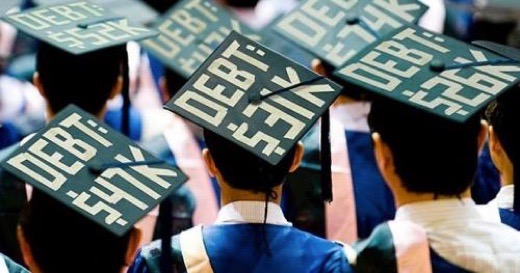

Image above: Students wearing graduation caps with their debt taped on top. From (http://www.zerohedge.com/news/2017-02-02/america%E2%80%99s-student-debt-problem-much-bigger-anybody-realized).

The Department of Education recently released a memo admitting that repayment rates on student loans have been grossly exaggerated. Data from 99.8% of schools across the country has been manipulated to cover up growing problems with the $1.3 trillion in outstanding student loans.

New calculations show that more than half of all borrowers from 1,000 different institutions have defaulted on or not paid back a single dollar of their loans over the last seven years.

This comes in stark contrast to previous claims and should call into question any statistics provided by government agencies. The American people haven’t fully grasped the long-term implications of loaning a trillion dollars to young people who have no credit or assets.

Increases in tuition seen over the past two decades have become a point of controversy and angst for those who don’t fully understand the contributing factors.

Between 1995 and 2015, the average cost of a public, four-year university skyrocketed by well over 200%. Although federal student aid programs are often championed as a necessity, they have been instrumental in making higher education unaffordable. The opportunity to pay for college by working a part-time job evaporated as soon as huge sums of money were handed out to anyone with a pulse.

Since students no longer pay their tuition upfront, colleges are able to raise prices in perpetuity, knowing the government will step in and make credit easier and easier to obtain. As an added bonus, outstanding student loans account for 45% of the government’s financial assets.

Subsidizing the lives of an entire generation has turned personal growth and advancement into a choice instead of a necessity.

After all, why take risks or work your way up from the bottom when with just a signature, the life you’ve always wanted could be laid at your feet? It’s not hard to figure out why so many people are tempted to take advantage of the instant gratification that comes from student loans, but like everything else in life, they have a price.

The same safety net that delays the anxiety of the future also ensures that monthly payments will be owed for decades to come. Procrastinating when faced with pivotal life decisions is an instinct that used to be overcome as a teenager, but today it is worn like a badge of honor well into adulthood.

The policies of intervention haven’t stopped at federal aid, and loan forgiveness is now being offered to those willing to work in the public sector or at a non-profit for ten years.

This perverse incentive only serves to drive those desperately in debt further towards government dependence. Productive jobs are created when the needs of others are met in the free market, not by joining the ranks of the state for self-preservation.

The idea that success comes exclusively through attending a university has created a stigma against some of the most valuable occupations.

The lack of real skill sets has lead to a shortage of welders, electricians, carpenters, and other trade workers. Instead of learning through experience with apprenticeships, many students have embraced four years of sleeping in, drinking heavily, and getting an increasingly useless degree.

While there are many fields that require specialized training, the surge in popularity of degrees like sociology, anthropology, and communications clearly illustrate a disconnect between the needs of the economy and the skills of the incoming workforce.

The normalization of this system has blinded individuals to their own potential. Some of the most successful entrepreneurs and thinkers are those who have bypassed traditional education.

Mark Zuckerberg, Steve Jobs, Richard Branson, and hundreds of other innovators achieved greatness by breaking from predictable paths to knowledge.

Instead, passion and experience were the foundations that gave them the confidence needed to make groundbreaking strides. What it means to learn and be educated is changing rapidly as technology develops, and it will eventually force the State to adapt with it.

Albert Einstein was able to spot the innate flaws in the education system even back in 1936, but it’s doubtful he could have fathomed how far things would go:
“I want to oppose the idea that the school has to teach directly that special knowledge and those accomplishments which one has to use later directly in life. The demands of life are much too manifold to let such a specialized training in school appear possible…The development of general ability for independent thinking and judgment should always be placed foremost.”
Those who do achieve their degrees often do so without developing important skills like critical thinking and individual discernment. The scariest part about this revelation is that almost 90% of outstanding private loans are co-signed by parents, making this an intergenerational problem.

As the instability of pension funds, social security, and economic conditions continue, any additional burdens passed onto the baby boomers could have far-reaching ramifications.

The vast distortions in information that this report exposes should motivate everyone to become an independent fact checker. The only way to reform this broken system is to shift the pursuit of knowledge towards the direction of each individual’s passion instead of creating more cogs for the machine.

.

The Terrible Thoreau

SUBHEAD: Thoreau died just 150 years ago, but theEarth has ages more than 150,000 years since.

By Jim Ralston on 9 September 2015 for the Sun -
(http://thesunmagazine.org/issues/477/that_terrible_thoreau)


Image above: An Autumn morning on Waldon Pond. From (https://nn.wikipedia.org/wiki/Walden_Pond).

In the first hour of morning, Henry David Thoreau writes in his transcendentalist masterpiece Walden, “some part of us awakes which slumbers all the rest of the day and night.”

I’m sleeping in my clothes on Emily’s living-room couch when I wake to find her two-year-old daughter, Ariel, clutching her stuffed tyrannosaurus and staring into my eyes.

“Go for walk?” she says.

I point to the dark window and tell her it’s still dark out; she needs to go back to bed.

“Go for walk?” she repeats, as if I must not have heard her the first time. She runs into the kitchen and returns with a pretend cup of coffee. I pretend to drink it, smacking my lips and saying, “Ah.” Then I get up.

I’ve been baby-sitting Ariel on Tuesday nights in exchange for a sofa to sleep on when I’m in town for work. (I live a good distance from the community college where I teach.) Over the months, I’ve learned that if Ariel wants to go for a walk, that’s what’s going to happen.

And on that walk, if she wants to sit on the curb and examine a dried-up earthworm, that’s what we’ll do. And if she wants to put the worm in my shirt pocket for safekeeping, along with some interesting twigs and dead bugs, well, what are pockets for?

She and I don’t talk much on our walks, and when we do, we speak in simple sentences: nouns, verbs, the occasional adjective — such as scary if we’re talking about dragons or raccoons. When I don’t understand what Ariel is saying, she sighs and turns her attention to something else: a row of ants on the sidewalk, a squirrel, a clump of thistles. (“Sharpies,” she calls them.)

In the condominium playground she goes down the slide headfirst, and I catch her at the bottom. I think of myself as someone who lives in the moment, but taking care of Ariel has revealed to me what an effort it is just to be for a couple of hours.

When my mind wanders to my to-do list for the day, she pulls me back, pointing to a waning moon hanging above the first streaks of dawn. “Can’t reach it,” she says, holding her arms out. We climb the ladder to the top of the slide and stretch out our arms together, but it’s still beyond our reach.

A neighbor’s dog has been put in the yard to do his business. “Bingo’s pooping,” Ariel says. She wants to pet him, even though Bingo always knocks her down. An upstairs light pops on here and there as people rise from their beds and drift into their kitchens for their first cup of coffee.

Emily’s light is on, too. “Mama’s up,” I say. In the glow of sunrise we pick a bouquet of dandelions and daisies for Emily. She and I had a brief romance a while back, and I’m still in love with her in a sleepy sort of way, but it’s not mutual.

“Robin,” Ariel says, pointing to a bird I hadn’t noticed.

“Two robins,” I say as a second swoops in.

“Want to hold them,” she says.

I tell her that robins don’t want to be held; they want to be free. Ariel runs after them anyway.

The college where I teach English is only a few years old and doesn’t have a real campus yet. Classes are held on the first floor of the Berkeley County Building in Martinsburg, West Virginia. Weather permitting, I find places to teach outside.

This morning at nine I’m scheduled to teach a group of high-school seniors who are taking courses for college credit. I write a note on my classroom’s whiteboard: “American Lit in Norbourne Parish Cemetery; quiz on Henry David Thoreau.”

Waiting for the students to arrive, I poke around the old graveyard, home to many wealthy residents from Martinsburg’s early years. Some of the monuments are twice as tall as I am, but the names and dates have largely eroded away, as names and dates do.

Many of the individual headstones stand at a severe slant, if they haven’t fallen over altogether. Nobody comes here anymore to put things right. Homeless men sleep in remote plots by the back wall. I see signs of their encampments: an empty bottle, some food wrappers. I catch a whiff of urine.

As I walk among the graves, I recall passages from Walden that I’ve known by heart since my college days in the 1960s: “The mass of men lead lives of quiet desperation.” “I went to the woods because I wished to live deliberately, to front only the essential facts of life, to see if I could learn what it had to teach, and not, when I came to die, discover that I had not lived.”

In my youth I thought there was no way I would die without having lived, but today I’m not so sure. Somewhere in midlife time kicked into overdrive, and now, suddenly, there it is on the horizon: the end of the road.

Oh, the acceleration of time! Thoreau died just two life spans ago, but the human population explosion — along with the explosion of our industries and material desires — has caused Mother Earth to age more in that 150 years than she did in the previous 150,000. She has become an old woman overnight.

In 1845 Thoreau, within a half-hour’s walk of his hometown of Concord, Massachusetts, could build a one-room cabin on a pristine lake (Walden is more of a lake than a pond) a mile from his nearest neighbor, catch fish for his dinner, cultivate a bean field for his cash needs, and keep his accounts on his thumbnail.

Every day the possibility of living such a simple and elegant existence grows smaller. Earlier this morning, driving the back roads from Emily’s into town, I passed a construction site swarming with bulldozers and cranes the size of dinosaurs on what I swear last week was a cow pasture.

Nature has been plundered, gobbled up, drilled, fracked, deforested, depastured, deflowered — you name it; we’ve done it and are doing it. We tell ourselves that Mother Earth, like banks and insurance companies, is too big to fail, or that, should She begin to fail, we can bail Her out at the last minute.

But enough already. Here come the students filing through the gate, texting on their phones and snapping pictures of themselves, happy to be outside with the birds and the bees on a spring morning, even if they are in a cemetery. Skylar arrives ahead of the pack and whispers to me that I’m getting a reputation: people are calling me the “graveyard professor.”

As she and her classmates settle in among the tombstones, using them for desks or backrests, I ask them to take out a piece of paper for the quiz. They protest almost in one voice, but I begin anyway. Number one: How big was the cabin Thoreau built with his own hands at Walden Pond? Number two: Why didn’t he make it bigger? Number three: On what day did he move in, and why did he choose that day?

As the quizzes trickle in, I see that only a few have read the assignment. Skylar, whose mom died last year, and Minerva, who’s from the Dominican Republic, get their usual perfect scores. The males largely fail.

Disappointed, I try to get my students to view Thoreau’s themes of independence and freedom through the lens of their own lives. Thoreau saw a farmer as being owned by his farm, rather than the other way around. I ask them what possessions they are “owned” by: their smart- phones, maybe?

A few roll their eyes, but I press on: A phone has a monthly bill. If your parents don’t pick up the tab, you need a part-time job to pay for it, and then a car to get to work, and maybe a second job to pay for the car.

“Maybe we like our jobs,” one young man says.

OK, I reply, but what about the workers in China who made those phones: Do they like their jobs? Thoreau took up his life on Walden Pond not only to live simply but also to make sure he wasn’t enjoying a comfortable existence on the backs of others who labored for little or no wage.

Several students talk at once, asking what they are supposed to do: give up their phones?

I tell them I don’t have a cellphone. Or the Internet. Or a TV.

“No TV, Mr. Ralston?” Minerva says. “That’s like not having a toilet.”

There is laughter in the graveyard.

As the class winds down, I go over the answers to the quiz: Thoreau moved into his ten-by-fifteen-foot cabin on July 4, Independence Day, 1845. He chose that day to make the point that political independence is just the beginning.

We’re not completely free until we also throw off our inner masters: greed, laziness, ignorance. I gesture to the cemetery around us. “People hope there’s life after death,” I say, “but for Thoreau the right question was: Is there life before death?”

On that note I send the students on to their next class. As they exit to the street, texting while they walk, I want to call out to them to watch out for cars. All this finger chattering! I remember my hour with Ariel this morning, how aware she was of her surroundings.

I’m also reminded of Thoreau’s acid remark about the laying of the Atlantic telegraph cable in the mid-1800s: that the first message we received from the other side of the ocean would be that Princess Adelaide had the whooping cough.

In my head I hear Howard, my friend and upstairs neighbor back home, telling me to ease up on the kids. Howard is a healer, a spiritual counselor, and an adherent of various Eastern practices: qigong, tai chi, acupuncture. He corrects me when I focus only on how dire humanity’s situation has become.

For example, if I tell him about some problem I perceive in others, Howard might reply, And your tendency to judge people — that’s not a problem?

He and I have been sparring like this for years, and he lands a good blow now and then. I’m always seeing danger ahead for the human race, and his response is always Name a time when there wasn’t danger ahead.

Howard likes to quote from another famous transcendentalist, Walt Whitman, who writes in his poem “Song of Myself” that there “will never be any more perfection than there is now, / Nor any more heaven or hell than there is now.” Howard says Whitman was a giant soul — and Thoreau would have been, too, if not for his penchant for carping about humankind.

.

That's all Folks!

SUBHEAD: Lest some colleague accuse me of burying the lead, here it is up front - I’m leaving Truthdig.

By Peter Z. Scheer on 1 March 2015 for TruthDig -
(http://www.truthdig.com/report/item/thats_all_folks_20150301)


Image above: Porky Pig bids "adieu" for Looney Tunes. From (https://www.pinterest.com/pin/363665738630869742/).

Lest some colleague accuse me of burying the lead, here it is up front: I’m leaving Truthdig.

In case you don’t know me, I’m the managing editor, which means I more or less run the show. (Truth is, our talented staff does most of the hard work.) I feel strange about leaving. Roll with me—I have some things to get off my chest.

When I started this job nine or so years ago, George W. Bush was in his second term and the U.S. was plainly stuck in two costly, deadly, seemingly endless wars. America was torturing people.

Our government routinely lied about pretty much everything. Bush’s attorney general, who tried to eliminate all traces of marijuana and boobies from the national landscape, was replaced by a guy who was somehow worse.

The people of New Orleans were drowning and waiting to be saved by the horse enthusiast who was in charge of FEMA. In those times, running Truthdig was a lot easier. The targets were clearly marked.

In a period when the press at large had mostly failed in its duty, Truthdig would avoid quibbling about the obvious and dig for lesser-known truths about the day’s events. We would mine these truths from experts, on-the-ground reports and the small crevices of the Internet and broadcast them as far as our readers, friends and online allies would carry them.

Now, as I write this, an original print of Shepard Fairey’s “Hope” poster sits behind me, Barack Obama’s eyes overseeing everything I type. How appropriate given what we now know about the NSA. I cannot think of a greater disappointment than President Obama—like so many millions of other Americans, I completely fell for it.

I remember sitting in a Nevada home surrounded by volunteers from California, Chicago and elsewhere. Among those migrants were disaffected Republicans who may have more clearly recognized a fellow traveler in the candidate. I thought then that they were the dupes. I was wrong.

Regardless, we were united by a common desire for profound change, and we seemed to have found a vehicle for it in Obama. Of course he would go on to squander it all. Truthdig covered the hell out of Obama’s fall from grace. It wasn’t easy, or popular.


Bush, Dick Cheney and Donald Rumsfeld—these had been natural villains for us to pick on. Obama turned out to be an American tragedy. I think of all the young Obama volunteers sleeping in their cars and on couches, sacrificing their time, comfort, energy and zeal for the man.

He marched them from a mountaintop of idealism into a cynical swamp. In doing so, he destroyed my generation’s faith in the political process. It won’t come back. I keep the poster of the young, idealized Obama to remind me not of the man but of the hope—raw and addictive and now gone.

As the Obama years were getting underway, terror raged—not in the form of a missile, bomb or hijacked airplane but of a financial system that apparently still gets to do whatever the fuck it wants. I remember Paul Krugman saying that if the stimulus package was not twice the size of what was being offered, America would end up with a slow, Japanese-style recovery that would take a decade or more.

He was right, obviously. Through its timidity, the government crushed my generation’s belief in the economy: Jobless and with few prospects, we were forced to go back to live with our parents ... unless their homes had been foreclosed.

The Occupy movement restored, for a wonderful moment, the flicker of hope, until some mostly Democratic mayors helped snuff it out. That was a great story to cover. Less so drones, extrajudicial assassinations and mass deportations, including those of refugee children.

Obama’s legacy, as he so often reminds us, is that Detroit—the city bankrupt and the U.S. auto industry now owned in part by Fiat—still kind of makes cars, albeit in Mexico. Also, we have a somewhat reformed health care system, of which I am admittedly a beneficiary.

Don’t get me started on the national security state. It is baffling to me to think that Richard Nixon’s presidency was brought down by a burglary, while the NSA and other intelligence agencies continue to stampede the Constitution without repercussion.

They want to know who you are, what you do, what you say and what you think, and will put you in prison if you dare let anyone know the full extent of what they’re up to. That’s America now, and the collective reaction is “Meh.”

Where does that apathy come from? Some people blame America’s young, but these kids live on a planet that is melting and they exist under a government whose only accountability is to billionaires. Is it apathy, or resignation?

A woman I met while I was at KPFK in Los Angeles one day to broadcast the “Truthdig Radio” show turned to me in tears. She had done the math and figured out she would never be able to pay off her student loans. She begged me to do something about it. Me? Me.

The exaggerated power of the blog had become her last, best hope. I promised to try, but never really did. So before I go, let me venture into the area that so worried her.

Allen Ginsberg wrote in the 1950s, “I saw the best minds of my generation destroyed by madness, starving hysterical naked. ...” I, too, have seen the best minds of my generation go to waste, but not all of these people are starving.

On the contrary, many are doing very well by suckling at the teat of corporate America as they tithe to the student-loan sharks, hoping to hold on to some security in an increasingly frightening world. People in their 20s and 30s no longer have the luxury of “finding themselves,” as their parents used to call it.

The late billionaire Steve Jobs told the assembled graduating students of Stanford University just two years before the nation’s economic collapse, “You’ve got to find what you love.” Because, he elaborated, “the only way to do great work is to love what you do.”

I have two friends who would like to be artists. Instead, one is now a graphic designer, the other makes Internet ads. I have a friend who loves to act; he’s a lawyer. Journalism is now a training camp for PR. The best mathematicians go to work for Wall Street investment firms.

Many of these people are shackled to what is estimated by the Consumer Financial Protection Bureau to be $1.2 trillion in student loan debt. By law, they are not allowed to default. In 1972, the year Jobs dropped out of college, the average annual cost for a four-year education, including fees, room and board, was $2,031, according to the Digest of Education Statistics.

 In 2013 it was $23,872. That’s an increase of more than 1,100 percent. Reed College, which Jobs attended for six months, now costs $59,960 a year for tuition, room and board, a figure greater than the net worth of the typical American household. Not including books, transportation and other expenses, that’s $239,840 for a bachelor’s degree, which is significantly less valuable in the marketplace now than it was in 1972.

And so artists become decorators, anthropologists join global marketing firms and documentarians make crap about Hitler and interplanetary aliens for the History Channel.

These are the lucky ones, the ones who have good jobs and can live well as they lose their creative ambition. There are millions more who must choose between rent and food, who are forced to toil more for fewer dollars and less opportunity.

Let’s think about the long-term consequences of a culture’s failure to value historians, philosophers, artists, musicians, writers and teachers. This attitude and the burden imposed by the student loan system ensure our social slide from passionate to pacified.

We’re taking a generation of educated, potentially independent thinkers and turning it into an organ of multinational corpulence. One day we’ll all wake up to our morning news sponsored by Chevron, eat our sodium flakes and have Siri walk the dog, and no one will remember the name Allen Ginsberg.

.

College and Career Fair peace ban

SUBHEAD: The Hawaii state wide College and Career Fair bans local groups advocating peace and justice.

By Kip Goodwin on 12 November 2014 for Island Breath -
(http://islandbreath.blogspot.com/2014/11/college-and-career-fair-ban.html)


Image above: Military recruiting at career fair in 2010 at Central Carolina Community College. From (http://www.cccc.edu/news/print.php?print=362).

The College and Career Fair is held annually on the four major population islands in Hawaii. Juniors and seniors from all the high schools, as well as middle school students, are bussed in on each island.

This year's event on Kauai is at the Kauai Marriott at Kalapaki on Monday, on November 17th. Some fifty colleges and recruiters from branches of the military have tables.

For the last four years, volunteers of Hawaii Peace and Justice have presented, at their table, factual and vetted information about military enlistment and service and post service realities,as well as college and career opportunities not otherwise represented at the Fair.

This year, Hawaii Peace and Justice is being kicked out of all College and Career Fairs on all islands. In a letter, Fair organizers say HI Peace and Justice does not fit within their mission statement. The letter is dated on Oct. 12, but not postmarked until one month later, or less than one week before the first Fair, a clear indication HI College and Career Fair wants to avoid a backlash from students, teachers and parents.

Upcoming Hawaii College & Career Fairs BANS Local Peace Groups!

The annual Hawaii College & Career Fair starts next week and travels to all islands.The Fairs provides career information and opportunities for 12,000 kids and parents to speak to over 200 representatives of higher education institutions including trade schools, business groups, visitor industries, and military recruiters.

THIS YEAR, at the last possible moment, local Hawaii 'counter military recruiting' groups have been UNINVITED and EXCLUDED from the fairs on all islands. Banning these groups is illegal and they need your help now.

Local counter military recruitment groups are youth advocacy groups that provide high school and middle school youth with crucial information 'to counter' the slick pitch for enlistees from military recruiters and give them alternative ideas besides enlistment.

Heads Up ~ YOUR Quick Email Needed NOW ~ for Equal Time!

PLEASE SEND YOUR QUICK COMMENT TO:
http://www.hawaiicollegecareerfair.org/About-Us.html

If you are a parent, please ask your child's principal for 'equal time' for 'counter-recruiters' at the fair if you child's class is being bussed into this event.

Also, please send letters of support and/or outrage to your local newspapers. This is a blatant attempt to keep youth from getting full disclosure about military careers that they have a LEGAL right to.

Without the the local counter-recruitment groups participating at these fairs, minors will get heavily biased information, funded by our tax dollars.

ONLY YOU can put the pressure on to correct this injustice, right now.

Mahalo!
Oahu - Hawaii Peace & Justice
Maui - Careers in Peace Making
Kauai - Kauai Alliance for Peace & Social Justice
Hawaii Island -The Peace Squad

See also:
Ea O Ka Aina: Army recruiting Kindergarteners? 11/11/09
Parent questions Army presence on Kauai Elementary School Campus. 

Ea O Ka Aina: DOD sues to recruit kids 6/14/09
U.S. military targets kids' minds domestically, targets Middle East kids with weapons.

.

Strange Jubilee

SUBHEAD: Millennials ought to seize the opportunity to make the point that the years of loan swindling are over. By James Kunstler on 9 April 2012 for Kunstler.com - (http://kunstler.com/blog/2012/04/strange-jubilee-1.html) Image above: "Occupy Wall Street" protesters and students demonstrate in Foley Square in New York City on 10/5/11. From (http://www.msnbc.msn.com/id/45040659/ns/us_news-life/t/another-idea-student-loan-debt-make-it-go-away/#.T4Mkzo4QJFQ). Is there a Baby Boomer so dim in this land of rackets and swindles who thinks that he or she will escape the wrath of the Millennials rising? The developing story is so obvious that only an academic economist could fail to notice. Here's how it will go: some months from now, as the financial unwind worsens, and the mirage of gainful employment shimmers away to nothing, and the technocrats of Europe meet nervously by some Swiss lakeside (and are seen glumly shaking their heads), and Romney and Obama try to out-do each other peddling miracle cures for the tanking national self-esteem - a dangerous meme will go forth across the internet, and this meme will say: Millennials, renounce your college loans and set yourselves free!
And then something truly marvelous will happen. They will at once disempower the swindling generation of their fathers, teachers, loan officers, and overlords and quite possibly bring on, at long last, the epochal collision of pervasive American control fraud with the hard hand of reality.
I think this will happen, and I would venture even to set the meme loose here and now and watch it go viral. The college loan racket has been an even more cynical enterprise than the mortgage racket was because so many people who ought to have known better, people of supposed intelligence such as college deans, cabinet secretaries, and think-tank Yodas, all colluded to support the false promise that the gigantic cargo cult of higher ed would keep churning out fresh careers forever - when the truth was that the entire groaning vessel of hopes and dreams was already under water and sinking into the eternal darkness.
And is there a Millennial so dim who believes that the promised package of lifetime goodies once called "a job with benefits" waits like a liveried servant to conduct them without friction through the ceremonies of career and family according to premises and promises of an obsolete American Dream? Dreams do die hard. As dreams go it was a pretty good one while it lasted, but like all dreams, it has vanished in the mists of a new morning leaving the dreamers half-sick, anxious, and drained. They have nothing to lose but their fears of the re-po man and the simulated dudgeon of telephone robot debt-collectors.
This idea should catch on as the election season heats up. Like the anti-war youth of August, 1968, burning their draft cards in the streets of Chicago, the Millennials should flock to Charlotte and Tampa this summer and fill the parking lots (there are no streets in these places) with the smoke of their burning loan contracts - and then proceed with the loud repudiation of party politics in its two current useless, lying, craven, feckless factions. The effrontery of these rogues, promising a hundred years of shale gas, and jobs, jobs, jobs, and a personal relationship with Jesus! Send them packing into the bowels of history, then go home and make it work locally, where it will have to happen in any case because the arc of events has a velocity of its own now and that is our certain destination.
The colleges themselves will, of course, implode shortly, along with everything else currently organized on the super-gigantic scale. They are no more prepared for what is about to happen to them than the chiselers in government, banking, medicine, and global corporate enterprise. We will wonder in retrospect how they ever managed to winkle 50-grand a year for their absurd promises, and how we permitted young people with undeveloped powers of judgment to sign their financial lives away on terms even more stringent than their parents' mortgages. When the universities do go down, tossing their employees overboard in the process, it will be interesting to see the former faculty chairpersons and distinguished professors of econometric modeling learn how to plant kale and care for chickens side-by-side with their formerly-indentured students. I can imagine a period of turmoil in America even harsher than, say, the Cultural Revolution of the 1960s in China where officials, professors, and authorities of all kinds were paraded through the angry mobs wearing dunce caps. Weird things happen history.
The college loan money will not be paid back anyway, so Millennial youth ought to seize the golden opportunity to make the deliberate point that the years of swindling are officially over now. This strange jubilee could, and should, change everything.
.

Student debt hits a $trillion

SUBHEAD: The United States employs Vinnie the Kneecapper to collect student college debt.  

By Raul Ilargi Meijer on 26 March 2012 for the Automatic Earth - 
  (http://theautomaticearth.org/Finance/us-employs-vinne-the-kneecapper-to-collect-student-debt.html)
   
Image above: The student debt monster roars. From (http://studentbill.com/profiles/blogs/the-debt-monster)
 
On the heels of the assessment we saw from Tyler Durden, via Fitch, of the implosion of US student loan debt, which stands at over $1 trillion, increases by $40-50 billion (!!) each month (or $500-$600 billion per year), and of which 27% is already 30 days or more delinquent, John Hechinger explains for Bloomberg how the US Education Department goes about collecting this debt.
Turns out, it's a case of "Eat your heart out, Tony Soprano". Hard to believe this could happen in a supposedly civilized country, but there you have it. Here are some excerpts from Hechinger's article:

The debt collector on the other end of the phone gave Oswaldo Campos an ultimatum:
Pay $219 a month toward his more than $20,000 in defaulted student loans, or Pioneer Credit Recovery, a contractor with the U.S. Education Department, would confiscate his pay. Campos, disabled from liver disease, makes about $20,000 a year.
"We’re not playing here," Campos recalled the collector telling him in December. "You’re dealing with the federal government. You have no other options."
Campos agreed to have the money deducted each month from his bank account, even though federal student-loan rules would let him pay less and become eligible for a plan -- approved by Congress and touted by President Barack Obama -- requiring him to lay out about $50 a month. To satisfy Pioneer, Campos borrowed from friends, cut meat from his diet and stopped buying gas to drive his 82-year-old mother to doctor’s visits for her Parkinson’s Disease.
 
With $67 billion of student loans in default, the Education Department is turning to an army of private debt-collection companies to put the squeeze on borrowers. Working on commissions that totaled about $1 billion last year, these government contractors face growing complaints that they are violating federal laws by insisting on stiff payments, even when borrowers’ incomes make them eligible for leniency.

Education Department contracts -- featuring commissions of as much as 20 percent of recoveries -- encourage collectors to insist on high payments. Former debt collectors said they worked in a "boiler-room" environment, where they could earn bonuses of thousands of dollars a month, restaurant gift cards and even trips to foreign resorts if they collected enough from borrowers. [..]

Debt collectors are the subject of more complaints to the Federal Trade Commission than any other industry -- almost 181,000 last year. Within the past 17 months, three companies working for the Education Department -- including one that is majority owned by JPMorgan Chase & Co.’s private-equity arm -- settled federal or state allegations of abusive debt collections. The companies didn’t acknowledge wrongdoing, and Chase declined to comment. The Education Department said the government investigations didn’t involve the companies’ work for the agency. [..]

Debt-collection companies helped the Education Department recover $11.3 billion in defaulted loans during the year ended Sept. 30. The agency projects it will collect 85 cents on every dollar that defaults, factoring in collection costs and the time-value of money.

The debt collectors made out well, too. Based on a review of government contracts and Education Department data, the private companies -- working directly for the government and through state agencies -- received commissions of about $1 billion in the year through September. [..]

"Student-loan debt collectors have power that would make a mobster envious," Harvard Law Professor Elizabeth Warren, who helped establish the Consumer Financial Protection Bureau and is now running for a U.S. Senate seat from Massachusetts, said in 2005.

Under Education Department contracts, collection companies "rehabilitate" a defaulted loan by getting a borrower to make nine payments in 10 months. If they succeed, they reap a jackpot: a commission equal to as much as 16 percent of the entire loan amount, or $3,200 on a $20,000 loan.

These companies receive that fee only if borrowers make a minimum payment of 0.75 percent to 1.25 percent of the loan each month, depending on its size. For example, a $20,000 loan would require payments of about $200 a month. If the payment falls below that figure, the collector receives an administrative fee of $150.
Debt collectors are under pressure to extract as much money as they can up front, or lose their jobs, said J.C. Cournan, who worked for Pioneer Credit Recovery from 2004 through 2007.

Collectors, then paid about minimum wage, could earn thousands of dollars a month in bonuses, based on the money that borrowers repaid, said Cournan, who took the upstate New York job out of high school. Pioneer set monthly goals for wage garnishments and loan rehabilitations, he said.

Using automatic dialers to track down borrowers, Cournan would figure out where they worked, then contact their employers. He would tell borrowers that he was going to seize part of their wages if they didn’t make the payments. Using a company loan calculator, Cournan would insist on the minimum payment, he said.

"When you’re making 8 bucks an hour, it’s all about the bonuses. You’re starving," said Cournan, 26, now an auto mechanic. [..]

The collection business is booming as defaults more than doubled since 2003, along with outstanding federal student loans, which totaled $848 billion as of Sept. 30, surpassing credit-card debt.

The U.S. loan program was born in 1965 as a "Great Society" initiative for lower-income students under President Lyndon Johnson. Today, with tuition soaring, two-thirds of college seniors graduate with loans, which average $25,000, according to the Institute for College Access & Success, an Oakland, California, nonprofit education and advocacy group.

Obama -- supported by Congress -- has pledged to give borrowers a break and make college more affordable.

In 2009, Congress expanded a program that lets lower-income students tie payments to their incomes. It’s a sliding scale, based on their debt, salaries and family obligations. Married borrowers with two children, $30,000 in income and $30,000 in student loans wouldn’t have to make any payments, according to a government loan calculator. If circumstances don’t improve, the loans can be canceled after 25 years.

Well, you get the picture by now. And if the US government gives the shining example by resorting to employing debt collectors with a mobster mentality, we can all imagine what sort of "services" other creditors may think wise to use.

It's insanity to use this sort of thing against one's own young generation, upon which the future of a nation depends. The fact that the $1 trillion total student loan debt is set to double at the current rate within 2 years, is a clear enough signal of how the US sees its own children. The Vinnie the Kneecapper fashion of collecting on the debt really only serves to clarify and amplify that picture.

And you may rest assured that it's not just the young. As debt levels are rising, and defaults are exploding against the backdrop of much stricter bankruptcy laws, we will soon all know someone in our families or circle of friends who's had a visit of Vinnie.

Maybe now people will start to understand why we have said so many times before that they need to get out of debt.
.