Showing posts with label Wetiko. Show all posts

Beyond Wetiko Agriculture

SUBHEAD: Saving our soil by supporting the microorganisms that are the foundation of life.

By Tom Newmark & Steven Farrell on 15 March 2017 for Common Dreamsd -
(http://www.commondreams.org/views/2017/03/15/beyond-wetiko-agriculture-saving-ourselves-soil)
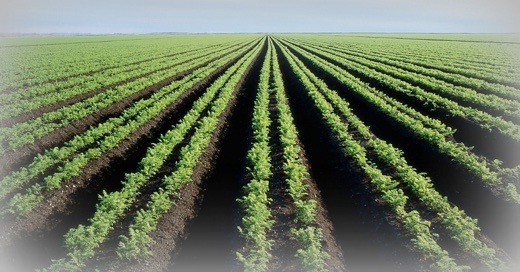

Image above: Genetically modified pesticide sprayed monocrop farmed with large machines by corporate agribusiness. From original article.

How much longer do you hope to live? How long do you hope your children or grandchildren will live?  Do you think you or your loved ones will live 60 more years? If so, you’ll be around to witness the end of food production on the planet.  Unless, that is, we become conscious of the crisis and evolve.

According to a recent United Nations FAO report, due to human ecological malfeasance we have only 60 harvests left on this wasting planet.

That’s it: 60 more years of food and then the industrial agribusiness frenzy is over. And it might actually be far worse: the just-issued report of the Environmental Audit Committee of the British House of Commons warned that "Some of the most productive agricultural land in England is at risk of becoming unprofitable within a generation through soil erosion and loss of carbon, and the natural environment will be seriously harmed." Indeed, in some places it’s already happening.

Food systems around the world are breaking down, and the resulting food shortages have led to wars and revolutions. Starving people are risking everything as they flee to areas where there is still food. Why is this happening?

Why would humans destroy the very soils that have long sustained civilizations?  The First Peoples of North America have an explanation for this form of suicide: the wetiko psychosis. Wetiko, also known by some First Peoples as wendingo, is a cannibalistic spirit that devours the flesh of humans or, ecologically, eats the flesh of Mother Earth.

Like all memetic thought-forms, wetiko is transferred from person-to-person or through larger cultural forces through values, beliefs, ideologies, behaviors and practices.

The wetiko psychosis, then, is the mental derangement that leads our species to consume life-giving soils, and some will say that the psychosis is caused by spirit possession.

Others might say it’s caused by governments under the control of indifferent corporations that enslave and crush the spirits of the free. And others might say its the result of clever marketing or meme warfare.

But it’s the wetiko psychosis we’re seeing: the diagnosis is clear.

Just like families that suffer with deranged family members, the family of life on this planet suffers from our collective wetiko psychosis.

Eighty percent of life, as measured by the biomass of all organisms alive today, finds their home in the soil. Earthworms, nematodes, fungi, protozoa, bacteria, and more work together to create a "soil food web" that delivers water and essential nutrients to the plants that we see growing atop the land.

They form the life bridge between the inert chemistry of the planet and the biological processes that make Earth a living planet—that make our planet Gaia.

Wetiko-deranged humans, however, rip apart and poison the soil food web—dismantle the life bridge—thereby diminishing the complexity and vitality of the nutrient-delivery system. Want to see what that looks like?

Consider these two photos, taken by the authors on the same day in a field near their farm in Costa Rica.

These two fields were part of an experiment comparing industrial/chemical agriculture with regenerative agriculture.

The fields were planted side-by-side with the same crop—cassava—and the fields were essentially identical at the start of the trial. Same starting soil, same geography, same farmers, same crop, same water, and same sunlight.

At the time of planting an unprecedented drought hit the region: even though the test sites were in a rainforest region, there was no rain for six weeks.

As the photos reflect, one field survived while the other suffered massive plant death.
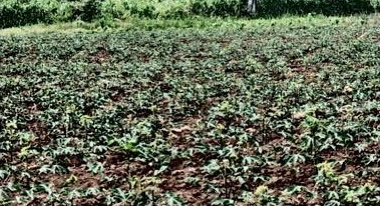
Photo above: Regenerative cassava field during a drought. From original article.

Photo above: Conventional cassava field during a drought. From original article.

The field that survived was the regenerative field, so neither chemicals nor pesticides were applied to it. The other field—the dead zone—was treated with agrochemicals in accordance with agricultural best practices in Costa Rica.

As the drought occurred immediately after planting the first crop in the experiment, we could not attribute the failure in the dead zone to diminished soil organic matter.

If anything, the dead zone started with slightly better soils, and even slightly better populations of soil microorganisms.

After the chemicals were applied, however, the microorganism populations in the dead zone—both bacteria and protozoa—plummeted, while in the regenerative site those microorganism populations rose.

Those were the only differences between the fields, and it appears that the health of the soil food web in the regenerative field was enough to protect plant life during the severe drought.

Drought is the new normal. Farmers must contend with increasing and unprecedented weather extremes caused by climate change. We need all the help we can get, and the unseen trillions of microorganisms in a healthy field are there to help us weather the storm and to rebuild damaged soils.

This can only happen once we see the forces of wetiko at work and dismantle its root cause in our culture, in our communities, in our governments, in our corporations, in our relationship to the Earth, and of course, in ourselves.

This essay is a part of the Seeing Wetiko series in partnership with The Rules, a global network of activists, writers, researchers, coders, farmers and others focused on addressing the root causes of inequality, poverty and climate change.

.

Lessons from Standing Rock

SUBHEAD: The North Dakota camp may have been evicted but the movement hasn’t lost.

By Alnoor Ladha on 8 March 2017 for Common Dreams -
(http://www.commondreams.org/views/2017/03/08/memory-fire-and-hope-five-lessons-standing-rock)


Image above: Burning of NoDAPL Standing Rock village at site of Dakota Access Pipeline protests. From original article.

Here are five lessons activists around the world can learn from the water protectors.

"The struggle of man against power is the struggle of memory against forgetting." —Milan Kundera, The Book of Laughter and Forgetting

On February 22, 2017, water protectors at the Oceti Sakowin camp, the primary camp of Standing Rock, were evicted by the Army Corps of Engineers in a military style takeover. A peaceful resistance that began with a sacred fire lit on April 1, 2016, ended in a blaze as some of the protectors, in a final act of defiance, set some of the camp’s structures on fire.

The millions of people around the world who have stood in solidarity and empathy with Standing Rock now stand in disbelief and grief, but the forced closure of the encampment is simply the latest chapter in a violent, 500-year-old history of colonization against the First Nations. It is also the latest chapter in the battle between an extractive capitalist model and the possibility of a post-capitalist world.

Of course, the ongoing struggle will not go down in the flames at Oceti Sakowin. We should take this opportunity to remember the enduring lessons of this movement, and prepare ourselves for what is to come next.

1. There is a global convergence of movements
When I visited Standing Rock in October 2016, it struck me that this was the most diverse political gathering I’d ever seen.

Over 300 North American tribes had came together for the first time in history. Standing alongside them were over 100 Indigenous communities from all over the globe. A contingent from the Sami people, the Indigenous peoples of Scandinavia, had traversed the Atlantic to show their support the day I arrived. They were joined by black bloc anarchists, New Age spiritualists, traditional environmentalists, union organizers and ordinary Americans who have never attended a protest.

The media has characterized Standing Rock as a one-off protest against a pipeline in North Dakota.

But the reality is that the various movements from around the world including the Umbrella Movement in Hong Kong, the Pink Tide in Latin America, the landless people’s movement from India, the anti-austerity movement in Europe, the global Occupy movement, and the countless "awakenings" spreading across the African continent are uniting as expressions of the same impulse: a belief that the neoliberal capitalist system has failed the majority of humanity and a new world is emerging.

2. A more holistic activism is emerging
With its sacred fire, daily prayers and water ceremonies, Standing Rock has helped to reanimate the sacred aspect of activism. We are seeing a shift from resistance to resistance and renewal simultaneously. Progressive movements which once internalized the Neitzchean dictum that "God is dead" are now evolving their positions.

As the anarchist philosopher Hakim Bey states:
"As Capital triumphs over the Social as against all spiritualities, spirituality itself finds itself realigned with revolution."There is a shift to embracing a more holistic activism that transcends traditional Cartesian duality and calls upon greater forces. Cedric Goodhouse, an elder at Standing Rock put it simply, saying: "We are governed by prayer."
The particular ways in which Standing Rock embodied non-violent direct action has given many activists a new faith in the possibility of a more sacred activism. I stood with dozens of water protectors when they prayed on water in front of Energy Transfer Partners (ETP) engineers while they were laying down oil pipeline.

The very act of seeing Indigenous elders praying on water said more about the implications of an extractive pipeline than any linear argument. They dropped their tools not only because they wanted to avoid confrontation, but because somehow they understood they were on the wrong side of the moral calculus.

The author Charles Eisenstein reminds us of a powerful insight about sacred activism that has been embodied in Standing Rock: "We need to confront an unjust, ecocidal system. Each time we do we will receive an invitation to give in to the dark side and hate 'the deplorables.'

We must not shy away from those confrontations. Instead, we can engage them empowered by the inner mantra that my friend Pancho Ramos-Stierle uses in confrontations with his jailers: 'Brother, your soul is too beautiful to be doing this work.'

If we can stare hate in the face and never waver from that knowledge, we will access inexhaustible tools of creative engagement, and hold a compelling invitation to the haters to fulfill their beauty."

3. Occupation of space is a critical tactic
Even before Occupy there has been a renaissance in the political understanding of the value of place and space. The battlegrounds between the corporate/state nexus and people’s movements are physical realms: the places where resources are being extracted, water is being polluted and capitalist interests are expanding through what Marxist geographer, David Harvey, calls “accumulation by dispossession.”

The occupation of space creates a physical spectacle that forces the corporate media to tell the stories it would otherwise like to ignore. It creates networks of solidarity and deep relationships that span beyond the time and space of the occupation. It creates inter-generational transfers-of-knowledge, both politically and spiritually. It weaves the connective tissue for the continued resistance against corporate (and other imperialist) power.

Standing Rock will be remembered by the thousands of activists who braved blizzards to sleep in tipis, who cooked food together in the communal kitchens, and celebrated in song and ceremony with tribal elders around the sacred fire.

As the activist Reverend Billy Talen recently stated: "Zuccotti Park and the stretch of sidewalk in front of the Ferguson police department and the meadow near the Sacred Stone… these three places are lived in.

Here is where activists cared for each other and shared food, clothing and medicine. The force that upsets entrenched power the most is this compassionate living, this community in plain sight."

4. We are Nature protecting itself
Part of the on-going colonial legacy of North America is a battle between the mute materialism of capitalism that seeks to dominate nature and the symbiotic approach of Indigenous thought that sees Nature as alive, and sees human beings as playing a central role in the evolution and stewardship of the broader whole. It is this very worldview that rationalists derisively call “animist” and that continues to confound the utility maximization ideals of modern thought.

Indigenous lands are increasingly going to be a battleground not only for resource extraction, but ideology itself. Although Indigenous peoples represent about 4% of the world’s population they live on and protect 22% of the Earth’s surface. Critically, the land inhabited by Indigenous peoples holds the remaining 80% of the planet’s biodiversity.

It is no coincidence that ETP moved away from its early proposal to have the DAPL project cross the Missouri river just north of Bismarck, a primarily white city, to the Standing Rock area inhabited by the Sioux tribe.

During COP 21 in Paris, Indigenous youth groups carried banners that read: "We are Nature protecting itself." The idea that we are not protestors, but protectors of the sacred is a central theme that resonates throughout the world.

In a powerful article on the Sacred Stone blog, the camp’s founder Ladonna Bravebull Allard said: "This movement is not just about a pipeline. We are not fighting for a reroute, or a better process in the white man’s courts.

We are fighting for our rights as the Indigenous peoples of this land; we are fighting for our liberation, and the liberation of Unci Maka, Mother Earth. We want every last oil and gas pipe removed from her body. We want healing. We want clean water. We want to determine our own future."

These ideals are not just Indigenous ideals; they are ideals linked with our very survival as a species. In a world of catastrophic climate change, protecting the sacred must be the mantra of all activists and concerned citizens.

5. There is a common antagonist
Although the various social movements around the world are portrayed as separate incidents that are particular to their local context, there is a growing awareness among movements themselves that we are uniting against the same antagonist: the deadly logic of late-stage capitalism.

Whether one is fighting for land rights in India or tax justice in Kenya or to stop a pipeline in the US, the ‘enemy’ is the same: a cannibalistic global economy that requires perpetual extraction, violence, oppression, in the service of GDP growth, which in turn, benefits a tiny elite at the expense of the world’s majority.

There is a Algonquin word, wetiko, that refers to a cannibalistic spirit that consumes the heart of man. It was a common term used when the First Nations of North America initially interacted with the Western European colonialists.

The spirit of wetiko, like many memetic thought-forms, has mutated and evolved, and has now become the animating force of the global capitalist system. We are not just fighting a pipeline; we are fighting the wetiko spirit that has taken hold of our planet like invisible architecture.

What Standing Rock achieved so beautifully was to provide this broader context, to ladder up a local struggle for clean water to the struggle against the forces of wetiko itself. 

Wetiko is inherently anti-life. And what we are all fighting for is a new system that recognizes our interdependence with the Earth and with each other, and that allows our highest selves to flourish.

The sacred fire at Standing Rock may now be smoldering but it’s reverberations are only beginning to be felt. As Julian Brave NoiseCat poignantly states in his reflections on the impact of this historical movement:
 "They have lit a fire on the prairie in the heart of America as a symbol of their resistance, a movement that stands for something that is undoubtedly right: water that sustains life, and land that gave birth to people."
This is the enduring power of Standing Rock. It has created inextinguishable hope, activated our historical memory and created new forms of power by the profound act of starting a global movement from a single sacred fire.

The fires of Standing Rock are illuminating the transition that lies ahead and the new society that is emerging from its ashes.


.

GDP is the Big Wetiko

SUBHEAD: The mantra that ‘growth is good’ has been repeated so often that it has the feel of common sense.

By M Kirk, J Hickel & J Brewer on 11 February 2017 for Occupy -
(http://www.occupy.com/article/all-change-or-no-change-culture-power-and-activism-unquiet-world-part-iii#sthash.9SUPSI4i.AzGLRfif.dpbs)


Image above: Wetiko is a variety of native American evil spirit and a in our culture a form of insanity. Strangely enough, people under the collective enchantment of wetiko become fanatically attached to supporting an agenda that oftentimes is diametrically opposed to serving then own best interests. From (http://aetherforce.com/dispelling-wetiko-by-paul-levy/).

If there is one idea that has gained the status of true hegemony – dominant and unquestioned around the world – it is the idea that we need to perpetually grow our economies, and every part of them, in order to improve the quality of human life. This idea is so prevalent that we take it almost completely for granted, as though it is a law of nature.

But in reality, the Gross Domestic Product (GDP) measure was first developed in the 1930s by American and British economists. During WWII, it came into official use by governments keen to know the extent of wealth and resources available for their war efforts.

It is this war-time history that explains why GDP is so single-minded – almost violent. It counts money-based activity, but it doesn’t care whether that activity is useful or destructive. If you cut down a forest and sell the timber, GDP goes up; if you fish the seas to extinction, or start a war, GDP goes up.

GDP doesn’t care about the costs associated with these activities, so long as money is made. What is more, GDP doesn’t count useful activities that are not monetized. If you grow your own food, clean your own house, or take care of your aging parents, GDP says nothing.

GDP exemplifies the logic of wetiko by emphasizing material acquisition and encouraging a self-serving pattern of increasing consumption for every society that uses it as a principal measure of progress. GDP, then, is an instruction to power. In defining progress, it directs power to dedicate itself to more of the same, indefinitely and, if left unchallenged, without limits.

The problem is that this hegemonic theory of human progress is rapidly undermining the very conditions of our existence on this planet. Having pursued GDP growth with single-minded recklessness for the past few generations, we’re now overshooting our planet’s biocapacity by more than 60% each year – vastly outstripping the ability of the natural world to absorb our waste and replenish the resources we’re using.

There are no longer any frontiers where new growth doesn’t directly harm someone else, by, say, degrading the soils, polluting the water, poisoning the air, and exploiting human beings. GDP growth is creating more misery than it eliminates – more ‘illth’ than ‘wealth’, as Herman Daly put it.

And all of this is just at our existing levels of economic activity. Now think about what happens when we start to factor in the prospect of exponential growth. If the global economy is to expand by 3% next year, that means adding US$ 2 trillion to this year’s GDP.

To put that in perspective, this amount is more than the entire global GDP in 1970. Imagine all the cars, all the televisions, all the houses, all the factories, all the barrels of oil, and everything else that was produced in 1970 – not only in Britain and the US, but also in France, Germany, Japan, and every country in the whole world.

Everything.

Keep that mountain of stuff in your mind. That’s how much we have to add next year on top of replicating the amount we produced this year. And because growth is exponential – not linear – we have to add even more than that the year after, and so on ad infinitum.

But these policy-level parameters are really only the surface of the problem. The deeper force is the imperative of ever-increasing production and consumption, and this is what lies at the very heart of our culture – less as an addiction than as an unexamined assumption, an unquestioned ideological force.

The point here is that although there appears to have been all this change in the past year or even in the past 200 years, the deep wetiko logic of the system has not been questioned. People have turned to the likes of Donald Trump and Nigel Farage and Narenda Modi in hope of change, but the irony is that, of the political choices before us, these are the ones who are the most wetiko-ized in their belief system.

Donald Trump, for example, is practically wetiko personified – Jack Forbes would no doubt have called him a Big Wetiko. His conceptions of wealth and virtue and power, his complete comfort with the idea of profiting from the destruction of the natural environment, are all the stuff of pure wetiko.

Not that there are any truly non-wetiko politicians out there, in any national mainstream space we know of. Even Leftist populists, like Jeremy Corbyn and Bernie Sanders, stop far short of questioning the deep wetiko logic of the system. Their agendas, though far more progressive than their right-wing counterparts, still adhere to the basic economic orthodoxy of perpetual material growth.

When seen through the wetiko lens, then, it becomes apparent that all of the political warfare and upheaval of 2016 was mostly about surface-level differences in ideology. If changing the deep wetiko nature of our global political economy is what is needed – as we believe it is – we must acknowledge the limitations of electoral politics, and then work to overcome those limitations by changing the cultural environment and assumptions that define them.

Culture Hacking: A New Approach to Change

In light of the above, we advocate for an approach to social change that we call culture design or culture hacking. Addressing the systemic threats for humanity in the 21st century will require an intentional, open, and collaborative ‘design science’ for social change.

The elements of this approach include a variety of perspectives that will need to be integrated in both theory and practice. We’re not saying every group needs every perspective on this list, but a selection, ideally at least one from each of the following buckets, according to resources and requirements.
  • People who study the long view – anthropology, cultural history, evolutionary theory, the rise and fall of empires, cliodynamics (the mathematical study of history), and other related fields.
  • People who understand the cognitive and behavioral sciences – cognitive linguistics, social psychology, cognitive neuroscience, sociology.
  •  People who understand the science of complex systems – nonlinear dynamics, system mapping, root-cause analysis, ecology, and so forth.
  •  People who live an alternative cultural worldview from the bones out, as it were, rather than just the head down – Indigenous thinkers, leaders and activists, well-established post-capitalist communities.
When we look through a lens created by this sort of multi-disciplinary, multi-experience diversity, we start to see the world differently. Instead of framing policies as issues such as health care or climate change, we start to see cultural ‘anchors’, like GDP, as a measure of progress.

These anchors are the fundamental connectors that express the cultural logic baked into the system. They constitute the ‘common sense’ of a culture – the unquestioned filters of interpretation that give shape to political agendas outside conscious awareness. This is where the real power hides and, as always, it is in plain sight.

We see it as a task for 21st century social movements to ‘make the invisible visible’ by consciously deconstructing, analyzing, and re-constructing the cultural patterns of meaning that shape political and economic outcomes. This requires a systemic perspective about culture. And it only works when informed directly by rigorous research methodologies from the social sciences.

To give an example of where this sort of approach can lead:

When the Sustainable Development Goals (SDGs) were launched in 2015, practically every government, large non-government organization (NGO), corporation, and United Nations body signed up and celebrated them. We, at /The Rules, took a different view.

Rather than seeing their many laudable objectives, or the fact that they were, in traditional policy and process terms, a marked improvement on their predecessors, the Millennium Development Goals (MDGs), what we saw in them was more of the same.

More of the same basic cultural and economic logic that has created so much poverty and suffering, and brought us to the brink of climate disaster. We saw them sticking like glue to the ‘Plato to NATO’ logic of material progress being synonymous with actual progress.

Specifically, they hung entirely off the idea of GDP growth. All the good they hope to deliver is dependent on every single country – North and South – growing its GDP. And they are very specific about it: overall they are aiming for at least 7% per year in the least developed countries, and higher levels of economic productivity across the board. Goal 8 is entirely dedicated to this objective.

And so we saw the SDG moment as an opportunity to start to question and deconstruct some of the cultural narratives that underpin International Development ‘common sense’. We set ourselves the objective, ‘to open up the mental space for inquiry among development professionals and change agents working to address systemic threats to humanity’.
The strategy had two parts:
  1. Weaken the core logic of development-as-usual by challenging its assumptions and revealing covert, unpopular agendas.
  2. Ask questions designed to initiate people on a learning journey that reveals the structural causes of poverty and inequality  –  thus opening up the conversation landscape to a new set of stories that give meaning to these emergent understandings.
This was built on a Theory of Change informed by the science of cultural evolution, which has observed that people live within stories that make sense of their social world. These stories become entrenched as institutional structures and practices, making them difficult to dislodge and change. Telling a ‘better story’ is therefore a process of making the dominant stories less coherent and more difficult to understand, which opens up space for new meanings to fill in where they have broken down.

Our Theory of Change is to challenge the logic of the problematic narratives while facilitating a learning process that helps people craft their own new stories that make sense of the knowledge and insights gained along the way.

The questions we encouraged people to ask were:
How is poverty created? Where do poverty and inequality come from? What is the detailed history of past actions and policies that contributed to their rapid ascent in the modern era? When were these patterns accelerated and by whom? Who’s Developing Whom? The story of development is often assumed or unstated. What is the role of colonialism in the early stages of Western development? How did the geographic distribution of wealth inequality come into being? What are the functional roles of foreign aid, trade agreements, debt service, and tax evasion in the process of development? And most importantly, who gains and who loses along the way?

Why is Growth the Only Answer?

The mantra that ‘growth is good’ has been repeated so often that it has the feel of common sense. Yet we know that GDP rises every time a bomb drops or disaster strikes. Growth, as defined up till now, is more nuanced and complex than this mantra would have us believe.

Why must the sole measure of progress be growth (measured in monetary terms)?
Who benefits from this story? What alternative stories might be told?

We spread these questions through blogs and articles. They were woven into infographics and short videos, and we worked with a network of interested journalists who used them as a basis for reflection and commentary in as many media spaces as possible.

Our strategy was, of course, imperfect in both design and execution. But the intention was correct, and the level of cultural logic it targeted was roughly right. One way we know that is so is because it did not win us many friends. We were accused of naysaying, of undermining hard work of the people who developed the SDG framework (as if that is the point!).

And, of course, we were called naïve, because questioning something like GDP growth is akin to questioning the blue of the sky; it just doesn’t make sense in the ‘real’ world. We know that GDP growth is essential to healthy economies. Just as we know that international development is about developing all countries along the same capitalist, consumerist path. These things are simply common sense.

Tellingly, though, we received a fair amount of private, back-channel support. A number of NGO staff, for example, contacted us to say things like, ‘I know growth has to be challenged but we can’t do it [at x organization], it’s too radical’.

It’s impossible to know from the data we were able to gather how prevalent these opinions are, but it is safe to say we have a long way to go before the political mainstream develops the desire or the imagination to confront the deeper cultural logics that keep us locked into our current path to almost-certain environmental ruin and various forms of civilizational collapse that may ensue.

This does not mean that there are two binary options for historical perspective – the rationalist, linear Western perspective versus the holistic, cultural perspective that accounts for the deep logic to which our rules and laws give daily power. What we are saying is that without understanding the latter, we will be forever locked in by the very logic we are trying to change.

Culture hacking requires an expanded field of vision that includes a broad range of perspectives not traditionally found around the activism table, and that revels in the non-linear complexity that is the defining characteristic of culture.

In order for us to achieve lasting, structural change, a new generation of activists armed with the tools of culture hacking will have to deconstruct and de-program the dominant modes of action and analysis.

As we bear witness to all the changes that we are seeing in the outside world, a critical battleground will be our own conceptions of how activism works.

- See more at (http://www.occupy.com/article/all-change-or-no-change-culture-power-and-activism-unquiet-world-part-iii#sthash.9SUPSI4i.AzGLRfif.dpuf)

.