
SUBHEAD: By charging trespassing, the state was imposing a blanket prohibition on engaging in customary practices.
By Joan Conrow on 16 May 2012 for the Honolulu Weekly -
(http://honoluluweekly.com/diary/2012/05/public-access/)
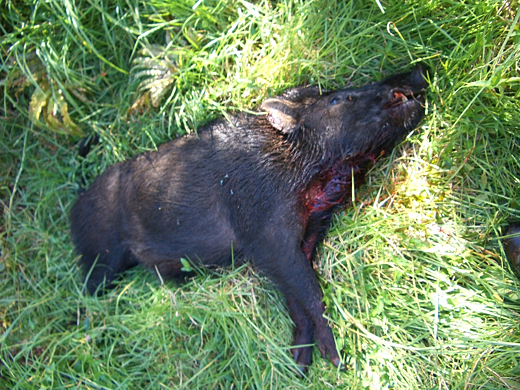
Image above: Wild boar hunted down on Kauai by Mauka Man. From (http://maukaman.net/view_video.php?id=58).
On April 25, a state judge dismissed trespassing charges against a Kauai man after finding that he had been exercising traditional native Hawaiian rights hunting wild pigs on private land.
Kui Palama, 28, was arrested on Jan. 17, 2011, and charged with two misdemeanor counts of trespassing and hunting on private property after a security guard found him with pig meat on Hanapepe lands held by Gay & Robinson, the former sugar plantation family who also owns the island of Niihau.
Kauai Circuit Court Judge Kathleen Watanabe dismissed the charges after defense attorney Tim Tobin presented evidence proving that Palama is a descendant of the indigenous peoples who occupied the Islands prior to 1778, and that the Gay & Robinson land is mostly undeveloped. Tobin also called Jon Osorio, a professor of Hawaiian Studies at the University of Hawaii, as an expert witness who testified that pig hunting is a traditional and customary practice.
All three criteria must be fulfilled in order to meet the standard for exercising traditional rights as protected by the state Constitution. The requirements were established in the Hawaii Supreme Court’s landmark decision, Nansay Hawaii vs Public Access Shoreline Hawaii (PASH), written by Justice Robert Klein in 1995. In his motion to dismiss, Tobin argued that by charging Palama with trespassing, the state was effectively imposing a blanket prohibition on his right to engage in customary practices.
Asked about the The Kauai prosecutor’s office recent announcement to appeal the decision, Palama said he isn’t worried. “When you’re right, you’re right,” he said.
“I’m not upset with Gay & Robinson for arresting me because it pushed me in the right direction,” Palama added. “We keep hearing,you have these rights, but what does it mean? By actually going through the process, I learned a lot.”
Palama said he hopes his experience will encourage other Hawaiians who are hesitant to exercise their traditional cultural rights because they fear being arrested. But although he’s willing to help others go through the process, he can’t understand why Hawaiians have to keep proving they’re entitled to rights guaranteed by the state Constitution.
“They already passed [PASH], so why are they arresting me?” Palama says. “It’s like they’re breaking their own laws. We were born here with this right. They acknowledged we had this right. They didn’t give it to us.”
Palama says it has become increasingly important for Hawaiians to exercise their access rights because mauka lands used for subsistence hunting are being blocked by private landowners. Gay & Robinson maintains a strict no trespassing policy and hires guards to patrol its extensive West Kauai holdings.
“This is our life here in Hawaii,” Palama says. “How can they stop us from getting food for our table?”
.
By Joan Conrow on 16 May 2012 for the Honolulu Weekly -
(http://honoluluweekly.com/diary/2012/05/public-access/)
Image above: Wild boar hunted down on Kauai by Mauka Man. From (http://maukaman.net/view_video.php?id=58).
On April 25, a state judge dismissed trespassing charges against a Kauai man after finding that he had been exercising traditional native Hawaiian rights hunting wild pigs on private land.
Kui Palama, 28, was arrested on Jan. 17, 2011, and charged with two misdemeanor counts of trespassing and hunting on private property after a security guard found him with pig meat on Hanapepe lands held by Gay & Robinson, the former sugar plantation family who also owns the island of Niihau.
Kauai Circuit Court Judge Kathleen Watanabe dismissed the charges after defense attorney Tim Tobin presented evidence proving that Palama is a descendant of the indigenous peoples who occupied the Islands prior to 1778, and that the Gay & Robinson land is mostly undeveloped. Tobin also called Jon Osorio, a professor of Hawaiian Studies at the University of Hawaii, as an expert witness who testified that pig hunting is a traditional and customary practice.
All three criteria must be fulfilled in order to meet the standard for exercising traditional rights as protected by the state Constitution. The requirements were established in the Hawaii Supreme Court’s landmark decision, Nansay Hawaii vs Public Access Shoreline Hawaii (PASH), written by Justice Robert Klein in 1995. In his motion to dismiss, Tobin argued that by charging Palama with trespassing, the state was effectively imposing a blanket prohibition on his right to engage in customary practices.
Asked about the The Kauai prosecutor’s office recent announcement to appeal the decision, Palama said he isn’t worried. “When you’re right, you’re right,” he said.
“I’m not upset with Gay & Robinson for arresting me because it pushed me in the right direction,” Palama added. “We keep hearing,you have these rights, but what does it mean? By actually going through the process, I learned a lot.”
Palama said he hopes his experience will encourage other Hawaiians who are hesitant to exercise their traditional cultural rights because they fear being arrested. But although he’s willing to help others go through the process, he can’t understand why Hawaiians have to keep proving they’re entitled to rights guaranteed by the state Constitution.
“They already passed [PASH], so why are they arresting me?” Palama says. “It’s like they’re breaking their own laws. We were born here with this right. They acknowledged we had this right. They didn’t give it to us.”
Palama says it has become increasingly important for Hawaiians to exercise their access rights because mauka lands used for subsistence hunting are being blocked by private landowners. Gay & Robinson maintains a strict no trespassing policy and hires guards to patrol its extensive West Kauai holdings.
“This is our life here in Hawaii,” Palama says. “How can they stop us from getting food for our table?”
.
7 comments :
What Palama and his misinformed supports don't tell you is that G&R would have no problem with Palama hunting pig on their lands if he coordinated with the ranch first. The ranch let's lots of folks hunt but for safety reasons controls access not to prevent access, but so that they know where people are and can keep others out of the areas with hunters. It has happened on Kauai in the past where hunters have killed each other mistaking a human for a pig. G&R knows about Native Hawaiian gathering rights and is sensitive to them. It was the State prosecutors who were uninformed of these well-established rights and brought the trespassing charges against Palama. The State did it out of concern for their control State held lands.
How can i contact gnr ranch to exercise my gathering rights?
Who can I contact if I want to exercise my gathering right on GnR ranch which is in the kona ahupua'a?
Aloha Ikaika34,
Try contacting LLewelyn William Kaohelaulii. He is the komahiki representing the Kona District of Kauai for the Aha Kiloe Council. He is known casually as Poipu Billy.
He is partners name is Terrie Hayes. Phone 808-742-9575 or email terriehayes@gmail.com.
You could also try Kekane Pa. Kane is Kauai Representative and Speaker of House of the Reinstated Nation of Hawaii. Try calling 808-645-1838 or emailing kekanepa@hotmail.com.
Juan Wilson
IB Publisher
Aloha Ikaika34,
Incidentally, Keith Robinson is on the Aha Kiole Council, representing Niihau.
Juan
And who is to say that these guys actually represent our community in the kona district? these guys don't even show up to any public hearings, meetings, or events to rep the fishers and hunters. they not even friendly they make like they mo betta than you wen you try fo talk to dem! auwe...
Aloha Anonymous,
Who are you? From your comment I assume you either hunt or fish... maybe do both. "These guys" may not be the best reps possible, but they showed up for the public Aha Moku meetings over the last six years.
Were you there?
IB Publisher
Post a Comment