Showing posts with label Robinsons. Show all posts

GMO land leaser responsibility

SOURCE: Mike Shooltz (mshooltz@aol.com)
SUBHEAD: Gay & Robinson to remain with Dupont/Pioneer lawsuit on pesticide spraying in Kauai.

By Chris D'Angelo on 16 March 2014 for Garden Island News -
(http://thegardenisland.com/news/local/gay-robinson-to-remain-in-pioneer-lawsuit/article_33156382-accc-11e3-8c5a-0019bb2963f4.html)


Image above: Aerial photo of part pf Dupont GMO seed facility on Gay & Robinson land on Kauai. From (http://www.recsolar.com/business-government/portfolio/agriculture-and-cold-storage/dupont-pioneer-hi-bred-seed-company).

[Source's note on behalf of Kauai Rising:  Federal Judge Kobayashi's ruling described in the article below  could significantly raise the stakes for anyone currently leasing land to the GMO agrochemical companies. It will, at least, certainly give them something to seriously consider, especially folks like Kamehameha Schools who have leases up for renewal this year. Mahalo for all that you are all doing in support of the health and well being of all. Each day brings new signs that all of your efforts are bearing fruit. Shine on!]

A federal judge has refused to dismiss Kauai landowner Gay & Robinson, Inc. as a defendant in a pair of civil cases against biotech giant Pioneer Hi-Bred.

The Feb. 27 ruling by U.S District Judge Leslie Kobayashi means the landowner could potentially be held liable for the conduct of its tenant — specifically plaintiffs’ claims about the drift of fugitive dust and pesticides into Waimea, on Kauai’s Westside.

It could also have implications for other large landowners in Hawaii, including the State of Hawaii and Kamehameha Schools, which also lease land to genetically modified seed companies.

Prior to the recent ruling, Kobayashi dismissed claims against Gay & Robinson, as well as the Robinson Family Partners, ruling that the claims did not contain sufficient factual allegations to support arguments of negligence, failure to warn, trespass and nuisance.

However, the judge allowed the Waimea plaintiffs to amend their complaint.

The amended complaint, filed in September, “added factual allegations regarding the history of the Robinson Defendants’ lease with Pioneer,” according to the ruling. It also expanded allegations about the Robinson defendants’ historical sugar farming on the property later leased to Pioneer; how the location of the fields should make the risk of drift and runoff readily apparent; and the defendants’ failure to implement best management practices.

Plaintiffs allege that following their initial lease with Pioneer, they entered into lease extensions for additional terms and for more acreage. They say the Robinson defendants are liable for Pioneer’s unlawful acts during the terms of those extensions because they “knew about erosion and drift problems and knew about complaints from Waimea residents; participated in Pioneer’s insufficient attempts to address erosion and drift; and allowed Pioneer to operate even though they knew that Pioneer had not obtained the required permits and exemptions,” the ruling states.

The court ruled it is “reasonable infer that, at the time of the lease extensions in 2002, 2005, and 2010, the Robinson Defendents knew that Pioneer’s unlawful farming operations were causing, or would necessarily cause, a nuisance.”

The Waimea plaintiffs are seeking damages for the impact to their homes; the reduction of their property values due to fugitive dust and the effects of pesticides; and the costs to remediate their properties and other relief.

Kyle Smith, one of two attorneys representing Kauai’s Westside community in the lawsuit against the genetically modified seed grower, said he was pleased with the court’s recent ruling and that the fight over the Robinson defendants has been “long-running.”

Michael Pupura, an attorney for one of the two law firms representing the defendants in the case, declined to comment on the ruling.

A trial date has been set for early August.

.

Niihau and the US Military

SUBHEAD: Wonder why the restricting access to Niihau public waters? Here are the federal military contracts that mention Niihau.

By Lyn McNutt on 5 February 2014 in Island Breath -
(http://islandbreath.blogspot.com/2014/02/niihau-and-us-military.html)


Image above: Cover art for Ironhand's Niihau FSX scenery add-on used for military plane simulation environment. Could be used for drones, From (http://forum.avsim.net/topic/267219-hawaii-niihau-scenery/).

As part of  the on-going political hijinks surrounding developing the Robinsons' Exclusive Zone (the REZ) on Niihau, I went on line and dug out public info for Niihau Ranch LLC Federal contracts based on their DUNS number.  These are collated and attached.

Since the file export only recognized numbers as text, I had to hand calculate the NET funding received, so they need to be re-checked.  I write grants, and have been a program and project manager.  I look at these contracts with $0, and others with up to half of the estimated costs being returned to the funder, and those strange balloon payments in December of several years, and I get very intrigued.  Accounting may work this way in DoD, but not in the world the rest of us inhabit. 

Niihau Ranch LLC seems to be returning a lot of money to the Federal Government.  Look at the dollar amounts and many are negative, roughly at 50% of costs.  Why?  When costing out a military proposal I believe that there are some standard rates for wages for laborers, maintenance, etc.  We have been told that Niihauans receive a maximum of $12 an hour.

Does this account for the discrepancy?  Also public records indicate (but I do not have these exact numbers) that 2/3 of the Niihauans are on EBT and Welfare and over half are on disability.  If it is true that $12 per hour is the going wage on Niihau, and government contracts, that could be used to increase income, are being used to continue to pay the Niihau wage, while at the same time the residents need federal assistance, this seems to me, in my opinion, to not be very supportive of the Niihau people.  So why should we give control of public waters around Niihau to Niihau Ranch LLC?

So, the bills introduced lately are the latest in a loooong string of manipulations (glad to detail over the phone) to get the REZ.  The Robinsons tried the (in chronological order sort of): fishing ban, monk seals, sanctuary, then Hawaii Civic Clubs (what's on now) and are now setting up the Aha Moku Council as a back up, with a dose of Sanctuary on the side for insurance.

Many of the attempts have at their core the request for a REZ of 2-3 miles off-shore.  To get advanced training with Black Ops and support drone testing, a two-mile offshore REZ is needed.  So, if you cannot get the public waters into your private domain using the "critters" (the Feds) then why not use the State, DLNR and the Sanctuary together, get the State to declare the REZ, and watch the income grow?

These activities involve land and water, and I do not think there has been any environmental assessment of the impact of the facilities and infrastructure on Niihau.  I don't think there have been county permits issued for this TMZ, but I may be wrong here.

As a scientist, I can tell you that DLNR and the Feds have completely missed the point here,  The ecosystems, culture and economies of Kauai and Niihau are co-joined.  If Kauai suffers, Niihau suffers.

To separate out Niihau using the Conservation Hostages on Niihau to secure a private REZ,  in the name of "preserving" the "culture" on Niihau as an isolated entity, only serves to further fragment the people, the economy and compromises the health of the people on Kauai and Niihau.  There are more Niihauans living on Kauai than Niihau.  There is a reason for this.  Once you get kicked off, no come back.  Estimates are 35-40 full time Niihau residents currently. 

This whole thing smells--- pilau.

This is the real reason for all this activity.  If you have a restricted zone extending into the ocean (public waters) then this increases the level of military support contracts available since Black Ops and Stryker force training require restricted access.

Please note that most of these are sole source contracts through the US Government Accounting Office.  The sole source justification is based on the private ownership, restricted access and availability of a cheap labor force.

Some of the contracts are for $1, and those it would seem involve construction or renovation of facilities or the land, and this $1 fee places Niihau Ranch outside of laws governing payment to workers based on rates associated with Federal contracts.

There are TEN PAGES OF THESE CONTRACTS
(https://www.fpds.gov/ezsearch/fpdsportal?indexName=awardfull&templateName=1.4&s=FPDS&q=Niihau&x=17&y=9)


Some Background

By Lyn McNutt on 23 January 2014 in Island Breath -
(email to Dee Morikawa dmorikawa@hawaiilink.net)


Image above: Historic US military plane flying in simulation over Niihau. But it could be a drone simulation. From (http://forum.avsim.net/topic/267219-hawaii-niihau-scenery/).

I have passed this on to the folks who organize the fishers.  What really troubles me is the unethical behavior (again) of our State and Federal "partners".  We were promised 'transparency' and we get done deals with pre-written legislation.  I also object strongly to the game being played of 'protecting' Native Hawaiian rights of the Niihau people, when the Robinsons have been actively courting expanded military activity on Niihau for YEARS, which hardly seems to be compatible with the idea of 'protecting' the Niihauans. 

To my mind, all this legislation is a major sham, with a real goal of political maneuvering for financial gain from private individuals to Limited Liability Corporations to the Federal government, all based on emotions and NO DATA.  The Kauai/Niihau connections exist on so many levels, and this shows clearly that Native Hawaiians and modern Hawaiians recognize that both sides of the channel make up one ecosystem; that's why there are also so many cultural and economic connections.

Fish caught in Niihau waters (proposed for restriction) have Kauai shrimp in their gut.  How do we stop the fish from coming over from Niihau and 'harvesting' the Kauai resources?  See how silly this all is if you look at it in a larger picture?  The fish and marine mammals and seabirds and local residents ALL know this is one ecosystem and we depend on each other.  The real ecosystem does not approve of these legislative shenanigans.

You cannot take out parts of this and then "make them well".  The REAL problem is on the Kauai side.  I will say that again, the REAL problem is on the Kauai side.  If the Kauai ecosystem is weakened, including the connections to the land and fresh water, and it fails, then Niihau will fail, not matter how much public waters you give to Niihau Ranch, LLC., nor how many restrictions and regulations you put in place.  Kauai is the "source" and Niihau is "the Incubator" and both share in the abundance, and should be the caretakers.  BOTH.

To protect these resources requires a larger view of the ENTIRE situation, and collecting data NOW to make rational decisions.  This legislative assault of creating Bills to 'supporting' Hawaiian peoples' cultural needs, and legislating scientific restrictions without any scientific basis in fact is creating dissent and fostering resentment on the West side of Kauai with the PURPOSE (this is the purpose) of to dividing the people and giving away public assets to a private landowner.

It should also be looked at critically by the governor, as this type of environmental politics at the expense of the Stakeholder is not at all the face to present to the local voters before an election.  Think about it a little.

All this conniving and conspiring needs to stop now. Who gave them the power to end local economies with the stroke of a pen without any real data and with no involvement at the local level?  It is your kuleana to protect us from this type of political nonsense. 

The assault tactic taken by our state government in partnership with NOAA Sanctuary Division is doomed scientifically, and socially before it starts: no buy-in, no consultation, no data, no agreements with the users, no stakeholder conversations, no consideration for real world relationships, just legislation to hide the glaring fact that DLNR has not done its job for years and THEY are really the root cause of this problem--not the fishers, not the local folks.  If you have made a mistake then correct it in a pono fashion.  Don't at like it is somebody else's fault.  Grow up and take some responsibility, and get on with fixing the error the right way.

But all this backroom planning and negotiation will get what they really want: 
  • The precedent that they can even do this based on NO DATA and no local hearings.
  • The precedent that they can legislate away control of public resources and give away rights to these waters to private landholders with no public hearings.
  • Job security at the Federal level in particular Access to potentially lucrative military contracts to pay land taxes through promoting uses of the new legislatively restricted zones.
  • The really bad precedent of giving up at the State level in these areas while ceding control to the Federal government and/or corporations because they have 'money' or 'resources' (once you give it away, you will NOT get it back until they have used it up, like Ko'olahawe).
  • Dividing and conquering all the Native Hawaiians and local users until all of Hawaii is in the National Sanctuary System and becomes part of the International Marine Protected Area network in the Pacific.   We will become what they want, an manageable aquarium for tourists, with little or no local subsistence use, and sustainability based on tourism needs.
The end result a cute, NGO-friendly, totally unrealistic, happy sanctuary with souvenirs, while true subsistence use and sustainability to support life in Hawaii is gone, along with the local fishing economy.

 Tell it like it is Dee, please!  We need you Obi-wan Kanobi, you are our last hope!  The rebel alliance awaits your command.
.

Hawaiian customary hunting rights

SUBHEAD: By charging trespassing, the state was imposing a blanket prohibition on engaging in customary practices.  

By Joan Conrow on 16 May 2012 for the Honolulu Weekly -  
(http://honoluluweekly.com/diary/2012/05/public-access/)

   
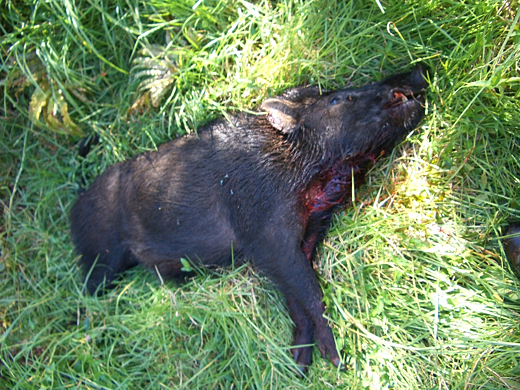
Image above: Wild boar hunted down on Kauai by Mauka Man. From (http://maukaman.net/view_video.php?id=58).
 
On April 25, a state judge dismissed trespassing charges against a Kauai man after finding that he had been exercising traditional native Hawaiian rights hunting wild pigs on private land.
Kui Palama, 28, was arrested on Jan. 17, 2011, and charged with two misdemeanor counts of trespassing and hunting on private property after a security guard found him with pig meat on Hanapepe lands held by Gay & Robinson, the former sugar plantation family who also owns the island of Niihau.

Kauai Circuit Court Judge Kathleen Watanabe dismissed the charges after defense attorney Tim Tobin presented evidence proving that Palama is a descendant of the indigenous peoples who occupied the Islands prior to 1778, and that the Gay & Robinson land is mostly undeveloped. Tobin also called Jon Osorio, a professor of Hawaiian Studies at the University of Hawaii, as an expert witness who testified that pig hunting is a traditional and customary practice.

All three criteria must be fulfilled in order to meet the standard for exercising traditional rights as protected by the state Constitution. The requirements were established in the Hawaii Supreme Court’s landmark decision, Nansay Hawaii vs Public Access Shoreline Hawaii (PASH), written by Justice Robert Klein in 1995. In his motion to dismiss, Tobin argued that by charging Palama with trespassing, the state was effectively imposing a blanket prohibition on his right to engage in customary practices.

Asked about the The Kauai prosecutor’s office recent announcement to appeal the decision, Palama said he isn’t worried. “When you’re right, you’re right,” he said.

“I’m not upset with Gay & Robinson for arresting me because it pushed me in the right direction,” Palama added. “We keep hearing,you have these rights, but what does it mean? By actually going through the process, I learned a lot.”

Palama said he hopes his experience will encourage other Hawaiians who are hesitant to exercise their traditional cultural rights because they fear being arrested. But although he’s willing to help others go through the process, he can’t understand why Hawaiians have to keep proving they’re entitled to rights guaranteed by the state Constitution.

“They already passed [PASH], so why are they arresting me?” Palama says. “It’s like they’re breaking their own laws. We were born here with this right. They acknowledged we had this right. They didn’t give it to us.”

Palama says it has become increasingly important for Hawaiians to exercise their access rights because mauka lands used for subsistence hunting are being blocked by private landowners. Gay & Robinson maintains a strict no trespassing policy and hires guards to patrol its extensive West Kauai holdings.

“This is our life here in Hawaii,” Palama says. “How can they stop us from getting food for our table?”


.