Stone Age Sailors on Crete

SUBHEAD: Discovery of Cretan tools points to sea travel 130,000 years ago. By AP Staff on 3 January 2011 for Huffington Post - (http://www.huffingtonpost.com/2011/01/03/cretan-tools-130000-years-sea-travel_n_803626.html) Image above: The oldest, largest, and most elaborate prehistoric vessel known found in a pit at the foot of the pyramid at Cheops, Egypt. From (http://indigenousboats.blogspot.com/search/label/Egypt). Archaeologists on the island of Crete have discovered what may be evidence of one of the world's first sea voyages by human ancestors, the Greek Culture Ministry said Monday. A ministry statement said experts from Greece and the U.S. have found rough axes and other tools thought to be between 130,000 and 700,000 years old close to shelters on the island's south coast.

Crete has been separated from the mainland for about five million years, so whoever made the tools must have traveled there by sea (a distance of at least 40 miles). That would upset the current view that human ancestors migrated to Europe from Africa by land alone.

"The results of the survey not only provide evidence of sea voyages in the Mediterranean tens of thousands of years earlier than we were aware of so far, but also change our understanding of early hominids' cognitive abilities," the ministry statement said.

The previous earliest evidence of open-sea travel in Greece dates back 11,000 years (worldwide, about 60,000 years – although considerably earlier dates have been proposed).

The tools were found during a survey of caves and rock shelters near the village of Plakias by archaeologists from the American School of Classical Studies at Athens and the Culture Ministry.

Such rough stone implements are associated with Heidelberg Man and Homo Erectus, extinct precursors of the modern human race, which evolved from Africa about 200,000 years ago.

"Up to now we had no proof of Early Stone Age presence on Crete," said senior ministry archaeologist Maria Vlazaki, who was not involved in the survey. She said it was unclear where the hominids had sailed from, or whether the settlements were permanent.

"They may have come from Africa or from the east," she said. "Future study should help."

The team of archaeologists has applied for permission to conduct a more thorough excavation of the area, which Greek authorities are expected to approve later this year.

.

Mediterranean Monk Seal Secret

SUBHEAD: Biologists find endangered seals secret Greek island. By Stephen Messenger on 3 January 2011 for TreeHugger - (http://www.treehugger.com/files/2011/01/biologists-find-endangered-seals-secret-island-getaway.php) Image above: Mediterranean monk seals. From original article.

It's never been easy being an endangered species -- particularly nowadays, what with all the people encroaching upon their native hangouts or clamoring for a rare peek at them. But despite all that, one group of highly endangered monk seals has managed to find some much needed solace on the beaches a remote island in Greece, far from the prying eyes of lookers-on. Biologists, however, have recently uncovered the seals' secret refuge -- though mum's the word on where exactly they're hiding.

While some seals are quite cavalier when it comes to hanging out where humans live, Mediterranean monk seals are understandably shy. As one of the most endangered marine species on the planet, only about 600 individuals are thought to still be in existence -- and they're doing their best to remain undisturbed.

Biologists say that human activity has deterred most of the endangered monk seals from their natural behavior of resting on beaches around the Mediterranean, driving them to settle difficult to access coastal caves where they can raise their young in peace. But, a recently discovered colony of seals on one particular Greek island has researchers optimistic that some sense of normality may exist yet for the threatened species.

Though for any animal lover who might relish a peek at the endangered animals in their secret refuge, biologists are disappointingly tight-lipped as to where it can be found. "It is human disturbance that has caused the species to retreat to inaccessible caves," said Alexandros Karamanlidis, who studies Monk seals. "So this place is incredibly important - the seals feel so secure that they go out on to open beaches."

It seems, however, that a possible salvation for the species may lie on this undisclosed island. Scientists say that breeding success has declined for the monk seals since they've been forced away from their natural breeding grounds into spots where their offspring are more likely to perish due to violent weather.

Just a little peace and quite, it seems, goes a long way when it comes to raising a family of seal pups. A report from the BBC explains:

The number of seal pups born annually in the newly discovered colony on this tiny island is amongst the highest recorded anywhere in the Mediterranean Sea.

The team has placed cameras on the island to study the seals remotely.

The area's popularity with tourists has gradually driven the animals away from other beaches, and the scientists hope to stop the same thing happening on this island.

Like most places in the world, the seals' island hideaway is threatened by the same pleasure-seeking humans habits that drove so many other member of the endangered species away from their usual habitat -- but biologists are working so that the same thing won't happen to this particular seal beach-goers. "The seals only survive in Greece because we have these isolated islands that people do not have access to," said Dr Karamanlidis. "So we're trying to make this a place where [the animals] feel secure."

In other words, their lips are sealed.

.

The End of The End

SUBHEAD: How did Yergin and CERA, Exxon Mobil, and "Government and industry officials" so completely outmaneuver the peak oil prophets of doom? By Mike Bendzela on 2 January 2011 in OpEd News - (http://www.opednews.com/articles/The-End-of-The-End--How-t-by-Mike-Bendzela-110102-802.html) Image above: Poster for "OilPeakapocalypse Now". From (http://www.schnews.org.uk/archive/news499.htm).

"Demand has peaked for good. It has declined four years in a row and will not reach the 2006 level again, even when the economy fully recovers." "Government and industry officials," quoted in Jonathan Fahey's AP article, "US gas demand should fall for good after '06 peak."

When I first began reading about peak oil in 2003, the year 2010 seemed like a distant, dire time, the Post-Peak Era, when suburbia and all its accessories would End.

It is now 2011, and the same world is still too much with us. The traffic on our road keeps increasing, and the acquisition of the last technological marvel is still the important issue of the day. As a critical thinker, I'm committed to changing my mind when predictions are invalidated. My view of "peak oil" has evolved from True Believer into Ambivalent Agnostic. The scales are dropping from my eyes.

I began seeing the handwriting on the wall about a year ago. It eventually caused me to cancel the module on peak oil in my College Writing class in the Fall of 2010. Advocates of peak oil apocalypse may be thinking that this sounds like the testament of a born-again Cornucopian who has seen the Light. No such luck.

This revelation was vouchsafed to me by Jonathan Fahey, via the Associated Press, in a recent article titled "US gas demand should fall for good after '06 peak." It contains a brilliantly-executed, if largely-unspoken, rhetorical strategy: Peak Oil is dead. Long live peak demand.

What I have read in their article confirms my nagging suspicion that the peak oil argument is over. Regardless of the validity or invalidity of the case, the debate is dead. Perhaps we only have ourselves to blame.

That which fervent peaker imaginations previously announced as intimations of doom, the prophet Daniel Yergin now preaches as Good News. The Peak of Demand is coming in clouds of glory. This is a gospel we can all embrace. Even loathed environmentalists will react with "delight."

We all know that the "peak demand" argument is fake, a distinction without a difference. When extraction peaks, demand peaks by definition. We taste the spoonful of sugar, but the pill still goes down like a chocolate-covered Valium. Fahey and his source, Daniel Yergin of Cambridge Energy Research Associates (CERA), recast the very terms of "peak oil" in their own image. They articulate these refurbished terms as foregone conclusions, and they do so with confidence, not with apocalyptic fervor. Their argument is a Winner.

The end of growth--which peakers have spoken about for so long now that it is something of a cliché --is spun not as our punishment for failing to prepare for peak oil but as our reward for increased fuel efficiency standards, ethanol mandates, and less driving due to demographic shifts, such as the aging of the Baby Boomers.

If oil indeed has peaked, as many of us suspect, then the quote that Fahey attributes to Paul Sankey of Deutsche Bank is actually true: "...by 2030 America will use just 5.4 million barrels a day, the same as in 1969"; and this quote by the National Resources Defense Council (NRDC) is true: "...the country's dependence on foreign oil will wane and heat-trapping emissions of carbon dioxide will grow more slowly"; and what Yergin says is true: "the heady days of gasoline growing in the U.S. are over."

In the same way that New Testament scribes recast ancient Hebrew apocalyptic expectations in the image of their risen "christos," Jesus of Nazareth, so these latter-day CERA prophets and their scribes have supplanted the apocalyptic terms of the peak oil movement with the messianic message of "peak demand." It's an inspirational message: Even with 27 million more cars on the road by 2020, as foretold by NRDC, and with high per capita demand, we can still consume less and lower our carbon dioxide emissions. Yes, we can.

This is not the Apocalypse per se, but it is still the onset of the Kingdom of God. How silly of us for not seeing the distinction before.

So how did they do it? How did Yergin and CERA, Exxon Mobil, and "Government and industry officials" so completely outmaneuver the peak oil prophets of doom? How did they manage to get their AP-disseminated articles stuffed into everyone's stockings, while the peak oil message withered on the tree?

Easy. They co-opted the peakers' terms, converting lead into gold, and they stayed on message. How have our own prophets fared by comparison?

Saint Matthew Simmons gained a huge following by saying Saudi Arabian oil production was in its twilight. He wrote a book, "Twilight In the Desert," that made many startling inferences based on published technical papers rather than on direct data because the data are unavailable State secrets. Many of us were convinced by his inferences. But he also said that oil would be $200 a barrel by the end of 2010 and that natural gas production was about to go over a cliff. Before his untimely death, he even claimed that the Deepwater Horizon disaster left an "open hole" in the floor of the Gulf of Mexico and that the whole coast would have to be evacuated. Given these startlingly deluded claims, one wonders if he ever knew what he was talking about in the first place.

Then there's the other Matt, the star-gazing Magus Savinar, who continually invoked "The End Of The World As We Know It" (TEOTWAWKI) on his website Life After the Oil Crash, which is still listed number one under a Google search for "peak oil." He drew comparisons to the Titanic, told us to start hording canned goods and horoscopes, and disappeared. When disaster failed to materialize, he shut down his website and said his disciples were failures. What a cad.

Michael Ruppert of Patmos has been saying "collapse" is imminent for about ten years now. His predictions include delirium tremens visions of Dick Cheney bringing down the World Trade Center. Ruppert's career reveals an essential truth: scratch a peak oil advocate, and there is a high probability of finding a 911 conspiracy theorist. The peak in world oil production turns out to be the "motive" for those who believe the Bush administration engineered the attacks as an excuse to occupy the oil fields of Iraq. Subsequent refutations of the conspiracy theory fall on deaf ears: these theorists KNOW that 911 was "an inside job." When they see buildings that have been hit by jetliners burning and collapsing, they see "controlled demolitions." They have the credibility of those who see the Virgin Mary in rust stains.

I was a victim of this conspiratorial thinking: Years ago, I attended a "peak awareness" meeting where I met a young filmmaker who asked to interview me about peak oil. I did and had a nice long conversation with him about peak oil. Little did I know that the film would turn out to be a platform that simply recycles Mike Ruppert's paranoid claims that peak oil was the motivation for the 911 attacks staged by the United States. Seeing my scenes edited together with scenes of Ruppert saying Flight 93 was "shot down" over Pennsylvania nearly made me ill. This movie will embarrass me in perpetuity on the Internet. Perhaps it serves me right.

Loathing for the United States is a virtual prerequisite for becoming a peak oil acolyte. A twin-headed angel--one head rising in the West by the name of James Kunstler, the other head rising in the East named Dmitry Orlov--continually issue jeremiads against the US-as-Babylon. These two fire hoses of contempt are pressurized by the belief that a Reckoning will come to America at the peak of world oil production. But it's apparent that the peak has arrived, or is near, and yet one continually awaits Orlov's prediction that the US will go the way of the USSR. One also awaits Kunstler's perennial predictions that the Dow Jones Industrial Average will slide to 6000 and that suburbia will be abandoned. One notes that, though the USSR dissolved, Russia bounced back. One should also note that Kunstler is a self-described "comedian," and, yes, his writing is often very amusing.

Robert Hirsch, et al. is a group of authors that published an influential paper back in 2005 warning that failing to prepare well in advance of peak oil would be courting economic doom. These authors had cachet because they were hired by the Department of Energy to conduct their study. In subsequent interviews in 2008, Hirsch foresaw oil at $500 barrel. Oil prices immediately dropped into the thirties. In a more recent book-length treatment of their thesis, these authors have the audacity to say that anthropogenic global warming theory is unproved. They cite the most god-awful sources to make the claim that there is "doubt" about human-induced climate change, including the widely-debunked Oregon Petition Project and various Right Wing websites. They advise that we develop and burn everything we have at our disposal--bitumen, coal, lignite--to combat peak oil, and that global climate change need not concern us. These bright peak oil advocates, like the others, have clearly lost their minds.

That leaves a heavenly host of bloggers--novelists, therapists, high priests of this-and-that--with their invocations of an new agrarian future: Grow kale or die. I'm inclined to think "Grow kale and die."

It is an article of faith among the peak oilists that industrial agriculture is doomed. They like to remind us that they are not saying oil is going to "run out," but then they proceed to preach messages that sound as if it were indeed going to run out. In the "absence" of oil, we will "return" to a peasant past, where former stock traders hoe organically-grown fava beans. Most peak oil converts share the same belief about agriculture: industrial agriculture, bad; "organic" farming and "permaculture," good. They have been saying this for so long that it is yet another peak oil cliché.

These peak oilists fail to see that evolution works one way: industrial agriculture is not going to disappear, it is going to adapt. Biotechnologies and genetics will continue to develop foods that are more stable, more apt to survive under adverse conditions, and more able to deliver higher yields per acre.
"Organic" agriculture and "permaculture" are belief systems, pure and simple. They are food purity cults developed by Luddites and agrarian romantics with no trust in the modern world or in science. It takes much more acreage, and much more labor, to grow foods by these methods than by conventional means. They work fine on small farms, but large farms--those that feed large populations--must operate on industrial scales. When oil supply begins to contract, it is more likely that fuels will be requisitioned for uses in agriculture first rather than that a new peasant class will open up. As I said, evolution will continue. Just imagine what new GMOs can be developed that will require less land and less labor to grow. Imagine reformulations of pesticides that target certain species and leave the others alone.

Imagine the energy that could be conserved if we simply clamped down on non-essential, recreational uses of gasoline and diesel. With the phenomenal success of the Internet and related technologies, we can now stay at home and do most everything we used to have to drive somewhere to do--shop, watch movies, work at our jobs, go to the bank, get a degree, etc. Imagine the possibilities. That's exactly what peak oil advocates have lacked--imagination.

And we wonder why no one listened.

So what is it like seeing our prophets' credibility pass into oblivion? Like looking down an open hole into which a box containing someone you love is being lowered. Only they now tell us the Tomb Is Empty. We continue to await the return.

By critiquing the failure of peak oilists to convince the public that TEOTWAWKI is nigh, I am not saying that the future is rosy. I believe peak oil is imminent, if not here already, and I have my own visions of the future, but I'm not going to be so foolish as to blab them. Truly, I say unto you: I have no idea what's going to happen. The best I can do is offer some ancient, unoriginal advice:

"There is nothing better for a man than that he should eat and drink, and make his soul enjoy good in his labor."

.

The Electric Car Fetish

SUBHEAD: It's time to let go of the car culture so we can rid ourselves of its myriad ill effects. By Kurt Cobb on 29 December 2010 in Scitizen - (http://www.scitizen.com/future-energies/the-electric-car-fetish_a-14-3607.html) Image above: Eye candy look of the electric Dodge Zeo concept car. From (http://www.greenskid.com/what-i-want-the-zeo-electric-car-concept). Many automobile enthusiasts believe that the electric car is the wave of the future that will help save the environment while expanding the availability of private transport to the world's growing middle class. They are likely wrong on both counts. Not too long ago a dinner guest at a party I attended told me that my concern about the peaking of global oil production was misplaced. Didn't I know that the electric car was already on its way? That a lot of smart people were involved in making it a reality before too long? That the main problem of charging on long trips had already been solved with battery switching stations that could now be deployed? I registered my skepticism that the electric car would ever become a widespread phenomenon. I cited resource constraints for key metals needed for batteries and the length of time needed to turn over the existing car fleet--around 17 years in the United States, for example. That assumes, of course, that the necessary infrastructure to produce such a fleet is already in place, which it isn't and won't be for some time, if ever. If the peak in oil production is close by, then that alone would doom the widespread adoption of an electric car fleet since global society could soon be dealing with an immediate oil crisis that wouldn't wait on the slow cycles of new technology adoption. (Some people believe we are already dealing with that crisis and that it began with the 2008 oil price spike which saw crude oil futures vault to $147.) One can easily cite all the obvious impediments that constrain the widespread adoption of private electric automobiles: the lack of charging infrastructure; the poor performance of electric vehicles for range and acceleration compared to gasoline and diesel-powered vehicles; consumer skepticism about electric vehicles; and the creaking existing electrical infrastructure which would probably need serious expansion to accommodate a worldwide fleet of private electric automobiles. Perhaps all of these problems could be overcome if the world had decades to work on them. But it is doubtful that we have that kind of time. In addition, there are three issues which rarely get a hearing. First, in the United States, for example, transportation produced 33 percent of all carbon dioxide emissions in 2008. (I was unable to find comparable figures for the world.) If the entire automobile and truck fleet were to be electrified, the amount of carbon dioxide emissions would decline, but not by as much as one might expect. The problem is that as of 2006 (the latest year for which global figures are available) 66 percent of the world's electricity is generated by conventional fossil-fuel powered plants, according the U.S. Energy Information Administration. The number is 71 percent for the United States, the country with about one quarter of all motor vehicles in the world--about 256 million out of approximately 1 billion. That means that simply replacing the current gasoline and diesel-powered vehicle fleet with one running on electricity will not even come close to reducing carbon dioxide emissions from that source by the 80 percent that scientists say is vital to preventing catastrophic climate change. We'll simply be substituting cars powered by gasoline and diesel with ones powered indirectly by coal and natural gas. Of course, we could greatly increase our deployment of renewable energy sources such as wind and solar to accommodate the need for new greenhouse gas-free electricity generation, couldn't we? There are three problems with this view. First, both sources are intermittent, so we will have to maintain a substantial baseload generating capacity using fossil fuels to ensure adequate electricity production when the wind fails and the sun isn't shining. Second, the scale of deployment would almost be unimaginable. The energy density of windmills and solar panels is at least an order of magnitude lower than that of fossil fuels. The square miles of photovoltaics and the number of windmills needed to generate electricity for an automobile and light truck fleet would imply an enormous footprint for these sources of power. Third, the time to scale up such solutions to the necessary level might be decades. This is the so-called rate-of-conversion problem. It actually takes time to implement alternative energy and infrastructure solutions. The key question is: How much time do we have? The answer appears to be: Not very much! Let's assume for the moment that climate change can be ignored--a big and dangerous assumption, I know! The next question we must ask then is: Is there enough fossil fuel and nuclear power to run an electric car infrastructure? Several developments should give us pause. First, a recent study suggests that coal production from existing coal fields may peak in 2011. That's not a misprint. Second, even though claims for vast supplies from new shale gas fields are being bandied about, there is reason for caution about natural gas supplies as well. Shale gas reserves are actually much more limited than widely believed; they are costly to produce; and, their extraction will likely be hampered by concerns about water pollution. Recently, the governor of New York ordered a moratorium on shale gas drilling until concerns about groundwater safety could be evaluated. Similar actions from other states seem likely as concerns about water supplies mount, and legislatures paused to think through stricter regulations that will mean slower exploitation of this resource. As for nuclear power providing the additional electrical capacity we would require, one need only review the history of the civilian nuclear power industry to realize that there is little chance of this happening. The regulatory hurdles to rapid expansion are very large. The amount of uranium left to power the current fleet of uranium-fueled reactors is in doubt. And, the lead times to build nuclear generating plants are measured in decades, not years. Nuclear-generated electricity will likely do no more than maintain its share of electricity production in the decades ahead as plants beyond their service life are decommissioned. So, what can we do about transportation? The quickest way to reduce liquid fuel consumption and thus carbon dioxide emissions in transportation would be to implement ride-sharing programs based on successful pilot programs around the world. This would mean allowing people to use their private cars as essentially part-time cabs. The advantage is that it reduces traffic, fuel consumption and greenhouse gas emissions NOW--not at some unspecified date in the future. The technical issues have already been worked out. It is the cultural ones which are the sticking points. Second, we should in my view electrify public transportation to the extent possible. This would protect this part of our transportation infrastructure from sudden fuel shocks. And, it should be possible to do this with only a fraction of the outlays needed to make private electric cars available. In addition, public transportation should be vastly expanded with an eye toward new ways of configuring public transport that require significantly less energy, meet consumer expectations more readily, and can be cheaply and modularly constructed. If the public had been able to foresee that the private automobile would lead to the despoilation of huge swaths of prime farmland to build roads and highways; the emptying out of many of America's and the world's cities into suburban sprawl; high blood levels of lead in children (from leaded gasoline which is now outlawed); a sedentary lifestyle that would contribute to an obesity epidemic that reaches down into children younger than 10; a nightmarish number of people killed and maimed on roadways each year; air pollution that regularly threatens human health; climate change through the production of greenhouse gases; and dependence on a fuel supply--petroleum--that has led to several wars and which regularly undergoes huge price swings; if they had known all that, would the public have agreed to allow the private automobile to become the dominant form of transportation in the so-called developed world? It's time to let go of the car culture so we can rid ourselves of its myriad ill effects. And, it is time to let go of the electric car fetish that is merely an extension of that ruinous car culture. .

A Road Less Traveled

SUBHEAD: Passenger travel in the industrialized world has been stagnant for nearly a decade. By Melinda Burns on 1 January 2011 in Miller-McCuune - (http://www.miller-mccune.com/environment/a-road-less-traveled-26524) Image above: Poster for the movie "Trains, Planes and Automobiles". From (http://www.themoviedb.org/movie/2609).

Amid the planes, trains and automobiles of the holiday season comes a surprising finding from transportation scientists: Passenger travel, which grew rapidly in the 20th century, appears to have peaked in much of the developed world.

A study of eight industrialized countries, including the United States, shows that seemingly inexorable trends — ever more people, more cars and more driving — came to a halt in the early years of the 21st century, well before the recent escalation in fuel prices. It could be a sign, researchers said, that the demand for travel and the demand for car ownership in those countries has reached a saturation point.

“With talk of ‘peak oil,’ why not the possibility of ‘peak travel’ when a clear plateau has been reached?” asked co-author Lee Schipper, who shares his time between Global Metro Studies at the University of California, Berkeley, and the Precourt Energy Efficiency Center at Stanford University.

Schipper and Adam Millard-Ball, a doctoral candidate at Stanford University, looked at the gross domestic product per capita of the United States, Canada, Sweden, France, Germany, the United Kingdom, Japan and Australia from 1970 through 2008 and plotted it against the distance traveled per capita per year in each country by car, pickup truck, bus, train, light rail, streetcar, subway and plane.

Beginning in 1970, they found, motorized passenger travel grew rapidly in all eight countries as greater prosperity led to rising car ownership and domestic air travel. But after 2000, when per capita GDP in the U.S. hit $37,000, passenger travel stopped growing here. In the other countries, passenger travel leveled out at a GDP of $25,000 to $30,000 per capita.

“A major factor behind increasing energy use and carbon dioxide emissions since the 1970s has ceased its rise, at least for the time being,” Schipper said. “If it is a truly permanent change, then future projections of carbon dioxide emissions and fuel demand should be scaled back.”

The peak travel study runs counter to government models predicting steady growth in travel demand well beyond 2030. Schipper and Millard-Ball say that their own findings are “suggestive rather than conclusive.” They speculate that highway gridlock, parking problems, high prices at the gas pump and an aging population that doesn’t commute may be contributing to peak travel. People already spend an average 1.1 hours per day traveling from one place to another, and driving speeds can’t get much faster.

“You can’t pronounce one single factor for the slowdown in travel,” Schipper said. “The most important thing will be to see what happens as the economy recovers. Everybody expects oil prices to go up. But with new fuel economy standards, more hybrids and higher oil prices competing against a recovery in which people buy old-fashioned gas-guzzlers, the question is, what is going to win?”

Most of the eight countries in the study have experienced declines in miles traveled by car per capita in recent years. The U.S. appears to have peaked at an annual 8,100 miles by car per capita, and Japan is holding steady at 2,500 miles.

There are signs of saturation in vehicle ownership, too, at about 700 cars per 1,000 people in the U.S. — more cars than licensed drivers — and about 500 cars per 1,000 people in Japan and most of the European countries. Car ownership has declined in the U.S. since 2007 because of the recession.

“You get to a point where everybody who could possibly drive, drives,” Schipper said.

Finally, researchers found, the energy intensity of cars and light trucks has declined in all eight countries since 1990. (Energy intensity is the amount of fuel expended per passenger-mile, or one passenger moving one mile.)

At the same time, though, vehicle occupancy declined, as more and more people drove alone. In the U.S, the average vehicle occupancy is 1.7 people per car, down from 2.2 in 1970, reflecting a likely shift away from carpooling. So, for example, in 2007, car travel in the U.S., with two-thirds of the seats empty, was more energy-intensive than U.S. air travel, because the planes were more than 80 percent full, on average.

There’s no question that the task of reducing carbon dioxide emissions in transportation is daunting. According to one estimate, vehicle travel in the U.S. would have to fall by half by 2050, or fuel efficiency would have to improve to 130 miles per gallon, or biofuels would have to make up most of the fuels on the market to avoid the worst impacts of climate change.

And people still like to buy big, heavy cars that can accelerate to 60 mph in less than four seconds. In a separate study this year, Schipper found that technological improvements to vehicle efficiency drove down fuel use per unit of horsepower by 50 percent in recent years, even as most of the potential fuel savings were wiped out by consumer’s preferences for larger, more powerful vehicles, particularly in the U.S.

Still, peak travel holds a glimmer of collateral benefits for the industrialized world. Higher prices at the pump, including higher fuel taxes, could help stimulate the manufacture of smaller, less powerful cars, change people’s driving habits and foment a renaissance in walking and bicycling, reducing carbon dioxide emissions below their present levels, Schipper said.

The growth of motorized travel in China, India and Brazil will reduce the overall impact of gains in the industrialized world, but they are still gains, he said. The average American car on the road today uses a third less fuel per mile than in 1973, and 20 percent less than in 1981, he said. For European cars, the savings is between 20 percent and 25 percent.

Traffic is paralyzed everywhere, and that will be an obstacle to motorization in the developing world in the end, Schipper said.

“My basic thesis is, ‘There ain’t room on the road,’” he said. “You can’t move in Jakarta or Bangkok or any large city in Latin America or in any city in the wealthy part of China. I think Manila takes the prize. Yes, fuel economy is really important, and yes, hybrid cars will help. But even a car that generates no CO2 still generates a traffic problem.

“Sadly, what is going to restrain car use the most is that you can’t move.”

.

Air Travel during Climate Change

SUBHEAD: In the time of Climate Change air travel is neither justifiable nor sustainable. By We live in a time of far-flung relationships, our families, colleagues, and friends often spread out across continents. These relationships mirror the global nature of many of our most pressing problems, such as global climate change—and they also contribute to those problems.

In Eaarth: Making a Life on a Tough Planet, Bill McKibben likens the biosphere to “a guy who smoked for forty years and then he had a stroke. He doesn’t smoke anymore, but the left side of his body doesn’t work either.” This new world, he says, requires new habits.

And, no doubt, many of us have adopted new habits—trying to use public transportation, buying local foods, rejecting bottled water. But the “savings” from such practices are wiped out by a habit that many of us not only refuse to kick, but also increasingly embrace: flying, the single most ecologically costly act of individual consumption.

Flights of Privilege

A round-trip flight between New York and Los Angeles on a typical commercial jet yields an estimated 715 kilos of CO2 per economy class passenger, according to the International Civil Aviation Organization. But due to the height at which planes fly, combined with the mixture of gases and particles they emit, conventional air travel has an impact on the global climate that’s approximately 2.7 times worse than its carbon emissions alone, says the Intergovernmental Panel on Climate Change. As a result, that roundtrip flight’s “climatic forcing” is really 1,917 kilos, or almost two tons, of emissions—more than nine times the annual emissions of an average denizen of Haiti (as per U.S. Department of Energy figures).

Only 2-3 percent of the world’s population flies internationally on an annual basis, but the climate impacts of air travel are felt by a much larger—and poorer—population. It is difficult to illustrate the meaning of such numbers in terms of who among the planet’s citizens pays the costs. Image above: German short film "The Bill". From (http://www.youtube.com/watch?v=rWfb0VMCQHE).

But this is exactly what the 2009 German short film The Bill does in powerfully demonstrating the ecological privilege and disadvantage embodied by flying. In doing so, it shows aviation to be a classic example of how the comparatively well-off privatize benefits of environmental resource consumption (the ability to travel quickly and afar) while socializing the detriments. By making a disproportionate contribution to climate destabilization and associated forms of environmental degradation—biodiversity loss, rising sea levels, and desertification, for instance—air travelers exacerbate the precarious existence of the most vulnerable. In doing so, they contribute to unjust hierarchies (e.g. racism and imperialism) that reflect a world of profound inequality.

Global Organizing—Without Planes

Clearly this presents a huge challenge to social and environmental justice advocates, activists, and organizers from the planet’s relatively wealthy areas who often connect to distant peoples and places by flying. Because the institutions and individuals most responsible for our global predicaments typically exercise mobility and exert their power across great distances, those of us who want to challenge their practices often must also do so. So what to do?

One option is to use transportation that stays on the Earth’s surface, to accept traveling more slowly, and to make flying a very rare exception instead of the rule. Throughout North America, buses—and, in many places, trains—are viable options. And for transoceanic voyages, ships (including freight ones) are a possibility—albeit not typically inexpensive or as common as they need be.

Another option—indeed an obligation in a time of growing ecological destruction and a degraded resource base—is to stay home more often. Given that “jet travel can’t be our salvation in an age of climate shock and dwindling oil,” McKibben writes, “the kind of trip you can take with a click of a mouse will have to substitute.” In other words, we have to become much better at exploiting the “trips” that the Internet and related technologies afford—by videoconferencing, for example.

While such options present numerous challenges, not least logistical ones, perhaps the biggest obstacle is the particular way of seeing and being common to the small slice of the world’s population that flies regularly. Traveling long distances by bus, train, or ship, for example, necessitates time—and a willingness to expend it in manners that those from the world’s privileged parts and sectors are not used to doing. It doesn’t necessarily entail doing less, but it does mean doing things in different ways.

A New Normal

It also calls for new mechanisms and institutions—and some organizing to bring them about. Take long-distance travel by ship. Less than a century ago, many regular folks traversed the seas—think of immigrants to Angel and Ellis islands. And many well-known organizers and activists—Gandhi, Helen Keller, and W.E.B. Dubois, to name just three—journeyed extensively by ship.

To do so today, of course, is far more difficult as jet travel has greatly weakened the passenger ship option. But what if, for instance, U.S. and Canadian activists and advocates going to Denmark for the Dec. 2009 climate summit had, instead of booking individual flights, organized to travel together by ship—with all promising to get to and from their ports of call by surface-level transportation? And what if they had publicized this effort as a way of setting an example for, and challenging, others?

That such a suggestion will seem unrealistic, if not foolhardy, to many illustrates the way that what we’re used to thinking of as normal can stifle our imaginations, and let us off the political, ecological, and ethical hook. The option is as “realistic” as we make it. In this regard, we need to push and support one another in the effort to make far-reaching alternatives viable.

Climate science tells us that we need a 90 percent cut in greenhouse gas emissions over the next few decades to keep within a safe upper limit of atmospheric carbon. In light of the great changes such a reduction demands, what is unrealistic and foolhardy is the notion that we can continue flying with abandon.

.

Taking 'Retire' out of Retirement

SUBHEAD: Boomers feel optimistic about their future, and what they've accomplished. Some 80 percent report they are happy. By Jennifer Ludden on 1 January 2011 for NPR News - (http://www.npr.org/2011/01/01/132490242/boomers-take-the-retire-out-of-retirement) Image above: Retired couple stroll the beach in Florida. From (http://www.theepochtimes.com/n2/content/view/37576). It may be hard to believe, but the generation that transformed America as it came of age in the 1960s is now entering its senior years. "There are 7,000 boomers a day who will be turning 65 in 2011, which is a significant birthday for sure," says Steve Cone, executive vice president of AARP. Sixty-five used to be the age when Americans stopped working, kicked back and embarked on serious leisure to make up for all those decades of the daily grind. But just like with every other stage of life they've gone through, baby boomers are expected to transform how we think about "retirement." Leading the way will be couples like Stephanie and Stan Zirkin. She will turn 65 on May 14; he's already 65, not officially a boomer, but, as he puts it, "close enough." The Zirkins live in a cozy rowhouse in the Washington, D.C., suburb of Greenbelt, Md. Since their daughter split from her husband, Stephanie has stepped in as a main caregiver for her 6-year-old grandson, Stephen. "To be perfectly frank," she says, "by the time Stephen came along, I was kind of tired out." When her daughter is working, Stephanie picks up Stephen at the bus stop after school, supervises homework and sometimes feeds him dinner. "I always wanted to have a grandchild that I could take care of on a daily basis," she says. "I just hadn't pictured it happening that far along." Boomers may have bolted for the door at 18 and been off their parents' payroll after college, but their offspring are taking longer to reach traditional milestones of adulthood. Marriage and children come later. Certainly with the bad economy, some are taking longer to establish careers. Growing numbers of 20-somethings have been moving back in with their boomer parents after college, a loving form of financial subsidy. When the Zirkins' daughter separated from her husband, Stan found another way to help out. "I dipped into my savings and bought her a condominium, which is a hundred yards from here," he says. "You know, I was feeling very secure when I ended my mortgage a few years ago, but now I have another one!" Working Longer Stan is a branch chief at the National Labor Relations Board, commuting via car and Metro to downtown Washington each day. He says he loves his work, and despite reaching traditional retirement age, he isn't about to give it up. "I've spent my entire career doing good for people who might otherwise be powerless," he says. "That's a feeling I can't imagine being duplicated anyplace else." Stan was eligible for retirement a decade ago. When friends ask if he's considering it, Stephanie has a ready answer: "Not till they pry the [subway] farecard from his cold, dead fingers!" she says, laughing. That, too, is typical. Boomers, more educated than their parents, may derive more of their identity through work. In an AARP poll of people hitting 65 this year, Cone says, 40 percent have no intention of retiring. "The 40 percent is a much larger group than any generation before the boomers," he says. "But the other factor we see in the poll is that a lot of people feel they have to keep working." In fact, when AARP asked what the best 65th birthday gift would be, the top answer was "financial security." The recent recession derailed retirement plans for many. But Alicia Munnell, of the Center for Retirement Research at Boston College, says the problem goes beyond that. "We are having a contraction in all aspects of the retirement income system," she says, "so boomers are going to face a much tougher time than their parents faced." Living Longer A 2009 study by the center found that 51 percent of working households today will be unable to maintain their standard of living once they retire. The reasons are many. Munnell says because of the rising retirement age and the tax structure, Social Security is replacing less and less of a beneficiary's earnings. Traditional pensions are disappearing, replaced by riskier 401(k)s. Then there's the exploding cost of health care and the shrinking value of homes. There's also the fact, Munnell says, that Americans simply do not save enough. On top of all this, everyone's living much longer. "What we are trying to do is have people save for a 40-year work life for 20 years in retirement," Munnell says. "The arithmetic doesn't work out if you think about it. People just don't get enough income during that period." In fact, for those who retire early, it's entirely possible today to spend more years in retirement than you did in your job. Munnell believes those who can should work longer. She'd also like to see another government-sponsored program to encourage retirement savings. Longevity is certainly an issue for Stephanie and Stan Zirkin; each has a parent in his 90s. "My father is 97," says Stephanie. "He lives alone. He's still got all his marbles, maybe even acquired another few. He's tough." The Zirkins say their parents are still financially independent. And, unlike many, they feel they have saved well for retirement. Stephanie believes their sense of thrift may speak more to their Depression-era parents than the rest of her generation. Still, looking after aging parents on one end and struggling children on the other is probably no one's retirement dream. And yet, Cone says, the AARP survey shows an extraordinary -- and characteristic -- resilience. "Boomers feel very optimistic about a) their future, and b) what they've accomplished," he says. Some 80 percent reported that they are happy where they are in life. Retirement Alternatives Stan says he's followed with interest some of his contemporaries who've already retired. He's found no one moving to Florida to sit by a pool. "One of the guys decided he majored in the wrong subject in college so he's back in college," Stan says. "He's taking anthropology, I think. That's his new love, and he says he intends to stay until he gets another degree, just for the heck of it. "Another one, he always wanted to work with his hands, and so he used some of his retirement money to purchase rundown houses, and he's renovating them himself. So, they are not retiring. They are simply going to a different stage of their life." Stephanie says this is fine by her; no need to have Stan lounging around the house all day. And really, she's busy enough caring for her grandson. So what is she looking forward to in coming decades? "Ooh," she smiles, "great-grandchildren!" .

Doom or Boom? Let’s do Both!

SUBHEAD: Call it a renaissance. Call it salvation. Call it the apocalypse (i.e., the unveiling). By Guy McPherson on 1 January 2011 in Transition Voice - (http://transitionvoice.com/2011/01/doom-or-boom-let%e2%80%99s-do-both) Image above: "Deer Hunter" painting. From (http://www.stillasleep.com/WALLPAPERS/CAT/Paintings/1/index.html).

The twin sides of our fossil-fuel addiction — energy decline and global climate change — are the most important topics we can address. Sadly, the national conversation ignores or marginalizes these critical issues. On the rare occasion they inadvertently come up, we act like a roomful of kids with plates full of peas and mashed potatoes, pushing the main course around without actually ingesting it. We want dessert instead.

Yes, I’m a doomer

I admit I’m a doomer. But I don’t think that’s a bad thing. To be a doomer is to recognize the tragedy of the human experience.

During the last decade, I’ve often felt like I was standing in front of the tanks in Tiananmen Square. Pointing out the lunacy of our imperialism puts me in the company of social critics such as Socrates, Nietzsche, and Schopenhauer.

At the opposite end of the spectrum are those hopelessly optimistic writers and thinkers who don rose-colored-glasses and conclude we can always find a way to advance civilization. These same eternal optimists also find civilization meritorious, contrary to the fact that it’s not, and never can be, equitable or sustainable. Indeed, the defining characteristics of civilization include a perverse inversion of power, nonsensical structures of punishments and rewards, obedience at home, and oppression abroad. The industrial economy is the low point of western civilization.

Of course, power often doesn’t arise for those who deal in reality. Again, Nietzsche and Schopenhauer come to mind. At the same time that no good deed goes unpunished, bad acts are usually rewarded. Realists are targeted as Cassandras and treated poorly in any empire, at least as far back as Socrates.

On the other hand, optimists, however foolish, earn external rewards.

Realists are not so fortunate, but they get to deal in reality, and therefore face with honor the toughest judge of them all: the mirror. Yes, I’m a doomer. And damned proud of the company I keep, too.

A closer look

We are humans, and therefore animals. As a result, evolution drives us to a “flight or fight” existence geared toward survival. For survivors, evolution demands we procreate. Once we clear those two hurdles, evolution pushes us to acquire material possessions. Each of these three demands — requisite for transmitting our genes into the future — is disastrous to the common good, as well as to prospects for continued human survival. And although evolution is nearly impossible to overcome, as Nietzsche eloquently pointed out, culture piles on, thus driving us toward societal disaster at every turn.

Consider, for example, the costs of continued economic growth, based on an ever-expanding human population of consumers. Atop the list of hidden costs are the two hundred or so species we drive to extinction every day. They’re in our way, so evolution and culture say they have to go. But as the Sixth Great Extinction accelerates, the ongoing omnicide threatens to take Homo sapiens into the abyss.

At this late juncture in the era of industry, the data are clear and accumulating: Terminating the industrial economy represents the only legitimate chance we have to save our own species from the effects of runaway greenhouse.

In addition, completion of the ongoing economic collapse offers the only legitimate opportunity for non-human species and non-industrial cultures to survive the onslaught of industrialization. If we take our usual anthropocentric view, the data are increasingly evident: The industrial economy poses a major threat to the persistence of our species on Earth.

An appeal

I recognize the blight we people have become. I long for the day when nature, epitomized in non-human species, stands a fighting chance against our relentless assault. Is there world enough, and time, for even half these species to get through the bottleneck we’ve imposed?

This question leads to another: When will even a small percentage of industrial humans join the doomer movement? Will the day come only after our species is reduced to a couple of small groups of hungry individuals in polar regions, struggling to survive? Will we ever recognize the perils of human population growth and runaway greenhouse? More importantly, is destruction what we want? Is Hell on Earth our goal for our hapless descendants?

Will you join me in abandoning an immoral set of living arrangements? Will you join me in abandoning the empire, long after it abandoned us?

The boom

If we bring the industrial economy to its overdue terminus, we give hope to the living planet on which we depend for our very lives. In addition, we give hope to Homo sapiens — the wise ape — beyond another generation. In short, we allow Earth to bloom.

Call it a renaissance. Call it salvation. Call it the apocalypse (i.e., the unveiling).

I’m not suggesting it will be easy to return to a set of living arrangements that provides hope for our species and the others that remain. We entered population overshoot with the initial civilization, several thousand years ago. More recently, acceleration of population overshoot has been enabled by ready access to inexpensive fossil fuels. The overshoot is so profound that completion of the ongoing collapse of the industrial economy likely will reduce the human population on Earth substantially and suddenly. But every day in overshoot adds an additional 205,000 people to the planet (births minus deaths). Extending overshoot extends the madness, ratchets up the catastrophe, and leads to even more suffering and death.

Suggesting we cannot return to our roots as human animals negates the first two million years of the human experience. It also serves as an excuse to keep the current murderous game going. Let’s not wait for the last human being on the planet to start the crusade for life. Instead, let’s facilitate the boom of life.

Let’s start today.

.

Tortured Until Guilty!

SUBHEAD: The placement of human beings in solitary confinement is not a measure of their depravity. It is a measure of our own. By Lynn Parramore on 31 December 2010 in Huffington Post - (http://www.huffingtonpost.com/lynn-parramore/tortured-until-proven-gui_b_803018.html) Image above: Bradley Manning in a happier moment before solitary in Quantico brig. From (http://www.observer.com/2010/politics/military-torturing-bradley-manning).

The degree of civilization in a society can be judged by entering its prisons. ~ Fyodor Dostoevsky

In the earliest days of our Republic, a group of well-meaning Philadelphia Quakers set out to reform the prison system. The idea was to remove convicts from the mayhem and corruption of overcrowded jails to solitary cells where sinners would return to mental and spiritual health through reflection. In the Walnut Street Jail, no windows would distract the prisoners with street life; no conversation would disturb their penitence. Alone with God, they would be rehabilitated.

There was a small problem. Many of the prisoners went insane. The Walnut Street Jail was shut down in 1835.

But the word penitentiary became part of the language, and the idea of placing prisoners in solitary confinement did not die. It seemed so reasonable -- so much better than chain gangs or public stocks. New prisons opened to test the theory that solitude might bring salvation to criminals.

Charles Dickens had a keen interest in prison conditions, having witnessed his father's detention in a Victorian debtor's prison. When he heard about the latest American innovation in housing convicts, he came to see for himself. At Philadelphia's Eastern State Penitentiary, the wretches he found in solitary confinement were barely human specters who picked their flesh raw and stared blankly at walls. His on-the-spot conclusion: Solitary confinement is torture. Dickens wrote:

I believe that very few men are capable of estimating the immense amount of torture and agony which this dreadful punishment, prolonged for years, inflicts upon the sufferers...I hold this slow and daily tampering with the mysteries of the brain, to be immeasurably worse than any torture of the body: and because its ghastly signs and tokens are not so palpable to the eye and sense of touch as scars upon the flesh; because its wounds are not upon the surface, and it extorts few cries that human ears can hear; therefore I the more denounce it, as a secret punishment which slumbering humanity is not roused up to stay.

A man who had seen his share of inhumanities, Dickens pronounced solitary confinement to be "rigid, strict, and hopeless...cruel and wrong."

That was 1842. Since then, piles of scientific studies, along with the vivid accounts of victims, have confirmed what was obvious to Dickens. Solitary confinement is worse than smashed bones and torn flesh. When human beings are deprived of social contact for even a few weeks, concentration breaks down, memory fades and disorientation sets in. Eventually, many prisoners experience explosive rages, hallucinations, catatonia, and self-mutilation. Some become irretrievably insane. Far from promoting safety, the most commonly cited justification, solitary confinement often amplifies violent impulses, turning prisoners into ticking time bombs who are far more dangerous to human society upon release than they ever were to begin with (see National Geographic's documentary on the subject, available on Netflix).

Human beings need social contact for normal brain function. Solitary confinement is thus a method of inflicting traumatic injury upon the human mind. "It's an awful thing, solitary," wrote former Vietnam prisoner John McCain in Faith of My Fathers. "It crushes your spirit and weakens your resistance more effectively than any other form of mistreatment." Among its legion perversities, solitary confinement turns medical doctors into torturers; renders violent criminals more aggressive, and makes prisoners cut off from human society incapable of functioning in it.

In 1890, the United States Supreme Court nearly declared the punishment unconstitutional. It is banned by the Geneva Convention, condemned by the United Nations, and either prohibited or restricted in most civilized countries. And yet today, as Atul Gawande revealed in his gut-wrenching 2009 New Yorker article, tens of thousands of Americans are tortured in this fashion every day, out of sight, in the "Supermax" prisons that have popped up like poisoned mushrooms on the American landscape since the 1980s. Some prisoners are consigned to these Houses of Unholiness for violations - both major and minor -- of prison rules. Some for gang activity. Others for trying to escape. Or for violent behavior. Some are placed there because they are mentally ill and there is nowhere else to put them -- the equivalent of casting a sufferer of pneumonia onto an Arctic tundra.

Save for the death penalty, solitary confinement is the most extreme sanction allowed by law. Like slavery and every other form of institutionalized inhumanity, it should be banished to the dark annals of American history as an example of what happens when our humanity slumbers.

Instead, it is being used as a method of terror and coercion by the United States government upon a citizen who has not even been convicted of a crime.

As Glenn Greenwald and several other courageous journalists and bloggers have documented, Bradley Manning, the 22-year-old U.S. Army Private accused of leaking classified documents to WikiLeaks, has been detained in solitary confinement for the last seven months, despite not having been convicted of any crime, having been a model detainee, and having evidenced no signs of violence or even disciplinary misdemeanors. Manning has been kept alone in a cell for 23 hours a day, barred from exercising in that cell, deprived of sleep, and denied even a pillow or sheets for his bed. As Greenwald reports, "the brig's medical personnel now administer regular doses of anti-depressants to Manning to prevent his brain from snapping from the effects of this isolation." No date for a court hearing has been set.

The message of the U.S. government to its citizens in this activity is clear: blow the whistle and your brain will be mutilated before you even have a trial.

But it may be that much to the shame of the U.S. government, our slumbering humanity is awakening. The solitary confinement -- the torture, for we must call it that -- of Bradley Manning is ironically shining a light on this brutality and tipping us off to the danger of authoritarianism. A United Nations probe is now investigating the Bradley case, and the drumbeat of outrage in the blogosphere grows louder every day. Protesters are organizing. Whatever one thinks of Manning and his involvement in the WikiLeaks release of classified information, there can never be any justification for torture. As Greenwald argues, such practices weaken the position of the United States government, both abroad and at home. Other countries will think twice before accepting extradition requests to a place where inhumane treatment of prisoners is sanctioned. Our moral standing in the world suffers, while the American citizenry, already suspicious of post-9/11 governmental abuses of power, grows even more alarmed. What kind of legitimacy adheres to a judicial hearing when the accused has been subject to sanity-threatening conditions? Trust and faith in American justice will deteriorate as long as such damaging practices continue.

As we spend time and rejoice with our friends and family this New Year's Eve -- enjoying the social interaction that human beings require -- let us pause for a moment to remember the thousands of people being tortured in American prisons, including Bradley Manning, and let us send our own message back to our government: We are Americans. We will not accept the intimidation and coercion of our fellow citizens, even from the Pentagon. Most assuredly, we will not accept torture in our name. Not of the accused. Not of the mentally ill. Not even of convicted criminals. When our civilized society is attacked, no matter what the justification, we will rise up to defend it.

The placement of human beings in solitary confinement is not a measure of their depravity. It is a measure of our own.

.

My Dad, in 1984

SUBHEAD: “Pop? What if Mondale gets elected, and guns are outlawed and some people come to take them?” “Open fire, boy.”

By Danny Showalter on 30 December 2010 in Nature Bats Last - (http://guymcpherson.com/2010/12/my-dad-in-1984)

Image above: Father and son in scene from post-apocalyptic movie "The Road". From (http://www.firstshowing.net/2008/08/07/six-new-photos-from-cormac-mccarthys-the-road).

I remember the presidential election between Ronald Reagan and Walter Mondale. My Pop hated Mondale. That was 1984, and I was seven. I’ll come back to that after a brief digression.

I grew up in rural Indiana. Shortly before I was born, my father, my mother, my aunt and my uncle, went in together on 120 acres of land, mostly woods, on a little jelly-bean shaped lake called Fish Lake. It had all the small mouth bass, bluegill and catfish you could eat, if you knew where they were biting. We gardened for sustenance and from August to November we canned, canned and canned some more. My father was and is a conservative, a Viet Nam veteran, a gun collector and somewhat of a survivalist type. We always had a freezer full of venison, we ate fresh rabbit, and raised chickens and had our yearly hog (a snorting compost pile all spring and summer) that we butchered in the early winter. You get the idea. Once we even raised a few calves for beef.

My mother raised me in a liberal Brethren/Mennonite tradition, that is, pacifism, community involvement and simplicity, but my father never went to church. He stayed home, cut and ranked wood for the woodstove.

And so it was 1984. When I asked my father why he was so rabidly anti-Mondale (in seven year-old terms), he replied, “Well, boy… . the Democrats want to take our guns away.” I nodded, and went off into the woods or to the barn to play. As I recalled and obsessed on my father’s words that day (they were and still are very important to me, despite the fact that I can see his worldview being manipulated now by a presumptive media and a neo-conservative narrative), I almost went into a panic… . take our rifles?

I had had no introduction to gun violence at all. Firearms were tools with which we hunted and acquired food, and on rare occasion, used to convince people who hunted on our land without permission that this was not where they wanted to be. So there I was, in the woods, whittling a stick or something, in a panic that if Mondale got elected, we would be confronted by police that requested my father give them his guns. Knowing my father well, and his response to this hypothetical(all too real in seven-year-old terms) was also what threw me into this panic. So I went back to him for a bit of clarification.

“Pop? What if Mondale gets elected, and guns are outlawed and some people come to take them?”

My dad tensed his lips, then decided to grin, looking up at me with a sparkle in his eye, the little creases around his eyes telling me he loved my question. In a response I wonder if I would give a seven-year-old, he said:

“Open fire, boy.”

Okay, so this response makes tears come to my eyes. Not then, but now.

Open fire.

If I thought I, at seven, was nervous before, this made me downright upset. I knew my dad was right, and I still know he was right, even though now we disagree quite a bit on exactly which institutions are most oppressive and their intentions. I have spoken to him at length on institutions like the IMF, the World Bank, the Council on Foreign Relations, Trilateral Commission and so on. I have had discussions with him at length concerning the Federal Reserve, and how money is expanded and contracted and the game of economic musical chairs we are forced to play, and who is usually left standing in poverty with no place to sit. I have discussed with him his own views, and what that would mean if he were not in rural Indiana raising berries, grapes and goats now, but in the occupied territories of Palestine, even though he sees only “radical Islam” in that resistance instead of a proud tradition of anti-colonialism and self-determination.

My father taught me self-reliance, and the importance of personal sovereignty. He taught me how to grow things and my mother taught me how to preserve them. I was taught how to raise animals well and consciously, and with respect for their natures and gifts. But he also taught me fear. “They” hate our way of life. America has “enemies”.” Liberals” want to take your firearms. You know, the typical tea party shit. To be fair, I find him to be much more conscious and critical thinking than that movement, but he still buys into a neo-conservative narrative with earnest at times (he believes Fox News is liberal, which to me, shows the mastery of propaganda behind NewsCorp!). But he taught me how to fear very well. Outsiders were not to be trusted. They can gain your trust, sure … but make sure they think like you … er, like us.

Our family was insular. My dad and uncle married my mother and her sister. All of our cousins on the 120 acres had only two sets of grandparents, who lived a quarter mile in either direction and farmed, too. My grandpa was a WW2 veteran, despite being a Mennonite. He was a farmer and factory worker. My other grandpa drove a school bus and farmed. My grandmothers were craftspeople. One, an extraordinary chef and gardener. She taught me that arrowroot, instead of cornstarch, is the only way to bake a pie. The other grandmother was a florist. She raised and arranged flowers, and eventually bought a store that my mother now owns, since Grandma died.

As should be clear, I have always been raised in a radical tradition, of sorts. My father raised me with the fear I mentioned, but also left me to play in the woods, to tend to the chickens, and to fish the lake and observe its patterns. My mother taught me community involvement, pacifism and forgiveness at all costs. My grandparents taught me that the Great Depression was only the beginning, and that the way “town people” lived was going to make it very hard on those of us who wanted to use land sustainably (not their words). But it was all within a conservative — and later, neo-conservative — framework.

I was taught this framework and lived it, much like the lines you learn for a play your parents come to see, and you perform it to the best of your abilities and you make your parents, who undoubtedly love you, proud. You make them understand why they love you. Don’t be an outsider, Daniel. Outsiders are not to be trusted.

Years later, after one of our heated conversations that begin with a passing comment about the West Bank, or Bill Clinton or some such, it became obvious to my father that I wasn’t — and couldn’t — think through the narrow window of dualism. Politics were growing increasingly irrelevant, economically speaking, the American Dream was not panning out, and it confounded him that while I spat at the neo-conservative ideas that the Republicans were spewing, I could not align myself with Democrats, either. I began using the term Corporatist in place of both, thinking it more accurate. My speaking about the evils of our sugar-coated imperialism (globalization) didn’t fit in with what he had learned.

Using American, conservative, and self-determinate ideas to apply to the situation in the West Bank and Gaza really gummed up his gears. He knew, after all, if he were a Palestinian, he would be a leader of Hamas. If he were a Colombian farmer, or a Basque separatist, or a factory worker in Sarajevo, he would act only in solidarity against Western influence. Were he Afghan, he would be growing poppies with an AK-47 over his shoulder to protect his crop and selling his opium resins for the highest price to feed his family, not be welcoming occupiers as bringing freedom and globally-produced goods, and he wouldn’t smile up at the predator drones. But to any of these things he couldn’t and still cannot bring himself to admittance.

One time, exasperated and angry with me after one of these conversation, he asked, “Who taught you this shit? Why do you think the way you do?”

I remember I felt really sad, depressed, for a moment. My father was not proud of me. He did not approve what I stood for or what I would continue to stand for and it felt like an ultimatum that could never be satisfied. Like a heart-wrenching breakup you see coming right at you, but can do nothing to stop. It felt like our last conversation. I was in silent tears at this point and almost sobbed aloud, into the phone. But I didn’t. I didn’t because I remembered that I had the answer to his question. I could answer him when he asked “who taught you this shit?” I took a deep breath and said,

“Pop, you did. You made sure we had acres of untouched forest to hunt in and creeks to splash in, a lake to fish out of, an apple orchard and a plot of garden to love and watch grow. You taught me seasons, and appropriate ways to prepare for them. You gave me a chance to connect with the dirt and the sky and the water. And you also impressed upon me the need to defend those things.”

I held my breath and waited for his response. He was sure to be angered, as you never used my Patriarch’s own words against him. Totally taboo. I braced.

“Boy, I sure don’t know where you learned this stuff, but I love you. Boy, I love you.” I could see the creases at the corners of his eyes and his twinkle through the phone, on his voice.

Open fire, boy. Open fire.

• Danny Showalter is a writer/student/activist living in Portland, Oregon. He is currently working to bring ideas of true sustainability to academia, where they are not yet wanted, and to the streets of Portland, where they are not yet heard. He can be found on his days off muttering Blake and Milton passages to himself in his garden and greenhouse. This essay first appeared at the Danny’s blog.

On Resilience

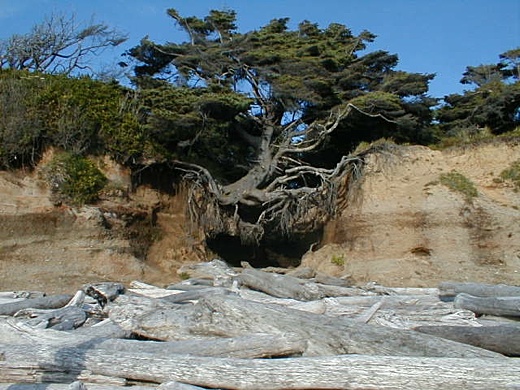
SUBHEAD: With roots in ecology and complexity science, resilience theory can turn crises into catalysts for innovation. By Carl Folke on 13 December 2010 in Seed Magazine - (http://seedmagazine.com/content/article/on_resilience) Image above: A tree straddles two realities. From (http://refusetobeupset.com/resillience-adapting-to-hardships/).
In the 1930s the American art collector Albert Barnes commissioned Henri Matisse to produce a major painting for his private gallery in Merion, outside Philadelphia. Matisse was ecstatic: He rented an old cinema in Nice, where he lived at that time, and spent the entire next year completing the work, a dance triptych. He was pleased with the result. But when the piece arrived in Merion, Barnes wrote to Matisse explaining an unfortunate oversight: His collaborators had taken the wrong measurements, so the painting did not fit on the gallery wall.

The difference in size was marginal, and Matisse could easily have tweaked the triptych to fit the wall, a technical fix. But instead he rented the cinema for another 12 months to complete a new painting with the right dimensions. Moreover, since he felt that mindless duplication was not real art, Matisse considerably changed the concept, effectively creating a whole new design. And in this process of reworking the piece, as he experimented with forms that would capture the dancers’ rhythmic motion, he invented the famous “cut outs” technique (gouaches découpés), what he later labeled “painting with scissors.” Whether consciously or unconsciously, Matisse turned a mistake into an opportunity for innovation. The new triptych not only pleased Barnes, but also served as the stylistic starting point for what would later become Matisse’s most admired works.

The French master’s ad hoc ingenuity captures the essence of an emerging concept known as resilience. Loosely defined, resilience is the capacity of a system—be it an individual, a forest, a city, or an economy—to deal with change and continue to develop. It is both about withstanding shocks and disturbances (like climate change or financial crisis) and using such events to catalyze renewal, novelty, and innovation. In human systems, resilience thinking emphasizes learning and social diversity. And at the level of the biosphere, it focuses on the interdependence of people and nature, the dynamic interplay of slow and gradual change. Resilience, above all, is about turning crisis into opportunity.

Resilience theory, first introduced by Canadian ecologist C.S. “Buzz” Holling in 1973, begins with two radical premises. The first is that humans and nature are strongly coupled and coevolving, and should therefore be conceived of as one “social-ecological” system. The second is that the long-held, implicit assumption that systems respond to change in a linear—and therefore predictable—fashion is altogether wrong. In resilience thinking, systems are understood to be in constant flux, highly unpredictable, and self-organizing with feedbacks across multiple scales in time and space. In the jargon of theorists, they are complex adaptive systems, exhibiting the hallmark features of complexity.

A key feature of complex adaptive systems is their ability to self-organize along a number of different pathways with possible sudden shifts between states: A lake, for example, can exist in either an oxygenated, clear state or an algae-dominated, murky one. A financial market can float on a housing bubble or settle into a basin of recession. Conventionally, we’ve tended to view the transition between such states as gradual. But there is increasing evidence that systems often don’t respond to change in a smooth way: The clear lake seems hardly affected by fertilizer runoff until a critical threshold is passed, at which point the water abruptly goes turbid.

Resilience science focuses on these sorts of regime shifts and tipping points. It looks at incremental stresses, such as accumulation of greenhouse gases in combination with chance events—things like storms, fires, even stock market crashes—that can tip a system into another equilibrium state from which it is difficult, if not impossible, to recover. How far can a system be perturbed before this shift happens? How much shock can a system absorb before it transforms into something fundamentally different? How can active transformations from an undesirable social-ecological state into a better one be orchestrated? That, in a nutshell, is the essence of the resilience challenge.

The resilience line of thinking helps us avoid the trap of simply rebuilding and repairing flawed structures of the past—be it an economic system overly reliant on risky speculation or a health-care system that splits a nation at its financial seams and yet fails to deliver adequate coverage. Resilience encourages us to anticipate, adapt, learn, and transform human actions in light of the unprecedented challenges of our turbulent world.

Arguably the most urgent of these tasks is the nested set of global environmental crises we now confront: climate change, ocean acidification, pandemics, water scarcity, overfishing, and loss of ecosystem services. The tremendous acceleration and expansion of the human enterprise, especially since World War II, is pushing the Earth dangerously close to the limits of the human activity it can sustain, and beyond which abrupt environmental change is increasingly likely. Obviously, global sustainability demands that humanity remain within these planetary operating boundaries. The relevant question then becomes: What will it take?

To begin, we need to put our role on this planet in perspective by placing humanity and the Earth’s systems in a geological context. If you graph the range of global temperature variations over the past 100,000 years, most of it forms a wild, erratic sawtooth pattern as climatic variations have at turns scorched or frozen the world. But, about 10,000 years ago, temperature variation stabilized, and we entered what geologists call the Holocene epoch. This is the stable period during which agriculture and complex societies, including our own, developed and flourished.

Considering the fact that our modern globalized society has developed within these unusually stable conditions, it might come as no surprise that today’s hospitable environment is often taken for granted in investment decisions, political actions, and international agreements.

Before the Holocene period, the climatic conditions on Earth were likely too unpredictable—with temperatures fluctuating wildly—for humans to settle down and develop in one place. Clearly, the only rational strategy now is to try and ensure that we remain in the human-friendly Holocene phase, that human development does not kick us into an unknown geological era.

The big challenge for humanity, then, is to begin working with the processes of the biosphere, instead of against them. This is not merely an environmental strategy—it is about sustaining our own development on planet Earth. And there are countless pathways for such development, as long as the biophysical preconditions for a functioning Earth system are respected.

This global resilience perspective stands in stark contrast to development paradigms and global policies that treat environmental issues as external to society, that offer only minor adjustments of current behaviors, and that tend to concentrate on technical quick fixes to get rid of the problems. It also runs counter to the philosophies of many traditional conservationists; they tend to see the world as environmentally stable, and seek to “save the environment” by limiting or excluding human activity. Both perspectives treat human and nature as two separate entities.

Embarrassingly, in a few generations we seem to have created a mind-set that either assumes that the economy is at the very center of the universe, or that nature needs to be saved from us humans. This is a dangerous mental trap, one we must escape as soon as possible in order to seed a prosperous future for humanity.

Luckily, the climate crisis has kick-started a new kind of mental revolution: We are slowly reconnecting with the planet. We are beginning to recognize that humans are part of the biosphere, simultaneously shaping it and fundamentally dependent on its functioning. This thinking is present in an accumulating body of work on ecosystem services, like the 2005 UN Millennium Ecosystem Assessment, that surveys the capacity of the world’s natural systems to support human development.

Resilience consists of three features—persistence, adaptability, and transformability—each interacting from local to global scales. How can societies persist and adapt in order to avoid tipping over critical thresholds into undesirable situations? When a shift into an undesired regime appears inevitable (or has already occurred and is irreversible), how can social-ecological systems transform to fit the new circumstances? One example of such “transformability” is the recent shift in governance of the Great Barrier Reef in Australia.

Here the challenges of climate change, eutrophication, and overfishing have led Australians to begin treating the reef as an invaluable, embedded part of their economy, and to begin managing it through collaborations between citizens, scientists, and policymakers. The current search for alternative energy sources to build a society that is less dependent on fossil fuels is another example. Overturning petroleum—the very foundation of human development thus far—will require unprecedented creativity and social innovation. In other words, it will demand a new ethic of social-ecological resilience.

Don’t be too alarmed by unexpected events, be prepared for them, and make use of them to improve negative circumstances. These actions will require trust and collective effort, a theme brought into focus with the awarding of the 2009 Nobel Prize in Economics to Elinor Ostrom, a key player in resilience thinking. Ostrom’s work gives evidence that grassroots, cooperative action can be enormously successful when it comes to caring for public commons—resources that benefit all, and that are traditionally vulnerable to exploitation.

This message is at the core of the resilience framework. That the global community is now recognizing it provides hope that resilience will be the new lens through which we face the turbulence, and opportunity, of the coming decade. Like that great French painter, with the right vision, we too can adapt to adversity, rethink our approach—and perhaps create a masterpiece in the process.

• Carl Folke is the science director of the Stockholm Resilience Centre at Stockholm University and director of Beijer Institute of the Royal Swedish Academy of Sciences.

The Haybox Factor

SUBHEAD: Neanderthals routinely ate cooked vegetables, and cooked meat has been a hominid staple since the days of Homo erectus.  

By John Michael Greer on 29 December in the Archdruid Report - (http://thearchdruidreport.blogspot.com/2010/12/haybox-factor.html)

   
Image above: A fireless cooker circa 1890 branded 'The Chatham Jewel' in an oak case. From (http://www.antiquefever.com/kitchen_and_dining.html).

Like any other movement in contemporary society, the Peak Oil scene now and again has to take time away from addressing the challenges that have brought it into being in order to sort out its own internal vagaries. One timely example was the fluttering in several different dovecotes following longtime peak oil stalwart Matt Savinar’s decision to shut down his forum and news blog, in order to refocus his energies on a new career as an astrologer. It’s a curious detail of sociology that people who hold one set of beliefs that are stigmatized by society – those people who hope to become respectable one of these days, at least – tend to distance themselves reflexively from those who hold unrelated but equally stigmatized beliefs.

In most corners of American society today, the reality of hard ecological limits has about the same cachet as the ancient belief that events here on earth are foreshadowed by changes in the circling heavens. Actually, that understates the case. Plenty of people who regularly sneak glances at newspaper horoscope columns are quick to reject any suggestion that the march of progress could be stopped in its tracks by nature’s callous refusal to provide us with as much cheap concentrated energy as we happen to want.

Thus it’s no surprise that most of the responses to Savinar’s announcement were negative. Still, Savinar may have the last laugh. An article in Tuesday’s Wall Street Journal discussed the way that old-fashioned Southern conjure – also known as rootwork or hoodoo, the traditional magic of African-American folk culture – has become a growth industry while the rest of the economy is circling the drain.

While the New Age movement is very much a creature of prosperous times, old-fashioned occultism has always tended to swim against the current of the business cycle, prospering in hard times and finding fewer takers when the economy booms. If the current economic unraveling has the usual effects, Savinar may just have made an exceptionally smart career move.

At the same time, there’s more to the matter than one person pursuing a marketable skill in whose relevance and efficacy, by the way, he wholeheartedly believes. Just prior to the shutdown of the “Life After The Oil Crash” forum, Savinar posted a series of increasingly irritated comments about the number of people on it whose obsessive concern about the prospect of a catastrophic future stopped well short of doing anything to prepare for it.

 I know the feeling; this blog and the Green Wizards forum have attracted a lot of people who are actually doing something about their future, but I’ve had plenty of run-ins elsewhere with people who apparently believe that (a) insisting that some technology they’re doing nothing to develop or deploy will bail us out of our predicament, (b) displaying their doombat machismo by imagining a future more godawful than anybody else’s, or (c) finding somebody to blame and showing Jung a thing or two about how to project the shadow, are useful responses to the end of the industrial age.

Unproductive as these habits may be, there’s an understandable logic behind them, and behind all the attempts to paint the future in glowing colors of one sort or another – be those colors the syrupy hues of a Thomas Kinkade cottage painting or the purer if less comforting tones of a thermonuclear fireball. All of these portraits are ways not to think about the future that’s actually bearing down on us, a future that might best be summed up by pointing out that nearly all of us here in America will be poor – not "can’t afford the latest Xbox this month" poor, by the way, but "may not be able to put food on the table" poor – for the rest of our lives.

Yes, it really is as simple as that. White’s Law defines energy per capita as the basic measurement of economic development; as energy per capita declines, the economy contracts, and its capacity to support individuals at any level above the starvation line contracts as well. All the social, political, and military fireworks that punctuate the curve of decline unfold from that inescapable equation, as those who can no longer support themselves by supporting the system turn to catabolizing the system as a matter of sheer survival. Just now the turn to catabolism is happening in a shamefaced, surreptitious way: thieves stripping empty homes for copper and aluminum, banks cashing in their futures to buy short-term cash flow, cities quietly announcing that this or that set of essential services will no longer be available.

Later rounds of catabolism may be a good deal more direct; each new round of news stories about the struggles between warlords beyond America’s fortified southern frontier makes me think of the proud border chieftains of an earlier age: Alaric, Hengist, Genseric, Attila. Such reflections may make the green wizardry I’ve been discussing in recent posts seem pointless, but that pointlessness is an illusion. If the great driving force behind a future of disintegration and chaos is the simple inability of a failing society to provide even the most basic subsistence for the bulk of its people, anything that will allow those people to make other arrangements for their subsistence offers a way to cushion the decline.

With that in mind, I want to talk about a simple, resilient technology that helps solve several of the most serious problems that poor people face now and the rest of us will be facing shortly. It was common – in fact, heavily promoted – all over the industrial world a century ago, and you’ve probably never heard of it. Let’s start with the problem: cooking fuel.

According to a recent news story, archeologists have found out that our sturdy cousins the Neanderthals routinely ate cooked vegetables, and cooked meat has been a hominid staple since the days of Homo erectus. Pace today’s raw food diet promoters, most foodstuffs are safer to eat and easier to digest when they’ve been subjected to heat, which is why every human culture everywhere on earth cooks most meals.

The one drawback is that the heat has to come from somewhere, and usually that involves burning some kind of fuel; anywhere outside today’s industrial world, fuel doesn’t come cheap, and in most poor countries the struggle to find enough fuel to cook with is a major economic burden, not to mention a driving force behind deforestation and other ecological crises. The obvious response, if you happen to think the way people in the modern industrial world think, is to deal with fuel shortages by finding and burning more fuel. That’s exactly the thinking that got us into our current predicament, though, so it’s worth looking at other options.

To do that, we need to start with the thermodynamics of cooking itself. Imagine, then, a saucepan on the stove cooking rice. It’s a metal container with a heat source under it, and inside it are two cups of water and a cup of grass seeds – that’s "rice" to you and me; the goal of the operation is to get enough heat and moisture into the grass seeds that your digestive system can get at the starches, sugars, B vitamins, and other nutritious things inside them. So far, so good, but this is where a familiarity with the laws of thermodynamics comes in handy, because there’s a prodigious waste of energy going on.

Trace the energy along its route and you can watch the waste happen. The energy at the heat source is highly concentrated; it flows, with some losses, into the metal saucepan; some of it flows through the pan to the water and rice, where it does the job of cooking, but a great deal of the heat gets into the sides and lid of the pan; some of it comes directly through the substance of the pan, some of it comes indirectly through the water and rice, but one way or another a great deal of the energy in your cooking fuel is being used to warm the surrounding air. This is all the more wasteful in that your rice doesn’t need a huge amount of heat once the water’s been brought to a boil; a very gentle simmer is more than enough, but to produce that gentle simmer a lot of fuel gets burnt and a lot of heat wasted.

Here’s an experiment for you to try. Get a cork mat larger than the bottom of the saucepan you use to cook rice, and a tea cozy. What’s a tea cozy? An insulated cover for a teapot, designed to keep the tea in the pot good and hot while you work your way down from the first relatively pallid cups off the top to the stuff with the color and consistency of road tar down at the very bottom.

The kind of tea cozy you want has a slit in one side for the handle of the teapot, and one opposite it for the spout, and it needs to be large enough to pop over the saucepan with the saucepan’s handle sticking out through one of the slits; the more insulation it has, the better.. Got it? Okay, get your pot of rice started; when the water has reached a good fierce boil and you’ve put the rice in, cover the saucepan tightly, take it off the heat, put it on the cork mat and pop the tea cozy over it. Leave it for a little longer than you would normally keep it on the stove, and then serve; if you’ve followed the instructions, you should have perfectly cooked rice with a fraction of the fuel consumption you’d otherwise have had. If you’ve done the experiment, you’ve just learned the principle behind the fireless cooker.

In America, those were often called "hayboxes," because that’s what the old-fashioned version was – a wooden box stuffed full of hay in such a way that there was a space for a pot in the middle, and a pillow of cotton ticking stuffed with more hay that went over the top. A hundred years ago, though, you could get elegant models from department stores that had porcelain-coated steel cases, rock wool insulation, and easy-to-clean metal liners with pots sized to fit; the best models had soapstone disks you could stick in the oven during the day’s baking, then drop into the fireless cooker, put a pot of soup or stew on top, and have it piping hot for dinner six hours later. I’ve never seen an old-fashioned fireless cooker; my guess is that here in America, at least, most of them were turned in during the big scrap metal drives in the Second World War. They were apparently still in use in some corners of Europe in the 1940s and 1950s, Still, the technology is simple enough that even the least capable home craftsperson can put one together in an hour or two.

My spouse and I have two of them, a portable version in a wooden box and a rather less portable version built into a piece of furniture; both of them were built using a slightly improved version of the basic haybox design with polyester quilt batting for the insulation and cotton ticking covering the batting to keep it clean. Doubtless the design could be improved, but the portable one holds heat well enough that a pot of Scotch oats, brought to a boil on an open fire and tucked into the cooker before going to bed, serves up piping hot oatmeal the next morning.

Fireless cookers will not save the world. They aren’t even a complete solution to the problem of finding adequate cooking fuel, though they make a good many other responses more viable by sharply cutting the amount of heat that has to be provided from some other source. In the jargon of the peak oil scene, they aren’t silver bullets, or even silver BBs; they’re simply a useful bit of appropriate tech that can be put to work in order to make an impoverished future a little easier to live with. There are many other things that can be put to work in the same way. Come to think of it, that’s basically what human culture is – a bag of tricks, not unlike Felix the Cat’s, suited to the needs and possibilities of a particular suite of human ecologies.

The culture we’ve grown up with was adapted to an environment in which, for most people in the industrial world, the big question was how to make the most use of cheap abundant fossil fuels. The culture our great-grandchildren will grow up with, in turn, will be adapted to an environment in which the big question will be how to manage a healthy and graceful existence on a very sparse resource base.

Fireless cookers might well become a part of that culture of the not too distant future, particularly if enough green wizards check out the possibilities in haybox technology here and now.  

Resources
Far and away the best book written on fireless cookers so far is Heidi Kirschner’s Fireless Cookery. Published by a small press in 1981, it’s long out of print; some small press could do a lot worse than hunt up the current copyright holder, get the rights, and put it back on the bookshelves. I understand that Girl Scout handbooks from before 1950 or thereabouts have instructions for making a haybox, and might be worth consulting; there are also chapters on the technology in some American cookbooks from the first decade or so of the twentieth century.  

.