Europe revolts against TTIP

SUBHEAD: United States faces major trade negotiation setback as Europeans revolt against TTIP.

By Andrei Akulov on 4 September 2016 for Strategic Culture -
(http://www.strategic-culture.org/news/2016/09/04/us-faces-major-setback-as-europeans-revolt-against-ttip.html)


Image above: Europeans demonstrate against American corporatism of TTIP. From original article.

France wants to halt thorny EU-US trade talks on the Transatlantic Trade and Investment Partnership (TTIP) as President Francois Hollande underlined there would be no deal until after President Barack Obama leaves office in January. Matthias Fekl, the French minister for foreign trade, has said his country will call for an end to the deal.

France has been sceptical about the TTIP from the start and has threatened to block the deal, arguing the US has offered little in return for concessions made by Europe. All 28 EU member states and the European parliament will have to ratify the TTIP before it comes into force.

The statements came just a couple of days after German economy minister Sigmar Gabriel had said talks for TTIP had de facto failed. Gabriel, who leads Germany’s centre-left Social Democratic party and is vice-chancellor in the coalition government, said Europe mustn’t submit to the American proposals.

Mr. Gabriel’s statement is in contrast with the position of Chancellor Angela Merkel who supports the deal. Meanwhile, the US-German conflicts are growing. US courts and authorities took a hard line against the Volkswagen Group, Germany’s largest car manufacturer, in relation to its exhaust scandal. In a deal that does not include all damage claims, VW is required to pay up to 13.6 billion euros.

There is a growing chorus in Germany saying that the country should orientate more to Asia. This perspective shared by the organizers of the anti-TTIP lobby, including the German Trade Union Federation (DGB), the Left Party and the Greens.

The fact that former British Prime Minister David Cameron – an outspoken proponent of TTIP – is no longer involved in negotiations is another major setback for the deal, which at this point is believed by many to be dead in the water.

TTIP negotiations have been ongoing since 2013 in an effort to establish a massive free trade zone that would eliminate many tariffs. After 14 rounds of talks that have lasted three years not a single common item out of the 27 chapters being discussed has been agreed on.

The United States has refused to agree on an equal playing field between European and American companies in the sphere of public procurement sticking to the principle of «buy American».

The opponents of the deal believe that in its current guise the TTIP is too friendly to US businesses. One of the main concerns with TTIP is that it could allow multinational corporations to effectively «sue» governments for taking actions that might damage their businesses.

Critics claim American companies might be able to avoid having to meet various EU health, safety and environment regulations by challenging them in a quasi-court set up to resolve disputes between investors and states.

In Europe thousands of people supported by society groups, trade unions and activists take to the streets expressing protest against the deal.

Three million people have signed a petition calling for it to be scrapped. For instance, various trade unions and other groups have called for protests against the TTIP across Germany to take place on September 17. A trade agreement with Canada has also come under attack.

US presidential candidate Donald Trump has promoted protectionist trade policies, while rival Hillary Clinton has also cast doubt on the TTIP deal. Congressional opposition has become steep. The lawmakers on both sides of the aisle have railed against free trade agreements as unfair to US companies and workers.

These developments take place against the background of another major free trade agreement - the Trans Pacific Partnership (TPP) - hitting snags on the way to being pushed through Congress. The chances are really slim

The likely failure will be a great setback undermining the US credibility in the Asia Pacific region and the world. According to Singapore’s Prime Minister Lee Hsien Loong, for America’s friends and partners, ratifying the trade pact was a litmus test for US credibility and seriousness of purpose.

Both deals have been problematic, primarily because they contain clauses that would allow corporations to sue sovereign nations and are seen as a US attempt to assert political, diplomatic and corporate influence.

As illustrated above, even Americans reject them, blaming the North American Free Trade Agreement for the exodus of American manufacturing to cheaper destinations. But the failure to push through both agreements will put into doubt the US status of global superpower.

Inside the US wealth inequality is growing.

Student loans are up. So too are food stamps and health insurance costs. In the meantime, labor force participation, home ownership and median family incomes have plummeted. The US government's $19 trillion debt is a huge problem.

Long wars in Afghanistan and Iraq have exacted an enormous price - immense financial expense, estimated to be as high as $6 trillion (£3.9tn). The detention centre at Guantanamo Bay, as well as the NSA and Wikileaks spying scandals, have undermined the belief in American values and American diplomacy.

The defense expenditure is huge, but its effectiveness is questioned. «We’re in a dramatic crisis now. There is no question that we’re capable against the threats on the counter-terrorism side, but we’ve reached a point where we’re in fact—not heading towards—but we’re already hollow against a high-end threat, said House Armed Services Committee majority staff director Bob Simmons speaking before an audience at the American Enterprise Institute (AEI) on June 21.

We lack the capacity and capability that we need to effectively deter on the high-end.

Among the foreign policy disasters in the Middle East, the rise of the Muslim extremists in several nations has created a crisis for all of the West, including the United States but most immediately and especially for refugee-swamped Europe.

The West is reaping the results of America’s foreign policy failures as it struggles to cope with hundreds of thousands of refugees pouring out of Syria and the Middle East.

>There is scant evidence that this century the US has achieved any progress pursuing its foreign policy goals. And while the US has stagnated, some countries, like Russia, China and many others, have prospered. This combination of decline at home and rise abroad has reduced America’s international power markedly.

At the turn of the century few argued when the 20th century was dubbed the «American Century». Over the past 16 years, America's fortunes have changed with dizzying speed. The safer bet is that the 21st century will not be America’s. The TTIP’s rejection by European leaders and grass roots’ protests against the agreement testify to the fact.
.

Kauai General Plan Update

SUBHEAD: The Planning Dept and Opticos Design Inc has presided over a complete failure to produce a new plan for our future.

By Juan Wilson on 3 September 2016 for Island Breath -
(http://islandbreath.blogspot.com/2016/09/kauai-general-plan.html)

http://www.islandbreath.org/2016Year/09/160904hanapepebig.jpg
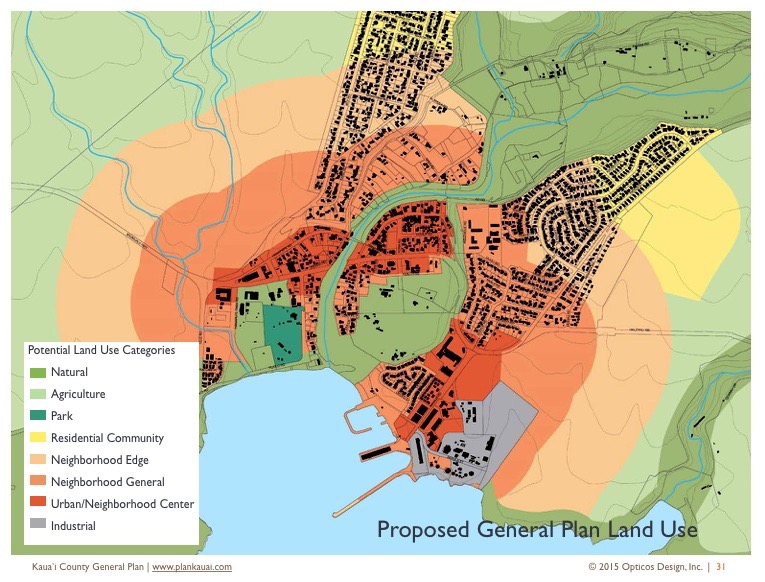
Image above: Page 37 from Kauai Plan Closing Workshop on Hanapepe-Eleele showing the expansion of the Urban Neighborhood center, Neighborhood General, Neighborhood Edge and Residential Community "doubling" in area, indicating a doubling of population planned for this area. this will eliminate vast areas of the best potential acreage for growing food near the current residents of Hanapepe-Eleele. From (http://plankauai.com/wp-content/uploads/2015_1104_HanapepeEleeleClosing-1.pdf).

For some background on this issue see:
(Ea O Ka Aina: Kauai Plan Disappoints) 9/12/15
(Ea O Ka Aina: Lihue loss of vision) 9/5/14)

When I moved to Hawaii in 2000 Kauai County issued the Kauai General Plan. It was produced with community participation in 1998-99 and was actually a pretty good effort. It can still be found on the County website at (http://www.kauai.gov/Government/Departments-Agencies/Planning-Department/Long-Range-Division/The-Kauai-General-Plan).

The plan looked ahead twenty years and hoped to guide planning over that period in an alignment with the hopes and wishes of the residents of the island. The take away from the 2000 Plan was "Keep Kauai Rural!".  To those on Kauai involved with the plan that meant, NOT urban and NOT suburban! "Chapter 2: Community Values" stated:


2.1 COMMUNITY VALUES
The Community Values were formulated by the Citizens Advisory Committee, using input from 25 outreach meetings with a variety of community, business and public interest groups.

The statement was revised based on public review and the initial round of Planning District
meetings in June 1998.
  • Protection, management, and enjoyment of our open spaces, unique natural beauty, rural lifestyle, outdoor recreation and parks.
     
  • Conservation of fishing grounds and other natural resources, so that individuals and families can support themselves through traditional gathering and agricultural activities.

  • Access to and along shorelines, waterways and mountains for all. However, access should be controlled where necessary to conserve natural resources and to maintain the quality of public sites for fishing, hunting, recreation and wilderness activities valued by the local community.

  • Recognition that our environment IS our economy, our natural capital, the basis of our economic survival and success.
     
  • Balanced management of our built environment, clustering new development around existing communities and maintaining the four story height limit.
     
  • Diverse job and business opportunities so that people of all skill levels and capabilities can support themselves and their families.

  • Government that supports and encourages business.
     
  • Balanced economic growth development promoting providing good jobs and a strong economy, without sacrificing our environment and or our quality of life.
     
  • Respect and protection for the values and rights of our many cultures, in compliance with our laws and responsibilities as citizens.
     
  • Preservation of our cultural, historical, sacred and archeological sites.
     
  • Appreciation and support for the traditions of the Native Hawaiian host culture and the many other cultural traditions and values that make up the Kauai community.

Those were the community values that would guide planning going forward to 2020. The vision forward forward was also in Chapter 2:


2.2 VISION FOR KAUAI 2020
The Vision describes conditions on Kauai in the year 2020 and is written from the standpoint of that point in time. It reflects not only the Community Values but also the issues and opportunities foreseen by community members. The Vision expresses what Kauai should strive for, in the context of realistic conditions as they are understood in 1999.

The Vision is presented first in summary, then in a longer narrative. We envision that in 2020 Kauai will be . . .
  • a “garden island” of unsurpassed natural beauty;

  • a rural environment of towns separated by broad open spaces;

  • a vital modern society formed by the people and traditions of many cultures;an island of distinctly individual towns and communities, each with its own unique history and character;

  • a community which values its historic places and where people practice and draw strength from ancient languages and cultural traditions;

  • a rural place whose population size and economy have been shaped to sustain Kauai's natural beauty, rural environment and lifestyle;

  • a community which cares for its land and waters, leading the way with best management practices in the development of roads and other public facilities and in its land development and environmental regulations;

  • an agricultural center, producing a wide range of crops, food, and forest products for local consumption and export;
  • a resort destination where visitors are welcomed, supported with adequate facilities, and provided with a variety of cultural and recreational opportunities;

  • a resort destination whose government and industry leaders respect the island’s residents and their need to have a community life where visitors are not always present and who find effective ways to protect residents’ customary use of special places for religious and cultural observances, fishing, gathering, hunting and recreation;
  • and an island whose government supports the labor force and small business owners, firmly holding to essential policies and regulations while eliminating unnecessary red tape.

In fact the Kauai General Plan 2000 was too good for the land speculators and project developers intent on making a killing in Kauai real estate aided and abetted by county employees and public servants. So, as a result, the General Plan was put on a shelf and ignored.

Ten years after the work done to put together the General Plan, a wave of dicey real estate deals were frothing through the American economy. Kauai had more than its share. Over ten thousand units of speculative condos, timeshares, and residents were moving forward in places like Poipu and Kapaa.

Fortunately for those on Kauai who don't live here for the nightlife, shopping opportunities and traffic; that real estate bubble crashed before totally engulfing Kauai with suburban sprawl like Mililani, Oahu or Kihei, Maui, where traffic congestion and national franchises rule the land.

The County Planning Department has recently been involved in a process to update the plan looking forward another generation.  To do this they conducted community meetings around the island and hired a planning consulting firm, Opticos Design, Incorporated. The city of Flagstaff, Arizona used this same firm for its 2011 zoning update. The Flagstaff website tells the tale:
The intent of the new Zoning Code was to not only update and modernize the Code, but also to create regulations that reinforce the community's desires as expressed in the Regional Plan to promote Sustainable Development practices and Smart Growth principles.
For those of you who don't know planning jargon Sustainable Development translates to DEVELOPMENT and Smart Growth translates to GROWTH.

When I looked at the current effort that Opticos Design that is detailed online the first thing that caught my attention was the url www.plankauai.com. that's a commercial domain. Not a ".org" or even more appropriately a ".info". The ".info" is for credible resource websites ("org".edu" and ".gov." are other non commercial designations). Whereas the ".com" (and ".biz") are reserved for commercial enterprises. Why would an online public planning effort be a commercial enterprise?

The Plan Kauai website seems to avoid telling you what it is really up to. There is a lot of "eye candy" layout and graphics and "feel good" pictures of local sites and residents. But the planning substance is hard to find, incomplete and poor in quality.

A simplistic concept of concentric levels of density around core "urban centers" has been used to explain and rationalize filling out every community on the island with denser development. Some of these "urban centers" are not much more than four corners with a stop sign.

Opticos Designs website reports on the planning effort are not up to date.

Below are links to four of the latest planning documents for different parts of the island. I challenge Kauai residents to find this information on the Plan Kauai website. Obviously eastside Lihue-Hanamaulu and the southside Koloa-Kalaheo areas are not listed below (and it seems unavailable to the public for review this late in the game). By the way, each of the PDF files below are more than half identical boilerplate for the first 30 so so pages.

Waimea to Kekaha:
(http://plankauai.com/wp-content/uploads/2015_1104_Waimea-KekahaClosing.pdf)

Hanapepe to Eleele:
(http://plankauai.com/wp-content/uploads/2015_1104_HanapepeEleeleClosing-1.pdf)

Wailua to Anahola:
(http://plankauai.com/wp-content/uploads/East-Kauai-Closing-Pres-sm.pdf)

Kilauea to Hanalei:
(http://plankauai.com/wp-content/uploads/2015_1106_NorthShoreClosing.pdf)

I recently wrote to my colleagues on the Executive Committee of the Kauai Group Sierra Club


Fellow Ex Comm Members:

I reviewed the final Kauai Plan Closing Workshops proposals this morning. I looked in some detail at the Westside, because I know it best. That includes Hanapepe-Eleele, Waimea-Kekaha.

As far as I am concerned the plans are a complete failure. They do not address the future, but look to the trajectories of the past and decided the best course was to continue on the same path we are on and step on the gas.

Development, Growth, Suburbanization are their guides and Sustainability,  Self-reliance, Food Security are unmentioned.

Also unmentioned are Global Warming, Climate Change and Ocean Rising.

Even pretending this is a serious effort on the part of our Planning Department is an insult to planning.

I’ll give you example closest to my home of a “total failure” of planning in Hanapepe Valley. The area I live in is designated by the State of Hawaii as “Rural”. Not “Urban” or “Agricultural”. It is heavily wooded and has acres of taro, pasture, and small farms. There are residences and junkyards.

Food is produced here, birds have forested refuge and there are horses, goats, pigs, domestic chickens and hunting dogs. Much of this would not be happening in a urban or even suburban development.

The General Plan proposal for the area I live in is for filling in more residential suburban development like Hanapepe Heights and Eleele. Both totally unsustainable living areas. This plan if implemented would destroy the old Hawaiian style way of living in a valley in Hawaii.

The motto of the previous Kauai Plan was "Keep Kauai rural!” Obviously, that idea was thrown under the bus by the Planning Department.

I recommend the Sierra Club reject this update of the Kauai General Plan.
 Juan Wilson: Architect-Planner

In the case of where I live in Hanapepe-Eleele this planning approach would result in doubling the developed area and population of the community in 20 years. I think if this criteria is used throughout Kauai for planning the island could not be self-sustainable.

Moreover, in the future  when imported fresh vegetable and frozen food are no longer routinely available from the mainland our outer islands of Hawaii will be required to not only sustain themselves but also support the currently unsustainable population of Oahu.

Not if, but when the current model of international global marketing fails, we in Hawaii will greatly regret doubling the needed  carrying capacity of our islands. Kamaaina (people raised locally) translates in Hawaiian to the "fruit of the land". Hawaiian culture places human communities a subset of the local watershed based biosphere. or "ahupuaa".

Nature cannot be a subset of human activity. That way lies apocalypse.


.

Mni Wiconi! Water is Life!

SUBHEAD: No oil pipeline! To indigenous Lakota protecting the water is equal to saving the world.

By By Kelly Hayes & Deseree Kane on 3 September 2016 for TruthOut -
(http://www.truth-out.org/news/item/37475-whatever-it-takes-another-day-on-the-front-lines-of-nodapl)


Image above: Dale American Horse shackled himself to construction equipment at the North Dakota Access Pipeline construction site on Native American Lakota Territory. Photo by Deseree Kane from original article.

On Wednesday, the struggle waged by Indigenous Water Protectors against the construction of the Dakota Access pipeline raged on when a surprise act of civil disobedience halted construction for 6.5 hours.

Dale American Horse, known to community members as Happi, played a pivotal role in the action by using a blockade apparatus to attach himself to a piece of equipment, forcing a shutdown of all construction equipment in the area. For hours, officials attempted to remove Happi in a variety of dangerous ways that included the use of a reciprocating saw -- which is not a precision tool -- and an ill-conceived effort to lift Happi with a hydraulic crane.

As thousands of Natives from around the country continue to gather and rally at Standing Rock, it has become clear that a historic stand worthy of song and story is being made in North Dakota.

The first proposed path of the Dakota Access pipeline was scrapped, in response to complaints that it would endanger the drinking water of North Dakota's capital. The route was subsequently revised, such that the pipeline would cross the Missouri River -- a half-mile north of the Standing Rock Sioux Reservation.

This exercise in erasure and Native disposability has been squarely rejected both by the Standing Rock Sioux and by Natives who have flocked from around the country to join their cause.

For those who are paying attention, the question of whether or not Indigenous peoples can repel the Dakota Access pipeline has begun to embody one of the larger questions of our time: Will non-Native people finally hear Indigenous voices, and help shift the course of history?

It's no secret that all life on Earth stands imperiled, during a period that many scientists have described as the world's sixth mass extinction event.

We have been told, again and again, that our entire way of living and our entire culture of energy dependence must be transformed if we are to have any hope. And yet, greed has kept us on a global collision course with catastrophe.

At Standing Rock, the camps that have formed to stop the pipeline carry many lessons. They carry the wisdom of elders. They carry the stories of struggles past. They hold the vibrancy of their youth who have stepped into struggle for the first time. And Wednesday, they carried the power of a fierce resistance.

Happi's mother, Cheryl Angel, who supported her son's choice to get arrested in the action, explained in an interview, "Sometimes you have to put yourself out there if you want people to understand what you're doing. It seems like the state of North Dakota doesn't understand that the people who have lived here for a millennia have a relationship with water."

Across the Earth, Indigenous peoples are leading struggles to hold back humanity's assault on the natural world. In North Dakota, protesters -- some of whom prefer to be called "Water Protectors" -- are using prayer, community building, art and action to make the world at large aware of their struggle to preserve what they cherish.

"Water is sacred to us. We use it every day not just to live, but for ceremonies, for spiritual cleansing, for healing and for blessing," said Angel.


Image above: Dale North Dakota State police move in, telling Water Protectors that they are obstructing a governmental function. Officers yell, "Move or you're going to jail" as community members lock arms. Moments later there were multiple arrests. Photo by Deseree Kane from original article.

A total of eight Water Protectors were arrested over the course of Wednesday's action. While awaiting her son's release, Angel spoke of his sacrifice as being grounded in a cultural understanding of water, and our human relationship with the Earth.

"In our Lakota language we use the word Mni Wiconi, which means 'water is life.' Protecting the water is equal to saving the world. I honor that, Happi honors that. Everyone standing with Standing Rock understands that no one can live without water."
.

Who does what in the soil

SUBHEAD: Part 3 of The Cosmos, the Earth, and Your Health – The Story of Soil.

By Toby Hemenway on 29 August 2016 for Toby Hemenway -
(http://tobyhemenway.com/1404-who-does-what-in-the-soil/)


Image above: Healthy soil can't help but support life. Photo by Jack the Lizard. From (http://www.animal-dino.com/story_of_soil.html).

In the first two episodes of this series on how soil is formed, we’ve been operating at the cosmic level, talking about the how the elements of life were molded during the Big Bang, inside stars, and in explosive supernovae. It’s time to come back to earth, and to reverse scales from the mind-bogglingly large to the infinitesimally small.

When we left our story, the main actors had taken their places on stage; the elements critical for life had formed. Now, as we wait for the curtain to rise, we can look at the playbill to see who these characters are and why they are so beautifully suited for their roles in creating life and building soil.

We can divide the elements of life and soil into two main categories based on how they behave and what roles their structure allows them to play. (I say “in life and soil” because the two are virtually identical: Soil is where most life comes from, and there are almost no elements needed for life that can’t be found in healthy soil.)

The first category is a batch that chemists call “main-group elements” because how they cluster in a large group in the periodic table. The main-group elements involved in soil include carbon, nitrogen, potassium, phosphorus, calcium, magnesium, and sulfur. These are, obviously, major players in story of soil, and copious amounts of all of them get cycled around by living things.

A second group of elements are less abundant in life, but are every bit as crucial in living processes because of their hyperactive, social-butterfly qualities.

They are members of a group that chemists call “transition metals.” That word “transition” hints at the shape-shifting nature of their character that makes them so dynamic and able to play multiple roles in living things.

They include iron, nickel, copper, zinc, manganese, cobalt, and molybdenum. There are many more transition metals, but those seven are the most common and the ones whose roles in life we know best.

I’ll give you some brief biographies of the major players to show what role they fill in life and likewise in soil.

Carbon, that’s a word that’s constantly in the news these days, and often not in a good way. But carbon has been at the center of events long before the fossil-fuel era. It’s hard to conceive of life that isn’t based on carbon.

That’s because it is uniquely multi-functional among all the elements. It comes in several forms; soft graphite, hard diamond, soot, and nanotech inspiring fullerenes are each pure carbon, and each has wildly different qualities from the others.

Carbon can construct nearly 10 million known compounds, vastly more than any other element.

And although a few other elements can bond to one or maybe two others of its kind, only carbon can build chains of itself. When it combines with hydrogen, its most common partner, it forms a tetrahedron, and any Bucky Fuller fans out there know that tetrahedra have almost magical properties.

Water, another molecule with unexpected qualities, also forms a tetrahedron, and that’s food for thought.

Carbon is immensely changeable, depending on what it is linked to. When hydrogen is its principal partner, it forms hydrocarbons. These are liquids such as gasoline, oils and tars, and solids such as plastic. When oxygen is added to the carbon-hydrogen pairing, the result is gums, waxes, fats, sugars, and other gooey substances that we associate with life.

Adding nitrogen yields dyes, amino acids, and alkaloids such as caffeine and psilocybin. Add sulfur, and antibiotics result. Blend in phosphorus and we get DNA and a crucial energy-carrier called ATP.

It’s ability to form innumerable compounds is one reason that carbon plays such a big role in life, but there’s another reason just as powerful: It can store lots of energy when it bonds to itself, and then release that energy when those bonds break. It’s that energy that makes carbon in soil, in the form of organic matter, so important. Just as we do, soil life such as microbes and insects need a constant supply of carbon compounds for their easily available energy.

When the enzymes and acids within living things break carbon bonds, the energy released is transferred to compounds in the organism such as ATP and sugar, moved to places that it is needed, and released again to power more molecule building and unbuilding.

That’s most of what metabolism is: the transfer of energy from carbon compounds, otherwise known as food, from one place to another, to do various important tasks via other carbon compounds such as proteins, DNA, and vitamins that are especially suited to those tasks.

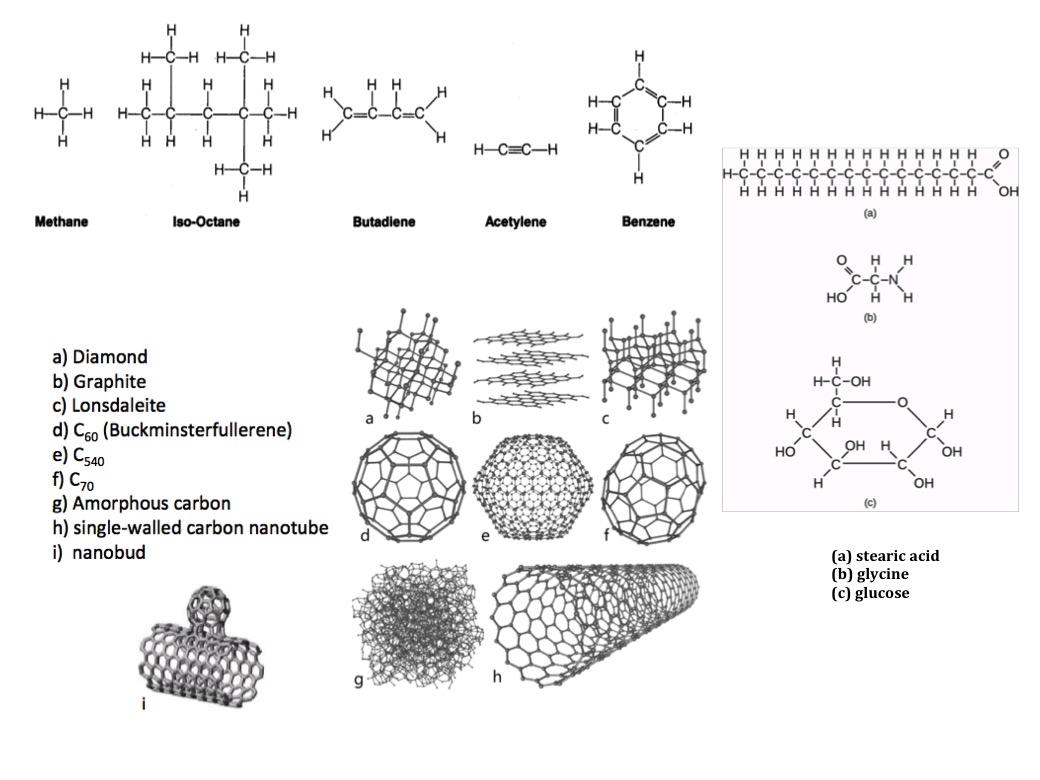
Carbon Compounds Final
Image above: Some of the many forms of carbon. Even if you can’t read chemical structures, you can see that the patterns that carbon creates are many and varied. From original article.

I could write a book on the marvels of carbon (and may some day!) but before carbon’s nuggetized biography takes over this whole article, I will sum up by saying that carbon’s ability to store and move energy, and also to bond with so many other elements and thus shuttle them from place to place, make this element the backbone of life. Soil lacking in carbon—in organic matter and the soil life it breeds—is dead soil, and it creates dead food.

Nitrogen is a much-touted soil nutrient, critical but often so over-emphasized that other nutrients just as valuable get overlooked. It’s needed to build protein, which is found in structural tissues such as muscle and cell membranes, and also in enzymes, active, flexible chains of molecules that are the construction equipment of life.

Enzymes weld together protein, starch, and DNA chains; push needed molecules through cell membranes; repair and regulate DNA, and do essentially all the building, transport, and disassembly that go on within living things. Every living being needs nitrogen to keep protein in good supply.

Nitrogen is also a major ingredient in chlorophyll, the compound that uses sunlight to build sugar out of carbon dioxide in the air. That’s why plants green up so fast when they get a dose of nitrogen. Too much nitrogen can prompt insect damage, because bugs need lots of it and can “smell” when plants have it in overabundance.

Phosphorus stimulates root formation, improves flowering and seed production, strengthens stems and stalks, aids nitrogen-fixing bacteria, and increases disease resistance. It’s used in DNA, special fats that make up cell membranes, and in ATP, which is a principal energy-storing molecule.

Phosphorus is stored in large amounts in seeds as phytin, where it can by used by the developing seedling. Phosphorus also aids in transporting other nutrients around the cell. Some scientists and activists believe we’re rapidly depleting phosphorus supplies and feel that we need to be much better at stewarding it.

Potassium has a role that is less understood, but it is needed for many enzymes to function, and it helps young plants get started, in part by strengthening roots. Potassium-deficient plants are more susceptible to cold, extreme heat, drought, insect predation, and disease.

Calcium is a neglected nutrient that is just beginning to get its due. The textbooks will tell you that calcium is needed in modest amounts to build cell walls, protect against heat stress and disease, aid in nitrogen fixation by bacteria, improve fruit quality, and help in the uptake of other nutrients. That last role conceals a mountain of important and often dismissed functions for calcium.

Maverick soil scientist Dr. William Albrecht was among the first to sniff out calcium’s unsung role in soil biology, nutrition and health, and his work spawned a school of advocates, including the Acres USA publishing team, and soil specialists such as Michael Astera and Steve Solomon. I recommend checking out their work for an expanded and radical view of soil minerals that has helped me immensely in growing nutrient-dense food.

For example, agricultural lime (calcium hydroxide) has been used for millennia to make acidic soils sweeter, that is, to raise their pH. But Albrecht found evidence that it’s the calcium in lime that reverses the nutrient deficiencies that common wisdom claims are due to acid pH. In other words, when soil contains enough calcium, soil acidity matters much less. This is, to put it mildly, controversial, but a view that some serious plant growers swear by.

Calcium also loosens sticky clay soils. So this new school of calcium aficianados recommends much higher levels of calcium in soil than conventional agronomists. They also believe that soil levels of calcium, magnesium, potassium, sodium, iron, zinc, and a few other nutrients should be adjusted to an ideal ratio, roughly 65% calcium,
15% magnesium, 4% potassium, and 1-3% each of the others.

For more on these ratios and the thinking behind them, check out http://soilminerals.com and Michael Astera’s book The Ideal Soil. For an opposing view, see what soil scientist Neal Menzies has to say.

My personal view, and the one that guides my fertilizer recipes, is that most soils benefit from adding more calcium than the conventional guides say, but there is a lot of leeway in the ratio of calcium to other nutrients. I don’t worry about achieving a perfect 65/15/3 balance, just something in the ballpark, or even in the same part of town.

Magnesium is at the center of the chlorophyll molecule, just as iron is at the heart of the very similar hemoglobin molecule in mammals. It’s essential for ferrying phosphorus and iron to where they are needed.

Many of the enzymes that synthesize sugar, fats, and oils contain magnesium. In soil, it increases the stickiness of some clays, so levels that are too high can make soils gummy and even anaerobic. In soils low in clay, adding magnesium sometimes helps soil hold more water and stabilizes organic matter.

To wrap up this segment of our series on soil: Carbon builds structure and stores energy. It’s not properly a nutrient, but its presence in soil in many forms is critical for ecosystem function and everyone’s health.

The elements that make up what soil folk call the primary nutrients are nitrogen, phosphorus, and potassium. Those three are, I think, overemphasized, a legacy of some of the earliest experiments done on plant nutrition that used anything resembling the scientific method.

Justus von Liebig, a brilliant German chemist who made major contributions to organic chemistry and invented important chemical equipment, examined the content of ashes from grains. He found principally nitrogen, phosphorus, and potassium, and since then generations of farmers and soil scientists have concentrated on—and used staggering quantities of—these and only these as nutrients.

The roles of carbon and of the other mineral nutrients were neglected for over a century, leading to depletion of most of the world’s farmable soil and a precipitous decline in nutrition in our food.

The secondary nutrients, calcium and magnesium, are only secondary in sheer mass required, but not in importance to plant, soil, animal, and human health. The same goes for the trace elements. Chalk up another victory for the “quantity over quality” mindset, and a loss for all of life.

I’ve used more words than I expected to get to this point in our tale. We haven’t made it to the trace elements and why those transition metals are so magical and important—so important that some scientists joke that life arose simply as a way to move them around.

We’ll talk about that next time, and begin looking at how to tailor your soil to yield lush amounts of nutrient-dense food: both quantity and quality.

See also:
TobyHemenway: A big Bang for Big Soil 8/9/16
TobyHemenway: The Cosmos, the Earth and Soil 6/22/16

• Toby Hemenway is the author of Gaia’s Garden: A Guide to Home-Scale Permaculture, which was awarded the Nautilus Gold Medal in 2011, was named by the Washington Post as one of the ten best gardening books of 2010, and is the best-selling permaculture book in the world. His new book on urban permaculture, The Permaculture City, was released in July, 2015.


.

Good nutrition begins in the soil

SUBHEAD: We need public awareness of the links between our health, what we eat, and how we farm.

By Patrick Holden on 1 September 2016 for Sustainable Food Trust -
(http://sustainablefoodtrust.org/articles/good-nutrition-begins-soil/)


Image above: Photo of a cross section through healthy soil. From (http://www.singleton.nsw.gov.au/index.aspx?NID=1639).

Quite rightly, more and more doctors and members of the public are asking “what should I eat to stay healthy?” As someone who has been farming sustainably in West Wales for the last 40 years, I would add the question “how should we farm so that the food produced truly promotes the health of the public?”

These two questions are linked, because what we have done to the chronic diseases of our bodies has very much been mirrored in the soil.

At our recent conference in San Francisco called The True Cost of American Food, Tyler Norris from Kaiser Permanente (perhaps the leading health insurance and managed health care company on the West Coast) said they are facing an unaffordable health treatment crisis. He attributed much of this to the industrialisation of agriculture, particularly in California’s Central Valley which is America’s ‘food basket’.

Not that Norris knew, but he was echoing an observation made many years ago by Lady Eve Balfour who founded the Soil Association. She called for a thorough investigation of the causes of health (which she believed are rooted in the food we eat and the way we farm) because she saw the NHS becoming a “national disease treatment service” rather than a “national health service”.

Lady Balfour had been inspired by Sir Albert Howard, a man who had been sent out to India at the height of the Empire, a century ago by the British Government, to encourage the people of India to adopt western diets. Fortunately, Howard had the intelligence and humility to realise early on in his mission that he had nothing much to teach India about sound nutrition.

He recognised too that the relative healthiness of North West India was due not simply to what people ate, but to the way their food was grown in soils which produced highly nourishing crops because the farmers, perhaps intuitively and without the science which has only recently confirmed its importance, always looked after the soil microbiome.

Industrial farming

How much does current farming practice affect the health of the microscopic life of the soil? Ought farmers to try and influence it for the better, and do we need to change agricultural practice in order to restore the public health? To answer these questions we must go back 70 years and see what happened to post-war agriculture and farming.

In the mid-1940s this country embarked on an ‘experiment’ to stimulate the growth of plants and animals artificially. In the case of plants we used chemical fertilisers; with animals it was high protein feeds.

The ‘side-effects’ of these methods in the plant world include fungal diseases, pests and weed problems. Our response of course has been to suppress them with fungicides, pesticides and herbicides. (You might consider whether this process has parallels in medicine).

Where livestock is concerned, high protein feeds disturb their internal microbiome. We then treat the ensuing infections and inflammatory diseases with a range of antibiotics and other antimicrobial drugs.

The use of these chemicals in milk and meat production contributes to the development of antibiotic resistant bacteria and the crisis the world now faces, with the prospect of communicable diseases regaining their former power as the major cause of premature death globally.

Seventy years of this kind of farming has so severely depleted the soil microbiome that in most areas we now have a predominantly dead soil. Only by changing our farming practices can we rebuild soil microbiological life and the soil carbon in which this resides. This is well established.

Less clear, until we have more research to go on, is whether in addition, pesticides are impacting on public health by contributing to endocrine dysfunction.

The damage done

Clearly the dying soil is already a huge and increasing problem. In parallel, we face a dramatic narrowing of the gene pool in agriculture and in the biodiversity that formerly co-existed on farmland. A third element in the farming crisis, alongside these interwoven forms of depletion, is a pricing system that produces cheap food no matter what the true costs.

But if farming methods had to take into account the damage done to public health and the environment, much would have to change.

When the cheapest food is probably doing you most damage, the food industry is sending very confusing signals to their consumers. Yet as long as the “externalities” – the damaging consequence to public health and the environment – are not reflected in the price of food, good and sustainable food will always cost more at the checkout.

Farmers are in a bind too because there is a better business case for producing food in an intensive way than for producing food in a sustainable way, because they do not have to pay for the hidden costs. And so the system is perpetuated by a systemic problem in which farming has played a major role but is powerless to resolve.

The issue of endocrine disruption, due to pesticides and other chemicals routinely used in almost all of our food production systems, should also be of greater concern. Though there is an absence of solid data confirming or refuting the links between endocrine disrupting pesticides and negative public health outcomes, there are correlations we should not ignore.

One example of this is the herbicide glyphosate, easily the most widely used herbicide in the world, which for the last 40 years has been promoted as an entirely safe chemical.

Last year the WHO classified it as a probable carcinogen due to its endocrine disrupting properties and studies indicating a link between exposure and certain types of cancer.

So if we are hoping to impact cancer prevalence by giving patients more health-promoting foods, we need to know whether those same foods carry other risks.

I remain extremely concerned about GM technology, in part because of the risks we take by altering the natural world before we fully understand it, but also because it has resulted in other changes, including impacts on wildlife and the widespread use of Roundup the most widely used herbicide containing glyphosate.

Roundup is getting everywhere. It is in air we breathe, the water we drink and, of course, in our food, partly because it is also used as a pre-harvest desiccant – in other words it is sprayed onto many crops like oil seed rape, both GM and non-GM and grain crops before they are harvested and thereby kills off all the plants in that field, so contributing to the dramatic narrowing of the gene pool.

Moreover, due to the uptake of GM crops farmers are increasingly rejecting the crop varieties that have adapted to the places where they have been grown for generations, in favour of GM herbicide or pesticide-tolerant crops.

This gives a farmer a short term economic advantage, but at a long-term cost that should make us all much more worried about trade agreements and pricing policies that will make it ever more difficult to stop the consequences of genetically modified crops affecting our food and our food supply.

As for the dangers of meat, I think we need to differentiate between grass-fed meat which is high in omega-3 fatty acids and antioxidants and grain-fed meat which contains very little of these vital micro-nutrients. We also need to distinguish processed meat, which can include a wide range of chemical additives, and carcass meat from healthy animals.

When I went to Northern Kenya about 3 years ago, to a gathering of 26 tribes of “nomadic pastoralists” I learned that most of them for much of the year were subsisting on a diet of blood, fresh meat and milk. They looked unbelievably healthy!

Perhaps with so many nutritional orthodoxies – notably the longstanding case against saturated fats, already now in question – we should at least keep an open mind about whether a health promoting and sustainable diet should include meat.

Better food policy

Right now there may be a growing (and changing) consensus on what is good for our hearts, our brains and our whole body and therefore what we should eat.

But we are a very long way indeed from having farming procedures and practices that would sustain that sort of food supply. And we won’t make the necessary progress until growers properly engage with the health professionals who are responsible for maintaining public health.

Only if there is public pressure will these things happen. I believe that if we could get public health and farming out of their silos and find a way of linking these sectors we could then make the necessary structural changes to agriculture.

We need to move away from chemistry to biology in the way that we farm. Nitrogen fertilisers are one of the principal reasons why the soil biology has diminished, along with the pesticides, which go hand in hand with them.

But giving them up would call not just for huge structural changes in agricultural systems, but also for a shift in what farmers produce, if 21st century diets are ever going to restore the vitality and the diversity of our farming systems and our population.

Without fertilizer nitrogen, a return to the rotational practices of mixed farming is the only way we can rebuild soil fertility and produce enough nitrogen naturally grow bountiful crops.

This would be the biggest structural change in agriculture for more than half a century, and it would have huge implications for what we produce and provides another dimension to the whole issue of what we should eat.

At the moment we have a globalised food economy. But surely within the constraints of our population and the capacity of our agriculture, we could produce much more of our food nearer home.

What would happen if we sourced our staple foods from the sorts of production systems that we are capable of switching to in this country, and if the national diet became fit to maintain public health?

Farming, food and the future

Above all we must link our diets with the productive capacity of a sustainable food system. In terms of our staple foods, a sustainable farming system would have to give up producing chicken and pork intensively. We cannot rebuild soil health while growing arable crops year after year, as we do at the moment in many parts of the UK and we should not continue to rely on imports of soyabean meal from South America where its production is degrading soils and rivers, while putting carbon into the atmosphere.

This would mean that we would produce less cereals, probably about half the quantity under a reformed agricultural structure.

But during the fertility building phase which would probably be cellulose-based from grass and clover, we would need ruminant livestock producing red meat, grass-fed of course, to digest the cellulose, and also to re-manure and reinstate the lost biology of the soil. And to give the farmers an income, we would need to eat that red meat. A sustainable diet should mean no more cheap industrialised chicken or pork, whatsoever.

Some expensive grass- and partly grain-fed chicken and pork, because they can get some of their diet from grass, but probably no more than 30% since they cannot digest cellulose in the ways cattle and sheep can. We would still have to feed some grain to our dairy cows, as most dairy farmers do.

Salads would feature too but not the sort the supermarkets are selling. Unless you buy organically, supermarket salads are almost universally from hydroponics: not soil fed, but tube fed, and some studies suggest hydroponic produce impacts the human biome.

We will need vegetables and some grain, but we would eat the grain instead of feeding it to intensively reared livestock.

For our health’s sake we need to avoid processed foods. On the whole we need to move towards more fermented products – sourdough bread, yoghurt, cheese (lots of cheese – I am as you might suspect a cheese producer!).

Ways forward

To enable those changes, we need a massive education programme. It’s no good just asking “what should I eat?” without linking the question to “how can we farm to produce health?”, promoting food from farming systems ever more aligned to our new knowledge of microbiomes in the gut and in the soil.

For the soil is the gut – the source of nourishment – for the plants we farmers grow. And it now seems there is a vital link between the microbiome of our intestines and the microbiome of the soil.

Seventy years of intensive farming have decreased the microbiome of the soil to such low levels that now we urgently need to restore it. And this will mean changing the way we farm.

To achieve this we need enabling policies and a supportive economic environment. The economic case will depend on finding a reliable means for assessing the negative health outcomes of present farming systems. Once monetised, we would have a very strong case for Government incentives to switch to more sustainable farming systems.

But as the health outcomes are going to be long term and certainly not within the political cycle, these changes will only happen if there is a huge rise in public awareness of the links between our health, what we eat, and how we farm.

.

Fossil Fuels for foreseeable Future

SUBHEAD: Chevron CEO sees fossil fuel use as indispensable for our future - not Earth's.

By Chevron CEO John S. Watson on 30 August 2016 for LinkedIn -
(https://www.linkedin.com/pulse/why-i-think-oil-natural-gas-indispensable-foreseeable-john-s-watson)


Image above: Chevron CEO John S. Watson (l) talks to LinkedIn Editor Dan Roth (r). From original article.

[IB Publisher's Note: This is another good reason to not join LinkedIn. It's like FaceBook without your family or posse. Just a bunch of buzzards looking to make a few more bucks. What a surprise - Chevron's Chief Executive Officer is for fossil fuel usage to keep the industrial world growing for the foreseeable future. Not a word is mentioned about CO2, Global Warming, Ocean Rising or Climate Change. His case: "Fossil fuels have enabled the greatest advancements in living standards over the last 150 years." But at what cost - a livable planet Earth?]

I recently met with LinkedIn Executive Editor Dan Roth to talk about the current state of the oil and natural gas industry, which he noted has seen almost 70 bankruptcies this year, lower profits and a large number of layoffs. Dan wondered how Chevron could continue to attract employees – particularly millennials.

It’s a fair question – for those outside the oil and natural gas industry. Those of us in the industry know the products we develop are indispensable to the economies of the world. And so, even as we work our way through this low-price environment, we’re confident in the future.

During my 36 years with Chevron, oil prices have dropped 50 percent or more five times. In the most recent fall, oil went from a high of just over $115 a barrel to under $50 a barrel in just six months. When prices fall, industry pulls back on investment and scales back the workforce in line with activities.

Ours is a long-term business, so we know that eventually supply and demand will come back into balance and prices will stabilize. The global economy depends on it.

The energy we produce enables light, heat, mobility, mechanized agriculture, modern communications, the health system that keeps us well, and the many electronic devices that keep us connected and entertained. It’s also the feedstock for everything from crayons to contact lenses, not to mention the basis of our roads and runways.

More than 50 percent of the world's energy currently comes from oil and natural gas – and another nearly 30 percent from coal. Fossil fuels have enabled the greatest advancements in living standards over the last 150 years.

They’re abundant; reliable; energy-dense; can be stored; provide multiple, high-value consumer products beyond power and fuel; and have a global infrastructure of refineries, pipelines, ships, and distribution systems that’s been more than a century in the making.


Image above: Chevron chart of industrial energy sources from 1870 to forecast of 2040. Note that fossil fuels make up 20% of energy in 1870 and over 80% in 2040. The planet Eaarth will be a cinder at that rate. From original article.

And yet, despite the depth and breadth of today’s energy market, there are still 1.2 billion people in the world without electricity and more than 2.7 billion people who still burn solid fuels, such as wood, crop residue and dung, to cook their food. Enabling affordable and reliable energy for these people, even as we maintain our modern lifestyles, is critical to global economic growth and stability.
Fossil fuels have enabled the greatest advancements in living standards over the last 150 years.
This will require more energy in the years ahead than we can possibly produce by renewable sources given today’s technology. Most forecasts call for global energy demand to rise by around one third or more by 2040 as populations grow, incomes rise and people all over the world strive for the standard of life we enjoy today. It’s clear that to meet those needs we’ll need all forms of energy – renewables, oil, natural gas, coal and nuclear.

Although the use of renewables will grow, under the International Energy Agency’s New Policies Scenario (with calculations based on current and projected emissions policies) we see oil and natural gas are forecast to account for 50 percent of global energy demand by 2040.

 Even in its 450 Scenario (which accounts for a greater reduction in emissions), oil and natural gas will still account for 44 percent, with coal providing an additional 16 percent.

Despite rapid growth in installed capacity, the share of total primary energy demand supplied by wind and solar generation is expected to still be about 3 percent in 2040.

While that’s a big jump from the less than 1 percent of the energy supplied by these renewables today, those forecasts make clear that, without a game-changing energy technology breakthrough, renewables will be insufficient to independently provide enough affordable and reliable energy to meet the needs of the developed world while also raising the living standards of developing countries.

Bill Gates notes that energy is critical to lifting people out of poverty. “If I could have just one wish to help the poorest people, it would be to find a cheap, clean source of energy to power our world,’’ he said in his 2016 annual letter.

“You might be wondering, `Aren’t people just trying to stay healthy and find enough to eat? Isn’t that important too?’ Yes, of course it is…But energy makes all those things easier. It means you can run hospitals, light up schools, and use tractors to grow more food.”

Gates predicts the world will uncover a clean-energy breakthrough within the next 15 years. Chevron supports continued research into early-stage technologies to find that breakthrough.

And while this search is underway, the world will continue to need energy from the mix of sources that we have today. That doesn’t mean we won’t see efficiency and environmental improvements along the way.

Industry, in partnership with governments and universities, has a good track record of advancing technology to make energy more efficient while addressing environmental priorities.

Since I was a kid, automotive tailpipe emissions have been reduced 98 percent, and electric vehicles have moved from an innovative idea into an integral – although still small – part of our nation’s roadways.

At the same time, the oil and natural gas industry has continued to find more resources and ways to recover more of them efficiently, economically and safely. In the past decade alone, we’ve used innovation and technology to transform the U.S. energy story from one of scarcity to one of abundance.

This can’t be done without always maintaining the right people in the right jobs at the right time. Even in today’s business environment, we’ve continued to hire, develop and train our employees. Demographics indicate a large retirement wave in the next 5-10 years, and we have to ensure we have the necessary talent in place to continue to advance our industry.

The energy sector has been, and will continue to be, transformed over a long sweep of time. But this transformation must be compatible with meeting our economic and environmental priorities, and that means oil and natural gas will remain critical.

These fuels remain for the foreseeable future the foundation of the energy economy, keeping the world’s lights on, its factories running, and the transportation system moving. People want to work for us because our products make life better.

.

Solar and Wind can't support the Grid

SUBHEAD: If intermittent sources of energy cannot support grid electricity it doesn't mean we should not go there.

By Gail Tverberg on 31 August 2016 for Our Finite World -
(https://ourfiniteworld.com/2016/08/31/intermittent-renewables-cant-favorably-transform-grid-electricity/). See original article for all graphic figures that support Tverberg's position on renewable energy and the Electric Grid.


Image above: Photo-illustration of wind and solar energy supporting the grid in an article titled "US Electrical Grid More Reliable with Renewables". Gail would say that's a bit optimistic. From (http://www.energydigital.com/renewableenergy/3226/US-Electrical-Grid-More-Reliable-with-Renewables).

[IB Publisher's Note: Gail has been a long time observer of the Peak Oil phenomena and has skills as a actuary and provides clear analysis in her articles on energy. I do think she has a blind spot with regards to the Electric Grid. Her case in the article below is that the renewable energy supplied by solar and wind energy is too variable and unpredictable to supply more than 10-15% of the electricity supplied to the Electric Grid. Her conclusion is to recommend that continued investment in solar and wind has become counterproductive with greater penetration than is has today. This has to do with the difficulty and expense of energy storage. For a continuation of the lifestyle we are accustomed to energy storage is critical if we are using intermittent power sources. She's right... but. She makes no effort to look at the possibility that the Grid will become too expensive for us to support as modern industrialization and infrastructure breakdown as fossil fuels continue to be too expensive for a "growth Economy". The Grid will breakdown into isolated power stations supplying individual communities. Renewable energy will evolve to be an increasing part of the total electricity produced as it  replaces the Grid connections at individual sites. At some point wind and solar may all that is available in many rural and suburban locations, with or without storage. Gail's point that solar and wind can't support the Grid is probably true... and that's not necessarily a bad  thing.]


Many people are hoping for wind and solar PV to transform grid electricity in a favorable way. Is this really possible? Is it really feasible for intermittent renewables to generate a large share of grid electricity? The answer increasingly looks as if it is, “No, the costs are too great, and the return on investment would be way too low.”

We are already encountering major grid problems, even with low penetrations of intermittent renewable electricity: US, 5.4% of 2015 electricity consumption; China, 3.9%; Germany, 19.5%; Australia, 6.6%.

In fact, I have come to the rather astounding conclusion that even if wind turbines and solar PV could be built at zero cost, it would not make sense to continue to add them to the electric grid in the absence of very much better and cheaper electricity storage than we have today.

There are too many costs outside building the devices themselves. It is these secondary costs that are problematic.

Also, the presence of intermittent electricity disrupts competitive prices, leading to electricity prices that are far too low for other electricity providers, including those providing electricity using nuclear or natural gas.

The tiny contribution of wind and solar to grid electricity cannot make up for the loss of more traditional electricity sources due to low prices.

Leaders around the world have demanded that their countries switch to renewable energy, without ever taking a very close look at what the costs and benefits were likely to be.

A few simple calculations were made, such as “Life Cycle Assessment” and “Energy Returned on Energy Invested.” These calculations miss the fact that the intermittent energy being returned is of very much lower quality than is needed to operate the electric grid.

They also miss the point that timing and the cost of capital are very important, as is the impact on the pricing of other energy products. This is basically another example of a problem I wrote about earlier, Overly Simple Energy-Economy Models Give Misleading Answers.

Let’s look at some of the issues that we are encountering, as we attempt to add intermittent renewable energy to the electric grid.

Issue 1. Grid issues become a problem at low levels of intermittent electricity penetration.

In 2015, wind and solar PV amounted to only 12.2% of total electricity consumed in Hawaii, based on EIA data. Even at this low level, Hawaii is encountering sufficiently serious grid problems that it has needed to stop net metering (giving homeowners credit for the retail cost of electricity, when electricity is sold to the grid) and phase out subsidies.

Hawaii consists of a chain of islands, so it cannot import electricity from elsewhere. This is what I mean by “Generation = Consumption.” There is, of course, some transmission line loss with all electrical generation, so generation and consumption are, in fact, slightly different.

The situation is not too different in California. The main difference is that California can import non-intermittent (also called “dispatchable”) electricity from elsewhere. It is really the ratio of intermittent electricity to total electricity that is important, when it comes to balancing. California is running into grid issues at a similar level of intermittent electricity penetration (wind + solar PV) as Hawaii–about 12.3% of electricity consumed in 2015, compared to 12.2% for Hawaii.

Issue 2. The apparent “lid” on intermittent electricity at 10% to 15% of total electricity consumption is caused by limits on operating reserves.

Electric grids are set up with “operating reserves” that allow the electric grid to maintain stability, even if a large unit, such as a nuclear power plant, goes offline. These operating reserves typically handle fluctuations of 10% to 15% in the electricity supply.

If additional adjustment is needed, it is possible to take some commercial facilities offline, based on agreements offering lower rates for interruptible supply. It is also possible for certain kinds of power plants, particularly hydroelectric and natural gas “peaker plants,” to ramp production up or down quickly. Combined cycle natural gas plants also provide reasonably fast response.

In theory, changes can be made to the system to allow the system to be more flexible.

One such change is adding more long distance transmission, so that the variable electricity can be distributed over a wider area. This way the 10% to 15% operational reserve “cap” applies more broadly.

Another approach is adding energy storage, so that excess electricity can be stored until needed later.

A third approach is using a “smart grid” to make changes, such as turning off all air conditioners and hot water heaters when electricity supply is inadequate. All of these changes tend to be slow to implement and high in cost, relative to the amount of intermittent electricity that can be added because of their implementation.

Issue 3. When there is no other workaround for excess intermittent electricity, it must be curtailed–that is, dumped rather than added to the grid.

Overproduction without grid capacity was a significant problem in Texas in 2009, causing about 17% of wind energy to be curtailed in 2009. At that time, wind energy amounted to about 5.0% of Texas’s total electricity consumption. The problem has mostly been fixed, thanks to a series of grid upgrades allowing wind energy to flow better from western Texas to eastern Texas.

In 2015, total intermittent electricity from wind and solar amounted to only 10.1% of Texas electricity. Solar has never been large enough to be visible on the chart–only 0.1% of consumption in 2015. The total amount of intermittent electricity consumed in Texas is only now beginning to reach the likely 10% to 15% limit of operational reserves.

Thus, it is “behind” Hawaii and California in reaching intermittent electricity limits.

Based on the modeling of the company that oversees the California electric grid, electricity curtailment in California is expected to be significant by 2024, if the 40% California Renewable Portfolio Standard (RPS) is followed, and changes are not made to fix the problem.

Issue 4. When all costs are included, including grid costs and indirect costs, such as the need for additional storage, the cost of intermittent renewables tends to be very high.

In Europe, there is at least a reasonable attempt to charge electricity costs back to consumers. In the United States, renewable energy costs are mostly hidden, rather than charged back to consumers. This is easy to do, because their usage is still low.

Euan Mearns finds that in Europe, the greater the proportion of wind and solar electricity included in total generation, the higher electricity prices are for consumers.

The five countries shown in red have all had financial difficulties. High electricity prices may have contributed to their problems.

The United States is not shown on this chart, since it is not part of Europe. If it were, it would be a bit below, and to the right of, Czech Republic and Romania.

Issue 5. The amount that electrical utilities are willing to pay for intermittent electricity is very low. 
The big question is, “How much value does adding intermittent electricity add to the electrical grid?”

Clearly, adding intermittent electricity allows a utility to reduce the amount of fossil fuel energy that it might otherwise purchase. In some cases, the addition of solar electricity slightly reduces the amount of new generation needed. This reduction occurs because of the tendency of solar to offer supply when the usage of air conditioners is high on summer afternoons.

Of course, in advanced countries, the general tendency of electricity usage is down, thanks to more efficient light bulbs and less usage by computer screens and TV monitors.

At the same time, the addition of intermittent electricity adds a series of other costs:
  • Many more hook-ups to generation devices are needed. Homes now need two-way connections, instead of one-way connections. Someone needs to service these connections and check for problems.
  • Besides intermittency problems, the mix of active and reactive power may be wrong. The generation sources may cause frequency deviations larger than permitted by regulations.
  • More long-distance electricity transmission lines are needed, so that the new electricity can be distributed over a wide enough area that it doesn’t cause oversupply problems when little electricity is needed (such as weekends in the spring and fall).
  • As electricity is transported over longer distances, there is more loss in transport.
  • To mitigate some of these problems, there is a need for electricity storage. This adds two kinds of costs: (1) Cost for the storage device, and (2) Loss of electricity in the process.
  • As I will discuss later, intermittent energy tends to lead to very low wholesale electricity prices. Other electricity providers need to be compensated for the effects these low prices cause; otherwise they will leave the market.
To sum up, when intermittent electricity is added to the electric grid, the primary savings are fuel savings. At the same time, significant costs of many different types are added, acting to offset these savings. In fact, it is not even clear that when a comparison is made, the benefits of adding intermittent electricity are greater than the costs involved.

According to the EIA’s 2015 Wind Technologies Market Report, the major way intermittent electricity is sold to electric utilities is as part of long term Power Purchase Agreements (PPAs), typically lasting for 20 years.

Utilities buy PPAs as a way of hedging against the possibility that natural gas prices will rise in the future. The report indicates that the recent selling price for PPAs is about $25 to $28 per MWh (Figure 6). This is equivalent to 2.5  to 2.8 cents per kWh, which is very inexpensive.

In effect, what utilities are trying to do is hedge against rising fuel prices of whatever kind they choose to purchase. They may even be able to afford to make other costly changes, such as more transmission lines and energy storage, so that more intermittent electricity can be accommodated.

Issue 6. When intermittent electricity is sold in competitive electricity markets (as it is in California, Texas, and Europe), it frequently leads to negative wholesale electricity prices. It also shaves the peaks off high prices at times of high demand.

In states and countries that use competitive pricing (rather than utility pricing, used in some states), the wholesale price of electricity price varies from minute to minute, depending on the balance between supply and demand. When there is an excess of intermittent electricity, wholesale prices often become negative. Figure 7 shows a chart by a representative of the company that oversees the California electric grid.


Clearly, the number of negative price spikes increases, as the proportion of intermittent electricity increases. A similar problem with negative prices has been reported in Texas and in Europe.
When solar energy is included in the mix of intermittent fuels, it also tends to reduce peak afternoon prices.

Of course, these minute-by-minute prices don’t really flow back to the ultimate consumers, so it doesn’t affect their demand. Instead, these low prices simply lead to lower funds available to other electricity producers, most of whom cannot quickly modify electricity generation.

Clearly, wholesale electricity prices have been trending downward, while residential electricity prices have been rising. In fact, if prices for nuclear, natural gas, and coal-fired electricity had been fair prices for these other providers, residential electricity prices would have trended upward even more quickly than shown in the graph!
 

Figure 8. Residential Electricity Prices in Europe, together with Germany spot wholesale price, from http://pfbach.dk/firma_pfb/references/pfb_towards_50_pct_wind_in_denmark_2016_03_30.pdf

Note that the recent average wholesale electricity price is about 30 euros per MWh, which is equivalent to 3.0 cents per kWh. In US dollars this would equate to $36 per MWh, or 3.6 cents per kWh. These prices are higher than prices paid by PPAs for intermittent electricity ($25 to $28 per MWh), but not a whole lot higher.

The problem we encounter is that prices in the $36 MWh range are too low for almost every kind of energy generation.

A price of $36 per MWh is way down at the bottom of the chart, between 0 and 50. Pretty much no energy source can be profitable at such a level. Too much investment is required, relative to the amount of energy produced. We reach a situation where nearly every kind of electricity provider needs subsidies. If they cannot receive subsidies, many of them will close, leaving the market with only a small amount of unreliable intermittent electricity, and little back-up capability.

This same problem with falling wholesale prices, and a need for subsidies for other energy producers, has been noted in California and Texas. The Wall Street Journal ran an article earlier this week about low electricity prices in Texas, without realizing that this was a problem caused by wind energy, not a desirable result!

Issue 7. Other parts of the world are also having problems with intermittent electricity.

Germany is known as a world leader in intermittent electricity generation. Its intermittent generation hit 12.2% of total generation in 2012. As you will recall, this is the level where California and Hawaii started to reach grid problems.

By 2015, its intermittent electricity amounted to 19.5% of total electricity generated.


Figure 10. German electricity generated, based on BP Statistical Review of World Energy 2016.
Needless to say, such high intermittent electricity generation leads to frequent spikes in generation. Germany chose to solve this problem by dumping its excess electricity supply on the European Union electric grid. Poland, Czech Republic, and Netherlands complained to the European Union.

As a result, the European Union mandated that from 2017 onward, all European Union countries (not just Germany) can no longer use feed-in tariffs. Doing so provides too much of an advantage to intermittent electricity providers.

Instead, EU members must use market-responsive auctioning, known as “feed-in premiums.” Germany legislated changes that went even beyond the minimum changes required by the European Union. Dörte Fouquet, Director of the European Renewable Energy Federation, says that the German adjustments will “decimate the industry.”

In Australia, one recent headline was Australia Considers Banning Wind Power Because It’s Causing Blackouts. The problem seems to be in South Australia, where the last coal-fired power plants are closing because subsidized wind is leading to low wholesale electricity prices.

Australia, as a whole, does not have a high intermittent electricity penetration ratio (6.6% of 2015 electricity consumption), but grid limitations mean that South Australia is disproportionately affected.

China has halted the approval of new wind turbine installations in North China because it does not have grid capacity to transport intermittent electricity to more populated areas.

Also, most of China’s electricity production is from coal, and it is difficult to use coal to balance with wind and solar because coal-fired plants can only be ramped up slowly. China’s total use of wind and solar is not very high (3.9% of consumption in 2015), but it is already encountering major difficulties in grid integration.

Issue 8. The amount of subsidies provided to intermittent electricity is very high.

The renewable energy program in the United States consists of overlapping local, state, and federal programs. It includes mandates, feed-in tariffs, exemption from taxes, production tax credits, and other devices. This combination of approaches makes it virtually impossible to figure out the amount of the subsidy by adding up the pieces. We are pretty certain, however, that the amount is high. According to the National Wind Watch Organization,
At the federal level, the production or investment tax credit and double-declining accelerated depreciation can pay for two-thirds of a wind power project. Additional state incentives, such as guaranteed markets and exemption from property taxes, can pay for another 10%.
If we believe this statement, the developer only pays about 23% of the cost of a wind energy project.
The US Energy Information Administration prepared an estimate of certain types of subsidies (those provided by the federal government and targeted particularly at energy) for the year 2013. These amounted to a total of $11.3 billion for wind and solar combined.

About 183.3 terawatts of wind and solar energy was sold during 2013, at a wholesale price of about 2.8 cents per kWh, leading to a total selling price of $5.1 billion dollars.

If we add the wholesale price of $5.1 billion to the subsidy of $11.3 billion, we get a total of $16.4 billion paid to developers or used in special grid expansion programs. This subsidy amounts to 69% of the estimated total cost.

Any subsidy from states, or from other government programs, would be in addition to the amount from this calculation.

Paul-Frederik Bach shows a calculation of wind energy subsidies in Denmark, comparing the prices paid under the Public Service Obligation (PSO) system to the market price for wind. His calculations show that both the percentage and dollar amount of subsidies have been rising. In 2015, subsidies amounted to 66% of the total PSO cost.

by comparing paid for wind under PSO with market value of wind energy. 

In a sense, these calculations do not show the full amount of subsidy. If renewables are to replace fossil fuels, they must pay taxes to governments, just as fossil fuel providers do now. Energy providers are supposed to provide “net energy” to the system. The way that they share this net energy with governments is by paying taxes of various kinds–income taxes, property taxes, and special taxes associated with extraction. If intermittent renewables are to replace fossil fuels, they need to provide tax revenue as well. 

Current subsidy calculations don’t consider the high taxes paid by fossil fuel providers, and the need to replace these taxes, if governments are to have adequate revenue.

Also, the amount and percentage of required subsidy for intermittent renewables can be expected to rise over time, as more areas exceed the limits of their operating reserves, and need to build long distance transmission to spread intermittent electricity over a larger area. This seems to be happening in Europe now.

In 2015, the revenue generated by the wholesale price of intermittent electricity amounted to about 13.1 billion euros, according to my calculations.

In order to expand further, policy advisor Daniel Genz with Vattenfall indicates that grids across Europe will need to be upgraded, at a cost of between 100 and 400 billion euros. In other words, grid expenditures will be needed that amount to between 7.6 and 30.5 times wholesale revenues received from intermittent electricity in 2015.

Most of this will likely need to come from additional subsidies, because there is no possibility that the return on this investment can be very high.

There is also the problem of the low profit levels for all of the other electricity providers, when intermittent renewables are allowed to sell their electricity whenever it becomes available.

One potential solution is huge subsidies for other providers.

Another is buying a lot of energy storage, so that energy from peaks can be saved and used when supply is low.

A third solution is requiring that renewable energy providers curtail their production when it is not needed. Any of these solutions is likely to require subsidies.

Conclusion
We already seem to be reaching limits with respect to intermittent electricity supply. The US Energy Information Administration may be reaching the same conclusion. It chose Steve Kean from Kinder Morgan (a pipeline company) as its keynote speaker at its July 2016 Annual Conference. He made the following statements about renewable energy.

 
This view is very similar to mine. Few people have stopped to realize that intermittent electricity isn’t worth very much. It may even have negative value, when the cost of all of the adjustments needed to make it useful are considered.

Energy products are very different in “quality.” Intermittent electricity is of exceptionally low quality. The costs that intermittent electricity impose on the system need to be paid by someone else. This is a huge problem, especially as penetration levels start exceeding the 10% to 15% level that can be handled by operating reserves, and much more costly adjustments must be made to accommodate this energy.

Even if wind turbines and solar panels could be produced for $0, it seems likely that the costs of working around the problems caused by intermittent electricity would be greater than the compensation that can be obtained to fix those problems.

The situation is a little like adding a large number of drunk drivers, or of self-driving cars that don’t really work as planned, to a highway system. In theory, other drivers can learn to accommodate them, if enough extra lanes are added, and the concentration of the poorly operating vehicles is kept low enough.

But a person needs to understand exactly what the situation is, and understand the cost of all of the adjustments that need to be made, before agreeing to allow the highway system to add more poorly behaving vehicles.

In An Updated Version of the Peak Oil Story, I talked about the fact that instead of oil “running out,” it is becoming too expensive for our economy to accommodate. The economy does not perform well when the cost of energy products is very high. The situation with new electricity generation is similar.

We need electricity products to be well-behaved (not act like drunk drivers) and low in cost, if they are to be successful in growing the economy. If we continue to add large amounts of intermittent electricity to the electric grid without paying attention to these problems, we run the risk of bringing the whole system down.

.

Canoe Plant BINGO & BBQ Event

SUBHEAD:Benefit for the Farm-To-School Lunch Program at Kawaikini Public Charter School.

By Linda Pascatore on 1 September 2016 for Island Breath -
(http://islandbreath.blogspot.com/2016/09/canoe-plant-bingo-bbq-event.html)


Image above: Classroom with students and teacher at Kawakini School. From ().

WHAT:
Canoe Plant BINGO and Barbeque to benefit the Farm-to-School Lunch Program at  Kawaikini Public Charter School in LÄ«huÊ»e

WHERE:
At Hanai Market, at the old Kojima Store location in downtown Kapaa on Kuhio Highway.

WHEN:
Saturday, September 10th, from 5-8 PM

WHO:
Sponsored by Malama Kauai.  Those who cannot make the event but would still like to donate to the program can mail donations to:

Malama Kauai, ATTN: Kawaikini Lunch
PO Box 1414
Kilauea, HI 96754

Or donate online at www.malamakauai.org.

For more info contact:
Malama Kauai Youth & Food Programs VISTA
Sara Hopps, at sara@malamakauai.org or telephone 828-0685 x18.

http://www.islandbreath.org/2016Year/09/160901bingobig.jpg
Image above: Poster for Bingo event. Click to enlarge for printing. From Malama Kauai.

Bingo cards are only $1 Donation, and participants can win prizes such as gift certificates, jewelry, activity passes and more from local businesses including Kaua’i Beer Company, Hawaii Reef Guides, Olympic Cafe, Oasis, Studio Barre & Soul, Marriott Resort  and Aloha Aina Juice Cafe and much more. Locally sourced food will be prepared by Hanai’s culinary team, including Chef Adam Watten.

Since losing its school food vendor when Lanakila Kitchen closed in 2015, Kawaikini has had no consistent lunch program to provide its students.

This also means that students cannot use their reimbursements for free or reduced lunch through the National School Lunch Program, causing hardship for some families.

Last school year there was an interim lunch program, where the students were provided low-cost meals twice per week, which included donated produce from Malama Kauai, Moloaa Organicaa, and other farms.

Meals were prepared by Aunty Lorna Poe, who has three grandchildren at the school. Students are also provided fresh fruits and vegetables for snacks through the Village Harvest gleaning program.

“We are actively seeking a new food program vendor,” says Samuel Ka’auwai, Principal at Kawaikini NCPCS . “Because of the low reimbursement rate and smaller budget we have, it’s been difficult to find a vendor willing to provide meals three days a week when they know they won’t make a large profit.

We’re hopeful that the right person will come along or that we can raise more funding to incentivize someone to kokua (help).”
.