Itsy Bitsy Spiderwort

SUBHEAD: Permaculturists are the emergency planetary technicians, and bioremediation is our bailiwick.  

By Albert Bates on 3 April 2011 in The Great Change - 
(http://peaksurfer.blogspot.com/2011/04/itsy-bitsy-spiderwort.html)

 
Image above: Zig zag spiderwort buds. From (http://rampant-mac.com/dp_08/Zig-Zag-Spiderwort_1440.jpg).
 
Since the reactor meltdown in Japan we have been in communication with the Permaculture Institute there, offering advice, equipment and public health-related resources. They were quick to inform us that the shelves in stores were becoming barren of canned goods and water, that fresh produce and tap water was no longer reliable, and that people were afraid to garden because the possibility of soil contamination. While there is no quick and easy solution to these problems, there are things that dedicated permaculturists can do. We are the emergency planetary technicians, and bioremediation is our bailiwick. Firstly, lets have a look at the problem.

Like most developed countries, Japan has gone from a nation of people who walked and used animals for transport, to one that depends on cars, trucks, trains, and high tech. Using first coal and oil, and then nuclear power, they have been able to hire versatile energy slaves for every purpose, and have become utterly dependent on many technological prosthetics. With high speed rail and fast highways carrying food from country to city, Japan has urbanized its population to more than 15,000 people per square mile in its cities.

So, when a collapse of the nuclear house of cards finally came — and it is inevitable everywhere they have been built, it is just a matter of time — it affected a great many people. Lets briefly recap where the Japanese ‘accident’ stands at this writing. The 9.0 Tōhoku earthquake of Friday, March 11, 2011, has been long expected. Japan is located near the boundary of three plates (the Boso Triple Junction) that have been relatively quiet since a 8.3 magnitude quake in 1923 that killed 142,000 people.

While Japan has engineered its buildings to withstand such events and prevent great loss of life, the 2011 quake produced maximum ground accelerations that exceeded the design specifications for 4 of the 6 reactors at the Fukushima Daiichi plant (as well as for all of the nuclear plants in the United States). Although Fukushima was protected by a seawall that was designed to withstand a tsunami of 5.7 metres (19 ft), the wave that struck the plant, which is on the coast, was estimated to be more than twice that height at 14 metres (46 ft). At least three nuclear reactors suffered explosions due to hydrogen gas that built up within their containment buildings after cooling system failure.

 Reactor #1
At the Fukushima complex, roughly 70 percent of the core of reactor No.1 suffered severe damage, but is now being hosed down, so that the oxidizing fuel in the core is no longer melting. Still, a witches’ brew of long-lived radionuclides are being carried away in steam and ocean runoff. The melted rods have been encrusted with salt from seawater, which will make them a continuing health hazard until they have cooled and are encased in concrete.  

Reactor #2
Tokyo Electric Power Co (TEPCO) said it has found a crack in the pit at its No.2 reactor, generating readings of 1,000 millisieverts of radiation per hour in the air inside the pit. For those old enough to remember the rads and rem nomenclature, that would be 10 rem per hour. Actually, they probably meant to say 10 grays per hour, but they got it wrong.

The nuclear industry switched from rads and rem a decade or more ago to grays and sieverts because that made the worst cases seem much more minor. A sievert is 100 rem so a rem is 10 mSv. A millisievert is 100 millirem (0.1 rem). Rem (for “radiation equivalent for man”) is a health physics term that attempts to calculate what portion of a rad (rate of disintegration in dry air) is biologically absorbed. Grays are the new rads, sieverts the new rem.

Decimals have been shifted to confuse us. While no amount of radiation is safe — the tiniest fraction has the potential to either kill you or leave you undisturbed, much like taking a stroll through a mine field — the industry allows its workers to receive an annual dose of 17 rem, or 170 mSv, in the US (and 20 mSv in Japan).

The limit for workers during Fukushima emergency has now been elevated to 250 mSv/year. Therefore the observed dose in Reactor No. 2 exceeds the annual allowable dose in about fifteen minutes. To work inside that space, TEPCO would need to replace every employee every fifteen minutes, and the retiring employees would need to go somewhere far enough away to be uncontaminated for a year before they could return to work. Workers at Reactor #2 are attempting to plug the crack with concrete, presumably working in 15 minute shifts.  

Reactor #3
Over at Reactor #3, which violently exploded on YouTube on March 14— some days before TEPCO and the Japanese government admitted it had a serious problem there — a long vertical crack is running down the side of the reactor vessel itself. Since the surrounding containment building has been blown away, it is easy to view the reactor from Google Earth. According to TEPCO, the crack runs down below the water level in the reactor and has been leaking fluids and gases since the explosion. “It’s up and down and it’s large,” TEPCO said. “The problem with cracks is they do not get smaller.” Number 3 is where they were using MOX fuel, or a mixture of plutonium and uranium. When you blend in plutonium in that volume, the public health threat is cubed.

 Reactor #4
Reactor #4 was out for service and the core was being stored in a swimming pool when the earthquake and tsunami took out offsite power. The heat from the fresh fuel quickly evaporated the coolant and once exposed to air the zirconium cladding oxidized (burned away) allowing the uranium and transuranic elements in the fuel pellets to collect at the bottom of the pool and melt together like radioactive lava. The hot mass has now cracked the concrete bottom of the pool but water is being poured in at a faster rate than it is going out, so for now the fuel is being cooled. Nonetheless, because of the random configuration, the potential for recriticality of the pile cannot be excluded, and in such an event a rekindled chain reaction could produce considerably more heat than fire hoses can cope with, meaning the core would once more uncover and burn. As of last Friday, the fuel in the #4 pool was once more uncovered and burning. Observed “blue flashes” above the plant at night suggest that a rekindled chain reaction is indeed taking place.  

Off Site
 High levels of radiation have been measured 40 km from the complex, well outside the evacuation zone. Low airborne levels, and contamination of fresh food and tap water have been measured in Tokyo, 140 km to the South. Some operating problems have also been reported at other nuclear reactor complexes in Japan that are attempting to go to cold shutdown status but have not succeeded. With that situation in mind, we were asked by people in Japan what they should do with respect to food. Our reply has been three-fold. Firstly, people should eat only foods packaged prior to the March 11 earthquake, or imported from well outside the zone of potential contamination.

While we initially thought it a wives’ tale, we discovered some scientific support for miso soup and presumably other fermented foods as well (natto, ontjom, tempeh, kim chi, sauerkraut, etc.). According to a group of Japanese researchers at the Department of Environment and Mutation, Research Institute for Radiation Biology and Medicine, Hiroshima University, miso (a fermentation product from soybeans) has a radioprotective effect on mice. Miso at three different fermentation stages (early-, medium- and long-term fermented miso) was mixed into biscuits at 10% and administered from 1 week before irradiation. Animal survival in the long-term fermented miso group was significantly prolonged as compared with the short-term and medium-term fermented miso.

Delay in mortality was evident in all three miso groups, with significantly increased survival. At high doses (10 and 12 Gy X-irradiation at 4 Gy/min), the treatment with long-term fermented miso significantly increased survival. Thus, eating foods with prolonged fermentation appears to be very important for protection against radiation effects. See: Ohara M, et al, (2001) Radioprotective effects of miso (fermented soy bean paste) against radiation in B6C3F1 mice: increased small intestinal crypt survival, crypt lengths and prolongation of average time to death, Hiroshima Journal of Medical Sciences 50:4;83-86. Secondly, food producers who are threatened with contamination should either evacuate the area, or if the contamination is slight or indirect, they should move growing operations indoors, erecting glass houses and polytunnels as needed. We recommended to the Permaculture Institute of Japan that they build a bioshelter and monitor anything going into the enclosed growing area as it came in — soil, water, seed, tools, people, etc. — to maintain radioactive sterility. Of course, there is no way of knowing if a single hot particle of plutonium carries in on someone’s clothes, but you do what you can. We are supplying Geiger counters from SE International here on The Farm. Thirdly, obtain KU-9 Tradescantia cuttings from Dr. Sadeo Ichikawa at the University of Saitama, Uruwa, and clonally propagate those.

Distribute them widely. For those unfamiliar with Tradescantia, our illustrated 1978 book, Honicker v. Hendrie: A Lawsuit to End Atomic Power, describes them in detail. Professor Ichikawa, while doing genetic research at Brookhaven National Laboratory in Upton, NY in the early 1970s, studied the effects of gamma radiation on reproductive integrity of stamen hairs in polyploid Tradescantia. After studying effects on chromosomes of various Tradescantia species (commonly known as spiderwort), Ichikawa was able to select and clonally propagate a number of cultivars in a species he named Tradescantia nonukes. Tradescantia nonukes has two genes for color in the cells of the stamen hairs and petals. The dominant gene codes cells to display blue.

The recessive gene codes cells to display pink. Spiderwort produces its flowers daily, so a change from blue to pink, or blue with purple splotches, would instantly signal the presence of an environmental mutagen. Well, “instantly” may be a stretch. Since mutagens can reach the sites of cell division by air, water and soil mineral uptake, the display may lag the exposure by some days.


Nonetheless, this is a very low cost and accurate biological Geiger counter. How accurate? By taking daily cell counts for color change along the single-cell strands of stamen hairs under a low-power optical microscope, Ichikawa and his SUNY-Brookhaven students were able to chart subtle changes in background radiation from day to day. In field trials outside a nuclear plant in Japan, Ichikawa accurately correlated known emissions data to responses by his plants. The clones are highly sensitive, and moreover, they are not measuring ionizing radiation by static charge in dry air the way a Geiger tube does, using a mathematical model to extrapolate biological dose from studies of mice and dogs to humans. The plants are measuring biological uptake in the first instance and therefore monitoring all possible exposure pathways.
See C. H. Nauman, A. G. Underbrink and A. H. Sparrow (1975) Influence of Radiation Dose Rate on Somatic Mutation Induction in Tradescantia Stamen Hairs. Radiation Research 62:1; 79-96; Ichikawa, S. (1981), In Situ Monitoring with Tradescantia around Nuclear Power Plants, Environmental Health Perspectives 57:145-164, The National Institute of Environmental Health Sciences (NIEHS); and Ichikawa, S., et. al., (1995), Flower production, stamen-hair growth, and spontaneous and induced somatic mutation frequencies in Tradescantia cuttings and shoots with roots cultivated with nutrient solutions, Japanese Journal of Genetics 70:5;585-600.

To those in Japan, and others, we urge that it is important to obtain genuine Tradescantia nonukes and not some common garden variety that does not have genetically dipolar coloration. The KU-9 clone is a perennial that can overwinter from Texas and Florida into Southern Canada, going back to its roots while dormant and re-emerging again in the Spring after last frost. In a greenhouse it can bloom all year. Every temperate climate permaculturist should have a supply.

We met Dr. Ichikawa in Louisville, Kentucky in 1976 and returned to Tennessee with samples of clonal Tradescantia nonukes that we have propagated since that time. Because of genetic variation, it should never be grown from seed, and any Spiderwort you get from a seed packet will not be a reliable radiation detector. To clone Tradescantia is very easy. Select a long strand with at least three nodes between root and flower. Cut the strand near the root zone and then trim it back so that there are two extant nodes on the cut stem. Remove flowers and trim the leaves to one-half or one-third size (this reduces stress, since the plant cannot supply leaves and flowers until it has re-established roots).

The cutting can remain dry for a few days, but the root end should be wrapped in moistened bathroom tissue to keep it from drying out. As soon as feasible, place the root end into a small vase or water glass. This will allow it to retain moisture and begin to grow new root hairs. Within a few days of cutting, or even immediately, the clone can be placed into moistened soil. It should establish there within a few weeks and in a month or so be making new flowers. The original stem will likely die back before flowering, but then re-emerge from its roots with fresh growth. Reconditioning damaged soil is the next challenge, and we will discuss that here next post.

 And by the way, smoking 1.5 packs/day gives you a radiation dose of 13-60 mSv/year. Tobacco is grown using superphosphate fertilizers that contain thorium, which decays to radium and its radioactive daughters (lead, bismuth and polonium). These particles are deposited on the sticky hairs of the tobacco leaf and then burned into the smoke you inhale, lodging in your lungs for decades, or being carried by your bloodstream to various long-term residences in your body. Just because you don’t work in a nuclear plant or live in Japan doesn’t mean you are free of risk from inhaled radioactive particles. Try blowing smoke on a spiderwort plant and watch what happens.
MISO SOUP (serves 2)
Ingredients: 3 ounces dried soba noodles 2-4 tablespoons white miso paste 2-3 ounces firm tofu, chopped into 1/3-inch cubes Handful of spinach, washed and trimmed 2 green onion, tops removed, thinly sliced 3 small shiitake caps, preferably hanadonko grade (white with black cracks) Small handful cilantro, optional Pinch of red pepper flakes
Cook soba noodles in salted water according to package directions. Drain and run cold water over the noodles to stop them from cooking. Set aside.
Stem, clean and slice the shiitake caps. If dried, rehydrate for some hours. In an iron skillet brown them lightly in olive oil and shoyu. This brings out the mushroom flavor. Set aside.
In a medium saucepan bring 4 cups water to boil. Reduce heat to gentle simmer and remove from heat. Pour a bit of the hot water into a small bowl and whisk in the miso paste…this allows the paste to thin out and prevents clumping. Stir the paste back into the pot. Add the tofu and shiitake, remove from the heat and let sit for a minute. Split the noodles between 2-3 bowls and pour the miso broth, shiitake and tofu over them. Add some spinach, green onion, cilantro, and (if desired) red pepper flakes to each bowl and serve.
.

Our Economic Black Hole

SUBHEAD: The black hole power grows silently and invisibly with every further addition to its hidden mass.  

By Richard Heinberg on 2 April 2011 in Post Carbon Institute -
(http://www.postcarbon.org/blog-post/295033-our-economic-black-hole)

 
Image above: Scene from 'The Battle of the Black Hole" episode of Stargate (2006). From (http://stargate.wikia.com/wiki/Battle_of_the_Black_Hole).
 
In recent months economist and former Labor Secretary Robert Reich has been saying that the American economy is “in the gravitational pull of the Great Recession”. It’s an interesting metaphor. The U.S. economy is assumed to be a satellite of some heavy object, and just needs a little more push (in the form of Federal stimulus) in order to achieve escape velocity and go on its merry way.

Perhaps the metaphor makes more sense if it’s reframed slightly. Maybe it is more accurate to think of the economy itself as the black hole. At its heart is a great sucking void created in 2008 by the destruction of trillions of dollars’ worth of capital. The economy used to be a star, spewing out light and heat (profits and consumer goods), but it imploded on itself. Now its gaping maw will inevitably draw all surrounding matter into itself.

You can’t see the black hole, of course; it’s invisible. It is composed largely of unrepayable debt in the form of mortgages, and of toxic assets (mortgage-backed securities and related derivatives) on the books of major financial institutions, all of which are carefully hidden from view not just by the institutions themselves but by the Treasury and the Fed. Added to those there is also a growing super-gravitational field of resource depletion—which is again invisible to nearly everyone, though it does create noticeable secondary effects in the form of rising energy and food prices.

The Treasury and Fed are perhaps best thought of as a pair of powerful Battlestars orbiting just outside the singularity, zapping propulsive jolts of energy (in the forms of stimulus packages, bailouts, and quantitative easing programs) at hapless spaceships (banks and businesses) in the vicinity in order to keep them from falling into default, bankruptcy, and foreclosure. Unfortunately, the Battlestars—with their limited and depleting energy sources—are ultimately no match for the black hole, whose power grows silently and invisibly with every further addition to its hidden mass. The Battlestars will themselves eventually be assimilated.

What are we puny, rank-and-file space voyagers to do? Sadly, we must resign ourselves to being absorbed by the black hole at some point. There’s at least the theoretical possibility, though, that at the heart of the singularity there exists a wormhole—a magical pathway to some other reality. In that alternate universe the economic rules are entirely different: money is not based on interest-bearing debt, and the economy is assumed to be a subset of the ecosystem, rather than the other way around. Unfortunately, it is impossible to get to this through-the-looking-glass world without passing through the singularity.

However, what we do now may have some bearing on our prospects: a few physicists reportedly believe that there are many alternate realities, and by visualizing and acting according to the rules of the reality we prefer, we might be attracted toward it rather than some other.

At least that’s the way it works in science fiction.


.

Financial Advice

SUBHEAD: How do I invest my money for it to survive financial, political and commercial collapse?  
By Dmitry Orlov on 1 April 2011 in ClubOrlov -  
(http://cluborlov.blogspot.com/2011/04/financial-totalitarianism.html)

 
Image above: Detail of "St. Francis in Ecstasy" by Giovanni Bellini. From (http://www.medievalists.net/2010/02/11/between-form-and-representation-the-frick-st-francis).
 
A particularly annoying question I am often asked and have come to hate is:
“How do I invest my money for it to survive financial, political and commercial collapse?”
The short answer is:
“Nohow. Money will not survive collapse; not yours, not anyone else's.
But that answer is not acceptable, because accepting it would require a profound loss of faith—faith in money, a profound Götterdämmerung for a civilization based on the worship of money. People want continue to believe all sorts of things: that they can own land (i.e., shares in the Earth), or that they can do good through philanthrophic spending and charity, or that the world with which they have grown up and have lived their lives can collapse all around them, but that if they are informed and prepared, they can survive with all of their middle-class trappings intact. I am told that there is good money to be made in telling them such things.
Those who care to look can easily turn up plenty of evidence that the value of every type of financial asset, not just fiat currency or debt instruments, is unsupported. Its value derives from the goods and services provided by a functioning global industrial economy, which is quickly running out of every type of resource it requires; not just high-EROEI fossil fuels, but also metals, rare earth elements, phosphate, irrigation water and arable land.

As industrial activity dwindles, worker productivity will decline precipitously. Many people point to precious metals as the ultimate storehouse of value, but without industrial equipment a man can only put out about 100 Watts of energy—a light bulb's worth—and won't dance any faster no matter how many gold or silver coins you throw at him.
This eventual outcome is the result of long-term physical trends: physical processes that move at predetermined rates and in only one direction. It is not possible to un-burn oil or coal or to un-mine gold or silver. But the short-term political and financial trends point in an altogether different direction: that of the global industrial economy turning boutique.

You see, one shoe has already dropped: the level of industrial activity that can be sustained today is already insufficient to provide anywhere near full employment and a reasonable quality of life for vast numbers of people; the solution is to disenfranchise them, to confiscate their savings, to cancel their retirements, to concentrate all of the remaining wealth in as few hands as possible, and to create a boutique economic and financial environment in which the lucky and unscrupulous few can continue to live comfortably, and... wait for the other shoe to drop, I suppose. That will happen once the industrial economy becomes sufficiently disrupted by social and political upheaval that even its boutique version finally crashes.
A feeble (feeble-minded?) counter-reaction to these trends can be discerned: many people want to somehow find an escape from this system while still clinging to their money. This may seem like a contradiction in terms—“fleeing the money system while clinging to the money itself”—but this point seems lost on many people.

 Most of this counter-reaction is focused on the stampede to precious metals (gold and silver). This train of thought starts out as a smart market play: precious metals have been and continue to be a spectacular investment, and a good way to avoid being robbed blind by the out-of-control printing presses at the US Treasury. But eventually it goes off into ontological self-delusion—that gold and silver are “real” money, as opposed to paper fiat currency, which is “fake” money. Ladies and gentlemen, it doesn't matter whether or not it's shiny; it's all as real or as fake as you are.

Some people go straight over the edge and decide to take the law into their own hands and, waving about a dog-eared copy of the US Constitution, set off to coin their own “coin of the realm,” not realizing that the realm isn't theirs. If the realm is financially stable, it will simply change the rules to make such a gambit unprofitable. If the realm is financially distressed and teetering on the verge of collapse, it will panic, shout “Terrorism!” at the slightest provocation, and the result is long-term political imprisonment for the ontologically deluded:
March 21, 2011 WASHINGTON (Reuters) – A North Carolina man was convicted for creating and distributing a counterfeit currency that was very similar to the real dollar, a U.S. Attorney said. Bernard von NotHaus, 67, minted Liberty Dollar coins in the value of $7 million dollars. The conviction concludes an investigation that was started in 2005. “Attempts to undermine the legitimate currency of this country are simply a unique form of domestic terrorism,” Anne Tompkins, U.S. Attorney for the Western District of North Carolina, said in a statement on Friday. “While these forms of anti-government activities do not involve violence, they are every bit as insidious and represent a clear and present danger to the economic stability of this country,” she said.
This Reuters story has since been taken down, after being ignored by media in the US (but not in Russia). Von NotHaus is looking at 20 years in jail. This is a lot, you might think, for stamping some politically edgy shiny trinkets, but then Stalin gave out similarly long sentences to millions of people for doing absolutely nothing, so let us count our blessings.

Let's get one thing straight, though: in the United States, by law, anyone who, “except as authorized by law, makes or utters or passes, or attempts to utter or pass, any coins of gold or silver or other metal, or alloys of metals, intended for use as current money, whether in the resemblance of coins of the United States or of foreign countries, or of original design . . .” faces a fine or imprisonment. It is the same in every other country: the term “coin of the realm” implies that it is the realm that controls creation of all coinage and its circulation. You can wave your US Constitution around, or you can swat flies with it, or you can use it as kindling: the result will be exactly the same.


You cannot create your own money system, and you cannot change the way the money system works; either you are in the money system, or you are out. Most of us lack the ability to sever all ties with the financial realm, but, as with so many things, having the right attitude is very helpful. To that end, let me drop a Bible-bomb on you. (I do this as someone quite free of any religious sentiment; I just find the Bible to be an interesting and useful work of world literature, filled with highly quotable, pithy remarks.)

Here's a particularly nice quote from the Beatitudes: “Blessed are the poor in spirit.” Never has a truer phrase been written. Many of the more recent self-styled or so-called “Christians” have attempted to distort it to mean that it doesn't imply depriving yourself of any worldly goods, and that “poor in spirit” is a special, strictly spiritual sort of poverty. That is, of course, nonsense. You do not have to dig deep for the real meaning: “Poor” just means “poor,” and “in spirit” means “on purpose, not as a result of, say, injustice, misfortune, or being lazy, stupid or a gambler.” Oh, and “blessed” means “not damned.”

Accordingly, Christian monks take the vow of non-acquisitiveness, which is a virtue, with the corresponding vices of stinginess (“what is mine is mine”) and greed (“what is yours is mine”). It is rather difficult to embrace such basic tenets while remaining within a culture that has elevated avariciousness and rapaciousness to the status of virtues. But here is a key insight: being poor on purpose is much easier than being poor as a result of suddenly having less than you are accustomed to having. Voluntary poverty is a hell of a lot easier than involuntary poverty.
And so, the answer to the perennially annoying question:
“How do I invest my money for it to survive financial, political and commercial collapse?”
Answer:
"There is no answer to your question. Try asking a different question, to which there might be an answer.”

Fukushima Leak goes Unplugged

SUBHEAD: So on Sunday they went farther up the system and injected sawdust, three garbage bags of shredded newspaper and a polymer.  

By Hiroko Tabuchi & Ken Belson on 3 April 2011 for New York Times - 
(http://www.nytimes.com/2011/04/04/world/asia/04japan.html?_r=1)

 
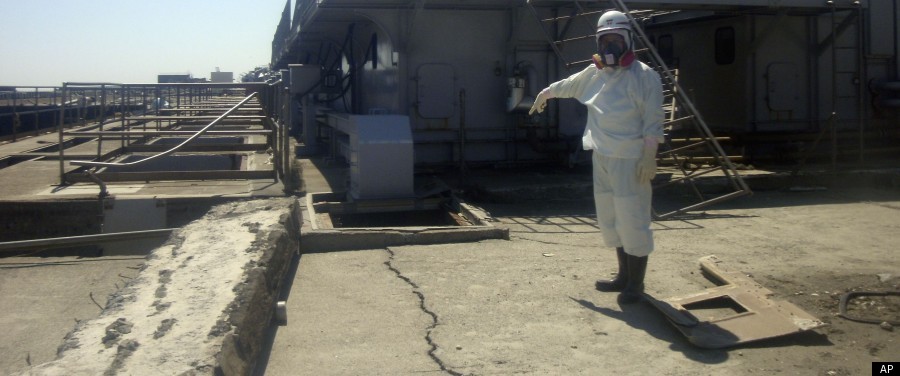
Image above: Tepco worker at Reactor #2 points to pit and crack where 7 tons an hour of highly radioactive water are leaking into pacific Ocean. From (http://i.huffpost.com/gen/262928/thumbs/r-JAPAN-NUCLEAR-CRISIS-huge.jpg).

Workers’ desperate struggle to plug a gush of highly contaminated water from the Fukushima Daiichi nuclear power station, using sawdust, shredded newspaper and an absorbent powder, appeared to be failing early Monday as the radiation threat from the crippled plant continued to spread.

Water with high amounts of radioactive iodine has been spewing directly into the Pacific Ocean from a large crack discovered Saturday in a six-foot-deep pit at the coastal plant north of Tokyo. The pit is next to the seawater intake pipes at the No. 2 reactor.

After an unsuccessful attempt to flood the pit with concrete to stop the leak, workers on Sunday turned to trying to plug the apparent source of the water — an underground shaft thought to lead to the damaged reactor building — with more than 120 pounds of sawdust, three garbage bags full of shredded newspaper and about nine pounds of a polymeric powder that officials said absorbed 50 times its volume of water.

[IB Editor's note: We've read in another article that the "polymeric powder" i question is a sister ingredient to the one used in baby diapers to absorb bodily fluids. You know, the blue glowing goop they stain the hygiene products with on TV. Yay! Pampers saves the Pacific!]
 
Although the stopgap measure did not appear to be succeeding, workers would keep trying to stem the leak, said Hidehiko Nishiyama, deputy director general of the Nuclear and Industrial Safety Agency.

Early Monday, workers injected a dye into a separate tunnel where contaminated water had been discovered, to determine whether that was the source of the water in the pit, said Tokyo Electric Power Company, the plant’s operator. Workers are also expected to continue efforts Monday to stop the leakage from the pit into the ocean.

Experts estimate that about seven tons an hour of radioactive water is escaping the pit. Safety officials have said that the water, which appears to be coming from the damaged No. 2 reactor, contains one million becquerels per liter of iodine 131, or about 10,000 times the levels normally found in water at a nuclear plant.

“There is still a steady stream of water from the pit,” Mr. Nishiyama said, but workers would continue to “observe and evaluate” the situation overnight.

The leak underscores the dangerous side effects of the strategy to cool the plant’s reactors and spent fuel storage pools by pumping them with hundreds of tons of water. While much of that water evaporates, a significant portion also turns into dangerous runoff that has been discovered in various parts of the plant, endangering workers at the plant and hindering repair efforts. On March 24, three workers were injured when they stepped into a pool of radioactive water in one of the plant’s turbine buildings.

In recent days, workers have tried to clear the contaminated pools, but have struggled to find places to store the water. Meanwhile, higher-than-normal levels of radiation have been detected in waters near the plant, raising fears of damage to sea life.

Tokyo Electric has said it has little choice but to pump more water into the reactors at the moment, since the normal cooling systems at the plant are inoperable and more radioactive material would be released if the reactors were allowed to melt down fully or if the rods caught fire.

Still, some experts expressed bewilderment at what they called an 11th-hour bid to plug the leak.
“I’ve never heard of anything like it at a nuclear power plant,” said Itsuro Kimura, emeritus professor at Kyoto University and director of the Japan-based Institute of Nuclear Technology.

What is really needed, he said, is for the cooling systems to come back online at the plant’s six reactors. Those cooling systems work by circulating water around the nuclear fuel, producing little runoff.
“That is the best way to stop the leakage of radioactive water,” Mr. Kimura said. “But for now, they have to stop the water leaking the best they can.”

Tokyo Electric has come under growing scrutiny for its handling of the nuclear crisis set off by the March 11 earthquake and tsunami that hit Japan. In recent days, reports surfaced that the company would be taken over by the government. Tokyo Electric reported that a protesters’ sound truck, presumably sent to heckle the company, was blocked from entering the Fukushima Daiichi plant on Thursday.

There are also frequent protests at the company’s headquarters in the Uchisaiwai-cho neighborhood of central Tokyo. On Sunday, several hundred antinuclear protesters assembled in front of Tokyo Electric’s offices, then marched to Kasumigaseki to protest in front of the offices of Japan’s nuclear regulators.

The protesters shouted such slogans as, “Tokyo Electric, get out of nuclear energy” and “Compensate the victims.” Others called for the company and government to apologize. Some carried placards that read, “Even if we don’t have nuclear power, we’ll still have electricity.”

“The Japanese people don’t protest usually, but this time, we have to show that we can call for change,” said Masanobu Takeshi, 40, with his wife and son.

Makoto Yanagida, 70, who has been protesting since March 12, said that on the first day, only about 10 people showed up. Sunday’s protest, the 10th, drew more than 300 people, he said. Mr. Yanagida said that he would continue protesting until nuclear plants were shut down.

Nuclear officials warned, however, that it could take months to bring the Fukushima Daiichi plant under control.

“It would take a few months until we finally get things under control and have a better idea about the future,” said Mr. Nishiyama of the nuclear safety agency. “We’ll face a crucial turning point within the next few months, but that is not the end.”

Earlier Sunday, Tokyo Electric said that two workers at the Fukushima Daiichi plant who were missing since the day of the earthquake and tsunami had been confirmed dead — the first of the company’s employees to be listed among the dead since the crisis began. Five employees of subsidiary companies also died at other Tokyo Electric facilities.

Tokyo Electric said the two workers at Fukushima Daiichi were found in the basement of the turbine building connected to the No. 4 reactor. The company found the bodies on Wednesday but did not release the details until the families had been notified.

The company said that the workers, Kazuhiro Kokubo, 24, and Yoshiki Terashima, 21, died on March 11, around 4 p.m., after the tsunami hit the plant.

“It pains me that these two young workers were trying to protect the power plant,” Tokyo Electric’s chairman, Tsunehisa Katsumata, said in a statement.

Of the other five deaths connected to the earthquake and tsunami, one man died when he was struck by a crane that had toppled at the Fukushima Daini nuclear power plant. Four other workers died at Tokyo Electric’s Hitachinaka coal-fired power plant when they fell from the chimneys they were working on.

Engineers pin hopes on Polymer  

By Ryan Nakashima & Mari Yamaguchi on 3 April 2011 for the AP -  
(http://hosted.ap.org/dynamic/stories/A/AS_JAPAN_EARTHQUAKE)

 
Image above: Pit where leak occurs partially filled with concrete that failed to block radioactive water escaping to ocean. From (http://www.allvoices.com/contributed-news/8666676-catastrophe-in-japan-21-workers-suffer-genetic-damage-from-radiation).
 
Engineers at Fukushima Dai Ichi Nuclear Plant pinned their hopes on chemicals, sawdust and shredded newspaper to stop highly radioactive water pouring into the ocean from Japan's tsunami-ravaged reactors Sunday as officials said it will take several months to bring the crisis under control, the first time they have provided a timetable.

Concrete already failed to stop the tainted water spewing from a crack in a maintenance pit, and the new mixture did not appear to be working either, but engineers said they were not abandoning it.
The Fukushima Da-ichi plant has been leaking radioactivity since the March 11 tsunami carved a path of destruction along Japan's northeastern coast, killing as many as 25,000 people and knocking out key cooling systems that kept it from overheating. People living within 12 miles (20 kilometers) of the plant have been forced to abandon their homes.

The government said Sunday it will be several months before the radiation stops and permanent cooling systems are restored. Even after that happens, there will be years of work ahead to clean up the area around the complex and figure out what to do with it.

"It would take a few months until we finally get things under control and have a better idea about the future," said Nuclear and Industrial Safety Agency spokesman Hidehiko Nishiyama. "We'll face a crucial turning point within the next few months, but that is not the end."

His agency said the timetable is based on the first step, pumping radioactive water into tanks, being completed quickly and the second, restoring cooling systems, being done within a matter of weeks or months.

Every day brings some new problem at the plant, where workers have often been forced to retreat from repair efforts because of high radiation levels. On Sunday, plant operator Tokyo Electric Power Co. announced it had found the bodies of two workers missing since the tsunami.

Radiation, debris and explosions kept workers from finding them until Wednesday, and then the announcement was delayed several days out of respect for their families.

TEPCO officials said they believed the workers ran down to a basement to check equipment after the magnitude-9.0 earthquake that preceded the tsunami. They were there when the massive wave swept over the plant.

"It pains us to have lost these two young workers who were trying to protect the power plant amid the earthquake and tsunami," TEPCO Chairman Tsunehisa Katsumata said in a statement.

On Saturday, workers discovered an 8-inch (20-centimeter) crack in a maintenance pit at the plant and said they believe water from it may be the source of some of the high levels of radioactive iodine that have been found in the ocean for more than a week.

This is the first time they have found radioactive water leaking directly into the sea. A picture released by TEPCO shows water shooting some distance away from a wall and splashing into the ocean, though the amount is not clear. No other cracks have been found.

The radioactive water dissipates quickly in the ocean but could be dangerous to workers at the plant.
Engineers tried to seal the crack with concrete Saturday, but that effort failed.

So on Sunday they went farther up the system and injected sawdust, three garbage bags of shredded newspaper and a polymer - similar to one used to absorb liquid in diapers - that can expand to 50 times its normal size when combined with water.

The polymer mix in the passageway leading to the pit had not stopped the leak by Sunday night, but it also had not leaked out of the crack along with the water, so engineers were stirring it in an attempt to get it to expand. They expected to know by Monday morning if it would work.

Meanwhile, tens of thousands of people are still living in shelters, 200,000 households do not have water, and 170,000 do not have electricity.

Running water was just restored in the port city of Kesennuma on Saturday, and residents lined up Sunday to see a dentist who had flown in from the country's far north to offer his services. Many were elderly and complaining of problems with their dentures.

Overhead and throughout the coastal region, helicopters and planes roared by as U.S. and Japanese forces finished their all-out search for bodies.

The effort, which ended Sunday, is probably the final hope for retrieving the dead, though limited operations may continue. It has turned up nearly 50 bodies in the past two days.

In all, more than 12,000 deaths have been confirmed, and another 15,500 people are missing.


.

KIUC sells off Water Rights

SUBHEAD: In summary KIUC has asked a mainland company to seize the water rights and develop several hydroelectric projects on Kauai.  

By Ken Taylor on 1 April 2011 in Island Breath -
(http://islandbreath.blogspot.com/2011/04/kiuc-sells-off-water-rights.html)

  
Image above: Privitation of water rights cartoon by M. Wuerker.

 In an act of either ignorance or audacious contempt for water, culture, and recent State court decisions, the KIUC Board of Directors voted on Tuesday, March 29, to engage the mainland company, Free Flow Power, to secure water rights to develop several hydroelectric projects on Kauai. In fact, these water claims had already been submitted by the Free Flow Power, but the Board decision will make every electrical user on Kauai party to this action.

Note that three Board members, Carol Bain, Ben Sullivan, and Jan Tenbruggencate voted against this action.

This Board action initiates a proscriptive Federal process for developing these water projects. The FERC process, like all Federal processes, is procedural, not substantive. This means that all they must do is check all the boxes on their list. Meetings will be conducted by the mainland company, Free Flow Power, or their subcontractor.

You will be given your three minutes at the microphone. Your name and input will be dutifully recorded and filed. The substance of your testimony is not relevant. When all required public meetings are concluded and all "stakeholders" consulted, the project can go forward. According to KIUC, the FERC process was chosen because it is an "independent and powerful arbiter." This means that FERC, not the Coop members or our community, will make the decision.

If a FERC license is granted. It conveys the right of Federal eminent domain. The licensee has the full power of the Federal government to seize land necessary to development the hydro project and transmit the power.

Do not think that this Federal process will protect any Hawaiian rights. Section 106 of the National Historic Preservation Act (NHPA) requires federal agencies to take into account the effects that their federally funded activities and programs have on "significant historic properties. Thus, the FERC process under Section 106 will only "consider" the things that kupuna made. It will NOT consider, or protect, the rights of living or future Hawaiians.

Likewise, NAGPRA, the Native American Graves Protection and Repatriation Act, will provide some protection to iwi kupuna under the FERC process, but provides NO specific legal consideration to living or future Hawaiians. In summary, as KIUC coop members, you have asked, and will soon be paying for, a mainland company to seize the water rights and develop several hydroelectric projects on Kauai.

Furthermore, you have asked the Federal government to preside over this action and seize any lands that you need to accomplish your goal. As KIUC Coop members we should recognize that these predatory claims are inexcusably insensitive to the past injustices of water use in Hawaii. We should know that these claims are an egregious breach of the protocol for how we think of, and access, water in Hawaii.

We should know that this action will put the Coop in an unnecessary aggressive and possessive position that will lead to conflict and litigation. We urge all Coop members to contact KIUC staff and Board members and instruct them to cancel any ties with Free Flow Power, and tell them that you reject the FERC process. Tell them that you have respect and responsibility for our water resources and you do not need a Federal arbiter to determine our use.


KIUC 4463 Pahe'e Street, Suite 1 Lihu'e, HI 96766-2000 info@kiuc.coop Att: KIUC Board of Directors I am a KIUC Cooperative member.
I am instructing the KIUC Board of Directors to repeal the decision on Tuesday, March 29, to engage the mainland company, Free Flow Power, to secure water rights to develop several hydroelectric projects on Kauai on my behalf.
I do not want to be party to a FERC hydroelectric development process. I will not participate in such a process. I have respect and responsibility for our island’s water resources and I do not need a Federal arbiter to determine our use. Please respond to this request in writing. Thank you (your name)

[IB Editor's Note: For those who are not members, but customers of KIUC, we suggest you write a letter/email the board of director's with your concern. You cannot direct the board as members might, but your water rights will be affected by KIUC actions. As non-members you have an option that members don't: You can buy electricity from other power providers. It's something that gives you a bit of leverage.]
 
See also:
Ea O Ka Aina: KIUC 25 Years After the Crash 3/17/11
Ea O Ka Aina: Kauai Hydro Projects Power Up 1/18/11
Ea O Ka Aina: KIUC Wailua Dam Plans 1/17/11
Ea O Ka Aina: Westside Solar Farm 2011 1/3/10
Ea O Ka Aina: KIUC $75 million GenX Plant 8/1/09


.

GMO Cows Produce Human Milk

SUBHEAD: Scientists have created cattle genetically modified with human genes that produce "human" milk.  

By Richard Gray on 2 April 2011 for the The Telegraph -  
(http://www.telegraph.co.uk/earth/agriculture/geneticmodification/8423536/Genetically-modified-cows-produce-human-milk.html)


Image above: Clarabelle Cow with park visitor at Mickey's Toontown at Disneyland. From (http://www.flickr.com/photos/23879054@N00/264566822).

 Scientists have created genetically modified cattle that produce "human" milk in a bid to make cows' milk more nutritious. They have successfully introduced human genes into 300 dairy cows to produce milk with the same properties as human breast milk.

Human milk contains high quantities of key nutrients that can help to boost the immune system of babies and reduce the risk of infections.
The scientists behind the research believe milk from herds of genetically modified cows could provide an alternative to human breast milk and formula milk for babies, which is often criticised as being an inferior substitute.
They hope genetically modified dairy products from herds of similar cows could be sold in supermarkets. The research has the backing of a major biotechnology company.
The work is likely to inflame opposition to GM foods. Critics of the technology and animal welfare groups reacted angrily to the research, questioning the safety of milk from genetically modified animals and its effect on the cattle's health.

But Professor Ning Li, the scientist who led the research and director of the State Key Laboratories for AgroBiotechnology at the China Agricultural University insisted that the GM milk would be as safe to drink as milk from ordinary dairy cows. He said:
"The milk tastes stronger than normal milk. We aim to commercialize some research in this area in coming three years. For the “human-like milk”, 10 years or maybe more time will be required to finally pour this enhanced milk into the consumer’s cup.”
China is now leading the way in research on genetically modified food and the rules on the technology are more relaxed than those in place in Europe.

The researchers used cloning technology to introduce human genes into the DNA of Holstein dairy cows before the genetically modified embryos were implanted into surrogate cows.

Writing in the scientific peer-reviewed journal Public Library of Science One, the researchers said they were able to create cows that produced milk containing a human protein called lysozyme,
Lysozyme is an antimicrobial protein naturally found in large quantities in human breast milk. It helps to protect infants from bacterial infections during their early days of life.

They created cows that produce another protein from human milk called lactoferrin, which helps to boost the numbers of immune cells in babies. A third human milk protein called alpha-lactalbumin was also produced by the cows.

The scientists also revealed at an exhibition at the China Agricultural University that they have boosted milk fat content by around 20 per cent and have also changed the levels of milk solids, making it closer to the composition of human milk as well as having the same immune-boosting properties.

Professor Li and his colleagues, who have been working with the Beijing GenProtein Biotechnology Company, said their work has shown it was possible to "humanise" cows milk.

In all, the scientists said they have produced a herd of around 300 cows that are able to produce human-like milk.

The transgenic animals are physically identical to ordinary cows.

Writing in the journal, Professor Li said: "Our study describes transgenic cattle whose milk offers the similar nutritional benefits as human milk.

"The modified bovine milk is a possible substitute for human milk. It fulfilled the conception of humanising the bovine milk."

Speaking to The Sunday Telegraph, he added the “human-like milk” would provide “much higher nutritional content”. He said they had managed to produce three generations of GM cows but for commercial production there would need to be large numbers of cows produced. He added:
“Human milk contains the ‘just right’ proportions of protein, carbohydrates, fats, minerals, and vitamins for an infant’s optimal growth and development.
As our daily food, the cow’s milk provided us the basic source of nutrition. But the digestion and absorption problems made it not the perfect food for human being."
The researchers also insist having antimicrobial proteins in the cows milk can also be good for the animals by helping to reduce infections of their udders.

Genetically modified food has become a highly controversial subject and currently they can only be sold in the UK and Europe if they have passed extensive safety testing.

The consumer response to GM food has also been highly negative, resulting in many supermarkets seeking to source products that are GM free.

Campaigners claim GM technology poses a threat to the environment as genes from modified plants can get into wild plant populations and weeds, while they also believe there are doubts about the safety of such foods.

Scientists insist genetically modified foods are unlikely to pose a threat to food safety and in the United States consumers have been eating genetically modified foods for more decades.

However, during two experiments by the Chinese researchers, which resulted in 42 transgenic calves being born, just 26 of the animals survived after ten died shortly after birth, most with gastrointestinal disease, and a further six died within six months of birth.

Researchers accept that the cloning technology used in genetic modification can affect the development and survival of cloned animals, although the reason why is not well understood.
A spokesman for the Royal Society for the Protection of Animals said the organisation was "extremely concerned" about how the GM cows had been produced. She said:
"Offspring of cloned animals often suffer health and welfare problems, so this would be a grave concern.
"Why do we need this milk – what is it giving us that we haven't already got."
Helen Wallace, director of biotechnology monitoring group GeneWatch UK, said: "We have major concerns about this research to genetically modify cows with human genes.
"There are major welfare issues with genetically modified animals as you get high numbers of still births.
There is a question about whether milk from these cows is going to be safe from humans and it is really hard to tell that unless you do large clinical trials like you would a drug, so there will be uncertainty about whether it could be harmful to some people.
Ethically there are issues about mass producing animals in this way."
Professor Keith Campbell, a biologist at the University of Nottingham works with transgenic animals, said:
"Genetically modified animals and plants are not going to be harmful unless you deliberately put in a gene that is going to be poisonous. Why would anyone do that in a food?
Genetically modified food, if done correctly, can provide huge benefit for consumers in terms of producing better products."


.

Corn Bubble Trouble

SUBHEAD: With the real estate scams a bit boxed in, Wall Street will be speculating on grains big time.  

By John Laumer on 2 April 2011 for TreeHugger -  
(http://www.treehugger.com/files/2011/04/corn-bubble-could-bring-troubles.php)

 
Image above: Jiffy Pop popcorn ad. This attempt to control exploding popcorn never worked very well. From (http://www.thedigitalreel.com/print/JiffyPop.jpg).
 
Corn is such a cultural cornerstone in America. Lend an ear to John Fahey playing "Give Me Corn Bread When I'm Hungry."

Remember Thoreau buying sacks of cracked corn for his Walden Pond stay? Tortillas and Katchina Dolls, and marbled beef, and corn root borers and Monsanto working together for the good of...
We may soon have to think about a corn price 'bubble' and what that means for American culture, during the rise, and after it "pops."


Farmers will do well this year if they are outside the areas of extended drought or floods. For the rest of us, especially the unemployed and underemployed, there may be increased difficulty.

Bloomberg reports (http://www.bloomberg.com/news/2011-03-31/corn-soybeans-surge-as-supplies-ebb-heightening-food-inflation-concerns.html) that:
Corn rose the most allowed by the Chicago Board of Trade as concerns mounted that food costs will climb after the latest U.S. government forecasts on supplies and acreage.
Reuters via Planet Ark reports (http://planetark.org/enviro-news/item/61649) that:
A government survey found corn plantings would be the second-largest since World War Two and soybeans the third highest ever. But traders focused on a companion report that showed unexpectedly small stockpiles, sending corn prices up by 5 percent. Wheat and soybeans surged more than 3 percent.
"We are not going to run out of (corn and soybeans) but we are in a very tight situation," said Joe Glauber, Agriculture Department chief economist, in an Insider interview.
Tractor makers are going do well for the first time in years. Farmland prices are crazy high. From the Illinois State Journal Register (http://www.sj-r.com/top-stories/x1777814067/Farmland-prices-continue-to-head-upwards):
Some of the highest prices were in the Springfield region, where sales of $6,500 to $9,000 an acre were reported for prime land.
Less prime farm land is going to be converted to housing developments while those land prices hold.
With corn reserves down and prices up, it is hard to imagine giving very much grain to nations experiencing famine.

American farmers will be pushing marginal land to the brink, trying to wring every dollar they can out of it while demand is up. There will be increased erosion on steep slopes and on plowed over grassed waterways. Water quality will suffer.

Irrigation water will be in high demand: farmers will be competing with cities for that water.
With the real estate scams a bit boxed in, Wall Street will be speculating on grains big time. How well do you think that will fly?


The corn bubble drives other trends that we all need to be thinking about. Chasing after top corn dollars, farmers will be tempted to get loans on new equipment and acreage (from smaller farms or badly managed ones) and seed and fuel and so on.

Bankers, seeing the large price that corn can bring (feeling the bubble along with all the others) will grant those loans, backed by Wall Street speculators who's firms are also buying futures contracts on grain based on "the bubble."

When the bubble bursts or if the farmer is hit by extreme weather (climate change I'm saying, yes), taxpayers are left to cover the loan defaults up and down the supply chain and the farmer is screwed.


.

Stick a fork in it - It's done!

SUBHEAD: “I don’t know if we can ever enter the No. 3 reactor building again,” Hikaru Kuroda, the company’s chief of nuclear facility management.

By Tsuyoshi Inajima, Yu-huay Sun & Wes Goodman on 2 April 2011 for Bloomberg - 
(http://www.bloomberg.com/news/2011-04-01/japan-s-government-says-stake-in-tepco-not-ruled-out-amid-radiation-leaks.html)


Image above: Aerial photo of wrecked Fukushima Reactor #3. From (http://pinktentacle.com/2011/04/high-resolution-photos-of-fukushima-daiichi/).


Tokyo Electric Power Company will try injecting a special polymer into a leaking pit at its stricken nuclear plant after a concrete plug failed to stop radioactive water from draining into the nearby sea.

Tokyo Electric will inject the polymer through a pipe connected to the pit, and is working to devise alternatives if that effort also should fail, the company said at a press conference that ended early today in Tokyo. The pit, used as storage for power cables near reactor No. 2, is cracked and leaking radioactive water.

Tokyo Electric, also known as Tepco, is preparing to infuse nitrogen into reactors to reduce the threat of a hydrogen explosion, and is connecting power cables to some cooling pumps as it tries to contain the spread of radiation and avert a meltdown 23 days after a crippling earthquake and tsunami.

A company executive said today he isn’t optimistic about the prospect of containing damage at the Fukushima Dai-Ichi nuclear power plant’s No. 3 reactor.

“I don’t know if we can ever enter the No. 3 reactor building again,” Hikaru Kuroda, the company’s chief of nuclear facility management, said at a press conference.

Workers must continue to cool the radioactive fuel rods with water to avert more damage, said John Price, a nuclear consultant and professor at Australia’s Monash University. “If it’s leaking or being exhausted as steam, then they have to keep putting it in.”

Radioactive Seawater
Radiation in contaminated seawater near the Fukushima Dai- Ichi plant was measured at more than 1,000 millisieverts an hour, Tepco said yesterday in a statement. Exposure to that level for an hour would trigger nausea, and four hours might lead to death within two months, according to the U.S. Environmental Protection Agency.

Japan’s Nuclear and Industrial Safety Agency yesterday ordered Tepco to increase its monitoring of seawater near the No. 2 reactor after the leaks led to a rise in radiation, agency Deputy Director Hidehiko Nishiyama said. Above-normal levels of radioactive iodine were detected in seawater 40 kilometers (25 miles) south of the plant, the agency said.

About 10 centimeters (4 inches) to 20 centimeters of radioactive water was found in the leaking pit, which is 1.2 meters by 1.9 meters across and 2 meters deep, and had a crack about 20 centimeters wide, Takashi Kurita, a company spokesman, told reporters at a briefing at Tepco’s Tokyo headquarters.

Plugging the Leak
Tokyo Electric tried to plug the crack by filling the pit with concrete yesterday, Junichi Matsumoto, another company official, said at a later press conference. Water in the pit was found to have 10,000 times the normal level of toxic iodine 131, he said.

The pit is at a different site from the trenches where the company found contaminated water earlier, Susumu Tsuzuki, a Tepco nuclear facility maintenance official, told reporters.

General Electric Co. (GE) Chief Executive Officer Jeff Immelt will meet officials from Tepco as the utility struggles to stabilize its damaged reactors, designed by the U.S. company.

Immelt is traveling to Japan “to meet with employees, partners and customers including Tepco,” as the utility is known, Deirdre Latour, a GE spokeswoman, said in an e-mail. Reactors at the crippled plant are based on a four-decade-old design from Fairfield, Connecticut-based GE.

Offering Help
“If they’re meeting now, it’s probably to discuss how to cool the reactors quickly, or how to scrap them, as Tepco doesn’t have the technology to do this,” said Jeffrey Bor, head of the economics department at the Chinese Culture University in Taipei and a former vice president of the International Association for Energy Economics. Taiwan operates six nuclear power reactors.
Tepco is still considering when and where it will inject nitrogen into the plant, said Kensuke Takeuchi, another spokesman.

The threat of a hydrogen explosion emerged when the gas was released from overheating reactors after the March 11 tsunami knocked out their cooling systems.

A 9-magnitude temblor and subsequent tsunami severed power and damaged reactors at the Fukushima complex about 220 kilometers (136 miles) north of Tokyo. Workers have been spraying water on the reactors to cool radioactive fuel rods in the worst nuclear accident since Chernobyl in 1986.

Radiation Slows Work
U.S. Energy Secretary Steven Chu estimated as much as 70 percent of the core in one of the six reactors may have been damaged. High radiation levels have impeded progress at the plant, Chu said April 1 during a breakfast sponsored by the Christian Science Monitor in Washington.

“Injecting nitrogen is done to cool reactors quickly,” said Chinese Culture University’s Bor. “Nitrogen should be considered an emergency measure and can’t be used for prolonged periods because you don’t have such large quantities of it.”

Tepco said it is connecting power cables to cooling systems on three of four damaged reactors. The utility will have to check pipes and equipment connected to the residual heat removers and those that circulate water through the reactors before the pumps can be turned on, Kobayashi said. Connecting power may not work because of potential damage caused by blasts that ripped through the plant in the days after the quake.

U.S. Military Barge
A second U.S. military barge has arrived at the port near the Fukushima power plant, while the first has started to pour fresh water into a tank at the complex to be used for cooling the reactors, Tepco said in a statement.

Katsumata, 71, took charge at Tepco last week when President Masataka Shimizu, 66, was hospitalized March 30 because of high blood pressure. Shimizu won’t be gone from his post “for long,” Katsumata said.

Japanese Prime Minister Naoto Kan yesterday made his second visit to the areas hit by the quake and tsunami, according to televised footage by national broadcaster NHK. Kan flew on a helicopter to Iwate prefecture in the northeast to meet with evacuees and then went to neighboring Fukushima prefecture to talk with Self-Defense Forces members and other workers at the Dai-Ichi nuclear plant.

The Japanese government may buy a stake in Tepco as the company tries to recover from the disaster and control the radiation leaks.


.

A Slower Ferry is Better

SOURCE: Dick Mayer (dickmayer@earthlink.net) SUBHEAD: The Hawaii state legislature has a Superferry bill that is flawed and misguided. By David Jung on 1 April 2011 in the Maui News - (http://www.mauinews.com/page/content.detail/id/547875/Viewpoint--Ferry-system-bill-lacks-key-information--is-misguided.html) Image above: Variation of an anti-SuperFerry poster titled "Whale Rider" created in 2007 by Juan Wilson. As general manager of Sea Link Of Hawaii, Hawaii's oldest ferry system, I feel obligated to share my 25 years of experience. Sea Link has operated since 1986 between Maui and Molokai at then-Gov. John Waihee's request to ease Molokai's unemployment problem. New ferry legislation (HB1239) has passed the state House and is poised to pass in the Senate. I am amazed and disturbed that fundamental economic and environmental questions have not been asked. While I do support a statewide ferry system, I fear this bill is misguided. What will the cost of operating a vessel and the ridership be? The legislation specifies that the service must have a 30-plus knot Superferry-type vessel; fuel consumption will be 1,500 to 2,000 gallons per hour (or 4,500 to 6,000 gallons per way from Oahu to Maui). Diesel is currently near $4 per gallon. This type of vessel is fuel inefficient and cannot compete with the 450 to 500 gallons used by a DC-9 on a 25-minute Oahu-to-Maui trip. A more conventional Alaskan or English Channel ferry will burn a fraction of that fuel. While the Superferry is a technological wonder, it is too expensive to maintain and operate on our interisland routes, even if the vessel itself were given free to the state. It will require huge subsidies, especially if the ridership is around the 150-passenger average that the Superferry was experiencing when it shut down. I have yet to see an operating budget based on 150 passengers per trip. How can we commit to a system with no idea what it will cost? The suggestion that the Superferry will be self-supporting is misleading. On the environmental side, we have seen the humpback whale population in Hawaii continue to increase. From 600 whales in the late '60s to 20,000 whales this year, it is a wonderful success story, but it has caused increases in whale/vessel collisions. While concerned about the whales, I am very concerned with the ferry and its passengers. Available research indicates high vessel speeds increase the likelihood of collisions. A 30-plus-knot ferry colliding with a 45-ton whale will likely injure passengers and cause structural damage to a lightweight, aluminum-hulled high-speed ferry, not to mention maiming or killing the whale. If a ferry is to operate during whale season, it will need to run at less than 20 knots. Sea Link's 17-knot ferry has had to slow down to avoid whales in the Kalohi Channel while the Superferry raced past at high speed. Propeller/rudder guards and the vessel-hull design should be such that effects of collisions are minimized. The Superferry twin torpedo hull is more likely to impale a humpback than a conventional hull that would ride over and drive down the animal with much less impact. The vessel needs to be specially designed for our special conditions. A large 20-knot state of the art conventional ferry should meet Hawaii's economic and environmental needs. They are currently operating successfully throughout northern Europe and Alaska. The concept of an upgraded statewide ferry system is a worthy goal. We do, however, have two successful PUC-regulated ferry companies between Maui, Molokai and Lanai. Both companies are self-supporting and pay PUC and employee taxes. Sea Link even has been subsidizing Molokai workers for over 20 years with a $25 round-trip fare at no cost to the state. Why the Legislature wants to include these routes with a state-run ferry and force out these two companies is beyond comprehension. House Bill 1239 is flawed. It will only lessen the chances of a successful operation being introduced. I implore our citizens and our legislators to take the time to carefully consider the issues. • David Jung is general manager of Sea Link of Hawaii. See also: Island Breath: Boycott the Superferry! 8/17/07 (with several links to prior articles) .

This Time it's Different

SUBHEAD: It's time to shop ’til we drop, time for the vaunted consumer to kick the engine of economic progress into overdrive. By Guy McPherson on 1 April 2011 for Nature Bats Last - (http://guymcpherson.com/2011/04/this-time-is-different/)

Image above: The house used in "Leave it to Beaver". From (http://gocalifornia.about.com/od/toppicturegallery/ig/Television-and-Movie-Houses/Leave-it-to-Beaver-House.htm).

Okay, I’m convinced. I’ve been wrong this entire time, but I’m willing to admit the error of my ways. It’s time to move on.

The industrial age will last forever, with no negative consequences for the living planet, including an infinite number of human occupants. If we find a use for those species that have inadvertently gone extinct, then we will develop technology to replace the species or bring them back from extinction. Or both.

When atmospheric carbon dioxide becomes problematic for humans, then appropriate technology will be developed. We will either extract carbon dioxide from the atmosphere or develop a way to cool Earth. Or both.

The news coming out of left-wing environmental organizations is ridiculous, and I’ll tolerate no more of it on this website. We solved the ozone problem at the South Pole and, when and if it becomes necessary, we’ll solve it at the North Pole. And enough about saving the whales: When was the last time you needed a whale, anyway?

When needed, we will find or create a comprehensive substitute for crude oil. Or both. Prices of our God-given resources will provide plenty of warning with respect to requisite changes in human behavior or technological developments. The free market has never failed, and it will never fail.

With respect to the number of humans on Earth, we have plenty of room and plenty of food. We could fit all the people on this planet into Texas — which is not a bad idea — and have plenty of space left over. We have food-distribution problems, but I’m confident the coming One World Government will be able to handle that problem

I used to refer to the U.S. as “Google Nation.” Like Google, it seemed had nearly unlimited information, but no wisdom. But now I know why we’re called the wise apes (sapiens = wise). We have all the knowledge and wisdom we’ll ever need to get us out of any predicament. There is no challenge we cannot conquer.

Now that the recession has ended and economic growth is fully under way, I’d like to take my proper place in the industrial economy. I will consider a position in government because government agencies exist to serve citizens. The Ministry of Truth would be a good fit for my skills. However, I would prefer a position in the private sector even more than I would value a position in government because real change occurs in the private sector. Sustainable growth of the industrial economy depends on research and development from corporations. In addition, the private sector must lead the way in economic growth and in setting the bar for ethical, humane behavior toward humans and other animals.

Anybody who is not earning a decent wage in this economy clearly is not trying hard enough. I have no pity for those losers, and I am certain they will not impede my quest for a high-paying job.

With every paycheck and bonus, I will invest heavily in the U.S. stock markets, using the tried-and-true strategy of “buy and hold.” I look forward to assisting in my own way to the ongoing progressive efforts of companies that contribute to our happiness and well-being, including such leading lights as Monsanto, BP, and DuPont.

My share of the rural property is for sale, effectively immediately. Please post a comment here if you’re interested, or send me a message. In the meantime, I hope to invest in a suburban house like the one shown above. In a few years, I’ll flip the house for a larger, shinier model.

Enough reading this drivel, everybody: It’s time to go back to work. It’s time to move some pixels around on our much-deserved imperial monitors, time to shop ’til we drop, time for the vaunted consumer to kick the engine of economic progress into overdrive. Otherwise, we’ll never get off this disgusting, depauperate planet. Our journey to other solar systems, other galaxies, and other universes is limited only by our imagination. Let’s aim for the stars!


Next-day updates (no foolin’):

Ellie — one of the goats we helped bring into the world last February — had kids of her own yesterday (two does and a buck). Tentative names, subject to suggestions from readers here: Joker, Fool, and Prank.

This 14-year-old clip from Good Will Hunting seems timely:

Video above: Mat Damon in NSA interview scene from "Good Will Hunting". From (http://www.youtube.com/watch?v=l8rQNdBmPek). .

Ready for the Sarcophagus

SUBHEAD: The developed industrial nations providing help to bury Fukushima Dai Ichi Nuclear Plant. By Staff on 31 April 2011 for MSNBC News - (http://www.msnbc.msn.com/id/42359020/ns/world_news-asiapacific) Image above: A truck carrying a cement pump that can extend nearly 200 feet is loaded onto an Antonov 124 plane in Stuttgart, Germany headed for Japan. From original article. Some of the world's largest cement pumps were en route to Japan's stricken nuclear plant on Thursday, initially to help douse areas with water but eventually for cement work — including the possibility of entombing the site as was done in Chernobyl.

Operated via remote control, one of the truck-mounted pumps was already at the Fukushima Dai-ichi site and being used to spray water. Four more will be flown in from Germany and the United States, according to the German-manufacturer Putzmeister. The biggest of the five has an arm that extends well over 200 feet.

"Initially, they will probably pump water," Putzmeister stated. "Later they will be used for any necessary concreting work."

A construction company in Augusta, Ga., was among those redirecting the pumps to Japan. Its owner said he believes building a concrete sarcophagus will follow.

"Our understanding is they are preparing to go to next phase and it will require a lot of concrete," Jerry Ashmore told the Augusta Chronicle.

He did not expect the pump to return. "It will be too hot to come back," Ashmore said.

A cargo plane is expected to fly the truck and pump from Atlanta next week at a cost of $1.4 million.

Putzmeister concrete pumps were among those used to seal in the Chernobyl reactor after it exploded in Ukraine in 1986, and sightings of the first truck at the Dai-ichi complex last week led to media speculation that Japan was planning to do the same in Fukushima.

Meanwhile, the Mainichi newspaper reported Friday that Japan's government plans to take control of Tokyo Electric Power Co., the operator of the stricken nuclear plant, by injecting public funds.

But the government is unlikely to take more than a 50 percent stake in the company, an unnamed government official was quoted by the daily as saying.

"If the stake goes over 50 percent, it will be nationalized. But that's not what we are considering," the official was quoted as saying.

Japanese trade minister Banri Kaieda said the government has yet to debate the possibility of nationalizing or taking control of TEPCO, Kyodo news agency reported.

The government may set up a team to discuss TEPCO-related compensation issues, Kyodo quoted Kaieda, whose ministry oversees nuclear safety, as saying the firm faces a huge potential compensation bill.

TEPCO could face compensation claims topping $130 billion if Japan's worst nuclear crisis dragged on, Bank of America-Merrill Lynch estimated this week, further fueling expectations Japan's government will step in to save Asia's largest utility.

Earlier Thursday, TEPCO said that short-lived radioactive contaminants 10,000 times above health standards were found in groundwater below the power plant.

Contaminated water has been pooling at the complex since it was damaged by the devastating earthquake and tsunami. Some was already known to have leaked into the sea and soil, and now groundwater is part of that mix.

The high levels of iodine-131 were measured in groundwater 45 feet beneath the reactor at Unit 1, Tokyo Electric Power spokesman Naoyuki Matsumo told reporters.

Matsumo emphasized that the local drinking water supply was not affected, which is the main way people might be harmed by iodine-131, which decays quickly, with half disappearing in eight days.

Contamination from the plant has also been seeping into the sea, though so far poses no threat to human health. Levels of radioactive iodine rose again Thursday in seawater some 360 yards from the shore to 4,385 times the legal limit.

Japan's Nuclear and Industrial Safety Agency said Thursday that consistently high levels found in seawater outside the plant may mean radiation is leaking out continuously.

"That is a possibility," Agency Deputy Director-General Hidehiko Nishiyama told a news conference when asked if there was continuous contamination of the sea.

He added that regulators and engineers did not know where the leaks may be.

On Wednesday, nuclear safety officials said seawater 300 yards outside the plant contained 3,355 times the legal limit of radioactivity.

Japanese officials are increasingly seeking outside help, including experts in eliminating contaminated water from French nuclear giant Areva. Experts and a robot from the U.S. have also arrived in Japan.

"The amount of water is enormous, and we need any wisdom available," nuclear safety agency spokesman Hidehiko Nishiyama said.

Areva CEO Anne Lauvergeon said she appreciated the enormity of the problem. Areva, a large supplier of nuclear fuel, sent staff with expertise in boiling water reactors and disposing of contaminated water and fuel rods.

"There is no precedent (for this kind of problem), and it's very complex," she said at a news conference in Tokyo.

Story: View images of quake, tsunami by date, location

The U.S. has also sent a remote-controlled robot, and officials from TEPCO said they expect to use it within a few days for evaluating areas with high radiation.

In other developments:

  • Efforts to recover the bodies of tsunami and quake victims from the evacuation zone have been slowed by debris, but also by fears of radiation. Police dressed in full radiation suits retrieved 19 corpses from the rubble Wednesday, a police official said. Each officer wears a radiation detector and must leave the area whenever an alarm goes off — a frequent occurrence that has often dragged the operation to a halt, the official said. "We want to recover bodies quickly, but also must ensure the safety of police officers against nuclear radiation," he said. Local media have estimated hundreds of bodies remain.
  • Hundreds of evacuees from the area around the stricken nuclear plant are being turned away by hospitals and shelters because of fear they may be carrying radiation, a British newspaper reported. The Daily Telegraph said some officials were demanding that evacuees provide certificates proving they have not been exposed to contamination.
  • French President Nicolas Sarkozy arrived in Japan Thursday, the first leader to visit since the devastating earthquake and tsunami sparked the worst nuclear crisis since Chernobyl in 1986.
  • Japan's health ministry ordered more tests after a cow slaughtered for beef was found to have radioactive contamination slightly higher than the legal limit. Officials stressed that the meat was not ever put on the market. Contamination has already been found in vegetables and raw milk near the plant, which has been leaking radiation since the March 11 earthquake and tsunami. The cesium was found in a cow slaughtered March 15 more than 40 miles from the plant. The cow had a total cesium level of 510 becquerels per kilogram. The limit is 500. A person could eat beef with that level of contamination for decades without getting sick.

As officials seek to bring an end to the nuclear crisis, hundreds of thousands in the northeast are still trying to put their lives back together following the earthquake and tsunami, which killed more than 11,000 people and left over 16,000 missing.

The government said damage is expected to cost $310 billion, making it the most costly natural disaster on record.

In the small coastal city of Miyako, many people still have no idea what happened to their relatives. Residents watched intently Thursday as a firefighter in a boat and two tractors cleared the bay of rubble, part of cleanup efforts under way along hundreds of miles of Japan's northeastern seaboard.

Giant tractors and dump trucks cleared roads and sorted debris into giant piles. Huge barges with onboard cranes docked offshore and scooped up wreckage in the shallow bays.

"I lost three grandchildren," says Isamu Aneishi, 69, who sat on a log for hours and watched the men search the bay.

A vacant lot outside Miyako has been turned into a car graveyard, with hundreds of wrecked vehicles from across the region deposited in neat rows. Some looked ready to be driven away, while others were little more than mangled heaps of metal.

Many were marked with red spray paint, indicating bodies had been found inside, and some still had keys in the ignition. Residents walked up and down the rows looking for their cars.

"This is my third time coming here," said Yasuhiro Ichihashi, 42, who watched his car get swept out of the parking lot at his factory from high ground. "They keep adding more cars every day, so I come back to check."

Strandbeests on the Shore

SOURCE: CW Uhlinger (bill@nshaonline.org) SUBHEAD: Amazing work, but is this our legacy? Recycled plastic that stalks the shorebreak like living plastic? By Staff on 20 December 2010 for the BBC - (http://www.bbc.co.uk/programmes/b00vt1xp) Image above: Theo Jansen and one of his strandbeests. Stillframe from video below.

Wallace and Gromit explore the wonders of the natural world and look at inventions inspired by Mother Nature. We visit some incredible flying penguins and other elegant manta-ray-inspired robots at Festo in Germany and visit Malawi, where scientists are studying the intricate structures of termite mounds to create self-cooling houses of the future.

In Holland we meet the brilliant sculptor Theo Jansen as he shows us his latest amazing contraption, the Animaris Siamesis - a huge insect-like structure that moves independently and gracefully with the wind.

Kinetic sculptor and artist Theo Jansen builds 'strandbeests' from yellow plastic tubing that is readily available in his native Holland.

The graceful creatures evolve over time as Theo adapts their designs to harness the wind more efficiently. They are powered only by the wind and even store some of the wind's energy in plastic bottle 'stomachs' to be used when there is no wind.

Video above: "Theo Jansen's Strandbeests". From (http://www.youtube.com/watch?v=HSKyHmjyrkA). .