
SUBHEAD: In Hawaii it does not mean the same thing as in upstate New York. But it still means much.
By Juan Wilson on 20 December 2019 for Island Breath -
(https://islandbreath.blogspot.com/2019/12/the-winter-solstice-once-again.html)
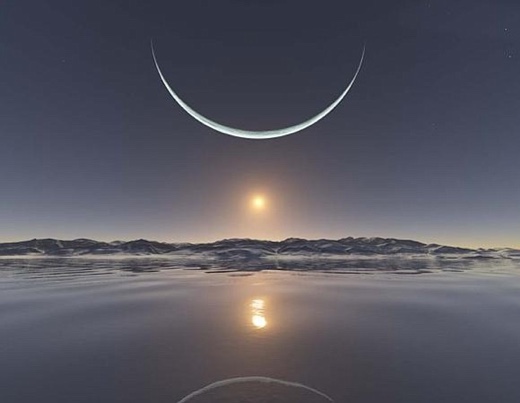
Image above: Image of a Winter Solstice on today's Navajo-Hopi Observer. From (https://www.nhonews.com/news/2017/dec/26/guest-column-welcoming-winter-solstice/).
Below are two articles from our website "The Gobbler" from the Winter of 1995 in western upstate New York. At this time of year you go to work in the morning in the dark and come home in the afternoon in the dark. Colder than in the inside of your refrigerator - and often colder than the inside of your freezer.
Tonight we are going to have
Christmas Traditions
by Linda Pascatore
©1995 The Gobbler: Winter Crystal
The Seasons of the Senecas
© 1995 The Gobbler: Winter Thaw
by Linda Pascatore

Method of tapping trees, Grand River Reserve
The local Seneca Indians here in Western New York had traditional celebrations for each season. They lived in close harmony with nature and the flow of the seasons. They were dependent on the natural environment to provide them with the basic necessities of their lives; food, clothing and shelter.
Their spirituality was also centered in nature. They called the earth Mother, the sky Father, the moon Grandmother, the sun Grandfather, and animals, trees and plants their brothers and sisters. It was natural for them to celebrate the changing seasons.
The Senecas were part of the Iroquois Confederacy. The Iroquois divided the year into four seasons which coincide with ours. Their new year was probably originally in the Spring, but after contact with Europeans they began to celebrate it around the time of the Winter Solstice as we do today. The names of the seasons, obtained from Chief David Key (Seneca speaking Onondaga) are;
Winter: gu sa' a gi, "the cold has arrived"
Spring: diyugwagaho' di, "it is time to plant or sow"
Summer: gana na' gi, "it red has come"
(a reference to red strawberries?)
Fall: ganana' ge hagwadi, "the red colours have come"
The local Native Americans found the twelve moons of the year more meaningful than our rather arbitrary system of months, which attempts to fit lunar months into a solar calendar (see our Gobbler version of a Solar/Moon calendar). The Iroquois named months after weather conditions or foods produced at that particular time of year. The names that follow begin with the first moon after the New Year. They were provided by John Gibson, historic chief of the Brant Reservation (near Silver Creek);
disgu' na: "principal mid-winter moon"
gana du' ha: "leaves falling into the water from such trees as the oak and beech, to which they have clung during the winter"
gana du gu' na: "great falling of leaves under the water now"
he sata: "bushes, shrubs, and plants begin to grow again"
u hiaigu' na: "berries begin to ripen"
sisge' ha: "plants growing"
sisgegu' na: "almost everything growing up and bearing something"
gade' a: "food beginning to form"
gade a gu' na: "season when everything is bearing food"
dijutu' weha: "beginning of cold weather"
djutuwegu' na: "again it is cold greatly"
disa: "the sun is returning" (reference to lengthening days after the Winter Solstice)
The Iroquois celebrated eight major festivals each year. They often coincided with the seasonal availability of foods that were staples for area tribes. The dates varied with local conditions across the Iroquois territory. They were;
New Year
Tapping the Maple Trees
Maple Sugar Festival
Planting the Corn
Strawberry Festival
Bean Festival
Green Corn Festival
Gathering the Corn.
At this time of year in early spring in the northeast, the native Americans would have been tapping the maple trees, as is still done today. Maple syrup is a local resource and true native food. The Iroquois used bark funnels as taps and wooden troughs carved from a tree trunk to hold the sap (see illustration). It was boiled down to make syrup and used in cooking. At the end of the maple syrup season, the Maple Sugar Festival was held.
The Iroquois festivals usually included ceremony, singing, dancing, and feasting. At this particular celebration, the soups were flavored with the new maple syrup. Making maple sugar seems a natural excuse for a party at the end of a dreary winter.
A modern Maple Sugar Festival at the Methodist Church in Mayville. We listened to the children of the parish sing while stirring hot maple syrup in anticipation of the sweet sugar crystallizing. Maybe some traditions are so ingrained in time and place that they cross the lines of culture to become common, shared human experiences.
Editor's Note: There is little written on the details of these seasonal events. The Native Americans used oral traditions; myths, legends and stories. Through the years, many of these ceremonies were incorporated into the Long House religion, which is a mixture of traditional native beliefs and Christianity.
Currently, the Long House ceremonies are not shared with non-native outsiders. If there are Senecas, Iroquois or other natives in the area who would like to write something for us or just tell us some stories, please E mail us. I did find some valuable resources at Barbara Berry's Book Shop, on Route 394 and Stedman Road, in Stedman, New York.
Warren Berry has an entire series of books which are reprints of historical writings on many aspects of Iroquois life. The sources used for this article are Myths of the Iroquois by E.A. Smith and Iroquois Foods and Food Preparation by F.W. Waugh; published by Iroqrafts, Ltd.; Ontario, Canada.
http://islandbreath.org/TheGobbler/Articles%20Published/Seasonal%20SZ/07%20Crystal/sz_iroquois_winter.html
.
By Juan Wilson on 20 December 2019 for Island Breath -
(https://islandbreath.blogspot.com/2019/12/the-winter-solstice-once-again.html)
Image above: Image of a Winter Solstice on today's Navajo-Hopi Observer. From (https://www.nhonews.com/news/2017/dec/26/guest-column-welcoming-winter-solstice/).
Below are two articles from our website "The Gobbler" from the Winter of 1995 in western upstate New York. At this time of year you go to work in the morning in the dark and come home in the afternoon in the dark. Colder than in the inside of your refrigerator - and often colder than the inside of your freezer.
Tonight we are going to have
Christmas Traditions
by Linda Pascatore
©1995 The Gobbler: Winter Crystal
Nativity scenes, Santa Claus, reindeer, stars, wreaths and holly, stockings and presents are all associated with Christmas. Some traditions are directly related to the Christian holiday, while others had their origin earlier in various midwinter or solstice celebrations.
Christmas, or Christ's mass, is the feast day celebrating the birth of Jesus two thousand years ago. Since the exact date of Christ's birth was not known, the earliest Christians didn't celebrate it. But in 350 AD, the Pope set a date--December 25th.
It was probably observed at this time because of strong traditions of solstice celebrations. Winter solstice is the shortest day, and the longest night of the year. It falls around December 21st. The earth, in traveling around the sun, is tilted on its axis. At the Autumnal Equinox, around September 23rd, the North Pole begins tilting away from the sun. The days become shorter, the noon sun is lower in the sky, and we get less sunlight in the Northern Hemisphere.
Solstice means a standing still, because the sun appears at the same low point for a few days around midwinter. From that time on, the days become longer, the light grows, and the coming of Spring has begun. People feared the cold dark winter. It was natural to celebrate the return of the sun and hope for the new year. There were many festivals around this time.
In most cultures, this was the new year, when the Sun returned, a time of light and hope. Since Christ was the "light of the world", and the hope for salvation and new spiritual life, the tone of the solstice festivals was appropriate for his birthday. The "Sun" god was replaced by the "Son" of God.
Long before Christ was born, the Persians celebrated the "Birthday of the Unconquered Sun" on December 25th. They lit fires in honor of Mithra, the god of light. This date marked the beginning of their New Year.
The Jews had Hanukkah, the Feast of Lights, in December. The purpose was to commemorate an ancient victory, in which they drove off an invading army and then rededicated their temple. Legend has it that they had only enough lamp oil for the Eternal Lamp in the temple to burn for one day, but the light miraculously burned for eight days. The Menorah symbolizes this event. One more candle is lit each day of Hanukkah, along with the servant candle or shamash, until all eight are burning on the last day.
Many of our Christmas traditions are found in the ancient Roman celebration of Saturnalia, honoring Saturn, the god of agriculture. The Romans wore masks, danced in the streets, had feasts, and gave gifts. They placed evergreen branches in their homes at this time, and crowned Saturn with wreaths of holly. Trees were decorated and lit with candles. A figure of Saturn was placed on top of the tree. No war or disputes of any kind were allowed during the Saturnalia Festival, making peace and goodwill part of this ancient Roman holiday.
For Christians, the birth of Jesus is the center of the most meaningful traditions. Nativity scenes, with Jesus, Mary, Joseph and the attendant angels, shepherds, wise men and animals are found around the world. People usually render the figures in their own image, so features will vary from Middle Eastern to Hispanic, Nordic, Oriental or African. Saint Francis of Assisi introduced the living Nativity Scene. He set up a manger in a cave and had real animals and people play the parts.
This tradition continues in many places today, with whole villages taking part in the Christmas pageants. In Mexico, people dress as Mary and Joseph, and visit one house each night for nine nights, reenacting the holy family's search for shelter. They are turned away the first eight nights, then on the last night, Christmas Eve, they are finally given shelter and the birth of Jesus is celebrated by all.
The star on top of the Christmas tree represents the bright star of Bethlehem which led the three wise men to the infant Jesus. Astronomers have tried to find an explanation for this famous star. There were no bright novas, or new stars, in the years around the birth of Christ.
No comet was visible then, either. However, it is possible that Christ was actually born in the spring of 6 B.C., when there was a close alignment of three stars in Pices; Mars, Jupiter, and Saturn
This particular alignment had great significance in Jewish history. The same constellation had appeared together in Pices shortly before Moses was born. The wise men of the East, learned in astronomy, might have taken the appearance of these stars as a sign of some great event about to take place in Israel, and so begun their journey there.
In the Bible, Jesus is called "the bright and morning star." Today, in many parts of Europe and the Middle East, Christmas festivities begin with the appearance of the first star on Christmas Eve.
The three kings, or wise men, are the center of many Christmas traditions. They were probably magi, learned priests from ancient Persia. Some eastern orthodox sects celebrate Christmas on the feast of the Three Kings or the Epiphany, January 6th. The word Epiphany means manifestation, and according to church doctrine, on that day it was manifested to the wise men that the baby was sent by God.
The days between Christmas and January 6th are called the twelve holy days, with the Epiphany being the Twelfth Night. The gifts of the Magi foretold the destiny of the Christ child; the would be a king, the frankincense that he would be a high priest, and the myrrh that he would be a healer and martyr.
In Germany and Austria, boys go in groups of four on the Epiphany, one carrying a star and the other three dressed as kings. In Spain, children go out to the gates of the city with cake for the kings, figs for the servants, and hay for the camels; looking for the kings silhouetted on the horizon. In many countries children receive their gifts on January 6th, either from the Three Kings or from their youngest camel.
Two other gift givers, the Italian La Befana and the Russian Baboushka, are tied up in the legend of the Wise Men. As the story is told, La Befana refused to accompany the Magi to Bethlehem, and Babouska misdirected the visitors. Since then, both women wander on the feast of the Kings, leaving gifts for all children as they search for the Christ child.
Santa Claus is a beloved symbol of Christmas to children of many cultures, especially northern Europeans and Americans. He was not always the jolly old elf of today. His first ancestor was probably the god Odin, from Scandinavia thousands of years before Christ.
Legend has it that at midwinter, or solstice, Odin would ride an eight-footed horse through the world, bringing rewards or punishments to men. Odin's son Thor wore red and fought the gods of ice and snow at midwinter, conquering the cold and allowing the return of the sun.
Saint Nicholas is the Christian predecessor to Santa. He was a kind-hearted bishop in Asia Minor in the 4th century. Legend has it that a poor nobleman had three daughters and no dowry for them. When the time came for the first daughter to marry, a bag of gold appeared overnight in his home.
The same thing happened with the second daughter. When it was time for the third daughter to marry, her father kept watch and caught Bishop Nicholas dropping a bag of gold down the chimney, where it landed in a stocking hung over the fire to dry.
News of the bishop's good deeds got out. and soon the stories grew into legendary proportions. The anniversary of his death was December 6th, and soon the legend merged with Christmas.
In Holland, St. Nicholas or Sinterklaas, would come on a horse. Children would leave their shoes filled with hay for his horse, and he would leave them nuts and candies. In Lapland, the saint drove a reindeer sleigh.
The Swedes wait for a gnome, Jultomten, with the goats of the god Thor pulling the sleigh. In Germany and Holland the influence of Odin remained, and Saint Nick carried a switch to dole out punishment for bad children as well as rewards for good ones.
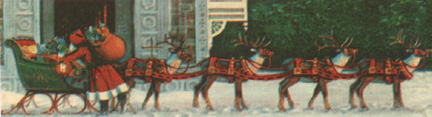
Americans created a kinder, gentler Santa. In 1809 Washington Irving wrote of a chubby man with a big smile. The most popular image of Santa Claus was in Dr. Clement Moore's "The Night Before Christmas." This poem contains all the modern elements--the flying reindeer pulling the sleigh, entry through the chimney, stockings hanging by the fireplace, a large sack of toys, and a fat, jolly Saint Nick.
Certain common themes run through all the Christmas traditions, from the solstice festivals, to the pagan gods, to the Christian commemoration of the birth of Jesus. They all celebrate the return of light and hope to the world. The sentiments of the season are peace and goodwill, love and the spirit of giving.
- Source:
- Image above: Holly, Reindeer, and Colored Lights; The Story of the Christmas Symbols; by Edna Barth, Seabury Press, New York, 1971.
The local Seneca Indians here in Western New York had traditional celebrations for each season. They lived in close harmony with nature and the flow of the seasons. They were dependent on the natural environment to provide them with the basic necessities of their lives; food, clothing and shelter.
Their spirituality was also centered in nature. They called the earth Mother, the sky Father, the moon Grandmother, the sun Grandfather, and animals, trees and plants their brothers and sisters. It was natural for them to celebrate the changing seasons.
The Senecas were part of the Iroquois Confederacy. The Iroquois divided the year into four seasons which coincide with ours. Their new year was probably originally in the Spring, but after contact with Europeans they began to celebrate it around the time of the Winter Solstice as we do today. The names of the seasons, obtained from Chief David Key (Seneca speaking Onondaga) are;
The local Native Americans found the twelve moons of the year more meaningful than our rather arbitrary system of months, which attempts to fit lunar months into a solar calendar (see our Gobbler version of a Solar/Moon calendar). The Iroquois named months after weather conditions or foods produced at that particular time of year. The names that follow begin with the first moon after the New Year. They were provided by John Gibson, historic chief of the Brant Reservation (near Silver Creek);
The Iroquois celebrated eight major festivals each year. They often coincided with the seasonal availability of foods that were staples for area tribes. The dates varied with local conditions across the Iroquois territory. They were;
At this time of year in early spring in the northeast, the native Americans would have been tapping the maple trees, as is still done today. Maple syrup is a local resource and true native food. The Iroquois used bark funnels as taps and wooden troughs carved from a tree trunk to hold the sap (see illustration). It was boiled down to make syrup and used in cooking. At the end of the maple syrup season, the Maple Sugar Festival was held.
The Iroquois festivals usually included ceremony, singing, dancing, and feasting. At this particular celebration, the soups were flavored with the new maple syrup. Making maple sugar seems a natural excuse for a party at the end of a dreary winter.
A modern Maple Sugar Festival at the Methodist Church in Mayville. We listened to the children of the parish sing while stirring hot maple syrup in anticipation of the sweet sugar crystallizing. Maybe some traditions are so ingrained in time and place that they cross the lines of culture to become common, shared human experiences.
Editor's Note: There is little written on the details of these seasonal events. The Native Americans used oral traditions; myths, legends and stories. Through the years, many of these ceremonies were incorporated into the Long House religion, which is a mixture of traditional native beliefs and Christianity.
Currently, the Long House ceremonies are not shared with non-native outsiders. If there are Senecas, Iroquois or other natives in the area who would like to write something for us or just tell us some stories, please E mail us. I did find some valuable resources at Barbara Berry's Book Shop, on Route 394 and Stedman Road, in Stedman, New York.
Warren Berry has an entire series of books which are reprints of historical writings on many aspects of Iroquois life. The sources used for this article are Myths of the Iroquois by E.A. Smith and Iroquois Foods and Food Preparation by F.W. Waugh; published by Iroqrafts, Ltd.; Ontario, Canada.
http://islandbreath.org/TheGobbler/Articles%20Published/Seasonal%20SZ/07%20Crystal/sz_iroquois_winter.html
.
