SOURCE: Ken Taylor (littlewheel808@gmail.com)
SUBHEAD: The industry exacerbates the global water crisis, and it’s not good for the islands either.
By Risa Kuroda on 27 July 2017 for Civic Beat -
(http://www.civilbeat.org/2017/07/the-truth-about-hawaiian-bottled-water/)

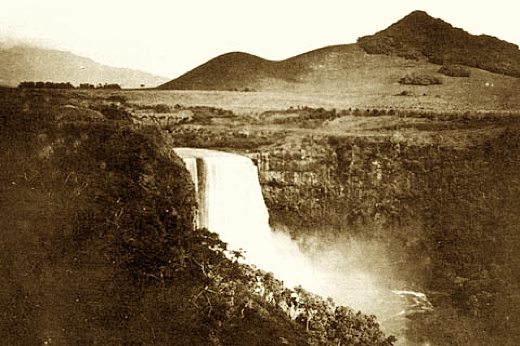
Image above: Kauai Natural Artesian Water promotional photo showing a waterfall background. That's not where this water comes from. From (http://www.foodsofhawaii.com/author/kauai-natural-artesian-water/).
Quickly trying to gather your things and your peace of mind, you relax your shoulders slightly: you’ve made it through the security checkpoint at Honolulu International Airport.
Since TSA made you empty your Hydro Flask, you decide to look for a drink. The only water fountain in the terminal trickles water so intermittently that it would take ages to fill your bottle.
You considered just getting a sip to quench your thirst but perceived the risk of catching a minor disease or being shot in the face with a random jet stream as you unwillingly pursed your lips as close to the fountainhead as possible. With a defeated sigh you drag yourself to a store to find no shortage of cold, refreshing, pristine, and over-priced Hawaiian bottled water.
Chances are, you recognized maybe one of the three Hawaiian bottled water brands in that airport store. Hawaii bottles an abundance of magical life giving elixirs but for the most part the water in the bottles of Hawaiian Springs, Waiakea or Hawaii Volcanic, to name a few, is not the water that most Hawaii residents drink.
As the state’s second-highest revenue-generating export, Hawaii’s water travels thousands of miles to bring in in hundreds of thousands of dollars to the local economy.
Sounds like a good trade off right? Unfortunately the implications of bottled water on our islands may not be as pristine as we hope it to be.
In fact, our bottled water industries gravely contribute to the exacerbation of the global water crisis, which has profoundly negative impacts on our environment and local communities.
The global water crisis is no hoax. Earth is covered in water but only 2.5 percent of it is fresh water.
Of that portion, 70 percent of it is locked in ice and nearly 30 percent is deep underground in aquifers. Just 0.3 percent of all fresh water is surface water, or what is considered “renewable water” within humanity’s conceivable lifespan.
Though agriculture is the main culprit of consumptive, meaning non-renewable, water extraction bottlers like Hawaiian Springs and Hawaii Volcanic’s unscrupulous use of artesian aquifer wells contribute to what political and environmental pundits foresee as eventual cause for future wars.

Image above: A Surfrider poster about the danger to sea birds of floating plastic junk like water bottle caps. From (https://www.b4plastics.com/nl/news/survival-of-the-fittest-plastics-een-evolutie-die-we-uitlokken-of-ondergaan).
Bottled water, and its role in the global water crisis, is also about the bottles, the transportation, the marketing, the profits and the collateral damages that occur both to the environment and to human communities during and after the production of this fetishized commodity.
Though some companies are turning to glass bottling most, including the main bottling companies in Hawaii, still use polyethylene terephthalate plastic. Every PET bottle made requires double the amount of water actually in the bottle to manufacture. Since the average American consumes 36.4 gallons of bottled water per year, we are actually consuming around 72.8 gallons of bottled water.
In the same one-year span, more than 17 million barrels of crude oil is needed to produce the bottles — an amount of oil enough to sustain 1 million vehicles on the road or power approximately 190,000 American homes for one year. In a study done on FIJI Water, the manufacture and transport of one bottle was worth 7.1 gallons of water, 1 liter of fossil fuels and 1.2 pounds of greenhouse gases.
At what enormous cost does Hawaiian water make its way not to the communities where it came from but to the lobbies of five-star hotels in Hawaii and around the world? It is estimated that solving the water crisis would cost $10 billion.
The price that bottling companies pocket in revenue is $13 billion. We cannot think for one second that Hawaii has nothing to do with perpetuating a crisis.
Plastic bottles also do not biodegrade. The bottled water industry generates as much as 1.5 million pounds of bottles per year and only 13 percent of plastic bottles are actually recycled after being discarded. The rest go to landfills, where they can leach toxic chemicals into the land.
Or better yet, they end up in the ocean: Marine plastic pollution has impacted at least 267 species worldwide, including 86 percent of all sea turtle species, 44 percent of all seabird species and 43 percent of all marine mammal species.
Since Hawaii depends on the environment, including the vitality of our marine life, it is incredibly important for us to not turn our islands into a giant, lifeless trash heap. After all, would tourists or even the film industry pay to experience Hawaii’s dead monk seals and turtles?
In addition, though bottling companies can contribute jobs to a neighborhood, when the profit-driven interests of a corporation conflict with the interests of a local community or ecosystem, it is rarely the latter that benefit.
]
Most often, local communities and watersheds are left to deal with negative externalities when bottling companies decide to turn a blind eye.
For example, our state is currently in a period of drought and has just recently bounced back from a period of severe to extreme drought just last year. Given intensifying global warming, it is not prudent to be unscrupulously drawing upon water sources for jobs and capital accumulation. In the end, the communities will be the ones literally left in the dried up dust while bottling corporations’ wallets are lush with green Benjamins.
Bottled water is no environmentally friendly product. It is a prime example of greenwashing, which is an attempt to do ethically or environmentally what should not be done at all.
Under General Comment 15 of the United Nations Committee on Economic, Social and Cultural Rights, governments have a responsibility to ensure that its citizens not only have access to but also actually have clean and affordable tap water in accordance with their right to life.
The residents of Hawaii, like those of San Francisco and Concord, Massachusetts, need to take back the tap and push Hawaii lawmakers to wake up to the dirty truth that is Hawaii’s bottled water industry.
Decision against Kauai Springs
SUBHEAD: The industry exacerbates the global water crisis, and it’s not good for the islands either.
By For Chris Deangelo on 6 October 2014 for the Garden Islands -
(http://thegardenisland.com/news/local/crime-and-courts/a-landmark-decision/article_7feed654-4d29-11e4-afca-c7950a559d55.html)

Image above: Label for a five gallon bottle of Kauai Springs water. The water comes from a diversion of spring water to Grove Farms. From (https://i2.wp.com/kauaisprings.com/images/Kauai-Springs-Label-1.jpg).
In February, the state Supreme Court — in what has been called a landmark decision for Hawaii’s Public Trust Doctrine — sided with the County of Kauai by striking down a 2008 circuit court ruling that the Kauai Planning Commission “exceeded its jurisdiction” in denying Kauai Springs, Inc. permits for its operation.
Seven months later, and contrary to that ruling, the Koloa-based water bottling and distribution company’s doors remain open.
“They continue to operate,” said Attorney David Minkin, who was hired as special counsel to represent the county in the Kauai Springs case. “Working with the Planning Department, we have sent them a notice of violation telling them that, if they don’t shut down, we will start fining them and turn it over both at the Planning Commission level as well as the prosecutor’s office to go after them for violating the law.”
The notice was sent to Kauai Springs on Tuesday, following a site investigation of the property by the Planning Department a week before. It orders the company to cease and desist all water bottling and distribution activities. Failure to comply could result in fines of up to $10,000 per day, as well as criminal prosecution, the letter states.
Kauai Springs has been given until Oct. 14 to respond.
On Wednesday, at the request of Councilman Tim Bynum, Minkin briefed the Kauai County Council’s Planning Committee on the Supreme Court ruling in the case and its application and relevance to the law.
Hawaii’s Public Trust Doctrine states that, “For the benefit of present and future generations, the state and its political subdivisions shall conserve and protect Hawaii’s natural beauty and all natural resources, including land, water, air, minerals and energy sources, and shall promote the development and utilization of these resources in a manner consistent with their conservation and in furtherance of the self-sufficiency of the state … All public natural resources are held in trust by the state for the benefit of the people.”
Minkin said the Supreme Court judge ruled the Planning Commission made the right call in denying the permits.
So what does the ruling mean moving forward?
“It means that, especially when water’s at issue, that every agency that has some duty or responsibility has to take a look at it from the constitutional perspective of the Public Trust Doctrine,” Minkin said. “You just can’t punt it and say, ‘Not my kuleana.’ You have to look at it. You have to evaluate it. You have to get information. And if you’re left with a question in the back of your mind that you don’t have enough information, it’s not the department, in this case the Planning Commission, it’s not their duty to go out and track down and get information.”
Instead, the applicant — in this case, Kauai Springs — must present the appropriate information.
“It basically shifts the burden,” Minkin said of the ruling.
Councilman Mel Rapozo questioned what good the Supreme Court decision is if the county doesn’t act on it. He said it’s time to put teeth behind it and stop Kauai Springs from utilizing the island’s natural resources illegally.
“I think the public needs to know. Are we going to fine them? Are going to just send them letters? I mean, if it’s this landmark decision, we should be prosecuting,” Rapozo said.
Kauai Springs has a long-term agreement with the Knudsen Trust to obtain water from a spring at the base of Mount Kahili. The pipeline, which brings the water to company’s Koloa bottling facility, is owned by Grove Farm.
Deputy County Attorney Mauna Kea Trask said the ruling was a substantial document, 107 pages to be exact, and “took a while to digest.”
“We are moving down that avenue,” he said of enforcement, adding that his hope is to reach a resolution without having to expend additional funds or go back to court.
Minkin said recent efforts to work things out with Kauai Springs’ legal counsel proved unsuccessful.
“We’ve resolved it as much as I can, now the next step has to be taken,” he said to Rapozo. “And I’ve made the recommendation, I agree with you — my background is also law enforcement — and I think, yes, this needs to be shut down.”
Kauai Springs owner Jim Satterfield did not return phone calls or emails seeking comment.
For several years, the case went back and forth, with both sides filing appeals. In 2007, the Planning Commission denied Kauai Springs’ three permit.
Kauai Springs turned around and sued the commission over the denial of the permits.
In 2008, 5th Circuit Judge Kathleen Watanabe sided with Kauai Springs and ordered the county to issue the permits.
“We felt, and the county felt, that was inappropriate … and we appealed it and we got the initial decision by the intermediate court,” which vacated the circuit court’s final judgement, Minkin said. “Applicant wasn’t happy with that and then it went up to the state Supreme Court, and the state Supreme Court went even further than the intermediate court did, to basically specify what our duties are as the county.”
The county has spent about $111,000, under the budget of $115,000, on the case, including the appeal, according to Minkin.
Bynum said he is proud of the Planning Commission and county for taking the Public Trust Doctrine seriously. While the court case was long, with many ups and downs, it was important for the community, he said.
.
SUBHEAD: The industry exacerbates the global water crisis, and it’s not good for the islands either.
By Risa Kuroda on 27 July 2017 for Civic Beat -
(http://www.civilbeat.org/2017/07/the-truth-about-hawaiian-bottled-water/)
Image above: Kauai Natural Artesian Water promotional photo showing a waterfall background. That's not where this water comes from. From (http://www.foodsofhawaii.com/author/kauai-natural-artesian-water/).
Quickly trying to gather your things and your peace of mind, you relax your shoulders slightly: you’ve made it through the security checkpoint at Honolulu International Airport.
Since TSA made you empty your Hydro Flask, you decide to look for a drink. The only water fountain in the terminal trickles water so intermittently that it would take ages to fill your bottle.
You considered just getting a sip to quench your thirst but perceived the risk of catching a minor disease or being shot in the face with a random jet stream as you unwillingly pursed your lips as close to the fountainhead as possible. With a defeated sigh you drag yourself to a store to find no shortage of cold, refreshing, pristine, and over-priced Hawaiian bottled water.
Chances are, you recognized maybe one of the three Hawaiian bottled water brands in that airport store. Hawaii bottles an abundance of magical life giving elixirs but for the most part the water in the bottles of Hawaiian Springs, Waiakea or Hawaii Volcanic, to name a few, is not the water that most Hawaii residents drink.
As the state’s second-highest revenue-generating export, Hawaii’s water travels thousands of miles to bring in in hundreds of thousands of dollars to the local economy.
Sounds like a good trade off right? Unfortunately the implications of bottled water on our islands may not be as pristine as we hope it to be.
In fact, our bottled water industries gravely contribute to the exacerbation of the global water crisis, which has profoundly negative impacts on our environment and local communities.
The global water crisis is no hoax. Earth is covered in water but only 2.5 percent of it is fresh water.
Of that portion, 70 percent of it is locked in ice and nearly 30 percent is deep underground in aquifers. Just 0.3 percent of all fresh water is surface water, or what is considered “renewable water” within humanity’s conceivable lifespan.
Though agriculture is the main culprit of consumptive, meaning non-renewable, water extraction bottlers like Hawaiian Springs and Hawaii Volcanic’s unscrupulous use of artesian aquifer wells contribute to what political and environmental pundits foresee as eventual cause for future wars.
Image above: A Surfrider poster about the danger to sea birds of floating plastic junk like water bottle caps. From (https://www.b4plastics.com/nl/news/survival-of-the-fittest-plastics-een-evolutie-die-we-uitlokken-of-ondergaan).
Bottled water, and its role in the global water crisis, is also about the bottles, the transportation, the marketing, the profits and the collateral damages that occur both to the environment and to human communities during and after the production of this fetishized commodity.
Though some companies are turning to glass bottling most, including the main bottling companies in Hawaii, still use polyethylene terephthalate plastic. Every PET bottle made requires double the amount of water actually in the bottle to manufacture. Since the average American consumes 36.4 gallons of bottled water per year, we are actually consuming around 72.8 gallons of bottled water.
In the same one-year span, more than 17 million barrels of crude oil is needed to produce the bottles — an amount of oil enough to sustain 1 million vehicles on the road or power approximately 190,000 American homes for one year. In a study done on FIJI Water, the manufacture and transport of one bottle was worth 7.1 gallons of water, 1 liter of fossil fuels and 1.2 pounds of greenhouse gases.
At what enormous cost does Hawaiian water make its way not to the communities where it came from but to the lobbies of five-star hotels in Hawaii and around the world? It is estimated that solving the water crisis would cost $10 billion.
The price that bottling companies pocket in revenue is $13 billion. We cannot think for one second that Hawaii has nothing to do with perpetuating a crisis.
Plastic bottles also do not biodegrade. The bottled water industry generates as much as 1.5 million pounds of bottles per year and only 13 percent of plastic bottles are actually recycled after being discarded. The rest go to landfills, where they can leach toxic chemicals into the land.
Or better yet, they end up in the ocean: Marine plastic pollution has impacted at least 267 species worldwide, including 86 percent of all sea turtle species, 44 percent of all seabird species and 43 percent of all marine mammal species.
Since Hawaii depends on the environment, including the vitality of our marine life, it is incredibly important for us to not turn our islands into a giant, lifeless trash heap. After all, would tourists or even the film industry pay to experience Hawaii’s dead monk seals and turtles?
In addition, though bottling companies can contribute jobs to a neighborhood, when the profit-driven interests of a corporation conflict with the interests of a local community or ecosystem, it is rarely the latter that benefit.
]
Most often, local communities and watersheds are left to deal with negative externalities when bottling companies decide to turn a blind eye.
For example, our state is currently in a period of drought and has just recently bounced back from a period of severe to extreme drought just last year. Given intensifying global warming, it is not prudent to be unscrupulously drawing upon water sources for jobs and capital accumulation. In the end, the communities will be the ones literally left in the dried up dust while bottling corporations’ wallets are lush with green Benjamins.
Bottled water is no environmentally friendly product. It is a prime example of greenwashing, which is an attempt to do ethically or environmentally what should not be done at all.
Under General Comment 15 of the United Nations Committee on Economic, Social and Cultural Rights, governments have a responsibility to ensure that its citizens not only have access to but also actually have clean and affordable tap water in accordance with their right to life.
The residents of Hawaii, like those of San Francisco and Concord, Massachusetts, need to take back the tap and push Hawaii lawmakers to wake up to the dirty truth that is Hawaii’s bottled water industry.
Decision against Kauai Springs
SUBHEAD: The industry exacerbates the global water crisis, and it’s not good for the islands either.
By For Chris Deangelo on 6 October 2014 for the Garden Islands -
(http://thegardenisland.com/news/local/crime-and-courts/a-landmark-decision/article_7feed654-4d29-11e4-afca-c7950a559d55.html)
Image above: Label for a five gallon bottle of Kauai Springs water. The water comes from a diversion of spring water to Grove Farms. From (https://i2.wp.com/kauaisprings.com/images/Kauai-Springs-Label-1.jpg).
In February, the state Supreme Court — in what has been called a landmark decision for Hawaii’s Public Trust Doctrine — sided with the County of Kauai by striking down a 2008 circuit court ruling that the Kauai Planning Commission “exceeded its jurisdiction” in denying Kauai Springs, Inc. permits for its operation.
Seven months later, and contrary to that ruling, the Koloa-based water bottling and distribution company’s doors remain open.
“They continue to operate,” said Attorney David Minkin, who was hired as special counsel to represent the county in the Kauai Springs case. “Working with the Planning Department, we have sent them a notice of violation telling them that, if they don’t shut down, we will start fining them and turn it over both at the Planning Commission level as well as the prosecutor’s office to go after them for violating the law.”
The notice was sent to Kauai Springs on Tuesday, following a site investigation of the property by the Planning Department a week before. It orders the company to cease and desist all water bottling and distribution activities. Failure to comply could result in fines of up to $10,000 per day, as well as criminal prosecution, the letter states.
Kauai Springs has been given until Oct. 14 to respond.
On Wednesday, at the request of Councilman Tim Bynum, Minkin briefed the Kauai County Council’s Planning Committee on the Supreme Court ruling in the case and its application and relevance to the law.
Hawaii’s Public Trust Doctrine states that, “For the benefit of present and future generations, the state and its political subdivisions shall conserve and protect Hawaii’s natural beauty and all natural resources, including land, water, air, minerals and energy sources, and shall promote the development and utilization of these resources in a manner consistent with their conservation and in furtherance of the self-sufficiency of the state … All public natural resources are held in trust by the state for the benefit of the people.”
Minkin said the Supreme Court judge ruled the Planning Commission made the right call in denying the permits.
So what does the ruling mean moving forward?
“It means that, especially when water’s at issue, that every agency that has some duty or responsibility has to take a look at it from the constitutional perspective of the Public Trust Doctrine,” Minkin said. “You just can’t punt it and say, ‘Not my kuleana.’ You have to look at it. You have to evaluate it. You have to get information. And if you’re left with a question in the back of your mind that you don’t have enough information, it’s not the department, in this case the Planning Commission, it’s not their duty to go out and track down and get information.”
Instead, the applicant — in this case, Kauai Springs — must present the appropriate information.
“It basically shifts the burden,” Minkin said of the ruling.
Councilman Mel Rapozo questioned what good the Supreme Court decision is if the county doesn’t act on it. He said it’s time to put teeth behind it and stop Kauai Springs from utilizing the island’s natural resources illegally.
“I think the public needs to know. Are we going to fine them? Are going to just send them letters? I mean, if it’s this landmark decision, we should be prosecuting,” Rapozo said.
Kauai Springs has a long-term agreement with the Knudsen Trust to obtain water from a spring at the base of Mount Kahili. The pipeline, which brings the water to company’s Koloa bottling facility, is owned by Grove Farm.
Deputy County Attorney Mauna Kea Trask said the ruling was a substantial document, 107 pages to be exact, and “took a while to digest.”
“We are moving down that avenue,” he said of enforcement, adding that his hope is to reach a resolution without having to expend additional funds or go back to court.
Minkin said recent efforts to work things out with Kauai Springs’ legal counsel proved unsuccessful.
“We’ve resolved it as much as I can, now the next step has to be taken,” he said to Rapozo. “And I’ve made the recommendation, I agree with you — my background is also law enforcement — and I think, yes, this needs to be shut down.”
Kauai Springs owner Jim Satterfield did not return phone calls or emails seeking comment.
For several years, the case went back and forth, with both sides filing appeals. In 2007, the Planning Commission denied Kauai Springs’ three permit.
Kauai Springs turned around and sued the commission over the denial of the permits.
In 2008, 5th Circuit Judge Kathleen Watanabe sided with Kauai Springs and ordered the county to issue the permits.
“We felt, and the county felt, that was inappropriate … and we appealed it and we got the initial decision by the intermediate court,” which vacated the circuit court’s final judgement, Minkin said. “Applicant wasn’t happy with that and then it went up to the state Supreme Court, and the state Supreme Court went even further than the intermediate court did, to basically specify what our duties are as the county.”
The county has spent about $111,000, under the budget of $115,000, on the case, including the appeal, according to Minkin.
Bynum said he is proud of the Planning Commission and county for taking the Public Trust Doctrine seriously. While the court case was long, with many ups and downs, it was important for the community, he said.
.