A Ground to Stand on

SUBHEAD: Life is up to something. It is becoming more diverse and more complex. By James Bannon on 21 February 2011 in An Ecology of Home - (http://villagegreentimberframes.com/page7/blog.php) Image above: The forest floor in Maine near Arrowhead Lake. From (http://www.panoramio.com/photo/4542895).

A homestead economy needs to be flexible, and a winter of very heavy snow has forced me to adjust my building plans. During my work week the storms and three-plus feet of snow on the ground have chased me inside the shop to make cabinets for one house and doors for another. For our own addition my original plan to drag or carry logs out of the forest and then hire or trade with a farmer/contractor friend who owns a portable sawmill to come over and help saw the logs into timbers isn’t possible. So I decided to cut the trees and hew the logs in place, then carry the lighter timbers out once the snow has melted. Hewing is quite a bit slower than a sawmill, but it was also my first choice, since I particularly like the rippled surface of a hand-hewn timber. The snow gave me the excuse I needed to accept that the project is going to take longer than I first planned.

It’s been four years since I’ve worked on a project that involved hewing for most or all of a day, and my muscles and technique suffered the first couple of days from the long layoff. The work was much harder than it needed to be, since I was forcing it rather than finding an easy rhythm and letting the axes (felling ax for scoring, hewing ax for finishing the surface) do the work. As a result my muscles tired more quickly, and then the quality of the work suffered since I had less control of the hewing ax as I squared the side of the log down to the line.

Since timber framing is my livelihood, I expect the results to be professional, and when they’re not I get frustrated. So for a couple of days I was at war with myself. This week was better. I stopped pushing and settled down into a consistent rhythm, and the pleasure I’d found in the work before returned. I wouldn’t want to do it day after day and year after year, but going into a forest with a couple of axes and turning trees into timbers is one of the things I’ve most enjoyed in the time I’ve been building and renovating timberframes.

I haven’t written very much here about the relationship between building and ecology yet, which probably seems a little odd for a blog published by someone whose livelihood is house-building. I plan to take it up in the weeks ahead, but I want to take this week to ground the various themes I’ve raised over the past couple of months on a solid foundation. When I’m building a house, my first choice of foundation material is stone—slabs of granite or field stone. Maine’s coast is famously rocky, so raw material is abundant, the stones are beautiful and last essentially forever, and even once the house that sits on the stone foundation decays, the foundation or the stones can be reused.

The foundation I have in mind serves two purposes. It provides a ground for our story to stand on, and it guides and informs our actions as we try to build a homestead economy that is not at war with our native ecology. The memoir half of a philosophical memoir should stand on its own; at worst you’ll find our story uninteresting or unrealistic or find us disagreeable or flaky. We can live with that. But the philosophical half, the argument, needs a solid foundation, and I want something as hard and immovable and unassailable as the granite outcrops along the coast here.

I’ve written that we came here to become part of an ecology, that we identify with the native forest, that we’ll work with the land to help it become what it wants to be, that we’ll make a place for ourselves within that context; that we’re seekers of happiness and richer, deeper experiences of being alive. All true. I’ve written that our economy, the economy that consumes frontiers, the economy that is rooted in agriculture and mining and drilling, the economy that too often levels native ecologies to extract the commodities they contain, has run out of new frontiers to exploit and so must inevitably begin to cannibalize itself. It defines the word unsustainable. I think that’s the best interpretation of the evidence.

I’ve written that this economy has altered the makeup of the atmosphere, changed the climate, and reduced biodiversity to the point that life on earth is now in its sixth major extinction epoch. As a matter of verified scientific fact, yes.

These concerns and convictions, our determination to live a certain set of principles, these are the values that animate our story. And there is the story’s weakness, for we’ve learned that values are relative. Yours may be different from ours. Your story may not be our story. Our story is certainly not the story of those who look at a landscape and see only resources to be exploited, or who see economic growth in and of itself as the highest good, or who believe that we stand apart from the wild green world, enabled by our intelligence and technologies, to conquer and subdue. But how will we judge whose story is better? Where is the unmoving ground on which that judgment depends?

This ground I’m searching for is a first principle, some unifying thing or principle or movement that can be used to explain the world and everything in it. The search for this first principle is as old as our western intellectual tradition; in fact it explicitly defines the very moment of birth of our intellectual tradition. It begins when Thales, the first of the Greek natural philosophers, seeks to discover the one thing that everything in the visible world is made of. Western philosophy begins with this single question. Thales is quickly followed by Anaximander and Anaximenes, who propose different answers to the same question.

As Greek philosophical thought progresses through Parmenides and Pythagoras, it becomes increasingly abstract and the search to discover a material first principle is dropped in favor of purely theoretical organizing principles for the visible world. But the emphasis on a single, unchanging, eternal, unifying principle that orders the visible world with all its apparent complexity and change is nearly constant.

By the time Plato adapts these ideas, another shift in emphasis has taken place as well: to Plato the material world of trees and rocks and rivers and flesh and bone is a deceptive, flawed, unredeemable mess that serves as nothing so much as an obstacle to true knowledge. He invents an invisible world of forms or ideas that are perfect and unchanging and eternal. The world that we see and experience with our senses is merely an imperfect imitation of that divine invisible world. That in a nutshell is Plato’s metaphysics. If you’re unfamiliar with the specifics but it all still sounds familiar, that’s because Plato’s notion of two worlds, one visible and corrupt and deceitful and the other invisible, perfect and pure provided the basic architecture for western ideas about the nature of reality and knowledge until the nineteenth century when the whole edifice came crashing to the ground.

I bring this all up here for two reasons.

First it is simply impossible to overstate the importance of the development of Greek thought and culture from 750 BC, when literacy returned to the Mediterranean world following a 400-year dark age, to the death of Aristotle in 322 BC. Our culture, our institutions of learning, and especially our ways of organizing reality owe everything to this period.

And second, because the defining feature of our intellectual tradition for the vast majority of its history is a conviction that unity is superior to diversity, simplicity is superior to complexity, that the spiritual is superior to the material, that being is superior to becoming.

As I said above, as a metaphysics, the whole edifice came crashing to the ground in the nineteenth century, but the looming shadow and residue of that edifice are with us still. We are still living that legacy. Not at the highest levels of academia perhaps, but as a matter of cultural habit we still believe in unity, and one is still the number of divinity.

A society, an economy, a culture organized around unity implies centralization, control, a diffusion of knowledge and intelligence from a single point. But ecology points to a different model entirely. Where is the center of a forest? It depends on rain and sun and warmth, but those are so elemental to almost all life on land that it makes little sense to talk of them as centers. They are preconditions.

Intelligence in an ecosystem is diffuse. So is energy. Diversity and complexity are its most salient features. Try to photograph it and you quickly understand that no single point draws the camera. The forest is everywhere all at once. This is the key to ecological resilience. Try to kill the forest. The obvious way is to cut down or burn all the trees. But the forest’s DNA, its intelligence, is stored in the soil and it quickly regenerates itself. To kill it it must be destroyed again and again until all that stored intelligence has been wiped away. It can be done, but it requires continued, repeated assaults.

Try to kill a centralized state, whether it is fed by oil or corn or wheat or coal. You don’t really have to do anything but wait. All its intelligence flows through its single fuel source and the military/administrative/religious establishment that feeds off it. Its resilience is limited by the resilience of that energy flow and that single cultural node. Cut that off, or wait for it to fail or run out, and the entire organization fails. History provides a nearly endless run of examples.

As long as the frontiers are large or numerous enough, the centralized state can survive. But frontiers inevitably close. They closed for Athens when access to the timber it needed to rebuild its navy was cut off. They closed for Rome when the Iberian silver mines ran out and it had to debase its currency. They’re closing today in the Middle East as oil production declines and revenue streams dry up.

I’m suggesting that to the extent that our culture and economy are built on the intellectual tradition that began in Ionia in the sixth century BC, developed in Athens in the fourth, and prevailed throughout the Roman, medieval, Renaissance, and Enlightenment periods in Europe, it is vulnerable to collapse. Centralized systems aren’t resilient. Collapse—or restoration of a more dispersed state depending on your loyalties— is inevitable because it operates in direct opposition to the first principle that organizes the reality of living ecologies.

This is the ground for our story. It expresses itself in a trend that is observable across the whole history of the living world. I think it qualifies as a first principle, and to the extent that it organizes the visible world, I think it is similar to what the early Greek philosophers were after. I think it is sound enough to form the basis for value judgments.

For the purposes of building a homestead economy and ecology the forest itself is probably good enough as a starting point. Forests have existed for 350 million years. They’re ubiquitous, persistent, and resilient. They naturally occupy about half the land area of the planet. As I’ve written before, forests work. Other ecologies work too, but forest is what works here where we live, and probably where you live too, since forests and humans have many of the same requirements.

The answer to why they work is also the answer to the search for a first principle on which to ground our story and our actions: diversity and complexity. Forests are the planet’s greatest terrestrial storehouses of diversity and complexity. The large majority of the planet’s land species are found in forests. Forests work because diversity and complexity work. As Edward O. Wilson put it in his book The Diversity of Life,

“Biological diversity embraces a vast number of conditions that range from the simple to the complex, with the simple appearing first in evolution and the more complex later. Many reversals have occurred along the way, but the overall average across the history of life has moved from the simple and few to the more complex and numerous…Progress, then, is a property of the evolution of life as a whole by almost any conceivable intuitive standard... It makes little sense to judge it irrelevant.” [bold mine]

It’s a memorable synopsis from one of the world’s foremost scientists. Life is up to something. It is becoming more diverse and more complex. Not always, and not in every place, but as an average across all of time from the beginning of life. Life may not have a goal, but the trend is unmistakable. The first principle that organizes reality has been with us all along. It’s the opposite of what the Greeks were looking for, the opposite of what the western intellectual tradition accepted as a given, but it’s what the world is made of, and it’s what we’re made of.

And for what it’s worth, the same movement is seen in the history of the universe as well, from nothingness to singularity to a few elements to many, from simplicity to complexity. Diversity and complexity work, the evidence suggests that they are woven into the nature of things, and they express themselves most often on land as forests.

That’s our rock, the granite upon which our story stands. We have a first principle. We can build an economy, make judgments, create new myths, find an intelligible context for history and the world around us. We can work within an ecology and be confident of our actions. Since intelligence is dispersed throughout the ecology, we can do less rather than more. We can watch and learn rather than dictate and control. We can build resilience and retake our place in the majestic pageant of life. We can revalue our commodities, restore our native ecologies and cultivate diversity and complexity. We might find our way back to Eden. Resources:

The hewing ax I use is made by Gransfors Bruks. It’s a very nice tool, but the blade lacked the correct curvature when I first got it and I had to spend quite a bit of time modifying it. To hew properly and produce the rippled texture that makes hewn surfaces so appealing, the back of the blade should be slightly convex in both directions. The Ax-Wielder’s Handbook by Mike Beaudry is a good introduction to hewing.

I don’t have a good general-interest book to recommend on the development of Greek thought from the presocratics to Plato. The one I used in graduate school is The Presocratic Philosophers by Kirk, Raven, and Schofield. It’s the standard bilingual academic text, but best suited for someone who really wants to immerse themselves in the topic, as I once did.

The Diversity of Life by Edward O. Wilson is one of the books that has most informed and influenced my thinking about biological diversity over the past couple of decades. I highly recommend it.

.

Commission denies copter tours

SUBHEAD: Planning Commission overrules Department to protect the fragile ecosystem of Kauai. [Editor's Note: We applaud the Planning Commission for overriding the Planning Department Recommendation to approve landing helicopters near a secluded waterfall with a delicate ecosystem. We hope to see the Planning Commission continue to serving it's intended role: to direct the Planning Department to action that ensures the General Plan is followed with the well being of the public and the aina. For too long the Planning Department has been in the driver's seat, and the Planning Commission has been just a rubber stamp for the Department's recommendations. It seems that instead of ensuring the General Plan is followed, the Planning Department is in the business of approving constant exceptions to the rules. All correspondence for the Commission goes through the Planning Department. If you want to let them know how you feel about the decision, you can call them at (808) 241-4050] Image above: Inter-Island Helicopter headquarters at Burns Field in Hanapepe, Kauai. Note - fuel depot (lower left) built without permit, hanger (upper left) built without required Special Management Area permit. This is the outfit that flies "green harvest flights" over rural residential areas for the DEA. Photo from (http://www.flickr.com/photos/inter-island_helicopters/519617114/#/photos/inter-island_helicopters/519617114/lightbox/). By Leo Azambuja on February 22, 2011 in The Garden Island (http://thegardenisland.com/news/local/govt-and-politics/article_138a6088-3f21-11e0-8fd4-001cc4c03286.html) In a rare move that flew in the face of the Planning Department’s recommendation, the Kaua‘i Planning Commission on Tuesday denied Inter-Island Helicopters a permit to land a chopper near a secluded waterfall for guided tours.

“I find this proposed helicopter landing site not compatible with the subject property,” Commissioner Caven Raco said. “The site is a very pristine and protected area.”

The commission unanimously approved Raco’s motion to deny the landing permit at Hali‘i Falls, located approximately 1.5 miles from Kilohana Crater, 3.5 miles from Kaumuali‘i Highway, and three miles from Kahili Adventist School.

Inter-Island co-owner Robin Venuti’s promise to bring back native flora wasn’t enough to convince the commissioners.

He said he understood commissioners’ concerns, but the impacts would be less than the benefits.

“We truly feel that our being there will do more good, as we already said, removing (invasive) plant species, education ... than the five minutes per hour for a maximum of four flights per day,” Venuti said.

Venuti told commissioners he would help clear the area of invasive species, especially overgrown ginger.

Commissioner Camilla Matsumoto said she did not see such a proposal on the application. Venuti responded, saying, “Right now all the improvements we would do would be on a safety issue,” adding that a guava tree and ginger plants needed to be removed to allow for the landing.

County planner Ka‘aina Hull said such conditions to clear the area of invasive species could be added to the application, but commissioners remained firm on their opinion. Not even Planning Director Michael Dahilig’s testimony was able to convince commissioners to approve the permit.

“We’ve taken a look at compatibility issues, and we think that they can be mitigated,” said Dahilig, adding that nothing is 100 percent compatible or incompatible. “There’s always this shade of gray that we deal with.”

Dahilig said that is the reason the department allows a flexibility in the use permit process to establish conditions to limit use and mitigate certain elements of a particular issue, making it more compatible.

“When we’re taking a look at the totality of these circumstances here, we think that, based on the recommendation, there are curves on the use that can be implemented in order to make this use compatible,” Dahilig said.

Commissioner Hartwell Blake said the question was the cost of compatibility.

“First we have to put up with ambient noise,” he said. “We have to put up with mini-cyclones.”

Raco told Venuti that he had no personal objections to the helicopter tour industry; his decision was based on a zoning ordinance.

“You need to accept the fact that the helicopter landing site is extremely loud and extremely offensive,” he told Venuti, adding that chapter eight of the County Charter designates industrial districts as areas where activities offensive to the senses should take place.

“I believe the impact would be severe, and that no degree of mitigation would be appropriate,” Raco said.

Robin and his wife Dana Venuti have been trying since September to obtain a permit to land a tour on Hali‘i Falls. Inter-Island was previously owned by Ken D’Attilio, who had been allegedly conducting unpermitted waterfall landings there for many years.

The Venutis said they took over the company in January 2010, and have been trying to clean up advertising promoting waterfall landings as they worked to obtain a permit to land by Hali‘i. They said in September that they hadn’t done a single waterfall landing since the beginning of the summer.

Despite claiming ownership of the company in September, Dun and Bradstreet, a business and database company, as of July 3, 2010, stated four of D’Attilio’s family members as stock holders, each with 25 percent ownership in the company.

When contacted in September about the ownership issue, D’Attilio said the company still belonged to him.

In January, D&B reported the Venutis as Inter-Island owners. Robin Venuti said on Jan. 11 that D’Attilio remained as a consultant.

After leaving the meeting, Venuti seemed to remain confident he could still obtain a permit.

“We will fight through, we’ll make it. We’ll get through it,” he said.

.

Life Within the Soil

SUBHEAD: The real secrets of a healthy soil — mega-diversity in soil life. By Doug Weatherbee on 19 January 2011 on Sustainable World Radio - Image above: Doug Weatherbee. Photo from his website( http://soildoctor.org). Listen to a two part interview on soil with Doug Weatherbee broadcast on Sustainable World Radio. Part 1 (http://pdcastsusworldradio.libsyn.com/life-within-the-soil-part-1) or Doug_Weatherbee1SoilDr.mp3 Part 2 (http://pdcastsusworldradio.libsyn.com/life-within-the-soil-part-2) or Doug_Weatherbee2SoilDr.mp3

Given that the soil beneath our feet is the source of all we eat, breathe, possess, and are, and given that it’s disappearing fast, it is imperative that we begin to protect and even restore it. Understanding a little better how it works is one giant step towards accomplishing this.

The content of Sustainable World Radio’s interview with Doug brings one face to face with the absurdity of a monocrops, industrialized, product-based agriculture, as he looks at the real secrets of a healthy soil — mega-diversity in soil life — and its potential to bring not only resiliency, but also gift us with a self-perpetuating system.

Doug Weatherbee, a Soil Foodweb Advisor and owner of SoilDoctor.org, talks about the biodiversity that lies beneath our feet. Soil is alive!

In part 2 of this interview, Doug talks about soil organic matter, carbon sequestration, how to tend your soil to support either fungal or bacterial populations, and how home gardeners can minimize soil disturbance and increase soil fertility.

.

Inflection Point

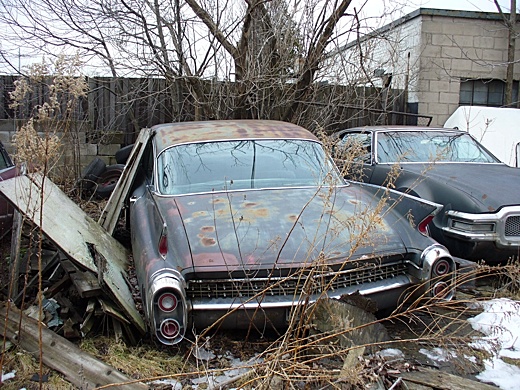
SUBHEAD: The current political upheavals could come to be recognized as a major turning point in the history of the oil age. By Tom Whippleon 23 February 2011 in Falls Church News-Press - (http://www.fcnp.com/commentary/national/8586-the-peak-oil-crisis-inflection-point.html) Image above: A fifty-year-old Cadillac rusts away in the snow. From (http://jezzbean.wordpress.com/2010/01/02/20-lost-forgotten-cars-of-the-world/).

It has taken two months for the contagion that began with the immolation of a fruit seller in Tunisia to reach the first significant oil producing nation.

As oil production in Libya grinds to a halt and Muammar Gadhafi clings to power amidst increasing turmoil, it is beginning to look as if it may be sometime before Tripoli resumes its normal oil exports. While the 1.6 million barrels a day (b/d) that the Libyans pumped in January may not appear significant in a world that produces some 88 million barrels each day, we should remember that those barrels are being consumed somewhere in a world where they are consumed just as fast as they are produced. If there is anything that we have learned in the last 40 years, it is that relatively small disruptions in oil production can lead to relatively large increases in oil prices.

OPEC, the International Energy Agency, and the Saudi oil minister are already rushing to reassure us that we have nothing to fear. The OECD has reserve stockpiles totaling 1.6 billion barrels of oil and OPEC is forever reminding us about the six million b/d of spare oil production capacity that they claim can be turned on as soon as it becomes necessary. This of course would be nice if the upheaval in Libya was going to be the only problem, but it isn't.

There are at least half a dozen major Middle East oil exporters with large numbers of digitally-connected underemployed youths and are run by heredity or less-than-democratic corrupt governments. In recent days we have seen flavors of the "Tunisian contagion" erupt in Algeria, Kuwait, Iran, and Iraq which are indeed very significant oil exporters. The upheaval in Bahrain, not a major exporter, has even had a, so far minor, reflection in the Shiite portions of Saudi Arabia with its 8 and maybe 10 or 12 million b/d of oil production. This week the King of Saudi Arabia announced $35 billion worth of government aid to the poorest of his subjects suggesting that someone in Riyadh is getting nervous.

The conditions that created the current upheavals can only worsen. Rising oil prices are bound to stifle tourism and foreign investment in the Middle East and a looming global food shortage seems likely to make life even tougher for the growing ranks of un- or underemployed poor. Governments that have massive oil revenues can afford to buy, or try to buy, the acquiescence of their peoples, but adequate food supplies could turn out to be a different matter. As we saw with Russia last summer, massive crop failures can easily shut down food exports as governments become more concerned about domestic food riots than the well being of other countries. The bottom line is that it seems likely we shall be seeing disruptions, perhaps serious ones, in other oil producing states in the not too distant future.

Those closely watching the balance between worldwide oil supply and demand are well aware that getting the global economy through the next 18 months without a major oil price spike depends largely on two factors. First is a significant drop in the rate of increase in China's demand for oil which has been growing unusually quickly in the last six months. Second is the existence of OPEC's spare production capacity which will have to come into play to prevent shortages from developing.

While the IEA currently puts this spare capacity at 4.7 million b/d, and the Saudis alone insist they can pump another four million b/d, other observers say this figure is likely to be too optimistic. No country, not even the Saudis, can or would want to pump up and sell its last possible barrel for long. Some well-informed observers believe that the Saudi's effective spare capacity may be more on the order to two million b/d provided they decide to produce it.

Add the loss of all or a major portion of Libyan oil production for an unknown period and the likely more-than-forecasted increase in Chinese demand, to the possibility that the Saudis will never produce much more than 10 million b/d, and the world is in for some real problems. To avoid shortages, the price of oil will be moving significantly higher. This week we have already seen oil trade in London at $108 a barrel and analysts are already talking about oil moving beyond the $147 all-time nominal peak set three years ago - a notion that was widely rejected four weeks ago. Should oil get back in the vicinity of $150 or beyond later this year, recent history tells us that a violent reaction is likely to set in. Given the fragility of the US and other OECD economies, the demand for oil is likely to drop sharply and with it will fall much economic activity fostered by people moving around in cars and planes or spending discretionary money.

The question of the day, however, is whether or not the current political upheavals will come to be recognized as a major turning point in the history of the oil age. There is no question that the loss of Libyan production, if prolonged, will accelerate the day when global oil production begins its final decline towards the end of the oil age. However, the optimistic case holds that any outage of Libyan production will be of short duration and the upheavals will not spread to other oil exporting countries.

If this should be true much higher oil prices could be delayed for a year or two. The pessimistic case says that the Libyan outage will continue for a while; will not be replaced by a rapid increase in Saudi exports; additional shortages will develop if other oil exporters have significant domestic problems: and the current price increases continue steadily until the global economy falters. If this should occur the Tunisian contagion really was an inflection point in world history.

.

Is Peak Population Almost Here?

SUBHEAD: The convergence of climate change and Peak Oil has enormous implications for population growth. By Paul Chefurka on 22 February 2011 in Limits to Growth - (http://paulchefurka.ca/Peak%20Population.html) Image above: 'The Waiting Room" by George Tooker, 1959. From (http://weimarart.blogspot.com/2010/11/george-tooker.html). After 40 years of beating the drum of overpopulation, I have stopped.

I no longer think that overpopulation or the ecological devastation that comes from overconsumption are going to be problems for much longer. I now expect world population to peak between 7.5 and 8 billion people by 2025 or 2030, and then start declining. I also think that the human activity that is currently damaging the natural world is going to start diminishing at the same time.

But I haven't changed my mind for the reasons you might think. It's not that I believe that after all this time, after all this human growth and planetary mutilation, we are finally getting a handle on our behaviour. Instead, the reason I believe this "good news" is about to unfold is that we are already in the throes of a collision between climate change and world oil supply limits (aka Peak Oil) that from this moment on is going to progressively destabilize the global food supply.

As our food and energy supplies tighten and then begin to shrink, the engine of population growth will shudder to a halt and our ability to wreak havoc on the world will be drastically curtailed. Whether this will be a good or bad thing is entirely a question of your perspective.

Climate Change

We've all seen the reports of extreme weather events hitting the world's grain crops - especially the floods in Australia and Pakistan and the droughts in Russia, Northern China and Thailand. This instability in rainfall patterns is one of the two impacts of rising atmospheric CO2 that will keep getting more pronounced as the decades go by. Disruptions in rainfall will, on balance, reduce the total amount of grain that the world's great growing regions can produce. The other effect of rising atmospheric CO2 is the gradual acidification of the oceans. That process is showing signs of reducing the food available at the bottom of the food chain (plankton) even as humans have pretty well fished out the top of the chain. 90% of the large fish in the oceans are already gone - we've eaten them.

Peak Oil

The other unfolding story that will impact the world's food supply and human activity in general is Peak Oil. We are now at Peak Oil. For the last six and a half years - since the middle of 2004 - the world's oil production has been on the "bumpy plateau" long predicted by peak oil analysts. Despite monthly average prices gyrating between $40 and $135, during that time oil production has varied from the average of 73 million barrels per day by only 2%:

The real story is probably a bit worse than that though, because the amount of oil available on the world market seems to be declining. Producing countries are keeping more of their oil for their own use even as their production rates go into decline, leaving less and less surplus oil to export.

The following graph shows the actual volume of the international oil market for the past 45 years, and a couple of projections for the next 20 based on some fairly conservative assumptions. The mechanisms behind this behaviour are well understood. The main unknown quantities at this time are how fast the underlying production will decline, and how much influence rising prices will play in modifying our use of oil. I suggest you think of these projections as "well founded speculation" for now, and use them to try and frame your thoughts about what this kind of event could mean to the world.

Why is this an issue for the world's food supply? After all we only use on average between 2% and 3% of our energy for agriculture. Obviously we should be able to work around a problem like this with no trouble.

Well, the problem is that it's not just the planting, growing and harvesting of food that's important. As I described in another article, the global food system as a whole (which includes all processes and infrastructure involved in feeding our population: the growing, harvesting, processing, packaging, transporting, marketing, consumption, and disposal of food and food-related items) probably consumes between 20% and 25% of the world's oil - largely for transportation.

As people are fond of pointing out whenever the potential for problems with global food production is raised, what we have is not so much a food production problem as a food distribution problem. So anything that makes food distribution more problematic (e.g. by raising the cost of distribution) is going to impact food availability and prices. And anything that raises food prices hits the world's poor the hardest, driving them out of the marketplace. And that is a fancy way of saying "regional famines". The World Food System Under Pressure We now have a world food supply system that is under pressure from both ends. Climate Change is already reducing harvests and will continue to do so into the future, while Peak Oil is making the distribution of the food that is grown steadily more expensive. We are seeing these effects already, in both the field and the marketplace. On the demand side we are still adding 80 million people per year to the world, the equivalent of adding another Egypt every year. That growth brings with it an irreducible requirement for new food production and distribution - 80 million new people require that we grow and distribute an additional 30 million tonnes of grain every year. While the percentage growth rate of our population is in fact declining, the absolute number we are adding each year is remaining constant at 80 million, a level it has stubbornly maintained since 1980. This is a picture of a global life support system under enormous strain, attacked on both the supply and demand sides by inexorable forces. Will this situation result in a Malthusian crisis? Well, if I had to lay a bet, I wouldn't bet against it. Here's why. Let me say at the outset that we have indeed learned a lot since the days of Thomas Malthus in the 18th century. The Green Revolution based on Norman Borlaug's incredible research has given the world much respite from hunger for the last 60 years. However, science has also progressed in other areas. For example we have become much better at efficiently using up the world's resources, especially fossil fuel - oil and natural-gas derived fertilizer - that was one linchpin of Borlaug's Green Revolution. We can think of the Green Revolution as a stable tripod, with one leg composed of fossil fuel, one of water and one of high-yield crops. Due to Peak Oil and the net oil export crisis the first leg of our food-production tripod, fossil fuel, is showing signs of getting shorter. The second leg of the tripod, water, is now under pressure both from climate change and from the depletion of aquifers world-wide The third leg, intrinsic crop yields (related to the plant itself and not to operational factors like fertilizer, water and pesticides) have not increased significantly in the last 20 years or more, despite Herculean efforts with hybridization and even genetic engineering. The increased crop yields we have seen over the last 30 years are instead related to operational factors like mechanization, fertilizer and water - the very factors that are now threatened by peak oil and climate change. The Limits to Population Growth Because of its growing impact on the global food system, the convergence of climate change and peak oil has enormous implications for population growth. I think it's entirely probable that we are near the upper limit of human population growth even now. I would expect that as the converging crisis begins to bite harder over the next (few?) years, food production will plateau and may even begin to fall. Some time soon afterward (perhaps within 5 years of the crisis fully manifesting) the global population growth rate will begin to drop precipitously, reaching zero perhaps 5 to 10 years later. At that point our population will begin to fall. The Work Continues Despite our best intentions around family planning, educating and empowering women and raising the material circumstances of the poorest among us, these efforts are already being overtaken by the circumstances I describe here. We must continue these ameliorating efforts with the utmost urgency, however, because the more successful we are the more people we will be able to protect against the worst effects of the coming food storm. The storm is coming upon us faster than most of us realize. The time to act is now.

.

No Modern "Steady State"

SUBHEAD: A system without fossil fuels and without debt is the world of 1750 with fewer than one billion people. By Gail Tverberg on 21 February 2011 in Our Infinite World - (http://ourfiniteworld.com/2011/02/21/there-is-no-steady-state-economy-except-at-a-very-basic-level/#more-1301) Image above: Home economy crafts in Colonial Williamsburg, Virginia circa 1750. From (http://light-impression.blogspot.com/2009/01/colonial-williamsburg.html).

We keep seeing statements from the Center for the Advancement of a Steady State Economy suggesting that a steady state economy is desirable. I would agree that growth in a finite world is not sustainable, but even continuation of our current level economic level, or a drop to an economic level two or three levels below that where we are today, is not sustainable.

We are consuming a huge amount of fossil fuels, and to maintain anything close to our current economic state, we would need to continue to consume a very large amount of fossil fuels. If a person stops and thinks about it, no level of fossil fuel extraction is sustainable, because we only have a finite amount of fossil fuels. At best, we would be talking about stair-stepping extraction–reducing it to a lower level than today, and holding it there for a while.

One big issue with even trying to stair-step fossil fuel use is the fact that our financial system needs growth to keep from collapsing. In order to pay back debt with interest, it is necessary to have economic growth, and financial growth and growth in fossil fuel use are very closely tied. Economic growth can be 2% or 3% above fossil fuel use growth because of efficiency gains, and economic growth in a particular country can be higher than that of world economic growth because of greater outsourcing of manufacturing to other countries. There was even a gain in the late 70s and early 80s, as we picked the low-hanging efficiency fruit and switched to using nuclear. But overall, there is no evidence that fossil fuel use, or even oil use, can be divorced from economic growth. If there is a big decline in fossil fuel use, it will translate to a decline in economic growth.

The need for economic growth in order to pay back debt even applies to our money supply itself. Money is loaned into existence. This happens when a commercial bank makes a loan and deposit at the same time. The problem is that when the money is created, not enough money is loaned into existence to pay back the interest as well. So economic growth is needed to create the additional money so that the debt can be paid back with interest.

Because of this issue, a Steady State Economy (economy without growth) requires a financial system with virtually no debt. It might be possible to have a little debt, but its use would be primarily to facilitate short-term transactions. Debt jubilees at regular intervals might be needed, to keep people from building up much debt.

It is theoretically possible to create a Steady State Economy that doesn’t use fossil fuels, and a new financial system that doesn’t use debt. As far as I can see, though, this would put us in a situation similar to where we were in 1750, because none of our so-called newer “renewables” (like solar PV and wind turbines and algae-based biodiesel) are really possible without fossil fuels. We need fossil fuels to extract metals and to make the solar PV and wind turbines and to transport them to their new locations. There is not even a plan in place that would get us to a situation such that the various renewables would replace themselves and provide enough energy for the world to live on.

The problem with going to a system without fossil fuels and with much less debt than we have today is the fact that the world supported fewer than one billion people in 1750. There are now nearly 7 billion people in the world. Furthermore, most people living today don’t have the skills required to live without fossil fuels. We also don’t have all of the infrastructure in place that we would need to live as people did then (draft animals, horse drawn carriages, wells that could be repaired with local materials, schools close to where people live, homes mostly in rural areas or villages, etc.). So it is not clear that we could even successfully make this type of transition.

When I read articles that talk longingly about going to a “Steady State Economy,” I am perplexed. If governments were to take away fossil fuels, or even reduce their use significantly, it would likely cause a crash of the financial system, and this would likely lead to a crash of other systems, particularly international trade. It would seem to be virtually impossible to keep this crash from affecting food production systems, international food export systems, and even such basic systems as electricity (because workers need to be paid, and fuel needs to be purchased). It seems to me that without a lot of intervention and planning, we would soon fall back to a very low level, very quickly, perhaps much lower than the 1750 level.

It seems to me that what we really ought to be doing is looking at the situation that is ahead, and figuring out what we can do to make the best of a pretty awful situation. Those wanting a steady state are dreaming for something that can never happen. Decline is pretty much inevitable. We need to be working to understand what is really ahead and figuring out how to make the best of a bad situation. Perhaps by planning, we can make things a little better.

.

Demise of the Dollar

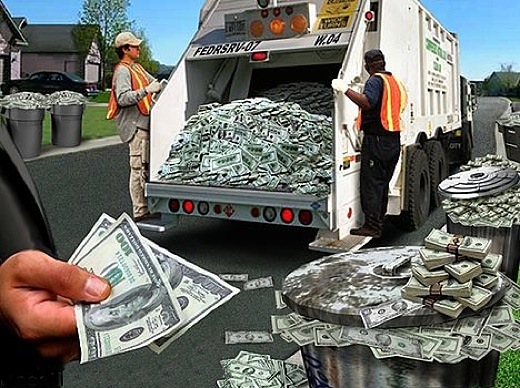
SUBHEAD: The Great Recession never left us and collapse of the industrial economy is already under way. By Guy McPherson on 22 February 2011 in Nature Bats Last - (http://guymcpherson.com/2011/02/demise-of-the-dollar) Image above: Illustration of hyperinflation by David Dees. From (http://www.rense.com/1.mpicons/deesA2.htm).

The U.S. dollar continues its journey from Brobdingnagian to Lilliputian stature, and the latest trade report is a prelude to the dollar as microbe. The Prime Mover in this case is King Ben, who has the helicopter on track for a one-way trip to Zimbabwe with every American along for the ride. Death of the world’s reserve currency “is irreversible, and it will unleash a cyclone of chaos and confusion that will leave many literally suspended in disbelief as the entire false paradigm most of humanity has lived under for their entire existence is washed away forever.” It’s not just a bunch of bloggers and pundits announcing the dollar’s funeral, either: Even the International Monetary Fund is discussing abandoning the U.S. dollar as the world’s reserve currency, which portends hyperinflation as surely as Benny and the Inkjets working overtime on the printing presses.

Already, the crushing of the consumer sector is under say even as the road to madness is paved with King Ben’s $100 bills. To his credit, Bernanke finally admitted that nearly every bank in the country almost failed shortly after the price of oil peaked in mid-2008. He failed to mention, however, that such an outcome surely would have terminated western civilization within a month.

Meanwhile, Ben and the boys at the Federal Reserve Bank keep launching new ships in the never-ending fleet of Quantitative Easing. QE II was intercepted by Wall Street on its way to Main Street, so QE III is on the way, undoubtedly destined for the same fate. Like a high-speed, head-on collision, QE III will have quite an impact, but only on those immediately involved. The rest of us will be rubber-necking and wondering what happened as we drive by.

Coincident with the death of the U.S. dollar, the industrial economy is perched on the brink of catastrophic collapse. Or, as I’ve written before, the Great Recession never left us and collapse of the industrial economy is already under way. Most people have simply not realized it yet because they haven’t been told by the media or the completely impotent federal government. Many signs point to 2012 as the year the ongoing collapse of the industrial economy reaches its overdue end, although I’m not yet giving up on 2011.

If you prefers charts to texts, try this set for an abbreviated version of the story. In other words, the Keynesian experiment has nearly run its course, so it’s time to get serious about feeding yourself and your community in the near future.

If you think revolution is restricted to other countries, take a look at the gap between the haves and the have-nots around the world. Inequality is far worse in the U.S. than Egypt, Tunisia, or Yemen: The American picture is truly ugly. Ongoing events in Middle Eastern countries, driven by economic factors, are the canaries in the coal mine of global economic collapse, as intimated by Dmitry Orlov and further explained by noted trends forecaster Gerald Celente. And if you think we wouldn’t use force on our own, then you haven’t checked with the troopers in Wisconsin.

Even as Middle Eastern puppets for the U.S. are falling like dominoes, despite continued U.S. support, it becomes increasingly clear Obama will be the president who asks the last mercenary to turn out the lights on American Empire. Collapse is proceeding apace, and even Congressional Representative Ron Paul admits the federal government is in the process of complete failure.

Crude oil underlies the entire industrial mess and CNBC admits we need those dictators puppets to keep the oil flowing to the U.S. as the major domestic source of oil in the U.S. continues to falter and past-peak, free-falling Saudi Arabia clings by a thin thread (as recognized by Foreign Policy). When the kingdom falls, it could well take the U.S. dollar with it, and quickly. And contrary to statements from our politicians, “we’re not worried about the rivers of blood — we’re worried about the rivers of oil” coming out of the Middle East. As we’ve been since the 1970s.

If you think we can pay our way out of this predicament, it’s time to pony up. If you pay taxes, you and your family owe more than $1 million en route to saving our monetary system. Small wonder, then, that Tim Geithner foresees imminent default on U.S. debt. Before we get there, Timmy is blackmailing Congress, claiming that failure to raise the debt limit leads to default. But Timmy knows default is right around the corner, either way.

Jeff Rubin explains why oil-price shocks induce recession, and also why there is a lag between the shock and the economic pain. Rubin and an ever-larger choir are joined by Jim Rogers and financier and author Stephen Leeb in the expanding club forecasting oil priced at $150 per barrel in the near term (and Global Research has joined the party, too). That’s what happens when the giant oil fields run dry.

Lest you run out and buy oil futures, bear in mind the other potential outcome to this globalized world: China’s economic bubble could burst in short order. When it does, only one bubble remains: the human population bubble on Earth.

.

From the bottom of the pyramid

SUBHEAD: The wealthy may have deliberately chosen to buy themselves out of the need for 'messy' human entanglements and interdependencies.  

By Nicole M. Foss on 22 February 2011 for the Automatic Earth -  
(http://theautomaticearth.blogspot.com/2011/02/february-22-2011-view-from-bottom-of.html)


Image above: Jane Darwell as Ma Joad in 1940 film "The Grapes pf Wrath". From (http://www.examiner.com/movie-events-in-salt-lake-city/9-admirable-movie-moms).

People occasionally comment that we only consider the circumstances of the relatively wealthy in articles like, for instance, our Lifeboat Primer. It is true that by no means everyone can achieve the ideal circumstance of holding no debt, having cash on hand and having some control over the essentials of their own existence, however there are many other important factors in play that may decide the balance of advantage. It seems important to consider explicitly the plight of those lower down the financial food-chain. The decisions people have to make will depend critically on their personal circumstances.

However unfair it may be, all of us face constraints grounded in where we find ourselves in life, and we do not all have the same options available to us. This may seem overwhelmingly to favour the currently better off, but this is not always the case by any means. There are different ways of being well off besides the conventional monetary definition. If one is going to fall out of a window, how much it hurts when one hits the ground will depend on how many stories high the window was.

Some of those who live a relatively hand to mouth existence may find themselves falling out of a ground floor window. They will dust themselves off and move on. This will be much less painful than falling from the hundredth floor, as many of the better off will end up doing. People who may have nothing, but also owe nothing, are not so badly off in comparison with those who have a lot, but owe far more than they have. The latter is a very common situation, and will become increasingly common as assets prices fall in a deflationary environment, and debt servicing becomes ever more onerous.

Very many seemingly wealthy people are over-stretched "like butter spread over too much bread", as Bilbo put it in The Lord of the Rings. Essentially, it is far better to have nothing, than less than nothing in net monetary terms.

As we have pointed out before (see Trickles, Floods and the Escalating Consequences of Debt), indebtedness can have serious consequences. Just because we have not seen these recently in developed countries does not mean they are gone forever (in an ever-increasing spiral of civilized behaviour). For the time being, civilized methods exist for getting out from under unrepayable debt, but these are unlikely to persist once too many people try to rely on them.

For those who think they may need to have recourse to bankruptcy, it would be better not to wait too long, as that particular door may close. Being in debt gives others power over one's life, and that power may be exerted in many different ways, none of which are likely to be pleasant for the debtor. We have seen the subprime crisis, which involved primarily the poor in an exploitative and predatory relationship with the financial system.

That is now essentially over. The interest rate adjustments on those negative amortization loans (where borrowers were offered a low teaser interest which reset after a few years, and the unpaid interest was added to the principle at the end of that time) are mostly in the past. Loan re-adjustments will continue until 2012, but now for prime mortgages. These are typically people who are much wealthier, but couldn't resist, for instance, the Palm Springs beach house or the New York condo.

These are people whose lives have always been thoroughly embedded in in our modern bubble economy, and whose decisions have all been based on the assumption of its continued existence. A significant percentage of such people is carrying many other forms of debt in addition to mortgages. Many wealthy people are in at least as deep a hole compared to their income as any subprime borrower, and many of them will lose their shirts as well. Also, everything you own you may have to protect in one way or another, and this can require significant resources, as well as cause significant stress.

Many wealthy people in disparate parts of the world effectively live in gilded prisons, where they have to pay for protection services (and never know when someone else may outbid them for the services of their private security guards). In some parts of the world, kidnapping the children of the wealthy approaches the level of national sport. While there are obvious comforts to being wealthy, it is no panacea and no real predictor of surviving or thriving. The critical factor is not so much available money, as adaptability.

Although money represents unmade choices, and is therefore an advantage in one way, the ready availability of money has also made many people soft, and prone to take the path of least resistance.

This has often lulled them into a false sense of security. Some people know how to be poor and others do not. Better yet, some know how to be both poor and happy. For some, poverty would be merely a frustration, and for others an insurmountable obstacle. The Future Belongs to the Adaptable, not necessarily to the currently wealthy. Wealthy people are too often dependent on a functioning system - a system they have learned well how to navigate and function within, but a system that is extremely brittle in its economic efficiency. Without that all-encompassing life-support system, they may not be able to function at all. During the Soviet collapse, the former pillars of community (most often middle-aged men) frequently drank themselves to death because they could not adapt to a new reality.

The wealthy may have deliberately chosen to buy themselves out of the need for 'messy' human entanglements and interdependencies in favour of maximizing autonomy, but this can be an acute vulnerability in hard times. Community matters far more than money. No man is an island, and pooling resources can do a lot to help a group of people get through a bottle-neck, even if none of them is wealthy. Time, skills, creativity and emotional support are at least as important to share as money in building a mutual support system. Doing so can greatly reduce the dependence on money to the benefit of all involved, given that money will be very scarce. Pooling resources across the generations can be particularly important, and represents the way the vast majority of humanity already lives, where top-down services and other external supports have never been available.

Extended family is a tried-and-tested, and very robust, structure. In difficult times, who you know, and how well you know them, matters at least as much as what you know, and the most important connections are not necessarily those with the wealthy or powerful. There is simply strength in numbers, especially where those numbers are based on relationships of trust, and a trust born of mutual interdependence can be far more common in the lower echelons of society where it has been more necessary, and may therefore have been more firmly established already. It is necessary to know whom to trust, and towards whom to maintain a healthy scepticism. The poor are often more adept at telling the difference. As Dimitri Orlov said, Real Communities are Self-Organizing:
"The rich get to play, while other, less privileged parts of the population, such as the immigrants, the squatters and the homeless, the chronically unemployed or underemployed, the bums (the real ones, not the ones in government), simply don't have the same options. At the same time, their need for community is much greater, and so they spontaneously self-organize, network informally, and defend their interests as best they can. They all know that "a nail that sticks up gets hammered down" and so they don't advertise their efforts or make them official or explicit."
We need to learn from those who have lived a life where they have had to learn on their feet. It is not possible, nor indeed necessary, to avoid all difficult environments, but it is quite likely to be necessary to learn to operate within them, and this is not a subject taught in school. As TAE commenter Subgenius said recently:
"I also bought a LOT of unpleasant people drinks, etc. over the first few years. A few years in and a situation got very out of control and I found I had a small army backing me up, which saved me from a pretty nasty set of possibilities. Remember - neighbors are ALL. You don't have to LIKE them, but treat them with what THEY perceive as respect and they will look out for you. "
Finally, we can take comfort in the words of John Steinbeck, expressed by Ma Joad in The Grapes of Wrath:
"I ain’t never gonna be scared no more. I was, though. For a while it looked as though we was beat. Good and beat. Looked like we didn’t have nobody in the whole wide world but enemies. Like nobody was friendly no more. Made me feel kinda bad and scared too, like we was lost and nobody cared…. Rich fellas come up and they die, and their kids ain’t no good and they die out, but we keep on coming. We’re the people that live. They can’t wipe us out, they can’t lick us. We’ll go on forever, Pa, cos we’re the people."
.

Geopolitics Rule

SUBHEAD: We must reinvent democracy in a way that embraces the concept of less at at all levels. By Steve Ludlum on 21 February 2011 in Economic Undertow - (http://economic-undertow.blogspot.com/2011/02/geopolitics-rule.html) Image above: "Until Libya is Free" photo. From original article. One of the big ideas here at the Undertow is that the economic price limit or upper bound for crude oil is a lot lower than most analysts suggest. The American Way was built on a foundation of unlimited sub- $20 per barrel crude. $18 crude made Hollywood, TV, advertising, Interstate highways, Suburbia, shopping malls and mass consumption. $18 crude created then enabled a massive automobile- industrial complex. $18 crude allowed cheap meals to be had without getting out of a car; cheap crude severed the bounds between humans and nature and substituted company 'values' for all the other kinds. Suburbia would not exist in any form without cheap fuel which is the loss-leader for everything else. Big cars, big houses and long commutes make no sense when fuel is expensive. Neither do chain stores, speed boats, Concentrated Animal Feeding Operations (CAFO's), and air travel for the masses. The writ of suburbia is parking lots stuffed with automobiles as far as the eye can see. Whatever existed before is erased from history, bulldozed in favor of more parking lots stuffed with automobiles. What remains is determined by the marketing departments of multinational businesses which invent what is useful for them. Do you think 'money' is valuable? It is because the businesses have decided this is so. Expensive fuel not only 'strands' capital investment by rendering it unprofitable, it makes any follow- on costs unsupportable. Support and maintenance expenses cannot be serviced by the meager returns suburbia provides in an expensive fuel regime. This is why state and municipal budgets have spiraled out of control. Sprawl is expensive. It requires a lot of people to service it. Unlike what marketing suggests, the inhabitants of sprawl are not rugged individualists facing the future with canned hams, knobby tired all-terrain vehicles and Glock semi-auto pistols. Instead, they are like helpless children who require the attention of thousands of highly paid specialists to make sure the hams, the vehicles and various belt-fed weaponries work as the warranties promise. Heaven forbid that the streets are left unplowed after a snowstorm or that the little nuggets have to walk more than three blocks to school! Hell hath no fury like the neighbor of someone building a barbecue pit without a permit or having an uncovered garbage can! The 'Nanny State' is a product of consumer demand and is geared into the proper function of all the products that make up sprawl. Shrinking government or down- scaling the ability of managers to function strands trillions in capital investment! Shrunken services lead shrinking property values. Instead of fixing problems the stripping of services amplifies them. This is where the neoliberal apologists fail as economists: cutting wages only shifts the costs rather than eliminating them. The 'value' of sprawl shrinks right along with the wages: any savings are an illusion. While support for sprawl will by necessity shrink along with sprawl itself it is necessary to put this shrinkage in the proper context. It must be understood that sprawl cannot support itself: without this understanding nothing about government functions and costs makes sense! Geopolitics rule. What is happening in Egypt and Libya is also taking place in America and for the same reasons. Geopolitics transcends culture. Qaddafi is not an Andy Warhol character. There is no 'escapist fun' about a madman strafing crowds of one's own citizens from helicopters. There is also nothing fun about $110 oil. A couple of more months at this level and the system built on $18 oil surrenders to fate. Signs of breakage/leakage are ominously appearing across the world's economies. High prices have caused the unrest, they are also the first results of it. The world is poised at the edge of a geopolitical compounding price-feedback spiral. The mendacity of the Establishment whether Qaddafi's or Walker's feeds on itself. The first level outcome is the unmanning of the neoliberal order which is itself a collection of false premises that are dependent upon passive acceptance of accumulating outrages in exchange for phantom benefits. The other outcome is the reaction to what the false premises actually represent in real time. The reaction to vicious Qaddafi is a threatened shutdown of Libya's oil fields. The reaction to Walker's bald-faced assault on sprawl-management is the possible suspension of important public services. People are learning fast the vulnerabilities of the system and are starting to take advantage. Even if both Qaddafi and Walker succeed for the instant, the game itself is changed with advantages now accumulating to the neoliberals' putative victims. Right now both the municipal employees as well as the politicians are failing to face reality. The problems in state and local governments are structural and unsolvable without dismantling the high- cost, energy gobbling structures. Refusing to dismantle does nothing but shift the timing of the ultimate bankruptcy somewhat. Bankruptcy is the peak oil outcome: it cannot be outwitted or outmaneuvered by intellectual dishonesty or any other kind! It must be faced and dealt with directly. This is some unreality, from Mike Konczal:
The Less Discussed Part of Walker’s Wisconsin Plan: No-Bid Energy Assets Firesales.
Have you heard about 16.896? The fight in Wisconsin is over Governor Walker’s 144-page Budget Repair Bill. The parts everyone is focusing on have to do with the right to collectively bargain being stripped from public sector unions (except for the unions that supported Walker running for Governor). Focusing on this misses a large part of what the bill would do. Check out this language, from the same bill (my bold):
16.896 Sale or contractual operation of state−owned heating, cooling, and power plants. (1) Notwithstanding ss. 13.48 (14) (am) and 16.705 (1), the department may sell any state−owned heating, cooling, and power plant or may contract with a private entity for the operation of any such plant, with or without solicitation of bids, for any amount that the department determines to be in the best interest of the state. Notwithstanding ss. 196.49 and 196.80, no approval or certification of the public service commission is necessary for a public utility to purchase, or contract for the operation of, such a plant, and any such purchase is considered to be in the public interest and to comply with the criteria for certification of a project under s. 196.49 (3) (b).
The bill would allow for the selling of state-owned heating/cooling/power plants without bids and without concern for the legally-defined public interest. This excellent catch is from Ed at ginandtacos.com (who, speaking of Madison, took me to the Essen Haus on my 21st birthday, where the night began to go sideways). Ed correctly notes:
If this isn’t the best summary of the goals of modern conservatism, I don’t know what is. It’s like a highlight reel of all of the tomahawk dunks of neo-Gilded Age corporatism: privatization, no-bid contracts, deregulation, and naked cronyism. Extra bonus points for the explicit effort to legally redefine the term “public interest” as “whatever the energy industry lobbyists we appoint to these unelected bureaucratic positions say it is.” In case it isn’t clear where the naked cronyism comes in, remember which large, politically active private interest loves buying up power plants and already has considerable interests in Wisconsin. Then consider their demonstrated eagerness to help Mr. Walker get elected and bus in carpetbaggers to have a sad little pro-Mubarak style “rally” in his honor. There are dots to be connected here, but doing so might not be in the public interest.
It’s important to think of this battle as a larger one over the role of the state. The attempt to break labor is part of the same continuous motion as saying that the crony, corporatist selling of state utilities to the Koch brothers and other energy interests is the new “public interest."Regardless of how the politics play out, labor must compete with fuel. Beginning in the 1990's US businesses faced the same cost squeeze that states and localities are facing now. Mexico and China bailed out US businesses by importing jobs that increased costs had rendered unprofitable. Unlike businesses, states and cities cannot export firefighting jobs to China or India. Children must be taught near their homes and the choice is to pay or have stupid children. Stripping labor's ability to negotiate wage and benefit levels is irrelevant. The economy's productive capability sets prices both for both fuel and labor. If the economy cannot support the price of fuel the price will decline to a level that can be supported. This will be accomplished by demand destruction and the unraveling of the 'Automobile State'. Credit and momentum can push an economy to the point where it appears to support a high price but not for very long. The same is true for labor. Regardless of sentiment, the economy cannot support high prices 'out of thin air'. Any given price must allow an organic return. At some level the high prices eliminate returns altogether. High labor costs, like high fuel costs are self-correcting. Oil prices that are higher than nominal $35/bbl are problematic. Allocation takes place at the higher price: fuel can be bought in place of something else like wage increases or business profits. For this reason, high fuel prices are deflationary. Allocations in scale economies are ruinous: input constraints ration individual processes. Should a vital process become non-functional, the scale economy as a whole falters. This is a variation on Leibig's Law of the Minimum. Here, the least well-functioning process hobbles all the other processes. Another way to state this is the slowest boat sets the pace for the convoy. At some point the convoy is too slow to be productive. This is the point where we are now. At the high price there is no other activity allowed but buying fuel or the choice between that and paying wages. What happens then? Like the labor protestors in Wisconsin, the millions whose upward-turning hearts are bent toward democracy and freedom are bound to be disappointed. Democracy is not magic but rather a way to efficiently express demand. The protesters in Madison are making public their desire to have access to a shrinking economic (resource) base. Long silent, the new democrats in Cairo and Benghazi are doing the exact same thing. Along with the freedom from arbitrary detention and abuse, the New Democrats are demanding consumer goods and easy, technology oriented jobs. They want automobiles, houses, luxuries and vacations. They insist the process of democracy give them both the right AND the means to have these things. What they don't understand is that these are in the process of being taken away from the Americans who created the idea of consumption in the first place. The New Democrats are idealists but also hard-headed. They want the slice of the pie, particularly since the slice available is part of the oil production pie which is baked in their kitchen! Since democracy efficiently expresses demand, the more demand overall means less available at a price that anyone but the wealthy can afford. How ironic: adding democracy actually makes things worse for everyone because the one thing it cannot do is make everyone wealthy! If Americans cannot afford the middle-class way of life the Egyptians certainly cannot afford to do so. Egypt stands now a nation of Oliver Twists, lining up for more bowls of poison. Nothing can give them what they are bleeding for other than finance, neoliberalism and property bubbles. The future of the New Democracies is likely more Albanias. Like Egypt in many ways, the US has ceased to be a productive country. It invested foolishly in toys, waste and luxury rather than is workshops and in worker skills. We have smart-ish machines and knuckleheaded citizens who refuse to learn anything. We turn away from reality and hide behind nativist politics and televised circuses. Outside of agriculture and military goods our production does not provide much in the way of return. Without subsidies from our grandchildren our entire economy would collapse. We don't earn enough. Instead of labor, artistry and discipline, we have made gambling the centerpiece of our so-called civilization which is built as cheaply and destructively as possible on a foundation of styrofoam packing peanuts. There is no good outcome to this since the 'Management' chooses not to understand gambling's nature, that it is a zero-sum operation. We do not want to embrace any other way but rather put more coins in the slot machine faster. The New Democrats are faced with a challenge that preceding versions did not have to address. They must somehow reinvent democracy in a way that embraces the concept of less at at all levels. They must find a place in their philosophy that allows nature to provide services other than 'resources' that are strip mined then landfilled. They must create a value system that embraces something outside of 'company values' created by marketing experts and American pop culture. It may be that the current distress in the oil regions may be the end of our gambling way of life. What happens next I do not know. The danger is deleveraging of the massive debt overhang - our gambling debts if you will. Since stimulus has been in effect since 1980 and easy money from central banks is already flowing to catatonic banking sector there is no reserve or 'Plan B' available to stop runs out of securities. It's likely to get 'interesting' for the next week or so. Warfare creates supply uncertainty which is added to actual shortfalls. The situation in Libya -- a major oil exporter -- is opaque. Nobody knows what is actually taking place in Tripoli right now, who is in charge and whether the mechanisms of production will be adversely effected. Oil company personnel are fleeing the country. The risk is that Libya's output might be sanctioned. This uncertainty has pushed Brent to almost $110 per barrel. Geopolitics trumps economics. Events of the past few weeks leaves the entire oil-producing region teetering. No country is secure in the sense that the government is assured of remaining in authority. This is as true of Saudi Arabia's government as well as China's. What is taking place is a demonstration of the limits of indirect coercion as an organizing idea. The two words 'Food Riots" are a figure of speech. Food riots that displace governments mean that the resource constraints that render riots inevitable have to be taken seriously. Resources matter: the action of a disgruntled fruit vendor in Tunis has set in motion what hundreds of reports and media articles have failed to accomplish: insist there are real limits that cannot be compromised. The next group to learn this will be the democracies of the West. .

GMO danger to livestock

SOURCE: Ken Taylor (taylork021@Hawaii.rr.com) SUBHEAD: Alert! Pathogen new to science found in Roundup Ready GM Crops causing spontaneous abortions in livestock.  

By Mae-Wan Ho on 21 February 2011 for Inst. for Science in Society -  
(http://www.i-sis.org.uk/newPathogenInRoundupReadyGMCrops.php)

 
Image above: British white beef cow and calf "suitable" for feeding either on grass or in GMO feedlot. From (http://www.britishwhitecattle.us.com/2009_03_01_archive.html).
 
USDA senior scientist sends “emergency” warning to US Secretary of Agriculture Tom Vilsack on a new plant pathogen in Roundup Ready GM soybean and corn that may be responsible for high rates of infertility and spontaneous abortions in livestock Dr. Mae-Wan Ho

An open letter appeared on the Farm and Ranch Freedom Alliance (http://farmandranchfreedom.org/gmo-miscarriages) founded and run by Judith McGeary to save family farms in the US [1, 2]. The letter, written by Don Huber, professor emeritus at Purdue University, to Secretary of Agriculture Tom Vilsack, warns of a pathogen “new to science” discovered by “a team of senior plant and animal scientists”. Huber says it should be treated as an “emergency’’, as it could result in “a collapse of US soy and corn export markets and significant disruption of domestic food and feed supplies.”

The letter appeared to have been written before Vilsack announced his decision to authorize unrestricted commercial planting of GM alfalfa on 1 February, in the hope of convincing the Secretary of Agriculture to impose a moratorium instead on deregulation of Roundup Ready (RR) crops.

The new pathogen appears associated with serious pervasive diseases in plants - sudden death syndrome in soybean and Goss' wilt in corn – but its suspected effects on livestock is alarming. Huber refers to “recent reports of infertility rates in dairy heifers of over 20%, and spontaneous abortions in cattle as high as 45%.”

This could be the worst nightmare of genetic engineering that some scientists including me have been warning for years [3] (see Genetic Engineering Dream or Nightmare, ISIS publication): the unintended creation of new pathogens through assisted horizontal gene transfer and recombination.

Huber writes in closing: “I have studied plant pathogens for more than 50 years. We are now seeing an unprecedented trend of increasing plant and animal diseases and disorders. This pathogen may be instrumental to understanding and solving this problem. It deserves immediate attention with significant resources to avoid a general collapse of our critical agricultural infrastructure.”
The complete letter is reproduced below.

Dear Secretary Vilsack:
A team of senior plant and animal scientists have recently brought to my attention the discovery of an electron microscopic pathogen that appears to significantly impact the health of plants, animals, and probably human beings. Based on a review of the data, it is widespread, very serious, and is in much higher concentrations in Roundup Ready (RR) soybeans and corn-suggesting a link with the RR gene or more likely the presence of Roundup. This organism appears NEW to science!
This is highly sensitive information that could result in a collapse of US soy and corn export markets and significant disruption of domestic food and feed supplies. On the other hand, this new organism may already be responsible for significant harm (see below). My colleagues and I are therefore moving our investigation forward with speed and discretion, and seek assistance from the USDA and other entities to identify the pathogen's source, prevalence, implications, and remedies.
We are informing the USDA of our findings at this early stage, specifically due to your pending decision regarding approval of RR alfalfa. Naturally, if either the RR gene or Roundup itself is a promoter or co-factor of this pathogen, then such approval could be a calamity. Based on the current evidence, the only reasonable action at this time would be to delay deregulation at least until sufficient data has exonerated the RR system, if it does.
For the past 40 years, I have been a scientist in the professional and military agencies that evaluate and prepare for natural and manmade biological threats, including germ warfare and disease outbreaks. Based on this experience, I believe the threat we are facing from this pathogen is unique and of a high risk status. In layman's terms, it should be treated as an emergency.
A diverse set of researchers working on this problem have contributed various pieces of the puzzle, which together presents the following disturbing scenario: Unique Physical Properties This previously unknown organism is only visible under an electron microscope (36,000X), with an approximate size range equal to a medium size virus. It is able to reproduce and appears to be a micro-fungal-like organism. If so, it would be the first such micro-fungus ever identified. There is strong evidence that this infectious agent promotes diseases of both plants and mammals, which is very rare.
Pathogen Location and Concentration It is found in high concentrations in Roundup Ready soybean meal and corn, distillers meal, fermentation feed products, pig stomach contents, and pig and cattle placentas.
Linked with Outbreaks of Plant Disease The organism is prolific in plants infected with two pervasive diseases that are driving down yields and farmer income-sudden death syndrome (SDS) in soy, and Goss' wilt in corn. The pathogen is also found in the fungal causative agent of SDS (Fusarium solani fsp glycines).
Implicated in Animal Reproductive Failure Laboratory tests have confirmed the presence of this organism in a wide variety of livestock that have experienced spontaneous abortions and infertility. Preliminary results from ongoing research have also been able to reproduce abortions in a clinical setting.
The pathogen may explain the escalating frequency of infertility and spontaneous abortions over the past few years in US cattle, dairy, swine, and horse operations. These include recent reports of infertility rates in dairy heifers of over 20%, and spontaneous abortions in cattle as high as 45%.
For example, 450 of 1,000 pregnant heifers fed wheatlege experienced spontaneous abortions. Over the same period, another 1,000 heifers from the same herd that were raised on hay had no abortions. High concentrations of the pathogen were confirmed on the wheatlege, which likely had been under weed management using glyphosate.
Recommendations In summary, because of the high titer of this new animal pathogen in Roundup Ready crops, and its association with plant and animal diseases that are reaching epidemic proportions, we request USDA's participation in a multi-agency investigation, and an immediate moratorium on the deregulation of RR crops until the causal/predisposing relationship with glyphosate and/or RR plants can be ruled out as a threat to crop and animal production and human health.
It is urgent to examine whether the side-effects of glyphosate use may have facilitated the growth of this pathogen, or allowed it to cause greater harm to weakened plant and animal hosts. It is well-documented that glyphosate promotes soil pathogens and is already implicated with the increase of more than 40 plant diseases; it dismantles plant defenses by chelating vital nutrients; and it reduces the bioavailability of nutrients in feed, which in turn can cause animal disorders. To properly evaluate these factors, we request access to the relevant USDA data.
I have studied plant pathogens for more than 50 years. We are now seeing an unprecedented trend of increasing plant and animal diseases and disorders. This pathogen may be instrumental to understanding and solving this problem. It deserves immediate attention with significant resources to avoid a general collapse of our critical agricultural infrastructure. Sincerely, COL (Ret.) Don M. Huber Emeritus Professor, Purdue University APS Coordinator, USDA National Plant Disease Recovery System (NPDRS)

References

1. “Researcher: Glyphosate (Roundup) or Roundup Ready Crops May Cause Animal Miscarriages”, Jill Richardson, La Vida Locavore, 18 February 2011 http://www.lavidalocavore.org/diary/4523
2. “Researcher: Glyphosate (Roundup) or Roundup Ready Crops May Cause Animal Miscarriages”, 18 February 2011, http://farmandranchfreedom.org/gmo-miscarriages
3. Ho MW. Genetic Engineering Dream of Nightmare? The Brave New World of Bad Science and Big Business, Third World Network, Gateway Books, MacMillan, Continuum, Penang, Malaysia, Bath, UK, Dublin, Ireland, New York, USA, 1998, 1999, 2007 (reprint with extended Introduction). http://www.i-sis.org.uk/genet.php