The Fallacy of Demonizing Russia

SUBHEAD: Only those without wisdom would characterize themselves as “exceptional” and “indispensable.”

By Natylie Baldwin on 17 May 2017 for Consortium News -
(https://consortiumnews.com/2017/05/17/the-fallacy-of-demonizing-russia/)


Image above: Memorial statue of Russians suffering during the Siege of Leningrad (St. Petersburg) From original article.

Today’s demonization of Russia is especially offensive when viewed against the suffering of the Russian people that I recalled in a visit to the monument honoring the defense of Leningrad against a brutal Nazi siege.

We entered the monument to the siege of Leningrad from the back. There is a large semi-circle with eternal flame torches at intervals and embedded sculptures of Lenin’s face, and other symbols of the Soviet era.

The monument was built in the post-war period so the Soviet iconography is understandable. In the middle is a sculpture of a soldier, a half-naked woman looking forlorn into the distance, and another woman collapsed on the ground with a dead boy in her arms.

There are several concentric steps that follow the semi-circle and I sat down on one of them and took in the feel of the area. Classical style music played in the background with a woman’s haunting voice singing in Russian.

It was explained to me that it was a semi-circle instead of a full-circle to represent the fact the city was not completely surrounded and ultimately not defeated.

I finally got up and went through the opening in the semi-circle and came out to the front where a tall column with 1941 and 1945 on it stood with a large statue of two soldiers in front of it.

There are several statues on either side of the front part of the monument of figures, from soldiers to civilians, who labored to assist in alleviating the suffering of the siege and defending the city.

Soldiers and civilians helped to put out fires, retrieve un-exploded ordnance from buildings, repair damage, and built the road of life over a frozen body of water to evacuate civilians and transport supplies.

The siege lasted 872 days (Sept. 8, 1941, to Jan. 27, 1944), resulting in an estimated 1.2 million deaths, mostly from starvation and freezing, and some from bombing and illness. Most were buried in mass graves, the largest of which was Piskarevskoye Cemetery, which received around 500,000 bodies.

An accurate accounting of deaths is complicated by the fact that many unregistered refugees had fled to Leningrad before the siege to escape the advancing Nazi army.


Image above: Part of a diorama of the city of Leningrad during the siege by the German Nazi army created in 1995 for Central Museum of Great Patriotic War, 1941-1945 in Moscow. From (http://panoramacouncil.org/what_we_do/resources/panoramas_and_related_art_forms_database/the_siege_of_leningrad/).

According to Wikipedia, by the end of the siege: “Only 700,000 people were left alive of a 3.5 million pre-war population. Among them were soldiers, workers, surviving children and women. Of the 700,000 survivors, about 300,000 were soldiers who came from other parts of the country to help in the besieged city.”

We decided to go into the small museum attached to the Monument, which consisted of one large room. As you walk in after paying for your ticket, you see a series of glass cases that each contain artifacts from the siege with explanatory panels in both Russian and English.

My Russian friend Mike and I noted the Soviet propaganda-style language used in the panels. He said that if the museum had been done today, the language would be different. In any event, the basic information was readily understandable, if one ignored the glory-to-the-Soviet style wording.

On one wall was a large movie screen on which was projected a constant loop of two films that ran approximately 10 minutes each. One was footage of the siege in general and how it affected the residents and what the soldiers and civilians did to defend against it.

The second film focused on the massive deaths, including era footage of people pulling wrapped up corpses in make-shift sleds through the snow to the nearest mass pit for burial. In the center of the exhibit was a large square sculptured map of the city with the outline of the area that was surrounded by the Germans lit up in red.

When we emerged from the darkness of the museum and monument, the sun was bright and it was probably one of the warmest days of the year in St. Petersburg. On the walk back to the car, I told Mike that I didn’t think the average American could even begin to fathom this level of suffering.

With the exception of a very small percentage of the population sent to fight our myriad and senseless conflicts, war is something that happens to other people somewhere else. It’s an abstraction – or worse yet, fodder for entertainment.

Mike didn’t respond to my verbal stream-of-consciousness. So we continued on in silence. But it all made me ponder how spoiled Americans have been in this respect, with a vast ocean on either side and weak or friendly neighbors to the north and south.

We have not experienced a war on our soil since the 1860’s and have not suffered an invasion since 1812. I can’t help but think that this, along with our youth, goes a long way toward explaining our lack of perspective and humility as a nation. Only those without wisdom would characterize themselves as “exceptional” and “indispensable.”

 • Natylie Baldwin is co-author of Ukraine: Zbig’s Grand Chessboard & How the West Was Checkmated, available from Tayen Lane Publishing. She blogs at natyliesbaldwin.com.

.
Radicle and Rhizomati

SUBHEAD: In ancient times herbalists were called the rhizomati, meaning ‘root gatherers’ or ‘root cutters’.

By Lisa Fazio on 17 May 2017 for Dark Mountain -
(http://dark-mountain.net/blog/radicle-and-rhizomati-notes-from-a-folk-herbalist/)


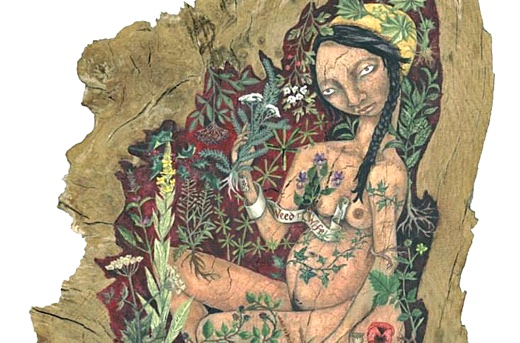
Image above: Painting "weed Wife" on section of oak burrby Rima Staines 2013 (www.rimastaines.com). From original article.

Hierarchy
Power structures establish various systems to ensure the organisation of interrelationships and the distribution of resources throughout a group, community, or ecosystem. In human terms, these systems become our tribes, societies, and civilisations. The dominant power structure in the Western world at this time is capitalist, colonial, and hierarchical, with resources being distributed (or, more accurately, hoarded) from the top down.

Before capitalism, many of us who have descended from the nations of Europe have a cultural history of feudalism or some other social-ranking hierarchy. Feudal society is the rootstock of capitalism. One of the primary differences subsumed from this medieval power structure by early capitalism was the waged exchange of labor.

The feudal peasants were non-waged, that is, not paid in monetary currency for their labour. Instead, they were paid by an exchange of resources such as land, shelter, and farming rights. Both capitalist and feudal hierarchies were architected to direct and control the circulation of currency from those at the top, who are the elite and few, down to those at the bottom, who are the poor and many.

Capitalism depends on unrestrained growth and production, the manufacturing of material goods, and the extraction of resources to meet these ends. Colonisation, the imperious expansion of geographic, cultural, and political boundaries becomes requisite — with all its cruelty and overconsumption — as a result of this excessive and continuous reach to sustain the unsustainable.

When contemplating the quagmire of obstacles and institutions within our capitalist society that interfere with the equitable and just interchange of currency and access to resources, I find myself motivated to explore less oppressive economic, social, and political human relationships.

In doing so, I have become aligned with that ever-gallant and hopeful group of folks dismissed as unrealistic dreamers.

We ‘dreamers’ always hold fast to the truth that the wilful designation of creation and power can be delineated into a network of horizontal or lateral functions that make greed, conquest, and competition unnecessary and invalid, except in extreme conditions.

In the words of Larry Wall, creator of Perl, the open-sourced computer programming language: ‘There is more than one way to do it.’

Perl, and Wall’s band of merry hackers, revolutionized the internet with a coding script that encourages other programmers to interject or hack, as they say in the business, their own design style and innovations that contribute to improvements and success for everyone using the network.¹

These internet wizards built the bridge between those of us who simply want to use the internet and those who actually understand it.

I personally am not remotely skilled in the exotic language of programming or the strange tongue of capitalist economics. As one called to the path along the hedges, in the woods, the fields, the gardens, and all the green, untamed and untrailed places, I have found another way to do things in learning the ways of the world beneath the dark shadows of treetops and in the soils with the rooted ones.

As a folk herbalist practising in the foothills of the Adirondack Mountains of New York State, I live remotely, keeping a distant participation to some degree (perhaps never enough?), in the mainstream rush and panic of daily life in the ‘real’ world of productivity, competition and corporate time sheets.

My work with others, however, brings me into direct contact with the consequent ills, both physical and emotional, of life within the overworked, overstimulated and ‘red in tooth and claw’ system.

My long hours and days gathering and growing the herbs to share with my clients, family, neighbours and friends feels like a different world or alternate reality in contrast to the interface I must make with the civilised world of offices, fluorescent lights and concrete.

While I truly love all parts of my work, this polar interchange always clearly elucidates for me the distinct difference between the world of unruly winds and wild waters, and the tame and burning filaments of electricity enslaved within the lightbulb.

Much of my herbal work is spent with a shovel, basket and clippers as I dig and gather roots, leaves, flowers, bark and berries that are prepared into teas and other herbal formulations. I make every practical effort to harvest from local sources. This requires me to be tuned into to the seasonal cycles and growing patterns of wild plants.

I also grow a variety of herbs in my own garden, and have become acutely tuned into conservation and ethical harvesting techniques that ensure the long-term survival and proliferation of our wild medicine plants.

This art and practice of traditional herbalism has deep roots into the history of every culture on earth. These roots have twisted, turned and intertwined throughout thousands of years of human civilisation, often being lost and forgotten as the quality of our communal engagements and our narrative with the world has placed humans on top of a hierarchy that centralises power into an above-ground, rootless, disembodied, hegemony.

That said, I think it’s important here to acknowledge that hierarchies occur naturally in wild communities, especially in herd animals, and that hierarchy is not always played out as an oppressive power structure. It can be an excellent tool for ensuring survival, protection and the health of a herd or community when based on consensus, synergy and cooperative principles.

Becoming radicle
Radicle: a rootlike subdivision, the portion of the embryo that gives rise to the root system of the plant
— biology-online.org
Radicle describes the first part of the seed to emerge after germination that subsequently becomes the primary root. Radicles and the roots they become are a most powerful natural force that, as every city sidewalk knows, will crack and divide concrete. The soil depends upon these mighty revolutionaries to deeply move, turn and aerate the surface of the planet so that life can ascend from it. Plants ‘know’ that in order for productive growth to be sustained, they must first set their roots and begin to make contact with the vast and nutritious field of minerals and essential microbes within the substratum.

Plant roots have many different and effective growing styles, but my favourite are those that are rhizomatic. A rhizome is actually an underground stem that is rootlike; it spreads horizontally, sending out shoots and creating a lateral chain of connection where new sprouts can emerge.

Rhizomes are non-hierarchical and extremely resilient because even if you dig up one part, the other sections will continue to grow and proliferate. Rhizomes have no top or bottom, any point can be connected to any other. They can be broken off at any point and will always be able to start up again.

Their network can be entered at any point; there is no central origin. And because there is no central regulatory force, rhizomes function as open systems where connections can emerge regardless of similarities or differences. Freedom of expression exists within a rhizome.

Rhizomes, therefore, are heterogeneous and can create multiplicities, or many different roots, that are sovereign but still in contact and communication with all other parts of the system. This is in contrast to, for instance, a tree, which has a central origin or trunk from which all of its roots and branches emerge. Disconnected from that source, they are no longer in direct contact with their growing system.

As author and storyteller Martin Shaw writes about ‘the rhizomatic universe’ in his book A Branch From the Lightening Tree:

The rhizome is a plant root system that grows by accretion rather than by separate or oppositional means. There is no defined center to its structure, and it doesn’t relate to any generative model. Each part remains in contact with the other by way of roots that become shoots and underground stems. We see that the rhizome is de-territorial, that it stands apart from the tree structure that fixes an order, based on radiancy and binary opposition.

Learning methods and cultural philosophies have been inspired and developed from the patterns observed within rhizomatic root systems. One such concept was introduced by philosopher Guilles Deleuze and psychoanalyst Félix Guattari. From their book on the subject, A Thousand Plateaus: Capitalism and Schizophrenia:

As a model for culture, the rhizome resists the organizational structure of the root-tree system, which charts causality along chronological lines and looks for the original source of ‘things’ and looks towards the pinnacle or conclusion of those ‘things.’

A rhizome, on the other hand, is characterized by ‘ceaselessly established connections between semiotic chains, organizations of power, and circumstances relative to the arts, sciences, and social struggles.’ Rather than narrativize history and culture, the rhizome presents history and culture as a map or wide array of attractions and influences with no specific origin or genesis, for a ‘rhizome has no beginning or end; it is always in the middle, between things, interbeing, intermezzo.’ The planar movement of the rhizome resists chronology and organization, instead favoring a nomadic system of growth and propagation.

In this model, culture spreads like the surface of a body of water, spreading towards available spaces or trickling downwards towards new spaces through fissures and gaps, eroding what is in its way. The surface can be interrupted and moved, but these disturbances leave no trace, as the water is charged with pressure and potential to always seek its equilibrium, and thereby establish smooth space.

Examples of rhizomatic patterns exist throughout the living world and include plants such as ginger, crabgrass, violets and, my favourite, wild sarsaparilla (Aralia nudicalis). In human terms we can see many examples of rhizomatic systems, such as we discussed above about Larry Wall and the internet, even amid the context of complex societal hierarchy. New economic and environmental models of power such as permaculture, bioregionalism, and re-localisation are designed to work as horizontal, cooperative, synergistic, and non-competitive systems.

The Rhizomati
Rhizome: A continuously growing horizontal underground stem that puts out lateral shoots and adventitious roots at intervals.
— Oxford English Dictionary online
Herbal medicines are, and always have been, a rhizomatic source of the equitable and lateral distribution of basic needs that seeks not to hoard, commercialise, and capitalise on healthcare or to dole it out only to those with access to the necessary currency. Herbs themselves have not escaped the thralls of patriarchal conquest.

All of our modern medicine was founded on the insight gained from the common people and their unwritten relationship with the medicine of the plants.

Many of the early European physicians gathered their knowledge from village herbalists, often women who could not read or write (as the patriarchy forbade them). These women are rarely even mentioned in the published literature of medical history.

An example can be found in the book written by Dr William Withering (1774-1799), the man who is said to have ‘discovered’ the medicinal use of foxglove.

The very first page of his book makes a short mention of a village wise woman who used it in a formula for dropsy: ‘I was told that it had been a long-kept secret by an old woman in Shropshire, who had sometimes made cures after the more regular practitioners had failed.’

The village healers were not elite or favoured by the ruling classes, and in fact were historically perceived as a threat. Their healing work was focused on the direct and intimate needs of their local community, which they frequently sought to empower and support. Traditional herbal medicine was not motivated by profit nor was it sanctioned by the overculture.

In our current times, herbal medicine and plant-based culture has re-emerged in many forms and I perceive it is in a major cycle of transformation.

Many call it the ‘herbal renaissance’ and it’s not clear yet what the trajectory will be, as the world seemingly changes at the speed of light.

However, the core values remain inextricably connected to the interdependent place-based character of the village healer and his or her reciprocal conversation with the wild and green world.

Our ancestors in healing, the long-ago plant people, were in service to their human community as well as the medicine allies they harvested from the hedges. These plant people often lived on the edge of town and worked as not only healers of physical sickness, but also practitioners of spirit, shamans of the village soul, and knowers of, or in old English ‘cunners’ of, the ‘wort’, or herb.

Some were called wortcunners. Some were called magicians. Some were called witches. There are many different types of herbalists now and in the past. In ancient times — interestingly! — they were called the rhizomati, or by some sources, rhizotomoki, meaning ‘root gatherers’ or ‘root cutters’.

The rhizomati were rhizomatic practitioners of underground and lateral energy patterns as found in the plant kingdom. According to Christian Rätsch, ‘the rhizotomoki still spoke with the plant spirits…’ He adds:
‘These root-gatherers observed the gods sacred to the respective plant. They made use of the moon’s energy and knew the particular oath formulas for each plant. Witchcraft medicine belongs to the spiritual and cultural legacy of the rhizotomoki.’
Rätsch asserts, therefore, that ‘witchcraft medicine is wild medicine. It is uncontrollable, it surpasses the ruling order, it is anarchy. It belongs to the wilderness.’² Anarchy and wildness, in this sense, are not instances of chaos, mayhem, or lack of a system; rather, it is a system that is self-organised, organic, self-regulated, and impervious to oppressive external control mechanisms.

The rhizomati were carriers of traditional healing knowledge and have emerged at various points in time. In fact, as would a rhizome — going underground for a time and sprouting their legacy up to the surface in another place or time. Renowned modern-day herbalist David Hoffman has compared herbalists of our time to the Greek ‘rhizotomoi’ who held a very special place in the hierarchy of health-care practitioners during ancient times. He asserts that, now as then, herbal healers ‘breach so many realms.’

It is important to understand that the rhizotomoi were not merely the garden labourers that grew the plants, nor did they have the status of academic physicians who dispensed already prepared pills and formulas.

Hoffman says: ‘They were people who knew the plants, knew where they grew, knew how to cultivate them, knew how to collect them appropriately, knew how to make the medicine, but then also knew how to use the medicine in the context of the people’s needs… they were herbalists.’


The legacy of these herbalists has carried their medicine bags into the vernacular, or kitchen, gardens of the past few hundred years in Europe and North America.

Such gardens belonged to people of any class, and provided subsistence food and medicine to individuals and families. These communal plots were stewarded by the rhizomati and provided a local source of plants and seeds, were designed to meet the natural rhythms of the seasons, and were small enough to adapt to changing local conditions.

They were places ‘in which “herb women” and rhizomati, root gatherers, are a key source of plant materials and seeds, and garden innovations are shared among peers—family, neighbors, friends—rather than distributed by a central authority.’³

Today’s root cutters, root gatherers, folk herbalists, plant charmers, and the like, face unknown challenges as the trail leads into the future of a global, capitalist economy. Herbal medicine has become increasingly mainstream and, will no doubt, continue to be commodified and profiteered at some level.

The overculture has made many recent bids to commercialise, exploit and restrict the use of plants by the people. There have been recent regulations enacted that limit the ability of herbalists to maintain home-based businesses, thereby restricting access to local products and serving the burgeoning corporate herbal industry.4

That is not to say that there is not a place in our health-care system for phyto-physicians that work with herbs allopathically. Plant-based preparations have already found a place in mainstream bio-medicine as a complementary modality, a method of prevention, and as a tool of synergy to potentise pharmaceutical protocols.

However, this does not concede the necessity of the decentralized, community focused, and client-centred practice of folk herbalists. The modern rhizomati are a source of resilience and empowerment for our society and world, thanks to their interface with plants and people.

This resilience will come not only at our resistance to capitalist exploits, but in our ability to establish rhizomatic, horizontal and local systems of vital sustenance, imagination, and community.

Change and dissent are enacted on even the simplest, most humane level when we just become aware of equitable alternatives to our dominant power structure. This I believe to be true well beyond the realms of herbal medicine practice. It has implications for our homes, businesses, communities local and beyond, schools, food production, the arts, and developing technologies.

The key to the door of social justice and change is the knowledge that there are other ways to do it — as well as in the courage and innovation of those that are willing to imagine more than one possibility.

May the rhizomati live again and may we all rise rooted!

Footnotes
  1. Silberman, Steve, Neurotribes, New York: Avery, 2015
  2. Müller-Ebeling, Claudia, Christian Rätsch, and Wolf-Dieter Storl, Witchcraft Medicine: Healing Arts, Shamanic Practices, and Forbidden Plants, Rochester, Vermont Inner Traditions, 2003
  3. ‘Vernacular Gardens’, Wyrtig.com, For gardeners with a sense of history, 2015. Accessed February 18, 2017
  4. For more on these regulations or the cGMP laws: A Radicle blogspot. FDA cGMP compliance open source project. aradicle.blogspot.com, 2015. Accessed February 18, 2017
.

Chelsea Manning freed from prison

SUBHEAD: Manning served more time in prison than any other American leaker of information.

By David Kravits on 17 April 2107 for Ars Technica -
(https://arstechnica.com/tech-policy/2017/05/chelsea-manning-freed-from-military-prison/)


Image above: Chelsea Manning poses for new portrait with cation, " So here I am everyone!!" From (https://twitter.com/xychelsea/status/865250670831702016).

Chelsea Manning was released from the Military Corrections Complex at Fort Leavenworth in Kansas on Wednesday—nearly three decades before the Army private's sentence was up for leaking classified military documents to WikiLeaks.

The intelligence analyst, who left the barracks at 2am (CDT), was court-martialed and convicted of leaking more than 700,000 documents and video about the war in Iraq and Afghanistan. She came out as a transgender woman shortly after being handed an unprecedented 35-year prison sentence in 2013.

Then-President Barack Obama commuted Manning's term in January and set a May 17 release date. Manning, whom President Trump has called a "TRAITOR" on Twitter, had been in prison longer than any other US leaker convicted under the Espionage Act. She was eligible for parole in six years.

Because Manning's conviction is under appeal, she is to remain in the military on "excess leave in an active-duty status" entitling her to healthcare, the military said. If she loses her appeal, she might be dishonorably discharged and could lose her healthcare and other benefits.

Neither the military nor Manning's supporters said where she would be living. But Manning tweeted in January she would return to Maryland, where she previously resided.

"I am looking forward to so much! Whatever is ahead of me is far more important than the past. I’m figuring things out right now—which is exciting, awkward, fun, and all new for me," Manning said in a statement.

Manning said in a petition to Obama that she "did not intend to harm the interests of the United States or harm any service members." Among other reasons, she wanted to be released in order to continue her transition-related healthcare. A White House online petition saw more than 100,000 people demand that Obama commute Manning's sentence.

"It has been my view that, given she went to trial, that due process was carried out, that she took responsibility for her crime, that the sentence that she received was very disproportionate relative to what other leakers had received. It made sense to commute, and not pardon, her sentence," Obama said of Manning's commutation during the final days of his presidency.

Manning enlisted with the Army in 2007 and leaked the documents at a Barnes & Noble in suburban Maryland. The classified files, which were on a camera's memory stick, were uploaded during a 2010 mid-tour leave from Iraq.

At trial, Manning testified about a classified video of a 2007 Apache helicopter attack in Iraq that was ultimately found to have killed civilians and a Reuters journalist. "For me, that was like a child torturing an ant with a magnifying glass," Manning said. Using Tor, Manning uploaded the video and documents to WikiLeaks. The video went viral and is known as the "collateral murder" video.

In the days before Obama commuted Manning's sentence, WikiLeaks founder Julian Assange said he would surrender to US authorities if Obama showed Manning mercy. Assange is living in a self-imposed exile in the Ecuadorian Embassy in London amid fears he could be charged in the US for exposing the secrets Manning leaked.

However, Assange weaseled out of his pledge, saying he meant he would surrender only if Obama allowed Manning to leave the brig immediately, not on May 17.


.

Swedes drop Assange investigation

SUBHEAD: Sweden’s public prosecutor discontinues the rape investigation into WikiLeaks founder.

By Esther Addley & Alan Travis on 19 MAy 2017 for the Guardian-
(https://www.theguardian.com/media/2017/may/19/swedish-prosecutors-drop-julian-assange-investigation)


Image above: Photo from Ecuadorian Embassy in London of Julian Assange after hearing report of Sweden dropping charges against him.  From original article.

Swedish prosecutors have dropped their preliminary investigation into an allegation of rape against the WikiLeaks founder, Julian Assange, bringing an end to a seven-year legal standoff.

The decision was taken after prosecutors concluded that “at this point, all possibilities to conduct the investigation are exhausted”, Sweden’s director of public prosecutions, Marianne Ny, said on Friday.
“In order to proceed with the case, Julian Assange would have to be formally notified of the criminal suspicions against him. We cannot expect to receive assistance from Ecuador regarding this.
Therefore the investigation is discontinued.

“If he, at a later date, makes himself available, I will be able to decide to resume the investigation immediately.”

The WikiLeaks founder sought asylum in Ecuador’s embassy in London in 2012 after losing court battles to avoid extradition to Sweden over the claims, which he denies.

Separate allegations of sexual assault, made by a second Swedish woman, were dropped by Swedish authorities in 2015 after the statute of limitations expired.

Shortly after the announcement on Friday morning, an image of Assange smiling was posted to his Twitter account.

Later he tweeted again: “Detained for 7 years without charge while my children grew up and my name was slandered. I do not forgive or forget.”

However, a lawyer representing the woman who made the allegation of rape described the decision as a “scandal”.

“It is a scandal that a suspected rapist can escape justice and thereby avoid the courts,” Elisabeth Massi Fritz told Agence France-Presse in an email. “My client is shocked and no decision to [end the case] can make her change [her view] that Assange exposed her to rape.”

With the threat of extradition to Sweden removed, the 45-year-old Australian could potentially opt to leave the embassy.

However, Assange’s lawyers have repeatedly said he will not do so without assurances that he will not face extradition to the US over possible espionage charges linked to WikiLeaks’ publishing activities – the basis on which Ecuador granted him asylum.

The Metropolitan police in London said Assange would also face immediate arrest for breaching his bail conditions; a warrant was issued when he failed to attend a magistrates court after entering the embassy.

“The Metropolitan police service is obliged to execute that warrant should he leave the embassy,” the statement said.

It added: “Whilst Mr Assange was wanted on a European arrest warrant (EAW) for an extremely serious offence, the MPS response reflected the serious nature of that crime.

Now that the situation has changed and the Swedish authorities have discontinued their investigation into that matter, Mr Assange remains wanted for a much less serious offence. The MPS will provide a level of resourcing which is proportionate to that offense.”

Per Samuelson, Assange’s Swedish lawyer, told reporters the decision represented a total victory.

“This is one of the happiest days of my legal career. The decision was taken because he was interrogated in November 2016 and could give a good explanation of what happened … This is obviously about consensual sex between two adults.”

Ecuador’s foreign minister, Guillaume Long, also welcomed the decision, adding that he “regrets that the Swedish prosecutor delayed more than four years in carrying out this interview. Given that the European arrest warrant no longer holds, Ecuador will now be intensifying its diplomatic efforts with the UK so that Julian Assange can gain safe passage, in order to enjoy his asylum in Ecuador.”


But Claes Borgström, the lawyer who originally represented Assange’s two accusers but is no longer involved in the case, said he found the decision regretful. He told the Guardian: “I understand why the prosecutors have dropped the case now.

Such a long time has passed. But I regret that Julian Assange was not brought to the Swedish court of law to answer the allegations against him.

“All the time since he left Sweden it has been in his hands. He decided to avoid the arms of justice. He didn’t want to come to court. He didn’t want to answer the allegations, so he decided to escape.”

The EAW against Assange was formally withdrawn at Westminster magistrates court on Friday morning, the Crown Prosecution Service confirmed. The UK Home Office said the decision to drop the rape investigation was a matter for the Swedish authorities, and not one in which the British government had any involvement.

Reuters reported in March that a long-running US grand jury investigation into WikiLeaks had been expanded to include recent leaks of CIA documents, a move that Assange’s lawyers said strengthened the grounds for his asylum claim.

Assange was interviewed by Sweden’s deputy public prosecutor, Ingrid Isgren, in the embassy in November, following a lengthy diplomatic and legal impasse between the Swedish and Ecuadorian authorities.

Friday’s announcement in Sweden followed the Swedish government receiving a letter from the government of Ecuador which accused the prosecutor of “serious failure”, including a “lack of initiative” to complete inquiries.

The letter raised questions about developments in the US since the election of Donald Trump as president, including a speech by the CIA director, Mike Pompeo, describing WikiLeaks as a “hostile intelligence service” and a threat to US national security.

Public declarations such as this constituted an “obvious risk” for Assange, the letter said.

The US attorney general, Jeff Sessions, said last month that arresting Assange was a priority. There are no charges against him, although media reports have suggested the US justice department is considering how to bring them.

“We’ve already begun to step up our efforts and whenever a case can be made, we will seek to put some people in jail,” Sessions said.

Asked at a Conservative party campaign event in Edinburgh if the UK would now support a request to extradite Assange to the US, Theresa May said: “We look at extradition requests on a case-by-case basis.”

The prime minister added: “In relation to Julian Assange, any decision that is taken about UK action in relation to him were he to leave the Ecuadorian embassy would be an operational matter for the police.”


Lest we forget US to charge Assange

By Staff on 20 April 2017 for Aljazeera -
(http://www.aljazeera.com/news/2017/04/julian-assange-arrest-priority-jeff-sessions-170421023413061.html)

The arrest of WikiLeaks founder Julian Assange is a US "priority", Attorney General Jeff Sessions has said, as media reports indicated his office was preparing charges against the leaker.

"We are going to step up our effort and already are stepping up our efforts on all leaks," Sessions said at a news conference on Thursday in response to a reporter's question about a US priority to arrest Assange.

The justice department chief said a rash of leaks of sensitive secrets appeared unprecedented.
"This is a matter that's gone beyond anything I'm aware of. We have professionals that have been in the security business of the United States for many years that are shocked by the number of leaks and some of them are quite serious," he said.

"Whenever a case can be made, we will seek to put some people in jail."

Prosecutors in recent weeks have been drafting a memo that looks at charges against Assange and members of WikiLeaks that possibly include conspiracy, theft of government property and violations of the Espionage Act, the Washington Post reported, citing unnamed US officials familiar with the matter.

Several other media outlets cited unnamed officials as saying US authorities were preparing charges against Assange.

Prosecutors had struggled to determine whether the First Amendment protected Assange from prosecution but had now found a way to move forward, officials told CNN.

The justice department declined to comment on the reports.

Assange, 45, has been holed up at the Ecuadoran embassy in London since 2012 trying to avoid extradition to Sweden where he faces a rape allegation that he denies.

He fears Sweden would extradite him to the United States to face trial for leaking hundreds of thousands of secret US military and diplomatic documents that first gained attention in 2010.

Assange's case returned to the spotlight after WikiLeaks was accused of meddling in the US election last year by releasing a damaging trove of hacked emails from presidential candidate Hillary Clinton's campaign and the Democratic Party.

US officials say the emails were hacked with the aid of the Russian government in its bid to influence the US election.

Critics say their release late in the race helped to tip the November 8 election to Republican Donald Trump.

Trump and his administration have put heat on WikiLeaks after it embarrassed the Central Intelligence Agency last month by releasing a large number of files and computer code from the spy agency's top-secret hacking operations.

The documents showed how the CIA exploits vulnerabilities in popular computer and networking hardware and software to gather intelligence.

Supporters of WikiLeaks say it is practising the constitutional right of freedom of speech and the press.

CIA Director Mike Pompeo last week branded WikiLeaks a "hostile intelligence service," saying it threatens democratic nations and joins hands with dictators.

Pompeo focused on the anti-secrecy group and other leakers of classified information like Edward Snowden as one of the key threats facing the United States.

"WikiLeaks walks like a hostile intelligence service and talks like a hostile intelligence service. It has encouraged its followers to find jobs at CIA in order to obtain intelligence ... And it overwhelmingly focuses on the United States, while seeking support from anti-democratic countries and organisations," said Pompeo.

"It is time to call out WikiLeaks for what it really is - a non-state hostile intelligence service often abetted by state actors like Russia."

In response to Thursday's report WikiLeaks reposted on Twitter an opinion piece written by Assange and published in the Washington Post earlier this month.

"WikiLeaks' sole interest is expressing constitutionally protected truths, which I remain convinced is the cornerstone of the United States' remarkable liberty, success and greatness," Assange wrote.


Where have all the insects gone?

SUBHEAD: People, have a gut feeling. They remember how insects used to smash onto their windshields.

By Gretchen Vogel on 10 May 2017 for Science Magazine -
(http://www.sciencemag.org/news/2017/05/where-have-all-insects-gone)


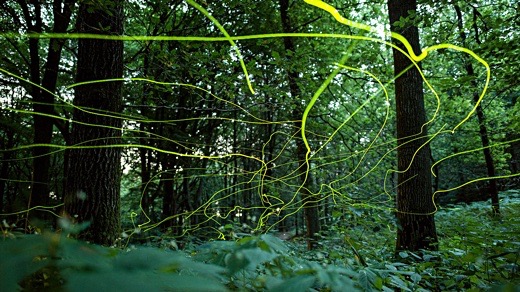
Image above: Fireflies, like these in a forest in the Netherlands, have disappeared from some areas in North America and Europe where they were once abundant. Photo by Paul Van Hoof. From original article.

Entomologists call it the windshield phenomenon. "If you talk to people, they have a gut feeling. They remember how insects used to smash on your windscreen," says Wolfgang Wägele, director of the Leibniz Institute for Animal Biodiversity in Bonn, Germany. Today, drivers spend less time scraping and scrubbing.

"I'm a very data-driven person," says Scott Black, executive director of the Xerces Society for Invertebrate Conservation in Portland, Oregon. "But it is a visceral reaction when you realize you don't see that mess anymore."

Some people argue that cars today are more aerodynamic and therefore less deadly to insects. But Black says his pride and joy as a teenager in Nebraska was his 1969 Ford Mustang Mach 1—with some pretty sleek lines. "I used to have to wash my car all the time.

It was always covered with insects." Lately, Martin Sorg, an entomologist here, has seen the opposite: "I drive a Land Rover, with the aerodynamics of a refrigerator, and these days it stays clean."

Though observations about splattered bugs aren't scientific, few reliable data exist on the fate of important insect species. Scientists have tracked alarming declines in domesticated honey bees, monarch butterflies, and lightning bugs.

But few have paid attention to the moths, hover flies, beetles, and countless other insects that buzz and flitter through the warm months. "We have a pretty good track record of ignoring most noncharismatic species," which most insects are, says Joe Nocera, an ecologist at the University of New Brunswick in Canada.


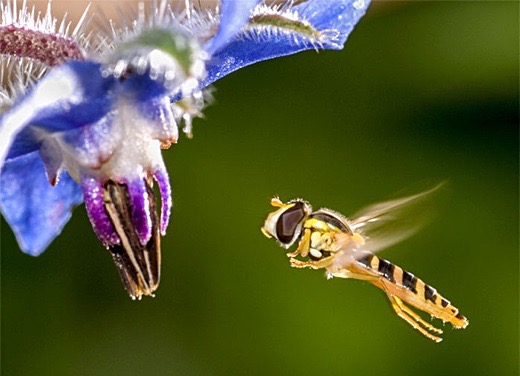
Image above: Hover flies, often mistaken for bees or wasps, are important pollinators. Their numbers have plummeted in nature reserves in Germany. Photo by Jef Meul. From original article.

Of the scant records that do exist, many come from amateur naturalists, whether butterfly collectors or bird watchers.

Now, a new set of long-term data is coming to light, this time from a dedicated group of mostly amateur entomologists who have tracked insect abundance at more than 100 nature reserves in western Europe since the 1980s.

Over that time the group, the Krefeld Entomological Society, has seen the yearly insect catches fluctuate, as expected. But in 2013 they spotted something alarming. When they returned to one of their earliest trapping sites from 1989, the total mass of their catch had fallen by nearly 80%.

Perhaps it was a particularly bad year, they thought, so they set up the traps again in 2014. The numbers were just as low.

Through more direct comparisons, the group—which had preserved thousands of samples over 3 decades—found dramatic declines across more than a dozen other sites.

Such losses reverberate up the food chain. "If you're an insect-eating bird living in that area, four-fifths of your food is gone in the last quarter-century, which is staggering," says Dave Goulson, an ecologist at the University of Sussex in the United Kingdom, who is working with the Krefeld group to analyze and publish some of the data. "One almost hopes that it's not representative—that it's some strange artifact."

No one knows how broadly representative the data are of trends elsewhere.

But the specificity of the observations offers a unique window into the state of some of the planet's less appreciated species. Germany's "Red List" of endangered insects doesn't look alarming at first glance, says Sorg, who curates the Krefeld society's extensive collection of insect specimens. Few species are listed as extinct because they are still found in one or two sites.

But that obscures the fact that many have disappeared from large areas where they were once common. Across Germany, only three bumble bee species have vanished, but the Krefeld region has lost more than half the two dozen bumble bee species that society members documented early in the 20th century.

Members of the Krefeld society have been observing, recording, and collecting insects from the region—and around the world—since 1905. Some of the roughly 50 members—including teachers, telecommunication technicians, and a book publisher—have become world experts on their favorite insects.

Siegfried Cymorek, for instance, who was active in the society from the 1950s through the 1980s, never completed high school. He was drafted into the army as a teenager, and after the war he worked in the wood-protection division at a local chemical plant.

But because of his extensive knowledge of wood-boring beetles, the Swiss Federal Institute of Technology in Zurich awarded him an honorary doctorate in 1979. Over the years, members have written more than 2000 publications on insect taxonomy, ecology, and behavior.

The society's headquarters is a former school in the center of Krefeld, an industrial town on the banks of the Rhine that was once famous for producing silk. Disused classrooms store more than a million insect specimens individually pinned and named in display cases.

Most were collected nearby, but some come from more exotic locales.

Among them are those from the collection of a local priest, an active member in the 1940s and 1950s, who persuaded colleagues at mission stations around the world to send him specimens. (The society's collection and archive are under historical preservation protection.)

Tens of millions more insects float in carefully labeled bottles of alcohol—the yield from the society's monitoring projects in nature reserves around the region.

The reserves, set aside for their local ecological value, are not pristine wilderness but "seminatural" habitats, such as former hay meadows, full of wildflowers, birds, small mammals—and insects. Some even include parts of agricultural fields, which farmers are free to farm with conventional methods.

Heinz Schwan, a retired chemist and longtime society member who has weighed thousands of trap samples, says the society began collecting long-term records of insect abundance partly by chance.

In the late 1970s and early 1980s, local authorities asked the group for help evaluating how different strategies for managing the reserves affected insect populations and diversity.

The members monitored each site only once every few years, but they set up identical insect traps in the same place each time to ensure clean comparisons.

Because commercially available traps vary in ways that affect the catch, the group makes their own. Named for the Swedish entomologist René Malaise, who developed the basic design in the 1930s, each trap resembles a floating tent.

Black mesh fabric forms the base, topped by a tent of white fabric and, at the summit, a collection container—a plastic jar with an opening into another jar of alcohol. Insects trapped in the fabric fly up to the jar, where the vapors gradually inebriate them and they fall into the alcohol.

The traps collect mainly species that fly a meter or so above the ground. For people who worry that the traps themselves might deplete insect populations, Sorg notes that each trap catches just a few grams per day—equivalent to the daily diet of a shrew.

Sorg says society members saved all the samples because even in the 1980s they recognized that each represented a snapshot of potentially intriguing insect populations. "We found it fascinating—despite the fact that in 1982 the term ‘biodiversity' barely existed," he says. Many samples have not yet been sorted and cataloged—a painstaking labor of love done with tweezers and a microscope. Nor have the group's full findings been published.

But some of the data are emerging piecemeal in talks by society members and at a hearing at the German Bundestag, the national parliament, and they are unsettling.

Beyond the striking drop in overall insect biomass, the data point to losses in overlooked groups for which almost no one has kept records. In the Krefeld data, hover flies—important pollinators often mistaken for bees—show a particularly steep decline.

In 1989, the group's traps in one reserve collected 17,291 hover flies from 143 species. In 2014, at the same locations, they found only 2737 individuals from 104 species.

Since their initial findings in 2013, the group has installed more traps each year. Working with researchers at several universities, society members are looking for correlations with weather, changes in vegetation, and other factors. No simple cause has yet emerged.

Even in reserves where plant diversity and abundance have improved, Sorg says, "the insect numbers still plunged."

Changes in land use surrounding the reserves are probably playing a role. "We've lost huge amounts of habitat, which has certainly contributed to all these declines," Goulson says. "If we turn all the seminatural habitats to wheat and cornfields, then there will be virtually no life in those fields."

As fields expand and hedgerows disappear, the isolated islands of habitat left can support fewer species. Increased fertilizer on remaining grazing lands favors grasses over the diverse wildflowers that many insects prefer. And when development replaces countryside, streets and buildings generate light pollution that leads nocturnal insects astray and interrupts their mating.

Neonicotinoid pesticides, already implicated in the widespread crash of bee populations, are another prime suspect. Introduced in the 1980s, they are now the world's most popular insecticides, initially viewed as relatively benign because they are often applied directly to seeds rather than sprayed.

But because they are water soluble, they don't stay put in the fields where they are used. Goulson and his colleagues reported in 2015 that nectar and pollen from wildflowers next to treated fields can have higher concentrations of neonicotinoids than the crop plants.

Although initial safety studies showed that allowable levels of the compounds didn't kill honey bees directly, they do affect the insects' abilities to navigate and communicate, according to later research. Researchers found similar effects in wild solitary bees and bumble bees.

Less is known about how those chemicals affect other insects, but new studies of parasitoid wasps suggest those effects could be significant. Those solitary wasps play multiple roles in ecosystems—as pollinators, predators of other insects, and prey for larger animals.

A team from the University of Regensburg in Germany reported in Scientific Reports in February that exposing the wasp Nasonia vitripennis to just 1 nanogram of one common neonicotinoid cut mating rates by more than half and decreased females' ability to find hosts.

"It's as if the [exposed] insect is dead" from a population point of view because it can't produce offspring, says Lars Krogmann, an entomologist at the Stuttgart Natural History Museum in Germany.

No one can prove that the pesticides are to blame for the decline, however. "There is no data on insecticide levels, especially in nature reserves," Sorg says.

The group has tried to find out what kinds of pesticides are used in fields near the reserves, but that has proved difficult, he says. "We simply don't know what the drivers are" in the Krefeld data, Goulson says. "It's not an experiment. It's an observation of this massive decline. The data themselves are strong.

Understanding it and knowing what to do about it is difficult."

The factors causing trouble for the hover flies, moths, and bumble bees in Germany are probably at work elsewhere, if clean windshields are any indication. Since 1968, scientists at Rothamsted Research, an agricultural research center in Harpenden, U.K., have operated a system of suction traps—12-meter-long suction tubes pointing skyward. 

 
Set up in fields to monitor agricultural pests, the traps capture all manner of insects that happen to fly over them; they are "effectively upside-down Hoovers running 24/7, continually sampling the air for migrating insects," says James Bell, who heads the Rothamsted Insect Survey.

Between 1970 and 2002, the biomass caught in the traps in southern England did not decline significantly. Catches in southern Scotland, however, declined by more than two-thirds during the same period. 
 
Bell notes that overall numbers in Scotland were much higher at the start of the study. "It might be that much of the [insect] abundance in southern England had already been lost" by 1970, he says, after the dramatic postwar changes in agriculture and land use.

The stable catches in southern England are in part due to constant levels of pests such as aphids, which can thrive when their insect predators are removed. Such species can take advantage of a variety of environments, move large distances, and reproduce multiple times per year. 
 
Some can even benefit from pesticides because they reproduce quickly enough to develop resistance, whereas their predators decline. "So lots of insects will do great, but the insects that we love may not," Black says.

Other, more visible creatures may be feeling the effects of the insect losses. Across North America and Europe, species of birds that eat flying insects, such as larks, swallows, and swifts, are in steep decline. Habitat loss certainly plays a role, Nocera says, "but the obvious factor that ties them all together is their diet."

Some intriguing, although indirect, clues come from a rare ecological treasure: decades' worth of stratified bird droppings. Nocera and his colleagues have been probing disused chimneys across Canada in which chimney swifts have built their nests for generations. 
 
From the droppings, he and his colleagues can reconstruct the diets of the birds, which eat almost exclusively insects caught on the wing.

The layers revealed a striking change in the birds' diets in the 1940s, around the time DDT was introduced. The proportion of beetle remains dropped off, suggesting the birds were eating smaller insects—and getting fewer calories per catch. 
 
The proportion of beetle parts increased slightly again after DDT was banned in the 1970s but never reached its earlier levels. The lack of direct data on insect populations is frustrating, Nocera says. "It's all correlative. We know that insect populations could have changed to create the population decline we have now. But we don't have the data, and we never will, because we can't go back in time."

Sorg and Wägele agree. "We deeply regret that we did not set up more traps 20 or 30 years ago," Sorg says. He and other Krefeld society members are now working with Wägele's group to develop what they wish they had had earlier: a system of automated monitoring stations they hope will combine audio recordings, camera traps, pollen and spore filters, and automated insect traps into a "biodiversity weather station". 
 
Instead of tedious manual analysis, they hope to use automated sequencing and genetic barcoding to analyze the insect samples. Such data could help pinpoint what is causing the decline—and where efforts to reverse it might work best.

Paying attention to what E. O. Wilson calls "the little things that run the world" is worthwhile, Sorg says. "We won't exterminate all insects. That's nonsense. Vertebrates would die out first. But we can cause massive damage to biodiversity—damage that harms us."

.

By 2050 no living coral reefs?

SOURCE: Katherine Muzik PHD (kmuzik@gmail.com)
SUBHEAD: In a generation all ocean reefs may succumb to Global Warming from human activity. 

By Dahr Jamail on 15 May 2017 for Truth Out! -
(http://www.truth-out.org/news/item/40579-coral-reefs-generate-half-of-earth-s-oxygen-and-they-could-all-die-off-by-2050)

http://www.islandbreath.org/2017Year/05/170516reefbig.jpg
Image above: An aerial photograph of a small portion of the Great Barrier Reef in northeast Australia. From (http://www.businessinsider.com/australias-great-barrier-reef-will-disappear-within-two-decades-with-no-intervention-2014-3) Click to enlarge.

When he was six years old, Dean Miller already knew he wanted to be a marine biologist. At that time, growing up in Australia, the world of marine biology seemed both spectacular and limitless, he says.

"I wanted to study the wonders of the Great Barrier Reef, the intricate and complex connections between the thousands of different life-forms that represent the most diverse ecosystem on the planet," Miller told Truthout.

But in the last two years, this has all changed for him.
 
"I now look at the reef as an ecosystem that is suffering from our actions and I feel guilty beyond belief that this is happening in my backyard, on our generation's watch," he explained. "I no longer dream of the kaleidoscope of life, color and movement that represents the world's coral reefs.

Instead, I worry and fight for the actual existence of coral reefs as we know them, as the changes I see are happening all too quickly -- much quicker than the reef can adapt."

This is because over the last two years, the Great Barrier Reef, which is so dear to Miller and countless others who revel in the beauty and mysteries of the oceans, has been dying off at an unprecedented rate due primarily to warming ocean waters.

Coral bleaching occurs when corals become stressed by warmer-than-normal water, causing them to expel symbiotic algae that live in their tissues, from which they get their energy. Coral turns completely white when it bleaches. If it remains bleached long enough, it dies.

One scientist has already gone so far as to declare the Great Barrier Reef is now in a "terminal stage." Most of those studying the reef agree that what is happening is unprecedented. This is because, at a minimum, two-thirds of the 1,400-mile long reef bleached out last year, which led to 22 percent of it dying. Now another bleaching event has resulted in at least two-thirds of the reef bleached again.

"The bleaching this year has moved much farther south and has taken scientists by surprise in its severity and extent," Miller said. And he fears the state of the reef could be even worse than scientists realize, since only aerial surveys have been conducted to assess the damage and no research vessel is currently active on the reef to provide finer details.

With ocean temperatures rising across the globe as anthropogenic climate disruption (ACD) continues to pick up speed, the Great Barrier Reef, the largest coral ecosystem on Earth, may well be an example of what is happening to all of the coral on the planet.

"This Is New for All of Us"
Marine biologist David Burdick coordinates a NOAA-funded long-term coral reef monitoring program out of the University of Guam Marine Laboratory, and has been conducting field studies of Guam's coral reefs for more than a decade.

"In 2013, we had a moderate to severe bleaching event that came out of nowhere and lasted for three months, and we lost a quarter of the coral that was impacted from the 80 percent of the coral species that bleached," Burdick told Truthout during a recent interview on Guam.

Then, less than seven months later, what he called "an unusual sea-surface temperature spike" caused another moderate to severe bleaching event. "Corals that were already weakened by the 2013 event -- many of them died," he explained. "The event was fairly widespread, and corals that survived the 2013 event did not survive this one."

Fifty percent of the coral that bleached during the 2014 event died.

"Then, while we were still analysing all of our data from that event, we had another large bleaching event in 2016," Burdick said. "So we had three major bleaching events, essentially having one per year, which is a pattern now, apparently."

Prior to these events, they'd never seen anything on Guam that would be classified beyond a "moderate" coral bleaching event.

"This is all new for us," Burdick said.

Miller is equally stunned by what he is seeing along the Great Barrier Reef, which is eerily similar to what Burdick is seeing on Guam.

"Parts of the reef that didn't bleach last year are now under immense pressure, and this is totally different because this is back-to-back bleaching," Miller explained. "The system was already stressed, and this is a new stress event. We are seeing much mortality on reefs in our area…. What didn't die last year is dying this year."

In addition to the new bleaching in this year's event, southern portions of the reef that are typically in cooler waters are now also bleaching out.

"It's heartbreaking to see," Miller added. "Seventy thousand direct tourism-related jobs and a $6 billion tourism industry are all at risk, especially on top of the recent damage from Cyclone Debbie."

A study published this March in the journal Nature found that last year's bleaching of the Great Barrier Reef was so severe that there was no similar analog in the thousands of years of ancient coral cores scientists use to study past climates.

Another study published in Nature projected that by the year 2050, more than 98 percent of global coral reefs will be afflicted by "bleaching-level thermal stress" every single year.

However, the prognosis could be even worse: The scientists involved in the study from this March speculated that the era of never-ending global coral bleaching may have already arrived, albeit several decades earlier than was predicted even just last year.

They explained that the Great Barrier Reef needs 10 to 15 years between bleaching events in order to fully recover, and that recovery time period is "no longer realistic."

"We Don't Even Know What We Are Losing"
Laurie Raymundo is a coral ecologist at the University of Guam Marine Lab who has worked closely with Burdick for years.

Similar to Miller, she knew when she was 11 years old that she wanted to study coral. She now teaches at the University of Guam, and is designing a course in coral reef ecology and management that will include ACD impacts. She has lived in Guam since 2004 and is a co-author of the 2016 Paris Climate Agreement.

Like the other scientists Truthout spoke with, Raymundo is deeply troubled by what she is seeing.

If we lose coral reefs, Raymundo warned Truthout, "We will lose all our sensitive species, and we will have lower diversity."

Equally worrying to her is the fact that there is still so much we don't know about the importance of coral reefs.

"We don't even know what we are losing, and we don't understand what a loss of biodiversity fully means, for pharmaceuticals, ecologically, and in so many other ways," she said. "We are losing things before we even actually know, fully, what we are losing."

One crucial function we do know we're losing: While coral reefs only cover 0.0025 percent of the oceanic floor, absorb nearly one-third of the carbon dioxide generated from burning fossil fuels.

A report by the UN's Food and Agriculture Organization shows that coral reefs are responsible for producing 17 percent of all globally consumed protein, with that ratio being 70 percent or greater in island and coastal countries like those of Micronesia.

At the time of this writing, Earth has lost nearly half of its coral, and oceanic warming only continues to accelerate.

"We are finding that reefs living under anthropogenic stresses for many years have already lost their more sensitive coral species, and the ones that are there now are already the tough bastards," Raymundo said. "And when reefs have lower diversity, there is less ecological redundancy; hence, they are more likely to collapse."

A Future Without Coral?
A 2012 study revealed that half of the Great Barrier Reef had already vanished in just the previous 27 years. Two years later, the world's most qualified coral reef experts released a report showing that, without dramatic intervention, the Great Barrier Reef would disappear completely by 2030.

Furthermore, a study published and released by NOAA in 2011 warned that, "unless action is taken now to reduce the threats," 90 percent of all reefs will be "threatened" by 2030, and all of Earth's coral reefs could be completely gone by 2050.

The study, "Reefs at Risk Revisited," listed human-caused climate disruption, warmer water temperatures, ocean acidification, shipping, overfishing, coastal development and agricultural runoff as the contributing factors.

While that might sound extreme, Miller told Truthout he thought the report actually didn't go far enough.

"I think it's too conservative," he explained. "Corals need many years to adjust to the warmer ocean waters, and we don't have that kind of time anymore. The warming we are seeing now is happening far too fast to allow for evolution…. So what we're seeing now is death. That's what bleaching is."
Burdick, who described Guam's reefs as "getting clobbered," agreed.

"Various factors will buy some areas some time, so some coral species might eek out a bit longer, for a while," he said. "But [with] bleaching events every five to 10 years, you won't give coral enough time to come back to where it was. It is all about the rate of change. And right now, that rate is increasing, and rapidly at that."

Back in Australia, Miller is dismayed by the fact that his government is doing very little, if anything, to mitigate the crisis.

Truthout asked Miller what steps the Australian government is taking to save the Great Barrier Reef.
"From what I can tell, virtually nothing," he answered. "They are not focussed on this at all, but rather are pushing for the Adani Coal Mine to go ahead. We here in Australia can hardly believe it, to be honest. In fact, the government has had almost no comment on the bleaching at all."

The coal mine he referred to is looking like it is going to move forward, which will, according to Miller, bring an additional 500 ships carrying coal across the Great Barrier Reef every single year.
Truthout interviewed Miller's colleague, John Rumney, the managing director of Great Barrier Reef Legacy in February, when this year's bleaching event began.

"This coral is in big trouble," Rumney said at the time. Like Miller, Burdick and Raymundo, Rumney warned of the extreme loss of biodiversity that comes with the disappearance of reefs.

"When all that coral goes, all that diversity of fish that depends on it goes," Rumney told Truthout. "The entire food chain is in big trouble."

Miller concurred, saying, "We might see ecosystem collapse as we know it."

The need for independent research on the Great Barrier Reef during this second mass-bleaching event is needed more than ever, according to Miller. His and Rumney's organization is striving to get more scientists out to the reef as quickly as possible.

"The world's greatest natural icon and largest living structure needs our help more than ever, and unless we act as a concerned global population, nothing will be done," he concluded. "It is not too late. The reef is worth saving -- and our actions now will determine the fate of coral reefs in as little as 5 to 10 years. We must act."
.

Why I have no plans for a computer

SUBHEAD: Thirty years ago he realized his first duty was to reduce his own consumption?

By Wendell Berry 21 September 1987 in BTconnect -
(http://home.btconnect.com/tipiglen/berrynot.html)


Image above: Wendel Berry, three decades after writing this article stands in front of his solar panels in Henry County, Kentucky.  From (http://huckleberryhans.wixsite.com/resonantliving/single-post/2017/03/06/Lenten-Day-6-Giving-up-Despair---Operation-Beauty).

[IB Publisher's note: This article was originally published in print by The New England Review and Bread Loaf Quarterly in the Fall of 1987 (https://www.jstor.org/stable/40241890?seq=1#page_scan_tab_contents)] 

Like almost everybody else, I am hooked to the energy corporations, which I do not admire. I hope to become less hooked to them. In my work, I try to be as little hooked to them as possible. As a farmer, I do almost all of my work with horses. As a writer, I work with a pencil or a pen and a piece of paper.

My wife types my work on a Royal standard typewriter bought new in 1956 and as good now as it was then. As she types, she sees things that are wrong and marks them with small checks in the margins. She is my best critic because she is the one most familiar with my habitual errors and weaknesses. She also understands, sometimes better than I do, what ought to be said.

We have, I think, a literary cottage industry that works well and pleasantly. I do not see anything wrong with it.

A number of people, by now, have told me that I could greatly improve things by buying a computer. My answer is that I am not going to do it. I have several reasons, and they are good ones.

The first is the one I mentioned at the beginning. I would hate to think that my work as a writer could not be done without a direct dependence on strip-mined coal. How could I write conscientiously against the rape of nature if I were, in the act of writing, Implicated in the rape ? For the same reason, it matters to me that my writing is done in the daytime, without electric light.

I do not admire the computer manufacturers a great deal more than I admire the energy industries. I have seen their advertisements. attempting to seduce struggling or failing farmers into the belief that they can solve their problems by buying yet another piece of expensive equipment. I am familiar with their propaganda campaigns that have put computers into public schools in need of books.

That computers are expected to become as common as TV sets in "the future" does not impress me or matter to me. I do not own a TV set. I do not see that computers are bringing us one step nearer to anything that does matter to me: peace, economic justice, ecological health, political honesty, family and community stability, good work.

What would a computer cost me? More money, for one thing, than I can afford, and more than I wish to pay to people whom I do not admire. But the cost would not be just monetary. It is well understood that technological innovation always requires the discarding of the "old model"—the "old model" in this case being not just our old Royal standard. but my wife, my critic, closest reader, my fellow worker.

Thus (and I think this is typical of present-day technological innovation). what would be superseded would be not only something, but somebody. In order to be technologically up-to-date as a writer, I would have to sacrifice an association that I am dependent upon and that I treasure.

My final and perhaps mv best reason for not owning a computer is that I do not wish to fool myself. I disbelieve, and therefore strongly resent, the assertion that I or anybody else could write better or more easily with a computer than with a pencil.

I do not see why I should not be as scientific about this as the next fellow: when somebody has used a computer to write work that is demonstrably better than Dante's, and when this better is demonstrably attributable to the use of a computer, then I will speak of computer with a more respectful tone of voice, though I still will not buy one.

To make myself as plain as I can, I should give my standards for technological innovation in my own work. They are as follows:
  1. The new tool should be cheaper than the one it replaces.
  2. It should be at least as small in scale as the one it replaces.
  3. It should do work that is clearly and demonstrably better than the one it replaces.
  4. It should use less energy than the one it replaces.
  5. If possible, it should use some form of solar energy, such as that of the body.
  6. It should be repairable by a person of ordinary intelligence, provided that he or she has the necessary tools.
  7. It should be purchasable and repairable as near to home as possible.
  8. It should come from a small, privately owned shop or store that will take it back for maintenance and repair.
  9. It should not replace or disrupt anything good that already exists, and this includes family and community relationships.
After the foregoing essay, first published in the New England Review and Bread Loaf Quarterly, was reprinted in Harper's, the Harper's editors published the following letters in response and permitted me a reply. W.B.


LETTERS
Wendell Berry provides writers enslaved by the computer with a handy alternative: Wife—a low-tech energy-saving device. Drop a pile of handwritten notes on Wife and you get back a finished manuscript, edited while it was typed. What computer can do that? Wife meets all of Berry's uncompromising standards for technological innovation: she's cheap, repairable near home, and good for the family structure.

Best of all, Wife is politically correct because she breaks a writer's "direct dependence on strip-mined coal."

History teaches us that Wife can also be used to beat rugs and wash clothes by hand, thus eliminating the need for the vacuum cleaner and washing machine, two more nasty machines that threaten the act of writing.
Gordon Inkeles Miranda, Calif.


I have no quarrel with Berry because he prefers to write with pencil and paper; that is his choice. But he implies that I and others are somehow impure because we choose to write on a computer. I do not admire the energy corporations, either. Their shortcoming is not that they produce electricity but how they go about it. They are poorly managed because they are blind to long-term consequences. To solve this problem, wouldn't it make more sense to correct the precise error they are making rather than simply ignore their product ? I would be happy to join Berry in a protest against strip mining, but I intend to keep plugging this computer into the wall with a clear conscience.
James Rhoads Battle Creek, Mich.


I enjoyed reading Berry's declaration of intent never to buy a personal computer in the same way that I enjoy reading about the belief systems of unfamiliar tribal cultures. I tried to imagine a tool that would meet Berry's criteria for superiority To his old manual typewriter. The clear winner is the quill pen. It is cheaper, smaller, more energy-efficient, human-powered, easily repaired, and non-disruptive of existing relationships.

Berry also requires that this tool must be "clearly and demonstrably better" than the one it replaces. But surely we all recognize by now that "better" is in the mind of the beholder. To the quill pen aficionado, the benefits obtained from elegant calligraphy might well outweigh all others.

I have no particular desire to see Berry use a word processor; or he doesn't like computers, that's fine with me. However, I do object to his portrayal of this reluctance as a moral virtue. Many of us have found that computers can be an invaluable tool in the fight to protect our environment.

In addition to helping me write, my personal computer gives me access to up-to-the-minute reports on the workings of the EPA and the nuclear industry. I participate in electronic bulletin boards on which environmental activists discuss strategy and warn each other about urgent legislative issues.

Perhaps Berry feels that the Sierra Club should eschew modern printing technology which is highly wasteful of energy, in favor of having its members handcopy the club's magazines and other mailings each month ? 
Nathaniel S. Borenstein Pittsburgh, Pa.


The value of a computer to a writer is that it is a tool not for generating ideas but for typing and editing words. It is cheaper than a secretary (or a wife!) and arguably more fuel-efficient. And it enables spouses who are not inclined to provide free labor more time to concentrate on their own work.

We should support alternatives both to coal-generated electricity and to IBM-style technocracy. But I am reluctant to entertain alternatives that presuppose the traditional subservience of one class to another. Let the PCs come and the wives and servants go seek more meaningful work.
Toby Koosman Knoxville, Tenn.


Berry asks how he could write conscientiously against the rape of nature if in the act of writing on a computer he was implicated in the rape. I find it ironic that a writer who sees the underlying connectness of things would allow his diatribe against computers to be published in a magazine that carries ads for the National Rural Electric Cooperative Association, Marlboro, Phillips Petroleum, McDonnell Douglas, and yes, even Smith-Corona. If Berry rests comfortably at night, he must be using sleeping pills.

Bradley C. Johnson Grand Forks, N.D.


WENDELL BERRY REPLIES:
The foregoing letters surprised me with the intensity of the feelings they expressed. According to the writers' testimony, there is nothing wrong with their computers; they are utterly satisfied with them and all that they stand for. My correspondents are certain that I am wrong and that I am, moreover, on the losing side, a side already relegated to the dustbin of history. And yet they grow huffy and condescending over my tiny dissent. What are they so anxious about?

I can only conclude that I have scratched the skin of a technological fundamentalism that, like other fundamentalisms, wishes to monopolize a whole society and, therefore, cannot tolerate the smallest difference of opinion. At the slightest hint of a threat to their complacency, they repeat, like a chorus of toads, the notes sounded by their leaders in industry. The past was gloomy, drudgery-ridden, servile, meaningless, and slow.

The present, thanks only to purchasable products, is meaningful, bright, lively, centralized, and fast. The future, thanks only to more purchasable products, is going to be even better. Thus consumers become salesmen, and the world is made safer for corporations.

I am also surprised by the meanness with which two of these writers refer to my wife. In order to imply that I am a tyrant, they suggest by both direct statement and innuendo that she is subservient, characterless, and stupid—a mere "device" easily forced to provide meaningless "free labor."

I understand that it is impossible to make an adequate public defense of one's private life, and so l will only point out that there are a number of kinder possibilities that my critics have disdained to imagine: that my wife may do this work because she wants to and likes to; that she may find some use and some meaning in it; that she may not work for nothing.

 These gentlemen obviously think themselves feminists of the most correct and principled sort, and yet they do not hesitate to stereotype and insult, on the basis of one fact, a woman they do not know. They are audacious and irresponsible gossips .

In his letter, Bradley C. Johnson rushes past the possibility of sense in what I said in my essay by implying that I am or ought to be a fanatic. That I am a person of this century and am implicated in many practices that I regret is fully acknowledged at the beginning of my essay. I did not say that I proposed to end forthwith all my involvement in harmful technology, for I do not know how to do that.

I said merely that I want to limit such involvement, and to a certain extent I do know how to do that. If some technology does damage to the world—as two of the above letters seem to agree that it does—then why is it not reasonable, and indeed moral, to try to limit one's use of that technology? Of course, I think that I am right to do this.

I would not think so, obviously, if I agreed with Nathaniel S. Borenstein that " 'better' is in the mind of the beholder." But if he truly believes this, I do not see why he bothers with his personal computer's "up-to-the-minute reports on the workings of the EPA and the nuclear industry" or why he wishes to be warned about "urgent legislative issues."

According to his system, the "better" in a bureaucratic, industrial, or legislative mind is as good as the "better" in his. His mind apparently is being subverted by an objective standard of some sort, and he had better look out.

Borenstein does not say what he does after his computer has drummed him awake. I assume from his letter that he must send donations to conservation organizations and letters to officials. Like James Rhoads, at any rate, he has a clear conscience. But this is what is wrong with the conservation movement. It has a clear conscience.

The guilty are always other people, and the wrong is always somewhere else. That is why Borenstein finds his "electronic bulletin board" so handy. To the conservation movement, it is only production that causes environmental degradation; the consumption that supports the production is rarely acknowledged to be at fault. The ideal of the run-of-the-mill conservationist is to impose restraints upon production without limiting consumption or burdening the consciences of consumers.

But virtually all of our consumption now is extravagant, and virtually all of it consumes the world. It is not beside the point that most electrical power comes from strip-mined coal . The history of the exploitation of the Appalachian coal fields is long, and it is available to readers.

I do not see how anyone can read it and plug in any appliance with a clear conscience. If Rhoads can do so, that does not mean that his conscience is clear; it means that his conscience is not working.

To the extent that we consume, in our present circumstances, we are guilty. To the extent that we guilty consumers are conservationists, we are absurd. But what can we do ? Must we go on writing letters to politicians and donating to conservation organizations until the majority of our fellow citizens agree with us? Or can we do something directly to solve our share of the problem?

I am a conservationist. I believe wholeheartedly in putting pressure on the politicians and in maintaining the conservation organizations. But I wrote my little essay partly in distrust of centralisation. I don't think that the government and the conservation organizations alone will ever make us a conserving society.

Why do I need a centralized computer system to alert me to environmental crises? That I live every hour of every day in an environmental crisis I know from all my senses. Why then is not my first duty to reduce, so far as I can, my own consumption?

Finally, it seems to me that none of my correspondents recognizes the innovativeness of my essay. If the use of a computer is a new idea, then a newer idea is not to use one.

.