Showing posts with label Waimea. Show all posts

Kauai General Plan open house

SUBHEAD: Waimea hosted a westside community meeting on proposed County General Plan update.

By Juan Wilson on 8 December 2016 for Island Breath -
(http://islandbreath.blogspot.com/2016/12/kauai-general-plan-open-house.html)


Image above: Kauai Planning Department Deputy Director Kaaina Hull explaining the General Plan Update as shown on the presentation boards for Waimea and Hanapepe. Photo by Juan Wilson.

On December 5th, 2016 I attended the Kauai Planning Department Open House on the Kauai General Plan Update proposal at the Waimea Theater.

About 25 people attended the meeting. When I arrived, just before 5:30pm, Leanora Kaiaokamalie (Lea) was setting up presentation boards in the lobby of the Waimea Theater and other staff were setting up tripods with boards of the General Plan proposal in front of the stage.

I asked Lea about setting up boards that I had done concerning the general plan including material I presented to HENA (Hanapepe Eleele Neighborhood Association). These consisted of material I have shared with HENA and material on my website.

She said I would have to wait until her boss arrived. The boss being Kaaina Hull, the Deputy Director of the Kauai Planning Department.

Ken Taylor arrived about that time with his own presentation boards. Ken showed me his boards showing his estimate of property tax increases that the plan's execution would require.

Kaaina Hull was late arriving so Ken and I set up our presentation material at the back of the theater. We engaged with some of the public that were interested and I handed out some presentation material.

Once Kaaina got to the theater the the open house activity got under way. In front of the Hanapepe-Eleele tripod board I engaged Lea in a conversation of the “neighborhood “rings” that seem a core concept across all of Kauai's community population clusters.

Walking Distance and Density
The proposed General Plan describes these "rings" as defined as neighborhoods characterized by walking distance to the community centers.

First I asked her if the names and colors of the nested rings might also relate to greater density at the core and lesser density at the perimeter. A gradient from red (Neighborhood Center), to red-orange (neighborhood General) to orange (Neighborhood Edge) to yellow (Residential Community). Lea  said that was “correct”.

I then asked her if the Planning Department had numbers with the ranges of density to these areas. I asked because I did not see that information in the Kauai General Plan Update Proposal or on the Kauai Plan website. Lea said there were such numbers, but they were not in the public presentation material.

When asked what the density numbers were she said one would have to go online and find them. She said they were buried in “Resources” on the website, but could not give link information or further detail.

One piece of information I have been trying to discover is the growth in population on Kauai that a build-out of proposed General Plan implies. For Hanapepe-Eleele area I have used the upcoming Lima Ola "affordable housing" project developed by the Kauai Housing Division on 75 acres of Alexander & Baldwin property adjacent to Eleele and south of the Kaumaalii Highway.

The Lima Ola project has proposed 550 units in single family, and multi-unit multi-story housing. The Lima Ola project takes up the bulk of the  "Residential Community" in the west Eleele area. The 550 units on 75 acres means 7.33 units per acre.

Using the average number of residence per unit on Kauai of 2.99 this means a population increase of 1,645 people. Projecting that level of development  across the greater Hanapepe-Eleele area could increase the population from 5,028 residents (in the 2010 US Census) to 13,545 new residents, or an increase of 269% people.

Later, after people had a chance to see the material and talk to Planning staff Lea handed the meeting over to Kaaina. He did an overview of the Planning Department effort and the prominent elements of the plan.

Population needs and Hazard planning
He took questions as he spoke, and I asked him why they were showing concentric rings crossing from Hanapepe Heights to Eleele that crossed the breadth of the Hanapepe Valley. I pointed out there was no ring because the landscape could not be traversed between the Heights and Eleele. One had to descend to the hazard area flood plain negating the “ring” function”.

I mentioned that in fact many assets of the community in the river valley would likely have to be abandoned as the hazard area now included our only area firehouse, neighborhood center, and library.

With the possible projected population increase and response to global warming, sea rise and tsunami/hurricane threats to low lying areas, it is likely that some of these community services would have to be expanded and placed at higher elevations.

This would include an additional elementary school in Hanapepe Heights, a neighborhood center in both Hanapepe Heights and Eleele, and a fire house in both neighborhoods.  The fire house would be needed in both locations because the flooding hazard zone has been increased to cross the Kaumaalii Highway and disaster relief and fire fighting might be unable to cross the valley floor.


Rationale for Population Planning
Kaaina made the case that there were compelling reasons the Planning Department had to plan for more housing on Kauai. One reason was the need for "affordable" housing so that the younger generation, our children, could stay on the island.

But also, the Planning Department also anticipated large increase in population on Kauai over the next few generation that necessitated the great expansion proposed in the General Plan update. Their study had shown a Kauai population increasing greatly going out to 2035.

Kaaina said that the bulk of that population increase would not be from the American mainland arrivals or foreign immigrants moving to Kauai. He said The bulk was from “Natural” population growth.

He explained that this was because local people’s births exceeded deaths by between 1% to 2% a year. He stated that it was “unconstitutional” to limit reproductive rights of Americans. Thus the extrapolation of that birth "excess" through 2035 necessitated the current update plan.

The Planning Department has put no other reason to accommodate a doubling of the population of Kauai that I am aware of.

I counter that the the plan will damage the island in many ways. The ecosystem will be threatened in ways not seen before (even discounting global warming, rising seas and less regular rain.) The cost of mitigating the negative effects of greatly increasing Kauai’s population  is not affordable.
  • It means more schools need to be built.
  • It means existing highways widened and new highways created. 
  • It means new recreational, sports, and community services with have to be provided.
  • It means greater impact on our delicate natural resources too. 
There are things that cannot be mitigated with "planning". You cannot manufacture additional sandy beaches. As it is, our sandy beaches are threatened by coral die-off, global warming, and sea rise, Just imagine Salt Pond Beach Park with triple the parking needs and Sunday crowds in 2035.

Natural Growth can be Adjusted
I said to Kaaina that the argument that "natural" growth demands we suburbanize Kauai like has happened on Oahu and Maui is false.

My point is, wouldn’t it be much cheaper and more desirable to mitigate the impact of 1-2% “natural” population growth through education, incentives, and other benign motivators. Statistically parents who restrict their offspring to two or less are better educated and do better financially. A birthrate a wee bit higher than two per family can support a steady total population as there is some unfortunate child mortality.

Does the Planning Department mean to say that we have so little self control that we must destroy the island’s nature, charm, culture to accommodate unborn hoards. 

Incentives and education are much less expensive than paving over the landscape building new highways, schools and other infrastructure. The island could even remain rural and be where you wanted to live… meaning living within Kauai’s natural beauty … not just seeing it afar from end of your suburban cul-de-sac amid the sprawl.

Again the Deadline to respond to the General Plan update is December 16th 2016. Island Breath recommends that the Kauai General Plan Update not be adopted as planned. It should be rejected.  A New approach is needed to marginally reduce "natural" population growth and avoid thus avoid unaffordable infrastucture costs as well as environmental and resource degradation.

The plan as written will make Kauai less resilient, and more dependent on off island resources for food and energy. "KEEP KAUAI RURAL!"

Comments to the draft can be emailed to plankauai@kauai.gov

or snail-mailed to:
Kauai County Planning Department,
Attention: Long Range Division
4444 Rice Street, Suite A473, Līhue, HI 96766.

See also:
Ea O Ka Aina: Reject the Kauai General Plan Update 11/30/16
Ea O Ka Aina: Kauai County "Keep it Rural" 11/17/16
Kauai County General Plan 2000-2020 undated
Ea O Ka Aina: Kauai General Plan Update 9/3/16
Ea O Ka Aina: Kauai Plan Disappoints 12/9/15
Ea O Ka Aina: Tax Donkey Purgatory - Lima Ola 7/18/14
Ea O Ka Aina: Lihue Loss of Vision 9/5/14
Ea O Ka Aina: Kilauea Development on Agland 4/9/11
Ea O Ka Aina: If a tyrant developed Kauai 3/24/11
Ea O Ka Aina: Potash King's Palace 6/24/10
Ea O Ka Aina: Kauai Farm Worker Housing 7/14/09
Ea O Ka Aina: Let Moloaa farmers farm 4/2/09
Ea O Ka Aina: Kauai General Plan 4/2/09
Ea O Ka Aina: Peak Oil Planning 1/29/09
Island Breath: Kauai Sustainable Land Use Plan 11/1/07
Island Breath: LEGS Sustainability Conference 10/13/07
.
Stink Grows Over Chlorpyrifos

SUBHEAD: The pesticide was blamed by some — and dismissed by others — as the source of health issues at Waimea Canyon Middle School. The EPA’s proposed ban could eliminate any future school impacts.

By Paul Achitoff on 13 January 2016 for Civil Beat -
(http://www.civilbeat.com/2016/01/the-stink-grows-over-chlorpyrifos-will-the-epa-act/)


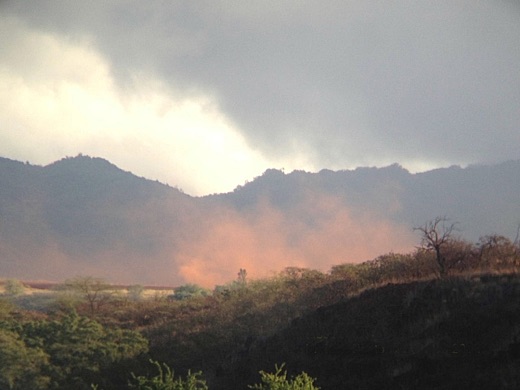
Image above: Red dust laden with pesticide residue blows up from a GMO test field near town of Waimea on Kauai, Hawaii. Photo by Klayton Kubo. From (http://grist.org/business-technology/gmo-companies-are-dousing-hawaiian-island-with-toxic-pesticides/).
 

Two years ago, Civil Beat posted a piece I wrote about chlorpyrifos, a pesticide (also known as Dursban and Lorsban) the agrichemical companies on Kauai use on their biotech crops as much or more than any other.

This is the pesticide investigators found in every sample taken at Waimea Canyon Middle School after dozens of schoolchildren complaining of disorientation, severe headaches and nausea repeatedly were taken to the hospital—the investigation that notoriously concluded their symptoms were probably due to exposure to stinkweed.

I pointed out that chlorpyrifos, a potent neurotoxin, can permanently lower a child’s IQ.

Organophosphates, such as chlorpyrifos, work by blocking an enzyme that controls messages that travel between nerve cells. When the enzyme is blocked, this causes overstimulation of neuronal cells, neurotoxicity and eventually death.

It operates the same way in people.

But peer-reviewed studies establish that even short-term exposure to chlorpyrifos can cause permanent injury.

A Harvard study states, for instance, “Dose-related correlations were recorded between maternal exposures to chlorpyrifos or other organophosphates and small head circumference at birth — which is an indication of slowed brain growth in utero — and with neurobehavioural deficits that have persisted to at least 7 years of age. …MRI of the brain showed that prenatal chlorpyrifos exposure was associated with structural abnormalities that included thinning of the cerebral cortex.”

In other words, the science establishes that children born to mothers exposed to this pesticide had brain damage.

A reply was quickly forthcoming from Steve Savage, a former employee of DuPont (parent of Pioneer) and Mycogen, a Dow subsidiary. Savage criticized me for misinforming the public and fear-mongering. Savage often writes for the Genetic Literacy Project, which promotes pesticides and genetic engineering and accuses critics of being “anti-science” as well as “illiterate.”

Savage compared chlorpyrifos to caffeine and aspirin and assured readers its use is safe. This belittling of concerns and “anti-science” meme from industry bloggers has become a familiar industry tactic.

More recently, Civil Beat published an article by public relations professional Jan TenBruggencate. TenBruggencate (also Board Chair of the Kauai Island Utility Cooperative) completely misunderstood the relevant circumstances at Waimea Canyon School, noting that no Roundup had been sprayed before the incidents, although I’m not aware of anyone familiar with the matter ever suggesting that Roundup had been the problem.

TenBruggencate never mentioned chlorpyrifos or that it had been detected on site. Despite being uninformed (I’m assuming this was not intentional misdirection), he declared that stinkweed had “launched Kauai’s pesticide wars,” plainly suggesting that those suspecting a toxic pesticide was the problem — or perhaps any problem at all on Kauai — are sadly ignorant.

Against this background, it’s noteworthy, first, that EPA banned all household uses of chlorpyrifos 15 years ago because it’s too toxic to allow children to be exposed to it. Then in December 2014, EPA acknowledged the extensive body of peer-reviewed science correlating chlorpyrifos exposure with brain damage to children, including reduced IQ, delayed development, and loss of working memory.

Two months ago EPA, apparently not persuaded that chlorpyrifos is no more harmful than caffeine or aspirin, proposed to go much further and revoke all tolerances for the pesticide. This hopefully will end not only all uses of chlorpyrifos resulting in residues on food and contamination of drinking water, but those resulting in drift to schools, homes and other places people are located, as well.

The public comment period on this proposal closed on Jan. 5; along with 80,000 other comments urging EPA to ban the pesticide, the agency received a letter from more than 65 environmental health scientists and healthcare professionals, citing extensive evidence that chlorpyrifos harms children.

I wouldn’t be very surprised if our “Good Neighbors,” the chemical companies on Kauai, Maui, Molokai and Oahu, are at this moment energetically lobbying EPA to exempt them from any action the agency ultimately takes to further restrict chlorpyrifos use, arguing that the voluminous scientific evidence is somehow inadequate and directing their attorneys to challenge any restriction that costs them anything.

No matter how strong the scientific evidence is that chlorpyrifos presents an unreasonable threat to health, I wouldn’t be very surprised if the biotech industry’s bloggers don’t assure you that all of this concern is just more anti-science fear-mongering — that the real problem clearly is stinkweed.


.

Pesticides in Paradise

SUBHEAD: Hawaii's spike in birth defects puts focus on experimental pesticide spraying of GMO crops.

By Christopher Pala on 23 August 2015 for the Guardian -
(http://www.theguardian.com/us-news/2015/aug/23/hawaii-birth-defects-pesticides-gmo)


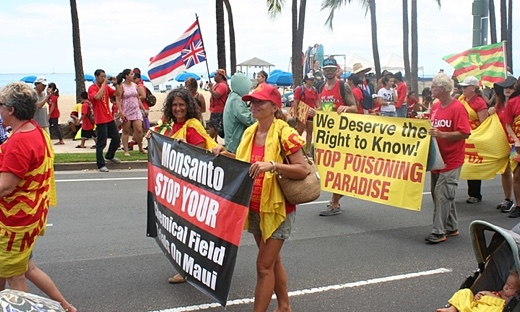
Image above: After four separate attempts to rein in the companies failed, an estimated 10,000 people marched through Honolulu’s Waikiki tourist district. Kauai Councilman Gary Hooser holds sign near word "Pioneer". Photograph by Christopher Pala. From original article.

Pediatrician Carla Nelson remembers catching sight of the unusually pale newborn, then hearing an abnormal heartbeat through the stethoscope and thinking that something was terribly wrong.
The baby was born minutes before with a severe heart malformation that would require complex surgery.

What worried her as she waited for the ambulance plane to take the infant from Waimea, on the island of Kauai, to the main children’s hospital in Honolulu, on another Hawaiian island, was that it was the fourth one shehad seen in three years.

In all of Waimea, there have been at least nine in five years, she says, shaking her head. That’s more than 10 times the national rate, according to analysis by local doctors.

Nelson, a Californian, and other local doctors find themselves in the eye of a storm swirling for the past three years around the Hawaiian archipelago over whether a major cash crop on four of the six main islands, corn that’s been genetically modified to resist pesticides, is a source of prosperity, as the companies claim – or of birth defects and illnesses, as the doctors and many others suspect.

After four separate attempts to rein in the companies over the past two years all failed, an estimated 10,000 people marched on 9 August through Honolulu’s Waikiki tourist district. Some held signs like, “We Deserve the Right to Know: Stop Poisoning Paradise” and “Save Hawaii – Stop GMOs” (Genetically Modified Organisms), while others protested different issues.

“The turnout and the number of groups marching showed how many people are very frustrated with the situation,” says native Hawaiian activist Walter Ritte of the island of Molokai.

Waimea, a small town of low, pastel wood houses built in south-west Kauai for plantation workers in the 19th century, now sustains its economy mostly from a trickle of tourists on their way to a spectacular canyon. Perhaps 200 people work full-time for the four giant chemical companies that grow the corn – all of it exported – on some 12,000 acres leased mostly from the state.

In Kauai, chemical companies Dow, BASF, Syngenta and DuPont spray 17 times more pesticide per acre (mostly herbicides, along with insecticides and fungicides) than on ordinary cornfields in the US mainland, according to the most detailed study of the sector, by the Center for Food Safety.

That’s because they are precisely testing the strain’s resistance to herbicides that kill other plants. About a fourth of the total are called Restricted Use Pesticides because of their harmfulness. Just in Kauai, 18 tons – mostly atrazine, paraquat (both banned in Europe) and chlorpyrifos – were applied in 2012.

The World Health Organization this year announced that glyphosate, sold as Roundup, the most common of the non-restricted herbicides, is “probably carcinogenic in humans”.

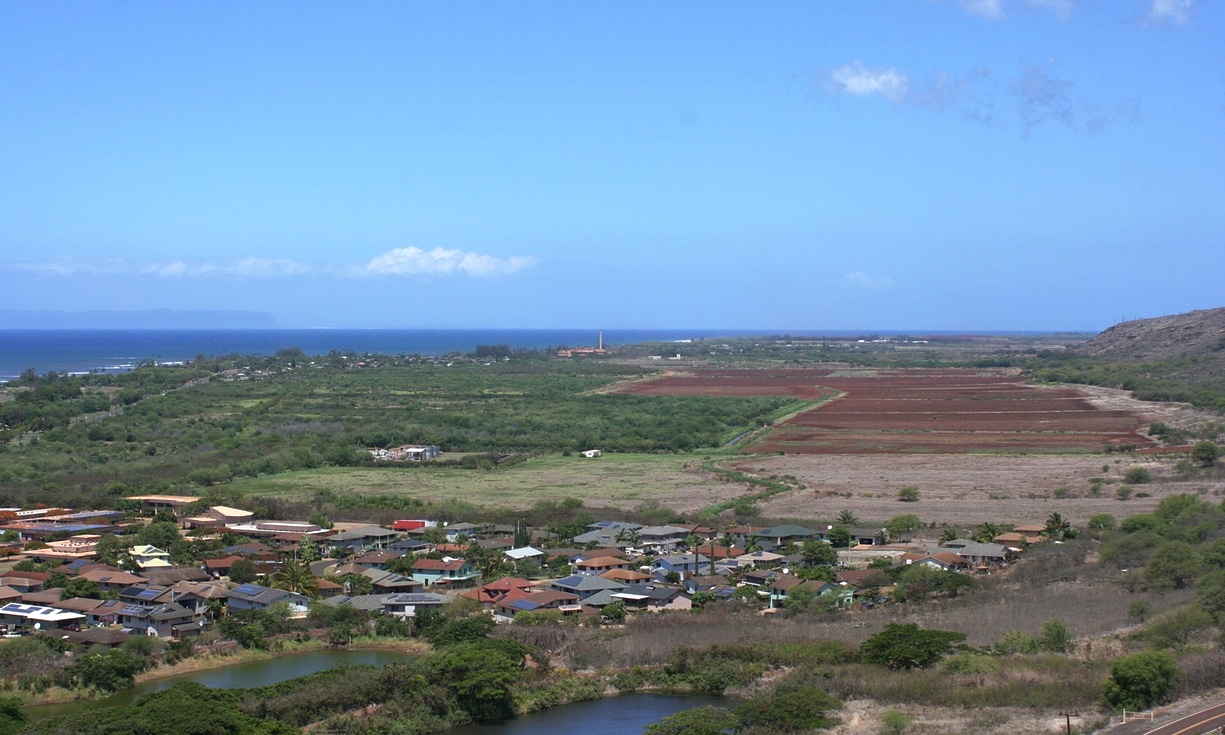
The cornfields lie above Waimea as the land, developed in the 1870s for the Kekaha Sugar Company plantation, slopes gently up toward arid, craggy hilltops. Most fields are reddish-brown and perfectly furrowed. Some parts are bright green: that’s when the corn is actually grown.

Both parts are sprayed frequently, sometimes every couple of days. Most of the fields lie fallow at any given time as they await the next crop, but they are still sprayed with pesticides to keep anything from growing. “To grow either seed crops or test crops, you need soil that’s essentially sterile,” says professor Hector Valenzuela of the University of Hawaii department of tropical plant and soil science.

When the spraying is underway and the wind blows downhill from the fields to the town – a time no spraying should occur – residents complain of stinging eyes, headaches and vomiting.


“Your eyes and lungs hurt, you feel dizzy and nauseous. It’s awful,” says middle school special education teacher Howard Hurst, who was present at two evacuations. “Here, 10% of the students get special-ed services, but the state average is 6.3%,” he says. “It’s hard to think the pesticides don’t play a role.”

<img border="0" src="http://www.islandbreath.org/2015Year/08/150824waimeabig.jpg" />
Image above: Waimea and the adjacent GMO fields. The cluster of buildings in the middle left are the Waimea Middle School and the Kauai Veterans Memorial Hospital. Click to embiggen. Photograph by Christopher Pala. From original article.

At these times, many crowd the waiting rooms of the town’s main hospital, which was run until recently by Dow AgroSciences’ former chief lobbyist in Honolulu. It lies beside the middle school, both 1,700ft from Syngenta fields. The hospital, built by the old sugar plantation, has never studied the effects of the pesticides on its patients.

The chemical companies that grow the corn in land previously used for sugar refuse to disclose with any precision which chemicals they use, where and in what amounts, but they insist the pesticides are safe, and most state and local politicians concur. “The Hawai‘i legislature has never given the slightest indication that it intended to regulate genetically engineered crops,” wrote lawyer Paul Achitoff of Earthjustice in a recent court case.

As for the birth defects spike, “We have not seen any credible source of statistical health information to support the claims,” said Bennette Misalucha, executive director of Hawaii Crop Improvement Association, the chemical companies trade association, in a written statement distributed by a publicist. She declined to be interviewed.

Nelson, the pediatrician, points out that American Academy of Pediatrics’ report, Pesticide Exposure in Children, found “an association between pesticides and adverse birth outcomes, including physical birth defects”.

Noting that local schools have been evacuated twice and children sent to hospital because of pesticide drift, Nelson says doctors need prior disclosure of sprayings: “It’s hard to treat a child when you don’t know which chemical he’s been exposed to.”

Her concerns and those of most of her colleagues have grown as the chemical companies doubled to 25,000 acres in a decade the area in Hawaii they devote to growing new varieties of herbicide-resistant corn.

Today, about 90% of industrial GMO corn grown in the US was originally developed in Hawaii, with the island of Kauai hosting the biggest area. The balmy weather yields three crops a year instead of one, allowing the companies to bring a new strain to market in a third of the time.

Once it’s ready, the same fields are used to raise seed corn, which is sent to contract farms on the mainland. It is their output, called by critics a pesticide delivery system, that is sold to the US farmers, along with the pesticides manufactured by the breeder that each strain has been modified to tolerate.

Corn’s uses are as industrial as its cultivation: less than 1% is eaten. About 40% is turned into ethanol for cars, 36% becomes cattle feed, 10% is used by the food industry and the rest is exported.


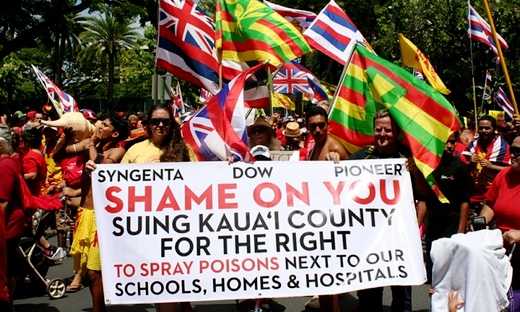
Image above: A march against pesticides in Hawaii includes Kauai's KKCR host Felicia Cowden holding left of Monsanto sign. Photograph by Christopher Pala for the Guardian. From original article.

At a Starbucks just outside Honolulu, Sidney Johnson, a pediatric surgeon at the Kapiolani Medical Center for Women and Children who oversees all children born in Hawaii with major birth defects and operates on many, says he’s been thinking about pesticides a lot lately. The reason: he’s noticed that the number of babies born here with their abdominal organs outside, a rare condition known as gastroschisis, has grown from three a year in the 1980s to about a dozen now.

“We have cleanest water and air in the world,” he says. So he’s working with a medical student on a study of his hospital’s records to determine whether the parents of the gastroschisis infants were living near fields that were being sprayed around the time of conception and early pregnancy. He plans to extend the study to parents of babies suffering from heart defects.

“You kind of wonder why this wasn’t done before,” he says. “Data from other states show there might be a link, and Hawaii might be the best place to prove it.”

Unbeknownst to Johnson, another two physicians have been heading in the same direction, but with some constraints. They’re members of a state-county commission appointed this year to “determine if there are human harms coming from these pesticides”, as its chairman, a professional facilitator named Peter Adler, tells a meeting of angry local residents in Waimea earlier this month. Several express skepticism that the panel is anything but another exercise in obfuscation.

The panel of nine part-time volunteers also includes two scientists from the chemical companies and several of their critics. “We just want to gather information and make some recommendations,” Adler tells the crowd of about 60 people. “We won’t be doing any original research.”

But one of the two doctors, a retired pediatrician named Lee Evslin, plans to do just that. “I want see if any health trends stand out among people that might have been exposed to pesticides,” he says in an interview. “It won’t be a full epidemiological study, but it will probably be more complete than anything that’s been done before.”

The panel itself, called the Joint Fact-Finding Study Group on Genetically Modified Crops and Pesticides on Kauaʻi, is the only achievement of three years of failed attempts to force the companies to disclose in advance what they spray and to create buffer zones – which they do in 11 other states, where food crops receive much less pesticides per acre.

The pushback from the expansion of the GMO acreage first emerged when Gary Hooser of Kauai, a former state senate majority leader who failed in a bid for lieutenant governor in 2010, ran for his old seat on the Kauai County council in 2012.

“Everywhere I went, people were concerned about GMOs and pesticides. They were saying, ‘Gary, we gotta do something’,” he recounts over coffee at the trendy Ha Coffee Bar in Lihue, the island’s capital. “Some were worried about the GMO process itself and others by the threats of the pesticides, and it became one of the dominant political issues.”

Once elected, Hooser, who has a ruddy complexion, piercing blue eyes and arrived in Hawaii as a teenager from California, approached the companies for information about exactly what they were spraying and in what amounts. He was rebuffed.

In the process of what he called “doing my homework”, he discovered that the companies, unlike regular farmers, were operating under a decades-old Environmental Protection Agency permit to discharge toxic chemicals in water that had been grandfathered from the days of the sugar plantation, when the amounts and toxicities of pesticides were much lower. The state has asked for a federal exemption for the companies so they can avoid modern standards of compliance.

He also found that the companies, unlike regular farmers, don’t pay the 4% state excise tax. Some weren’t even asked to pay property taxes, worth $125,000 a year. After pressure from Hooser and the county tax office, the companies paid two years’ worth of back taxes.

So with the backing of three other members of the seven-member Kauai council, he drafted a law requiring the companies to disclose yearly what they had grown and where, and to announce in advance which pesticides they proposed to spray, where and when. The law initially also imposed a moratorium on the chemical companies expanding their acreage while their environmental impact was assessed.

After a series of hearings packed by company employees and their families wearing blue and opponents wearing red, the bill was watered down by eliminating the moratorium and reducing the scope of the environmental study. The ordinance then passed, but the companies sued in federal court, where a judge ruled that the state’s law on pesticides precluded the counties from regulating them. After the ruling, the state and the county created the joint fact-finding panel officially committed to conducting no new research.

Hooser is confident the ruling will be overturned on appeal: the Hawaii constitution “specifically requires” the state and the counties to protect the communities and their environment.

In his appeal, Achitoff of Earthjustice argued that Hawaii’s general pesticide law does not “demonstrate that the legislature intended to force the county to sit and watch while its schoolchildren are being sent to the hospital so long as state agencies do not remedy the problem.”

In the Big Island, which is called Hawaii and hosts no GMO corn, a similar process unfolded later in 2013: the county council passed a law that effectively banned the chemical companies from moving in, and it was struck down in federal court for the same reasons. A ban on genetically modified taro, a food root deemed sacred in Hawaiian mythology, was allowed to stand.

In Maui County, which includes the islands of Maui and Molokai, both with large GMO corn fields, a group of residents calling themselves the Shaka Movement sidestepped the company-friendly council and launched a ballot initiative that called for a moratorium on all GMO farming until a full environmental impact statement is completed there.

The companies, primarily Monsanto, spent $7.2m on the campaign ($327.95 per “no” vote, reported to be the most expensive political campaign in Hawaii history) and still lost.

Again, they sued in federal court, and, a judge found that the Maui County initiative was preempted by federal law. Those rulings are also being appealed.

In the state legislature in Honolulu, Senator Josh Green, a Democrat who then chaired the health committee, earlier this year attempted a fourth effort at curbing the pesticide spraying.
In the legislature, he said, it’s an open secret that most heads of the agriculture committee have had “a closer relationship with the agro-chemical companies than with the environmental groups”.

Green, an emergency room doctor who was raised in Pennsylvania, drafted legislation to mandate some prior disclosure and some buffer zones. “I thought that was a reasonable compromise,” he says. Still, he also drafted a weaker bill as a failsafe. “If even that one doesn’t pass, it’s going to be obvious that the state doesn’t have the political will to stand up to the chemical companies,” he said in a phone interview at the time. “That would be terrible.”

The chairman of the senate agricultural committee, Cliff Tsuji, didn’t even bring the weaker bill to a vote, even though Hawaii’s governor had pledged to sign any bill that created buffer zones.
Asked by email what he would do now, Green replied with a quip: “Drink scotch.”

.

DuPont guilty in Waimea, Kauai

SOURCE:Shannon Rudolph (shannonkona@gmail.com)
SUBHEAD: First 10 of 150 Waimea residents suing GMO giant DuPont awarded $507,000 for damages.

By Staff on 8 May 2015 for Babes Against Biotech -
(https://www.facebook.com/BabesAgainstBiotech/photos/a.526826160727490.1073741836.327002374043204/823020294441407/)


Image above: The Big Six GMO Corporations killing us: Monsanto, DuPont, Syngenta, Dow, BASF, Bayer.  From (http://www.prwatch.org/news/2014/06/12506/pesticide-and-gmo-corporations-spend-big-hawaii).
DuPont \/Pioneer guilty At least $507,090 was awarded today to the first 15 of over 150 Waimea, Kauai residents who have been long suffering the pesticide laden dust coming off GMO test fields experimenting with chemicals.

Over 150 residents near DuPont/Pioneer's test fields sued the multinational chemical company, for pesticide dust, health and environmental damages, however the Judge did not allow health or environmental claims. Through discovery in this lawsuit we have discovered at least 80 different pesticides being tested by just one of 5 chemical companies operating in Hawaii.

We have discovered and plaintiff attorneys have brought to light the questionable practices and operations of DuPont/Pioneer. The case came down to only dust damages to property and loss of enjoyment of property for only 2009-2011, neglecting the fact that DuPont/Pioneer has been operating in that neighborhood around 18 years. The witnesses and plaintiffs were also not allowed to tell the jury that the dust is laden with heavy pesticides and experimental genetic material.

The average settlement per person awarded damages was $33,806 per person or $56,343 per household. Since it was a bellwether trial, only 15 plaintiffs (making 10 households) took part in the trial portion, and the judgements awarded will be used in negotiations for a mass settlement for over 150 people.

Though it does not address the health and environmental impacts, which are our greatest concerns, today is a huge victory in the courts for all the people of Hawaii in Kauai, Maui, Molokai and Oahu who are affected by the chemical test fields. This is the first class action lawsuit against the chemical companies regarding the pesticide dust and we doubt it will be the last.

We do however, expect an appeal from the DuPont/Pioneer legal team who spent some of the case having giggling exchanges and cracking quiet jokes to each other in the courtroom.

If each of the at least 150 plaintiffs were awarded the average of $33,806, the settlement could total more than $5,000,000.00. The estimates estimated damages at least by loss of enjoyment of property $50/hour at least 2 hours per day.

 Other known chemical GE test fields exist up and down the westside of Kauai, in Lihue, Kunia and Haleiwa on Oahu, throughout Molokai and in Kihei on Maui. Thousands of Hawaii households near the chemical test fields affected by the test fields, could signal larger problems in the courts for the chemical cartel in the future.

These are the questions our court reporter and amazing cartoonist BAB Lauryn Rego and all the plaintiffs got answered today:

"Yes. Did Pioneers dust trespass? Yes. Was pioneers conduct the legal cause in significantly interfering with each Plaintiffs use and enjoyment of his or her property? Yes. Did the seriousness of harm to each Plaintiff outweigh the public benefit of Pioneers operation? Yes."

To us, one of the greatest themes we received in the verdict is this: Did the seriousness of harm to each Plaintiff outweigh the public benefit of Pioneers operation? Yes.

Yes. The seriousness of the harms to plaintiff in property damages have long exceeded the public benefit of the chemical companies doing what DuPont/Pioneer do in Hawaii, and specifically proven now in regards to Pioneer and Waimea. This doesn't even include the health, and environmental damages that were not allowed in this particular case. Stay tuned for the latest on GE and pesticide issues on the frontlines in Hawaii, GMO Ground Zero worldwide.

MAHALO TO KYLE SMITH AND PLAINTIFF ATTORNEYS! Thank you for doing all you could to achieve justice for our Waimea ohana, we know this is only the beginning! #waimeatrial


Pulling Back The Curtain


By Gary Hooser on 9 May 2015 in Island Breath - 

Jury verdict unanimous, DuPont Pioneer guilty of harming Waimea Kauai residents

It has taken years for Waimea residents to finally hold DuPont Pioneer accountable and it is still not over.  However yesterday a jury in Honolulu unanimously ruled that this company must pay for the damages caused by their irresponsible actions.

According to the Honolulu Star Advertiser story http://tinyurl.com/p2r9oqt

"The verdict said DuPont Pioneer failed to follow generally accepted agricultural and management practices from Dec. 13, 2009, to Dec. 31, 2011, and that the "seriousness of the harm to each plaintiff outweighs the public benefit of Pioneer's farming operation." "

The court action focused on property damage caused by the vast amounts of pesticide laden dust that has blown on to these homes and residents for years.

However, if the dust is bad enough to cause property damage then it surely must be causing damage also to health and environment.

To be clear, this lawsuit is unrelated to the Syngenta led suit against the County of Kauai now under appeal.

The existence of the DuPont Pioneer lawsuit was early evidence that when combined with many other factors, precipitated the introduction of Bill 2491 and the attempt to regulate this industry on Kauai.

Credit for victory goes entirely to the perseverance of Waimea Town residents.

The facade presented through the “Good Neighbor” persona created by the community relations and media guru’s of these companies is quickly evaporating.

No amount of money or industry PR can erase the fact that a unanimous jury decision found them guilty of harm.

The curtain is being drawn back for the whole world to now see the hypocrisy of DuPont Pioneer calling themselves a “good neighbor” while continuing to cause damage to local residents for years after the initial complaints were filed.

Meanwhile another self proclaimed “good neighbor” Syngenta continues to use and sell highly toxic Restricted Use Pesticides (atrazine, paraquat and 4 others) that are illegal to use in their own country.

What kind of good neighbor uses toxic pesticides by the ton in their neighbor’s yard but yet uses zero of these chemicals in their own yard back home in Switzerland because their laws will not allow it (all the while telling you how safe it is)?

Syngenta will deny and obfuscate this fact.  But if you have doubts, read this recent New York Times article (http://tinyurl.com/m4qkma6) about how Syngenta misrepresents the truth with regards to the use of atrazine in their own country.

What kind of good neighbors sue their local government for merely requiring modest disclosure and basic buffer zones around schools, hospitals and homes?

It will be interesting to see how the industry spins this one.

These companies are harming our community.  They consistently misrepresent themselves, the nature of their actions and the negative impact of their actions on our health, environment and yes on our property as well.

Community members who live near the fields and have to deal with these companies up close and personal know this.  Those of us who have been involved in this battle for the past few years know it as well.

I am increasingly hopeful that more and more residents of Kauai and all Hawaii will begin to see and understand the nature and urgency of our efforts and join with us in demanding accountability.

Mahalo to those residents and community leaders who have persevered and are responsible for this win.

Auwe to those government and industry leaders who have failed in their duties to support these good people.


• Gary Hooser is a County Councilman on Kauai who was key to establishing legislation to manage restrictive use pesticides used experimentally on Kauai by GMO companies.

.