Showing posts with label Monoculture. Show all posts

Land resources of indigenous wanted

SUBHEAD: International labor organization helps legalize land grabs on indigenous people's territories.

By Renata Bessi &Santiago Navarro on 24 July 1027 for Truth Out -
(http://www.truth-out.org/news/item/41328-international-labor-organization-s-convention-169-helps-legalize-land-grabs-on-indigenous-territories)


Image above: Garifuna community in Honduras, threatened by tourism projects and oil palm monoculture. Photo by Aldo Santiago. From original article.

[IB Publisher's note: This humble homestead looks a bit like rural Hawaii or other pealsant subtropical locations where there are still indigenous people living lightly on the land in preservation with nature. That's not to say that the indigenous do not weigh on nature, but compare their living environment with a goldmine, hydroelectric dam or mono culture palm oil megafarm.]

Indigenous peoples' territories are some of the few places where natural resources are preserved throughout the world. In fact, they protect about 80 percent of the planet's biodiversity but are legal owners of less than 11 percent of these lands, according to the World Bank.

Because of this -- and the fact that so many companies hope to get a piece of these resources -- Indigenous peoples are often in a vulnerable position, and in a permanent kind of war with businesses and governments.

The International Labor Organization's (ILO) Convention 169 on Indigenous and Tribal Peoples' Rights, together with the United Nations 2007 Declaration on the Rights of Indigenous Peoples, have been the main international legal tools to defend territorial rights.

In theory, Convention 169 guarantees Indigenous people residing in the signatory countries the right to their land. To this end, it establishes that for any project that a company or government plans in their territories, they must be guaranteed a free, prior and informed consultation.

Because Convention 169 commits the signatory states to guarantee the integrity of Indigenous peoples, it's been frequently invoked by Indigenous communities and peoples, especially in Latin America, when defending their territories in court. But the Convention has clear limitations that actually jeopardize its intent.

Indeed, the Convention is unprecedented in that it establishes that "all peoples have the right to self-determination."

But in several official yet not-so-public statements, the ILO makes clear how far it sees Indigenous rights as going: "One of the concerns expressed in both political and business circles has to do with a misinterpretation of the Convention where the outcome of the consultations could be the vetoing of projects.

Said consultations don't imply the right of veto and it's imperative that an agreement or consent be obtained," as stated in the document entitled "ILO Convention 169: Indigenous Peoples and Social Inclusion."

While in many parts of Latin America, Indigenous peoples are defending their struggle for self-determination through consultations, for high-level ILO officials, the mechanism's use is clear.

"It's not a 'plebiscite' to obtain a 'yes or no' vote, nor to obtain a 'veto' around decisions with general benefit.

It's a dialogue in good faith to enhance the benefits for Indigenous people regardless of the decision (the state) makes," said Carmen Moreno, director of ILO's Latin America regional office during the forum "Situation of the Right to Consultation in Convention 169," which was held in conjunction with the World Bank in Guatemala in April.

In fact, according to the international organization, it's governments that have the last word on Indigenous territories. "The power of the Convention is that it's an instrument through which the peoples concerned can participate freely in a dialogue with the State.

But the State, ultimately, is the one who must make a decision," the ILO Convention 169: Indigenous Peoples and Social Inclusion reads. Regarding the most serious cases where peoples must be relocated from their territories, "even in these situations the people have no decision-making power," said Moreno.

In addition, Convention 169 establishes that the rights of Indigenous peoples in relation to natural resources must be protected, but it does not grant them exclusive rights over those resources.

Latin America: Principal Signatory
The Convention was signed in 1989 and went into effect in 1991. To date, 15 of the 22 countries that have ratified it are in Latin America: Argentina, Bolivia, Brazil, Chile, Colombia, Costa Rica, Dominica, Ecuador, Guatemala, Honduras, Mexico, Nicaragua, Paraguay, Peru and Venezuela. (In addition to Denmark, Spain, Fiji, Nepal, Norway, the Netherlands and the Central African Republic.)

The significant number of Latin American adherents to the Convention is not a coincidence. It's an attempt to appease the high-intensity conflicts generated by the massive growth of development projects throughout the region.

The Latin American Mining Conflict Observatory (OCMAL) points out that over the last decade, Latin America has become one of the epicenters of mining expansion.

"Guaranteeing indigenous people's rights in Latin America: Progress in the past decade and remaining challenges," a report put out by the Economic Commission for Latin America and the Caribbean (ECLAC), registered more than 200 conflicts in Latin American Indigenous territories linked to extraction of hydrocarbons and mining from 2010 and 2013.
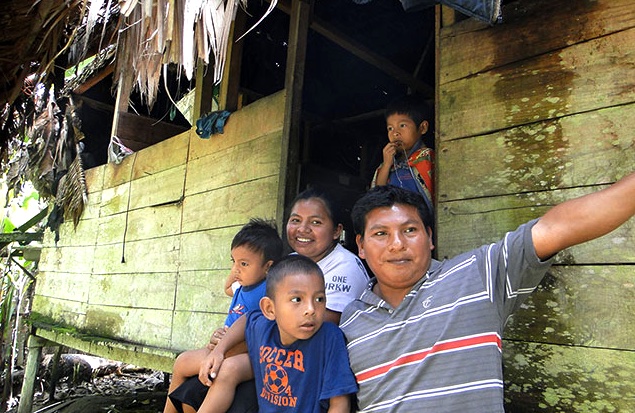

Image above: Baudillo Salles Sánchez, member of the Briri tribe with his family in Costa Rica. Photo by Renata Bessi. From original article.

Térraba: Marked Cards
Carmen Moreno claims that development is the main objective. "The consultations established in Convention 169 are an instrument of good governance to contribute to the development and growth of countries," she said.

However, not everyone the Convention supposedly protects feels included. "They just forgot to ask if our definition of development is the same as their plan for our territories," says Broran tribe member Pablo Sivar, from the Térraba-Boruca Indigenous territory in Costa Rica, who is a part of the Council of Elders. "I definitely don't believe in their type of development."

Sivar and his community are aware of impending threats to their lands and water. "In Térraba, there used to be a lot of water, but not anymore. And they wanna finish off the main river we have, the Térraba River, also known as river Diquís, which in the Boruca language means 'big water'."

He went on to explain that the El Diquís Hydroelectric Project would be the largest hydroelectric plant in Central America, despite official statistics that show that about 99 percent of the country already has electricity. "Who will the Diquís Project favor? Who it will develop? Is it the Térraba Indigenous people? Is it the Indigenous people of the south? Or is it just a few people?"

Work on the Diquís Project began in 2006. After much resistance by the local community, the project was halted in 2011.

Without any additional information, the company simply announced -- on the same day the United Nations Special Rapporteur on the Rights of Indigenous Peoples James Anaya visited -- that it would withdraw its machinery and infrastructure from Térraba territory.

Approximately three years later, the government arrived to begin developing a consultation protocol for Indigenous peoples, with the financial cooperation of international organizations, such as the ILO and the United Nations Development Program (UNDP).

This was announced at one of the government meetings in Térraba, where Truthout was. "We know why they're here. We know what they want," Pablo Sivar stated.

In the same meeting, the locals wanted to know if the process was linked to the Diquís Project. Immediately, government officials denied any link and tried to change the subject. "This process has nothing to do with the project. We're here to develop a consultation protocol for Indigenous peoples," said Ana Gabriel, Costa Rica's vice minister for political affairs and citizen dialogue.

Government officials aren't transparent about the link between projects and the protocol in these public forums, and make contradictory statements to the media. The plan to build the dam in Broran territory continues.

The Indigenous consultation would be the last stage before handing in all necessary documentation to obtain environmental viability and move forward with the project. Feasibility studies and designs are already in place. The construction is scheduled to start in 2018, and operation in 2025.

The attempt to obscure the relationship between the protocol and the project is not in vain. The Indigenous resistance of the hydroelectric dam is longstanding.

"We know that everything is ready for them to resume the work," Cindy Broran of the Broran Indigenous Movement, founded by Térraba tribe members to resist the hydroelectric Project, told Truthout.

"Consultation is the way to legitimize the company's presence in the territory and with it they'll be able to secure financing from international bodies, such as the World Bank. We know that everything's in place."

Project Halted Due to Lack of Consultation
According to Ana Gabriel, who's responsible for developing the consultation protocol in Costa Rica, the country owes a historic debt to its Indigenous peoples and the current government plans on making up for it.

"It's no small matter that the president himself has issued a directive and given a mandate to develop this consultation protocol," she told Truthout.

Despite the politically correct rhetoric of healing and historical debts to Indigenous peoples, the truth is that development projects, funded by international institutions, are unviable because of the lack of consultation.

The vice minister of Costa Rica himself admitted it: "There have been projects that have had to be stopped in Indigenous territories due to lack of consultation."
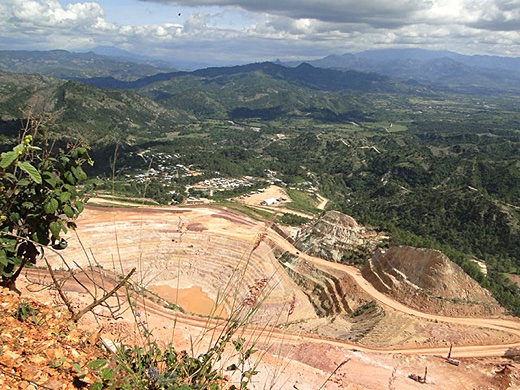

Image above: Gold mine in a Honduran indigenous community. Photo by Renata Bessi. From original article.Diquís Project: A Bitter Experience

In 2006, the Diquís Project began in Broran territory with a permit issued by the Development Association, a government entity responsible for land management. "Before we knew it, trucks, cars and people were entering the community," said Broran.

"We went to request information and they told us that they had moved forward with it because they had 76 signatures of people affiliated with the Development Association. The association gave the go-ahead for the company to come in and build the dam."

"When the company moved in, it became chaotic," Broran said. "They messed up the whole river, killing many species. Many shops sprang up to sell food, but mostly canteens and bars for workers from outside.

The association gave permission for these businesses, without considering that Indigenous law prohibits the sale of alcohol within its territory. The illegal sale of land increased. Health centers and schools ran out of supplies."

Additionally, ancestral patrimony of the Broran people was looted. Between 2006 and 2010, archaeologists contracted by the company did intense work, recounts Broran. They dug three tunnels that still exist.

"We learned from folks who worked there that they found many archeological sites, including our ancestors' cemeteries. They took everything they found. They took everything and we don't know where it is."

With Sights on Energy
Since the 1970s, the Costa Rican government has conducted studies to implement a hydroelectric project in the region. "Before, it was called Boruca Hydroelectric Project, which was about 15 km downstream from where the Diquís Project is today, but because of the resistance by the Boruca people, the project was cancelled.

So, they moved it higher, in our lands, but it's the same project. It will affect the same river only now on Broran ancestral lands," Cindy Broran said.

According to a study by the World Rainforest Movement, geologists from the company Alcoa (where former US Treasury Secretary Paul O'Neill was the CEO between 1987 and 1999) found deposits of bauxite in the General River Valley's subsoil. Bauxite is the prime material used to make aluminum.

In 1970, Costa Rica's Legislative Assembly passed a law (No. 4562) saying Alcoa -- one of the three largest aluminum companies in the world and considered a defense company since one of its main clients is the United States armed forces -- could exploit up to 120 million tons of bauxite over 25 years and with a possible 15 years of extension, in exchange for building an aluminum refining plant in the same area.

Aluminum foundries require a great quantity of low-cost electric energy. The project is feasible provided a hydroelectric dam were to be built on the Rio Grande de Térraba, the study said.

The dam project triggered major resistance because many people considered it a violation and dangerous. Large demonstrations and protests took place, forcing Alcoa to give up its project.

Energy for the US
The Costa Rican Electricity Institute (ICE) in charge of the Diquís Project has shifted its objectives.

According to the document "National and Transnational Pressures on Energy in Costa Rica," produced by the Association of Popular Initiatives Ditsö, the main reason for resuming construction of the hydroelectric project is the possibility of selling energy abroad, mainly to Mexico and the United States.

The dam is part of the Mesoamerica Project, initially called Puebla-Panama Plan (PPP) and funded by the United States government.

It's an initiative which, among other things, includes an extensive network of infrastructure projects from Mexico to Panama "necessary to export -- or better yet, to plunder -- many of our natural resources, whose common destination is the U.S. and Mexico," the document states.

Diquís: Clean Energy?
To date, the Inter-American Development Bank (IDB) has financed feasibility, environmental and social impact studies around the Diquís project.

They explained their investment as "contributing to increased energy supply in Costa Rica and Central America, promoting sustainability, efficiency and competitiveness of the region's energy sector, in order to address the impact of CAFTA (a "free trade" agreement between the United States, Central America and the Dominican Republic) in the region, through the implementation of a large-scale clean and renewable energy project."

The Process Is Finalized
The process of developing a consultation protocol was designed by the government to occur in four phases and began in March 2016. Of the 24 Indigenous territories of Costa Rica, 20 agreed to everything up until the last phase, including the people of Térraba. Now, the president must issue an order legitimizing the consultation protocol for Costa Rica.

"We debated a long time over whether or not to participate in this process. We're aware that the government always has political gains in mind," said Broran.

"We also know that they manipulate the term 'consultation,' that they're trying to show good faith for public relations. But we want to be there, and say what we think, in front of all Costa Rica."

The Bribri people of Talamanca, a territory in southern Costa Rica, refused to participate in the development of the consultation protocol. "This whole process is a performance," Bribri tribe member Baudillo Salles Sánchez told Truthout.

"Protocols and consultations are tools to justify entering and exploiting the territory. They do the consultation as they wish, and then they can say that they're exploiting our resources with our consent."


.
Mainstreaming alternative agriculture

SUBHEAD: What it will take to mainstream small size local farming practices in America.

By Maywa Montanegro & Alistair Isles on 20 July 2016 for Ensia -
(https://ensia.com/voices/what-would-it-take-to-mainstream-small-size-local-farming-practices/)


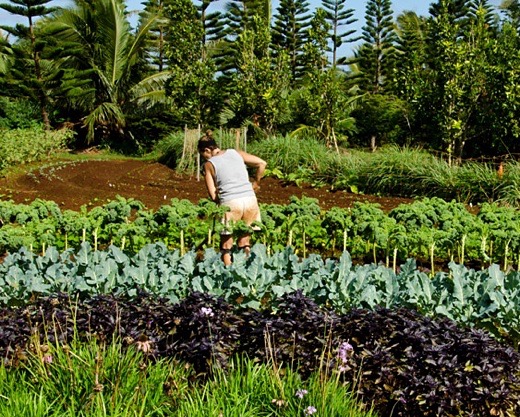
Image above: Kauai Farm Connection in Kilauea, Kauai, Hawaii is a two acre permaculture farm supplying a variety of produce. From (http://www.kauaigrown.org/kauai-farm-connection).

Ensia Editor’s note: This Voices piece is published in collaboration with the academic journal Elementa. It is based on “Toward thick legitimacy: Creating a web of legitimacy for agroecology,” a peer-reviewed article published July 20 as part of Elementa’s New Pathways to Sustainability in Agroecological Systems forum.
The industrialized food system, studies have shown, is linked to greenhouse gas emissions, algal blooms, pesticide pollution, soil erosion and biodiversity loss, to name a few ecological troubles. Add to this a long list of social ills, from escalating rates of obesity to the demise of the family farmer and deadening of rural landscapes and rural economies across much of the U.S.

In 2010, the National Academies of Science updated its seminal 1989 publication “Alternative Agriculture” with a fresh look at the state of food and farming in America. Its expert panel concluded, “Growing awareness of unintended impacts associated with some agricultural production practices has led to heightened societal expectations for improved environmental, community, labor, and animal welfare standards in agriculture.”

Yet that growing awareness and those heightened expectations haven’t led to alternative agricultural systems becoming the norm in the U.S. Organic has made some headway, but many organic growers have been forced to imitate industrial farming.

That is grow bigger and resort to monocultures instead of truly diversified fields, and sell to large supermarkets — forgoing many of the benefits alternative agricultural systems offer, such as natural pest control, pollination from native bees, and a smaller production scale conducive to family farmers and local food economies.

So, what gives industrialized agriculture such staying power despite its adverse impacts, even as alternatives offer such benefits? And how can more wholesome food production methods such as agroecology become conventional instead of alternative? To achieve real change in how food is produced and eaten, we need to change people’s expectations of what “normal” agriculture should look like.

What Is Normal?
The industrial food system is considered “normal” and remains intractable for many reasons, including consumer habits.

For example demanding perfectly shaped, vine-ripe tomatoes year-round, or political and economic interests like agribusinesses wielding influence through election donations and lobbying

Also because of the priorities of government departments and universities. For example, research programs favoring biotechnology over agroecology and classical plant breeding.

International trade plays an outsize role too.

Partnerships among U.S. government negotiators, multinational food companies and groups such as the Biotechnology Innovation Organization help shape deals like the Trans-Pacific Partnership to smooth the way for corporate-friendly trade agreements.

But beneath the global tomatoes, research budgets and trade pacts, there is something less visible that makes the industrial food system powerful: something called legitimacy.

Legitimacy is what makes one food system more credible and “normal” than another. Legitimacy is what makes it commonsensical for consumers to buy soda in Big Gulps and for companies like Walmart to advertise everyday low prices as a good thing, ignoring the hidden costs behind the cheapness. Legitimacy can be tricky to define because, while it is obvious once something has it, how to get it is not so clear.

Legitimacy is what makes it commonsensical for consumers to buy soda in Big Gulps and for companies like Walmart to advertise everyday low prices as a good thing, ignoring the hidden costs behind the cheapness. Legitimacy can be tricky to define because, while it is obvious once something has it, how to get it is not so clear.

Like a spider’s web, thick legitimacy is created by multiple strands that reinforce one another.That’s partly because legitimacy isn’t even a single thing, but depends on multiple bases.

Something can be scientifically legitimate if it meets the standards of research. It might become politically legitimate through legislative backing or government grants. Legitimacy might also result from the civic legitimacy of social trust, or the practical legitimacy of a proven practice. And people can accept something as ethically legitimate — agreeing it’s fair and right.

Industrial farming is supported by all of these types of legitimacy at once, giving it what we call “thick legitimacy.” Like a spider’s web, thick legitimacy is created by multiple strands that reinforce one another.

How can truly alternative alternatives — those that support localized food economies, biologically diverse production, and just distribution of land, water, seed and knowledge resources — gather thick legitimacy? As a start, they must not simply criticize industrial agriculture. They also need a proactive strategy for reshaping people’s expectations about what agriculture should look like and do.

Three Steps to Thick Legitimacy
Here, we’ll focus on agroecology, but what we sketch below also applies to diversified organic, biodynamic, permaculture, local, slow and other forms of alternative agri-food systems.
Agroecology can attain thick legitimacy through three interconnected pathways:
  1. build on and revise existing research practices, developing scientific legitimacy; 
  2. garner legitimacy in policy, practical and civic arenas; and 
  3. focus attention on the ethics and values of food systems themselves, which will feed back and affect all other forms of legitimacy.
Scientific Legitimacy
Agroecology is already a thriving science. Universities with agroecology departments and training programs, journals dedicated to agroecology research and international societies such as the Latin American Scientific Society of Agroecology show that agroecology science is increasingly accepted around the world, at least within research communities. Still, a criticism sometimes levied at agroecologists is that their science is more ideological than empirical, more aspirational than applicable.

Agroecologists can bolster the empirical basis of their science. A long-running criticism of agroecological farming is that it cannot possibly “feed the world.”

However, research is still only beginning to establish “agroecological yield.” University of California, Berkeley scientists are showing that organic systems can lag behind conventional systems by just 19 percent when it comes to productivity, and just 8 or 9 percent when farmers alternate crops year-to-year or grow several crops together in their fields.

In other words, adding more agroecological practices results in yields that are significantly better than “bare-bones” organic. And this is the case even though organic and agroecological research has been systematically underfunded. With further research into agroecology on tap, industrial food supporters will find it harder to refute evidence that agroecology is yield competitive.

While we can joust on the productivity battleground, thereby strengthening agroecology’s credibility in agricultural science and policy, we don’t have to copy the same logic that supports industrial food.

Many inventions of agribusiness, such as large-scale monoculture, are the outcome of what is known as a “productionist” mentality: the philosophy that food output should be prioritized at the expense of other agricultural values.

This productionist science has apparently accomplished a great deal (e.g., supplying pesticides, mechanized harvesters and genetically modified organisms), and it now promises to provide solutions for climate change (e.g., efficient irrigation, crop-sensing drones and GPS-driven harvesters). Such effectiveness makes industrial agriculture highly legitimate — for now.

However, it neglects a critical part of the equation: While an output-first ideology seems on its face legitimate, it disregards the fact that agricultural landscapes are complex human-nature ecosystems.

Farms that ignore or discount the connections among abiotic (minerals, nutrients, wind, precipitation, energy), biotic (living) and social (needs of farmers, habits of eaters, political economies of local and global markets) components are less resilient to unpredictable changes like California’s now frequently recurring drought.

By moving beyond the simplistic science of industrial farming to a science that embraces this complexity, we create systems that produce not just food but also resilience, stability and sustainability — in the long run a far more valuable output than the one-dimensional yield of industrial agriculture.

A final strategy to increase the scientific legitimacy of agroecology is to capitalize on the broader trend of science embracing multiple ways of knowing.

The National Science Foundation has begun awarding grants to researchers who want to pursue “transdisciplinary” science — research that combines social sciences such as ethnobotany, sociology and philosophy with natural sciences such as agronomy and ecology, and puts them into conversation with the traditional and indigenous expertise of farming communities — and other funding organizations will likely follow suit.

Agroecology is already well poised to gain traction and scientific legitimacy in these emerging programs.

Policy, Civic and Practical Legitimacy
To achieve political, policy, civic and practical legitimacy, we must learn to discuss agroecology in a way that diverse people will understand. This means putting agroecology into the frames and language of legislatures, government departments, corporations and the public at large. Right now, for example, a particularly powerful language that government officials use is “cost-benefit.”

When deciding whether to control a pesticide or whether farmers should house pregnant pigs in bigger boxes, the U.S. Department of Agriculture and Environmental Protection Agency often employ cost-benefit analysis, a method that quantitatively compares the monetary costs and benefits of a given thing.

We could start using the language of CBA to push for more support of agroecology. For instance, if even a few million dollars more were invested in agroecology research and development, there may be ripple effects in credibility.

Long-term studies, like those of the Rodale Institute that show that ecological farming yields can match — and, in drought years, exceed — conventional yields across a period of 30 years, could persuade skeptical scientists, the media, legislators and consumers to take agroecology more seriously.

But this strategy of speaking to power is successful, in part, because of the structures of power and knowledge that currently exist. In fact, most agroecologists would say using CBA is the wrong approach. To disrupt the locked-in systems of technology, capital, policy and science, we must rethink the very criteria societies use to evaluate agricultural outcomes.

Currently, these criteria emphasize ever-growing crop and animal yields, turning fossil fuel inputs into highly productive “labor,” maximizing profit, and feeding large populations at a low cost. By these standards, industrial food is highly efficient.

Evaluated according to different criteria, however, our current food system, led by industrial farming, becomes terribly inefficient on almost all counts. In the U.S. alone, up to 40 percent of food produced is wasted somewhere from on the farm field to the household refrigerator.

Much of the food thrown away on farms is rejected because of supermarket specifications or consumer preferences. Globally, it’s thought that around a third of the food produced for human consumption every year — some 1.3 billion metric tons (1.4 billion tons) — is lost or wasted. We also do not count the “externalities” of industrial food — that is, the hidden economic costs of current production and consumption.

According to researchers at the Universidade Estadual de Londrina, for example, the cost of soil erosion in Brazil is US$242 million per year in the state of Paraná and US$212 million per year in the state of São Paulo. Meanwhile, researchers from the McKinsey Global Institute estimate that excess weight and obesity comes at a price tag of US$2 trillion in global health care costs.

Prominent international initiatives like The Economics of Ecosystems and Biodiversity and conferences such as the True Costs of American Food have begun to make headway in exploring and tallying these externalized costs.

But we need more creative and more comprehensive criteria with which to size up our food systems.

These could include: Do farmers have food security and stable livelihoods? Are rural economies systematically replenished rather than siphoned dry of people, capital and biodiversity?

Does a farm treat its workers fairly and recycle its natural resources? Do urban and rural populations have access to affordable, culturally appropriate and nourishing food?
Although there is certainly room for improvement, agroecology is already much more likely than industrial agriculture to perform well according to these whole-systems criteria.

Ethical Legitimacy

Historian Taylor Branch’s trilogy about the evolution of the Civil Rights movement offers insights into how focusing attention on the ethics and values of food systems can begin to pare away the thick legitimacy of industrial food, and build up new thick legitimacy for agroecology. Accustomed to a culture of racist oppression,

Blacks didn’t believe they could vote, ride undisturbed in the front sections of public buses or sit on city councils.
Only when they began rejecting the normalcy of this culture — a painful process that included watching their own children beaten while they stood by — did they start exercising their moral power.

Similarly, we can withdraw our tacit consent to industrial agriculture as something normal, weakening its moral legitimacy.

We can simultaneously accept agroecology and other alternative agricultures as “conventional” — indeed, ethically better — food systems.

We can say that while we like the cheapness and availability of industrially produced food, we don’t want the pervasive labor abuses, obesity and hunger crises, environmental pollution, and resource extraction that come with this way of eating.

We can say we want something that will truly persist over time, instead of contributing to Earth’s growing burden of overstressed ecosystems and people who are unevenly stuffed and starved.

By contrast to the extractive focus of industrial farming, an ethic of renewal urges that societies revive and mend the environmental cycles on which they depend.

An ethic of renewal could help societies pivot toward a new, sustainable normal. Rejecting human dominion over nature, renewal insists upon the interdependency of all living things. Renewal means moving away from systems of input and output that equate with extraction and pollution.

It means recycling biomass, nutrients and biological resources, and regenerating cultural and ecological knowledge among communities and from one generation to the next. It means treating humans and nature as co-evolving rather than as discrete parts.

This ethic can be backed up legally and politically, enshrined as an environmental right. One example is Bolivia’s proposal in 2009 that the United Nations General Assembly enact the Universal Declaration of the Rights of Mother Earth (“Pachamama”). The declaration would oblige governments to “respect, protect, conserve and where necessary, restore the integrity, of the vital ecological cycles, processes and balances of Mother Earth.”

While the U.N. hasn’t yet passed this declaration, Bolivia, Ecuador and other Latin American countries have taken the lead on inserting similar clauses into their constitutions and laws.

The human right to food is another way to strengthen a regenerative ethic. Olivier De Schutter, former U.N. special rapporteur on the right to food, says that agroecology is an essential part of achieving the right to food globally. Agroecology can enable societies around the world to make rapid progress in meeting the needs of many vulnerable peoples while maintaining the ecological and social foundations of food systems.

Many governments are now beginning to introduce anti-poverty programs aimed at those without sufficient food, such as Brazil’s Zero Hunger policy, which connects family farms with schools in some regions.

Meanwhile, La Via Campesina, a global peasant coalition, is demonstrating the practical, civic and political legitimacy of a new moral moment for agroecology. Formed in 1993 in response to free trade and globalization, LVC has grown into the largest social movement on the planet with an estimated 250 million smallholder farmers, pastoralists, fishers and indigenous peoples in 164 organizations from 73 countries. Agroecology has become an important tenet of the LVC movement, which says,
“Agroecology is the answer to how to transform and repair our material reality in a food system and rural world that has been devastated by industrial food production and its so-called Green and Blue Revolutions. We see Agroecology as a key form of resistance to an economic system that puts profit before life.”
 Gathering Momentum
The good news is, agroecology is already beginning to make headway toward thick legitimacy across the U.S.

In Ohio, David Brandt is showing skeptical neighbors that cover crops — plants such as rye, radishes and hairy vetch — can feed the soil during the corn off-season and save on fertilizer and land erosion costs. In West Oahu, the Mala Ai Opio Organic Farm is growing rows of lettuce, collard greens, oriental cabbages, beets, radishes, kale, chard and eggplants next to fruit trees.

Its student farmers are convincing other farmers across Hawaii that this indigenous intercropping technique can control the island’s plentiful pests.

In public libraries around the country, citizens are saving and exchanging seed, while gardeners are learning to remove toxic metals from urban soils. Indigenous elders and university students are practicing subtle acts of resistance with participatory research that envisions reclaiming land for public agriculture.

Very importantly, the transformers are not only or even primarily those of the white elite. Many agroecologists are Black, Latino and Asian farmers reclaiming their heritage in places from the Southern plantation states to the South Bronx.

A number are indigenous communities restoring seed and knowledge diversity. Some are formerly incarcerated individuals making new futures for themselves in urban tilth; others are entrepreneurs, busily connecting agroecological farms with food deserts, from Baltimore to Dallas.

At the moment, most Americans still accept industrial food practices as credible and authoritative, and in doing so consent to the use and existence of such practices. But movements are underway to change that.

With a focus on what’s right about agroecology, not just what’s wrong with industrial agriculture, we can turn the alternative into the everyday and the undervalued into the legitimate — and give agroecology the credibility and authority it well deserves.

Maywa Montenegro @MaywaMontenegro is a food systems researcher, University of California, Berkeley.

Alastair Iles @AlastairIles is a rofessor of environmental policy and social change, University of California, Berkeley 
.

The Gift of the Maya

SUBHEAD: The Maya forest garden holds a hidden-in-plain-sight way through our present crises.

By Alan Bates on 26 July 2015 for The Great Change -
(http://peaksurfer.blogspot.co.uk/2015/07/the-gift-of-maya.html)


Image above: A perilous tightrope walk to sustainability. Fore ground is a painting by Michael Whelan titled "Edgwalker". A mashup background of Mayan civilization has been inserted. From original article.

It takes a bit of time for the elegance of a food forest to emerge, something on the order of decades. Strolling the garden through the morning mist in a hot Tennessee summer, we tried to remember what this landscape looked like 21 years ago, when we moved to this site, set up our yurt and started in on our little corner of paradise.

What we see today does not remotely resemble what was here then. Then there was a wire-fenced, stony horse paddock in a re-emerging poplar forest. The deep soil tilth now is blanketed in thick vines, their giant leaves hiding pumpkins, squashes and melons. Bamboo cathedrals twined with akebia and passionfruit arch 70 feet (20 meters) over a duck pond next to our cob henhouse. As we let out our poultry for their daily bug chase, bullfrogs croak and leap away. A snapping turtle submerges beneath the mat of duckweed and hyacinths at the water's edge.

All around us figs, peaches, apples, pears, blueberries, cranberries, cherries, plums and persimmons bend down boughs under the weight of their fruit, rabbits stealing out to grab a windfall and then hop back to cover, while high up in the oaks, beech, butternuts and hickories, squirrel forest wardens check the progress of their winter larder.

All this complexity, shrouded in mist and glistening in dew, would not be called orderly by farmers trained in Ag schools or raised in a tradition of straight rows and powerful machines with air-conditioned cabs. They can pump food from the earth the way you would pump barrels of oil, but not without depleting reserves accumulated over eons. As they pour on chemicals, the genetically monocultured crops gradually but inexorably lose nutrient density and attract predators.

Our general health as a society reflects that loss and malaise. Family treasures are squandered on biotech voodoo and Roundup potions in the pursuit of a false paradigm of technological progress, but the escalating fixes are unable to stem the tide of biological entropy. And all the while, just beyond the fences, magical weeds of awesome power dance in anticipation of the invaders' surrender and patiently await the return of their lost domain.

We have been reading The Maya Forest Garden by Anabel Ford and Ronald Nigh. It tells the tale of a civilization that weathered many climate changes, foreign conquests and failed attempts at cultural genocide. That civilization is still there today, after 8,000 years. There are more children born and raised in families today whose first language is a Mayan dialect than during the Classic period 1400 years ago.

When the first two-leggeds arrived in Mesoamerica over 10,000 years ago, the region was cool and arid – akin to the Great Plains of central Canada. Over the next 2,000 years, as the Hemisphere continued to emerge from the great Ice Age, Mesoamerica became a warm and wet tropical region, reaching an early heating peak during the Holocene Thermal Maximum before settling back to the wet tropics we find there today.

Ford and Nigh disagree with popular myths told by historians of rapacious city-states that denuded their landscape to bake lime for painting temples and then starved. They write:
The Maya and their ancestors have been living in this region for more than 10,000 years. Why would they cut down the forest that was their garden? Even after concerted efforts by governments and private interests to convert forest to pasture over the past half of the twentieth century, and after development schemes to introduce commercial annual monocrops into the perennial polycultivated croplands, and in spite of global trade agreements that have jeopardized the smallholder, the Maya forest has lived to tell the tale.

It is important to understand that the developed European culture views agriculture and forests as incompatible. That idea is embedded in our understanding of "arable" [Latin: to plow] and in the Malthusian view that agricultural lands are finite, based on the medieval concept of "assart," the act of converting forest into arable land.

To evaluate ancient land use, we must conjure a world without the plow, without cattle or horses, where work in the fields was accomplished by hand, and where transport was on foot.
According to Ford and Nigh, the Maya forest garden was not just an indelible feature that withstood the rise and fall of successive empires, but holds, in its ramblings and roots, a hidden-in-plain-sight way through our present crises.
We argue that conservation of the Maya forest must engage the traditional farmer, whose skills and knowledge created – and continue to maintain – the forest and its culture.
Land use changed over time based on social constraints. In ancient times, smallholders who produced a variety of goods and services from the forest were at times compelled to increase production to pay taxes and to feed the elites and their armies. This process continues today. Greater demands for exports from the forest require denser populations, because working hilly terrain without machines or animals requires hands and feet.

Today it may imply imported labor, a form of economic slavery not much different than in the Classic Maya era. To the extent that human labor for cultivation and transportation has been replaced with fossil energy, the requirements for human slaves have diminished.

One barrel of oil has 5.7 million BTUs of energy, or 1700 kWh. An average adult can, in hard labor, generate 0.6 kWh/day. That's 11 years of human labor packed into each barrel of oil. Put another way, fifty dollars currently buys you eleven petroleum slaves working year-round at hard labor. What would those slaves cost if they were human? Ten thousand dollars? Half a million dollars? It depends on where you get them and what tasks they perform for you.

Thanks to petroslavery, we have higher wages, higher profits, really cheap products and more people doing little to nothing. The average USAnian uses 60 barrels per year (or equivalent coal, gasoline and fracked gas) or roughly 660 fossil slaves standing at the beck and call of each and every citizen.

Those numbers are quite a bit less in the Mayan world today, but nonetheless significant, and growing. Farmers don't have to carry corn and mangos to the city on their backs, although no one has yet found a way to machine-harvest cacao or spray-pollinate vanilla vines.

Nonetheless, extraction costs for fossil fuels are rising -- 17% per year for the past 10 years. That drives up energy costs and as that price goes up, its like having to pay your slaves. Profits decline, and some slaves get laid off.

As we lose our energy slaves, will we go back to sending our army to snatch human slaves from weaker or less militaristic neighbors? The Classic Maya were something like that. With cheap slave energy gained by conquest they paved roads and built pyramids.

Many historians assume they overran their resources or had a slave revolt, but Ford and Nigh have eliminated ecocide, because food resources never diminished. Slavery has its limits and the Maya's slaves may have reached theirs.

Misleading assumptions about Mayan ecological demise, and climate over 10,000 years, came from paleoclimatic reconstructions based on lake sediments and pollen counts. Ford and Nigh point out that the pollen data emphasize windborne pollen, and yet, in the tropics, all but about 2 percent of plants are pollenated by bees, birds, bats and butterflies.

Ford and Nigh picked up clues from ramon trees and grassland forbs, which were better indicators of the milpa cycle. While climate perturbations, sometimes severe, occurred repeatedly, the heaviest climate changes came in the Early Holocene, before the appearance of the Maya. The milpa system evolved in that era, as proof of concept for climate-resilient agriculture.
The Maya resource system, based on the milpa forest garden cycle of the past and present, adapts to extreme conditions by moderating the impacts of deluges and managing land cover against drought. The system was resilient under conditions of change, and the climatic stability of the Classic promoted the rise of the Maya civilization.
Ford and Nigh conclude that the Classic Era, while it was not without impact -- evidenced by high phosphorus lake sediment loading and diminishing soil quality -- did not end from an environmental collapse. And yet, 1100 years ago, the Empire broke down and retreated back into the jungle. Civic centers gradually depopulated and rural farms resumed their ubiquity. Soil quality began to improve and runoff to decrease.

The Maya did not disappear, they dispersed. Having little to interest outside invaders, the last of their strongholds, at Nojpeten, was not conquered by the Spanish until 1697
, on the Ides of March. (In ancient Greece, that date also marked Pharmakos, which involved beating an old man dressed in animal skins and driving him from the city. History may not repeat, but it rhymes.)

When the human slavery system ended, it was not replaced by machine or animal slaves (they had neither). It was replaced with tree crops – vegetable slaves --  toiling without complaint, providing myriad household and ecological services, and asking only the occasional tender loving care. Skills that could glean the most from any terrain were passed generation to generation down to the present.

In the Cartesian view of the world everything is separated into chemicals, physical properties, or energy systems. The quantum entanglement of the real world is much less simple. It took a few thousand years for humans to find harmony with their environment and to co-evolve the comfortable Holocene climate, as much a product of human respect for the limits of the natural world as of galactic and planetary cycles.

No doubt some shaman warned a Neolithic hunting party not to slay the last mastodon, but they didn't listen, and we got an Ice Age, or worse, agriculture.

Once the original instructions were forgotten, thanks in no small measure to electric lights, television and the internet, the Holocene weave began unraveling. Biodiversity and soil fertility plummeted, population skyrocketed, and the popular culture of idle elite tilted to the kinky, bloodthirsty and perverse. If this sounds like the Maya, that would not be far wrong, but we are speaking of the times we live in. We have lost our way.

The Maya forest shows us a way home, should we choose to take it.

This past Thursday, NASA senior scientist James Hansen and 17 co-authors published a paper, “Ice melt, sea level rise and superstorms: evidence from paleoclimate data, climate modeling, and modern observations that 2°C global warming is highly dangerous,” in the Atmospheric Chemistry and Physics discussion group. The paper noted that despite repeated warnings for more than 25 years, global greenhouse gas emissions continue to increase and fossil fuels remain the primary energy source.
"The argument is made that it is economically and morally responsible to continue fossil fuel use for the sake of raising living standards, with expectation that humanity can adapt to climate change and find ways to minimize effects via advanced technologies," the paper says. " We suggest that a strategic approach relying on adaptation to such consequences is unacceptable to most of humanity…."
Specifically, the authors, making an end run around lengthy peer review in order to address delegates who will gather at the UN climate summit in Paris in December, point out that even if the UN denouement is extraordinarily successful and achieves its 2-degree target, civilization will not avert catastrophe.

As Natalia Shakhova, a professor at the University Alaska Fairbanks, told Dahr Jamail of Truthout  last January, the transition from the methane being frozen in the permafrost, either on land or in the shallow continental shelves, "is not gradual. When it comes to phase transition, it appears to be a relatively short, jump-like transformation from one state of the process to another state. The difference between the two states is like the difference between a closed valve and an open valve. This kind of a release is like the unsealing of an over-pressurized pipeline."

Shakhova has been warning for years that a 50-gigaton "burp" of methane from thawing Arctic permafrost beneath the East Siberian sea is "highly possible at anytime." That would be the equivalent of 1,000 gigatons of carbon dioxide (GtCO2), three thousand times what is released from the Siberian shelf in an average year. Humans have released approximately 1,475 GtCO2 since 1850 from fossil fuel burning and land use changes. Ninety percent of that was absorbed by the ocean; some frozen in ocean sediments as clathrates.

The Permian mass extinction of approximately 95 percent of all species on the planet 250 million years ago was triggered by a massive lava flow in an area of Siberia that led to an increase in global temperatures of 6 degrees Celsius. The lava caused the melting of frozen methane deposits under the seas. Released into the atmosphere, the Permian methane "burp" caused temperatures to skyrocket.

Hansen's group warns that is not too late to avert a similar fate this time, but it will take more than reducing carbon emissions.
Rapid transition to abundant affordable carbon-free electricity is the core requirement, as that would also permit production of net-zero-carbon liquid fuels from electricity. The rate at which CO2 emissions must be reduced is about 6%/yr to reach 350 ppm atmospheric CO2 by about 2100, under the assumption that improved agricultural and forestry practices could sequester 100 GtC.
Actually, we know that improved agricultural and forestry practices can sequester on the order of 10 GtC annually, and could return the atmosphere and oceans to pre-industrial greenhouse chemistries (250 ppmv CO2e) by 2100 if scaled rapidly. We know that from studying, among other clues, the Maya forest.

Ford and Nigh conclude:
If we take these real human and ecological costs into account and systematically compare them to the intensive Maya milpa, we find that milpa is neither primitive nor unproductive and is positive for human health and the environment. Food produced by the milpa is of high quality, as it is based on the natural fertility maintained in the forest garden cycle, where regenerated woodlands continually restore minerals and organic matter.
High biodiversity assures that pesticides are unnecessary and all wastes are recycled in the field. Water is managed by the conservation of vegetation and by the infiltration of rainwater stored in the soil. A healthy and natural relationship is fostered for animals that are attracted to the secondary vegetation of the milpa forest garden, resulting in a kind of semi-domestication based on the landscape.

Dependence on fossil fuels is nonexistent, and far from contributing to greenhouse gas emissions, the Maya milpa creates a long-term store of carbon in the soil.

Significantly, the milpa and its diversity provide a livelihood for farm families and a food surplus for local markets.

Yet milpa agroforestry seems to violate the master narrative of our times: the incessant march of progress from hunter-gatherer to complex sedentary agriculture. The Eurocentric vision assumes that Western civilization is the pinnacle of human progress and that disappearing cultures can only aspire to emulate it.

Not only in the popular mind but also in the view of scientists, politicians, and technicians, it is capitalist industrial agriculture that is the unquestioned standard of production; all previously existing forms are, in this view, ready to be replaced.

We must vindicate the milpa forest garden and similarly sophisticated systems of human ecology that are native to their place. Their intricacy, subtlety, and contribution to our environmental balances are critical to our future.
The gift of the Maya, at least some of them, is to never have forgotten. The gift of Anabel Ford and Ronald Nigh, and James Hansen, after rigorous lifetimes in this arcane scientific pursuit, is the retelling of that story to a world audience.

.

Honeybee Enslavement

SUBHEAD: Honeybee collapse is the result of their enslavement of bees in industrial monoculture farms.

By Allan Christensenon 19 May 2015 for From Filmers to Farmers -
(http://fromfilmerstofarmers.com/blog/2015/may/honeybee-collapse-is-the-result-of-their-enslavement-in-industrial-monocultures/)


Image above: A monoculture of almond trees in California, where 90% of our almonds are grown. Photo by Steve Corey. From original article.

As you may have noticed, last week the media was once again filled with yet another round of collapsing honeybee stories, this time the coverage being about the loss of 42.1 percent of hives in the US over the past year, the second largest die-off on record.

As has been the recurring case though, thanks in part to beekeepers making splits with their hives (creating two hives out of one, in short), hive numbers have actually increased this year in comparison to last year's. This doesn't however mean that the honeybees' health is improving, a quote in the Washington Post giving a bit of the backstory.

What has emerged is a complex set of pressures on managed and wild bee populations that includes disease, a parasite known as the varroa mite, pesticides, extreme weather and poor nutrition tied to a loss of forage plants.

Well, yes and no. While Colony Collapse Disorder (CCD) is fortunately not being singled out this time as the sensationalist bogeyman, the beating around the bush still goes on, effectively clouding over the overarching issue (their poor nutrition is tied to more than just a loss of forage plants, while the "disease" they must deal with is more than just another checkbox on a list). In short, the core of the problem afflicting the majority of honeybees is that they are confined to living out their lives amongst fields of monocultures in the industrial agricultural system.

For starters, with the creation of monocultures encompassing hundreds and sometimes thousands of acres, farms are no longer able to provide the living environment necessary to maintain honeybee colonies, and in many cases even wild pollinators.


Although, say, a large blueberry "farm" may provide an immense supply of flowers for nectar and pollen, being a monoculture means that there is only one plant, and as this sole plant may only flower for a few weeks or even a few days of the year, this doesn't provide enough time for the honeybees to collect their needed supplies for the barren winter months.

Since these monoculture fields are essentially floral deserts for most of the year, to a large extent various native insects – wild pollinators – are similarly unable to exist amongst the dearth of flowers. In fact, there are now parts of China where bees have already gone extinct, requiring apple orchards to employ between twenty and twenty-five people to pollinate a hundred trees, something wild pollinators or a couple of hives worth of bees would normally be able to do.

But rather than being generally seen as an example of bad farming and something to rectify, these circumstances have resulted in a whole new industry of their own, for honeybee pollination has become big business indeed.

As stated by Jeff Pettis, head of the US federal government’s bee research laboratory in Beltsville, MD, and co-author of the recent beehive survey.

If beekeepers are going to meet the growing demand for pollination services, researchers need to find better answers to the host of stresses that lead to both winter and summer colony losses.

But here lies a large part of the problem. Owing to its status of quasi domestication (I say "quasi" since honeybees aren't really domesticated but rather retain their wildness while inhabiting artificial domains we provide for them), the honeybee has become an ideal pollinator to be shifted around in order to cater to the whims of monocultures. In fact, large beekeepers now make most of their money from "pollination services" rather than from sales of honey or other bee products.

In an area encompassing roughly 17,000 acres in the Fraser Valley of British Columbia, approximately one-fifth of the world's blueberries are grown requiring almost 70,000 hives for pollination, coming from all over B.C. and Alberta. That however pales in comparison to the massive mono-forest of roughly 600,000 acres in the central valley of California that grows about 82 percent of the world's almonds.

In three weeks of February every year, more than 1 million hives (of 2.74 million in the US, down from a peak of about 6 million in the 1950s) make their way from as far away as New England and thirty-eight states in total in order to pollinate the crop.


Image above: Beehives being transported by flatbed truck for pollination. Consider the wind and vibration of transporting a hive at 65mph on a worn-out interstate route. Photo by Robert Thomson. From original article.

Added to by hives flown in from Australia on 747 jumbo jets to supplement struggling hive numbers, what results is a massive bee slum where all sorts of microbes and parasites from around the country get passed around, the bees none the better for it all due to their already compromised immune systems. Why might they be compromised?

Stuck on a diet of almond nectar, or blueberry nectar, or whatever the next crop may be, while the individual nectar and pollen from these crops may be healthy forms of food, honeybees are forced to feed on a homogeneous diet – resembling one where humans eat only bananas for three weeks, then broccoli for one week, carrots for two weeks, and so on. The result is a kind of rotational mono diet that lacks the nutrition provided by a well-rounded diet, exacerbating the malnourished and weakened state that leaves honeybees more prone to disease.

As reported in the journal Bee Culture, a decline in plant diversity could very well be causing a... decline in bee populations. Honeybees that pollinate on a wider variety of plants have a more robust immune system than bees which pollinate on monocrops, even when the monocrops had higher protein content.

One result of all this is that honeybees in the industrial system are routinely treated with antibiotics to combat bacterial infections, to the extent that many bees carry antibiotic resistant bacteria in their guts.

As if that weren't all enough, the honeybees' two sources of food, nectar (which they transform into honey for storage purposes, and which provides them with minerals, vitamins and enzymes) and pollen (which is their excellent source of protein and other nutrients), are just as much a victim of the monoculture mind-set.

Because honey and pollen can command a pretty penny on the market, many beekeepers – particularly the larger ones – actually remove all the honeybees' stores of honey and pollen. Since this leaves the bees with nothing to survive on over the winter, their pollen is then replaced with soy patties, while their honey is swapped for a sugar syrup if not high fructose corn syrup.

Having had their wholesome nutrient-rich (albeit monoculture-sourced) honey and pollen supplemented or even taken away from them, the modern honeybee is often forced to live off a diet that not only puts stress on its digestive systems and compromises its immune systems, but whose equivalency for us humans would be called junk food.

On top of all that, not only then must honeybees cope and live amongst the insecticides necessary for monoculture "farms" and golf courses and suburban lawns and such (be they neonicotinoids or not), but because of their poor health, strips of insecticides are also commonly placed inside hives to kill off Varroa mites and other plagues, which honeybees are now too unhealthy to ward off. In case you need me to spell it out, insecticides kill insects, and yes, honeybees are in fact insects themselves.

So while there is no doubt that CCD and other sensationalist news stories have created the awareness that "like, gee whiz, bees are dying," it would certainly be fair to ponder whether they have done all that much to inform us of the greater problem honeybees – and wild pollinators – must attempt to live amongst.

But truth be told, they largely haven't, for what has instead resulted is an audience that has deferred to a phalanx of "experts," who in true superhero style are expected to save the day with an array of techno fixes that will vanquish CCD and other honeybee problems to the dustbin of history.
 
But in reality, CCD and much else that honeybees suffer from are actually symptoms of a much greater problem, the problem of industrial agriculture. As author Rowan Jacobsen put it in his excellent book Fruitless Fall: The Collapse of the Honeybee and the Coming Agricultural Crisis,

Until local agriculture replaces global agriculture, there will always be another parasite, another virus, another mysterious collapse.


.