Nuclear Meltdowns 101

SUBHEAD: If it turns out that the way you've been generating electricity is criminally negligent, then you shut it all down.  

By Dmitry Orlov on 18 March 2011 in ClubOrlov - 
(http://cluborlov.blogspot.com/2011/03/nuclear-meltdowns-101.html)
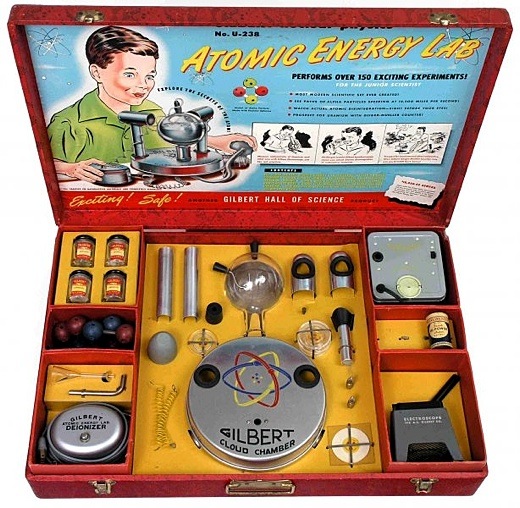
   
Image above: The A. C. Gilbert Atomic Energt Lab play set that included 3 very low-level radioactive sources and 4 samples of uranium-bearing ores. From (http://eplaya.burningman.com/viewtopic.php?p=407065).
 

I am no nuclear expert, and that is probably a good thing. I did do a lot of reading about Chernobyl back when it happened. And now I am, as I was then, and as I am sure many of you are, getting really fed up with incomplete, inaccurate, misleading and generally unsatisfactory explanations that are being offered for what is going on at Fukushima. Either information is not available, or it is a flood of largely irrelevant technical minutia designed to thrill nuclear nerds but bound to bamboozle rather than inform the general reader. And so, for the sake of all the other people who aren't nuclear experts and have no ambition of ever becoming one, here's what I have been able to piece together.

What do they mean when they say “hydrogen explosions”?
The hydrogen gas is being vented from inside the reactors and from spent fuel pools that are directly above them. Since it is very hot, it explodes as soon as it mixes with the outside air. It is formed from the rapid oxidation of the zirconium pipes that hold in the pellets of nuclear fuel. At Fukushima, some of the fuel pellets are made with uranium, while others are made with plutonium from reprocessed nuclear weapons. Zirconium is a metal which, like aluminum, instantly forms a thin, protective layer of oxide on contact with air, but doesn't oxidize further—unless it is heated up, that is. The zirconium-clad fuel rods must be kept submerged in water at all times, or they do heat up, and then the zirconium cladding oxidizes (burns) very rapidly and disintegrates into a powder. This is already enough information to tell us that a lot of the “fuel rods” at Fukushima are no longer rod-shaped, because the zirconium cladding has disintegrated, and that the fuel pellets must have fallen out and accumulated at the bottoms of the reactor vessels, where they are packed close together and heating up further. How much further they heat up will determine whether they will melt through the bottoms of the reactors. If they do, they would probably melt into the ground below and form a large pancake of hot, molten slag, which will slowly crumble into radioactive dust over many years, as has happened at Chernobyl. There is also a small chance that the fuel pellets will “go critical,” if the mass of them becomes sufficiently compact to restart the nuclear chain reaction; if that happens, the telltale tall brown cloud should be easy to spot from as away as Tokyo. This seems unlikely, but then nobody seems to be able to definitively rule it out either.
What do they mean when they say that they are cooling the reactor with seawater?
Seawater is corrosive, and is probably the worst coolant imaginable. Normally, nuclear reactors are cooled with fresh, filtered, deionized water. The crew at Fukushima used seawater because they had no other choice.

When the cooling pumps failed because the tsunami caused a blackout, they called in the fire brigade, and the fire engines there apparently use seawater. The reactor cooling systems are plumbed with stainless steel pipes, which degrade rather rapidly on contact with sea water because of the chlorine in it, especially if they are hot (which they are).

At Fukushima, “containment” has already become a relative term, since the reactors are vented to the outside air in any case to keep them from bursting, but once these pipes disintegrate (a process that might take a few days to a few weeks) the containment vessels will become riddled with holes, letting in outside air and, if by then there is any zirconium left to burn, possibly causing hydrogen explosions inside the reactors, compromising them further. Their radioactive contents will then be carried to the atmosphere in aerosol form. We will probably know when that happens because the Geiger counters in the area will peg out.

Nothing has been said about the destination of the copious amounts of now contaminated seawater that is being pumped through the damaged reactors and spent fuel pools. At Chernobyl, the water that that was used to "cool" the by then nonexistent reactor formed a large radioactive lake which threatened to poison Pripyat river.

At Fukushima, we must suspect, all of that contaminated seawater is draining straight back into the Pacific, where tidal currents will carry it up and down the coast, contaminating the entire coastline with long-lived radioactive elements. Which brings us to a very general question:
What is the difference between radiation and radioactivity?
This is a basic enough distinction, but, listening to the news coverage, I have observed a great deal of confusion. (Some of it seems intentional, if not malicious: I heard some nuclear expert/twit, a retired Oxford don, I think, on NPR explain how "wadiation" can be "thewapeutic" and never once did he mention "wadioactivity," and it made me quite mad.). Do not use the two terms interchangeably unless you want to sound like you don't know what you are talking about. Radiation, of a non-lethal kind, is what you get from a light bulb, an X-ray machine, at the beach or in a tanning booth.

Radioactivity, or radioactive contamination, is what you get when a nuclear bomb or a nuclear power plant explodes, and it stays around and produces radiation for years. Both radiation and radioactivity are invisible and hard to measure, but that's where the similarity ends. Radiation consists of subatomic particles that generally go in straight lines at close to the speed of light.

Given enough radiation, initially non-radioactive materials can in turn become radioactive.

Radioactivity, on the other hand, is caused by radioactive materials, which decay into other materials, some also radioactive, some stable, plus some radiation, at some rate, either quickly or not so quickly. Uranium and plutonium hang around for many thousands of years. Radioactive substances can be pulverized and carried up into the atmosphere by explosions (not necessarily nuclear ones) in which case they drift with the wind for thousands of kilometers and pollute huge stretches of land and ocean. Exposure to excessive levels of radiation causes radiation poisoning, from which people can fully recover, while the various radioactive elements pollute the environment and are taken up by living organisms in a wide variety of ways, many of them not yet understood by science, poisoning them and causing a wide assortment of cancers and genetic defects.

Some may be flushed out, while others become lodged in the lungs or in the bones for the life of the individual, where they remain radioactive, weakening immune systems, causing cancers and birth defects and shortening lifespans. I once spent a few hours at the airport in Minsk, waiting for a flight to Frankfurt with a group of “Chernobyl children” being flown out for treatment. They were quite a sight!
What about these “spent fuel pools” that keep catching on fire?
Well that's probably the most insane thing about the nuclear power industry. They haven't figured out what to do with the spent fuel rods, so they store them tightly packed in pools of water directly at the site, or, in the case of Fukushima, since land in Japan is at such a premium, stacked directly on top of the reactor itself. The reactors at Fukushima are quite old, and so their spent fuel pools are packed full.

The spent fuel rods, which accumulate over the entire lifetime of the power plant, have to be kept submerged to keep them cool, or the zirconium cladding burns away (causing hydrogen explosions) and the fuel pellets accumulate at the bottom of the pool, burning through it if the fuel is fresh enough (which, in some cases, it might be).

The result is the same as with the fuel rods disintegrating inside the reactor itself, except that here there is no containment vessel to keep (at least some of) the radioactive material out of the environment.
Why do we have nuclear energy in the first place?
This all sounds completely insane, doesn't it? Well, if it weren't for the nuclear bomb, anyone who proposed building a commercial fission reactor would have been laughed out of the room.

ut having nuclear bombs (which are by far the scariest things on the planet) makes nuclear fission reactors that much less scary, relatively speaking. And the reason we have nuclear bombs is because the only thing scarier than a nuclear bomb is not having one, since that opens you up the possibility of having one dropped on you by someone who does, such as the USSR (in theory) or the USA (as an historical fact).

Compared to nuclear bombs, nuclear reactors seem "peaceful," although this is clearly not the case.

Compared to nuclear reactors, nuclear bombs are as safe as houses, because they don't start a chain reaction until somebody pulls the trigger, whereas nuclear reactors maintain a controlled chain reaction during most of their existences. It's like comparing having a gun safely in your possession to heating your house with ammo, in which case, surely enough, accidents will happen.
What do people mean when they say that nuclear power is “safe” when compared to planes, trains and automobiles?
What they mean is that the nuclear power industry has so far killed many fewer people per unit time. They have no data on how many people it will kill eventually, although by now they know that, unlike planes, trains and automobiles, which do crash and burn with some regularity, but cause limited damage, nuclear disasters do not have any definable upper bound on their destructive potential.

 I am pretty sure that there is enough above-ground radioactive material sitting in spent fuel pools and inside reactors to kill just about everyone. It will stay dangerous for over a million years, which is a lot longer than the expected lifetime of the nuclear power industry, or any industry, or any human civilization, or perhaps even the human race. When nuclear experts say that a nuclear reactor is safe, they can only mean that it is safe for the rest of the afternoon; beyond that they can't possibly have any actual data to support their claim.

All they can do is extrapolate, given a rosy “everything will always remain under control” scenario, and that is not a valid approach. When they say that nuclear power is safe, what they are really saying is that it is safe given their perfect ability to accurately predict that the indefinite future will remain economically and socially stable, and we already know this to not be the case
.
If we give up on nuclear energy, what will replace it?
Nothing, probably. Let me try an example: if your lucrative murder-for-hire business suddenly runs afoul of a few silly laws (even though it has so far killed many fewer people than planes, trains or automobiles) that doesn't mean that you should keep killing people until you find another source of income. 
 
Same thing with electricity: if it turns out that the way you've been generating it happens to be criminally negligent, then you shut it all down. 
 
If you have less electricity, you will use less electricity. If this implies that economic growth is over and that all of your financial institutions are insolvent and your country bankrupt, then—I am sorry, but at this point in time that's not even newsworthy. Don't worry about that; just keep the nuclear accidents to a bare minimum, or you won't have anything else left to worry about.
.

Winter Begins and Ends

SUBHEAD: A challenging winter bookended by two special moons. Let's hope this spring ends like a lamb.

 By Juan Wilson on 21 March 2011 for Island Breath -  
(http://islandbreath.blogspot.com/2011/03/winter-begins-and-ends.html)  
Image above: Full moon with rainbow halo similar to moon observed in the wee hours of 3/20/19. From (http://www.angelvillanueva.com/en/photography/index.htm).

The winter of 2010-2011 began and ended with celestial special events. A full lunar eclipse on the night of December 21st and a super full moon on March 19th. The latter was because the moon was nearer to Earth than it has been in a generation, so it was bigger and brighter than normal. Depending on where you were you might have seen these wonders.  

Winter Begins
Our gang decided to view the lunar eclipse from Puolo Point situated between Hanapepe Bay and Salt Pond Beach Park. It is flat grassy land and has a great view plain from east to west for viewing the sky. There were enough of us interested in seeing the moon to require four vehicles. We had three 4WD trucks and a rental sedan. s most on Kauai remember, this was a rainy fall and winter. As we drove out in a caravan to Puolo Point we encountered some deep mud along the track.

We eventually found a passable way to the spot we wanted and began unloading some chairs, coolers and other accessories we had packed. Soon however we realized two things. It was heavily overcast... to much to see the moon... and we were missing on vehicle - the sedan. As the drizzle began to intensify one couple decided to bail and got back in their 4WD for the trip back to town. It was iffy that the rest of us would stay.

We felt we needed to hold out until our friends in the rental showed up. After about 15 minutes we saw their headlights bobbing along the fence line of Burns Field airstrip. They appeared headed towards a trail with some heavy mud ponding. I climbed up into the bed of my pickup and tried to wave them off with a flashlight. No luck.

My friends interpreted the signal as an invitation towards the mud. They got stuck front first to the door frames. Getting them out required standing in the mud in front of the car and grappling with the bumper to push them backwards.

With an assist from one of our trucks using a rope tied to the rear we got them out... but not before the spinning front-wheel-drive tires sprayed a fountain of mud at those of us pushing from the front. It was all quite funny... "Dawn of the Mud People!"... But, we never saw any of the moon eclipse that night.

 
Image above: Juan Wilson and Linda Pascatore covered in mud. Not from pushing car but helping set-up saltpans at Salt Pond in 2009.  

Winter Ends
A group of younger friends joined us camping near Queen's Pond, between Barking Sands and Polihale on the west side. As usual, it was a challenge driving out there through miles of washboard dirt road and drying mud holes.

At first it was quite windy when we set up the big umbrella at our camp. We had to tip it sharply into the wind and anchor it with our ice chests. By sunset the wind had died down. The waves were big but orderly when the moon rose over the pali. Our worries about clouds were unwarranted.

The scattered clouds only made the sky more interesting as the enlarged moon played hide and seek. it may have been the brightest and biggest moon I have ever seen. It surely was for those among us under 30. The moon had a rainbow halo, gradating from light blue to violet to pink, much of the night. Every crab-hole cast a shadow along the shorebreak.

We got up several times during the night just to marvel at the lighting on one of the most dramatic landscapes on Kauai. We could see the moon before it set even in the light of morning. In spite of the ongoing tragedy in Japan and the threat it represents these few hours were a beautiful end to a long winter.

 .

Kauai Council Rule Changes

SUBHEAD: Consider the following Kauai County Council meeting rule changes. By Ken Taylor and Linda Harmon on 18 March 2011 - Image above: The seal of Kauai County hangs on the wall behinf Jay Furfaro as he chairs a County Council public meeting. From (http://thegardenisland.com/news/local/govt-and-politics/article_3769fc9a-04d2-11e0-b96d-001cc4c002e0.html). Consider the following Kauai County rule changes regarding how the County Council conducts meetings. Many people have been frustrated by the current Kauai County Council public meeting policies or lack of. Say they may have taken the morning off from work to attend a meeting. Item one on the agenda is of great importance to them. Once the meeting starts they find their agenda item is not handled in order and is bumped from the morning until after lunch. The whole day of work will be lost. After lunch the council decides to go into a closed door session. There is a long break in the meeting. When the public hearing continues it is decided to hit a controversial agenda item that takes the rest of the meeting. The item of importance to you is rescheduled for the next meeting. Ouch! In this article are five ways we suggest for improving the County Council Meeting rules: We think these changes will make Kauai government more democratic and encourage public participation.
  1. Regarding closed sessions. Often enough mid way through the meeting the council will decide to break for a closed door session rather than dealing with the matter after or before the public meeting begins.
  2. Public comment period. Many councils around the country allow for public comment on matters relevant to the council that are not on the agenda. This is a method of addressing the council as a body and allowing the viewing public to hear both grievance or accolade that otherwise might never get aired. The council is there strictly to listen.
  3. Holding evening sessions. Evening sessions allow more public participation. We hear it is too costly to pay personnel over time. We don’t see the need for all the personnel present in the first place. The evening session would be strictly for matters of public concern. The routine communications of the council with different departments would be scheduled during that same morning or during the afternoon along with scheduled closed sessions.
  4. Live television broadcasts meetings. This is commonplace in cities and counties across the country and makes for government more accountable and accessible to the public.
  5. Following agenda order. The matters of greatest importance to the public should come first to allow more public participation.
Below are excerpts from a few counties and city councils that exhibit items on their legislative body agendas that would enhance our own democratic process at the Kauai County Council level: 1. Regarding closed sessions. Kauai County Council should schedule closed sessions after or before the public hearing so they don't interrupt the public meeting. Require the county attorney summarize the findings of the closed session during the following public hearing. - Goleta, California The City Council will meet in closed session: Conference with legal counsel - Anticipated Litigation, pursuant to the provisions of Government Code Section with respect to potential initiation of one matter of litigation. (Note: In Golita the city attorney regularly reports to the public hearing that follows what transpired at the closed session of the city council.) 2. Public Comment Period Have period for public to comment on Kauai County Council business not on meeting agenda. - Goleta, California At this time the public shall have an opportunity to comment on any non-agenda item relevant to the jurisdiction of the City. It is requested that each speaker complete a "Speaker Request Form" and submit it to the City Clerk. Reasonable time limits are imposed on each topic and each speaker. No action or discussion may take place by the Council on any item not on the posted agenda. The Council may respond to statements made or questions asked, and may direct the staff to report back on the topic at a future meeting. - Napa, California Public Comment: Speaker cards are available; it is requested but not required, to submit a card to the City Clerk before the meeting begins. Speakers will be limited to five minutes and will comply with the City rules of order. If your comments pertain to a specific item on the agenda, reserve your comments until the item is before the City Council Board. Time limits will be enforced by the Mayor to facilitate the fair and efficient conduct of the meeting. - Santa Barbara County, California Persons desiring to address the Board must complete and deliver to the Clerk the form which is available at the Hearing Room entrance prior to the commencement of this comment period. The Public Comment Period is reserved for comment on matters within the subject matter jurisdiction of the Board of Supervisors. Each person may address the Board for up to three minutes at the discretion of the Chair, for a total Public Comment Period of no more than 15 minutes. When testifying before the Board of Supervisors, personal attacks and other disruptive behavior is not appropriate. (Note: Public Comment Period is commonly held at the beginning of council and commissions allowing freer flow of concerns by the public.) 3. Evening Sessions or split sessions (1:30 for county business/house keeping...6:00pm for issues that may affect the public.) Hold Kauai County Council meetings in the evening to allow the working public to participate in them. - Goleta, California Council Meeting at 6:00P.M. 130 Cremona Drive, Suite B Goleta, California 4. Live Televised Meetings Televise live Kauai County Council meetings so the public can see what is transpiring in their behalf. - Bozeman, Montana Commission meetings are televised live on cable channel 20 and streamed live at www.bozeman.net. City Commission meetings are re-aired on cable Channel 20 three times per session. Wednesday at 4 pm, Thursday at noon, Friday at 10 am and Sunday at 2 pm (Note: All 5 community councils (or the like meetings) we checked out offered live televised meetings for public viewing) 5. Follow Agenda Item Order The Kauai County Council should follow the order of the written agenda of its meetings in consideration of the attending members of the public. JoAnn Yukimura has been chairing the subcommittee with members Derek Kawakami and Nadine Nakamura. They like the idea of allowing 15 minutes at the beginning of the meeting for comments on strictly agenda items however. This would allow early birds to say their piece and leave. Attached are the rule changes they will vote on at the March 30th council meeting. Now is the time to let your councilpersons know your wishes. If you want to participate in County Council Rule changes email your suggestions to: councilmembers@kauai.gov. To review the submitted changes to rules see this (http://www.islandbreath.org/2011Year/03/110321cok.pdf) 860KB. .

NRC part of Nuclear Industry

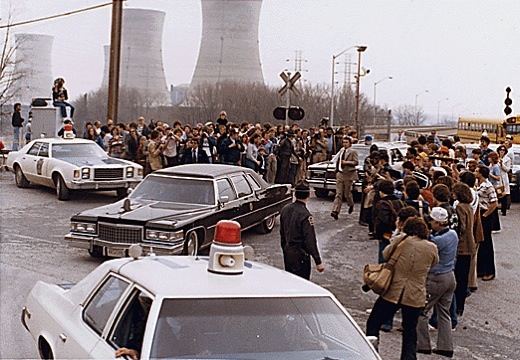
SUBHEAD: The NRC's job has become protecting the industry instead of protecting the public. By Justin Elliot on 19 March 2011 for Salon.com - (http://www.salon.com/news/politics/war_room/index.html?story=%2Fpolitics%2Fwar_room%2F2011%2F03%2F19%2Fnrc_history_captive_agency) Image above: President Jimmy Carter visits Three Mile Island nuclear accident in 1979. From (http://www.wired.com/wiredscience/2009/05/threemile). In 2007, then-candidate Barack Obama sat down for an interview with the editorial board of the Keene Sentinel, a newspaper in a New Hampshire town 15 miles away from a controversial nuclear power plant across the border in Vermont. Asked about his views on the Nuclear Regulatory Commission, the federal agency in charge of overseeing nuclear power plants, Obama responded by calling the NRC a "moribund" agency. "It's become captive of the industries that it regulates, and I think that's a problem," he said. Despite those stark comments, there's no evidence that President Obama has fundamentally changed the workings of the NRC -- which has for years been criticized as too close to industry. Earlier this year, for example, three states sued the NRC after it extended from 30 to 60 years the amount of time that nuclear waste can be stored on-site at power plants. This is no academic issue. A new study by the Union of Concerned Scientists found 14 "near misses" at U.S. power plants last year, some of them due to oversight failures. Meanwhile, at least one former top NRC official is now working for the nuclear power industry and appearing on television on behalf of the pro-nuclear lobby. To understand how the NRC came to be so cozy with the industry it is supposed to regulate and what the crisis in Japan means for the agency's future, I spoke with Robert Duffy, a professor of political science at Colorado State University and author of the 1997 book, "Nuclear Politics in America." The following has been edited for length and clarity. Can you give a brief history of the origins of the NRC? Back in the early 1970s, the Atomic Energy Commission [the predecessor of the NRC] was coming under attack for being overly cozy with the nuclear industry. The fundamental problem with the AEC was that its statutory mandate said it was supposed to promote, develop and regulate nuclear power. It's hard to do all three simultaneously. What inevitably happened was that they were promoting and developing at the expense of regulating. The Joint Committee on Atomic Energy, which was a uniquely powerful congressional committee, was pushing the AEC to show results. And results meant reactors. So the promotional aspects and the developmental aspects always took priority over the regulatory aspects. By the early 1970s, that was becoming problematic. Were there specific incidents that people were upset about? People within the AEC on the scientific end of the body were raising questions about the pace of nuclear development and specifically some safety questions. They felt that the political appointees weren't paying sufficient attention to that -- pushing it under the carpet. Eventually some of these disagreements became public. There were stories in the New York Times, there were exposes on "60 Minutes," the evening news and so on. That created a problem. The second thing that happened right around the same time was the first Arab oil embargo, in 1973. All of a sudden energy got thrust into the nation's spotlight for the first time. What the government ended up doing was splitting the AEC into two. They took the promotional and developmental side of the AEC and that soon became the Department of Energy, and then the regulatory arm became the Nuclear Regulatory Commission. What was the mission of the NRC? It was to regulate the nuclear power industry and ensure its safety. Now, the problem was that they basically slapped a new name on the building and gave the agency new stationery, but they didn't change anything else. So you took all of the same people who for decades had been promoting, developing and regulating nuclear power, and didn't even change the building, and said "now your job is to regulate." You didn't change the mindset. Their first official action as the NRC was to adopt all of the AEC's regulation procedures. So you have this agency created in 1975. Carter becomes president in 1977. Carter is much more skeptical of nuclear power then Ford or Nixon were, and he starts with some appointees who were a little more skeptical of nuclear power. Then you have Three Mile Island in 1979. Shortly after that Reagan becomes president, and Reagan is very pro-nuclear. So the agency had this brief window between 1975 and 1980 when it could have fundamentally transformed itself into an aggressive regulator, but it didn't. Then Reagan came to power and reversed course and appointed people who were pro-nuclear and wanted to get off the industry's back. How much public anger was there after Three Mile Island? There was public anger, but what often gets forgotten is that the industry had already gone into the toilet because of cost overruns. That's the issue that has continued to hinder a nuclear revival. People started saying, "Those things are just too damn expensive and nobody in their right mind would put their own money at risk to build one." That preceded Three Mile Island. Three Mile Island just put the nail in the coffin for the next 20 years in public opinion. Because of those Reagan appointments to the NRC, did oversight become less stringent for many years? No utilities placed any orders for new reactors after 1978. So what the NRC was really dealing with during the 1980s was licensing and building those plants that had already broken ground. The Reagan NRC saw their job as facilitating the licensing and construction of those plants. There were fights over the Shoreham, Long Island, plant and the Seabrook, N.H., plant. They had massive demonstrations and massive arrests; people engaged in civil disobedience because they thought these plants were unsafe and that they couldn't be safely evacuated in case of an accident. Are there examples from the '80s or '90s of problems in oversight, or safety issues? A classic example of this centered on the question of how big evacuation zones should be. That became the focal point of the fights over the plants in Shoreham and Seabrook. The initial NRC rule required that local and state officials from all jurisdictions within a 10-mile evacuation zone participate in evacuation planning and response. Some of them refused. The Seabrook plant was located just over the border from Massachusetts, and Michael Dukakis, who was governor of Massachusetts at the time, didn't want the plant. So he refused to participate. According to the NRC rules, if Massachusetts refused to participate, the plant couldn't be licensed. So they changed the rule to allow the utility to step in and fulfill the role of state and local government in emergency planning. In other words, "Fine, we can't get them to meet the rule on the books, we'll just change the rule." In the 20 some years after Reagan, have things changed fundamentally? No. In more recent years, the big fight has been over extending the license for reactors. Initially they were good for 40 years, and a lot of the plants we have in the United States now are at or very close to their 40-year term. What the utilities want is to extend the life of the reactor another 20 years. The NRC has gone along with the industry and just said, "Go right ahead." A lot of these plants were built in the mid-1960s for 40 years. So there are questions about the effects of irradiating metal for long periods of time. There were concerns that the reactor vessels become brittle over time and other issues that critics say the NRC has not paid sufficient attention to. What about Obama's comments about the agency being "captive" and "moribund" in 2007? I think his point was that the NRC, like a lot of other agencies under the Bush administration, had seen its job as protecting the industry instead of protecting the public. You had people who were overly friendly to the people they were regulating. You had the people who were looking for their next job. It was demoralizing for staffers who actually did believe in what they were doing. But the NRC has never really been a strong, independent regulatory agency. That's because nobody except for the Union of Concerned Scientists and some other groups want it to be. Presidents and Congress have the regulatory agency they want. What are your thoughts about the NRC and the politics of nuclear power post-Japan? I think the NRC will be forced to say they're going to do a comprehensive review of all U.S. facilities to see what they can learn from what happened in Japan, and think that that's smart. My guess is that the politics of it will change a little, but not in a fundamental way. You'll have Republicans continue to be full-throated supporters of nuclear power. You'll have probably some greater skepticism on the part of Democrats now. .

McDonald's Sources

SOURCE: Joanne Paipona (paipona@hotmail.com)
SUBHEAD: McDonald's launches new sourcing policy for palm oil, paper, beef to reduce global environmental impact.  

By Rhett Butler on 11 March 2011 on Mongabay.com -  
(http://news.mongabay.com/2011/0310-mcdonalds.html)

 
Image above: Big Mac Meal. The cornerstone of the McDonald's menu.

McDonald's announced a far-reaching sourcing policy that could significantly reduce the fast-food giant's impact on the environment, including global forests. Yesterday McDonald's unveiled its Sustainable Land Management Commitment (SLMC), a policy that requires its suppliers to use "agricultural raw materials for the company's food and packaging that originate from sustainably-managed land". The commitment will be monitored via an independent evaluation process, according to the company. The policy will initially focus on five commodities: beef, poultry, coffee, palm oil, and packaging.

 McDonald's target commodities are based on analysis conducted in partnership with environmental group WWF's Market Transformation initiative led by Jason Clay. McDonald's has announced several environmental criteria for sourcing in recent years including seafood and soy commitments, but the new pledge brings in more commodities.

Under SLMC, McDonald's is working with the Global Roundtable for Sustainable Beef to improve the environmental performance of beef production and is sponsoring a three-year study to assess carbon emissions on 350 ranches in the U.K. and Ireland. The company said it plans to join the Roundtable on Sustainable Palm Oil (RSPO) this year and will source only RSPO-certified palm oil by 2015.

McDonald's has also joined the Sustainability Consortium, a group working to build tools to assess the environmental impacts of consumer products over their life-cycle. McDonald's said it is introducing the policy as a response to consumer concerns. "We know that our customers care about where their food comes from," said Francesca DeBiase, McDonald's vice president for Strategic Sourcing, in a statement.

The announcement comes amid a broader emphasis on sustainability by consumer-facing retailers worldwide. As corporations have increased the share of resources they consume in meeting global demand for their products, they have found themselves increasingly under pressure to become better stewards of the environment. Accordingly, a number of major retailers in recent years have announced new sourcing policies that improve traceability of raw materials in their supply chains. Suppliers have either had to meet these criteria or find new customers.

McDonald's experienced this first-hand in 2006 when the activist group Greenpeace launched a campaign targeting animal feed used to fatten chickens used for McNuggets in Europe. Greenpeace spent a year tracking soy as it moved through the supply chain from farms in the southern Amazon to ports on the Amazon River, across the Atlantic, and eventually to poultry facilities in Britain and Ireland.

 The response was immediate. McDonalds—stung by the McLibel case of the 1990s and other activist campaigns—immediately demanded its suppliers provide deforestation-free soy, presenting the industry was presented with a daunting dilemma: move towards environmental respectability or of its biggest, and most influential, customers.

The largest soy players—whose vast portfolio of commodities are sold globally—chose the former, agreeing to a moratorium on soy grown on newly deforested lands that has changed the way commodities are produced in the Amazon. The moratorium has been extended every year since and through monitoring, which has has continually improved, has shown to be effective at reducing direct forest clearing for soy production.

In a sign of the campaign's success, John Sauven, a Greenpeace campaign director at the time—issued a statement congratulating McDonald's for using "its might to push a multi-million dollar industry towards a more sustainable future." "I cannot say it came naturally to Greenpeace to jump into bed with the world's largest fast food company!"

Sauven said in the statement. McDonald's, which says it has 32,000 locations that serve approximately 64 million customers in 117 countries each day, acknowledged its global environmental responsibility in making its latest announcement.

"McDonald's serves customers around the world, and we accept the responsibility that comes with our global presence," said McDonald's Chief Executive Officer Jim Skinner. "We will continue to focus our energy on developing sustainable sourcing practices and broadening our menu choices."  

.

Radiation found in Japanese food

SUBHEAD: Contamination from Japan's stricken nuclear complex had seeped into the food chain.  

By Shino Yuasa & Eric Talmage on 19 March 2011 for Huffington Post - (http://www.huffingtonpost.com/2011/03/19/japan-elevated-radiation-_n_837919.html)

 
Image above: Children in Kawamata, Japan, taking preventative doses of potassium iodide on 3/14/11. From (http://wwe.wgbh.org/News/Articles/2011/3/14/Why_Iodine_Tablets_Come_Out_When_Radiation_Threatens.cfm).


In the first sign that contamination from Japan's stricken nuclear complex had seeped into the food chain, officials said Saturday that radiation levels in spinach and milk from farms near the tsunami-crippled facility exceeded government safety limits.

Minuscule amounts of radioactive iodine also were found in tap water Friday in Tokyo and elsewhere in Japan – although experts said none of those tests showed any health risks. The Health Ministry also said that radioactive iodine slightly above government safety limits was found in drinking water at one point Thursday in a sampling from Fukushima prefecture, the site of the nuclear plant, but later tests showed the level had fallen again.

Six workers trying to bring the Fukushima Dai-ichi plant back under control were exposed to more than 100 millisieverts of radiation – Japan's normal limit for those involved in emergency operations, according to Tokyo Electric Power Co., which operates the complex. The government raised that limit to 250 millisieverts on Tuesday as the crisis escalated.

Officials said the crisis at the plant appeared to be stabilizing, with near-constant dousing of dangerously overheated reactors and uranium fuel, but the situation was still far from resolved.

"We more or less do not expect to see anything worse than what we are seeing now," said Hidehiko Nishiyama of the Nuclear and Industrial Safety Agency.

Japan has been grappling with a cascade of disasters unleashed by the 9.0-magnitude earthquake on March 11. The quake spawned a tsunami that ravaged Japan's northeastern coast, killing more than 7,600 people and knocking out cooling systems at the Fukushima Dai-ichi nuclear plant, causing the complex to leak radiation.

More than 11,000 people are still missing, and more than 452,000 are living in shelters.

Chief Cabinet Secretary Yukio Edano, meanwhile, insisted the contaminated foods "pose no immediate health risk."

An expert in the United States also said the risk appeared limited and urged calm.


Story continues below

"The most troubling thing to me is the fear that's out of proportion to the risk," said Dr. Henry Duval Royal, a radiologist at Washington University Medical School.

The tainted milk was found 20 miles (30 kilometers) from the plant, a local official said. The spinach was collected from six farms between 60 miles (100 kilometers) and 75 miles (120 kilometers) to the south of the reactors.

Those areas are rich farm country known for melons, rice and peaches, so the contamination could affect food supplies for large parts of Japan.

More tests was being done on other foods, Edano said, and if they show further contamination, then food shipments from the area would be halted.

Officials said it was too early to know if the nuclear crisis caused the contamination, but Edano said air sampling done near the dairy showed higher-than-normal radiation levels.

Iodine levels in the spinach exceeded safety limits by three to seven times, a food safety official said. Tests on the milk done Wednesday detected small amounts of iodine-131 and cesium-137, the latter being a longer-lasting element that can cause more types of cancer. But only iodine was detected Thursday and Friday, a Health Ministry official said.

After the announcements, Japanese officials immediately tried to calm an already-jittery public, saying the amounts detected were so small that people would have to consume unimaginable amounts to endanger their health.

"Can you imagine eating one kilogram of spinach every day for one year?" said State Secretary of Health Minister Yoko Komiyama. One kilogram is a little over two pounds.

Edano said someone drinking the tainted milk for one year would consume as much radiation as in a CT scan; for the spinach, it would be one-fifth of a CT scan. A CT scan is a compressed series of X-rays used for medical tests.

The Health Ministry said iodine levels slightly above the safety limit were discovered Thursday in drinking water samples from Fukushima prefecture. On Friday, levels were about half that benchmark; by Saturday, they had fallen further.

Drinking one liter of water with the iodine at Thursday's levels is the equivalent of receiving one-eighty-eighth of the radiation from a chest X-ray, said Kazuma Yokota, a spokesman for the prefecture's disaster response headquarters.

The trace amounts of iodine were found in Tokyo's water on Friday, the first day since the government ordered nationwide daily sampling due to the nuclear crisis, the Ministry of Education, Culture, Sports, Science and Technology said. A ministry statement said the amounts found did not exceed government safety limits. But tests on water, which for decades were only done once a year, usually show no iodine.

At the Fukushima plant, emergency workers have been struggling to cool the reactors and the pools used to store used nuclear fuel, as well as to put the facility back on the electricity grid.

A replacement power line reached the complex Friday, but workers needed to methodically work through badly damaged and deeply complex electrical systems to make the final linkups without setting off a spark and potentially an explosion. Company officials hoped to be able to switch on the cooling systems Sunday.

Once the power is reconnected, it is not clear if the cooling systems will still work.

A fire truck with a high-pressure cannon pumped water directly from the ocean into one of the most troubled areas of the complex – the cooling pool for used fuel rods at the plant's Unit 3. Because of high radiation levels, firefighters only went to the truck every three hours to refuel it.

Holes were also punched in the roofs of units 5 and 6 to vent buildups of hydrogen gas, and the temperature in Unit 5's fuel storage pool dropped after new water was pumped in, according to officials with Tokyo Electric Power Co., which owns the complex.

More workers were thrown into the effort – bringing the total at the complex to 500 – and the safety threshold for their radiation exposure was raised 2 1/2 times so they could keep working.

Officials insisted that would cause no health damage.

Edano said conditions at the reactors in Units 1, 2 and 3 – all of which have been rocked by explosions in the past eight days – had "stabilized."

The reactors and the storage pools both need constant sources of cooling water. Even when they are taken from reactors, uranium rods remain very hot and must be cooled for months, possibly longer, to prevent them from heating up again and emitting radioactivity.

Low levels of radiation have been detected well beyond Tokyo, which is 140 miles (220 kilometers) south of the plant, but hazardous levels have been limited to the plant itself.

People evacuated from around the plant, along with some emergency workers, have tested positive for radiation exposure. Three firefighters needed to be decontaminated with showers, while among the 18 plant workers who tested positive, one absorbed about one-tenth of the amount that could induce radiation poisoning.

Outside the bustling disaster response center in the city of Fukushima, 40 miles (60 kilometers) northwest of the plant, government nuclear specialist Kazuya Konno was able to take only a three-minute break for his first meeting since the quake with his wife, Junko, and their children.

"It's very nerve-racking. We really don't know what is going to become of our city," said Junko Konno, 35. "Like most other people, we have been staying indoors unless we have to go out."

She brought her husband a small backpack with a change of clothes and snacks. The girls – aged 4 and 6 and wearing pink surgical masks decorated with Mickey Mouse – gave their father hugs.

The government conceded Friday that it was slow to respond to the crisis and welcomed ever-growing help from the U.S. in hopes of preventing a complete meltdown.

Nishiyama, of the nuclear safety agency, also said backup power systems at the plant had been improperly protected, leaving them vulnerable to the tsunami.

The failure of Fukushima's backup power systems, which were supposed to keep cooling systems going in the aftermath of the earthquake, let uranium fuel overheat and were a "main cause" of the crisis, Nishiyama said.

"I cannot say whether it was a human error, but we should examine the case closely," he told reporters.

A spokesman for Tokyo Electric said that while the generators were not directly exposed to the waves, some electrical support equipment was outside. The complex was protected against tsunamis of up to 5 meters (16 feet), he said. Media reports say the tsunami was at least 6 meters (20 feet) high when it struck Fukushima.

Spokesman Motoyasu Tamaki also acknowledged that the complex was old, and might not have been as well-equipped as newer facilities.

The crisis has led to power shortages and factory closures, and triggered a plunge in Japanese stock prices.

On Saturday evening, Japan was rattled by 6.1-magnitude aftershock, with an epicenter just south of the troubled nuclear plants. The temblor, centered 150 kilometers (90 miles) northeast of Tokyo, shook buildings in the capital..

French engage Libyan military

SUBHEAD: Libyan Air Force jet shot down over Benghazi by European coallition. Ground forces attacked from air. By Ryan Lucas and Hadeel-Al-Shalchi on 19 March 2011 for AP - (http://www.huffingtonpost.com/2011/03/19/warplane-shot-down-libya_n_837911.html) Image above: Libyan jet about to crash in Benghazi after engagement with French air force. From original article. French fighter jets fired the first shots at Moammar Gadhafi's troops on Saturday, launching the broadest international military effort since the Iraq war in support of an uprising that had seemed on the verge of defeat.

In the hours before the no-fly zone over Libya went into effect, Gadhafi sent warplanes, tanks and troops into Benghazi, the rebel capital and first city to fall to the rebellion that began Feb. 15. Then the government attacks appeared to go silent.

French President Nicolas Sarkozy said after an emergency summit in Paris that French jets were already targeting Gadhafi's forces. The 22 participants in Saturday's summit agreed to do everything necessary to make Gadhafi respect a U.N. Security Council resolution Thursday demanding a cease-fire, Sarkozy said.

"Our consensus was strong, and our resolve is clear. The people of Libya must be protected, and in the absence of an immediate end to the violence against civilians our coalition is prepared to act, and to act with urgency," President Barack Obama said in Brasilia, Brazil, on the first day of a three-country Latin American tour.

The rebels, who have seen their advances into western Libya turn into a series of defeats, said they had hoped for more, sooner from the international community, after a day when crashing shells shook the buildings of Benghazi and Gadhafi's tanks rumbled through the university campus.

"People are disappointed, they haven't seen any action yet. The leadership understands some of the difficulties with procedures but when it comes to procedures versus human lives the choice is clear," said Mustafa Gheriani, a spokesman for the opposition. "People on the streets are saying where are the international forces? Is the international community waiting for the same crimes to be perpetrated on Benghazi has have been done by Gadhafi in the other cities?"

A doctor said 27 bodies had reached hospitals by midday. As night fell, though, the streets were quiet. Libyan state television showed Gadhafi supporters converging on the international airport and a military garrison in Tripoli, and the airport in Gadhafi's hometown of Sirte, in an apparent attempt to deter bombing.

In an open letter, Gadhafi warned: "You will regret it if you dare to intervene in our country." In Paris, U.S. Secretary of State Hillary Rodham Clinton said Gadhafi's government had lost all legitimacy and lied about the cease-fire.

"We have every reason to fear that left unchecked, Gadhafi will commit unspeakable atrocities," she said. Saturday's emergency meeting involved 22 leaders and top officials, including Arab League Secretary-General Amr Moussa and U.N. Secretary-General Ban Ki-Moon and the foreign ministers of Jordan, Morocco and the United Arab Emirates. It was the largest international military action since the beginning of the Iraq war, launched almost exactly eight years ago.

Earlier Saturday, a plane was shot down over the outskirts of Benghazi, sending up a massive black cloud of smoke. An Associated Press reporter saw the plane go down in flames and heard the sound of artillery and crackling gunfire. Before the plane went down, journalists heard what appeared to be airstrikes from it. Rebels cheered and celebrated at the crash, though the government denied a plane had gone down -- or that any towns were shelled on Saturday.

The fighting galvanized the people of Benghazi, with young men collecting bottles to make gasoline bombs. Some residents dragged bed frames and metal scraps into the streets to make roadblocks.

"This city is a symbol of the revolution, it's where it started and where it will end if this city falls," said Gheriani. But at Jalaa hospital, where the tile floors and walls were stained with blood, the toll was clear.

"There are more dead than injured," said Dr. Ahmed Radwan, an Egyptian who had been there helping for three weeks.

Jalaa's Dr. Gebreil Hewadi, a member of the rebel health committee, said city hospitals had received 27 bodies. At a news conference in the capital, Tripoli, the government spokesman read letters from Gadhafi to Obama and others involved in the international effort.

"Libya is not yours. Libya is for the Libyans. The Security Council resolution is invalid," he said in the letter to Sarkozy, British Prime Minister David Cameron, and U.N. Secretary-General Ban Ki-Moon.

To Obama, the Libyan leader was slightly more conciliatory: "If you had found them taking over American cities with armed force, tell me what you would do."

In a joint statement to Gadhafi late Friday, the United States, Britain and France -- backed by unspecified Arab countries -- called on Gadhafi to end his troops' advance toward Benghazi and pull them out of the cities of Misrata, Ajdabiya and Zawiya. It also called for the restoration of water, electricity and gas services in all areas. It said Libyans must be able to receive humanitarian aid or the "international community will make him suffer the consequences" with military action.

Foreign Minister Moussa Koussa said that Libyan officials had informed the U.N. and the Security Council that the government was holding to the cease-fire it had announced Friday and called for a team of foreign observers to verify that.

"The nation is respecting all the commitments put on it by the international community," he said, leaving the podium before answering any questions about Benghazi.

In the course of the rebellion, Libya has gone from a once-promising economy with the largest proven oil reserves in Africa to a country in turmoil. The foreign workers that underpinned the oil industry have fled; production and exports have all but ground to a halt; and its currency is down 30 percent in just two weeks. The oil minister, Shukri Ghanem, held a news conference calling on foreign oil companies to send back their workers. He said the government would honor all its contracts.

"It is not our intention to violate any of these agreements and we hope that from their part they will honor this agreement and they will send back their work forces," he said.

Italy, which had been the main buyer for Libyan oil, offered the use of seven air and navy bases already housing U.S., NATO and Italian forces to enforce the no-fly zone over Libya.

Italy's defense minister, Ignazio La Russa, said Saturday that Italy wasn't just "renting out" its bases for others to use but was prepared to offer "moderate but determined" military support.

A French fighter jet fired Saturday on a Libyan military vehicle, the first reported offensive action in the international military operation against Gadhafi's forces, French Defense Ministry spokesman Thierry Burkhard said.

Warplanes from the United States, Canada, Denmark arrived at Italian air bases Saturday as part of an international military buildup. Germany backed the operation but isn't offering its own forces.

British Prime Minister David Cameron said after the summit: "The time for action has come, it needs to be urgent."

Freedom - Libya yes! - Bahrain no!

SUBHEAD: How is it we sit by and watch peaceful Bahrainis seeking democracy murdered in the street by invading Saudis? By Tom Scocca on 17 March 2011 for Slate.com - (http://www.slate.com/blogs/blogs/scocca/archive/2011/03/17/would-a-no-fly-zone-over-america-save-the-democracy-movement-in-bahrain.aspx) Image above: Saudi forces moving across causeway to Bahrain armed with US supplied weapons and helicopters on 3/4/11. From (http://www.ibtimes.com/articles/122824/20110315/bahrain-saudi-arabia-armed-forces-1-000-troops-protest-egypt-tunisia-lebanon-khalifa-gcc-defense-pac.htm).

It can't compete with the earthquake/tsunami/nuclear-meltdown sequence in Japan, or the civil war we're about to start dropping bombs onto in Libya, and, honestly, after nuclear disaster and air strikes, it's totally reasonable for the news-following public to watch some college basketball, but, still: Bahrain. It does also matter, Bahrain. The helpful thing, if you're overwhelmed by so much news going on at once, is that Bahrain is roughly the same story as Libya—only instead of pro-democracy protesters being murdered by a terrorist-sponsoring monster of a dictator who has been on America's enemies list for ages, the pro-democracy protesters are being murdered by a government that is America's very own dear ally. And where Qaddafi brought in foreign mercenaries for support, King Hamad bin Isa al-Khalifa of Bahrain brought in troops from our even more vital ally, Saudi Arabia.

Tuesday, the New York Times reported on victims of the crackdown, from Salminaya Hospital in the capital, Manama:

One man, Ahmed Farhan, 24, had dozens of shotgun pellet wounds in his back and a gaping head injury. The second man, a foreign worker from Bangladesh, had tire marks from having been run over by security forces, the doctors said.

Yesterday, the military seized that hospital, the Times reported, as the forces of the dictatorship bore down:

[H]undreds of Bahraini troops, backed by helicopters and tanks, forcefully cleared the capital’s central square of demonstrators clamoring for reform. Three protesters and two security officers were killed. [...] The United States, which bases its Fifth Fleet here, has struggled to balance its strategic interest in placating Bahrain and its ally, Saudi Arabia, its fears that Iran is exploiting the anger of Bahrain’s majority Shiite protesters, and American democratic principles. American officials have held off backing the protesters while urging Bahrain’s leaders to exercise restraint. That advice was ignored. [...] After the square had been cleared of people, with military helicopters still hovering, uniformed police officers accompanied by men in civilian clothes could be seen smashing windshields of parked cars. Meanwhile, tanks rolled toward the financial district. It was last Sunday’s action by the protesters, taking over the streets leading to the financial district, that set the king on the path of smashing the movement. Bahrain calls itself “business friendly” and viewed that move as beyond the pale.

Do reread that last part:

It was last Sunday’s action by the protesters, taking over the streets leading to the financial district, that set the king on the path of smashing the movement. Bahrain calls itself “business friendly” and viewed that move as beyond the pale.

So basically, take all those proud feelings about the United States standing up for freedom and human rights in Libya and turn them inside out, and vomit into them. That's Bahrain. Nicholas Kristof, in a column deploring the violence, wrote:

Today the United States is in a vise — caught between our allies and our values.
Are we? Bahrain and Saudi Arabia are the same rotten royalist dictatorships they've always been. And they've been on our side. The helicopters over the square were reportedly American-made Cobras, because the Royal Bahraini Air Force flies what we sell them; the rifles on the ground are American M16s. Freedom and democracy are what we talk about. Values are what we do. .

Lawsuit against GMO alfalfa

SOURCE: Jeri DiPietro (ofstone@aol.com)
SUBHEAD: “Roundup Ready” Alfalfa will increase pesticide use and cause grave harm to environment and organic industry.

 By Heather on 18 March 2011 for the Center for Food Safety - 
  (http://truefoodnow.org/2011/03/18/farmers-and-consumer-groups-file-lawsuit-challenging-genetically-engineered-alfalfa-approval)
 
Image above: Bales of organic alfalfa at sunset. From (http://mikeisaak.com/blog/?p=200).

 Today, attorneys for the Center for Food Safety (CFS) and Earthjustice filed a lawsuit against the U.S. Department of Agriculture (USDA), arguing that the agency’s recent unrestricted approval of genetically engineered (GE), “Roundup Ready” Alfalfa was unlawful.

The GE crop is engineered to be immune to the herbicide glyphosate, which Monsanto markets as Roundup. USDA data show that 93% of all the alfalfa planted by farmers in the U.S. is grown without the use of any herbicides. With the full deregulation of GE alfalfa, USDA estimates that up to 23 million more pounds of toxic herbicides will be released into the environment each year.

“USDA has once again failed to provide adequate oversight of a biotech crop,” said Andrew Kimbrell, Executive Director of the Center for Food Safety. “This reckless approval flies in the face of overwhelming evidence that GE alfalfa threatens the rights of farmers and consumers, as well as significant harm to the environment. APHIS has refused to apply and enforce the law and instead has chosen to bow to the wishes of the biotech industry.”

This is the second case challenging the legality of USDA’s handling of GE alfalfa. In 2007, in another case brought by CFS, a federal court ruled that the USDA’s approval of the engineered crop violated environmental laws by failing to analyze risks such as the contamination of conventional and organic alfalfa, the evolution of glyphosate-resistant weeds, and increased use of Roundup.

The case resulted in USDA undertaking a court-ordered four-year study of GE alfalfa’s impacts under the National Environmental Policy Act (NEPA). Remarkably, it marked the first time USDA had ever undertaken such a study, known as an Environmental Impact Statement (EIS), in over 15 years of approving GE crops for commercial production. While USDA worked on the EIS, GE alfalfa remained unlawful to plant or sell, a ban that remained in place despite Monsanto appealing the case all the way to the U.S. Supreme Court.

Earthjustice attorney Paul Achitoff commented: “We expect Monsanto to force-feed people genetically engineered crops—that’s its business model. We hoped for better from the USDA, which has much broader responsibilities. GE alfalfa will greatly increase use of toxic chemicals from coast to coast, threatens the organic dairy industry, and will have farmers going back to Monsanto every year to buy its patented seed and Roundup.”

The plaintiffs include a diverse coalition of conventional and organic farmers, dairies and agricultural associations, and environmental and consumer groups: CFS, Beyond Pesticides, Cornucopia Institute, California Farmers Union, Dakota Resources Council, Geertson Seed Farms, National Family Farm Coalition, Northeast Organic Dairy Producers Alliance, Sierra Club, Trask Family Seeds and Western Organization of Resource Councils.

“We in the farm sector are dissatisfied but not surprised at the lack of courage from USDA to prohibit Roundup Ready alfalfa and defend family farmers,” said plaintiff farmer Pat Trask.

Known as the “queen of forages,” alfalfa is the key feedstock for the dairy industry. Organic dairies stand to lose their source of organic feed, a requirement for organic dairy, including milk and yogurt products. The organic sector is the most vibrant part of U.S. agriculture, now a 26 billion dollar a year industry and growing 20% annually.

“Approving the unrestricted planting of GE alfalfa is a blatant case of the USDA serving one form of agriculture at the expense of all others,” says plaintiff Ed Maltby, Executive Director of the Northeast Alliance of Organic Dairy Producers. “If this decision is not remedied, the result will be lost livelihoods for organic dairy farmers, loss of choice for farmers and consumers, and no transparency about GE contamination of our foods.”

Because alfalfa is pollinated by bees that can fly and cross-pollinate between fields and feral sources many miles apart, the engineered crop will contaminate natural alfalfa varieties. Roundup Ready alfalfa is the first engineered perennial crop, meaning it remains in the ground for 3-6 years and is widely prevalent in wild or feral form throughout America, further increasing the likelihood and extent of transgenic contamination.

“USDA’s review is inaccurate and completely failed to consider critical issues. The decision to deregulate Roundup Ready alfalfa opens the door to widespread transgenic contamination, costing farmers their markets, reputation and ability to grow natural varieties,” said plaintiff farmer Phil Geertson.

“We are an organic, grass-fed beef operation relying on alfalfa in pasture mix and for winter feed. GE alfalfa means contamination of all alfalfa seeds within a few years. Our options include giving up organic production at great revenue loss or finding another forage at great cost increase,” says organic beef producer Jim Munsch from Wisconsin.

Approval of Roundup Ready alfalfa will spur the glyphosate-resistant epidemic that is already regarded as one of the most serious challenges facing U.S. agriculture. Weeds evolve resistance to glyphosate just as bacteria evolve immunity to overused antibiotics.

 While other Roundup Ready crops spawned the epidemic, Roundup Ready alfalfa will exacerbate it by increasing the frequency and intensity of glyphosate use on millions of acres of cropland. Farmers respond to resistant weeds by applying more and more herbicides, soil-eroding tillage operations, and even hand-weeding on hundreds of thousands of acres. Such “superweeds” have expanded four-fold to infest over 10 million acres since just 2008, with some projecting 38 million acres by 2013. Alfalfa, the fourth most prevalent crop in the U.S., is grown on over 20 million acres, spanning every state.

“Alfalfa grows in dense stands that naturally suppress weeds, and so has traditionally been the one crop in farmers’ rotations that provides a much-needed break from the onslaught of toxic herbicides. Roundup Ready alfalfa will only foster still more resistant weeds, and thereby increase the pesticide dependence of U.S. agriculture beyond already unsustainable levels,” said Bill Freese, CFS Science Policy Analyst.

The latest USDA data show that less than 10 percent of alfalfa acres are sprayed with any herbicide, and consequently, GE alfalfa will dramatically increase the use of such chemicals across the country, with all of their attendant hazards to wildlife, plants, groundwater, and people.


.

Bahrain Demolishes Pearl Square

SUBHEAD: After Saudi "support" Bahrain demolishes Pearl Square monument that became symbolic of peaceful Shiite resistance to Sunni monarchy.

 By Barbara Surk on 18 March 2011 for Huffington Post - 
(http://www.huffingtonpost.com/2011/03/18/bahrain-pearl-square-monument_n_837799.html)


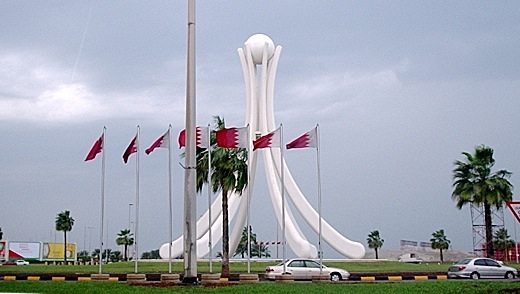
Image above: Symbolic monument representing a pearl. The rich pearl trade there was the pre-oil occupation of Bahrainis. The traffic circle will be converted to a conventional intersection with electric signal lights. From (http://bigthink.com/ideas/30850)

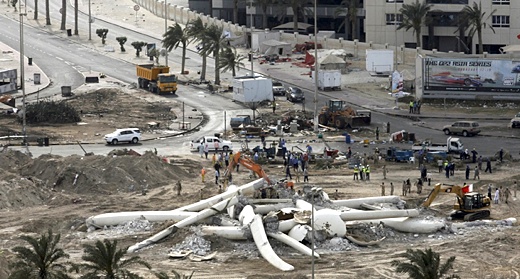
Bahrain on Friday tore down the 300-foot (90-meter) monument at the heart of a square purged of Shiite protesters this week, erasing a symbol of an uprising that's inflaming sectarian tensions across the region.

The monument – six white curved beams topped with a huge cement pearl – was built in Pearl Square as a tribute to the Sunni-ruled kingdom's history as a pearl-diving center. It became the backdrop to the Shiite majority's uprising after protesters set up a month-long camp at Pearl Square in the capital, Manama.

Security forces overran the camp on Wednesday, setting off clashes that killed at least five people, including two policemen. At least 12 people have been killed in the month-long revolt.

Bahrain's foreign minister, Khalid bin Ahmed Al Khalifa, told reporters in Manama that the army brought down the monument because "it was a bad memory."

"We are not waging war, we are restoring law and order," Khalid said at a press conference in Manama.

Shiite anger rose sharply around the Mideast on Friday as large crowds in Iran and Iraq cursed Bahrain's Sunni monarchy and its Saudi backers over the violent crackdown on protesters demanding more rights.

Amateur video footage of security forces shooting and beating protesters has spread across the internet and fueled fury in predominantly Shiite Iraq and in Iran, where a senior cleric on Friday urged Bahraini protesters to keep going until victory or death.

Thousands of Bahrainis gathered for the funeral of Ahmed Farhan, a 29-year-old demonstrator slain Tuesday in the town of Sitra hours after the king declared martial law in response to a month of escalating protests. Sitra, the hub of Bahrain's oil industry, has been the site of the worst confrontations.

A funeral for Abdul-Jaffer Mohammed Abdul-Ali, 40, took place in the village of Karranah, west of the capital. His brother Abdul-Ali Mohammed told The Associated Press that Abdel-Jaffer was killed on Wednesday morning on his way to Pearl Square to reinforce the protesters' lines during the military assault on the encampment.

"My brother was not a political man, but he participated in the protest every day to have a better future for his four children," Abdul-Ali said.

"When he heard the Pearl Square was under attack, he went there," he added. "Our country is under siege and he wanted to help liberate it."

Shiites account for 70 percent of the tiny island's half-million people but they are widely excluded from high-level posts and positions in the police and military of the country, whic is home to the U.S. Navy's 5th Fleet.

"Brothers and sisters" in Bahrain should "resist against the enemy until you die or win," Iranian Ayatollah Ahmad Jannati told worshippers at Friday prayers at Tehran University, a nationally televised forum seen as expressing the views of Iran's ruling Shiite clergy.

Worshippers chanted angry slogans against Saudi Arabia's royal family, which has sent troops to back Bahrain's king.

"There is no God but Allah, Al Saud is God's enemy," some chanted in Arabic. One Persian banner read, "Death to Al Saud."

Across Iraq, thousands rallied in mostly Shiite cities in the country's largest demonstrations since a wave of dissent spread across the Middle East in the wake of Tunisia's overthrow of its autocratic president.

Grand Ayatollah Ali Sistani – Iraqi-based Shiism's highest ranking cleric in the Mideast – suspended teachings at religious schools across Iraq on Friday in a show of solidarity with the protesters.

A representative of al-Sistani warned during his Friday sermon in the holy city of Karbala that the brutal images of what is happening in Bahrain will inflame passions and lead to sectarian problems in the region.

Bahrain's rulers invited armies from other Sunni-ruled Gulf countries this week to help root out dissent as the month of protests spiraled into widespread calls for an end to the Sunni monarchy. In declaring emergency rule, the king gave the military wide powers to battle the uprising.

There are no apparent links between Iran and Bahrain's Shiite opposition but the U.S. and Sunni leaders in the Persian Gulf leaders have expressed concern that Iran could use the unrest in Bahrain to expand its influence in the region. Iran has recalled its ambassador from Bahrain to protest the crackdown.

The United States bases the 5th Fleet in Bahrain partly to counter Iran's military reach around the region.
Bahrain's King declares Martial Law 

By Lin Noueihed & Frederik Richter on 15 March 2011 for Reuters - (http://www.huffingtonpost.com/2011/03/15/bahrain-king-declares-martial-law_n_836326.html)
   
Image above: Wreckage of Pearl Square monument today. From (http://photoblog.msnbc.msn.com/_news/2011/03/18/6293994-bahrain-demolishes-pearl-roundabout-statue).

Bahrain's king declared martial law on Tuesday as his government struggled to quell an uprising by the island's Shi'ite Muslim majority that has drawn in troops from fellow Sunni-ruled neighbour Saudi Arabia. An uneasy calm fell on Bahrain overnight, and a defence ministry statement suggested action against protesters camped out for weeks at Pearl roundabout could be swift.

Forces may impose curfews, disperse gatherings and evacuate areas, it said. The three-month state of emergency hands power to Bahrain's security forces, which are dominated by the Sunni Muslim elite. Clashes left three dead.

A hospital source said two men, one Bahraini and the other Bangladeshi, were killed in clashes in the Shi'ite area of Sitra and more than 200 people were wounded in various incidents. Story continues below Advertisement State television said a Bahraini policeman was also killed, denying media reports that a Saudi soldier had been shot dead.

Over 60 percent of Bahrainis are Shi'ites who complain of discrimination at the hands of the Sunni royal family. Calls for the overthrow of the monarchy have alarmed the Sunni minority, which fears that unrest could serve non-Arab Shi'ite power Iran.

The United States, a close ally of both Bahrain and Saudi Arabia, said it was concerned about reports of growing sectarianism in the country, home to the U.S. Navy's Fifth Fleet. It dispatched Assistant Secretary of State Jeff Feltman to Bahrain to push for dialogue to resolve the crisis. Speaking in Cairo, U.S. Secretary of State Hilary Clinton said she had told her Saudi counterpart to promote talks to resolve the situation.

"In order for the situation to return to normal we have to establish order and security and ... stop the violations which have spread disturbances among the people of our dear country," said Interior Minister Sheikh Rashed al-Khalifa. Bahraini state media have said Shi'ite opposition activists, who complain the state has been naturalising Sunni foreigners to tip the sectarian balance, are targeting foreigners.

The opposition says the security forces are full of naturalised foreigners willing to use force against protesters. SAUDI ANXIETY On Monday, more than 1,000 Saudi troops rolled into the kingdom at the request of Bahrain's Sunni rulers.

The United Arab Emirates has sent 500 policemen and Qatar said it would also send police. Thousands of Bahrainis marched on the Saudi embassy in Manama on Tuesday to protest against the intervention.

"People are angry, we want this occupation to end. We don't want anybody to help the al-Khalifa or us," said a protester who gave his name as Salman, referring to the ruling family. Analysts said the troop movement showed concern in Saudi Arabia that any concessions in Bahrain could inspire the kingdom's own Shi'ite minority.

Iran, which sits across the Gulf from Bahrain, criticised the decision to send in Saudi troops. "The presence of foreign forces and interference in Bahrain's internal affairs is unacceptable and will further complicate the issue," Foreign Ministry spokesman Ramin Mehmanparast said at his weekly news conference in Tehran.

A Bahraini foreign ministry official called the remarks "blatant interference in Bahrain's internal affairs", the state news agency BNA said, adding that Manama had recalled its ambassador to Iran for consultations. SECTARIAN CLASHES Bahrain has been gripped by its worst unrest since the 1990s after protesters took to the streets last month, inspired by uprisings that toppled the leaders of Egypt and Tunisia.

Unlike those countries, where the mainly Sunni populations united against the regime, Bahrain is split along sectarian lines, raising the risk of a slide into civil conflict. Violent clashes between youths wielding clubs, knives and rocks have become daily occurrences, forcing Bahrain University and many schools to close in order to avoid further trouble.

The United Nations and Britain echoed the U.S. call for restraint and the Group of Eight powers expressed concern, though analysts said the escalation showed the limits of U.S. influence when security was threatened. Amnesty International urged Bahrain and Saudi Arabia to restrain their forces after witnesses said protesters were shot.

The disturbances are a major blow to the economy in Bahrain, whose oil reserves dwindling. Shops and offices were closed on Tuesday and the streets were deserted. Fitch cut Bahrain's credit ratings by two notches to BBB from A-minus and said more downgrades were possible in the short term as political risk soared in the country.

The largest Shi'ite opposition group, Wefaq, condemned the imposition of martial law and urged international intervention. In a sign security could deteriorate, Washington advised against travel to Bahrain due to a breakdown in law and order. Britain also advised against travel to Bahrain and said people without a pressing reason to remain should leave. Armed youths attacked the printing press of Bahrain's only opposition newspaper Al Wasat overnight, in an effort to stop its publication.

Metal barricades and piles of rocks blocked the main road to the financial district and most shops were shut. Residents have placed skips and pieces of metal on the road, to prevent strangers from entering their neighbourhoods. Young men carrying sticks guarded the entrances to their areas. "We are staying peacefully," said Ali Mansoor at Pearl square. "Our problem is not with Saudi Arabia, it is with the government."

 .

Is Saudi supression OK with US?

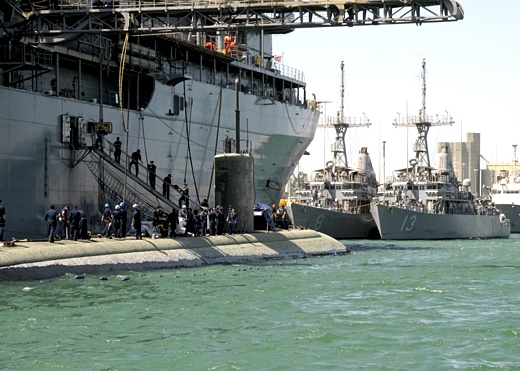
SUBHEAD: Saudis and Fifth Fleet want calm to return to Bahrain and both want to limit Iran's influence in the region. By David Usborne on 18 March 2011 for New Zealand Herald - (http://www.nzherald.co.nz/world/news/article.cfm?c_id=2&objectid=10713281) Image above: US Fifth Fleet conducts maintenance and support of submarines and surface vessels in its area of responsibility from Manama, Bahrain. From (http://www.cusnc.navy.mil/photos/2011/hi/110303-N-3686T-380.jpg).

If Washington is uneasy about a Saudi-led foreign force of 1000 soldiers crossing the causeway from Saudi Arabia into Bahrain to take part in a crackdown, it is nonetheless keeping its criticism muted for two reasons.

Firstly, it would welcome an end to the turmoil in the island nation, home to the Fifth Fleet, and secondly, it knows that wagging its finger at Riyadh right now is unlikely to have much effect.

No Arab nation is more important to the United States than Saudi Arabia. It remains a bulwark against Iranian expansionism and a pivotal partner fighting global terrorism. Thus the statement from the White House stressed that the deployment of troops is "not an invasion" and included the mild admonition that they show "respect and restraint" on Bahraini soil.

Secretary of State Hillary Clinton said yesterday that force was not the answer. "We find what's happening in Bahrain alarming. We think that there is no security answer to the aspirations and demands of the demonstrators. They are on the wrong track."

In any event, anything stronger would not fly because not since the post-9/11 days - when it emerged that most of the hijackers had come from the kingdom - have Saudi-US relations been as testy as they are today.

It probably hasn't helped that in recent weeks the US has tightened the tone of its criticisms of Saudi Arabia by saying that to stave off trouble of its own, Saudi needs to pick up the pace of reforms it has allegedly been pursuing for several years.

Mostly, though, the Saudi leaders have yet to get over how the US handled last month's crisis in Egypt. As the protests intensified in Cairo, the Saudis implored President Barack Obama to stand by their ally, Hosni Mubarak. Egypt, after all, is hardly peripheral to US strategy in the Middle East. Obama cut Mubarak loose anyway.

Raising the temperature now is hardly what Washington wants. It is Saudi Arabia which in recent days has increased oil production to offset the loss of supplies from Libya, helping to avert a global energy shock. And in truth, the overlap of interests between the two countries remains significant as the turmoil in the Middle East persists.

Both want calm to return to Bahrain, neither wants an uprising to take shape in the kingdom and both want to limit Iran's influence in the region.

If Saudi Arabia deemed it necessary to send troops as part of a Gulf Co-operation Council force into Bahrain to protect the monarchy there and to fend off Iran from extending its influence on the peninsula, it was never going to ask permission from the US first. Never mind that its longer-term interests are keeping the US on side as its main supplier of arms and medical care to the ailing King Abdullah.

And that leaves Washington rehearsing all the usual bromides about restraint and respect. But this horse is already out of the stable - or across the causeway - and the US could do nothing about it even if it wanted to.

.

Japan nukes faked reports

SUBHEAD: Japan nuclear disaster caps decades unreported accidents and faked safety reports to regulatory agencies.  

By Jason Clenfield on 18 March 2011 for Bloomberg News - 
  (http://www.bloomberg.com/news/2011-03-17/japan-s-nuclear-disaster-caps-decades-of-faked-safety-reports-accidents.html)

 
Image above: Fukushima Daiichi Nuclear Station showing damaged reactors #1, #3, and #4. Exterior of #2 appears intact although smoke and/or steam has streamed from hole in upper east wall. From (http://shineyourlight-shineyourlight.blogspot.com/2011/03/japan-one-week-after-disaster-photo-and.html)

 The unfolding disaster at the Fukushima nuclear plant follows decades of falsified safety reports, fatal accidents and underestimated earthquake risk in Japan’s atomic power industry. The destruction caused by last week’s 9.0 earthquake and tsunami comes less than four years after a 6.8 quake shut the world’s biggest atomic plant, also run by Tokyo Electric Power Co. In 2002 and 2007, revelations the utility had faked repair records forced the resignation of the company’s chairman and president, and a three-week shutdown of all 17 of its reactors.

With almost no oil or gas reserves of its own, nuclear power has been a national priority for Japan since the end of World War II, a conflict the country fought partly to secure oil supplies. Japan has 54 operating nuclear reactors -- more than any other country except the U.S. and France -- to power its industries, pitting economic demands against safety concerns in the world’s most earthquake-prone country.

 Nuclear engineers and academics who have worked in Japan’s atomic power industry spoke in interviews of a history of accidents, faked reports and inaction by a succession of Liberal Democratic Party governments that ran Japan for nearly all of the postwar period. Katsuhiko Ishibashi, a seismology professor at Kobe University, has said Japan’s history of nuclear accidents stems from an overconfidence in plant engineering. In 2006, he resigned from a government panel on reactor safety, saying the review process was rigged and “unscientific.”

 Nuclear Earthquake
 In an interview in 2007 after Tokyo Electric’s Kashiwazaki nuclear plant was struck by an earthquake, Ishibashi said fundamental improvements were needed in engineering standards for atomic power stations, without which Japan could suffer a catastrophic disaster. “We didn’t learn anything,” Ishibashi said in a phone interview this week. “Nuclear power is national policy and there’s a real reluctance to scrutinize it.”

 To be sure, Japan’s record isn’t the worst. The International Atomic Energy Agency rates nuclear accidents on a scale of zero to seven, with Chernobyl in the former Soviet Union rated seven, the most dangerous. Fukushima, where the steel vessels at the heart of the reactors have so far not ruptured, is currently a class five, the same category as the 1979 partial reactor meltdown at Three Mile Island in the U.S.  

‘No Chernobyl’
 “The key thing here is that this is not another Chernobyl,” said Ken Brockman, a former director of nuclear installation safety at the IAEA in Vienna. “Containment engineering has been vindicated. What has not been vindicated is the site engineering that put us on a path to accident.” The 40-year-old Fukushima plant, built in the 1970s when Japan’s first wave of nuclear construction began, stood up to the country’s worst earthquake on record March 11 only to have its power and back-up generators knocked out by the 7-meter tsunami that followed.

Lacking electricity to pump water needed to cool the atomic core, engineers vented radioactive steam into the atmosphere to release pressure, leading to a series of explosions that blew out concrete walls around the reactors. Radiation readings spiked around Fukushima as the disaster widened, forcing the evacuation of 200,000 people and causing radiation levels to rise on the outskirts of Tokyo, 135 miles (210 kilometers) to the south, with a population of 30 million.

 
Image above: Twisted frame a wreckage of upper part of containment building #3 lies over cooling pools and reactor containment below. From (http://shineyourlight-shineyourlight.blogspot.com/2011/03/japan-one-week-after-disaster-photo-and.html)  

Basement Generator
Back-up diesel generators that might have averted the disaster were positioned in a basement, where they were overwhelmed by waves. “This in the country that invented the word Tsunami,” said Brockman, who also worked at the U.S. Nuclear Regulatory Commission. “Japan is going to have a look again at its regulatory process and whether it’s intrusive enough.” The cascade of events at Fukushima had been foretold in a report published in the U.S. two decades ago.

The 1990 report by the U.S. Nuclear Regulatory Commission, an independent agency responsible for safety at the country’s power plants, identified earthquake-induced diesel generator failure and power outage leading to failure of cooling systems as one of the “most likely causes” of nuclear accidents from an external event. While the report was cited in a 2004 statement by Japan’s Nuclear and Industrial Safety Agency, it seems adequate measures to address the risk were not taken by Tokyo Electric, said Jun Tateno, a former researcher at the Japan Atomic Energy Agency and professor at Chuo University.  

Accident Foretold
 “It’s questionable whether Tokyo Electric really studied the risks,” Tateno said in an interview. “That they weren’t prepared for a once in a thousand year occurrence will not go over as an acceptable excuse.” Hajime Motojuku, a utility spokesman, said he couldn’t immediately confirm whether the company was aware of the report. All six boiling water reactors at the Fukushima Dai-Ichi plant were designed by General Electric Co. and the company built the No. 1, 2 and 6 reactors, spokeswoman Emily Caruso said in an e-mail response to questions.

The No. 1 reactor went into commercial operation in 1971. Toshiba Corp. built 3 and 5. Hitachi Ltd., which folded its nuclear operations into a venture with GE known as Hitachi-GE Nuclear Energy Ltd. in 2007, built No. 4. All the reactors meet the U.S. Nuclear Regulatory Commission requirements for safe operation during and after an earthquake for the areas where they are licensed and sited, GE said on its website.

 Botched Container?
Mitsuhiko Tanaka, 67, working as an engineer at Babcock Hitachi K.K., helped design and supervise the manufacture of a $250 million steel pressure vessel for Tokyo Electric in 1975. Today, that vessel holds the fuel rods in the core of the No. 4 reactor at Fukushima’s Dai-Ichi plant, hit by explosion and fire after the tsunami. Tanaka says the vessel was damaged in the production process. He says he knows because he orchestrated the cover-up.

When he brought his accusations to the government more than a decade later, he was ignored, he says. The accident occurred when Tanaka and his team were strengthening the steel in the pressure vessel, heating it in a furnace to more than 600 degrees Celsius (1,112 degrees Fahrenheit), a temperature that melts metal. Braces that should have been inside the vessel during the blasting were either forgotten or fell over. After it cooled, Tanaka found that its walls had warped.  

‘Felt Like a Hero’

The law required the flawed vessel be scrapped, a loss that Tanaka said might have bankrupted the company. Rather than sacrifice years of work and risk the company’s survival, Tanaka used computer modeling to devise a way to reshape the vessel so that no one would know it had been damaged. He did that with Hitachi’s blessings, he said. “I saved the company billions of yen,” Tanaka said in an interview March 12, the day after the earthquake.

Tanaka says he got a 3 million yen bonus ($38,000) from Hitachi and a plaque acknowledging his “extraordinary” effort in 1974. “At the time, I felt like a hero.” That changed with Chernobyl. Two years after the world’s worst nuclear accident, Tanaka went to the Ministry of Economy, Trade and Industry to report the cover-up he’d engineered more than a decade earlier. Hitachi denied his accusation and the government refused to investigate. ‘No 

Safety Problem’
Kenta Takahashi, an official at the NISA’s Power Generation Inspection Division, said he couldn’t confirm whether the agency’s predecessor, the Agency for Natural Resources and Energy, conducted an investigation into Tanaka’s claim. In 1988, Hitachi met with Tanaka to discuss the work he had done to fix the dent in the vessel. They concluded that there was no safety problem, said Hitachi spokesman Yuichi Izumisawa. “We have not revised our view since then,” Izumisawa said. In 1990, Tanaka wrote a book called “Why Nuclear Power Is Dangerous” that detailed his experiences. Tokyo Electric in 2002 admitted it had falsified repair reports at nuclear plants for more than two decades.

 Chairman Hiroshi Araki and President Nobuyama Minami resigned to take responsibility for hundred of occasions on which the company had submitted false data to the regulator. Then in 2007, the utility said it hadn’t come entirely clean five years earlier. It had concealed at least six emergency stoppages at its Fukushima Dai-Ichi power station and a “critical” reaction at the plant’s No. 3 unit that lasted for seven hours.

 Ignored Warnings?
Tokyo Electric ignored warnings about the tsunami risks that caused the crisis at Fukushima, Tatsuya Ito, who represented Fukushima prefecture in the national parliament from 1991 to 2003, said in a March 16 telephone interview. The Fukushima Dai-Ichi plant was only designed to withstand a 5.7-meter tsunami, not the 7-meter wall of water generated by last week’s earthquake or the 6.4-meter tsunami that struck neighboring Miyagi prefecture after the Valdiva earthquake in 1960, Ito said. The dangers posed by a tsunami the size of the one generated by the 9.5-magnitude Valdiva temblor off Chile are described in a 2002 report by the Japan Society of Civil Engineers, Ito said. “Tokyo Electric brought this upon itself,” said Ito, who now heads the National Center for the Citizens’ Movement Against the Nuclear Threat, based in Tokyo. “This accident unfolded as expected.”

 Coming Clean
 Ito said he has met Tepco employees to discuss his concerns at least 20 times since 2003 and sent a formal letter to then- president Tsunehisa Katsumata in 2005. “We are prioritizing the safety of the plant and are not at a point where we can reflect upon and properly assess the root causes,” said Naoki Tsunoda, a Tokyo Electric spokesman in Tokyo. He said he couldn’t immediately confirm the exchanges made between Ito and the company. Kansai Electric Power Co., the utility that provides Osaka with electricity, said it also faked nuclear safety records.

Chubu Electric Power Co., Tohoku Electric Power Co. and Hokuriku Electric Power Co. said the same. Only months after that second round of revelations, an earthquake struck a cluster of seven reactors run by Tokyo Electric on Japan’s north coast. The Kashiwazaki Kariwa nuclear plant, the world’s biggest, was hit by a 6.8 magnitude temblor that buckled walls and caused a fire at a transformer. About 1.5 liters (half gallon) of radioactive water sloshed out of a container and ran into the sea through drains because sealing plugs hadn’t been installed.  

Fault Line
While there were no deaths from the accident and the IAEA said radiation released was within authorized limits for public health and environmental safety, the damage was such that three of the plant’s reactors are still offline. After the quake, Trade Minister Akira Amari said regulators hadn’t properly reviewed Tokyo Electric’s geological survey when they approved the site in 1974. The world’s biggest nuclear power plant had been built on an earthquake fault line that generated three times as much seismic acceleration, or 606 gals, as it was designed to withstand, the utility said. One gal, a measure of shock effect, represents acceleration of 1 centimeter (0.4 inch) per square second.

 ‘Rubber Stamp’
 After Hokuriku Electric’s Shika nuclear power plant in Ishikawa prefecture was rocked by a 6.9 magnitude quake in March 2007, government scientists found it had been built near an earthquake fault that was more than twice as long as regulators deemed threatening. “Regulators just rubber-stamp the utilities’ reports,” Takashi Nakata, a former Hiroshima Institute of Technology seismologist and an anti-nuclear activist, said at the time. While Japan had never suffered a failure comparable to Chernobyl, the Fukushima disaster caps a decade of fatal accidents. Two workers at a fuel processing plant were killed by radiation exposure in 1999, when they used buckets, instead of the prescribed containers, to eye-ball a uranium mixture, triggering a chain-reaction that went unchecked for 20 hours.

 ‘No Possibility’
 Regulators failed to ensure that safety alarms were installed at the plant run by Sumitomo Metal Mining Co. because they believed there was “no possibility” of a major accident at the facility, according to an analysis by the NRC in the U.S. The report said there were ‘indications’ the company instructed workers to take shortcuts, without regulatory approval. In 2004, an eruption of super-heated steam from a burst pipe at a reactor run by Kansai Electric killed five workers and scalded six others. A government investigation showed the burst pipe section had been omitted from safety checklists and had not been inspected for the 28 years the plant had been in operation. Unlike France and the U.S., which have independent regulators, responsibility for keeping Japan’s reactors safe rests with the same body that oversees the effort to increase nuclear power generation: the Trade Ministry. Critics say that creates a conflict of interest that may hamper safety.

‘Scandals and Lies’
“What is necessary is a qualified, well-funded, independent regulator,” said Seth Grae, chief executive officer of Lightbridge Corp., a nuclear consultant in the U.S. “What happens when you have an independent regulatory agency, you can have a utility that has scandals and lies, but the regulator will yank its licensing approvals,” he said. Tanaka says his book on the experiences he had with the nuclear power industry went out of print in 2000. His publisher called on March 13, two days after the Fukushima earthquake, and said they were starting another print run. “Maybe this time people will listen,” he said.

 .