Showing posts with label Lingle. Show all posts

Superferry stationed in Japan

SOURCE: Brad Parsons (mauibrad@hotmail.com)
SUBHEAD: No it was necer a military vessel, but Navy to put former Superferry vessel into service in Japan. 

By Staff on 12 March 2014 for Pacific Business Journal -
(http://www.bizjournals.com/pacific/blog/morning_call/2014/03/navy-to-put-former-hawaii-superferry-vessel-into.html)

http://www.islandbreath.org/2014Year/03/140312guambig.jpg
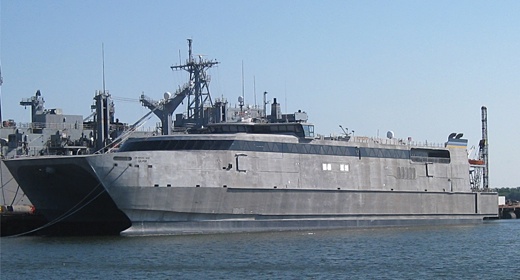
Image above: The USNV Guam with a drab new paint job and prepared for duty in Japan soaking up nuclear radiation. Click to embiggen. From Brad Parsons.

[IB Editor's note: This Superferry (The Quam) and the USS Ronald Reagan (recently contaminated off the coast of Fukushima Daiichi) are two losers headed to be stationed in Japan. Is this revenge on the Japanese for fucking up the west coast of North America?]

The Alakai is a high-speed ferry built for the failed Hawaii Superferry.  The Navy, which acquired the Alakai and a second ferry named the Huakai about two years ago, plans to put one of the vessels into service in the Pacific to support Japan-based Marines.

The Navy is putting one of the two high-speed vessels built for the failed Hawaii Superferry into service in the Pacific to support Japan-based Marines, replacing another ferry called the WestPac Express.

Defense News reports the Navy has decided to count the former Hawaii ferry toward a battle force that has grown to 291, from 283, under a new system of counting ships.

Defense News reports the Navy initially said the two Hawaii Superferry vessels, the former Alakai and Huakai, would not be counted as part of the battle force because they were not outfitted to support a company combat team, but has since changed that decision.

The Navy acquired the two twin-hulled Hawaii Superferry vessels about two years ago from the U.S. Maritime Administration, and renamed them the USNS Puerto Rico and the USNS Guam.

More recently, the state of Hawaii last year auctioned off the barges built for the Hawaii Superferry, at a cost of $40 million, for $425,000 to a buyer from the Mainland, who is trying to resell the barges to another buyer before he moves them from Honolulu Harbor.

http://www.islandbreath.org/2007Year/20-HookahiKauai/0720-13WelcomeJumbo.jpg
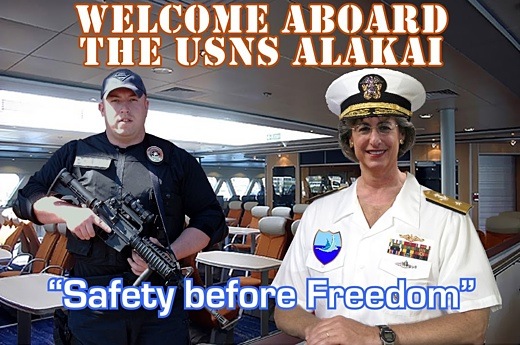
Image above: Governor Linda Lingle as leader of the Unified Command greets passengers on the Superferry Alakai with Homeland Security detail (only there for your safety). Click to embiggen. Graphic by Juan Wilson from (http://www.islandbreath.org/2007Year/20-HookahiKauai/0720-13UnifiedCommand.html).

.

State Abandoned Dam Inspections

SOURCE: Hope Kallai (lokahipath2@live.com) SUBHEAD: Under Governor Linda Lingle, DLNR Chair Peter Young covered up state forsaking dam responsibilities. By Rick Daysog on 26 January 2009 for Honolulu Advertiser - (http://www.honoluluadvertiser.com/apps/pbcs.dll/article?AID=/20090126/NEWS01/90126) Image above: From (http://islandbreath.org/2006Year/03-environment/0603-07ReservoirFails.html). Three months before the fatal collapse of the Kaloko Dam on Kaua'i, the state issued a notice suspending all dam safety inspections and emergency flood responses and later attempted to conceal the suspension, according to documents obtained by The Advertiser. And while the suspension was in place, state dam safety inspectors did not respond to reports of flooding near the Kaloko Dam a month before the March 14, 2006, disaster, missing a potential chance to identify problems with the dam. Memos and e-mails issued by state Department of Land and Natural Resources officials paint an unflattering picture of the department's actions leading up to tragedy, which killed seven people and caused millions of dollars in damage. The memos also could increase the legal exposure for the state, which is being sued along with retired auto dealer Jimmy Pflueger by the relatives of the seven victims. "The state is basically saying it is abrogating all of its legal duties," said Dennis Binder, a dam safety expert and law professor at Chapman University in Orange, California, who reviewed the memos. "That's a hell of a smoking gun." Budget problems In a Jan. 26, 2006, internal memo, the DLNR's chief engineer, Eric Hirano, said he was temporarily suspending all dam inspections and emergency responses to floods due to budget constraints and lack of personnel. A month later, DLNR Chairman Peter Young instructed Hirano to refrain from stating that the inspections have been halted, saying "we need to look at another way of handling this." "We should not state we are doing nothing, but rather state we will respond to issues and questions related to these items," Young said in his Feb. 14, 2006, e-mail to Hirano. Young did not rescind Hirano's decision to suspend inspections. And after the memo was issued, DLNR officials did not conduct any dam inspections until the collapse of the Kaloko Dam. That could be taken as an endorsement of Hirano's memo, according to Binder. By law, the state is supposed to inspect all dams every five years but the Kaloko Dam was not inspected. Young, who was voted out as DLNR's chairman by the state Senate in 2007, referred questions to the attorney general's office, citing the pending litigation. Young's ouster was partly the result of his handling of the Kaloko disaster. His replacement, Laura H. Thielen, declined comment as did a spokeswoman from the attorney general's office. To be sure, Hirano's memo and Young's response came at a time of heightened sensitivity about the state's dam system. In August 2005, Hurricane Katrina caused dozens of levees in New Orleans to fail, resulting in hundreds of deaths. The Advertiser reported in October 2005 that 22 Hawai'i dams were in urgent need of repair. The story quoted Edwin Matsuda, the engineer in charge of dam safety, as saying the state was fortunate not to have had a major dam failure. Prior flooding Because of the suspension of its flood response duties, the state may have missed some vital clues as to the condition of the Kaloko Dam prior to the breach. On February 27, 2006, DLNR's Hirano said in an e-mail that he received a report from Kauai County Public Works officials that a 4-foot high wall of water flowed from the Kaloko Reservoir area downstream to nearby Moloa'a, where it destroyed a small bridge. Rather than sending out its own inspectors to the site, Hirano took no action, even though his e-mail says he was unsure whether the flood "may or may not be attributable to the Kaloko Dam." "At this point, (Kaua'i County Public Works) will not be following up further and we'll take a wait and see approach until any news is reported and confirmed that the dam was involved," Hirano said in his e-mail.
"If the dam were to be involved, the most we would do at this point is to conduct an investigation of the situation."
The following month, the Kaloko Dam collapsed during heavy rains, sending an estimated 400 million gallons of water through Kaua'i's North Shore, killing seven people and destroying parts of a state highway and large sections of an ocean reef. Criminal charges The tragedy has resulted in criminal charges against the 82-year-old Pflueger, who owns the land under the dam. The state believes Pflueger altered a key safety feature for the dam known as a spillway. The absence of a spillway, which acts as an overflow valve, may have contributed to the dam breaking during a month of heavy rain. In November, Pflueger was indicted by a Kaua'i grand jury on seven counts of manslaughter and one count of criminal endangering. Pflueger has pleaded not guilty and has denied filling in the spillway. His attorney, William McCorriston, has argued in the past that the breach of the century-old dam was not due to overtopping and the filling in of a spillway but was likely due to the collapse of the ground beneath the dam. McCorriston also has denied that Pflueger was responsible for the upkeep and inspection of the dam, saying while Pflueger owns the land beneath the dam, he does not own the dam itself. Pflueger's deed to the property is subject to a private contract that assigns responsibility for maintenance and inspection of the Kaloko Dam to a private company, called Kilauea Irrigation Co., McCorriston has said. Defense attorneys may argue that the state is holding Pflueger responsible for inspecting the dam when the state, which is required to monitor dams, dropped the ball. The documents also could add fuel to arguments by Pflueger's legal team that the state has a conflict of interest in pursuing criminal charges against his client since the state is a party to a civil lawsuit. McCorriston has argued that the state has a vested interest in pursuing the criminal case against Pflueger since it also is being sued by the families of the victims. But Binder, the dam safety expert, believes the state's inaction does not absolve Pflueger of any potential criminal or civil liability, even if it increases the state's potential exposure. Under Hawai'i's Dam Safety Act of 1987, the repair and maintenance of a dam remains the responsibility of the owner. "That duty is not dependent on any action or inaction by the state," said Binder. See also: Ea O Ka Aina: Remove Moloaa Stream Diversion 8/18/11 Ea O Ka Aina: Ka Loko Dam Culpability 2/7/10 .

Lingle Vetoes Gay Marriage

SUBHEAD: Hawaii's Governor Linda Lingle waits until deadline to strike down pro single-sex marriage legislation. Image above: Photo of a gay marriage ceremony in Hawaii. From (http://hawaiigayunions.com/category/hawaii-civil-union-bill). By Leo Azambuja on 6 July 2010 in the Garden Island News - (http://thegardenisland.com/news/local/article_4d0c05c6-89a2-11df-bfaa-001cc4c002e0.html) Gov. Linda Lingle on Tuesday vetoed House Bill 444, which took two years to be approved by the state Legislature and would have given same-sex and heterosexual couples the same rights and benefits as couples united by traditional marriage.

“We are discriminating against people. I truly feel this is a civil rights issue. We are not treating people equally,” said Rep. Mina Morita, D-14th District.

Rep. Roland Sagum, D-16th District, said he is not against people wanting those types of union.

“It happens in every family,” he said. “But the law had the word marriage in it, therefore many people in my district wanted me to vote against it.”

Sagum noted that the core issue right now is to find jobs and getting people back to work.

Rep. Jimmy Tokioka, D-15th District, said he was concerned with the use of the word “solemnization” in the bill. “It’s in there 25 times, and it’s a short bill.”

Solemnization means to “to perform with pomp or ceremony, or especially to celebrate a marriage with religious rights,” according to Merriam-Webster.

Tokioka said that, as a representative, looking at the definition of solemnization as marriage, he also looks at the definition of marriage in Hawai‘i Revised Statues, which means a union between a man and a woman.

He said if people read the bill they would understand some of the concerns from people who are concerned about the sanctity of marriage.

Tokioka said Lingle’s desire was that the issue should be voted on by all the people of Hawai‘i. But the next opportunity to have a question on a ballot will be in two years, he said.

Some lawmakers were ready to override Lingle’s veto. The Senate was ready to convene, but House Speaker Calvin Say had already made a decision last week not to bring in the House, Morita said.

If the Legislature had gone back into session, the focus would’ve been on HB 444. The House, however, would not have a super-majority of votes necessary to override Lingle’s veto, according to Tokioka.

The bill’s effective date was Jan. 1, 2010, which Tokioka said was one of the reasons Lingle thought the bill was flawed.

“That would mean if she signed a bill today, tomorrow people could walk into the Health Department and try to get a civil union, which the Health Department is not set up for,” Tokioka said.

The Senate had just enough secured votes to override the veto, but the House’s override was still necessary for an override.

Sen. Gary Hooser voted in favor of the bill. He could not be reached for comments by press time.

Video above: National NBC news coverage of Lingle Veto. From (http://www.msnbc.msn.com/id/21134540/vp/38124509#38124509) .

Lingle robs Kauai schools

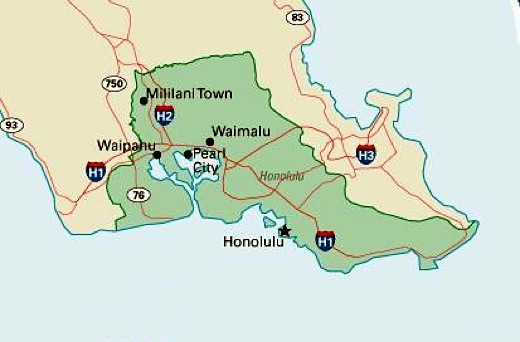
SUBHEAD: Outer island school funds to be used for Oahu special election. Image above: The map of Hawaii Congressional District 1 is just Honolulu and its suburbs. Most of the population of Hawaii lives here (as well as was most of the support for the Superferry). [Editor's Note: Taking 17 instructional days a year from our children for furloughs was not enough? Now Lingle has grabbed school renovation funding on neighbor islands to use for a special election to replace Oahu's Representative Abercrombie? Please contact the governor and let her know that this will not be tolerated: to contact Governor Linda Lingle, call 808-586-0034, or e-mail her at governor.lingle@hawaii.gov] BY: Paul Curtis in The Garden Island, Saturday March 13, 2010 - http://thegardenisland.com/news/local/govt-and-politics/article_346d745c-2e74-11df-80b8-001cc4c002e0.html The special election to fill the U.S. Congress seat vacated by Neil Abercrombie as he prepares to run for governor has nothing to do with Kaua‘i because that congressional district doesn’t include Neighbor Islands, right? Wrong. Governor Linda Lingle authorized the transfer of $389,481 from the Neighbor Island public schools repair and maintenance account into an account to help fund the special election. That move concerns state Rep. Jimmy Tokioka, D-Wailua-Lihu‘e-Koloa, he said Wednesday at the groundbreaking ceremonies for the project to make Kaumuali‘i Highway four lanes from Lihu‘e to Puhi. Tokioka said Lingle didn’t want to have to ask the state Legislature for funds for the special election, so went the route of reducing restrictions imposed on various programs in the state Department of Accounting and General Services (DAGS) instead. Among the several functions of DAGS is public school repair and maintenance for the state Department of Education, and running elections, as the state Office of Elections is administratively attached to DAGS as well. In a Feb. 24 letter to Russ K. Saito, DAGS comptroller, Lingle used her authority to reduce restrictions by $389,481 for Neighbor Island school repair and maintenance, and by $113,346 for the Office of Elections, to help pay for the special election. She also authorized in the letter moving that $389,481 into the Office of Elections account. The state Legislature likes money appropriated to be spent on what it’s appropriated for, said Saito, adding that state law allows Lingle to move no more than 10 percent of specific appropriated funds for other purposes. Saito wanted to make it clear that DAGS is obligated to perform repair and maintenance functions at public schools through an agreement with DOE, and that the $389,481 moved for the special election won’t impact any Neighbor Island school repair and maintenance projects. Savings will be made by keeping vacant positions vacant, or other means, he said. “We perform our function” for DOE. “We are fulfilling our obligations,” Saito said Friday. In these days of budget deficits, shortfalls and a sagging economy, there is a DAGS budget for X amount of dollars, and Lingle-imposed restrictions for Y amount of dollars, meaning that, even though the DAGS budget might be, say, around $145 million (the DAGS fiscal year 2009 operating budget), Lingle has mandated restrictions that DAGS can’t spend anywhere near that amount, Saito explained. The money for the special election, said Russell Pang, Lingle’s chief of media relations, has to come from DAGS (where the Office of Elections is administratively located). Pang reiterated Saito’s assurances that Neighbor Island school repair and maintenance projects won’t be affected by the money move. Regarding the special election, Tokioka said a bill moving through the state Legislature would push the election back from May 22 to Aug. 14, in order to allow enough time to receive mailed ballots from overseas for those living in Abercrombie’s former district but living or serving in the armed forces abroad. The 1st Congressional District includes the southernmost portions of O‘ahu, roughly from Waipahu to Waimanalo. The district is generally known as “urban O‘ahu.” Tokioka said the change in election date would impact just 42 days of the current federal congressional session. Abercrombie’s term was scheduled to have ended in January 2011. According to a Feb. 8 opinion from Russell A. Suzuki, state deputy attorney general, it would likely be in violation of the U.S. Constitution to delay the special election much if at all past the May 22 date. The special election is to be conducted via mail-in ballots only. Other money matters Tokioka said he had been told by state House Speaker Calvin Say and House Finance Committee Chairman Marcus Oshiro that if Tokioka wanted the hotel-room tax (transient accommodations tax, or TAT) shares to continue going to the counties, Tokioka needed to work to find around $1 million needed for the special election. The House version of the state budget, which has moved to the state Senate for consideration, includes funds for agricultural inspectors and keeping open Maui and Kaua‘i offices of state Department of Human Services. “We want to make sure there’s a presence on Kaua‘i, certainly,” he said of DHS offices scheduled to be closed as early as July 1 in state cost-cutting measures. “To me, personally, the ag inspectors were very important,” to keep invasive species out of the state and individual counties, said Tokioka. “My focus has been involved in balancing the budget,” he said. “Getting the kids back in school on furlough Fridays” is extremely important as well, he said.

DLNR on Larsens Beach access

SUBHEAD: After meeting with the people of Kauai on the Superferry, Chairperson Laura Thielen may be shy about selling us another bad idea.
  
Image above: Lingle appointed DLNR Chair Laura Thielen works tirelessly for private interests. Photo by Brad Parsons from (http://www.flickr.com/photos/21400600@N03/2267570210/)  

By Richard Spacer on 27 January 2010 in Island Breath -
(http://islandbreath.blogspot.com/2010/01/dlnr-on-access-to-larsens-beach.html)

DLNR Chair Laura Thielen tells our senator Gary Hooser there is no money for site visits or public hearings on Kauai for the Larsen's Beach issue, yet in 2009-2010 there were 3 that I know of. DLNR had meetings on Kauai to discuss Ke'e Beach in Haena State Park, Koke'e, and most recently on January 21st, Kalalau. The January 21st meeting was at Hanalei School. One of the press releases from DLNR says "providing safe public access to recreational areas is a priority for DLNR and is a cornerstone of the department's Recreational Renaissance Initiative."

Apparently that cornerstone does not apply to Larsen's Beach where the safe access is the gentle, lateral trail that is proposed to be fenced off! How can Thielen say there is no money for a public hearing on the Larsen's issue but there was for these other 3 Kauai issues? T

o read a PDF file of two recent letters from DLNR Chairperson Laura Thielen to Kauai's Hawaii State Senator Gary Hooser concerning Larsen's Beach blocking click here: www.islandbreath.org/2010Year/01/100128ThielenHooser.pdf The text of the first letter follows.


DEC - 11- 2009
Dear Senator Hooser:
SUBJECT: Conservation District Use Application (CDUA) KA-3525 for Brush/Pasture Management & Fence Replacement Located at Lepeuli, Hanalei, island of Kauai, TMK: (4) 5-1-003.003
Thank you for your correspondence dated December 2, 2009, regarding your requests to hold an informational hearing on Kauai and to have the Board of Land and Natural Resources review the subject CDUA. According to your information. you are very concerned that it appears the proposed cattle fence replacement will block a lateral existing trail and impact public use at Larsen's Beach.
Departmental staff has been working closely with the County of Kauai, as the County owns a public access way to the beach in the same vicinity. According to landowner, Waioli Corp., this defined public access way was an agreement between Waioli Corp. and Kauai County that includes an access road, parking lot and a winding trail from the parking lot to the beach. The winding trail was to provide beach access that also protected the beach by intentionally creating a not so easily traversed path from the parking lot to the beach.
The intent was to minimize numbers of people and their impacts as this is an isolated beach with no facilities or lifeguard where several drownings have occurred and there are many known resources that exist and utilize the area (seals, turtle, kaakaniu reef white sandy beach, & birds).While access is provided, it is not encouraged.
The public has been traversing a much gentler slope to the beach across Waioli Corp.'s private land. Should the CDUA be approved, this access across Waioli Corp.'s proper-ty will cease, as the fence replacement will prevent individuals from going down this private pathway. However, access to the beach will continue to be through the County designated pathway. Public access to Lepeuli (Larsen's) Beach shall be maintained by the County of Kauai.
As you are aware, due to fiscal constraints, neither the Board northe Department shall be able to hold an informational hearing on Kauai. Regarding this Conservation District Use Application, I will carefully reviewstaff 's analysis and recommendation in my decision-making. Tentatively,a decision on this particular CDUA is proposed to be forthcoming later this month.
Should you have any questions regarding this matter, feel free to contact Tiger Mills of our Office of Conservation and Coastal Lands at (808) 587-0382.
Sincerely, Laura Thielen, Chairperson Department of Land and Natural Resources cc: Kauai Planning Dept.
The text of the second letter follows.
[Publisher's Note: Thielen has a typo on her January letter. It says JAN - 7 - 2009. We corrected to JAN - 7- 2010.]
JAN - 7- 2010
The Honorable Gary L. Hooser Majority Leader State Capitol, Room 214
SUBJECT: Conservation District Use Application (CDUA) KA-3525 for Brush/Pasture Management & Fence Replacement Located at Lepeuli, Hanalei, island of Kauai, TMK: (4) 5-1-003:003
Dear Senator Hooser: The Office of Conservation and Coastal Lands (OCCL) is in receipt of your correspondence requesting a briefing and site visit prior to any approval of the subject CDUA. I will contact your office to schedule a meeting. In regards to a site inspection, as I have explained before in the attached correspondence, due to fiscal constraints, we are unable to afford travel expenses as our Department's budget has been reduced by approximately a third in the past few years. However, we have had on-island staff conduct a site visit, have discussed the matter with our Kauai Land Board member and with the Mayor of Kauai.
All parties agreed there is alternative beach access available and that the landowner's efforts have had a positive effect in eliminating significant trash and undesirable behavior in the area. Please feel free to contact Tiger Mills of the Office of Conservation and Coastal Lands regarding any questions that you may have regarding the subject application or this correspondence at (808) 587-0382. Sincerely, Laura Thielen cc: County of Kauai, Planning Department.

Governor Lingle Misspeaks

SUBHEAD: As is par for the course, Lingle mangles truth and logic to make a bad case regarding alternative transportation. 

By Brad Parsons on 18 January 2010for Island Breath -
(http://islandbreath.blogspot.com/2010/01/governor-lingle-mispeaks.html)


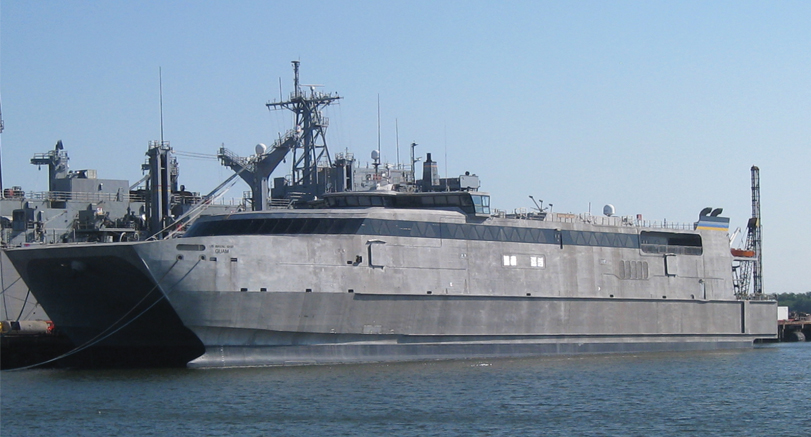
  Image above: The two Hawaii Superferries docked in Norfolk, VA since 7/1/09. From Dick Mayer. From (http://connect.hawaiinewsnow.com/vmix_hosted_apps/p/media?id=9401236)  

"Governor says city needs to revise its financial plan for rail project."  

This from today's article in The Honolulu Advertiser covering Linda Lingle's opening remarks at the Honolulu chapter of the American Institute of Architects presentation of the Honolulu rail transit program. During her remarks she said:
"The Superferry did not use one dollar of public funding. We had reimbursable general obligation bonds that were paid for, and will be paid for, by the people who use the harbors. There's not one dollar of direct tax funding that ever went to Superferry or was pledged to Superferry or will be used for Superferry in the future."

6WRONG! The Superferry DID use public funding beyond the general obligation bonds. Beyond the bonded money there was all of the money spent to fix the barge at Kahului harbor. There was all of the money spent on the tug boat service daily to hold the barge to the Kahului pier when the ferry came in.

There was all of the money spent for extra DLNR security when the ferry first started operating and then continuing for inspections. There was all of the money spent to pay for the Act 2 Special Session. There was all of the legal fees of the Attorney General in this case. There are all of the legal fees of the continuing bankruptcy proceedings. Lingle also said:

"In addition, there was never a requirement for an EIS for the Superferry until it was challenged and went to the State Supreme Court and then the Supreme Court made the ruling. The Superferry was treated the way every other ocean-related project was treated whether it was Matson, NCL, Young Brothers or anyone else using our oceans. It was treated the same way, our Administration made the same decision, it's just that the Supreme Court changed the law with their decision."

WRONG AGAIN! You are one hard-headed, obstinate politician! The EIS requirement existed all along, before the Supreme Court even made their first ruling on this. The Superferry was not treated the same as the other harbor users. Those harbor users have had to do EIS's for similar projects. The Supreme Court never changed the law. In fact, it was your Attorney General who wrote the flawed new law Act 2 and your Administration who lobbied the new law through the Legislature. The underlying HEPA law never changed. The Supreme Court never changed the law.

Return of the Zombieferry

SUBHEAD: So you thought the Superferry was dead. Don't be too sure. The Lingle Administration still wants to save its reputation. Image above: "Ghost Ship Series: The Ninth Wave" by George Grie. From http://www.neosurrealismart.com/modern-art-prints/?artworks/ghost-ship-series-the-ninth-wave-remake.html By Brad Parsons on 21 November 2009 - While kids go without Furlough Friday classes, the Lingle Administration is developing a previously secret plan to revive the Superferry. State may be using it’s Third Mortgage to negotiate with MARAD to bring the two ferries, Alakai and Huakai, back to Hawaii to operate. Feds would own and operate the ferries to be subsidized with additional operating budget appropriations to be arranged by Inouye. Story to follow at blog site. Below is a copy of message sent directly to Senator Inouye.
Senator Inouye:

It has come to my attention that Linda Lingle's Administration is trying to negotiate with MARAD the return of the Alakai and Huakai to Hawaii to operate as a federally owned and subsidized ferry service. The alternative would otherwise be that MARAD just sell the vessels for greater use elsewhere in the world.

You should be aware that if you help Linda Lingle return these to Hawaii to operate as a ferry service, Linda Lingle plans to use this as a statewide campaign issue in 2010, that she believes would be popular with the Oahu electorate. On the otherhand, if her plan never gets off the ground, and the ferries are sold, the Oahu voting public will not be reminded of the issue, and it would not be an issue in the 2010 election. Take it as good advise, Obama's MARAD and your office should not aid Linda Lingle on this issue, as any assistance you offer her on this she intends to use against you and the Democratic Party in the next election. MARAD should just sell the vessels as they otherwise would.

Aloha, Brad Parsons

.

State ignores outcry at Kokee Plan

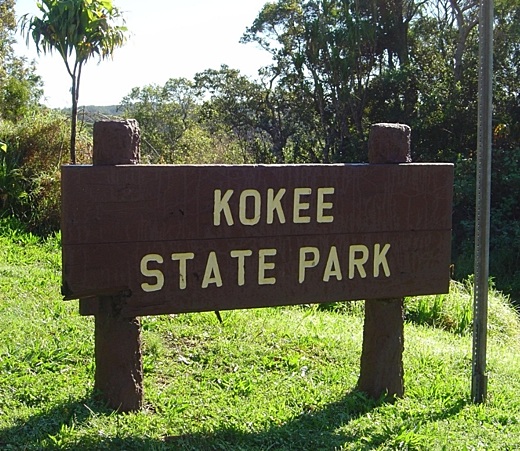
SUBHEAD: Residents reject Kokee entrance fees. Public tell DLNR to preserve park "as is". You can still submit testimony by letter or e-mail until November 19, 2009. [Editor's Note: After years of countless public meetings and almost unanimous requests to preserve Kokee as it is, the state continues to ignore the public and move ahead on plans to develop Kokee and turn it into an income generator for the rest of the park system. You can still submit public comments by November 19th, e-mailed to: RecreationalRenaissance@hawaii.gov or mailed to: DLNR, Reacreational Renaissance Rules PO Box 621 Honolulu, HI 06809] By Paul C Curtis on 5 November 2009 in The Garden Island - http://kauaiworld.com/articles/2009/11/05/news/kauai_news/doc4af28de633d31332983334.txt PUHI — Michael Ornellas of Kapa‘a said his father warned him that one day he would lose access to the very place he was born and raised, the mountains of the Eastside. The idea of losing access to hunting grounds in Koke‘e on the Westside is unfathomable, he said. State Department of Land and Natural Resources officials heard comments from dozens of community members who testified Wednesday evening at the Chiefess Kamakahelei Middle School cafeteria. The hearing was held to address the proposed amendments to Hawai‘i Administrative Rules governing state parks that would allow DLNR to charge admission to state parks and use the money to support the park system, among other things. . “Koke‘e is the only place all of us get access to,” Ornellas said, adding that several of the places he and others used to hunt on the North Shore and Eastside are no longer accessible due to gates erected by private landowners. “Listen to everybody.” Robert Girald, a lifelong Puhi resident who also recalls unfettered access to the mountains and ocean while growing up, said Koke‘e is now the only mountain place remaining for public hunting here and needs to remain available to hunters. “Keep it wilderness. Keep it Kaua‘i,” said Girald, who also recalled a short-lived federal idea in 1964 to make Koke‘e a national park. After local public opposition, the national-park idea “faded away,” he said. “Let’s keep things simple. We don’t need all of that,” he said of an entrance gate, entrance fees for visitors, concessions and other ideas conceived to generate revenue for state-land upkeep. “Let’s keep it a wilderness park,” said Girald, adding that he is surprised that after hours of public testimony against the state’s Recreational Renaissance Plan B to fund repair and maintenance of state parks and harbors that there have been no proposed changes to the plan. There are so many new rules proposed that the state will need to hire more people just to enforce the rules, he said. The public opposition to the proposed erection of an entry gate and an entry fee for visitors to Koke‘e State Park and Ha‘ena State Park was seemingly unanimous. And all those who spoke on proposed increases in mooring fees at state harbors opposed such increases. Richard Iwamoto, a Westside commercial akule fisherman, said an increase in mooring fees for his boat would be passed on to consumers, moving the price of akule from $6 a pound to $7.20 a pound in local stores. Most people who eat akule are elderly who can’t absorb the additional cost, “So what’s going to happen? We sure as hell can’t fish for a loss,” Iwamoto said. The community and people are against a gate and entrance fees at Koke‘e State Park, said Adrian “Cowboy” Malina, who was given the three minutes of several other registered speakers and said the “sweat equity” used to fix the road access leading to Polihale State Park could also be used to fix up Koke‘e. Malina, who was cited and had to go to court for the way he went about trying to improve Koke‘e roads and waters (like removing invasive ginger from streams in apparent violation of federal and state Clean Water Acts), said he would “go to court anytime for the right thing.” He also advocated finding a nonprofit to fix up and manage run-down state cabins at Koke‘e, and that fellow hunters he talks to would be willing to donate vehicles, equipment and labor for park improvements. One recreational boater said proposed increases for mooring fees at state harbors would be “raping the boaters,” and said what the state describes as “modest increases” in mooring fees are anything but modest. A rise in mooring fees at Hanalei Bay from $30 to over $1,000 is not modest. “The people will help you,” but the proposed fee increases are “off the planet,” the boater said. Other speakers said people won’t pay the increased mooring fees in Hanalei Bay because they can’t afford them. “Hawai‘i should have world-class (harbor) facilities,” but don’t, said Dick Olsen, former commodore of the Nawiliwili Yacht Club. If the state can’t afford world-class harbor facilities, they should seriously consider privatization of state harbors, he said. “Koke‘e is not bad, and you guys (state DLNR officials from O‘ahu) just don’t get it,” said Ned Dana. “You guys need to learn from Kaua‘i.” Dana added that the plan should have started with public meetings to gauge what the public wants, instead of coming up with a plan first then conducting statewide meetings on the proposals. Linda Marsh of Bubbles Below scuba charters said six-passenger-boat operations like hers can’t survive with increased mooring fees. “I may very well be forced to sink my boat” if it costs $3,000 to moor for the summer in Hanalei Bay, said Phil Green. “This is absurd. These are not modest increases.” Mary Lu Kelley said she doesn’t like the way the state plan is being pushed in front of the ongoing development of a Koke‘e master plan. “We do not want a gate. We don’t want another lodge in Koke‘e,” she said, adding that she wants vacant lands and vacant cabins auctioned off. Several speakers including Bruce Pleas of Kekaha said entrance fees collected on Kaua‘i should stay on Kaua‘i, while another speaker said the state plan continues the attack on the mountains, heritage and history of Kaua‘i. “You guys aren’t even going to listen to us,” she said to state officials, adding that they don’t understand “our connection with the land.” “Kaua‘i is not a zoo,” and Kauaians don’t want entry gates, concession stands and parking lots, said another speaker. At least 60 people attended the meeting. Canen Ho‘okano, chair of the Koke‘e Advisory Council, said increasing the administrative fee visitors pay when they rent vehicles would raise more money than the plan to institute entry fees at eight state parks across the state. “Koke‘e is self-sustainable by itself. Let’s start getting a little more creative” in fund-raising ideas, said Ho‘okano. Nancy Budd, also a member of the Koke‘e Advisory Council, said there are lots of other ways to raise lots more money than through entry fees, that each island finds its own special places sacred, and that management of parks should be sensitive to the local mana‘o, or knowledge. The current proposed Koke‘e master plan ignores several years of public opposition, said Budd. “(The state) should trash this paper. No Plan B, no gates,” said Puanani Rogers. The state should go with the Koke‘e Advisory Council’s recommendations for the park, “and let it be ours, not yours.” Rogers spoke of the cultural, archaeological and historical significance of Ha‘ena and Koke‘e, and said, “Please do not mess around with our burials, OK?” Dayne Aipoalani of the Polynesian Kingdom of Atooi sovereignty group served papers on Dan Quinn, state parks administrator, saying 92,000 acres of crown lands in Waimea, Koke‘e, Alaka‘i and Na Pali belong to the Hawaiian people, not the state. The cease-and-desist order also claims the state is trespassing. “The lands that you talk about do not belong to you,” said Rogers. Public comments on the state plans must be postmarked (via U.S. mail) or e-mailed by Nov. 19, to RecreationalRenaissance@hawaii.gov, or mailed to DLNR, Recreational Renaissance Rules, P.O. Box 621, Honolulu, HI 96809. More information on the comprehensive plan is available at www.hawaii.gov/dlnr/recreate. The proposed rules are available online at hawaii.gov/dlnr/rules. Copies for public review are available Monday through Friday from 8 a.m. to 4 p.m. (except furlough Fridays) at the DLNR district offices for the Division of Boating and Ocean Recreation (at Kukui Grove Professional Village), and State Parks and Forestry and Wildlife (in the Lihu‘e State Office Building). People may also make written requests for mailed copies by sending name and mailing address in correspondence sent to the DLNR address above. see also: Ea O Ka Aina: Save Kokee Meeting 6/28/09 Island Breath: Kokee will never be the same 7/27/06 Island Breath: DLNR Betrayal of Kokee 7/26/06

Dead Last - Hawaii gets F in Education

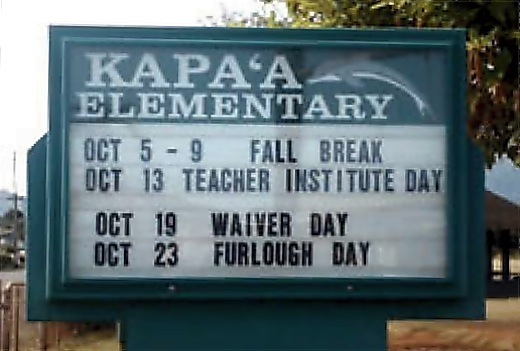
SUBHEAD: Our politicians and community leaders always say children are our future. This is the time they need to prove it. image above: Kapaa Elementary sign of lack of educational offerings. From article in Truthout.org. Photo by Jack Yatsko. By Jon Letman on 6 November 2009 - http://www.truthout.org/1106098

Hawaii's public schools are in crisis.

Simply put, there isn't enough money to keep them open full-time. With the State of Hawaii facing a $1 billion budget deficit through the middle of 2011 and a $468 million budget cut to Hawaii's Department of Education, in September the Hawaii State Teachers Association (HSTA) voted to accept a two-year contract that includes 17 furlough days for both the 2009-2010 and 2010-2011 academic years.

Commonly referred to in the islands as "furlough Fridays," the cuts have been scheduled for regular school days, reducing Hawaii's public instruction from 180 days to 163, the fewest in the nation and ten days less than the state second from the bottom, North Dakota.

The classroom cuts were made despite President Obama and Secretary of Education Arne Duncan's call for the nation's schools to increase the amount of classroom time so that the US can better compete in the global marketplace.

With what was, for most parents, an unexpected and unwelcome surprise, the furloughs have sparked a firestorm of debate in which state politics, budget priorities and questions about the impact school cuts will have on students, their families and the state have all come to a head.

There is no shortage of frustration to go around, particularly among parents of public school children. One such parent is Jack Yatsko, a PTSA member and the father of fifth and eighth grade daughters on the island of Kauai. At an anti-furlough rally he helped organize one week prior to the first furlough day, Yatsko said in a speech before Kauai's state building, "our kids are not poker chips in a high stakes game of budget and contract negotiations."

Yatsko pointed out that in 2005 and 2006, the Department of Education consistently informed parents that if their child missed 10 or more days of school without a medical excuse, they could be prosecuted for educational neglect.

Of the 34 furlough days planned this year and next, Yatsko said, "this is educational neglect."

Another parent on Kauai, Nadine Nakamura, has a son in fourth grade and daughter in eighth grade. Nakamura is also a PTSA member and is chair of her School Community Council.

Like Yatsko, she sees a web of blame-game being played. "Everyone is pointing to the other group, saying, 'it wasn't us.' The governor says she wasn't involved in negotiations. The legislature says the governor wouldn't raise taxes, then you have the Board of Education and Department of Education saying the legislature and governor shouldn't have cut their budget in the first place. Some are saying parents should have rallied a long time ago. One state legislator says, "I can't believe the teachers approved [a contract with furloughs]."

Senate Majority Leader Gary Hooser, among the most vocal state legislators calling for a special legislative session to examine possible alternatives to the furlough days, calls the classroom cuts "unacceptable."

In an op-ed piece in the Honolulu Advertiser, Hooser suggested a using a portion of a $180 million Hurricane Relief Fund as one way to keep schools open. Hooser has also called for reforming Hawaii's general excise tax which, unlike most states, generates the bulk of Hawaii's education funding. So-called "new sin taxes" on soda, processed and fast food, and petroleum oils are potential revenue generators, Hooser wrote.

According to Wil Okabe, president of the Hawaii State Teachers Association, Hawaii's public schools, which operate as a single school district, cost $5 million a day to run. The latest two-year contract, approved by 81 percent of voting teachers, reduces their pay by nearly 8 percent as it slashes instructional days for students.

And while Hawaii received over $157 million in stimulus funding through the American Recovery and Reinvestment Act, money intended to keep the state from cutting education services, Okabe indicated that it was Governor Lingle who imposed 14 percent budget cuts on the Department of Education while using stimulus money for balancing the state budget. Okabe called it a "shell game."

He added that Hawaii's schools do have the opportunity, if they choose, to individually vote to exchange non-instructional work time such as "professional development" or "wavier days" for cancelled class days as an alternative to furlough Fridays.

One woman who knows Hawaii's education system intimately is Maggie Cox. Currently serving her second four-year term as Kauai's representative to the Board of Education, Cox has worked as a teacher, vice principal and principal for 40 years in Hawaii. She also served on the negotiating committee for the contracts that include the 17 furlough days.

Cox says that if the governor or state legislature wanted to "bail out" the schools, they could have done so last spring. If they provide the funds, she says, the schools can return to offering full instruction.

While stressing that the Board of Education reduced classroom cuts by over 50 percent (from Lingle's originally requested 36 days to 17), Cox said, "we did the best we could to have as little impact on the schools as possible." She concedes that reduced classroom time means some subjects won't be covered or covered as well (in the classroom). Cox also noted that prior to the furlough days, Hawaii's academic year was 180 days, in keeping with the majority of public schools across the country but, as she acknowledged, well below that of countries in Europe and Asia.

"When you look at other nations, teachers' salaries and schools are top priority. The budgets are there for them," Cox said.

According to Trends in International Mathematics and Science Study 2003 research, the average number of instructional days in Korea, Japan and China was over 221, with Australia, Russia, England and Canada all between 188 and 196 days. With the latest cuts, students in Hawaii could have up to 12 weeks less class time a year than those in East Asia.

Meanwhile, nearly one-third of Hawaii's public schools are in restructuring as they attempt to meet federal No Child Left Behind requirements and Hawaii's fourth and eighth graders' test scores lag behind in National Assessment of Educational Progress rankings.

Here a cut, there a cut

Hawaii's state employee furloughs haven't been limited to educators and school employees. One furloughed state employee is Raymond Catania, a social services assistant with the Department of Human Services, Child Services, and an 18-year veteran with the state.

Catania, who has two teenage daughters, one a sophomore at Kauai High School, pulls no punches.

"By forcing teachers to take furloughs, it hits our children. Rich families can send their kids to Punahou (where Obama studied) or other private schools, but the working class can't afford that so our kids get cheated."

"The governor got what she wanted - furloughs and layoffs," Catania said, blaming the Lingle administration for not raising the general excise tax in a bid to please what he called "the business community she represents."

All options, including the hurricane fund, tax increases and the introduction of a lottery to generate revenue, should be examined, Catania said, adding that the governor shares blame for the school cuts with the teachers' union leadership.

"They (HSTA) were in the best position to resist the furloughs. There was far more sympathy for teachers and kids than for state workers like me. If the union refused to accept furloughs, there would have been a lot of public support, but they gave in and settled quickly."

And while many argue that temporary furloughs are better than layoffs, Catania disagrees. "Some elements in the community say, 'at least we've got our jobs.' The slaves had jobs. So what? My wife and I have three jobs and we can't even pay our bills and we're not alone."

In a state with some of the highest living costs in the nation, where salaries are consistently lower than national averages, Catania's frustrations are not uncommon. The furloughs and classroom cuts have only rubbed salt in open wounds.

Catania said that with Hawaii's huge military presence, it is painful to see military expenditures increase, while the host state suffers what he considers disproportionate cuts to education and human services.

Some State of Hawaii education officials expressed similar criticisms of burgeoning military budgets while education programs are slashed, but refused to be quoted by name.

On Oahu, Kyle Kajihiro, program director for the American Friends Service Committee, an international Quaker-founded nonprofit that works for development, peace programs and social justice, sees the current economic crisis as a pretext to cut programs for political or ideological reasons. He said the cuts are indicative of the state's priorities.

"I have to question why the defense budget keeps going up and up and schools keep getting cut. It's unconscionable." Citing the National Priorities Project, Kajihiro points out that since 2001 Hawaii residents have paid a $3 billion share of the wars in Iraq and Afghanistan. "For that same money, Hawaii could have funded 54,718 elementary school teachers for a year," he said. Hawaii has around 13,000 public school teachers.

Long-term effects of school cuts include lowering Hawaii's competitiveness and ability to diversify its economy, keeping Hawaii dependent on federal handouts and tied to an economy based on the military and tourism, Kajihiro said.

Instead, Kajihiro said that because Hawaii is an isolated state with finite land and natural resources and heavily reliant on imported food and energy, it could also be a case study of best practices that could apply to the rest of the planet.

"There is experience here based on ancient Hawaiian models that we could be capitalizing on to create a new paradigm of economic development and sustainability, but we need to foster young people with the necessary imagination and schooling to become global leaders."

"Politicians and community leaders always say children are our future. This is the time they need to prove that they mean it by funding our schools and investing in education."

Jon Letman is a freelance writer in Hawaii. He writes about politics, society, culture and conservation on the island of Kauai. He can be contacted at jonletman@hawaiian.net.

see also: Ea O Ka Aina: Hawaii's Chuldren Left Behind 11/1/09

Hawaii's Children Left Behind

SUBHEAD: It has the shortest number of school days and abysmal performance record... and just cut instruction time.

image above: Hawaii State Teachers Association members vote on contract. http://www.edweek.org/login.html?source=http://www.edweek.org/ew/articles/2009/09/30/05hawaii.h29.html

Editorial on 30 October 2009 in New York Times - http://www.nytimes.com/2009/10/31/opinion/31sat2.html

The economic crisis has forced every state to scramble to get its budget in balance. This has meant torturous efforts to preserve essential services and minimize the pain and damage from slashed spending and lost jobs. Every state has sacrificed. But Hawaii has sacrificed its own schoolchildren.

The 50th state, the only one with a single statewide school district, has just cut 17 days from the academic year, under a new labor contract with public school teachers that avoids layoffs in favor of pay cuts and furloughs, all to be taken on instructional days. Barring a court order or other intervention, there will be no classes on most Fridays for the rest of the school year, leaving 170,000 children in the lurch. Parents are furious that a state already lagging in academic achievement would willingly adopt the country’s shortest school year.

The teachers’ union, the school board, the Department of Education and Gov. Linda Lingle all share responsibility for the debacle; they all signed off on the new contract last month. Ms. Lingle issued a statement at the time praising it as being “in the best interest of teachers, our students and the general public.”

Parents don’t think so. Nor does the federal education secretary, Arne Duncan. In an op-ed article in The Honolulu Advertiser, he called it “inconceivable” that furlough Fridays were the best solution to school-budget woes and wondered why the state hadn’t used its federal stimulus money to save classroom days. (The state instead used the $105 million to cut its own contribution to education, which was legal but hardly admirable.)

Hawaii’s political leaders and school officials are now standing in a circle of blame, pointing at one another. The governor, who had ordered the Department of Education to cut its $1.8 billion budget by 14 percent, now says she had not expected the union to take its furlough days from instruction time. She said she regretted the settlement, even though her attorney general defended it in hearings over two federal lawsuits filed on behalf of parents and children trying to restore the school days.

As other states struggle to bolster education, to add classes and lengthen the school year, Hawaii is going in the wrong direction. What it needs are not apologies but open classrooms for the students whose futures are being mortgaged — especially the poor and disabled children and those in special education who are particularly vulnerable to lost instructional time. For now, they are learning a terrible lesson in how little their government and teachers think an education is worth.

Hawaii Furlough Friday Rally

SOURCE: Andrea Brower (andrea@malamakauai.org) SUBHEAD: Demonstration against loss of student instruction time by Lingel Administration. image above: Plein air painting of Old Hanalei Elementary school by Ed Terpening. From http://www.edterpening.com/cityscapes.html WHAT: Furlough Friday Rally against loss of student instruction time WHEN: 16 October, 2009 from 3:00-4:00pm WHERE: State Office Building Lihue, Kauai, Hawaii All parents, students, teachers, and members of the public are invited to a rally to send a message to the Governor, State Legislature, and the Department of Education, and Hawaii State Teachers Association that 17 Furlough Fridays this school year are not acceptable. The rally will be held at the State Office Building on Friday, October 16, 2009, from 3:00 to 4:00 p.m. The rally is being organized by parents of public school students. “A special session of the State Legislature is needed to find a long-term funding solution that does not sacrifice instructional days for our youth,” said Tracy Murakami, parent of children attending King Kaumualii Elementary and Kapaa Middle Schools. “Action is needed NOW,” said parent Jack Yatsko, Kapaa Elementary School PTSA Board Member. “It is unacceptable that Hawaii public schools would have the fewest instructional days in the Nation if the furlough is implemented." The rally is intended to show public outrage over decisions to reduce 17 instructional days this school year. Rally organizers ask that participants wear school colors and/or uniforms, protest with aloha, and use this as an opportunity to teach our youth about our basic democratic right to free speech. More information about the rally can be found on the Kauai Planning and Action Alliance website at: www.kauainetwork.org.

Micro-Managing

SUBHEAD: Pacific immigrants from Micronesia face a government death panel of their own. SOURCE: Shannon Rudolph (shannonkona@gmail.com) By Alan D. McNarie on 2 September 2009 in Honolulu Weekly - http://honoluluweekly.com/feature/2009/09/micro-managing Retired cook Calvin Nelson says that when he came to Hawaii from Kwajalein after the United States had seized his home for a new missile range, he was told, “everything will be covered.” But 20 years later, he learned that a new health program that the state government was issuing for himself and thousands of other Micronesian immigrants wouldn’t pay for the kidney dialysis that kept him alive. He vowed that if that happened, he would go back and reclaim his home on the missile range. “Well, I guess I don’t have any choice but to go home and to go to heaven. There’s no other way for me to receive treatment,” he told the Weekly. Trucy James was in a similar situation, except there was no home left for her to return to. It was destroyed in a nuclear bomb blast–one of 67 such nuclear tests that devastated much of the island chain. Now, like Nelson, she faced a cutoff of her dialysis, without which both would be dead in a matter of days. image above: Photo by author Alan D. McNarie Nelson, James and approximately 108 other legal Micronesian immigrants on dialysis got a last-minute reprieve from the governor on August 31, when Senior Policy Advisor Linda Schmidt and Health and Human Services Director William Koller told a group of Micronesian protestors outside Lingle’s office that their kidney dialysis would be covered for the next two years. Not so lucky, perhaps, were 130–160 Micronesians, including Marshallese nuclear test refugees, who need radiation therapy or chemotherapy for cancer. According to a Health and Human Services press release, the dialysis patients could be treated because Federal courts had ruled dialysis an “emergency treatment” and the Federal government would eventually reimburse the State for such treatment–but “We cannot cover chemotherapy in the same way because the Federal Government does not consider it an emergency.” “We are working with the American Cancer Society and other providers to find a way to continue chemo treatments,” said the press release. Queens Medical Center said Tuesday it will continue to treat Micronesian cancer patients at no cost, for now. Hundreds of Micronesian immigrants may lose their benefits entirely, because they didn’t file the proper paperwork on time. Who pays? At the heart of the Micronesian health crisis is the state’s budget crunch and a dispute between the U.S. and the State over who should foot the bill for the immigrants. The U.S. is obligated to provide for Micronesian immigrants’ health needs under the Compact of Free Associations, which guarantees residents of the former U.S. Trust Territories of the Pacific Islands access to some U.S. domestic programs and services in exchange for military concessions from the Federated States of Micronesia, Republic of Palau and Republic of the Marshall Islands–including the missile range at Kwajalein. Under COFA, the federal government also divides $30 million of “Compact Impact” money annually among Hawaii, Guam, American Samoa and Northern Mariana Islands to help defray the cost of providing services to Micronesian immigrants. The Lingle administration maintains that it spent over $101 million to provide such services in 2007, but only got $11 million in Compact Impact payments from the U.S. government. In response to this gap, the Lingle administration is removing Micronesian immigrants over the age of 18 from a program that provided the equivalent of QUEST (Medicaid) coverage, and is enrolling them instead under a new program called “Basic Care Hawaii,” which provides only a fraction of the former coverage. The administration claims it will save $15 million dollars by making the change. Critics contend, however, the change will force the immigrants be forced to use hospital emergency rooms instead of their former health care providers, thus straining the ER’s ability to provide services to all residents. From Eniwetok to Ocean View Particularly hard-hit may be the Big Island–especially the rural district of Kau, where relatively cheap land prices and rental costs have lured thousands of Micronesians. According to Dr. Keola G. K. Dowling, who serves as Care Coordinator for COFA Immigrants at the Big Island’s nonprofit Bay Clinics, the island holds 2,000–3,000 Marshallese, 3,000 Chuukese, 1,500 Kosraeans, 150–300 Yapese, 1,500–1,800 Pohnapeians, and 200 Palauans. But Dowling believes those estimates are low. He says more than a thousand Marshallese reside in the remote Kau community of Ocean View alone. “Almost all of the Eniwetok refugees live there,” he says. “Some Bikinians too. They definitely consider themselves nuclear refugees.” The U.S. Eniwetok and Bikini were used as nuclear testing grounds, setting off 67 open-air atomic and hydrogen bomb blasts that equaled, Dowling says, “1.7 hiroshima-sized bombs every morning 12 years…One of the islands in their homeland was turned into white light. It was vaporized.” “Of 160 Micronesians who are under chemotherapy in Hawaii, most of them are from the Marshall Islands, and most of those came from where they blasted those bombs on Eniwetok and Bikini,” Dowling notes. Bureaucracy vs. Culture The Micronesians’ supporters also claim that many immigrants didn’t know to register for the new program, thanks to a combination of cross-cultural difficulties and poor government planning. “Their exposure to bureaucratic systems and the necessity of doing paperwork has been pretty limited,” says retired UH-Hilo Professor Craig Severance, who has lived in Micronesia and who wrote a letter to Lingle supporting a delay in the implementation of the new program. He notes that while “Those that have been here for a while are well adjusted,” newcomers from the outer islands have trouble with bureaucracy, and “part of the trouble is not so much their fault as it is the agencies…It’s the responsibility of the agencies to make that transition easy, and not difficult. It’s also to make the translation and the communication of expectations clear, rather than simply stereotyping all Micronesians as being the same.” When members and supporters of Micronesians United called an ad hoc to discuss the health crisis, some participants brought stories of immigrants who were stymied in their efforts to get their paperwork in for the transition, because they were referred to automated phone services that were either entirely in English or were so badly translated that Marshallese islanders didn’t recognize the reputed Marshallese phone recordings as their own language. “A lot of them that did call them said that the recording was automated and ‘We didn’t understand it, says Leilani Resureccion of the nonprofit Alii’s Hale, which works with Pacific islanders in Kau. “If you don’t get your form in, then you will lose your health care for yourself and for your family.” Both Severance and Resureccion note that state law requires the government to supply translators for those who need them. But translation wasn’t the only problem. Ocean View has no post office. Many of the immigrants get their mail at post office boxes in Kona, 40-plus miles away, and many do not have cars, so they don’t often check their boxes often. So many may not have gotten the notification letters and forms that were mailed out. Resureccion notes that the Marshallese are a “very communal” people and that the best way to get the word out was through meetings. “Did the health workers actually come out here and hold meetings to inform them of the change?” she asks rhetorically. “You know what the answer is? No.” So the Lingle administration may save even more money than it anticipated, by dropping many members from its health care rolls entirely. Cream-skimming Participants at the August 31 meeting accused the Lingle administration of achieving the savings it claimed by essentially cream-skimming–keeping Micronesian patients who were unlikely to cost much and dumping high-expense, chronic care patients. One noted that the State of Hawaii was probably actually making a profit off under-18 Micronesians, who required little health care. “Migrants under 18 are not being taken off of Quest because they get two-for-one matching funds from the Feds,” he claimed. Downing also notes that the Lingle Administration could have saved money simply by reducing bureaucratic waste. He notes, for instance that both Bay Clinics and another organization got grants to do redundant studies of the immigrants’ needs. “There was a third entity called the COFA task force, and they had very big funding. As far as I know, they’ve never published anything of what they did,” he adds. PR Problem On top of their bureaucratic woes, Micronesians in Hawaii are also battling the same image problems that many immigrant groups face. When the Honolulu Advertiser ran a story about the health care crisis, online comments ran heavily in favor of the cuts; many of those commented made remarks to the effect that the Micronesians were freeloading. That’s far from the truth, according to their supporters. Resurecion says that in Kau, many of the Micronesians work as macadamia nut and coffee harvesters. “Most of the Micronesians we know are working and some of them are working in professional capacities,” says Severance. Downing agrees. “We do not want people ever to be saying of Micronesians that they were victims.”

Recreational Rennaisance Plan B

SUBHEAD: Staff presentation of "Recreational Rennaisance Plan B" and revenue generating fees.
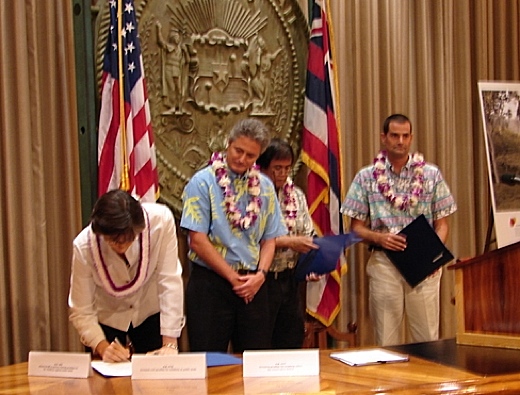
image above: Lingle signs SB1891 that increases fine for violating DLNR regulations and presents copies to Tim Johns, BLNR President, Ron Agor, and Mark Fox of the Nature Conservancy. WHAT:
Agenda for the meeting of the Board of Land and Natural Resources
WHEN:
Friday, August 14, 2009 at 9:00 am WHERE:
Kalanimoku Building Land Board Conference Room 132 1151 Punchbowl Street, Honolulu, HI 96813
WHO:
Kauai Representative to BLNR is Ron Agor

4028 Rice Street, #B Lihue, HI 96766

phone: (808) 245-4550

email: ron@agordesigngroup.com

website: www.agordesigngroup.com

[Publisher's note: Ron Agor is also a Kauai architect and chairman of the Kauai Republican Party]
BLNR AGENDA A. MINUTES 1. July 22, 2009 Minutes B. ADMINISTRATION 1. STAFF PRESENTATION AND BOARD APPROVAL OF RECREATIONAL RENAISSANCE “PLAN B” AS FOLLOWS: 1. STATE PARKS a. Appoint Staff to be Hearing Officers for purposes of Conducting Public Hearings related to Proposed Amendments to Certain Sections of Chapter 13-146, HAR for the State Parks System to allow for Overnight Accommodations to be reserved via the Internet, Payment by Credit Card and to Charge a Service Fee, and make other substantive and technical amendments relating to clarifying management action and regulatory powers; b. Establish parking fees at certain State Parks, Monuments, Recreation Areas, and Waysides and Authorize the Chairperson to issue and Invitation for Bids, Concession, Agreement or Other Public Process as Allowed by Law, such as a Request for Proposals, and to Award a Contract Related to Parking; c. Increase Fees for Overnight Accommodations at State Parks; d. Establish Commercial Filming Fees for State Parks; 2. DOBOR e. Preliminary Approval to Amend Portions of DOBOR’s Hawaii Administrative Rules, Title 13, sub-title 11, Chapters 230 et. seq., Parts I, II, and III, and Conduct Public Hearings related to the Proposed Amendments to the Administrative Rules; f. Authorize the issuance of Contracts, Concessions, Leases and Other Agreements as Allowed by Law on Lands, Including Submerged Lands Under DOBOR’s Management Jurisdiction for Income Production; g. Delegation of Authority to the Chairperson to Select the Appropriate Processes for Offering and Disposing of Long-term Parking Agreements as allowed by law for the Generation of Parking Revenues at the Ala Wai Small Boat Harbor and the Kailua-Kona Pier; h. Delegation of Authority to the Chairperson to Select the Appropriate Processes to Offering and Disposing of a Long-term Agreement for the Operation of the Heeia Kea Small Boat Harbor Fuel Dock, Convenience Store, and Snack Shop for DOBOR’s Income Production, whether by Lease, Concession or other agreement as allowed by law; 3. DOFAW i. Approve Updated fees for camping, and other recreational uses in forest reserves; j. Approval to Conduct Public Hearings to Repeal Hawaii Administrative Rules (HAR) Chapter 13, §13-125, “RULES REGULATING WILDLIFE SANCTUARIES,” and Adopt Chapter 13, §13-126, “RULES REGULATING WILDLIFE SANCTUARIES”; k. Set aside to DLNR, Division of Forestry and Wildlife for Wildlife Sanctuary Purposes and Issuance of a Management Right-of-Entry, Eighteen (18) Wildlife Sanctuaries Previously Designated by the Board and Identified in Chapter 13-125, HAR; l. Set aside to DLNR, Division of Forestry and Wildlife for Wildlife Sanctuary Purposes and Issuance of a Management Right-of-Entry, Pālā‘au, Moloka‘i, Tax Map Keys: (2)5-1-1:2, 4, 5, and the Unencumbered Lands Seaward of (2)5-1-1:2, 4 AND (2) 5-2-11:4; m. Authorize the Chairperson of DLNR to Develop and Operate Public Shooting Ranges Via Cooperative Agreement, Concession, or Lease; n. To Conduct Public Hearings to Amend Chapter 13, §13-121, “RULES REGULATING THE HUNTING OF WILDLIFE ON PUBLIC LANDS AND OTHER LANDS” to Establish Rules Regulating the Use of Public Shooting Ranges; o. Set Aside to DLNR, DOFAW for Na Ala Hele Trail and Off Highway Vehicle Park Purposes and Issuance of a Management Right-of-Entry, Wahikuli, Maui, Tax Map Key: (2)4-5-21:4; 4. ENGINEERING (Asset Management) p. Permission to Hire a Consultant to Develop Pilot Asset Management System for Selected DLNR Facilities. 5. LAND (Revenue Enhancement) q. Designation of certain Revenue Generating Properties as income-producing assets and reserve these properties to DLNR for the purpose of generating revenues to fund Plan B of the Recreational Renaissance, and ultimately upon receiving the necessary legislation, to also repay bonds issued for DLNR’s original or any approved Recreational Renaissance plan. r. Subject to Federal Aviation Administration prior approval, approve of and recommend to the Governor the issuance of executive orders: (1) withdrawing lands currently set aside to Department of Transportation for airport purposes, identified above as Ualena Street Industrial Properties and Kona Airport Industrial Lands, and resetting aside those lands to DLNR Land Division for income production purposes; and (2) setting aside lands identified above as Kanoelehua Industrial-Commercial Lot to Department of Transportation for airport purposes. s. Authorization to issue long-term leases for the Revenue Generating Properties via public auction, requests for proposals, or any other process authorized under Chapter 171, Hawaii Revised Statutes, as amended (“HRS”). t. Delegation of authority to the Chairperson of the Board of Land and Natural Resources (the “Chairperson”) to: (a) determine the appropriate process for offering and disposing of leases for each of the Revenue Generating Properties; and (b) determine the terms and conditions of each lease, provided, however, that all process, terms and conditions determined by the Chairperson shall comply with the provisions of HRS Chapter 171. u. Delegation of authority to the Chairperson to amend the terms and conditions of any lease, sale of a lease, public auction, request for proposal, or any other disposition previously approved/authorized by the Board, including, but not be limited to, amending the method of disposition, amending the terms and conditions of a lease to be offered for sale, adjusting the upset lease rent for leases to be sold at public auction, and amending the procedures of a request for proposal to authorize the Chairperson to select the successful applicant, negotiate the terms of any development agreement or lease, and execute any documents that are necessary or appropriate to effectuate the intent of the disposition; provided, however, that any amended terms and conditions shall comply with the provisions of HRS Chapter 171 and be subject to review and approval by the Department of the Attorney General. v. Authorize the revenues generated from leases of the Revenue Generating Properties to be held separately in a special fund or account to fund Plan B of the Recreational Renaissance, and ultimately upon receiving the necessary legislation, to also repay bonds issued for DLNR’s original or any approved Recreational Renaissance plan. w. Authorize the hiring of an independent real estate consultant to review DLNR’s land inventory, identify properties with development and revenue-generating potential, and provide recommendations on the disposition of leases for those properties; and delegate to the Chairperson the authority to determine the scope of work of the consultant’s contract, select the parcels to be reviewed under the contract, enter into supplemental contracts to address unforeseen conditions, and sign the necessary documents pertaining to the project. Here is the link to the full Agenda submittal which provides links for each agenda item.

http://hawaii.gov/dlnr/chair/meeting/submittals/090814

See State Parks proposed fees for camping & parking for Haena State Park/Napali Coast Trail & Kokee/Waimea at the above link.

Written testimony may be submitted in one of the following ways:

fax: (808) 587-0390 Attn: Board Members

e-mail: Board Secretary adaline.f.cummings@hawaii.gov

mail: Department of Land and Natural Resources

Attn: Board Members

1151 Punchbowl Street, Room 130,

Honolulu, Hawaii 96813.

7,700 tons of Aloha?

SOURCE: Ken Taylor (taylork021@Hawaii.rr.com)
SUBHEAD: The navy nuclear killer submarine USS Hawaii welcomed to Hawaii by Governor Linda Lingle.

By Jim Albertini on 30 July 2009 for the Maui Aina Center -
Malu ‘Aina Center


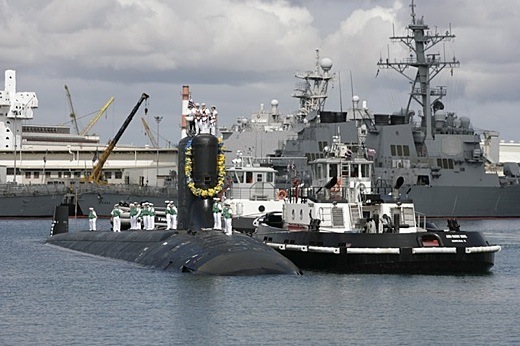
image above: Aloha ceremony welcoming the USS Hawaii to Pearl Harbor. From http://hawaii.gov/gov/govtube/photogallery/2009/uss-hawai-i-arrival-ceremony

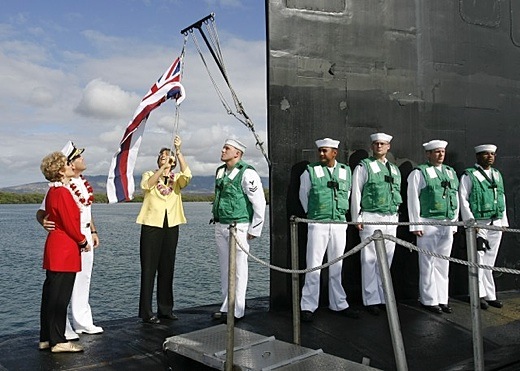
On Friday, July 24, 2009 the Hawaii Tribune-Herald published a photo (see below) of a blue and yellow lei draped USS Hawaii as it entered its new homeport of Pearl Harbor. Governor Linda Lingle was there for the greeting and the nuclear-powered and armed sub was given an Hawaiian blessing. Can you imagine such blasphemy and desecration of the culture and language of Hawaii and all creation? Dr. Glenn Paige, author and retired professor at UH Manoa wrote a letter to the Honolulu Star-Bulletin. It is reprinted below. 
I wonder how many readers were shocked by the Star-Bulletin's July 24 welcome to the nuclear submarine USS Hawaii with the banner heading, "7,700 tons of Aloha." According to the Pukui-Elbert dictionary, "aloha" means "love, affection, compassion, mercy, sympathy, pity, kindness" and more.

By all accounts, the USS Hawaii, with sponsor Gov. Linda Lingle's initials inscribed on a keel metal plate and a Hawaiian blessing by a member of the Hawaii Army National Guard, is the most murderous war machine yet devised by the lethal ingenuity of mankind. Its presence in Hawaii does not make the islands safer, but a target, as did the ships at Pearl Harbor in 1941.

Much greater safety must be sought in developing the applied multidisciplinary science of nonkilling security in Hawaii, the Asia Pacific region and the world Furthermore, despite celebration of the boost to Hawaii's economy, the cost of the $2.6 billion killer submarine constitutes what President Eisenhower in 1953 called "theft" by warships and guns from those who are hungry and poor."
image above: USS Hawaii in Pearl Harbor wearing giant lei draped over conning tower.From http://honolulunavyleague.org/theusshawaii/

Please note that the USS Hawaii is able to launch Tomahawk nuclear-armed missiles far more powerful than the atomic bombs which destroyed the cities of Hiroshima and Nagasaki. The USS Hawaii can also deliver comandoes in violation of other nations sovereignty. The Navy acknowledges discharging 4,843,000 gallons of radioactive liquid waste into Pearl Harbor from nuclear-powered submarines as of l973.

 Since then they have withheld data about such discharges. The Navy also admits to dumping over 2,000 fifty-five gallon steel drums of radioactive solid waste on the ocean floor off Hawaii's shores. (Source: The Dark Side of Paradise, p.l8) What effects such pollution may have on marine life and, in turn the health and safety of Hawaii's people is simply not clear.

But it is commonly accepted that there is no safe level of radiation, and even low-level doses of radiation accelerate our aging process and may cause cancer. And let's not forget the confirmed military radiation contamination in Hawaii from weapons training that has yet to be fully assessed. End U.S. Occupation: Military Clean-Up NOT Build-Up! 1. Mourn all victims of violence. 2. Reject war as a solution. 3. Defend civil liberties. 4. Oppose all discrimination, anti-Islamic, anti-Semitic, etc. 5. Seek peace through justice in Hawai`i and around the world.
Contact: Jim Albertini Malu ‘Aina Center for Non-violent Education & Action P.O.Box AB Kurtistown, Hawai’i 96760 phone: 808-966-7622 email: JA@interpac.net website: www.malu-aina.org

See also: