Oil at $80 Per Barrel

SUBHEAD: If the dollar continues to sink, oil is going to move so high that all sorts of economic consequences are inevitable. image above: 2008 illustration of oil cost dragging down America (turned sideways). From http://www.worldproutassembly.org/archives/2008/06/envisioning_a_w.html By Tom Whipple on 28 October 2009 in the Falls Church News-Press - http://www.fcnp.com/commentary/national/5177-the-peak-oil-crisis-80-a-barrel.html

Last week oil broke out of a months-long trading range and surged to $82 a barrel. For many of us who remember $140 oil from the summer of '08 this might not sound impressive until you are reminded that every time oil (adjusted for inflation) broke $80 a barrel some sort of economic recession occurred.

In the wake of the breakout to the upside, the financial press is full of stories talking about $95 or $100 oil this winter.

The general theory behind all this is that an economic recovery led by China is occurring right now. To hear Beijing tell the story, their economic stimulus and loose lending practices worked like a charm so that China will soon be leading the world to self-sustaining growth.

The international forecasting agencies are already talking of a jump in demand for oil next year which will put worldwide consumption back in the vicinity of where in was in 2008. Given that the world has only 2 or 3 million (or if you are optimistic 4 or 6 million) barrels a day (b/d) of spare oil production capacity and that it is taking all the industry can do to keep up with the roughly 4 million b/d that depletion is taking away each year, we will see tight oil supplies one of these days.

If this scenario plays out there will be much higher oil prices. We can't have it both ways. It will either be a really deep global recession and cheap gas or some sort of start at recovery and spiking oil prices.

Discussions have already started as to what level of oil prices causes serious damage. In the past an inflation adjusted $80 a barrel was a favored recession inducing number as this was the price that seemed to cause recessions back in the 1970s and 80s when Middle Eastern wars and embargos restricted supplies.

The trouble with $80 oil, of course, is that we are already there and no analyst that draws a paycheck from Wall Street wants to say flat out that another leg of a recessionary downturn is inevitable unless oil prices decline soon. A typical example was a Dow Jones story earlier this week entitled "Oil Price Rise Poses Little Threat, Yet, To Economic Recovery". The article points out that the danger to economic recovery won't start until we get to $90 or $100 a barrel or $3 a gallon gasoline.

For the time being, however, oil prices do not have as much to do with supply and demand as they did in days gone by. There is enough reserve capacity in the Saudi Arabia and the Gulf states to increase production by anywhere from 2-6 million b/d (depending on who you ask), so for the time being unless some major geopolitical event intervenes, oil prices seem to be tied more closely to the fate of the dollar.

As the dollar goes down vs. other currencies, oil prices go up. It does not seem to matter how much oil is building up in storage or how fast we are burning gasoline. For the time being, the dollar is in the driver's seat. Given the unprecedented amount of deficit spending and federal borrowing that is likely to be going on for the foreseeable future, the outlook for the U.S. dollar as a world currency does not look that bright. The U.S. plans to sell at least $118 billion worth of government securities before the end of next month. Looking at numbers like these some analysts are convinced a further decline in the dollar is inevitable no matter what the Federal Reserve does to mitigate the situation.

The current situation is clearly unsustainable. If the dollar continues to sink, oil is going to move so high that all sorts of economic consequences are inevitable. OPEC is already in a dilemma for no matter how much they like the increasing revenues, the smarter governments realize that if prices move much higher, it will trigger off even worse economic times.

In recent days, a new discussion has started as to just how much weaker the U.S. and OECD economies will be this winter as compared to the spring of 2008. Eighteen months ago oil prices had to spike well above $100 before the consequences became generally noticeable. This time around, with unemployment much higher and industrial production and retail sales much lower, concern is growing that it may not take much more of a price increase before retail sales take another dip.

Conventional wisdom holds that a national average of $3 a gallon gasoline (California is there already) is a psychological turning point where many stop visiting auto show rooms, cut back even more on driving, and become more fearful of making discretionary purchases.

Here, in America we are currently going through roughly 800 million gallons a day of oil in one form or another. This means that for every 10 cents the price of gasoline and other fuels increase we collectively have $79 million a day, $550 million a week, or $2.4 billion a month less to spend on other things. As very few of us are running up our credit cards or obtaining other forms of loans these days, purchases will inevitably diminish.

Keep watching your gasoline prices. Serious troubles may be closer than many want us to think.

see also: Ea O Ka Aina: $110 Oil Coming Our Way 10/27/09

Keep Kaakaaniu Beach Access

SUBHEAD: Ka`aka`aniu Beach is the name. Larsen was a manager who ran Klauea Plantation. Enough already of privatizing beaches.

By Andy Parx on 26 October 2009 in Parx News Daily - 
http://parxnewsdaily.blogspot.com/2009/10/road-more-traveled.html


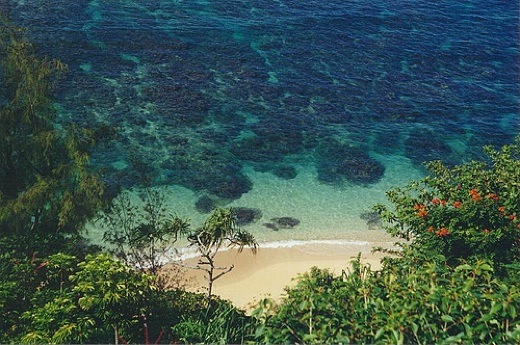
Image above: A view down onto Kaakaaniu Beach (known by haoles as "Larsens Beach") from access path. From http://www.hawaiilifeofluxury.com/larsens-beach-kauai  

The pilikila (Editor's note: translates to "related to deed"?) over the Larson’s Beach access has finally gotten some attention after a fine article in the Hawai`i Independent by Joan Conrow detailed how once again the public is about to lose a path that has been historically ours forever because of some slight of hand by a big landowner. She writes: 
 An outcry over plans to fence off a trail to Larsen’s Beach is causing Kauai residents to revisit two longstanding issues: Should concerns about liability restrict access; and is the county properly recording public easements? The controversy arose over cattle rancher Bruce Laymon’s plans to install a fence on northeast Kauai coastal land that he leases from the Waioli Corp., a kama`aina landowner whose holdings include the historic Waioli Mission House and Grove Farm Homestead Museum.  
But the rest of the article deals for the most part, not with Laymon but with Waioli Corp and the history of the access. Although going forward it’s Waioli’s actions that will determine the future of the access it’s Laymon’s past actions- with the ok of Waioli- that has brought the issue to a head.

Local rancher Bruce Laymon would have people believe, as his attorney told the Board of Land and Natural Resources (BLNR), that he “is a rancher and landscaper... an avid fisherman who loves Kauai and the community... and is not a sophisticated developer as the Sierra Club would like to have the Board believe” That, in part was what influenced the BLNR to approve staff recommendations to reduce his fine for illegally clearing the bluff above Larsen beach, a secluded clothing optional North Shore beach where travel-book-reading sunbathers from around the world come to vacation, from $15,000 to $2,000 according to the minutes of it’s July meeting.

Laymon claims that it was an innocent and understandable mistake when he relied on an approved “conservation plan” for his ranch, to do work along the ancient historic Alaloa trail above Ka`aka`aniu (rolling coconut) beach and reef- also knows as Larsen’s Beach after a Kilauea sugar plantation luna- which is famous for its limu kohu according to the BLNR staff report which PNN has obtained but is apparently not posted on line.

The work not only went well beyond what was permitted by the East Kaua`i Soil and Water Conservation District (EKWCD) Board when they approved his Brush Management Plan that had been developed with the help of the Natural Resources Conservation Service (NRCS) but encroached on the state conservation district and county special management area where permits are required to do any work.

 Rather than just carefully hand- remove all the non-native plants and leave the foliage in place to hold together the hillside- as the “approved plan” for the other areas required- Laymon apparently came in and cleared the entire area of “brush” denuding the hillside including cutting large trees down to stumps in order to harass the homeless in the area. According to the report Laymon apparently tried to dispose of the campers’ property calling it “household trash”, engaging in a confrontation with some when they tried to retrieve their belongings.

Though Laymon claimed ignorance and said he was “doing something good for the community”- a position with which members of the BLNR agreed- this isn’t his first run-in with the law for land-clearing operations without necessary permitting- nor is it the first time he’s had confrontational run-ins with nude sunbathers or so-called “illegal campers” on property he leased.

In 2003 Laymon did apparently illegal grubbing and grading on a three acre parcel above Kealia for which he didn’t have an NRCS approved plan. But the EKWCD Board said he made an “honest mistake” in including the three acre parcel in a plan for a different 2011 acre parcel in Kealia according to a lengthy article on the subject in the local newspaper.

This occurred during the infamous Kaua`i County Council “Developers Gone Wild” grubbing and grading hearings, spurred by the 2001 Pila`a mudslide disaster for which developer Jimmy Pflueger received the then-biggest-ever fine for a federal Clean Water Act violation.

 Despite the fact that Council Chair Kaipo Asing called actions “another Pila`a waiting to happen” Laymon’s buddies on the EKWCD Board, a group comprised of large landowners in the area who obtain votes based on the acreage they own, cleared him of all charges saying Laymon was just an unsophisticated rancher and landscaper who actually made the area look “beautiful” despite the fact that if a heavy rainfall had occurred while the land was denuded it could have despoiled the reef at Kealia.

 Laymon was also involved in the similarly infamous harassment of nude sunbathers in 1990 when he apparently organized an armed vigilante squad that roamed Kaupea Beach- aka Secret Beach- on ATVs at the behest and in the employ of landowners above the beach until the state told him to stop because the beach was state property. Among those owners were Michelle and Justin Hughes who leased Laymon the Kealia Property that they had obtained from developer Tom McCloskey who bought the entire Kealia ahupua`a after area sugar cane went defunct.

But it seems the BLNR staff either never heard about these incidents or chose not to tell the board about them and rather convinced the board that Laymon was just an unsophisticated rancher and landscaper who made an understandable mistake in clearing the area above Larsen.

The minutes of the BLNR meeting are revealing for what they don’t contain as much as what they do. Although Kaua`i member of the Board Ron Agor told many people that he would push for the full fine the minutes reveal that he actually led the other board members to accept the staff report and reduce the fine. Laymon is currently applying for an “after the fact” permit from the BLNR for not just the denuding of the hillside but to do the real work he intended to do before complaints stopped him in October of 2008- changing not just the historic Alaloa trail but the traditional easier access to the beach and substituting one more treacherous.

As to the future, the Sierra Club has been on the case and, in a letter, refutes testimony by Laymon’s attorney Lorna Nishimitsu who at one point actually tried to claim to the BLNR staff that the Alaloa trail was actually Ko`olau Road. The Sierra Club letter to the board details the issues and misrepresentation in the after the fact permit application and is apparently not available on line so is reproduced in full here.  

As you know, Paradise Ranch has submitted a CDUA for land leased from Waioli Corporation. This application calls for brush management for ranching and the construction of two sections of fence – one portion designated as pre-existing (near the northern boundary), and additional fencing that is not pre-existing, approximately twice the length of the first portion. We agree that cattle should be kept off the beach. However, the siting of this additional fencing raises a number of concerns. 

Safe Beach Access 
We appreciate that Waioli Corporation provided a public access easement to Larsen’s Beach years ago, but that route is steep and difficult for both children and elderly to use. The CDUA survey map Exhibit E, indicates that the proposed fence will block the favored public access along the gradual slope labeled “Existing Road” and “Existing Trail”. 

Emergency responders who routinely rescue visitors from the two rip currents at Larsen’s Beach also favor this route. Therefore, we ask you to keep the existing trail behind the beach unblocked.  

Historic Alaloa 
Exhibit D in the CDUA notes the State of Hawaii’s claims of ownership of the historic coastal trail – the Hawaiian Alaloa. The Alaloa is not Ko`olau Road as put forth by attorney Lorna Nishimitsu in a letter dated August 5, 2009 (Exhibit C). The evidence of the trail’s location is provided in the document called Ref: K98:1 Moloa`a (from September 1, 1998) which was not included in the CDUA exhibits, but is cited at the top of the Na Ala Hele Memo dated March 1, 2000 (Exhibit D). 

Therefore, attached to this letter is documentation from the 1998 Abstract Ref: K98:1 Moloa`a which includes an historic map labeled: Na Ala Hele Exhibit B – “Portion Registered Map 1395 dated 1878 depicting portion of Old Alaloa”. It is clear from this map that the Alaloa is a coastal trail and not the Kauai Belt Road, Kuhio Highway or Ko`olau Road. Furthermore, there is ample oral testimony collected by Na Ala Hele Kauai Advisory Council members in the late 1990’s that the path traversed close to the coastline and over the Pali. Kupuna in the area can corroborate this. 

The “pre-existing” fence does not interfere with the Alaloa. However, the proposed alignment for the new, additional fencing is makai of the existing trail ( see CDUA Survey Map-Exhibit E). The fence would block the “Existing Trail” at two points, cutting off existing public access to Larsen’s Beach via the Alaloa. 

We encourage Waioli Corporation to seek confirmation from the Na Ala Hele staff abstractor as soon as possible on this matter and to encourage DLNR to conduct a metes and bounds survey of the Alaloa in order to properly site the fence, and submit a corrected survey map for the Conservation District Use Application.

 Endangered Species 
The project area is adjacent to the sensitive coastal habitat of monk seals, green sea turtles, albatross and other endangered seabirds. Has the lessee considered using fencing that is dog proof so that endangered ground nesting birds would be protected? We hope that the U.S. Fish and Wildlife Service will be consulted and afforded the opportunity to comment. 

 Summary 
We ask that you relocate the proposed fencing so that it is mauka of the trail/road. Doing so would: a) Preserve the traditional and customary Alaloa; b) Provide the only safely graded beach access from Larsen’s Beach parking lot; c) Assist lifeguards and emergency responders in their rescue efforts, and d) Allow the public access when Monk Seal volunteers routinely ribbon off sections of this beach. 

 If liability is a concern, Waioli Corporation could dedicate the existing trail/road/Alaloa to the State under the Na Ala Hele Hawaii Trail & Access System, thereby removing the threat of liability. Neighboring Moloa`a Bay Ranch also has a portion of the Alaloa and that easement was adopted into the State Na Ala Hele trail system several years ago. Also, please note that your neighbor Falko Partners, north of Larsen’s Beach, is currently in discussion with the Kauai Public Land Trust about transferring rights to the coastal portion of the Conservation District to the public. 

Thank you for your consideration. Perhaps board members would benefit from a site visit to better understand the significance of this coastal gem and its importance to the community. Sincerely, Judy Dalton on behalf of the Executive Committee Sierra Club - Kauai Group, Hawaii Chapter

Superferry Redux

SUBHEAD: Live Internet video in-studio interview by Ed Coll on the Superferry issue. image above: Hawaiian Superferry graphic satire by MauiGoodness.com From http://www.mauigoodness.com/tag/hawaii-super-ferry By Brad Parsons on 28 October 2009 - On Sunday Oct. 25th, Ed Coll tested out the procedures for a live internet video talk show broadcast to the world, on the subject of a recap of the Superferry, "Superferry Redux." In studio guests included Pua La'a Norwood, her son Timoteo, and Brad Parsons. A call-in guest included Jimmy Trujillo. The show was a recap of the Superferry issue including reports of current events on the matter, but particularly contains the unique thoughts of the guests on the subject, while also testing out a new combination of broadcast technology. video above: This film is available for view at http://www.ustream.tv/recorded/2426587 see also: Island Breath: Superferry Redux 6/11/06 Island Breath: The Superferry & US Military 10/13/06

Emerald City vs Transition Town

SUBHEAD: Which is the real solution? "Bright Green Cities" of the empire or verdant villages nearby?

  
Image above: Still from "The Wizard of Oz" with the Emerald City painted on a matte.  

By Carolyn Baker on 27 October 2009 in Transition Times - 
  http://transition-times.com/blog/2009/10/27/transition-towns-or-bright-green-cities-the-color-of-movements-or-the-color-of-life/#more-398


Alex Steffen’s “Transition Towns or Bright Green Cities?”, of 10/27/09, at http://www.worldchanging.com/archives/010672.html, presents a kind of spectrum for environmental groups, ranging from “dark green” to “light green”, that may be more about visual impairment than color-coding. That is to say that it attempts to analyze and classify the Transition movement without actually seeing what it is at all.


First, when Steffen attempts to define what Transition Towns are, his emphasis is primarily on action. While it is true that action is substantial part of the movement, anyone who wishes to understand Transition must also grasp its three essential pillars: Head, Heart, and Hands.
• Head refers to educating ourselves regarding the realities of Peak Oil, climate change, species extinction, and myriad other challenges of the twenty-first century.

• Heart refers to the “Heart and Soul” aspect of Transition which relates to finding meaning and purpose amid the swirl of emotions we are certain to experience as we deepen our understanding of the challenges and their implications.

• Last, for a very good reason, is the Hands pillar which refers to learning new skills that will be necessary in order to survive in a post-industrial world and taking action in our communities to implement the Transition model.
Without the pillars of Head and Heart, action will not be sufficiently informed and may be ineffective.

Additionally, Steffen gets his numbers wrong when he speaks of “people in perhaps as many as 250 towns now actively taking part.” In fact, there are Transition initiatives in over 1500 communities globally, and about half of those are in the U.S.

As Steffen moves into addressing “the limits of Transition” he states:
“The Transition movement seems saturated with what Michael Lerner called ’surplus powerlessness’ disguised as practicality. All over the world, groups of people with graduate degrees, affluence, decades of work experience, varieties of advanced training and technological capacities beyond the imagining of our great-grandparents are coming together, looking into the face of apocalypse… and deciding to start a seed exchange or a kids clothing swap.”
What, I ask, is “powerless” about these actions? Steffen answers from his perspective in the next paragraph when he asserts that:
“Transition thinking seems obsessively focused on coordinating individual actions (like helping people barter their free time or connecting people who want to garden); even at its most ambitious, it generally focuses on building alternative systems (say, starting a local currency scheme) rather than reforming the larger systems that shape life all around us (say, starting an actual credit union or rewriting banking regulations).”
On this point Steffen gets it dead right—Transition does focus on building alternative systems rather than reforming larger systems. You see, this is why the “Head” pillar of Transition is so critically important. If one does not do the research which is ubiquitous, but exquisitely compiled in Rob Hopkins’ Transition Handbook, then one will miss the factual information that if assimilated, will preclude any hope that “larger systems” bought and paid for by corporations and their legislative minions can alter the present suicidal trajectory of the human race.

That Steffen has not done his research is telling from this point forward in the article, attested by statements like:
“Part of this is the legacy of the counter-culture out of which it emerged. Part of this is that Transition Towns aim to offer a way to step out of emotional paralysis by saying ‘just go ahead and do something, anything.’ Part of it is intentional: groups spread more rapidly when the demands placed on their members are minimal. However, the approach also betrays a far darker mindset.”
In fact, Transition does not encourage people to “just go ahead and do something, anything.” That is precisely why the Transition Handbook was written—to educate readers in what the issues actually are so that they can address them strategically and skillfully on the local level.

Then comes the really telling portion of the article where Steffen evaluates Transition as “dark thinking.” Before examining his specific misinterpretations of statements from people involved in Transition, let’s notice the disparaging word “dark.” Then let’s step back and ask the question:
When people on the Titanic in the wee hours of April 14, 1912 were hysterically trying to find a way to save themselves, would it have been appropriate to call their thoughts, feelings, or actions “dark”?
Obviously not because they knew they were perishing.

Only individuals who do not understand that the planet and the entire earth community is perishing can talk about “dark thinking” in relation to movements like Transition. Only those who have done no or only cursory research on oil depletion, climate change, species extinction, and overpopulation—or have chosen to immerse themselves in rosier assessments of these issues—would refer to the Transition model as “dark.”

But even more amazing is Steffen’s misinterpretation of statements by individuals involved in Transition:
“The movement’s founder, Rob Hopkins, talks almost cheerfully about passing peak oil, widespread food shortages and the idea of globalization crashing suddenly. Jennifer Gray, the founder of Transition U.S. (the American wing of the movement) told a New York Times reporter that she expects ‘a big population die-off.’ Board member Richard Heinberg says that central governments will ‘have to self-destruct in favor of local autonomy’ and that ‘overpopulation will eventually be solved by starvation and disease.’”
No one that I know in the Transition movement “talks cheerfully” about any of these topics. Quite the contrary. If the individuals who founded the movement and contributed to the handbook were joyously celebrating the collapse of civilization and all of the misery that it will entail, they would first of all be psychotic, and secondly, they would not have needed to create a Heart and Soul pillars in Transition to assist people in finding meaning in the midst of horror.

Only individuals who have not fully educated themselves about the state of the planet could deny that its systems are now in a profound process of collapse—a process which is exacerbating daily. The Transition movement is not arguing that collapse is a “tool for social change”, but simply that it is happening, it probably now has a life of its own, and that there’s virtually nothing that large-scale systems can do about it except to intensify the process.

Some fundamental scholarly research that I recommend to Alex Steffen would be: The Collapse of Complex Societies, by Joseph Tainter; Jared Diamond’s Collapse: How Societies Choose to Fail or Succeed, Richard Heinberg’s The Party’s Over and Peak Everything; The Long Emergency by James Howard Kunstler; Dmitry Orlov’s Re-Inventing Collapse; and Endgame, Vol. I and II by Derrick Jensen.
Absolutely essential documentary viewing would be “What A Way To Go: Life At The End of Empire”; “Blind Spot”, and “The Great Squeeze”.
And yes, Steffen is correct when he notes:
“Local efforts can’t protect against the violence of a systemic breakdown. The same thing is true of public health and epidemiology, of disaster response and trauma care, of famine protection and crop insurance, and so on and so on. To plan for the collapse of large-scale systems is to plan for widespread evil and suffering; ethical planning for the collapse is impossible: post-collapse idealism is oxymoronic.”
Yes, yes, yes! Although, it is debatable whether Transitioners generally are “idealistic” about the collapse of large-scale systems. What is probably more accurate is that most people who are involved in Transition hold a vision of what is possible and are working to that end; at the same time, however, most understand the momentous, formidable consequences of humanity’s continuation of its current suicidal tendencies, as well as the catastrophic repercussions of collapse.

I must adamantly disagree with Steffen’s insistence that we need “bright green” anything on a large scale. For him, it appears that “large” is the only scale that matters because he seems not to have grasped that “large” is synonymous with empire, “large” is part of the problem, and “large” is unraveling at lightning speed.

He wishes us to stop seeing these systems as “out of our control” when that is precisely what is so. The ship is taking on water faster than anyone can cope with, and it is, quite simply, sinking. As for myself, I don’t want or need a “politics of optimism” or the re-arranging of deck chairs. I want nothing less than a lifeboat, and Transition gives me the best one I’m aware of at the moment.
As for the charge that the Transition movement is cynical, my experience has been quite the opposite. If one defines cynical as: “distrusting or disparaging the motives of others; showing contempt for accepted standards of morality by one’s actions; bitterly or sneeringly distrustful, contemptuous, or pessimistic”, Transition eludes this definition.

[IB Publisher's note: The origin of the word "Cynic" was a person of a sect of Greek philosophers, 4th century b.c., who advocated the doctrines that virtue is the only good, that the essence of virtue is self-control, and that surrender to any external influence is beneath human dignity.]

Researching the current state of the planet in terms of energy, environment, an economics renders any thinking human being wary and cautious regarding larger systems—their integrity, their motives, and their long-term future. However, caution is not synonymous with cynicism.

Steffen refers to the etymology of the word “cynic” as related to “dog” in the sense that to be cynical is to be obedient. More specifically, however, the connection between “cynic” and “dog” actually originated in Ancient Greece when philosophers compared the cynic with the dog who continually gnawed on a the same bone, over and over.

In that connotation, the behavior of the cynic is similar to the definition of insanity which is essentially doing the same thing over and over again getting the same results, but each time expecting a different outcome. In my experience this is much more descriptive of the behavior of the larger systems that Steffen purports are necessary for change, and light years removed from anything I’ve witnessed in the mission or behavior of the Transition movement.

Clearly, Steffen has an aversion to all things dark, but had he read the Transition Handbook, he would have encountered a remarkable optimism and positive vision, yet an optimism tempered by the realities of the research to which the handbook directs the reader and which seems to have eluded him.

I could not do justice to Transition if I did not interject the one aspect of it that has not yet been discussed in my response to Steffen, namely, the Heart and Soul pillars. While he observes Transition as "falsely optimistic", his “bright green cities” vision is a chimera—an engineered extension of empire, highly unlikely in the face of all the realities he has chosen to overlook: energy depletion, climate change, and global economic meltdown.

Since the beginning of human history, the wisdom of ancient traditions has reiterated that life is not always as it seems. That which appears dazzling is not always desirable, and that which appears dark is not always wisely averted. Sometimes that which we fear most is our redemption. The greatest minds of human history: Socrates, Plato, Shakespeare, Jung, Einstein—to name a few, were not repelled by dark realities, but rather embraced them, however reluctantly, as conduits to deeper truth and more exquisite creativity.

Spin it as we will, the human race is precariously poised on the cliff’s edge, hanging by its fingernails. Our challenge is not to try to prevent the collapse of the larger systems, but to respond with resilience and self-sufficiency and to ask the kinds of questions that wisdom traditions and the greatest minds in human history have always asked:

Why is this happening? What meaning can I and my community find in this unfolding of events? What do I and my loved ones and my community need to do to prepare? And perhaps most importantly, what is my purpose in being here at this time? What have I come here to do? What can I contribute?
These are questions I address in my book Sacred Demise: Walking The Spiritual Path of Industrial Civilization’s Collapse. A “dark” book? Only if one insists that the dire condition of the planet and its inhabitants precludes opportunity to do what Steffen asks of us when he says;
“It’s time to make ourselves into the people who can do what’s needed.”
How we perceive the condition of our world determines whether we experience ourselves as passengers on the Titanic or on a luxury cruise ship that is having intermittent propeller problems. It’s much more about the color of life than the color of movements.

$110 Oil Coming Our Way?

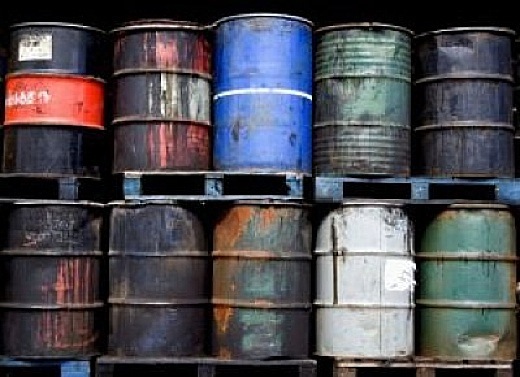
SUBHEAD: Complex web of circumstances will push oil prices past $100 a barrel ahead of demand. Oil Price Disconnect Hurts Us All image above: Corroding oil drums stacked on pallets. From http://www.hooversbiz.com/2008/02/29/100-oil-getting-past-the-novelty-value By Daniel Dicker on 21 October 2009 in The Street - http://www.thestreet.com/story/10614660/1/oil-price-disconnect-hurts-us-all.html# Why isn't anyone getting mad about the lunacy of the oil market? Why isn't anyone asking, "What is going on here?" anymore. It must be the highflying stock market and decent earnings reports, convincing us that at least the financial end isn't nigh. Everybody must be too busy trying to make back the money they lost last year to care about the catastrophe in oil that is replaying itself. Last year, as oil ratcheted up to $150 a barrel, I felt alone in screaming about the obvious decoupling of the fundamentals from the price, fighting the opposite viewpoints of the likes of heavyweights such as then-Secretary of the Treasury Hank Paulson and Nobel Prize-winning economist Paul Krugman.

This year, every oil analyst who comes on CNBC now seems to sound like me: "A liquidity trade," they crow. "A play on the weak dollar," they advise. These are euphemisms for a market with no tethers to supply and demand fundamentals, and it's arguably worse now than it was last year, as we have the added fuel of rapidly expanding ETFs in energy to add kerosene to this already raging liquidity fire. But now that we're all "on the same page" on what's causing this, I am astounded by the blithe spirit of all of these analysts. I wonder where the outrage is. Where is the concern?

People continue to forget that commodities aren't stocks.

If the stock market runs ahead of itself and decouples from its fundamentals, as most experts believe it probably has now, no one needs to get outraged about it. If stock prices have now gotten ahead of reasonable forecasts for earnings and growth, everyone still understands the game: You make your bets and take your chances.

But oil decoupling hurts everyone. It hurts American consumers and reduces purchasing power. It sends more than $200 billion a year overseas into sovereign wealth funds of Middle Eastern countries that don't like us very much.

For American business, it's even worse: Fully 25% of the companies represented by the New York Stock Exchange are energy-dependent. Nothing can have a bigger and more direct impact on the productivity and potential for our economy more directly than the price of the crude barrel.

And now, there's one recent trend to assure prices go even further up, making these ridiculous prices look cheap: Domestic refineries are being forced to shut down. Sunoco has closed a big refinery in New Jersey, and Valero has shut one of its largest in Aruba.

They've done this to combat puny margins caused by rising liquidity and investment-driven crude prices. And I think more shutdowns are on their way. They've got no choice, the refiners. They're fighting back the only way they can. But these shutdowns will cause a synthetic shortage of refined products -- the stuff people actually use. It's already beginning. The Department of Energy reports from last week showed a 5 million-barrel drawdown in gasoline. I'm expecting this week to be much the same, showing an outsized draw of refined products. And you can't stop and restart refineries like you can a kid on a skateboard. By the spring, we're looking at a full-fledged shortage at the pumps. Now that's a fundamental you can bank on to send the prices of refined products and crude higher -- much higher. Put a little shortfall of gasoline into this mix of low-dollar, ETF-crazed crude trading and can $120 oil be far away again? And it will happen while demand is at 14-year lows, while we are still a long way from a full recovery from the worst recession since the 1930s. I have to ask again: Where's the concern? Maybe when oil unnecessarily goes over $100 again or touches $150, we'll see some. But I don't see it yet. Maybe we've all become inured by triple-digit prices. But we're staring into a fresh disaster on oil that could single-handedly derail whatever recovery we're expecting.

We're catastrophe-driven, I guess, and when the catastrophe looks to be averted, everyone forgets.

Last year, I screamed to make a point about the lunacy of oil pricing. This year, in a way that has astounded me, the disaster is repeating itself in perhaps even worse form. This year, it seems, that's what I'll have to be screaming about.

Iceland's Big Mac Meltdown

SUBHEAD: The financial meltdown drives McDonalds from Iceland. MickyD refuses to use local lettuce or beef and the franchise cannot afford to jet them in. [Editor's note: Icelandic Locovores - This may be an example of how letting those "too big to fail" do exactly so that they are led quicker to solutions of problems like food distribution.] image above: World's Largest Big Mac featured at McDonald's Museum near Westmoreland City, PA. From http://courtyu.ontheroad.to/show/big-mac-attack

By Paul Waldie on 27 October 2009 in The Globe & Mail - http://www.theglobeandmail.com/news/world/the-big-whack-currency-collapse-drives-mcdonalds-out-of-iceland/article1339577/

The Big Whack Icelanders like Jon Ogmundsson have endured many hardships in the last year, including soaring inflation, rising unemployment and a banking crisis so serious the country nearly declared bankruptcy.

Now Iceland's battered economy is claiming one more victim - McDonald's.

Mr. Ogmundsson owns the country's three McDonald's restaurants and he plans to close them all this week. He says Iceland's troubled currency, the krona, is to blame. It has lost almost 70 per cent of its value against the euro in the last 18 months, driving up the cost of imports including the beef, cheese and special sauces Mr. Ogmundsson brings in from Germany.

"With the collapse of the Icelandic krona, our food costs have doubled," he said yesterday from Reykjavik. "Business is good, but the bottom line is not sexy."

Mr. Ogmundsson charges about 650 kronur for a Big Mac, roughly $5.50 (U.S.). He said he would have to increase the burger's price by 30 per cent just to cover the added input costs. "We have not been able to increase prices as we would need," he said. "Customers are not willing to pay more."

Most economists don't expect Iceland's economy, or its currency, to recover any time soon. Inflation stands at about 10 per cent, interest rates are 12 per cent and the International Monetary Fund expects the country's economy to shrink by 8.5 per cent this year, the worst among 33 developed nations.

The IMF and other lenders have put together a $10-billion rescue package for Iceland.

No currency has been hammered harder by the financial crisis than the krona, which plunged against all major currencies. While Iceland maintained a floating currency, a handful of other small countries in Latin America and Asia had earlier taken measures to prevent runs on their currencies after crises in the 1980s and 1990s, typically through pegs to the U.S. dollar or euro.

The krona lost 50 per cent of its value against the euro last year, putting it alongside the Zimbabwean dollar and Turkmenistan's manat in terms of poorly-performing currencies. It has fallen more than 15 per cent this year despite the government's adoption of some foreign-exchange controls.

McDonald's, which has more than 30,000 restaurants worldwide, doesn't have much confidence in Iceland's sagging economy either. In a statement, McDonald's said "the very challenging economic climate in the country makes it financially prohibitive to continue the business."

Yesterday's announcement ends 16 years of McDonald's in Iceland. The first restaurant was opened in Reykjavik in 1993 by then-prime minister David Oddsson, who took a big bite out of a Big Mac. That might have been a bad omen. Mr. Oddsson went on to become the head of the country's central bank and he has been widely blamed for the country's financial problems. The public bitterness got so bad this year Mr. Oddsson was forced from office and had to travel with a team of bodyguards.

McDonald's is not the only burger chain to fall victim to Iceland's ailing economy. Burger King has also pulled out. There are other fast food chains in the country, such as Pizza Hut, KFC and Taco Bell, but they rely more on local supplies instead of costly imports.

Mr. Ogmundsson said his customers will be sad to see the end of Ronald McDonald. But he offered some hope to burger-starved patrons. He plans to convert the restaurants into a new chain called Metro. They will have "very similar products like McDonald's," he said.

Not everyone in the country, which has a population of 320,000, is mourning the loss of the golden arches. History teacher and blogger Pall Vilhjalmsson joked that the feeble krona managed to do what seemed impossible, bring down an American icon.

The krona has "taken down the mighty symbol of American imperialism, The McDonald's," Mr. Vilhjalmsson said in an e-mail from Reykjavik.

He added that "the word on the street is that Starbucks is a 21st century edition of American imperialism. Alas, we do not have Starbucks in Iceland."

The End Of Electricity

SUBHEAD: As less electricity is available to produce fuel, there is less fuel to produce electricity. The end is swift. image above: ISAT GeoStar satellite view of 2003 grid failure in Northeast United States. From http://radio.weblogs.com/0126277 By Peter Goodchild on 26 October 2009 in Countercurrents - http://www.countercurrents.org/goodchild261009.htm

There seems to be a consensus that the depletion of fossil fuels will follow a fairly impressive slope. What may need to be looked at more closely, however, is not the "when" but the "what." Looking at the temporary shortages of the 1970s may give us the impression that the most serious consequence will be lineups at the pump. Fossil-fuel decline, however, will also mean the end of electricity, a far more serious matter.

It is easy to assume that the main issue with fossil-fuel depletion is the problem of what to put in our automobiles. For some, the problem may seem hardly big enough to worry about. The average motorist will have to accept paying far more for gasoline than in earlier times. "So what?" the driver may ask. "The Japanese [or whoever] have been paying far more for decades." And driving is not only a matter of transportation, it is one of our great passions.

The mileage we rack up on our vehicles is breathtaking, and for many the motto is, "I'd rather drive than eat." We can always assume ― with only the slightest of guilt feelings ― that ecological matters are somebody else's problem. We are tacitly confident, in other words, that our own problem of fossil fuels can be solved by a job promotion and a raise.

But that view may be totally wrong. A far greater consequence of fossil-fuel depletion could be the effect on the production of electricity. As time goes by, the biggest question of all may be, "Can we even keep the electricity going?" If we end up facing unavoidable world-wide blackouts and brownouts, then the result will be a sudden and catastrophic chain reaction. Fossil fuels and electricity are tightly integrated. We cannot have one without the other. Without fossil fuels, we can produce no (or not much) electricity. Conversely, without electricity, we lack the "nervous system" (a good analogy, since nerves work by ion transfer) to control any equipment that uses fossil fuels.

If all the above is true, then what we should be thinking of is not the familiar slope of fossil-fuel depletion depicted in 20 or 30 major studies, but a figure consisting of a gentle slope that continues for a very few more years and then becomes a steeper curve downward. When fossil fuels are inadequate for maintaining electricity, the further results will be manifold. Fossil-fuel production itself will cease, and so will a great deal else.

For that matter, it is not only fossil fuels and electricity that form a tightly integrated group, but a triad: fuels, electricity, and metals. Without fossil fuels and electricity, we cannot produce metals. For now, let us focus on the first two of the three, but there are other issues will also need attention one day.

Is there tangible evidence for such a rapidly plunging slope? Let us look at energy in general, not just fossil fuels. In several versions of his "Olduvai" essay, Richard C. Duncan gives various dates for a "brink" and a "cliff," even if I cannot always follow his reasoning in arriving at these dates. What is most important among the data that Duncan uses is the fact that world energy production per capita peaked and reached what he calls a "rough plateau" in 1979 (the same year in which global oil per capita reached a peak). If world energy per capita has already reached a peak, then electricity is in danger. It is very unlikely that demand for electricity will decline...

...The danger is when "global energy available for production of electricity" in a particular year no longer matches "global energy required for electricity." In other words, when we no longer have enough energy to channel into necessary electricity production, the game is over. Yes, we can divert some energy sources away from their present uses towards the production of electricity, but such a diversion causes its own problems.

For better or worse, the sources of electricity are mainly fossil fuels, and will continue to be so for the foreseeable future, so as these reach the down-slopes of their bell curves, electricity will follow a fairly similar curve. When will all this happen? It already has, beginning with that "rough plateau."

The only remaining question is how quickly the various events will unfold. That in turn must be subdivided into questions on such matters as the supplies of the sources (oil, natural gas, coal, hydroelectricity, nuclear power, etc.); on global GDP; on global population; on the amount of electricity generation; and on the chances of voluntarily conserving electrical power. (The chances of voluntary reduction are obviously slim, however. According to BP's Review of World Energy, from 1990 to 2008 global electricity use actually rose by 70%, which means an increase per capita of 41%.)

We must not forget the above-mentioned chain reaction ― the feedback mechanism. As less fuel (or any other source of energy) is available to produce electricity, there is less electricity to produce fuel. As less electricity is available to produce fuel, there is less fuel to produce electricity. The end is swift.

The answers are also complicated, of course, by the fact that the global data are not reflected in more-localized data. For some countries, blackouts and brownouts have been a way of life for years. But no country should assume that it is safe. In the U.S., the main energy source for electricity is coal, and there have been several recent reports that coal in the U.S. is not as abundant as once assumed. The remaining coal is of poor quality and difficult to extract.

For years I have lived with Richard Duncan's several versions of his "Olduvai" essay, reading them many times, often puzzled. Yet his writing continues to haunt me, because there is obviously something important staring out. In particular, I am struck by his emphasis on electricity. An important addition to his 2006 version is his emphasis on "proximate" versus "ultimate" causes of systemic collapse. ". . . Permanent blackouts . . . will be the proximate (direct, immediate) cause of the collapse of industrial civilization. In contrast, [there will be] many ultimate (indirect, delayed) causes. . . ."

Duncan also points out that the importance of electricity is overlooked because it is not the underlying giant problem of "the limits to growth." As any science-minded person knows, electricity is not even a source of energy, it is merely a carrier of energy. Fossil fuels are the primary sources of energy in our industrial civilization. Yet electricity is subtle, and its importance is easily underestimated.

It is "end use" that is significant. In his 2006 version, Duncan says that "electricity wins hands down as our most important end-use energy. To wit: I estimate that 7% of the world's oil is consumed by the electric power sector, 20% of the world's natural gas, 88% of the coal, and 100% each for nuclear and hydroelectric power. The result is that electric power accounts for 43% of the world's end-use energy compared to oil's 35%."

There are always many problems with the use of electricity. It is certainly costly. Duncan notes that, according to the International Energy Agency, the worldwide investment funds required for electricity from 2003 to 2030 will be about $9.66 trillion. That sort of money is simply not available.

In the 2000 version of his essay, Duncan adds that electric power systems are "complex, voracious of fuel, polluting, and require 24h-7d-52w maintenance and operations." Personally, I think of the great blackout of August 14, 2003, when a large part of northeastern North America came to a halt. But that was only one day, with a few serious problems on following days. Independent generators kept hospitals and restaurants going. Water trucks solved a problem for cities that did not have gravity-fed reservoirs. But what if the problems had continued for a much longer time ― perhaps forever ― so that those clumsy attempts at rectification were no longer operating?

When the lights go out, so does everything else.

SOURCES: BP Global Statistical Review of World Energy. Annual. http://www.bp.com/statisticalreview

Duncan, Richard C. "The Olduvai Theory: Energy, Population, and Industrial Civilization." The Social Contract, Winter 2005-2006. http://www.thesocialcontract.com/pdf/ sixteen-two/xvi-2-93.pdf

-----. "The Peak of World Oil Production and the Road to the Olduvai Gorge." Geological Society of America, Summit 2000. Reno, Nevada, 13 November 13 2000. http://www.dieoff.org/page224.htm

Harrabin, Roger. "UK 'Could Face Blackouts by 2016.'" BBC News. 11 September 2009. http://news.bbc.co.uk/2/hi/science/nature/8249540.stm.

Leopold, Jason. "Dark Days Ahead." Truth Out. 17 October 2006. http://www.truthout.org/docs2006/101706J.shtml#

North American Electric Reliability Council. Long-Term Reliability Assessment. Annual. http://www.nerc.com/pub/sys/all_wpdl/ docs/pubs/LTRA2008.pdf

Smith, Rebecca. "U.S. Foresees a Thinner Cushion of Coal." Wall Street Journal. 8 June 2009. http://online.wsj.com/article/ SB124414770220386457.html

Why Civilizations Collapse

SUBHEAD: They fail to make the difficult decisions necessary for survival. image above: Author of "Collapse", and "Guns, Steel & Germs", Jared Diamond From http://www.claremontconservative.com/2008/10/jared-diamond-is-coming-to-hmc-on-oct.html By Prof. Peter Saunders on 29 July 2009 in Instute of Science in Society http://www.i-sis.org.uk/whyCivilisationsCollapse.php Surviving environmental disasters As the world faces the challenge of climate change, it is instructive to recall that this is by no means the first time humans have had to cope with similar problems. Many societies have found themselves in serious trouble because of an unwelcome change in their environment. It may have been something over which they had no control, like the onset of the Little Ice Age in the 15th century, or they may have brought it upon themselves, all too often by clearing forests, or perhaps a combination of the two. Some societies survived, others did not. Long before the Spanish arrived, the Mayans of Central America had already abandoned their magnificent cities because of drought. Deforestation destroyed the Easter Island society that erected the famous statues, though a very much reduced population continued to live on the island. Others, like the Norwegian settlers in Greenland, and the original inhabitants of Pitcairn Island, died out completely. On the other hand, the Inuit who arrived in Greenland while the Norse settlements were flourishing are still there. The 18th century Tokugawa Japanese reversed the deforestation that had threatened their way of life. The inhabitants of Tikopia, a tiny island in the Pacific, have adopted a whole series of measures that allow them to survive in a difficult environment; one of the most striking 400 years ago was to kill all their pigs - high status animals in Melanesia and at one time a major source of protein on Tikopia - because they were too inefficient for feeding humans. Societies collapse through failing to take decisive action In his fascinating book Collapse [1] Jared Diamond describes and analyses these and other examples and looks for common features that would help explain why some civilisations survived environmental challenges and others did not. There are many reasons why societies have failed to cope. They may not have anticipated the problem, and so neither tried to head it off, nor made sure they were ready when it came. The Mayans might have been better able to deal with the great drought of the 9th century if they had known such things could happen in their part of the world. Unfortunately, the last great drought was in the 3rd century, and had been forgotten. The Mayans did keep careful records, but only of things they considered important such as the exploits of their kings, not trivia like climate data. A society may not even be aware of a serious problem when it is actually upon them, especially if the effect is slow. An increase in mean temperature of a degree or two per century can easily be masked by annual fluctuations or dismissed as part of some cycle. It may also be that the problem is just too difficult. If you live an already marginal existence on an isolated island in the South Pacific and the rainfall decreases even further, there is not much you can do.
Diamond found that in the many societies he studied, the most common reason for their collapse was none of the above, but the failure to take decisive action that could have saved them. Surprisingly, even when it had become obvious that there was a serious problem, little or nothing was done to address it. Why do societies fail to save themselves? Why would a society that knows it is in danger not do all it can to survive? There are a number of possible reasons, most of which arise from the fact that a society is not an individual but a collection of human beings. There can be significant conflicts of interests, and these often lead to decisions that suit one faction but are not in the best interests of the society as a whole. The most obvious source of conflict is that the interests of the ruler or the elite are not always the same as those of the rest. It is easy to think of examples, from the chiefs who devoted so much of Easter Island’s resources to building the famous statues (squandering large amounts on prestige projects is a common failing of rulers) to the owners of the companies that are clearing the rain forests and the politicians who are allowing that to happen. Even a group that does not have much intrinsic power may be given what it wants because it is more determined to get it than the majority are to refuse it. That is essentially why we continue to subsidise fishermen when the seas are already overfished. There is also the “tragedy of the commons”: a fisherman lands more fish than he knows he ought to because he fears that if he holds back in the hope of preserving stocks, others will take them instead. [2]. Societies also have deeply held values and find it very difficult to take any action that conflicts with them. The obvious example is religious taboos, but values do not have to be expressed in terms of a religion. The Greenland Norse, for example, reduced their chances of survival by keeping as close as they could to Norwegian customs and farming practices [3], and refusing to learn from the Inuit. Will we survive climate change? If collapses were usually due to one of the first three reasons that Diamond identifies - failure to anticipate the problem, failure to be aware of it when it materialises, and lack of the technology to cope - we could be quite confident about our prospects. It is more than a century since Arrhenius showed that if we burned too much fossil fuel the Earth would get warmer, so this isn’t coming as a complete surprise. Meteorologists and climatologists have been measuring the upward trend in the mean temperature and comparing it with the greenhouse gas concentration, so we know the scale of the problem. We already have the technologies to limit climate change and mitigate its effects (see Which Energy? [4] and Food Futures Now: *Organic *Sustainable *Fossil Fuel Free [5]), and more are being developed (see SiS 31-43). The crucial question is whether we have the ability to take the right decisions; and it is not at all obvious that we are any better placed to do that than earlier societies. The problem that faces us is planet-wide, and to solve it we need cooperation at an unprecedented global level. Any agreement to limit climate change will have to take into account the quite different interests of the developed countries and developing countries. The tragedy of the commons operates in the same way whether we are talking about individual fishermen or national fishing fleets. Worse, it can act at both levels simultaneously. There are two serious obstacles in trying to resolve such conflicts. First, any society has some form of government, from an autocratic ruler to an informal congress of the entire community, or something in between. The form of government obviously affects the decision-making. Diamond argues that those near one end of the spectrum of government or the other are more able to cope with environmental challenges than those in the middle. As there is no world government of any kind, formal or informal, we find ourselves having to make difficult choices with no framework for reaching decisions and no means of enforcing the decisions that are taken. Second, attempts to overcome conflicts of interests among states have to take account at the same time of those within states. Because the consequences of any agreement will impact differently on different groups, a country may be unable to make a concession to which an influential minority is strongly opposed. Most of the 44 Democrats in the US House of Representatives who almost defeated the recent climate change bill were from states that either produce coal or are heavily dependent on it [6]. It is too soon to know how much the struggle to get the bill through Congress will affect the US negotiating position, but it shows there can be a multiplier effect. A small but determined group within one society can have a significant effect on the whole world, even though on that scale they are very small indeed. Thus what Diamond identified as the greatest obstacle to success has become double layered and even more difficult to overcome. We must not give in to pessimism, but neither should we underestimate the size of the challenge that faces us. How we can save ourselves It is easy to delude ourselves into thinking either that climate change will not happen or that if it does, those of us who live in the developed world will be immune from its consequences. Climate change is happening, and the consequences will be global; if we don’t do something soon they will be much worse. And if we do not act quickly and effectively, our society may well collapse. The human species will probably not go extinct, but we may suffer the same fate as the Mayans: reduced to a much smaller, marginal agrarian population. If you find that an ultimately attractive prospect, think of the social unrest, wars, famines and other disasters that would happen along the way. We have all the science and technology we need to avert the catastrophe. What is more, as the Stern Report [7] has shown (The Economics of Climate Change, SiS 33 [8]), we can do it at a price we can easily afford. The question is whether we have the will, and an early test of this will be whether we can preserve the world’s remaining forests. Deforestation has been a key factor in many collapses because trees serve many vital purposes, such as holding the soil in place on slopes, providing timber for housing and boats, sequestering carbon dioxide from the atmosphere, and above all helping to stabilise the climate. Unfortunately they grow very slowly. Once a forest has been cleared it takes a long time to replace, if it can be replaced at all. Our society, like so many before us, is squandering this resource. We seem unable to stop the destruction of the Amazonian and Indonesian rain forests even though the Stern Report has shown that this would be by far the most cost effective contribution we can make towards mitigating climate change. The second most effective is reforesting areas already cleared (see also Saving and Restoring Forests Saves Far More Carbon Emissions than Biofuels, SiS 37 [9]). It needs international cooperation because the forests that have to be preserved lie largely in developing countries, those in the developed world having been cleared long ago (Old Growth Forests Are Carbon Sinks and Must Be Protected, SiS 40 [10]). If we cannot find a way of working together even on this, it is hard to see how we can cooperate on the more difficult problems like reducing the use of fossil fuels while allowing developing countries to raise their standards of living. The danger is not that we won’t do anything about climate change, especially now that the USA and China are on board. It is that what we do will be too little and too late. The effects are cumulative, and the longer we delay, the harder our task will be. It is already too late to begin with symbolic acts and good intentions. We need to make real changes, and we need to start making them now. References 1. Diamond J,. Collapse: How Societies Choose to Fail or Succeed. Viking Penguin, New York, 2005. 2. Hardin G., The Tragedy of the Commons. Science, 162, 1243-1248, 1968. 3. Twentieth century examples of a society refusing to learn how to live in a different environment are provided by Noel Coward in his song Mad Dogs and Englishmen, e.g., “In the Malay States there are hats like plates, which the Britishers won’t wear.” 4. Ho MW, Bunyard P, Saunders PT, Bravo E and Gala R., Which Energy? Institute of Science in Society, London, 2006, http://www.i-sis.org.uk/which_energy.php 5. Ho MW, Burcher S, Lim LC et al., Food Futures Now: *Organic, *Sustainable, *Fossil Fuel Free. Institute of Science in Society, London, 2008, ISBN 0-954-44923-4-X, http://www.i-sis.org.uk/foodFutures.php 6. “House passes bill to address threat of climate change”, Jim Broder, New York Times, 26 June, 2009. http://www.nytimes.com/2009/06/27/us/politics/27climate.html 7. Stern N., The Economics of Climate Change. Cambridge University Press, Cambridge, 2007, ISBN 0-521-70080-9. http://webarchive.nationalarchives.gov.uk/+/http:/www.hm-treasury.gov.uk/independent_reviews/stern_review_economics_climate_change/stern_review_report.cfm 8. Saunders P.T., The economics of climate change. Science in Society 33, 20-23, 2007. 9. Ho MW., Saving and restoring forests saves far more carbon emissions that biofuels. Science in Society 37, 17, 2008. 10. Ho MW., Old growth forests are carbon sinks and must be protected. Science in Society 40, 29-30, 2008. see also: Ea O Ka Aina: Jared Diamond Predicts 2/21/09

Nobel Economics Prize & Kauai

SUBHEAD: Two women view the Commons with different eyes - Elinor Ostrom and Linda Lingle. image above: Economist and Nobel Prize winner Elinor Ostrom. Ffrom http://www.pnas.org/content/103/51/19221/F1.expansion.html By Juan Wilson on 26 October 2009 - This year the Nobel Prize for Economics was awarded to a woman for the first time in history - American Elinor Ostrom. The importance of her work is that it indicates that the local management of shared resources may be the best way to preserve them. This has important implications here in Hawaii. Ostrom's work focused on the Tragedy of the Commons. The Tragedy of the Commons This refers to a dilemma that was first described in an influential article by Garrett Hardin and published in the journal Science in 1968. The article describes a dilemma in which a group of people acting independently in their own self-interest will ultimately destroy a shared limited resource even when it is clear that it is not in anyone's long term interest for this to occur. Central to Hardin's article is an example (first sketched in an 1833 pamphlet by William Forster Lloyd), of a hypothetical and simplified situation from medieval land tenure in Europe, of herders sharing a common parcel of land, on which they are each entitled to let their cows graze. In Hardin's example, it is in each herder's interest to put all his cows onto the common land, even if the carrying capacity of the common is exceeded and it is temporarily or permanently damaged as a result. The herder receives all of the benefits for his cows, while the damage to the common is shared by the entire group. If all herders make this individually rational economic decision, the common will be depleted or even destroyed to the detriment of all. As a result Hardin asks for a strict management of common goods via increased topdown government involvement and strict regulations. (http://en.wikipedia.org/wiki/Tragedy_of_the_Commons) Elinor Ostrom's Pleasant Discovery Elinor Ostrom is considered one of the leading scholars in the study of common pool resources. In particular, Ostrom's work emphasizes how humans interact with ecosystems to maintain long-term sustainable resource yields. Common pool resources include forests, fisheries, oil fields, grazing lands, and irrigation systems. Ostrom's work has considered how societies have developed diverse institutional arrangements for managing natural resources and avoiding ecosystem collapse in many cases, even though some arrangements have failed to prevent resource exhaustion. Her work emphasized the multifaceted nature of human–ecosystem interaction and argued against any singular "panacea" for individual social-ecological system problems. Ostrom discovered that there is plenty of evidence to demonstrate the Commons does not have to be a tragedy. She identified eight "design principles" of stable local Commons resource management. They are: 1. Clearly defined boundaries and effective exclusion of external unentitled parties. 2. Rules regarding the appropriation and provision of common resources are adapted to local conditions. 3. Collective-choice arrangements allow most resource appropriators to participate in the decision-making process. 4. Effective monitoring by those who are part of (or accountable to) the appropriators. 5. There is a scale of graduated sanctions for resource appropriators who violate community rules. 6. Mechanisms of conflict resolution are cheap and of easy access. 7. The self-determination of the community is recognized by higher-level authorities. 8. In the case of larger common-pool resources there needs to be organization in the form of multiple layers of nested enterprises, with smaller local common-pool resources at the base level. The Nobel organization said Ostrom's research brought this topic from the fringe to the forefront of scientific attention, by showing how common resources - forests, fisheries, oil fields or grazing lands, can be managed successfully by the people who use them. Ostrom's work in this regard challenged conventional wisdom, showing that common resources can be successfully managed without government regulation or privatization. (http://en.wikipedia.org/wiki/Elinor_Ostrom) Traditional Hawaiian Land Management Before contact with the British and Americans, Hawaii was self-sufficient and self-sustaining. Land and resources were managed for a millennium from the smallest ahupuaa upward (micro-bioregional level roughly translated to watershed). Each ahupuaa was a community unto itself with shared and private resources. Local chiefs (konohiki) and wise elders (kahuna) used kapu (roughly taboos) and other techniques to implement rules that were found to work in preserving the ahupuaa resources of forest, valley, stream and reef. At a higher level, moku (roughly island bioregion climatic divisions) were managed with techniques appropriate to their scale and needs. Historically each Hawaiian island (or group such as Kauai/Niihau) had its own sovereignty and organization. This nested level of resource management fits tightly to Ostrom's eight design principles for the Commons. Let ours in Hawaii not be a tragedy. For those interested in more on this subject visit: www.ahakiole.org, www.kumupono.com/land.htm, and http://hawaii.gov/dbedt/czm/initiative/wec/html/descrip/management.htm image above: Governor Linda Lingle at the 2009 National Governor's Association Convention. From http://www.nga.org 2009 photo gallery. The Lingle Touch There are many examples of how Hawaii, under Governor Linda Lingle, has been moving in the wrong direction concerning the Tragedy of the Commons. I will briefly mention three cases involving Kauai. The Hawaii Superferry The Superferry was a nonviable pipe dream until the U.S. Navy and private military investors took an interest. Under Lingle, with a Bush administration OK, the Hawaii state Department of Transportation partnered up with the U.S. government and committed $40 million to the Superferry. Lingle's DOT skipped doing a state required environmental assessment. They ignored the Maui and Kauai County Council resolutions banning the Superferry without a full Environmental Impact Statement. They challenged Kauai residents who refused to allow the ferry to dock in their harbor and fought a Maui court decision to scuttle the project. They pushed their agenda ahead without regard to the wishes of the outer islands. Lingle's fiasco with the establishment of this military-industrial enterprise was a great cost to all in Hawaii. The Master Plan for Kokee Central planning by Lingle's Department of Land & Natural Resources has ignored the wishes of the residents of Kauai. Their master plan is to privatize and commercialize a state park to maximize the flow of money from the park. They plan to add a gate and charge a fee to enter the public park. The DLNR claims to be saving Kokee's resources from overuse by island residents, and funding repairs and improvements to the park. In fact, the gate fees and other income sources will go to DLNR general funds, and not stay on Kauai. Moreover, much of the the improvement money will be to widen roads and add more parking for additional tourist traffic. Lingle, like many Republicans, do not understand that public parks are part of the commons and not state business enterprises. School Furlough Days Hawaii is the only state in America to have a totally centralized school district management. Under Lingle the Department of Education has dictated all schools be on the same schedule of a year round calendar. This does not work well. For example, in Kekaha the elementary school was on a full time schedule in some of the summer months in non air-conditioned classrooms in sizzling westside temperatures. By state dictate all schools will "save money" by closing schools on seventeen "furlough" Fridays through this school year. Hawaii already has the fewest instructional days per year in the nation and is on the lowest rung of student performance records. Lingle took this course without consideration of the costs to working couples who have no place for their children to go, and without plans to meet the strict educational goals required by state and federal mandates. We could have used that Superferry $40 million for the DOE. Now Lingle is asking to the office of the governor to have even greater control of the centralized education department. Wrong direction Linda! You won't be getting any Nobel Prize. The DOE should break education supervision down to the county (island) level with separate school districts on each island as needed. Then it won't matter if the state goes belly up investing in the wrong future. See also: Ea O Ka Aina: TheTriumph of the Commons 8/26/09

350 Day in Portland

SUBHEAD: 350 Day drew just 200-500 people to Portland's Pioneer Square. Later that afternoon 3,000 Halloween celebrating zombies replaced them. image above: KATU says day of climate action drew an estimated 1000 people to downtown Portland. From http://www.katu.com/news/local/65919412.html By Jan Lundberg on 25 October 2009 in Culture Change - http://www.culturechange.org/cms/index.php?option=com_content&task=view&id=535&Itemid=1 "I went down to the demonstration to get my fair share of abuse." - the Rolling Stones from You Can't Always Get What You Want It was as nice a day as Portland, Oregon, could hope for for a rally, and there was no abuse. This movement threatens no one. One reason is that the size of the crowd coming out for the well-orchestrated "350" climate protection global day of protest was minimal, considering the scope of the threat we're addressing. Estimates ranged from just 200-500 people in downtown Pioneer Square.

As the day progressed, the same square was taken over by around 3,000 zombies -- Halloween revelers trying to look freshly killed. The question is begged, what really are people's priorities here in Hipster Land? Judge not, I told myself, for Yea these zombies are less zombie-like in their daily lives than the rest of the normal population.

A more precise question of the hour: How many people in either event were really committed to the idea of bettering the climate-change agenda -- say, from that of the technofix, which some believe can get the planet down to 350 parts per million atmospheric CO2, to the more audacious and safer Luddite level of 280 ppm of pre-industrial civilization?

On the square, a Food Not Bombs activist advised me of a related event later on, a City Repair get-together at their new digs at St. Francis Church in SE Portland. She said Gaia University spokespersons were showing up. Their appearance cinched it for me, and off I pedaled. Once there in the park-like church grounds, after new friends put up the famous Tea Horse (a mobile living room) and enjoyed a pot luck dinner, a couple of dozen people filed into the Church's Che Guevara Room for a presentation around a circle of couches and chairs.

The purpose of Gaia University runs counter to the system that gave rise to today's university as we know it. When the founders of Gaia University were rebuffed several years ago at the gates of academia for trying to get Permaculture included in curricula, this revealed that Permaculture ideals of doing minimum work for maximum natural gain, and seeing problems as solutions, ran smack into the top-down regimentation that the ruling elite insists on. It seems clear that Permaculture (and common sense in general) has to be suppressed -- if just ignoring it first does not suffice.

As a somewhat jaded activist, I was truly excited to learn about Gaia University. The idea of setting up a global educational collective based on the principles of Permaculture and Ecovillages, for sustainability and regeneration, appeals to me greatly. Andrew Langford and Liora Adler are the dynamic duo in this endeavor, with cohorts in such places as the Ecovillage Training Center at The Farm, Tennessee. Andrew and Liora have not only got their "Small Is Beautiful"-like system figured out; they are solidly up and running. Turning upside down the prevailing notions of learning and education, in favor of learning what's truly useful for the better world we are trying to build, is the enlightened, practical purpose of Gaia University.

Just a few years old, accredited in the U.K., Gaia U. is moving forward with a new, flexible model beyond borders -- taking the advice of Buckminster Fuller who questioned whether fixing the old broken model is worthwhile. The circle-crowd in the Che room also could relate to Adler's and Langford's position of uncovering and teaching what has been subjugated for the sake of corporate profits and suppression of the mass psyche's hurts. "Fasting," I chimed in. At the end of the evening, it was icing on the cake for me to learn that Gaia University is keenly interested in a floating campus that fits right in with the concept of Sail Transport Network.

Short of the U.S. having a college as radical as the Earth University, in Chiapas -- Universidad de la Tierra, outside San Cristobal de las Casas, an autonomous zone in rebellion within Mexico -- Gaia University is one of the most promising models for organizing and moving forward. Please check out the program and community at Gaia U, and get your degree for the Earth while you keep up your good work.

see also: Ea O Ka Aina: 350 Rally in Waimea, Kauai 10/24/09

Self Jiving Nation

SUBHEAD: The Cabinet takes a well earned intermission to find Washington DC has been burning down during Act One. image above: An Obama administration cabinet meeting in the White House. From http://commons.wikimedia.org/wiki/File:Obama_cabinet_meeting.jpg By James Howard Kunstler on 26 October 2009 in Kunstler.com - http://kunstler.com/blog/2009/10/self-jiving-nation.html The scene in the White House these days must be a sort of Opera Bouffe (productions known for elements of comedy, satire, parody and farce), in which an earnest and rather grave young man moves from one roomful of lesser officials to another in which all agree to pretend that they have prevented the nation from falling into something they call "the abyss." At the end of Act I, a young deputy FDIC commissioner in the Little Mary Sunshine mold gets down on one knee, belts out a show-stopper about the glories of a bright and shining "tomorrow," and the audience goes out for intermission to discover that the city has been burning down around the theater all night.
Out in America-the-Real, Halloween time in this year of 2009 has an interesting "Day of the Locust" flavor. There's more than a whiff of smoke in the air, along with an odor of dead carp wafting out of all the the offices and institutions we depend on to define reality. Like the Hollywood of Nathaniel West's dark 1939 novel, America today seems poised in the gate of some harsh judgment. When the historians look back at this era - especially at the time between January 20th and the holiday season of 2009 - won't they marvel at how well-understood our predicament actually was, by so many parties to it, and the gulf between that comprehension and the story we told ourselves: that we were "recovering."
Like a lot of other observer-interlocutors, I'd like to know what folks imagine we are recovering to. To a renewed orgy of credit-card spending? To yet another round of suburban expansion, with the boys in the yellow hard-hats driving stakes out in the sagebrush for another new thousand-unit pop-up "community?" For a next generation of super-cars built to look like medieval war wagons? That's the "hope" that our officials seem to pretend to offer. It's completely inconsistent with any reality-based trend-lines, by the way.
Perhaps it's time to redefine "hope" in the greater social sense of the word. To me, hope is not synonymous with "wishes fulfilled." In fact, hope should not be about wishing at all. Hope should be based on confidence that the individual or group is reliably competent enough to meet the challenges that circumstances present. Hope is justified when people demonstrate to themselves that they can behave ably and bravely. Hope is not really possible in the face of patent untruthfulness. It is derived from a clear-eyed and courageous view of what is really going on. I don't think that defines any of the behavior in the United States these days. We've become a self-jiving nation intent on playing shell games, running Ponzi schemes, and working Polish blanket tricks on ourselves.
It begins to look now as if the Obama team is determined to run this creaking vessel right over the falls. We could have bravely faced the structural perversities in banking the past year, but we decided not to. So far only a tiny minority of the public - unfortunately the "tea-bagging" race-baiters - have been the only ones to squawk. I look around at my fellow baby-boomer ex-hippie, ex-political radical age-cohorts and I see a sad-ass claque of passive, played-out, defeated dreamers too depressed to form a coherent thought about what's really going on... lost in sentimental fantasies about "world peace," or free heart-transplants-for-everybody as they, the boomers themselves, lurch toward the graveyard.
Obama was not a boomer, not one of "us," so I had expectations that he'd rise above the fog of wishful thinking. But he begins to look more like Millard Fillmore and less like an earlier president from Illinois who got elected on the eve of a terrible national political convulsion. I think about Lincoln a lot these days, about how circumstances shoved him to act when Southern secessionists fired on Fort Sumter barely a month after the new president took the oath of office (which was done in March back then). There was no spinning the news on it, no wiggling away from reality: an organized insurrection led by rogue U.S. military officers fired on their fellow officers... and that was that. The issue, as the saying goes, was joined.
If you think we have been in a crisis of finance and economy for the past year or so, consider that we have also been sunk in a comprehensive crisis of leadership. Nobody in authority is willing to face the truth, state the truth, and offer a reality-based idea about how to meet the truth, This is a leadership failure not just in politics and government, but also in business, in the university faculties, in the editorial and production offices of the news media, and even among a barely-breathing clergy.
Americans look around and see nobody standing up for their interests. Their greatest interest is a vision of a fruitful society that they can help build and be a part of beyond the current wreckage of revolving-debt consumerism. It will have to be a vision based on fewer resources and on new arrangements for daily living. It will have to recognize losses frankly, and enable us to let go of things whose time is over, whether that is Happy Motoring, college-for-everybody, vast industries devoted to vanished leisure, or procedures geared to getting something-for-nothing.
For now, I still see the inflection point as coming by the holiday season, when the masters-of-the-universe on Wall Street will have to publicly post their Christmas bonuses (and as publicly held corporations, they will have to). It is also well within the realm of possibility that a Black Swan the size of Rodan the Flying Reptile will swoop through the stock markets to breath fire on the computer terminals and melt the glorious rally of 09 away. In the meantime, I wonder about that man in the White House, and those ever more comical meetings he attends every day. He must emerge from them spinning like a nine dollar gyroscope. Nobody wants to imagine what happens to him when the spinning stops