SUBHEAD: How to downsize a transport network to a sustainable human scale system.
By Kris De Decker on 29 December 2011 for the Low Tech Magazine - (http://www.lowtechmagazine.com/2011/12/the-chinese-wheelbarrow.html)

Image above: A Chinese wheelbarrow in use today.
For being such a seemingly ordinary vehicle, the wheelbarrow has a surprisingly exciting history. This is especially true in the East, where it became a universal means of transportation for both passengers and goods, even over long distances.
The Chinese wheelbarrow - which was driven by human labour, beasts of burden and wind power - was of a different design than its European counterpart. By placing a large wheel in the middle of the vehicle instead of a smaller wheel in front, one could easily carry three to six times as much weight than if using a European wheelbarrow.
The one-wheeled vehicle appeared around the time the extensive Ancient Chinese road infrastructure began to disintegrate. Instead of holding on to carts, wagons and wide paved roads, the Chinese turned their focus to a much more easily maintainable network of narrow paths designed for wheelbarrows. The Europeans, faced with similar problems at the time, did not adapt and subsequently lost the option of smooth land transportation for almost one thousand years.
Carrying stuff was the easiest way to go; there was no need to build roads or vehicles, nor to feed animals. But humans can carry no more than 25 to 40 kg over long distances, which made this a labour-intensive method if many goods had to be transported. Pack animals can take about 50 to 150 kg, but they have to be fed, are slightly more demanding than people in terms of terrain, and they can be stubborn. Pack animals also require one or more people to guide them.
When carrying goods - whether by person or by pack animals - the load is not only moved in the desired direction but it also undergoes an up and down movement with every step. This is a significant waste of energy, especially when transporting heavy goods over long distances. Dragging stuff does not have this drawback, but in that case you have friction to fight. Pulling a wheeled vehicle is therefore the most energy-efficient choice, because the cargo only undergoes a horizontal motion and friction is largely overcome by the wheels. Wheeled carts and wagons, whether powered by animals or people, can take more weight for the same energy input, but this advantage comes at a price; you need to build fairly smooth and level roads, and you need to build a vehicle. If the vehicle is drawn by an animal, the animal needs to be fed.
When all these factors are taken into consideration, the wheelbarrow could be considered the most efficient transport option over land, prior to the Industrial Revolution. It could take a load similar to that of a pack animal, yet it was powered by human labour and not prone to disobedience.
Compared to a two-wheeled cart or a four-wheeled wagon, a wheelbarrow was much cheaper to build because wheel construction was a labour-intensive job. Although the wheelbarrow required a road, a very narrow path (about as wide as the wheel) sufficed, and it could be bumpy. The two handles gave an intimacy of control that made the wheelbarrow very manoeuvrable.
East and West: a very different story
The wheelbarrow tells a very distinct history in both the Western and the Eastern world. Although to this date its origins remain obscure, it is clear that the vehicle played a much larger role in the East than in the West. While in recent years there has surfaced some evidence that the wheelbarrow might have been used on construction sites by the Ancient Greeks at the end of the fifth century BC, there is no mention at all of wheelbarrows in Ancient Rome (although that does not exclude the possibility that they in fact did use them).
The first sound evidence of the wheelbarrow in the Western world only emerged in the early thirteenth century AD. In China, their use is documented extensively from the second century AD onwards - more than a thousand years earlier. It is interesting to note that the wheelbarrow appeared at least 2,000 years later than two-wheeled carts and four-wheeled wagons.
Handbarrow
When the wheelbarrow finally caught on in Europe, it was used for short distance cargo transport only, notably in construction, mining and agriculture. It was not a road vehicle. In the East, however, the wheelbarrow was also applied to medium and long distance travel, carrying both cargo and passengers. This use - which had no Western counterpart - was only possible because of a difference in the design of the Chinese vehicle. The Western wheelbarrow was very ill-adapted to carry heavy weights over longer distances, whereas the Chinese design excelled at it.
On the European wheelbarrow the wheel was (and is) invariably placed at the furthest forward end of the barrow, so that the weight of the burden is equally distributed between the wheel and the man pushing it. In fact, the wheel substitutes for the front man of the handbarrow or stretcher, the carrying tool that was replaced by the wheelbarrow (illustration on the right).

Image above: Typical Chinese wheel barrow in Shanghai early 20th century. From original article.
The result was an extremely powerful and agile vehicle. In 1176 AD, the Chinese writer Tsêng Min-Hsing noted enthusiastically:
"The device is so efficient that it can take the place of three men; moreover, it is safe and steady when passing along dangerous places (cliff paths, etcetera). Ways which are as winding as the bowels of a sheep will not defeat it."
 The Chinese wheelbarrow - which was also widely in use in present-day Cambodia, Vietnam and Laos - originally appeared in two basic variants. One was originally termed the "wooden ox" ("mu niu"), which had the shafts projecting in front (so that it was pulled), while the other was termed the "gliding horse" ("liu ma"), which has the shafts projecting behind (so that it was pushed). A combination of both types was also used, being pulled and pushed by two men. From these two basic types, many variations evolved. Later, the Chinese also used western-style wheelbarrows alongside their own design.
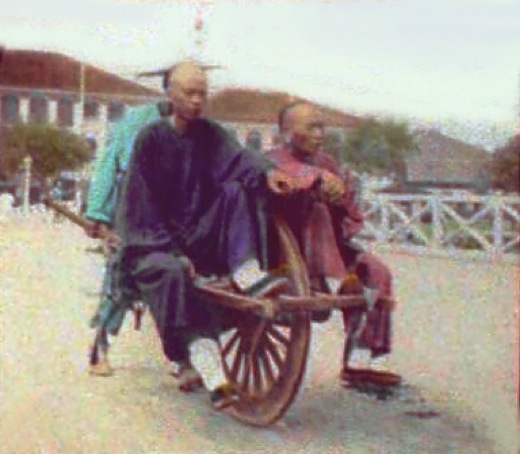
Image above: Wheelbarrow used for passenger travel in early 20th century Shanghai. As many as six people were typically carried. From (http://irapl.altervista.org/cpm/thumbnails2.php?search=Shanghai+-+two+Chinese+men+being+carried+in+wheelbarrow).
Western praise
The characteristic vehicle stupefied Western foreigners who visited China during the early modern period. In "Science and civilization in China", Joseph Needham quotes the Dutch-American merchant Andreas Everardus van Braam Houckgeest, who visited the country in 1797 and gives an excellent description of the contraption:

His words are quoted by Joseph Needham:

Image above: Vietnamese style wheelbarrow carrying a pig. From original article.
Watching the Vietnamese wheelbarrow pictured above, the defensive use of the vehicle is easy to imagine. According to Needham, it was the Chinese with their wheelbarrows who pioneered the use of 'laagers' or 'mobile forts' as a defence against the onslaught of cavalry, a tactical system that remained in use during later times using two-wheeled carts.

Image above: Chinese wheelbarrow being used with donkey as draft animal. From original article.
The latter configuration is shown again in a picture in the Thien Kung Khai Wu (1637), where in the text we read:

Image above: Giclee print of Chinese peasant with a wheelbarrow under sail in 1811. From (http://www.art.com/products/p1775791191-sa-i4204254/chinese-peasant-with-a-wheelbarrow-under-sail-1811.htm).
The use of auxiliary power from animals and wind (the two were sometimes combined) made it possible to design larger wheelbarrows that could take more cargo. Again, it is worthy to quote Andreas Everardus van Braam Houckgeest, writing in 1797:

Image above: Sail assisted wheel barrow near Xi'an, China in 1905. From (http://en.wikipedia.org/wiki/Wheelbarrow).
The decay of the Chinese road infrastructure
The importance of the Chinese wheelbarrow can only be understood in the context of the Chinese transportation network. Prior to the third century AD, China had an extensive and well-maintained road network suited for animal powered carts and wagons. It was only surpassed in length by the Ancient Roman road network. The Chinese road infrastructure attained a total length of about 25,000 miles (40,000 km), compared to almost 50,000 miles (80,000 km) for the Roman system.
The Chinese and Roman road systems were built (independently) over the course of five centuries during the same period in history. Curiously, due to (unrelated) political reasons, both systems also started to disintegrate side by side from the third century AD onwards, and herein lies the explanation for the success of the Chinese wheelbarrow. As we have seen, the one-wheeled vehicle appeared during this period, and this is no coincidence. Increasingly, it was the only vehicle that could be operated on the deteriorating road network. As F.H. King observed:

Image above: Rural wheelbarrow/foot path near Chungking, China. From original article.
Pathways designed for wheelbarrows
\However, it seems that Rudolf Hommel got it wrong, and was looking at the Chinese roads with a Western bias. Joseph Needham tells a more positive story, noting that the network of wide roads was gradually replaced by an informal, low-tech infrastructure that was not less ingenious than the wheelbarrows that operated on it (see his pictures on the right and below). The Chinese answer to a decaying road infrastructure went much further than the adaptation of their vehicles:
Interestingly, the modern, twentieth-century road network that appeared in China, and that Hommel was alluding to in 1937, did not immediately gave way to the automobile, but to another low-tech vehicle that is a worthy competitor for the wheelbarrow: the bicycle, a product of the Industrial Revolution that is even more efficient. It will probably take us (and the 21st-century Chinese) another few decades before we realise how smart the Chinese transport infrastructure was.
The decay of the Western road infrastructure
The use of wheelbarrows in combination with specially designed narrow pathways made land transportation in China considerably more efficient than in Europe for a period of almost 1,500 years. Today, criticism on the omnipresent automobile is often ridiculed by saying that we cannot go back to horses and carts, without realizing that the combination of horses and carts is far from evident and not as low-tech as it seems. History clearly shows that an extensive road infrastructure is a very vulnerable thing.
Europe was also left with a deteriorating road network after the demise of the Roman Empire, though the Europeans could buy some time. Because it was sturdier (using piles of stone and concrete rather than the early form of asphalt applied by the Chinese), the Roman road infrastructure remained relatively useful until about the 11th century AD, after which it was largely abandoned. But even before that time, the destruction of bridges and road facilities by the barbarians - or by the locals in order to defend themselves against the barbarians - gradually diminished its usefulness. Lack of maintenance and the plundering of paving stone did the rest. Moreover, the appearance of new towns and capitals (such as Paris) required new routes that did not always coincide with the existing Roman roads.
Contrary to the Chinese, the Europeans did not develop a new vehicle and appropriate infrastructure of paths to make up for the loss of the Ancient highways. New roads appeared during the economic revival of the late Middle Ages, but these were not paved or hardened in any other way. This made them at best inefficient in good weather and nearly impassable when (and after) it rained. Furthermore, because of the absence of foundations, soil erosion caused by heavy rains could wash entire roads away. As a result, the use of carts and wagons all but disappeared in medieval Europe, while nothing else came in place. For people, the options of land transportation again became limited to walking or - only for the rich - horseback riding.
Cargo was most often transported by pack animals (mostly donkeys and mules, sometimes horses), or simply by carrying it. With the exception of England, where wheeled traffic resurged from as early as the 14th century in some places, and France, where some sturdier roads (unpaved but with foundations) appeared in some regions during the late 16th century, smooth operating wheeled traffic only made a comeback in Europe during the nineteenth century - at the same time as the first railroads appeared.
If they would have been aware of the Chinese wheelbarrow, the Europeans could have followed a similar strategy as the Chinese, using their limited resources to construct and maintain smooth but narrow pathways (and bridges) while downsizing their vehicles. As was noted in several of the historical sources mentioned above, the Chinese wheelbarrow, aided by a second man, an animal, or wind power, could transport up to 300 kg of cargo. This was almost as much as the maximum allowed cargo for horse and ox drawn carts in Ancient Rome (326 kg and 490 kg respectively).
Lessons for the future
Of course, it was not only the wheelbarrow that kept Chinese communication running after the second century AD. At least as important was the impressive network of artificial canals that complemented it. This infrastructure became ever more important after the detoriation of the road network. For example, the Grand Canal, which ran from Hangzhou to Bejing over a distance of 1800 km, was completed in 1327 after 700 years of digging.
In Europe, the first (relatively modest) canals were only built during the 16th century, and most of them only appeared in the eighteenth and nineteenth centuries. The Chinese wheelbarrow alone could not have given Europe an equally effective transport infrastructure as the Chinese, but there is no doubt that it could have made life in medieval Europe a great deal easier.
The story of the Chinese wheelbarrow also teaches us an obvious lesson for the future. While many of us today are not even prepared to change their limousine for a small car, let alone their automobile for a bicycle, we forget that neither one of these vehicles can function without suited roads. Building and maintaining roads is very hard work, and history shows that it is far from evident to keep up with it.
In this regard, it is important to keep in mind that we won't be as lucky as the medieval Europeans who inherited one of the best and most durable road networks in the world. Our road infrastructure - mostly based on asphalt - is more similar to that of the Ancient Chinese and will disintegrate at a much faster rate if we lose our ability to maintain it. The Chinese wheelbarrow - and with it many other forgotten low-tech transportation options - might one day come in very handy again.
Kris De Decker (edited by Shameez Joubert)
.
By Kris De Decker on 29 December 2011 for the Low Tech Magazine - (http://www.lowtechmagazine.com/2011/12/the-chinese-wheelbarrow.html)
Image above: A Chinese wheelbarrow in use today.
For being such a seemingly ordinary vehicle, the wheelbarrow has a surprisingly exciting history. This is especially true in the East, where it became a universal means of transportation for both passengers and goods, even over long distances.
The Chinese wheelbarrow - which was driven by human labour, beasts of burden and wind power - was of a different design than its European counterpart. By placing a large wheel in the middle of the vehicle instead of a smaller wheel in front, one could easily carry three to six times as much weight than if using a European wheelbarrow.
The one-wheeled vehicle appeared around the time the extensive Ancient Chinese road infrastructure began to disintegrate. Instead of holding on to carts, wagons and wide paved roads, the Chinese turned their focus to a much more easily maintainable network of narrow paths designed for wheelbarrows. The Europeans, faced with similar problems at the time, did not adapt and subsequently lost the option of smooth land transportation for almost one thousand years.
Transport options over land
Before the arrival of the steam engine, people have always preferred to move cargo over water instead of over land, because it takes much less effort to do so. But whenever this was not possible, there remained essentially three options for transporting goods: carrying them (using aids like a yoke, or none at all), tying them to pack animals (donkeys, mules, horses, camels, goats), or loading them onto a wheeled cart or wagon (which could be pulled by humans or animals).Carrying stuff was the easiest way to go; there was no need to build roads or vehicles, nor to feed animals. But humans can carry no more than 25 to 40 kg over long distances, which made this a labour-intensive method if many goods had to be transported. Pack animals can take about 50 to 150 kg, but they have to be fed, are slightly more demanding than people in terms of terrain, and they can be stubborn. Pack animals also require one or more people to guide them.
When carrying goods - whether by person or by pack animals - the load is not only moved in the desired direction but it also undergoes an up and down movement with every step. This is a significant waste of energy, especially when transporting heavy goods over long distances. Dragging stuff does not have this drawback, but in that case you have friction to fight. Pulling a wheeled vehicle is therefore the most energy-efficient choice, because the cargo only undergoes a horizontal motion and friction is largely overcome by the wheels. Wheeled carts and wagons, whether powered by animals or people, can take more weight for the same energy input, but this advantage comes at a price; you need to build fairly smooth and level roads, and you need to build a vehicle. If the vehicle is drawn by an animal, the animal needs to be fed.
When all these factors are taken into consideration, the wheelbarrow could be considered the most efficient transport option over land, prior to the Industrial Revolution. It could take a load similar to that of a pack animal, yet it was powered by human labour and not prone to disobedience.
Compared to a two-wheeled cart or a four-wheeled wagon, a wheelbarrow was much cheaper to build because wheel construction was a labour-intensive job. Although the wheelbarrow required a road, a very narrow path (about as wide as the wheel) sufficed, and it could be bumpy. The two handles gave an intimacy of control that made the wheelbarrow very manoeuvrable.
East and West: a very different story
The wheelbarrow tells a very distinct history in both the Western and the Eastern world. Although to this date its origins remain obscure, it is clear that the vehicle played a much larger role in the East than in the West. While in recent years there has surfaced some evidence that the wheelbarrow might have been used on construction sites by the Ancient Greeks at the end of the fifth century BC, there is no mention at all of wheelbarrows in Ancient Rome (although that does not exclude the possibility that they in fact did use them).
The first sound evidence of the wheelbarrow in the Western world only emerged in the early thirteenth century AD. In China, their use is documented extensively from the second century AD onwards - more than a thousand years earlier. It is interesting to note that the wheelbarrow appeared at least 2,000 years later than two-wheeled carts and four-wheeled wagons.
Handbarrow
When the wheelbarrow finally caught on in Europe, it was used for short distance cargo transport only, notably in construction, mining and agriculture. It was not a road vehicle. In the East, however, the wheelbarrow was also applied to medium and long distance travel, carrying both cargo and passengers. This use - which had no Western counterpart - was only possible because of a difference in the design of the Chinese vehicle. The Western wheelbarrow was very ill-adapted to carry heavy weights over longer distances, whereas the Chinese design excelled at it.
On the European wheelbarrow the wheel was (and is) invariably placed at the furthest forward end of the barrow, so that the weight of the burden is equally distributed between the wheel and the man pushing it. In fact, the wheel substitutes for the front man of the handbarrow or stretcher, the carrying tool that was replaced by the wheelbarrow (illustration on the right).
Superior Chinese design
In the characteristic Chinese design a much larger wheel was (and is) placed in the middle of the wheelbarrow, so that it takes the full weight of the burden with the human operator only guiding the vehicle. In fact, in this design the wheel substitutes for a pack animal. In other words, when the load is 100 kg, the operator of a European wheelbarrow carries a load of 50 kg while the operator of a Chinese wheelbarrow carries nothing. He (or she) only has to push or pull, and steer.Image above: Typical Chinese wheel barrow in Shanghai early 20th century. From original article.
The result was an extremely powerful and agile vehicle. In 1176 AD, the Chinese writer Tsêng Min-Hsing noted enthusiastically:
"The device is so efficient that it can take the place of three men; moreover, it is safe and steady when passing along dangerous places (cliff paths, etcetera). Ways which are as winding as the bowels of a sheep will not defeat it."
Image above: Wheelbarrow used for passenger travel in early 20th century Shanghai. As many as six people were typically carried. From (http://irapl.altervista.org/cpm/thumbnails2.php?search=Shanghai+-+two+Chinese+men+being+carried+in+wheelbarrow).
Western praise
The characteristic vehicle stupefied Western foreigners who visited China during the early modern period. In "Science and civilization in China", Joseph Needham quotes the Dutch-American merchant Andreas Everardus van Braam Houckgeest, who visited the country in 1797 and gives an excellent description of the contraption:
"Among the carriages employed in this country is a wheelbarrow, singularly constructed, and employed alike for the conveyance of persons and goods. According as it is more or less heavy loaded, it is directed by one or two persons, the one dragging it after him, while the other pushes it forward by the shafts. The wheel, which is very large in proportion to the barrow, is placed in the centre of the part on which the load is laid, so that the whole weight bears upon the axle, and the barrow men support no part of it, but serve merely to move it forward, and keep it in equilibrum.=
The wheel is as it were cased up in a frame made of laths, and covered over with a thin plank, four or five inches wide. On each side of the barrow is a projection, on which the goods are put, or which serves as a seat for the passengers. A Chinese traveller sits on one side, and thus serves to counter-balance his baggage, which is placed on the other. If his bagage is heavier than himself, it is balanced equally on the two sides, and he seats himself on the board over the wheel, the barrow being purposely contrived to suit such occasions.
The sight of this wheelbarrow thus loaded, was entirely new to me. I could not help remarking its singularity, at the same time that I admired the simplicity of the invention. I even think, that in many cases such a barrow would be found much superior to ours."
Image above: Application of wheelbarrows during flood control projects, Shandong, before 1973. From original article.
Wheelbarrow trains
The American soil scientist F.H. King shows himself equally impressed in his 1911 publication "Farmers of Forty Centuries":"We had observed long processions of wheelbarrow men moving from the canals through the streets carrying large loads of [crops] in bundles a foot long and five inches in diameter. These had come from the country on boats each carrying tons of the succulent leaves and stems. We had counted as many as fifty wheelbarrow men passing a given point on the street in quick succession, each carrying 300 to 500 pounds of [crops] and moving so rapidly that it was not easy to keep pace with them, as we learned in following one of the trains during twenty minutes to its destination. During this time not a man in the train haltened or slackened his pace. This same type of vehicle, too, is one of the common means of transporting people, especially Chinese women, and four, six and even eight may be seen riding together, propelled by a single wheelbarrow man."Rudolf Hommel, in his 1937 book "China at work" (based on a 1921 travel through the country), seems to be most intrigued by the ingenuity of the low-tech design, going into technical details:
"While there are many kinds of wheelbarrows, the one shown [here] is typical of them all; the principle always being the same, i.e. one large wheel surrounded by a framework, guarding the upper part of the wheel from contact with merchandise or persons transported. The two long shafts, held at a proper distance from each other by two crosspieces, terminate in the handlebars, and form the basis of the whole vehicle. Into them is mortised the lattice work which surrounds the wheel. On each side a carrying frame is formed by curved bars attached to the main shafts by crosspieces.
"The wheel, about 3 feet in diameter, is made entirely of wood and has two iron bands around the hub, and an iron tire. The axle is made of some very strong wood. From the frame of the wheelbarrow two pieces extend downward with the bearing holes for the axle. This looks rather precarious, and yet these pieces stand up splendidly under the heavy strain of immense loads and the considerable bumping over the miserable roads. These wheelbarrows are masterpieces of joinery and special care is bestowed on the selection of the best grades of hard wood for all parts. This description would not be complete without mentioning the squeaking of the unoiled axle, a nightmare to foreigners, which does not bother the Chinese in the least."
Low-tech masterpieces
Just as other Western observers, Hommel watched the vehicles pass by in admiration:"Besides transporting goods with these wheelbarrows, the Chinese use them also for passengers. I have seen as many as six people on them, three sitting on each side with their feet dangling down. If only one person is conveyed the driver balances the wheelbarrow skilfully with the wheel tilted at a considerable angle from the vertical. If a peasant wants to take a pig to the market, he saves himself all the trouble of guiding the recalcitrant beast, by tying it upon the wheelbarrow and wheeling it to the market."
Mobile forts
As so many other innovative technologies, the Chinese wheelbarrow was orginally developed for military purposes. The first records mention its use for supplying food to the army. The wheelbarrow gave the Chinese armies such an advantage in moving goods that it was kept secret - early Chinese writings talk about wheelbarrows in code. True to its origin, the wheelbarrow remained in use for military operations, though not only to supply food to soldiers. In 1176, Tsêng Min-Hsing alluded to the military use of the wheelbarrow in forming protective layers.His words are quoted by Joseph Needham:
"Not only is it useful for transporting army rations, but at need it can be employed as a defensive obstruction against cavalry. Since the digging of trenches and moats, and the building of forts, take time, the wheelbarrows can be deployed round the perimeter so that the enemy's horses cannot easily pass over. This kind of vehicle can readily go forward and withdraw, and can be used for any purpose. It might well be called a 'mobile fort'."
Image above: Vietnamese style wheelbarrow carrying a pig. From original article.
Watching the Vietnamese wheelbarrow pictured above, the defensive use of the vehicle is easy to imagine. According to Needham, it was the Chinese with their wheelbarrows who pioneered the use of 'laagers' or 'mobile forts' as a defence against the onslaught of cavalry, a tactical system that remained in use during later times using two-wheeled carts.
Animal traction
A remarkable feature of the Chinese wheelbarrow was the combined use of human and animal traction, which became common from an early date on. This practice can be seen in a 1126 painting by Chang Tsê-Tuan, which is described by Joseph Needham:"The painting depicts the popular life of the capital Khaifêng at the time of the spring festival. Many wheelbarrows are moving or stationary in the streets of the city. All but one have the large central wheel and some are very heavily laden. During the loading and unloading the wheelbarrows rest on the side-legs. One is being pushed by a single man, and in all cases the porter steadies the vehicle by the shafts behind, while traction is effected either by one man in shafts and one mule or donkey with collar-harness and traces, or by two animals side by side similarly attached."
Image above: Chinese wheelbarrow being used with donkey as draft animal. From original article.
The latter configuration is shown again in a picture in the Thien Kung Khai Wu (1637), where in the text we read:
"The northern one-wheeled barrow (tu yuan chhê) is pushed by one man from behind, with (one or more) donkeys pulling it from the front; it is hired by those who dislike riding (on horseback). The travellers sit on opposite sides to balance it, and a mat roof shields them from sun and wind. This kind of conveyance goes as far north as Chhang-an and Chi-ning, and also comes to the capital. When not carrying passengers these barrows will take as much as 4 or 5 tan of goods [about 6 cwt or 300 kg]. The one-wheeled barrow (tu lun thui chhe) of the south is also pushed by one man (but without animal aid), and carries only 2 tan. When it meets pot-holes (in the road) it has to stop; in any case it seldom goes more than 100 li [50 km]."
Image above: Giclee print of Chinese peasant with a wheelbarrow under sail in 1811. From (http://www.art.com/products/p1775791191-sa-i4204254/chinese-peasant-with-a-wheelbarrow-under-sail-1811.htm).
Wind powered wheelbarrows
An even more surprising method to augment human power in moving the wheelbarrow was the use of sails. The date of the introduction of the sailing wheelbarrow is unknown, but Joseph Needham notes that this contraption (the chia fan chhê) was still widely used in China at the time of writing (1965), notably in Honan and in the coastal provinces such as Shantung. Rudolf Hommel and F.H. King also spotted and described the vehicles. While some sails were very simple pieces of cloth, others were perfect miniatures of the ones used on a junk (a Chinese sailboat), easily adjustable by the driver.The use of auxiliary power from animals and wind (the two were sometimes combined) made it possible to design larger wheelbarrows that could take more cargo. Again, it is worthy to quote Andreas Everardus van Braam Houckgeest, writing in 1797:
"Near the southern border of Shantung one finds a kind of wheelbarrow much larger than that which I have been describing, and drawn by a horse or a mule. But judge of my surprise when today I saw a whole fleet of wheelbarrows of the same size. I say, with deliberation, a fleet, for each of them had a sail, mounted on a small mast exactly fixed in a socket arranged at the forward end of the barrow."
"The sail, made of matting, or more often of cloth, is five or six feet [1.5 to 2 m] high, and three or four feet broad,, with stays, sheets, and halyards, just as on a Chinese ship. The sheets join the shafts of the wheelbarrow and can thus be manipulated by the man in charge."
"One had to grant the apparatus was not a freak, but an arrangement by which, with a favourable wind, the wheelbarrow porters could be greatly assisted. Otherwise such a complicated thing would have been only a bizarre curiosity. I could not help admiring the combination, and was filled with sincere pleasure in seeing twenty or so of these sailing-wheelbarrows setting their course one behind the other."
Image above: Sail assisted wheel barrow near Xi'an, China in 1905. From (http://en.wikipedia.org/wiki/Wheelbarrow).
Wheelbarrows on rails
The Chinese wheelbarrow kept evolving even after the arrival of the Industrial evolution, adapting modern materials and wheels. Another noteworthy example of this is the so-called 'piepkar', which showed up on the island of Billiton at the coast of Sumatra at the turn of the twentieth century. There, a Dutch tin mining company was faced with very bad roads. The solution? A great example of combining Eastern and Western knowledge; wheelbarrows equipped with very narrow wheels, guided by iron rails. The technology - which was in use from the 1880s to around 1920 - reminds of the horse-drawn rail cars that became popular in Western cities at the time.The decay of the Chinese road infrastructure
The importance of the Chinese wheelbarrow can only be understood in the context of the Chinese transportation network. Prior to the third century AD, China had an extensive and well-maintained road network suited for animal powered carts and wagons. It was only surpassed in length by the Ancient Roman road network. The Chinese road infrastructure attained a total length of about 25,000 miles (40,000 km), compared to almost 50,000 miles (80,000 km) for the Roman system.
The Chinese and Roman road systems were built (independently) over the course of five centuries during the same period in history. Curiously, due to (unrelated) political reasons, both systems also started to disintegrate side by side from the third century AD onwards, and herein lies the explanation for the success of the Chinese wheelbarrow. As we have seen, the one-wheeled vehicle appeared during this period, and this is no coincidence. Increasingly, it was the only vehicle that could be operated on the deteriorating road network. As F.H. King observed:
"For adaptability to the worst road conditions no vehicle equals the wheelbarrow, progressing by one wheel and two feet".In 1937, Rudolf Hommel goes on complaining about the Chinese roads:
"In olden times, excellent wide roads were in existence in China, suitable for chariots, coaches, and wagons of many descriptions. Present-day conditions show a different picture, especially in Southern and Central China where the two-wheeled cart is not known. The splendid roads are gone, and in their place, we find only narrow paths, scarcely wide enough for foot passengers and wheelbarrows. The two-wheeled cart survived only in North China under the sway of the court of Peking, where the important business of victualizing the capital was sufficient urge to keep up the roads."
"The Chinese peasant, ever intent to gain more ground for the cultivation of his crops, has gradually reduced the width of former highways, unhampered by a watchful government. In fact, the greedy officials winked at such encroachments, as long as they have been thereby enabled to exact increased contributions in taxes from the hardworking peasants. It is only within the last five years that an extensive program of road building has been carried out."
Image above: Rural wheelbarrow/foot path near Chungking, China. From original article.
Pathways designed for wheelbarrows
\However, it seems that Rudolf Hommel got it wrong, and was looking at the Chinese roads with a Western bias. Joseph Needham tells a more positive story, noting that the network of wide roads was gradually replaced by an informal, low-tech infrastructure that was not less ingenious than the wheelbarrows that operated on it (see his pictures on the right and below). The Chinese answer to a decaying road infrastructure went much further than the adaptation of their vehicles:
"In many periods the government was interested primarily, and sometimes exclusively, in those roads and water-ways which were significant for tax-grain transportation and the conveyance of official messages. The upkeep of a multitude of local roads and paved pathways devolved, therefore, upon the people themselves, acting in their co-operative capacity under village elders and small-town worthies. In this context, religious associations, such as the Taoists Yellow Turbans about 180 AD, later so politically important, or the Buddhist fraternities afterwards, played a significant part. Making good roads was nothing less than a pious duty.
Thus in the course of time, quite apart from the Ancient and medieval imperial highways, China's landscape became shot through with millions of miles of well-paved paths, suitable chiefly for pedestrians, porters with carrying poles, pushers of wheelbarrows, and men carrying litters. Rough unpaved cart-tracks predominated only in the Eastern plains. Those who, like the author, have followed these paved ways past woods and rice-fields for many a mile cannot think of them without intense nostalgia. There was a long tradition of such privately initiated roads going back to the Han or even earlier, and their total mileage far outstripped that of the government main roads as the ages passed."
Interestingly, the modern, twentieth-century road network that appeared in China, and that Hommel was alluding to in 1937, did not immediately gave way to the automobile, but to another low-tech vehicle that is a worthy competitor for the wheelbarrow: the bicycle, a product of the Industrial Revolution that is even more efficient. It will probably take us (and the 21st-century Chinese) another few decades before we realise how smart the Chinese transport infrastructure was.
The decay of the Western road infrastructure
The use of wheelbarrows in combination with specially designed narrow pathways made land transportation in China considerably more efficient than in Europe for a period of almost 1,500 years. Today, criticism on the omnipresent automobile is often ridiculed by saying that we cannot go back to horses and carts, without realizing that the combination of horses and carts is far from evident and not as low-tech as it seems. History clearly shows that an extensive road infrastructure is a very vulnerable thing.
Europe was also left with a deteriorating road network after the demise of the Roman Empire, though the Europeans could buy some time. Because it was sturdier (using piles of stone and concrete rather than the early form of asphalt applied by the Chinese), the Roman road infrastructure remained relatively useful until about the 11th century AD, after which it was largely abandoned. But even before that time, the destruction of bridges and road facilities by the barbarians - or by the locals in order to defend themselves against the barbarians - gradually diminished its usefulness. Lack of maintenance and the plundering of paving stone did the rest. Moreover, the appearance of new towns and capitals (such as Paris) required new routes that did not always coincide with the existing Roman roads.
Contrary to the Chinese, the Europeans did not develop a new vehicle and appropriate infrastructure of paths to make up for the loss of the Ancient highways. New roads appeared during the economic revival of the late Middle Ages, but these were not paved or hardened in any other way. This made them at best inefficient in good weather and nearly impassable when (and after) it rained. Furthermore, because of the absence of foundations, soil erosion caused by heavy rains could wash entire roads away. As a result, the use of carts and wagons all but disappeared in medieval Europe, while nothing else came in place. For people, the options of land transportation again became limited to walking or - only for the rich - horseback riding.
Cargo was most often transported by pack animals (mostly donkeys and mules, sometimes horses), or simply by carrying it. With the exception of England, where wheeled traffic resurged from as early as the 14th century in some places, and France, where some sturdier roads (unpaved but with foundations) appeared in some regions during the late 16th century, smooth operating wheeled traffic only made a comeback in Europe during the nineteenth century - at the same time as the first railroads appeared.
Ox drawn carts
Carts and wagons drawn by oxen remained in use throughout the centuries in Europe, for heavy or large-sized loads that could not be transported by rivers or by sea. However, road conditions often required large spans of oxen, which made wheeled transportation of heavy loads ridiculously expensive and limited to very short distances. Because of friction, the nature of a road surface greatly determines how efficient wheeled transport will be. In "Energy in world history", Vaclac Smil writes: "On a smooth, hard, dry road, a force of only about 30 kg is needed to wheel a 1 tonne load. A loose, gravelly surface may easily call for five times as much draft. On sandy or muddy roads the multiple can be seven to ten times higher."This had important consequences, as we have seen in the article about the pre-industrial use of fossil fuels. Many countries could not capitalize on most of their energy resources, be it wood or peat or coal, because transporting them over land took more time and energy (in terms of animal feed) than they could afford.
If they would have been aware of the Chinese wheelbarrow, the Europeans could have followed a similar strategy as the Chinese, using their limited resources to construct and maintain smooth but narrow pathways (and bridges) while downsizing their vehicles. As was noted in several of the historical sources mentioned above, the Chinese wheelbarrow, aided by a second man, an animal, or wind power, could transport up to 300 kg of cargo. This was almost as much as the maximum allowed cargo for horse and ox drawn carts in Ancient Rome (326 kg and 490 kg respectively).
Lessons for the future
Of course, it was not only the wheelbarrow that kept Chinese communication running after the second century AD. At least as important was the impressive network of artificial canals that complemented it. This infrastructure became ever more important after the detoriation of the road network. For example, the Grand Canal, which ran from Hangzhou to Bejing over a distance of 1800 km, was completed in 1327 after 700 years of digging.
In Europe, the first (relatively modest) canals were only built during the 16th century, and most of them only appeared in the eighteenth and nineteenth centuries. The Chinese wheelbarrow alone could not have given Europe an equally effective transport infrastructure as the Chinese, but there is no doubt that it could have made life in medieval Europe a great deal easier.
The story of the Chinese wheelbarrow also teaches us an obvious lesson for the future. While many of us today are not even prepared to change their limousine for a small car, let alone their automobile for a bicycle, we forget that neither one of these vehicles can function without suited roads. Building and maintaining roads is very hard work, and history shows that it is far from evident to keep up with it.
In this regard, it is important to keep in mind that we won't be as lucky as the medieval Europeans who inherited one of the best and most durable road networks in the world. Our road infrastructure - mostly based on asphalt - is more similar to that of the Ancient Chinese and will disintegrate at a much faster rate if we lose our ability to maintain it. The Chinese wheelbarrow - and with it many other forgotten low-tech transportation options - might one day come in very handy again.
Kris De Decker (edited by Shameez Joubert)
Sources:
- "Science and Civilisation in China, Volume 4: Physics and Physical Technology, Part 2, Mechanical Engineering
", Joseph Needham, 1965 (the wheelbarrow)
- "Science and Civilisation in China, Volume 4: Physics and Physical Technology, Part 3: Civil engineering and nautics
", Joseph Needham, 1971 (the road network)
- "Hommel: China at Work", Rudolf P. Hommel, 1937
- "Farmers of Forty Centuries, or, permanent agriculture in China, Korea and Japan", F.H. King, 1911
- "The medieval wheelbarrow", Andrea L. Matthies, in "Technology and Culture", Vol. 32, No.2, April 1991
- "The origins of the wheelbarrow", M.J.T. Lewis, in "Technology and Culture", Vol.35, No.3, July 1994
- "Roads and pavements in France", Alfred Perkens Rockwell, 1895
- "Voyager au Moyen Age", Jean Verdon, 2007 (original edition 1998)
- "Histoire générale des techniques" (Tome I / Tome II), Maurice Dumas, 1962
- "Horse hauling: a revolution in vehicle transport in 12th and 13th century England", John Langdon, 1984
- "A social and economic history of medieval Europe
", Gerald Hodgett, 1972
- "Science and Technology in Medieval European Life", Jeffrey R. Wigelsworth, 2006
- "Medieval sourcebook: Richer of Rheims: Journey to Chartres, 10th century", Michael Markowski (webpage)
- "Inland transportation in England during the fourteenth century", J.F. Williard, 1926
- "The use of carts in the fourteenth century", J.F. Williard, 1932
- "Energy In World History", Vaclac Smil, 1994
- "The Subterranean Forest
", Rolf Pieter Sieferle, 2010
- Coming home with riches: the wheelbarrow as an auspicious motif in popular Chinese prints, Antje Richter, 2004
- The wheelbarrow, Engines of our ingenuity, John Lienhard
- Institut d'Asie Orientale: pictures (overview).
- Lantern slide collection, Art, Architecture and Engineering Library.
.