Peak Civilization

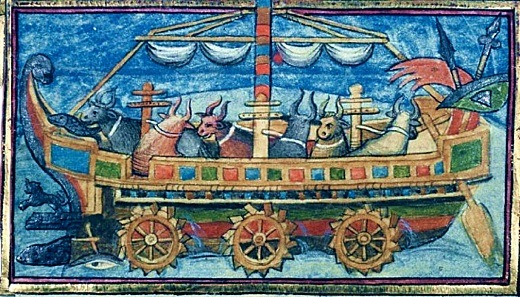
SUBHEAD: Example - The Fall of the Roman Empire. Collapse is invisible from the inside. By Ugo Bardi on 22 July 2009 in the Oil Drum: Europe - http://europe.theoildrum.com/node/5528 [Editor's note: This is the concluding section of a long article that is linked above.] image above: Middle Age copy of late Roman Empire design for oxen powered warship to rule the seas. From linked extended article. Avoiding Collapse From our viewpoint, we see what was the history of the Roman Empire. But, from inside, as we saw, it wasn't clear at all. But let's assume that someone had it clear, already at the time of Marcus Aurelius. I said that there might have been something like an ASPE; "association for the study of peak empire". Or let's imagine that a wise man, a Druid from foggy Britannia, an ancestor of Merlin the wise, was smart enough to figure out what was going on. You don't really need computers to make dynamical models, or maybe this druid made one using wooden cogs and wheels, the whole thing powered by slaves. So, let's say that this druid understood that the troubles of the Empire are caused by a combination of negative feedbacks and that these feedbacks come from the cost of the army and of the bureaucracy, the overexploitation of the fertile soil, the fact that Rome had exhausted the "easy" targets for conquest. Now, it is a tradition of Druids (and also the Association for the Study of Peak Oil & Gas, ASPO) of alerting kings and rulers of the dangers ahead. After all, Merlin did that for King Arthur and we may imagine that the Druid we are thinking of felt that it was his duty to do that with Emperor Marcus Aurelius. So, he decides to go to Rome and speak to the Emperor. Suppose you were that Druid; what would you say to the Emperor? Good question, right? I have asked it to myself many times. We could think of many ways of answering it. For instance, if gold is running out from the Empire's coffers, why not suggest to the Emperor to mount a naval expedition to the Americas? It is what Columbus would do, more than a millennium afterwards and the result was the Spanish empire - it was also based on gold and it didn't last for long. Maybe the Romans could have done something like that. But they didn't have the right technology to cross the oceans and, at the time of Marcus Aurelius, they had run out of the resources to develop it. So, they had to remain in Europe and to come to terms with the limits of the area they occupied. The Empire had to return its economy within these limits. So, there is only one thing that you, as the wise Druid from Britannia, can tell the Emperor: you have to return within the limits that the Empire's economy can sustain. So you walk to Rome - kind of a long walk from Eburacum, in Britannia; a place that today we call "York". You are preceded by your fame of wise man and so the Emperor receives you in his palace. You face him, and you tell him what you have found: "Emperor, the empire is doomed. If you don't do something now, it will collapse in a few decades" The Emperor is perplexed, but he is a patient man. He is a philosopher after all. So he won't have your head chopped off right away, as other emperors would, but he asks you, "But why, wise druid, do you say that?" "Emperor, " you say, "you are spending too much money for legions and fortifications. The gold accumulated in centuries of conquests is fast disappearing and you can't pay enough legionnaires to defend the borders. In addition, you are putting too much strain on agriculture: the fertile soil is being eroded and lost. Soon, there won't be enough food for the Romans. And, finally, you are oppressing people with too much bureaucracy, which is also too expensive." Again, the Emperor considers having your head chopped off, but he doesn't order that. You have been very lucky in hitting on a philosopher-emperor. So he asks you, "Wise druid, there may be some truth in what you say, but what should I do?" "Emperor, first you need to plant trees. the land needs rest. In time, trees will reform the fertile soil." "But, druid, if we plant trees, we won't have enough food for the people." "Nobody will starve if the patricians renounce to some of their luxuries!" "Well, Druid, I see your point but it won't be easy....." "And you must reduce the number of legions and abandon the walls!" "But, but.... Druid, if we do that, the barbarians will invade us....." "It is better now than later. Now you can still keep enough troops to defend the cities. Later on, it will be impossible. It is sustainable defense." "Sustainable?" "Yes, it means defense that you can afford. You need to turn the legions into city militias and..." "And...?" "You must spend less for the Imperial bureaucracy. The Imperial taxes are too heavy! You must work together with the people, not oppress them! Plant trees, disband the army, work together!" Now, Emperor Marcus Aurelius seriously considers whether it is appropriate to have your head chopped off, after all. Then, since he is a good man, he sends to you back to Eburacum under heavy military escort, with strict orders that you should never come to Rome again. This is a little story about something that never happened but that closely mirrors what happened to the modern druids who were the authors of "The Limits to Growth." They tried to tell to the world's rulers of their times something not unlike what our fictional druid tried to tell to Emperor Marcus Aurelius. The heads of the authors of "The Limits to Growth" weren't chopped off, but they were surely "academically decapitated" so to say. They were completely ignored. Not just ignored, ridiculed and vituperated. It is not easy to be a Druid. So, here we found another similarity between our times and the Roman ones. We are subjected to the "fish in the water" curse. We don't understand that we are surrounded by water. And we don't want to be told that water exists. As things stands, we seem to be blithely following the same path that the Roman Empire followed. Our leaders are unable to understand complex systems and continue to implement solutions that worsen the problem. As the wise Druid was trying to tell to Marcus Aurelius, building walls to keep the barbarians out was a loss of resources that was worse than useless. But I can see the politicians of the time running on a platform that said, "Keep the barbarians out! More walls to defend the empire". It is the same for us. Tell a politician that we are in trouble with crude oil and he/she will immediately say "drill deeper!" or "drill, baby, drill!" Negative feedback kills. Middle Ages are the solution But I would like to point out to you something: let's go back to what our fictional Druid was telling to Emperor Aurelius. He had this slogan "Plant trees, disband the army and work together". I had invented it in a post that I had written on the collapse of Tuscan society in 16th century; it is another story but one that shows how all societies follow similar paths. Anyway, can you see what kind of world the Druid was proposing to the Emperor? Think about that for a moment: a world of walled cities defended by city militias, no central authority or a weak one, an economy based on agriculture. Do you see it.....? Sure, it is Middle Ages! Think about that for a moment and you'll see that you could define Middle Ages as a solution for the problems of the Roman Empire! So, our Druid had seen the future and was describing it to Emperor Aurelius. He had seen the solution of the problems of Empire: The Middle Ages. It was where the Empire was going and where it could not avoid going. What the Druid was proposing was to go there in a controlled way. Ease the transition, don't fight it! If you know where you are going, you can travel in style and comfort. If you don't, well, it will be a rough ride. We may imagine a hypothetical "driven transition" in which the government of the Roman Empire at the time of Marcus Aurelius would have done exactly that: abandon the walls, reduce the number of legion and transform them into city militias, reduce bureaucracy and Imperial expenses, delocalize authority, reduce the strain on agriculture: reforest the land. The transition would not have been traumatic and would have involved a lower loss of complexity: books, skills, works of art and much more could have been saved and passed to future generations. All that is, of course, pure fantasy. Even for a Roman Emperor, disbanding the legions couldn't be easy. After all, the name "Emperor" comes from the Latin word "imperator" that simply means "commander". The Roman Emperor was a military commander and the way to be Emperor was to please the legions that the Emperor commanded. A Roman Emperor who threatened to disband the legions wouldn't have been very popular and, most likely, he was to be a short lived Emperor. So, Emperors couldn't have done much even if they had understood system dynamics. In practice, they spent most of their time trying to reinforce the army by having as many legions as they could. Emperors, and the whole Roman world, fought as hard as they could to keep the status quo ante, to keep things as they had always been. After the 3rd century crisis, Emperor Diocletian resurrected the Empire transforming it into something that reminds us of the Soviet Union at the time of Breznev. An oppressive dictatorship that included a suffocating bureaucracy, heavy taxes for the citizens, and a heavy military apparatus. It was such a burden for the Empire that it destroyed it utterly in little more than a century. Our Druids may be better than those of the times of the Roman Empire, at least they have digital computers. But our leaders are no better apt at understanding complex system than the military commanders who ruled the Roman Empire. Even if our leaders were better, they would face the same problems: there are no structures that can gently lead society to where it is going. We have only structures that are there to keep society where it is - no matter how difficult and uncomfortable it is to be there. It is exactly what Tainter says: we react to problems by building structure that are more and more complex and that, in the end, produce a negative return. That's why societies collapse. So will all our efforts are to keep the status quo ante. For this reason we are desperately looking for something that can replace crude oil and leave everything else the same. It has to be something that is liquid, that burns and, if possible, even smells bad. Drill more, drill deeper, boil tar sands, make biofuels even if people will starve. We are doing everything we can to keep things as they are. And, yet, we are going where the laws of physics are going to take us. A world with less crude oil, or with no crude oil at all, cannot be the same world we are used to, but it doesn't need to be the Middle Ages again. If we manage to deploy new sources of energy, renewable or nuclear - fast enough to replace crude oil and the other fossil fuels, we can imagine that the transition would not involve a big loss of complexity, perhaps none at all. More likely, a reduced flux of energy and natural resources in the economic system will entail the kind of collapse described in the simulations of "The Limits to Growth." We can't avoid going where the laws of physics are taking us. Conclusion: showdown at Teutoburg Two thousand years ago, three Roman legions were annihilated in the woods of Teutoburg by a coalition of tribes of the region that the Romans called "Germania". Today, after so many years, the woods of the region are quiet and peaceful places, as you can see in this picture: It is hard for us to imagine what the three days of folly of the battle of Teutoburg must have been. The legions surprised by the ambush of the Germans, their desperate attempt to retreat: under heavy rain and strong winds in the woods, they never were able to form a line and fight as they were trained to. One by one, almost all of them were killed; their general, Varus, committed suicide. The Germans left the bodies rotting in the woods as a sort of sacred memory to the battle. The ultimate disgrace for the legions was the loss of their sacred standards. It was such a disaster that it led to the legend that Emperor Augustus would wander at night in his palace screaming "Varus, give me back my legions!" I think we could pause for a moment and remember these men, Germans and Romans, who fought so hard and died. We have seen so many similarity between our world and the Roman one that we may feel something that these men felt as well. Why did they fight, why did they die? I think that many of them fought because they were paid to fight. Others because their commander or their chieftain told them so. But, I am sure, a good number of them had some idea that they were fighting for (or against) the abstract concept that was the Roman Empire. Some of them must have felt that they stood for defending civilization against barbarians, others for defending their land against evil invaders. Two millennia after the battle of Teutoburg, we can see how useless it was that confrontation in the woods soaked with rain. A few years later, the Roman general Germanicus, nephew of Emperor Tiberius, went back to Teutoburg with no less than eight legions. He defeated the Germans, recovered the standards of the defeated legions, and buried the bodies of the Roman dead. Arminius, the German leader who had defeated Varus, suffered a great loss of prestige and, eventually, he was killed by his own people. But all that changed nothing. The Roman Empire had exhausted its resources and couldn't expand any more. Germanicus couldn't conquer Germany any more than Varus could bring back his legions from the realm of the dead. Civilizations and empires, in the end, are just ripples in the ocean of time. They come and go, leaving little except carved stones proclaiming their eternal greatness. But, from the human viewpoint, Empires are vast and long standing and, for some of us, worth fighting for or against. But those who fought in Teutoburg couldn't change the course of history, nor can we. All that we can say - today, as at the time of the battle of Teutoburg, is that we are going towards a future world that we can only dimly perceive. If we could see clearly where we are going, maybe we wouldn't like to go there; but we are going anyway. In the end, perhaps it was Emperor Marcus Aurelius who had seen the future most clearly: "Nature which governs the whole will soon change all things which thou seest, and out of their substance will make other things, and again other things from the substance of them, in order that the world may be ever new." Marcus Aurelius Verus - "Meditations" ca. 167 A.D. see also: Ea O Ka Aina: Too Big to Fail 4/22/09 Island Breath: Navigating the Great Turning 5/22/08 Island Breath: The Great Turning from Empire 6/16/06

Real Soldiers Just Say No

SUBHEAD: Where will real change come from in US military policy? Perhaps from the soldiers themselves.  

By Jon Letman on 18 August 2009 in AntiWar.com - 
http://original.antiwar.com/letman/2009/08/17/soldiers-who-just-say-no

 
Image above: Satire illustration of Hawaii's own Lt Ehren Watada (of the Stryker Brigade), who was the first US Army officer to refuse to go to Iraq because it was an unjust war, and who was widely condemned by "patriots".] From http://michellemalkin.com/2006/06/08/zarqawis-moonbat-friends

Six months into Barack Obama’s presidency, the U.S. public’s display of antiwar sentiment has faded to barely a whisper. Despite Obama’s vow to withdraw all combat forces from Iraq before September 2011, he plans to leave up to 50,000 troops in "training and advisory" roles.

Meanwhile, nearly 130,000 troops remain in that country and more than 50,000 U.S. soldiers occupy Afghanistan, with up to an additional 18,000 approved for deployment this year. So where is the resistance?

In independent journalist Dahr Jamail’s The Will to Resist: Soldiers Who Refuse to Fight in Iraq and Afghanistan (Haymarket Books), Jamail profiles what may ultimately prove to be the United States’ most effective antiwar movement: the soldiers themselves.

During the early years of the Iraq war, Jamail traveled to Iraq alone and reported as an unembedded freelance journalist. Over four visits, Jamail documented the war’s effects on Iraqi civilians in Beyond the Green Zone (2007).

Although he is a fierce critic of the wars in Iraq and Afghanistan and the U.S. mainstream media, which he says served as a "cheerleader" for war, Jamail admits he was raised to admire the military. However, after covering the war from Iraq between 2003 and 2005, Jamail was enraged by what he calls "the heedless and deliberate devastation [he] saw [the U.S. military] wreak upon the people of Iraq."

Back in the U.S., traveling the country speaking out against the war, Jamail met scores of soldiers who had served in Iraq and Afghanistan and found that he shared with them a "familiar anguish" which drove him to further explore their motivations as soldiers. In doing so, he opens the door to a growing subculture of internal dissent that is increasingly bubbling up and spilling over the edge of an otherwise ultra-disciplined, highly controlled military society.

"The soldiers I spoke with while working on this book are some of the most ardent antiwar activists I have ever met," Jamail told IPS. "Having experienced the war firsthand, this should not come as a surprise." In The Will to Resist, Jamail profiles individual acts of resistance that he envisions as the possible seeds of a broader antiwar movement.

The book is filled with stories of soldiers who refuse missions deemed "suicidal," go AWOL, flee abroad, refuse to carry a loaded weapon, even arrange to be shot in the leg – and those who in a final act of desperation commit suicide. S

oldiers who refuse to deploy or follow orders risk court-martial, prison time, dishonorable discharge, and loss of veteran’s medical benefits, yet an increasing number of active-duty soldiers and veterans are willing to do so.

Rather than accept a mission almost certain to bring death, some troops simply refuse to follow orders. Jamail describes soldiers in Iraq on "search and avoid" missions who grew adept at giving the appearance of going out on patrol when, in fact, they were lying low, catching up on sleep, and trying to avoid being killed. Jamail quotes one Marine who served in Iraq and Afghanistan as saying, "Dissent starts as simple as saying, ‘This is bullshit. Why am I risking my life?’"

Soldiers tell Jamail that incidents of refusing orders are unremarkable and "pretty widespread," to which he responds, "It is also understandable why the military does not want more soldiers or the public to know about them."

 "Army Specialist Victor Agosto, who served a year in Iraq, has recently publicly refused orders to deploy to Afghanistan," Jamail told IPS, "and the Army, due to the threat of more soldiers and the broader public learning of this, backed away from giving Agosto the harshest court-martial possible, to one of the lightest." Jamail also dedicates two chapters to soldiers who stand up to systemic misogyny and homophobia in the military.

Extensive interviews with female soldiers detail a pervasive culture of institutionalized "command rape," harassment, abuse, and assault, which, in a number of high-profile cases (and many more unknown) end in ostracism, coercion, demotion, suicide, and murder.

Citing studies from professional medical journals that offer a grim assessment of sexual intimidation and abuse within the U.S. military, Jamail writes, "According to the group Rape, Abuse, and Incest National Network, one in six women in the United States will be a victim of sexual assault in her lifetime. In the military, at least two in five will.

In either case, at least 60 percent of the cases go unreported." As Jamail recounts horrific cases of violence toward women in the military, he notes the irony of frequent claims that the wars in Iraq and Afghanistan are "liberating" women of those Muslim countries.

 Like female soldiers, gay and lesbian service men and women are targeted for harassment and abuse. Jamail meets soldiers who, under the "Don’t Ask, Don’t Tell" policy, must conceal their true identity, falsely posing as straight while battling internal conflicts about their own roles in the military.

 In the blunt language of the soldiers, Jamail describes the military experience as a process of dehumanization."The primary objective appeared to be to mistreat and dehumanize your guys [fellow soldiers]," one Marine says. "I could not do it, not to my men and not to those people. I like the Iraqis, I like the Afghanis. Why were we treating them like sh*t? …

That is when I really started questioning what the hell was going on." For many soldiers, however, the pain of war is simply too much to bear and so they choose their own final discharge: suicide.

In an emotionally exhausting chapter, Jamail cites statistics from the Army Suicide Event Report, which states that active-duty military suicides have risen to their highest rates since the Army started tracking self-inflicted deaths in 1980, and the numbers are growing.

 Documenting the phenomenon of "suicide by cop," Jamail quotes from a Post Traumatic Distress Syndrome (PTSD)-wracked veteran’s pre-"suicide" Internet article in which he wrote, "We come home from war trying to put our lives back together but some cannot stand the memories and decide that death is better. We kill ourselves because we are so haunted by seeing children killed and whole families wiped out."

Contemplating the long-term implications of the more than 1.8 million military personnel who have served in Iraq and Afghanistan, Jamail points out that the United States, for many years to come, will be faced with caring for tens of thousands of veterans whose lives are permanently marred by grave physical and traumatic brain injuries, psychological scars, PTSD, and a host of associated problems ranging from divorce and substance abuse to domestic violence, homelessness, and run-ins with the law.

Other soldiers manage to cope somehow and, perhaps in a sense, recover.

Following their discharge, some veterans profiled by Jamail seek to make peace with themselves by educating others about the realities they experienced in war.

The most successful and constructive of military efforts to resist war are made by those who turn their experiences into teaching tools and therapeutic exercises like music, video, theater, painting, books, blogs, photographic and art exhibitions, performance art, and even making paper out of old military uniforms.

 In a chapter titled "Cyber Resistance," Jamail contends the Internet "is probably the first time that we have available to us an inexpensive and extremely inclusive means to communicate and thereby advocate sustained resistance to unjust military action, at an international scale without losing any gestation time."

 Web sites like YouTube, Facebook, Flickr, Twitter, Blogspot, and countless alternative news sources have given soldiers and veterans both a voice and the means to connect with those Jamail calls "fence-sitters, members of the silent majority and well-intentioned but resource-less individuals to participate in the promise of a historical transformation."

"While we don’t have an organized GI resistance movement today that is anywhere close to that which helped end the Vietnam War," Jamail said, "

The seeds for one are there, and they are continuing to sprout amidst a soil that is becoming all the more fertile by the escalation of troops in Afghanistan, the lack of withdrawal in Iraq, and an increasingly over-stretched military."

See also:
Island Breath: Army can't retry Watada 10/24/08
Island Breath: Watada can't use "unjust war" 1/16/07
Island Breath: Watada Explains Position 12/21/06
Island Breath: Army to try Watada for not deplying 11/13/06

Kauai Electronics Recycling

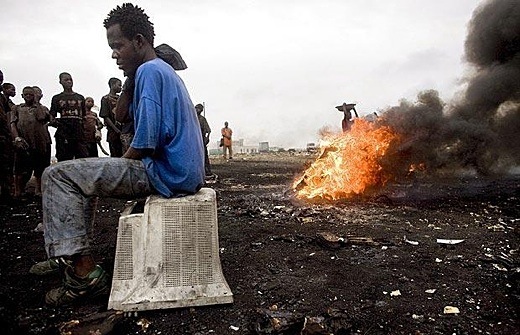
SUBHEAD: Keeping it Out of Africa. The right destination for your obsolete electronic equipment. By Jan TenBruggencate on 02 September 2009 in Raising Islands http://raisingislands.blogspot.com/2009/09/recycling-electronics-keep-it-out-of.html Folks on Kaua'i will be dropping off their old electronics for recycling during this Friday and Saturday (September 4th & 5th), and the good news is that none of it will end up on some village in Africa. image above: In Ghana obsolete electronics are stripped for parts and then thrown away. From http://www.telegraph.co.uk/news/picturegalleries/earth/2591471/Electronic-goods-recycling-poses-health-risk-for-Ghana-children.html?image=1 There is, of course, a vast difference between simply collecting stuff for recycling and actually recycling it. One of the open secrets about the whole recycling ethic is that large amounts of stuff never is recycled. Some “recyclables” are simply stockpiled awaiting some deus ex machina miracle to make their recycling possible or profitable. And large other amounts are simply dumped, often, as with some electronics, in third-world countries that reap the toxic benefits of our feel-good recycling efforts. image above: Plastic parts of abandoned electronics are burned off (releasing toxins) to reveal copper for recycling. From http://www.telegraph.co.uk/news/picturegalleries/earth/2591471/Electronic-goods-recycling-poses-health-risk-for-Ghana-children.html See this article on the e-waste trade in Africa. And this. The African paradigm describes a system in which a little of the material is indeed recycled, but much is left to create toxic dumps. This has gotten to be such a scandal, that some recyclers use it as a sales tool. They specifically advertise that they don't ship stuff to Africa. Like this. That said, much of Hawai'i's unwanted electronics does appear to be properly recycled. The next major electronics recycling program in the Islands is at the Vidinha Stadium parking lot on Kauai from 8 to 4 p.m. Friday (Sept. 4, 2009) for business and Saturday (Sept. 5) for residents. It is being run for the county by Recycle Hawai'i, a Big Island-based non-profit. Recycle Hawai'i, in turn, ships its electronic recyclables to a California firm, E-World Recyclers . E-World says nothing but compostable material like wood goes into landfills. Here's the list of stuff the Kauai electronics recyling program will take: Computer towers, tvs, copiers, monitors, hubs, fax machines, combination units, cell phones, keyboards, phones, scanners, CD-ROM drives, laptops, mice, stereo components, DVD drives, printers, backup batteries, plasma screens, typewriters, speakers, VCR players, electronic gaming units, cameras, radios, camcorders. They don't want packing supplies, toner cartridges or appliances. For more information on the Kauai program call County Recycling Office for further information at 241-4841.

The Light Bulb

SUBHEAD: The EU hopes that the ban on incandescent bulbs will reduce lighting energy up to 80%. By Dan Fletcher on 02 September 2009 in Time - http://www.time.com/time/business/article/0,8599,1919956,00.html

Across Europe, it's just about lights out for the humble incandescent bulb. The European Union began phasing out incandescents on Sept. 1, banning stores from buying new stock.

image above: "Idea Bulb" photo by Felipe http://www.flickr.com/photos/pseudopff/51890707

It's all part of an effort to drive consumers toward a better bulb: compact fluorescent lamps (CFLs), which last 10 times longer while consuming less than a third of the electricity as incandescents. At up to $10 each, CFLs are more expensive, but experts say they pay for themselves in energy savings in just a few months. The E.U. is even touting the switch as an economic stimulus; experts estimate that the swap to CFL will save customers €5 billion annually. Bucks for bulbs, anyone?

Though Thomas Edison is usually cited as the father of the lightbulb, it's more accurate to give Edison credit as the creator of the first commercially viable lightbulb. As early as 1820, inventors were honing in on the principles that would lead to the first electric illumination. An English inventor, Joseph Swan, took their early work and developed the basis of the modern electric lightbulb in 1879 — a thin paper or metal filament surrounded by a glass-enclosed vacuum. When electricity runs through the filament, the bulb glows. Edison refined the design, trying filaments made out of platinum and cotton before eventually settling on carbonized bamboo, capable of burning for more than 1,200 hours. With Edison's design — and the settlement of a lawsuit with Swan that resulted in the two inventors' joining forces in 1883 — electric lighting became viable for the first time.

The development of the lightbulb sparked the spread of electric power in the U.S. Edison was behind the creation of the first commercial power plant in 1882, and New York City had electricity by 1892. By the late 1930s, the Rural Electrification Administration, one of President Franklin D. Roosevelt's New Deal programs, had brought electric lighting to nearly every corner of the country. Development didn't stop on the bulb, either: researchers have honed Edison and Swan's design further, refining the filament by using tungsten metal and filling the vacuum with gas, both of which increase the life span of a bulb. Still, even modern bulbs are inefficient — less than 6% of the energy used by a bulb goes into producing light. The rest is given off as heat.

CFLs are designed to address this inefficiency. The technology for the bulbs was developed as early as the 1890s as lights, but General Electric perfected the design during the U.S. energy crisis in the 1970s. CFLs use electricity to excite mercury vapor, which produces ultraviolet light that is filtered through a coating on the bulb to become visible light. GE shelved the design, as the bulbs would have required new manufacturing plants, but the specs leaked over the years. Though assembling a CFL is still costly, the bulbs are environmentally friendly and save consumers money in the long run, forming the basis of the E.U.-mandated switch.

But this mass changing of the bulbs isn't universally appreciated. CFLs emit light in a different spectrum than their incandescent counterparts, producing a light that's "cooler" — tinged a light blue or green — than the yellowish hue of an incandescent. Many people complain that the effect is less aesthetically pleasing. CFLs also have environmental issues because of the danger of mercury exposure if the bulbs should break — making disposal tricky. And some people allege that constant exposure to fluorescent light causes health problems, though experts are largely skeptical of the claim.

These concerns, however, take a backseat to those over lightbulbs' environmental impact — replacing a single incandescent bulb with a CFL in every U.S. household would be the environmental equivalent of taking 7.5 million cars off the road. The U.S. plans to follow Europe's lead and outlaw incandescents in 2012. Still, at least one light will stay on: the Centennial Light in Livermore, Calif., has been shining continuously in the same firehouse since 1901, making it the longest-burning bulb on the planet.

see also: Light Emitting Diodes Compact Fluorescent Lamps 80 per cent less energy use

Dawn of Scarcity Industrialism

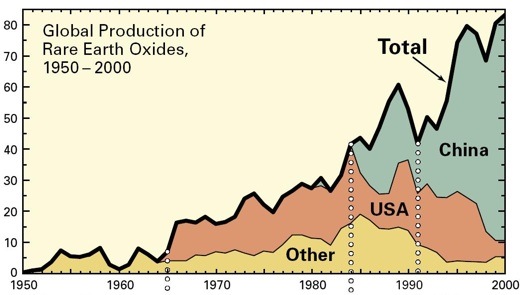
SUBHEAD: The Chinese will exploit a world that is increasingly shaped by resource scarcities. By John Michael Greer on 02 September 2009 in The Archdruid Report - http://thearchdruidreport.blogspot.com/2009/09/dawn-of-scarcity-industrialism.html Two bits of news circulating on the internet in the last week or so offer a useful glimpse at some of the currents of change that are setting the future into motion around us. One of them caused a modest flutter in the dovecotes of the internet and the mass media, and the other passed almost unnoticed. So far, though, the sweeping implications of both of these news items seem to have been missed by most observers. image above: Chart of source percentages of rare earth elements. From Our Green Economy is "Made in China" at logisticsviewpoints.com The first bit of news was a report that the Chinese government is planning to ban the export of rare earth elements. Those of my readers who don’t track the latest fads in technology may not know that these have become crucial to many cutting edge technologies. Lanthanum, for example, is used in high-tech batteries, and neodymium goes into the permanent magnets used in electric motors and wind turbines. The innards of the Prius and other hybrids, to say nothing of the as-yet-imaginary electric cars being hyped by what’s left of the American auto industry, depend on rare earth elements, and China currently produces well over 90% of the world’s supply of most of them. The report thus sparked claims of an imminent shortage in these minerals and, predictably, a flurry of speculative interest in (and hype-ridden articles about) mines outside of China that can produce the same minerals. A couple of details of the proposed restrictions somehow failed to make it into most media and internet accounts, and they are by no means minor issues. The first is that there’s nothing that new about this news; in each of the last three years, the Chinese government has cut the export quotas for rare earth elements from China’s mines. More important is the fact that the Chinese are not preventing the export of products containing rare earth elements; they are simply moving to ban the export of the raw materials. In effect, what the Chinese are saying is that they are no longer willing to accept the Third World’s designated role as a source of raw materials and cheap labor to be exploited for the benefit of somebody else; if the future is going to run on technologies based on rare earth elements, those technologies are going to come out of Chinese factories, and the wealth produced by them is going to be concentrated in Chinese hands. As this reality sinks in, we will doubtless hear more denunciations of “resource nationalism.” You’ll notice that nobody denounces “resource nationalism” when the United States imposes political controls on the control of its own strategic resources, as of course it does. The problem arises, as some wag or other put it, because a lot of our resources these days have unaccountably turned up underneath somebody else’s real estate. Now to some extent the rise of “resource nationalism” is simply one of the consequences of the decline of America’s global empire. Page back a century or so to the time when Britain was the global superpower, with troops garrisoned around the globe, and the same debates took place in very nearly the same terms. Britain’s Parliament and press trumpeted the virtues of free trade, meaning by that comfortably vague phrase a system of unequal exchanges that concentrated the bulk of the world’s wealth in London, while other countries – among them, ironically, the United States – used politically imposed trade barriers and tariffs to nurture their emerging industrial economies at Britain’s expense. As the British Empire waned, so did the global economy of the late 19th century, until the First World War finally pushed it over the brink into oblivion. We are arguably in a similar situation now, with America playing the role of declining empire and China, among other countries, imposing strategic trade barriers by political fiat as a means of building up its own industrial might at our expense. All other things being equal, we might reasonably expect a troubled transition lasting several decades and punctuated by a series of spectacular wars, not unlike the 1914-1945 transition period that saw Britain’s global empire replaced by America’s. Still, all other things are not equal, and the second bit of news I want to discuss here points up one of the differences. This was the announcement a few days back that the world derivative market has now reached a total paper value in excess of one quadrillion dollars. The conventional wisdom has it that such sums are beyond the capacity of the human mind to grasp, and in this case, the conventional wisdom may well be right. (If you have the sort of fashionable lifestyle that costs you $2000 a day, for example, and you started spending it when multicellular life first evolved on Earth, you wouldn’t yet have spent one quadrillion dollars.) Still, it’s important to grapple with such figures if only to grasp the fantastic absurdities that have created them. In thinking about this particular version of the unthinkable, two things should be obvious. The first is that there isn’t a quadrillion dollars worth of nonfinancial goods and services anywhere on our planet. The second, which derives necessarily from the first, is that those derivatives aren’t actually worth a quadrillion dollars in any meaningful sense, since it’s impossible to cash them in for anything other than more financial paper. In terms introduced in an earlier Archdruid Report post, derivatives exist solely in the tertiary economy, the economy of abstract numbers that started out as a representation of real wealth and has now gone spinning off into a hallucinatory Wonderland of its own. As I am not sure how many of my readers understand derivatives, a few words on the subject might be useful. A derivative is essentially a bet regarding some asset, index, cash flow, or the like, which is called the “underlying.” In the early days of derivatives, cash changed hands when the bet was settled – for example, a derivatives contract might obligate me to buy a hundred carloads of steel next October at a price fixed in advance, and the price of steel when the contract came due determined who profited and who lost. More recently, though, derivative contracts themselves have become hot speculative properties, subject to all the usual vagaries of bubble economics. Since they can quite literally be conjured out of thin air when needed, with no cash down, they are in many ways the perfect speculative instrument. It will be interesting to see just how long the current bubble in derivatives – for that is what it is, of course – can continue to run. Substantial gaps already exist between the speculative economy and that other, dowdier economy where nonfinancial goods and services are produced and consumed; nowadays the main connection between these two economies is credit, which is manufactured in the speculative economy but partly exported to the real economy. The late housing bubble and its aftermath offers a good demonstration of this; vast amounts of credit produced in the speculative economy flooded the real economy until 2007 or so, causing apparent prosperity; when the speculative economy crashed and all that credit dried up, so did the real economy’s prospects. Derivatives have less contact with the real economy than mortgage-backed securities did, and since nearly all the quadrillions of dollars in the derivatives bubble have been minted out of twinkle dust by processes even more arbitrary than those used by the US government to conjure the funds for its recent stimulus programs – and that is saying something – it’s not completely impossible that the bubble will go zooming off into a realm of pure abstraction full of quintillion-dollar deals as irrelevant to the real economy as the money traded in a game of Monopoly. Yet there is another potential connection between the etherial realms of speculative finance and the gritty world of matter where goods and services are produced and consumed, and China’s tightening grip on its rare earth elements points toward that connection. Economics does not exist in a vacuum, and the power of high finance can find itself suddenly overmatched when it has to contend with the sort of power that grows out of the barrel of a gun. This is the mostly unlearned lesson behind the collapse of Long Term Capital Management (LTCM), that poster child of 1990s speculative hubris. Founded by some of the brightest minds in the market, with two Nobel laureates on its staff, LTCM made money – for a while, lots of it – by a set of complex mathematical models that, according to one of its founders, could not fail within the lifetime of this universe or two more like it. The universe ended early; LTCM had been in business for all of five years when the Russian government unilaterally suspended payments on its foreign loans. LTCM had a lot of money in Russian loans, but the prospect of a default wasn’t included in the models, and by the time the rubble stopped bouncing LTCM was so deep in the red that a consortium of banks had to be strongarmed by US government officials into stumping up billions of dollars to prevent a run on securities markets. The lesson the founders of LTCM learned the hard way is that politics trumps economics. It’s a lesson that has been repeated many times over the last century, but it’s one that very few people seem willing to notice. If I’m right, though, it may just be the key to understanding the next fifty years or so of history. In previous posts here, I’ve suggested that the world is in the midst of a transformation between the kind of society and economy familiar to us over the last century or so, which I’ve called “abundance industrialism,” and a new kind that may as well be called “scarcity industrialism.” Where abundance industrialism was defined by the ready availability of cheap abundant natural resources, especially but not only fossil fuels, scarcity industrialism will be defined by the scarcity of such resources. One of the implications of this shift is that those nations and regions that control significant amounts of important resources will find those resources becoming a potent source of political leverage. The same sort of clout OPEC gained from its oil reserves in the Seventies, and may reclaim in the not too distant future, will become accessible to countries or cartels of countries with large amounts of any economically vital resource. If this is correct, the Chinese are not just using trade barriers to build their industrial plant at America’s expense; they’re doing that, of course, but it’s not all they’re doing. They are also taking advantage of the opportunities opening up as the age of scarcity industrialism dawns. They may well have recognized that in a world that will increasingly be shaped by resource scarcities, those who act to secure their own resource bases can thrive while others falter. It’s a lesson that Russia has already learned – witness the successful efforts of the Russian government to seize Russia’s fossil fuel assets from the handful of American- and British-backed billionaires who walked off with them during the chaos and corruption of the Yeltsin years – and other nations are beginning to learn it as well. The dawn of the age of scarcity industrialism thus promises to stand many of the assumptions of the recent past on their heads. It may not be out of place, therefore, to discuss some of the ways that societies might, if they were minded to do so, deal with some of these new realities, and next week’s post will try to peer ahead into this territory. see also: Island Breath: The Age of Industrial Scarcity 10/18/07 Island Breath: The Age of Salvage Societies 10/28/07

Fate of Kauai Levees

SUBHEAD: What will happen to the levees of Hanapepe and Waimea after decertification?
By Linda Harmon (harmonl001@hawaii.rr.com) on 2 September 2009

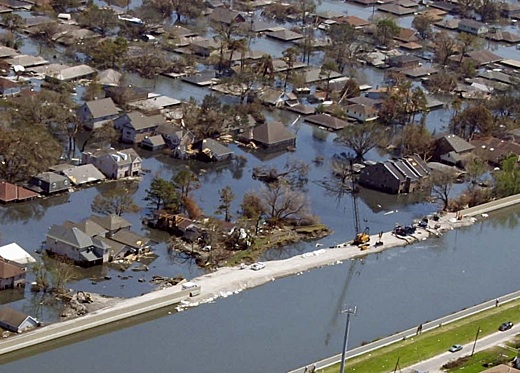
There is something wrong with the picture in my my mind when it comes to the funding county projects like levees. Stimulus money (matching funds to the state from the Federal Government) doesn’t seem to be available at the current time to upgrade levees, therefore we don’t consider the projects doable. If there aren’t matching funds from the feds, we aren’t going to get enough money to upgrade Kauai levees in populated areas to certification levels for appropriate public safety.

image above: Detail of NOAA photo of broken New Orleans levee in 2005 after Hurricane Katrina. From http://www.katrina.noaa.gov/helicopter/helicopter-2.html

People living within the "protected" areas of Waimea and Hanapepe levees can be spared harm by purchasing flood insurance. That’s the best advice the county, the state, and the Federal government has for us. We are told the expense for the Hanapepe levee alone could amount to tens of millions of dollars. The county has set aside some one hundred and fifty thousand for retrofitting both levees.

On the other hand, a project to expand the Waimea Waste Water Treatment Plant was approved last month by receiving matching funds from the American Recovery and Reinvestment Act of 2009. This Act makes federal monies available to develop infrastructure that will allow stalled building developments in Waimea to begin. The total for this project is costing us tax payers 14 million dollars (7 million from the state and 7 from the federal government).

The Waimea Waste Treatment Plant request had been on the back burner for some time waiting for submission. The projection numbers for the future plant capacity is reliant on a 1997 transportation plan. With the current economic downturn due to shortage of future oil, the expansion of the plant needs to be looked at anew. What kind of building boom do we really think is in the making with the future we now face?

While bidders are lining up for the present project, which is reliant on what I would think are bloated future population figures, present residents of both Hanapepe and Waimea are looking to pay hundreds of dollars of flood insurance per household for untold years down the line (if they can afford it), to limit their liability for lost life and property should the levees go down during a hundred year storm or a hurricane. see also: Ea O Ka Aina: Meeting on Flood Plain Areas 8/25/09 Ea O Ka Aina: Westside levees in trouble 7/8/09 Island Breath: Waimea & Hanapepe levees faulty 4/21/07

Kauai as Perserve America Site

SUBHHEAD: The US government wants to designate Kauai as a "Preserve America" site. Some of us don't believe we're even part of the United States. image above: Detail of accompanying poster stating "Kauai is not America, and never will be!" By Janos Samu (janossamu@earthlink.net) on 2 September 2009 Aloha mai kakou! On Wednesday, September 2nd at 11:45 a.m. at the Lihu`e Civic Center, Mo`ikehana Building Courtyard the County of Kaua`i along with NOAA will have a celebration trying to designate Kaua`i as a Preserve America site. Mazie Hirono, and others are planning the have a speech there. Jointly with some peace groups we have made plans to disrupt the ceremony and cover the area with the attached flyers. At the same time when the speeches start we will sing loudly the Hawai'i Pono'i so that the speeches cannot be heard. I will have at least 25 copies of the anthem printed so that everyone has one who does not know the anthem by heart. I have already notified District 2 and there will be citizens who participate from there. Since we are not going to make any statement in the the name of the Lawful Reinstated Hawaiian Government I was advised that no higher approval was needed for this action. Of course our officials, if present, may make statement as they see fit. So, Eileen, and everybody who receives this e-mail, please spread the word through your channels, and let's have a presence there. We will have our flags with us too. We must make it clear to the American officials that we don't want to be bulldozed into accepting their claim that Kaua`i is part of the American heritage. Will you join us? Can we count on you? If so, try to be there between 11:30 and 11:45 a.m. and it will be enough if we stay only for 30 minutes. Me ke aloha pumehana see also: September 2nd Liliokalani 2009 Jubilee 8/30/09

Whack!

SUBHEAD: The self-doubt and hard physical struggle of preparing for the collapse. By Guy R McPherson on 29 August 2009 in Nature Bats Last http://blog.ltc.arizona.edu/naturebatslast/2009/08/whack.html

Whack! The soil, such as it is, gives way to my mattock.

image above: Wielding a mattock from http://teamvelveeta.tom-purvis.com/2008/12/trailbuild.html

What if I'm right? What if the industrial age comes to its overdue close, taking the love of my life with it? What if she's stuck in Tucson, unwilling or unable to escape when the taps run dry at the gas stations and, more importantly, in her rental house?

Whack! Twenty more blows, and I've got a row of soil -- scientists would call it "unsorted alluvium" -- loosened and ready for my long-handled shovel. Eight feet wide and six inches deep, it's more cobble than soil, with occasional thin layers of gravel, clay, and easy-digging sand.

It's got to end some time, even if it's a few years off. The next case of $120 oil, assuming we get there before the industrial economy falls into the abyss, will be brutal for an already over-stretched American consumer. Banks are falling like dominoes on a mule cart over the bumpy terrain of declining energy supplies. When will the lights go out? When will I lose all communication with my brother, sister, and parents?

Whack! Fifty more rows give way. I take a break to gulp water and breathe the country air. I hear the cackle of a chicken as she brags about laying an egg. The ducks laugh, at her and me. They always laugh, the perfect audience for my twisted sense of humor.

My dad spent his early years in a house without running water or electricity, and it looks like he'll survive long enough to see the circle complete itself. When he was a kid, his mother declared she'd had enough of the uncivilized life. She was leaving, that very day. She wondered if anybody was going with her. They all went, of course, her husband and their pack of kids. My dad met my mom in college and they dated twice before deciding to get married.

They were mere children when they had three children. Fifty-some years later, they're still in good shape, as sharp as ever. Life-long educators, they instilled in me the work ethic and curiosity that saved me from the oppression of ending up as poor as they were, when they were raising three youngsters in a backwoods, redneck logging town nearly two hours' drive from the nearest real grocery store.

Whack! The mattock bounces off a massive rock. I scratch and claw through leather gloves pocked with holes, finally tossing it onto a small pile of cobble I've remembered to create beside the large mounds of soil mixed with gravel and cobble.

I was a year ahead of my sister in school, and we attended the same high schools and then the same college. We've always been close, and our weekend talks on the telephone remind me of the many late-night conversations that led to our similar life paths and offbeat philosophies. During an intramural flag-football game, my brother and I went out of our way to beat up on her college-freshman boyfriend, for no apparent reason except familial protection. Later, she found it funny. At the time, not so much.

Whack! I'm too old for the empire to fall. My bruised and battered body hasn't taken this kind of physical punishment since two-a-day football practices in high school.

I played cornerback behind my brother's defensive end every game of my sophomore season in high school. We taunted the opposing quarterback to run the ball our way. He rarely did. On the offensive side of the ball, I still remember the two passes I threw to my brother during his senior season. I never expected to relieve the star quarterback during the regular season, but he hit a rough spot so I played a single series. I called my brother's number, of course. And I drilled him between the numbers, only to see him drop the ball. So I called his number again, and this time he made the catch and the first down. We're still close, and we share the academic life, albeit in disparate institutions.

Whack! I've developed four rows of calluses on my hands. I can hardly bend my fingers each morning after a pained-wracked night of little sleep.

What if I'm wrong? It's happened a few thousand times before. What if I quit my easy, over-paid job only to see the empire last another decade? I can't bear the thought of missing out on daily interactions with students for ten years. And what if we keep killing every species and culture on the planet, and I have to read the news every day for a decade? I can't bear that thought, either.

What if we keep the industrial machine running long enough to destroy habitat for humans within a generation, as it seems we will? Surely the southwestern desert will be among the most miserable locations to face the demise of our species. What if I continue to see my wife of more than a quarter century only a couple days each month? Is that any way to keep a marriage alive?

Whack! My back aches, as it has for months. My imperialist doctor says I shouldn't work so hard. But this is my job now, preparing for our post-carbon future. Or maybe it's just my future, sans spouse.

Another couple years would be great, from a personal perspective, but can the living planet handle it? Every day brings us closer to the edge of ecological collapse and runaway greenhouse. Here at the mud hut, we could use the time to figure out the garden and the goats. Not to mention seeing our families another time or two.

Am I that selfish? Am I willing to forgo habitat for all future human beings on the planet just so I can grow some potatoes?

Of course I am. I'm Homo industrialis, after all. I care about me, here, now. Hell with tomorrow, and all the tomorrows to come. And potatoes are damned good, as any Idahoan knows. I'm pretty certain the existential angst isn't worth living through, anyway, for any thoughtful person. And why should I care about the thoughtless ones?

Whack! My arms and legs burn with every swing of the mattock. A sandhill crane, one of the first to arrive this year, trumpets in the distance. Although biologists don't know why they've been arriving earlier every year, I'm betting they're not bringing good news on the climate-change front.

I shouldn't have sold our house in the suburbs, much less quit my easy job to prepare. My wife loved that house, and our life. I should have stuck it out with her, keeping my mouth shut and playing field biologist instead of social critic. Then, at least, we could die together. And she'd have been happy during these last four years. Me, too, at least compared to the emotional rollercoaster I've experienced as a result of the pain I've caused her.

Whack! Sweat saturates my clothing and even my gloves, staining my hands yellow. I can barely see through my sunglasses, the lenses filled with sweat pouring from my forehead. Not that this job requires any more visibility than brains.

I'm just not cut out for post-carbon living. I'm a career academic. What ever made me think I could live close to the land? It's fine in theory. But in practice it's a pain in the ... well, every part of my body, which clearly is not too big to fail. Never mind the paucity of friends in my new community, most notably including my best friend for the last 28 years. I simply have neither the body nor the intellect to thrive here.

Whack! Best I keep whacking away. Thinking too much never did anybody any good. And where'd this self-indulgent crap come from, anyway? Onward, upward, through the self-induced fog.

Schopenhauer's question continues to haunt: How to get through a life not worth living? Make it worth living? That hardly seems an option at this point, given the lose-lose scenario I've managed to create for myself, and her. Take the Hemingway out? That certainly wouldn't help her. Not that I'd notice or, once I've left the planetary station, care.

Whack! Ah, self-indulgence. I'll bet there was damned little of it before the age of fossil fools. I can't imagine people, tribes, or societies would tolerate the self-absorption rampant in contemporary industrial humans.

A life of service was my answer when I served the empire. It was the answer inspired by the example of my parents, and followed by my siblings. It is the answer of my mentors and colleagues. It was easy to find, and apply, in my ivory-tower life. Whether I find it here, in time, remains to be seen.

Whack! A hundred rows or so, and the garden bed finally is hollowed out, ready for the hardware-cloth "basket" that lines the bottom and sides of the bed to protect the future garden from the present pocket gophers.

How will I serve this community? It's filled with doomers, many of whom have been growing their own food and organizing their lives around imperial collapse for decades. How do I fit? Or do I?

Very Small-Scale Agriculture

SUBHEAD: In the long term, Small and local wins. In the short term... Not so much. By Sharon Astyk on 01 September 2009 in Casaubon's Book - http://sharonastyk.com/2009/09/01/in-the-long-term-small-and-local-wins-in-the-short-term-not-so-much/ image above: Photo of a backyard farm in San Francisico. From http://popfarming.wordpress.com/2008/12/18/us-backyard-farming-myfarm-san-francisco

Several people have noted that in A Nation of Farmers we spend a lot of time talking about very small-scale agriculture - home gardening, farms spread across multiple yards, very small home farms - and less time talking about farming for a living - and this isn’t an accident.

One of my standing bits of advice to people who want to become farmers is this - do it. But make sure someone in your household keeps a job with a paycheck.

This, of course, limits the scale on which anyone can do this work - if you have to farm around your night-shift at Walmart or substitute teaching, or driving deliveries, this cuts into your time for the farm. If you have to watch the kids and farm at the same time, because your partner is off earning the health insurance and mortgage, you are going to spend a lot more time taking people potty and getting snacks than you would if you could farm full time without kids. So why aren’t I advising more people to farm full time?

Don’t get me wrong - I want to see more full-time farmers. But while in the longer term, I think that small scale agriculture is going to win, in the shorter term, Walmart and the economy are going to devour a lot of small farmers.

The trick, as you are planning your course of adaptation, is to learn the skills now, maybe obtain the land if you can get it, but hold in reserve for the time when you can make a living doing the work. Don’t get me wrong - if you are already trying it, or called to do the work, I encourage you. But have a backup plan - we need you, but you need to make a living.

With less than 1% of the US population involved in agriculture, the average age of farmers at 59 years old and the average age of small farmers at 65, we need, waiting in the wings, a relief force. But we can’t pay them yet.

Had oil prices continued to rise without affecting the economy, we might have seen the gradual evolution of a local farm economy as local providers were increasingly able to compete with industrial ones. But that, as we all know, didn’t happen.

Instead, volatility is the name of the game - and that means that most Americans will never know, from year to year, how much basic needs like their utility bills and groceries are going to cost them. And when price rise and jobs are lost - people stop paying premiums for their food.

That $7 gallon raw milk stops being a necessity for your family’s health and starts being a luxury, easily replaced by $4 gallon milk at WalMart. The CSA share cost seems more and more onerous. The grassfed meat may taste better, and be better for you, but, well….

We’re already seeing this - organic and raw milk dairy farmers are struggling just like everyone else - organic milk sales are expected to drop by 15%. Organic food sales slowed to a 6% year over year growth last year, up from 26% the year before - still growing as of January, but expected to decline overall this year.

The truth is that people are committed to organic and local - but only so far. And small and niche producers just plain can’t compete with larger farms with contracts. They depend on affluent consumers who care about good food to keep going - they need people to be able to afford their food, and to care enough to buy it.

Meanwhile Target and WalMart and the rest of the industrial producers are pulling out all the stops to convince us that their organics, their faux-local food is just about the same at half the price. Never mind that for this food we pay twice - in agricultural and corporate subsidies, in health costs, in welfare and food stamp payments for the farmers and the WalMart employees. The vast majority of people will, for a while, probably go back to WalMart for the milk and vegetables because they are trying desperately to get by.

In the very long term - local food is likely to win this battle - the larger scale industrial middlemen can’t succeed in an era of high energy prices in proportion to buying power. Their margins are tight, and higher energy costs and other factors are likely to drive them out of business - eventually. But we’re not there yet, and their death throes are likely to be long and painful, as they devour market shares of small farmers.

In the longer term, there will be a shift to paying more of our limited incomes for food - we’ve never paid less. Toby Hemenway and I once discussed this, and despite some differences, we both agree we’re headed rapidly (over the next decade or so) to a life where people in the US and other rich nations spend 30% of their income on food. But that’s a long and painful shift - one in which other costs decline proportionally, and in which a lot of people are ground between the stones of declining budgets, not enough food to go to the end of the month, and their desire for decent health and good food.

This is why I don’t spend more time exhorting people to take up full time agriculture for a living - I wish I could, since it is so desperately needed. But my own view of the future is that a lot of farmers will be driven from their land and run out of business - we are down to less than 1% of our population farming - but my own estimate is that the crash in farmers is going to come down further still - and that believe it or no, we’ve got a ways to go.

I suspect we’ll lose as many as a half million farmers in the next few years - and I say this with great sorrow and fear. The combination of one more economic straw on the camel’s back, aging and foolish agricultural policies are going to bring us to the brink of disaster - without the people we need most to pull us back.

So please, grow that garden, start that little farm as a side income, begin your retirement agricultural venture, and please, if you can, buy local, buy from the good guys, not the huge industrial organic farmer, but the little guy who still raising grains in your neighborhood. Train your kids to grow food. Learn as much as you can. Talk to the old farmers, get to know them, help them out if you can. Because in the end, we will need you all. The time is coming, but it isn’t yet, and there’s hard stuff in the middle.

The Five Horsemen

SUBHEAD: When the fifth horseman arrives, it will bring a new reality for all of us.  

By Chris Martenson on 29 August 2009 in Chris Martenson's Blog -  
http://www.chrismartenson.com/blog/five-horsemen/26258

 
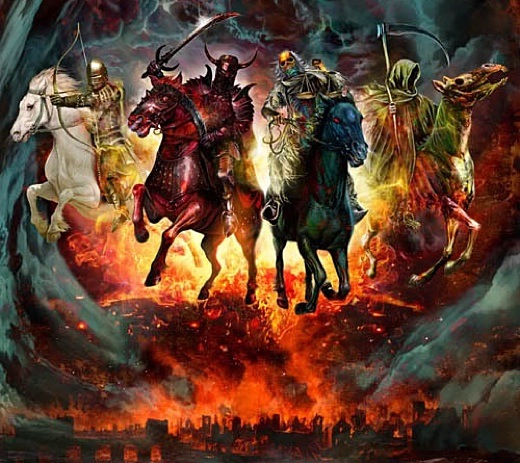
Image above: A detail from The Horsemen of the Apocalypse. From http://more.studentdoctor.net/showthread.php?p=7873803  

Executive Summary  
What can we expect next, and how will we recognize it? A series of sharp, interrupted shocks is more likely than a major sudden collapse.Five game-changing events, what I call The Five Horsemen, will indicate that the rules have changed and a new reality is about to take over:  

First Horseman: 
 New credit growth falls below interest payments.

Second Horseman: The Fed monetizes debt.  
Third Horseman:
Government deficit spending exceeds 10% of GDP.  

Fourth Horseman:
The dollar goes down, while interest rates go up.

Fifth Horseman:
US debt becomes denominated in foreign currencies.
 
Severe structural damage has already been inflicted on our economy. As I wrote two weeks ago (May 16, 2009) in It Has Hit the Fan:


"If you have been waiting for further confirmation about the direction of the economy, or waiting for a sign that it's now time to get serious about preparing for a future filled with less, this report is written for you.

You are living in the midst of the collapse of western economies, which are moving from a more complicated state to a less complicated one. This is it. Keep a journal, because it's happening right now.


After the Great Depression, many people remarked that it was only obvious in retrospect. While it was unfolding, things steadily eroded. But 75% of the workforce remained employed, while hopeful signs of progress were constantly trotted out by various politicians, private economists, and official-sounding government agencies. It is often quite difficult to appreciate the true magnitude of sweeping change while it is occurring."

The most pressing question now is this: What can we expect next, and when? 


In this report, I give you the precise combination of macro-events that will cause me to issue an alert and kick my thinking and actions into new orbits.

The Path I do not expect a major sudden collapse to be the most likely path, although it is a possibility. Instead, I anticipate a series of sharp shocks, followed by periods of relative tranquility.
Here's how I described the various paths in May of 2008, in a report entitled Charting a Course Through the Recession:


"While it is possible, I do not anticipate a one-way slide to the bottom, wherever and whenever that may be. I lean towards the ‘stair-step’ model, where a series of sequential shocks and relatively placid periods mark the path to the future. The three scenarios around which I tend to form my thinking (and actions) are:
1) No change. The future looks just like today, only bigger, and no major upheavals, shocks, or recessions happen. The Fed and Congress are successful in fighting off the deleterious effects of the bursting of the housing bubble, and everybody carries on without any major changes or adjustments. This is not a very likely outcome. Probability: 1%.
2) A series of short, sharp shocks. Moments of relative calm and seeming recovery are punctuated by rapid and unsettling market plunges and marked changes in social perspective. Think of the food scarcity and riots, and you know what this looks like. One day there was low awareness about food scarcity and the next day shortages and prices spikes were making the news. Soon enough, relative calm returns, prices fall, and order is restored, but prices somehow do not recover to their previous levels, leaving people primed and alert for the next leg of the process. I see this as the most likely path forward. Probability: 80%.
3) A sudden major collapse. Under this scenario, some sort of a tipping point causes a light-speed reaction in the global economic system that requires shutting down cross-border capital flows. Banks would no longer be able to clear transfers and accounts, which would wreak all sorts of havoc upon our just-in-time society. Food and fuel distribution would be the most immediate concerns. There's enough of a chance of this scenario occurring, and the impacts are potentially so severe, that you should take actions to minimize the impacts to yourselves and your loved ones. Probability: ~20%."

Based on the odds, the most likely outcome that I see is a series of short, sharp shocks (#2, above) as being the most likely to define the path forward. So far this has been our exact pattern with the first shock occurring in 2007, the second between October 2008 to March 2009 and now a period of stability between March and June of 2009. I invite you to re-read the piece linked above as a means of assessing my information gathering abilities, and my ability to connect the dots, and shine a light on the future.


In the grand sweep of the trajectory that will deliver the United States, and many other western countries, to a lower standard of living (although not necessarily a lower quality of life, but that's another story), there are several discrete elements that I think of as The Five Horsemen.
The Five Horsemen I believe that a diminished standard of living is in the future for each of the major economies across the world especially those where the inhabitants have been living beyond their means.
 
Another belief I hold is that any period of living beyond one's means must certainly be followed by an equivalent trough of living below one's means. For example, if you produce 100 but consume 110, then at some point you will need to produce 100 but only consume 90. 

There are two ways that we might expect this period of adjustment to unfold economically. I laid out the basic elements in Crash Course: Chapter 12 - Debt. "When too many claims (debts) are laid upon the future the only question is whether those debts will be defaulted upon or paid back (with "inflated away" being a form of default). If all those claims are destroyed by default, then the reduction in future living standard falls to the holder of the debt(s). If the debts are paid back, then the debtor must accept that they will have less money to spend on consumption. Either way, somebody has less coming to them in the future than they either expect or currently enjoy.
 
Stretched across an entire nation, too much debt becomes an unsolvable problem, a predicament, due to the fact that no benefit accrues from shifting the burden of bearing the impact of default from one sector to another. Shifting a promissory note from one pocket to the other does not change the net worth of the individual and this tactic is equally ineffective for an entire country. Thus the fact that the US government is assuming massive piles of bad debt from stricken financial corporations does nothing to solve the underlying problem, which sprouts from a nation that has overconsumed for decades. But this is exactly what the government is doing, and the goal seems to be to preserve the status quo at all costs." 
Assuming this view is correct, there are signs we can read along the way to confirm if our fiscal and monetary authorities have selected the right path or the wrong path. This report details the signposts that will tell us when certain thresholds have been crossed that will mark that the current strategy is failing and that a new leg of the journey has begun.

The problem and the mindset of the economic elites are neatly revealed in this quote:


"May 30 (Bloomberg News) -- World Bank President Robert Zoellick warned policy makers that fiscal-stimulus plans are insufficient to turn around the “real economy” and rising joblessness threatens to set off political unrest across the globe.

“While the stimulus has given an impulse, it’s like a sugar high unless you eventually get the credit system working,” Zoellick said in an interview yesterday."

I like this quote because it distinguishes between the "real economy" and the economy resulting from excessive government borrowing and spending. Stimulus money is almost by definition wasted money because the probability of it resulting in proper investment is so low. The gains from stimulus money run out the very second the juice is turned off. 


But it is the second part of the quote that is revealing - "...unless you eventually get the credit system working..." - apparently those in charge find it unthinkable that an economy could be built on anything other than credit.


An alternative quote expressing a more fundamental view would read, "While the stimulus has given an impulse, it’s like a sugar high, unless it is followed by growth in wage-based income".


The difference between the real quote and the one I provided is like night and day. The Zoellick quote assumes that our past period of living beyond our means is recoverable and extensible, and mine does not. Mine assumes a long-term relationship exists between what people earn and what they can spend. In order for us to service our past debts, we need to grow our incomes, not our access to easy credit.


There is a mathematical limit to this "game," at which point it cannot be carried on any longer. I think we have reached the outer limits of our debt-fueled fantasy, although I recognize that the extreme efforts to carry it on a bit longer may well produce short-term results.


The most obvious and mathematically-defensible end of a credit economy comes when interest payments exceed all income. However, things rarely progress that far, as the trouble becomes painfully obvious far earlier and creditors withdraw their continued support.


How will I know that the participants in this game have finally caught on to the fact that it's over? Here are the five game-changing events that will indicate that the rules have changed and a new reality is about to take over. As I mentioned, I have been tracking these for years and, unfortunately, been watching them unfold one by one.

The First Horseman: New credit growth falls below interest payments

"Anyone who believes exponential growth can go on forever in a finite world is either a madman or an economist." ~Kenneth Boulding, economist

In our debt-based monetary and economic system, it is imperative that new credit growth at least equal the interest payments on past debt. If this does not happen, then the entire financial edifice, levered up as it is, immediately begins to wobble and crumble. Of course this imposes an exponential growth "requirement" on our entire debt/money system rendering it a long-term impossibility.

Total credit market debt (chart below) stood at over $52 trillion at the end of 2008 and has fit an exponential curve nearly perfectly over the past 5 decades.


The "getting the credit system working again" quote by Mr. Zoellick refers to keeping the curve of this chart sweeping upwards in an uninterrupted fashion, as nothing less will get us back to "how things were."


Where this chart required ~$1 trillion of new yearly credit growth in 1995, the remorseless math of the exponential function turned that into $2 trillion per year by 2000, $3 trillion by 2005, and more than $4 trillion by 2008.


While the government's $1.8 trillion of deficit spending for 2009 is certainly heroic, it needs to be complemented by more than twice that amount from the private sectors in order to keep this chart on a smooth path. That, I am confident to say, will not be happening this year. 
Status of the first horseman: Arrived.


The Second Horseman: The Fed monetizes debt

"There is no means of avoiding the final collapse of a boom brought about by credit expansion. The alternative is only whether the crisis should come sooner as the result of a voluntary abandonment of further credit expansion, or later as a final and total catastrophe of the currency system involved." ~Ludwig Von Mises

My second sign occurs when the Federal Reserve directly "monetizes debt," which is a fancy way of saying "prints money out of thin air and exchanges it for private and/or government debt." This started in 2007 with the first set of rescues, although at the time the Fed took great pains to stress that it wasn't really monetization because they planned to reverse their actions soon.
 Of course, that has not happened yet. Some of their activity was cleverly concealed with complexity, such as when the Federal Home Loan Board (FHLB) bought up $160 billion in mortgages from failing originators such as Countrywide and then quietly passed them to the Federal Reserve for cash. Minus the FHLB complexity, this represented nothing less than the Fed printing up some fresh electronic cash and handing it over to Countrywide for some failing mortgage products.


The beginning of the end for nearly every debt-ridden country has always been the attempt to pay for past expenditures with newly-minted money. It always starts innocently enough and seems like the right thing to do, but soon the programs grow and grow, and eventually the currency of the country is destroyed.


Now the Fed is openly and actively buying dodgy debt from the government as well as from the private sector. I covered this in a recent "In Session" posting, where I charted the amount of US Treasury debt that was being purchased by the Federal Reserve on a daily basis.

Fed POMO activity daily rate v2.jpg


This chart reflects only the Treasury purchases. When we add in agency debt, mortgage-backed securities, and various other corporate debt programs, we find that the Federal Reserve is printing up roughly $15 to $30 billion dollars a day just to keep things limping along.


As for the opening quote by Mises, which I think most accurately reflects how things will turn out, I think it is safe to say this: Any country that is printing up to $30 billion a day just to keep things moving along is not voluntarily abandoning credit expansion. 


This means that we are risking a final catastrophe of the currency system involved. Unfortunately, the currency in question also happens to be the world's reserve currency, so this has enormous, far-reaching implications. 
Status of the second horseman: Arrived.


The Third Horseman: Government deficit spending exceeds 10% of GDP I did not expect to see this one arrive for the US this early in the game and I am quite stumped by the apparent acquiescence by the rest of the world's financial authorities to the US running a fiscal deficit of over more than 13% of GDP. I would have expected some resistance on their part, such as a refusal to continue buying US Treasury debt, more than a third of which (this year) has been bought by foreign central banks.
 
I am convinced that this stimulus money, as historical and enormous as it is, will fail to provide any lasting benefit, in part because so little of it is being spent on investments in the future. Promising to cover the losses for bad debts only protects those who financed past malinvestments. At most, a few measly percent of the total cost of this bailout and stimulus is going towards investments such as beefing up our energy independence or modernizing our transportation infrastructure. If, instead, 95% was going towards investments, and Wall Street had to fight over the remaining scraps, I would be singing a different tune. 


The inertia of government spending programs assures that these record deficits will recede slowly only under the best of circumstances and will actually grow larger under normal or worsening conditions. I also want you to recall here that government deficit spending has the strongest correlation with future inflation handily beating out the impact of bank monetary reserves, a common red herring argument trotted out most recently by Paul Krugman who wrote in the NYT:


"Now, it’s true that the Fed has taken unprecedented actions lately. More specifically, it has been buying lots of debt both from the government and from the private sector, and paying for these purchases by crediting banks with extra reserves. And in ordinary times, this would be highly inflationary: banks, flush with reserves, would increase loans, which would drive up demand, which would push up prices."

Again, inflation correlates most highly with government deficit spending and I remain at a loss as to why this clean, clear fact eludes so many who should, truth be told, know better.|
 Status of the third horseman: Arrived.


The Fourth Horseman: The dollar goes down, while interest rates go up
As long-time readers know, it is this fourth horseman that I watch on a daily basis. The combination of a failing dollar and a rapidly rising interest rate on US Treasury obligations will signal to me that the "limitless borrowing spree" of the US government is over.


Currently, more than $7 trillion in US Treasury debt is "held by the public." (The other $4 trillion is owed by the government to the government, so it is not on the open market.) Treasury debt is bought and sold in vast quantities on a daily basis. More than half of it is held by foreigners. If foreigners sold this debt, rates would rise. If they then took the dollar proceeds from these sales and exchanged them in preference for some other currency, the dollar would fall.


The combination of rising interest rates and a falling dollar will signal (to me) that a final loss of confidence in the US dollar as an international store of value has occurred. When (not if) this happens, all manner of financial ills will stalk the globe. Everything priced in dollars will go up in price - in dollars. That includes basically all commodities. All holders of US dollars and US debts will be desperate to get out of their holdings, and you can expect wild plunges and gyrations in most markets. Interest-rate derivatives, which are mainly denominated in dollars and linked to US interest rates, will become toxic destroyers. 


So much hinges on the US dollar retaining its role as the reserve currency of the world that thinking through this scenario would require a report all its own. Suffice it to say, that you cannot overestimate the impact of a rapid decline in the value of the dollar coupled to rising US Treasury interest rates.

Because of this, I am quite perplexed that the other central banks continue to play along and buy US debt, while the Fed monetizes like crazy and the US government sports a 13% of GDP fiscal deficit.

Here's the latest data. We certainly are seeing a bit of a decline in the dollar and a bit of a rise in interest rates especially since mid-March when the Fed announced its intention to buy massive quantities of US Treasury debt. 


USD down.jpg

TNX up.jpg

However, these moves are not not yet strong enough to cause me to issue an alert or take personal actions. They definitely have a big portion of my attention, but are not yet at the top of my list of immediate concerns.


What would make me sit up and take notice? Right now that would involve the dollar slipping into the low 70's, while the $TNX (ten year bond yield) vaulted up by some massive amount which, for me, would be 50 basis points in a day (which is one half of a percent).


At that point, I would be putting out an alert that it's time for any fence-sitters to hurry up and grab some dollar-decline protection. 

Status of the fourth horseman: Maybe it's here. Maybe. But not yet in full swing.


The Fifth Horseman: US debt becomes denominated in foreign currencies
For whatever reason, some people still trust the debt-rating agencies, and one of the more farcical practices is that these agencies routinely "rate" the US for credit-worthiness. The good news is that Moody's recently reaffirmed that the US still has a "AAA" rating, which is the highest possible rating. Or is this good news?


The reason this is a farce is captured in a post that I wrote in an "In Session" forum thread on this matter:


"This is a bit of a non-issue. For a country that has 100% of its debt denominated in its own currency there can be no other rating besides AAA. The idea behind the rating is to answer the question, "What is the probability that this entity can pay off this debt?" Well, that probability is 100%, when the entity has a printing press. The only thing that would change this would be if/when that entity has debt denominated in something other than its own currency. So while we can all be relieved that Moody's has such a high opinion of the US, this is useless information for the purpose of deciding if one wants to hold the debt of that country. An alternative measure would be, "What's the chance that this country will resort to printing to relieve itself of its debt burden, thereby eroding the claims of the current bondholders?" Let's call this new rating the "M system." One M means, "Sort of likely," two Ms means, "Probably will do it," and three Ms means, "No doubt, they will print." By this system, I rate US government debt as quadruple M, or MMMM. Off the charts, in other words."

However, the absolute game-changer would be if the US had to pay off borrowed money in a currency other than its own. Yen, for example. In order to pay off that loan, we'd have to get Yen from somewhere, with the usual source being a positive trade balance. 


If the US could not get the Yen through legitimate trade, then it could always print up dollars and buy Yen off the open market. But this would serve to drive up the value of Yen and drive down the value of the dollar, so this scheme would rapidly unravel in a currency crisis. If this sounds familiar, it should. This is how most developing nations get in trouble and experience severe currency and debt crises.


Having your debt denominated in your own currency is an enormous privilege. Should that luxury go away, it would become immediately apparent how much the US depends on the kindness of strangers to continue living beyond its means.


So far, only Japan has made some low-level noises about denominating their loans to the US in Yen instead of dollars, but you can be sure other countries are quietly considering it as well.Status of the fifth horseman:  

Conclusion: Not here yet.


Three out of the five "horsemen," which indicate where we are in the trajectory of our downfall, have already arrived. A fourth is possibly here; perhaps not quite yet. And the final one will mark an inevitable date with a vastly lower standard of living for US citizens and all countries that are the accidental holders of too many US dollars and debts.


I urge you to begin keeping a close eye on these five horsemen:

  1.  New credit growth falls below interest payments
  2. The Fed monetizes debt.  
  3. Government deficit spending exceeds 10% of GDP.
  4. The dollar goes down while interest rates go up. 5) US debt becomes denominated in foreign currencies.
The current presence of three, or possibly four, of these signs has me thinking very carefully about my assets, my family's needs, and how we will manage the changes ahead. When the fifth horseman arrives, it will bring a new reality for all of us, and I intend to be as ready as possible.