
SUBHEAD: No headlines until recent storms sent tsunamis of dairy sewage racing through Ookala, HI.
By Koohan Paik on 12 April 2017 in Island Breath -
(http://islandbreath.blogspot.com/2017/04/hawaiis-fresh-milk-poisons.html)
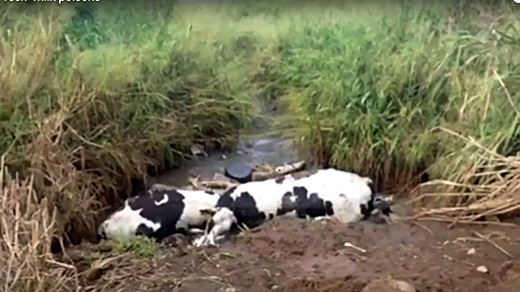
Image above: Dead cows ended up in stream runoff with mud and feces on the way to the ocean. From video below.
For years, Ookala residents have been putting up with the sickening pilau caused by Big Island Dairy mauka of the village.
No wonder it smells so rotten; the dairy confines a concentration of 1,800 cows (and growing) that stand and sleep in their own feces. If the cull rate compares to other industrial dairies, it would be about 30 percent per year, and the carcasses are thrown in a nearby pit that is in the path of stormwater runoff.
But the grumbling of Ookala residents didn’t make headlines until recent storms sent tsunamis of dairy sewage racing through their neighborhoods.
At a community meeting on March 28, one man lamented medical bills totaling tens of thousands of dollars for family members who had become sick after their home was marinated in fecal wastewater.
Several water-quality tests in early March taken from Ookala stream (when both dry and after a rain) showed, in all but one sample, that levels of enterococci tallied in at over 2,000 colony-forming units/mL, dangerously exceeding the maximum limit of 130/mL. Residents can’t safely fish or pick opihi with this toxic water flowing into the ocean.
No measurements were taken for antibiotics or hormones carried by the excrement, but, considering the source, high levels would be no surprise.
Most shocking has been Gov. David Ige’s lack of enforcement to protect us. Is this yet another instance of our elected officials colluding with big business?
Yes, it seems that Ige is putting agribusiness before health, safety and local livelihoods. For example, in 2014, the state joined Meadow Gold processing on Oahu to aggressively push dairies to lower the minimum price at which they could sell milk to Meadow Gold. Everyone knew a price drop would send local dairies belly-up.
That tragedy befell Ed Boteilho, whose family had run Cloverleaf Dairy in Hawi for over a half-century. It also prevented Dutch artisanal cheesemaker Kees Kea from achieving his dream of providing quality European cheeses to Hawaii.
Why? Because the only dairies that could afford to operate were the high-volume mega-dairies owned by mainland entities. The sole survivor of the price drop is Big Island Dairy, owned by Steve Whitesides of Idaho, where he owns another mega-dairy comprised of 14,000 cows.
What a difference a price makes. By signing the lowered milk price into law, the future of Hamakua as Oahu’s industrial dairy zone was sealed. Small-scale, local, environmental dairies are now unviable – unless the higher milk price can be restored.
Given this profit-before-people-agenda, it is no surprise that no environmental assessment (EA) was conducted for Big Island Dairy, the largest industrial dairy to ever operate in Hawaii.
And now that the dairy is building its own processing plant (which would cut Meadow Gold out of the chain), there are no plans for an EIS. But there should be.
The processing plant, which leases land from the state, would produce far more toxic wastewater than what is currently released. If they can’t manage the havoc they are already wreaking, who gave them the green light to make more pilikia?
Big Island Dairy is in Hawaii to exploit. With the compliance of Ige, this bad neighbor has driven local farmers out of business; it has driven pathogen levels in our streams through the roof; it has carpeted our pastures with controversial GMO corn; and, to add insult to injury, it is expanding.
This is the kind of irresponsible ag that turns beautiful lands into rural slums. This is not what we want for Hamakua.
Video above: This film reveals some of what goes on with a large scale industrial milking operation and illustrates why Kauai does not want one in Mahaulepu. From (https://youtu.be/cOgGjSG8d_I).
See also:
Ea O Ka Aina: Hawaii Dairy Farm permits revoked 2/25/17
Ea O Ka Aina: Out to Pasture 6/2/16
Ea O Ka Aina: Mahaulepu Dairy Farm draft EIS 5/28/16
Ea O Ka Aina: Hawaii Dairy Farm faces lawsuit 6/3/15
Ea O Ka Aina: Hawaii Dairy Farm Factsheet 10/11/14
Ea O Ka Aina: Kauai Grassfed Dairy Fraud 4/13/14
.
By Koohan Paik on 12 April 2017 in Island Breath -
(http://islandbreath.blogspot.com/2017/04/hawaiis-fresh-milk-poisons.html)
Image above: Dead cows ended up in stream runoff with mud and feces on the way to the ocean. From video below.
For years, Ookala residents have been putting up with the sickening pilau caused by Big Island Dairy mauka of the village.
No wonder it smells so rotten; the dairy confines a concentration of 1,800 cows (and growing) that stand and sleep in their own feces. If the cull rate compares to other industrial dairies, it would be about 30 percent per year, and the carcasses are thrown in a nearby pit that is in the path of stormwater runoff.
But the grumbling of Ookala residents didn’t make headlines until recent storms sent tsunamis of dairy sewage racing through their neighborhoods.
At a community meeting on March 28, one man lamented medical bills totaling tens of thousands of dollars for family members who had become sick after their home was marinated in fecal wastewater.
Several water-quality tests in early March taken from Ookala stream (when both dry and after a rain) showed, in all but one sample, that levels of enterococci tallied in at over 2,000 colony-forming units/mL, dangerously exceeding the maximum limit of 130/mL. Residents can’t safely fish or pick opihi with this toxic water flowing into the ocean.
No measurements were taken for antibiotics or hormones carried by the excrement, but, considering the source, high levels would be no surprise.
Most shocking has been Gov. David Ige’s lack of enforcement to protect us. Is this yet another instance of our elected officials colluding with big business?
Yes, it seems that Ige is putting agribusiness before health, safety and local livelihoods. For example, in 2014, the state joined Meadow Gold processing on Oahu to aggressively push dairies to lower the minimum price at which they could sell milk to Meadow Gold. Everyone knew a price drop would send local dairies belly-up.
That tragedy befell Ed Boteilho, whose family had run Cloverleaf Dairy in Hawi for over a half-century. It also prevented Dutch artisanal cheesemaker Kees Kea from achieving his dream of providing quality European cheeses to Hawaii.
Why? Because the only dairies that could afford to operate were the high-volume mega-dairies owned by mainland entities. The sole survivor of the price drop is Big Island Dairy, owned by Steve Whitesides of Idaho, where he owns another mega-dairy comprised of 14,000 cows.
What a difference a price makes. By signing the lowered milk price into law, the future of Hamakua as Oahu’s industrial dairy zone was sealed. Small-scale, local, environmental dairies are now unviable – unless the higher milk price can be restored.
Given this profit-before-people-agenda, it is no surprise that no environmental assessment (EA) was conducted for Big Island Dairy, the largest industrial dairy to ever operate in Hawaii.
And now that the dairy is building its own processing plant (which would cut Meadow Gold out of the chain), there are no plans for an EIS. But there should be.
The processing plant, which leases land from the state, would produce far more toxic wastewater than what is currently released. If they can’t manage the havoc they are already wreaking, who gave them the green light to make more pilikia?
Big Island Dairy is in Hawaii to exploit. With the compliance of Ige, this bad neighbor has driven local farmers out of business; it has driven pathogen levels in our streams through the roof; it has carpeted our pastures with controversial GMO corn; and, to add insult to injury, it is expanding.
This is the kind of irresponsible ag that turns beautiful lands into rural slums. This is not what we want for Hamakua.
Video above: This film reveals some of what goes on with a large scale industrial milking operation and illustrates why Kauai does not want one in Mahaulepu. From (https://youtu.be/cOgGjSG8d_I).
See also:
Ea O Ka Aina: Hawaii Dairy Farm permits revoked 2/25/17
Ea O Ka Aina: Out to Pasture 6/2/16
Ea O Ka Aina: Mahaulepu Dairy Farm draft EIS 5/28/16
Ea O Ka Aina: Hawaii Dairy Farm faces lawsuit 6/3/15
Ea O Ka Aina: Hawaii Dairy Farm Factsheet 10/11/14
Ea O Ka Aina: Kauai Grassfed Dairy Fraud 4/13/14
.
