SUBHEAD: Rodent eradication saves chicks and fertilizes soil and reefs for better biodiversity.
By Jan TenBruggencate on 6 July 2018 for Raising Islands -
(http://raisingislands.blogspot.com/2018/07/new-study-finds-rat-eradication.html)
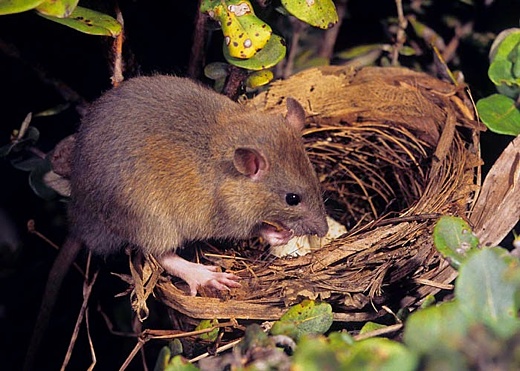
Image above: Rat in tree eating Hawaiian bird eggs. From (https://conservationbytes.com/2015/01/06/help-hawaiis-hyper-threatened-birds/).
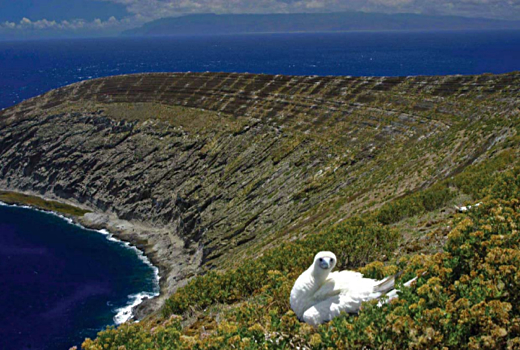
If the rat eradication of Lehua Island (in Kauai County, Hawaii) ends up being successful, it could result in a more productive nearshore fishery.
Which is ironic, in that many of those fighting the eradication program were fishermen.
A new study in the journal Nature says that when rats kill off seabirds on islands, it means those birds are no longer pooping in the nearshore waters, fertilizing reefs. And that means fewer fish on those reefs.
This study was done in the Chagos Archipelago, where some islands have rats and others are rat-free. Researchers looked at both the fertility of the land on those islands and the productivity of their reefs, where erosion from the land would carry nutrients like bird-poop-sourced nitrogen.
The Chagos are atolls and reefs just south of the Equator in the Indian Ocean. Their ownership is disputed between Great Britain and Mauritius. One is Diego Garcia, which houses a U.S military base.
The results of the research were clear, said the authors, who are from Australian, British, Danish and Canadian research institutions.
On islands without rats, seabird density as well as nitrogen deposits were hundreds of times higher. Yes, hundreds: 250 to more than 700 times higher.
Those rat-free islands had reefs that had 48 percent more biomass of "macroalgae, filter-feeding sponges, turf algae and fish."
The researchers looked specifically at damselfish, and found that they both grew faster and had higher total biomass on the rat-free islands.
The theory, then, is that seabirds feed in the open ocean, deliver bird poop to the islands, and that the islands then feed the nearshore waters, which makes the waters more productive and capable of producing more fish.
"Rat eradication on oceanic islands should be a high conservation priority as it is likely to benefit terrestrial ecosystems and enhance coral reef productivity and functioning by restoring seabird-derived nutrient subsidies from large areas of ocean," the authors wrote.
Rats are not the only problems on islands. On Midway Atoll, near the western end of the Hawaiian archipelago, mice began eating seabirds after rats were removed from the islands there. The case of the vampire mice, which chewed into the necks of Laysan albatross, is reviewed here.
On other islands, the mice even seemed to be getting bigger on their diets of eggs and bird flesh. The Washington Post was among the many international publications that picked up the vampire mouse story.
All that said, rodents mainly go after eggs and chicks of nesting seabirds. That was the case at Lehua Island. Here is a description of the situation on the little island north of Ni`ihau before an application of a rodenticide to try to wipe out the rats.
"We found Wedge-tailed Shearwater and Red-tailed Tropicbird eggs broken open, the edges gnawed, the insides consumed. Tiny seabird chick bodies were commonplace–pulled out of burrows and half eaten.
This was particularly true for the diminutive Bulwer’s Petrel–the vast majority of Bulwer’s Petrel burrows we found had bits and pieces of chick inside," wrote Andre Raine, Project Manager for the Kauai Endangered Seabird Recovery Project.
A couple of months after the 2017 rat eradication effort at Lehua, Raine said he could clearly see the difference:
"Fat, healthy Wedge-tailed Shearwater chicks shuffled about in their burrows looking like animated fuzzballs. One of our burrow cameras showed a Bulwer’s Petrel chick exercising outside its burrow and actually fledging – a great omen, as this is something we have never recorded on our cameras in previous years," he wrote.
Most, but not all the rats were killed off at Lehua, and wildlife crews were back this year with rat-hunting dogs to try to kill off the survivors and protect the island's nesting seabird population.
And the island's coastal reefs and fisheries.
The removal of rats from islands is a major conservation effort. It has been done successfully at islands in Hawai`i like Mokoli`i off O`ahu and Mokapu off Molokai.
When it was accomplished at Palmyra Atoll south of the Hawaiian Islands, it had the unintended effect of killing off the disease-causing Asian tiger mosquito, which had depended on rats for blood meals.
.
By Jan TenBruggencate on 6 July 2018 for Raising Islands -
(http://raisingislands.blogspot.com/2018/07/new-study-finds-rat-eradication.html)
Image above: Rat in tree eating Hawaiian bird eggs. From (https://conservationbytes.com/2015/01/06/help-hawaiis-hyper-threatened-birds/).
If the rat eradication of Lehua Island (in Kauai County, Hawaii) ends up being successful, it could result in a more productive nearshore fishery.
Which is ironic, in that many of those fighting the eradication program were fishermen.
A new study in the journal Nature says that when rats kill off seabirds on islands, it means those birds are no longer pooping in the nearshore waters, fertilizing reefs. And that means fewer fish on those reefs.
This study was done in the Chagos Archipelago, where some islands have rats and others are rat-free. Researchers looked at both the fertility of the land on those islands and the productivity of their reefs, where erosion from the land would carry nutrients like bird-poop-sourced nitrogen.
The Chagos are atolls and reefs just south of the Equator in the Indian Ocean. Their ownership is disputed between Great Britain and Mauritius. One is Diego Garcia, which houses a U.S military base.
The results of the research were clear, said the authors, who are from Australian, British, Danish and Canadian research institutions.
On islands without rats, seabird density as well as nitrogen deposits were hundreds of times higher. Yes, hundreds: 250 to more than 700 times higher.
Those rat-free islands had reefs that had 48 percent more biomass of "macroalgae, filter-feeding sponges, turf algae and fish."
The researchers looked specifically at damselfish, and found that they both grew faster and had higher total biomass on the rat-free islands.
The theory, then, is that seabirds feed in the open ocean, deliver bird poop to the islands, and that the islands then feed the nearshore waters, which makes the waters more productive and capable of producing more fish.
"Rat eradication on oceanic islands should be a high conservation priority as it is likely to benefit terrestrial ecosystems and enhance coral reef productivity and functioning by restoring seabird-derived nutrient subsidies from large areas of ocean," the authors wrote.
Rats are not the only problems on islands. On Midway Atoll, near the western end of the Hawaiian archipelago, mice began eating seabirds after rats were removed from the islands there. The case of the vampire mice, which chewed into the necks of Laysan albatross, is reviewed here.
On other islands, the mice even seemed to be getting bigger on their diets of eggs and bird flesh. The Washington Post was among the many international publications that picked up the vampire mouse story.
All that said, rodents mainly go after eggs and chicks of nesting seabirds. That was the case at Lehua Island. Here is a description of the situation on the little island north of Ni`ihau before an application of a rodenticide to try to wipe out the rats.
"We found Wedge-tailed Shearwater and Red-tailed Tropicbird eggs broken open, the edges gnawed, the insides consumed. Tiny seabird chick bodies were commonplace–pulled out of burrows and half eaten.
This was particularly true for the diminutive Bulwer’s Petrel–the vast majority of Bulwer’s Petrel burrows we found had bits and pieces of chick inside," wrote Andre Raine, Project Manager for the Kauai Endangered Seabird Recovery Project.
A couple of months after the 2017 rat eradication effort at Lehua, Raine said he could clearly see the difference:
"Fat, healthy Wedge-tailed Shearwater chicks shuffled about in their burrows looking like animated fuzzballs. One of our burrow cameras showed a Bulwer’s Petrel chick exercising outside its burrow and actually fledging – a great omen, as this is something we have never recorded on our cameras in previous years," he wrote.
Most, but not all the rats were killed off at Lehua, and wildlife crews were back this year with rat-hunting dogs to try to kill off the survivors and protect the island's nesting seabird population.
And the island's coastal reefs and fisheries.
The removal of rats from islands is a major conservation effort. It has been done successfully at islands in Hawai`i like Mokoli`i off O`ahu and Mokapu off Molokai.
When it was accomplished at Palmyra Atoll south of the Hawaiian Islands, it had the unintended effect of killing off the disease-causing Asian tiger mosquito, which had depended on rats for blood meals.
.