Showing posts with label Koloa. Show all posts

Koloa Camp Revival Event

SOURCE: Jeri DiPietro (ofstone@aol.com)
SUBHEAD: This event highlights the spirit of community that was a special part of Koloa Camp, as an example of aloha.  

By Jeri DiPietro on 16 May 2012 for press release in Island Breath- 
(http://islandbreath.blogspot.com/2012/05/koloa-camp-revival-event.html)


Image above: Painting of o plantation house titled "By Gone Days" by Kauai artist Martin Wessler. From (http://wesslerfineart.com/workszoom/860487). Note: Image removed at the request of artist.


WHAT:
“KOLOA CAMP REVIVAL” EVENT A celebration of our Koloa Camp Ohana  

WHEN:
Sunday, May 20th, 2012 Noon – 5 PM  

WHERE: Koloa Ball Park  

CONTACT:
For more information about this event contact: 808-292-3695 or 808-635-6145

Friends and supporters of Koloa Camp ohana present a celebration of the camp culture, comraderie, and history of Koloa Camp on Sunday, May 20, 2012 at Koloa Ball Park, noon - 5 pm. This event highlights the spirit of community that was a special part of Koloa Camp, as an example of old Kaua’ian aloha.

Live music by Kaua’i musicians, "talk story" with Koloa Camp kupuna and friends, food, and photo displays are part of this family-oriented celebration. “We want to thank all the people – the state senators, county council members, volunteers, petition signers, sign wavers, everyone who helped make the case for more affordable housing and respect for Koloa Camp tenants and kupuna,” said Doreen Jacintho, a longtime tenant of Koloa Camp. Ms. Jacintho is the daughter of Louis Jacintho, Jr., a Grove Farm irrigation supervisor.

In spring 2012, following eviction notices delivered to Koloa Camp tenants by landowner Grove Farm, the Kaua’i County Council and Hawaii State Senate passed resolutions urging Grove Farm to explore “win-win” alternatives to its proposed new housing development, to include more affordable housing for Koloa Camp existing tenants. Many Koloa Camp tenants were elderly with severely limited incomes and limited relocation possibilities.

Despite the passage of these resolutions Grove Farm proceeded with the evictions. “Aloha needs to be defined and lived anew by each generation,” said County Council member JoAnn Yukimura, “Each person and each business must ask the question, ‘How do we act with aloha here and now?’ I believe a win-win solution can be found for Koloa Camp and Grove Farm if we have the courage to try new ways and meet each other with mutual respect and the desire to find common ground.”

 .
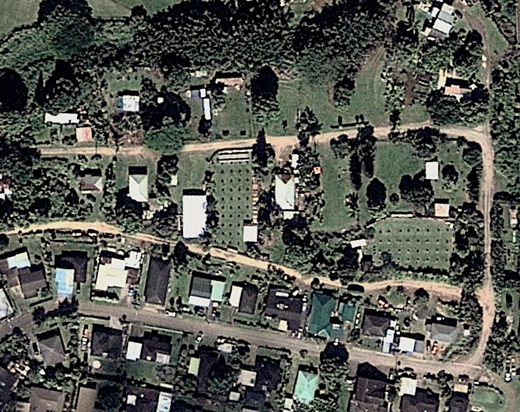
Koloa Camp Resolution

SUBHEAD: Please pass Resolution # 2012-29 Historic Preservation of Kauai and Koloa are important. By Ken Taylor on 13 March 2012 in Island Breath - (http://islandbreath.blogspot.com/2012/03/koloa-camo-resolution.html) Image above: Koloa Camp areal from Google Earth. Aloha Kakou, JoAnn Yukimura's resolution supporting Koloa Camp will be introduced this Wednesday morning, first order of business. We need to meet at the County Building at 8:30 am.
Resolution No. 2012-29 RESOLUTION CALLING FOR A JUST AND EQUITABLE SOLUTION AT KOLOA CAMP AND REQUESTING WITHDRAWAL OF EVICTION NOTICES BY GROVE FARM COMPANY TO ALLOW FOR EXPLORING OF ALTERNATIVES.
If you cannot make Wednesday, March 14th County Council meeting, send in a written note in Support of Resolution 2012-29 or email County Council members at: CouncilTestimony@Kauai.gov All that is needed, is something like:
"Please pass Resolution # 2012-29 Historic Preservation of Kauai and Koloa are important. Historic Preservation equals Quality of Life, and makes good economic sense."
While we want as many tenants as possible to testify, the testimony of residents of Wailani Rd, friends, family, and members of the community will be a HUGE factor in our favor. Let's move a mountain! This is our chance to help preserve 100+ years of Kauai history and to save some affordable housing in the process. This matter is important for all of Kauai. Please pass this on to all your friends and family.
See also:
Ea O Ka Aina: Koloa Camp Meeting 3/10/12
.

Koloa Camp Meeting

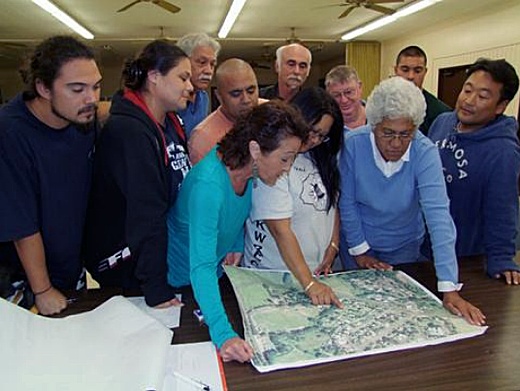
SUBHEAD: Meeting on Koloa Camp future with state senator Hee. Please join the community by participating. By John Patt on 10 March 2012 in Island Breath - (http://islandbreath.blogspot.com/2012/03/koloa-camp-meeting.html) Image above: Kauai residents meet to discuss saving Koloa Camp neighborhood. From Joan Conrow article below. WHAT: Community meeting on ways to save Koloa Camp with state senator Hee. WHEN: Sunday on 11 march 2012 at 1:30pm
WHERE: Koloa Kauai Canoe Club This evening we finalized our plans for tomorrow's meeting with Senator Hee. We are going to gather at the canoe hale around 1:30pm. The Senator is bringing several of his staff people, and it is important to have him meet as many of the tenants, family members, and Wailani Road residents as possible. Friends and members of the KCA are welcome to help show the senator that we have community support. It is also our chance to ask the senator questions, and to firm up our plans. JoAnn Yukimura is supposed to attend. She is going to introduce her resolution this Wednesday to the County Council. Also, those that can bring food/drinks, please do so. See you tomorrow.

Neighborhood in Crisis
By Joan Conrow on 6 March 2012 for Kauai Online - (http://www.forkauaionline.com/article/Local_News/Cover/Koloa_Camp_A_Neighborhood_in_Crisis_a_Neighborhood_in_Change/3325072)

Ask folks what they like most about living in Koloa Camp, and they'll answer without hesitation: the tight-knit community.

They also speak about the sense of history, and of place, that comes from living in century-old homes that previously housed Japanese field workers on the first sugar plantation in Hawai`i. As they see it, the boxy, metal-roofed relics from a bygone era do more than provide shelter. They also reflect a local lifestyle that is fast disappearing on Kaua`i.

So when Koloa Camp residents learned, via 120-day eviction notices sent out on Nov. 8, 2011, that their landlord, Grove Farm, planned to tear down their homes and build 50 new ones, they quickly banded together.

Families living in eight homes are affected, along with tenants renting five agricultural lots. They've been given until March 8 to vacate.

Camp residents began meeting every Sunday afternoon in the canoe hale that is also slated for demolition, and soon word of their plight spread to all points of the island. Folks showing their support for the residents packed the Koloa Neighborhood Center for meetings in December and January, when Grove Farm representatives detailed the company's plans to develop Waihohonu, named after the stream that flows near the camp.

Groundbreaking is scheduled for April, with construction expected to take about three years. Company officials said the project would provide affordable homes that are in big demand on Kaua`i.

Though Grove Farm offered to give Koloa Camp tenants the first chance to buy — the two- and three-bedroom houses range from 800 to 1,300 square feet and are tentatively priced at $230,00 to $485,000 — residents said they couldn't qualify for loans at those prices.

But mostly, they didn't want to see their neighborhood destroyed, leave homes where some had lived their entire lives, say goodbye to neighbors who felt like family.

“It's historically relevant and a valuable asset to this community,” says Kepa Kruse, who grew up in the camp. “It's what makes it old Koloa town.”

Eager to find an alternative, camp residents suggested the company instead build on land it owns on nearby Ala Kinoiki Road. But Grove Farm rejected the idea, saying the 6.5-acre proposed site was about half the size of Koloa Camp. Furthermore, it would take extensive time and money to change the zoning of the land from agriculture to residential.

Residents were beginning to get discouraged when developer Peter Savio stepped forward.

He had previously helped the residents of Poamoho Camp on O`ahu buy their houses when the Del Monte pineapple plantation shut down, and he thought a similar approach would work in Koloa.

“I'm here to give Grove Farm and everyone a way out,” says Savio, who offered to buy the camp at its appraised value, which is currently unknown, for the purpose of selling it back to the residents. “We're not asking for a discount or anything less than the market value. I really would love to see some of this history preserved. That's what excites me about these plantation camps.”

Grove Farm, which did not respond to a request for comment, formally rejected Savio's offer in mid-February.

But Savio, like the residents he represents, remains hopeful.

“I believe there's a lot of support on Kauai for saving the camp,” Savio says. “I do not see a local company strong-arming the community when there's an option like this.”

Added Kruse: “The camp residents are not moving.”

In keeping with that vow, they're making plans that center around staying, not leaving. They want to apply for assistance to preserve the historical structures, plant trees to stabilize the stream banks, create a community garden that will double as a hands-on learning place for sustainable living, and share their neighborhood with others.

“I see it as a chance to pass on a community, a historic camp, an `ohana, to the next generation,” says Koloa resident John Patt.

Update...

Residents of Koloa Camp have gotten the support of Hawai`i State Legislators in their bid to remain in their homes. On March 2, the State Senate approved a resolution calling upon Grove Farm to immediately put the evictions on hold and allow the Koloa Plantation Camp tenants to remain in their homes until alternative solutions are developed. The residents are supposed to be out by March 8.

The resolution also urges Grove Farm to engage in meaningful discussions with the tenants of Koloa Plantation Camp regarding the future plans for the plantation property and the development of alternative solutions.

The resolution, which is non-binding, now goes to the state House of Representatives for a vote.

.

Hapa Trail is State Owned

SUBHEAD: It is a good time to let the DLNR revisit this issue, after Lingle's laura Theilen is gone and under Abocrombie's new chairperson pick, William Aila.  

By Paul Curtis on 11 December 2010 for Garden Island News -  
(http://thegardenisland.com/news/local/article_380d2a08-05bf-11e0-a69f-001cc4c002e0.html)

 
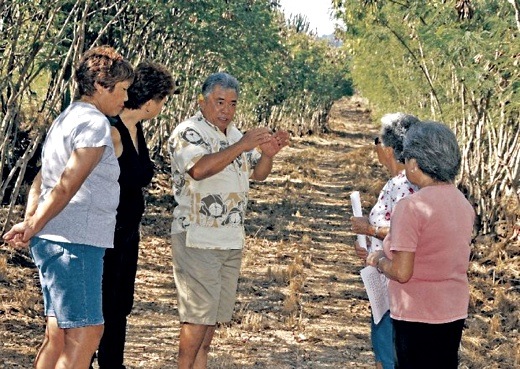
Image above: Teddy Blake explains some of the historical aspects of Hapa Trail. Photo by Dennis Fujimoto from original article.

Fifth Circuit Judge Randal Valenciano on Tuesday ruled the state owns the historic Hapa Trail on the South Shore.

For years the county had claimed ownership, even to the point of approving a controversial breach of the trail to allow access to a residential subdivision in Po‘ipu.

While the case of citizens suing the county and other entities claiming that allowance of access was illegal appears to be out of court for now, attorneys on both sides of the dispute are still at odds over what Valenciano’s rulings actually mean.

Deputy County Attorney Ian Jung said Valenciano dismissed the lawsuit, Theodore K. Blake versus the County of Kaua‘i Planning Commission et al. But David Kimo Frankel, staff attorney of the Native Hawaiian Legal Corporation representing Koloa resident Blake, said he isn’t sure if he needs to appeal Valenciano’s decision because he’s not sure the judge actually dismissed the lawsuit.

State court records show Valenciano made three decisions on several motions brought in the civil case:

— Hapa Road is a state road;

— No final agency action has happened (Frankel said that means no final subdivision approval has been issued, a statement disputed by Jung);

— The court does not have subject matter jurisdiction as to all counts (Jung reads that to mean case dismissed; Frankel disagreed).

Valenciano told Linda Chow, state deputy attorney general representing DLNR, to prepare the orders.

Chow could not be reached for comment by press time.

Stacey Wong, Knudsen Estate trustee, said he was told by his attorney, Honolulu-based Michael Tom, not to discuss the matter with the media.

Tom could not be reached by telephone or e-mail. Blake deferred comment to Frankel.

Contacted parties all agreed that any request by Knudsen, developer of the Village at Po‘ipu subdivision, to breach Hapa Trail must now be made to DLNR.

Hapa Trail is a non-vehicular extension of the county’s Hapa Road that runs from St. Raphael Church to its terminus at Po‘ipu Road.

That breach represents the only vehicular access to the subdivision to hook up with Kiahuna Plantation Drive. No direct access to Po‘ipu Road is allowed.

“The judge ruled that because the state of Hawai‘i did not yet grant an easement over Hapa Road Mr. Blake’s claims were not ripe,” Jung said in an e-mail.

“The judge further ruled that given the state of Hawai‘i is the owner of Hapa Road the Knudsen Trust will have to pursue obtaining an easement from the Board of Land and Natural Resources or reconfigure the roadway lots,” he said.

Frankel basically agrees with those two claims.

“The Village at Po‘ipu Phase One subdivision approval remains valid,” Jung said.

Frankel disputes that statement, saying final subdivision approval has not been issued, something he said Valenciano concurred with in his second ruling on 11 motions that had been filed in the case.

Others named as defendants in the suit are the County of Kaua‘i Planning Department, former Planning Director Ian Costa, the state Department of Land and Natural Resources, Laura Thielen as former DLNR and state Board of Land and Natural Resources chair, and the Eric A. Knudsen Trust, owner of the land on the makai side of the trail.

Blake’s lawsuit contends that:

— The process of considering the Village at Po‘ipu development proposal violated the state public-trust doctrine;

— In the process of considering the trust’s application for final subdivision approval of phase one of the development, defendants failed to thoroughly investigate and protect Native Hawaiian rights;

— Defendants failed to comply with the requirements of state administrative rules governing the review process the state DLNR State Historic Preservation Division is to follow in making comments to state and county agencies on entitlements affecting historic properties;

— The development threatens to cause irreparable injury to burial sites and other historic sites;

— Defendants failed to comply with the objectives, policies and guidelines of certain state law, specifically the protection, preservation and restoration of historic and prehistoric resources in the coastal-zone-management area that are significant to Hawaiian history and culture;

— A supplemental environmental impact statement is required to address a plan to cross Hapa Trail with a street.

While defendant Blake on advice of Frankel would not talk about Tuesday’s court action, Louie Abrams, president of the Koloa Neighborhood Association, would.

“We had some strong opposition to the breach of Hapa,” he said, and voiced those concerns to the Planning Commission repeatedly.

When the commission denied the breach would do irreparable damage and approved permits for the development, Blake sued.

At issue are Native Hawaiian customary, cultural and gathering rights, and preservation of a unique archaeological and agricultural area that archaeological experts said is one of a kind in all the Pacific Rim, said Abrams.

SHPD had no idea it was a historic road, said Abrams. If SHPD knew it was a historic road maybe they should have fought for trail protection, he added.

Abrams said it is “distressing” that a lot of volunteer work on a traffic-circulation system for the Koloa and Po‘ipu areas might be all for naught if the trust is allowed to build a vehicular road over the top of Hapa Trail.

“We were trying to designate it as a trail” because when the county Department of Public Works hears the word “road” they start making plans to allow subdivisions to use the road for access purposes, he said.

“We really see this as a very important matter for this community” in terms of traffic and pedestrian circulation, said Abrams.

“Now maybe we have a foothold, somebody to listen to us,” he said.

“Nobody figured out that Hapa was a historic road until two months before permits were issued. Even we didn’t know it was a historic road then.”

The late Dorothy Tao and the late Grace Blake wanted the road and trail preserved, he said.

“It is not settled and it is not clear. There’s hope,” said Abrams, adding that the association is seeking grants for mapping of important sites. “Otherwise those sites will just sit, or get bulldozed.

“I was ready to give up, and Hapa was really the only identity that this community has,” he said.

.

Koloa Field System

SUBHEAD: A lecture and walking tour of the ancient Koloa area farming system, one of the most productive in Hawaii.

By Jeri DePietro on 6 October 2010 for Island Breath - 
(http://islandbreath.blogspot.com/2010/10/koloa-field-system.html)

 
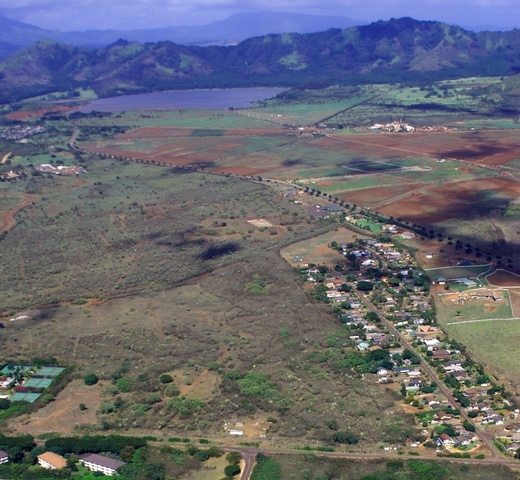
Image above: Aerial view of part of Hawaiian archaeological sites bounded by Hapa Trail (foreground), Poipu Bypass West (background) and old cane railroad right of way between mill and Koloa landing (right).  

The public is invited to a lecture and walking tour providing information on the historic agricultural lifestyle of Hawaiians on Kauai's south shore. Guest speaker Dr. Hal Hammatt will give the first lecture ever on the entire Koloa Field System Complex, stretching west from Kukui`ula Harbor to Weliweli in the east. The lecture will cover descriptions of sites located in the Koloa Field System and will highlight different sites to be seen on Friday morning's tour of four archeological preserves and Hapa Trail.  

WHAT:
Free public lecture on archaeological sites in Koloa/Poipu.  

WHEN:
Thursday, 14 October 2010 at 6:30pm  

WHERE:
Koloa Neighborhood Center

 DETAILS:
Refreshments will be provided after the lecture. Sponsored by Hui Malama O Koloa and Koloa Community Association. Join us on Friday for a field trip to visit several of these sites. Dr. Hal Hammatt will conduct a tour of the area, pointing out the sites described in Thursday evening's lecture and the Koloa Neighborhood Center. Participants are advised to wear hats, walking shoes and sunscreen. Water will be provided along the tour and refreshments will be provided at the tours conclusion. The tour is open to the public free of charge.  

WHAT:
Free walking tour of archeological preserves and Hapa Trail.  

WHEN:
Friday, 15 October 2010 at 10:00am  

WHERE:
Meet at Kiahuna Golf Course parking lot.  

DETAILS: Things to bring on the tour:
  • Hat and sunscreen.
  • Water will be provided throughout the entire tour
  • Refreshments will be served at the conclusion of the tour
  • Talk story time with Dr. Hammatt at end of tour
Talk on the entire complex of the Koloa Field System from Kukuila to Weliweli focuses on:
Different archaeological sites Unique irrigation system different crops grown abundantly animal corrals Why is the Koloa System highly regarded How the food was distributed Role in supplying ships at Hanakape Providing food for the 49ers in the California Gold Rush Tour of Archaeological Preserves in the Koloa Field System
There is a treasure trove of archaeological sites in Popu. The area is much more than a resort destination for visitors. The history of the area is fascinating. There were salt beds for making pakai, Pa a laka hula mound where hula icon olani Luahine learned hula and practiced. This was a strategic area in the civil wars of Kaua ibetween island chiefs, and much more. These events are presented in conjunction with the Society of Hawaiian Archaeologist Conference featuring top archaeologist in Hawaii, greater Polynesia and Micronesia. The tour lecture sponsored by Hui Malama o Koloa and the Koloa Community Association.

See also:
Ea O Ka Aina: Early Hawaiian Agriculture 1/1/10
Ea O Ka Aina: Hapa Trail Defilement 7/19/09
Ea O Ka Aina: Knudsen to spoil Poipu 1/18/09

 .

Hapa Trail Defilement

SUBHEAD: The Knudsen Trust (aka Stacey Wong) prevails in the further destruction of Koloa & Poipu area.


By Paul C. Curtis on 17 July 2009 in The Garden Island News - 
(http://www.kauaiworld.com/articles/2009/07/17/news/kauai_news/doc4a5ff1cab805f826275376.txt)


Image above: Archeological area off Hapa Trail to be developed into suburban sprawl. Photo by Juan Wilson

[IB Editor's Note: Randal Valenciano is the judge who approved the Superferry coming to Kauai. That, and his to decision to Green Light the Hapa Trail development by Stacey Wong, indicate he is no friend of Kauai.]

A judge Wednesday afternoon denied a motion for an injunction to prevent developers from conducting construction activities within 50 feet of historic Hapa Trail. Fifth Circuit Judge Randal Valenciano sided with the developers, the Eric A. Knudsen Trust, in a contentious case involving the historic trail that runs from St. Raphael’s Catholic Church in Koloa to Po‘ipu Road through the heart of existing and under-construction resort developments. The church is where the paved Hapa Road ends and the unpaved trail begins.

Valenciano said David Kimo Frankel, the Native Hawaiian Legal Corporation attorney for Koloa Native Hawaiian Teddy Blake, did not make convincing enough arguments supporting the injunction. Valenciano cited the 1978 case, Life of the Land v. Ariyoshi, that he also used in support of Blake’s appeal for a temporary restraining order issued last week prohibiting any construction or land-altering activity on or within 50 feet of Hapa Trail until Wednesday’s hearing.

The three-pronged test:

The plaintiff is likely to prevail; 
There will be irreparable damage if the injunction is not approved; and 
Approving the injunction would benefit the public interest.

On each point, Valenciano was succinct. “I think this is an open case,” he said of the first prong, indicating he is not sure the plaintiff would prevail. While bulldozers preparing land for the Village at Po‘ipu Knudsen Trust development did knock down portions of the wall on one side of Hapa Trail while doing their work, developers also agreed to restore 2,000 feet of the wall, so Valenciano did not see irreparable damage, the second prong.

Finally, Valenciano could find no fault with state Department of Land and Natural Resources State Historic Preservation Division officials who brokered a deal with Knudsen representatives to approve a final historic preservation plan that allows breach of Hapa Trail for the main entrance to the subdivision while agreeing to take the developer’s offer to restore 2,000 feet of the Hapa Trail’s eastern wall. Reconstruction of the wall is for the public’s benefit, SHPD acted in the public’s interest, the third prong, said Valenciano, adding that different people with different agendas handled the negotiations on SHPD’s end.

Troubling to Valenciano was the trust’s position they can “do stuff or take actions without repercussions,” adding that there is a segment of the Kaua‘i community who hold Hapa Trail as important historically and spiritually. Still, granting an injunction is a “drastic remedy,” said Valenciano.

The case is Theodore K. Blake, Plaintiff, versus County of Kaua‘i Planning Commission, County of Kaua‘i Planning Department, Ian Costa in his official capacity as planning director, DLNR, Laura Thielen in her official capacity as DLNR chair, and Eric A. Knudsen Trust, Defendants. Blake, through Frankel, argued that SHPD required the trust to establish a 50-foot buffer between construction activities and Hapa Trail, but trust attorney Michael Tom argued that the 50-foot-buffer idea was “concocted” after the fact. Linda Chow, for DLNR, said trust developers are not abiding by terms of an interim protection plan, and do not yet have final approvals necessary to breach Hapa Trail for the purposes of the subdivision’s main entrance road.

“They don’t have a current right to breach the wall,” she said. Ian Jung, representing the County of Kaua‘i defendants, said the county is stuck in the middle, trying to act as a facilitator to balance the rights of landowners and protection of historic places. Who owns Hapa Trail?

Ownership of Hapa Trail, a dirt road bisecting present and planned Po‘ipu resort developments, was questioned in court Wednesday. While most had operated under the assumption that the trail is county property, an attorney for the state Department of Land and Natural Resources said it is state property. “Hapa is still a state road. Legal title is with the state,” said Linda Chow, state deputy attorney general representing the DLNR.

If Hapa Trail is state property, plaintiff Theodore K. “Teddy” Blake can’t prevail in seeking the injunction because it sued the wrong entity, said 5th Circuit Judge Randal Valenciano. Blake sued the County of Kaua‘i, state DLNR and the Eric A. Knudsen Trust.

See also:
Ea O Ka Aina: Knudsen to Spoil Poipu 1/18/09
Ea O Ka Aina: Old Koloa Town Monkeypods 1/11/08

Knudsen to spoil Poipu


 SUBHEAD: Kauai Planning Commission continues to "OK" the rape the island. 

By Jeri DiPietro on 18 January 2009 for Island Breath - (http://islandbreath.blogspot.com/2009/01/knudsen-to-spoil-more-of-poipu.html)

 
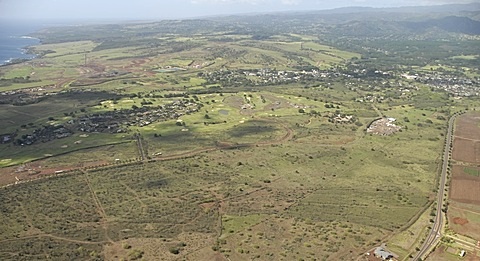
Image above: Aeria view of undeveloped land between Waikomo Reservoir and Poipu Road. Photo by the Kauai Historic Society.

It is inappropriate to allow cars to drive over Historic Hapa Trail, a walking/bike path. (see below “Developers to build road across Hapa Trail,” The Garden Island, Jan. 15th)

This path is county property, and the county will be liable for any potential harm incurred.

Other options exist, like making the driveway go straight onto Poipu Road. The county is willing to give them a variance for this route, but the developer claims it will cost more money.

The majority of the fuss at the Dec. 9 Planning Commission hearing was the owner’s attorney claiming to have a sign off letter from State Historic Preservation. They did have a letter but it wasn’t a sign-off. The letter asked for more conditions to ensure protection for archaeological sites of the amazing 203-acre agricultural system of taro, loi and auwai, known as the Koloa Field System. This system allowed the abundant growing of wetland taro in a dryland area long before the sugar plantations came to Koloa. Did the Planning Commission not take it upon themselves to do research? This is a chronic habit: do as little as possible. The discretionary portion of the planning process is absent. 

Regarding the Hapa Trail conditions associated with a residential subdivision application, the Knudsen trustee and its attorney say they are only obligated to restore 500 feet of trail, but they will agree to restore 2,000 feet. This is a smoke screen. Estimated completion date agreed on is the year 2029. The truth of the Poipulani ordinance implies they restore 6,000 feet and restore the rock walls. The rock walls have been victims of rock theft over the last 25 years. They and other landowners who benefited from the 1972 Kiahuna-Moana upzoning are compelled by law to restore the entire trail.

The ordinance states when they develop that land, and maintain Historic Hapa Trail in perpetuity.

The Kaua‘i County Council has appropriated money for an Environmental Assessment for Hapa, a requirement for altering county property. Some of the County Council does not agree with the Planning Commission decision, and the council will be obligated to sort out another bad decision. When will we truly begin to put our island first, for the benefit of future generations?

At the rate we are going, soon there will be nothing left to remind us of the way it used to be.

[IB Editor's Note: Stacey Wong's efforts to destroy Kauai continue as the Kauai Planning Commission knuckles under to Developer. The sad outcome on this proposal to suburbanize more of Poipu. This will likely have to end up in the courts.]


Knudsen to build across Hapa Trail

By Leo Azambuja on 15 January 2009 in The Garden Island News -
(http://www.kauaiworld.com/articles/2009/01/15/news/kauai_news/doc496efc430bbee718751042.txt)

Despite public outcry, developers got their way on Tuesday when the Kaua‘i Planning Commission approved a permit to build a road over the historic Hapa Trail on the South Shore. The Eric Knudsen Trust is planning a housing development in an area just east of Hapa Trail.

In order to obtain easier access to Po‘ipu Road, the developer opted to build an access road across the trail, a pedestrian path which runs alongside a 1.2-mile stone wall registered as a historic site. The trail used to be known as Hapa Road, but lawmakers had it changed to avoid it being mistaken as a road where cars could drive. The move was intended to help preserve it.

The site of the proposed development encompasses an area that includes several ancient taro patches and intricate irrigation systems. Community members who spoke against the development, mostly Koloa and Po‘ipu residents, had already accepted the possible loss of historic sites, but were not eager to give Hapa Trail away.

Resident Jerry Di Pietro said it is illegal to disturb the stone structure because there is a legal clause ruling that whoever develops the lands where the lo‘i and irrigation systems are located must maintain and restore the trail, including the stone structure. Hapa Trail belongs to the county. The developers already have prepared an Environmental Impact Statement, a more complex version of an Environmental Assessment.

Residents claimed that the EIS addresses only the development, not the trail or the stone structure, but Deputy Planning Director Imai Aiu said the EIS does address Hapa Trail. The stone structure is another controversy in itself. Residents say it is an ancient native Hawaiian structure.

The developers say it was built by the Knudsen family in the late 1800s. Commissioner Camilla Matsumoto said regardless, it is a historic site and as such it must be preserved. Former Mayor and Councilwoman JoAnn Yukimura, who was pivotal in the name change of the former Hapa Road, questioned why developers would not be willing to relocate access to the project from its eastern side.

The developers pledged to restore Hapa Trail, but they will have 20 years to finish the project. Newly elected Commission Vice Chair Caven Raco, saying that developers met all lawful requirements and should be granted the permit, made a motion to approve it. Commissioner Steven Weinstein said it was “time to move on,” which Commissioner Stuart Hollinger agreed with.

All three, alongside newly elected Commission Chair Jimmy Nishida, voted to approve the permit. Commissioners Herman Texeira and Matsumoto voted against it. After the permit approval, frustrated community members, who endured the 14-hour meeting, left the Mo‘ikeha Building saying there will be a lawsuit.

See also:
Island Breath: Knudsen Trust Setback 12/10/08 .

Knudsen Trust Setback

SUBHEAD: Desecration of Poipu delayed until January 13th.

By Teddy Blake on 9 December 2008 in Island Breath -
(http://islandbreath.blogspot.com/2008/12/knudsen-trust-setback.html)

 
Image above: Foreground is Hawaiian setlement on land claimed by Knudsen Trust. Aerial photo by Kauai Historic Society.

The subdivision committee of the Planning Commission approved the final subdivision of the Village at Po'ipu by a 2 to 1 (Hollinger voted against) vote. Commissioner Raco kept insisting for approval in such a pushy way that it made many in the audience wonder what was actually motivating him to act this way. Check him out on the Ho'ike coverage.

The Planning planner, Dale Cua, recommended that the committee not approve because the applicant had not fulfilled mitigation plans SHPD had requested for a proposed preservation site the developer had completely obliterated and SHPD refused to sign off until this was fulfilled by the developer.

When it came before the Commission as a whole, Raco again was very pushy in his quest for approval. He may have even gone overboard demanding that Planner Cua author and get into the hands of the developer a letter of approval so the developer can request the same from SHPD. He actually directed Planning to do the developer's work. Two points worked in Hapa Trail's favor with the Commissioners. The first was a strong, powerful and detailed letter from OHA authored by OHA's administrator Clyde Namu'o.

OHA demanded the Planning Commission withhold approval until all archeological sites were duly reviewed by OHA as they were not informed of the significance of the Koloa Field System. The second was the proposed breaching of Hapa Trail with no Environmental Assessment for Hapa Trail's breaching as is required by law as Hapa Trail belongs to the County of Kaua'i.

Another important issue raised by the community was that the developer needed Council's approval for an permanent easement over Hapa Trail. The Commission by a 5 to 1 vote voted to defer the matter until January 13, 2009 meeting. We need to step up vigilance now. SHPD needs to be informed in writing, emails and calls about this. If they sign off, Hapa Trail is toast.

The big issue is that Hapa Trail is proposed to be breached and there has been no Environmental Assessment for Hapa Trail's breaching or plans showing how the breaching will occur and what is will look like. We need to get the County Council members on board, the Mayor and our representatives. Any one who has a connection or knows any politician needs to make a call and follow up with an email or letter.

Hapa Trail is also an numbered State Historic Site, 50-10-30-992. SHPD needs to approve whether or not Hapa Trail can be breached or an alternative route used to Po'ipu Road. The Planning Director, Public Works Director and the County Attorney need to be apprised of what is going on with this application and applicant. We need to keep them informed of what is going on here. I have the email addresses to some listed below...

mayor@kauai.gov Kauai Mayor 
cokcouncil@kauai.gov County Council
tbynum@kauai.gov Councilman 
dchang@kauai.gov Councilman 
jay@jayfurfaro.org Councilman  
dkawakami@kauai.gov Councilman 
dkaneshiro@kauai.gov Councilman  
lkawahara@kauai.gov Councilwoman 
dfujimoto@kauai.gov County Planning 
 icosta@kauai.gov Planning Director  
iaiu@kauai.gov Planning Deputy
nmcmahon@hawaiian.net State Historic Preservation Department Kauai
pua.aiu@hawaii.gov State Historic Preservation Director 
 senhooser@capitol.hawaii.gov State Senator Hooser  
repmorita@Capitol.hawaii.gov State Representative Morita  
reptokioka@Capitol.hawaii.gov State Representative Tokioka 
 rds3@kikiaola.com State Representative Sagum 
 sengaluteria@Capitol.hawaii.gov State Senator Galuteria


.