SUBHEAD: The fungus kingdom potentially does just about everything from providing food and shelter to curing disease and healing the environment.
At an organic farm just outside Monterey, California, a super eco-building material is growing in dozens of darkened shipping containers. The farm is named Far West Fungi, and its rusting containers are full of all sorts of mushrooms--shiitake, reishi and pom-pom, to name a few. But Philip Ross, an artist, an inventor and a seriously obsessed amateur mycologist, isn't interested in the fancy caps we like to eat. What he's after are the fungi's thin, white rootlike fibers. Underground, they form a vast network called a mycelium. Far West Fungi's dirt-free hothouses pack in each mycelium so densely that it forms a mass of bright white spongy matter.
Mycelium doesn't taste very good, but once it's dried, it has some remarkable properties. It's nontoxic, fireproof and mold- and water-resistant, and it traps more heat than fiberglass insulation. It's also stronger, pound for pound, than concrete. In December, Ross completed what is believed to be the first structure made entirely of mushroom. (Sorry, the homes in the fictional Smurf village don't count.) The 500 bricks he grew at Far West Fungi were so sturdy that he destroyed many a metal file and saw blade in shaping the 'shrooms into an archway 6 ft. (1.8 m) high and 6 ft. wide. Dubbed Mycotectural Alpha, it is currently on display at a gallery in Germany.
Nutty as "mycotecture" sounds, Ross may be onto something bigger than an art project. A promising start-up named Ecovative is building a 10,000-sq.-ft. (about 930 sq m) myco-factory in Green Island, N.Y. "We see this as a whole new material, a woodlike equivalent to plastic," says CEO Eben Bayer. The three-year-old company has been awarded grants from the EPA and the National Science Foundation, as well as the Department of Agriculture--because its mushrooms feast on empty seed husks from rice or cotton. "You can't even feed it to animals," says Bayer of this kind of agricultural waste. "It's basically trash."
After the husks are cooked, sprayed with water and myco-vitamins and seeded with mushroom spores, the mixture is poured into a mold of the desired shape and left to grow in a dark warehouse. A week or two later, the finished product is popped out and the material rendered biologically inert. The company's first product, a green alternative to Styrofoam, is taking on the packaging industry. Called Ecocradle, it is set to be shipped around a yet-to-be-disclosed consumer item this spring.
One of the beauties of Ecocradle is that unlike Styrofoam--which is hard to recycle, let alone biodegrade--this myco-material can easily serve as mulch in your garden. Ecovative's next product, Greensulate, will begin targeting the home-insulation market sometime next year. And according to Bayer's engineering tests, densely packed mycelium is strong enough to be used in place of wooden beams. "It's not so far-out," he says of Ross's art house. So could Bayer see himself growing a mushroom house and living in it? "Well"--he hesitates--"maybe we'd start with a doghouse."
Return of the Fungi
By Andy Isaacson on 28 December 2009 in Mother Jones -
(http://motherjones.com/environment/2009/11/paul-stamets-mushroom?page=1)
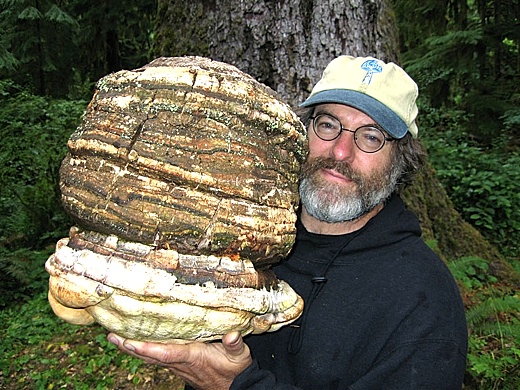
In the old-growth forests of the Pacific Northwest grows a bulbous, prehistoric-looking mushroom called agarikon. It prefers to colonize century-old Douglas fir trees, growing out of their trunks like an ugly mole on a finger. When I first met Paul Stamets, a mycologist who has spent more than three decades hunting, studying, and tripping on mushrooms, he had found only two of these unusual fungi, each time by accident—or, as he might put it, divine intervention.
Stamets believes that unlocking agarikon's secrets may be as important to the future of human health as Alexander Fleming's discovery of penicillium mold's antibiotic properties more than 80 years ago. And so on a sunny July day, Stamets is setting off on a voyage along the coastal islands of southern British Columbia in hopes of bagging more of the endangered fungus before deforestation or climate change irreparably alters the ecosystems where it makes its home. Agarikon may be ready to save us—but we may have to save it first.
Joining Stamets on the 43-foot schooner Misty Isles are his wife, Dusty, a few close friends, and four research assistants from Fungi Perfecti, his Olympia, Washington-based company, which sells medicinal mushroom extracts, edible mushroom kits, mushroom doggie treats, and Stamets' most recent treatise, Mycelium Running: How Mushrooms Can Help Save the World.
"What we're doing here could save millions of lives," he tells me on the first morning of the three-day, 120-mile voyage. "It's fun, it's bizarre, and very much borders on something spiritual."
A few months earlier, the University of Illinois-Chicago's Institute for Tuberculosis Research sent Stamets its analysis of a dozen agarikon strains that he'd cultured in his own lab.
The institute found the fungus to be extraordinarily active against
XDR-TB, a rare type of tuberculosis that is resistant to even the most effective drug treatments. Project BioShield, the Department of Health and Human Services' biodefense program, has found that agarikon is highly resistant to many flu viruses including, when combined with other mushrooms, bird flu. And a week before the trip, the National Center for Natural Products Research, a federally funded lab at the University of Mississippi, concluded that it showed resistance to orthopox viruses including smallpox—without any apparent toxicity. The potential implications are obvious:
Most Americans under 35 have not been vaccinated for smallpox, and experts fear the current supply of the vaccine may be insufficient in case of a bioterror attack. A bird flu pandemic within the decade is even likelier. Currently, agarikon is being tested to see if it can also fight off the
H1N1 swine flu virus.
"When you mention mushrooms people either think magic mushrooms or portobellos. Their eyes glaze over," Stamets laments. That a homely, humble fungus could
fight off virulent diseases like smallpox and TB might seem odd, until one realizes that even though the animal kingdom branched off from the
fungi kingdom around 650 million years ago, humans and fungi still have nearly half of their DNA in common and are susceptible to many of the same infections. (Referring to fungi as "our ancestors" is one of the many zingers that Stamets likes to feed audiences.)
On the first morning of our journey, agarikon remains elusive. From the deck of the
Misty Isles, the white heads of bald eagles pop out of the dense green slopes of Mink Island, generating false sightings of the chalky mushroom in the treetops. "People say, 'Everywhere you mycologists look, you see mushrooms,'" Stamets says, focusing his binoculars. He laughs. "It's true. The thing about mushroom hunters is, they tend to burn an image of a mushroom on their retina. Then you end up overlaying that image on the landscape. The mushrooms seem to jump out at you."
STAMETS IS of medium height and stocky build. His graying beard, round face, and glasses recall Jerry Garcia. As he tells it, mushrooms came into his life because of a humiliating stuttering habit. "I always stared at the ground and couldn't look people in the eye," he recounts. "That's how I found fungi."
He remembers pelting his seven-year-old twin brother with puffball mushrooms, watching the spores explode in his face. But Stamets didn't get serious about mushrooms until he was 18, when he ingested psilocybin mushrooms for the first time. Hallucinating alone in the Ohio countryside, he got caught in a summer thunderstorm and climbed a tree for shelter. Waiting out the storm, Stamets examined his life. "I asked myself, 'Well Paul, why do you stutter so much?'
So I repeated, 'Stop stuttering now,' over and over again, hundreds of times. The next morning, someone asked, 'Hi Paul, how are you?' I looked him right in the eye and said, 'I'm fine, how are
you?' I didn't even stutter. That was when I realized mushrooms were really important to me."
Not long after his first trip, Stamets enrolled in college but dropped out to work as a logger. He eventually graduated from Olympia's Evergreen State College, whose unofficial motto,
Omnia Extares, roughly translates as "Let it all hang out." While studying biology and electron microscopy, he pioneered research on psilocybin, discovering four new species and writing a definitive field guide. Unable to afford grad school, Stamets started Fungi Perfecti and published
The Mushroom Cultivator, which remains a classic within the subculture of mushroom enthusiasts. (He once spotted a copy on the bookshelf of one of the directors of the Pentagon's Defense Advanced Research Projects Agency.)
Stamets began distancing himself from the magic mushroom crowd about nine years ago. "The problem with the psychedelic scene," he told me while driving near his vacation home on Cortes Island, the Grateful Dead playing on the stereo, "is that people contemplate their belly buttons and don't get anything done. I wanted to save lives and the ecosystem." Yet he still credits psilocybin with giving him a sense of purpose. Stamets, who has a black belt in
Tae Kwon Do, used to spend hours executing complex martial arts routines in the mountains as he tripped. "I had these visions of myself as a mycological warrior in defense of the planet."
While studying the medicinal uses of fungi, Stamets built an extensive library of wild mushroom cultures harvested from the virgin forests of the Pacific Northwest. "It's my most valuable asset," he says. In the event of a fire, "everything can burn. I'm grabbing my test tubes and running."
His tinkering has yielded many surprising discoveries about mushrooms and mycelium, the cobweblike, often hidden network of cells that spawns them.
He's demonstrated that oyster mushroom mycelium can more effectively restore soils polluted by oil and gasoline than conventional treatments can; in one eight-week experiment, the fungus broke down 95 percent of the hydrocarbons in a diesel-soaked patch of dirt. He's used sacks of woodchips inoculated with oyster mycelium as filters to protect river habitats from pollutants such as farm runoff contaminated with coliform bacteria. Recently, he proved that cellulosic ethanol could be produced with sugars extracted from decomposing fungi.
Insisting that he's merely a "voice for the mycelium," Stamets says he can't really take credit for his discoveries about an
extraordinarily diverse and evolutionarily successful kingdom that modern science has scarcely explored. Still, over the past four years, he has filed for twenty-two patents and received four. "I'm up against big bad pharma, and they will try to steal from us. I have no illusions about this," he says. "Truly, it's a David versus Goliath situation." He asserts that after one of his public talks, in which he spoke about his discovery of a fungus that kills carpenter ants and termites by tricking them into eating it, he was approached by two retired pesticide industry executives. Convinced that their former employers would feel threatened by this relatively cheap, nontoxic pesticide, Stamets claims, they advised him to watch his back.
Stamets' mother, a charismatic Christian, believes the only explanation for his unexpected discoveries is that he is chosen. "I'm not that smart," he says. "I was the dumbest one in my family. But I'm just exceptionally lucky. Other mycologists know more about mycopesticidal fungi than I do. They missed it. In the 2,000-year history of
Fomitopsis officinalis"—agarikon's scientific name—"I'm the first one to discover it has antiviral properties? I don't get it, either."
"Paul Stamets is a modern example of the amateur scientist from the 17th and 18th century who made wonderful contributions with only their native curiosity and keen sense of observation," explains
Eric Rasmussen, a former Navy physician and researcher for the Defense Advanced Research Projects Agency and the National Science Foundation, who now heads
INSTEDD (Innovative Support to Emergencies Diseases and Disasters), a Google-funded nonprofit that develops tech-nology to control disease outbreaks. "He's listened to in a lot of unexpected corners." In 1997,
Battelle, a nonprofit R&D lab and a major Defense Department contractor, asked to screen more than two dozen strains of Stamets' fungi. A few years later, it sent him back a classified report revealing the mushrooms to be highly effective in breaking down the neurotoxin VX, the illegal chemical weapon. Soon afterward,
DARPA invited Stamets to one of its brainstorming sessions.
In his role as an ambassador for an entire taxonomic kingdom, Stamets has been elevated to something of a cult figure. "I do have some crazies once in a while who believe that I'm the messiah or that we're destined to be together," he said, by way of explaining the tight security around his Olympia compound. "That's sort of unnerving." While we explored Cortes Island the day before setting sail, he occasionally texted with
Leonardo DiCaprio, who had featured Stamets in his documentary
The 11th Hour.
Anthony Kiedis, the singer of the Red Hot Chili Peppers, had planned to join the agarikon expedition until he broke his foot. Stamets has "hero status in my mind," Kiedis emailed me. "He opens himself up to information about fungi the same way I open myself to a new song that is out there waiting to be found."
Yet for all the acclaim, Stamets is still an outsider without a PhD or an academic or institutional sponsor. That has made it hard for his work to be taken seriously in some circles—"We are just weird enough that I think we frighten people," he says—but it's an identity that he ultimately relishes. His inherently positive message—that we can tap a renewable natural resource to solve an array of environmental and medical challenges—has inspired a broad set of followers. Stamets leads workshops on "liberation mycology" and delivered the plenary address at last year's national botany conference. In February 2008, he
held forth at the TED (Technology, Entertainment, Design) Conference, the annual conclave of deep thinkers and tech gurus in California. Afterward, Google's founders "ambushed" him with an invitation to their exclusive summer think tank, and Al Gore complimented him on an obscure chemical reference, saying, "You taught me something I didn't know about global warming."
"Not a single prospect...was pleasing to the eye," sneered
Captain George Vancouver when he named this glacier-carved labyrinth of channels and fjords
Desolation Sound after spending a cloudy week here in the summer of 1792. But under the clear July sky, it's sublime: the water a deep, glassy blue, the islands dark green. Afternoon of the first day arrives without an agarikon sighting, so we head ashore to explore a patch of old growth. Stamets' friends joke about his notorious "death marches," but the jaunt proceeds at the leisurely pace of a chanterelle foray.
Fungi were among the first organisms to colonize land 1 billion years ago, long before plants. A visitor to the planet 420 million years ago would have encountered a landscape dominated by fungi such as
prototaxites, a bizarre-looking, 30-foot-tall mushroom. Contemporary fungi may be more discreet, but they're just as ubiquitous—and mysterious. Fewer than 7 percent of the estimated 1.5 million species have been cataloged. Mycologists have recently identified 1,200 species of mushrooms in just a few thousand square feet of Guyanese rainforest, half of them previously unknown to science.
As we walk, Stamets points out that the spongy feeling under our feet is a vast subterranean network of mycelium. Stamets refers to mycelium as "nature's Internet," a superhighway of information-sharing membranes that govern the flow of essential nutrients around an ecosystem. A honey mushroom mycelium that covers 2,200 acres in eastern Oregon is thought to be the world's largest organism. When Stamets saw mycelium for the first time, growing like a spiderweb across a log, he brought it home and tacked it onto his bedroom wall. Mycelium's labyrinthine tendrils prevent erosion, retain water, and break down dead plants into ingredients other organisms can use to make soil. Stamets likes to call fungi "soil magicians."
Yet it can be difficult to champion an organism that grows out of poop or decaying wood, can be deceptively toxic, and appears
extraterrestrial. Stamets says American society is pervaded by "mycophobia"—an irrational fear of fungi that he traces back to England, whose medical tradition equates mushrooms with decay and decomposition. Stamets has little patience with those who disrespect mushrooms. "I hate the word 'shrooms,'" he says. "Pet peeves: Don't kick mushrooms in my presence and don't use the word 'shrooms.'"
The summer dry season has subdued the mushroom population, but as we walk and my mind becomes more focused they soon pop into view: bracket fungi growing like ledges across a fallen log, a fragile cup-capped mushroom camouflaged in leaf litter. Logging has razed the Pacific Northwest's old growth; less than 20 percent of the original forest is still standing. A handful of mushroom species, including agarikon, depends on this diverse habitat, whose disappearance Stamets views as not just a lost opportunity but a national security concern.
The cancer drug Taxol was derived from the bark of Pacific yew trees, a conifer native to the Northwest. (See "
Natural Selections.") And tests of 18 of the 28 strains of agarikon Stamets has cultured have found varying levels of antiviral potency, indicating the great diversity even within a single fungus species, adding to the urgency of protecting its dwindling habitat. It's conceivable that the most powerful strain is growing on a tree in a logging concession somewhere.
Foresters long assumed agarikon caused trees to rot, and preemptively logged them. Stamets, however, believes it actually protects trees from parasitic fungi. "The tree says, 'I will accept you, Mr. Agarikon, but I want you to protect me. Give me life, and I will give you my body.'"
In the weeks before our cruise, the National Center for Natural Products Research identified the structures of the molecules responsible for agarikon's antiviral properties. It found the molecules to be more active in the laboratory than the smallpox antiviral
Cidofovir. Reverse engineering mushrooms' complex chemical creations to synthesize a new drug is a slow and costly process; Stamets estimates that he's sunk more than $400,000 of his own money into the effort. The next step toward developing a pharmaceutical is mammal studies, a gamble that the venture capitalists he has met with are so far unwilling to fund.
"I've seen the lab results. I know it has potential," says Rasmussen of INSTEDD. "What I don't know is how it performs in clinical trials. And that's a deeply frustrating situation to be in—to see this level of activity against nasty bacteria and viruses and not have the ability to begin clinical trials and work up the scale to human trials and see what the most effective delivery method is, what the dosing needs to be, what the side effects will be—and I think there will be very few. I mean, it's a mushroom, for God's sake." Thus far, the active ingredients in agarikon show no or very little toxicity.
Stamets has long had a hunch that agarikon could be a pharmaceutical powerhouse. He knew from historic texts that other cultures had tapped into its medicinal properties. In the year 65, the Greek physician Dioscorides
described it as a treatment for "consumption"—an early name for tuberculosis. A 19th century British text
noted that it was still prescribed "to diminish bronchial secretion."
Agarikon was also highly valued by the Coast Salish First Nations peoples of British Columbia. The Haida of British Columbia's Queen Charlotte Islands are said to have carved the tough, leathery fungus into spirit figures and placed them on the graves of shamans to protect them from evil spirits. Mushrooms also figure prominently in Haida mythology: Women, it is said, came into existence after a "Fungus Man" found shells that resembled vaginas. The Haida knew that boiling agarikon, which they called "ghost bread," into a tea helped with lung problems.
Tragically, they never discovered what Stamets is now finding: that the mycelium running through the tree bark is resistant to smallpox, which decimated the Haida when the British brought the virus to the region in the late 1700s. A few years ago, Stamets visited the Haida Nation's president. Oral traditions had kept the mushroom's reputation alive, but its secrets had been forgotten. "I know my grandmother knew about this fungus," the Haida leader told Stamets, "but after the smallpox epidemic we lost all of our elders, and we lost all of this knowledge."
AS THE MISTY ISLES sails alongside East Redonda Island, all binoculars on deck look for snags—craggy treetops that indicate an old, decaying Douglas fir, agarikon's ideal habitat. The captain, a Canadian named Mike, thinks we'd be interested in seeing some Haida pictographs on the northeast shore. The paintings come into view—crude red shapes on a granite face, sheltered by an overhang. Suddenly, from behind binoculars, a researcher yells, "There's one!" Our attention pivots toward a dense cluster of trees about 100 feet to the left of the pictographs, where I can barely make out a white blob growing on a Douglas fir.
"Oh my, it's
huge!" Stamets cries. "It's like the Moby Dick of agarikon...the biggest one I've ever seen in my life! How cosmic, right where the pictographs are! God, you're a beautiful column. It's got to be 70, 100 years old."
Mike anchors
Misty and I ride to shore with Stamets in an inflatable boat. We walk to the base of the tree and gaze up at the agarikon, 20 feet off the ground. The fungus is two feet long and resembles a bloated, mutant caterpillar, tubular and segmented. It is growing around a stubby branch poking out from the tree. Stamets believes that it probably fell from higher up, accidentally landed on the branch, and then calcified the wood to provide itself with a sturdy perch—an unusual occurrence he's never seen before.
From the pictograph site, someone calls out that one of the paintings appears to be of Fungus Man. "No way, no way!" Stamets exclaims. "Fungus Man is
there? Oh boy, oh boy, I'm getting shivers up and down my spine now." He takes three deep breaths. "We may have discovered a mystery that no one ever knew—that the pictographs exist here
because of agarikon. I feel like this is a fulfillment of a
dream. We're so lucky.
Unbelievable. See, this is the thing about mushrooms: It's not luck. There's something else going on here. We've been guided. But this is what
happens. All of our big finds, we have been led." It also happens to be Stamets' 53rd birthday.
Stamets grabs a long stick and reaches up to poke the fungus. It won't budge. He pokes again. "We really shouldn't take it," he concludes. "We should be honored that we found it. This is now supersacred." He lets the agarikon be and walks over to check out the pictographs. Fading from time and the elements, the rock paintings depict a dolphin, a turtle, and a two-foot-high figure with stick arms, big round eyes, and what seems to be a mushroom cap growing out of its round head. Is it Fungus Man?
The afternoon sun is falling behind the island, so we leave the question unresolved and set
Misty back on course. Just before dusk we reach the mouth of the Toba Inlet, a fjord carved into Canada's mainland, flanked by high slopes of Douglas fir, red cedar, and alder. We dock at a lone fishing lodge, and from an outdoor hot tub, we enjoy the tranquility that the salty George Vancouver once described as "an awful silence" pervading "the gloomy forest." Captain Mike grills salmon and Stamets considers the day's events. "I'm glad we didn't take it," he says. "When I had the stick in my hand, I felt, 'Something doesn't feel right about this.' I thought, 'If this is gonna come down just with a touch, I'll take it. But if it gives me resistance, I'm stopping.'" (He returned the following month with a team of researchers to retrieve samples.)
Toward the end of our last day at sea,
Misty turns down the east side of Cortes Island. Stamets spots another agarikon growing 35 feet above the water under the bottom branch of a Douglas fir, sweating beads of amber. He goes ashore for a closer look; while the fungus appears to be dead, he believes the mycelium running up the tree is still alive. Climbing onto an overhanging rock, he finds another one growing in a tree, a sign of an old colony.
Back on deck, Stamets looks across the open water. "How is history going to remember you?" he wonders. "How is Fleming remembered? How are people who have saved millions of lives remembered? I want to die with a smile on my face." He then strips off his clothes and dives into Desolation Sound.
.