How Cuba survived Peak Oil

SUBHEAD: The community and creativity of the Cuban people during a difficult time known to Cubans as the Special Period.  

[Editor's Note: This article was originally published on Island Breath in February 2006 http://www.islandbreath.org/2006Year/14-energy/0614-05CubaLeads.html]  

By Megan Quinn on 25 February 2006 in The Energy Bulletin
  http://www.energybulletin.net/node/13171

 
Image of the old and new in Cuba. Image by Cathernine Hall Studios
 
Havana, Cuba -- At the Organipónico de Alamar, a neighborhood agriculture project, a workers' collective runs a large urban farm, a produce market and a restaurant. Hand tools and human labor replace oil-driven machinery. Worm cultivation and composting create productive soil. Drip irrigation conserves water, and the diverse, multi-hued produce provides the community with a rainbow of healthy foods.

In other Havana neighborhoods, lacking enough land for such large projects, residents have installed raised garden beds on parking lots and planted vegetable gardens on their patios and rooftops.
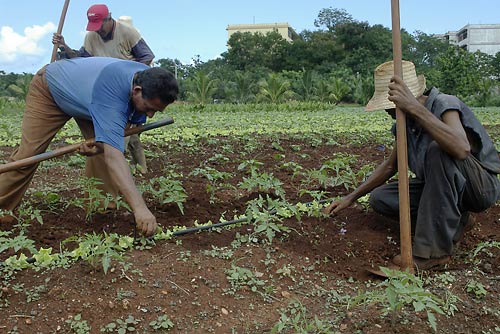
 
Farmers at the Organiponico de Alamar, a neighborhood agriculture project in downtown Havana, weed the beds. (Photo by John Morgan)

Since the early 1990s, an urban agriculture movement has swept through Cuba, putting this capital city of 2.2 million on a path toward sustainability.

A small group of Australians assisted in this grass-roots effort, coming to this Caribbean island nation in 1993 to teach permaculture, a system based on sustainable agriculture which uses far less energy.
This need to bring agriculture into the city began with the fall of the Soviet Union and the loss of more than 50 percent of Cuba's oil imports, much of its food and 85 percent of its trade economy.

Transportation halted, people went hungry and the average Cuban lost 30 pounds.

"In reality, when this all began, it was a necessity. People had to start cultivating vegetables wherever they could," a tour guide told a documentary crew filming in Cuba in 2004 to record how Cuba survived on far less oil than usual.

The crew included the staff of The Community Solution, a non-profit organization in Yellow Springs, Ohio which teaches about peak oil – the time when oil production world-wide will reach an all-time high and head into an irreversible decline. Some oil analysts believe this may happen within this decade, making Cuba a role model to follow.

"We wanted to see if we could capture what it is in the Cuban people and the Cuban culture that allowed them to go through this very difficult time," said Pat Murphy, The Community Solution's executive director. "Cuba has a lot to show the world in how to deal with energy adversity."

Scarce petroleum supplies have not only transformed Cuba's agriculture. The nation has also moved toward small-scale renewable energy and developed an energy-saving mass transit system, while maintaining its government-provided health care system whose preventive, locally-based approach to medicine conserves scarce resources.

The era in Cuba following the Soviet collapse is known to Cubans as the Special Period. Cuba lost 80 percent of its export market and its imports fell by 80 percent. The Gross Domestic Product dropped by more than one third.

"Try to image an airplane suddenly losing its engines. It was really a crash," Jorge Mario, a Cuban economist, told the documentary crew. A crash that put Cuba into a state of shock. There were frequent blackouts in its oil-fed electric power grid, up to 16 hours per day. The average daily caloric intake in Cuba dropped by a third.

According to a report on Cuba from Oxfam, an international development and relief agency, "In the cities, buses stopped running, generators stopped producing electricity, factories became silent as graveyards. Obtaining enough food for the day became the primary activity for many, if not most, Cubans."

In part due to the continuing US embargo, but also because of the loss of a foreign market, Cuba couldn't obtain enough imported food. Furthermore, without a substitute for fossil-fuel based large-scale farming, agricultural production dropped drastically.

So Cubans started to grow local organic produce out of necessity, developed bio-pesticides and bio-fertilizers as petrochemical substitutes, and incorporated more fruits and vegetables into their diets. Since they couldn't fuel their aging cars, they walked, biked, rode buses, and carpooled.
"There are infinite small solutions," said Roberto Sanchez from the Cuban-based Foundation for Nature and Humanity. "Crises or changes or problems can trigger many of these things which are basically adaptive. We are adapting."

A New Agricultural Revolution
Cubans are also replacing petroleum-fed machinery with oxen, and their urban agriculture reduces food transportation distances. Today an estimated 50 percent of Havana's vegetables come from inside the city, while in other Cuban towns and cities urban gardens produce from 80 percent to more than 100 percent of what they need.

In turning to gardening, individuals and neighborhood organizations took the initiative by identifying idle land in the city, cleaning it up, and planting.

 
Farmers pose with their produce at a farmers' market in downtown Havana. The Cuban government now allows these private markets, which provide year-round fresh local food to the community. (Photo by John Morgan)

When the Australian permaculturists came to Cuba they set up the first permaculture demonstration project with a $26,000 grant from the Cuban government.

Out of this grew the Foundation for Nature and Humanity's urban permaculture demonstration project and center in Havana. "With this demonstration, neighbors began to see the possibilities of what they can do on their rooftops and their patios," said Carmen López, director of the urban permaculture center, as she stood on the center's rooftop amongst grape vines, potted plants, and compost bins made from tires.

Since then the movement has been spreading rapidly across Havana's barrios. So far López' urban permaculture center has trained more than 400 people in the neighborhood in permaculture and distributes a monthly publication, "El Permacultor." "Not only has the community learned about permaculture," according to López, "we have also learned about the community, helping people wherever there is need."

One permaculture student, Nelson Aguila, an engineer-turned-farmer, raises food for the neighborhood on his integrated rooftop farm. On just a few hundred square feet he has rabbits and hens and many large pots of plants. Running free on the floor are gerbils, which eat the waste from the rabbits, and become an important protein source themselves. "Things are changing," Sanchez said. "It's a local economy. In other places people don't know their neighbors. They don't know their names. People don't say 'hello' to each other. Not here."

Since going from petrochemical intensive agricultural production to organic farming and gardening, Cuba now uses 21 times less pesticide than before the Special Period. They have accomplished this with their large-scale production of bio-pesticides and bio-fertilizers, exporting some of it to other Latin American countries.

Though the transition to organic production and animal traction was necessary, the Cubans are now seeing the advantages. "One of the good parts of the crisis was to go back to the oxen," said Miguel Coyula, a community development specialist, "Not only do they save fuel, they do not compact the soil the way the tractor does, and the legs of the oxen churn the earth."

"The Cuban agricultural, conventional, 'Green Revolution' system never was able to feed the people," Sanchez said. "It had high yields, but was oriented to plantation agriculture. We exported citrus, tobacco, sugar cane and we imported the basic things. So the system, even in the good times, never fulfilled people's basic needs."

Drawing on his permaculture knowledge, Sanchez said, "You have to follow the natural cycles, so you hire nature to work for you, not work against nature. To work against nature, you have to waste huge amounts of energy."

Energy Solutions
Because most of Cuba's electricity had been generated from imported oil, the shortages affected nearly everyone on the island. Scheduled rolling blackouts several days per week lasted for many years. Without refrigerators, food would spoil. Without electric fans, the heat was almost unbearable in a country that regularly has temperatures in the 80s and 90s.

The solutions to Cuba's energy problems were not easy. Without money, it couldn't invest in nuclear power and new conventional fossil fuel plants or even large-scale wind and solar energy systems. Instead, the country focused on reducing energy consumption and implementing small-scale renewable energy projects.

Ecosol Solar and Cuba Solar are two renewable energy organizations leading the way. They help develop markets for renewable energy, sell and install systems, perform research, publish newsletters, and do energy efficiency studies for large users.

Ecosol Solar has installed 1.2 megawatts of solar photovoltaic in both small household systems (200 watt capacity) and large systems (15-50 kilowatt capacity). In the United States 1.2 megawatts would provide electricity to about 1000 homes, but can supply power to significantly more houses in Cuba where appliances are few, conservation is the custom, and the homes are much smaller.

About 60 percent of Ecosol Solar's installations go to social programs to power homes, schools, medicals facilities, and community centers in rural Cuba. It recently installed solar photovoltaic panels to electrify 2,364 primary schools throughout rural Cuba where it was not cost effective to take the grid. In addition, it is developing compact model solar water heaters that can be assembled in the field, water pumps powered by PV panels, and solar dryers.

A visit to "Los Tumbos," a solar-powered community in the rural hills southwest of Havana demonstrates the positive impact that these strategies can have. Once without electricity, each household now has a small solar panel that powers a radio and a lamp. Larger systems provide electricity to the school, hospital, and community room, where residents gather to watch the evening news program called the "Round Table." Besides keeping the residents informed, the television room has the added benefit of bringing the community together.
"The sun was enough to maintain life on earth for millions of years," said Bruno Beres, a director of Cuba Solar. "Only when we [humans] arrived and changed the way we use energy was the sun not enough. So the problem is with our society, not with the world of energy."

Transportation - A System of Ride Sharing
Cubans also faced the problem of providing transportation on a reduced energy diet. Solutions came from ingenious Cubans, who often quote the phrase, "Necessity is the mother of invention." With little money or fuel, Cuba now moves masses of people during rush hour in Havana. In an inventive approach, virtually every form of vehicle, large and small, was used to build this mass transit system. Commuters ride in hand-made wheelbarrows, buses, other motorized transport and animal-powered vehicles.

One special Havana transit vehicle, nicknamed a "camel," is a very large metal semi-trailer, pulled by a standard semi-truck tractor, which holds 300 passengers. Bicycles and motorized two-passenger rickshaws are also prevalent in Havana, while horse drawn carts and large old panel trucks are used in the smaller towns.
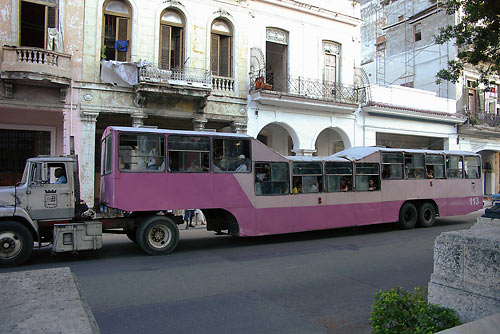
 
This unique Cuban transport vehicle, called a "camel", can carry 300 passengers. (Photo by John Morgan)

Government officials in yellow garb pull over nearly empty government vehicles and trucks on Havana's streets and fill them with people needing a ride. Chevys from the 1950s cruise along with four people in front and four more in back.

A donkey cart with a taxi license nailed to the frame also travels Cuba's streets. Many trucks were converted to passenger transport by welding steps to the back so riders could get on and off with ease.

Health Care and Education - National Priorities
Even though Cuba is a poor country, with a per capita Gross Domestic Product of only $3,000 per year (putting them in the bottom third of all nations), life expectancy is the same as in the U.S., and infant mortality is below that in the U.S. The literacy rate in Cuba is 97 percent, the same as in the U.S. Cuba's education system, as well as its medical system is free.

When Cubans suffered through their version of a peak oil crisis, they maintained their free medical system, one of the major factors that helped them to survive. Cubans repeatedly emphasize how proud they are of their system.

Before the Cuban Revolution in 1959, there was one doctor for every 2000 people. Now there is a doctor for every 167 people. Cuba also has an international medical school and trains doctors to work in other poor countries. Each year there are 20,000 Cuban doctors abroad doing this kind of work.
With meat scarce and fresh local vegetables in abundance since 1995, Cubans now eat a healthy, low-fat, nearly vegetarian, diet.

They also have a healthier outdoor lifestyle and walking and bicycling have become much more common. "Before, Cubans didn't eat that many vegetables. Rice and beans and pork meat was the basic diet," Sanchez from the Foundation for Nature and Humanity said. "At some point necessity taught them, and now they demand [vegetables]."

Doctors and nurses live in the community where they work and usually above the clinic itself. In remote rural areas, three-story buildings are constructed with the doctor's office on the bottom floor and two apartments on the second and third floors, one for the doctor and one for the nurse.
In the cities, the doctors and nurses always live in the neighborhoods they serve. They know the families of their patients and try to treat people in their homes. "Medicine is a vocation, not a job," exclaimed a Havana doctor, demonstrating the motivation for her work. In Cuba 60 percent of the doctors are women.

Education is considered the most important social activity in Cuba. Before the revolution, there was one teacher for every 3,000 people. Today the ratio is one for every 42 people, with a teacher-student ratio of 1 to 16. Cuba has a higher percentage of professionals than most developing countries, and with 2 percent of the population of Latin America, Cuba has 11 percent of all the scientists.

In an effort to halt migration from the countryside to the city during the Special Period, higher education was spread out into the provinces, expanding learning opportunities and strengthening rural communities. Before the Special Period there were only three institutions of higher learning in Cuba. Now there are 50 colleges and universities throughout the country, seven in Havana.

The Power of Community
Throughout its travels, the documentary crew saw and experienced the resourcefulness, determination, and optimism of the Cuban people, often hearing the phrase "Sí, se puede" or "Yes it can be done."

People spoke of the value of "resistir" or "resistance," showing their determination to overcome obstacles. And they have lived under a U.S. economic blockade since the early 1960s, viewed as the ultimate test of the Cuban ability to resist.

There is much to learn from Cuba's response to the loss of cheap and abundant oil. The staff of The Community Solution sees these lessons as especially important for people in developing countries, who make up 82 percent of the world's population and live more on life's edge. But developed countries are also vulnerable to shortages in energy. And with the coming onset of peak oil, all countries will have to adapt to the reality of a lower energy world.

With this new reality, the Cuban government changed its 30-year motto from "Socialism or Death" to "A Better World is Possible." Government officials allowed private entrepreneurial farmers and neighborhood organizations to use public land to grow and sell their produce. They pushed decision-making down to the grassroots level and encouraged initiatives in their neighborhoods. They created more provinces. They encouraged migration back to the farms and rural areas and reorganized their provinces to be in-line with agricultural needs.

From The Community Solution's viewpoint, Cuba did what it could to survive, despite its ideology of a centralized economy. In the face of peak oil and declining oil production, will America do what it takes to survive, in spite of its ideology of individualism and consumerism? Will Americans come together in community, as Cubans did, in the spirit of sacrifice and mutual support?

"There is climate change, the price of oil, the crisis of energy ." Beres from Cuba Solar said, listing off the challenges humanity faces. "What we must know is that the world is changing and we must change the way we see the world."  

The Power of Community: How Cuba Survived Peak Oil  
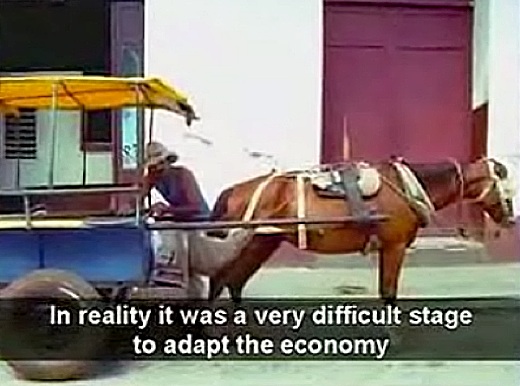
Image above: Still from film " The Power of Community: How Cuba Survived Peak Oil" The full film can also be seen at http://www.livevideo.com/video/mercofspeech/CD893609A0CB495D9A9CF04AC9E4AEFF/power-of-community-how-cuba-.aspx
 
Film Description
(length = 53mins) When the Soviet Union collapsed in 1990, Cuba's economy went into a tailspin. With imports of oil cut by more than half – and food by 80 percent – people were desperate. This film tells of the hardships and struggles as well as the community and creativity of the Cuban people during this difficult time. Cubans share how they transitioned from a highly mechanized, industrial agricultural system to one using organic methods of farming and local, urban gardens. It is an unusual look into the Cuban culture during this economic crisis, which they call "The Special Period."

The film opens with a short history of Peak Oil, a term for the time in our history when world oil production will reach its all-time peak and begin to decline forever. Cuba, the only country that has faced such a crisis – the massive reduction of fossil fuels – is an example of options and hope. "The Power of Community: How Cuba Survived Peak Oil" is a project of The Community Solution, a non-profit organization that designs and teaches low-energy solutions to the current unsustainable, fossil fuel based, industrialized, and centralized way of living. Visit www.communitysolution.org for more information.
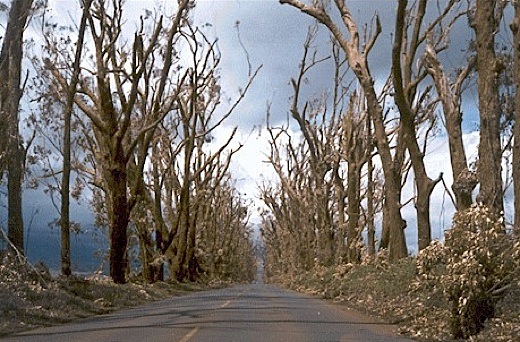
Iniki - Some Lessons Learned

SUBHEAD: The next hurricane will strike during the "The Long Emergency" and the responses may be much less rubust.  

By B. on 22 January 2009 in Survival Stories -
http://www.urbansurvivalstories.com/story.php?storyID=58

Originally published at SurvivalBlog.com

 
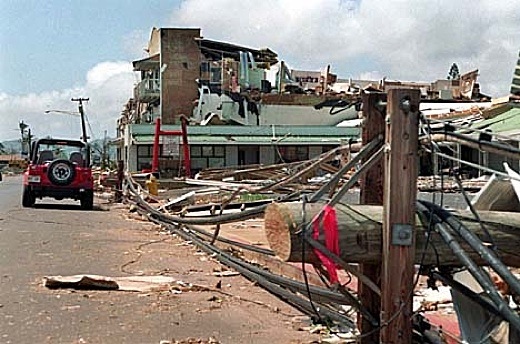
Image above: Kauai's famous Tree Tunnel leading to Poipu was devastated. From http://www.kiahuna418.com/iniki.html
 
Hurricane Iniki, which struck the island of Kauai on September 11, 1992, was the third-most damaging hurricane in U.S. history and provides some valuable insights into how people react when an entire self-contained community loses most of their creature comforts. By way of background, Kauai is the fourth largest island in the Hawaiian Archipelago. It, along with a small, privately-owned island off its western coast make up the County of Kauai.

The population in 1992 was about 50,000. On September 11, 1992, Hurricane Iniki made a direct hit on the island with winds upward of 150 miles per hour. Approximately 70 percent of the buildings on Kauai were destroyed or damaged. Telecommunications and electricity were lost and not entirely restored to all areas for six months. Due to early warning and good Civil Defense planning, there were only a handful of deaths attributed to the hurricane. The hurricane missed the rest of the state except for brushing the leeward coast of Oahu.

National Guard troops from other islands were on Kauai eight hours after the hurricane had passed. Within three days, there were approximately 1,000 National Guard personnel on the island. The command and control element reported directly to the mayor of Kauai County and to the Governor. These lessons learned are from the personal recollections of a member of the command and control element.

Most striking was the number of relief agencies that arrived on-island within a week to two weeks after the storm. At one point there were 5,000 relief workers representing 80 different governmental agencies and private organizations supporting a population of 50,000. The 1:10 ratio of relief workers to residents was one reason that there was almost no looting or lawlessness in the aftermath of the storm. This ratio of 1:10 would be difficult, if not impossible, to achieve in more densely populated areas or disasters that affect larger geographical regions (as we saw following Hurricane Katrina) . In New Orleans, the military response was initially focused on rescue or recovery and not on law enforcement.

 
Image above: The ravaged hotels along Poipu Beach after Iniki struck. From http://www.kiahuna418.com/iniki.html
 
Military planning is built around “operating systems” i.e. maneuver, communications, etc. To facilitate planning, the operating systems inherent in all civilian communities were identified, assessed and tracked to determine their current status to coordinate support and to help estimate how long before each system would be brought back on-line. These systems were:
Each of these operating systems presented unique challenges and insights as they relate to disaster planning.

Water
There are few private wells on the island. The County owns the water system, which consists of reservoirs in the mountains and some wells that service the drier parts of the island. The first priority for Civil Defense was to install generators at all pumping stations. In most areas water was back on-line within 3-to-4 days.

Food
MREs, supplied by the Federal government, were available within a few days after the storm. They became the main source of calories for most people. However, the novelty of eating MREs quickly wore off and distributing food became a high priority. Feeding stations serving a hot lunch were set up at various locations around the island using military cooks and idle chefs from the various resort hotels. However, headcounts changed daily and it was difficult to ensure that sufficient food was available at each location.

Communications and electricity - In 1992, there were few cellular phones. Nearly everyone relied on land lines for their telephone service. The hurricane downed perhaps a third of telephone/electrical poles on the island. Crews were flown in from as far away as the east coast and worked months to repair the damage. Replacement poles were obtained from the mainland and shipped to Kauai.

Reportedly, the base yards in several western states were emptied of poles to support the recovery operation for a community of 50,000. It should be noted that Hurricane Andrew had hit Florida three week before Iniki and the two areas were competing for some high priority items like telephone poles and the, much prized, blue plastic tarps used as temporary patches for leaking roofs. There were microwave relay sites on the island to transmit communications signals from Kauai to the other islands and, then, worldwide.

Some of these sites had only minor damage and were quickly repaired. Others were destroyed and replacement equipment was flown in from Oahu or the mainland. Within a week. telephone service was available to the public via mobile phone trailers that were set up around the island. However, telephone service to individual homes, like electricity, was delayed for up to six months as crews replaced downed poles.

Sewage and Waste
Kauai is a mix of public sewer systems and [private] septic systems. FEMA provided generator support to the Kauai County sewage treatment facilities and sewage never became a major health issue. Waste disposal was more challenging. The hurricane created a lot of destruction and debris. County sanitation workers had been furloughed to take care of their families. The County landfills were initially closed. People began to dump trash along side the roads. About three weeks after the storm over 1,500 active duty soldiers were brought to the island with their equipment and went door-to-door cleaning up yards and hauling away debris. A new landfill with an expected life of ten years that had been opened shortly before the storm was completely filled within a couple of months.

Traffic & Safety
It became apparent within the first few days that the Kauai Police Department was overwhelmed. A decision was made to free-up police officers whenever feasible to take care of their own families. Restoration of electricity to key intersection was given high priority so that traffic signals would be operational. Interestingly, there was little civilian traffic for the first week since few businesses were operating and most of the roads were blocked by downed poles. A military police unit was flown in to provide traffic control as needed.

However, as conditions improved, people adapted to driving without traffic lights and were generally courteous to other drivers when arriving simultaneously at intersections. Few accidents were reported. Looting was minimal due to the large presence of the military. The Honolulu SWAT deployed to Kauai and operated at night in high priority areas such as near jewelry stores, banks, etc. Two looters were arrested within the first week following the storm. In what amounted to lighting justice, they were charged, tried and convicted, and incarcerated within a week. The case was widely publicized and served as a great deterrent.

The fact that access to the island was tightly controlled for the first month also stopped any outsiders from taking advantage of the situation. The lesson learned is that highly visible military and police presence coupled with quick convictions served to keep criminal activity at a manageable level. However, the local police department, as we saw in the aftermath of Hurricane Katrina, is probably incapable of maintaining law and order.

Medical
All medical personal who live on Kauai were affected by the hurricane and, with the exception of emergency rooms, normal medical support ceased. State and County Civil Defense had air evacuated most expectant mothers and dialysis patients to Oahu a few hours before the hurricane struck. Interviews with doctors from the various relief organizations uncovered a pattern of medical emergencies. The first few days saw broken bones from falling off roofs, nail punctures and similar wounds. After about a week, diabetics and people on mood altering prescription drugs started to show up at the clinics looking for medication. These were followed by people who had ran out of medicine for chronic maladies like high blood pressure and epilepsy.

Drug addicts presented a special problem in that their regular supply was disrupted. No illegal drugs were getting on the island because the airfields and seaports were controlled by the military. Initially, addicts turned to known drug dealers and, if necessary, broke into the dealers’ homes looking for drugs. As a last resort, they started to appear at medical aid stations. Typically this occurred 7-10 days after the storm.

Medical challenges provide some of the most relevant lessons learned for people interested in preparing for a breakdown in local, regional or national government. As any infantryman will tell you, the welfare and location of the unit medic is always on your mind. If you don’t believe you have any skills to offer a group, you should develop your first aid and medical skills.

There will always be a need for a “doc” to take care of group members. Research and build your own medical kit. Talk to emergency room workers and find out how they triage incoming patients. Research and memorize the checklists that first responders use as they assess patient needs and prioritize casualties. Research the process doctors use to diagnose patient complaints and symptoms.

Medical equipment and a confident air could be your passport to safety.

One of the most prized items turned out to be generators. Without the immediate influx of generators from FEMA and the military, life of Kauai after the hurricane would have been much tougher. Generators pumped water, cleaned sewage, provided electricity to medical facilities, and refrigerated perishable food that had been barged and flown to the island. In many instances, relatives of Kauai resident living on the other islands or the mainland bought generators and have them shipped to the Kauai.

Military and civilian generators arriving at the port on Kauai were occasionally stolen by enterprising homeowners who simply backed their trucks up and drove off with a generator that had been off-loaded and staged for pickup by the legal owner. Apparently some local residents felt that it was worth the risk to provide refrigeration and lights to their families. The willingness to risk jail to obtain a generator can likely be traced to the desire to eat fresh food. MREs quickly lost their savor, especially for children.

Kauai residents would tell you that the most stressful time came immediately after the hurricane when all communication was lost and people were restricted to their immediate neighborhoods by the downed poles and trees. They simply did not know if they were going to get any help because they did not know whether the other islands had been hit by the storm. A communication plan that is well thought-out ahead of time would be a great psychological boost following a catastrophe. In addition to a good electronics, something as simple as a bulletin board that is updated every few hours would help the cohesiveness and bonding of the group.

Finally, I need to say something about the way people reacted and adjusted following the storm. In 1992, people in their 70s and 80s had lived through the Great Depression and World War II. They proved to be tougher than one would expect. They usually had a better attitude and often adapted better to living without television, electrical light and refrigeration than did many younger people.
Military people found the duty easier than most field training exercises. Military veterans had often endured tougher times and also quickly adapted. In general, the more outdoor oriented people were, the easier their transition and recovery. Some folks could not cope with the dramatic changes in their routine and committed suicide. Others left the island; never to return.

 
Image above: Ruins of Kojima Store in Kapaa after Iniki. From http://archives.starbulletin.com/2001/09/16/features/story2.html

By Anthony Sommer on 8 Spetember 2002 in Honolulu Star-Bulletin - http://archives.starbulletin.com/2002/09/08/news/story7.html

Despite surviving three hurricanes in the previous 35 years, Kauai was not ready for Iniki in 1992, the island's public safety officials admit today.

The destruction was so much greater than anything that had come before, there was no way to imagine what it would be like.

When (not if) the next hurricane comes, they say, the island will be much better prepared.

But they said the same thing before hurricanes Nina, Dot, Iwa and then Iniki. Kauai has had lots of experience with hurricanes:

• Hurricane Nina, on Dec. 1, 1957, only grazed the island. The eye passed 120 miles from Kauai, but 92 mph winds and 35-foot waves slammed into the east and south sides of the island. Damage was estimated at $100,000, and every boat in Poipu Harbor was sunk.

• Hurricane Dot hit Kauai on Aug. 6, 1959, demolishing homes, collapsing businesses and causing $6 million in damage as the eye of the hurricane passed directly over the island.

• Hurricane Iwa only brushed the island in 1982, but it brushed the island hard. The eye passed 30 miles northwest of Kauai. Thirty-foot waves demolished resorts in Poipu, and 44 of 45 boats moored at Port Allen were sunk. Damage statewide was estimated at $234 million, about one-third of it on Kauai.

The decade between Hurricane Iwa and Hurricane Iniki was the period of the greatest prosperity and development in Kauai's history. Huge new hotels were built. Housing boomed as people flocked to Kauai to work in the growing tourism industry.

By the early 1990s there was a lot more for a storm to destroy.

When Iniki hit on Sept. 11, 1992, the cost to repair the damage was $3 billion. In monetary terms, Iniki was ranked the third most destructive storm in U.S. history.

"When Iniki hit, the county was ill prepared," says Kauai Fire Chief David Sproat, who was a captain at the Hanalei Fire Station in 1992.

"Today everything has been enhanced. Our equipment is better. The structures have been hardened."
Firefighters learned their stations were the first place people would come for help. Similarly, police patrols became mobile emergency centers.

"We try to stock those cars so they can survive for the first 24 hours without coming to the police station if they need to," said Police Chief George Freitas.

Both police and firefighters learned during Iniki that the No. 1 need of emergency vehicles is a huge supply of spare tires.

So many nails had been scattered on the roads from destroyed buildings that county motor pools could not plug flat tires quickly enough.

On a more human level, they also learned that both police officers and firefighters need time to take care of their homes and families. The Kauai Police Department's disaster plan now calls for 12-hour shifts changing at noon and midnight.

"The idea is to give the officers a break that includes both day and night periods," Freitas said. "During Iniki it was common for officers who were given a break completely during daylight hours to come back to work without having had any sleep. They spent their time off working on their homes or their neighbors' houses."

The biggest boost came from police and fire departments on the other islands. Officers and firefighters from all over Hawaii showed up on Kauai to relieve their counterparts at just about the time many were reaching the point of exhaustion.

Kauai Civil Defense Director Mark Marshall notes there still are not enough shelter spaces to hold all the people on Kauai.

"We have 19,300 shelter spaces for a population of 58,000 and 20,000 tourists," he said. Since Iniki the hotels have been rebuilt to withstand high winds and are set back further from the shoreline. Marshall said they are better prepared to take care of their guests.

One of the ironies of Iniki is that one of the worst problems created by Iwa in 1982 -- downed trees and power poles blocking the roads for a long period of time -- was quickly handled by civilians rather than emergency personnel in 1992.

"Almost every guy who had been through Iwa took the same thing with him to the shelters during Iniki: a chain saw. They knew that after the storm they would have to cut their way back to their houses," recalled former Mayor JoAnn Yukimura.

And they did. Every major road on Kauai was open by September 12th.

A Breakthrough Moment

SUBHEAD: Bill McKibben on Why 350 is the World's Most Important Number?

By Bill McKibben on 26 August 2009 in The Post Carbon Institute -
http://postcarbon.org/commentary/350_breakthrough


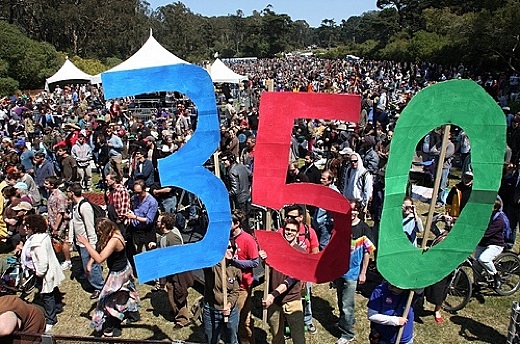
Image above: Demonstrating for www.350.org

Dear friends,

For once, this email isn't asking you to do anything at all. It's merely sharing the news--the amazing news--that arrived about 45 minutes ago at 350 headquarters.

Rajendra Pachauri is the U.N.'s top climate scientist. He leads the Intergovernmental Panel on Climate Change (IPCC), which every five years produces the authoritative assessment of climate science.

Their last report, in 2007, helped set the target of 450 ppm (parts per million of CO2) that many environmental groups and national governments have adopted as their goal for Copenhagen.
As you all know, that number is out of date.

When Jim Hansen and other scientists looked at phenomenon like the Arctic ice melt of the last two summers, they produced new data demonstrating that 350 ppm is the bottom line for the planet.

But it's been hard to get that news out to the powers that be.

So today it comes as enormous and welcome news that Dr. Pachauri, from his New Delhi office, said that 350 was the number.
"As chairman of the Intergovernmental Panel on Climate Change (IPCC) I cannot take a position because we do not make recommendations," said Rajendra Pachauri when asked if he supported calls to keep atmospheric carbon dioxide concentrations below 350 parts per million (ppm).
"But as a human being I am fully supportive of that goal. What is happening, and what is likely to happen, convinces me that the world must be really ambitious and very determined at moving toward a 350 target," he told Agence France Presse in an interview."
It's your work that has made this breakthrough possible. In fact, Pachauri specifically cited the last big piece of news for 350: the decision of 80+ small island nations and less developed countries to endorse the 350 target.
"I think this is a good development," said Pachauri. "Now people -- including some scientists -- see the seriousness of the impacts of climate change, and the fact that things are going to get substantially worse than what we had anticipated."
This news makes it much easier for all of us to push hard leading up to the International Day of Climate Action on the 24th of October (signup to start or attend an event at www.350.org), and the UN Climate Conference in Copenhagen this December.

It's clear now that science is powerfully on the side of the 350 target. Now we need the political world to follow suit. You will make that happen in the next two months. Oct. 24 is officially 60 days away, and we're building just the momentum we need to make it count.

Thanks for all you do,

 
Image above: Demonstrating for www.350.org

By Bill McKibben on 09 September 2009 in Tree Hugger
http://feeds.feedburner.com/TreehuggerRadio

Bill McKibben (author of Deep Economy and The End of Nature) is the man behind 350.org, the campaign to convince the world that we aren't safe until global carbon dioxide levels are down to 350 parts per million.

In the run-up to major climate talks in Copenhagen, the author-turned-organizer has orchestrated what he hopes will be the largest day of climate action in history, complete with scuba divers in the Maldives and monks in Tibet.

 McKibben talks with TreeHugger about the recent good news from the head of the Intergovernmental Panel on Climate Change, and about one of his greatest challenges to date: being a guest on The Colbert Report.

Listen to the podcast of this interview via iTunes, or just click here to listen, right-click to download.
Music credit: Dengue Fever

Taking Waikiki & Then there were none

SUBHEAD: Free showings of two documentaries Sunday Sept 20 at Kapaa Neighborhood Center Submitted by Ray Catania (may11nineteen71@gmail.com) on 8 September 2009 - Image above: Kapiolani Park wetlands before it was paved over. From 1920-1940 postacard http://www.downwindproductions.com/kapiolani_park_wetlands.html
Free showing of two documentaries, with presentation by Kanaka Maoli activist Jimbo Alalem. Movies and presentation will be followed by a question and answer session. Light pupus will be served.
"Taking Waikiki" was produced by Kauai residents Ed Coll and Carol Bain. It's about how a sustainable agriculture/aquacultural community was completely destroyed by the building up of the resort area of Waikiki.
"Then there were none" was produced by Dr. Elizabeth Kapu'uwailani Lindsey, the great-granddaughter of Hawaiian high chiefs and English seafarers. This film details the decline of the Native Hawaiian population because of western colonialism. WHAT:
Two documentary films about Hawaiian agriculture and the Hawaiian people.
WHEN:
Sunday, September 20th, 12:00pm to 3:00 pm
WHERE:
Kapaa Neighborhood Center
SPONSOR:
Mana Oha. The purpose of Mana Oha is to awaken all to the reality of Hawaiian Sovereignty through education and sharing the truth. For more info call Ben Nihi at 634-0469 or contact ben@manaoha.org.

A Terrible Ambivalence

SUBHEAD: Debating the collapse of our civilization or John Michael Greer's ambivalent acceptance.

By John Michael Greer on 9 September 2009 in The Archdruid Report
(http://thearchdruidreport.blogspot.com/2009/09/terrible-ambivalence.html


Image above: Paper mache scupture of Ambivalence by Stephen Hansen. From http://www.zenithgallery.com/shows/2003/hansen/hansen_1.htm
 
I’d meant to spend this week’s report talking about scarcity industrialism, the kind of economy that will be defined for us in the near future by the conjunction of resource scarcity with the immense mass of embodied energy we call an industrial civilization.

There’s a great deal to be said about the forms such an economy will likely take, and the harsh challenges and unexpected opportunities that it will bring to a world still far too used to getting as much energy as it wants whenever it happens to want it.

 Still, that necessary theme will have to wait a week or two. Last month the online edition of The Guardian, one of the leading (or at least surviving) British newspapers, featured a debate about the future of industrial society between journalist, poet and cofounder of The Dark Mountain Project Paul Kingsnorth, and the sturdy radical George Monbiot, who's most recently made a name for himself as a tireless advocate for drastic measures to counter global warming.

 It was refreshing to see the possibility of the collapse of our civilization debated on so public a forum, and of course it didn't hurt my feelings any to be cited as an authority of sorts by one of the participants.

Still, the debate left me with a deep sense of disquiet, which has only become stronger. in the days that followed and finally made this point unavoidable. At some risk of oversimplification, the argument between Monbiot and Kingsnorth may be summed up more or less as follows. Both agree that industrial civilization faces imminent collapse.

Monbiot argues that collapse might still be prevented if we all pull together, that the only alternative is letting total collapse happen, and that this is unthinkable because billions of people will die horribly.

He argues that the only alternative to preserving modern society in some improved form is a cataclysmic process of mass dieoff ending in a new dark age ruled by petty warlords, with some new earth-ravaging society likely to rise on the ruins of the old unless his preferred political solution gets put in place to control our species' ecocidal tendencies. Kingsnorth rejects all this.

He insists that collapse can't be prevented, and in any case should be allowed to happen, because industrial civilization is a "planetary weapon of mass destruction" and Descent to argue that the end of industrial civilization could be a lot less traumatic than Monbiot thinks it must be, insists that ecocide is inherent in our present society rather than in humanity as a whole, and suggests that whatever replaces our society is bound to be less dreadful than what we have now.

Anyone who has listened to debates about the future of industrial society at any point in the last fifty years or so will surely find both these arguments familiar.

Since the limits to growth first became visible on the horizon of our civilization's future, the great majority of those who took the time to notice them either insisted that humanity can and must do something about them, and offered some plan for reaching a better future, or insisted that nothing at all could be done about them, and claimed that the arrival of those limits would bring a better future.

 To be fair to Monbiot and Kingsnorth, their stances in the debate expressed moderate and nuanced versions of these common tropes. It wouldn't be hard at all to find examples much further out in either direction – out well past Monbiot, say, one of the current technofantasists or political zealots who believe that a world teetering on the edge of doom can be transformed into Utopia if only their pet project were to be adopted by all; out well past Kingsnorth, perhaps, one of the neoprimitivists who daydream about the carefree life in the bountiful lap of nature that would surely arrive if only six billion inconvenient people would hurry up and die.

The arguments in the Guardian debate are far less extreme, and far more reasonable, than these.

So why do they leave me shaking my head, convinced that neither one has grasped what's most essential about the predicament before us?

The places where Monbiot misses the turning, as I see it, stand out clearly, and longtime readers of this blog will likely have no difficulty at all anticipating my disagreements with his views. To begin with, his call to arms is an epic case of locking the barn door when the horse has not only left but mailed back a forwarding address from another state.

The end of industrial civilization would almost certainly have been forestalled if sensible policies had been put in place in the 1950s; there was arguably still some hope of success if all-out efforts had been launched in the 1970s; at this point, with Hubbert's peak already past, CO2 piling up in the atmosphere and the world's human population approaching seven billion, the chances of preventing collapse compare unfavorably with those of a snowball in Beelzebub's back yard.

 Now it could be argued that any possibility is worth pursuing if the alternative is dire enough, and this is basically the argument Monbiot makes.

Unfortunately his plan of action is simply to dust off the same toolkit of protest methods that activists have been using with diminishing returns, and governments have been brushing aside with increasing success, since the dawn of the twentieth century.

The handful of successes achieved by those methods many decades ago have imposed a bizarre astigmatism of the imagination on the left; the stereotyped methods of protest have become so sacrosanct, or so automatic, that the mere fact that they have failed consistently for years never quite seems to register.

All this invites comparison with Don Quixote, even if Monbiot is fighting for windmills rather than against them. Woeful countenances aside, though, insisting on the pursuit of an unreachable goal through ineffective methods is not normally a productive way to prepare for a difficult future.

There's nothing in Monbiot's proposal that hasn't been tried repeatedly since the 1950s without having the least impact on the trajectory of industrial society, and as the saying has it, if you always do what you've always done, you'll always get what you've always gotten.

All this may seem like support for Paul Kingsnorth's side of the argument, and of course it parallels a number of the points he makes in the debate and elsewhere in his writings. It seems fair to say that my views are much more in sympathy with his than with Monbiot's, and I suspect that Kingsnorth would agree with that assessment, as he's the one who cited me to support one of his arguments.

Yet there's a sour note running through his contributions to the debate, and it comes out forcefully every time he finesses the human cost of the transformation ahead of us. Monbiot, to give him his due, calls him on this repeatedly.

A deindustrial world, as Monbiot correctly points out, will be able to support maybe two billion people at most – my working guess, for what it's worth, is that this is too optimistic by a factor of four – and this means that in any future that doesn't include the survival of the industrial system, a lot of people are going to die.

Now of course he goes from there to imply, more or less, that yet another round of protest marches is the only way to keep five billion human corpses from hitting the ground in a single planetwide thud, and this doesn't exactly follow. Still, the basic point is valid, and Kingsnorth's efforts to evade it are troubling.

Yet that evasion is inseparable from a central theme of Kingsnorth's argument, which is that a better world can be expected to rise out of the wreckage of the present. That Monbiot's argument also hinges on his hopes for a bright new tomorrow adds a rich irony to the debate. Both men are proclaiming the gospel of a better future; their disagreements are simply about what form that future will take and how we will get there.

Both assume that we can have, and ought to have, a future that's even shinier than the present. It's a very common assumption, so common that many of those who are reading these words may share it, but it's also the place where the worm gets in and rots the apple to the core.

We are not going to have a future better than the present: not in our lifetimes, and not in those of our grandchildren's grandchildren. We collectively closed the door on that possibility decades ago, and none of the rapidly narrowing range of choices still open to us now offers any way of changing that.

If this sounds like fatalism, it may be worth remembering that once a car goes skidding off a mountain road into empty air, it requires neither a crystal ball nor a faith in predestination to recognize that nothing anybody can do is going to prevent a terrific crash. It's nonsense to claim, as some inevitably do, that this realization makes taking action pointless.

Our efforts, given hard work, wisdom, and a substantial dollop of luck, may well succeed in making the future less difficult than it will otherwise be. It may be possible for us to save a few things worth saving that would otherwise be lost, to stem some little of what will be an immense tide of human suffering, to do what we can to help stabilize a damaged biosphere so Nature doesn't have to rebuild it entirely from scratch.

All of these things are profoundly worth doing. None of them will change the fact that the future ahead of us will be a profoundly difficult time in which many of the things that are most meaningful to each of us will inevitably be lost. We do no one a favor, least of all ourselves, by trying to sugarcoat that very unpalatable reality.

Nor do we gain anything by playing the fox to industrial civilization's grapes, and insisting that the extraordinary gifts the recent past has given us are sour because they are about to pass out of our reach.

During the age that is coming to an end, the billion or so of us who have lived in the industrial world have enjoyed comforts and opportunities that our species had never known before and almost certainly will never know again. Those could never have been anything but temporary, they were distributed no more fairly than anything else passed around by human hands, and a wiser species would likely have had more common sense than to launch itself on the trajectory we followed, but it's as distorting to dismiss the extraordinary achievements of our age as it would be to ignore the terrible cost for those achievements that will be paid by us and our descendants.

So many of us want things all one way or the other, all good or all evil, without the terrible ambivalence that pulses through all things human as inescapably as blood.

So many of us want to see today's civilization as humanity's only hope or as ecocide incarnate, and long for a future that will be either the apotheosis or the final refutation of the present. It's far less popular, and arguably far more difficult, to embrace that ambivalence and accept both the wonder and the immense tragedy of our time. Still, it seems to me that if we are to face up to the challenges of the future that's bearing down on us, that difficult realization is an essential starting point.

 See also:
Ea O Ka Aina: Monbiot vs Kinsgnorth 8/17/09

Five Years Ago We Knew

SUBHEAD: It has been clear for some time where we are going... even looking in the rear view mirror. [Editor's Note: Even before reading Kunstler's "The Long Emergency" in 2005 people realized the plight we were in and where it would lead. Five years later we continue to try and find our way forward.]

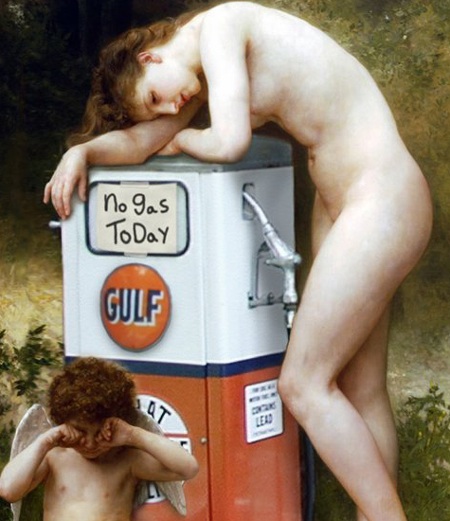
Good to the last drop? by Juan Wilson 26 August 2004 in Island Breath http://www.islandbreath.org/2004Year/09-science/science11endofoil.html A crisis is coming for much of the world: It is the end to the world oil economy as we know it. Much of the world's older oil sources are past their peak production and newer sources are not making up for increases in consumption. This increasing depletion in production capability appears to be inevitably leading us to the end of an economic order that dominates the world. image above: Satirical image based on style similar too French 19th painting. From http://massgastax.com

We have known since the 1970's that the end of oil was coming. It was bad news and we didn't want to hear it. To blot out the ugly noises made by environmentalists and planners during the Carter years we simply tuned them out by electing Ronald Reagan: "It's morning in America".

Well the problem is back "big time". The rosy estimates that oil production would peak in another 10 to 40 years is out the window. Experts like T. Boone Pickens believe in the Peak Theory of oil production. He and others are now saying the the approximately 80 million barrels a day being currently pumped is as much oil as we'll ever see again. In today's dollars the 1979 Iranian hostage crisis drove oil to $80 dollars a barrel. A permanent shortage of oil could drive prices over $200 a barrel in the blink of an eye. If you could find gasoline, it would cost $8 a gallon.

The American Oil Age began in about 1900 with the discovery of oil in Pennsylvania. We are now at the top of the bell-curve in world use of fossil fuels. The Peak Theory estimates and that the hydro-carbon era will glide to an end about 100 years from today.

The question is: How rough will the transition be? What will change? Who will suffer? The growth in consumption of oil in places like China will accelerate the curve down in available oil in unpredictable ways. The struggle for oil resources between competing nations may have irrational and chaotic consequences to the stability of economic systems long before the oil runs out. In economics loss of faith in the future frequently is all that is necessary to crash what is seemingly a robust market (remember the Internet Bubble Burst in 2000?).

The smoothness of the transition away from oil will have a large effect on the quality of life for everyone concerned. Lifestyles will change. Places like the North East United States, where suburban sprawl and harsh winters are a factor, may be the earliest and most negatively affected. But that does not leave us here in Hawaii in the clear.

The airline dependent vacation industry in Hawaii will quickly wither and die in the grip of a permanent worldwide oil shortage. Tourism as we know it will not exist. That will have a catastrophic effect on Hawaii. We will have to re-invent ourselves. Many without a strong connection to that land and people here may choose to leave, if they can.

With 900,000 people the island of Oahu has 75% of the population of the state of Hawaii. Oahu's economy will be unsustainable if oil prices quadruple or gasoline supplies become unreliable. It is possible that as many as 75% of Oahu's population would have to be distributed to the other islands if the Hawaiian islands need to become self-sufficient. With an over-all population of 1,2000,000 that will be difficult but not impossible.The Big Island would likely take have to absorb as many as 500,000 people: Maui County 70,000, Kauai 40,000.

How will impending change away from an oil economy change life on Kauai? Well, as mentioned above, we have have an increase in population (to about 100,000) due to redistribution of people state-wide. That increase will partially off-set with the lack of tourists. It is likely that all existing agricultural land will be needed for food and energy production. Forget about ethanol. That is a temporary and false economic ploy that will have virtually no impact on energy self-sufficiency. The growth of bio-diesel crops will be the rational choice if there is to be any hydro-carbon energy on Kauai.

Now is the time for the KIUC to pay the people of Kauai to produce energy. We will need every watt of wind and solar energy we can find once the fuel barges no longer make stops in Nawiliwili Harbor and Port Allen. All electricity fuel on this island will have to be produced locally within ten years or we won't have an economy.

We need the people to understand the coming crisis. We need planners. We need solutions. There is little time. If you have doubts read on.

see also:

Over a Million Barrels a Day Lost to Depletion http://www.fromthewilderness.com/free/ww3/082304_million_depletion.shtml

by Jim Meyer odac@btconnect.com 24 August 2004


The End of Oil: Interview with Paul Roberts http://www.motherjones.com/news/qa/2004/05/paul_rob_qa.html

by Nonna Gorilovskaya backtalk@motherjones.com 8 June 2004


Will The End of Oil Mean The End of America? http://www.commondreams.org/views04/0301-12.htm by Robert Freeman robertfreeman10@yahoo.com 1 March 2004


Life After the Oil Crash http://www.lifeaftertheoilcrash.net/Introduction.html

by Matt Savinar matt@lifeaftertheoilcrash.net 8 January 2004


Good to the Last Drop (original posting) http://www.islandbreath.org/2004Year/09-science/science11endofoil.html by Juan Wilson juanwilson@mac.com 26 August 2004

Driving Through America

SUBHEAD: A road trip look into the USA. In the near future, we'll return to a durable set of living arrangements. Scale By Guy R McPherson on 9 September 2009 in Nature Bats Last - http://blog.ltc.arizona.edu/naturebatslast/2009/09/scale.html

I'm driving from Tucson to the mud hut, taking a circuitous route that currently finds me staying in my wife's childhood home in western Nebraska. Along with my spouse and dog, I'm covering 4,300 miles while crisscrossing 11 states and all 4 time zones in the continental U.S. We'll circumambulate Kansas, and at one point we drove close enough to spit on the state. But it didn't seem worth the time or the saliva.

image above: Frame from Air Zoo slideshow presentation at http://www.airzoo.org

We're driving slowly and stopping often, primarily because the Obama administration's Keynesian approach to saving the industrial economy necessitates throwing money at the highway departments of every state in the country. The attendant "shovel-ready projects" are clear examples of the lengths to which industrial humans will go to sustain the unsustainable, maintain the immaterial, and generally restore the irredeemable for a few more months.

The many miles and frequent pauses reveal to any sentient animal the sheer lunacy of the living arrangements we've built for ourselves. Within the span of a couple generations, we abandoned a durable, finely textured, life-affirming set of living arrangements characterized by self-sufficient family farms intermixed with small towns that provided commerce, services, and culture.

Worse yet, we traded that model for a coarse-scaled arrangement wholly dependent on ready access to cheap fossil fuels. Then we ratcheted up the madness to rely on businesses that use, almost exclusively, a warehouse-on-wheels approach to just-in-time delivery of unnecessary devices designed for rapid obsolescence and disposal.

Simply ingenious, wouldn't you say?

The entire region, formerly abundant with a multitude of edible crops, currently is brimming with a single commodity: #2 corn. It's Roundup-ready, at that, just to throw a bucket of insulting acid into the face of reason. Roundup-resistant weeds are popping up throughout the region as we bring Farmageddon to the heartland and eventually to the world.

Most of the corn, which is essentially inedible until it is processed (i.e., pummeled with inordinate quantities of fossil fuels), is watered with the last remaining drops of the Ogallala aquifer, brought to the surface with the same finite fluid used to power our trucks and cars. Verdant fields of ethanol dreams are interrupted occasionally by a field of soybeans; without rotations of legumes, the soil would be so depleted of nitrogen by king corn, it wouldn't support even the great corn desert.

The corn fills our bellies with death-inducing faux sugar. But we willingly trade some of that "food" for fuel because the associated dependence on automobiles allows us to burn off the final inches of life-giving topsoil to promote our culture of death in rapid-transit, individualized death-traps. Who could pass up a deal like that?

Obnoxiously ubiquitous cell-phone towers line the edges of the cornfields adjacent to the Eisenhower Interstate Highway System ("Celebrating 50 Years, 1956-2006"). Each of these completely unnecessary towers of mortality -- which serve only to duplicate extant infrastructure -- kills 5,000 to 15,000 birds each year. Yet every imperialist has a cell phone, regardless of the death to songbirds. Don't even get me started on the col-tan in the cell-phone batteries mined from the Congo, because I'd rather not think about the brutal lives and tortuous deaths of the Congolese women and children we treat as collateral damage along our imperial path.

Seemingly every tenth cell phone marks a casino, yet another ubiquitous structure we'd be far better off without. These businesses extract money from the poor as they pursue the something-for-nothing goal upon which our culture has become based during the last few decades.

If it's not a casino, it's a distribution center for this country's rapidly waning commercial sector. We no longer make much of anything in this country, but we move around ton after ton of cheap plastic crap to the Targets and Wal-Marts that have displaced family owned businesses in every town and city in the country while exporting disaster capitalism throughout the world.

Finally, then, we come to the most ludicrous part of the entire endeavor: suburbia, filled with McMansions. This not-quite-country, not-quite-city living arrangement requires people to buy one of everything for every house -- except cars, of which we need at least two -- to live far from work, far from play, and far from the things we "need" to buy. Hundreds of acres of shoddily constructed, castle-like symbols of self-indulgence are separated from equally coarse-scaled places we use to grow "food," conduct "commerce" in our "service" economy, and otherwise live civilized lives. As has often been the case, today's symbols of gluttony are tomorrow's death traps.

As usual, I'm quick to point out the silver lining in this otherwise disastrous narrative: Better days lie ahead. How could they not?

In the near future, we'll return to a durable set of living arrangements. Since we need about 50 million additional gardeners to support the 300 million people in this nation, and because nearly everybody in the industrialized world would rather push electrons in a cube farm than push a shovel in a garden, I don't foresee us voluntarily returning to the agrarian age.

Not only are a majority of people unaware of the predicament we face -- thanks to the media, every level of government, and our own self-absorbed preference for the bliss of ignorance -- but there's simply no leadership in the industrialized world as we face an inevitable but unprecedented economic contraction.

As a result, I suspect we'll bypass agricultural pursuits and plunge right back to the post-industrial stone age. Once again, daily life will be characterized by a finely textured, life-affirming, durable set of arrangements characterized by respect for each other and reverence for the land, and accompanied by a solid dose of self-sufficiency.

The point of my circuitous route to the mud hut: a wedding on the in-law side of the family. The newlyweds are twenty-something Army officers, and the event fittingly provided the perfect example of the malevolence needed to maintain civilization.

Held in (the Air Zoo, Portage, Missouri) a venue designed and constructed to celebrate American military prowess, the reception allowed the guests to enjoy flight simulators between bouts of gorging on meat, fat, sugar, and alcohol. Each of us was allowed to "fly" a fighter jet and blast the enemy. I was a tad disappointed, though: I didn't get to bomb a children's hospital in the name of bringing democracy to a poverty-stricken, oil-rich country.

For those readers who would like to impress upon me that I'm an imperialist, too, or that "freedom isn't free," don't bother. In a heartbeat, I'd give up every aspect of the industrial economy, even if it cost me my life, to know western civilization was dead and gone.

And for those who believe we're really free, take a look around. See the security cameras. Notice the listening devices. Pay attention to the monitoring devices that record and report every transaction you complete. These tyrannies are among the thousands of minor costs we pay for "freedom" from terrorists. The larger costs are borne by non-human species and people in non-industrial cultures every minute of every day.

I took a break from the festivities to spend a little time outdoors as darkness was falling. In a few minutes, I was able to observe far more beauty than marked the cultural ceremony or the route along the way (so far): the cry of a red-tailed hawk drew my eye to two hawks flying low over the treetops. Shortly afterward, a brilliant harvest moon scaled the eastern horizon.

Hope springs eternal in, and from, the natural world: There's still something worth saving from the ravages of civilization. But is there world enough, and time? And, despite mounting evidence to the contrary, are there enough of us who actually care about saving the living planet?

Pre-Peak Oil Trimaran

SUBHEAD: Austal's new trimaran a monument to profligate habits of a Pre-Peak Oil world.  

By Brad Parsons on 9 September 2009 in HI Superferry Blogspot - http://hisuperferry.blogspot.com/2009/09/bragging-about-102ms-fuel-efficiency.html

ENGINES INSTALLED
Image above: September 8, 2009 engines are installed in next-generation Austal trimaran. From
(http://www.marinelog.com/DOCS/NEWSMMIX/2009sep00080.html)
Austal brags about the 102 meter long trimaran's "fuel efficiency".

Fuel efficiency is all relative. This vessels would be truly fuel efficient if it was powered by 1 of these engines rather than 3. The comparison that Austal is making is that 3 is more fuel efficient than 4 engines, but 2 is too many. Just one of these engines burns about 1000 gallons of MDO per hour. Their standard propulsion on most of their HSV's is 2 of these engines for about 2000 gallons of MDO burned per hour. The 102M would burn about 3000 gallons of MDO per hour.

That's a little more than $9000 per hour at current MDO prices. The routes that these ships take around the world are usually more than an hour. They gotta have steady business to make it work. Even in Japan last year, a company didn't have enough business to justify it with just 2 of these comparable engines. The most telling part of this story that I noticed was that they are building this vessel without a known buyer? Is that true? This vessel is a monument to the profligate habits of a pre-peak oil world.

Austal's next-generation 102 m next generation high speed trimaran is moving steadily towards its February 2010 completion at the company's Western Australian shipyard.
It is currently available for purchase.

See also: "Engines installed on Austal's next generation trimaran"


'The unique three-engine layout of Austal’s next generation trimaran'.
Austal’s next generation 102-metre high speed trimaran has had its unique three-engine layout successfully installed... A monument to the profligate habits of a pre-peak oil world.


Ghost Slave's Carrying Capacity

SUBHEAD: Consideration of the present system of exploitation, destruction of the natural world, and indeed, self-destruction. Image above: Scene from stage play of Chitty Chitty Bang Bang. Magical thinking about automobiles from 007 author Ian Flemming. From http://dljh1964.wordpress.com/2009/01/25/it-was-uncategorical-a-stage-burning-oracle By Derrick Jensen on date unknown in Endgame http://www.endgamethebook.org/Excerpts/13-Carrying-Capacity.htm

It is axiomatic that we are in no way protected from the consequences of our actions by remaining confused about the ecological meaning of our humanness, ignorant of ecological processes, and unmindful of the ecological aspects of history.

- William R. Catton, Jr.

I’ve been thinking a lot lately about carrying capacity, and what that will mean for life through the crash. The best book I’ve read about carrying capacity—what it is and what it means—is Overshoot: The Ecological Basis of Revolutionary Change, by William R. Catton Jr.

Any environment’s carrying capacity, he states, is the number of creatures living a certain way who can be supported permanently on a certain piece of land, for example how many deer could live on a certain island without overgrazing and damaging the capacity of that island to grow food for them.

Permanently is the key word here, because it’s possible to overshoot carrying capacity—to temporarily have more creatures than the land can support—but doing so damages the land, and permanently lowers future carrying capacity. This is true when we talk about nonhumans, and it’s just as true when we talk about humans.

Consider the land where you live. How many people could it have permanently supported before the arrival of our extractive culture? How many people did it support? What did these people eat? What materials did those who came before use to make their homes?

And now? What will those who come after eat? If you were to rely only on local foods harvested sustainably—by which I mean entirely without the assistance of civilization or its technologies (e.g., no fossil fuels or mining)—what would you eat? Do the plants and animals eaten there before still call this their home? How many people could live in your place forever? How many people will live there after the crash?

There are a few ways one can temporarily exceed a place’s carrying capacity.

One is by degrading the landscape; for example, eating all of the local fish this year instead of eating few enough that the fish remain fecund as always.

Another example would be killing off species you don’t eat—salamanders, owls, bees, grasshoppers, and others—and in doing so almost undoubtedly impeding the eventual viability of your food sources.

Once you’ve undercut the carrying capacity where you live, you can continue to exceed your carrying capacity by degrading someplace else, for example, by eating all of that place’s fish.

This is just another way of saying that cities must import resources, a process also known as conquest, colonialism, and these days, the global economy. As we’ve seen, when the resources of that other place get depleted—when its carrying capacity has more or less been permanently reduced—those who are importing resources will attempt to find another place to exploit.

Because the power of those at the center of empires always depends on this importation/exploitation, the powerful have become quite adept at it. It is, at this point, nearly ubiquitous. As long ago as 1965, more than half of Great Britain’s foods were coming from what Catton and others call “ghost acreage,” that is, from sources invisible to those at the center.

Catton writes, “If food could not be obtained from the sea (6.5%) or from other nations (48%), more than half of Britain would have faced starvation, or all British people would have been less than half nourished. Likewise, if Japan could not have drawn upon fisheries all around the globe and upon trade with other nations, two-thirds of her people would have been starving, or every Japanese citizen would have been two-thirds undernourished.” This importation not only makes the lifestyles (and lives) of those who import dependent on the military and economic violence I’ve been talking about so far in this book, but also makes them strangely dependent on those from whom they steal.

The United States economy is dependent on oil from the Middle East, South America, and around the world. American lives are dependent on it: the agricultural infrastructure—from gasoline to pesticides—rests on the foundation of oil and natural gas.

It’s not too much to say that we eat refined and transformed oil. It’s like Catton wrote, “Everything human beings do requires energy. At the barest minimum, animals human in form but with no technology would have been converting in their own bodies about 2,000 to 3,000 kilocalories of chemical energy (from food) into heat in the course of a day’s activities.”

That changed with domestication—more properly called enslavement—as some humans were able to harvest the energy—work—of those they enslaved, whether it was an ox pulling a plow or a bunch of humans pulling big blocks of stone to make mausoleums for the rich.

And it changed again with oil.

James Watt is one of the most important names in the history of enslavement, a first vote inductee into the Enslavers Hall of Fame, which is quartered neither in Cooperstown nor Cleveland, but in every city on the planet, and increasingly, in every head.

He ranks up there with the first of the domesticators, who not only enslaved plants, animals, and land to agriculturalists but all of us to the process of agriculture.

He ranks with those who first created a god in the sky, in so doing denying the divinity present in every rock, plant, animal, river, and raindrop, as well as every moment of every being’s life, and in so doing also created a heaven beyond the earth where the wretched could receive a reward perhaps (they hope) commensurate with their enslavement here.

He ranks with the founders of the first cities, whose kingship, we learn from the ancient King List of Sumer, “was lowered down from heaven,” showing, if little else, that from the beginning, all writers have been propagandists, and mainly for the wrong side. He ranks with those who first used force to steal another’s resources.

He ranks with those who discovered—after agriculture had enslaved us all—that, as Lewis Mumford put it, “He who controlled the agricultural surplus exercised the powers of life and death over his neighbors. That artificial creation of scarcity in the midst of increasing natural abundance was one of the first characteristic triumphs of civilized exploitation: an economy profoundly contrary to the mores of the village.”

Others in the Hall of Fame would include those who discovered, as Mumford also wrote, that any “crude system of control had inherent limitations. Mere physical power, even if backed by systematic terrorism, does not produce a smoothly flowing movement of goods to a collecting point, still less a maximum communal devotion to productive enterprise.

Sooner or later, every totalitarian state, from Imperial Rome to Soviet Russia, finds this out. To achieve willing compliance without undue waste in constant police supervision, the governing body must create an appearance of beneficence and helpfulness, sufficient to awaken some degree of affection and trust and loyalty.”

Entire histories could be filled with those who are in the Enslavers Hall of Fame (indeed, this is precisely what history consists of): the Benedictine Monks who developed clocks in order to regiment work, enslaving themselves and those who followed to time itself, and enslaving each moment also to this artificial creation, the clock, the second; Columbus, Cortés, Frobiscer, Cartier (and the kings and queens [and bankers] they served), who sought out new peoples and new lands to enslave; today’s mineralogical and biological prospectors (and the CEOs they serve) who seek to enslave ever more of the planet; the engineers, scientists, and technicians from the earliest cities till now who conceptualize ever-more-efficient ways to bring everything we see (and things we do not see) under their control; and many many more.

James Watt invented an effective means to enslave the dead. The bodies of the dead are burned in a confined space, heating the air around them and causing it to expand. Because the space is confined, pressure goes up, pushing out a piston which is attached to, and turns, a crankshaft. This enslavement device is called the steam engine, and has evolved now into the internal combustion engine.

At first the burned dead were trees, and later the longer dead, in the form of coal and oil. The energy released in this burning originally struck the earth when these plants and animals were alive, and had been stored in their bodies. Of course using energy stored in the bodies of others is old news: everybody’s been doing that since they learned how to metabolize. And everybody who has ever used fire to keep themselves warm has used energy stored in trees, or coal, for that matter. The big change was in the conversion of these dead into mechanical energy, into what Catton and others call “ghost slaves.”

A ghost slave would be the equivalent to how much energy one human would spend in one day (that 2,000 to 3,000 kilocalories Catton mentioned). Yesterday, for example, I went to a traditional Yurok (Indian) brush dance pit, where they hold their annual brush dances. The pit is perhaps four feet deep, and about ten by ten. A narrow ramp leads into it. The walls are lined with weathered wooden planks, and a pole stands one per side. There is effectively no roof. I was told that the design is similar to that of a traditional Yurok home, except, of course, that the houses have roofs. The point as it relates to ghost slaves is this: this home could be constructed by hand by a few people in a day with materials close by.

I pictured how the Yurok traditionally lived, there on the banks of the Klamath River. Fishing for salmon. Hunting for elk and deer. Gathering greens and berries. Performing rituals. Building their homes. Playing. Sustainably. Using their own energy, energy gained from eating, metabolizing.

No more.

We have come to base our way of living on these ghost slaves, and our use of them has turned us into slavers on a degree unimaginable to the most megalomaniacal of our forebears. More energy was used in a few minutes to propel a Saturn V rocket toward the moon—and perhaps to an even less life-serving purpose—than was used by two decades of Egyptians stacking 2.3 million blocks of stone (each stone weighing 2.5 tons) to form the Great Pyramid of Cheops.

A little closer to the experience of most of us is the truth that, as Catton points out, “Within two eventful centuries of the time when James Watt started us substituting fossil energy for muscle power, per capita energy use in the United States reached a level equivalent to eighty or so ghost slaves for each citizen. The ratio remained much lower than that in many other parts of the world. But, dividing the energy content of total annual world fuel consumption by the annual rate of food-energy consumption in an active adult human body, the world average still worked out to the equivalent of about ten ghost slaves per person....More than nine-tenths of the energy used by Homo sapiens was now derived from sources other than each year’s crop of vegetation.”

Because the amount of energy that struck the earth a very long time ago and ended up stored in coal, oil, natural gas, and so on is merely tremendous, and not infinite, its use is not sustainable. To base one’s way of life on this energy is to live unsustainably.

“To become completely free from dependence on prehistoric energy (without reducing population or per capita energy consumption),” wrote Catton, and remember this was more than twenty years ago, meaning that things have become far more extreme, “modern man would require an increase in contemporary carrying capacity equivalent to ten earths—each of whose surfaces was forested, tilled, fished, and harvested to the current extent of our planet.

Without ten new earths, it followed that man’s exuberant way of life would be cut back drastically sometime in the future, or else that there would someday be many fewer people.” Or maybe both.

Interview with William R. Catton, Jr.
http://video.google.com/videoplay?docid=-4171942672579965146&ei=QtqmSojd... This is an interview with William R. Catton, Jr., conducted on August 9, 2008 at his home near Tacoma, Washington, USA. Catton is the author of the seminal book, "Overshoot: The Ecological Basis of Revolutionary Change," published in 1980. In the interview he outlines the major themes of his book: stealing from the future, exuberant growth, takeover and drawdown, industrialization, carrying capacity deficit, the absence of real villains, the bane of advertising, humankind's true nature, ecological modesty, and the need for us to expect the worst. He also addresses the push to re-localize our economies, and outlines his current book project: "Humanity's Impending Impasse." He ends on a note of optimism, encouraging us to enjoy life despite the catastrophe he fears is coming. .

Hiatus

SUBHEAD: Distilled down as far as possible, a connection is the quantum unit of the sacred. [Editor's Note: We have enjoyed publishing several of Mr. Chefurka's articles over the last year or so. This one appears to be the last from his current website. We hope to hear more from him in the future.]

By Paul Chefurka on 2 September 2009 in Limits to Growth - http://paulchefurka.ca

image above: Photo of Paul Chefurka from his website. http://www.paulchefurka.ca/Introduction.html

Over the past few years I have used this site as a notebook to record my thoughts about our global civilization in the face of crisis. I've focussed on the converging crises of ecology, energy and economics – all of them driven by an expanding human population with growing material wants. As my investigation has progressed I've experienced a range of very intense feelings, from amazement, disbelief and outrage through resignation, despair and bone-deep cynicism to transformation, optimism and finally to hope.

In the process I've attempted at all times to respond to the world as it truly is, both in terms of the physical circumstances that we have helped create on our shared planet and the qualities of the human beings that share it. As my responses have developed I've also tried to apply the same honesty and realism to my personal reactions.

Being human, I have not always been successful at being honest about my own reactions, as my long sojourn in existential darkness amply demonstrated. Instead of recognizing my bleak feelings as a momentary, personal truth that was driven purely by my inner states, I mistook them for some sort of Absolute Truth. As I viewed world events through this barren filter, I indulged in long chains of confirmation bias and bent the meaning of the events I analyzed to fit and validate my own cynicism.

Just to be clear here, my perceptions about the physical world were not wrong. The evidence for climate change, the degradation of virtually all the ecological domains we have touched, the limits to growth implied by Peak Oil and the risks posed by the excessive complexity of our globalized civilization are all too real.

How we as individuals choose to respond to those physical facts, however, is an entirely different matter. Here we enter the realm of interpretations, values and meanings. Each of us will respond to the same set of facts in a different way depending on our inner state. Some of our responses may be helpful, others may not be. What one person sees as a glorious challenge, another may see as evidence of failure. I may perceive a situation as an invitation to shake off old ways and build a very different future; someone else may see the need to tighten up, refine or enforce existing ways; yet another may simply say the problem is too large and give up.

To some, choosing to shake off old ways and build a very different future can look a lot like giving up. We may even accuse those who are looking for a complete change of direction of being quitters if we are very attached to the old ways they are trying to shake off. For instance, we may be attached to our economic system, our desire for material growth, cars, air conditioning, television, packaged food or our legal and educational systems. For every person who suggests we might live perfectly happy lives without one or another of these things there will be a host of others with reasons why such a change is undesirable, unacceptable, impractical or even impossible.

In the end, though, change has always been inevitable. Our living circumstances have changed dramatically over the years, centuries and millennia. What humans have always done in the face of change is adapt to whatever new situation we found ourselves in.

Remarkably, we have always managed to find great amounts of happiness no matter how constrained our physical situation became. The root of this happiness has always been in our sense of connection. In the core of ourselves, only connections truly matter to us. My earlier despair arose from my sense of separation, of disconnectedness, of isolation. As I rediscovered my sense of connection – to my community, my world, the universe and my own true self – my despair, loneliness and cynicism washed away. In its place I rediscovered wonder, boundless joy, deep love and a sense of optimism that was simply inconceivable a couple of years ago. As I have explored this new interconnected realm I have traveled many paths that would have been similarly inconceivable to me just a short time ago. I recognized quickly that this new landscape was best described by the word "spiritual", though even that word seems somehow impoverished compared to the richness of the actual experience. Like all word symbols it has been given various meanings by our culture – meanings that in most cases bear only slim resemblance to reality.

Each path I have explored has revealed its kernel of truth and has given up a nugget of value. Deep Ecology, pantheism, Taoism, Zen and other forms of Buddhism, shamanism and Earth worship, the mystic experiential cores of Christianity, Judaism, Islam and Hinduism, the free-form spiritual experimentation of New Age thought, Tantra, Theosophy – the list goes on and on.

While I am still at the very beginning of this extraordinary journey, one idea has taken root in me. It's an idea that I see expressed in different forms in virtually all of these streams, and it's very simple:

The reality we experience exists because of its connections. Everything is connected, ultimately, to everything else. This applies to physical things like quarks, galaxies, plants and animals, as well as to non-physical things like ideas, social structures, actions, intentions and our inner Self.

Distilled down as far as possible, this idea becomes:

"A connection is the quantum unit of the sacred."

As I travel though this new land, I've come to realize that our consciousness and awareness determine the nature of the world we build from all those inward projections of the outer world. The old maxim "Know Thyself" has never been more urgent. The spreading "Gaian antibody" movement of environmental and social groups that I've described in various articles, along with the world-wide explosion of spiritual awakenings like mine are evidence that this sense of urgency is being felt by millions upon millions of people. In their own way each one is answering a call, and I have joined this rising tide.

I am now closing this notebook to which I have been so fiercely devoted for the last few years. It's time to follow a new direction. I would like to express my deepest gratitude to everyone who has followed and encouraged my explorations. I've made amazing connections through this work, and it has been a privilege to share these connections with all of you. I will be leaving the web site intact, and all the material here will remain available.

I wish you joy, I wish you love, I wish you success in your chosen path. But most of all I wish you Grace – that boundless, soundless shout of joy through which the universe answers us back.

Bodhisantra see also:

Ea O Ka Aina: Guardians of Hierarchy 7/22/09 Ea O Ka Aina: Meat Computers with Cultural Programs 4/28/09 Ea O Ka Aina: We Are Only Human 3/29/09 Ea O Ka Aina: Responding to the Crisis 2/20/09 Ea O Ka Aina: The New Normal 12/6/08 Island Breath: Don't Worry About Collapse I of III 8/2/08 Island Breath: Cultural Change at the Limits to Growth 6/9/08