More than following the rules

SUBHEAD: Several views of another Kauai power grab.
Following the Rules By Michael Levine on 04 June 2009 in The Garden Island - http://www.kauaiworld.com/articles/2009/06/04/news/kauai_news/doc4a278cb82f944193950343.txt image above: Kaipo Asing joind the mob in The Sopranos. Graphic by Juan Wilson. A Kauai County Council member’s attempt to clarify the process by which Chair Kaipo Asing builds the seven-member legislative body’s agendas and sets its course fell flat Wednesday on the grounds it violated the state Sunshine Law. Tim Bynum made a motion to add to the Asing-authorized agenda a proposed resolution clarifying the rules under which the chair is empowered to sanction agendas. County Attorney Al Castillo shot it down because it would have constituted a “reasonably major importance” and any action on it could only come after members of the public were made aware of the agenda item in advance. Bynum’s resolution would amend Council Rule No. 10(c), which says “bills and resolutions must be initialed by the council chair ... in order to be placed on the agenda,” to include clarifying language saying the chair “shall not use this rule to restrict introduction of any bill or resolution introduced by any member indefinitely.” This change would bring it into alignment with Council Rule No. 10(a), which says “any bill or resolution may be introduced by any member.” “I have on several occasions asked for items to be placed on the agenda that in my judgment warranted public discourse and decision making that you have not allowed,” Bynum told Asing in a Feb. 17 letter obtained by The Garden Island. Bynum notes specifically a bill to put minutes on the Internet, a bill related to county attorney opinions, a bill to fund an ocean study in Po‘ipu and a resolution to clarify the process to release confidential documents. “I have shared with you my opinion that our current council rules are not intended to give the chair the authority to keep a council member’s request off the agenda indefinitely,” Bynum wrote to Asing. “I believe that a reasonable interpretation of rule 10(c) and the word ‘initial’ is to empower the chair to appropriately manage the agenda by timing placement. “I believe that an elected official addressing their ideas and putting forth their proposals in the public forum is the point of the democratic process. Open discourse and public debate are fundamental to the process. If a member cannot be persuasive in their argument then the resolution or bill will fail, but to keep the discussion from ever occurring seems to me to be inappropriate,” Bynum wrote. In a letter to Asing and the rest of the council dated the same day, Bynum further wrote that the placement of an item on the agenda “is not a matter of discretion with the chair ... to grant or deny, but merely administrative in nature.” With the only two avenues of adding an item to the agenda — with Asing’s initial or through a floor motion — effectively closed off, Asing, who finished fourth in voting in November’s election behind Vice Chair Jay Furfaro, newcomer Derek Kawakami and Bynum, has essentially vested in himself a preemptive veto power even surpassing that held by Mayor Bernard Carvalho Jr. in that Asing’s decisions cannot be overridden by a supermajority vote and that his decisions are shielded from public view. After Bynum made the motion at the outset of Wednesday’s meeting, Asing moved the discussion to the end of the agenda. Five hours later, after dealing with the six-page agenda, Asing said Section 92-7(d) of the Hawai‘i Revised Statutes precluded the council from voting on or even discussing Bynum’s resolution because it is of “reasonably major importance and action thereon by the board will affect a significant number of persons.” Bynum provided to his fellow council members and the public a May 15 e-mail correspondence between himself and state Office of Information Practices staff attorney Jennifer Brooks in which she told him his proposed resolution “does not appear to be of reasonably major importance or to affect a significant number of people” and “appears suitable to be added to the agenda by a 2/3 vote, and the council would be acting in good faith in so adding it.” Castillo said the unanticipated matter should be discussed in executive session to protect the council from potential liability. After a 5-2 vote approving the secret session — Bynum and Lani Kawahara dissented — the council closed its doors for about an hour. When it reconvened, Castillo told the council “the proposed resolution encroaches upon the duties of the chairman as the presiding officer of the council. Therefore it is of reasonably major importance. The way that the council is run affects all of the people in this county.” “The people of Kaua‘i did not have an opportunity to know what was placed on the agenda. That’s the reason for the Sunshine Law,” Castillo said, adding that there are rules in place to govern how much time must elapse between the public posting of the agenda and the meeting to which it applies. After Asing called the meeting back to order and ended discussion by quickly adjourning it to comply with Castillo’s advice, the chair was asked if there were plans to include Bynum’s resolution on the agenda for the next meeting. “No,” he said. When asked if there was any reason why it would not be, as there is now enough time to bring the council into compliance with the Sunshine Law by posting the agenda item in advance of the June 16 meeting, Asing said, “Nothing especially.” “I am just following the rules of the council,” he said.
A Challenge to the 3 D's
SUBHEAD: Where is the aloha?
SOURCE: Elli Ward elaloha@gmail.com Once again, thanks to M. Levine's coverage of the goings-on at the County Council (Following the Rules, 06/04), we the public are informed of the ruthless ways our public officials engage in to "silence dissidents" and impose their will on their fellow citizens. What happened to all those pledges to practice ALOHA, act in the public interest, promote what is best for our community and beloved island, I ask. I happened to attend the Nov. 24/08 council meeting and saw first-hand evidence of blatant disregard for proper lawful procedures, the display of the fruits of backroom politics in the preordained committee and council structure (preprinted with numerous copies handed out, no less), and how those that dare oppose or question procedure could be "punished." Our then Mayor and now Council Chair, Mr. Asing, once again has chosen to unfold the various political tricks and iron determination hitherto napping under his cloak, to impose his will on fellow council members and, on us, the public, whose interest he has vowed to serve and PROTECT. I now, like in the days of yore, throw the gauntlet at the 3 D's (D. Chang, D. Kaneshiro, D. Kawakami), to rise up and challenge what is evidently so wrong. Council members Bynum and Kawahara are trying against overwhelming odds, to engage the public in government by opening up: "...County Attorney's opinions to public scrutiny...clarify process to release confidential documents...put minutes on the Internet," to name a few changes to the status quo. These all sound good, educational, informative, and, believe it or not: democracy in action. I appeal to you to start thinking for yourselves, return the power to the people, your own friends and neighbors who can only make right choices IF provided full and truthful information. Let's all live aloha like we mean it. Keeping the dark as dark as can be SUBHEAD: Doing what’s wrong as long as he can. By Andy Parx on 03 June 2009 in Got Windmills http://parxnewsdaily.blogspot.com/ The illegal conspiracy between Council Chair Kaipo Asing, County Clerk Peter Nakamura and various county attorneys to methodically violate the sunshine law has been the well documented in this space during the past year and a half. Lately it’s only gotten worse with the description of agenda items containing less and less of the specific information required by law, leaving out key details, especially those that might raise an eyebrow or two or find their way into this space. Sometimes the actual reading of the agenda item at the meeting- the first most of the viewing public has heard of the matter- lacks even the specificity the printed agenda contains, especially when we’ve picked apart and highlighted some of the more outrageous items. Most recently when we picked up on a discrimination complaint filed with the national EEOC by former county attorney Margaret Hanson Sueoka, although the EEOC and Sueoka were mentioned on the official agenda neither was mentioned in the reading of the executive session item appropriating money to fight the claim. None of this could be done without the benevolence of the county attorney (CA) whose function has morphed in the last decade from having a public component to merely being the attorney representing the council and administration. Opinions upon which those in public service rely never see the light of day any more- or didn’t until a recent vote by the Board of Ethics (BOE) to release one. The county attorney is hired and presumably fired by the council and the administration together according to the county charter. But a resolution from the Salary Commission up for council approval at today’s council meeting seeks to remove the council as a whole from evaluating the county attorney for purposes of determining his or her salary and give that power to the council chair and mayor alone. And of course the change, written into the details of the resolution and not in the multiple “whereas’”, is not listed on the agenda item either. The agenda item reads C 2009-194 Communication (04/28/2009) from Virginia Kapali, Chairperson, Kaua`i Salary Commission, transmitting for Council information, Resolution No. 2009-01, relating to the salaries of certain officers and employees of the County of Kaua`i which was adopted by the Salary Commission at its April 28, 2009 meeting, and recommending amendments to the Kaua`i County Code related to salaries of certain officers, the County Council, and Council Services employees. And in the list of whereas’ it says Whereas the Commission further desires to minimize confusion by eliminating inconstancies between the provisions contained in the Kaua`i County Code and any Salary Commission resolutions approved by the County. Sound pretty innocuous- just some “housekeeping” changes, eh? The effect is to cut members of the council out of the equation and currently that serves to silence council “dissidents” Lani Kawahara and Tim Bynum from their crusade to open up the council’s doings to the disinfectant of Sunshine. As PNN reported last month Kawahara has simply sought to have all the public information that the council gets every week be available to the public on-line rather than having them printed out on reams of paper and distributed only to those willing to drive to Lihu`e and specifically request all the accompanying paper work that goes with each agenda item. Kawahara is so frustrated she has threatened to take the paperwork, re-scan it (since they won’t make electronic versions available to her) and post them on a web site independent of the county or council services. As has been reported here and in the pages of the local paper Bynum has been engaged for years- all in vain- in a campaign to open the pages of county attorney opinions to public scrutiny and has been blocked by Asing and Nakamura at every juncture. That could not have been done without the acquiescence and direction of the last three county attorneys who at first stopped the council from simply voting to release the opinions as they had in the past until they put in place a standard procedure for doing that. This allowed Asing to block the introduction of such a resolution for about a year and when Bynum pushed harder, eventually with Kawahara on his side, Asing and the CA said that they needed to wait until a county-wide policy was put in place for a standard way for all boards and commissions to release the opinions. Although the recent BOE opinion was released, that was done in the face of a “request” from the CA to hold off until this long awaited policy is drawn up and approved by all of the boards and commissions- a process that could take years. The salaries of appointed officials like the CA are set in a “range” according to the County Code 3-2.1, all dependant on an evaluation of the “appointing authority”. Even if a salary is set at say $107,335 a year like that of the new county auditor- which is set in the salary commission’s resolution pursuant to the new charter amendment passed last November- it could be much lower at the discretion of the person appointing the new auditor, based on a standard evaluation form to be provided by the director of the Department of Personal. But whereas the current ordinance reads “(t)he county attorney’s salary shall be evaluated by the mayor and the council” the proposed ordnance deletes that and substitutes “the county attorney’s performance shall be conducted (sic) through an equally weighed evaluation that shall be jointly administered by the mayor and the council chairperson”. Though it may seem like a minor change since the council chair serves at the pleasure of the majority of the council, in the case of Asing, who apparently abuses his discretionary power at every chance, it’s a change that only consolidates the power of the minotaur with another blind alley in the undersea labyrinth that squelches dissidents and allows him to “do what’s wrong as long as he can”.

A Sapient Society - Reflections

SUBHEAD: The utopian ideal of the tribal organization.

By George Mobus on 3 June 2009 in Question Everything -
(http://questioneverything.typepad.com/question_everything/2009/06/a-sapient-society-reflections.html)

 
Image above: Gathering of regulars at the Great Blue Heron Festival. A kind of tribe. Photo by Juan Wilson 7/1/2004. Visit (http://www.greatblueheron.com)

On Monday I posted a wild idea for a sapient society, actually a sort of architectural framework for how a society of any scale might be functionally organized to reflect a human-centered yet Ecos-balanced approach to living. At the time I thought this was sort of radical, but then on reflection I realized that this organization is exactly what we evolved in the first place! Ancient tribes of humans had something of this architecture in their structure.

The core has always been the collective knowledge of generations and the wisdom of the elders. Certain individuals performed duties of governance, education, communications, etc. And most everybody participated in the operational functions of living, collecting food, wood, constructing shelters, etc. In other words, we humans have always been constructed to work in social structures like this.

Large (120-150 people) or small (20-30 people), tribes have been the social and cultural context for human evolution for a really long time. We just kind of screwed up when agriculture allowed us to start modifying this basic plan and growing our social units beyond a comfortable size. No one was to blame really. It wasn't anyone's fault that we didn't have the foresight to see the kind of problems that would emerge from restructuring our normal social organization in order to more efficiently accommodate the needs of a farming life. We are, after all, adaptive.

Agriculture put emphasis on a different set of skills from tribal living. The knowledge core (my university of noesis) had to become much more focused on specialization. Schools and trade guilds were invented to fulfill the disciplinarian role of education, to make specialists for efficiency purposes.

The stored knowledge and wisdom became oriented toward seasonal time scales. Governance started to rely more heavily on a top-down autocratic kind of command and control rather than guidance. What was missing was knowledge about ourselves, about our humanness. Early civilization was built on the best guesses anyone could make about how to best organize.

All of these civilizations were 'self-organizing' with whatever knowledge of human nature seemed available. And, too, don't forget that a lot of causal explanation for human nature and the way the world worked was based on the belief in unseen spirits and gods. Let's face it, we were pretty ignorant about an awful lot having to do with our own natures. What developed was a kluge of organization, a Rube Goldberg design working with the best tools we had at the time. That included slavery and war. That included giving in to materialism (remember we evolved in an environment of scarcity, so when technology started producing plenty we got greedy) and creating unnecessary opulence.

We created kings and priests and generals and overlords. Deep in the human psyche we have always had the desire to organize for mutual support and cooperation. All of our failed and semi-successful attempts to set up commerce and a polity have, at root, been attempts to embody the utopian ideal of the tribal organization. Things just got too big and too complicated before we really understood. All of our 'isms' and 'ists' are nothing more than groping, sometimes desperate, searches for the way back to humanity. Socialism isn't bad. Capitalism isn't bad.

Even fascism isn't inherently bad in the sense that it seeks organization around a 'knowledge' core. The problem with all of them is that those cores (state control, free markets, and their various combinations with a 'ruling class') were not based on wisdom and knowledge/understanding of the larger meaning of human existence. The state was created in a vain attempt to support the individuals but ended up turning humans into machines and instruments. I'm not calling for anything really new in the 'new social order'.

I'm calling for something very old, very primordial in human consciousness. The only thing new is a better (though hardly complete) understanding of what it means to be human. We now understand that we are not angels or separate from nature, but an integral part of the grand evolutionary story. We're just part of the latest chapter. And we have our faults and foibles as cognitive creatures just as any species has its weaknesses when it comes to natural selection. We now know that we screwed up when we put wisdom on the back burner in favor of material wealth. But we also know we did it out of ignorance and can forgive ourselves. That is, we can forgive ourselves if we have learned anything from our mistakes and resolve to correct those mistakes. That is almost certainly the only way we will win forgiveness from nature.
Can we devise new tribes? Can we organize new social arrangements along the lines I've outlined? Are there among us those who can live human lives recognizing a core of wisdom and knowledge and understanding as the organizing principle? Can we begin, in some small ways to recapture our humanity without giving up appropriate technology (like communications)? Or am I still just a dreamer of utopia? see also: Island Breath: A Sapient Society 6/3/09

Small new world

SUBHEAD: In a new book, Jeff Rubin argues that more expensive and less plentiful oil will spell the end of globalization. By Jeff Rubin on 29 May 2009 in the Vancouver Sun http://www.vancouversun.com/business/fp/Small+world/1637098/story.html Image above: Example of a small planet. From http://www.worth1000.com/contest.asp?contest_id=20021 I have good news and bad news for you. First the bad news. With global oil supply dwindling and demand rising, you can expect scarcity. And scarcity means high prices. You can expect triple-digit oil prices in the near future. Yes, the price at the pump is going to go up. Count on it. In the United States, that should translate into as much as $7 per gallon of gasoline, and about $2 per litre in Canada. Europe is of course already paying those prices, so they should get ready for the equivalent of double-digit gas prices. But it will also hurt in a lot of ways you may not be thinking about. Life as we've known it is up for grabs in a world of expensive fossil fuels. Expensive oil means a severe curb on the free-spending lifestyle that cheap energy has afforded us for some time now. It means you can say a long and wistful goodbye to the inexpensive products manufactured on the other side of the world. You may not love them, but they have been stretching our dollars for a while now and holding down inflation at the same time. You'll miss them when it starts to become clear that your paycheque just doesn't go as far as it used to. Your food in particular is going to cost a lot more -- in fact, it is already getting more expensive all the time. The stuff you burn in your car is the same thing the farmer in Iowa needs to plant and harvest his corn (to say nothing of the natural gas needed to manufacture his fertilizer). It's the same stuff that powers all the trucks and planes and ships that move everything around, the same stuff that is used as a feedstock for the petrochemical industry that produces our plastics and pharmaceuticals. It's what the navy uses to fuel its ships, and what the local government needs to run its lawnmowers to keep the parks looking groomed. Someone is going to have to pay for all of this, and less oil means less money. Some difficult choices lie ahead. Now the good news Expensive oil may mean the end of life as we know it, but maybe that life wasn't particularly great to start with. Smog-congested cities, global warming, oil slicks and other forms of environmental degradation are all part of the legacy of cheap oil. If you want a hint of what the future will look like if oil-guzzling members of the OECD get it right, just look at Europe today. There, drivers are already paying the equivalent of $2 for a litre of gasoline, and in France and Germany life goes on. European gasoline prices give a hint of what is down the road for North Americans, and it is not all doom and gloom. Sure, we will be facing higher prices (if you've ever bought a pint of beer in Frankfurt or a latte in London, you know just how much higher European prices can be than what North Americans pay). We will be living in denser communities, driving smaller cars, living more frugally and locally. When we travel, we may soon be boarding an electric-powered train rather than an oil-powered airplane. And with global climate change also bearing down on our energy consumption, we may soon be paying more attention to the cost not only of buying carbon-based fuel, but of burning it too, just as the Europeans are already doing. But living in a clean, efficient, densely populated city is not exactly the end of the world. Where would you rather spend your vacation: Paris or Houston? And while there are certainly going to be losers as the 18-wheeler of globalization is thrown into reverse, there are going to be winners too. In a world of triple-digit oil prices, distance suddenly costs money and lots of it. Many of those once high-paying manufacturing jobs that we thought we had lost forever to cheap labour markets overseas may be soon coming back home. With every dollar increase in the price of the bunker fuel that powers the container ships that ply the Pacific, China's wage advantage becomes less and less important and Western workers once again become competitive. Who would have dreamt that triple-digit oil prices would breathe new life into America's Rust Belt or the British steel industry? Get ready for a smaller world. Soon, your food is going to come from a field much closer to home, and the things you buy will probably come from a factory down the road rather than one on the other side of the world. You will almost certainly drive less and walk more, and that means you will be shopping and working closer to home. Your neighbours and your neighbourhood are about to get a lot more important in the smaller world of the none-too-distant future. Here's the question:Will we decide to reinvest in a global economy and an infrastructure that keeps us bound to oil consumption for every dollar or pound or yen of wealth we produce? If so, we are committing ourselves to a damaging cycle of recessions and recoveries that keeps repeating itself as the economy keeps banging its head on oil prices. If we go this route, peak oil will soon lead to peak GDP. Or we can change. Not only must we decouple our economy from oil but we must re-engineer our lives to adapt to a world of growing energy scarcity. And that means learning to live using less energy. While much could go terribly wrong in this transition, don't be surprised if we find more than a few silver linings in the process, like a solution to carbon emissions, for example. And don't be surprised if the new smaller world that emerges isn't a lot more livable and enjoyable than the one we are about to leave behind. Either way, your world is about to get a lot smaller. - Excerpted from "Why Your World Is About to Get a Whole Lot Smaller" by Jeff Rubin.

A Sapient Society

SUBHEAD: There will be survivors and areas of the world where some small semblance of civility will remain.
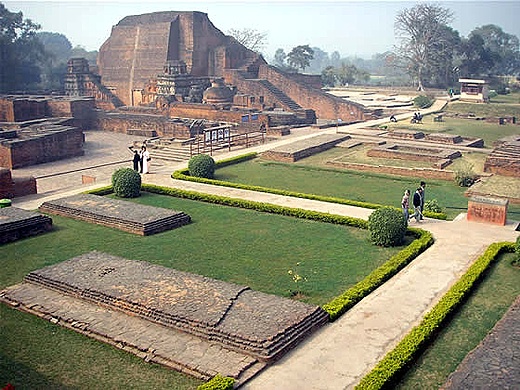
By George Mobus on 01 June 2009 in Question Everything - (http://questioneverything.typepad.com/question_everything/2009/06/a-sapient-society.html#comments) Image above: Site of Nalanda, the world's first university, founded in the 5th Century A.D. in India. From http://www.thezensite.com/BuddhistPhotos/Nalanda.htm Our current social order is not sustainable. Our economic system is based on a false set of premises — that we can extract all we want from the environment, pump all the waste we want into the environment, and all make our wealth by speculating with currency tokens. And all of this without any consequence other than that we are all enjoying more material wealth. Our political and moral positions admit that our societies must grow both in numbers of persons and in terms of how much consumption each person accounts for. This is a monstrous lie. The world is finite. And we, as a part of the world, have reached, nay exceeded, our fair share of space and resources. Fairness, here, means that our existence does not threaten the existence of the vast majority of the biota. As things stand now, our existence, and the way we insist on living, has triggered the sixth great extinction event. What is ironic about this is that we are almost certainly one of the species that is threatened since our existence actually does depend on the existence of the biota as it has been for the last many millions of years. And we are destroying much of that biota. Our actions have set in motion slow but inexorable forces that will accelerate the degradation of the natural world as time goes on. But that will take many centuries, maybe even millennia to work out. What will actually happen very much sooner is that we will loose our capacity to do the kind of economic work that has been the hallmark of modern civilization and upon which our civilization utterly depends. Our world, even the less developed nations, run on fossil fuels that provide the most compact source of high power that mankind has yet exploited. [NOTE: nuclear fission might be considered more compact, but its uses are primarily stationary and is still restricted to a very small percentage of the total energy consumed in the world.] And the net power availability of fossil fuels is starting to decline. For oil it is declining at an alarming rate and oil is the king pin energy source since it takes diesel fuel, for example, to mine and transport coal. Hence, all fossil fuel energy sources will go into decline even though there will still be lots of fossil fuels left underground! Our current form of social organization, our forms of governance, our economic processes, and our approaches to education of the younger generations cannot stand for much longer. We are on the verge of a social collapse and if I had to guess I would say within the next decade. Our world order is in a chaotic state and in such a state anything can happen. Even a slight event can trigger a complete phase transition. And no particular path to the bottom is predictable, only that the collapse will take us to the bottom. For myself I maintain an optimism that lets me think the collapse will not be so catastrophic that mankind will destroy itself completely, say in a nuclear winter scenario. I do think very many helpless humans will suffer horrendous deaths from all manner of catastrophe, but there will also be survivors, even areas of the world where some small semblance of civility will remain. Indeed, those wise enough to foresee this may make special preparations (I'm not necessarily talking the typical survivalist story here). If so, we will need to consider a new social order upon which to build a new society that may live in balance within the Ecos. • An architecture for social structure • A human centered social structure What we seem to have forgotten in our haste to create physical nirvana is that we are human beings and not just pieces of a giant wealth making machine. The latter is something that can easily ignore the rest of the Ecos and destroy nature in the name of progress without care. But if we remember that at the center of our human endeavors are real human beings who are not just cogs in a wheel but living beings that touch and interact with nature, indeed need nature in order to survive, we may become more human-centered. And human-centeredness doesn't mean hubris. It means we value ourselves as living, feeling, thinking beings first while still recognizing that all of those qualities obtain from being a part of the Ecos, not separate from it. The key insight into how society might be arranged so as to optimize the human presence in this world is that we as a species are a product of the tripartite co-evolution of...
• individual minds (development and learning), • genetic pools, and • group culture.
We, as individuals, are a product of our genetic inheritance, our cultural inheritance, and our knowledge inheritance — our conceptual constructions or mental models. An individual human being is an incredibly adaptive system, one whose behaviors can change and cover a wide range of responses to environmental change. The human capacity to learn is at the heart of our future. So, too, our societies have an inherent capacity for adaptation even if more sluggish than individual adaptation. Institutions are stable over multiple generations because they are more conservative in terms of organizational learning and changing as the environment changes. For most of human history this has been a strength. Where human individuals came and went, institutions endured, changing only slowly. In the quickened pace of our current social milieu this tendency may have become a liability, however. Finally, with the advent of our understanding of the mechanisms of genetics and epigenetic controls we are beginning to grasp the nature of evolutionary adaptation, that which takes the longest time scale for change. And we have discovered that it is feasible (at least it appears to be so) that we can directly intervene in the genetic adaptation process to meet the challenges of this rapidly changing world. We stand on the verge of reconciling these three very different time domains of adaptation in order to coordinate the future potential of human kind in the Ecos. A society that is centered on the greatest human strength would have as its core value learning and adaptation even while maintaining a framework of time-proven knowledge. This is a succinct description of a university. The university is a confluence of schools, laboratories and libraries where knowledge is gained, modified as evidence dictates, is taught to the younger generations, and is stored and maintained for ready retrieval upon need. A university is not just a "social construct". It is a natural extension of the human brain and mind. It is the societal mind, having all of the functions and qualities of an extended mind, along with the mechanical means to obtain, store, retrieve, and process knowledge for the good of the collective. It is, or should be, the seat of wisdom and understanding and open to all who seek that understanding. A university of noesis (mind and knowledge) would form the core structure for a sapient society (Fig. 1). Rather than our current conceptualization of a government, 'running things', the university would be the guide for how best to coordinate the organization of the rest of the social structure. The governing board of the university would be a council of wise elders, not chosen by democratic vote, but by lifelong evidence of growing wisdom and moral stability. They would be selected as in a meritocracy with no set number of members and a rotating chairmanship. The university would be the strategic mind of the society. Not a central planner (as so many too often confuse this form of governance with the failed model of Soviet bureaucracy), but a strategic vision setting body, and all that that implies. Figure 1. An architecture for a new social order. The University of Noesis is the core as described in the text. It would include the strategic element of a hierarchical, distributed control governance. The next outer shell contains the tactical and logistical functions for the entire society. Note that aesthetics, the appreciation of beauty, and the enjoyment systems are a part of this layer as these are as important as communications and education to the support and growth of every member of the society. The outer shell contains the operational systems that keep the society well and developing internally. The exergy and food systems are of primary importance but interfaces for other social systems and the rest of the Ecos are also part of this shell. The system is not closed, but the inflows and outflows of matter and other people are kept in balance. The principle idea in Fig. 1 is that a social system must naturally incorporate a hierarchical and distributed control subsystem for all of its essential activities. This is accomplished naturally with the concentric rings shown in the figure. The outer ring contains the operational level activities that make life possible and provide for the material wealth the society needs. The middle ring provides the coordination control (logistical and tactical support) to keep the society operating smoothly and to provide rapid adaptive responses to changes in the overall environment (for example defense includes repairing storm damage). The inner core captures the highest value of human life — knowing and understanding — for the individual in the context of the society. The highest purpose of this social architecture is that all members have access to all knowledge that they might desire and that their lives are devoted primarily to self-actualization. The education and communications subsystems are devoted to ensuring all citizens as much access as they desire to the core. The only cost one has to pay to be a member of society is to perform work as needed to maintain the structure. The bulk of 'jobs' will most likely fall under the exergy and food production categories. But any job that helps to maintain the structure so that energy flow is used most wisely (e.g. in helping construct energy efficient housing) counts. And as long as energy flows, everything else is free! Of course in a large enough grouping of such a social unit, some form of money token may be used to facilitate trade, but the monetary units would be based on exergy units and so would not become a basis for speculation or overvaluation. Feasible???? As I am sure many of you are now saying to yourself, 'but this is just utopianism, this is nothing more than a hippy commune!' Well, I'd like to believe it is a little more sophisticated than that. And I think it employs a good deal more subtlety in terms of its governance and economic underpinnings than your run-of-the-mill commune. For example, this is advanced not just as a model of a small community (though that it certainly is) but, by extension in scale it is a model for larger, indeed, global community organization. Note the import/export/immigration/emigration aspects. These allow any number of small communities to link up with one another and to form aggregate concentric shell-organized meta-societies. The model applies at all scales because it is based on distributed hierarchical control as I have described it elsewhere. And do not worry that I have gone off the deep end in dreaming. I recognize that what I have just described (and you have to recognize that this is in the context of all my previous writing) is completely infeasible because of one overriding factor — human nature. Or rather, the low sapient nature of our current species. We, in general, are simply not wise enough to form these kinds of communities, or communities of communities (as with so many of my concepts this architecture is self-similar at multiple scales!!!). If we were, it would already be done! No, I do not expect that anyone will rush out and try to set up such a community in the wilderness somewhere with the dream that they will create utopia. What I want to do is point out that under the right conditions of human consciousness and eusapience I think this organization might actually be the natural consequence of societal living. If humanity were to evolve into a more sapient creature, I suspect this kind of social organization would be the norm. Rather I offer it as a vision of what could be at some distant future time, after the fall of our current social order, and after evolution has had a chance to select for greater sapience among the survivors. One possible scenario might have it that some highly sapient individuals will seek one another out sometime before the fall and organize a means of ensuring their own survival. This could lead to a very interesting evolutionary bottleneck phenomenon whereby the gene pool of the survivors would have greater representation of whatever genetic (or epigenetic) factors are involved in sapience inheritance. Wishful thinking? Probably. Feasible? Possibly. I can hope, can't I?

Goodbye, GM...

SUBHEAD: Michael Moore - Ten Steps Obama Should Take for the Future of GM By Michael Moore on01 June 2009 in MichaelMoore.com http://www.michaelmoore.com/ Image above: part of ad by Bennett Chevrolet-Cadillac in Ontario, Canada. Note they were a Chevy-Olds dealership until Olds disappeared in 2004. From http://www.bennettchevolds.com/en/info/promos/house.spy?categories=new,used,service,parts,bodyshop,specials I write this on the morning of the end of the once-mighty General Motors. By high noon, the President of the United States will have made it official: General Motors, as we know it, has been totaled. As I sit here in GM's birthplace, Flint, Michigan, I am surrounded by friends and family who are filled with anxiety about what will happen to them and to the town. Forty percent of the homes and businesses in the city have been abandoned. Imagine what it would be like if you lived in a city where almost every other house is empty. What would be your state of mind? It is with sad irony that the company which invented "planned obsolescence" -- the decision to build cars that would fall apart after a few years so that the customer would then have to buy a new one -- has now made itself obsolete. It refused to build automobiles that the public wanted, cars that got great gas mileage, were as safe as they could be, and were exceedingly comfortable to drive. Oh -- and that wouldn't start falling apart after two years. GM stubbornly fought environmental and safety regulations. Its executives arrogantly ignored the "inferior" Japanese and German cars, cars which would become the gold standard for automobile buyers. And it was hell-bent on punishing its unionized workforce, lopping off thousands of workers for no good reason other than to "improve" the short-term bottom line of the corporation. Beginning in the 1980s, when GM was posting record profits, it moved countless jobs to Mexico and elsewhere, thus destroying the lives of tens of thousands of hard-working Americans. The glaring stupidity of this policy was that, when they eliminated the income of so many middle class families, who did they think was going to be able to afford to buy their cars? History will record this blunder in the same way it now writes about the French building the Maginot Line or how the Romans cluelessly poisoned their own water system with lethal lead in its pipes. So here we are at the deathbed of General Motors. The company's body not yet cold, and I find myself filled with -- dare I say it -- joy. It is not the joy of revenge against a corporation that ruined my hometown and brought misery, divorce, alcoholism, homelessness, physical and mental debilitation, and drug addiction to the people I grew up with. Nor do I, obviously, claim any joy in knowing that 21,000 more GM workers will be told that they, too, are without a job. But you and I and the rest of America now own a car company! I know, I know -- who on earth wants to run a car company? Who among us wants $50 billion of our tax dollars thrown down the rat hole of still trying to save GM? Let's be clear about this: The only way to save GM is to kill GM. Saving our precious industrial infrastructure, though, is another matter and must be a top priority. If we allow the shutting down and tearing down of our auto plants, we will sorely wish we still had them when we realize that those factories could have built the alternative energy systems we now desperately need. And when we realize that the best way to transport ourselves is on light rail and bullet trains and cleaner buses, how will we do this if we've allowed our industrial capacity and its skilled workforce to disappear? Thus, as GM is "reorganized" by the federal government and the bankruptcy court, here is the plan I am asking President Obama to implement for the good of the workers, the GM communities, and the nation as a whole. Twenty years ago when I made "Roger & Me," I tried to warn people about what was ahead for General Motors. Had the power structure and the punditocracy listened, maybe much of this could have been avoided. Based on my track record, I request an honest and sincere consideration of the following suggestions: ONE: Just as President Roosevelt did after the attack on Pearl Harbor, the President must tell the nation that we are at war and we must immediately convert our auto factories to factories that build mass transit vehicles and alternative energy devices. Within months in Flint in 1942, GM halted all car production and immediately used the assembly lines to build planes, tanks and machine guns. The conversion took no time at all. Everyone pitched in. The fascists were defeated. We are now in a different kind of war -- a war that we have conducted against the ecosystem and has been conducted by our very own corporate leaders. This current war has two fronts. One is headquartered in Detroit. The products built in the factories of GM, Ford and Chrysler are some of the greatest weapons of mass destruction responsible for global warming and the melting of our polar icecaps. The things we call "cars" may have been fun to drive, but they are like a million daggers into the heart of Mother Nature. To continue to build them would only lead to the ruin of our species and much of the planet. The other front in this war is being waged by the oil companies against you and me. They are committed to fleecing us whenever they can, and they have been reckless stewards of the finite amount of oil that is located under the surface of the earth. They know they are sucking it bone dry. And like the lumber tycoons of the early 20th century who didn't give a damn about future generations as they tore down every forest they could get their hands on, these oil barons are not telling the public what they know to be true -- that there are only a few more decades of useable oil on this planet. And as the end days of oil approach us, get ready for some very desperate people willing to kill and be killed just to get their hands on a gallon can of gasoline. President Obama, now that he has taken control of GM, needs to convert the factories to new and needed uses immediately. TWO: Don't put another $30 billion into the coffers of GM to build cars. Instead, use that money to keep the current workforce -- and most of those who have been laid off -- employed so that they can build the new modes of 21st century transportation. Let them start the conversion work now. THREE: Announce that we will have bullet trains criss-crossing this country in the next five years. Japan is celebrating the 45th anniversary of its first bullet train this year. Now they have dozens of them. Average speed: 165 mph. Average time a train is late: under 30 seconds. They have had these high speed trains for nearly five decades -- and we don't even have one! The fact that the technology already exists for us to go from New York to L.A. in 17 hours by train, and that we haven't used it, is criminal. Let's hire the unemployed to build the new high speed lines all over the country. Chicago to Detroit in less than two hours. Miami to DC in under 7 hours. Denver to Dallas in five and a half. This can be done and done now. FOUR: Initiate a program to put light rail mass transit lines in all our large and medium-sized cities. Build those trains in the GM factories. And hire local people everywhere to install and run this system. FIVE: For people in rural areas not served by the train lines, have the GM plants produce energy efficient clean buses. SIX: For the time being, have some factories build hybrid or all-electric cars (and batteries). It will take a few years for people to get used to the new ways to transport ourselves, so if we're going to have automobiles, let's have kinder, gentler ones. We can be building these next month (do not believe anyone who tells you it will take years to retool the factories -- that simply isn't true). SEVEN: Transform some of the empty GM factories to facilities that build windmills, solar panels and other means of alternate forms of energy. We need tens of millions of solar panels right now. And there is an eager and skilled workforce who can build them. EIGHT: Provide tax incentives for those who travel by hybrid car or bus or train. Also, credits for those who convert their home to alternative energy. NINE: To help pay for this, impose a two-dollar tax on every gallon of gasoline. This will get people to switch to more energy saving cars or to use the new rail lines and rail cars the former autoworkers have built for them. Well, that's a start. Please, please, please don't save GM so that a smaller version of it will simply do nothing more than build Chevys or Cadillacs. This is not a long-term solution. Don't throw bad money into a company whose tailpipe is malfunctioning, causing a strange odor to fill the car. One hundred years ago this year, the founders of General Motors convinced the world to give up their horses and saddles and buggy whips to try a new form of transportation. Now it is time for us to say goodbye to the internal combustion engine. It seemed to serve us well for so long. We enjoyed the car hops at the A&W. We made out in the front -- and the back -- seat. We watched movies on large outdoor screens, went to the races at NASCAR tracks across the country, and saw the Pacific Ocean for the first time through the window along Highway One. And now it's over. It's a new day and a new century. The President -- and the UAW -- must seize this moment and create a big batch of lemonade from this very sour and sad lemon. Yesterday, the last surviving person from the Titanic disaster passed away. She escaped certain death that night and went on to live another 97 years. So can we survive our own Titanic in all the Flint Michigans of this country. 60% of GM is ours. I think we can do a better job. see also: Island Breath: The end of the affair 5/30/09 Island Breath: Wishes, Hopes and Fantasies 5/25/09

Tightrope Without a Net

SUBHEAD: We’re all vulnerable and the nets will be desperately needed.
By Sharon Astyk on 01 June 2009 in Casaubon's Book http://sharonastyk.com/2009/06/01/on-a-tightrope-without-a-net Image above: Painting by Mark Bryan. From http://www.artofmarkbryan.com/the_ballerina.html The sum total of today’s news adds up to “the continuing story of the destruction of our protective safety nets.” GM’s bankruptcy is the lead, of course, one that constitutes an utter disaster for millions of people - unemployed workers who are unlikely to find new manufacturing jobs before their benefits run out, states swamped with benefits claims, elderly pensioners facing disaster, and the oridinary fall-out for towns, cities and states that will lead, later to deeper cuts of the nets that were designed to catch people when they fall. Then there’s California - among its major cuts, California stands to cut the poison control hotline, benefits for the disabled, school funding, health care for working class people and children, access to state parks, and almost everything else you can imagine. The cuts will fall heavily on the backs of the elderly, the already poor, the disabled and children, as always - people with minimal political constituencies will bear the brunt of this. And again, there’s more to come - California is already threatening to take money out of towns and cities - areas already hurting, already failing to sell municipal bonds. For the 47 states facing budget shortfalls, the trajectory is pretty clear - the federal government screws the states (by pouring its money into Wall Street, not helping people meet basic needs), the states sue the towns, and you get screwed all three ways - with fewer services, higher tax burdens and life on a tightrope without a net to catch you when you fall. California is the beginning, but not, unfortunately, the end. So far, most of us have no idea what life without a net is like - what happens when the federal government can no longer subsidize the stripped unemployment funds? What happens in the cold parts of the country when low income heating programs are stripped? What happens to the elderly, the disabled and the sick? What happens as public resources are stripped, damaged and destroyed? One thing I think it is important to observe is that we have chosen our present situation in large measure. As of this point, the US has actually spent four-trillion dollars on bailouts, almost all of it to large corporations, and committed another ten-billion. That money could have supported the people directly - now we are asking “how will we fund national health care?” Well, we spent the money, folks - and not on you. If the concern was lending, the government could have loaned. If the concern was keeping auto workers working, the government could have provided work and enough income to get along, or incentives for them to make new businesses. No matter what your feelings about big government, we’ve got it - and at every level we could have spent less and done more without pouring money into the coffers of people who were skimming most of it for themselves - legalized skimming, but skimming nonetheless. It is the culmination of the insane “rising tide lifts all boats” notion under which globalization was born - if we just make the rich richer, maybe a tiny bit will leak down to those who aren’t rich. And as we keep finding, not much leaks down. What’s facing us is a tidal wave of suffering - and the anger, and political conflict that accompanies it. The UN is warning that unrest is brewing all over the world will be desperately needed - the BBC reports that we’re facing massive repression, as human rights at all levels hit the backburners, and the anger that repressive and destructive governments agenda. The unrest that accompanies this worldwide may well change things beyond recognition. The project for all of us is to maintain what we can, to meet needs that we can, and to triage our safety nets and provide what resources we can. That’s why I was so pleased to read about Rob Hopkins’ and Richard Heinberg’s nascent discussion of using Transition to provide some kind of resources for people dealing with the present crisis. I think that as a basic principle, we can’t talk about “addressing peak oil and climate change” unless we actually have something to offer the victims of peak oil and climate change - placing these events always-already in the future, as though we had time and leisure is, I think, alienating, and being unable to respond immediately to realities risks tarring adaptive movements as irrelevant. I keep saying it, and will keep saying it - the things that we need to prioritize in responding to our collective crisis are precisely the things that people already care about most - any movement that does not focus on the human priorities of meeting basic needs will not succeed. At the neighborhood and community level, we need each other more than we ever have. The safety nets that are gone are going to have to be replaced with…us. In an essay I wrote a while back, I observed that the public safety nets were still holding, but that eventually they would crumble - and in many states, they are doing so now. What I wrote then now has to be put into practice, “Think of poverty as a fall out a window. Right now, there is a layer of safety net that catches a majority of people, although by no means all. But what’s under those? What happens if the traditional nets break? We need those nets not only because protecting others from hunger, cold and suffering is the ethical thing to do, and not only because, as they say, the life you save may soon be your own, but because all of our personal security depends on our community security. In hard times, crime rates go up, and people get angry. Brooks is right to anticipate a movement of angry and frightened people, and when people are angry and frightened, we’re all vulnerable. In a rational society, there are more layers to break your fall, and we’re going to need them. First, there are formal structures at the community level - if your town never needed a food pantry because people could drive to the neighboring city, now is the time to propose it at your church, school or other possible site. Think about ways you could adapt existing infrastructure - could the schools start distributing extra school lunches to the needy after the day is over? Could your school establish a backpack program, sending food home for the weekend with the neediest kids? Could you start a local gleaning program, or a senior lunch program? If you have these structures, but they are struggling, what can you do to reinforce them? Can you make another donation? Start a fund drive? What about setting up a bulletin-board system to bring families struggling to keep their homes together with people who need housing. There are a thousand good ideas - yours is probably one of them. The next layer is the neighbor and community layer. I know we all worry about looking like busybodies, but now is the time to start looking in on your neighbors, and offering to help. The way to do this is to talk to people, even before it looks like they need anything. That way you’ll know if your elderly neighbor can no longer afford to drive to get her medication and you can offer to pick it up, or if a neighbor is out of work and might be glad to get a day’s pay helping a friend of yours winterize her house. Being neighborly, and also gentle and nonjudgemental is how you are going to know if someone in your neighborhood has no food in the pantry. For every person who signs up for aid and accepts help, there are several who will rather go hungry than take institutional charity - but who will gladly come over and share a meal with their neighbor, or do you a favor and take that loaf of bread that you’ve got no where to store. One of the most important things we can do is when we do spend money these days, spend it in our communities if at all possible. I know most of us aren’t going to be buying a lot of holiday gifts, but every dollar you can pass on to a neighbor, a local farmer or a local business that enriches your community is one that makes everyone more secure. So maybe hire the out of work neighbor to plant and tend a garden for your sister, or give your best friend a farmstand gift certificate. Finally, there’s family, or the people who function like one. Those are the people who are standing there with their arms out at the base of your fall, and are prepared to risk something to catch you. These are the people you can depend on when you have no place to go or no food in the pantry. And as long as you have food and a place to sleep, try hard to be that person for close friends and extended family. In fact, try hard to extend out the circle if you can a bit - there are a lot of vulnerable people out there who could use a hand up. You don’t have to take in everyone, or treat everyone like family, but if each of us expands the category of people we will not allow to fall to the ground by one or two, well, there’s hope for us yet.” Today, June 1, 2009, is the day the nets broke. Let’s get to securing the lower levels, because they will be desperately needed, and we each of us depend upon them. see also: Island Breath: Do we plan for emergency? 6//2/09

Do we plan for Emergency?

SUBHEAD: Richard Heinberg and Rob Hopkins debate and cogitate planning for emergency.
By Heinberg and Hopkins on 27 May 2009 in Transition Culture http://transitionculture.org/2009/05/27/to-plan-for-emergency-or-not-heinberg-and-hopkins-debate/ Image above: Planning for emergency and confronting disaster by the Salvation Army. From http://www.birminghamsalvationarmy.org/default.aspx?id=24 At the Transition Network conference, Richard Heinberg gave an online presentation looking at the concept of Emergency Planning for Communities, something he initially unveiled at Findhorn last year. You can see his presentation here. For a while now, Richard and I have been discussing the tension between longer term planning for resilience and the more immediate and pressing responses demanded by sudden and rapid change. It is still an ongoing discussion, but we thought now, with Richard’s presentation, it would be a good time to open up the conversation for your thoughts. What follows is the series of email exchanges we have had since late last year. One of the fascinating discussion points at the conference between those in the US and those in the UK, revolves around the degree of vulnerability people feel. When Naresh and Sophy returned from delivering Transition Training in the US, one of their observations was that, as a country with no free healthcare and little in the way of social services and benefits, life feels much more fragile there, and the sense that things could all fall apart tomorrow much more palpable. Translating Transition to the US context can be, some of those present were saying, a bigger challenge because of that. Is the US being overdramatic, or the UK lulled into a false sense of security? Does putting emergency planning at the forefront of Transition risk losing more people than it engages? Is it possible to build resilience in the middle of a crisis? There are just some of the questions that arise from these exchanges. Anyway, we throw this open, and welcome your thoughts based on the discussions below. Dear Rob, Let me start by saying that I am not proposing any specific change in the public Transition written materials or trainings, merely a private strategic discussion among those at a high level within the movement.
My reasoning is simple: Transition has a very positive and optimistic face, which is extremely attractive and the main reason for its success. As you know, better than anyone, its goal is to envision a desirable post-fossil fuel future and then backcast incremental local steps for the achievement of that future. Now: the reason we all see it necessary to transition away from fossil fuels is that if we don’t, dire things will happen. But what if it’s actually too late to prevent some of those dire things from happening, and they occur during our Transition period and process? Obviously this is not an academic question. We are seeing a truly frightening financial collapse—partly resulting from this year’s high oil prices—unfolding before us. The world has changed very significantly in the past few months, so much so that the shift is difficult to overstate, even though its direction and implications are still revealing themselves. My question is: should the Transition movement ignore this new fact-on-the-ground, address it as just a bump or pothole along the way, or take it very seriously as (1) a potential challenge to the Transition program if people feel that their optimistic efforts are being overwhelmed by catastrophic economic conditions including closure of local businesses and loss of jobs and funding by key organizers; (2) a potential opportunity both to grow the movement and to offer tangible help to people in genuine need; or (3) both of the latter? If it is to be seen as (2), an opportunity, what might that mean in terms of public messaging, trainings, etc.?
My own view is that organizations like ours can help by providing inspiration (as Transition certainly does, probably to a much greater extent than PCI), as well as by helping to solve real problems. I would guess that in the near future solving problems will become more of a priority than it has been up to this point, simply because the number and scale of problems that individuals and communities will be confronting will snowball. Whether we like it or not, those of us who have put ourselves forward in the public eye as having answers will be looked to for practical solutions to very basic problems like homelessness, unemployment, hunger, decaying infrastructure, lack of heating fuel, lack of capital, and bank failures. Obviously, what Transition and PCI have been advocating (community gardens, local currencies, etc.) are in fact at least partial solutions to these very problems, but so far we have discussed them in terms of proactive efforts to keep the problems from happening, or to build a better world in the future. Should the growing presence of these problems affect how our solutions are described (to the general public, to policy makers, or among ourselves) and/or how they are implemented? Again, this is only meant to be a conversation opener. We’re all figuring this out as we go along—at least I am! With all best wishes, Richard. January 9th 2009. Dear Richard, Happy New Year to you. I have been giving your email some thought over the last couple of weeks and wanted to respond with some feedback. I agree with you that some element of Emergency Planning (which feels like a more appropriate term to me) is vital, but I wonder whether it is something that either falls completely outside of the work of Transition groups or, while connected, has somehow to be kept clearly distinct for the reasons below. To begin with, that kind of emergency response work is usually done by local authorities, or in the US by groups like FEMA. It is hard to figure out how one would come up with a community response plan that would be more effective, or able to mobilize what they are able to mobilize, than what they could do. I haven’t tried to find out who is responsible for that in Totnes, but I suspect that whoever it is would not be entirely welcoming of well-meaning approaches from us offering to input some Transition flavoring. At the root of it is the old bottom up/top down question. Is it possible to design a bottom up emergency response plan that is effective? At present, in the event of an emergency, in theory at least, the government agencies swing into action, organizing water, energy, food and so on (although of course Katrina is an example of exactly the opposite happening, but what would a pre-planned community response in New Orleans have looked like?). Of course this raises fascinating questions, as I suppose in a few years a community fully engaged upon energy descent would be far better at dealing with emergencies than “the authorities” - and in the past bottom up emergency planning worked superbly in the anarchist led communities during the Spanish Civil War. Having said that, those were communities which were already, and explicitly, united around a common vision; ie more like communities already meaningfully engaged in energy descent than the current early adopting transition initiatives. I think about this in terms of the principles of Transition. Does Emergency Planning lead to increased resilience? Maybe yes, but maybe not. Tends to be peoples’ last consideration in times of panic. The priority turns to short term survival. We are already seeing in the Ukraine people felling trees left, right and centre in order to keep warm, and Ireland during the Famine had barely a single tree. Short term emergencies tend to move people away from resilience, something that, it seems to me, can only really be created in a longer term, intentionally designed way. On the other hand, does that mean that principles of resilience should be put to one side in an emergency? While the answer to that must be no, I’m struggling to see what one does with the resulting tension. In terms of ‘Inner and Outer Transition’, I think this creates a huge challenge. There are very few people who can really delve into the nitty gritty of emergency planning without feeling deeply despondent.. there are a few grizzled doomers who would thrive on it, but how to create a meaningful community process of planning emergency responses without breeding powerlessness on an unprecedented scale is hard to imagine. There may be a need for working out how to do trauma counselling on a huge scale, training a team of people to support the freakouts that would happen, but again, on that scale it needs the Health teams and the NHS. In terms of subsidiarity, emergency planning is something that has almost always come from the top down. I would be fascinated to hear your thoughts on what an effective bottom-up response might look like. Wouldn’t bottom up responses to emergencies, almost by definition, be actions which emerge rather than follow a pre-determined plan? The piqueteros in Argentina appeared as a result of dire need/emergency, but not because of a previous plan. It may well be that within a TI a few people who are so inclined might write such a thing, but I can’t see it being something many people would choose to engage with. I feel that absolutely key to all of this is the fact that, in terms of visioning, there isn’t a positive potential outcome to use to inspire and engage people. Transition is very deliberately designed to be non-threatening, to be inviting and engaging. It could be argued that emergency planning is the opposite. The danger is that if the vision becomes collapse next week, that the Transition group becomes seen as a survivalist cult, and loses people. It is hard enough for us to engage and work with our local authority here, and we are presenting ourselves to them as rational, positive thinking people with ideas they need, answers to questions they aren’t asking yet, although no doubt we are still seen as fringe players. If we were to take a very doomy position, and invite them to prepare for meltdown next week, I suspect we would find it far harder to find a way into them. I think the question for me is more around how does one ’speed up’ an EDAP. Most of the work in one tends to focus on their first few years, and if it is written properly it should really engage that kind of input. For example, if we want to have food gardens in place in time for an emergency, the same obstacles still exist to their creation now that exist in an EDAP. It is about designing things that are viable in one economic context that will also be viable in another entirely different one. It is a big job, but those gardens aren’t going to appear by magic, they need to be planned, created and maintained. Same with woodfuel, local markets and so on.
I find it hard to see how the things that would actually lead to increased resilience could be done any faster, short of actually being in that emergency scenario by which time, in some ways, it is too late to do that effectively. Say the UK’s gas is shut off tomorrow, leading to a speeding up of the current economic troubles… not too much in the way of meaningful gardening to be done in Totnes in January.. Would be at least June before much is produced. An EDAP would be looking for triggers for rapidly speeding up the numbers of people growing food, other institutions that could help, identifying potential growing land and so on. It is hard to see how it might be done any faster. Finally, there are lots of other organisations, community groups and so on, who don’t engage at the moment, but who would in an emergency. I think the EDAP creates a template for how they might be invited to direct their energy. So, my feeling is that the creation of Emergency Plans is something that could either happen in parallel with the EDAP process, or could be the work of a separate group. I think it would shift public perception of the work of that initiative away from it being seen as a positive, forward looking and inclusive thing, to being a doomer cult, the embodiment of what everyone always suspected environmentalists were all about in the first place. It certainly has an important role, but perhaps it is something that just happens discretely… Finally, turning to your explicit question:“My question is: should the Transition movement ignore this new fact-on-the-ground, address it as just a bump or pothole along the way, or take it very seriously as (1) a potential challenge to the Transition program if people feel that their optimistic efforts are being overwhelmed by catastrophic economic conditions including closure of local businesses and loss of jobs and funding by key organizers; (2) a potential opportunity both to grow the movement and to offer tangible help to people in genuine need; or (3) both of the latter?” I think we clearly can’t ignore it or view it as a bump or pothole - and my gut feeling is that it is (3), the combination of challenge and opportunity. It may be though that the truth is that the opportunity is that the emergencies coming towards us will serve to demonstrate the need for transition more than anything else. Thank you for having raised this issue, which is absolutely vitally important. On re-reading the above, I’m not sure that we’ll get to a completely clear answer, but I look forward to your further thoughts with great interest. It might be worth looking at the idea of publishing this exchange of emails on Transition Culture, and/or elsewhere, as I know it is a subject of conversation elsewhere. There is, for example, an interesting thread on the Transition Network forum exploring this. Rob February 2nd 2009. Dear Rob, Many thanks for your thoughtful reply to my earlier letter about Transition and emergency planning. I think the best way for me to continue the conversation would be to respond to specific points you made. “Is it possible to design a bottom-up emergency response plan that is effective?” If not, then I think that we (that is, those of us who desire to see an orderly, decentralized transition process) may be in danger of being written off as irrelevant at some point—perhaps in just a few months’ time. As you point out: during an emergency, people are much less interested in long-range plans and much more focused on satisfying immediate needs. The emergency is unfolding, and it is not going to be transitory. So as people deal with survival issues, how can their collective efforts trend toward sustainability? “In the past bottom-up emergency planning worked superbly in the anarchist-led communities during the Spanish Civil War.” This is an encouraging example to think about, even if—as you note—circumstances are very different now. In fact, I think communities are going to be left mostly to their own devices, once the efforts of national governments begin to fail—and fail they will. So how will communities get by? Who will help them organize their response to an almost complete economic shut-down, so that families still have food, water, shelter, sanitation facilities, work, and health care? I think anyone who can offer tangible help will be regarded with some respect. “Does Emergency Planning lead to increased resilience?” As you say, emergency planning doesn’t necessarily lead to greater resilience, but on the other hand I don’t see how a society can be resilient without it, especially when there are so many crises looming. “I would be fascinated to hear your thoughts on what an effective bottom-up response might look like. Wouldn’t bottom-up responses to emergencies, almost by definition, be actions which emerge rather than follow a pre-determined plan?” Yes, but such responses are likely to emerge more quickly and effectively if a few folks within the community begin running scenario exercises ahead of time, identifying community resources and thinking about how those might be mobilized. Such efforts could in fact be crucial to preserving societal coherence. And this is what I fear most, frankly: the loss of societal coherence. If that goes—if we are each on our own, competing for food and drinkable water—then we have lost the game. This is what Orlov is talking about in his five stages of collapse (www.energybulletin.net/node/40919): it is social and cultural collapse that we must avoid if at all possible. We are seeing financial and commercial collapse now, and the beginnings of political collapse in many nations. How far down the chain are we going to go? Can we interrupt the process at some point by creating more cultural coherence? Transition is in fact creating more local cultural coherence—we’re on the right track!—but is it enough, and of the right sort? “I find it hard to see how the things that would actually lead to increased resilience could be done any faster, short of actually being in that emergency scenario by which time, in some ways, it is too late to do that effectively. Say the UK’s gas is shut off tomorrow, leading to a speeding up of the current economic troubles… not too much in the way of meaningful gardening to be done in Totnes in January. Would be at least June before much is produced. An EDAP would be looking for triggers for rapidly speeding up the numbers of people growing food, other institutions that could help, identifying potential growing land and so on. It is hard to see how it might be done any faster.” Fair enough—we’re all working as hard as we can, going as fast as we can go. But maybe there are unseen opportunities here. In the beginning of your letter you point out that, “that kind of emergency response work is usually done by local authorities, or in the US by groups like FEMA. It is hard to figure out how one would come up with a community response plan that would be more effective, or able to mobilise what they are able to mobilise, than what they could do. I haven’t tried to find out who is responsible for that in Totnes, but I suspect that whoever it is would not be entirely welcoming of well-meaning approaches from us offering to input some Transition flavouring.” I think you might be surprised. The few emergency response folks I’ve talked with are frankly very worried. A lot would depend on the manner in which they were approached. If they sense that we are merely pushing an agenda, they are likely to be quite hostile. If we appeal to a shared interest in addressing real looming problems, there is likely to be at least some openness to collaboration. These are the “adults” in the community, people who are taking responsibility in ways that aren’t always fun or rewarding, but are doing things that need to be done for everyone’s sake. I’d like to think that we are in the same category (though I wouldn’t rule out the “fun” part). Moreover, emergency response officials aren’t the only ones who are worried: my guess is that Community Resilience campaigns undertaken right about now (with cheerful smiles, holding garden implements, but acknowledging that the economy is falling apart and that we have to act fast) might garner even wider support and interest than Transition is already doing. “Finally, there are lots of other organisations, community groups and so on, who don’t engage at the moment, but who would in an emergency. I think the EDAP creates a template for how they might be invited to direct their energy. So, my feeling is that the creation of Emergency Plans is something that could either happen in parallel with the EDAP process, or could be the work of a separate group. I think it would shift public perception of the work of that initiative away from it being seen as a positive, forward looking and inclusive thing, to being a doomer cult, the embodiment of what everyone always suspected environmentalists were all about in the first place. It certainly has an important role, but perhaps it is something that just happens discretely…” If there is no looming emergency and you are planning for one, people may call you a doomer. When the emergency is palpable and undeniable and everyone is filled with a sense of urgency, then people may call you a realist—if you can describe what is happening accurately and point to solutions in a helpful way. Much depends on one’s tone of voice. This is the source of much of Obama’s attraction: he has earned the nickname “no-drama Obama” because he’s so unflappable. At this point, no one is going to call us doomers for engaging in disaster planning unless we have shrill voices and are buying up all the ammunition in town. A calm voice with a realistic yet helpful message will get you a long way these days. Maybe, as you suggest, aspects of the disaster-planning/EDAP process need to be discrete, but at this stage I think the existence of such a process is more likely to be a drawing-point than a put-off. I agree that the EDAP is already a helpful template in guiding existing groups to pitch in to address crises, though perhaps that could be more explicit. “I think we clearly can’t ignore [the economic crisis] or view it as a bump or pothole—and my gut feeling is that it is (3), the combination of challenge and opportunity. It may be though that the truth is that the opportunity is that the emergencies coming towards us will serve to demonstrate the need for transition more than anything else.” Yes, I agree completely. Yet somehow I still think there is more we could be doing. I understand: in the past two years Transition has taken off like a rocket; if it’s working, why screw with it? Perfectly sensible. At the same time, I have to underscore my sense that what we are seeing unfolding in the world right now will change just about everything. And everyone will have to adapt to survive—Transition (and Post Carbon Institute) included. I’m looking for both a plan to save the community, and a plan to help our efforts remain relevant and perhaps become much more so. It’s worth asking: What is Transition actually capable of doing to respond to an unprecedented economic crisis? In the most cynical assessment, it consists essentially of a lot of well-meaning local activists wanting to envision a better future. These are not the sorts of people to engage in serious emergency response work, nor do they have the support mechanisms to enable them to do it. But who does have the ability to do that work in the context of a vision of what needs to be done also to solve the longer-term crises of climate change and resource depletion? For whatever reason, Transition is appearing on the world scene at the right time, it is viral, and it has a positive, hopeful face that people respond to. It needs to keep that positive, hopeful visage, but perhaps it also needs to be perceived as being responsive to changing circumstances. If what we are proposing to do can only succeed if we have a decade or so of “normal” economic conditions during which to grow our base, train more trainers, and deploy our methods, then . . . it may indeed be too late. But if we can adapt quickly and thereby strategically help our communities adapt, the result may be beneficial both to communities and to those who are organizing Transition efforts. Obama is telling Americans that the economy is going to get much worse before it gets better. He was elected on a platform of hope, but he’s dishing out some pretty grim forecasts these days. I want him to succeed, but I fear that circumstances will overpower his ability to respond. You’re likewise a hopeful, unflappable public figure, Rob, and people love you for it (as well as for other qualities—your ability as a writer, your humor, and more). I suspect that there are a lot of folks out there waiting to see how the Transition message will evolve in response to changed circumstances. But I shouldn’t presume to speak for them; I am really just stating my own thoughts here. The emphasis of my own work will change from here on. I know I gained whatever notoriety I have on the basis of my gloomy writings about Peak Oil, but that may be a near-dead issue for the time being. I won’t leave it entirely behind (energy is ultimately where it’s at and I still have a book and some other publications on energy issues coming out in the next few months), but this year I intend to focus primarily on identifying efforts taking place in communities around the world that (1) address basic human needs in the context of economic collapse (2) are replicable and/or scalable, and (3) set us on the path toward sustainability. In fact this will also be the main focus for Post Carbon Institute for the foreseeable future, as we expand our Fellows program. I hope that what we come up with as a think tank will be immediately useful to Transition initiatives everywhere. I’m confident that in our partnership we will be able to do some really useful work. I realize that my suggestions are vague. Maybe overt disaster planning is just not practical at this stage (it may well be too late, and we may well not have the capacity), and maybe all that can come from this is a some new messaging that acknowledges the dire circumstances and that promises that useful ideas for responding to communities’ burgeoning problems will be forthcoming. In any case, I’m delighted to be working in collaboration. I have nothing but admiration for what the Transition Network has accomplished so far. May those accomplishments grow! Best wishes always, Richard February 4th 2009. Dear Richard Thanks so much for your considered and fascinating response. I’m delighted you feel happy for this exchange to be made public, as I think it will be of great interest to people. As you say, things are moving so very fast, it is fascinating to observe. I was very interested to hear you say that you feel that peak oil is in danger of becoming a non-issue… would it be fair to say that some of the peak oil community, in an understandable effort to communicate the implications of peaking, didn’t communicate clearly the possible implications of peak demand being reached before peak supply? I still find it a very useful lens to help people view things through, but as you say, we have to stay nimble and on our toes, as the economic situation is what is most clearly in peoples’ faces. I feel that your last email actually gave me a certain ‘Eureka’ moment. As you state, Transition “is working, so why screw with it?”, but at the same time, as you put it, “in the most cynical assessment, it consists essentially of a lot of well-meaning local activists wanting to envision a better future. These are not the sorts of people to engage in serious emergency response work, nor do they have the support mechanisms to enable them to do it”. Yet what Transition groups have done most powerfully in my experience is at least start to weave into their communities a powerful web of connections and links that weren’t there before. It has developed a language and an approach that is as accessible to Councils and businesses as it is to teachers, activists and estate managers. This, I think, has been one of the things that is most powerful about it. In Totnes for example, were the shit to hit the fan tomorrow, TTT now knows the best gardeners, the best people at teaching it, who are the main landowners, who are the local funders, and so on, so the drawing together of those pieces is far easier than it would have been before. This is highly valuable, and is perhaps one of the key contributions, alongside the awareness raising work.. My Eureka moment comes from thinking about how to best combine the need to build resilience as well as the need to build the ability to better respond in emergencies. As you know, the Transition idea emerges from a background in permaculture and bioregionalism, although permaculture training (and I write this as a teacher of many years) tends to assume a gentle transition in its perspective. While it offers an invaluable set of thinking tools, its longer term focus on ‘permanence’ perhaps doesn’t lead to a sufficiently appropriate set of tools. For example, teaching sheet mulching with vast amounts of cardboard and compost may not be the best approach for people faced with turning a football pitch into allotments. Were a training, presented in the Transition way, i.e. positive, empowering, visionary, yet intensely practical, to be developed and rolled out though Transition groups, this could be a very useful tool. It could pull together the best from bushcraft training (but without the excessively survivalist flavour), the best from bioregional studies (i.e. how to read where you are, what is home, what is the nature of where you live), the best of appropriate technology (how to build simple yet effective tools and then how to use them), biointensive horticulture (most amount of food from smallest amount of land), traditional allotment gardeners (growing food with what you’ve got), and also emergency response organisations (how to organise amid chaos, how to prioritise based on situations). Indeed, it could also create a very dynamic interface between emergency response organisations, green groups, Transition, education providers, probation/youth offenders services, and a range of training providers, among others. Perhaps even the Army (now there’s a sacreligious thought!!). What would be important would be that it would move beyond the usual crowd that go to such courses. It would draw as much from the work of activists such as Catherine Sneed, engaging young men who have been in trouble, as it would the usual permaculture course-going public. Such a programme, which could become core in schools and colleges, would start to create a team of people who would be ‘on call’ for this, and who could undergo regular additional training. My friend who is a fireman did his core training but then has to do regular top-up trainings. Perhaps then a key part of the EDAP is looking at how that training could be developed and then rolled out, as well as how it might be funded. The key aspect of it, as with all of this, is tone. If it is presented as an emergency response force training, I don’t think it would be as effective as if it was Transition Teams or something. It would be great to get some marketing/advertising bods on board with it, to really focus the presentation and the language. I think Chris Martenson’s Crash Course was designed with some of this in mind. There is also a fascinating area of overlap in terms of working with young men, and menswork, which is a vital thing to look at too in all this. I think that such a training, if properly designed, could run alongside the regular work of Transition initiatives, and run alongside the EDAP process, while at the same time generating useful insights for that. It builds on the positive slant of this. I do wonder though, thinking of my family and neighbours, just how much this kind of approach would engage people, given that many people will respond to the developing economic situation by thinking “how can I remortgage the house so as to reduce my payments”, “how can I reduce my overheads by switching to a different home phone provider” and “how secure is my job”, rather than “how am I going to store rainwater”, “how am I going to dig up my garden” and so on. In that regards, the Transition awarness raising stuff it clearly vital alongside this. In that sense, one could still have a Transition emergency preparedness group, if there were people keen to do such a thing, but Transition Network could design and pilot such a training that could then be rolled out through the network. The EDAP would be doing the longer term resilience building, while at the same time training and mobilising a group who would be of use in both scenarios. This would, as you say, create more “adults” in the community, but in a sense of maturity rather than paranoid survivalists. Key, as you say, in maintaining ’societal coherence’. Anyway, just a few thoughts. The field we are exploring here is so vast and wide, it is hard to pin it down to particular things, but for me I feel that the above maybe offers one way of building on what is best about Transition while at the same time developing a practical and relevant side to accompany the awareness raising work and the networking that combines to create the EDAP. If you’re interested in looking in more detail at how to develop this line of thinking, perhaps we could fix a time to have a telephone or skype conference, with me and Peter and Ben over here? If it seems to be fruitful, perhaps we could look at running a workshop on it at our conference on 24/5/6 April, with you attending electronically? With very best wishes, Rob February 4th 2009 Rob, I love your idea. At New College (R.I.P.) we always offered experiences in backpacking, camping, and primitive/appropriate technology alongside our heady course work in anthropology and social critique. It’s what many of the students came away remembering best. It gave them a sense of basic mammalian competence that took the edge off of the grim information we were imparting. The key will be to offer skill-building experiences that are both inviting/fun and relevant to the kinds of practical challenges people will be facing. As you say, many people will be focused on questions like, “how can I remortgage the house so as to reduce my payments”, “how can I reduce my overheads by switching to a different home phone provider” and “how secure is my job”, rather than “how am I going to store rainwater”, “how am I going to dig up my garden” and so on.” If we can address people’s very real economic concerns, we will be offering tangible benefit. What are some strategies for saving money? Get family and friends to move in with you. Find ways to cook with less fuel (solar cookers are only one of many strategies there), use less water (gray-water recycling with or without re-plumbing your house), ditch your car, share stuff, repair stuff, make stuff. How to live happily without x, y, and z. How to live more happily and healthily than ever on a fraction of the income. The big question on everyone’s mind is: How can I get by once I’ve lost my job (or now that I’ve lost it)? Learning how to raise capital and form cooperative ventures that benefit the community (and are therefore worthy of community support) could be a life-saver. Also: how to set up barter networks, how to make community currencies work for you. The design of such a course will be easiest if we get together three or four people who have complementary skill-sets and who are already teaching many of these things. The Voluntary Simplicity people have some of this down; also the appropriate technology folks; the primitive tech folks; the co-op venture folks. Now that I think of it, it might take more than three or four “experts.” But maybe there are those like Chris Martensen who are already aggregating these skills. It would not be so good to initiate a course design process that requires months and months of work and lots of investment, given that time and money are in short supply. The key is to synergize existing resources. As you know from the success of Transition itself, if it’s the right idea at the right time, circumstances will conspire to help. Richard

Shattered and Shuttered

SUBHEAD: A day trip to Canada from upstate New York and the lessons learned in Watertown.
By James Kunstler on 1 June 2009 in Kunstler.com - http://kunstler.com/blog/2009/06/shattered-and-shuttered.html
Image above: A view riding through east Watertown NY. From http://www.city-data.com/city/Watertown-New-York.html

The dollar was up to its armpits in quicksand, and oil prices had crept stealthily into the death-to-airlines range, and if, in the old slogan, "what's good for General Motors really is good for the USA", then destiny was dealing a harsh lesson to The Land of the Free -- while I made a drive on Thursday (in a Japanese rent-a-car) through the remotest ends of upstate New York State into the province of Ontario, Canada, to see what I could see. What I saw was pretty scary.

You get into these far reaches of upstate New York and your senses report that you have entered something like an H.P. Lovecraft story, where the sun comes up twenty minutes late, and the magnetic poles are not where they're supposed to be, and the few remaining denizens of the towns all have eleven fingers.... Even though I've seen plenty of desolation like it in other parts of the country -- the back roads of Ohio, the Mississippi River towns of the upper Midwest, the morbid stretch of blue highway between Memphis and Little Rock -- I've never encountered a landscape so shattered by the mere ravages of economic fate.

The most striking feature is how all the things once so "modern," all the roadside business enterprises designed along "space age" motifs -- the car dealerships with boomerang-shaped signs, the rocket-ship-style food huts, the schools that look like atomic power installations -- all teeter now in sublime decrepitude. The reversal of spirit from childlike exuberance of the 1960s to the senile sclerosis of today said everything about where America is at.

Much of what existed before the space age is not even there anymore, bulldozed decades ago in our haste to erase pre-drive-in living, as if it branded us a lower life-form than, say, our arch-enemy, the Soviets. I've wondered for many years what Modernism would be like when time finally passed it by, when it was no longer the sole thing it declared itself to be, up-to-date -- and there it was smeared all over the landscape like so much road kill.The most horrifying part of the trip was the old city of Watertown, a short hop shy of the Canadian border.


Named after the many falls located on the Black River, the city developed early in the 19th century as a manufacturing center. From years of generating industrial wealth, in the early 20th century the city was said to have more millionaires per capita than any other city in the nation. Residents of Watertown built a rich public and private architectural legacy. It is the smallest city to have a park designed by Frederick Law Olmsted, the celebrated landscape architect who created Central Park in New York City. -- WIKIPEDIA

All that industry is gone now, apparently, and all that's left of the town's economy is whatever it gets from nearby Fort Drum, the giant US Army installation. Nineteen year old soldiers-in-training are not so impressed by Olmsted parks and the civic embellishments dreamed up by timber magnates, bankers, and the owners of piano factories. The humanity visible on the downtown streets of Watertown looked like extras who wandered away from the latest Road Warrior location shoot -- semi-hominid creatures with strange loping gaits, arresting hair-dos, and enough tattoos to qualify them for harpoon duty on Herman Melville's Pequod. You passed by groups of them on the streets and wanted to make sure the car's doors were locked.


Image above: Scene in downtown Watertown NY. From http://www.city-data.com/city/Watertown-New-York.html

At the heart of the old town, everything possible had been done to erase the vestiges of pre-automobile living. I suppose this is because the first thing many young army recruits did until fairly recently was buy a car. If having to join the army (because there are so few other jobs) buys you a ticket to The American Dream, then getting a car is the consolation prize -- even if you have to make four years of "easy monthly payments" on it.

Very little of the town's physical history was left standing, and most of it stood in isolation, devoid of context, awaiting the next parade of the front-end-loaders.

What was left of "the action" had shifted to a ghastly franchise strip along the Route 3 connector to I-81. This stretch of highway was clearly where all the money had gone since, say 1976, though mostly to the pavement itself and its heroic furnishings of signage, light poles, multiple turning lanes, and curb cuts. The buildings were little more than packing crates with a few plastic doo-dads stuck on. You had to wonder if all this stuff would ever see another iteration of repair and restoration. I doubt it.

Burger King was doing some kind of promotion in its Watertown huts and the marquee in their several parking lots proclaimed -- I swear to God -- "Ask us about our Angry Burger." WTF? Is the rage of lumpen America so repressed now that it can only be expressed in menu items that turn people into hulking four-hundred-pound monsters?

It was, I'm sad to say, a relief to cross the border out of my own country. Once you got off the main highway of Canada, 401, along the north side of Lake Ontario, the landscape presented a disturbing contrast to what you saw on the American side. Unlike the slovenly, failing farms of New York State, the farms of Ontario looked successful and prosperous. The barns did not tilt at weird angles and the roofs were intact.

The farm houses were freshly painted and the grounds generally not strewn with the sort of dingy plastic effluvia Americans like to deploy around their dwellings to give the impression of plentitude. You wondered: how did all the IQ points below the Great Lakes somehow migrate over to the Canadian side? Had they invented some kind of quantum spirit vacuum, run perhaps on dark matter, that sucked all the vitality out of their neighbor-to-the-south? (If so, maybe Canada should take over our dreary duties in Central Asia.)

All this was occurring against the background of General Motors looming bankruptcy, an epochal moment in US history, like losing a limb or a loved one. The US Government has decided to drive a Chevrolet off the cliff Thelma and Louise style. We were heading there anyway, so why not make the trip in air-conditioned comfort, with plenty of room for all the family members, and on-board video entertainment for the little ones. In fact, it may not be the bankruptcy of GM itself that will amaze and appall the other nations of the world, so much as the US government's pretense that the company can return to health in just a little while and pay back all the money that the citizenry has allowed to be sucked into its black hole of losses.

My daddy bought Chevrolets in the 1950s, marvelously crazy-looking machines with winged tail-lights that handled like pontoon boats, broke down after 30,000 miles, and were tossed out every couple of years not on account of their mechanical failures so much as their obvious lack of up-to-the-minute styling. The post-war prosperity dazzled his generation with its democratic cornucopian bonanzas. The innocence of all that is truly lost now. There is a dark sense of things shifting out there now in a major way. The tectonics of history are taking us to a strange place. Maybe Mr. Lovecraft had it right.