SUBHEAD: In the blue economy every waste stream and every emission from one system is an input into another system.
 Image above: A comic book battle to the death from (http://www.comicvine.com/forums/battles/7/hal-jordan-vs-black-adam/555934/)
By Henry Curtis on 17 September 2010 in Disappeared News
Image above: A comic book battle to the death from (http://www.comicvine.com/forums/battles/7/hal-jordan-vs-black-adam/555934/)
By Henry Curtis on 17 September 2010 in Disappeared News -
(http://www.disappearednews.com/2010/09/beyond-sustainability-blue-vs-green.html)
The
World Congress on Zero Emissions was held at the Hawai`i Convention Center from September 13-17, 2010. The purpose of the gathering was to bring together a group of international people involved in dreaming about a transformative world where businesses conduct themselves in a way that benefits all people, rather than seeking to maximize profits and then, through guilt, giving some of it to those at the bottom of the rung.
The conference brought together a number of exciting and dynamic speakers.
Anders Nyquist is a world re-known pioneer of sustainable communities who built an eco-community in the 1960s in northern Sweden.
Tomoyo Nonaka was the first female CEO of a major Japanese corporation. She led Sanyo Electric Co., Ltd. from 2005-07, brought its profits out of the red into the black, introduced new sustainable products, and was ousted for being too “naive,” “feminine” and too “Gaia” oriented.
Lyonpo Thakur Singh Powdyel, the Bhutan Minister of Education, spoke about how his country implemented the Gross National Happiness (GNH) metric. During his last trip to Hawai`i 22 years ago, he had presented these ideas to skeptics at the East-West Center. Today he sees a lot of similarities between Gross National Happiness and the Aloha spirit.
The conference has a focus on Hawai`i. There were a lot of Hawaiian singers. All of the food came from Hawai`i.
The Master of Ceremonies was Professor M. Puakea Nogelmeier, a professor of Hawaiian language, traditional dance, chant and literature, at the Kamakakuokalani Center for Hawaiian Studies at the University of Hawai`i at Manoa. There were three separate panels on Kanaka Maoli issues.
On the fourth day of the conference the keynote speaker and conference organizer Professor Gunter Pauli addressed three separate groups of students: 100 third-fifth grade students, 350 middle school sixth to eight grade students and 350 high school students. At those presentations one could truly see the magnitude of the challenge facing us.
All of the student groups went first to a display room which contained sustainability booths and a number of new electric vehicles from around the world. Then they went into the Lili`u Theater.
The elementary and middle school students had enormous excitement and were engaged.
The high school students had less energy, many were less engaged, and 4 of the 20 students from Nanakuli High School sat in the back of the room and sought to disrupt the meeting.
Gunter suggested that the worst thing that one could do was the learn everything in school and to question nothing. He asked the students to step back and to wonder about the connections, interaction, and previous steps in systems.
In a very engaging style, he interacted with the elementary school students and talked about coffee and how it wakes up mom and dad, but how practically the total weight of the coffee is in the waste product. Throwing coffee grounds on plants kill beneficial worms. Disposing of the grounds in landfills create methane, a potent greenhouse gas. But using the grounds and very little sunshine one can grow Shitake mushrooms, which are very healthy to eat and which are traditionally very expensive. To do this you need both a dad and mom mushroom, something the Chinese learned some 700 years ago.
The conference focused on zero waste and zero emissions, which does not mean what it initially sounds like, but rather man mimicking nature. In nature all byproducts are used in other systems. Only man has created waste streams that are unusable by any other system. This must change.
In the
blue economy every waste stream and every emission from one system is an input into another system. There are zero emissions in the traditional sense in that no emission or waste is disposed of in some garbage dump but rather is needed in some other value added process.
The
blue economy is about sustaining financial, environmental, social and cultural flows. Any process which provides value to one sector while harming another sector is not blue.
The
blue economy shifts the focus from decreasing inputs to increasing revenue produced, to finding more revenue streams. A growing financial pie has sufficient financial flows to benefit all.
This contrasts with the
green economy where the idea of sustainability is all about minimizing pollution, minimizing energy inputs through energy efficiency, and supporting green jobs. The green economy is about the environment and shrinking the input pie.
The solution is to think positive, look way outside of the box, and to walk the talk especially on short-range implementation.
The goal is to get people into the uncomfortable zone and to dream of new ways of looking at things.
Thus the name tags at the conference did not pigeon-hole people by identifying the group they represented or their country, but gave only their name. The meetings did not start or end on time.
The rooms that we met in were changed at the last moment. Break-out sessions were re-organized and restructured. All panel discussions were held sequentially rather than occurring at the same time, but in different rooms.
Keynote speaker, Gunter Pauli, is an optimist with powerful aura and mana. His focus was on walking the talk – short term action now – in which multiple cash flows are generated that benefit business, social and environmental interests.
Brazil has the first power plant where the total CO2 waste emissions are fed into an algae pond to produce algal biodiesel.
Pauli recognizes that there are intense conflicts around the world. His approach is to shift the conflict from a bi-polar push-pull conflict to a more complex system, adding a third and perhaps a fourth party, and then seeking a solution that benefits all of them.
Expanding Conflict: Faced with competition from cheap Thai rice, Brazil banks were considering foreclosing on landowners growing rice in southern Brazil. The conflict was bipolar: bankers vs. land owners. The banks would receive the land, but are not land managers, and would not be able to prevent the landless from moving in and occupying the land. The solution was to bring the landless into the conflict though their organization the Movimente sem Terra (MST).
The conflict became three-way.
Southern Brazil water is very alkaline and thus rice farms produce algae which must be removed as waste product from the paddies. It turns out that the waster algae was Spirulina which can be used as food, its lipids can be converted in biodiesel, and its cell walls are esters which can be converted into cosmetics. The landowners now have functioning farms. The landless now have jobs and food. The bankers are now investing in successful businesses. And some of the profit is being fed into the local university which is producing a number of young Ph.D.’s and which has become a hotbed of algae research.
Blue economy conversation sounds like business people saying similar things to those expressed by deep green environmentalists.
"The form of capitalism that has dominated world societies is entirely disconnected from peoples’ real needs. Some two billion people struggle to get by on less than two dollars a day, lacking access to food, water, health, and energy, the most basic requirements for survival. Over 25% of the world’s youth are unemployed. Yet one billion of us are overnourished ...
The prevailing economic model predicates that scarcity is the major limitation. Industry searches for ever higher agricultural yields and manufactory outputs, demanding that the Earth and human labor produce more.
We must re-evaluate this notion and begin to more fully utilize what the Earth and labor produce, rather than demanding more materials and more output. It is time to end the insatiable quest for ever lower costs that drives business towards economies of scale through megamergers and acquisitions financed by billion dollar loans. It is time to adopt broad-based innovative strategies that generate multiple revenues and greater cash flows while creating more jobs. It is time for a Blue Economy."
Zero Emissions Research & Initiatives (ZERI) was founded by Gunter Pauli in 1994 in response to the alarming pressure humanity is putting on the environment. The ZERI production and consumption model makes sustainable development possible by understanding and working in concert with natural systems. It shifts the concept of industry as a linear process—where waste is an expected by-product—to a concept of a system in which all by-products are used to stimulate further production.
I asked Gunter about the rebound effect. In 1865 Lord Jevons analyzed the development of a more efficient coal-powered steam engine. This development triggered a sequence: the coal input per unit of output decreased, the finished product became cheaper, demand for the product rose, and the amount of coal used increase.
Thus some argue that efficiency is great from an microeconomic profit-oriented financial point of view but does not solve, and in fact worsens, the macroeconomic energy crisis.
Gunter responded that economic systems are not linear. That there are many different interactions in any system and that 2+2 might equal 7 today and 19 tomorrow. This argument reminded me of my graduate courses in economics where professors used to say, if you change this and hold everything else constant, how does the output change. Of course, you can’t hold a dynamic system constant - everything actually is in a state of flux.
The panel on Kuleana Living and Land was facilitated by Konia Freitas (Kamakakuokalani Center for Hawaiian Studies) with speakers Carlos Andrade (Kamakakuokalani Center for Hawaiian Studies), Katrina-Ann Kapā`anaokalāokeola Oliveira (Assistant Professor and the Interim Director of Hawaiian language at Kawaihuelani Center for Hawaiian Language at the University of Hawai`i at Mānoa), D. Kapua Sproat (Assistant Professor at the University of Hawai‘i at Mānoa’s William S. Richardson School of Law), and Camille Kalama (Native Hawaiian Legal Corporation )
The panel on Indigenous Hawaiian Contributions Toward Achieving Zero Emissions was organized and facilitated by Konia Freitas (Kamakakuokalani Center for Hawaiian Studies) with speakers Eric Enos (Founder and Program Director, Ka`ala Farm, Inc), Kukui Maunakea-Forth (co-founder of MA`O Organic Farms in Wai`anae), Paul Reppun (Reppun Farm), and William Aila (Waianae’s Harbor Master).
The Role of Governance in Managing Hawaii’s Natural Resources was organized by Ibrahim Aoudé (Chair, Ethnic Studies Department), facilitated by Hokulani K. Aikau (assistant professor of indigenous politics in Political Science at UH Manoa), with speakers Neil J. Kaho`okele Hannahs (Kamehameha School), Kaulana H.R. Park (Chairman, Hawaiian Homes Commission), Kevin Chang (OHA Land Manager), and LeeAnn Crabbe (Vice President of The Queen Lili‘uokalani Trust).
The Conference was sponsored by Enterprise Honolulu: the O`ahu Economic Development Board. In 2003 Enterprise Honolulu published a series of reports called the Economic Development Series (EDS).
A Key characteristic of a healthy economy is that it exports more than it imports. This is especially important for an island economy with no land-based contiguous markets. These goods arrive each day in containers at Sand Island and at the airport via cargo planes from global suppliers in other parts of the world.
We pay for all of these overseas shipments ... with the money available to us.
Imagine if we had to pay for all these products with hard cash, and that no cash was coming into the state.
How long would it take before we had no money left in the islands?
In order to pay for the things we import, we need a flow of exports to keep refilling our coffers. And the flow of payments for the goods and services we import should be at least balanced by the flow of goods and services we export. If payments for imports exceed payments for exports, we have a ‘trade deficit’. Just like a negative balance in your checking account impacts your household, if a trade deficit continues too long, a region’s quality of life begins a downward slide.
So how are we doing? According to the State’s Department of Business, Economic Development and Tourism, not so well:
Imports (goods and services) $14.954 billion
Exports (goods and services) $ 2.194 billion
Deficit (goods and services) -$12.760 billion
This massive deficit could bankrupt us in no time. Fortunately, tourism overshadows Hawaii’s export business and greatly reduces the trade deficit:
Deficit (goods and services) -$12.760 billion
Tourism (goods and services) $10.033 billion
Net Deficit (goods and services) -$2.727 billion
Federal expenditures of over $9 billion per year also keeps us from hitting bottom.
However, the fragility of the tourism industry combined with the dependence upon the federal government makes our whole economy fragile. To overcome these challenges, Hawaii must design new strategies which will result in sustainable prosperity for our state.
Key strategies to overcome the deficit and protect us from volatility of the tourism industry and dependence on the federal government include economic diversification to achieve: ... Export Enhancement - Increasing the volume of goods and services we sell outside Hawaii. ... Import Substitution - Replacing goods and services bought outside the region.
See also:
Ea O Ka Aina: Zero Emissions & Hawaiian Ahupuaa 8/31/10
Ea O Ka AIna: ASia Pacific Clean Energy Summit 9/8/10
.

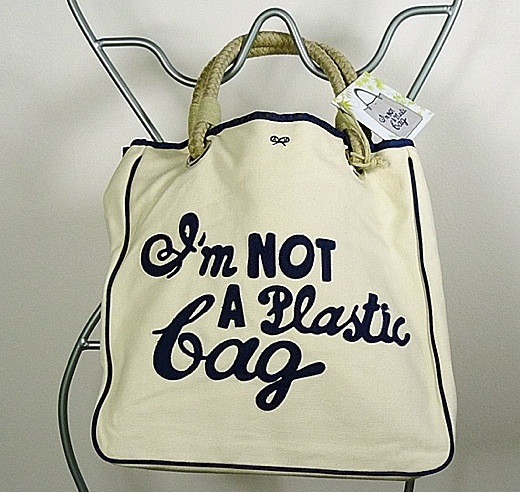 Image above: "I'm not a Plastic Bag" bag. From (http://nitrolicious.com/shop/2009/08/02/anya-hindmarch-%E2%80%9Ci%E2%80%99m-not-a-plastic-bag%E2%80%9D-tote-%E2%80%93-blue).
After completing an Environmental Impact Report (EIR), Los Angeles County Board of supervisors adopted an ordinance on November 16, 2010 banning plastic carryout bags and imposing a 10-‐cent fee on paper carryout bags.1
The EIR adopted the findings of the Ecobilan Report and the Scottish Report.2 Those reports determined that even after taking into account that paper bags hold more than plastic bags, the life cycle of a paper bag results in:
Image above: "I'm not a Plastic Bag" bag. From (http://nitrolicious.com/shop/2009/08/02/anya-hindmarch-%E2%80%9Ci%E2%80%99m-not-a-plastic-bag%E2%80%9D-tote-%E2%80%93-blue).
After completing an Environmental Impact Report (EIR), Los Angeles County Board of supervisors adopted an ordinance on November 16, 2010 banning plastic carryout bags and imposing a 10-‐cent fee on paper carryout bags.1
The EIR adopted the findings of the Ecobilan Report and the Scottish Report.2 Those reports determined that even after taking into account that paper bags hold more than plastic bags, the life cycle of a paper bag results in: