
SUBHEAD: America needs a systematic moral transformation, but very few are willing to take the necessary steps to get it.
By Ashvin Pandurangi on 2 August 2012 for Automatic Earth -
(http://theautomaticearth.com/Finance/permanent-growth-permanent-crisis.html)
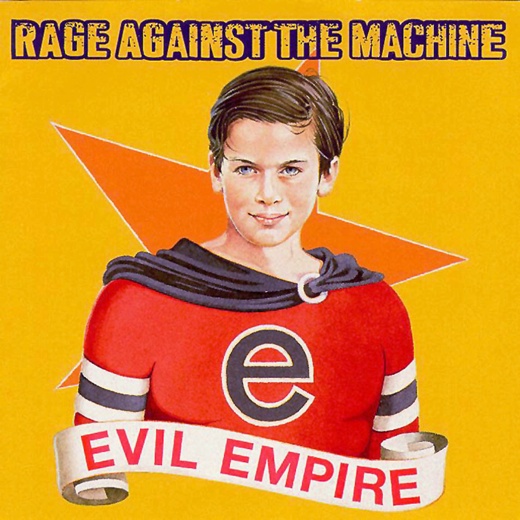
Image above: Album cover for "Evil Empire", the second release from band Rage Against the machine, in 1996. From (http://www.theaceblackblog.com/2011/04/cd-review-evil-empire-by-rage-against.html).
We need a systematic moral transformation in America - something which leads us to a society so fundamentally different than what we have now, it would be scarcely recognizable from our current perspective. That, in my opinion, is the conclusion Morris Berman gives us in his latest blog post, Sociopaths Rule, which is intended as a review and critique of the documentary, Heist: Who Stole the American Dream? (Frances Causey and Donald Goldmacher, 2011). Berman points out that Causey and Goldmacher are right to dump on Reagan's neo-liberal, trickle-UP economic paradigm, but they are also asking the wrong question.
It is not who stole the American Dream, but rather who convinced us that the "American Dream" is worth having in the first place. Why should we even value a socioeconomic philosophy centered on entrepreneurial individualism, unlimited growth and endless complexity? All of those things simply lead us to a state of moral apathy, which leads us to repeated bouts of corruption, exploitation and systemic crises. To answer the question of who transformed American culture into this state of hollow utilitarian morality, Berman takes us back to the very beginning and forces us to look in the mirror (full article found at link above).
America needs a systematic moral transformation, but very few are willing to take the necessary steps to get it.
See also:
Ea O Ka Aina: Post Growth Project 7/26/12
Ea O Ka Aina: Growth towards what? 11/14/11
Ea O Ka Aina: No Growth is Future Economy 7/15/10
Island Breath: Limits to Growth 6/9/08
Island Breath: Smart Growth = No Growth 4/17/07
Island Breath: Sustainability & Growth 4/19/05
The Gobbler: Economic Health vs Growth 6/21/93 .
By Ashvin Pandurangi on 2 August 2012 for Automatic Earth -
(http://theautomaticearth.com/Finance/permanent-growth-permanent-crisis.html)
Image above: Album cover for "Evil Empire", the second release from band Rage Against the machine, in 1996. From (http://www.theaceblackblog.com/2011/04/cd-review-evil-empire-by-rage-against.html).
We need a systematic moral transformation in America - something which leads us to a society so fundamentally different than what we have now, it would be scarcely recognizable from our current perspective. That, in my opinion, is the conclusion Morris Berman gives us in his latest blog post, Sociopaths Rule, which is intended as a review and critique of the documentary, Heist: Who Stole the American Dream? (Frances Causey and Donald Goldmacher, 2011). Berman points out that Causey and Goldmacher are right to dump on Reagan's neo-liberal, trickle-UP economic paradigm, but they are also asking the wrong question.
It is not who stole the American Dream, but rather who convinced us that the "American Dream" is worth having in the first place. Why should we even value a socioeconomic philosophy centered on entrepreneurial individualism, unlimited growth and endless complexity? All of those things simply lead us to a state of moral apathy, which leads us to repeated bouts of corruption, exploitation and systemic crises. To answer the question of who transformed American culture into this state of hollow utilitarian morality, Berman takes us back to the very beginning and forces us to look in the mirror (full article found at link above).
Greed, and the free-market ideology, were hardly born in 1981. In this sense, the film lacks a genuine (which is to say, long-range) historical perspective. Greed showed up on the American continent in the late sixteenth century, when what would later become the United States started to be colonized by a particularly aggressive and entrepreneurial segment of the English middle class. Louis Hartz makes this point in his classic work, The American Liberal Tradition (1955), when he says that America is a "fragment society," i.e. one that took a particular strand from the mother country—in this case the mentality of hustling, of go-getting, of unlimited economic expansion—and made it into the whole of the new country. One might argue that Reagan represented a "quantum leap" in this ideology, but he hardly invented it; from Day One, it is what America has been about. Credit-default swaps are merely the inevitable culmination of a process that has been going on for more than four hundred years.Over the last few decades, we have merely experienced the accelerated phase of economic, social, cultural and political decay in a country that has been decaying from the start. Note that the word "decay" cannot be confused with "contraction" or "stagnation". We are not talking about the inability of the wealth pie to grow or innovative institutions to develop - in fact, it is exactly those types of developments that contribute to the inner rot. If we want to recover any meaningful sense of justice, liberty, equality and social commonality, we must be willing to abandon the amoral American cultural Zeitgeist once and for all.
Like Occupy Wall Street, the film insists that we must "take back" the American Dream. Like OWS, it never seems to grasp the fact that rather than recovering or restoring the Americam Dream, we need to abolish it. The Dream is part of the American frontier mentality, coupled with the mythology of extreme individualism, and is in fact based on the idea of infinity: there can and should be no end to economic and technological expansion. Unfortunately for that hopelessly neurotic vision, we are fast running out of resources; the planet cannot support the Dream extended to every American, let alone every person on the planet. In fact, it was once calculated that for everyone on the planet to have a "modest" middle-class American life, we would need the resources of six Earths.So how do we achieve this radical transformation into a steady-state economy that abandons self-absorbed pursuits of growth and profit, and focuses on selfless struggle towards the good of the collective? As Berman states in his post, the American people are "exhausted, spiritually spent"... and any intentional metamorphosis of the national identity seems like a pipe dream right now. Movements such as Occupy may raise some awareness and produce a few beneficial results, but their underlying mentality about the whole thing falls way too short.
This is why socialism, or spreading the American Dream around more fairly, is not an adequate response to capitalism, because it too is based on the notions of "growth" and "progress," and those notions are fast becoming obsolete. The real shift required is not to (let's say) a Scandanavian-style economy, but to a steady-state one: no growth, and not profit-oriented. And if the left hates this, as I'm sure they do: well hard cheese, folks, because in thirty to forty years we are going to be forced into this, when petroleum runs out and the dream of unlimited energy turns into the nightmare of scarcity. To socialists and capitalists alike, to Paul Krugman and Robert Reich and every other so-called liberal, I can only say this: permanent growth means permanent crisis. It's time to start equating this type of growth with cancer.
America needs a systematic moral transformation, but very few are willing to take the necessary steps to get it.
"Compromise
Conformity
Assimilation
Submission
Ignorance
Hypocrisy
Brutality
The Elite
All of which are American dreams!"
(Rage Against the Machine, Know Your Enemy)
Ea O Ka Aina: Post Growth Project 7/26/12
Ea O Ka Aina: Growth towards what? 11/14/11
Ea O Ka Aina: No Growth is Future Economy 7/15/10
Island Breath: Limits to Growth 6/9/08
Island Breath: Smart Growth = No Growth 4/17/07
Island Breath: Sustainability & Growth 4/19/05
The Gobbler: Economic Health vs Growth 6/21/93 .

