SOURCE: Ed Wagner (ed.j.wagner@gmail.com)
SUBHEAD: US Jones Act’s impact on Hawaii’s economy versus commerce clause protections for all states.
By John S. Carroll on 30 October 2013 in Island Breath -
(http://islandbreath.blogspot.com/2013/10/jones-act-damage-to-hawaii.html)
[Source's note: I have attached a copy of a Jones Act speech given by Honolulu Attorney John Carroll to the National Defense Transportation Association at the Pagoda Hotel October 30, 2013]
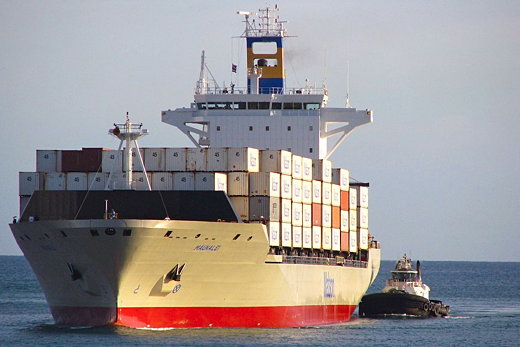
Image above: Matson's cotnatiner ship Maunalei on arrival in Honolulu Harbor. Taken from Aloha Tower Marketplace, Honolulu Harbor 4/22/11. From (http://www.flickr.com/photos/macprohawaii/5672274948/).
The fundamental purposes of the Commerce Clause of the US Constitution are, “...to assure the unrestricted flow of commerce throughout the several states,” [282 NE2d 336], and “...to assure to the commercial enterprises in every state substantial equality to access to a free national market,” [517 P2d 691], Further, the “...power granted is a positive power to legislate concerning transactions which, reaching across state boundaries, affect the people of more states than one, and to govern affairs which the individual states, with their limited territorial jurisdictions, are not fully capable of governing.” [322 US 533].
That language is very clear. You don’t need to be a lawyer or Constitutional scholar to understand that the Jones Act is in direct violation of, at least the spirit, if not the PRIMARY PURPOSE of the Commerce Clause of the U.S.Constitution . The Jones Act was passed into federal law in 1920, almost 40 years before Hawaii became a state.
That Act requires that for a ship to operate in interstate commerce, (between states), it must be built in America, owned by Americans, 75 percent manned by an American crew, and maintained and flagged in the United States. The net effect of the enforcement of the Jones Act on the State of Hawaii’s population has been wide-ranging. Examples:
The expense of agricultural production became prohibitive, not only because of the inbound shipping cost of fertilizers, herbicides, and farm implements but also due to the outbound shipping costs for our locally grown fruits, livestock and ornamental plants. Agriculture is no longer a viable component of this State’s economy.
Mothers in Hawaii pay up to $9.00 a gallon for fresh milk that is at best seven days old. No one I know of has analyzed the amount of preservative chemicals being injected into milk in order to keep it on the shelf for several weeks. There is almost no fresh milk being produced in Hawaii. Fresh poultry products have suffered the same fate. Our families are paying dearly for products that are at the end of normal shelf life by the time they become available for sale.
Every aspect of construction and commerce is similarly effected. Construction materials, lumber, paints and coatings, fixtures, and appliances all come at premium prices because of the Jones Act restrictions.
Hawaii Island cattle ranchers are faced with an intolerable situation. They transport their cattle from Kawaihae to Vancouver, B.C. on the Canadian-owned Corral Lines. Just to remain profitable, the cattle must be trucked across the border into the U.S. after which they have to be fattened to be sold. Some are flown in on 747 cargo planes at great cost to the ranchers. Hawaii is the only State in the United States that is completely free of “Mad Cow” disease. It is the safest, best-quality beef in America.
We could be in the midst of a beef-exporting boom to North America and Asia if only our ranchers could bring in the feed and ship the beef at competitive international rates. This isn’t just about beef, or mangoes, or pineapples, or coffee, my friends.
This is a story of good jobs lost, a State economy with no solid, economically viable component which could foster Hawaii’s total independence as a food producing center of the world. Our Beef, Pork, Poultry, Taro, Lilikoi, Mangoes, Pineapple and Papaya, organically produced, can command top prices on worldwide markets.
Since the Jones Act was passed in 1920, a monopolistic control of shipping in and out of the State of
Hawaii, has been entrenched. It effectively eliminates the cost reducing benefits of competition.
By comparison, the tiny islands of Singapore and Hong Kong, which do not have similar trade restrictions and with less than 1/20th the land mass of Hawaii, enjoy a combined Gross Domestic Product in excess of 200 billion U.S. dollars per year. That is over 300% times greater than Hawai`i’s GDP of sixty four billion U.S. dollars per year. This is an absurdity in terms of economic viability.
Our members in the US Congress, including former Representative Abercrombie, have stood together to keep the Jones Act in force despite its clearly devastating impact on our State’s economy.
None of our current Congressional Members, Senators Hirono and Schatz, Congressman Hanabusa and Gabbard, Governors Lingle and Abercrombie have so much as mentioned these shipping restrictions.
No leader in either party other than Charles Dejou and Ed Case have so much
as questioned the constitutionality of the imposition of these restrictions on this single state which has not one connecting highway, rail road or pipeline to any other state. “Equal access to interstate commerce”????
I don’t think so.
The elimination of these shipping restrictions must be a front burner issue in both the Gubernatorial and the Congressional races. The potential positive impact of reforming and eventually repealing the Jones Act is crystal clear. Products not only from Asia but from all over the globe travel thousands of extra nautical miles before they arrive in Hawaii. They are first shipped to a western state in the Continental US and then transferred to a Jones Act approved shipping line. We pay for all those extra miles of travel.
To make it worse, there are only two such lines that serve Hawaii, Matson and Horizon. They keep our shipping rates the highest in the world, far exceeding the cost of the extra miles and fuel. For example, companies shipping solid
waste out of our state to Asia to be made into recycled paper, plastic, and metals pay four times the per mile rate charged to mainland companies in the same business. This is a critical economic activity in Hawaii because of our lack of landfill space. How can Hawaii companies in this business survive and make a profit when they are charged four times as much for shipping the same materials?
An even more critical example of the negative effect of the Jones Act is butane. Butane is a gas that is essential to the operation of all of our hospitals and hotels. Most of the cooking and water heating in institutional-sized venues is done with butane. A reliable, affordable supply of butane is critical to the day-to-day functioning of our economy.
There is cheap butane available in California, but Hawaii operates on more expensive butane that is produced here in Hawaii or in Indonesia. Some butane comes into Honolulu on board Indonesian ships. Why would a business buy a commodity at a higher price that comes from farther away?
The reason for that is that there are NO, nada, none... American Jones Act-qualified ships that can carry bulk The Star Advertiser published the results of a poll showing that 82% of its readers favored either elimination or major modification of the Jones Act shipping prohibitions as they affect Hawaii.
This was following the filing of the Patrick Novak law suit against the US Government to eliminate Jones Act restrictions on Hawaii. That poll was an excellent effort with an excellent result as far as accuracy is concerned. Unfortunately, far too few voting citizens are aware of the impact of these restrictions.
Mike Hansen of the Shippers Council has spoken regarding the use of non Jones Act qualified vessels being utilized by the US Government, particularly the Department of Defense. America’s Shippers cannot use foreign built ships which puts them at a competitive disadvantage with foreign shippers who do not need to operate in interstate commerce.
A waiver of the so called “build” requirement could enhance American Shippers competitive position in international ship borne commerce. Given that the US Government has granted itself an exemption it would seem only fair to allow shippers the same advantage.
The purpose of the cabotage restrictions of the Act was to protect the US Merchant Fleet for National Defense purposes and the fact is that has failed,
THEREFORE:
ALL cabotage restrictions should be eliminated to allow the full, unfettered flow of international commerce to begin for Hawaii and the rest of our Country.
APEC proponents exalted “FREE TRADE” when it was held here in this State where foreign vessels are effectively excluded because of the interstate prohibitions.
.
SUBHEAD: US Jones Act’s impact on Hawaii’s economy versus commerce clause protections for all states.
By John S. Carroll on 30 October 2013 in Island Breath -
(http://islandbreath.blogspot.com/2013/10/jones-act-damage-to-hawaii.html)
[Source's note: I have attached a copy of a Jones Act speech given by Honolulu Attorney John Carroll to the National Defense Transportation Association at the Pagoda Hotel October 30, 2013]
Image above: Matson's cotnatiner ship Maunalei on arrival in Honolulu Harbor. Taken from Aloha Tower Marketplace, Honolulu Harbor 4/22/11. From (http://www.flickr.com/photos/macprohawaii/5672274948/).
The fundamental purposes of the Commerce Clause of the US Constitution are, “...to assure the unrestricted flow of commerce throughout the several states,” [282 NE2d 336], and “...to assure to the commercial enterprises in every state substantial equality to access to a free national market,” [517 P2d 691], Further, the “...power granted is a positive power to legislate concerning transactions which, reaching across state boundaries, affect the people of more states than one, and to govern affairs which the individual states, with their limited territorial jurisdictions, are not fully capable of governing.” [322 US 533].
That language is very clear. You don’t need to be a lawyer or Constitutional scholar to understand that the Jones Act is in direct violation of, at least the spirit, if not the PRIMARY PURPOSE of the Commerce Clause of the U.S.Constitution . The Jones Act was passed into federal law in 1920, almost 40 years before Hawaii became a state.
That Act requires that for a ship to operate in interstate commerce, (between states), it must be built in America, owned by Americans, 75 percent manned by an American crew, and maintained and flagged in the United States. The net effect of the enforcement of the Jones Act on the State of Hawaii’s population has been wide-ranging. Examples:
The expense of agricultural production became prohibitive, not only because of the inbound shipping cost of fertilizers, herbicides, and farm implements but also due to the outbound shipping costs for our locally grown fruits, livestock and ornamental plants. Agriculture is no longer a viable component of this State’s economy.
Mothers in Hawaii pay up to $9.00 a gallon for fresh milk that is at best seven days old. No one I know of has analyzed the amount of preservative chemicals being injected into milk in order to keep it on the shelf for several weeks. There is almost no fresh milk being produced in Hawaii. Fresh poultry products have suffered the same fate. Our families are paying dearly for products that are at the end of normal shelf life by the time they become available for sale.
Every aspect of construction and commerce is similarly effected. Construction materials, lumber, paints and coatings, fixtures, and appliances all come at premium prices because of the Jones Act restrictions.
Hawaii Island cattle ranchers are faced with an intolerable situation. They transport their cattle from Kawaihae to Vancouver, B.C. on the Canadian-owned Corral Lines. Just to remain profitable, the cattle must be trucked across the border into the U.S. after which they have to be fattened to be sold. Some are flown in on 747 cargo planes at great cost to the ranchers. Hawaii is the only State in the United States that is completely free of “Mad Cow” disease. It is the safest, best-quality beef in America.
We could be in the midst of a beef-exporting boom to North America and Asia if only our ranchers could bring in the feed and ship the beef at competitive international rates. This isn’t just about beef, or mangoes, or pineapples, or coffee, my friends.
This is a story of good jobs lost, a State economy with no solid, economically viable component which could foster Hawaii’s total independence as a food producing center of the world. Our Beef, Pork, Poultry, Taro, Lilikoi, Mangoes, Pineapple and Papaya, organically produced, can command top prices on worldwide markets.
Since the Jones Act was passed in 1920, a monopolistic control of shipping in and out of the State of
Hawaii, has been entrenched. It effectively eliminates the cost reducing benefits of competition.
By comparison, the tiny islands of Singapore and Hong Kong, which do not have similar trade restrictions and with less than 1/20th the land mass of Hawaii, enjoy a combined Gross Domestic Product in excess of 200 billion U.S. dollars per year. That is over 300% times greater than Hawai`i’s GDP of sixty four billion U.S. dollars per year. This is an absurdity in terms of economic viability.
Our members in the US Congress, including former Representative Abercrombie, have stood together to keep the Jones Act in force despite its clearly devastating impact on our State’s economy.
None of our current Congressional Members, Senators Hirono and Schatz, Congressman Hanabusa and Gabbard, Governors Lingle and Abercrombie have so much as mentioned these shipping restrictions.
No leader in either party other than Charles Dejou and Ed Case have so much
as questioned the constitutionality of the imposition of these restrictions on this single state which has not one connecting highway, rail road or pipeline to any other state. “Equal access to interstate commerce”????
I don’t think so.
The elimination of these shipping restrictions must be a front burner issue in both the Gubernatorial and the Congressional races. The potential positive impact of reforming and eventually repealing the Jones Act is crystal clear. Products not only from Asia but from all over the globe travel thousands of extra nautical miles before they arrive in Hawaii. They are first shipped to a western state in the Continental US and then transferred to a Jones Act approved shipping line. We pay for all those extra miles of travel.
To make it worse, there are only two such lines that serve Hawaii, Matson and Horizon. They keep our shipping rates the highest in the world, far exceeding the cost of the extra miles and fuel. For example, companies shipping solid
waste out of our state to Asia to be made into recycled paper, plastic, and metals pay four times the per mile rate charged to mainland companies in the same business. This is a critical economic activity in Hawaii because of our lack of landfill space. How can Hawaii companies in this business survive and make a profit when they are charged four times as much for shipping the same materials?
An even more critical example of the negative effect of the Jones Act is butane. Butane is a gas that is essential to the operation of all of our hospitals and hotels. Most of the cooking and water heating in institutional-sized venues is done with butane. A reliable, affordable supply of butane is critical to the day-to-day functioning of our economy.
There is cheap butane available in California, but Hawaii operates on more expensive butane that is produced here in Hawaii or in Indonesia. Some butane comes into Honolulu on board Indonesian ships. Why would a business buy a commodity at a higher price that comes from farther away?
The reason for that is that there are NO, nada, none... American Jones Act-qualified ships that can carry bulk The Star Advertiser published the results of a poll showing that 82% of its readers favored either elimination or major modification of the Jones Act shipping prohibitions as they affect Hawaii.
This was following the filing of the Patrick Novak law suit against the US Government to eliminate Jones Act restrictions on Hawaii. That poll was an excellent effort with an excellent result as far as accuracy is concerned. Unfortunately, far too few voting citizens are aware of the impact of these restrictions.
Mike Hansen of the Shippers Council has spoken regarding the use of non Jones Act qualified vessels being utilized by the US Government, particularly the Department of Defense. America’s Shippers cannot use foreign built ships which puts them at a competitive disadvantage with foreign shippers who do not need to operate in interstate commerce.
A waiver of the so called “build” requirement could enhance American Shippers competitive position in international ship borne commerce. Given that the US Government has granted itself an exemption it would seem only fair to allow shippers the same advantage.
The purpose of the cabotage restrictions of the Act was to protect the US Merchant Fleet for National Defense purposes and the fact is that has failed,
THEREFORE:
ALL cabotage restrictions should be eliminated to allow the full, unfettered flow of international commerce to begin for Hawaii and the rest of our Country.
APEC proponents exalted “FREE TRADE” when it was held here in this State where foreign vessels are effectively excluded because of the interstate prohibitions.
.