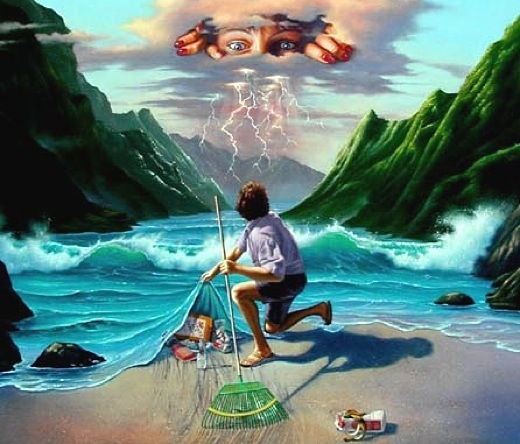
 Image above: Detail of painting by Jim Warren titled "Don't Mess With Mother Nature".
From (http://www.jimwarren.com/site/index.php?option=com_gallery2&Itemid=57&g2_itemId=85)
By Andy Clarke on 25 August 2009 in Andy's Column -
(http://www.cacor.ca/Andy%27s-col-2.html)
In our last column (June 1-30, 2009) we stated that what is required for the achievement of a sustainable society is the replacement of the present exponential growth system with an economic and political order based upon both ecological imperatives and the requirements for intergenerational well being. In short, and as stated by Aurelio Peccei and the Executive of the Club of Rome in 1972 (1), we are compelled to seek a “state of equilibrium” with Nature on our planet. This goal will require nothing less than the construction of an entirely new paradigm, effectively a steady state economic and political system, for the continuance of the human enterprise.
Before we can begin to explore the essential elements involved in replacing exponential growth with a steady state economic and political system, we must first gain an understanding of why the existing growth system has been dominant since the beginning of the agricultural revolution, soon followed by the first civilizations, about 10,000 years ago.
Not unlike all other species that have evolved on planet Earth, the human species is driven first and foremost by its several “wants”, with particular reference to food, protection from the elements, security from predators, and growth in population. It is only through success in achieving these “wants” that our species survived and eventually achieved its present level of dominance over all other advanced life forms. But now that humans have achieved a position without equal on planet Earth, the human growth drive now threatens the extinction on a massive scale of not only other biological life but perhaps humans themselves.
The question above all questions is: Have humans acquired, at this critical moment in their journey, the maturity and intelligence to replace exponential growth with a new political, economic and cultural global society based upon, and consistent with, ecological imperatives? Or, in the words of a recent study (2), does humanity now possess the wisdom to “move from its often selfish, self-centered adolescence to a more globally responsible adulthood?”
If we answer the above questions in the affirmative, almost certainly the only response that can lead to a civilized future for humanity, it is also important that we gain an adequate understanding of the magnitude of the challenges that must be overcome in the transition from the present nation-state growth paradigm to a new state of equilibrium with Nature.
Probably the greatest challenge we face is that our present global civilization is now consuming resources at a rate that is over 30% above what is sustainable. While economic conditions vary greatly throughout the world, our level of global overshoot continues to increase, both because of continuing growth in the developed world of approximately one billion people (OECD countries), and the strenuous efforts in most of the developing world, particularly China and India, to achieve developed world economic conditions.
Should the above percentage of overshoot of sustainability continue to increase, degradation of the Earth’s present level of carrying capacity must also be expected to increase. In other words, if the sustainable carrying capacity of the planet was about 3 billion living at first world economic standards in 1980, before overshoot began, today it may be only 2 billion and decreasing (3).
While the above trend in a reduction in the sustainable carrying capacity of the planet is troubling enough, a more detailed examination of the components of overshoot, population growth and consumption trends, provides still greater concern.
The global population is now about 6.8 billion and increasing about 70 million annually, or about 1 billion every 15 years. The United Nations mid projection for 2050 is 9 billion. But even should the world’s population level off at about 9 billion 40 years from now, it would appear that we will have exceeded the above 2 billion carrying capacity more than fourfold.
This depressing projection also does not allow for the resources required to improve the living standards of developing nations (includes some 2 billion now existing on $2.00 a day or less). There is now no escaping the conclusion that our unfolding destiny is now on a trajectory leading to collapse of today’s global civilization. The opportunity for necessary corrective action passed us by about three decades ago.
The evidence is becoming overwhelming that the forces of Nature will soon substantially reduce world population, and lessen the ecological destruction that humanity is now inflicting on the planet, by a sustainable level. Even after making a significant allowance for uncertainties and projection errors, it is no longer possible to avoid the conclusion that the transfer of world society to a steady state of economic and ecological equilibrium will not occur before humanity first experiences a period of major regression.
The unavoidable truth is that humankind must either abide by Earth’s limits or Nature will have the last word in setting things “right.”
There can be no doubt that many persons will reject the above frightful conclusion that a substantial die-off of humanity will occur before a viable rearrangement of the economic, political and social affairs of humanity becomes a practical possibility.
Many persons, including many of the well informed, will instinctively dismiss the above analysis because in their view it is unacceptable, and therefore there must be a less painful solution. Others may reject the above conclusion because it amounts to a counsel for despair. And still others will dismiss die-off because it borders on the unbelievable and beyond what can be imagined, or is contrary to their religious beliefs.
Persons who may be tempted to reject the above analysis would do well to reflect on the words contained in two important and authoritative research studies, the first published 37 years ago, and the second 5 years ago:
“Only real comprehension of the human condition at this turning point in history can provide sufficient motivation for people to accept the individual sacrifices and the changes in political and economic power structures to reach an equilibrium state.”
-- The Executive Commentary in Limits to Growth, 1972
“In 1972 it seemed that humanity’s population and economy were still comfortably below the planet’s carrying capacity. We thought there was still room to grow safely while examining longer term options. That may have been true in 1972; by 1992 it was no longer true.”
-- Limits to Growth, The 30-Year Update, 2004
While there can be little doubt that we must first pass through E. O. Wilson’s bottleneck (4) before more favorable opportunities for a steady state society in equilibrium with Nature come into view, there is today a vitally important survival mission for the more adventuresome among us.
If we assume that positive climate change feed back loops will not lead to a planet unsuitable for humans, it is possible that the first steps toward sustainable communities may begin to take root before the end of this century. Preparations begun today, leading to resilient and self sufficient local communities, will help lead the way toward the rebirth of human civilization. While a measure of faith is certainly required, now is the time to invest in, and prepare the way for, post bottleneck future generations.
Notes:
(1) Refer “The Limits to Growth”, page 195.
(2) Refer “The planet’s future: Climate change will cause civilization to collapse”, The Independent, July 12, 2009.
(3) Numerous writers have indicated that a sustainable world population living at first world standards numbers in the 1 to 2 billion range.
(4) E. O. Wilson, one of the greatest contemporary biologists, refers to “the bottleneck” as a crisis beyond all earlier experience.
see also:
Ea O Ka Aina: Apocalypse Now! 6/7/09
Ea O Ka Aina: Malthus and Vice 4/10/09
Island Breath: Sustainability - A vision for Kauai 1/4/04
Image above: Detail of painting by Jim Warren titled "Don't Mess With Mother Nature".
From (http://www.jimwarren.com/site/index.php?option=com_gallery2&Itemid=57&g2_itemId=85)
By Andy Clarke on 25 August 2009 in Andy's Column -
(http://www.cacor.ca/Andy%27s-col-2.html)
In our last column (June 1-30, 2009) we stated that what is required for the achievement of a sustainable society is the replacement of the present exponential growth system with an economic and political order based upon both ecological imperatives and the requirements for intergenerational well being. In short, and as stated by Aurelio Peccei and the Executive of the Club of Rome in 1972 (1), we are compelled to seek a “state of equilibrium” with Nature on our planet. This goal will require nothing less than the construction of an entirely new paradigm, effectively a steady state economic and political system, for the continuance of the human enterprise.
Before we can begin to explore the essential elements involved in replacing exponential growth with a steady state economic and political system, we must first gain an understanding of why the existing growth system has been dominant since the beginning of the agricultural revolution, soon followed by the first civilizations, about 10,000 years ago.
Not unlike all other species that have evolved on planet Earth, the human species is driven first and foremost by its several “wants”, with particular reference to food, protection from the elements, security from predators, and growth in population. It is only through success in achieving these “wants” that our species survived and eventually achieved its present level of dominance over all other advanced life forms. But now that humans have achieved a position without equal on planet Earth, the human growth drive now threatens the extinction on a massive scale of not only other biological life but perhaps humans themselves.
The question above all questions is: Have humans acquired, at this critical moment in their journey, the maturity and intelligence to replace exponential growth with a new political, economic and cultural global society based upon, and consistent with, ecological imperatives? Or, in the words of a recent study (2), does humanity now possess the wisdom to “move from its often selfish, self-centered adolescence to a more globally responsible adulthood?”
If we answer the above questions in the affirmative, almost certainly the only response that can lead to a civilized future for humanity, it is also important that we gain an adequate understanding of the magnitude of the challenges that must be overcome in the transition from the present nation-state growth paradigm to a new state of equilibrium with Nature.
Probably the greatest challenge we face is that our present global civilization is now consuming resources at a rate that is over 30% above what is sustainable. While economic conditions vary greatly throughout the world, our level of global overshoot continues to increase, both because of continuing growth in the developed world of approximately one billion people (OECD countries), and the strenuous efforts in most of the developing world, particularly China and India, to achieve developed world economic conditions.
Should the above percentage of overshoot of sustainability continue to increase, degradation of the Earth’s present level of carrying capacity must also be expected to increase. In other words, if the sustainable carrying capacity of the planet was about 3 billion living at first world economic standards in 1980, before overshoot began, today it may be only 2 billion and decreasing (3).
While the above trend in a reduction in the sustainable carrying capacity of the planet is troubling enough, a more detailed examination of the components of overshoot, population growth and consumption trends, provides still greater concern.
The global population is now about 6.8 billion and increasing about 70 million annually, or about 1 billion every 15 years. The United Nations mid projection for 2050 is 9 billion. But even should the world’s population level off at about 9 billion 40 years from now, it would appear that we will have exceeded the above 2 billion carrying capacity more than fourfold.
This depressing projection also does not allow for the resources required to improve the living standards of developing nations (includes some 2 billion now existing on $2.00 a day or less). There is now no escaping the conclusion that our unfolding destiny is now on a trajectory leading to collapse of today’s global civilization. The opportunity for necessary corrective action passed us by about three decades ago.
The evidence is becoming overwhelming that the forces of Nature will soon substantially reduce world population, and lessen the ecological destruction that humanity is now inflicting on the planet, by a sustainable level. Even after making a significant allowance for uncertainties and projection errors, it is no longer possible to avoid the conclusion that the transfer of world society to a steady state of economic and ecological equilibrium will not occur before humanity first experiences a period of major regression.
The unavoidable truth is that humankind must either abide by Earth’s limits or Nature will have the last word in setting things “right.”
There can be no doubt that many persons will reject the above frightful conclusion that a substantial die-off of humanity will occur before a viable rearrangement of the economic, political and social affairs of humanity becomes a practical possibility.
Many persons, including many of the well informed, will instinctively dismiss the above analysis because in their view it is unacceptable, and therefore there must be a less painful solution. Others may reject the above conclusion because it amounts to a counsel for despair. And still others will dismiss die-off because it borders on the unbelievable and beyond what can be imagined, or is contrary to their religious beliefs.
Persons who may be tempted to reject the above analysis would do well to reflect on the words contained in two important and authoritative research studies, the first published 37 years ago, and the second 5 years ago:
“Only real comprehension of the human condition at this turning point in history can provide sufficient motivation for people to accept the individual sacrifices and the changes in political and economic power structures to reach an equilibrium state.”
-- The Executive Commentary in Limits to Growth, 1972
“In 1972 it seemed that humanity’s population and economy were still comfortably below the planet’s carrying capacity. We thought there was still room to grow safely while examining longer term options. That may have been true in 1972; by 1992 it was no longer true.”
-- Limits to Growth, The 30-Year Update, 2004
While there can be little doubt that we must first pass through E. O. Wilson’s bottleneck (4) before more favorable opportunities for a steady state society in equilibrium with Nature come into view, there is today a vitally important survival mission for the more adventuresome among us.
If we assume that positive climate change feed back loops will not lead to a planet unsuitable for humans, it is possible that the first steps toward sustainable communities may begin to take root before the end of this century. Preparations begun today, leading to resilient and self sufficient local communities, will help lead the way toward the rebirth of human civilization. While a measure of faith is certainly required, now is the time to invest in, and prepare the way for, post bottleneck future generations.
Notes:
(1) Refer “The Limits to Growth”, page 195.
(2) Refer “The planet’s future: Climate change will cause civilization to collapse”, The Independent, July 12, 2009.
(3) Numerous writers have indicated that a sustainable world population living at first world standards numbers in the 1 to 2 billion range.
(4) E. O. Wilson, one of the greatest contemporary biologists, refers to “the bottleneck” as a crisis beyond all earlier experience.
see also:
Ea O Ka Aina: Apocalypse Now! 6/7/09
Ea O Ka Aina: Malthus and Vice 4/10/09
Island Breath: Sustainability - A vision for Kauai 1/4/04
Possibilities & Probabilities

SUBHEAD: Nature could have the last word in setting things “right".
Image above: Detail of painting by Jim Warren titled "Don't Mess With Mother Nature".
From (http://www.jimwarren.com/site/index.php?option=com_gallery2&Itemid=57&g2_itemId=85)
By Andy Clarke on 25 August 2009 in Andy's Column -
(http://www.cacor.ca/Andy%27s-col-2.html)
In our last column (June 1-30, 2009) we stated that what is required for the achievement of a sustainable society is the replacement of the present exponential growth system with an economic and political order based upon both ecological imperatives and the requirements for intergenerational well being. In short, and as stated by Aurelio Peccei and the Executive of the Club of Rome in 1972 (1), we are compelled to seek a “state of equilibrium” with Nature on our planet. This goal will require nothing less than the construction of an entirely new paradigm, effectively a steady state economic and political system, for the continuance of the human enterprise.
Before we can begin to explore the essential elements involved in replacing exponential growth with a steady state economic and political system, we must first gain an understanding of why the existing growth system has been dominant since the beginning of the agricultural revolution, soon followed by the first civilizations, about 10,000 years ago.
Not unlike all other species that have evolved on planet Earth, the human species is driven first and foremost by its several “wants”, with particular reference to food, protection from the elements, security from predators, and growth in population. It is only through success in achieving these “wants” that our species survived and eventually achieved its present level of dominance over all other advanced life forms. But now that humans have achieved a position without equal on planet Earth, the human growth drive now threatens the extinction on a massive scale of not only other biological life but perhaps humans themselves.
The question above all questions is: Have humans acquired, at this critical moment in their journey, the maturity and intelligence to replace exponential growth with a new political, economic and cultural global society based upon, and consistent with, ecological imperatives? Or, in the words of a recent study (2), does humanity now possess the wisdom to “move from its often selfish, self-centered adolescence to a more globally responsible adulthood?”
If we answer the above questions in the affirmative, almost certainly the only response that can lead to a civilized future for humanity, it is also important that we gain an adequate understanding of the magnitude of the challenges that must be overcome in the transition from the present nation-state growth paradigm to a new state of equilibrium with Nature.
Probably the greatest challenge we face is that our present global civilization is now consuming resources at a rate that is over 30% above what is sustainable. While economic conditions vary greatly throughout the world, our level of global overshoot continues to increase, both because of continuing growth in the developed world of approximately one billion people (OECD countries), and the strenuous efforts in most of the developing world, particularly China and India, to achieve developed world economic conditions.
Should the above percentage of overshoot of sustainability continue to increase, degradation of the Earth’s present level of carrying capacity must also be expected to increase. In other words, if the sustainable carrying capacity of the planet was about 3 billion living at first world economic standards in 1980, before overshoot began, today it may be only 2 billion and decreasing (3).
While the above trend in a reduction in the sustainable carrying capacity of the planet is troubling enough, a more detailed examination of the components of overshoot, population growth and consumption trends, provides still greater concern.
The global population is now about 6.8 billion and increasing about 70 million annually, or about 1 billion every 15 years. The United Nations mid projection for 2050 is 9 billion. But even should the world’s population level off at about 9 billion 40 years from now, it would appear that we will have exceeded the above 2 billion carrying capacity more than fourfold.
This depressing projection also does not allow for the resources required to improve the living standards of developing nations (includes some 2 billion now existing on $2.00 a day or less). There is now no escaping the conclusion that our unfolding destiny is now on a trajectory leading to collapse of today’s global civilization. The opportunity for necessary corrective action passed us by about three decades ago.
The evidence is becoming overwhelming that the forces of Nature will soon substantially reduce world population, and lessen the ecological destruction that humanity is now inflicting on the planet, by a sustainable level. Even after making a significant allowance for uncertainties and projection errors, it is no longer possible to avoid the conclusion that the transfer of world society to a steady state of economic and ecological equilibrium will not occur before humanity first experiences a period of major regression.
The unavoidable truth is that humankind must either abide by Earth’s limits or Nature will have the last word in setting things “right.”
There can be no doubt that many persons will reject the above frightful conclusion that a substantial die-off of humanity will occur before a viable rearrangement of the economic, political and social affairs of humanity becomes a practical possibility.
Many persons, including many of the well informed, will instinctively dismiss the above analysis because in their view it is unacceptable, and therefore there must be a less painful solution. Others may reject the above conclusion because it amounts to a counsel for despair. And still others will dismiss die-off because it borders on the unbelievable and beyond what can be imagined, or is contrary to their religious beliefs.
Persons who may be tempted to reject the above analysis would do well to reflect on the words contained in two important and authoritative research studies, the first published 37 years ago, and the second 5 years ago:
“Only real comprehension of the human condition at this turning point in history can provide sufficient motivation for people to accept the individual sacrifices and the changes in political and economic power structures to reach an equilibrium state.”
-- The Executive Commentary in Limits to Growth, 1972
“In 1972 it seemed that humanity’s population and economy were still comfortably below the planet’s carrying capacity. We thought there was still room to grow safely while examining longer term options. That may have been true in 1972; by 1992 it was no longer true.”
-- Limits to Growth, The 30-Year Update, 2004
While there can be little doubt that we must first pass through E. O. Wilson’s bottleneck (4) before more favorable opportunities for a steady state society in equilibrium with Nature come into view, there is today a vitally important survival mission for the more adventuresome among us.
If we assume that positive climate change feed back loops will not lead to a planet unsuitable for humans, it is possible that the first steps toward sustainable communities may begin to take root before the end of this century. Preparations begun today, leading to resilient and self sufficient local communities, will help lead the way toward the rebirth of human civilization. While a measure of faith is certainly required, now is the time to invest in, and prepare the way for, post bottleneck future generations.
Notes:
(1) Refer “The Limits to Growth”, page 195.
(2) Refer “The planet’s future: Climate change will cause civilization to collapse”, The Independent, July 12, 2009.
(3) Numerous writers have indicated that a sustainable world population living at first world standards numbers in the 1 to 2 billion range.
(4) E. O. Wilson, one of the greatest contemporary biologists, refers to “the bottleneck” as a crisis beyond all earlier experience.
see also:
Ea O Ka Aina: Apocalypse Now! 6/7/09
Ea O Ka Aina: Malthus and Vice 4/10/09
Island Breath: Sustainability - A vision for Kauai 1/4/04
Image above: Detail of painting by Jim Warren titled "Don't Mess With Mother Nature".
From (http://www.jimwarren.com/site/index.php?option=com_gallery2&Itemid=57&g2_itemId=85)
By Andy Clarke on 25 August 2009 in Andy's Column -
(http://www.cacor.ca/Andy%27s-col-2.html)
In our last column (June 1-30, 2009) we stated that what is required for the achievement of a sustainable society is the replacement of the present exponential growth system with an economic and political order based upon both ecological imperatives and the requirements for intergenerational well being. In short, and as stated by Aurelio Peccei and the Executive of the Club of Rome in 1972 (1), we are compelled to seek a “state of equilibrium” with Nature on our planet. This goal will require nothing less than the construction of an entirely new paradigm, effectively a steady state economic and political system, for the continuance of the human enterprise.
Before we can begin to explore the essential elements involved in replacing exponential growth with a steady state economic and political system, we must first gain an understanding of why the existing growth system has been dominant since the beginning of the agricultural revolution, soon followed by the first civilizations, about 10,000 years ago.
Not unlike all other species that have evolved on planet Earth, the human species is driven first and foremost by its several “wants”, with particular reference to food, protection from the elements, security from predators, and growth in population. It is only through success in achieving these “wants” that our species survived and eventually achieved its present level of dominance over all other advanced life forms. But now that humans have achieved a position without equal on planet Earth, the human growth drive now threatens the extinction on a massive scale of not only other biological life but perhaps humans themselves.
The question above all questions is: Have humans acquired, at this critical moment in their journey, the maturity and intelligence to replace exponential growth with a new political, economic and cultural global society based upon, and consistent with, ecological imperatives? Or, in the words of a recent study (2), does humanity now possess the wisdom to “move from its often selfish, self-centered adolescence to a more globally responsible adulthood?”
If we answer the above questions in the affirmative, almost certainly the only response that can lead to a civilized future for humanity, it is also important that we gain an adequate understanding of the magnitude of the challenges that must be overcome in the transition from the present nation-state growth paradigm to a new state of equilibrium with Nature.
Probably the greatest challenge we face is that our present global civilization is now consuming resources at a rate that is over 30% above what is sustainable. While economic conditions vary greatly throughout the world, our level of global overshoot continues to increase, both because of continuing growth in the developed world of approximately one billion people (OECD countries), and the strenuous efforts in most of the developing world, particularly China and India, to achieve developed world economic conditions.
Should the above percentage of overshoot of sustainability continue to increase, degradation of the Earth’s present level of carrying capacity must also be expected to increase. In other words, if the sustainable carrying capacity of the planet was about 3 billion living at first world economic standards in 1980, before overshoot began, today it may be only 2 billion and decreasing (3).
While the above trend in a reduction in the sustainable carrying capacity of the planet is troubling enough, a more detailed examination of the components of overshoot, population growth and consumption trends, provides still greater concern.
The global population is now about 6.8 billion and increasing about 70 million annually, or about 1 billion every 15 years. The United Nations mid projection for 2050 is 9 billion. But even should the world’s population level off at about 9 billion 40 years from now, it would appear that we will have exceeded the above 2 billion carrying capacity more than fourfold.
This depressing projection also does not allow for the resources required to improve the living standards of developing nations (includes some 2 billion now existing on $2.00 a day or less). There is now no escaping the conclusion that our unfolding destiny is now on a trajectory leading to collapse of today’s global civilization. The opportunity for necessary corrective action passed us by about three decades ago.
The evidence is becoming overwhelming that the forces of Nature will soon substantially reduce world population, and lessen the ecological destruction that humanity is now inflicting on the planet, by a sustainable level. Even after making a significant allowance for uncertainties and projection errors, it is no longer possible to avoid the conclusion that the transfer of world society to a steady state of economic and ecological equilibrium will not occur before humanity first experiences a period of major regression.
The unavoidable truth is that humankind must either abide by Earth’s limits or Nature will have the last word in setting things “right.”
There can be no doubt that many persons will reject the above frightful conclusion that a substantial die-off of humanity will occur before a viable rearrangement of the economic, political and social affairs of humanity becomes a practical possibility.
Many persons, including many of the well informed, will instinctively dismiss the above analysis because in their view it is unacceptable, and therefore there must be a less painful solution. Others may reject the above conclusion because it amounts to a counsel for despair. And still others will dismiss die-off because it borders on the unbelievable and beyond what can be imagined, or is contrary to their religious beliefs.
Persons who may be tempted to reject the above analysis would do well to reflect on the words contained in two important and authoritative research studies, the first published 37 years ago, and the second 5 years ago:
“Only real comprehension of the human condition at this turning point in history can provide sufficient motivation for people to accept the individual sacrifices and the changes in political and economic power structures to reach an equilibrium state.”
-- The Executive Commentary in Limits to Growth, 1972
“In 1972 it seemed that humanity’s population and economy were still comfortably below the planet’s carrying capacity. We thought there was still room to grow safely while examining longer term options. That may have been true in 1972; by 1992 it was no longer true.”
-- Limits to Growth, The 30-Year Update, 2004
While there can be little doubt that we must first pass through E. O. Wilson’s bottleneck (4) before more favorable opportunities for a steady state society in equilibrium with Nature come into view, there is today a vitally important survival mission for the more adventuresome among us.
If we assume that positive climate change feed back loops will not lead to a planet unsuitable for humans, it is possible that the first steps toward sustainable communities may begin to take root before the end of this century. Preparations begun today, leading to resilient and self sufficient local communities, will help lead the way toward the rebirth of human civilization. While a measure of faith is certainly required, now is the time to invest in, and prepare the way for, post bottleneck future generations.
Notes:
(1) Refer “The Limits to Growth”, page 195.
(2) Refer “The planet’s future: Climate change will cause civilization to collapse”, The Independent, July 12, 2009.
(3) Numerous writers have indicated that a sustainable world population living at first world standards numbers in the 1 to 2 billion range.
(4) E. O. Wilson, one of the greatest contemporary biologists, refers to “the bottleneck” as a crisis beyond all earlier experience.
see also:
Ea O Ka Aina: Apocalypse Now! 6/7/09
Ea O Ka Aina: Malthus and Vice 4/10/09
Island Breath: Sustainability - A vision for Kauai 1/4/04
Entropy Gets No Respect
SUBHEAD: . Modest as the energy outputs from alternative sources are, they are all we well have to work with when the fossil fuel is gone.
By John Michael Greer on 26 August 2009 in The Archdruid Report -
http://thearchdruidreport.blogspot.com/2009/08/entropy-gets-no-respect.html
The relation between modern industrial society and the scientific ideas that supposedly guide it is more complex than a casual glance will necessarily reveal. The ideology a society believes that it embraces and the assumptions about the world that actually underlie its actions and institutions are not uncommonly at odds with one another. It often takes the most strenuous sort of willed inattention to fail to notice the gap, but efforts toward that end can count on the support of public opinion as well as the more tangible backing provided by economic interests.
Consider the clash between the Christian and liberal values allegedly embraced by the great powers of 19th century Europe and the ruthless political and economic exploitation imposed by these same powers on the subject peoples of their huge colonial empires.
From http://alexvalentine.org/?cat=22
The result was a rush to find some justification for European empires other than the obvious one, which was simply that Europeans wanted the wealth and power they could get by exploiting the rest of the planet. As Stephen Jay Gould chronicled in his engaging "The Mismeasure of Man", generations of scientists thus spent their careers trying to argue that the “white race,” that imaginary and variously defined beast, was biologically superior to the other “races” on the planet.
These efforts fell afoul of a minor detail of anthropology. It so happens that people of European descent fall toward the middle range of a great many biological indices; people of African descent tend toward one end of most of these indices, and people of East Asian descent tend toward the other. Thus it proved impossible to argue, say, that Britons were superior to Africans without providing evidence that Chinese were superior to Britons, and claims that Britons were superior to Chinese ended up just as effectively proving that Africans were superior to Britons.
Still, these efforts continued right up into the first half of the 20th century, because the alternative was to admit that European domination of the planet was a straightforward act of piracy backed by nothing more edifying than a temporary advantage in military technology.
The industrial nations of the early 21st century are in a very similar predicament – or, more precisely, in two very similar predicaments. On the one hand, the relationship between the industrial nations and their Third World client states is very little more equitable than that between the British, say, and the quarter or so of the Earth’s land surface that was occupied by British troops and exploited by British economic interests in the 19th century.
Claims of racial superiority having fallen out of fashion, the industrial nations nowadays justify their position by claiming that their political and economic institutions are superior, and the rest of the world’s nations can share exactly the same lifestyles of abundance if they only adopt these.
Today’s industrial societies treat this claim as a self-evident truth. Of course the colonial powers of the 19th century treated the claim of European racial superiority as a self-evident truth, too, and the two claims are equally bogus. The abundance enjoyed by the world’s industrial nations just now, after all, is the result of the fact that those same industrial nations use the great majority of the world’s fossil fuel production.
Given that the current industrial nations have burnt around half the planet’s fossil fuel resources themselves, leaving the remaining half to fuel themselves and the rest of the world in the future, dangling the carrot of industrial prosperity in the faces of Third World countries at this point in the historical process is dishonest at best.
Of course it does seem to be true that representative governments and corporate-capitalist economies are more efficient than the competition at turning abundant fossil fuels into suburban lifestyles. This does not make representative governments and corporate-capitalist economies the cause of the prosperity of today’s industrial nations, any more than the skin color of people from Europe was the cause of Europe’s ascendancy during its age of empire.
Still, just as the unmentionable realities behind European imperialism made it inevitable that there would be attempts to justify it via bad science, the equally awkward realities behind the ascendancy of today’s industrial powers provide the push behind well-meaning attempts to package the industrial world’s institutions for export to the Third World.
The same sort of logic, on an even deeper level, governs the relationship between the nations of the modern industrial world and the foundation of those nations’ present prosperity – the Earth’s fossil fuel reserves themselves. The hard reality is that the minority of us who happened to have been born in a few powerful countries squandered half a billion years of stored photosynthesis to give ourselves a brief period of spectacular economic abundance, and by doing so, foreclosed the chance that anybody else would enjoy that same abundance in the future.
Fossil fuels are not renewable resources in any time frame accessible to our species. Every barrel and ton and cubic foot of fossil fuel we use now is subtracted from the total available to our descendants; despite an orgy of handwaving, no other resource can provide anything approaching the glut of cheap abundant energy on which our lifestyles of relative privilege depend.
Yet this point of view is at least as unmentionable in polite society just now as were the gritty realities of European colonialism in its time, or the equally gritty facts underlying the ascendancy of the world’s industrial nations over the Third World today. The strenuous efforts to find a racial basis for European supremacy a century ago, and the equally vigorous efforts to hold up contemporary Western institutions as the key to prosperity and peace in the Third World today, thus have precise equivalents in the enthusiasm with which every imaginable alternative energy resource gets treated by government officials and media pundits throughout the industrial world.
None of these resources can actually provide the cheap abundant energy needed to maintain the kind of society we have today. I know that this is a controversial statement just now. Still, it’s worth noting that every alternative energy resource that’s actually been brought into production has turned out, at best, to provide a modest increment to existing energy supplies, and that only if you don’t keep track of the energy subsidy the new resource gets from fossil fuels.
Of course technologies that haven’t been put into production look more promising, and the further they are from implementation, the more impressive they look; hype, often geared to the very practical goal of selling shares in IPOs, is at least as abundant in the energy field as anywhere else. And this, dear reader, is where the gap between our society’s official respect for science and its real attitudes toward the world shows up with remarkable clarity.
Once again, the role of the B-movie heavy in this drama is played by the second law of thermodynamics, better known as the law of entropy. As mentioned in a previous post, this is the gold standard of physics, the law you can’t break without, as Sir Arthur Eddington put it, collapsing in deepest humiliation. Everybody in the industrial world with the least smattering of a scientific education knows about it, or at least was introduced to it, and yet next to nobody wants to talk about how it affects the emerging energy crisis of our time.
The crucial implication of the law of entropy, for our purposes, is that it’s not energy as such, but a difference in energy potential, that allows work to be done. Imagine two smooth round boulders of equal weight, one of them sitting on a flat plateau and the other sitting on the slope of a steep hill. If the two are at the same distance from the center of the Earth, gravitation gives them exactly the same amount of potential energy. Still, if you give the one on the plateau a push, you aren’t likely to do anything but strain your muscles, while if you give an equal push to the one on the slope, you may send it rolling down the hill, squashing everything in its path.
The difference is that every part of the plateau has the same energy potential due to gravity, while every part of the slope does not have the same potential, and the boulder rolling down the slope can cash in some of the difference in potential to keep itself moving. The greater the difference in potential, the greater the payoff in terms of energy released.
Notice, though, what happens when the boulder on the slope finally lurches to a stop at the bottom of the valley below: it stops, and another push won’t get it going again. It still has a lot of potential energy in that position – it has, in theory, 4500 miles to fall until it reaches the center of the earth – but there’s nowhere it can go to release any of that energy. Without a difference in potential, how much energy you’ve got is a meaningless statistic. (This is, incidentally, why the quest for zero point energy is an exercise in absurdity; by definition, zero point energy is at the lowest possible potential state, and therefore cannot be made to do any work at all.)
The same rule applies to every energy resource: there has to be a difference in potential that allows energy to be released, and the bigger the difference, the bigger the benefit. With petroleum, the difference is in chemical energy.
Those long chains of carbon and hydrogen atoms have a lot of energy to release when they come apart and combine with highly reactive oxygen instead; the short chains that form natural gas have less, and the carbon in coal has less still, though it’s still a lot by the standards of other energy sources. All the extraordinary things our species has done with fossil fuels over the last three hundred years are functions, in effect, of the difference in chemical potential energy between a barrel of oil and a cloud of smoke.
Why are these reflections as welcome in the collective conversation of our time as a slug in a fresh green salad? Because they point up the profoundly shortsighted nature of the decisions that made the world in which all of us now live. The immense potential energy locked up in fossil fuels was put there by millions of years of photosynthesis.
It’s as though, to return to our metaphor, living things down through the ages rolled boulders uphill and perched them high above the valley floor. After a half billion years or so, our species came along, and figured out how to roll those boulders downhill. As long as there are still plenty of boulders in place, we can continue using them, but when the rate at which we want to send boulders rolling downhill outstrips the boulder supply, it’s a waste of breath to insist that we can get the same results by bouncing pebbles across the valley floor.
This is basically what the more enthusiastic proponents of alternative energy are saying. By the time sunlight gets to us, after traversing 93 million miles of empty space, it’s simply not that concentrated an energy source; that’s why it took the Earth’s photosynthetic organisms so many millions of years to build up the energy reserves we now squander so freely.
Wind and hydroelectric power are both secondhand sunlight, the product of natural cycles driven by the sun; the same is true of every kind of biofuel, of course. Nuclear energy is the one nonsolar energy resource we’ve got, but it has severe problems and limitations of its own, not least the fact that the fossil fuel inputs needed to build, run, and decommission a nuclear reactor are so vast that there’s a real question whether nuclear power is a net energy source at all. (Of course the further a nuclear technology is from actual implementation, the better it looks, and the ones that are still vaporware look best of all.)
Does this mean alternative energy is a waste of time? Of course not. Modest as the energy outputs from alternative sources are, they’re what we’ll have to work with when the fossil fuel is gone. What it means, rather, is that the particular kind of civilization we’ve built in the last three centuries will not survive the end of cheap abundant fossil fuels. A society that is used to getting things done by rolling huge boulders down steep slopes is going to have to learn to make do on the much less lavish results of bouncing pebbles across the flat.
The problem here is that very few people want to deal with that reality. The great majority will make themselves believe in zero point energy and evil space lizards and any other absurdity you care to name, rather than gulp and take a deep breath and admit that the prosperity we’ve enjoyed for the last three centuries was bought at our grandchildren’s expense. I sometimes suspect that one of the reasons so many people like to imagine an apocalyptic end to the industrial age is that sudden extinction is easier to contemplate than the experience of slowly waking up to the full extent of our own collective stupidity.
And that, dear reader, is why entropy has become the Rodney Dangerfield of the contemporary energy debate. It may be the gold standard of physics, but in the collective conversation about our future, it don’t get no respect.
see also:
Ea O Ka Aina: The Thermodynamic Economy 6/24/09
Sacred Shrines & Skinny Chickens
SUBHEAD: The bottom line? Biochar is about putting the earth back into the black.
By Albert Bates on 26 August 2009 in The Great Change -

Image above: Cross-section of topsoil with biochar. From http://forums.permaculture.org.au/viewtopic.php?f=1&t=1775&start=165
"The real voyage of discovery consists not in seeking new landscapes but in having new eyes" — Marcel ProustIn the world of climate policy, the argument has been shifting. It used to be between a few global warming Cassandras and hoards of global warming deniers, and that arguing got, well, pretty heated.
The deniers long ago lost their argument to the hard science of the matter, so the debate has boiled down to the preventionists versus the mitigators. Preventionists are looking for either very painful emission reductions, like zero, yesterday, or else some technical fix — nuclear fusion, or orbiting mirrors, say — a silver bullet that would let us go on spending more of Earth’s capital than one generation has any right to.
Mitigators have given up any hope that we can arrest or reverse climate change now, but have some hope we can either slow it down or, if not, be able to get out of its way. Susan Solomon, one of the United States’ top climate scientists, pointed out at a recent conference that the driest parts of the USA can expect to get still drier as the Earth warms.
We already have about 15% less rain in the Southeast than normal (this year aside), and we know that the last time it was this dry, about 15 to 18% below normal, we had the Dust Bowl. Solomon thinks we could reach more than 20% drier than average in the very near future.
The Southeast now gets 29% less spring rain most years than it did in 1970. The UN Framework Convention on Climate Change that was adopted many years ago said that the member nations should make every effort to “avoid serious or irreversible damage.”
Solomon says we recently passed that point. Because of the long time that greenhouse gases stay in the atmosphere, even if we halted all emissions immediately, the planet will continue to warm for at least another 600 years.
In the past 20 years, most of Tennessee has moved at least one agricultural zone to the southward, and some parts have moved as many as 3 zones. That means we can plant earlier and harvest later, which I suppose is a good thing.
It also means that we are now ideal habitat for armadillos, fire ants and scorpions, all of which are pushing our possums up into Ohio. Of course it is much worse for the trees, which can’t just uproot and move north. In earlier years we have seen blights claim white oaks and dogwoods.
This year we are losing more hickories from the weather fluctuations that make droughts, extreme rainfalls, late frosts and early thaws more frequent. Mitigation is not about rushing to relocate our families to Nova Scotia or Terra del Fuego, as the famous ecologist, James Lovelock, has been suggesting. For now at least, mitigation is painting roofs white to reflect sunlight back into space, saving greywater, and building drought-resistant shelterbelts to cool the microclimate around our homes.
Some of us are not ready to give up on prevention quite yet. I recently attended the North American Biochar Conference to learn more about the possibility for lowering temperature by reversing the carbon flow from the soil to the atmosphere.
One gram of charcoal (a piece about the size of a pencil eraser), it turns out, has a surface area of 500 to 1000 square centimeters (imagine a cube about the size of a piece of letterhead paper on each of its six sides) because of all its micropores.
Biochar is charcoal derived, without flaring, from sustainable sources (typically products that would otherwise be burned or allowed to decay to GHG without any control).
Because of the micropores, it acts like a coral reef in the soil. If it is turned in a nutrient pile (any compost will do) before being tilled into the ground, it becomes immediately colonized by soil microbes, much in the same way coral reefs are populated by all manner of marine life. The microbial products attract fungi, which benefit the roots of plants, carrying nutrients from the “reef” to where they will do the most good.
Besides stimulating the health of the soil, the char and its fungal conduits also provide a reservoir for soil moisture, soaking up water from oversaturated areas and giving it back to dry areas.
All this, and changing the residence time of carbon in the soil from a few years to hundreds, or even thousands, and we have a chance to stop the warming. And that has the potential to do more, quickly and safely, than all the LED light bulbs and hybrid cars we can possibly replace, or buying a lakeside cottage in Alaska.
Some years ago, scientists working at the International Charcoal Cooperative Association in Tochigi Prefecture, Japan, were called to rescue the black pines of the Izumo Taisha Shrine that were dying of acid rain.
By filling a shallow trench between trees with fertilized biochar, they were able to fully recover the trees within a few years. Many of these same scientists also experimented with methane reduction from animal husbandry. After initial success in adding charcoal to cattle feed, and eliminating ruminant off-gassing from both ends, they began working with poultry.
They starved chickens until they were hungry enough to begin pecking and eating biochar, after which the subjects routinely consumed the black chips without further stress, with the result that the chickens thrived, the coop smelled sweeter, the poop was even more fertile than before, and methane output was greatly reduced.
The results, as reported to the First Asia Pacific Biochar Conference held on the Gold Coast, Australia in May, 2009, were fifteen ears per stalk of corn and 250% yield increases for a variety of field crops after using biochar made from pyrolyzed chicken litter.
On August 1st, in Dunlap, Tennessee, Mantria Industries has opened a Carbon Fields project, designed to make enough biochar to offset the carbon footprint of a 3000-home eco-community the company is building in the scenic Sequatchie Valley.
Initially operating on woody wastes from landfills and sawmills, hundreds of hectares are being sown with fast growing bamboo, switchgrass and elephant grass. After being pelletized and pyrolyzed, the biochar produced will fertilize field and forest.
The recaptured heat and gases of production will generate two megawatts of green energy, more than enough to power the eco-community in a carbon-negative way. Mantria is only rolling up its first sleeve, however. In Hohenwald (Swiss-German: “High Forest”) Tennessee, it is building an 8- or 16- or 32-megawatt facility to pyrolyze the woody wastes the town is currently trucking 150 miles away to a landfill to bury (and decay into greenhouse gases).
By intercepting this tax-dollar drainage, Mantria will capture a cash flow of tipping fees, electricity sales, and revenues earned placing its new, EternagreenTM brand biochar into garden centers from Schenectady to Shenzhen. If Copenhagen and Congress approve cap-and-trade, the carbon credits Mantria generates could be another income stream.
The first question I had for Mantria CEO Troy Wragg was, “But is this sustainable?” He was unhesitant, enthusiastic, and emphatic. “Absolutely,” he said. There are currently 250,000 tons of wastes per year being trucked out of Lewis County alone. If you look at the surrounding counties, that number multiplies. Is it 8-, 16- or 32-megawatts? The Hohenwald recycling center is scalable.
Even at the smallest scale, 8-megawatts is 8 times more than Hohenwald (pop. 3000) needs to meet current residential and commercial electric demand. The Tennessee Valley Authority is paying Mantria for the surplus kilowatts, which it intends to sell through its Green-Power Switch program.
If Mantria were so inclined, it could even give away the power to local residents — with all the other revenue streams, it is too cheap to meter. And Mantria is not alone. Biochar Systems can deliver a ready-to-run pyrolysis plant on a 1.8 ton skid that can take 500 kg per hour from any landfill, sawmill, or poultry farm, and, with a clean, GHG-free airflow, deliver biogas, power, and biochar fertilizer back to you.
More competitors are popping up around the world. A system is available to make green energy of this type at almost any scale.
Ever since biochar started getting traction in the UN climate talks and the endorsement by climate activists James Lovelock, Jim Hansen, and Bill McKibben, opponents like Biofuelwatch and Vandana Shiva have been throwing up red flags about genetically modified forest monocultures being planted to fuel a vast biochar industry, displacing indigenous peoples and pumping up a carbon-trading Ponzi scheme to replace the recently exploded commoditized-mortgage-and-credit-default-swap bubble.
This attack has now ramped up to the point where it has effectively derailed biochar’s inclusion in the UNFCCC language that is slated for ratification in Copenhagen this December. Traveling from the Mantria ribbon-cutting in Tennessee to the North American Biochar Conference in Boulder this August, we arrived to discover that, much to our delight, biochar advocates had risen like the Rocky Mountains to receive the challenge and raise the vision.
Each day of the conference, roundtables met to discuss criteria for sustainability, how to characterize biochar and what to require of manufacturers. It was quickly apparent that at least in Australia, and likely elsewhere as well, there are enough profits to be made in charing wastes from poultry and paper that just those two sources could support the installable output of the emerging char-industries for many years to come.
Sustainable Obtainable Solutions founder and former USFS forester Gloria Floria introduced draft standards that would compel producers to commit to full Life Cycle Assessment for energy, water and carbon footprints.
The draft mandates would also require the biochar industry to optimize plant, animal, benthic and microbial biodiversity, improve forest health and habitat, and assist open and transparent citizen involvement in the construction, operation and monitoring of facilities and farms.
A policy committee will continue to work on these standards between now and the next International Biochar Initiative meeting in Rio de Janeiro in 2010. In Boulder, David Yarrow, biochar pioneer, small farmer and permaculture trainer in New York and New England, unveiled a vision of a community-centered biochar lifestyle that obtains fertility, fuel and food in an ecologically responsible cycle between humans and the living natural world.
The three economic drivers for biochar development are farm products (including fertilizer, fuels and power); climate services; and carbon-negative community.
That third driver is the greening of the human habitat to deliver carbon-negative housing and workplaces — the whole built environment. All of this is to say biochar is about putting the earth back into the black.
To quote Geoffrey P. Glasby at the University of Göttingen, Germany, “How ironic that a civilization capable of tracing the origin of the universe from 10-43 seconds after its formation and putting a lander on Titan does not have the rigor and self-discipline to sustain itself for as long as the ancients managed to do.”
It seems likely now that a combination of climate reality and peak everything may yet alter our destructive trajectory, hopefully in time. We are relearning some ancient wisdom about soil care, and, with appropriate humility, we are starting to power our homes from the back end of a chicken.
See also:
Ea O Ka Aina: Searching for Terra Preta 8/7/09
Ea O Ka Aina: Soylent Black 1/11/09
Ea O Ka Aina: Black is the New Green 2/28/09
Island Breath: Rethinking BioChar 10/15/07 .
Triumph of the Commons
SUBHEAD: We need to take advantage of what we know about human nature in order to move society toward "greener" behavior.
By Mark van Vugt on 25 August 2009 in New Scientist -
http://www.newscientist.com/article/mg20327225.700-triumph-of-the-commons-helping-the-world-to-share.html

Image above: The Good Shepherd tends his flock. From http://www.catholicradiodramas.com/Saints_Works_D_thru_G/gregory_of_nyssa_A_prayer_to_the_Good_Shephard.htm
Four decades ago, ecologist Garrett Hardin published a ground-breaking paper on this phenomenon, arguing that when personal and communal interests are at odds, overexploitation of resources is inevitable. His tragedy of the commons referred to the destruction of communal pasture when individual herders act rationally in their own best interests, each putting as many cows as possible onto the land. The same fate, he noted, is likely to befall any shared limited resource, from the atmosphere and oceans to national parks and rivers. Over the years, and with the rise of environmentalism, Hardin's ideas have become hugely influential.
Does this mean we are doomed to plunder the world's resources and trash our planet? Even Hardin wasn't entirely pessimistic. He noted that groups can create institutions to manage their communal resources, although these usually fail because of "free-riders" - individuals who try to reap the benefits of cooperation without paying any of the costs. The solution he came up with was "mutual coercion, mutually agreed upon by the majority of the people affected" (Science, vol 162, p 1243). In other words, people must give up their freedom to save the commons. I disagree.
Today we understand human nature and motivation far better than we did in Hardin's day. In particular, we know that individuals do not always act selfishly but also have some regard for the interests of others and the natural environment. Games such as the prisoner's dilemma and the public goods game demonstrate that under certain conditions people do behave altruistically (New Scientist, 12 March 2005, p 33). Besides, countless success stories attest to the fact that communities can overcome the tragedy of the commons without a great deal of coercion.
Putting all this together, I have identified four key conditions for the successful management of shared environmental resources: information, identity, institutions and incentives. (Current Directions in Psychological Science, vol 18, p 169). I believe we can and should use this 4i framework as the basis for a plan of action to combat local and global environmental catastrophe.
Information, identity, institutions and incentives correspond to what most psychologists believe are the four core motives that influence our decision-making in social dilemmas, respectively understanding, belonging, trusting and self-enhancing. Let's consider them in turn, starting with "institutions" because it is the one that comes closest to Hardin's prescription for overcoming the tragedy of the commons.
In our technologically and culturally complex modern world, many limited resources are managed by institutions, from private companies distributing water, to governments limiting air pollution through quotas. Hardin believed that such institutions cannot avert the tragedy of the commons without coercion because of the problem of free-riders. In fact, it is worse than that: researchers have since shown that introducing a system of policing simply creates a second-order free-rider problem - raising the issue of who guards the guards. Nevertheless, there are institutions that successfully promote environmental sustainability, so how do they do it?
The key is trust - and the cornerstone for building trust is fairness. In the 1991 California water shortage, the local water authorities tried to implement drastic water-saving measures but only with partial success. Residents were most likely to comply with authorities if they felt their concerns were taken seriously and they got accurate, unbiased information about the severity of the drought (Journal of Personality and Social Psychology, vol 69, p 482). Likewise, in my research I discovered that following the privatization of the British railway network in 1994, railway passengers who did not trust the private companies to run the system efficiently and fairly were more likely to switch from trains to cars (Social Psychology Quarterly, vol 63, p 355).
Next up is information. People want to make sense of their natural environment - and their impact on it - but we seldom have enough information to evaluate questions such as: Should I recycle? Is it really worth turning those lights off? Would it be better to buy a new eco-friendly car or hang onto my old one for a while longer? And it turns out that the more uncertain we are the more likely we are to bias our decisions in our own narrow self-interest. In a lab study where a group of people were asked to manage a communal resource, they were far more successful when the resource was fixed in size than when its size fluctuated (European Journal of Social Psychology, vol 20, p 475). The researchers concluded that the environmental uncertainty caused by a fluctuating resource led individuals to underestimate the damage of their actions and exploit the resource to the point of collapse.
Equipped with better information, we face less environmental uncertainty and can therefore make more sustainable choices. But how can we improve the quality of environmental information available? First we must recognise that many aspects of environmental decision-making are intrinsically uncertain. That is especially true at the global level, where there is often a bewildering array of complex interacting factors. This is why local information, relevant to specific individuals in their particular circumstances, is far more effective at persuading people to change their behaviour. We are much more likely, for example, to act on information about local flood risks than on general data about the dangers of global climate change.
The best information systems are simple but accurate. The ABC rating system used throughout Europe for labelling household electrical appliances is a good example because it allows customers to compare at a glance complex information about energy use and emissions between different products. Research designed to evaluate this system also highlights the obvious but important point that information is most likely to promote sustainable behaviour when given to people who are already committed to the environment but lack the technical know-how to make a green choice.
Social identity, a feeling of belonging to a social group, influences our behaviour in other ways too. My colleagues and I found that the more connected people felt to their community, the more willing they were to act in the group's interests by conserving water during a shortage (Personality and Social Psychology Bulletin, vol 27, p 1440). Since we all identify most strongly with our primary groups - family, friends and neighbours - environmental messages that appeal to these relationships, such as "think of your children's future", can be highly effective.
People who identify with a group are also more concerned about upholding a green reputation. In another study we found that when people harvested from a common resource - a shared pot of money - and their decisions were made public they behaved more responsibly (Personality and Social Psychology Bulletin, vol 32, p 1402).
Showing people how their behavior compares with that of others produces a similar effect. When a US energy company started issuing its customers with smiley and frowney faces to indicate whether their bills were more or less than the neighborhood average, energy consumption went down dramatically (Psychological Science, vol 18, p 429). Various environmental pressure groups use the power of social norms to "name and shame" polluting companies into changing their policies, and with success (Quarterly Review of Biology, vol 78, p 275).
One way to connect a group of strangers is through inducing competition with other groups. David De Cremer from Erasmus University in Rotterdam, the Netherlands, and I showed that students cooperated more with each other when they believed they were being compared with groups from other universities (European Journal of Social Psychology, vol 29, p 871). Creating competition between communities does not always promote environmental welfare, however. When a resource is the shared responsibility of several communities - such as the North Sea fish stocks - it is at even greater risk of depletion. That is why it is important to think of ways to blur group boundaries, for instance, by generating a superordinate social identity, such as, "we are all Europeans".
The fourth great motivator is incentives - appeals to people's desire to enhance themselves through seeking pleasure and avoiding pain. Government subsidies encourage people to adopt green technologies. Fines persuade individuals and companies to comply with environmental regulations. However, some incentive schemes are more effective than others. My own research on domestic water use indicates that economic incentives make little difference when people are already prepared to do their bit for the environment (Personality and Social Psychology Bulletin, vol 27, p 1440). Sanctions can even be counterproductive if they are considered unfair and distort people's understanding of an environmental problem as essentially an economic one. For example, if people feel that they pay through the nose to run a car, they may be more likely to believe that they should be able to drive as much as they like.
The most effective strategies to protect our shared environment are likely to combine several of the 4is. For example, when my colleagues and I conducted a survey of 120 households in the UK during the drought of 1997 we found that those with a water meter made the most efforts to conserve water.
Because they were paying only for the water they used, not a flat rate, they had a financial incentive to save. The meter also allowed them to see more clearly where the most water was being wasted, so giving them a greater understanding of the situation (Personality and Social Psychology Bulletin, vol 25, p 731).
All this shows that with a good understanding of human nature, a destructive global free-for-all is not inevitable. Of course we don't yet have all the answers, but while social psychologists like myself continue to probe human behaviour and motivation, we already know enough to make a difference. I would like ingenious conservationists, policy-makers, marketers and others to start using the 4i framework to influence the way people behave. We only have one planet and as the human population grows its limited resources are increasingly stretched. To avoid a commons tragedy we need to act decisively and we need to act now.
I am involved in the BeWEL network based at the University of Aberdeen, UK, conducting interdisciplinary research into how people interact with nature and how this affects their wellbeing. One study involves asking people to describe their engagements with nature to see how doing this affects their mood. In another, neuroscientists are examining which parts of the brain are involved when people see pictures of natural versus built environments and listen to natural sounds such as birdsong as opposed to artificially created sounds such as a cuckoo clock. Edward Wilson from Harvard University coined the term biophilia to describe the idea that we have a basic need to enjoy and affiliate with nature. If it turns out to be hard-wired, then biophilia could be another strong motivator in persuading people to protect the environment.
All this helps explain why celebrity endorsements can benefit the environment. People look to celebrities and other high-profile figures for clues about what costly displays gain the most status. So by associating themselves with green causes and products celebrities can influence the domains in which individuals compete for status. Take the Toyota Prius. It is expensive - so not everyone can afford it - and green, so driving it is altruistic because it benefits others. And the fact that Leonardo DiCaprio owns one makes it a highly desirable status symbol.
• Mark van Vugt is at the VU University of Amsterdam in the Netherlands and the Universities of Kent and Oxford, both in the UK. He is currently running a series of seminars called "Darwin's medicine: Evolutionary psychology and it applications", which aims to bridge the gap between Darwinian psychology research and policy-making
By Mark van Vugt on 25 August 2009 in New Scientist -
http://www.newscientist.com/article/mg20327225.700-triumph-of-the-commons-helping-the-world-to-share.html
Image above: The Good Shepherd tends his flock. From http://www.catholicradiodramas.com/Saints_Works_D_thru_G/gregory_of_nyssa_A_prayer_to_the_Good_Shephard.htm
Do you ever get the impression that civilization
has degenerated into an unedifying free-for-all? Like pigs gobbling at
their troughs, we all seem to be out to get as much as possible of
whatever is on offer. Everyone is at it, from loggers felling the
Amazonian rainforest and fishers fighting over the last few cod to SUV
drivers running the oil wells dry and politicians on their gravy
trains. Science even has a name for the phenomenon - one that seems
eerily prescient following the recent revelation about MPs' expense
claims in the UK. It is called the Tragedy of the Commons.
Four decades ago, ecologist Garrett Hardin published a ground-breaking paper on this phenomenon, arguing that when personal and communal interests are at odds, overexploitation of resources is inevitable. His tragedy of the commons referred to the destruction of communal pasture when individual herders act rationally in their own best interests, each putting as many cows as possible onto the land. The same fate, he noted, is likely to befall any shared limited resource, from the atmosphere and oceans to national parks and rivers. Over the years, and with the rise of environmentalism, Hardin's ideas have become hugely influential.
Does this mean we are doomed to plunder the world's resources and trash our planet? Even Hardin wasn't entirely pessimistic. He noted that groups can create institutions to manage their communal resources, although these usually fail because of "free-riders" - individuals who try to reap the benefits of cooperation without paying any of the costs. The solution he came up with was "mutual coercion, mutually agreed upon by the majority of the people affected" (Science, vol 162, p 1243). In other words, people must give up their freedom to save the commons. I disagree.
Today we understand human nature and motivation far better than we did in Hardin's day. In particular, we know that individuals do not always act selfishly but also have some regard for the interests of others and the natural environment. Games such as the prisoner's dilemma and the public goods game demonstrate that under certain conditions people do behave altruistically (New Scientist, 12 March 2005, p 33). Besides, countless success stories attest to the fact that communities can overcome the tragedy of the commons without a great deal of coercion.
Putting all this together, I have identified four key conditions for the successful management of shared environmental resources: information, identity, institutions and incentives. (Current Directions in Psychological Science, vol 18, p 169). I believe we can and should use this 4i framework as the basis for a plan of action to combat local and global environmental catastrophe.
Information, identity, institutions and incentives correspond to what most psychologists believe are the four core motives that influence our decision-making in social dilemmas, respectively understanding, belonging, trusting and self-enhancing. Let's consider them in turn, starting with "institutions" because it is the one that comes closest to Hardin's prescription for overcoming the tragedy of the commons.
In our technologically and culturally complex modern world, many limited resources are managed by institutions, from private companies distributing water, to governments limiting air pollution through quotas. Hardin believed that such institutions cannot avert the tragedy of the commons without coercion because of the problem of free-riders. In fact, it is worse than that: researchers have since shown that introducing a system of policing simply creates a second-order free-rider problem - raising the issue of who guards the guards. Nevertheless, there are institutions that successfully promote environmental sustainability, so how do they do it?
The key is trust - and the cornerstone for building trust is fairness. In the 1991 California water shortage, the local water authorities tried to implement drastic water-saving measures but only with partial success. Residents were most likely to comply with authorities if they felt their concerns were taken seriously and they got accurate, unbiased information about the severity of the drought (Journal of Personality and Social Psychology, vol 69, p 482). Likewise, in my research I discovered that following the privatization of the British railway network in 1994, railway passengers who did not trust the private companies to run the system efficiently and fairly were more likely to switch from trains to cars (Social Psychology Quarterly, vol 63, p 355).
Next up is information. People want to make sense of their natural environment - and their impact on it - but we seldom have enough information to evaluate questions such as: Should I recycle? Is it really worth turning those lights off? Would it be better to buy a new eco-friendly car or hang onto my old one for a while longer? And it turns out that the more uncertain we are the more likely we are to bias our decisions in our own narrow self-interest. In a lab study where a group of people were asked to manage a communal resource, they were far more successful when the resource was fixed in size than when its size fluctuated (European Journal of Social Psychology, vol 20, p 475). The researchers concluded that the environmental uncertainty caused by a fluctuating resource led individuals to underestimate the damage of their actions and exploit the resource to the point of collapse.
Equipped with better information, we face less environmental uncertainty and can therefore make more sustainable choices. But how can we improve the quality of environmental information available? First we must recognise that many aspects of environmental decision-making are intrinsically uncertain. That is especially true at the global level, where there is often a bewildering array of complex interacting factors. This is why local information, relevant to specific individuals in their particular circumstances, is far more effective at persuading people to change their behaviour. We are much more likely, for example, to act on information about local flood risks than on general data about the dangers of global climate change.
The best information systems are simple but accurate. The ABC rating system used throughout Europe for labelling household electrical appliances is a good example because it allows customers to compare at a glance complex information about energy use and emissions between different products. Research designed to evaluate this system also highlights the obvious but important point that information is most likely to promote sustainable behaviour when given to people who are already committed to the environment but lack the technical know-how to make a green choice.
Just connect
Targeted environmental education programs are a good idea and they work particularly well in situations where people share a common social identity, because we are more likely to exchange environmentally relevant information when we identify more with our community. This effect is borne out in a classic example of triumph over tragedy of the commons among the lobster fishers of Maine. Over many decades they have developed a self-policing system to maintain the limited resource upon which their livelihood depends. Research shows that the system is most sustainable in small communities with dense social networks because fishers exchanged catch information more freely than in those with fewer connections (Ethology and Sociobiology, vol 12, p 221).Social identity, a feeling of belonging to a social group, influences our behaviour in other ways too. My colleagues and I found that the more connected people felt to their community, the more willing they were to act in the group's interests by conserving water during a shortage (Personality and Social Psychology Bulletin, vol 27, p 1440). Since we all identify most strongly with our primary groups - family, friends and neighbours - environmental messages that appeal to these relationships, such as "think of your children's future", can be highly effective.
People who identify with a group are also more concerned about upholding a green reputation. In another study we found that when people harvested from a common resource - a shared pot of money - and their decisions were made public they behaved more responsibly (Personality and Social Psychology Bulletin, vol 32, p 1402).
Showing people how their behavior compares with that of others produces a similar effect. When a US energy company started issuing its customers with smiley and frowney faces to indicate whether their bills were more or less than the neighborhood average, energy consumption went down dramatically (Psychological Science, vol 18, p 429). Various environmental pressure groups use the power of social norms to "name and shame" polluting companies into changing their policies, and with success (Quarterly Review of Biology, vol 78, p 275).
One way to connect a group of strangers is through inducing competition with other groups. David De Cremer from Erasmus University in Rotterdam, the Netherlands, and I showed that students cooperated more with each other when they believed they were being compared with groups from other universities (European Journal of Social Psychology, vol 29, p 871). Creating competition between communities does not always promote environmental welfare, however. When a resource is the shared responsibility of several communities - such as the North Sea fish stocks - it is at even greater risk of depletion. That is why it is important to think of ways to blur group boundaries, for instance, by generating a superordinate social identity, such as, "we are all Europeans".
The fourth great motivator is incentives - appeals to people's desire to enhance themselves through seeking pleasure and avoiding pain. Government subsidies encourage people to adopt green technologies. Fines persuade individuals and companies to comply with environmental regulations. However, some incentive schemes are more effective than others. My own research on domestic water use indicates that economic incentives make little difference when people are already prepared to do their bit for the environment (Personality and Social Psychology Bulletin, vol 27, p 1440). Sanctions can even be counterproductive if they are considered unfair and distort people's understanding of an environmental problem as essentially an economic one. For example, if people feel that they pay through the nose to run a car, they may be more likely to believe that they should be able to drive as much as they like.
The most effective strategies to protect our shared environment are likely to combine several of the 4is. For example, when my colleagues and I conducted a survey of 120 households in the UK during the drought of 1997 we found that those with a water meter made the most efforts to conserve water.
Because they were paying only for the water they used, not a flat rate, they had a financial incentive to save. The meter also allowed them to see more clearly where the most water was being wasted, so giving them a greater understanding of the situation (Personality and Social Psychology Bulletin, vol 25, p 731).
All this shows that with a good understanding of human nature, a destructive global free-for-all is not inevitable. Of course we don't yet have all the answers, but while social psychologists like myself continue to probe human behaviour and motivation, we already know enough to make a difference. I would like ingenious conservationists, policy-makers, marketers and others to start using the 4i framework to influence the way people behave. We only have one planet and as the human population grows its limited resources are increasingly stretched. To avoid a commons tragedy we need to act decisively and we need to act now.
Back to our roots
Humans seem to have an affinity for nature. We prefer natural environments to built ones, and built environments with some natural objects, such as trees or water features, over more wholly urban landscapes (Environment and Behavior, vol 13, p 523). Across cultures, people are attracted to the savannah-type landscapes in which our ancestors are thought to have evolved, and in both Europe and the US zoos attract more visitors annually than all professional sports events combined. Nature also impacts on our health. Hospital patients in rooms with a window overlooking natural scenes recover more quickly than those in rooms with windows overlooking brick walls (Science, vol 224, p 420).I am involved in the BeWEL network based at the University of Aberdeen, UK, conducting interdisciplinary research into how people interact with nature and how this affects their wellbeing. One study involves asking people to describe their engagements with nature to see how doing this affects their mood. In another, neuroscientists are examining which parts of the brain are involved when people see pictures of natural versus built environments and listen to natural sounds such as birdsong as opposed to artificially created sounds such as a cuckoo clock. Edward Wilson from Harvard University coined the term biophilia to describe the idea that we have a basic need to enjoy and affiliate with nature. If it turns out to be hard-wired, then biophilia could be another strong motivator in persuading people to protect the environment.
Follow that green celebrity
Like any other social animal, humans compete for status, because high status brings privileges. We do this with conspicuous "handicap" displays which, like the peacock's tail, are personally costly and so only affordable to high-quality individuals. These displays can take the form of "competitive altruism" - showy generosity such as public charity campaigns where rich people advertise their wealth by competing to be the biggest donor. My colleagues and I have found that people become more generous when their donations are made public and that generous people get more status than their stingier counterparts (Personality and Social Psychology Bulletin, vol 32, p 1402) Men - though not women - are more generous when a person of the opposite sex is present (Evolutionary Psychology, vol 6, p 386).All this helps explain why celebrity endorsements can benefit the environment. People look to celebrities and other high-profile figures for clues about what costly displays gain the most status. So by associating themselves with green causes and products celebrities can influence the domains in which individuals compete for status. Take the Toyota Prius. It is expensive - so not everyone can afford it - and green, so driving it is altruistic because it benefits others. And the fact that Leonardo DiCaprio owns one makes it a highly desirable status symbol.
DPW open-house on flood areas
SUBHEAD: Revised flood insurance rate maps to be discussed at open house at Kalaheo Neighborhood Aug 26 from 2 to 7pm
By TGI Staff on 19 August 2009, in The Garden Island -
http://www.kauaiworld.com/articles/2009/08/19/news/kauai_news/doc4a8bb586f3ce0110012260.txt)
 image above: Kauai PWD using large backhoe to strip vegetation off back side of eroding and damaged Hanapepe levee. Why do they continue this and application of herbicides? Photo by Juan Wilson.
WHERE:
image above: Kauai PWD using large backhoe to strip vegetation off back side of eroding and damaged Hanapepe levee. Why do they continue this and application of herbicides? Photo by Juan Wilson.
WHERE:
image above: Kauai PWD using large backhoe to strip vegetation off back side of eroding and damaged Hanapepe levee. Why do they continue this and application of herbicides? Photo by Juan Wilson.
WHERE:Kalaheo Neighborhood Center
WHEN:
Wednesday, August 26
WHO:
Presented by the Department of Public Works
WHAT:
Information on the preliminary digital flood insurance rate maps that were recently developed by the Federal Emergency Management Agency will be discussed at upcoming open houses around the state, a press release from the county Department of Public Works states.
On Kaua‘i, the DFIRM open houses are scheduled as follows:
— Aug. 25: Kapa‘a Neighborhood Center, 2 to 7 p.m.
— Aug. 26: Kalaheo Neighborhood Center, 2 to 7 p.m.
Property owners are urged to attend these events to get the latest information on the consequences of the flood map changes and the options that are available to those whose homes will be designated in a flood zone. Formal presentations on the changes will be made by FEMA personnel at 3 p.m. and 6 p.m. at both events.
Kapa‘a, Hanapepe, Po‘ipu, Waimea and Kekaha are among the towns that will be significantly impacted by the flood map changes, the release said.
Representatives from federal FEMA Region IX, U.S. Army Corps of Engineers, state Department of Land and Natural Resources including National Flood Insurance Program State Coordinator Carol Tyau-Beam, and the county Department of Public Works will be available to answer questions and address concerns.
Kaua‘i County is a participating community in the NFIP, which allows property owners to purchase insurance that can protect against losses from flooding at a low cost if they meet certain requirements.
“Of particular concern to us is the official notification by USACE last week that the Waimea and Hanapepe levees no longer meet FEMA certification height requirements against the so-called ‘100 year flood,’” County Engineer Donald Fujimoto said in the release. “While the levees will still protect against 99 percent of flooding events, the loss of that certification means some homeowners will need to purchase flood insurance when they didn’t need to before.”
USACE was hired by the County to perform hydrology, hydraulic and risk and uncertainty studies in the two levees in order to determine if the levees could maintain their FEMA certification.
Fujimoto was informed by USACE that many levees around the country are no longer able to maintain their FEMA certification because of stricter requirements that were implemented following Hurricane Katrina in 2005. Also, USACE reported that, since the levees were completed (Hanapepe in 1966 and Waimea in 1984), development- and erosion-caused sediment deposits which have impacted the height of the levees.
The county has been in discussion with USACE regarding plans to bring the levees back into compliance and with FEMA on various ways to minimize the impact on property owners who will need to purchase flood insurance in the meantime.
The county estimates that 319 parcels in Waimea and 133 parcels in Hanapepe will be impacted by the proposed de-certification. According to FEMA, such insurance will not be required until February 2010, however, it may be financially beneficial to purchase the required insurance as soon as possible.
Fujimoto noted that not all changes will be negative for owners. Many properties in Po‘ipu and some parts of Kapa‘a will be positively impacted by the DFIRM changes.
More information on these issues and the DFIRM program will be provided at the public meetings. The DFIRM maps are also available for inspection via the Web at www.hidlnr.org/eng/nfip.
For more information, contact Mario Antonio at mantonio@kauai.gov or 241-4873.
Anyone who needs an American Sign Language interpreter, materials in an alternate format or an auxiliary aid should call Antonio at least five days prior to the event.
PUC KIUC Testimony
SUBHEAD: We each need to weigh in on the plans cooked up by the KIUC board for more generating power.
By Juan Wilson on 25 August 2009 -
[Editor's Note: The following is testimony to the PUC regarding a rate hike request by KIUC (Kauai Island Utility Cooperative). A meeting on this issue will be held at Wilcox Elementary School in Lihue at 6:00pm tonight. If youy can attend the meeting... in any case... testify.]
 image above: Detail from photo of KIUC Chair Randy Hee at West Kauai Rotary meeting on 7/14/09.
From http://picasaweb.google.com/lh/photo/1XPoM2Gi7JBHCOYWcyVgtw
Aloha PUC Commissioners,
I am an architect and planner living in Hanapepe, Kauai. I ask you to deny KIUC a rate increase if it is to be used to finance a $75 million centralized diesel/biofuel generating plant or if it is to increase "RELIABILTY" related to future estimated load increases. The philosophy of KIUC is stuck in the past and ignores the likely scenarios about to beset us.
There are two likely futures relative to energy prices:
One: The hyper-stimulus of our economy stumbles into a false growth spurt. We resume our self destructive dependence on ever increasing resource consumption. Energy prices sour. We are again paying $150 a barrel for oil and the cost of electricity doubles on Kauai.
Two: The economy stays dead... meaning no growth. There is a prolonged depression and load on Kauai does not increase. We then need no additional central generating plant or the debt associated with it.
The primary solution to our current dilemma is to destroy demand for energy supplied by KIUC. There are two ways to do that.
One: Simply have KIUC members use less energy.
Two: Encourage independent and distributed production.
Actually, a combination of the two is where the sweet spot is.
What KIUC should not be doing is financing increased central capacity. It should be enabling users to produce power of their own so as to depend less on their grid. They should pay co-op members for every watt they produce and encourage them to share it.
The current arrangement disallows KIUC members from buying power from any source but KIUC. What madness.
The KIUC members should insist that their utility company sets up a credit union to finance distributed solar PV and wind generated power at the point of consumption... and support the means to store that energy. KIUC should be increasing flexibility and decentralization not "reliability" and more centralized dependence.
Randy Hee and most of the current KIUC board are marching off the cliff in the 11th hour. I, for one, won't be going with them.
Juan Wilson
Architect-Planner
PO Box 949
Hanapepe HI 96716
(808) 335-0733
see also:
Ea O Ka Aina: Let's encourage solar power 3/17/09
image above: Detail from photo of KIUC Chair Randy Hee at West Kauai Rotary meeting on 7/14/09.
From http://picasaweb.google.com/lh/photo/1XPoM2Gi7JBHCOYWcyVgtw
Aloha PUC Commissioners,
I am an architect and planner living in Hanapepe, Kauai. I ask you to deny KIUC a rate increase if it is to be used to finance a $75 million centralized diesel/biofuel generating plant or if it is to increase "RELIABILTY" related to future estimated load increases. The philosophy of KIUC is stuck in the past and ignores the likely scenarios about to beset us.
There are two likely futures relative to energy prices:
One: The hyper-stimulus of our economy stumbles into a false growth spurt. We resume our self destructive dependence on ever increasing resource consumption. Energy prices sour. We are again paying $150 a barrel for oil and the cost of electricity doubles on Kauai.
Two: The economy stays dead... meaning no growth. There is a prolonged depression and load on Kauai does not increase. We then need no additional central generating plant or the debt associated with it.
The primary solution to our current dilemma is to destroy demand for energy supplied by KIUC. There are two ways to do that.
One: Simply have KIUC members use less energy.
Two: Encourage independent and distributed production.
Actually, a combination of the two is where the sweet spot is.
What KIUC should not be doing is financing increased central capacity. It should be enabling users to produce power of their own so as to depend less on their grid. They should pay co-op members for every watt they produce and encourage them to share it.
The current arrangement disallows KIUC members from buying power from any source but KIUC. What madness.
The KIUC members should insist that their utility company sets up a credit union to finance distributed solar PV and wind generated power at the point of consumption... and support the means to store that energy. KIUC should be increasing flexibility and decentralization not "reliability" and more centralized dependence.
Randy Hee and most of the current KIUC board are marching off the cliff in the 11th hour. I, for one, won't be going with them.
Juan Wilson
Architect-Planner
PO Box 949
Hanapepe HI 96716
(808) 335-0733
see also:
Ea O Ka Aina: Let's encourage solar power 3/17/09
image above: Detail from photo of KIUC Chair Randy Hee at West Kauai Rotary meeting on 7/14/09.
From http://picasaweb.google.com/lh/photo/1XPoM2Gi7JBHCOYWcyVgtw
Aloha PUC Commissioners,
I am an architect and planner living in Hanapepe, Kauai. I ask you to deny KIUC a rate increase if it is to be used to finance a $75 million centralized diesel/biofuel generating plant or if it is to increase "RELIABILTY" related to future estimated load increases. The philosophy of KIUC is stuck in the past and ignores the likely scenarios about to beset us.
There are two likely futures relative to energy prices:
One: The hyper-stimulus of our economy stumbles into a false growth spurt. We resume our self destructive dependence on ever increasing resource consumption. Energy prices sour. We are again paying $150 a barrel for oil and the cost of electricity doubles on Kauai.
Two: The economy stays dead... meaning no growth. There is a prolonged depression and load on Kauai does not increase. We then need no additional central generating plant or the debt associated with it.
The primary solution to our current dilemma is to destroy demand for energy supplied by KIUC. There are two ways to do that.
One: Simply have KIUC members use less energy.
Two: Encourage independent and distributed production.
Actually, a combination of the two is where the sweet spot is.
What KIUC should not be doing is financing increased central capacity. It should be enabling users to produce power of their own so as to depend less on their grid. They should pay co-op members for every watt they produce and encourage them to share it.
The current arrangement disallows KIUC members from buying power from any source but KIUC. What madness.
The KIUC members should insist that their utility company sets up a credit union to finance distributed solar PV and wind generated power at the point of consumption... and support the means to store that energy. KIUC should be increasing flexibility and decentralization not "reliability" and more centralized dependence.
Randy Hee and most of the current KIUC board are marching off the cliff in the 11th hour. I, for one, won't be going with them.
Juan Wilson
Architect-Planner
PO Box 949
Hanapepe HI 96716
(808) 335-0733
see also:
Ea O Ka Aina: Let's encourage solar power 3/17/09
The Good Food Revolution
SOURCE: Jeri DiPietro (ofstone@aol.com)
SUBHEAD: Given global warming, growing populations, and declining natural resources, how will we feed ourselves?
By Claire Hope Cummings on 13 February 2009 in Yes Magazine -
http://www.yesmagazine.org/issues/food-for-everyone/the-good-food-revolution
The island of Kaua‘i is one of the most beautiful and fragile places on earth. From above, it looks like a vibrant green flower, lush and pulsing with life, floating in the middle of the Pacific Ocean. The Hawaiian tourist industry calls it “The Garden Isle,” comparing it to the Garden of Eden. The image of Hawai‘i has always been sold as a “paradise.” But there is another side to life on this island, one that visitors rarely see.
 image above: Traditional gathering of taro on Maui. Photo by Scott Crawford.
From http://gallery.mac.com/scottcrawford#100041
The west side of this tiny island is home to the U.S. military’s Pacific Missile Range and testing grounds, part of the longstanding military occupation of the Hawaiian islands, and to the headquarters of giant agrochemical corporations Syngenta and Dupont. These corporations test and produce genetically modified crops on former sugar plantation lands here and throughout Hawai‘i, along with toxic herbicides, insecticides, and fertilizers. It is the very worst of America’s “agrochemical military industrial complex,” imposed on the ancient homelands of a rich traditional farming and fishing culture, in the midst of some of the world’s most precious biodiversity.
When I visited the west side of Kaua‘i in 2006, the local newspapers were full of reports of children from Waimea Canyon School who had been sickened by chemicals used on nearby test plots. As many as 60 people were affected, including teachers and staff. It happened again in 2007, with school children suffering nausea, headaches, and dizziness. In 2008, for the third time in three years, chemicals being tested for industrial agriculture sickened children and adults and sent them to clinics and the emergency room with tears in their eyes, holding their heads in their hands, or vomiting. The corporations responsible for the tests deny any role in the incidences. But the open air testing of chemicals and genetically modified crops is a now a persistent worry for people living in this small rural community. Local activists have suggested that the welcome sign at the Kaua‘i airport be changed to warn tourists of what is going on there: “Welcome to the Mutant Garden Island.” Instead of being a source of health and well-being for the land and people, the American system of industrial agriculture has become a source of problematic food and even fear.
The connection to the military is the key to understanding how this tragedy came about. Most of the toxic chemicals used in agriculture came from the implements of war, such as nerve poisons and defoliants developed during World War II. And our military has been repeatedly used to impose our system of industrial agriculture on other lands, depriving traditional farmers of their livelihoods and redirecting their natural resources to the use of U.S. business interests. American plantation owners used the military to force the monarchy of Hawai‘i out of power. The takeover of Hawai‘i—the imposition of plantation agriculture on Hawai‘i’s traditional system and the conversion of the Hawaiian people to a Western lifestyle—is a case history and a warning for all of us concerned about the future of food. We are facing an urgent problem: Given global warming, growing populations, and declining natural resources, how will we feed ourselves?
Before colonization, Hawaiians had a sophisticated system of land, water, and ocean resource use that fed populations equal to or even greater than those on several of the islands today (excluding the urban populations of O‘ahu). Now, residents of Hawai‘i import 85 percent of their food. The descendants of the first Hawaiians, like most native peoples who have been colonized, suffer from some of the worst poverty and diet-related health problems of anyone living in the United States.
The food being imported into Hawai‘i is produced, processed, packaged, and transported using enormous amounts of fossil fuels. By one measure, the current U.S. food system uses 10 times more energy than it produces in the form of food calories. Even if you like industrial agriculture, its built-in obsolescence is a problem. When oil production peaks, and prices rise again, as they inevitably must, food in Hawai‘i will become unaffordable. What will happen when the gas pumps and grocery store shelves are empty? This is a question all of us will face, sooner or later, since we are all on what David Brower called “Earth Island,” a small planet floating in a sea of space.
A Storied Land
Mythologists like Joseph Campbell tell us that many creation myths are stories about how a food plant or animal came to people, usually as a gift from their creator. But invariably, these gifts came with instructions about maintaining respect for and reciprocity with the sources of one’s food, to assure its continuing productivity. These stories are central to the formation of a culture’s core values. And they affect us now, not just in how we feed ourselves, but in how we relate to the natural world and each other.
A Hopi creation story, as told by Frank Waters in The Book of the Hopi, is a good example, illustrating the values inherent in the choices we make. As Waters explains, the continuity of the Hopi people comes from these values and the way corn forms the sacred center of their lives, kept alive in ritual and practices to this day.
Since the beginning of their existence, the Hopi have emerged through several worlds. Whenever they were overwhelmed by wickedness or corruption, their world would be destroyed. Later, they would emerge into the next world. At each emergence, the Creator would give them corn for sustenance. When the people entered the Fourth World, the one we are living in now, the Creator decided to find out how much greed and ignorance there still was among these humans. Many ears of corn were laid out of all different shapes, sizes, and colors. The people had divided into many races, and each was told to choose, according to its wisdom, the corn they would take with them into the Fourth World. They rushed forward and took different corn ears—long ears, fat ears, and ears of different colors. The Hopi held back and waited. All that was left for them was the smallest ear. But, they said, it was like “the original humble ear given them on the First World.” They recognized that this corn would be the best one to help them survive the harsh desert climate where they now lived.
Traditional people worldwide have developed long-standing symbiotic relationships among themselves, their homelands, and their foods. And their farming practices are intimately adapted to the places they inhabit. All over the Americas, people developed corn varieties that were finely tuned to local conditions. According to Boone Hallberg, a botanist and one of the world’s experts on corn, some of these varieties were drought-resistant; some withstood wind, crowding, local pests, and different soils; and some even fixed their own nitrogen. These plants are evidence of an incredible genius at work in the reciprocal relationships among people, plants, and place. New Mexican activist Miguel Santistevan describes how, in the Pueblos, each type of corn “drank” from its own river, producing seed that was specific to its own watershed.
One of the world’s most influential creation stories comes from the Book of Genesis in the Bible. It is often told incorrectly, without the warnings and prohibitions that are in the story—as if the children of Adam and Eve were entitled to control creation. Whether you read this story literally or metaphorically, it has had a powerful impact on Western thought.
Many scholars believe that our current environmental conditions came about because our society interpreted this story as a license to dominate nature. When told this way, the development of our military-industrial system of agriculture makes sense. We can see the long arc of history, the search-and-destroy missions throughout the ages, including manifest destiny and the conquest of native peoples, their lands, and their well-developed integrated food systems.
image above: Traditional gathering of taro on Maui. Photo by Scott Crawford.
From http://gallery.mac.com/scottcrawford#100041
The west side of this tiny island is home to the U.S. military’s Pacific Missile Range and testing grounds, part of the longstanding military occupation of the Hawaiian islands, and to the headquarters of giant agrochemical corporations Syngenta and Dupont. These corporations test and produce genetically modified crops on former sugar plantation lands here and throughout Hawai‘i, along with toxic herbicides, insecticides, and fertilizers. It is the very worst of America’s “agrochemical military industrial complex,” imposed on the ancient homelands of a rich traditional farming and fishing culture, in the midst of some of the world’s most precious biodiversity.
When I visited the west side of Kaua‘i in 2006, the local newspapers were full of reports of children from Waimea Canyon School who had been sickened by chemicals used on nearby test plots. As many as 60 people were affected, including teachers and staff. It happened again in 2007, with school children suffering nausea, headaches, and dizziness. In 2008, for the third time in three years, chemicals being tested for industrial agriculture sickened children and adults and sent them to clinics and the emergency room with tears in their eyes, holding their heads in their hands, or vomiting. The corporations responsible for the tests deny any role in the incidences. But the open air testing of chemicals and genetically modified crops is a now a persistent worry for people living in this small rural community. Local activists have suggested that the welcome sign at the Kaua‘i airport be changed to warn tourists of what is going on there: “Welcome to the Mutant Garden Island.” Instead of being a source of health and well-being for the land and people, the American system of industrial agriculture has become a source of problematic food and even fear.
The connection to the military is the key to understanding how this tragedy came about. Most of the toxic chemicals used in agriculture came from the implements of war, such as nerve poisons and defoliants developed during World War II. And our military has been repeatedly used to impose our system of industrial agriculture on other lands, depriving traditional farmers of their livelihoods and redirecting their natural resources to the use of U.S. business interests. American plantation owners used the military to force the monarchy of Hawai‘i out of power. The takeover of Hawai‘i—the imposition of plantation agriculture on Hawai‘i’s traditional system and the conversion of the Hawaiian people to a Western lifestyle—is a case history and a warning for all of us concerned about the future of food. We are facing an urgent problem: Given global warming, growing populations, and declining natural resources, how will we feed ourselves?
Before colonization, Hawaiians had a sophisticated system of land, water, and ocean resource use that fed populations equal to or even greater than those on several of the islands today (excluding the urban populations of O‘ahu). Now, residents of Hawai‘i import 85 percent of their food. The descendants of the first Hawaiians, like most native peoples who have been colonized, suffer from some of the worst poverty and diet-related health problems of anyone living in the United States.
The food being imported into Hawai‘i is produced, processed, packaged, and transported using enormous amounts of fossil fuels. By one measure, the current U.S. food system uses 10 times more energy than it produces in the form of food calories. Even if you like industrial agriculture, its built-in obsolescence is a problem. When oil production peaks, and prices rise again, as they inevitably must, food in Hawai‘i will become unaffordable. What will happen when the gas pumps and grocery store shelves are empty? This is a question all of us will face, sooner or later, since we are all on what David Brower called “Earth Island,” a small planet floating in a sea of space.
A Storied Land
Mythologists like Joseph Campbell tell us that many creation myths are stories about how a food plant or animal came to people, usually as a gift from their creator. But invariably, these gifts came with instructions about maintaining respect for and reciprocity with the sources of one’s food, to assure its continuing productivity. These stories are central to the formation of a culture’s core values. And they affect us now, not just in how we feed ourselves, but in how we relate to the natural world and each other.
A Hopi creation story, as told by Frank Waters in The Book of the Hopi, is a good example, illustrating the values inherent in the choices we make. As Waters explains, the continuity of the Hopi people comes from these values and the way corn forms the sacred center of their lives, kept alive in ritual and practices to this day.
Since the beginning of their existence, the Hopi have emerged through several worlds. Whenever they were overwhelmed by wickedness or corruption, their world would be destroyed. Later, they would emerge into the next world. At each emergence, the Creator would give them corn for sustenance. When the people entered the Fourth World, the one we are living in now, the Creator decided to find out how much greed and ignorance there still was among these humans. Many ears of corn were laid out of all different shapes, sizes, and colors. The people had divided into many races, and each was told to choose, according to its wisdom, the corn they would take with them into the Fourth World. They rushed forward and took different corn ears—long ears, fat ears, and ears of different colors. The Hopi held back and waited. All that was left for them was the smallest ear. But, they said, it was like “the original humble ear given them on the First World.” They recognized that this corn would be the best one to help them survive the harsh desert climate where they now lived.
Traditional people worldwide have developed long-standing symbiotic relationships among themselves, their homelands, and their foods. And their farming practices are intimately adapted to the places they inhabit. All over the Americas, people developed corn varieties that were finely tuned to local conditions. According to Boone Hallberg, a botanist and one of the world’s experts on corn, some of these varieties were drought-resistant; some withstood wind, crowding, local pests, and different soils; and some even fixed their own nitrogen. These plants are evidence of an incredible genius at work in the reciprocal relationships among people, plants, and place. New Mexican activist Miguel Santistevan describes how, in the Pueblos, each type of corn “drank” from its own river, producing seed that was specific to its own watershed.
One of the world’s most influential creation stories comes from the Book of Genesis in the Bible. It is often told incorrectly, without the warnings and prohibitions that are in the story—as if the children of Adam and Eve were entitled to control creation. Whether you read this story literally or metaphorically, it has had a powerful impact on Western thought.
Many scholars believe that our current environmental conditions came about because our society interpreted this story as a license to dominate nature. When told this way, the development of our military-industrial system of agriculture makes sense. We can see the long arc of history, the search-and-destroy missions throughout the ages, including manifest destiny and the conquest of native peoples, their lands, and their well-developed integrated food systems.
image above: Traditional gathering of taro on Maui. Photo by Scott Crawford.
From http://gallery.mac.com/scottcrawford#100041
The west side of this tiny island is home to the U.S. military’s Pacific Missile Range and testing grounds, part of the longstanding military occupation of the Hawaiian islands, and to the headquarters of giant agrochemical corporations Syngenta and Dupont. These corporations test and produce genetically modified crops on former sugar plantation lands here and throughout Hawai‘i, along with toxic herbicides, insecticides, and fertilizers. It is the very worst of America’s “agrochemical military industrial complex,” imposed on the ancient homelands of a rich traditional farming and fishing culture, in the midst of some of the world’s most precious biodiversity.
When I visited the west side of Kaua‘i in 2006, the local newspapers were full of reports of children from Waimea Canyon School who had been sickened by chemicals used on nearby test plots. As many as 60 people were affected, including teachers and staff. It happened again in 2007, with school children suffering nausea, headaches, and dizziness. In 2008, for the third time in three years, chemicals being tested for industrial agriculture sickened children and adults and sent them to clinics and the emergency room with tears in their eyes, holding their heads in their hands, or vomiting. The corporations responsible for the tests deny any role in the incidences. But the open air testing of chemicals and genetically modified crops is a now a persistent worry for people living in this small rural community. Local activists have suggested that the welcome sign at the Kaua‘i airport be changed to warn tourists of what is going on there: “Welcome to the Mutant Garden Island.” Instead of being a source of health and well-being for the land and people, the American system of industrial agriculture has become a source of problematic food and even fear.
The connection to the military is the key to understanding how this tragedy came about. Most of the toxic chemicals used in agriculture came from the implements of war, such as nerve poisons and defoliants developed during World War II. And our military has been repeatedly used to impose our system of industrial agriculture on other lands, depriving traditional farmers of their livelihoods and redirecting their natural resources to the use of U.S. business interests. American plantation owners used the military to force the monarchy of Hawai‘i out of power. The takeover of Hawai‘i—the imposition of plantation agriculture on Hawai‘i’s traditional system and the conversion of the Hawaiian people to a Western lifestyle—is a case history and a warning for all of us concerned about the future of food. We are facing an urgent problem: Given global warming, growing populations, and declining natural resources, how will we feed ourselves?
Before colonization, Hawaiians had a sophisticated system of land, water, and ocean resource use that fed populations equal to or even greater than those on several of the islands today (excluding the urban populations of O‘ahu). Now, residents of Hawai‘i import 85 percent of their food. The descendants of the first Hawaiians, like most native peoples who have been colonized, suffer from some of the worst poverty and diet-related health problems of anyone living in the United States.
The food being imported into Hawai‘i is produced, processed, packaged, and transported using enormous amounts of fossil fuels. By one measure, the current U.S. food system uses 10 times more energy than it produces in the form of food calories. Even if you like industrial agriculture, its built-in obsolescence is a problem. When oil production peaks, and prices rise again, as they inevitably must, food in Hawai‘i will become unaffordable. What will happen when the gas pumps and grocery store shelves are empty? This is a question all of us will face, sooner or later, since we are all on what David Brower called “Earth Island,” a small planet floating in a sea of space.
A Storied Land
Mythologists like Joseph Campbell tell us that many creation myths are stories about how a food plant or animal came to people, usually as a gift from their creator. But invariably, these gifts came with instructions about maintaining respect for and reciprocity with the sources of one’s food, to assure its continuing productivity. These stories are central to the formation of a culture’s core values. And they affect us now, not just in how we feed ourselves, but in how we relate to the natural world and each other.
A Hopi creation story, as told by Frank Waters in The Book of the Hopi, is a good example, illustrating the values inherent in the choices we make. As Waters explains, the continuity of the Hopi people comes from these values and the way corn forms the sacred center of their lives, kept alive in ritual and practices to this day.
Since the beginning of their existence, the Hopi have emerged through several worlds. Whenever they were overwhelmed by wickedness or corruption, their world would be destroyed. Later, they would emerge into the next world. At each emergence, the Creator would give them corn for sustenance. When the people entered the Fourth World, the one we are living in now, the Creator decided to find out how much greed and ignorance there still was among these humans. Many ears of corn were laid out of all different shapes, sizes, and colors. The people had divided into many races, and each was told to choose, according to its wisdom, the corn they would take with them into the Fourth World. They rushed forward and took different corn ears—long ears, fat ears, and ears of different colors. The Hopi held back and waited. All that was left for them was the smallest ear. But, they said, it was like “the original humble ear given them on the First World.” They recognized that this corn would be the best one to help them survive the harsh desert climate where they now lived.
Traditional people worldwide have developed long-standing symbiotic relationships among themselves, their homelands, and their foods. And their farming practices are intimately adapted to the places they inhabit. All over the Americas, people developed corn varieties that were finely tuned to local conditions. According to Boone Hallberg, a botanist and one of the world’s experts on corn, some of these varieties were drought-resistant; some withstood wind, crowding, local pests, and different soils; and some even fixed their own nitrogen. These plants are evidence of an incredible genius at work in the reciprocal relationships among people, plants, and place. New Mexican activist Miguel Santistevan describes how, in the Pueblos, each type of corn “drank” from its own river, producing seed that was specific to its own watershed.
One of the world’s most influential creation stories comes from the Book of Genesis in the Bible. It is often told incorrectly, without the warnings and prohibitions that are in the story—as if the children of Adam and Eve were entitled to control creation. Whether you read this story literally or metaphorically, it has had a powerful impact on Western thought.
Many scholars believe that our current environmental conditions came about because our society interpreted this story as a license to dominate nature. When told this way, the development of our military-industrial system of agriculture makes sense. We can see the long arc of history, the search-and-destroy missions throughout the ages, including manifest destiny and the conquest of native peoples, their lands, and their well-developed integrated food systems.
Musing on TVR Hatred
SUBHEAD: One reason for TVR hatred is that some folks are flouting the law while the county looks the other way.
By Joan Conrow on 24 August 2009 in KauaiEclectic -
http://kauaieclectic.blogspot.com/2009/08/musings-on-tvr-hatred.html
“Why do people hate vacation rentals so much?” asked a friend who has one.
We were talking, of course, about the controversial and contentious Transient Vacation Rentals (TVRs) that are outside designated Visitor Destination Areas (VDAs) and so must seek permits to get grandfathered in as legal uses.
 image above: A rental house on the north shore past Hanalei.
From http://myislandbungalow.com
I replied that I thought it had something to do with folks like Joe Brescia, who build lavish homes right on the beach and overwhelm residential communities with their commercial properties. This, in turn, raises property values and cuts into the supply of longterm rentals, both of which can work to push locals out. And in the process, neighborhoods are turned into defacto resorts, complete with beach umbrellas, teak lounge chairs and the stink of sunscreen on stretches of sand that only fishermen used to frequent.
At least, that’s the case in places like Wainiha, Haena, Hanalei and Kekaha.
On ag land, the same issues of rising property values and speculation come into play, unless it’s a rare bonafide farmer with the TVR, and then such activities are generally considered OK, because they help the farmer keep farming, and that’s a good thing.
Otherwise, the gentrification associated with ag TVRs works to push the price of land beyond what farmers can afford to pay. Those who do manage to pull off a farm get complaints from non-farming neighbors about noise and dust and trees that block their views.
But there’s more to it than that. Beneath it all runs a thick layer of resentment that folks, many of them living elsewhere, and many of them organized into investment groups, are making serious money off Kauai while giving nothing back. Indeed, they often show total disdain for the community, what with building on burials, blocking beach access and building big ass houses that are totally out of place and character.
In other words, people are feathering their personal nests at public expense. In many ways, TVRs are the worst expression of the old take up space, use up resources and move on mentality.
Undeniably, some of this resentment is linked to racial and economic animosities, because let's face it, many of Kauai's TVRs are owned by rich haoles.
From what I hear, such animosities apparently prompted at least one inspector to be over-zealous in issuing permit denials for bogus violations, which left the county open to litigation. And that’s reportedly why the Planning Commission reversed some of these denials in a hush-hush process that has TVR critics complaining about lack of transparency and Prosecutor Shaylene Iseri-Carvalho issuing subpoenas for those records.
It’s unclear whether Shaylene actually intends to get to the bottom of things and prosecute folks for the misdemeanor violation of operating an illegal TVR, or if she’s merely trying to make political hay and feed her feud with the current county administration.
However, in recent testimony by Protect Our Neighborhood Ohana (PONO) to the County Council, it appears that some of the TVRs that were denied did indeed have legitimate violations:
“Approvals” have been granted for some Wainiha/Haena TVR's despite habitation of ground-floor units for TVR use. Some approvals now illegally allow habitation on the ground floor of structures located within designated flood plain areas in violation of the National Flood Insurance Program and Flood Plain Management, County Code, Chapter 15: which states that Space below the lowest floor may be enclosed solely for parking of vehicles, building access, or storage.
PONO also has asked the County Council to launch an investigation or audit. In testimony delivered to the panel, it stated:
We do not support giving the Planning Department any additional authority to further grant “enforcement deals” regarding transient vacation rentals. PONO asks that the County Council exercise their oversight responsibilities regarding the implementation of Ordinance 876 & 864 which has been a fiasco. Lack of transparency has reached new lows in our Planning Department and Commission.
The group further testified that it appears that some applications were accepted after the Oct. 15, 2008 deadline, and some approvals were granted after the March 30, 2009 cutoff. It also questioned whether the Planning Department had fully considered the cumulative impact of TVRs on a neighborhood, as required under Special Management Area rules, as well as the General Plan.
The group roundly criticized the Planning Department’s lack of disclosure:
Although the ordinance provides for the files to be publicly available by March 2, 2009, they have been largely kept secret. No files were available at the counter as required. PONO filed a Request to Access Government Documents on April 14, 2009 which has yet to be complied with. To date, only a small percentage of the files requested have been made available to PONO.
PONO further states:
The Council should be concerned about the absence of files available for public review and scrutiny. In addition, the files which were made available to PONO were egregiously lacking in the information required by the Ordinance.
The group then cited such examples as “no documentation or report of the required inspection of the premises, whether inspection occurred, or any indication the subject property passed or failed the inspection … No indication in the files whether or not the applicant had claimed a Permanent Home Use Real Property exemption on their property …[and] no signatures of approving staffers."
Meanwhile, PONO has filed its own lawsuit against the county planning commission over its denial of their request to appeal some of the North Shore TVR approvals. So now the county is looking at lawsuits from both TVR opponents and proponents.
It seems the Council, which drafted this law, and Carvalho’s administration, which is charged with implementing it, need to sit down together and straighten out this mess before they dig the hole any deeper.
"It wasn't supposed to be just a registry," said Caren Diamond of PONO, explaining that the law was intended to grant permits to TVR owners who had properly applied, paid their taxes and otherwise followed the law. "Instead, the Planning Department has approved them across the board."
And that leads to yet another reason for TVR hatred, the sense that some folks are flouting the law while the county once again looks the other way — or worse, condones it.
image above: A rental house on the north shore past Hanalei.
From http://myislandbungalow.com
I replied that I thought it had something to do with folks like Joe Brescia, who build lavish homes right on the beach and overwhelm residential communities with their commercial properties. This, in turn, raises property values and cuts into the supply of longterm rentals, both of which can work to push locals out. And in the process, neighborhoods are turned into defacto resorts, complete with beach umbrellas, teak lounge chairs and the stink of sunscreen on stretches of sand that only fishermen used to frequent.
At least, that’s the case in places like Wainiha, Haena, Hanalei and Kekaha.
On ag land, the same issues of rising property values and speculation come into play, unless it’s a rare bonafide farmer with the TVR, and then such activities are generally considered OK, because they help the farmer keep farming, and that’s a good thing.
Otherwise, the gentrification associated with ag TVRs works to push the price of land beyond what farmers can afford to pay. Those who do manage to pull off a farm get complaints from non-farming neighbors about noise and dust and trees that block their views.
But there’s more to it than that. Beneath it all runs a thick layer of resentment that folks, many of them living elsewhere, and many of them organized into investment groups, are making serious money off Kauai while giving nothing back. Indeed, they often show total disdain for the community, what with building on burials, blocking beach access and building big ass houses that are totally out of place and character.
In other words, people are feathering their personal nests at public expense. In many ways, TVRs are the worst expression of the old take up space, use up resources and move on mentality.
Undeniably, some of this resentment is linked to racial and economic animosities, because let's face it, many of Kauai's TVRs are owned by rich haoles.
From what I hear, such animosities apparently prompted at least one inspector to be over-zealous in issuing permit denials for bogus violations, which left the county open to litigation. And that’s reportedly why the Planning Commission reversed some of these denials in a hush-hush process that has TVR critics complaining about lack of transparency and Prosecutor Shaylene Iseri-Carvalho issuing subpoenas for those records.
It’s unclear whether Shaylene actually intends to get to the bottom of things and prosecute folks for the misdemeanor violation of operating an illegal TVR, or if she’s merely trying to make political hay and feed her feud with the current county administration.
However, in recent testimony by Protect Our Neighborhood Ohana (PONO) to the County Council, it appears that some of the TVRs that were denied did indeed have legitimate violations:
“Approvals” have been granted for some Wainiha/Haena TVR's despite habitation of ground-floor units for TVR use. Some approvals now illegally allow habitation on the ground floor of structures located within designated flood plain areas in violation of the National Flood Insurance Program and Flood Plain Management, County Code, Chapter 15: which states that Space below the lowest floor may be enclosed solely for parking of vehicles, building access, or storage.
PONO also has asked the County Council to launch an investigation or audit. In testimony delivered to the panel, it stated:
We do not support giving the Planning Department any additional authority to further grant “enforcement deals” regarding transient vacation rentals. PONO asks that the County Council exercise their oversight responsibilities regarding the implementation of Ordinance 876 & 864 which has been a fiasco. Lack of transparency has reached new lows in our Planning Department and Commission.
The group further testified that it appears that some applications were accepted after the Oct. 15, 2008 deadline, and some approvals were granted after the March 30, 2009 cutoff. It also questioned whether the Planning Department had fully considered the cumulative impact of TVRs on a neighborhood, as required under Special Management Area rules, as well as the General Plan.
The group roundly criticized the Planning Department’s lack of disclosure:
Although the ordinance provides for the files to be publicly available by March 2, 2009, they have been largely kept secret. No files were available at the counter as required. PONO filed a Request to Access Government Documents on April 14, 2009 which has yet to be complied with. To date, only a small percentage of the files requested have been made available to PONO.
PONO further states:
The Council should be concerned about the absence of files available for public review and scrutiny. In addition, the files which were made available to PONO were egregiously lacking in the information required by the Ordinance.
The group then cited such examples as “no documentation or report of the required inspection of the premises, whether inspection occurred, or any indication the subject property passed or failed the inspection … No indication in the files whether or not the applicant had claimed a Permanent Home Use Real Property exemption on their property …[and] no signatures of approving staffers."
Meanwhile, PONO has filed its own lawsuit against the county planning commission over its denial of their request to appeal some of the North Shore TVR approvals. So now the county is looking at lawsuits from both TVR opponents and proponents.
It seems the Council, which drafted this law, and Carvalho’s administration, which is charged with implementing it, need to sit down together and straighten out this mess before they dig the hole any deeper.
"It wasn't supposed to be just a registry," said Caren Diamond of PONO, explaining that the law was intended to grant permits to TVR owners who had properly applied, paid their taxes and otherwise followed the law. "Instead, the Planning Department has approved them across the board."
And that leads to yet another reason for TVR hatred, the sense that some folks are flouting the law while the county once again looks the other way — or worse, condones it.
image above: A rental house on the north shore past Hanalei.
From http://myislandbungalow.com
I replied that I thought it had something to do with folks like Joe Brescia, who build lavish homes right on the beach and overwhelm residential communities with their commercial properties. This, in turn, raises property values and cuts into the supply of longterm rentals, both of which can work to push locals out. And in the process, neighborhoods are turned into defacto resorts, complete with beach umbrellas, teak lounge chairs and the stink of sunscreen on stretches of sand that only fishermen used to frequent.
At least, that’s the case in places like Wainiha, Haena, Hanalei and Kekaha.
On ag land, the same issues of rising property values and speculation come into play, unless it’s a rare bonafide farmer with the TVR, and then such activities are generally considered OK, because they help the farmer keep farming, and that’s a good thing.
Otherwise, the gentrification associated with ag TVRs works to push the price of land beyond what farmers can afford to pay. Those who do manage to pull off a farm get complaints from non-farming neighbors about noise and dust and trees that block their views.
But there’s more to it than that. Beneath it all runs a thick layer of resentment that folks, many of them living elsewhere, and many of them organized into investment groups, are making serious money off Kauai while giving nothing back. Indeed, they often show total disdain for the community, what with building on burials, blocking beach access and building big ass houses that are totally out of place and character.
In other words, people are feathering their personal nests at public expense. In many ways, TVRs are the worst expression of the old take up space, use up resources and move on mentality.
Undeniably, some of this resentment is linked to racial and economic animosities, because let's face it, many of Kauai's TVRs are owned by rich haoles.
From what I hear, such animosities apparently prompted at least one inspector to be over-zealous in issuing permit denials for bogus violations, which left the county open to litigation. And that’s reportedly why the Planning Commission reversed some of these denials in a hush-hush process that has TVR critics complaining about lack of transparency and Prosecutor Shaylene Iseri-Carvalho issuing subpoenas for those records.
It’s unclear whether Shaylene actually intends to get to the bottom of things and prosecute folks for the misdemeanor violation of operating an illegal TVR, or if she’s merely trying to make political hay and feed her feud with the current county administration.
However, in recent testimony by Protect Our Neighborhood Ohana (PONO) to the County Council, it appears that some of the TVRs that were denied did indeed have legitimate violations:
“Approvals” have been granted for some Wainiha/Haena TVR's despite habitation of ground-floor units for TVR use. Some approvals now illegally allow habitation on the ground floor of structures located within designated flood plain areas in violation of the National Flood Insurance Program and Flood Plain Management, County Code, Chapter 15: which states that Space below the lowest floor may be enclosed solely for parking of vehicles, building access, or storage.
PONO also has asked the County Council to launch an investigation or audit. In testimony delivered to the panel, it stated:
We do not support giving the Planning Department any additional authority to further grant “enforcement deals” regarding transient vacation rentals. PONO asks that the County Council exercise their oversight responsibilities regarding the implementation of Ordinance 876 & 864 which has been a fiasco. Lack of transparency has reached new lows in our Planning Department and Commission.
The group further testified that it appears that some applications were accepted after the Oct. 15, 2008 deadline, and some approvals were granted after the March 30, 2009 cutoff. It also questioned whether the Planning Department had fully considered the cumulative impact of TVRs on a neighborhood, as required under Special Management Area rules, as well as the General Plan.
The group roundly criticized the Planning Department’s lack of disclosure:
Although the ordinance provides for the files to be publicly available by March 2, 2009, they have been largely kept secret. No files were available at the counter as required. PONO filed a Request to Access Government Documents on April 14, 2009 which has yet to be complied with. To date, only a small percentage of the files requested have been made available to PONO.
PONO further states:
The Council should be concerned about the absence of files available for public review and scrutiny. In addition, the files which were made available to PONO were egregiously lacking in the information required by the Ordinance.
The group then cited such examples as “no documentation or report of the required inspection of the premises, whether inspection occurred, or any indication the subject property passed or failed the inspection … No indication in the files whether or not the applicant had claimed a Permanent Home Use Real Property exemption on their property …[and] no signatures of approving staffers."
Meanwhile, PONO has filed its own lawsuit against the county planning commission over its denial of their request to appeal some of the North Shore TVR approvals. So now the county is looking at lawsuits from both TVR opponents and proponents.
It seems the Council, which drafted this law, and Carvalho’s administration, which is charged with implementing it, need to sit down together and straighten out this mess before they dig the hole any deeper.
"It wasn't supposed to be just a registry," said Caren Diamond of PONO, explaining that the law was intended to grant permits to TVR owners who had properly applied, paid their taxes and otherwise followed the law. "Instead, the Planning Department has approved them across the board."
And that leads to yet another reason for TVR hatred, the sense that some folks are flouting the law while the county once again looks the other way — or worse, condones it.
Financial Crisis Called Off
SUBHEAD: Our Rube Goldberg economy of swindles was based on the idea that it's possible to get something for nothing.
By James Kunstler on 24 August 2009 in Clusterfuck Nation -
http://kunstler.com/blog/2009/08/financial-crisis-called-off.html
Whew, what a relief! Everybody from Ben Bernanke and a Who's Who of banking poobahs schmoozing it up in the heady vapors of Jackson Hole, Wyoming, to the dull scribes at The New York Times, toiling in their MC Escher hall of mirrors, to poor dim James Surowiecki over at The New Yorker, to - wonder of wonders! - the Green Shoots claque at the cable networks, to the assorted quants, grinds, nerds, pimps, factotums, catamites, and cretins in every office from the Bureau of Labor Statistics to the International Monetary Fund - every man-Jack and woman-Jill around the levers of power and opinion weighed in last week with glad tidings that the world's capital finance system survived what turned out to be a mere protracted bout of heartburn and has been reborn as the Miracle Bull economy. Our worries over. If you believe their bullshit. Which I don't.
 image above: A perpetual motion machine is demonstrated to an potential investor.
From http://www.lhup.edu/~dsimanek/museum/thinking.htm
All this goes to show is how completely the people in charge of things in the USA have lost their minds. They seem to think this mass exercise in pretend will resurrect the great march to the WalMarts, to the new car showrooms, and the cul-de-sac model houses, reignite another round of furious sprawl-building, salad-shooter importing, and no-doc liar-lending, not to mention the pawning off of innovative, securitized stinking-carp debt paper onto credulous pension funds in foreign lands where due diligence has never been heard of, renew the leveraged buying-out of zippy-looking businesses by smoothies who have no idea how to run them (and no real intention of doing it, anyway), resuscitate the construction of additional strip malls, new office park "capacity" and Big Box "power centers," restart the trade in granite countertops and home theaters, and pack the turnstiles of Walt Disney world - all this while turning Afghanistan into a neighborhood that Beaver Cleaver would be proud to call home.
By the way - and please pardon the rather sharp digression - but does anybody know if they buried Michael Jackson yet? It's only been a couple of months. And, if not, is that the stench now wafting across the purple mountains' majesty from sea-to-shining sea? Isn't it a little indecent to keep the poor fellow waiting? Or is a really surprising comeback secretly planned, with product tie-ins and all?
America loves the word "recovery" as only a catastrophically sick society can. "In recovery" is the new universal mantra of loser individuals and loser nations. Everybody in the USA is in recovery. Even Michael Jackson (he may have given up on somatic activity but, on the plus side, as the Rotarians love to say, he's quit using drugs for once and for all, and the magazines have stopped publishing photos of him taken after 1990, when he turned himself into something out of the Hammer Films catalog).
To sum it all up, the US economy is in recovery. Paul Krugman says that we'll soon realize that Gross Domestic Product (GDP) is growing. He actually said that on the Sunday TV chat circuit. Not to put too fine a point on it, but I would really like to know what you mean by that Paul, you fatuous wanker.
Do you mean that the Atlanta homebuilders are going to open up a new suburban frontier down in Twiggs County so that commuters can enjoy driving Chrysler Crossfires a hundred and sixty miles a day to new jobs as flash traders in the Peachtree Plaza? Do you mean that the Home Equity Fairy is going to wade into the sea of foreclosure and save twenty million mortgage holders currently sojourning in the fathomless depths with the anglerfish? Do you mean that all the bales of deliquescing, toxic "assets" hidden in the vaults of Citibank, JP Morgan, Bank of America, et al, (not to mention on the books of every pension fund in the USA, and not a few elsewhere) will magically turn into Little Debbie Snack Cakes on Labor Day weekend? Do you mean that American Express and Master Card are about to declare a Jubilee on accounts in default everywhere? Do you mean that General Motors will produce a car that a.) anyone really wants to buy and b.) that the company can sell at a profit? Are you saying we get a do-over, going back to, say, 1981? Did we win some cosmic lottery that hasn't been announced yet? What's growing in this country besides unemployment, bankruptcy, repossession, liquidation, gun ownership, and suicidal despair? In short, are you out of your mind, Paul Krugman?
The key to the current madness, of course, is this expectation, this wish, really, that all the rackets, games, dodges, scams, and workarounds that American banking, business, and government devised over the past thirty years - to cover up the dismal fact that we produce so little of real value these days - will just magically return to full throttle, like a machine that has spent a few weeks in the repair shop. This is not going to happen, of course.
It is permanently and irredeemably broken - this Rube Goldberg contraption of swindles all based on the idea that it's possible to get something for nothing. And more to the point, we're really doing nothing to reconstruct our economy along lines that are consistent with the realities of energy, geopolitics, or resource scarcity. So far, our notions about a "green" economy amount to little more than blowing green smoke up our collective ass. We think we're going to build "green" skyscrapers! We're too dumb to see what a contradiction in terms this is. The architects are completely uninterested in the one thing that really is "green" - traditional urban design - and most particularly the walkable neighborhood. That's just too conventional, not special enough, lacking in star power, not enough of a statement, boring, tedious, so not cutting edge! We blather about high speed rail, but you can't even get from Cleveland to Cincinnati on a regular train - and what's more amazing, nobody is really interested in making this happen. All we really care about is finding some miracle method to keep all the cars running.
What we've been seeing is nothing more than a massive pump-and-dump operation in the stock markets, most of it executed by programmed robot traders, with the trading nut provided by taxpayers current and future. These shenanigans add up to new risks and fragilities so extreme that the next time a grain of sand catches in the exquisite machinery they will sink the USA as a viable enterprise. We will end up discrediting not just capitalism, but also the idea of capital per se, that is, of deployable acquired wealth. As this occurs, of course, events on-the-ground will give new meaning to the term "reality television."
image above: A perpetual motion machine is demonstrated to an potential investor.
From http://www.lhup.edu/~dsimanek/museum/thinking.htm
All this goes to show is how completely the people in charge of things in the USA have lost their minds. They seem to think this mass exercise in pretend will resurrect the great march to the WalMarts, to the new car showrooms, and the cul-de-sac model houses, reignite another round of furious sprawl-building, salad-shooter importing, and no-doc liar-lending, not to mention the pawning off of innovative, securitized stinking-carp debt paper onto credulous pension funds in foreign lands where due diligence has never been heard of, renew the leveraged buying-out of zippy-looking businesses by smoothies who have no idea how to run them (and no real intention of doing it, anyway), resuscitate the construction of additional strip malls, new office park "capacity" and Big Box "power centers," restart the trade in granite countertops and home theaters, and pack the turnstiles of Walt Disney world - all this while turning Afghanistan into a neighborhood that Beaver Cleaver would be proud to call home.
By the way - and please pardon the rather sharp digression - but does anybody know if they buried Michael Jackson yet? It's only been a couple of months. And, if not, is that the stench now wafting across the purple mountains' majesty from sea-to-shining sea? Isn't it a little indecent to keep the poor fellow waiting? Or is a really surprising comeback secretly planned, with product tie-ins and all?
America loves the word "recovery" as only a catastrophically sick society can. "In recovery" is the new universal mantra of loser individuals and loser nations. Everybody in the USA is in recovery. Even Michael Jackson (he may have given up on somatic activity but, on the plus side, as the Rotarians love to say, he's quit using drugs for once and for all, and the magazines have stopped publishing photos of him taken after 1990, when he turned himself into something out of the Hammer Films catalog).
To sum it all up, the US economy is in recovery. Paul Krugman says that we'll soon realize that Gross Domestic Product (GDP) is growing. He actually said that on the Sunday TV chat circuit. Not to put too fine a point on it, but I would really like to know what you mean by that Paul, you fatuous wanker.
Do you mean that the Atlanta homebuilders are going to open up a new suburban frontier down in Twiggs County so that commuters can enjoy driving Chrysler Crossfires a hundred and sixty miles a day to new jobs as flash traders in the Peachtree Plaza? Do you mean that the Home Equity Fairy is going to wade into the sea of foreclosure and save twenty million mortgage holders currently sojourning in the fathomless depths with the anglerfish? Do you mean that all the bales of deliquescing, toxic "assets" hidden in the vaults of Citibank, JP Morgan, Bank of America, et al, (not to mention on the books of every pension fund in the USA, and not a few elsewhere) will magically turn into Little Debbie Snack Cakes on Labor Day weekend? Do you mean that American Express and Master Card are about to declare a Jubilee on accounts in default everywhere? Do you mean that General Motors will produce a car that a.) anyone really wants to buy and b.) that the company can sell at a profit? Are you saying we get a do-over, going back to, say, 1981? Did we win some cosmic lottery that hasn't been announced yet? What's growing in this country besides unemployment, bankruptcy, repossession, liquidation, gun ownership, and suicidal despair? In short, are you out of your mind, Paul Krugman?
The key to the current madness, of course, is this expectation, this wish, really, that all the rackets, games, dodges, scams, and workarounds that American banking, business, and government devised over the past thirty years - to cover up the dismal fact that we produce so little of real value these days - will just magically return to full throttle, like a machine that has spent a few weeks in the repair shop. This is not going to happen, of course.
It is permanently and irredeemably broken - this Rube Goldberg contraption of swindles all based on the idea that it's possible to get something for nothing. And more to the point, we're really doing nothing to reconstruct our economy along lines that are consistent with the realities of energy, geopolitics, or resource scarcity. So far, our notions about a "green" economy amount to little more than blowing green smoke up our collective ass. We think we're going to build "green" skyscrapers! We're too dumb to see what a contradiction in terms this is. The architects are completely uninterested in the one thing that really is "green" - traditional urban design - and most particularly the walkable neighborhood. That's just too conventional, not special enough, lacking in star power, not enough of a statement, boring, tedious, so not cutting edge! We blather about high speed rail, but you can't even get from Cleveland to Cincinnati on a regular train - and what's more amazing, nobody is really interested in making this happen. All we really care about is finding some miracle method to keep all the cars running.
What we've been seeing is nothing more than a massive pump-and-dump operation in the stock markets, most of it executed by programmed robot traders, with the trading nut provided by taxpayers current and future. These shenanigans add up to new risks and fragilities so extreme that the next time a grain of sand catches in the exquisite machinery they will sink the USA as a viable enterprise. We will end up discrediting not just capitalism, but also the idea of capital per se, that is, of deployable acquired wealth. As this occurs, of course, events on-the-ground will give new meaning to the term "reality television."
image above: A perpetual motion machine is demonstrated to an potential investor.
From http://www.lhup.edu/~dsimanek/museum/thinking.htm
All this goes to show is how completely the people in charge of things in the USA have lost their minds. They seem to think this mass exercise in pretend will resurrect the great march to the WalMarts, to the new car showrooms, and the cul-de-sac model houses, reignite another round of furious sprawl-building, salad-shooter importing, and no-doc liar-lending, not to mention the pawning off of innovative, securitized stinking-carp debt paper onto credulous pension funds in foreign lands where due diligence has never been heard of, renew the leveraged buying-out of zippy-looking businesses by smoothies who have no idea how to run them (and no real intention of doing it, anyway), resuscitate the construction of additional strip malls, new office park "capacity" and Big Box "power centers," restart the trade in granite countertops and home theaters, and pack the turnstiles of Walt Disney world - all this while turning Afghanistan into a neighborhood that Beaver Cleaver would be proud to call home.
By the way - and please pardon the rather sharp digression - but does anybody know if they buried Michael Jackson yet? It's only been a couple of months. And, if not, is that the stench now wafting across the purple mountains' majesty from sea-to-shining sea? Isn't it a little indecent to keep the poor fellow waiting? Or is a really surprising comeback secretly planned, with product tie-ins and all?
America loves the word "recovery" as only a catastrophically sick society can. "In recovery" is the new universal mantra of loser individuals and loser nations. Everybody in the USA is in recovery. Even Michael Jackson (he may have given up on somatic activity but, on the plus side, as the Rotarians love to say, he's quit using drugs for once and for all, and the magazines have stopped publishing photos of him taken after 1990, when he turned himself into something out of the Hammer Films catalog).
To sum it all up, the US economy is in recovery. Paul Krugman says that we'll soon realize that Gross Domestic Product (GDP) is growing. He actually said that on the Sunday TV chat circuit. Not to put too fine a point on it, but I would really like to know what you mean by that Paul, you fatuous wanker.
Do you mean that the Atlanta homebuilders are going to open up a new suburban frontier down in Twiggs County so that commuters can enjoy driving Chrysler Crossfires a hundred and sixty miles a day to new jobs as flash traders in the Peachtree Plaza? Do you mean that the Home Equity Fairy is going to wade into the sea of foreclosure and save twenty million mortgage holders currently sojourning in the fathomless depths with the anglerfish? Do you mean that all the bales of deliquescing, toxic "assets" hidden in the vaults of Citibank, JP Morgan, Bank of America, et al, (not to mention on the books of every pension fund in the USA, and not a few elsewhere) will magically turn into Little Debbie Snack Cakes on Labor Day weekend? Do you mean that American Express and Master Card are about to declare a Jubilee on accounts in default everywhere? Do you mean that General Motors will produce a car that a.) anyone really wants to buy and b.) that the company can sell at a profit? Are you saying we get a do-over, going back to, say, 1981? Did we win some cosmic lottery that hasn't been announced yet? What's growing in this country besides unemployment, bankruptcy, repossession, liquidation, gun ownership, and suicidal despair? In short, are you out of your mind, Paul Krugman?
The key to the current madness, of course, is this expectation, this wish, really, that all the rackets, games, dodges, scams, and workarounds that American banking, business, and government devised over the past thirty years - to cover up the dismal fact that we produce so little of real value these days - will just magically return to full throttle, like a machine that has spent a few weeks in the repair shop. This is not going to happen, of course.
It is permanently and irredeemably broken - this Rube Goldberg contraption of swindles all based on the idea that it's possible to get something for nothing. And more to the point, we're really doing nothing to reconstruct our economy along lines that are consistent with the realities of energy, geopolitics, or resource scarcity. So far, our notions about a "green" economy amount to little more than blowing green smoke up our collective ass. We think we're going to build "green" skyscrapers! We're too dumb to see what a contradiction in terms this is. The architects are completely uninterested in the one thing that really is "green" - traditional urban design - and most particularly the walkable neighborhood. That's just too conventional, not special enough, lacking in star power, not enough of a statement, boring, tedious, so not cutting edge! We blather about high speed rail, but you can't even get from Cleveland to Cincinnati on a regular train - and what's more amazing, nobody is really interested in making this happen. All we really care about is finding some miracle method to keep all the cars running.
What we've been seeing is nothing more than a massive pump-and-dump operation in the stock markets, most of it executed by programmed robot traders, with the trading nut provided by taxpayers current and future. These shenanigans add up to new risks and fragilities so extreme that the next time a grain of sand catches in the exquisite machinery they will sink the USA as a viable enterprise. We will end up discrediting not just capitalism, but also the idea of capital per se, that is, of deployable acquired wealth. As this occurs, of course, events on-the-ground will give new meaning to the term "reality television."
Peak Oil & Generation Gap
SUBHEAD: Will money continue to exist on the Road to the Olduvai Gorge?
By Peter Goodchild on 23 August 2009 in Countercurrents.org
http://www.countercurrents.org/goodchild230809.htm
Discussions of survival tactics in a post-oil world can be categorized in many ways: pessimistic and optimistic, pacific and militaristic, technophobic and technophilic. But a curious dividing line can be seen between older and younger speakers. The old tend to think of little more than their bank accounts, often to the point of dismissing all else with the comment, "Well, anyway, I'll probably be dead before much happens." The young, on the other hand, expect to be entering a strange new world - if they think anything at all. The difference can be seen in terms of whether one expects to be living mainly before or after the end of the money economy.
 image above: Photo illustrating "The Generation Gap".
From http://www.nydailynews.com/news/us_world/2009/06/29/2009-06-29_survey_shows_widening_generation_gap_among_americans.html
image above: Photo illustrating "The Generation Gap".
From http://www.nydailynews.com/news/us_world/2009/06/29/2009-06-29_survey_shows_widening_generation_gap_among_americans.html
We stand on the peak between the rise and the fall of the Oil Age, and descriptions of the future may be either scientific analysis or science fiction, the latter serving a useful temporary role when the former is insufficient. The many studies of oil depletion seem to indicate that the peak itself was around 2008, and that by about 2030 oil production will be about half the peak rate. An older person of today might not have to worry about that 50-percent decline in production. A 20-year-old of today, on the other hand, will be 40 years old at that time, still planning to live for another few decades.
I used to participate in an Internet forum that discussed this future, and while I constantly preached my sermons on such matters as the virtues of Mandan Bride over other varieties of corn, my colleagues were utterly absorbed in the minutiae of pension plans, mortgages, and medicare, as well as the various forms of legalized extortion known as taxes and insurance. For them, everything had to be evaluated in terms of money. My counter-argument was that money can exist only as long as there are such things as governments, stock markets, and currency markets (as George Soros explains in The Crisis of Global Capitalism), and that such things are not likely to last much longer. At the time, I thought of myself as approaching middle age. Does that mean that my colleagues were even older? I suppose so.
This" peak-oil generation gap" seems to occur around age 50, although my choice of this number isn't based on any serious assembly of data, or on any proper statistical analysis. The old sit brooding in their counting houses. The young have a rather directionless anger.
The further we look into the future, the less clearly we can see, yet there is a general feeling that there are a few years left before the roller coaster really begins to terrify. Those who do not go looking for Mandan Bride to plant in their garden are those who have no intention of entering that recurring Stone Age of which Richard C. Duncan speaks in "The Peak of World Oil Production and the Road to the Olduvai Gorge." They may even be physically unfit for such activities, although a good deal of unfitness is self-imposed: I have never been an athlete, but at age 60 I can often outpace a much younger person. But for various good reasons, the elderly may have no intention of heading off into the Rockies with a black-powder gun and a collection of beaver traps. Such post-apocalyptic scenarios, it must be admitted, not only represent hard work, but the Rockies of the twenty-first century may be less welcoming than those same mountains of two hundred years ago. As we get older, our admiration for Nature may not diminish, but we might prefer to watch the sunset through a large window in a spacious cottage with all the mod cons.
All of this is fine, as long as we don't forget that money is only phlogiston, that mysterious stuff that was once thought to be responsible for combustion. The history of money is the history of its gradual transformation into the truly mystical. It is now so mystical that we can never be sure we actually have any. In the Middle Ages, yes, there was a chance that Vikings might show up on the weekend, but there was always the option of digging a hole in your backyard and burying your coins there until the danger had passed. If you survived that weekend, you could dig up your savings and carry on as usual. Today there are several good reasons why you might not be able to dig up what you buried.
There seem to be various words of financial wisdom from which to choose, but the proverbs contradict one another. All that is certain is that the next few years will be characterized by what was called "stagflation" during the temporary oil crises of the 1970s and 80s: prices go up but wages do not do the same. If that is again to be the case, and if there are other dangers to our finances, there are three options. The first is to do your best to hang onto money. The second is to get rid of it and exchange money for tangible goods. The third, the most radical, is to give up both money and tangible goods.
The first option is based on the hope that money as such will continue to exist in the near future. If money does continue to exist, then you should work hard, live frugally, and put all your savings into a bank account. A corollary, I suppose, is that you should get rid of debts, since it is often the high interest on debts that prevents people from making any genuine improvements in their lives.
The catch with this option is that there are four reasons why a savings account isn't what it used to be. The above-mentioned stagflation means, by definition, that your present savings will lose their purchasing power, while your ability to put money into the bank will simultaneously decrease. Secondly, in any country there is always the danger of a currency collapse, and even the American dollar itself is no longer sacred. There is no longer a gold standard, there are no longer fixed exchange rates, and therefore any form of money has only the spending power that the speculators allow. The third is that banks are not fortresses: banks can go bankrupt, as we have seen lately, and we should never be foolish enough to believe that a bank account is "guaranteed." (But, no, the credit collapse that began in 2007 has nothing to do with anything I'm discussing, contrary to rumor.) The fourth is that, as they say, money is just dots on a screen. What would you do if those dots disappeared? Without electricity and computers, there would be no money. The malicious wiping out of large amounts of electronic data is becoming child's play. In any case, as Duncan and others have said, the first significant sign of the End may be the collapse of electricity (which in North America is produced mainly with fossil fuels), not the "Sorry, No Gas" signs. No electricity, no dots.
The second option, getting rid of money and replacing it with tangible possessions, has the advantage that one is not plagued by the vagueness of finance. There is something quite charming about a large toolbox filled with screwdrivers, wrenches, pliers, and other tools, preferably non-electric. Durable clothing (polyester, I regret to say, lasts longer than cotton) and boots (leather, not synthetic) are always worth buying, and if they never get used they can be traded for something else. A small house without a mortgage is a great blessing. So is a large garden, if you have sense enough not to grow low-calorie vegetables (you'll need heavy food for heavy work). If you live in the country, learn to use a rifle and hunt for meat; one deer or moose is a lot of meals. I often suspect that we should forget about euros and gold, and that ammunition will be the only real currency.
And what about that more radical choice, to give up both money and tangible items? In the first place, Americans own vast quantities of junk, and hoarding is a national neurosis. Moving all that tonnage from one house to another can be enough to give its owner a heart attack. In the meantime, a house with one of everything is a prime target for burglars. A lakeside cottage filled with electronic gadgets might as well have a sign in front saying, "Take Me." Even now, the police cannot respond quickly to thefts in rural areas, and if situations become more anarchic the police will be even more overburdened.
Although many philosophers have advocated the simple life, that third choice is puzzling. (Besides, a successful financial analyst must prevaricate eternally.) After the collapse of the Soviet Union, universally during the Great Depression of the 1930s, and on other occasions, money simply ceased to be relevant to daily life. Until this event again comes to pass, however, there might be problems in living with neither money nor tangible goods. Both de jure and de facto, it is a crime to have no money, even if vagrancy laws are being repealed. Governments invented neither deer nor hunting, but they see fit to exact money retroactively for licenses to hunt deer. At the same time, taxes and insurance take a large part of whatever income you may have, generally at no advantage to yourself. Without either money or tangible possessions, also, how would you deal with a future emergency? Well, you could barter (although to some extent this is illegal), either with your present possessions or with your skills. You could learn to make the things you need instead of buying them. You could also learn to repair old items, at least if those possessions are not made of plastic, a nearly ubiquitous material that can only be discarded and repurchased. Perhaps above all, you could learn to stop the knee-jerk response that an item seen is an item that must be bought. But there are no simple answers: the money economy takes so much and gives so little, and we are all enchained by it. If I walk down the highway instead of driving a car, I tend to hang my head in embarrassment, afraid to be looked upon as an alcoholic or a drifter ― unless I am wearing colorful sports clothing and visibly flexing my limbs, making it seem that I am only doing it all for exercise.
The more we look at the fragility of money, then, it seems that the young survivalist with his army-manual reprints may not be living in a world so different from that of the wealthy pensioner who looks at oil depletion as a question of how many angels can dance on the head of a pin. Those who put their faith in the money economy were lucky enough to start saving cash in easier times. For young people today, however, working at a job that provides any savings can be a grim struggle. The two generations need to have more sympathy for each other. We are all heading into the same wilderness.
Subscribe to:
Posts
(
Atom
)