Why Prosecute WikiLeaks?

SUBHEAD: No media outlet has been successfully charged for what WikiLeaks does, and it's site is under attack. UPDATE: WikiLeaks has struggled back online and can now be accessed at its direct IP address (http://213.251.145.96/). We discovered this address at NetworkWorld.com (http://www.networkworld.com/news/2010/120310-wikleaks-struggles-back-online-at.html?hpg1=bn) The leaked cables database is also keyword searchable at http://cablesearch.org.
[Publisher's note: For more on WikiLeak's recent disruption of service see (http://www.huffingtonpost.com/2010/12/02/wikileaks-down-website-go_n_791436.html). A legal analysis and recent interview with Julian Assange follow.] Images above: www.WikiLeaks.org returns error message ar 8:35pm PST on 12/2/10. Video above: Al Jazeera "Inside" news feature on Julian Assange. From (http://www.youtube.com/watch?v=66CHVHH-fk8)
By Trevor Timm on 12 November 2010 for New York Law School -
(http://www.lasisblog.com/2010/11/12/wikileaks-has-committed-no-crime) Since August, when Wikileaks first published 91,000 classified documents relating to the Afghanistan War, and in October, when they published approximately 400,000 more relating to the War in Iraq, many conservative commentators have been clamoring for the Justice Department to prosecute Wikileaks for publishing classified information. But in the United States, generally publishing classified information is not a crime. The sort of information that a news organization can be prosecuted for publishing is limited to: nuclear secrets (Atomic Energy Act), the identities of covert agents (Intelligence Identities Protection Act), and certain forms of communications intelligence (Section 798 of the Espionage Act). Perhaps lamenting that the U.S. does not have an Official Secrets Act like the United Kingdom, right wing columnists have consistently misinterpreted these Acts, or have cited other provisions of our espionage laws which almost surely do not apply to Wikileaks, The most commonly cited statute by those who advocate prosecuting Wikileaks is Section 793(e) of the Espionage Act. In August, former Bush speechwriter Marc Theissen linked to this section in an article for the Washington Post when he wrote that Wikileaks is “a criminal enterprise” whose founder, Julian Assange, should be arrested by U.S. forces on foreign soil, international law be damned. But this provision does not apply to those who publish information. Section 793(e)reads “Whoever having unauthorized possession of, access to, or control over any document…relating to the national defense…willfully communicates… the same and fails to deliver it to the officer or employee of the United States entitled to receive it…[s]hall be fined under this title or imprisoned not more than ten years, or both.” As made clear in the Pentagon Papers case, the word “communicates” was never meant “to encompass publication” or to affect the press. Congress included the word “publish” in three other sections of the Act but intentionally left it out of 793. As the legislative history of this provision states, “Nothing in this Act shall…in any way to limit or infringe upon freedom of the press or of speech as guaranteed by the Constitution of the United States.” Justice Douglas referenced the legislative history in his concurring opinion, when he wrote of Section 793, “it is apparent that Congress was capable of, and did, distinguish between publishing and communication in the various sections of the Espionage Act.” Washington Times columnist Tony Blankley wants Wikileaks charged under a similar provision in the Espionage Act, Section 794(b), which does include the word “publish.” Yet this statute applies only to information that is published with intent to deliver it to the enemy, a fact any prosecutor would have to prove beyond a reasonable doubt. While Wikileaks admits it intended to affect U.S. public opinion of the war (as Daniel Ellsberg did with the Pentagon Papers), this is far different than intending the information for the enemy. The documents were first disseminated to only domestic and allied country newspapers to effect public opinion of the war, and Wikileaks redacted names and other information in the Iraq War logs. And while Wikileaks was criticized for not redacting names in the Afghanistan files, it had asked the government for help redacting names from the documents through an intermediary—the New York Times—and the government declined to help. Further, Section794 sets out specific information that is prohibited such as troop and ship “movement[s]” and military “plans,” emphasizing future missions, while the Iraq and Afghanistan leaks consisted of after-action reports about what had already taken place. In other words: history. Regardless of the specificity of Section 794, there is no proof the documents have led to any harm of U.S. soldiers. Although Chairman of the Joint Chiefs of Staff Admiral Mike Mullen said Wikileaks will have “blood on its hands,” the Pentagon later admitted, “We have yet to see any harm come to anyone in Afghanistan that we can directly tie to exposure in the Wikileaks documents.” Admittedly, that U.S. forces haven’t be harmed by the publication of these documents yet is not guarantee against a harm yet to come. Still, it is worth noting that despite the hysteria of the conservatives, and their predictions of disaster resulting from Wikileaks’ leaks, we know of no ramifications from the publication whatsoever. Other commentators have cited Section 798 of the Espionage Act, a provision that has previously alarmed journalists because it has no intent requirement like Sections 793 and 794. In other words, someone can be prosecuted under this act, no matter the motivations behind publication or the audience it was intended for. But these commentators do not seem to have analyzed the law beyond that point. If they did, they would realize, as Salon.com columnist Glenn Greenwald points out, Section 798 covers “only very narrow categories of information (i.e., cryptography, signals communication intelligence, or interception of foreign governments’ communications) which plainly do not encompass the leak of the Afghan [or now Iraq] war documents.” No media outlet has ever been charged under Sections 793, 794 or 798. The Bush Administration—not exactly a friend to the press—considered prosecuting the New York Times under Section 798 for its story on the NSA’s most likely illegal warrantless wiretapping program, which fits more squarely under the definition of communication intelligence. Yet even then, the Justice Department declined to do so. Perhaps realizing these realities, during the most current leak of Iraq War documents, many commentators seem to have dropped the pretense that Wikileaks could be charged under a specific statute at all. Jonah Goldberg openly wondered in the Chicago Tribune and several other newspapers last week, “Why wasn’t Julian Assange garroted in his hotel room years ago? It’s a serious question.” Mr. Goldberg most likely knows the answer is because assassination is illegal (Er, at least it used to be). The New York Sun, after asking “What would our greatest leaders expect President Obama to do in respect of Julian Assange?” suggested FDR or Lincoln would have tried Assange for treason. The Sun probably knows Assange is a foreign citizen, making a treason charge impossible. And former Bush State Department official Christian Whiton said the Wikileaks organization should be deemed “enemy combatants, paving the way for non-judicial actions against them.” Judging by Whiton’s refusal to elaborate on his comments, he probably knows that will never happen either. All of this evidence suggests that the Justice Department’s statement saying they are “exploring possible criminal charges” against Wikileaks is just posturing. As Timothy Matusheski, a lawyer working with Wikileaks and Mr. Assange, said, “They accuse him of breaking the law. But they haven’t said what law.” Perhaps because they can’t find one.

An Interview Julian Assange
Admire him or revile him, WikiLeaks’ Julian Assange may be the prophet of a coming age of involuntary transparency, the leader of an organization devoted to divulging the world’s secrets using technology unimagined a generation ago. Over the last year his information insurgency has dumped 76,000 secret Afghan war documents and another trove of 392,000 files from the Iraq war into the public domain–the largest classified military security breaches in history. Sunday, WikiLeaks made the first of 250,000 classified U.S. State Department cables public, offering an unprecedented view of how America’s top diplomats view enemies and friends alike. But, as Assange explained to me earlier this month, the Pentagon and State Department leaks are just the start. In a rare, two-hour interview conducted in London on November 11, Assange said that he’s still sitting on a trove of secret documents, about half of which relate to the private sector. And WikiLeaks’ next target will be a major American bank. “It will give a true and representative insight into how banks behave at the executive level in a way that will stimulate investigations and reforms, I presume,” he said, adding: “For this, there’s only one similar example. It’s like the Enron emails.” Here is an edited transcript of that discussion: Forbes: To start, is it true you’re sitting on trove of unpublished documents? Julian Assange: Sure. That’s usually the case. As we’ve gotten more successful, there’s a gap between the speed of our publishing pipeline and the speed of our receiving submissions pipeline. Our pipeline of leaks has been increasing exponentially as our profile rises, and our ability to publish is increasing linearly. You mean as your personal profile rises? Yeah, the rising profile of the organization and my rising profile also. And there’s a network effect for anything to do with trust. Once something starts going around and being considered trustworthy in a particular arena, and you meet someone and they say “I heard this is trustworthy,” then all of a sudden it reconfirms your suspicion that the thing is trustworthy. So that’s why brand is so important, just as it is with anything you have to trust. And this gap between your publishing resources and your submissions is why the site’s submission function has been down since October? We have too much. Before you turned off submissions, how many leaks were you getting a day? As I said, it was increasing exponentially. When we get lots of press, we can get a spike of hundreds or thousands. The quality is sometimes not as high. If the front page of the Pirate Bay links to us, as they have done on occasion, we can get a lot of submissions, but the quality is not as high. How much of this trove of documents that you’re sitting on is related to the private sector? About fifty percent. You’ve been focused on the U.S. military mostly in the last year. Does that mean you have private sector-focused leaks in the works? Yes. If you think about it, we have a publishing pipeline that’s increasing linearly, and an exponential number of leaks, so we’re in a position where we have to prioritize our resources so that the biggest impact stuff gets released first. So do you have very high impact corporate stuff to release then? Yes, but maybe not as high impact…I mean, it could take down a bank or two. That sounds like high impact. But not as big an impact as the history of a whole war. But it depends on how you measure these things. When will WikiLeaks return to its older model of more frequent leaks of smaller amounts of material? If you look at the average number of documents we’re releasing, we’re vastly exceeding what we did last year. These are huge datasets. So it’s actually very efficient for us to do that. If you look at the number of packages, the number of packages has decreased. But if you look at the average number of documents, that’s tremendously increased. So will you return to the model of higher number of targets and sources? Yes. Though I do actually think…[pauses] These big package releases. There should be a cute name for them. Megaleaks? Megaleaks. That’s good. These megaleaks…They’re an important phenomenon, and they’re only going to increase. When there’s a tremendous dataset, covering a whole period of history or affecting a whole group of people, that’s worth specializing on and doing a unique production for each one, which is what we’ve done. We’re totally source dependent. We get what we get. As our profile rises in a certain area, we get more in a particular area. People say, why don’t you release more leaks from the Taliban. So I say hey, help us, tell more Taliban dissidents about us. These megaleaks, as you call them, we haven’t seen any of those from the private sector. No, not at the same scale as for the military. Will we? Yes. We have one related to a bank coming up, that’s a megaleak. It’s not as big a scale as the Iraq material, but it’s either tens or hundreds of thousands of documents depending on how you define it. Is it a U.S. bank? Yes, it’s a U.S. bank. One that still exists? Yes, a big U.S. bank. The biggest U.S. bank? No comment. When will it happen? Early next year. I won’t say more. What do you want to be the result of this release? [Pauses] I’m not sure. It will give a true and representative insight into how banks behave at the executive level in a way that will stimulate investigations and reforms, I presume. Usually when you get leaks at this level, it’s about one particular case or one particular violation. For this, there’s only one similar example. It’s like the Enron emails. Why were these so valuable? When Enron collapsed, through court processes, thousands and thousands of emails came out that were internal, and it provided a window into how the whole company was managed. It was all the little decisions that supported the flagrant violations. This will be like that. Yes, there will be some flagrant violations, unethical practices that will be revealed, but it will also be all the supporting decision-making structures and the internal executive ethos that cames out, and that’s tremendously valuable. Like the Iraq War Logs, yes there were mass casualty incidents that were very newsworthy, but the great value is seeing the full spectrum of the war. You could call it the ecosystem of corruption. But it’s also all the regular decision making that turns a blind eye to and supports unethical practices: the oversight that’s not done, the priorities of executives, how they think they’re fulfilling their own self-interest. The way they talk about it. How many dollars were at stake in this? We’re still investigating. All I can say is it’s clear there were unethical practices, but it’s too early to suggest there’s criminality. We have to be careful about applying criminal labels to people until we’re very sure. Can you tell me anything about what kind of unethical behavior we’re talking about? No. You once said to one of my colleagues that WikiLeaks has material on BP. What have you got? We’ve got lots now, but we haven’t determined how much is original. There’s been a lot of press on the BP issue, and lawyers, and people are pulling out a lot of stuff. So I suspect the material we have on BP may not be that original. We’ll have to see whether our stuff is especially unique. The Russian press has reported that you plan to target Russian companies and politicians. I’ve heard from other WikiLeaks sources that this was blown out of proportion. It was blown out of proportion when the FSB reportedly said not to worry, that they could take us down. But yes, we have material on many business and governments, including in Russia. It’s not right to say there’s going to be a particular focus on Russia. Let’s just walk through other industries. What about pharmaceutical companies? Yes. To be clear, we have so much unprocessed stuff, I’m not even sure about all of it. These are just things I’ve briefly looked at or that one of our people have told me about. How much stuff do you have? How many gigs or terabytes? I’m not sure. I haven’t had time to calculate. Continuing then: The tech industry? We have some material on spying by a major government on the tech industry. Industrial espionage. U.S.? China? The U.S. is one of the victims. What about the energy industry? Yes. Aside from BP? Yes. On environmental issues? A whole range of issues. Can you give me some examples? One example: It began with something we released last year, quite an interesting case that wasn’t really picked up by anyone. There’s a Texas Canadian oil company whose name escapes me. And they had these wells in Albania that had been blowing. Quite serious. We got this report from a consultant engineer into what was happening, saying vans were turning up in the middle of the night doing something to them. They were being sabotaged. The Albanian government was involved with another company; There were two rival producers and one was government-owned and the other was privately owned. So when we got this report; It didn’t have a header. It didn’t say the name of the firm, or even who the wells belonged to. So it wasn’t picked up because it was missing key data. At the time, yeah. So I said, what the hell do we do with this thing? It’s impossible to verify if we don’t even know who it came from. It could have been one company trying to frame the other one. So we did something very unusual, and published it and said “We’ve got this thing, looks like it could have been written by a rival company aiming to defame the other, but we can’t verify it. We want more information.” Whether it’s a fake document or real one, something was going on. Either one company is trying to frame the other, which is interesting, or it’s true, which is also very interesting. That’s where the matter sat until we got a letter of inquiry from an engineering consulting company asking how to get rid of it. We demanded that they first prove that they were the owner. It sounds like when Apple confirmed that the lost iPhone 4 was real, by demanding that Gizmodo return it. Yes, like Apple and the iPhone. They sent us a screen capture with the missing header and other information. What were they thinking? I don’t know. So the full publication is coming up? Yes. Do you have more on finance? We have a lot of finance related things. Of the commercial sectors we’ve covered, finance is the most significant. Before the banks went bust in Dubai, we put out a number of leaks showing they were unhealthy. They threatened to send us to prison in Dubai, which is a little serious, if we went there. Just to review, what would you say are the biggest five private sector leaks in WikiLeaks’ history? It depends on the importance of the material vs. the impact. Kaupthing was one of the most important, because of the chain of effects it set off, the scrutiny in Iceland and the rest of Scandinvia. The Bank Julius Baer case was also important. The Kaupthing leak was a very good leak. The loanbook described in very frank terms the credit worthiness of all these big companies and billionaires and borrowers, not just internal to the bank, but a broad spectrum all over the world, an assessment of a whole bunch of businesses around the world. It was quite an interesting leak. It didn’t just expose Kaupthing, it exposed many companies. The bank Julius Baer exposed high net worth individuals hiding assets in the Cayman Islands, and we went on to do a series that exposed bank Julius Baer’s own internal tax structure. It’s interesting that Swiss banks also hide their assets from the Swiss by using offshore bank structuring. We had some quite good stuff in there. It set off a chain of regulatory investigations, possibly resulting in some changes. It triggered a lot of interesting scrutiny. Regulation: Is that what you’re after? I’m not a big fan of regulation: anyone who likes freedom of the press can’t be. But there are some abuses that should be regulated, and this is one. With regard to these corporate leaks, I should say: There’s an overlap between corporate and government leaks. When we released the Kroll report on three to four billion smuggled out by the former Kenyan president Daniel arap Moi and his cronies, where did the money go? There’s no megacorruption–as they call it in Africa, it’s a bit sensational but you’re talking about billions–without support from Western banks and companies. That money went into London properties, Swiss banks, property in New York, companies that had been set up to move this money. We had another interesting one from the pharmaceutical industry: It was quite self-referential. The lobbyists had been getting leaks from the WHO. They were getting their own internal intelligence report affecting investment regulation. We were leaked a copy. It was a meta-leak. That was quite influential, though it was a relatively small leak–it was published in Nature and other pharma journals. What do you think WikiLeaks mean for business? How do businesses need to adjust to a world where WikiLeaks exists? WikiLeaks means it’s easier to run a good business and harder to run a bad business, and all CEOs should be encouraged by this. I think about the case in China where milk powder companies started cutting the protein in milk powder with plastics. That happened at a number of separate manufacturers. Let’s say you want to run a good company. It’s nice to have an ethical workplace. Your employees are much less likely to screw you over if they’re not screwing other people over. Then one company starts cutting their milk powder with melamine, and becomes more profitable. You can follow suit, or slowly go bankrupt and the one that’s cutting its milk powder will take you over. That’s the worst of all possible outcomes. The other possibility is that the first one to cut its milk powder is exposed. Then you don’t have to cut your milk powder. There’s a threat of regulation that produces self-regulation. It just means that it’s easier for honest CEOs to run an honest business, if the dishonest businesses are more effected negatively by leaks than honest businesses. That’s the whole idea. In the struggle between open and honest companies and dishonest and closed companies, we’re creating a tremendous reputational tax on the unethical companies. No one wants to have their own things leaked. It pains us when we have internal leaks. But across any given industry, it is both good for the whole industry to have those leaks and it’s especially good for the good players. But aside from the market as a whole, how should companies change their behavior understanding that leaks will increase? Do things to encourage leaks from dishonest competitors. Be as open and honest as possible. Treat your employees well. I think it’s extremely positive. You end up with a situation where honest companies producing quality products are more competitive than dishonest companies producing bad products. And companies that treat their employees well do better than those that treat them badly. Would you call yourself a free market proponent? Absolutely. I have mixed attitudes towards capitalism, but I love markets. Having lived and worked in many countries, I can see the tremendous vibrancy in, say, the Malaysian telecom sector compared to U.S. sector. In the U.S. everything is vertically integrated and sewn up, so you don’t have a free market. In Malaysia, you have a broad spectrum of players, and you can see the benefits for all as a result. How do your leaks fit into that? To put it simply, in order for there to be a market, there has to be information. A perfect market requires perfect information. There’s the famous lemon example in the used car market. It’s hard for buyers to tell lemons from good cars, and sellers can’t get a good price, even when they have a good car. By making it easier to see where the problems are inside of companies, we identify the lemons. That means there’s a better market for good companies. For a market to be free, people have to know who they’re dealing with. You’ve developed a reputation as anti-establishment and anti-institution. Not at all. Creating a well-run establishment is a difficult thing to do, and I’ve been in countries where institutions are in a state of collapse, so I understand the difficulty of running a company. Institutions don’t come from nowhere. It’s not correct to put me in any one philosophical or economic camp, because I’ve learned from many. But one is American libertarianism, market libertarianism. So as far as markets are concerned I’m a libertarian, but I have enough expertise in politics and history to understand that a free market ends up as monopoly unless you force them to be free. WikiLeaks is designed to make capitalism more free and ethical. But in the meantime, there could be a lot of pain from these scandals, obviously. Pain for the guilty. Do you derive pleasure from these scandals that you expose and the companies you shame? It’s tremendously satisfying work to see reforms being engaged in and stimulating those reforms. To see opportunists and abusers brought to account. You were a traditional computer hacker. How did you find this new model of getting information out of companies? It’s a bit annoying, actually. Because I cowrote a book about [being a hacker], there are documentaries about that, people talk about that a lot. They can cut and paste. But that was 20 years ago. It’s very annoying to see modern day articles calling me a computer hacker. I’m not ashamed of it, I’m quite proud of it. But I understand the reason they suggest I’m a computer hacker now. There’s a very specific reason. I started one of the first ISPs in Australia, known as Suburbia, in 1993. Since that time, I’ve been a publisher, and at various moments a journalist. There’s a deliberate attempt to redefine what we’re doing not as publishing, which is protected in many countries, or the journalist activities, which is protected in other ways, as something which doesn’t have a protection, like computer hacking, and to therefore split us off from the rest of the press and from these legal protections. It’s done quite deliberately by some of our opponents. It’s also done because of fear, from publishers like The New York Times that they’ll be regulated and investigated if they include our activities in publishing and journalism. I’m not arguing you’re a hacker now. But if we say that both what you were doing then and now are both about gaining access to information, when did you change your strategy from going in and getting it to simply asking for it? That hacker mindset was very valuable to me. But the insiders know where the bodies are. It’s much more efficient to have insiders. They know the problems, they understand how to expose them. How did you start to approach your leak strategy? When we started Suburbia in 1993, I knew that bringing information to the people was very important. We facilitated many groups: We were the electronic printer if you like for many companies and individuals who were using us to publish information. They were bringing us information, and some of them were activist groups, lawyers. And some bringing forth information about companies, like Telstra, the Australian telecommunications giant. We published information on them. That’s something I was doing in the 1990s. We were the free speech ISP in Australia. An Australian Anti-church of Scientology website was hounded out of Victoria University by legal threats from California, and hounded out of a lot of places. Eventually they came to us. People were fleeing from ISPs that would fold under legal threats, even from a cult in the U.S. That’s something I saw early on, without realizing it: potentiating people to reveal their information, creating a conduit. Without having any other robust publisher in the market, people came to us. I wanted to ask you about [Peiter Zatko, a legendary hacker and security researcher who also goes by] “Mudge.” Yeah, I know Mudge. He’s a very sharp guy. Mudge is now leading a project at the Pentagon’s Defense Advanced Research Projects Agency to find a technology that can stop leaks, which seems pretty relative to your organization. Can you tell me about your past relationship with Mudge? Well, I…no comment. Were you part of the same scene of hackers? When you were a computer hacker, you must have known him well. We were in the same milieu. I spoke with everyone in that milieu. What do you think of his current work to prevent digital leaks inside of organizations, a project called Cyber Insider Threat or Cinder? I know nothing about it. But what do you of the potential of any technology designed to prevent leaks? Marginal. What do you mean? New formats and new ways of communicating are constantly cropping up. Stopping leaks is a new form of censorship. And in the same manner that very significant resources spent on China’s firewall, the result is that anyone who’s motivated can work around it. Not just the small fraction of users, but anyone who really wants to can work around it. Censorship circumvention tools [like the program Tor] also focus on leaks. They facilitate leaking. Airgapped networks are different. Where there’s literally no connection between the network and the internet. You may need a human being to carry something. But they don’t have to intentionally carry it. It could be a virus on a USB stick, as the Stuxnet worm showed, though it went in the other direction. You could pass the information out via someone who doesn’t know they’re a mule. Back to Mudge and Cinder: Do you think, knowing his intelligence personally, that he can solve the problem of leaks? No, but that doesn’t mean that the difficulty can’t be increased. But I think it’s a very difficult case, and the reason I suggest it’s an impossible case to solve completely is that most people do not leak. And the various threats and penalties already mean they have to be highly motivated to deal with those threats and penalties. These are highly motivated people. Censoring might work for the average person, but not for highly motivated people. And our people are highly motivated. Mudge is a clever guy, and he’s also highly ethical. I suspect he would have concerns about creating a system to conceal genuine abuses. But his goal of preventing leaks doesn’t differentiate among different types of content. It would stop whistleblowers just as much as it stops exfiltration of data by foreign hackers. I’m sure he’ll tell you China spies on the U.S., Russia, France. There are genuine concerns about those powers exfiltrating data. And it’s possibly ethical to combat that process. But spying is also stabilizing to relationships. Your fears about where a country is or is not are always worse than the reality. If you only have a black box, you can put all your fears into it, particularly opportunists in government or private industry who want to address a problem that may not exist. If you know what a government is doing, that can reduce tensions. There have been reports that Daniel Domscheit-Berg, a German who used to work with WikiLeaks, has left to create his own WikiLeaks-type organization. The Wall Street Journal described him as a “competitor” to WikiLeaks. Do you see him as competition? The supply of leaks is very large. It’s helpful for us to have more people in this industry. It’s protective to us. What do you think of the idea of WikiLeaks copycats and spinoffs? There have been a few over time, and they’ve been very dangerous. It’s not something that’s easy to do right. That’s the problem. Recently we saw a Chinese WikiLeaks. We encouraged them to come to us to work with us. It would be nice to have more Chinese speakers working with us in a dedicated way. But what they’d set up had no meaningful security. They have no reputation you can trust. It’s very easy and very dangerous to do it wrong. Do you think that the Icelandic Modern Media Initiative [a series of bills to make Iceland the most free-speech and whistleblower-protective country in the world] would make it easier to do this right if it passes? Not at the highest level. We deal with organizations that do not obey the rule of law. So laws don’t matter. Intelligence agencies keep things secret because they often violate the rule of law or of good behavior. What about corporate leaks? For corporate leaks, yes, free speech laws could make things easier. Not for military contractors, because they’re in bed with intelligence agencies. If a spy agency’s involved, IMMI won’t help you. Except it may increase the diplomatic cost a little, if they’re caught. That’s why our primary defense isn’t law, but technology. Are there any other leaking organizations that you do endorse? No, there are none. Do you hope that IMMI will foster a new generation of WikiLeaks-type organizations? More than WikiLeaks: general publishing. We’re the canary in the coalmine. We’re at the vanguard. But the attacks against publishers in general are severe. If you had a wishlist of what industries or governments, what are you looking for from leakers? All governments, all industries. We accept all material of diplomatic, historical or ethical significance that hasn’t been released before and is under active suppression. There’s a question about which industries have the greatest potential for reform. Those may be the ones we haven’t heard about yet. So what’s the big thing around the corner? The real answer is I don’t know. No one in the public knows. But someone on the inside does know. But there are also industries that just have more secrecy, so you must know there are things you want that you haven’t gotten. That’s right. Within the intelligence industry is one example. They have a higher level of secrecy. And that’s also true of the banking industry. Other industries that are extremely well paid, say Goldman Sachs, might have higher incentives not to lose their jobs. So it’s only the obvious things that we want: Things concerning intelligence and war, and mass financial fraud. Because they affect so many people so severely. And they’re harder leaks to get. Intelligence particularly, because the penalties are so severe. Although very few people have been caught, it’s worth noting. The penalties may be severe, but nearly everyone gets away with it. To keep people in control, you only need to make them scared. The CIA is not scared as an institution of people leaking. It’s scared that people will know that people are leaking and getting away with it. If that happens, the management loses control. And WikiLeaks has the opposite strategy? That’s right. It’s summed up by the phrase “courage is contagious.” If you demonstrate that individuals can leak something and go on to live a good life, it’s tremendously incentivizing to people.
Additional related current reporting on these matters:
"Julian Assange answers your questions" The Guardian, 3 December 2010.
"Assange's Lawyer speaks out on details of rape charges" James D. Catlin, 2 December 2010.
"Assange Case: Evidence Destroyed Over and Over Again" Göran Rudling, 30 September 2010.
.

The Road to Nowhere

SUBHEAD: Only by terminating the world’s industrial economy is there any hope for the future of our own species.

By Guy McPherson on 1 December 2010 in Transition Voice -  
(http://transitionvoice.com/2010/12/the-road-to-nowhere)

 
Image above: Firestorm on 10/25/03 in San Bernardino, CA burned several hundred homes. From (http://www.wildlandfire.com/pics/grprix/grandprix.htm). 
 
When I wrote about the topic of global climate change in this space a mere two months ago, the situation was dire.

Each of a series of assessments indicated an increasingly disturbing outcome for global average temperature. The latest of those assessments, based on more data and more sophisticated models than prior efforts, suggest we have passed tipping points that may lead to the extinction of our own species, along with many others. A global average increase of two degrees Celsius likely leads to runaway greenhouse. This means destruction of most human habitat on Earth.

About six weeks after my brief review graced Transition Voice, the situation took a turn for the worse. The International Energy Agency’s World Energy Outlook was released in early November. It contains a shocking assessment: We’re headed for a global average temperature increase of 3.5 C by 2035. If an increase of two degrees spells runaway greenhouse, you can bet the consequences of a 3.5 degree increase within 25 years is catastrophic.

The upside

On the other hand, I also pointed out unexpectedly good news in my previous essay. Completion of the ongoing collapse of the world’s industrial economy might prove sufficient to save the planet and us.

Although climate-change assessments fail to incorporate positive geo-physical feedbacks such as the release of methane hydrates and decreased albedo, they also leave out the negative feedback of world economic collapse. Yet it appears a single path — collapse of the world’s industrial economy — allows us to avoid runaway greenhouse and the associated extinction of Homo Sapiens.

Fortunately for us, we’re inadvertently following that path.

Assuming we transition from economic collapse to economic growth or to a steady-state economy, what are the likely outcomes?

If we could wrest control of policy from the corporations who currently run the government, what choices would be wisest?

What are the costs and consequences of choosing to pursue action on the climate-change front?

Two roads diverged

First, let’s consider two simple outcomes associated with the no-action alternative to which federal and state governments are firmly committed: (1) runaway climate change and (2) no significant change in climate.

If climate change turns out to be as dire as predicted, then pursuing the current no-action path leads to probable extinction of human life on Earth. First, though, we will cause mass human suffering by destroying our ability to grow food. We’ll also continue to cause the extinction of several hundred species daily. But never mind the non-human species we’re driving to extinction.

After all, we’ve never expressed serious interest in them in the past. Instead let’s focus on the ability to produce food for our large and growing human population.

Gleaning the truth

Many people assume food-producing regions will change locations as the planet heats up. If we can no longer produce grains in the Midwestern US, these folks believe, we’ll simply move the great American breadbasket further north.

This would turn Canada into a food-producing superpower. Unfortunately, however, that’s an unlikely outcome. Canadian soils are no match for the deep, organic-rich soils of the American Midwest. Climate might be favorable for crop production as Canada warms, but grossly inadequate soil isn’t.

If climate chaos turns out to be a false alarm then the path of non action appears to be the correct one. We don’t have to make big economic sacrifices on behalf of an ambiguous future if Earth can tolerate infinite carbon emissions.

This tidbit of good news comes with a warning, however. At some point, the thousands of species we’re driving to extinction catches up with us. At some point, wiping out the pollinators, decomposers, and direct sources of our food turns out badly. We depend on other species for our own survival in ways we barely understand.

I’ll not make the ethical case for saving non-human species because I don’t know a dozen people in the industrialized world who care about them. But I’ll make a selfish one: we need those species for our own survival.

As with the no-action alternative, simplistically I will address two outcomes associated with the “take-action” side of the climate-change issue.

If we take significant action — which at this point probably entails allowing complete collapse of the world’s industrial economy — and climate change turns out to have been a hoax, then we’ve obviously made a horrible mistake by terminating the dream of never-ending economic growth.
We will have destroyed the potential for every high school student in the US to spend a summer in Europe for immersion in another culture (sic).

We will have caused economic hardship that will lead to destruction of the social safety net upon which we’ve come to depend. We will have caused people in industrialized countries to forgo fuel at gas stations, food at grocery stores, and water coming out of the municipal taps.

This scenario sounds horrific. But in fact, it’s nirvāna.

Pull the plug, save the patient

Only by terminating the world’s industrial economy is there any hope for the thousands of species we drive to extinction every year.

Only by terminating the world’s industrial economy is there any hope for the people in non-industrialized countries we oppress to prop up economic growth in the “developed” world. As a consequence, only by terminating the world’s industrial economy is there any hope for the future of our own species to squeeze through the Sixth Great Extinction.

The second outcome, if we take action, is the potential for averting runaway greenhouse. Please read the prior paragraph again. All the benefits listed there are realized anew in light of the ongoing and accelerating climate-change apocalypse.

Further, averting climate chaos, if it’s possible at this late date, spares us environmental catastrophe in the near term. Averting climate chaos, if it’s possible at this late date, spares us catastrophic hurricanes, wildfires, floods, dust bowls, famines, epidemics, and climate refugees. Averting climate chaos, if it’s possible at this late date, spares us miserable lives and untimely deaths for the 205,000 new people we add each day to an overshot planet.

Resistance against the imperialism of never-ending economic growth is imperative, and not merely for our privileges. Our very survival as a species hangs in the balance. For those of us young enough to anticipate being alive in 2035, our survival as individuals is at stake.

We're Toast  

By Guy McPherson on 1 December 2010 in Nature Bats Last - 
 (http://guymcpherson.com/2010/12/were-toast/)
 
When people tell me the dire messages about which I write don’t resonate with other people, I struggle with a coherent response. Would you prefer continued overshoot on an overshot planet? Would you prefer we keep heating our overheated home? Would you prefer we ignore the most important issues in the history of our species? Party on, brothers and sisters, when you bother to extract your head from
your assthe sand. As long as we ignore reality, it’ll all be fine.

And then, there’s reality. I’ll go there. You’ve been warned.

We’re irrevocably broke. I’ve made that announcement before. Finally, though, mainstream financial analysts are joining the party of reality.

Perhaps our individual and collective bankruptcy (of every kind) explains why 79.6% of respondents to a Scientific American poll are unwilling to forgo even a single penny to forestall the risk of catastrophic climate change. Scientific American readers undoubtedly are better informed than the general populace. And yet they won’t pay a thing to avoid extinction of our species. Kinda makes you warm and fuzzy all over, doesn’t it?

At the request of corporate CEOs and their minions, high-level politicians, we’ll spend, spend, spend to keep propping up the industrial economy that is making us crazy and killing us.

Far be it for me to suggest those CEOs and politicians are killing us directly — I’ll leave that charge to others — but there is no doubt this system is destroying every aspect of the living planet on which we depend for our lives. In return, we’ll throw away fiat currency in the name of infrastructure so we can maintain our non-negotiable, completely disastrous way of life.

But we won’t spend
a bucka dimea single cent to preclude disaster for our children.

Excuse me, I need to wretch into my composting toilet. I encourage you to do the same. I’ll wait.
Mind you, it’s too late to avoid terrifyingly bad climate change, and avoiding catastrophe seems increasingly unlikely, even to the mainstream media. The numbers keep coming at us, too: greenhouse gases are near the all-time peak, at least since the industrial era began. The United Nations concurs: We’re unlikely to avoid runaway greenhouse.

In short, we’re toast. For a brief yet comprehensive overview of recent assessments and projections, take a look at my latest essay at Transition Voice.

The numbers keep pouring in, faster even than we can keep track: 2010 will join 1998 as hottest since 1850. Or maybe it’ll break this most dire of records and become the warmest year ever. In light of this news, emissions are on the rise, and the talks in Cancun are set to fail.

As I’ve indicated many times, there are no politically viable solutions to climate change. Politicians who propose cutting back emissions sufficiently to make a minor dent in the predicament will be drawn and quartered. Survivors will be hung. Then shot.

The anticipated response from Homo consumicus: We don’t need no stinkin’ solutions. Overshoot? Not on my planet. Oppression? So what? We’re number one.

As with anthropogenic climate change, I’ve also pointed out the absence of politically viable solutions to peak oil and the attendant economic consequences. A minor example of the economic impacts of expensive oil occurs every time we eclipse $80 oil when, shortly thereafter, sovereign defaults fill the news. Iceland. Greece.

Now the Eurozone debt crisis is escalating. Or, to put a finer point on it, the game is up in the Eurozone, with violence is on the rise. And, as it turns out, Japan and the U.S. are circling the same drain as the entire Eurozone, although most Americans haven’t figured it out yet because the fair and balanced pundits at Fox News haven’t told us.
 
Much to the chagrin and willful ignorance of the mainstream media and also editors at sites that focus on energy, including The Oil Drum and Energy Bulletin, the industrial economy could reach its overdue terminus quite soon. It’s far too late for a fast collapse of the industrial economy: By virtually every economic measure, we’ve experienced a lost decade already.

The last superpower didn’t take this long to fall, and few civilizations have hung on as long as this, the worst of them. In the midst of economic turmoil and pathetic models, even economists admit they haven’t a clue.
Evidence for completion of the ongoing collapse of the industrial economy continues to mount. For starters, the smart money is selling out of U.S. stock markets as U.S. banks are hoarding funds instead of loaning.

The American love affair with stocks is over. States are imploding one by one (and then, if we’re lucky, all at once). The Federal Reserve is bailing out a surprising array of corporations, foreign banks, and, of course, the big banks in the U.S. (the latter to the tune of $9 trillion). Unemployment compensation benefits just ended for another two million people in the U.S. The U.S. government’s attempts to reflate the housing bubble have been overtaken by economic reality.

Meanwhile, we spend money we don’t have on the ongoing, never-ending war in Afghanistan, which — not surprisingly to regular readers here — is not about Afghanistan at all.

If there is any doubt about the moral hypocrisy underlying this empire, consider the governments of the “free world” joining Fox News and Republican presidential hopeful Mike Huckabee in calling for the assassination of Julian Assange because he dares expose the truth about American Empire. In response, Amazon bows to political pressure by pulling the plug on free speech.

And no wonder. It’s one thing to mess with Obomber and Chillary, but there’s no way Assange will get away with taking on a big U.S. bank. I’ll excuse you while you take another break to puke.

Increasingly, the blogosphere is filled with people who recognize the increasingly obvious ongoing economic collapse for what it is. Although there is little agreement about the causes, the consensus is growing about where we’re headed.

A quick online search of a few of the following names gives a few clues about the breadth and depth of the people and organizations warning about and, in some cases, preparing for near-term collapse of the industrial economy (this list is not comprehensive):
Niall Ferguson, Michael Ruppert, Karl Denninger, Rob Viglione, Bill Bonner, Gerald Celente, Jeff Rubin, Matt Savinar, Catherine Austin Fitts, Charles Munger, Gonzalo Lira, Joe Bageant, Dave Cohen, Jan Lundberg, Matt Simmons, Chris Hedges, Dmitry Orlov, Michael Snyder, Nicole Foss, Paul Craig Roberts, Marc Faber, Bill Bonner, James Wesley Rawles, Tony Robbins, Nouriel Roubini, Max Keiser, Tyler Durden, Chris Martenson, James Kwak, Simon Johnson, Chris Clugston, Kenneth Deffeyes, John Taylor, Samsam Bakhtiari, James Howard Kunstler, Bob Chapman, George Ure, Anthony Fry, Igor Panarin, G. Edward Griffin, Joseph Meyer, Harry Dent, John Williams, Richard Russell, Niño Becerra, Martin Weiss, Eric deCarbonnel, Robin Landry, John P. Hussman, Robert Prechter, Richard Mogey, Peter Schiff, Lindsey Williams, Hugh Hendry, Arthur Laffer, Bob Janjuah, Jeff Gundlach, Société Générale.
I am not suggesting even a slim minority of these fine people understand the good news associated with the ongoing economic collapse, and there is no consensus on the role of peak oil in triggering it. As nearly as I can determine, most of these folks view western civilization as a fine idea and, reflecting society, they prefer extinction of our species to the decline of civilization.

Personally, I don’t care what phenomenon gets the credit for bringing down the industrial economy, as long as it happens quickly. Peak oil? Fine. Overwhelming debt load leading to default? Superb. Hyperinflation?

Good idea. Deflation to the point of Dow Zero? Wonderful.

Take your pick, somebody’s touting it as the route to the industrial economy’s imminent demise.
As should be clear even to the casual reader, all roads lead to Rome. And Rome is burning.
.

COPS16 First Day

SUBHEAD: Opening day coverage of the Cancún 16th Climate Conference of Parties Summit (COPS16). Image above: Pool at the Moon Palace Hotel in Cancun, Mexico. Host facility of COP16. From (http://www.flickr.com/photos/39712788@N00/293996042). By Albert Bates on 30 November 2010 in The Great Change - (http://peaksurfer.blogspot.com/2010/11/cimientos-de-cancun.html) Cancún, México, November 30. Uniformly, expectations are being downplayed for any concrete action to be achieved here, which makes one only wonder, so why are 15,000 people converging on Cancún to work on a treaty to prevent catastrophic climate change? Michael Jacobs, one of UKPM Gordon Brown's climate change advisers, told a London newspaper “Let's get the bad news out of the way first – there isn't going to be a legally binding global climate treaty for at least three years.” That seems the consensus view here. Which made it all the more interesting that on one wall of Cancún Messe are these charts of delegates’ and observers’ carbon footprints for all of the Climate COPs since the Earth Charter was translated into the big three frameworks for action (the convention on climate change, the convention on biodiversity and the convention on desertification) — 17 years ago. If people are trying to save the planet from the runaway carbon cycle, is having meetings in places that maximize our carbon footprint the best way to do that? Cancún is particularly poignant as COP sites go, because it is such a perfect encapsulation of the mental disconnect between the scale of the challenge and what will be actually required. We can either impose that requirement on ourselves by legally-binding treaty or it will be imposed on us involuntarily by Newtonian physics. Nature bats last. A mere forty years ago this area had been a string of small fishing villages working the seemingly inexaustible reef ecosystems for a daily catch, and beyond the beach, dense rainforest and tiny, remote Mayan settlements all the way to Mérida, the colonial capital of New Spain. México decided to invest its one-time bonanza of petrodollars — now in rapid decline, not to say freefall — in tourism. In that 40 years it went from exporting food to the world to becoming a net importer of its most important staples — rice, beans and corn. Instead of selling huaraches and jalapeños, it sold turquoise beaches, Jose Cuervo tequila, and Corona. México cut a 50-mile swath of mangroves to erect luxury resort hotels and tethered itself to multi-thousand-mile jet flights from London, Paris and Atlanta. Now that peak oil has arrived, it is a good day to die. Climate change will heal the sore that Cancún has scratched, because all of this will soon enough be under the Caribbean Sea. It was there recently, between the last two ice ages, when a 1-degree C increase covered a large part of this flat, low-lying Yucatán Peninsula with ocean. This will happen again, in the lifetime of many of the delegates here. Perhaps that is why they are partying like its 1999. The center of the conference is in the Hotel Moon Palace, with 2,457 rooms fetching some $750 per night. Each room comes with a double-occupancy Jacuzzi and a sea view, liquor dispenser with top shelf brands of whiskey, rum, tequila and vodka, and LCD TV with Fox News locked in. There are three Jack Nicklaus golf courses and spas and a half-dozen upscale restaurants with dinner buffets starting at $50 if you didn’t book the all-inclusive. You can swim to two of the restaurants (and three beach bars) by either the ocean or the 220-meter chlorine river that winds through the connecting patios by the beach. With their rooms comp’d by their governments, delegates can unwind with a hot stone and aloe massage by the pool, balneotherapy in one of 6 private suites, or facials and body scrubs in 20 spa rooms. If mingling with lower classes is not for you, the Moon Palace has 50 Presidential Suites where everything can be brought to you by skilled professionals. Last Saturday, Mexican President Felipe Calderon dedicated the State’s first commercial-scale wind turbine, announcing that it will provide “part” of the hotel’s electricity and save carbon for the conference. Given that each double Jacuzzi generates 35 times more carbon dioxide than an ordinary bath and 80 times more than a five-minute shower, we’re guessing that the wind will only make a very small contribution even to México’s public relations. The Climate Action Network voted Canada its first Cancún Fossil of the Day Award for a year of climate inaction, but the New Face of Moet Champagne, Canadian Scarlett Johansson, has gotten into the Jacuzzi with Tcktcktck and Oxfam. The actress has signed an open letter as an Oxfam Global Ambassador “to call on international negotiators to protect the world's poor from climate catastrophe.” Leonardo DiCaprio, another respected climate change celebrity, has received praise from environmental groups for flying on commercial airlines rather than by private jet. In fairness, earlier this week he donated $1 million to the World Wildlife Fund to protect wild tigers around the world. They don’t fly by private jet either. So it should come as no surprise that at the official reception dinner, where all the music was provided by military bands, the food was catered by Margarita Carrillo de Salinas, owner and executive chef of Don Emiliano in Cabo San Lucas, Casa México in Mexico City and La Colina in Tokyo. Chef Margarita is the leader of the Slow Food movement in Baja and recently accepted a UN award on behalf of México for its “World Heritage” cuisine. It was lovely to see La Maestra getting down with the Mariachis and dancing until after midnight with delegates and NGOs. In all of this, there is an abiding sense of dancing on a grave. The trouble is, it is our grave. All of ours. There is no joy in that, not really. There is only a profound disconnect. See also: Ea O Ka Aina: COP16 as Cancun Disappears 12/1/10 . .

COP16 as Cancun disappears

SUBHEAD: The UN climate conference in Cancun is sited near ground zero of climate change damage in Gulf of Mexico.

By Mark Stevenson on 30 November 2010 for Huffington Post -  
(http://www.huffingtonpost.com/2010/11/30/un-climate-change-confere_n_790129.html)


Image above: Cancun beach erosion undermines hotel seawall in 2009. From (http://www.cancuninfo.net/2009/12/cancun-beach-recovery-update-dec-82009).  


Cancun's eroding white sand beaches are providing a note of urgency to the climate talks being held just south of this seaside resort famed for its postcard-perfect vistas.

Rising sea levels and a series of unusually powerful hurricanes have aggravated the folly of building a tourist destination atop shifting sand dunes on a narrow peninsula. After the big storms hit, the bad ideas were laid bare: Much of Cancun's glittering hotel strip is now without a beach.

Hotels built too tall, too heavy and too close to the shore, as well as beaches stripped of native vegetation to make them more tourist-friendly, have contributed to the massive erosion.

"It was the chronicle of a disaster foretold," said Exequiel Ezcurra, the former head of Mexico's environmental agency. "Everybody knew this was going to happen. This had been predicted for 40 years."

Cancun's beaches largely disappeared after Category 4 Hurricane Wilma hit in 2005, leaving waves lapping against hotel foundations or against rocks.

Four category 4 and 5 hurricanes have hit Mexico in the past decade, the highest rate in 40 years and equal to all those in the preceding three decades, according to Mexico's National Meteorological Service. Many scientists blame such extreme weather patterns on climate change.

The coastline erosion was worsened by a rise in sea level, which has grown at a rate of about 2.2 millimeters a year.

"It doesn't sound like much, but ... in an area as low as that sandbar, it doesn't help, especially when the sandbar doesn't have the properties to compensate for sea level," Ezcurra said.

In a major restoration project last year, millions of cubic yards (meters) of sand were dredged from the sandy bottom of the Caribbean and pumped ashore in Cancun. The project created a seven-mile stretch of beach some 40 to 70 yards (meters) wide, at a cost of about $70 million.

It is already washing away. Waves have carved a waist-high shelf into the beach and Assistant Tourism Secretary Hector de la Cruz acknowledges that 6 percent to 8 percent of the new sand has been swept away – even without any major storms.

It was the second time such an undertaking had been tried; a $19 million beach restoration effort in 2006 also washed away, finished off by a Category 5 hurricane, Dean, that hit further down the coast in 2007.

Officials hope each disaster will be the last and the sand will somehow stick.

"The erosion was really caused by Hurricane Wilma stalling over the area, and we just have to hope we don't get another one like that," De la Cruz said.

Tourists and local residents are skeptical.

Fernando Garcia, a 47-year-old opal dealer from Bilbao, Spain, strode up the steep Delfines beach after a swim in the turquoise waters and gazed back to the shelf the waves have carved in the sand.

"In a year or two, another hurricane will come and the same thing will happen all over again," he said. "This is an absurd waste of money."

In a financial sense, however, it still works. Cancun remains the biggest money-earner of all of Mexico's tourist destinations, bringing in about $3 billion per year – about a quarter of Mexico's tourism income.

"I wouldn't talk about Cancun as an error," said De la Cruz. "I think Cancun is one of the most successful tourist developments not just in Mexico, but in the entire Caribbean."

And those with enough money to stay here continue to enjoy it – perhaps even more, as the climate undergoes increasingly large swings.

Margaret Young, a retired teacher from Winnipeg, Canada, came to Cancun as unusually heavy storms lashed her hometown.

"We feel climate change," Young said. "We get storms in the summer that we never used to get."

And the foot of snow that fell in the Winnipeg area in late November was also unusual. "We used to get some snow, but not that severe," she said.

Told that the beach she and her friends were enjoying was largely artificial, Young said: "How would you know from looking at it? It's fabulous, one of the nicest beaches ever."

All the debate might be academic if it weren't for the fact that pumping huge amounts of sand affects both the ocean floor ecosystems where the sand was removed, and the coral reefs that lie offshore.

That's because sand from the sea bottom contains fine sediments that wash away with the tide from the newly restored beaches and onto the reefs, blocking out sunlight and causing them to secrete mucuous-like substances, said Roberto Iglesias, a biologist with the Ocean Sciences Institute of Mexico's National Autonomous University.

Experiments are still under way to judge the exact effects, but there is evidence that sea grasses have suffered higher die-offs from previous beach restoration efforts, said Iglesias, who works on coral reefs and coastal environments in Puerto Morelos, just outside Cancun, where the two-week U.N. climate change conference is being held.

Experts note that dredging sandy sea bottoms affects the populations that live there, such as conches, octopus and sea cucumbers.

Iglesias recalled one local official saying the resort had to choose restoring the beaches over protecting coral reefs "because the majority of Cancun's inhabitants make their living off the beaches, not the reefs."

De la Cruz, whose agency oversaw the sand-dredging project, blames more frequent, violent storms for the erosion and maintains "all the beaches in the Caribbean are vulnerable to these natural events."

But the former head of Mexico's environmental agency, Exequiel Ezcurra, says Cancun was built with fatal flaws.

Tall hotels force winds downward onto the beach, creating eddies that encourage erosion. Waves that once might have rolled harmlessly right over the dunes now smack into solid hotel foundations, and rebound – filled with sand – back out to sea. And the very weight of big hotels might be pressing the unstable sand peninsula downward.

Fittingly for the scene of what some see as an environmental crime, the coastal resort has increasingly been marked by police tape. In July 2009, marines cordoned off the beach in front of a Cancun hotel that had built an illegal breakwater to hoard sand.

The armed guards treated the stretch of beach as a stolen property case: While such cement jetties often benefit the builder, they rob properties down-current of their natural flow of sand.

Garcia says the powder sand beaches – unblemished by the shrubs, vines and dune grasses that might hold it together – are "something made up, intended as a promotional picture."

But he concedes their effectiveness. "This is something to be used to sell the idea of the resort to people who live in cold climates," he said.
See also:
Ea O Ka Aina: Clearing the air in Cancun 11/29/10
Ea O Ka Aina: Rise of the Climate Hawks 10/27/10
Ea O Ka Aina: Soot is half of Climate Change 7/30/10
Ea O Ka Aina: COP15 Journal - Day 16 12/19/09
Ea O Ka Aina: Climate Deal in Copenhagen 12/18/10


.

Freedom of speech or criminality

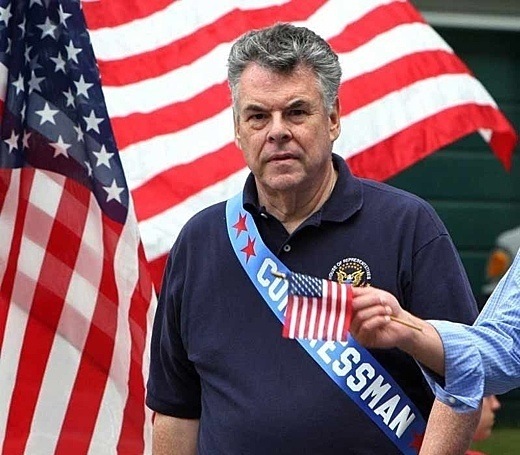
SUBHEAD: Republicans rant but WikiLeaks founder Julian Assange lurks beyond he reach of U.S. law. Image above: Congressman Peter King (R-NY) is asking for terrorist charges against Julian Assange. From (http://www.digitaljournal.com/article/275646). By Ann Woolner on 1 December 2010 for Bloomberg News - () Attorney General Eric Holder wants us all to know that the Justice Department has begun a dead-serious probe into WikiLeaks’s release of hundreds of thousands of internal government documents, many of them classified. It is an “active, ongoing criminal investigation,” he told reporters this week as news stories stemming from the document dump appeared. President Barack Obama’s top spokesman went further. Robert Gibbs called those responsible “criminals, first and foremost.” You can say that WikiLeaks founder Julian Assange is reckless and dangerous for making the documents public. You can say he’s hurt the international conversation among diplomats and endangered the lives of innocent people who have helped the U.S. in time of war, people who staked their lives on promises of anonymity. But before you call someone a criminal, you have to have a law that you can say he broke. Holder is going to have a hard time doing that with Assange. If the attorney general were confident, he wouldn’t have answered a reporter’s question about difficulties in prosecuting Assange this way: “To the extent there are gaps in the laws, we will move to close those gaps.” This is essentially an acknowledgement of a hole in the law. And even if prosecutors can leap across that, they’d then face a really big hurdle in the form of the First Amendment. Out of Reach Yes, Congress can pass new laws and amend old ones, and would no doubt be happy to do so if it meant locking up Assange. But it wouldn’t. New laws can’t criminalize past conduct. The Constitution clearly bans so-called ex post facto laws so that the government can’t toss someone in jail for something that was legal at the time it was done. Besides, even if current law were sufficient, how would authorities bring Assange, an Australian native in hiding outside the U.S., into this country to stand trial? Presented with this question, Holder told reporters that no one’s foreign citizenship or residence would prevent them from being targeted. But that brings us back to this question: on what charge could he be indicted? Without that, Assange could live next door to Holder and wave at him daily without fear of arrest as the nation’s top prosecutor went off to work. Espionage Act No law criminalizes civilian release of classified information, except in rare circumstance, such as revealing the name of an undercover agent or disclosing secret codes. Britain has an Official Secrets Act, but prosecutions are hard to mount, difficult to win and easy to lambast as politically motivated. All we’ve got is that World War I-era spy law, the Espionage Act of 1917. Representative Peter King, the New York Republican and next chairman of the House Homeland Security Committee, sent Holder a letter this week urging him to use the law to charge Assange. The best shot at making that work would be by proving Assange encouraged the leak and conspired with his inside source to disgorge the documents. An Army private first class has been charged under military law with some of the leaks. And even if investigators can find a clear conspiracy between the two, a ruling by a federal judge in another case shows it isn’t easy to use the spy law to prosecute civilians. ‘Messy Prosecution’ “The government would still have to prove it was potentially damaging to national security, that he knew it was potentially damaging, that he understood that his conduct was unlawful,” says Baruch Weiss, a former U.S. prosecutor who helped defend two lobbyists charged with violating that law. Image above: Former governor Mike Huckabee (R-AK) is asking for execution of those responsible for WikiLeaks. From (http://www.inquisitr.com/50009/huckabee-clemency). “This would be a messy prosecution,” says Weiss, a partner at Arnold & Porter in Washington. There isn’t much court precedent on the point, but the lobbyists got a boost from a 2006 ruling that limited the scope of the broadly written espionage law. The ruling, by U.S. District Judge T.S. Ellis III in Alexandria, Virginia, helped persuade Holder last year to drop the case against the two lobbyists for the American Israel Public Affairs Committee. They had been charged in 2005 for getting and passing along confidential government information in a way they claimed was perfectly legal and common in Washington. Any prosecution of Assange would come up against First Amendment issues. How can you criminalize speech, especially political speech, especially on matters of grave public importance? That would seem to fly in the face of the Constitution’s promise of a free press and free speech. Help From Allies The administration’s best chance of getting Assange behind bars would be to get someone else to do it. The Daily Beast website reported in August that American officials were pitching the idea to the U.K., Australia and Germany, arguing that their troops, too, have been harmed by the leaks. Those are countries without the clear constitutional guarantees of free speech that the U.S. has. It might work, but there’s a reason the founders insisted on free speech and a free press. Whatever harm the leaks have caused, slipping around the First Amendment isn’t the way to fix it. .

Wikileaks diplomatic cable results

SUBHEAD: The WikiLeaks diplomatic cables are small revelations that may cause a big idea to take hold. Image above: Wreckage of US tanks, hummers, and personnel carriers. From (http://forums.cadetstuff.org/viewtopic.php?f=37&t=14868).

By Arianna Huffington on 30 November 2010 for Huffingon Post - (http://www.huffingtonpost.com/arianna-huffington/the-wikileaks-cables-smal_b_790158.html)

Let's start with what the U.S. embassy cables released by WikiLeaks this weekend are not.

They are not, as Hillary Clinton claimed, "an attack on America's foreign policy interests" that have endangered "innocent people." And they are not, as Robert Gibbs put it, a "reckless and dangerous action" that puts at risk "the cause of human rights."

And they do not amount to what the Italian foreign minister, in one of the sorrier moments in the history of hyperbole (or is it hysteria?), deemed the "September 11 of world diplomacy."

They are also not "top secret" since between 2 and 3 million government employees are cleared to see this level of "secret" document, and some 500,000 people have access to the Secret Internet Protocol Network (SIPRnet) where the cables were stored. Maybe they should think about changing the name to the Not-All-That Secret Internet Protocol Network (NATSIPRnet).

What's more, the revelations are not particularly revelatory. As Richard Haass, president of the Council on Foreign Relations, said: "Much of what we have seen thus far confirms more than it informs."

But here is what makes the leaked cables so important: they provide another opportunity to turn the spotlight on the war in Afghanistan, which, despite the fact that it's costing us $2.8 billion a week keeps getting pushed into the shadows -- even in this deficit-obsessed time. The cables are a powerful reminder of what this unwinnable war is costing us in terms of lives, in terms of money, and in terms of our long-term national security.

They don't deliver the punch in the gut or the chill down the spine that the Afghanistan war logs WikiLeaks released in July did, with their disturbing accounts of killed civilians, dead children, confused soldiers, and mounting chaos.

But the funny thing about tipping points is that you never know what fact, image, or story will bring things to a critical mass -- what small moment will cause a big idea to finally take hold.

Picture a very complicated combination lock, one that requires dialing up eight different numbers to open. And you have seven of the numbers -- but the lock still won't open until you hit upon that final number. 1/8th may not seem as "big" as 7/8ths, but without the final click of the combination, the tumblers won't fall into place.

"We need to prepare ourselves," wrote Malcolm Gladwell in The Tipping Point, "for the possibility that sometimes big changes follow from small events, and that sometimes these changes can happen quickly... Look at the world around you. It may seem an immovable, implacable place. It is not. With the slightest push -- in just the right place -- it can be tipped."

So maybe the tipping point will be the cables' reminder that we have placed our faith in the future of Afghanistan into the hands of a president our diplomats think is "extremely weak" and "driven by paranoia." Maybe it will be the news that President Karzai has freed many dangerous detainees -- including 29 who had been held at Guantanamo -- and pardoned numerous drug dealers. Maybe it will be yet another portrait of the president's half-brother as "corrupt and a narcotics trafficker." Maybe it will be the story of Afghanistan's former vice president being stopped in Dubai carrying $52 million in cash -- money he was allowed to keep. (Here's Dan Froomkin on the many other ways billions in American taxpayer money has gone down the drain in Afghanistan -- money desperately needed for some nation-building here at home.)

Or maybe it will be the bracing honesty of Anne Patterson, U.S. ambassador to Pakistan from 2007 until last month, who, without spin, sheds light on the complex relationship between our supposed allies in the Pakistan intelligence agencies and the Taliban, a relationship that poses a clear and present danger to American troops in Afghanistan. In the words of Simon Jenkins: "Patterson's cables are like missives from the Titanic as it already heads for the bottom."

If any of these revelations tip the scales, reminding people why bringing our troops home quickly needs to be more -- much more -- than "aspirational" (as the Pentagon recently termed the goal of being out by 2014), then this round of WikiLeaks will have been a very good thing, indeed.

.

Vatican backs worldwide GMOs

SUBHEAD: Papal science advisers support genetically modifies crops to feed the world poor.

By Matthew McDermott on 1 December 2010 for TreeHugger - (http://www.treehugger.com/files/2010/12/papal-science-advisors-worlds-poor-need-gm-crops.php)

Image above: Small scale African farming. Photo by Luigi Gaurino in original article.

The Vatican's science advisors have come out in support of genetically modified crops, saying that they scientists have both the right and moral duty to produce them to help the world's poor, New Scientist reports. The 40 member group, led by the scientist who developed so-called golden rice which has extra vitamin A, said that there has not been one documented case where GM crops have harmed consumers or the environment.

Because of this the group argues, "for the relaxation of what they say are draconian regulations preventing development of crops for the poor." Adding that "regulatory hurdles make it too expensive for anyone other than large multinational firms to develop crops benefiting the poor, such as drought-resistant cassava and yams."

No doubt that the world's farmers, particularly in sub-Saharan Africa, South Asia and in other developing nations, need to develop more drought-resistant and climate-tolerant crop varieties. One glance at maps of areas with high levels of food security risk and where climate change is going to cause havoc with precipitation backs up that assertion.

But a quick survey of the literature on the actual effect of GM crops on crop yields reveals that the primary financial beneficiaries of GM crop introduction is not small-scale farmers but the multinational corporations and their ideological lapdogs (cough, Bill Gates, cough) pushing them as the best solution, and that GM crops on the whole have done little to improve crop yields beyond what can be done with conventional (and non-patentable) breeding techniques--as well as revival of the multitude of traditional crop varieties which have all too often fallen by the wayside in the rush to "modernize".

Quoted in the original, Friends of the Earth is right on when it comments, "We need food and farming policies that put the needs of people before the profits of a handful of GMO companies."

Even if it can be conclusively proven that there is no environmental and health risk from specific GM crops, the inherently unbalanced and inequitable situation created by a small number of multinationals controlling so much of the world's food supply--and putting an end to the age-old and vitally important for sustainable food security practice of seed saving--remains an intractable problem.

It is no true or lasting help to the world's poor to develop GM crops that are drought-tolerant if it just continues to keep them perpetually indebted to corporate overlords.

See also: Ea O Ka Aina: Bill Gates & Demon Corn 9/30/10 Ea O Ka Aina: Oxfam at odds over GMO's 4/14/10

.