SUBHEAD: When the elites wage war on America it will look like like a training program on our soil.
By Brandon Smith on 6 May 2015 for Alt-Market -
(http://www.alt-market.com/articles/2588-when-the-elites-wage-war-on-america-this-is-how-they-will-do-it)
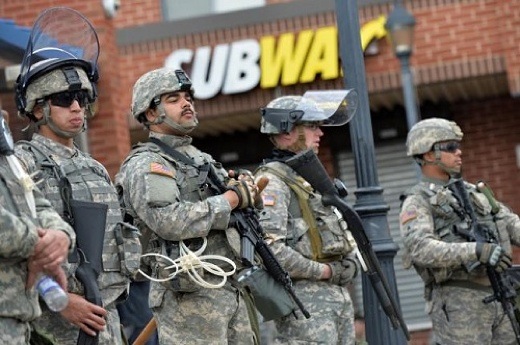
Image above: US military on American street guarding a Subway franchise. From original article.
The consequences and patterns of war, whether by one nation against another or by a government against the citizenry, rarely change. However, the methods of war have evolved vastly in modern times.
Wars by elites against populations are often so subtle that many people might not even recognize that they are under attack until it is too late. Whenever I examine the conceptions of “potential war” between individuals and oligarchy, invariably some hard-headed person cries out: “What do you mean ‘when?’ We are at war right now!”
In this case, I am not talking about the subtle brand of war. I am not talking about the information war, the propaganda war, the economic war, the psychological war or the biological war. I am talking about outright warfare, and anyone who thinks we have already reached that point has no clue what real war looks like.
The recent exposure of the nationwide Jade Helm 15 exercise has made many people suspicious, and with good reason. Federal crisis exercises have a strange historical tendency to suddenly coincide with very real crisis events. We may know very little about Jade Helm beyond government admissions, claims and misdirections.
But at the very least, we know what “JADE” is an acronym for: Joint Assistance for Deployment and Execution, a program designed to create action and deployment plans using computer models meant to speed up reaction times for military planners during a “crisis scenario.” I
t is linked with another program called ACOA (Adaptive Course of Action), the basis of which is essentially the use of past mission successes and computer models to plan future missions. Both are products of the Defense Advanced Research Projects Agency (DARPA).
As far as I know, no one has presented any hard evidence as to what “HELM” really stands for, but the JADE portion of the exercise explicitly focuses on rapid force deployment planning in crisis situations, according to the government white paper linked above.
This fact alone brings into question statements by the Department of Defense that Jade Helm is nothing more than a training program to prepare military units for “foreign deployment.” This is clearly a lie if Jade Helm revolves around crisis events (which denotes domestic threats), rather than foreign operations.
Of course, if you also consider the reality that special operations forces ALWAYS train like they fight and train in environments similar to where they will fight, the entire notion of Jade Helm as a preparation for foreign theaters sounds absurd. If special operations forces are going to fight in Iraq, Iran or Syria, they go to training grounds in places like Kuwait.
If they are training in places like Fort Lauderdale, Florida (including “infiltration training”), then there is no way around the fact that they are practicing to fight somewhere exactly like Fort Lauderdale with a similar culture and population.
I would further note that Jade Helm exercises are also joint exercises with domestic agencies like the FBI and the DEA. Again, why include domestic law enforcement agencies in a military exercise merely meant to prepare troops for foreign operations? I often hear the argument that the military would never go along with such a program, but people who take this rather presumptive position do not understand crisis psychology.
In the event of a national catastrophe many military personnel and government employees may determine that they will do what is "best for them and their families". And if following orders guarantees the security of their families (food security, shelter, etc), then they may very well follow any order, no matter how dubious.
Also, a large scale crisis could be used as a rationale for martial law; otherwise well meaning military men and women could be convinced that the loss of constitutional freedoms might be for the "greater good of the greater number". I believe some military will indeed resist such efforts, but of course, Jade Helm may also be a method for vetting such uncooperative people before any live operation occurs.
So if Jade is actually a crisis-planning system for the military and the military is training for domestic operations, what is the crisis it is training to react to? It’s hard to say. I believe it will come down to an economic disaster, but our economic and social structures are so weak that almost any major event could trigger collapse.
Terror attacks, cyberattacks, pandemic, a stiff wind, you name it. The point is the government expects a crisis to occur. And with the advent of this crisis, the ultimate war on the American people will begin.
Video above: Max Boot describes modern use of guerrilla warfare From (https://youtu.be/WxMCcqRc9C0).
Why wait for a crisis situation? With the cover of a crisis event, opposition to power is more easily targeted. For my starting point on the elite war strategy, I would like to use the following presentation on guerrilla warfare by Max Boot, Council on Foreign Relations senior fellow and military adviser, at the elitist World Affairs Council.
I would first point out that Boot claims his work is merely a historical character study of interesting figures from the realm of insurgency and counterinsurgency and is not “polemical.” I’m afraid that I will have call horse hockey on that.
Boot is direct adviser to the Department of Defense. His work and this presentation were obviously a study of guerrilla tactics from the perspective of counterinsurgency and an attempt to explore strategic methods for controlling and eradicating guerrillas and “terrorists.”
Any defense the American people might muster against elitist dismantling of constitutional liberties would inevitably turn to "insurgency". So using CFR member Boot’s views on counterinsurgency as a guideline, here is how the elites will most likely wage open war on those within the American population who have the will to fight back.
Control Public Opinion
Boot stresses the absolute necessity for the control of public opinion in defeating an insurgency. Most of his analysis is actually quite accurate in my view in terms of successes versus failures of guerrilla movements. However, his obsession with public opinion is, in part, ill-conceived.
Boot uses the American Revolution as a supposed prime example of public opinion working against the ruling powers, claiming that it was British public opinion that forced parliament and King George III to pull back from further operations in the colonies.
Now, it is important to recognize that elitists have a recurring tendency to marginalize the success of the American Revolution in particular as being a “fluke” in the historical record. Boot, of course, completely overlooks the fact that the war had progressed far longer than anyone had predicted and that the British leadership suffered under the weight of considerable debts.
He also overlooks the fact that pro-independence colonials were far outnumbered by Tories loyal to the crown up to the very end of the war. The revolution was NEVER in a majority position, and public opinion was not on the revolutionaries’ side.
The very idea of the American Revolution is a bit of a bruise on the collective ego of the elites, and their bias leads them to make inaccurate studies of the event. The reality is that most revolutions, even successful ones, remain in a minority for most, if not all, of their life spans.
The majority of people do not participate in history. Rather, they have a tendency to float helplessly in the tides, waiting to latch onto whatever minority movement seems to be winning at the time.
Boot suggests that had the Founding Fathers faced the Roman Empire rather than the British Empire, they would have been crucified and the rebellion would have immediately floundered because the Romans had no concern for public opinion. This is where we get into the real mind of the elitist.
For now, the establishment chooses to sway public opinion with carefully crafted disinformation. But what is the best way to deal with public opinion when fighting a modern revolution?
Remove public opinion as a factor entirely so that the power elite are free to act as viciously as they wish. Engineered crisis, and economic crisis in particular, create a wash of other potential threats, including high crime, looting, riots, starvation, international conflict, etc.
In such an environment, public opinion counts for very little, if people even pay attention at all to anything beyond their own desperation. Once this is achieved, the oligarchy has free reign to take morally questionable actions without fear of future blowback.
Control The Public
Another main tenet Boot describes as essential in defeating insurgency is the control of the general population in order to prevent a revolution from recruiting new members and to prevent them from using the crowd as cover. He makes it clear that control of the public does not mean winning the “hearts and minds” in a diplomatic sense, but dominating through tactical and psychological means.
He first presents the example of the French counterinsurgency in Algeria, stating that the French strategy of widespread torture, while “morally reprehensible,” was indeed successful in seeking out and destroying the insurgent leadership.
Where the French went wrong, however, was their inability to keep the torture campaign quiet. Boot once again uses the public opinion argument as the reason for the eventual loss of Algeria by the French.
What Boot seems to be suggesting is that systematic torture is viable, at least as a hypothetical strategy, as long as it remains undetected by the overall public. He also reiterates this indirectly in his final list of articles for insurgency and counterinsurgency when he states that “few counterinsurgencies (governments) have succeeded by inflicting mass terror, at least in foreign lands,” suggesting that mass terror may be an option against a domestic rebellion.
Boot then goes on to describe a more effective scenario, the British success against insurgents in Malaya. He attributes the British win against the rebellion to three factors:
I believe the British/Malayan example given by Boot would be the main methodology for the elites and the federal government in the event that a rebellion arises in the U.S. against planned shifts away from constitutional republic or martial law instituted in the wake of a national emergency.
Isolate Population Centers
There is a reason why certain American cities are being buried in technologically sophisticated biometric surveillance networks, and I think the Malayan example holds the key. Certain cities (not all) could be turned into massive isolated camps, or “green zones.” They would be tightly controlled, and travel would be highly restricted. Food, shelter and safety would likely be offered, after a period of disaster has already been experienced.
A couple months of famine and lack of medication to the medically dependent would no doubt kill millions of people. Unprepared survivors would flock to these areas in the hopes of receiving aid. Government forces would confiscate vital supplies in rural areas whenever possible in order to force even more people to concentrate into controlled regions.
I have seen the isolation strategy in action in part, during the G20 summit in Pittsburgh. More than 4,000 police and National Guard troops locked down the city center, leaving only one route for travel. The first day, there were almost no protesters; most activists were so frightened by the shock-and-awe show of force that they would not leave their homes. This is the closest example I have personally experienced to a martial law cityscape.
Decapitate Leadership
The liberty movement has always been a leaderless movement, which makes the “night of long knives” approach slightly less effective. I do not see any immediate advantage to the elites in kidnapping or killing prominent members of the movement, though that does not mean they will not try it anyway. Most well-known liberty proponents are teachers, not generals or political firebrands. Teachers leave all their teachings behind, and no one needs generals or politicians. The movement would not necessarily be lost without us.
That said, there is a fear factor involved in such an event. The black-bagging of popular liberty voices could terrorize others into submission or inaction. This is why I constantly argue the need for individual leadership; every person must be able and willing to take individual action without direction in defense of his own freedoms, if the need arises. Groups should remain locally led, and national centralization of leadership should be avoided at all costs.
According to the very promoters of Jade Helm exercises, training will center on quick-reaction teams striking an area with helicopter support, then exfiltrating within 30 minutes or less. Almost every combat veteran I have spoken with concerning this style of training has said that it is used for “snatch and grab” — the capture or killing of high value targets, then exfiltration before the enemy can mount a response.
Fourth-Generation Warfare
The final method for war against the American people is one Boot does not discuss: the use of fourth-generation warfare. Some call this psychological warfare, but it is far more than that. Fourth-generation warfare is a strategy by which one section of a population you wish to control is turned against another section of the population you wish to control. It is warfare without the immediate use of armies.
Rather, the elites turn the enemy population against itself and allow internal war to do most of their work for them. We can see this strategy developing already in the U.S. in the manipulation of race issues and the militarization of police.
The use of provocateurs during unrest in places like Ferguson, Missouri, and Baltimore suggests that a race war is part of the greater plan. I believe law enforcement officials have also been given a false sense of invincibility. With military toys and federal funding, but poor tactical philosophies and substandard training, LEOs are being set up as cannon fodder when the SHTF.
Their inevitable failure will be used as a rationalization for more domestic military involvement; but in the meantime, Americans will be enticed to fight and kill each other while the elites sit back and watch the show.
4th Gen warfare also relies on fooling the target population into supporting measures that are secretly destructive to the people.
For example, liberty movement support for controlled opposition such as Russia or China, or liberty support for a military coup in which the top brass are elite puppets just like the Obama Administration. Think this sounds far fetched? It has already happened in our recent history! Marine Corp Major General Smedley Butler was hired by corporate moguls to lead a paid army in a coup against Franklin D. Roosevelt (also an elitist puppet) in 1933.
Butler luckily exposed the conspiracy before it ever got off the ground. Both sides were controlled, but the coup if successful could have resulted in popular support for the expedient erosion of the Constitution, rather than a slow erosion which is what took place. This is the epitome of 4th Gen tactics - make the people think they are winning, when they are actually helping you to defeat them.
Know Thy Enemy
I have outlined the above tactics not because I necessarily think they will prevail, but because it is important that we know exactly what we are dealing with in order to better defend ourselves. Such methods can be countered with community preparedness, the avoidance of central leadership, the application of random actions rather than predictable actions, etc.
Most of all, liberty champions will have to provide a certain level of safety and security for the people around them if they want to disrupt establishment efforts to lure or force the population into controlled regions. Crisis is the best weapon the elites have at their disposal, and exercises like Jade Helm show that they may use that weapon in the near term.
The defense that defeats crisis is preparation — preparation not just for yourself, but for others around you. War is coming, and while we can’t know the exact timing, we can assume the worst and do our best to be ready for it as quickly as possible.
.
By Brandon Smith on 6 May 2015 for Alt-Market -
(http://www.alt-market.com/articles/2588-when-the-elites-wage-war-on-america-this-is-how-they-will-do-it)
Image above: US military on American street guarding a Subway franchise. From original article.
The consequences and patterns of war, whether by one nation against another or by a government against the citizenry, rarely change. However, the methods of war have evolved vastly in modern times.
Wars by elites against populations are often so subtle that many people might not even recognize that they are under attack until it is too late. Whenever I examine the conceptions of “potential war” between individuals and oligarchy, invariably some hard-headed person cries out: “What do you mean ‘when?’ We are at war right now!”
In this case, I am not talking about the subtle brand of war. I am not talking about the information war, the propaganda war, the economic war, the psychological war or the biological war. I am talking about outright warfare, and anyone who thinks we have already reached that point has no clue what real war looks like.
The recent exposure of the nationwide Jade Helm 15 exercise has made many people suspicious, and with good reason. Federal crisis exercises have a strange historical tendency to suddenly coincide with very real crisis events. We may know very little about Jade Helm beyond government admissions, claims and misdirections.
But at the very least, we know what “JADE” is an acronym for: Joint Assistance for Deployment and Execution, a program designed to create action and deployment plans using computer models meant to speed up reaction times for military planners during a “crisis scenario.” I
t is linked with another program called ACOA (Adaptive Course of Action), the basis of which is essentially the use of past mission successes and computer models to plan future missions. Both are products of the Defense Advanced Research Projects Agency (DARPA).
As far as I know, no one has presented any hard evidence as to what “HELM” really stands for, but the JADE portion of the exercise explicitly focuses on rapid force deployment planning in crisis situations, according to the government white paper linked above.
This fact alone brings into question statements by the Department of Defense that Jade Helm is nothing more than a training program to prepare military units for “foreign deployment.” This is clearly a lie if Jade Helm revolves around crisis events (which denotes domestic threats), rather than foreign operations.
Of course, if you also consider the reality that special operations forces ALWAYS train like they fight and train in environments similar to where they will fight, the entire notion of Jade Helm as a preparation for foreign theaters sounds absurd. If special operations forces are going to fight in Iraq, Iran or Syria, they go to training grounds in places like Kuwait.
If they are training in places like Fort Lauderdale, Florida (including “infiltration training”), then there is no way around the fact that they are practicing to fight somewhere exactly like Fort Lauderdale with a similar culture and population.
I would further note that Jade Helm exercises are also joint exercises with domestic agencies like the FBI and the DEA. Again, why include domestic law enforcement agencies in a military exercise merely meant to prepare troops for foreign operations? I often hear the argument that the military would never go along with such a program, but people who take this rather presumptive position do not understand crisis psychology.
In the event of a national catastrophe many military personnel and government employees may determine that they will do what is "best for them and their families". And if following orders guarantees the security of their families (food security, shelter, etc), then they may very well follow any order, no matter how dubious.
Also, a large scale crisis could be used as a rationale for martial law; otherwise well meaning military men and women could be convinced that the loss of constitutional freedoms might be for the "greater good of the greater number". I believe some military will indeed resist such efforts, but of course, Jade Helm may also be a method for vetting such uncooperative people before any live operation occurs.
So if Jade is actually a crisis-planning system for the military and the military is training for domestic operations, what is the crisis it is training to react to? It’s hard to say. I believe it will come down to an economic disaster, but our economic and social structures are so weak that almost any major event could trigger collapse.
Terror attacks, cyberattacks, pandemic, a stiff wind, you name it. The point is the government expects a crisis to occur. And with the advent of this crisis, the ultimate war on the American people will begin.
Video above: Max Boot describes modern use of guerrilla warfare From (https://youtu.be/WxMCcqRc9C0).
Why wait for a crisis situation? With the cover of a crisis event, opposition to power is more easily targeted. For my starting point on the elite war strategy, I would like to use the following presentation on guerrilla warfare by Max Boot, Council on Foreign Relations senior fellow and military adviser, at the elitist World Affairs Council.
I would first point out that Boot claims his work is merely a historical character study of interesting figures from the realm of insurgency and counterinsurgency and is not “polemical.” I’m afraid that I will have call horse hockey on that.
Boot is direct adviser to the Department of Defense. His work and this presentation were obviously a study of guerrilla tactics from the perspective of counterinsurgency and an attempt to explore strategic methods for controlling and eradicating guerrillas and “terrorists.”
Any defense the American people might muster against elitist dismantling of constitutional liberties would inevitably turn to "insurgency". So using CFR member Boot’s views on counterinsurgency as a guideline, here is how the elites will most likely wage open war on those within the American population who have the will to fight back.
Control Public Opinion
Boot stresses the absolute necessity for the control of public opinion in defeating an insurgency. Most of his analysis is actually quite accurate in my view in terms of successes versus failures of guerrilla movements. However, his obsession with public opinion is, in part, ill-conceived.
Boot uses the American Revolution as a supposed prime example of public opinion working against the ruling powers, claiming that it was British public opinion that forced parliament and King George III to pull back from further operations in the colonies.
Now, it is important to recognize that elitists have a recurring tendency to marginalize the success of the American Revolution in particular as being a “fluke” in the historical record. Boot, of course, completely overlooks the fact that the war had progressed far longer than anyone had predicted and that the British leadership suffered under the weight of considerable debts.
He also overlooks the fact that pro-independence colonials were far outnumbered by Tories loyal to the crown up to the very end of the war. The revolution was NEVER in a majority position, and public opinion was not on the revolutionaries’ side.
The very idea of the American Revolution is a bit of a bruise on the collective ego of the elites, and their bias leads them to make inaccurate studies of the event. The reality is that most revolutions, even successful ones, remain in a minority for most, if not all, of their life spans.
The majority of people do not participate in history. Rather, they have a tendency to float helplessly in the tides, waiting to latch onto whatever minority movement seems to be winning at the time.
Boot suggests that had the Founding Fathers faced the Roman Empire rather than the British Empire, they would have been crucified and the rebellion would have immediately floundered because the Romans had no concern for public opinion. This is where we get into the real mind of the elitist.
For now, the establishment chooses to sway public opinion with carefully crafted disinformation. But what is the best way to deal with public opinion when fighting a modern revolution?
Remove public opinion as a factor entirely so that the power elite are free to act as viciously as they wish. Engineered crisis, and economic crisis in particular, create a wash of other potential threats, including high crime, looting, riots, starvation, international conflict, etc.
In such an environment, public opinion counts for very little, if people even pay attention at all to anything beyond their own desperation. Once this is achieved, the oligarchy has free reign to take morally questionable actions without fear of future blowback.
Control The Public
Another main tenet Boot describes as essential in defeating insurgency is the control of the general population in order to prevent a revolution from recruiting new members and to prevent them from using the crowd as cover. He makes it clear that control of the public does not mean winning the “hearts and minds” in a diplomatic sense, but dominating through tactical and psychological means.
He first presents the example of the French counterinsurgency in Algeria, stating that the French strategy of widespread torture, while “morally reprehensible,” was indeed successful in seeking out and destroying the insurgent leadership.
Where the French went wrong, however, was their inability to keep the torture campaign quiet. Boot once again uses the public opinion argument as the reason for the eventual loss of Algeria by the French.
What Boot seems to be suggesting is that systematic torture is viable, at least as a hypothetical strategy, as long as it remains undetected by the overall public. He also reiterates this indirectly in his final list of articles for insurgency and counterinsurgency when he states that “few counterinsurgencies (governments) have succeeded by inflicting mass terror, at least in foreign lands,” suggesting that mass terror may be an option against a domestic rebellion.
Boot then goes on to describe a more effective scenario, the British success against insurgents in Malaya. He attributes the British win against the rebellion to three factors:
- The British separated large portions of the population, entire villages, into concentration camps, surrounded by fences and armed guards. This kept the insurgents from recruiting from the more downtrodden or dissatisfied classes. And it isolated them into areas where they could be more easily engaged.
- The British used special operations forces to target specific rebel groups and leadership rather than attempting to maneuver through vast areas in a pointless Vietnam-style surge.
- The British made promises that appealed to the general public, including the promise of independence. This made the public more pliable and more willing to cooperate.
I believe the British/Malayan example given by Boot would be the main methodology for the elites and the federal government in the event that a rebellion arises in the U.S. against planned shifts away from constitutional republic or martial law instituted in the wake of a national emergency.
Isolate Population Centers
There is a reason why certain American cities are being buried in technologically sophisticated biometric surveillance networks, and I think the Malayan example holds the key. Certain cities (not all) could be turned into massive isolated camps, or “green zones.” They would be tightly controlled, and travel would be highly restricted. Food, shelter and safety would likely be offered, after a period of disaster has already been experienced.
A couple months of famine and lack of medication to the medically dependent would no doubt kill millions of people. Unprepared survivors would flock to these areas in the hopes of receiving aid. Government forces would confiscate vital supplies in rural areas whenever possible in order to force even more people to concentrate into controlled regions.
I have seen the isolation strategy in action in part, during the G20 summit in Pittsburgh. More than 4,000 police and National Guard troops locked down the city center, leaving only one route for travel. The first day, there were almost no protesters; most activists were so frightened by the shock-and-awe show of force that they would not leave their homes. This is the closest example I have personally experienced to a martial law cityscape.
Decapitate Leadership
The liberty movement has always been a leaderless movement, which makes the “night of long knives” approach slightly less effective. I do not see any immediate advantage to the elites in kidnapping or killing prominent members of the movement, though that does not mean they will not try it anyway. Most well-known liberty proponents are teachers, not generals or political firebrands. Teachers leave all their teachings behind, and no one needs generals or politicians. The movement would not necessarily be lost without us.
That said, there is a fear factor involved in such an event. The black-bagging of popular liberty voices could terrorize others into submission or inaction. This is why I constantly argue the need for individual leadership; every person must be able and willing to take individual action without direction in defense of his own freedoms, if the need arises. Groups should remain locally led, and national centralization of leadership should be avoided at all costs.
According to the very promoters of Jade Helm exercises, training will center on quick-reaction teams striking an area with helicopter support, then exfiltrating within 30 minutes or less. Almost every combat veteran I have spoken with concerning this style of training has said that it is used for “snatch and grab” — the capture or killing of high value targets, then exfiltration before the enemy can mount a response.
Fourth-Generation Warfare
The final method for war against the American people is one Boot does not discuss: the use of fourth-generation warfare. Some call this psychological warfare, but it is far more than that. Fourth-generation warfare is a strategy by which one section of a population you wish to control is turned against another section of the population you wish to control. It is warfare without the immediate use of armies.
Rather, the elites turn the enemy population against itself and allow internal war to do most of their work for them. We can see this strategy developing already in the U.S. in the manipulation of race issues and the militarization of police.
The use of provocateurs during unrest in places like Ferguson, Missouri, and Baltimore suggests that a race war is part of the greater plan. I believe law enforcement officials have also been given a false sense of invincibility. With military toys and federal funding, but poor tactical philosophies and substandard training, LEOs are being set up as cannon fodder when the SHTF.
Their inevitable failure will be used as a rationalization for more domestic military involvement; but in the meantime, Americans will be enticed to fight and kill each other while the elites sit back and watch the show.
4th Gen warfare also relies on fooling the target population into supporting measures that are secretly destructive to the people.
For example, liberty movement support for controlled opposition such as Russia or China, or liberty support for a military coup in which the top brass are elite puppets just like the Obama Administration. Think this sounds far fetched? It has already happened in our recent history! Marine Corp Major General Smedley Butler was hired by corporate moguls to lead a paid army in a coup against Franklin D. Roosevelt (also an elitist puppet) in 1933.
Butler luckily exposed the conspiracy before it ever got off the ground. Both sides were controlled, but the coup if successful could have resulted in popular support for the expedient erosion of the Constitution, rather than a slow erosion which is what took place. This is the epitome of 4th Gen tactics - make the people think they are winning, when they are actually helping you to defeat them.
Know Thy Enemy
I have outlined the above tactics not because I necessarily think they will prevail, but because it is important that we know exactly what we are dealing with in order to better defend ourselves. Such methods can be countered with community preparedness, the avoidance of central leadership, the application of random actions rather than predictable actions, etc.
Most of all, liberty champions will have to provide a certain level of safety and security for the people around them if they want to disrupt establishment efforts to lure or force the population into controlled regions. Crisis is the best weapon the elites have at their disposal, and exercises like Jade Helm show that they may use that weapon in the near term.
The defense that defeats crisis is preparation — preparation not just for yourself, but for others around you. War is coming, and while we can’t know the exact timing, we can assume the worst and do our best to be ready for it as quickly as possible.
.