SUBHEAD: When hard times come to us, the Gypsies will still be around and maybe they will teach us a thing or two.
By Ugo Bardi on 25 April 2013 for Cassandra's Legacy -
(http://cassandralegacy.blogspot.com/2013/04/survival-tips-from-gypsies.html)
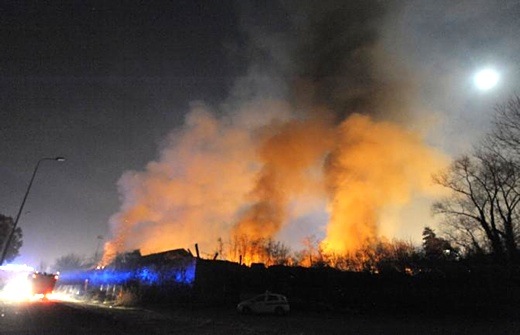
Image above: A Romani (Gypsie) camp set on fire by an angry mob in Torino, Italy, on 12/10/ 2011. From (http://www.corriere.it/gallery/cronache/12-2011/torino-disordini/1/scontri-torino_6bf3b2a0-236f-11e1-bcb9-01ae5ba751a6.shtml#2).
By Ugo Bardi on 25 April 2013 for Cassandra's Legacy -
(http://cassandralegacy.blogspot.com/2013/04/survival-tips-from-gypsies.html)
Image above: A Romani (Gypsie) camp set on fire by an angry mob in Torino, Italy, on 12/10/ 2011. From (http://www.corriere.it/gallery/cronache/12-2011/torino-disordini/1/scontri-torino_6bf3b2a0-236f-11e1-bcb9-01ae5ba751a6.shtml#2).
But I think I absorbed enough that I could try a personal interpretation of the ways of the Gypsies: how they managed the amazing feat of surviving for more than half a millennium in Europe, within an often hostile society. Don't take this text of mine as a an attempt to glorify the Roma - I understand the problems they are facing.
But I also recognize that there are many ways of being human and that the Roma have chosen a specific one and, for this, they deserve respect. Perhaps, from them we can learn something useful for the hard times that are coming.
In December 2011, a 16 year old Italian girl living in a suburb of Turin reported that she had been raped by two Gypsies coming from a nearby camp. Apparently, she was readily believed and soon an angry mob of some 500 people marched toward the camp armed with clubs and torches.
When the mob arrived to the camp, they found it completely empty of people. The Gypsies (better said, the "Roma") had left in a hurry, taking with them all their valuables. So, there was nothing left to do for the mobsters but to vent their rage by breaking windows, smashing furniture, and setting some of the shacks on fire. Later on, the firemen put out the fires and the girl confessed that she had invented everything. She had been afraid of telling her parents that she had lost her virginity with her boyfriend. (You can read the story here, in Italian).
You may wonder about how it can be that a story that seems to belong to Middle Ages took place in a (theoretically) modern country such as Italy in 2011. But what impressed me most is not the stupidity of my fellow countrymen or the naivety of the girl. It was the reaction of the Roma.
Suppose you come to know that a mob armed with clubs and torches is marching toward your home. I don't know about you, but my first reaction would be to wait for them shotgun in hand. That would be - I think - the typical reaction of middle class Westerners. We tend to see our home as our castle; worth making a stand for.
But the Roma of the story didn't reason that way. And they did the right thing: they fled. Suppose, instead, that they had tried to defend their homes. It was later learned that some people in the mob had guns. Can you imagine what could have happened? Considering how these stories are normally reported in the press, it is likely that the Roma would have ended up being described as the culprits.
When the smoke cleared, instead, the right and the wrong side of the clash were evident for everybody. So, the Roma could come back to repair their shacks, having avoided the worst. I think it is an interesting example of how you can be surprised by a culture and a way of thinking that suddenly reveals itself as truly different.
After some years of contacts with the Roma who live at just a few hundred meters from my office, I came to understand a little of this culture which I think I can describe as the most alien I have ever encountered. It is a culture that draws on more than half a millennium of experience in a difficult and hostile world; from the time they started arriving in Europe, slowly migrating from their country of origin: India. We may not like the way of behaving of the Roma and their stubbornness in resisting integration. But the fact that they survived and thrived for such a long time means that they have been doing something right.
So I tried to put together a few "tips for survival" placing myself in the role of a Rom, as much as I am able to, being myself just a humble Gadjo. I am not sure that my notes can work as a survival manual, but at least they it should provide some food for thought. (I apologize in advance to my Roma friends for any misinterpretation I made and I am ready to correct my text with their help.)
10 TIPS FOR SURVIVAL FROM THE GYPSIES
- In battle, the best strategy is flight.
(The golden rule). Many centuries of survival in an often hostile world taught the Roma that making a stand in conditions of inferiority is not the way to go. That doesn't mean that the Roma are meek as individuals or family groups. On the contrary, they can be aggressive and occasionally engage in noisy internecine fights. But, in general, they tend to avoid conflicts with the Gadje, fleeing if necessary. There are no reports of the Roma as an ethnic group having been ever involved in a war and only a few Roma are known to have ever served in Gadje armies or fighting organizations. It is an attitude that seems to be still valuable today, as shown by the case of the attack against the Roma camp of Torino (Italy) in 2011, where the rapid flight of the Roma avoided a violent clash that could have turned very bad for them.
- Don't carry and don't use weapons.
This rule derives directly from the golden rule (the best strategy is flight). If you are the underdog in a conflict, escalating it is a very bad idea because, most likely, the weapons you brought to the fray will be used against you. The Roma seem to have been practicing this strategy during all their history as wanderers and they still stick to it today. Even though some of them may be engaged in illegal activities, it is extremely rare to read reports of a Rom carrying or using weapons. The concept of having a "right to bear arms" is almost unthinkable to them. On this point, they are well in advance in comparison to Western Gadje.
- Cherish your mobility.
This rule is a consequence of the first two. If you are unarmed and you are the weaker side in a conflict, you can't be a sitting duck; you have to be mobile. For centuries, the Roma have been using this strategy. Their life has been on the road and it remains so such even today, although they don't use any more their old horse-drawn carts; much preferring motor cars (and there doesn't seem to exist a Mercedes that a Rom doesn't like). So, the Roma don't seem to be particularly interested in switching their trailers and mobile homes for regular apartments, even though sometimes they are invited (or even forced) to do so by local administrations. But things change and vanishing in the background is becoming difficult in a world which is becoming more and more regulated and controlled. Today, the Roma are often segregated in camps that look more and more like open air prisons; a situation that they must grudgingly endure.
- Travel light in life.
Modern Roma seem to have inherited from their ancestors the concept that they have to be always ready to pack up and scramble on short notice. One of the results of this attitude is that a Romani home (be it a shack or a trailer) doesn't show any of the typical clutter of Gadje's homes. That's not just because the Roma are poorer, but mainly because they seem to apply some kind of "Feng Shui" rules in the sense that they ruthlessly throw away everything that is not not strictly needed. As a consequence, normally the inside of a Romani home is truly spic & span, unlike the situation of not a few Gadje's homes. On the other hand, the Roma don't seem to use the same care in maintaining the exterior of their homes. Again, if they are always ready to flee, what sense would it make to take care of the communal lawn? So, a Romani camp often looks like it was bombed just a few days before. That is usually the only thing seen by the Gadje who visit the camp, and surely that is not so good for the public image of the Roma. But, on the other hand, there are not so many Gadje interested in visiting Romani camps.
- Cultivate creative obfuscation.
If you are perpetually in danger of being ethnically cleansed, you'd better be careful in avoiding to give information to your more powerful neighbors. The Roma seem to take this idea as a stimulus to develop a linguistic smokescreen that makes everything vague. If you happen to be chatting with Romani people, you'll notice that it is never clearly stated who is doing what, when, and how. Appointments are always very elastic (to say the least) and if you are invited for dinner by a Romani family you are sure to arrive always too late or too early. In addition, the Roma seem to be positively jealous of their language and won't provide much help for your attempts to learn it. All these features do bring some advantage to the Roma even today, although not in terms of endearing them very much to the Gadje. It is, however, part of being Roma.
- A man's family is his refuge.
A Rom man becomes really a man only when he is married and has children, and the same is true for a Romni, a woman. But the family for the Rom is best seen as a "clan" that includes a large number of relatives in a maze of relationships and obligations. It is on this network of family members that the Roma rely for their needs when times are bad. The clan provides support, defense, entertainment, and emergency help. All that is fundamental for people who don't have a job, a retirement fund and, in many cases, no medical assistance. The problem is that tradition encourages families to have children and the Roma often have up to five or six per couple. That used to be a good strategy in the hard times of old, when just a fraction of a family's offspring would survive to adulthood. Today, instead, having many children creates a host of practical problems additional to the many that the Roma already have. Of these problems, one is that the Gadje tend to disapprove the Roma for adopting a strategy, large families, that they themselves had been adopting up to not long ago. That may change with a new generation of Romnie who often state that they have no intention of burdening themselves with so many children as their mothers did. Whether the "demographic transition" will take place with the Roma is to be seen, but one thing is sure, anyway: the Roma greatly love their children.
- What you learned to do yourself, can never be stolen.
The Roma have always been excellent craftsmen. They worked as potters, blacksmiths, horseshoers, and jacks of all trades. Even today, a Rom can build - alone - a complete shack using scrap wood and he can do it well enough that the roof doesn't fall on the heads of the family. It doesn't leak when it rains and it is even cozy in winter, with the stove that warms it nicely! Unfortunately, however, modern Roma have also lost most of the specific abilities of their ancestors: there is no need anymore to repair old pots and pans and most mechanical objects are being manufactured in ways that make them impossible to repair. Still, the Roma maintain a remarkable flexibility and adaptability. They are quick learners: should there be again a need for people who can repair a broken umbrella; the Roma can re-learn how to do that.
- Catch the occasion when you see it.
Living perpetually on the road, often fleeing powerful enemies, the Roma have learned to be flexible, resourceful, and always ready to catch the opportunity of the moment. It may be this characteristic that makes them magnificent traders - they have a nearly unbelievable ability in understanding what is valuable and what is junk and they exploit it to the utmost. Of course, there often remain legitimate doubts about the source of the objects they trade and it is true that some Roma pursue a career as petty thieves. Whether that is part of the Romani traditional ways is debatable, but it is sure that the number of Roma who are actually engaged in illegal activities is greatly overestimated by most Gadje. For one thing, it is more and more difficult to steal anything in a world of sensors, alarms, electronic cards, and hidden cameras. But "illegal" is also a question of definition. For instance, one of the traditional activities of the Roma was collecting scrap metal for recycling, something that they saw (and still see) as a perfectly legitimate activity. However, governments started creating laws and regulations that transformed this kind of waste collection into an illegal activity. That pushed most of the Roma who specialize in this field into the shadow world of the "parallel economy," where they still manage to collect metals by exploiting their creativity and adaptability; but under much more difficult conditions.
- Be jealous of your identity.
The Roma stubbornly refuse to be integrated in the society of the Gadje and they jealously guard their language and their traditions. That seems to to be a common attitude still today, despite the fact that many Romani children go to school and despite the presence of TV sets and Internet connections in Romani homes. In this respect, the Roma behave like the Jews, although they don't see their identity in religious terms (they have normally adopted the religion of the region they find themselves in). Also, unlike the Jewish tradition, the Romani one is not written. It is completely oral and that may be a reason why the Roma don't seem to be especially interested in learning how to read and write. What the Roma need to know, they keep inside their heads, unlike most Gadje who are increasingly lost in a tsunami of information that they can't control any more. Emphasizing ethnic identity is a useful concept to maintain cohesion in the Romani community, but it may backfire by generating a convenient target for that fraction of Gadje who are inclined toward racism and ethnic hatred; of which there seem to be plenty today, just as there were in the past. During the second world war, the Roma suffered an attempt of extermination similar to that of the Jews at the hands of the Nazis. Today, pogrom-like attacks against the Roma seem to be rare, but they still occur at times. Anyhow, if the Roma managed to survive the Nazis, they can probably survive anything.
- Be a free spirit.
In old times, the Roma's preferred occupation was as musicians and their famed ability with musical instruments was not just a way to make a living; it was also a way to celebrate the fleeting beauty of the world. Today, only a few Roma have maintained this skill in a world where music has become mostly a product of the entertainment industry. However, the Roma still cherish their freedom and normally refuse to submit to the slavery of a time card. That doesn't make it easy for them to find jobs in a world that emphasizes reliability, efficiency, and control - the result is that most of the Roma living in Wester countries seems to be condemned to a condition of extreme poverty. Maybe in the old times the Roma were happy with their carefree life "on the road", but today in Roma camps there are cases of depression, mental illness, and unhappiness. However, it is difficult to say whether on the average the Roma are more stressed by their condition of poverty than their neighboring Gadje are stressed by their daily fight with mortgages, rents, evictions, unemployment, and the like. What can be said for sure is that freedom, for anyone, is not only a choice but also a cost.
Dmitry Orlov notes in his book "The Five Stage of Collapse" how the Roma thrived with the collapse of the Soviet Union. When hard times come to us, I bet that the Roma will still be around and maybe they will teach us a thing or two.
* In the most common Romani dialect, the term "Rom" has "Roma" as plural, while "Romani" is an adjective.