SOURCE: Linda Harmon (
harmonl001@hawaii.rr.com)
SUBHEAD: A ruling against the Army Corps of Engineers in New Orleans may have an impact in Hanapepe Valley.
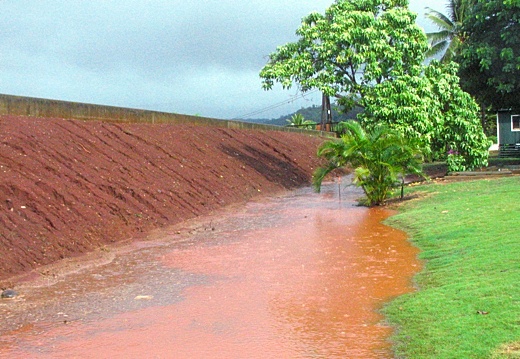
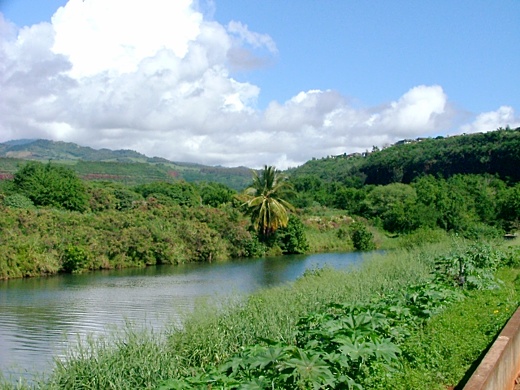
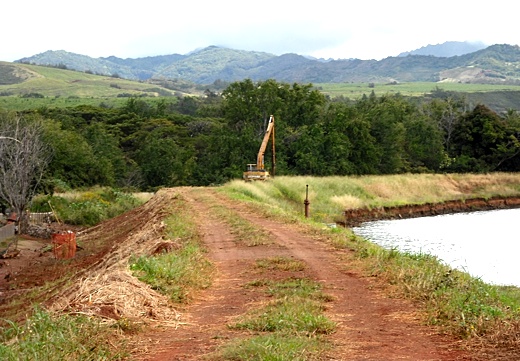
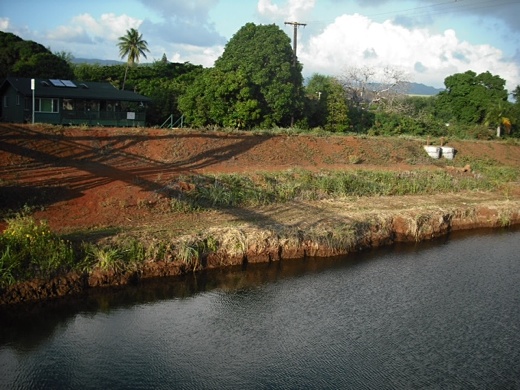
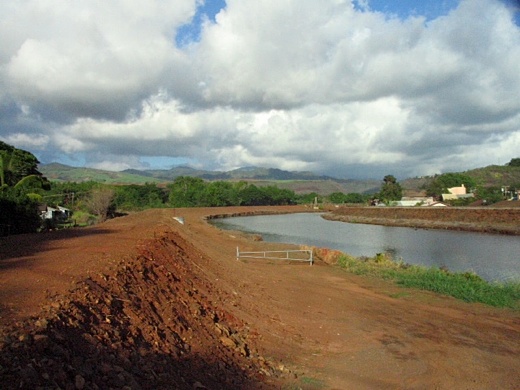
[Editor's Note: After the Koloko Dam failure on Kauai in 2006, The Army Corps of Engineers ordered that the embankments of the Hanapepe River levees be stripped of all vegetation for inspection. The County has complied with backhoes and herbicides and kept the levees bare ever since. Subsequently the levees have suffered accelerated erosion and runoff. It's banks have continued being scoured away. No repairs have been begun or even proposed. Are our government agencies waiting for a disasterous flood to be spurred to action?]
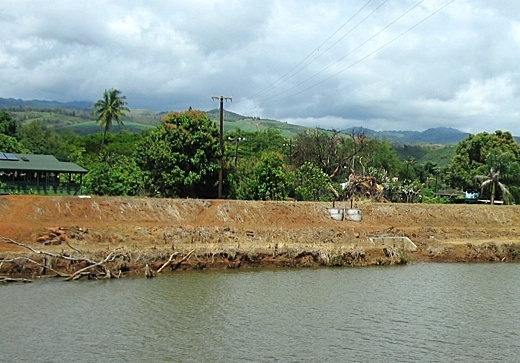 Image above: The stripped and eroded Hanapepe levee after orders from the Army Corps.
Photo by Juan Wilson 3/28/07
By Richard Fausset on 19 November 2009 in the LA Times -
(http://www.latimes.com/news/nation-and-world/la-na-katrina-flooding19-2009nov19,0,3370102.story)
Image above: The stripped and eroded Hanapepe levee after orders from the Army Corps.
Photo by Juan Wilson 3/28/07
By Richard Fausset on 19 November 2009 in the LA Times -
(http://www.latimes.com/news/nation-and-world/la-na-katrina-flooding19-2009nov19,0,3370102.story)
In a ruling that could leave the government open to billions of dollars in claims from Hurricane Katrina victims, a federal judge said late Wednesday that the U.S. Army Corps of Engineers had displayed "gross negligence" in failing to maintain a navigation channel -- resulting in levee breaches that flooded large swaths of greater New Orleans.
U.S. District Judge Stanwood R. Duval peppered his 156-page decision, issued in New Orleans, with harsh criticism of the Army corps, at one point citing its "insouciance, myopia and shortsightedness" in failing to maintain the Mississippi River-Gulf Outlet, known locally as MRGO.
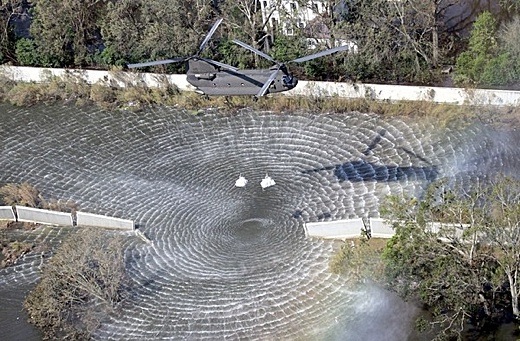 Image above: A helicopter drops sandbags on broken levee after Hurricane Katrina in New Orleans.
For more than 40 years, the judge said, the corps had known that a crucial levee protecting suburban St. Bernard Parish and the Lower 9th Ward neighborhood would be compromised by the deterioration of the channel. The corps had "myriad" ways to address the problem, he wrote, but failed to do so.
Duval awarded a total of $719,000 to a small group of flood victims that sued the government in April 2006.
But according to Pierce O'Donnell, the lead plaintiff's counsel, roughly 100,000 New Orleans-area residents and businesses who have filed flood-damage claims with the Army corps were now potentially eligible for payment.
In a phone interview, O'Donnell hailed what he called a historic ruling, one that backed the widely held contention in New Orleans that the 2005 catastrophe was not just the fault of Mother Nature.
"The judge agreed with us that Katrina was not a natural disaster," O'Donnell said. "Katrina was a man-made disaster caused by the Army Corps of Engineers."
In a statement Wednesday, the Army corps said only that the opinion was being reviewed by lawyers from the Army and Justice Department. "We have no further comment at this time as the issues involved in the case are still subject to further litigation," the corps said.
At the heart of the case was maintenance and operation of the Mississippi River-Gulf Outlet.
The channel, which was decommissioned after Katrina, was completed in the 1960s as a shipping shortcut between New Orleans and the Gulf of Mexico. Over the years, the marshy banks of the channel had widened significantly in spots -- and long before Katrina hit, experts had warned that the destruction of wetlands could create a funnel effect that would intensify storm surges.
During the trial, attorneys for the government argued that the Army Corps of Engineers was not liable for the post-hurricane flooding because it was immune from civil lawsuits questioning federal flood policy decisions.
But Duval found that such "gross negligence" overrode any immunity claim. His opinion, however, does not apply to residents of New Orleans East, another badly flooded part of the region where O'Donnell had hoped to score a victory. Duval ruled that the Army corps was not negligent for failing to build a surge protection barrier there.
The overall ruling could create problems for the Obama administration, which has promised to bring more attention and care to New Orleans than was evident during President George W. Bush's administration.
Katrina, one of the worst disasters in U.S. history, caused more than 1,800 deaths in the Gulf Coast states and wreaked billions of dollars in property damage. In New Orleans, the storm surge breached levees in several places, flooding about 80% of the city. Many residents were left trapped on roofs or in attics for days.
The federal government has promised tens of billions of dollars in post-storm rebuilding aid to Louisiana. The Justice Department has estimated that the total outstanding civil claims could amount to billions more.
But those claimants, O'Donnell said, might not be paid until the appeals process is exhausted, which could last years. He called upon the Obama administration and Congress to agree to a universal settlement -- something he said the Bush administration had pledged not to do.
O'Donnell said his team had filed a separate legal action that seeks to cover those thousands of victims in a class-action suit. He noted that the federal government had agreed to universal settlements in past cases in which it had erred, including after a 1976 failure of the Teton Dam in Idaho and the 2000 Cerro Grande fire in New Mexico, which started as a federal controlled burn.