
SUBHEAD: In the fall of a civilization things you think of as important and necessary are going to go away.
By John MIchael Greer on 25 January 2017 for The Archdruid Report -
(http://thearchdruidreport.blogspot.com/2017/01/how-great-fall-can-be.html)
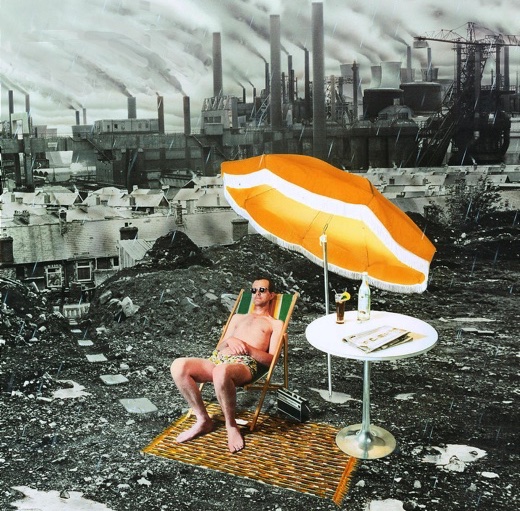
Image above: Cover art of Supertamp album "Crisis? What Crisis?" From ().
While I type these words, an old Supertramp CD is playing in the next room. Those of my readers who belong to the same slice of an American generation I do will likely remember the words Roger Hodgson is singing just now, the opening line from “Fool’s Overture”:
“History recalls how great the fall can be...”
It’s an apposite quote for a troubled time.
Over the last year or so, in and among the other issues I’ve tried to discuss in this blog, the US presidential campaign has gotten a certain amount of air time.
Some of the conversations that resulted generated a good deal more heat than light, but then that’s been true across the board since Donald Trump overturned the established certainties of American political life and launched himself and the nation on an improbable trajectory toward our current situation.
Though the diatribes I fielded from various sides were more than occasionally tiresome, I don’t regret making the election a theme for discussion here, as it offered a close-up view of issues I’ve been covering for years now.
A while back on this blog, for example, I spent more than a year sketching out the process by which civilizations fall and dark ages begin, with an eye toward the next five centuries of North American history—a conversation that turned into my book Dark Age America.
Among the historical constants I discussed in the posts and the book was the way that governing elites and their affluent supporters stop adapting their policies to changing political and economic conditions, and demand instead that political and economic conditions should conform to their preferred policies.
That’s all over today’s headlines, as the governing elites of the industrial world cower before the furious backlash sparked by their rigid commitment to the failed neoliberal nostrums of global trade and open borders.
Another theme I discussed in the same posts and book was the way that science and culture in a civilization in decline become so closely identified with the interests of the governing elite that the backlash against the failed policies of the elite inevitably becomes a backlash against science and culture as well. We’ve got plenty of that in the headlines as well.
According to recent news stories, for example, the Trump administration plans to scrap the National Endowment for the Arts, the National Endowment for the Humanities, and the Corporation for Public Broadcasting, and get rid of all the federal offices that study anthropogenic climate change.
Their termination with extreme prejudice isn’t simply a matter of pruning the federal bureaucracy, though that’s a factor.
All these organizations display various forms of the identification of science and culture with elite values just discussed, and their dismantling will be greeted by cheers from a great many people outside the circles of the affluent, who have had more than their fill of patronizing lectures from their self-proclaimed betters in recent years.
Will many worthwhile programs be lost, along with a great deal that’s less than worthwhile? Of course. That’s a normal feature of the twilight years of a civilization.
A couple of years before the sequence of posts on dark age America, for that matter, I did another series on the end of US global hegemony and the rough road down from empire. That sequence also turned into a book, Decline and Fall.
In the posts and the book, I pointed out that one of the constants of the history of democratic societies—actual democracies, warts and all, as distinct from the imaginary “real democracy” that exists solely in rhetoric—is a regular cycle of concentration and diffusion of power. The ancient Greek historian Polybius, who worked it out in detail, called it anacyclosis.
A lot can be said about anacyclosis, but the detail that’s relevant just now is the crisis phase, when power has become so gridlocked among competing power centers that it becomes impossible for the system to break out of even the most hopelessly counterproductive policies.
That ends, according to Polybius, when a charismatic demagogue gets into power, overturns the existing political order, and sets in motion a general free-for-all in which old alliances shatter and improbable new ones take shape.
Does that sound familiar? In a week when union leaders emerged beaming from a meeting with the new president, while Democrats are still stoutly defending the integrity of the CIA, it should.
For that matter, one of the central themes of the sequence of posts and the book was the necessity of stepping back from global commitments that the United States can no longer afford to maintain. That’s happening, too, though it’s being covered up just now by a great deal of Trumped-up bluster about a massive naval expansion.
If we do get a 350-ship navy in the next decade, I’d be willing to bet that a lot of those ships will turn out to be inexpensive corvettes, like the ones the Russians have been using so efficiently as cruise missile platforms on the Caspian Sea.
European politicians are squawking at top volume about the importance of NATO, which means in practice the continuation of a scheme that allows most European countries to push most of the costs of their own defense onto the United States, but the new administration doesn’t seem to be buying it.
Mind you, I’m far from enthusiastic about the remilitarization of Europe. Outside the brief interval of enforced peace following the Second World War, Europe has been a boiling cauldron of warfare since its modern cultures began to emerge out of the chaos of the post-Roman dark ages.
Most of the world’s most devastating wars have been European in origin, and of course it escapes no one’s attention in the rest of the world that it was from Europe that hordes of invaders and colonizers swept over the entire planet from the sixteenth through the nineteenth centuries, as often as not leaving total devastation in their wake.
In histories written a thousand years from now, Europeans will have the same sort of reputation that Huns and Mongols have today—and it’s only in the fond fantasies of those who think history has a direction that those days are definitely over.
It can’t be helped, though, for the fact of the matter is that the United States can no longer afford to foot the bill for the defense of other countries.
Behind a facade of hallucinatory paper wealth, our nation is effectively bankrupt. The only thing that enables us to pay our debts now is the status of the dollar as the world’s reserve currency—this allows the Treasury to issue debt at a breakneck pace and never have to worry about the cost—and that status is trickling away as one country after another signs bilateral deals to facilitate trading in other currencies.
Sooner or later, probably in the next two decades, the United States will be forced to default on its national debt, the way Russia did in 1998.
Before that happens, a great many currently overvalued corporations that support themselves by way of frantic borrowing will have done the same thing by way of the bankruptcy courts, and of course the vast majority of America’s immense consumer debt will have to be discharged the same way.
That means, among other things, that the extravagant lifestyles available to affluent Americans in recent decades will be going away forever in the not too distant future.
That’s another point I made in Decline and Fall and the series of posts that became raw material for it.
During the era of US global hegemony, the five per cent of our species who lived in the United States disposed of a third of the world’s raw materials and manufactured products and a quarter of its total energy production.
That disproportionate share came to us via unbalanced patterns of exchange hardwired into the global economy, and enforced at gunpoint by the military garrisons we keep in more than a hundred countries worldwide.
The ballooning US government, corporate, and consumer debt load of recent years was an attempt to keep those imbalances in place even as their basis in geopolitics trickled away. Now the dance is ending and the piper has to be paid.
There’s a certain bleak amusement to be had from the fact that one of the central themes of this blog not that many years back—“Collapse Now and Avoid the Rush”—has already passed its pull date. The rush, in case you haven’t noticed, is already under way.
The fraction of US adults of working age who are permanently outside the work force is at an all-time high; so is the fraction of young adults who are living with their parents because they can’t afford to start households of their own.
There’s good reason to think that the new administration’s trade and immigration policies may succeed in driving both those figures down, at least for a while, but of course there will be a price to be paid for that—and those industries and social classes that have profited most from the policies of the last thirty years, and threw their political and financial weight behind the Clinton campaign, will be first in line to pay it. Vae victis! (Woe to the vanquished!)
More generally, the broader landscape of ideas this blog has tried to explore since its early days remains what it is.
The Earth’s economically accessible reserves of fossil carbon dwindle day by day; with each year that passes, on average, the amount of coal, oil, and natural gas burnt exceeds the amount that’s discovered by a wider margin; the current temporary glut in the oil markets is waning so fast that analysts are predicting the next price spike as soon as 2018.
Talk of transitioning away from fossil fuels to renewable energy, on the one hand, or nuclear power on the other, remains talk—I encourage anyone who doubts this to look up the amount of fossil fuels burnt each year over the last two decades and see if they can find a noticeable decrease in global fossil fuel consumption to match the much-ballyhooed buildout of solar and wind power.
The industrial world remains shackled to fossil fuels for most of its energy and all of its transportation fuel, for the simple reason that no other energy source in this end of the known universe provides the abundant, concentrated, and fungible energy supply that’s needed to keep our current lifestyles going.
There was always an alternative—deliberately downshifting out of the embarrassing extravagance that counts for normal lifestyles in the industrial world these days, accepting more restricted ways of living in order to leave a better world for our descendants—but not enough people were willing to accept that alternative to make a difference while there was still a chance.
Meanwhile the other jaw of the vise that’s tightening around the future is becoming increasingly visible just now. In the Arctic, freak weather systems has sucked warm air up from lower latitudes and brought the normal process of winter ice formation to a standstill.
In the Antarctic, the Larsen C ice shelf, until a few years ago considered immovable by most glaciologists, is in the process of loosing an ice sheet the size of Delaware into the Antarctic Ocean. I look out my window and see warm rain falling; here in the north central Appalachians, in January, it’s been most of a month since the thermometer last dipped below freezing.
The new administration has committed itself to do nothing about anthropogenic climate change, but then, despite plenty of talk, the Obama administration didn’t do anything about it either.
There’s good reason for that, too.
The only way to stop anthropogenic climate change in its tracks is to stop putting greenhouse gases into the atmosphere, and doing that would require the world to ground its airlines, turn its highways over to bicycles and oxcarts, and shut down every other technology that won’t be economically viable if it has to depend on the diffuse intermittent energy available from renewable sources.
Does the political will to embrace such changes exist? Since I know of precisely three climate change scientists, out of thousands, who take their own data seriously enough to cut their carbon footprint by giving up air travel, it’s safe to say that the answer is “no.”
So, basically, we’re in for it.
The thing that fascinates me is that this is something I’ve been saying for the whole time this blog has been appearing.
The window of opportunity for making a smooth transition to a renewable future slammed shut in the early 1980s, when majorities across the industrial world turned their backs on the previous decade’s promising initiatives toward sustainability, and bought into the triumphalist rhetoric of the Reagan-Thatcher counterrevolution instead.
Since then, year after weary year, most of the green movement—with noble exceptions—has been long on talk and short on action.
Excuses for doing nothing and justifications for clinging to lifestyles the planet cannot support have proliferated like rabbits on Viagra, and most of the people who talked about sustainability at all took it for granted that the time to change course was still somewhere conveniently off in the future. That guaranteed that the chance to change course would slide steadily further back into the past.
There was another detail of the post-Seventies sustainability scene that deserves discussion, though, because it’s been displayed with an almost pornographic degree of nakedness in the weeks just past.
From the early days of the peak oil movement in the late 1990s on, a remarkably large number of the people who talked eagerly about the looming crisis of our age seemed to think that its consequences would leave them and the people and things they cared about more or less intact.
That wasn’t universal by any means; there were always some people who grappled with the hard realities that the end of the fossil fuel age was going to impose on their own lives; but all things considered, there weren’t that many, in comparison to all those who chattered amiably about how comfortable they’d be in their rural doomsteads, lifeboat communities, Transition Towns, et al.
Now, as discussed earlier in this post, we’ve gotten a very modest helping of decline and fall, and people who were enthusiastically discussing the end of the industrial age not that long ago are freaking out six ways from Sunday.
If a relatively tame event like the election of an unpopular president can send people into this kind of tailspin, what are they going to do the day their paychecks suddenly turn out to be worth only half as much in terms of goods and services as before—a kind of event that’s already become tolerably common elsewhere, and could quite easily happen in this country as the dollar loses its reserve currency status?
What kinds of meltdowns are we going to get when internet service or modern health care get priced out of reach, or become unavailable at any price?
How are they going to cope if the accelerating crisis of legitimacy in this country causes the federal government to implode, the way the government of the Soviet Union did, and suddenly they’re living under cobbled-together regional governments that don’t have the money to pay for basic services?
What sort of reaction are we going to see if the US blunders into a sustained domestic insurgency—suicide bombs going off in public places, firefights between insurgent forces and government troops, death squads from both sides rounding up potential opponents and leaving them in unmarked mass graves—or, heaven help us, all-out civil war?
This is what the decline and fall of a civilization looks like. It’s not about sitting in a cozy earth-sheltered home under a roof loaded with solar panels, living some close approximation of a modern industrial lifestyle, while the rest of the world slides meekly down the chute toward history’s compost bin, leaving you and yours untouched.
It’s about political chaos—meaning that you won’t get the leaders you want, and you may not be able to count on the rule of law or even the most basic civil liberties.
It’s about economic implosion—meaning that your salary will probably go away, your savings almost certainly won’t keep its value, and if you have gold bars hidden in your home, you’d better hope to Hannah that nobody ever finds out, or it’ll be a race between the local government and the local bandits to see which one gets to tie your family up and torture them to death, starting with the children, until somebody breaks and tells them where your stash is located.
It’s about environmental chaos—meaning that you and the people you care about may have many hungry days ahead as crazy weather messes with the harvests, and it’s by no means certain you won’t die early from some tropical microbe that’s been jarred loose from its native habitat to find a new and tasty home in you.
It’s about rapid demographic contraction—meaning that you get to have the experience a lot of people in the Rust Belt have already, of walking past one abandoned house after another and remembering the people who used to live there, until they didn’t any more.
More than anything else, it’s about loss.
Things that you value—things you think of as important, meaningful, even necessary—are going to go away forever in the years immediately ahead of us, and there will be nothing you can do about it.
It really is as simple as that.
People who live in an age of decline and fall can’t afford to cultivate a sense of entitlement.
Unfortunately, for reasons discussed at some length in one of last month’s posts, the notion that the universe is somehow obliged to give people what they think they deserve is very deeply engrained in American popular culture these days.
That’s a very unwise notion to believe right now, and as we slide further down the slope, it could very readily become fatal—and no, by the way, I don’t mean that last adjective in a metaphorical sense.
History recalls how great the fall can be, Roger Hodgson sang. In our case, it’s shaping up to be one for the record books—and those of my readers who have worked themselves up to the screaming point about the comparatively mild events we’ve seen so far may want to save some of their breath for the times ahead when it’s going to get much, much worse.
.
By John MIchael Greer on 25 January 2017 for The Archdruid Report -
(http://thearchdruidreport.blogspot.com/2017/01/how-great-fall-can-be.html)
Image above: Cover art of Supertamp album "Crisis? What Crisis?" From ().
While I type these words, an old Supertramp CD is playing in the next room. Those of my readers who belong to the same slice of an American generation I do will likely remember the words Roger Hodgson is singing just now, the opening line from “Fool’s Overture”:
“History recalls how great the fall can be...”
It’s an apposite quote for a troubled time.
Over the last year or so, in and among the other issues I’ve tried to discuss in this blog, the US presidential campaign has gotten a certain amount of air time.
Some of the conversations that resulted generated a good deal more heat than light, but then that’s been true across the board since Donald Trump overturned the established certainties of American political life and launched himself and the nation on an improbable trajectory toward our current situation.
Though the diatribes I fielded from various sides were more than occasionally tiresome, I don’t regret making the election a theme for discussion here, as it offered a close-up view of issues I’ve been covering for years now.
A while back on this blog, for example, I spent more than a year sketching out the process by which civilizations fall and dark ages begin, with an eye toward the next five centuries of North American history—a conversation that turned into my book Dark Age America.
Among the historical constants I discussed in the posts and the book was the way that governing elites and their affluent supporters stop adapting their policies to changing political and economic conditions, and demand instead that political and economic conditions should conform to their preferred policies.
That’s all over today’s headlines, as the governing elites of the industrial world cower before the furious backlash sparked by their rigid commitment to the failed neoliberal nostrums of global trade and open borders.
Another theme I discussed in the same posts and book was the way that science and culture in a civilization in decline become so closely identified with the interests of the governing elite that the backlash against the failed policies of the elite inevitably becomes a backlash against science and culture as well. We’ve got plenty of that in the headlines as well.
According to recent news stories, for example, the Trump administration plans to scrap the National Endowment for the Arts, the National Endowment for the Humanities, and the Corporation for Public Broadcasting, and get rid of all the federal offices that study anthropogenic climate change.
Their termination with extreme prejudice isn’t simply a matter of pruning the federal bureaucracy, though that’s a factor.
All these organizations display various forms of the identification of science and culture with elite values just discussed, and their dismantling will be greeted by cheers from a great many people outside the circles of the affluent, who have had more than their fill of patronizing lectures from their self-proclaimed betters in recent years.
Will many worthwhile programs be lost, along with a great deal that’s less than worthwhile? Of course. That’s a normal feature of the twilight years of a civilization.
A couple of years before the sequence of posts on dark age America, for that matter, I did another series on the end of US global hegemony and the rough road down from empire. That sequence also turned into a book, Decline and Fall.
In the posts and the book, I pointed out that one of the constants of the history of democratic societies—actual democracies, warts and all, as distinct from the imaginary “real democracy” that exists solely in rhetoric—is a regular cycle of concentration and diffusion of power. The ancient Greek historian Polybius, who worked it out in detail, called it anacyclosis.
A lot can be said about anacyclosis, but the detail that’s relevant just now is the crisis phase, when power has become so gridlocked among competing power centers that it becomes impossible for the system to break out of even the most hopelessly counterproductive policies.
That ends, according to Polybius, when a charismatic demagogue gets into power, overturns the existing political order, and sets in motion a general free-for-all in which old alliances shatter and improbable new ones take shape.
Does that sound familiar? In a week when union leaders emerged beaming from a meeting with the new president, while Democrats are still stoutly defending the integrity of the CIA, it should.
For that matter, one of the central themes of the sequence of posts and the book was the necessity of stepping back from global commitments that the United States can no longer afford to maintain. That’s happening, too, though it’s being covered up just now by a great deal of Trumped-up bluster about a massive naval expansion.
If we do get a 350-ship navy in the next decade, I’d be willing to bet that a lot of those ships will turn out to be inexpensive corvettes, like the ones the Russians have been using so efficiently as cruise missile platforms on the Caspian Sea.
European politicians are squawking at top volume about the importance of NATO, which means in practice the continuation of a scheme that allows most European countries to push most of the costs of their own defense onto the United States, but the new administration doesn’t seem to be buying it.
Mind you, I’m far from enthusiastic about the remilitarization of Europe. Outside the brief interval of enforced peace following the Second World War, Europe has been a boiling cauldron of warfare since its modern cultures began to emerge out of the chaos of the post-Roman dark ages.
Most of the world’s most devastating wars have been European in origin, and of course it escapes no one’s attention in the rest of the world that it was from Europe that hordes of invaders and colonizers swept over the entire planet from the sixteenth through the nineteenth centuries, as often as not leaving total devastation in their wake.
In histories written a thousand years from now, Europeans will have the same sort of reputation that Huns and Mongols have today—and it’s only in the fond fantasies of those who think history has a direction that those days are definitely over.
It can’t be helped, though, for the fact of the matter is that the United States can no longer afford to foot the bill for the defense of other countries.
Behind a facade of hallucinatory paper wealth, our nation is effectively bankrupt. The only thing that enables us to pay our debts now is the status of the dollar as the world’s reserve currency—this allows the Treasury to issue debt at a breakneck pace and never have to worry about the cost—and that status is trickling away as one country after another signs bilateral deals to facilitate trading in other currencies.
Sooner or later, probably in the next two decades, the United States will be forced to default on its national debt, the way Russia did in 1998.
Before that happens, a great many currently overvalued corporations that support themselves by way of frantic borrowing will have done the same thing by way of the bankruptcy courts, and of course the vast majority of America’s immense consumer debt will have to be discharged the same way.
That means, among other things, that the extravagant lifestyles available to affluent Americans in recent decades will be going away forever in the not too distant future.
That’s another point I made in Decline and Fall and the series of posts that became raw material for it.
During the era of US global hegemony, the five per cent of our species who lived in the United States disposed of a third of the world’s raw materials and manufactured products and a quarter of its total energy production.
That disproportionate share came to us via unbalanced patterns of exchange hardwired into the global economy, and enforced at gunpoint by the military garrisons we keep in more than a hundred countries worldwide.
The ballooning US government, corporate, and consumer debt load of recent years was an attempt to keep those imbalances in place even as their basis in geopolitics trickled away. Now the dance is ending and the piper has to be paid.
There’s a certain bleak amusement to be had from the fact that one of the central themes of this blog not that many years back—“Collapse Now and Avoid the Rush”—has already passed its pull date. The rush, in case you haven’t noticed, is already under way.
The fraction of US adults of working age who are permanently outside the work force is at an all-time high; so is the fraction of young adults who are living with their parents because they can’t afford to start households of their own.
There’s good reason to think that the new administration’s trade and immigration policies may succeed in driving both those figures down, at least for a while, but of course there will be a price to be paid for that—and those industries and social classes that have profited most from the policies of the last thirty years, and threw their political and financial weight behind the Clinton campaign, will be first in line to pay it. Vae victis! (Woe to the vanquished!)
More generally, the broader landscape of ideas this blog has tried to explore since its early days remains what it is.
The Earth’s economically accessible reserves of fossil carbon dwindle day by day; with each year that passes, on average, the amount of coal, oil, and natural gas burnt exceeds the amount that’s discovered by a wider margin; the current temporary glut in the oil markets is waning so fast that analysts are predicting the next price spike as soon as 2018.
Talk of transitioning away from fossil fuels to renewable energy, on the one hand, or nuclear power on the other, remains talk—I encourage anyone who doubts this to look up the amount of fossil fuels burnt each year over the last two decades and see if they can find a noticeable decrease in global fossil fuel consumption to match the much-ballyhooed buildout of solar and wind power.
The industrial world remains shackled to fossil fuels for most of its energy and all of its transportation fuel, for the simple reason that no other energy source in this end of the known universe provides the abundant, concentrated, and fungible energy supply that’s needed to keep our current lifestyles going.
There was always an alternative—deliberately downshifting out of the embarrassing extravagance that counts for normal lifestyles in the industrial world these days, accepting more restricted ways of living in order to leave a better world for our descendants—but not enough people were willing to accept that alternative to make a difference while there was still a chance.
Meanwhile the other jaw of the vise that’s tightening around the future is becoming increasingly visible just now. In the Arctic, freak weather systems has sucked warm air up from lower latitudes and brought the normal process of winter ice formation to a standstill.
In the Antarctic, the Larsen C ice shelf, until a few years ago considered immovable by most glaciologists, is in the process of loosing an ice sheet the size of Delaware into the Antarctic Ocean. I look out my window and see warm rain falling; here in the north central Appalachians, in January, it’s been most of a month since the thermometer last dipped below freezing.
The new administration has committed itself to do nothing about anthropogenic climate change, but then, despite plenty of talk, the Obama administration didn’t do anything about it either.
There’s good reason for that, too.
The only way to stop anthropogenic climate change in its tracks is to stop putting greenhouse gases into the atmosphere, and doing that would require the world to ground its airlines, turn its highways over to bicycles and oxcarts, and shut down every other technology that won’t be economically viable if it has to depend on the diffuse intermittent energy available from renewable sources.
Does the political will to embrace such changes exist? Since I know of precisely three climate change scientists, out of thousands, who take their own data seriously enough to cut their carbon footprint by giving up air travel, it’s safe to say that the answer is “no.”
So, basically, we’re in for it.
The thing that fascinates me is that this is something I’ve been saying for the whole time this blog has been appearing.
The window of opportunity for making a smooth transition to a renewable future slammed shut in the early 1980s, when majorities across the industrial world turned their backs on the previous decade’s promising initiatives toward sustainability, and bought into the triumphalist rhetoric of the Reagan-Thatcher counterrevolution instead.
Since then, year after weary year, most of the green movement—with noble exceptions—has been long on talk and short on action.
Excuses for doing nothing and justifications for clinging to lifestyles the planet cannot support have proliferated like rabbits on Viagra, and most of the people who talked about sustainability at all took it for granted that the time to change course was still somewhere conveniently off in the future. That guaranteed that the chance to change course would slide steadily further back into the past.
There was another detail of the post-Seventies sustainability scene that deserves discussion, though, because it’s been displayed with an almost pornographic degree of nakedness in the weeks just past.
From the early days of the peak oil movement in the late 1990s on, a remarkably large number of the people who talked eagerly about the looming crisis of our age seemed to think that its consequences would leave them and the people and things they cared about more or less intact.
That wasn’t universal by any means; there were always some people who grappled with the hard realities that the end of the fossil fuel age was going to impose on their own lives; but all things considered, there weren’t that many, in comparison to all those who chattered amiably about how comfortable they’d be in their rural doomsteads, lifeboat communities, Transition Towns, et al.
Now, as discussed earlier in this post, we’ve gotten a very modest helping of decline and fall, and people who were enthusiastically discussing the end of the industrial age not that long ago are freaking out six ways from Sunday.
If a relatively tame event like the election of an unpopular president can send people into this kind of tailspin, what are they going to do the day their paychecks suddenly turn out to be worth only half as much in terms of goods and services as before—a kind of event that’s already become tolerably common elsewhere, and could quite easily happen in this country as the dollar loses its reserve currency status?
What kinds of meltdowns are we going to get when internet service or modern health care get priced out of reach, or become unavailable at any price?
How are they going to cope if the accelerating crisis of legitimacy in this country causes the federal government to implode, the way the government of the Soviet Union did, and suddenly they’re living under cobbled-together regional governments that don’t have the money to pay for basic services?
What sort of reaction are we going to see if the US blunders into a sustained domestic insurgency—suicide bombs going off in public places, firefights between insurgent forces and government troops, death squads from both sides rounding up potential opponents and leaving them in unmarked mass graves—or, heaven help us, all-out civil war?
This is what the decline and fall of a civilization looks like. It’s not about sitting in a cozy earth-sheltered home under a roof loaded with solar panels, living some close approximation of a modern industrial lifestyle, while the rest of the world slides meekly down the chute toward history’s compost bin, leaving you and yours untouched.
It’s about political chaos—meaning that you won’t get the leaders you want, and you may not be able to count on the rule of law or even the most basic civil liberties.
It’s about economic implosion—meaning that your salary will probably go away, your savings almost certainly won’t keep its value, and if you have gold bars hidden in your home, you’d better hope to Hannah that nobody ever finds out, or it’ll be a race between the local government and the local bandits to see which one gets to tie your family up and torture them to death, starting with the children, until somebody breaks and tells them where your stash is located.
It’s about environmental chaos—meaning that you and the people you care about may have many hungry days ahead as crazy weather messes with the harvests, and it’s by no means certain you won’t die early from some tropical microbe that’s been jarred loose from its native habitat to find a new and tasty home in you.
It’s about rapid demographic contraction—meaning that you get to have the experience a lot of people in the Rust Belt have already, of walking past one abandoned house after another and remembering the people who used to live there, until they didn’t any more.
More than anything else, it’s about loss.
Things that you value—things you think of as important, meaningful, even necessary—are going to go away forever in the years immediately ahead of us, and there will be nothing you can do about it.
It really is as simple as that.
People who live in an age of decline and fall can’t afford to cultivate a sense of entitlement.
Unfortunately, for reasons discussed at some length in one of last month’s posts, the notion that the universe is somehow obliged to give people what they think they deserve is very deeply engrained in American popular culture these days.
That’s a very unwise notion to believe right now, and as we slide further down the slope, it could very readily become fatal—and no, by the way, I don’t mean that last adjective in a metaphorical sense.
History recalls how great the fall can be, Roger Hodgson sang. In our case, it’s shaping up to be one for the record books—and those of my readers who have worked themselves up to the screaming point about the comparatively mild events we’ve seen so far may want to save some of their breath for the times ahead when it’s going to get much, much worse.
.
