SUBHEAD: Biochar can address three or four critical crises at once.
By Fiona Harvey on 27 February 2009 in The Financial Times
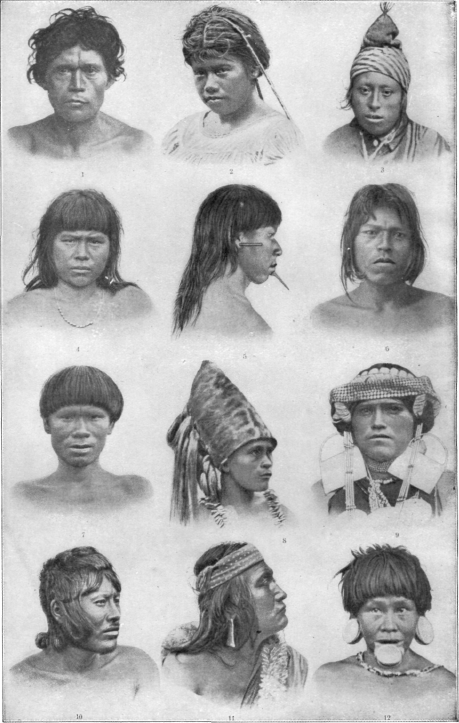
Image above: Detail of page of portraits of South American Natives. From http://chestofbooks.com/reference/The-New-Student-s-Reference-Work-Vol1/pp0078.html
In Brazil’s Amazon basin, farmers have long sought out a special form of fertiliser – a locally sourced compost-like substance prized for its amazing qualities of reviving poor or exhausted soils. They buy it in sacks or dig it out of the earth from patches that are sometimes as much as 6ft deep. Spread on fields, it retains its fertile qualities for long periods.They call it the terra preta do indio – literally, “the dark earth of the Indians”. Dense, rich and loamy, this earth forms a stark contrast with the thin, poor soils of the region. (It seems a paradox, but rainforest soils have low fertility. This is why farmers who cut down the forest for agriculture have to keep on felling – after a few years of cropping, yields collapse and they have to move on.) Patches of terra preta extend for many hectares in some places but until recently, no one really knew what the mysterious dark earth was. Some guessed it was volcanic, or the sediment of old lakes, or the residue of some long-rotted vegetation. Few imagined that it was man-made.
Terra preta, modern analysis has proved, is one of the last remaining traces of pre-Columbian agriculture in the Amazon basin. It was made more than 2,500 – and perhaps as long as 6,000 – years ago by people living by the river. These cultures survived and supported complex agriculture, despite poor soil, by making their own earth. They used dung, fish, animal bones and plant waste – the usual suspects. But the key ingredient in terra preta, and what gives it its dark colour, is charcoal.
“It’s wonderful stuff,” says Simon Shackley, a social science lecturer at the University of Edinburgh. “We started to get to know about it when Dutch scientists began to look at it in the 1960s. They found these dark soils in this area of very poor soil, where it was being put on fields like compost. It’s really the product of slash-and-burn agriculture, and other organic waste, incorporated into the soils over hundreds or even thousands of years – and it does appear to be fertile indefinitely, which is really a very odd thing.”
This ancient product of the Amazon is now the subject of intense scrutiny by climate change scientists. The tenacity of the charcoal of terra preta – retaining its fertilising properties over centuries – has given them an idea. Charcoal is a form of carbon, the burnt remains of plant and animal material. If it can stay intact in the earth for so long, without being released as carbon dioxide gas, why not lock up more carbon in the earth in this manner?
Scientists have begun to refer to the charcoal made from plants for the purpose of storing carbon as “biochar”. The theory is that biomass – any plant or animal material – can be turned into charcoal by heating it in the absence of oxygen. By taking CO2 out of the atmosphere, the impact on climate change could be huge. Soils naturally contain large quantities of carbon, from decayed vegetation. But this carbon is relatively unstable, in climate terms – soils give off CO2 when they are disturbed, by ploughing for example, making them as much a carbon source as a carbon sink. So the idea of trying to lock up carbon in soils has found little favour among climate scientists – indeed, it has even gained a bad name, as farmers have sought to cash in by claiming their fields should qualify for the carbon credits intended to provide financial support to projects such as wind farms or solar power plants.
What is different about biochar is that the stability of the charcoal should make it possible to lock away the carbon it contains for hundreds of years. The carbon is mineralised, so it’s very resistant to breaking down. What’s more, the ancillary benefits – not just its soil-improving characteristics, but certain byproducts of its manufacture – should be enough to make it economically attractive.
When it’s made, about a third of the biomass is turned to char, a third is turned to syngas that can be burned to generate electricity, and a third into a crude oil substitute that could be very useful in making plastics, though it would be hard to use as a transport fuel. Tim Flannery, the eminent Australian explorer and naturalist , argues that these properties of biochar “allow us to address three or four critical crises at once: the climate change crisis, the energy crisis, and the food and water crises”, because putting biochar in the soil not only fertilises the soil, but also helps it to retain water.
Just how much could biochar do to change the world’s carbon balance? There is little doubt of the enormous amount required. Every year, human activities – burning fossil fuels, cutting down forests, converting grassland to crops and so on – contribute eight to 10 billion tonnes of carbon to the atmosphere. Most of that carbon does not go on to damage the climate – the world has a natural carbon cycle, by which carbon dioxide in the atmosphere is absorbed and re-emitted by “carbon sinks” of vegetation, soils, the seas and other natural processes. But these processes are being severely overloaded, so the carbon content of the atmosphere is rising. At present, it stands at about 387 parts per million, certainly higher than at any time in the last 650,000 years and probably in the last 20 million. According to the Global Carbon Project, between 2000 and 2007, the land and ocean carbon sinks – such as forests, and plankton in the ocean – removed about 54 per cent, or 4.8 billion tonnes a year of the carbon that humans pumped into the atmosphere. That leaves a carbon surplus of about 4 billion tonnes or so per year, which we need to find ways to reduce or absorb. Moreover, the amount absorbed by natural sinks is declining as land and oceans warm, meaning every year we must either work even harder to remove carbon from the air, or stop emitting it.
Even as governments talk of a “low-carbon economy”, global greenhouse gas emissions are rising fast. According to the Intergovernmental Panel on Climate Change, the world authority on climate science, emissions must peak in the period 2015 to 2020 if we are to avoid the most catastrophic effects of climate change. On present projections, that will be impossible – unless a way can be found to make available cheap, easy methods of removing carbon dioxide from the atmosphere, and of generating clean electricity in ways that can be adopted around the world much more quickly than current renewable technologies.
According to some early estimates of biochar’s potential, this wonder substance alone could achieve all the carbon reductions necessary to prevent further global warming. Johannes Lehmann of Cornell University and others calculated that biochar could remove between 5.5 and 9.5 billion tonnes of carbon from the air each year. But those estimates relied on heroic assumptions about the ability to make biochar easily around the world, says Shackley. “There has been a tendency to withdraw from some of the very large figures lately,” he notes. “Now, I would say people are talking more about something in the range of one to two billion tonnes a year.”
This may seem disappointing in comparison with previous grandiose claims, but it still represents an impressive potential contribution from a single method, Shackley says. “It’s certainly not trivial,” agrees Tim Lenton, professor of earth systems science at the University of East Anglia. “It might be a good-sized slice of what we need, and it has sizeable side benefits – it’s win-win.” If other carbon-reducing techniques – such as preserving and regrowing forests, increasing the share of energy from renewables, and the push for energy efficiency – were pursued simultaneously, the world could make the cuts needed in our “carbon budget” to stave off climate disaster.
This potential, and the unique and sometimes mysterious qualities of biochar, are making it one of the most exciting new areas of climate change research. The idea of sequestering carbon through biochar has gained some heavy-hitting scientific backers, such as James Lovelock, the maverick scientist whose Gaia hypothesis has come back into vogue. Scientists at Cornell University, led by Lehmann, are working on ways to sequestrate carbon in biochar-enriched soil.
According to some early estimates of biochar’s potential, this wonder substance alone could achieve all the carbon reductions necessary to prevent further global warming. Johannes Lehmann of Cornell University and others calculated that biochar could remove between 5.5 and 9.5 billion tonnes of carbon from the air each year. But those estimates relied on heroic assumptions about the ability to make biochar easily around the world, says Shackley. “There has been a tendency to withdraw from some of the very large figures lately,” he notes. “Now, I would say people are talking more about something in the range of one to two billion tonnes a year.”
This may seem disappointing in comparison with previous grandiose claims, but it still represents an impressive potential contribution from a single method, Shackley says. “It’s certainly not trivial,” agrees Tim Lenton, professor of earth systems science at the University of East Anglia. “It might be a good-sized slice of what we need, and it has sizeable side benefits – it’s win-win.” If other carbon-reducing techniques – such as preserving and regrowing forests, increasing the share of energy from renewables, and the push for energy efficiency – were pursued simultaneously, the world could make the cuts needed in our “carbon budget” to stave off climate disaster.
This potential, and the unique and sometimes mysterious qualities of biochar, are making it one of the most exciting new areas of climate change research. The idea of sequestering carbon through biochar has gained some heavy-hitting scientific backers, such as James Lovelock, the maverick scientist whose Gaia hypothesis has come back into vogue. Scientists at Cornell University, led by Lehmann, are working on ways to sequestrate carbon in biochar-enriched soil.
In the UK, a biochar research centre has been set up at Edinburgh university; other European countries are following suit, and research projects are under way in countries from Canada to Australia. A few companies are in the early stages of trying to find ways to commercialise biochar production. Biochar even has its own song – “The Biochar Blues” – written by members of the International Biochar Initiative.
Charcoal is, of course, nothing new. People have been making it for millennia, chiefly for fuel. The process is simple: take wood, or straw or the waste from crops, and heat it in the absence of oxygen. Traditionally, this was done by heaping earth on top of the lit biomass so that it smouldered for a long time. Modern kilns can make the process more efficient, but the principle remains the same.
There is much about biochar that remains a puzzle, however. Take the soil-fertility effects. What is it about biochar that improves soil so much? “The simple answer is that we don’t know exactly,” says Shackley. “It’s probably a combination of several factors. Charcoal is very porous, so it acts like a sponge in retaining water, and the nutrients dissolved in water, which is something poor soils aren’t very good at. And [its porous nature] also means it provides a good material for the growth of lots of important bacteria.”
Another factor in its favour is that using biochar as a fertiliser can displace artificial nitrogen fertilisers, which give off nitrous oxide, a greenhouse gas 300 times more powerful than carbon dioxide. And biochar is not toxic, adds Lenton – “no one has yet said there is some great hidden danger associated with it”.
But Saran Sohi, a lecturer in soil science, warns that anyone hoping that biochar alone will solve fertility problems is probably deluded – biochar is not enough by itself to make the difference that terra preta does to thin Brazilian soils. “Terra preta soils also contain other nutrients, from the other substances they contain – things like bones, which are rich in phosphorus [essential for healthy plant growth],” he says. The biochar undoubtedly plays a role in holding these nutrients together, ensuring they remain available to plant roots, but the nutrients must be provided by other means. “No one has yet succeeded in recreating terra preta,” Shackley adds.
To produce biochar on an industrial scale, traditional methods of charcoal production would be impractical. Instead, researchers are looking to pyrolysis – which is a form of controlled thermal decomposition of organic material in the absence of oxygen, at heats that can reach 500 to 600°C.
Using pyrolysis also allows the capture of the syngas and the tarry liquid byproducts, both of which can be used as fuel to generate electricity or for the heating process.
The amount of biochar to be produced depends on accelerating or slowing down the pyrolysis process: fast methods produce 20 per cent biochar and 20 per cent syngas, with 60 per cent bio-oil, while slow methods produce about 50 per cent char and far smaller quantities of oil. “It’s much easier to do slow pyrolysis as well,” notes Adrian Higson of the UK’s National Non-Food Crops Council. “And cheaper.” As modern pyrolysis plants can be run entirely from the syngas, the output is between three and nine times the energy input required, according to the Institute for Governance and Sustainable Development.
What to use to make the char? Tearing down forests to turn into charcoal would be insane in climate change terms. But there is plenty of other material. Agriculture produces large amounts of plant and animal waste – straw, husks, dung. Even human waste – sewage sludge, or some forms of household rubbish – could be used.
And using waste products creates a double carbon saving: if left to rot, they produce methane, a greenhouse gas 20 times more powerful than carbon dioxide. But the difficulty is in gathering the waste – and making it economic to do so. Farmers will require some persuasion that the trouble of conserving and cooking their waste to a charcoal makes financial sense, and they may need new machinery to do so. At a municipal waste level, the problem will be sorting the organic waste, which can be turned to char, from the rest of the rubbish – and proving that this is cheaper and more beneficial than merely burying it.
The IGSD suggests a way of marrying small-scale and industrial methods for producing the char, that if refined could enable the economically viable production of biochar in urban, rural and even poor regions. It suggests three possible systems. The first is a centralised scheme, whereby all waste biomass in a given region would be brought to a central plant for processing; the second is a decentralised system in which each farmer or a small group of farmers would have their own fairly low-tech pyrolysis kiln.
The third system proposes a mobile alternative, in which a vehicle equipped with a pyrolyser, powered using syngas, would visit small farms, returning the biochar to the farmers to use, while collecting the bio-oil to be transported to a refinery and turned into liquid biofuel for vehicles. As an example, the IGSD cites Brazil’s sugar cane industry, in which the tops of the canes, normally burned in the field, and the bagasse – the residue from sugar production – could be turned efficiently into biochar. It estimates that of the 460 megatonne annual sugar cane harvest, as much as 230 megatonnes could be available for pyrolysis. A clutch of companies is now working on these problems, and seeking to commercialise biochar as a medicine for both climate and soil, and as an energy source.
As Mike Mason, founder of the carbon offsetting company Climate Care, bought by JP Morgan, somewhat ruefully notes, he had been planning by now to spend most of his time charging round Africa looking at elephants (he was born in the UK, but was raised in east Africa). But instead he decided that climate change was too great a problem to leave alone, and with his new company, Biojoule, has been investigating ways to turn biochar into a viable business. In Ontario, Canada, Dynamotive is making biochar and up to 130 tonnes a day of bio-oil at a wood-products mill. Crucible Carbon, based in Australia, predicts that its technology will allow carbon sequestration from biochar at the cost of about A$20 (£9) a tonne.
Yet even without the logistical problems, others are less sure of the absolute benefits of the product. Robert Trezona, head of research and development at the Carbon Trust, a UK government-funded body that helps businesses cut their greenhouse gas emissions, worries that seeing biochar as the main output from cooking biomass might be to miss the point. The Carbon Trust is running a competition to develop pyrolysis plants, but with the aim of manufacturing liquid transport fuels from biomass, using fast pyrolysis techniques, to which biochar is merely a byproduct of questionable usefulness.
Charcoal is, of course, nothing new. People have been making it for millennia, chiefly for fuel. The process is simple: take wood, or straw or the waste from crops, and heat it in the absence of oxygen. Traditionally, this was done by heaping earth on top of the lit biomass so that it smouldered for a long time. Modern kilns can make the process more efficient, but the principle remains the same.
There is much about biochar that remains a puzzle, however. Take the soil-fertility effects. What is it about biochar that improves soil so much? “The simple answer is that we don’t know exactly,” says Shackley. “It’s probably a combination of several factors. Charcoal is very porous, so it acts like a sponge in retaining water, and the nutrients dissolved in water, which is something poor soils aren’t very good at. And [its porous nature] also means it provides a good material for the growth of lots of important bacteria.”
Another factor in its favour is that using biochar as a fertiliser can displace artificial nitrogen fertilisers, which give off nitrous oxide, a greenhouse gas 300 times more powerful than carbon dioxide. And biochar is not toxic, adds Lenton – “no one has yet said there is some great hidden danger associated with it”.
But Saran Sohi, a lecturer in soil science, warns that anyone hoping that biochar alone will solve fertility problems is probably deluded – biochar is not enough by itself to make the difference that terra preta does to thin Brazilian soils. “Terra preta soils also contain other nutrients, from the other substances they contain – things like bones, which are rich in phosphorus [essential for healthy plant growth],” he says. The biochar undoubtedly plays a role in holding these nutrients together, ensuring they remain available to plant roots, but the nutrients must be provided by other means. “No one has yet succeeded in recreating terra preta,” Shackley adds.
To produce biochar on an industrial scale, traditional methods of charcoal production would be impractical. Instead, researchers are looking to pyrolysis – which is a form of controlled thermal decomposition of organic material in the absence of oxygen, at heats that can reach 500 to 600°C.
Using pyrolysis also allows the capture of the syngas and the tarry liquid byproducts, both of which can be used as fuel to generate electricity or for the heating process.
The amount of biochar to be produced depends on accelerating or slowing down the pyrolysis process: fast methods produce 20 per cent biochar and 20 per cent syngas, with 60 per cent bio-oil, while slow methods produce about 50 per cent char and far smaller quantities of oil. “It’s much easier to do slow pyrolysis as well,” notes Adrian Higson of the UK’s National Non-Food Crops Council. “And cheaper.” As modern pyrolysis plants can be run entirely from the syngas, the output is between three and nine times the energy input required, according to the Institute for Governance and Sustainable Development.
What to use to make the char? Tearing down forests to turn into charcoal would be insane in climate change terms. But there is plenty of other material. Agriculture produces large amounts of plant and animal waste – straw, husks, dung. Even human waste – sewage sludge, or some forms of household rubbish – could be used.
And using waste products creates a double carbon saving: if left to rot, they produce methane, a greenhouse gas 20 times more powerful than carbon dioxide. But the difficulty is in gathering the waste – and making it economic to do so. Farmers will require some persuasion that the trouble of conserving and cooking their waste to a charcoal makes financial sense, and they may need new machinery to do so. At a municipal waste level, the problem will be sorting the organic waste, which can be turned to char, from the rest of the rubbish – and proving that this is cheaper and more beneficial than merely burying it.
The IGSD suggests a way of marrying small-scale and industrial methods for producing the char, that if refined could enable the economically viable production of biochar in urban, rural and even poor regions. It suggests three possible systems. The first is a centralised scheme, whereby all waste biomass in a given region would be brought to a central plant for processing; the second is a decentralised system in which each farmer or a small group of farmers would have their own fairly low-tech pyrolysis kiln.
The third system proposes a mobile alternative, in which a vehicle equipped with a pyrolyser, powered using syngas, would visit small farms, returning the biochar to the farmers to use, while collecting the bio-oil to be transported to a refinery and turned into liquid biofuel for vehicles. As an example, the IGSD cites Brazil’s sugar cane industry, in which the tops of the canes, normally burned in the field, and the bagasse – the residue from sugar production – could be turned efficiently into biochar. It estimates that of the 460 megatonne annual sugar cane harvest, as much as 230 megatonnes could be available for pyrolysis. A clutch of companies is now working on these problems, and seeking to commercialise biochar as a medicine for both climate and soil, and as an energy source.
As Mike Mason, founder of the carbon offsetting company Climate Care, bought by JP Morgan, somewhat ruefully notes, he had been planning by now to spend most of his time charging round Africa looking at elephants (he was born in the UK, but was raised in east Africa). But instead he decided that climate change was too great a problem to leave alone, and with his new company, Biojoule, has been investigating ways to turn biochar into a viable business. In Ontario, Canada, Dynamotive is making biochar and up to 130 tonnes a day of bio-oil at a wood-products mill. Crucible Carbon, based in Australia, predicts that its technology will allow carbon sequestration from biochar at the cost of about A$20 (£9) a tonne.
Yet even without the logistical problems, others are less sure of the absolute benefits of the product. Robert Trezona, head of research and development at the Carbon Trust, a UK government-funded body that helps businesses cut their greenhouse gas emissions, worries that seeing biochar as the main output from cooking biomass might be to miss the point. The Carbon Trust is running a competition to develop pyrolysis plants, but with the aim of manufacturing liquid transport fuels from biomass, using fast pyrolysis techniques, to which biochar is merely a byproduct of questionable usefulness.
“Producing liquid biofuels for transport is going to be very important in cutting emissions. We don’t know the same about biochar,” he says. In fact, encouraging small farmers to produce biochar by traditional, low-tech methods may actually result in more greenhouse gas emissions than simply burning the plants for fuel or discarding them, he says.
“This is very much unproven,” he objects. “You want to be able to show that it stays in the soil for hundreds of years, and to prove that is difficult.”
The Carbon Trust is not allowing companies applying to it for funding to count the biochar byproduct of pyrolysis as part of the carbon savings they produce. “We are a long way from having enough technical evidence to create a proper case for biochar,” says Trezona. “Even the soil-improvement benefit is a new unexpected finding.”
Flannery disagrees. “At least half of the carbon in charcoal is still sequestered 500 years later. This has been known for a long time, from radio carbon dating from charcoal by paleontologists,” he says.
Even if biochar does not fulfil all of the potential claimed for it, it could still make an important contribution. Al Gore, the former US vice-president and environmental campaigner, likes to point out that the search for a “silver bullet” to solve the problem of climate change has been a distraction. Instead, he argues, though there may be no silver bullet, “there is silver buckshot”.
“This is very much unproven,” he objects. “You want to be able to show that it stays in the soil for hundreds of years, and to prove that is difficult.”
The Carbon Trust is not allowing companies applying to it for funding to count the biochar byproduct of pyrolysis as part of the carbon savings they produce. “We are a long way from having enough technical evidence to create a proper case for biochar,” says Trezona. “Even the soil-improvement benefit is a new unexpected finding.”
Flannery disagrees. “At least half of the carbon in charcoal is still sequestered 500 years later. This has been known for a long time, from radio carbon dating from charcoal by paleontologists,” he says.
Even if biochar does not fulfil all of the potential claimed for it, it could still make an important contribution. Al Gore, the former US vice-president and environmental campaigner, likes to point out that the search for a “silver bullet” to solve the problem of climate change has been a distraction. Instead, he argues, though there may be no silver bullet, “there is silver buckshot”.
Only by bringing many different methods of cutting emissions or absorbing carbon to bear can we reduce atmospheric levels of carbon to within the limits of safety. And of those possible methods, few are as simple and cheap as biochar. Johannes Lehmann of Cornell makes the point that “biochar sequestration does not require a fundamental scientific advance and the underlying production technology is robust and simple, making it appropriate for many regions of the world”.
But no one should doubt that rolling out this technology will be a mammoth task. The problem is twofold: developing a model for biochar production that reliably reduces greenhouse gases but is easily replicable in small farms in poor countries; and in the developed world, changing the business model of large farms so that collecting and cooking their waste is a better option than not. The huge US agribusinesses may be easy to reach, and good candidates to start using their waste for char, but they are likely to need financial incentives before they begin to see the point. The poor farmers of the developing world might be glad of the husbandry advice and techniques that would help them revitalise their own soils with biochar, but how to reach them all? That may prove impossible.
These problems of economics and communication will be the real hurdles at which biochar may fall, just as they have been the reasons why we have failed to capitalise on other ways of cutting carbon, from the very simple – small alterations to wood-fired cooking stoves in Africa and India can reduce the indoor air pollution from cooking fires that kills millions, yet hardly any homes have them – to the complex challenges, such as adopting renewable energy. A massive effort will be required to overcome the inertia that has been the downfall of other great climate ideas.
But no one should doubt that rolling out this technology will be a mammoth task. The problem is twofold: developing a model for biochar production that reliably reduces greenhouse gases but is easily replicable in small farms in poor countries; and in the developed world, changing the business model of large farms so that collecting and cooking their waste is a better option than not. The huge US agribusinesses may be easy to reach, and good candidates to start using their waste for char, but they are likely to need financial incentives before they begin to see the point. The poor farmers of the developing world might be glad of the husbandry advice and techniques that would help them revitalise their own soils with biochar, but how to reach them all? That may prove impossible.
These problems of economics and communication will be the real hurdles at which biochar may fall, just as they have been the reasons why we have failed to capitalise on other ways of cutting carbon, from the very simple – small alterations to wood-fired cooking stoves in Africa and India can reduce the indoor air pollution from cooking fires that kills millions, yet hardly any homes have them – to the complex challenges, such as adopting renewable energy. A massive effort will be required to overcome the inertia that has been the downfall of other great climate ideas.
See also:
Island Breath: Yellow is the New Green 2/27/09
Island Breath: Soylent Black 1/11/09
Island Breath: Rethinking Biochar 10/15/07