SUBHEAD: They appear to be blind to climate change, resource depletion and capitalism's greed.
By Kurt Cobb on 12 August 2018 for Resource Insights -
(http://resourceinsights.blogspot.com/2018/08/climate-politics-and-narrow-vision-of.html)
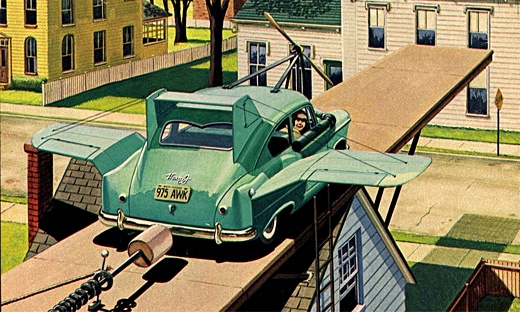
Image above: Artist Bruce McCall painting of a spring activated roof launch of a flying car - the ultimate expression of lunatic 1950s self-centered techno-utopiansim with propellers buzzing over quiet asbestos-sided suburban homes. From (https://ideas.ted.com/wheres-my-flying-car-well-probably-at-ted-at-some-point/).
Most people know the tale of the blind men and the elephant. Each describes a part of the elephant. The elephant is said to be like a pillar by the blind man touching the elephant's leg. The one touching the elephant's tail says the elephant is like a rope and so on.
Now, let's substitute so-called futurists for blind men in this tale and you get something even less reliable. Futurists are the soothsayers of our age. Of course, futurists have eyes to see at least. But they, like the blind men, almost never see the whole picture.
And, in this case they are giving us a description of something that is not even there for them to examine. The future doesn't exist. It's a mere concept. Unlike the blind men, futurists aren't really describing part of a whole.
Typically, they imagine the future as a more magical version of the past where all kinds of new powers are made available to the individual: the ability to transmit emotions and memories through a worldwide "brain-net," 3D-printed human organs based on our own DNA that replace damaged or diseased ones, re-creations of loved ones who have passed away with which we can interact as we did when they were alive.
Naturally, some futurists put the first humans on Mars in the 2030s. NASA apparently has a contest for 3D-printed designs of habitats suitable for humans on Mars.
The idea that colonizing Mars will enhance the chances that humans will survive well into the future is already part of the culture. (Wait a minute! You mean really bad stuff could happen on Earth in our benign technology-laden future. But I digress.)
Unfortunately, there is the nagging problem that cosmic radiation is likely to turn anyone living on Mars into a cancer-riddled dementia patient. No problem! We'll just engineer a whole new race of humans designed to resist the cosmic radiation they will be subject to on Mars and during any space travel.
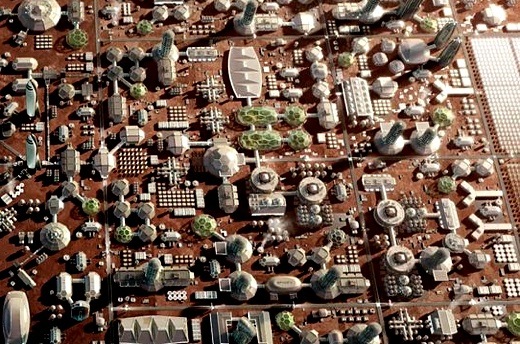
Image above: Illustration of the plan of a future Spacex Mars colony envisioned by Elon Musk. Seems unlikely that has any chance since modern Earthlings seem incapable of sustaining life even on the friendly planet they evolved on. Looks a bit like current day Phoenix, Arizona - with the same destiny - a deserted desert. From (https://www.cnet.com/news/elon-musk-spacex-mars-colony-published-in-new-space/).
For all their imaginative and storytelling powers, futurists—the ones who imagine an unlimited, happy future with vast technological change but not those who see dystopia and destruction ahead and who are instead labeled "alarmists"—these happy futurists cannot imagine dramatic change in our social and political systems.
Capitalism as we know it remains intact, apparently even on Mars. Democratically elected governments are still around; but their choices are increasingly limited to what to do with all our future abundance and the savings that will come from licking most acute and chronic diseases for good.
And, there is another really, really big thing they don't seem to be able to imagine: a civilization crippled and possibly destroyed by climate change. Well, of course, technology will solve the climate problem, they say.
My retort continues to be, "If humans are so clever and our technology so powerful, why haven't we solved the problem of climate change, a problem we already knew 30 years ago was a civilization-threatening emergency?"
The answer, of course, is that climate change cannot be solved by merely applying technology. It is a multi-dimensional, complex problem that is above all political. Those who hold power do not want to pay either in the form of foregone revenue or higher taxes what would be required to solve the problem.
And, the consumer society that is now spreading throughout the world is so profitable and appealing to just about everyone, that there is simply not the necessary constituency to support those few in the power elite who are ready to make such expenditures and sacrifices.
So, as this existential problem literally burns our forests, scorches our crops (thereby threatening a global food crisis) and brings drought to those thirsting for water and floods to those who already have too much—even as we continue down this path of destruction, the artificial intelligence labs and 3D printing equipment makers are predicted by futurists to be racing forward to a future that doesn't include the possibly fatal ravages of climate change.
The stability of governments is at stake. The viability of whole nations hangs in the balance in the future that climate change has already imagined for us.
There's a reason that most so-called futurists either don't take this into account or dismiss it as a minor problem that will somehow be fixed. The reason is that they either work for or consult with the world's corporations.
And, the corporate imagination of the world we live in and will live in is entirely dominated by visions of continuing corporate control of our lives (but in a benign way, of course).
No revolutions, no social upheaval, no mass migrations, no food or water crises and above all, no redistribution of wealth or power. Nothing to get in the way of continued economic expansion and resource use directed by the world's corporations.
As I've written before, "The Future" is a sales pitch designed to keep us locked into existing institutions and power relationships. It has nothing to do with solving our real problems or liberating us from the increasing power of corporations and the governments they have captured. It is, in fact, an elitist vision of a future entirely run by wealthy technologists who find politics and environmental disruption inconvenient.
Trying to put things into perspective for me, my landlady suggested that in the future only a fool would rob a bank in person. Why not get a robot to do it for you and have a drone play the role of the lookout? The answer from the technologists, of course, is that we won't need actual physical banks or paper money in the future.
That may or may not be true. But I have a feeling that the criminals will figure out other purposes for their crime robots and drones (and artificial intelligence squads for that matter), purposes not currently discussed in the speeches and white papers of the world's corporate-funded futurists.
These futurists, I predict, will be too busy forecasting the ways in which our attention and income will be monopolized by new technologies in the wondrous world to come.
.
By Kurt Cobb on 12 August 2018 for Resource Insights -
(http://resourceinsights.blogspot.com/2018/08/climate-politics-and-narrow-vision-of.html)
Image above: Artist Bruce McCall painting of a spring activated roof launch of a flying car - the ultimate expression of lunatic 1950s self-centered techno-utopiansim with propellers buzzing over quiet asbestos-sided suburban homes. From (https://ideas.ted.com/wheres-my-flying-car-well-probably-at-ted-at-some-point/).
Most people know the tale of the blind men and the elephant. Each describes a part of the elephant. The elephant is said to be like a pillar by the blind man touching the elephant's leg. The one touching the elephant's tail says the elephant is like a rope and so on.
Now, let's substitute so-called futurists for blind men in this tale and you get something even less reliable. Futurists are the soothsayers of our age. Of course, futurists have eyes to see at least. But they, like the blind men, almost never see the whole picture.
And, in this case they are giving us a description of something that is not even there for them to examine. The future doesn't exist. It's a mere concept. Unlike the blind men, futurists aren't really describing part of a whole.
Typically, they imagine the future as a more magical version of the past where all kinds of new powers are made available to the individual: the ability to transmit emotions and memories through a worldwide "brain-net," 3D-printed human organs based on our own DNA that replace damaged or diseased ones, re-creations of loved ones who have passed away with which we can interact as we did when they were alive.
Naturally, some futurists put the first humans on Mars in the 2030s. NASA apparently has a contest for 3D-printed designs of habitats suitable for humans on Mars.
The idea that colonizing Mars will enhance the chances that humans will survive well into the future is already part of the culture. (Wait a minute! You mean really bad stuff could happen on Earth in our benign technology-laden future. But I digress.)
Unfortunately, there is the nagging problem that cosmic radiation is likely to turn anyone living on Mars into a cancer-riddled dementia patient. No problem! We'll just engineer a whole new race of humans designed to resist the cosmic radiation they will be subject to on Mars and during any space travel.
Image above: Illustration of the plan of a future Spacex Mars colony envisioned by Elon Musk. Seems unlikely that has any chance since modern Earthlings seem incapable of sustaining life even on the friendly planet they evolved on. Looks a bit like current day Phoenix, Arizona - with the same destiny - a deserted desert. From (https://www.cnet.com/news/elon-musk-spacex-mars-colony-published-in-new-space/).
For all their imaginative and storytelling powers, futurists—the ones who imagine an unlimited, happy future with vast technological change but not those who see dystopia and destruction ahead and who are instead labeled "alarmists"—these happy futurists cannot imagine dramatic change in our social and political systems.
Capitalism as we know it remains intact, apparently even on Mars. Democratically elected governments are still around; but their choices are increasingly limited to what to do with all our future abundance and the savings that will come from licking most acute and chronic diseases for good.
And, there is another really, really big thing they don't seem to be able to imagine: a civilization crippled and possibly destroyed by climate change. Well, of course, technology will solve the climate problem, they say.
My retort continues to be, "If humans are so clever and our technology so powerful, why haven't we solved the problem of climate change, a problem we already knew 30 years ago was a civilization-threatening emergency?"
The answer, of course, is that climate change cannot be solved by merely applying technology. It is a multi-dimensional, complex problem that is above all political. Those who hold power do not want to pay either in the form of foregone revenue or higher taxes what would be required to solve the problem.
And, the consumer society that is now spreading throughout the world is so profitable and appealing to just about everyone, that there is simply not the necessary constituency to support those few in the power elite who are ready to make such expenditures and sacrifices.
So, as this existential problem literally burns our forests, scorches our crops (thereby threatening a global food crisis) and brings drought to those thirsting for water and floods to those who already have too much—even as we continue down this path of destruction, the artificial intelligence labs and 3D printing equipment makers are predicted by futurists to be racing forward to a future that doesn't include the possibly fatal ravages of climate change.
The stability of governments is at stake. The viability of whole nations hangs in the balance in the future that climate change has already imagined for us.
There's a reason that most so-called futurists either don't take this into account or dismiss it as a minor problem that will somehow be fixed. The reason is that they either work for or consult with the world's corporations.
And, the corporate imagination of the world we live in and will live in is entirely dominated by visions of continuing corporate control of our lives (but in a benign way, of course).
No revolutions, no social upheaval, no mass migrations, no food or water crises and above all, no redistribution of wealth or power. Nothing to get in the way of continued economic expansion and resource use directed by the world's corporations.
As I've written before, "The Future" is a sales pitch designed to keep us locked into existing institutions and power relationships. It has nothing to do with solving our real problems or liberating us from the increasing power of corporations and the governments they have captured. It is, in fact, an elitist vision of a future entirely run by wealthy technologists who find politics and environmental disruption inconvenient.
Trying to put things into perspective for me, my landlady suggested that in the future only a fool would rob a bank in person. Why not get a robot to do it for you and have a drone play the role of the lookout? The answer from the technologists, of course, is that we won't need actual physical banks or paper money in the future.
That may or may not be true. But I have a feeling that the criminals will figure out other purposes for their crime robots and drones (and artificial intelligence squads for that matter), purposes not currently discussed in the speeches and white papers of the world's corporate-funded futurists.
These futurists, I predict, will be too busy forecasting the ways in which our attention and income will be monopolized by new technologies in the wondrous world to come.
.