Showing posts with label Crossroads. Show all posts

Autumnal Equinox 2010

SUBHEAD: A time for reflecting on the Wheel of Life as we stand at the crossroads.
 
By Juan Wilson on 22 September 2010 - 
(http://islandbreath.blogspot.com/2010/09/autumnal-equinox.html)
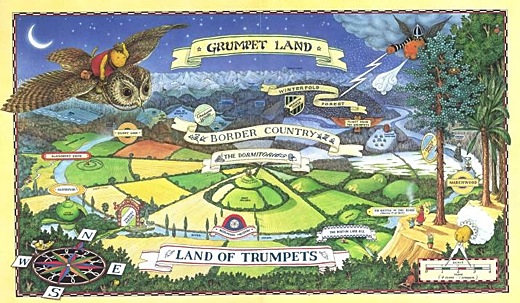
Image above: Illustration for "Trouble for Trumpets" a thoroughly delightful children's book on the Wheel of Life. From (http://oldmanfoltz.com/2008/02/05/trouble-for-trumpets).

Today is the first day of Fall. Last night my wife, Linda, and I went out to Puolo Point, here in Hanapepe, Kauai, to watch the last sunset of summer 2010.

Because we hadn't been out to sunset for a few weeks we miscalculated when to optimize our arrival time at the beach. The sun was disappearing over Niihau as we stopped to watch. The shoreline was beautiful. It was bathed in the orange glow of twilight to the west, with cool cast shadows from a bright waxing moon from the east.

Now, the next day (September 22nd), we face a new season - Fall... followed by Winter.
It is my opinion that this past summer will be the last in which the United States of America will be able to delude itself with campaign of "regaining the American Dream" accompanied by the backup mantra of "U.S.A. Numba One! U.S.A. Numba One!"

This Fall, somewhere between the November 2nd elections and the Winter Solstice we will see a shift in the American psyche. Before the end of the Xmas shopping season middle America will come to realize we are not ever going to get back to the Good-Ol'-Days. Parts of the country are already there... the Rustbelt, Appalachia, the Inland Empire to name a few. Now it's time for LA, Las Vegas, Atlanta, the Beltway, Greenwich CT and the Hamptons to join the Third World.

Our fossil-fuel-based economy is contracting and will continue to contract until some kind of balance with the planet is attained. Measured in time I estimate that economy will be more like the middle of the 19th century than the middle of the 20th.

If you want a house hunting guide for the future - pick a place to live that doesn't need an SUV or AC.

An American cultural heritage we share with others is a sense of the Wheel of Life - In a day, a year, a lifetime and a place. 
Morning, Noon, Evening and Night
Spring, Summer, Fall and Winter
Birth, Youth, Aging, Death.
East, South, West, North
These analogies provide us some metaphoric comfort because they illustrate the circular nature of time regarding important aspects of our lives. It is not just a long slow degradation from start to end, but one that includes a rebirth.

Fall is a season celebrate the riches of the harvest before we face the trial of the long Winter night. It is a time to gather and care for the seeds we'll need to plant next spring. It is a time to can, dry and preserve what rations we have endure until the green Spring buds appear again. Fall is a time to fix the roof and lay away the cordwood for the cold stormy nights to come.

America needs to pull itself away from the sugarcoated saturated fat 48" plasma cable TV screen. There is nothing there to prepare you for the future. It is only a gimmick to turn your head from it. America has fallen and it can't get up. In our present state we cannot even admit we're down.

The Tea Party has a sense of what is happening; so do the Rapturous evangelicals. But they have it exactly wrong. They are trying to claw their way back to America's halcyon on days of white rule and cheap oil. They nightmare about making a last stand at an "Out-Of-Gas" Seven-Eleven surrounded by brown people moving north. Their mantra is "No more Mexicans and Moslems!" with background singers crooning "Drill, Drill Drill!"

The reality is we are all slowly going back to being indigenous people. Where ever you are is now your land. Those around you are your people. What you grow or hunt is your food. Get to know your seasons. It's what makes the world go round.

See also:
.
Choose "Cliff" or "Crossroads"

SUBHEAD: What we face. How we visualize - and verbalize - the way forward matters a lot.

By Alan Wartes on 10 September 2010 in The Story of Here -  
(http://thestoryofhere.blogspot.com/2010/09/why-words-matter.html)

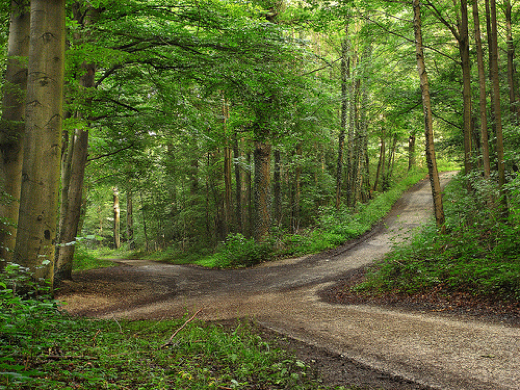
Image above: Photo by Martin Leibernmann (www.martin-liebermann.de) of a crossroads in the woods. From (http://www.flickr.com/photos/liebermann/580181284).  
 
Here’s something we’ve forgotten that poets, shamans, healers, and sorcerers (a healer’s dark opposite) have known for millennia: words matter. The power of a curse and a blessing—and the difference between the two—is contained in the words that transmit them. Words are the servants of vision, and vision is the essential ingredient in everything humans have ever created or accomplished, good or bad. It is impossible to build a bridge across a canyon, for instance, without first seeing it in your mind. Words are the machinery that move the picture from the realm of pure, solitary dream to objective reality.
But words matter, not just because they help us describe specific ideas; words matter because they have the power to transfer entire belief systems to others. What you see, you say. What you say, they’ll see. Then they’ll say it too, again and again—and a new paradigm is born out of a single unexamined set of words. Once that happens, those words form a Great Wall of “Truth” beyond which we no longer bother to look. (This is the psychological technology behind modern public relations and propaganda.)
Need an example? Here’s one nearly everyone can agree on:

“It’s impossible to live without money.”
There was a time when these were just words. For many indigenous people, tucked away in remote regions of the world, that time persisted well into the twentieth century, until “progress” caused their homes to cease being remote. Like all our ancestors, they refuted the above words by the simple act of subsistence.
Now, however, this lie has been repeated so loudly and so often that we rarely, if ever, ask ourselves if it’s true. In modern times, it’s hard to live without money, no doubt. But it is a long, long way from impossible. Someone who does challenge the idea behind the words is quickly bombarded with more words: hippie, anarchist, drop-out, un-American—or best of all—just plain crazy.
Words matter. That’s why it is important to stop once in a while and pay attention to the sea of words you paddle around in every day. What pictures do they paint? What boundaries do they draw? What possibilities do they murder?
One particular sentence has been on my mind recently. Anyone who has tuned in to the conversation about humanity’s problematic future will recognize it immediately. If you’ve begun to educate yourself about peak oil, climate change, loss of biodiversity, deterioration of food resilience and security, perennial warfare, economic instability, and so on, then you’re guaranteed to have run across it yourself.
Here goes:

“Civilization is headed off a cliff.”
Don’t get me wrong. Some days, examining the evidence does give you that spinning, stomach-sucking feeling you get when leaning too far out a window twenty floors up. It sometimes seems inevitable that, sooner or later, our next step will lead to a quick drop and a sudden stop—on the sharp rocks or pavement below.
But, aside from its epic, “doomy” entertainment value, I’ve concluded the image these words create isn’t doing anyone any good. For one thing, it implies only two possible outcomes (since the third, backing up, is unlikely): either gravity does its thing and life as we have known it is irrevocably over; or, somehow, after millennia of earthbound existence, we suddenly sprout wings and fly. (Sometimes we tell ourselves those wings will take the form of technological breakthroughs, and sometimes we hope for a spontaneous “shift” in consciousness to save us from suicide.)
But, honestly, after lying awake all night, sweating in the dark, neither outcome sounds very plausible. The sun eventually comes up, the birds start jabbering about how good it is to be alive, and you put the whole thing on hold while your coffee drips and your bagel browns in the toaster. In other words, life has a habit of “going on”.
The fact is, so long as we see ourselves standing on a cliff’s edge, we’ll keep swinging unproductively between visions of full spectrum catastrophe and wishful thinking—a kind of circular paralysis—while real opportunity goes unnoticed. It feels a little like motion, but never gets us anywhere.
The alternative word-image I’ve stubbornly chosen for myself is not new or original at all. If anything, it’s even more cliché. But it is less dramatic, and less populated with doomsday forces and magical powers. By comparison to a life-and-death cliffhanger, it is almost boring—and, therefore, easy to dismiss as too tame to reflect the true urgency of our present predicament. Yet, when it comes to describing what happens when we take that next step forward—and the next, and the next—nothing beats the mental picture of standing at a crossroads.

“Civilization has come to a crossroads.”
Now, if you were attached to the “cliff” motif, but you’ve stayed with me this far, you may be inclined to imagine a Mad Max kind of crossroads—barren wasteland in every direction, zombies on wheels, gas gauge in your armored school bus on “E”, sun going down. Danger all around.
For the purpose of this discussion, may I humbly suggest something more in the Robert Frost genre? A green path that diverges in the woods, perhaps. I don’t mean to imply there aren’t dangers lurking in the forest, or that the choice before us isn’t momentous—far from it.
No matter how you visualize it, we have all come to the turning point in the history of humanity, and the stakes couldn’t possibly be higher. But the “crossroads” picture confers some survival advantages (as an evolutionary biologist might put it) on those who adopt it. There is hope embedded in the imagery itself that can alleviate fear and even suggest solutions.

First, when you stand at a crossroads, whatever happens next will most likely unfold at walking speed. You have arrived here by taking single steps, one after the other, every day of your life. You’ll move on by single steps going forward. Lao Tzu wrote that the journey of a thousand miles begins with a solitary step. What he didn’t say was that it’s all single steps, every one as important as any other.
Second, even in the worst case scenario, you stand with both feet planted firmly on the ground, just like your forebears stretching back tens of thousands of years. The earth itself is your foundation. At the edge of a cliff, a stiff breeze or a moment of distraction can spell instant doom. Not so much on the road.
Third, though a hundred people may fall off a cliff at the same time, it can never be said they fell together. The image leaves no room for collective action or mutual support of any kind. But when you travel a road, you can always go in the company of others, each of you more secure, and less likely to panic when the wolves howl, than you would be if you went alone.
Finally, choosing one road or the other is usually not a do-or-die proposition. To get really lost takes dozens or hundreds of wrong turns. To find your way back again begins with the simple act of identifying the flaws in your decision-making process—and then choosing more wisely at the next crossroads. And the next, and so on.
At a crossroads, walking stick in hand, a pack on your back, in the company of fellow travelers, you are unlikely to fall to your doom, and you don’t need wings. All that’s required is one step, the next step. Then another. Each one is like an acorn: it contains a whole new forest of trees waiting to take root—and all the necessary momentum of great change.
This much is clear: we can’t go back. How we visualize—and verbalize—the way forward matters a lot. And don’t forget: the power of words to alter beliefs works both ways—to instill fear and despair, or hopeful determination . How you talk about the road ahead may well be the most world-changing thing you ever do.

.